
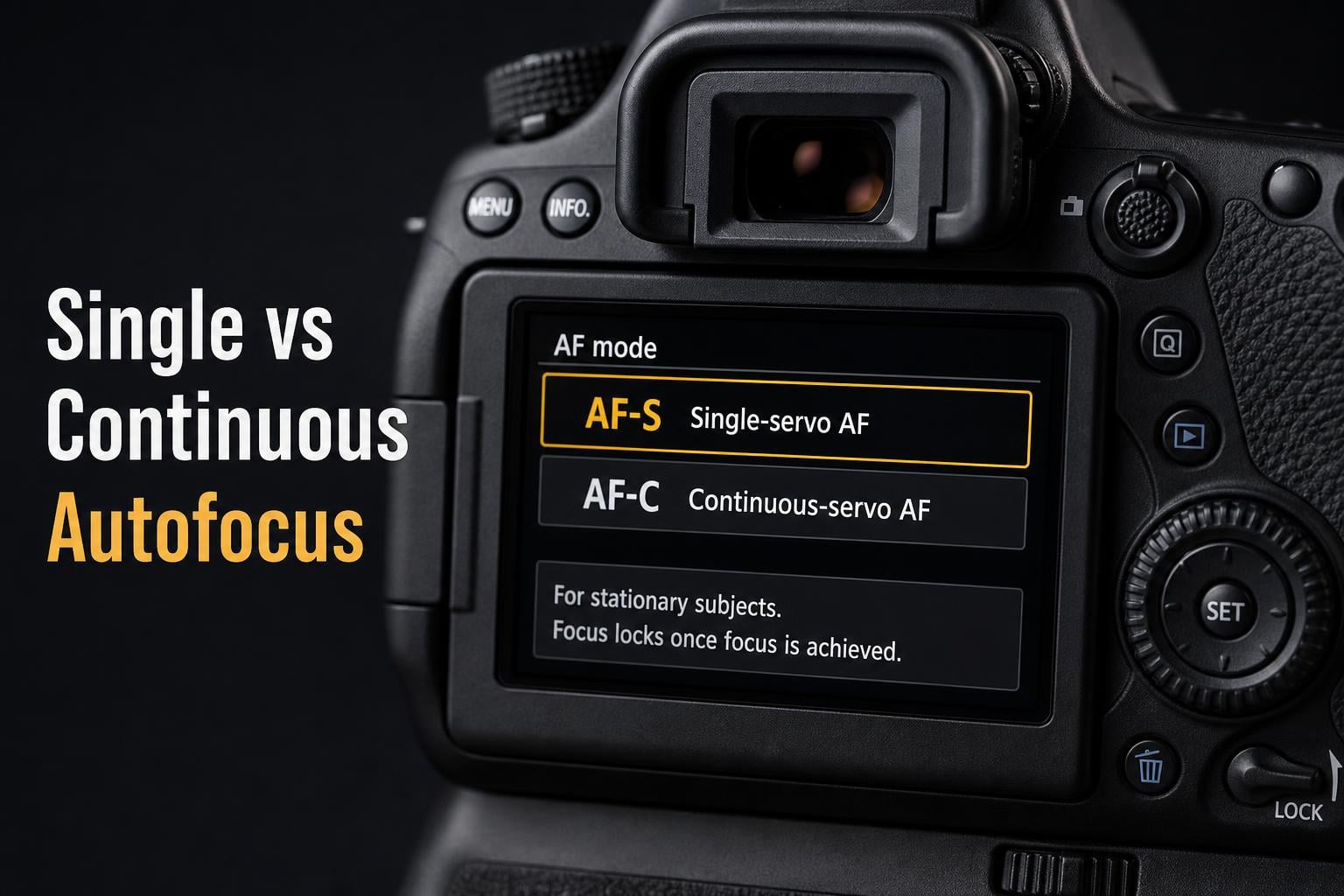
Getting blurry photos even though your camera has great autofocus? The problem usually comes down to picking the wrong focus mode. Single vs continuous autofocus is one of those decisions that can make or break your shot, and most photographers get it wrong far more often than they realize.
In this guide, I will break down exactly what each mode does, when to use it, and why switching between the two at the right moment will give you noticeably sharper images. Whether you are shooting portraits, sports, wildlife, or street scenes, you will walk away knowing exactly which button to press.
Table of Contents
What Is Single Autofocus (AF-S)?
Single autofocus, often labeled as AF-S on Nikon and Sony cameras or One-Shot on Canon bodies, locks focus the moment you half-press the shutter button. Once the camera confirms focus is locked, it stops adjusting. The focus distance stays fixed until you either take the shot or release your finger.
This mode is built for stationary subjects. The camera does the focusing work once, gives you a focus confirmation beep or indicator, and then holds that exact distance. You can recompose your shot while the focus stays locked on the original point, which is what makes AF-S so popular for portrait and landscape photographers.
The key advantage here is precision. Because the camera only calculates focus once and locks it, you avoid the micro-adjustments that continuous tracking can introduce. Many photographers on photography forums report that their sharpest static images come from AF-S rather than its continuous counterpart.
What Is Continuous Autofocus (AF-C)?
Continuous autofocus, known as AF-C on Nikon and Sony or AI Servo on Canon cameras, never stops tracking. The moment you half-press the shutter, the camera begins focusing and keeps recalculating the focus distance as your subject moves closer, farther away, or side to side.
This mode exists for motion. If your subject is a sprinter crossing a finish line, a bird taking flight, or a child running through a park, AF-C is what keeps that subject sharp as the distance between you and them changes frame by frame.
Modern continuous autofocus systems use predictive algorithms to estimate where a moving subject will be at the exact moment the shutter fires. The camera accounts for shutter lag and subject velocity to pre-position the focus. High-end cameras from Sony, Canon, and Nikon now pair this with AI tracking and Eye AF, which can lock onto a subject’s eye and follow it through complex scenes.
Single vs Continuous Autofocus: Quick Comparison
Here is a quick side-by-side breakdown of how the two modes stack up against each other.
| Feature | Single AF (AF-S / One-Shot) | Continuous AF (AF-C / AI Servo) |
|---|---|---|
| Focus behavior | Locks once, then holds | Constantly adjusts |
| Best for | Stationary subjects | Moving subjects |
| Focus lock confirmation | Yes (beep or indicator) | No confirmation, always tracking |
| Focus and recompose | Works perfectly | Not recommended |
| Typical genres | Portraits, landscapes, still life | Sports, wildlife, events |
| Battery drain | Lower | Higher (constant motor activity) |
| Sharpness on static subjects | Excellent | May show micro-adjustments |
When to Use Single Autofocus?
Use single autofocus any time your subject is not moving toward or away from you. This covers a surprisingly large percentage of everyday photography.
Portraits: Your subject is sitting or standing relatively still. AF-S locks focus on the nearest eye, gives you confirmation, and you fire the shutter. The focus stays exactly where you set it.
Landscapes: Mountains do not move. AF-S gives you a clean focus lock on your chosen point, whether that is a foreground rock or a distant ridge, and holds it while you compose.
Product and still life photography: Precision matters more than speed. AF-S ensures the camera does not second-guess the focus distance after locking on.
Architecture and real estate: Static subjects with deep depth of field requirements. AF-S works cleanly every time.
The focus and recompose technique works beautifully with AF-S. You place your active focus point on the subject, half-press to lock focus, then shift the camera to frame the composition you want. The focus stays locked at the original distance. This is one of the most practical techniques for photographers who do not want to constantly move their focus point selector.
One important note from the photography community: photographers consistently report that AF-S produces sharper results on stationary subjects compared to continuous AF. The reason is simple. When continuous AF is active on a still subject, the lens may make tiny focus adjustments right as you press the shutter, shifting the focus plane slightly off your intended target.
When to Use Continuous Autofocus?
Switch to continuous autofocus whenever your subject is moving. If the distance between your camera and the subject is changing, even slowly, AF-C is the right choice.
Sports photography: Athletes sprint toward you, away from you, and across the frame. AF-C tracks their movement and keeps adjusting the focus distance right up to the moment of capture.
Wildlife and bird photography: Animals are unpredictable. A perched bird can take off without warning. Wildlife photographers almost exclusively shoot in AF-C because they cannot afford to miss focus when a subject suddenly bolts.
Events and weddings: People dancing, walking down aisles, and moving through reception spaces. AF-C keeps the focus locked on your subject as they move through the scene.
Children and pets: If you have tried photographing a toddler or a dog, you know they never hold still. AF-C handles that constant motion.
Pay attention to your minimum shutter speed when using continuous AF. A good rule of thumb is to keep your shutter speed at least 1 over the reciprocal of your focal length. For a 200mm lens, that means 1/200s or faster. For fast-moving subjects like birds in flight, you will often need 1/1000s or faster to freeze motion and get a sharp result even with perfect focus tracking.
Focus Mode Recommendations by Photography Genre
Different photography genres call for different autofocus strategies. Here is a quick reference guide to help you choose.
| Photography Genre | Recommended Focus Mode | Why |
|---|---|---|
| Portraits | AF-S / One-Shot | Subject is static, focus precision is critical |
| Landscapes | AF-S / One-Shot | No movement, focus lock stability preferred |
| Sports | AF-C / AI Servo | Fast-moving subjects require constant tracking |
| Wildlife and birds | AF-C / AI Servo | Animals move unpredictably, tracking is essential |
| Street photography | AF-S or AF-C | Depends on whether subjects are static or walking |
| Macro | Manual focus | Depth of field is too shallow for reliable AF |
| Events and weddings | AF-C / AI Servo | People in motion, moments happen fast |
| Real estate | AF-S / One-Shot | Static scene, precision matters |
Street photography deserves a special note here. The community is divided. Some street photographers prefer AF-S because they can focus and recompose quickly, locking focus on a subject before they even raise the camera. Others use AF-C with a wide autofocus area to handle subjects walking toward them. Your choice depends on your shooting style and how much your subjects move.
Back Button Focus: The Best of Both Worlds
Back button focus is a technique where you assign autofocus to a button on the back of your camera, typically the AF-ON or AE-L button, instead of the shutter release. This decouples focusing from the shutter, giving you independent control over both actions.
Why does this matter for the single vs continuous autofocus debate? Because back button focus effectively lets you switch between AF-S and AF-C behavior without changing any settings.
Here is how it works. Set your camera to AF-C. Press and hold the back button to continuously track a moving subject. Release the back button, and the focus locks instantly at that distance, behaving exactly like AF-S. You press the shutter only to capture the image.
This is why back button focus is so widely recommended by experienced photographers on Reddit and other photography communities. It gives you the tracking power of continuous AF when you need it and the focus lock of single AF when you do not, all without diving into menus. Once you train your muscle memory, it becomes second nature.
To set it up, go into your camera menu and look for the custom button assignment options. Assign AF-ON to your preferred back button, then disable autofocus from the shutter half-press. The exact steps vary by brand, but the principle is the same across Canon, Nikon, Sony, Fujifilm, and other major manufacturers.
Why Continuous AF Can Cause Soft Images (and How to Fix It)
One of the most common questions in photography forums is straightforward: why are my images less sharp when I use continuous AF? The answer comes down to how the focus system behaves between the moment you decide to shoot and the moment the shutter actually fires.
Even on a completely still subject, AF-C keeps making tiny focus adjustments. If one of those micro-adjustments happens during the shutter lag, the focus plane shifts slightly and you get a softer image than you would have with AF-S. This is not a defect. It is simply how continuous tracking works by design.
Here are some practical ways to reduce softness when using continuous autofocus:
Use a single focus point or a small cluster instead of a wide area mode to give the camera a more specific target.
Make sure your lens microfocus adjustment is calibrated. Some cameras allow you to fine-tune autofocus for specific lenses, which can dramatically improve sharpness.
Use a faster shutter speed to minimize the impact of any micro-adjustments during exposure.
If your subject is truly stationary, switch to AF-S. There is no benefit to tracking a subject that is not moving.
Many photographers discover that simply switching to AF-S for static scenes resolves a sharpness problem they had been blaming on their lens or camera body. If your images look soft and you are using AF-C on still subjects, this is the first thing to change.
Manual Focus: When to Skip Autofocus Entirely?
Autofocus is convenient, but there are situations where manual focus is the better choice. Switching your lens to MF gives you complete control over the focus plane without any camera interference.
Macro photography: At close focusing distances, the depth of field can be measured in millimeters. Even the most advanced autofocus system struggles to place the focus plane exactly where you want it on a tiny subject. Manual focus, often combined with focus peaking, is the standard approach.
Low light situations: When light levels drop, autofocus systems hunt because they cannot find enough contrast to lock onto. Manual focus with focus peaking or magnification lets you take control when the camera cannot.
Backlit scenes: Strong backlight can confuse autofocus sensors. Manual focus lets you cut through the interference and place focus exactly where it needs to be.
Focus stacking: If you are blending multiple images for extended depth of field, common in landscape and macro work, you need precise control over each focus increment. Manual focus is the only reliable way to shift the focus plane systematically.
FAQs
What is the difference between single and continuous autofocus?
Single autofocus (AF-S) locks focus once when you half-press the shutter and holds it until you release the button or take the shot. Continuous autofocus (AF-C) keeps adjusting focus as long as the button is pressed, tracking subjects that are moving toward or away from the camera.
Should I use AF-S or AF-C for portraits?
Use AF-S (or One-Shot on Canon) for portraits. Portrait subjects are typically stationary, and AF-S gives you a focus lock confirmation so you know the focus is exact. It also avoids the micro-adjustments that continuous AF can introduce on static subjects, which means sharper images.
Can I use continuous autofocus for everything?
You can, but it is not recommended. Continuous AF on stationary subjects can cause tiny focus shifts during shutter lag, leading to slightly softer images. It also drains battery faster because the focus motor runs constantly. Use AF-S for static subjects and AF-C for moving ones.
What is back button focus and should I use it?
Back button focus assigns autofocus to a button on the back of your camera instead of the shutter release. Set your camera to AF-C, and pressing the back button tracks moving subjects while releasing it locks focus like AF-S. It is widely recommended by experienced photographers because it gives you both focus modes without changing settings.
Should my camera be on AF or MF?
Keep your camera on AF for most situations where your subject is clearly defined and lighting is adequate. Switch to MF (manual focus) for macro photography, low light scenes, backlit conditions, or focus stacking where precise control over the focus plane matters more than speed.
Conclusion
The single vs continuous autofocus decision comes down to one simple question: is your subject moving? If it is stationary, use AF-S for the sharpest possible image with a confirmed focus lock. If it is moving, use AF-C to track the subject and keep it sharp as the distance changes.
Start with those two rules. Then, when you are ready to level up, set up back button focus with your camera locked in AF-C. That single change gives you the flexibility of both modes at the same time, controlled by your thumb instead of a menu. It is the technique that experienced photographers rely on every single shoot.
Try it on your next session. Pick the right mode for the scene, watch your sharpness improve, and stop blaming your gear for what was actually a focus mode problem all along.