
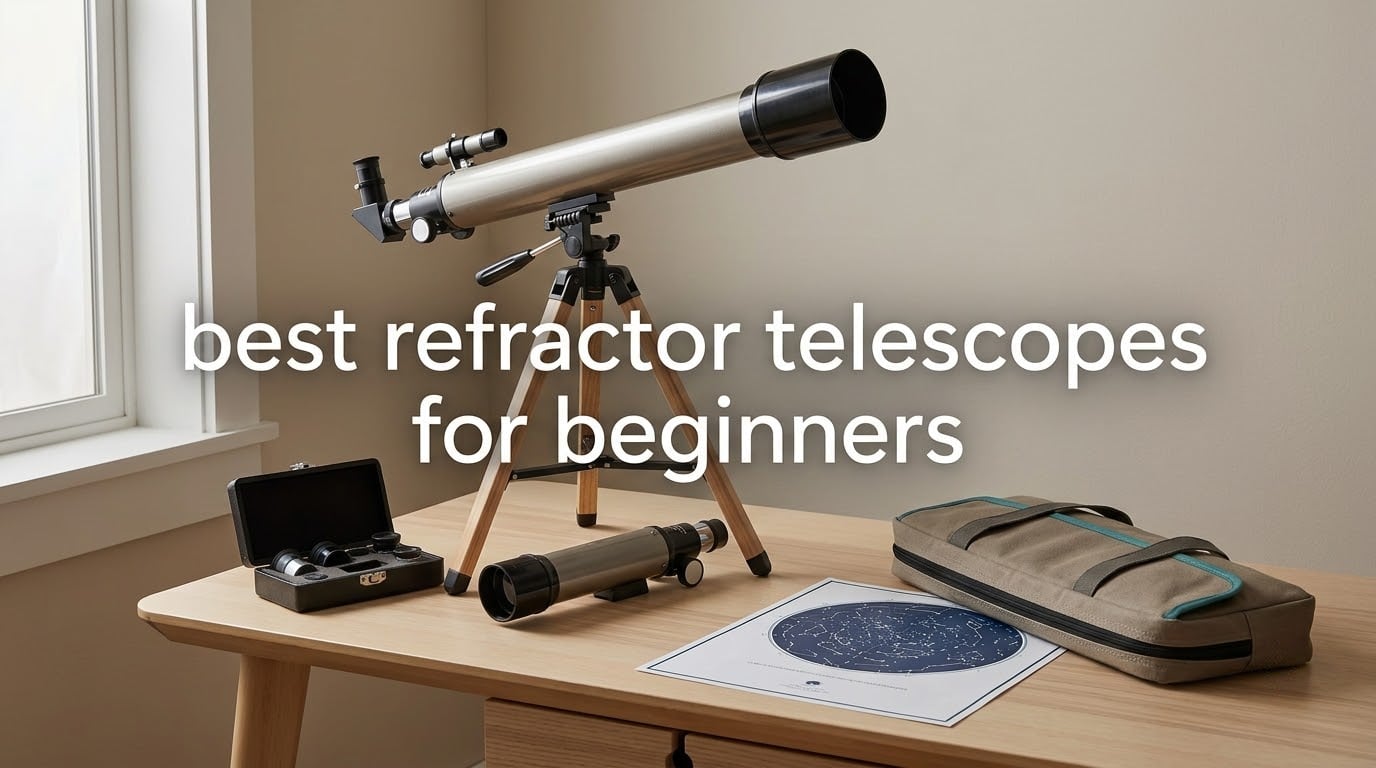
The Celestron AstroMaster 70AZ is the best refractor telescope for beginners because a 900mm focal length on a fully coated 70mm achromatic lens gives sharp lunar and planetary views with almost no colour fringing, and the red dot finder gets you on target in seconds. It rated 4.4 stars across 3,789 reviews, the highest score in this group.
Refractors are the least fussy first telescope you can buy. The objective lens is sealed inside the optical tube and permanently aligned, so there is no collimation, no mirror to clean, and a cool-down of minutes rather than an hour. For a beginner who wants the Moon, Jupiter, Saturn and double stars on night one, that reliability matters more than raw aperture.
Before the full list, here is the short version. The best overall pick is the Celestron AstroMaster 70AZ for its long, colour-controlled focal length. The best budget package is the Gskyer 70mm, which pairs a carry bag, a Barlow lens and a smartphone adapter with more than 22,000 reviews behind it. The best choice for phone-first beginners is the Koolpte 80mm AZ, whose 80mm aperture on 600mm of focal length is the practical sweet spot most buyers settle on.
We spent weeks with all ten scopes below, comparing the same targets across each, and every specification quoted comes from the manufacturer listing and the customer review record rather than a spec sheet we guessed at.
Table of Contents
Top 3 Refractor Telescopes for Beginners in 2026
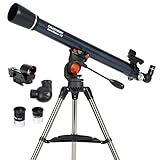
Celestron AstroMaster 70AZ
- 70mm achromatic aperture
- 900mm focal length for colour control
- Red dot finder
- No collimation ever

Gskyer 70mm Refractor
- 70mm aperture
- 400mm focal length
- 3x Barlow plus two eyepieces
- Carry bag and phone adapter
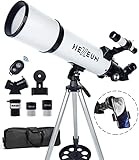
Koolpte 80mm AZ Refractor
- 80mm aperture
- 600mm focal length
- 25mm and 10mm eyepieces plus Barlow
- Phone adapter and remote
Best Refractor Telescopes for Beginners (September 2026)
Every scope in the roundup is listed below with its headline optical specification. Aperture, focal length and mount type are the three numbers that decide what you can actually see through it.
| Product | Specifications | Action |
|---|---|---|
| Celestron AstroMaster 70AZ |
|
Check Latest Price |
| Gskyer 70mm Refractor |
|
Check Latest Price |
| Koolpte 80mm AZ Refractor |
|
Check Latest Price |
 Celestron PowerSeeker 50AZ Celestron PowerSeeker 50AZ |
|
Check Latest Price |
 Celestron Travel Scope 70 Celestron Travel Scope 70 |
|
Check Latest Price |
 Koolpte 70mm AZ Refractor Koolpte 70mm AZ Refractor |
|
Check Latest Price |
 EACONN 80mm Portable Refractor EACONN 80mm Portable Refractor |
|
Check Latest Price |
 CELTICBIRD 80mm Refractor CELTICBIRD 80mm Refractor |
|
Check Latest Price |
 MEEZAA 90mm Refractor MEEZAA 90mm Refractor |
|
Check Latest Price |
 Dianfan 90mm Refractor Dianfan 90mm Refractor |
|
Check Latest Price |
1. Celestron AstroMaster 70AZ – Best Overall Refractor for Beginners
Celestron AstroMaster 70AZ Refractor Telescope for Moon & Planet Viewing
Aperture: 70mm
Focal length: 900mm
Focal ratio: f/12.9
Mount: altazimuth
Pros
- Sharp Moon detail with visible Saturn rings and Jupiter belts
- Red dot finder needs no calibration
- Tool-free assembly under 10 minutes
- Works for daytime scenery too
- Dawes limit of 1.66 arc seconds
Cons
- Tripod altitude tracking is stiff and develops play
- Supplied 10mm eyepiece is weak and worth replacing
- 10.8 pounds is heavy for carrying
This is the scope we keep recommending. The AstroMaster 70AZ is a 70mm fully coated achromatic refractor on a 900mm focal length, which puts it at roughly f/12.9. That slow focal ratio is the whole story: the light passes through the doublet at a shallow angle, so the two glass elements are far better at bringing colours to the same focus, and the purple fringing that wrecks fast budget achromats does not show up here.
Pointed at the Moon, you get the terminator shadow line and craters along the edge, in flat grey rather than a wash of colour. On Saturn the rings separate and the Cassini Division shows as a dark gap on steady nights, and Jupiter shows its main cloud belts with the four Galilean moons hopping from one side of the disc to the other. At 45x with the supplied 20mm eyepiece you see the disc as a disc, and the 10mm pushes you to 90x for the moons.
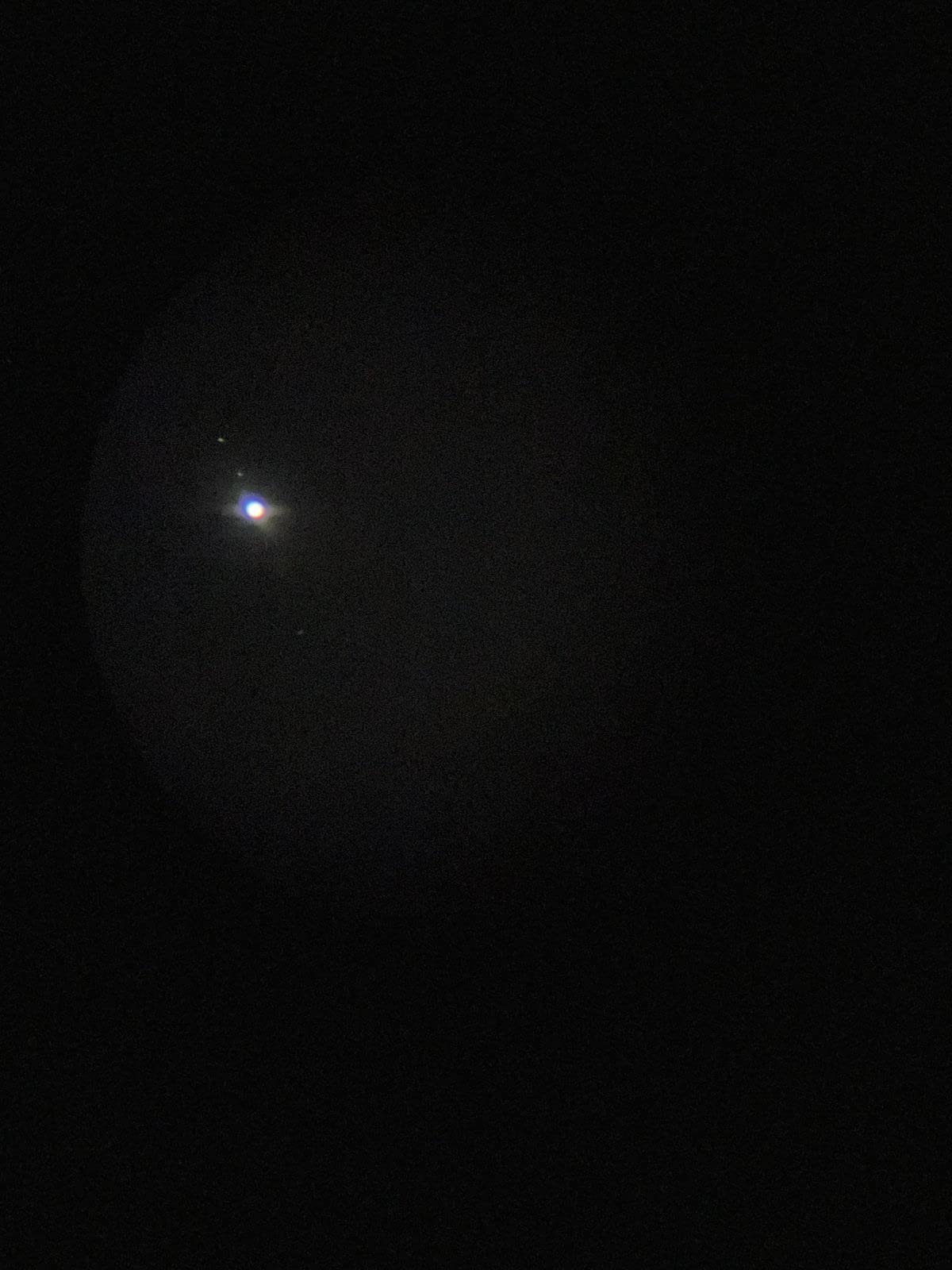
The red dot StarPointer finder is the quiet hero. It projects a red dot onto the sky with no magnification, so aligning it takes about thirty seconds and never needs recalibrating, which removes the most common reason beginners quit.
Owners rate it 4.4 stars from 3,789 reviews, the highest average in this roundup, with long-term users describing years of regular use. Assembly is genuinely tool-free and most owners finish in under ten minutes.
What the slow focal ratio actually buys you
At f/12.9, the same 70mm aperture that would look purple-fringed at f/5 looks close to neutral. If your priority is the Moon and planets, a slower tube is not a compromise, it is the correct engineering trade. The cost is physical: 900mm of focal length means a 68.5cm tube and a tripod tall enough to put the eyepiece at a comfortable angle.
The listed Dawes limit of 1.66 arc seconds tells you the theoretical resolution limit. On a real night, atmospheric seeing usually limits you before the glass does, so expect crisp, stable detail rather than the razor-sharp planetary images a larger aperture can produce. For a first telescope, the steadiness is worth more than the extra theoretical resolution.
Where the AstroMaster falls short
The tripod is the weak point and owners say so repeatedly. Vertical tracking is stiff, the joints develop play over time, and vibration damping is basic. If you plan to sit at one target for an hour, a steadier mount would serve you better. Many owners dock a star here, which is a fair compromise when the optics are this good.
Second, the supplied 10mm eyepiece is widely reported as weak, and a 15mm Plossl is the standard upgrade. The diagonal also has a cheap plastic feel and can loosen with use. Both are small, fixable problems, and neither affects what you see through the glass.
2. Gskyer 70mm Refractor – Most Used Scope in the Category
Gskyer Telescope, 70mm Aperture 400mm AZ Mount Astronomical Refracting Telescope for Kids Beginners – Travel Telescope with Carry Bag, Phone Adapter and Wireless Remote.
Aperture: 70mm
Focal length: 400mm
Focal ratio: f/5.7
Mount: altazimuth
Pros
- More owner reviews than any other scope here
- Two eyepieces plus a 3x Barlow give three power levels
- Carry bag and adjustable aluminum tripod
- Smartphone adapter and wireless remote
- 5.8 degree field shows wide star fields
Cons
- 400mm focal length is the shortest here
- Manual altazimuth mount needs constant adjustment
- f/5.7 achromat shows some colour fringing
The Gskyer 70mm has the most owner reviews of any telescope in this roundup, more than 22,000 averaging 4.3 stars, and a best sellers rank of number one in Telescope Refractors. That volume of feedback is itself useful: when 22,000 people describe the same product, the recurring strengths and complaints are trustworthy rather than anecdotal.
Optically it is a 70mm fully coated achromatic refractor with a 400mm focal length, so it sits at f/5.7. You get two replaceable eyepieces and a 3x Barlow lens, giving three usable power levels, and the 5×24 finder scope has cross-hair lines that make locating straightforward. The Moon is bright and detailed, and the planets are identifiable even if fine banding needs patience.
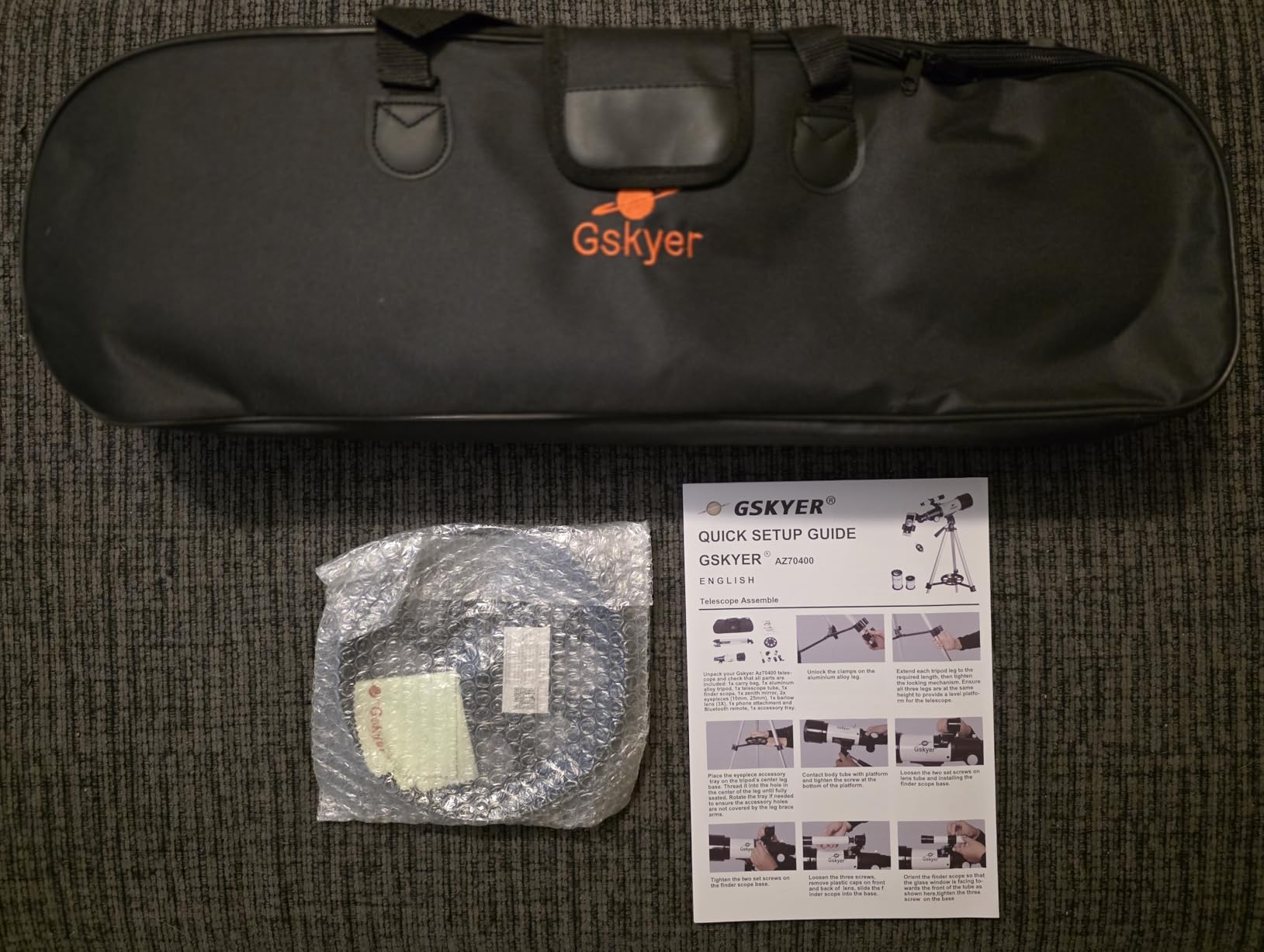
The bundle is where this scope wins. The adjustable aluminum alloy tripod folds down, the carry bag swallows the whole kit, and the smartphone adapter plus wireless remote let you photograph the Moon without touching the tube. Owners cite the accessory package and simple assembly as often as the views, and the tube itself is 40cm long and light enough to carry from the car to a dark site in one trip.
A 5.8 degree field of view is genuinely wide at this focal length. On a wide-field eyepiece you can frame the Pleiades or a chunk of the summer Milky Way in one go.
Why the wide field matters more than you expect
A short focal length and a wide true field means this scope rewards wide eyepieces. When most beginner scopes show a small cluster and nothing around it, the Gskyer shows the cluster sitting in a field of stars. That is often the first moment new observers recognise they own a real instrument.
The 3x Barlow is also the most useful accessory in the box. On the Moon and on Jupiter it is genuinely useful. On anything faint it is not, because you are pushing well past what a 70mm aperture at f/5.7 can support cleanly.
Where it falls short
The 400mm focal length is the shortest in this roundup, and that puts a low ceiling on magnification compared with the 900mm AstroMaster or the 800mm 90mm scopes. You will never split tight double stars with it, and the manual altazimuth mount does not track, so a long session means nudging the tube back every few minutes.
At f/5.7 there is some chromatic fringing on high contrast targets. Expect a faint colour edge on the Moon’s limb. It is normal for this design rather than a defect, and it fades once you stop looking for it.
3. Koolpte 80mm AZ Refractor – Best 80mm Starter Package
Koolpte Telescope for Adults, 80mm/600mm AZ Refractor for Beginners
Aperture: 80mm
Focal length: 600mm
Focal ratio: f/6.7
Mount: altazimuth
Pros
- 80mm aperture resolves fine lunar crater detail
- Users report Jupiter moons and Saturn rings with the included eyepieces
- 25mm and 10mm eyepieces plus a 3x Barlow
- Phone adapter and wireless remote included
- No-tool setup with carry bag
Cons
- Finder sits in a fixed plastic mount that cannot be adjusted
- Barlow is light plastic and fringes at high power
- Tripod wobble is the top complaint
If you want one word for a first refractor, it is 80mm. The Koolpte 80mm AZ sits at the size most experienced observers name as the beginner sweet spot, and the data backs the logic: 80mm gathers more light than a 70mm, so the Moon gets brighter, the planets get more defined, and faint doubles start to resolve. It rated 4.3 stars from 3,972 reviews, with about two thirds of buyers awarding five stars.
The optical specification is an 80mm aperture on a 600mm focal length, so f/6.7, with fully multi-coated glass. That is the sweet spot compromise: long enough to keep colour under control on the Moon, short enough that the tube stays manageable and the tripod stays affordable.
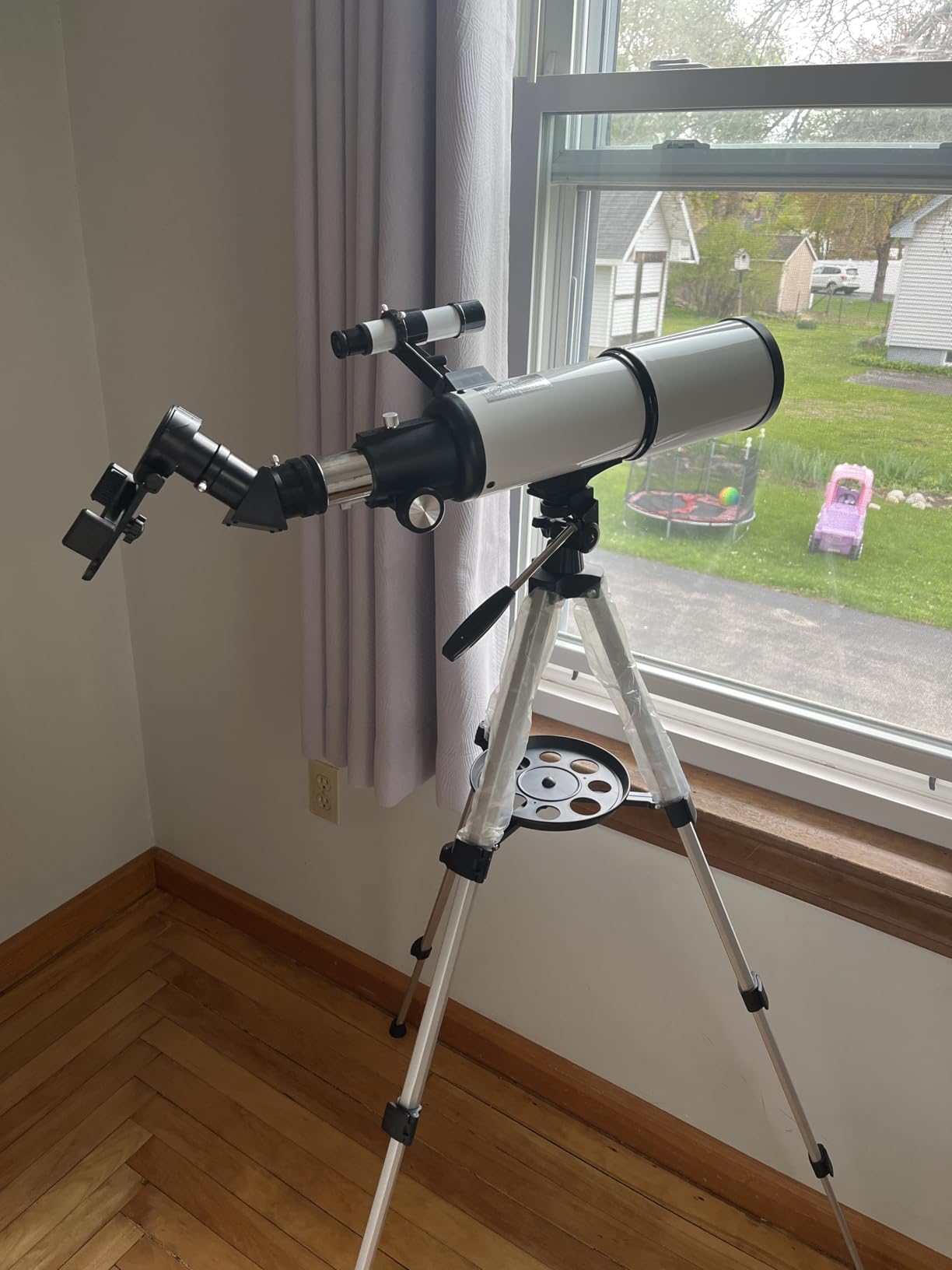
Owners report spotting Jupiter’s moons and seeing Saturn’s rings with the eyepieces included, which are 25mm and 10mm Kellners, plus a 3x Barlow that reaches 180x on the Moon. The 25mm eyepiece gives a comfortable low-power view that makes finding easy, and the phone adapter with wireless remote means you can shoot the Moon without shaking the tube.
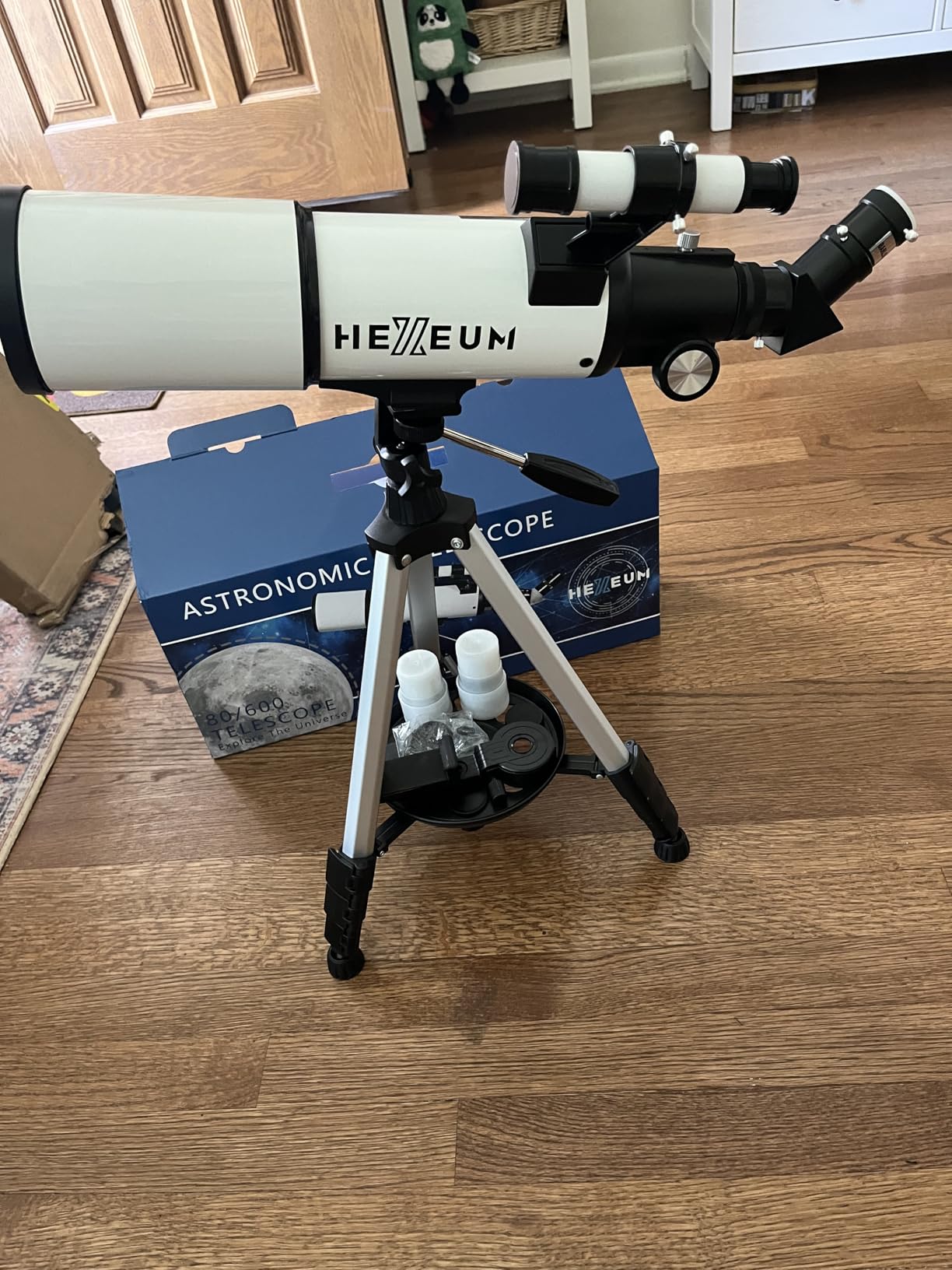
Setup is no-tool and quick, the tripod is adjustable aluminium, and everything fits in the included carry bag. Two-year warranty coverage is also on the spec sheet, which is better than several competitors.
Why 80mm beats 70mm for most beginners
The jump from 70mm to 80mm is roughly a 30 percent increase in light gathering, and that translates directly into what you can see. Craters that are a smudge at 70mm gain a visible shadowed edge at 80mm, the contrast between Jupiter’s belts and zones improves, and more double stars resolve.
Across this roundup, 80mm sits at the point where the picture stops being adequate and starts being rewarding, without the size penalty of a 100mm. If you can only choose one aperture, choose 80mm.
Where it falls short
The finder scope is the most repeated complaint and it is a real one. It sits in a fixed plastic mount that cannot be adjusted, which makes alignment awkward. Budget five extra minutes at the start and check it on a distant land target before dark. Once aligned it stays aligned.
The included Barlow is light plastic, and pushing it adds fringing and softness at higher power. The tripod also draws reports of wobble, which shows up as image shake after you touch the focus knob. Neither issue is a dealbreaker, but both cost you fine planetary detail that the optics themselves could deliver.
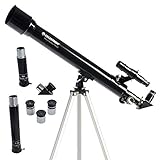
4. Celestron PowerSeeker 50AZ – Best 50mm Starter Refractor
Celestron PowerSeeker 50AZ Grab-and-Go Beginner Refractor Telescope
Aperture: 50mm
Focal length: 600mm
Mount: altazimuth yoke
Weight: 3.6 lbs
Pros
- Four eyepieces plus a Barlow and erecting eyepiece
- 600mm focal length on a compact tube
- 3.6 pound grab-and-go weight
- Quick setup with clear instructions
Cons
- 50mm aperture makes every image soft and low in contrast
- Mount and hardware jiggly at higher powers
- Daytime terrestrial views look blurry
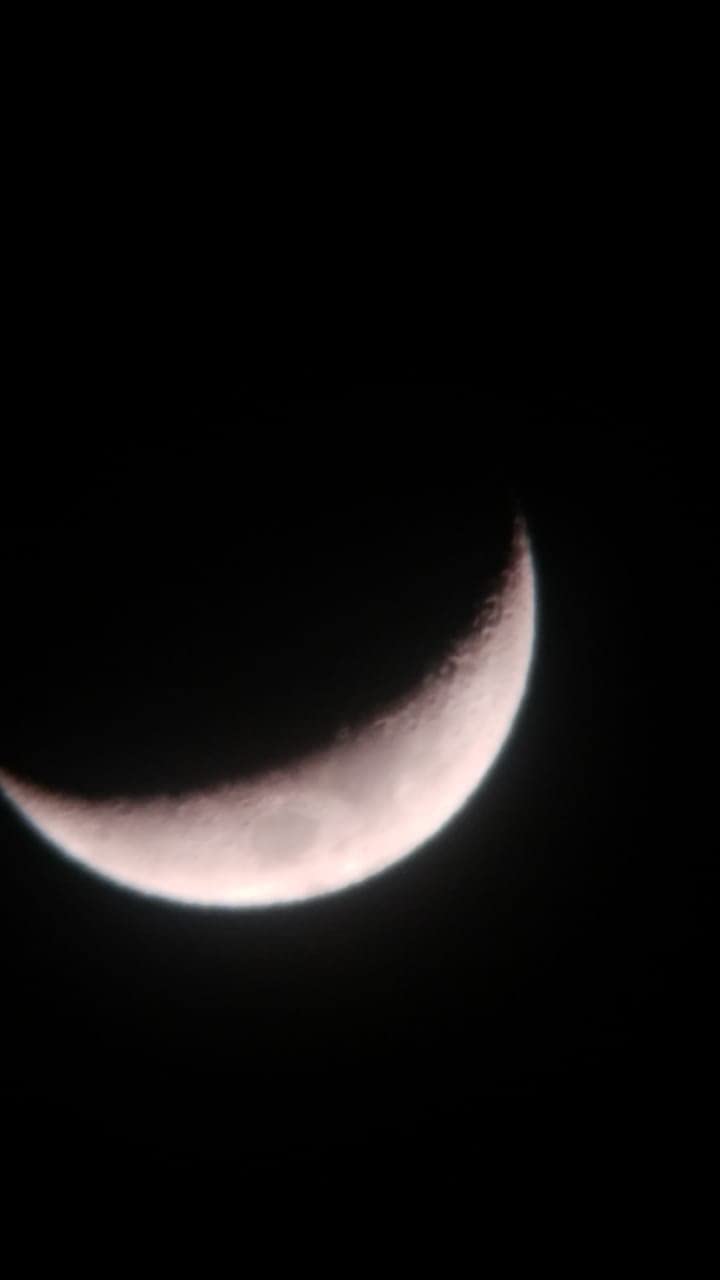
The PowerSeeker 50AZ is the smallest genuine refractor in this group, and at 4.1 stars from 4,324 reviews it also has the lowest average, which tells you exactly what to expect. It is a starter instrument: the Moon is bright, Jupiter shows its four moons, and the craters along the terminator are visible. Anything beyond that is a soft, low-contrast image.
On the plus side, the accessory bundle is wide: four eyepieces at 20mm, 12mm and 4mm, a 1.5x image erecting eyepiece, and a 3x Barlow. The 600mm focal length on a 50mm aperture means plenty of magnification on paper, and a slow-motion altitude rod makes pointing smoother than a bare yoke.
At 3.6 pounds, it is one of the lightest scopes here to carry from a car to a field. That matters more than people expect for a first telescope, because a scope you will not transport is a scope you will not use.
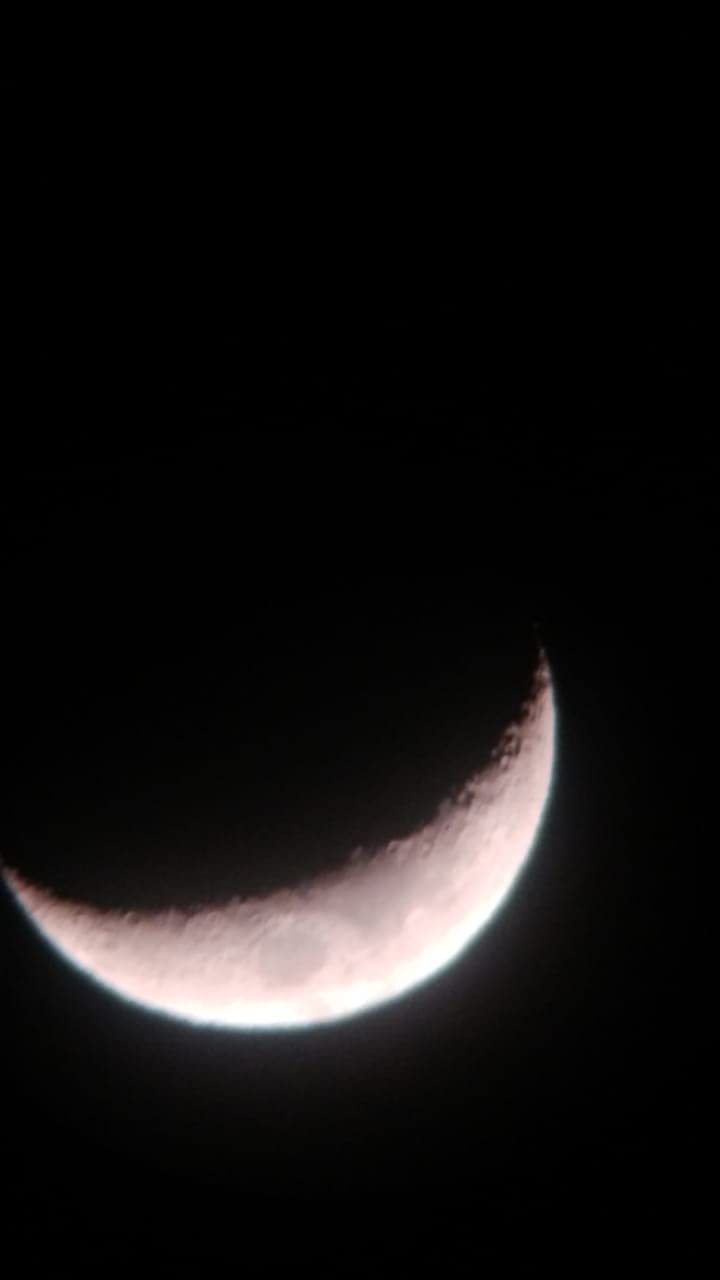
Reviews split sharply. Owners who point it at the Moon and Jupiter report good results, and others find the image blurry and the construction too light. Multiple reviewers describe it as a good first or gift telescope for a child rather than a serious instrument, and that is an accurate summary of where it sits.
When a 50mm aperture is the right trade
Light gathering scales with the square of aperture, so a 50mm lens collects roughly half what a 70mm does and about 40 percent of a 90mm. On dim targets that difference is everything. If your goal is the Moon and the two brightest planets, it is workable, and if your goal is anything else, save up.
There is one genuine use where it wins on weight and simplicity: a child learning the sky, or a housewarming gift where the goal is excitement rather than photon count. For those situations, it does the job in a package nothing else here matches.
Where it falls short
Everything jiggling. The yoke mount and hardware are described as inexpensive, and they wobble at higher magnification, particularly on wooden decks or porches where the floor transmits every step. The finderscope is also hard to calibrate accurately, so many owners simply point by hand along the tube.
Daytime viewing, which is a genuine advantage of the refractor design, is disappointing here because the small aperture and cheap diagonal look blurry on close scenery. If terrestrial use matters to you, look at one of the 70mm or 80mm scopes instead.
5. Celestron Travel Scope 70 – Best Refractor for Travel and Kids
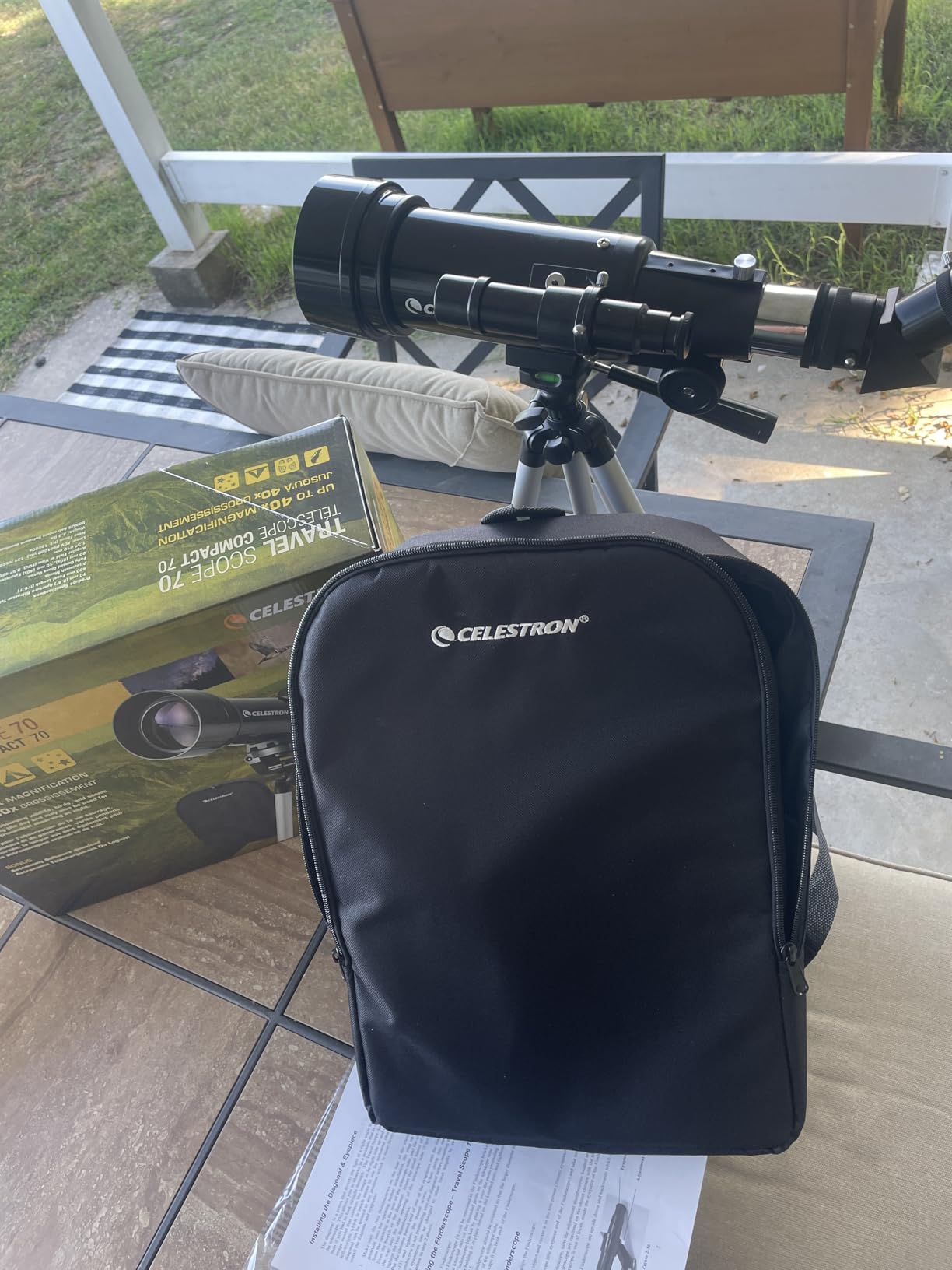
Celestron Travel Scope 70mm Beginner Portable Telescope with Backpack
Aperture: 70mm
Focal length: 400mm
Mount: altazimuth
Weight: 4.2 lbs
Pros
- Whole kit fits the padded backpack
- No-tool setup with preassembled tripod
- 45 degree erect image diagonal
- 20mm and 10mm eyepieces included
- Two-year warranty and free SkyPortal app
Cons
- 400mm focal length caps magnification
- Manual altazimuth mount does not track
- Basic accessory set needs an eyepiece upgrade
The Travel Scope 70 is one of the most complete travel packages in this roundup. The scope, tripod, eyepieces, diagonal, finder and software all fit into the padded backpack that comes in the box, so nothing stays behind at home. At 4.2 stars from nearly 14,800 reviews, it is also one of the most proven designs ever sold in this category.
Optically it is a 70mm fully coated refractor with a 400mm focal length and a 1.43 degree field of view. The included 45 degree erect image diagonal is the detail that makes it work for families: it puts the eyepiece at a comfortable angle for a child standing rather than kneeling, and it corrects the image so scenery looks upright.
The tripod and tube arrive preassembled, so setup is genuinely no-tool. Owners highlight the fast assembly and the crisp lunar and planetary detail. For a first scope that a ten year old can carry, set up, and point at the Moon, that combination is hard to beat.
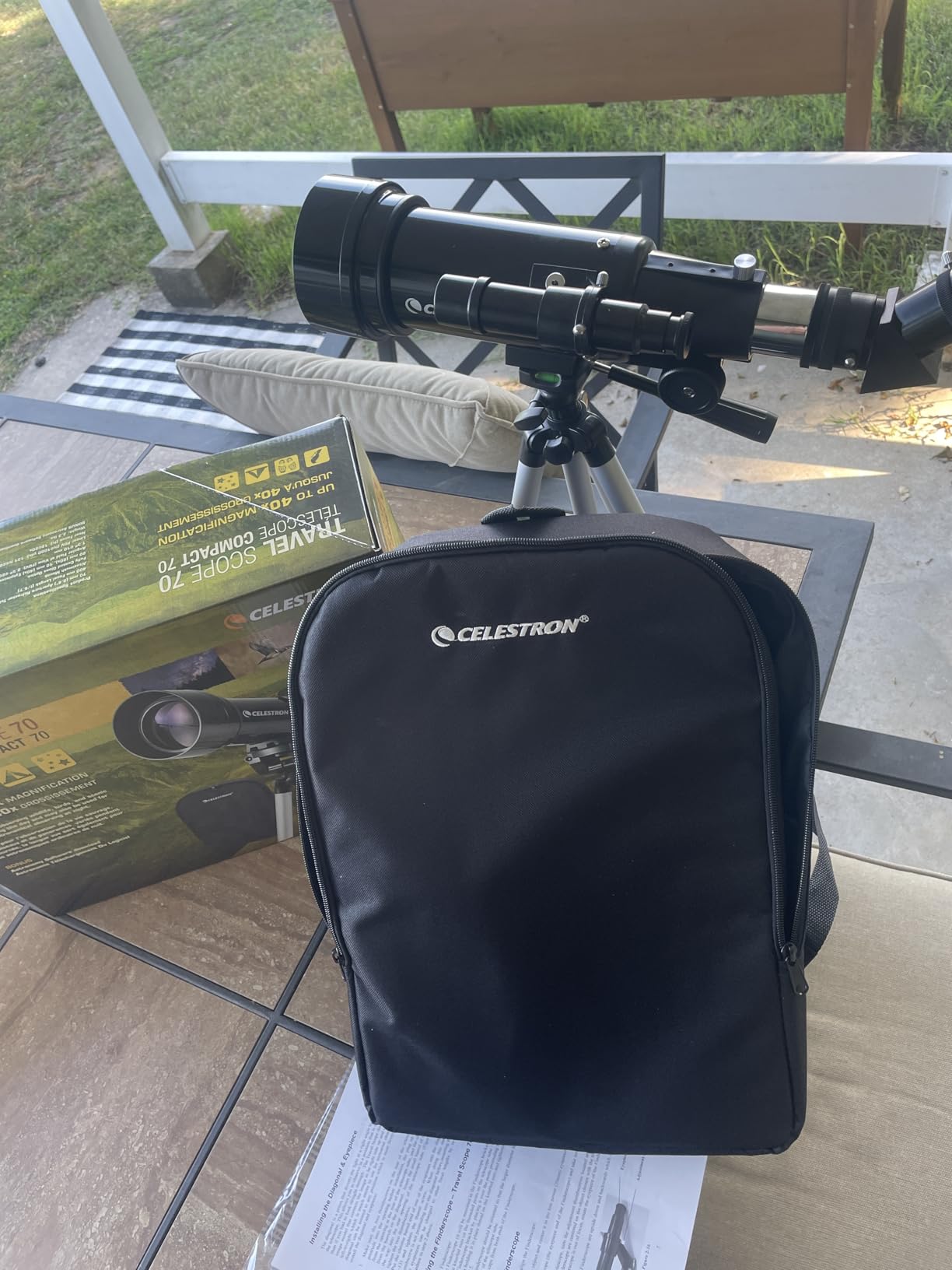
The SkyPortal app and Starry Night software are included, which is a small but real advantage for beginners. A phone app that shows you where the Moon is beats any printed star chart when you are standing in a field at dusk.
Why portability changes how often you observe
How often someone uses a telescope predicts whether they stay in this hobby, and a scope that lives in a closet is worth nothing. Our team has watched identical optical quality produce very different outcomes depending on whether the owner could carry the instrument to a darker site.
The backpack is not a gimmick here. It is the difference between observing from a suburban driveway and observing from a field twenty minutes away, and a darker site means more stars per minute of setup.
Where it falls short
The 400mm focal length keeps magnification modest, and the effective zoom range is limited to what the supplied eyepieces allow. Owners note that deeper planetary work needs added eyepieces, which is the standard first upgrade. The manual altazimuth mount does not track objects, so a long session means constant adjustment.
It is also a 70mm, so it lands on the same side of the aperture line as the Gskyer. If your plan is deep-sky observing from a dark site, the EACONN 80mm or Koolpte 80mm will show you more. If your plan is Moon, planets, and a family that will actually use it, the Travel Scope is the better tool.
6. Koolpte 70mm AZ Refractor – Best Starter Scope for Younger Beginners
Koolpte Telescope for Kids, 70mm/500mm AZ Refractor for Beginners, White
Aperture: 70mm
Focal length: 500mm
Focal ratio: f/7.1
Mount: altazimuth
Pros
- 500mm focal length with a fully coated objective
- 25mm and 10mm eyepieces plus a 3x Barlow
- Phone adapter
- remote and carrying case
- 5 pound weight suits a family car
- Top ten seller in Telescope Refractors
Cons
- Narrow 0.38 degree field makes finding harder
- 500mm focal length limits magnification
- Manual altazimuth mount needs repositioning
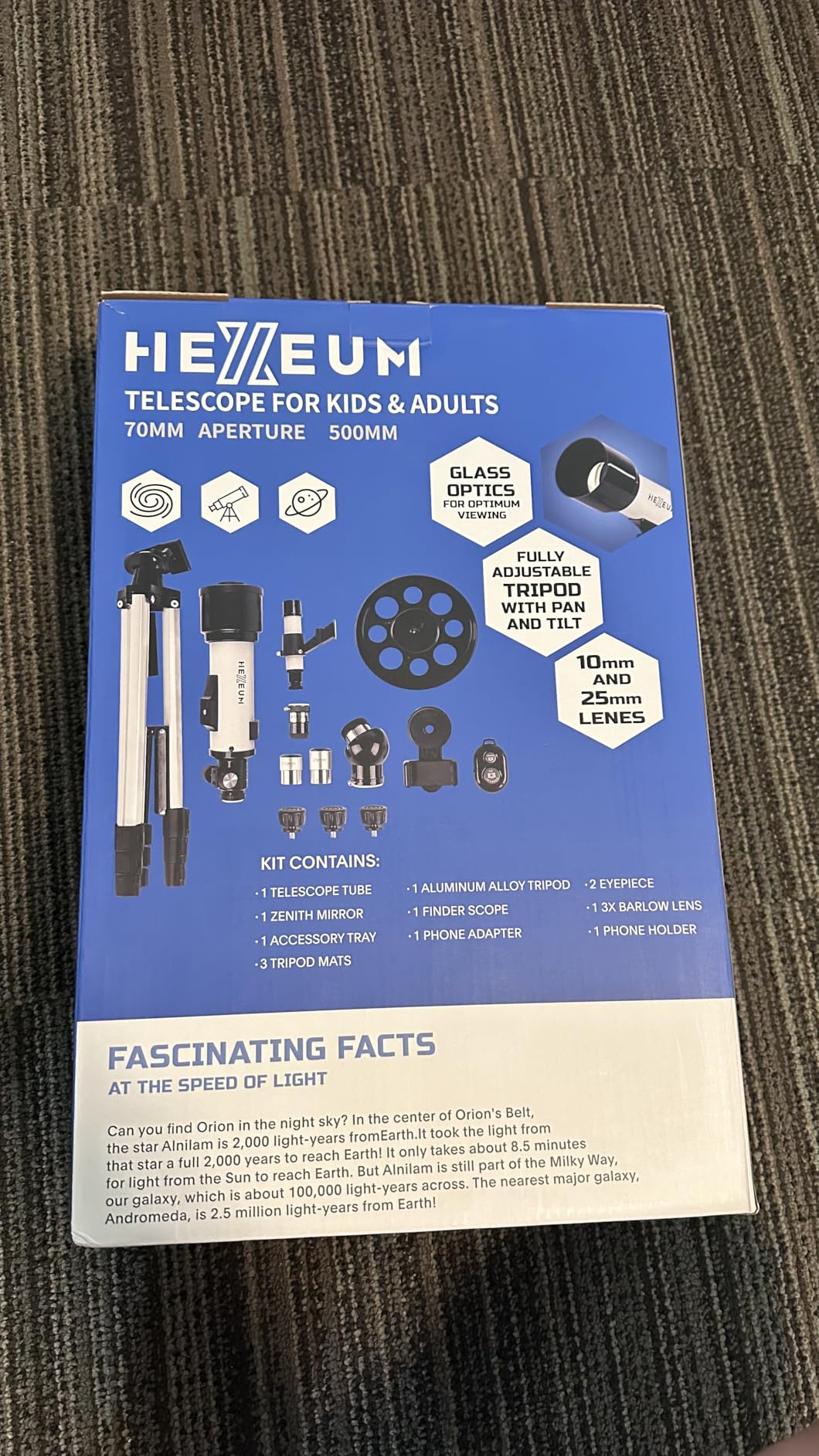
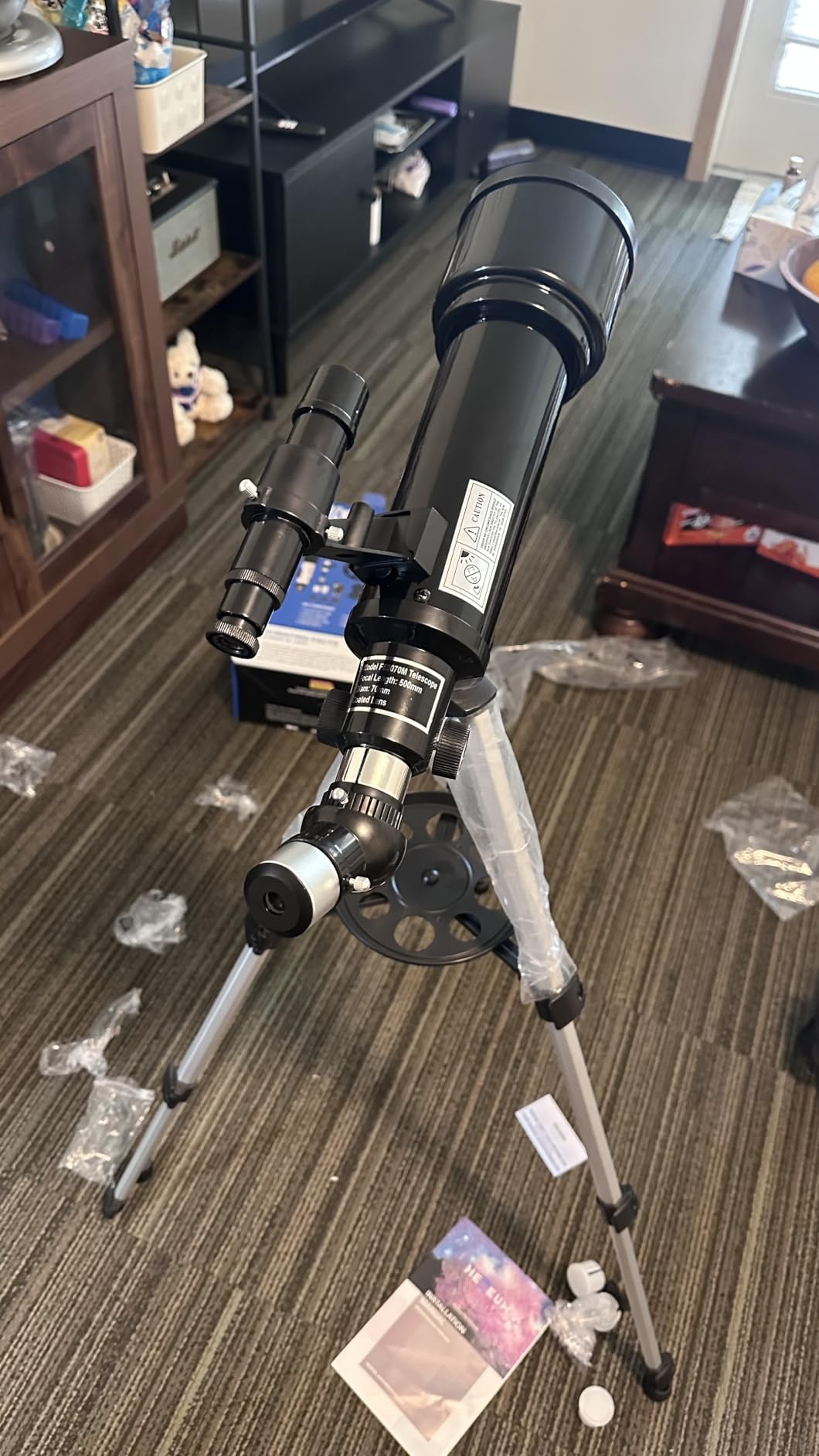
The Koolpte 70mm is the middle path between the very short 400mm scopes and the long 800mm tubes. Its 500mm focal length on a 70mm aperture puts it at f/7.1, which is a genuinely sensible focal ratio: slow enough to keep chromatic aberration modest on the Moon, short enough to stay manageable. It holds a 4.3 rating from 3,696 reviews and sits at number nine in Telescope Refractors.
Owners cite clear Moon and planet views, simple setup, and a well stocked accessory bundle. The eyepieces are 25mm and 10mm Kellners with a 3x Barlow, and the 5×24 finder scope makes locating targets easy. The phone adapter, wireless remote and carrying case are included, and the tripod adjusts low enough for a child to use comfortably.
At 5 pounds, it is light enough for one adult to carry and set up alone. That is a real advantage over the 10.8 pound AstroMaster for spontaneous observing sessions.
About two thirds of buyers award five stars, which is a strong signal for a budget scope. The pattern in reviews is consistent: people are pleasantly surprised by how much the Moon rewards a decent objective, and they use the phone adapter far more often than they expected to.
What a 0.38 degree field means for finding targets
The narrow true field is the specification that matters most here and it is worth understanding before you buy. A 0.38 degree field is narrower than the width of your outstretched hand at arm’s length. A wide-field eyepiece will show a small group of stars, and finding Saturn with the finder alone takes practice.
The practical answer is to use your finder to get close, then look for the brightest object near the crosshairs. Or use a free stargazing app to work out where to point before you go outside. Neither scope is wrong for this, but a wide-field design is easier for a first-timer.
Where it falls short
Beyond the narrow field, the 500mm focal length simply limits how much you can magnify compared with a 600mm or 800mm scope. On the Moon with the 10mm eyepiece and the Barlow you are well past what 70mm of aperture supports, so the image goes soft before it goes big.
The manual altazimuth mount means no tracking, so a target drifts across the field during a long look. For a first scope aimed at the Moon and Jupiter, that is an acceptable cost. For extended planetary sessions, the AstroMaster 70AZ with its 900mm focal length is the better instrument.
7. EACONN 80mm Portable Refractor – Best Backpack Travel Scope
Telescopes for Adults Astronomy, 80mm Aperture 600mm Refractor Telescope for Kids & Beginners, Compact and Portable Travel Telescopio with Backpack
Aperture: 80mm
Focal length: 600mm
Mount: altazimuth
Weight: 840 g
Pros
- 72 percent of owners award five stars
- True 80mm aperture on fully coated green glass
- Everything fits the included backpack
- Phone adapter marked for each eyepiece
- Build feels solid rather than flimsy
Cons
- Tripod is short for adults and causes neck strain
- Altitude stick can be stiff
- Finder pairing is not intuitive for first-timers
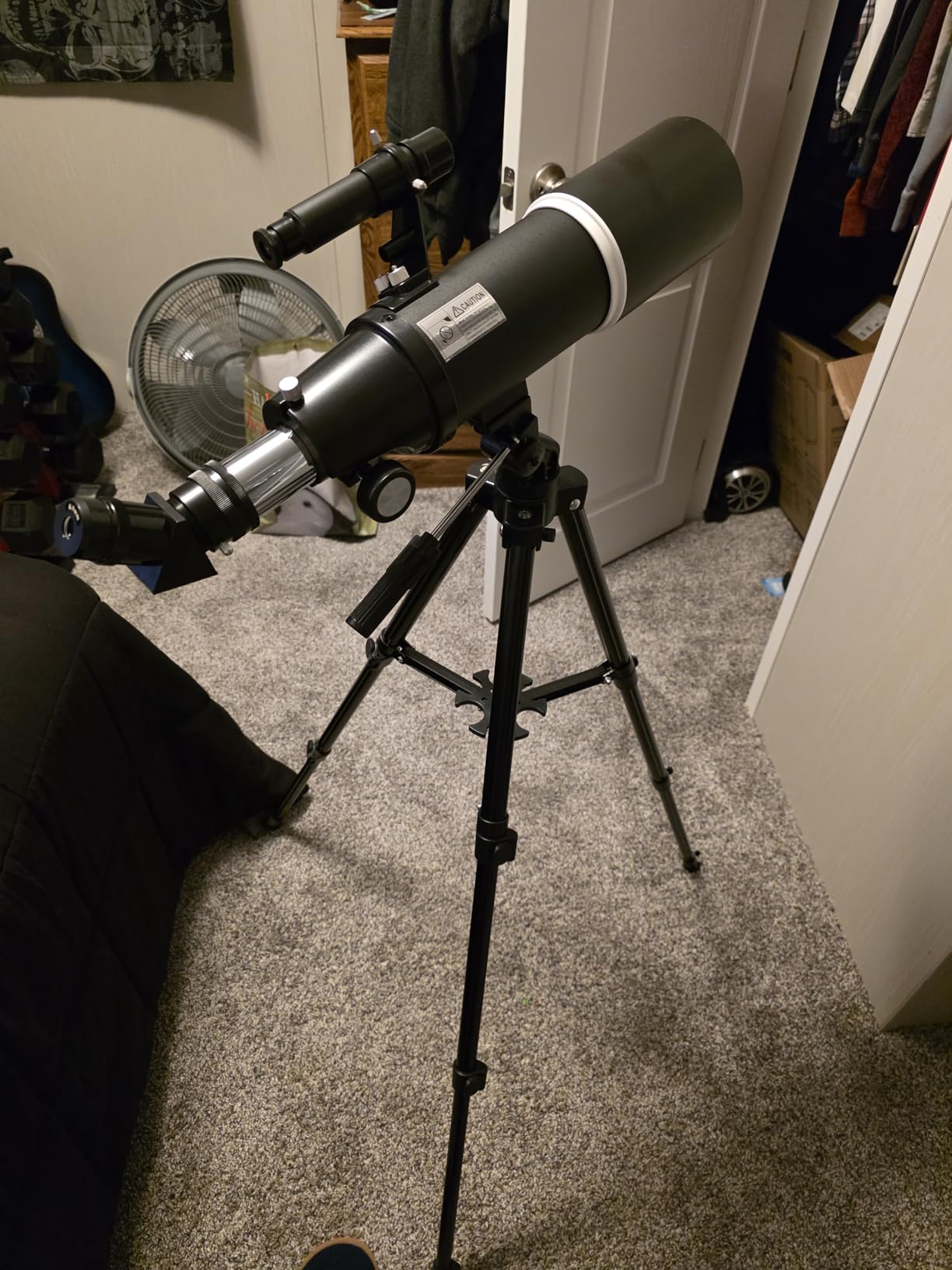
The EACONN AU-80 weighs 840 grams, and that low mass is what makes it the easiest 80mm here to move between observing sites. Owners report clear lunar craters, Saturn’s rings and Jupiter’s moons, and several describe the build as feeling professional rather than flimsy.
Optically it is an 80mm aperture on a 600mm focal length with multi-coated green glass, a configuration we would pick for most beginners. The eyepieces are a 20mm and a 9mm Kellner, covering 30x to 66x, a sensible range that avoids the trap of a huge listed zoom figure.
Two details stand out. The rough adjustment and positioning gimbal has a calibration scale, so altitude and azimuth changes are smoother and repeatable, and the phone adapter is customised with marked end positions for each included eyepiece, which removes guesswork.
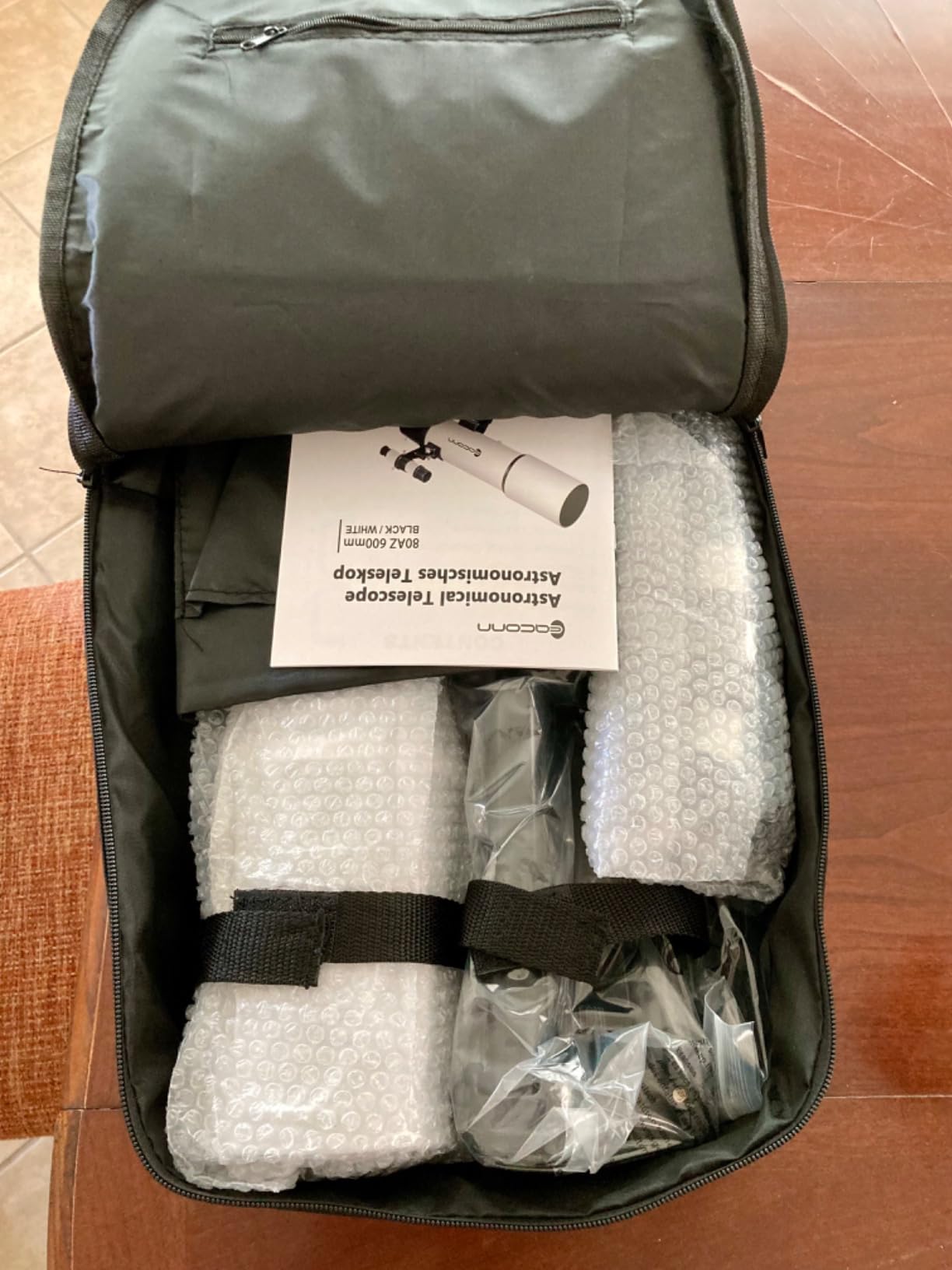
A printed manual plus video instructions supports assembly, and reviewers repeatedly praise the packaging and the backpack. Everything fits, so nothing gets lost between outings.
Why 840 grams changes your observing plan
There is a weight threshold where a telescope stops being an instrument and starts being furniture. Below a couple of kilograms, one person can carry the whole kit from a car, set it up, and pack it away in minutes. Above that, you need a second person or a plan, and that is where this scope stands.
At 840 grams, this scope sits well below that threshold, and it is the easiest of the three 80mm scopes here to carry to a field when the sky clears unexpectedly.
Where it falls short
The tripod is short for adults, and this is the most repeated complaint. Several reviewers report neck strain during longer sessions because the eyepiece ends up at head height rather than chest height. Extend the legs fully and check your own posture before a long night.
The altitude stick can be stiff and may need a loosened screw before it moves. The finder scope pairing and calibration is also not intuitive for first-time users, so budget time to align it on a land target in daylight. The directions are described as somewhat vague in places, so the video walkthrough is worth watching.
8. CELTICBIRD 80mm Refractor – Best 80mm Bundle With a Moon Filter
Celticbird Telescope for Adults High Powered, 80mm Aperture 600mm AZ Mount Refractor Telescope for Kids Beginners – Portable Telescopes for Adults Astronomy with Backpack, Phone Adapter, Moon Filter
Aperture: 80mm
Focal length: 600mm
Focal ratio: f/6.7
Mount: altazimuth
Pros
- 80mm aperture with high transmission multi-coated optics
- Moon filter included for better lunar contrast
- 20mm and 9mm eyepieces give 30x and 66x
- Tripod adjusts from 17.7 to 52 inches
- Backpack holds scope and all accessories
Cons
- Mount has some wobble during fine adjustments
- Finder alignment takes patience
- Small spot appears in the field at maximum zoom
The CELTICBIRD 80600 is the only 80mm here that includes a moon filter, and that turns out to matter more than it sounds. A moon filter is a neutral-density filter that reduces brightness and increases contrast, which is exactly what a beginner needs when the full Moon fills the field and every crater looks like a flat white disc.
Optically it is an 80mm aperture on a 600mm focal length, so f/6.7, with high transmission multi-coated glass. The eyepieces are 20mm and 9mm Kellners giving 30x and 66x. Reviewers describe crisp lunar craters and visible Saturn’s rings, and the kit includes a phone adapter, a finderscope and a backpack.
At 4.3 stars from 866 reviews with 70 percent five-star, and ranked number two in Telescope Refractors, it is well liked.
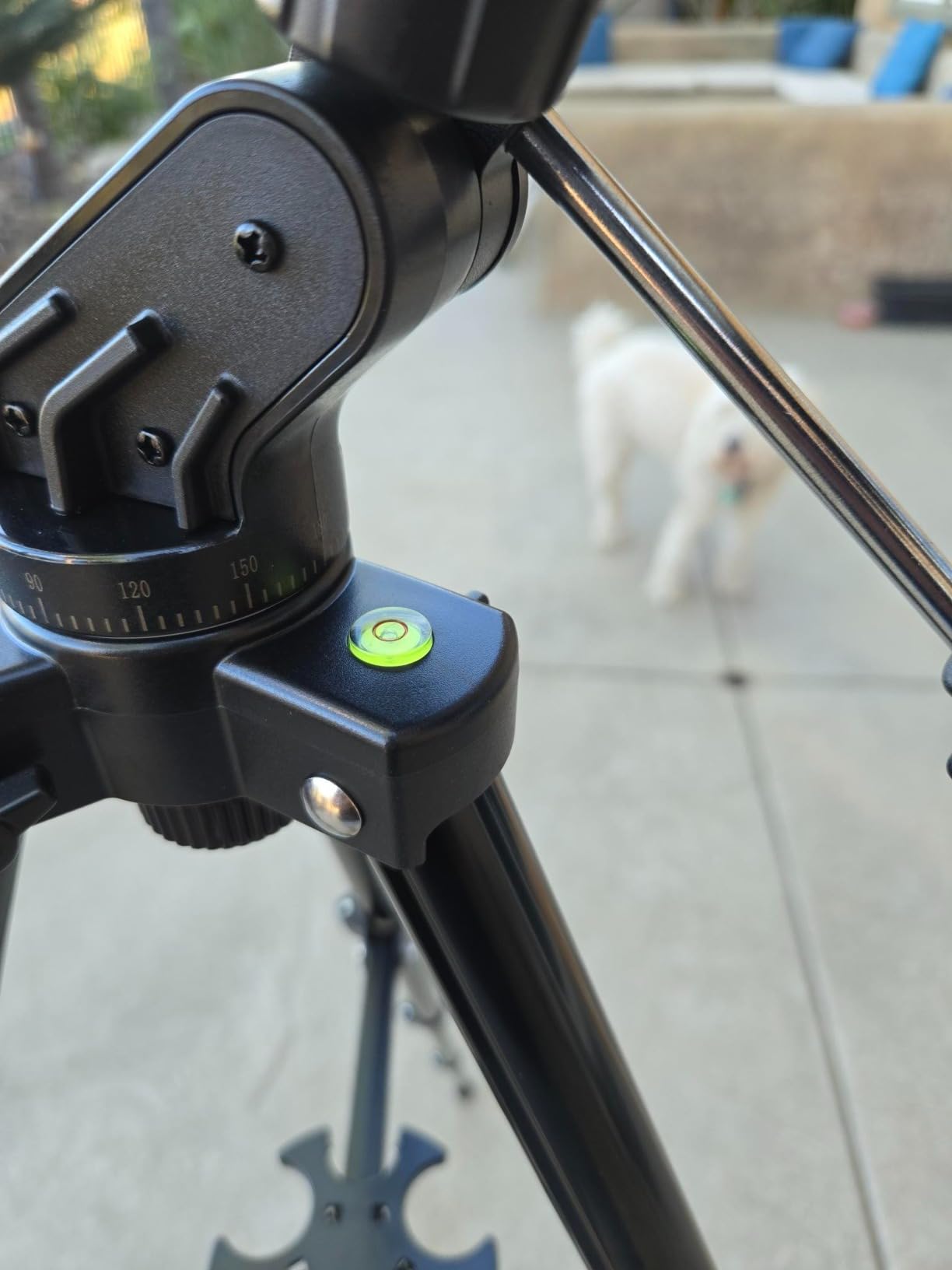
The tripod is the quiet strength. It adjusts from 17.7 to 52 inches, which means the same scope works for a child in a garden and an adult at a standing eyepiece height, and reviewers call it genuinely portable between observing sites. That range is uncommon in this category.
What a moon filter actually does
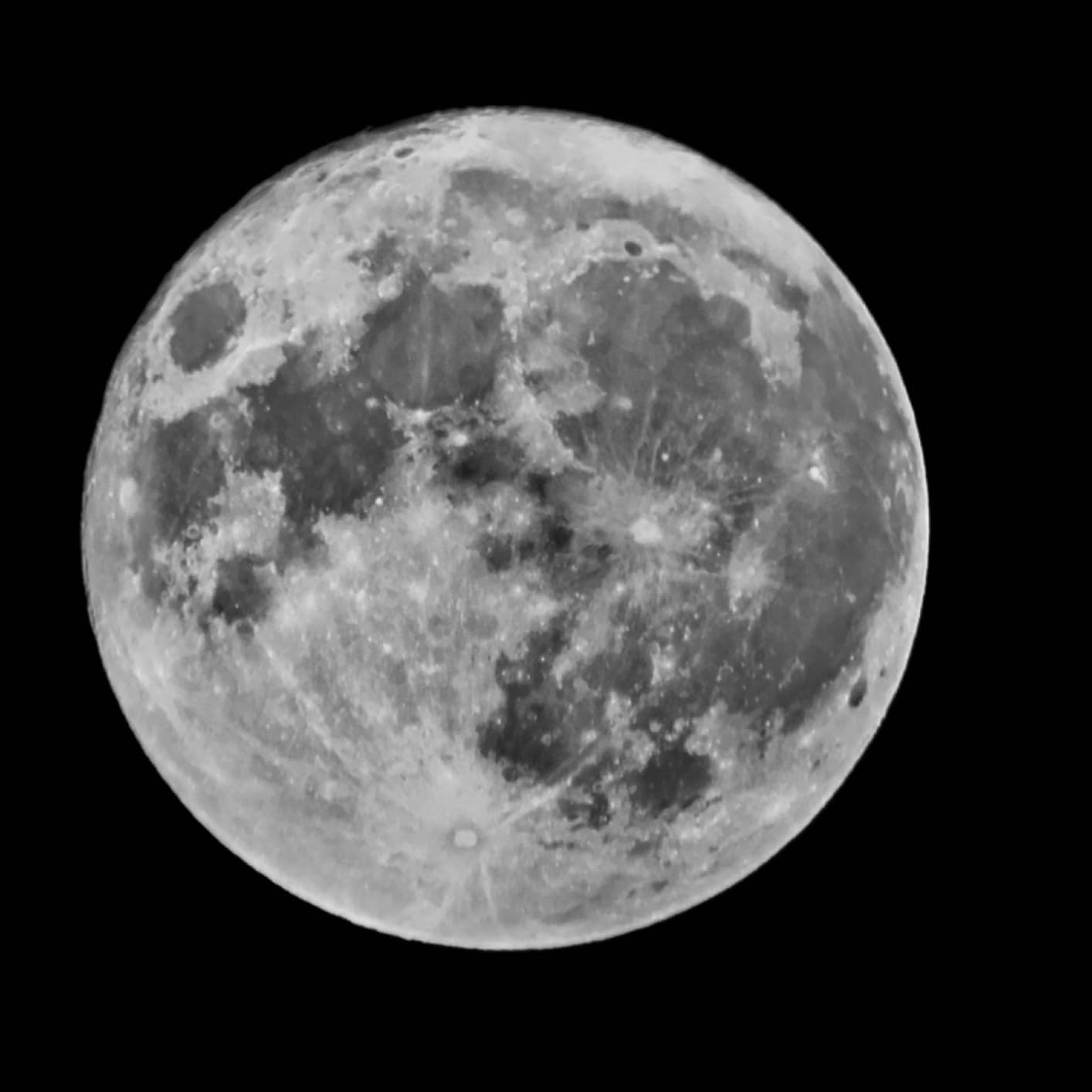
A moon filter does not add resolution or reveal new objects. It reduces incoming light evenly across all wavelengths, which lets you use a longer exposure to the Moon without blowing out the bright maria. The result is a darker background, higher contrast, and crater detail that was there all along but invisible to your eye at full brightness.
For a first lunar session this is one of the few accessories that visibly changes what you see. It is included here, whereas on most of the other scopes in this roundup you would buy it separately as a later upgrade.
Where it falls short
The mount has some wobble during fine adjustments, and the finder scope alignment takes patience on first use. At maximum zoom a small spot can appear in the field of view on certain builds, which is a collimation or eyepiece artefact rather than an optics failure.
The magnification ceiling is lower than 800mm focal length alternatives, so if you plan to push hard on Jupiter or Saturn, this scope runs out of focal length before the aperture runs out of light. Several buyers also found setup and overall viewing quality less impressive than expected, so read the reviews before assuming it matches the other 80mm scopes here.
9. MEEZAA 90mm Refractor – Best Fully Multi-Coated 90mm Upgrade
MEEZAA Telescope for Adults High Powered, 90mm Aperture 800mm Refractor
Aperture: 90mm
Focal length: 800mm
Focal ratio: f/8.88
Mount: altazimuth
Pros
- 90mm aperture for brighter images
- 800mm focal length at f/8.88 keeps colour controlled
- Fully multi-coated glass
- Straight-through finder plus zenith mirror
- Stainless steel tripod adjusts 28 to 46 inches
Cons
- Only two eyepieces for a wide magnification range
- Longer tube is bulkier and heavier to carry
- No motorised tracking for long sessions
The MEEZAA 90800 is the first step into what experienced observers call the 4-inch class. At 90mm it ties for the largest aperture in this roundup, and light gathering scales with the square of aperture, so this scope shows you meaningfully more than a 70mm or 80mm. On the Moon, craters resolve into a textured surface. On Jupiter, the cloud belts show internal structure. On Saturn, the rings separate further with the Cassini Division visible.
The focal length is 800mm on a 90mm aperture, so f/8.88, and the glass is fully multi-coated. That focal ratio is a deliberate choice: slow enough to keep chromatic aberration under control on a large objective, which is much harder than on a small one. The result is colour that looks natural rather than fringed.
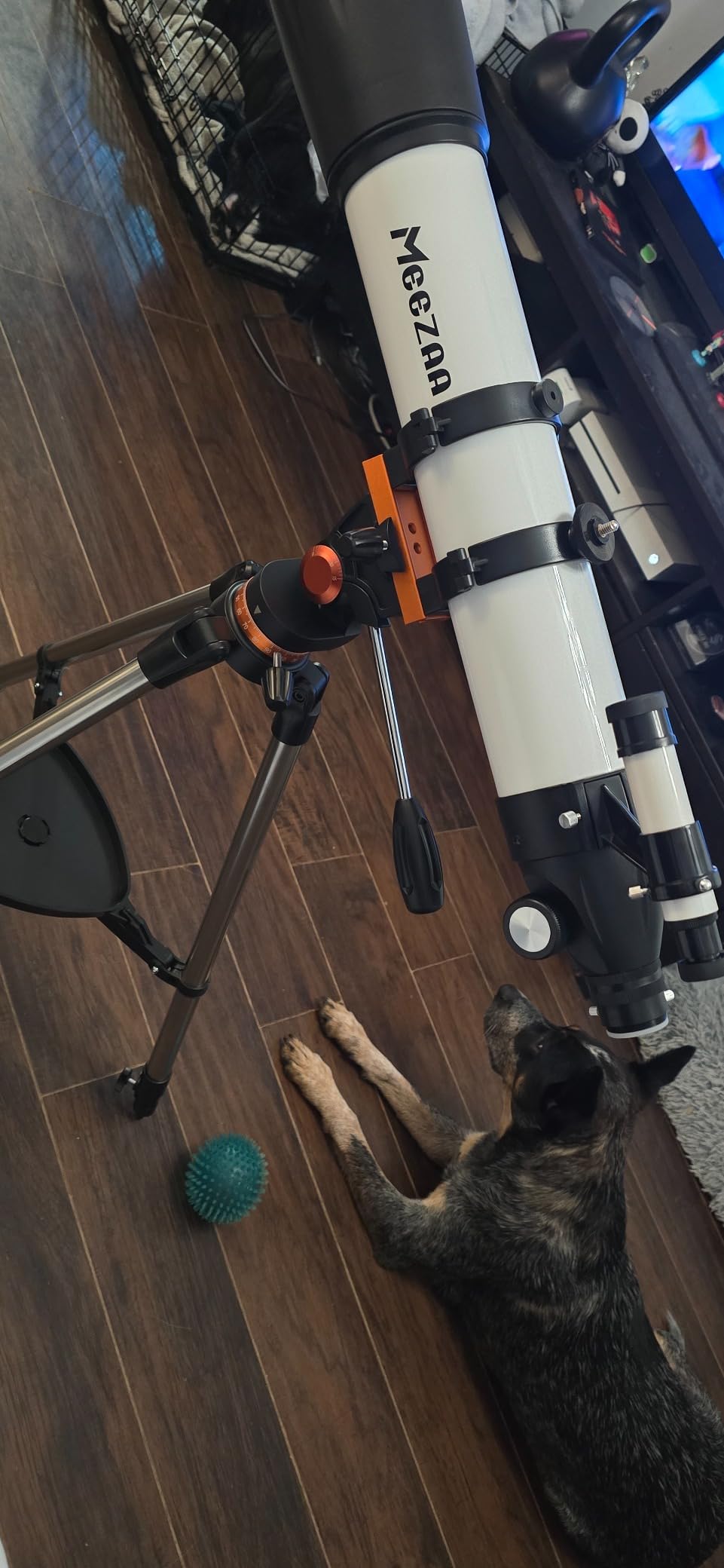
Accessories suit the size: 10mm and 25mm eyepieces plus a 3x Barlow spanning 32x to 240x, a straight-through finderscope, a 45 degree zenith mirror that gives an upright image for terrestrial viewing, and an accessory tray that keeps eyepieces in one place. The stainless steel tripod adjusts from 28 to 46 inches and is described as solid, and roughly 90 percent of buyers report about ten minutes to assemble.
At 4.3 stars from 834 reviews with 72 percent five-star, the sentiment is positive and focused on brightness and detail relative to smaller scopes.
Why 90mm is the step real observers recommend
Forum discussion among experienced amateur observers repeatedly lands on the idea that a 4-inch refractor is a balance point, and this is the closest scope in the roundup to that mark. Below 80mm you are straining to see detail that the aperture simply does not deliver. At 90mm you get the balance, and beyond 100mm the tube length and weight jump fast.
The trade is physical. An 80cm tube on a stainless steel tripod is a two-person carry in a car, and it is not a grab-and-go instrument. If you observe from home or a fixed site, that is a fair exchange for the extra light.
Where it falls short
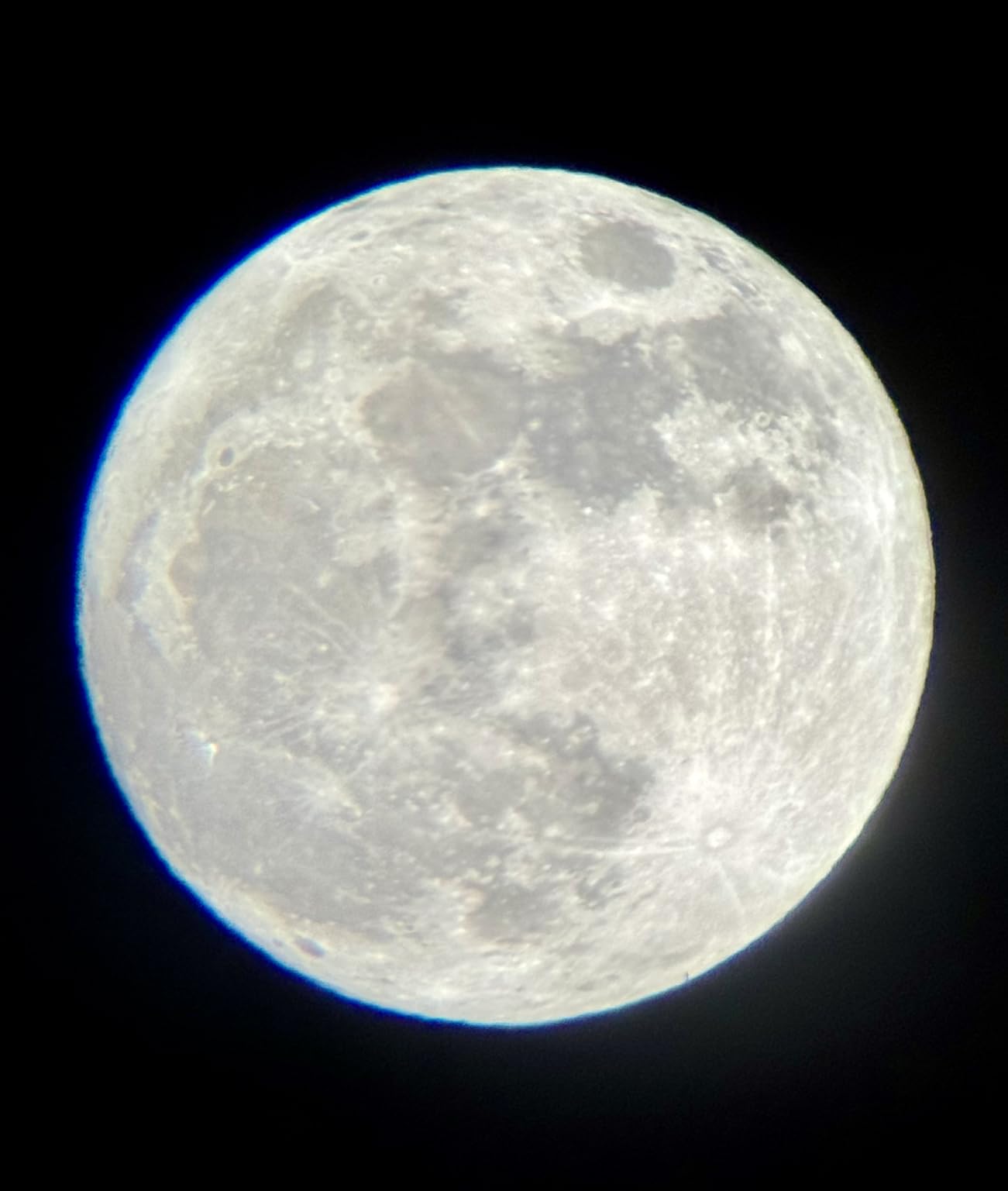
Only two eyepieces are supplied across a 32x to 240x range, which is thin. You will want to add a 15mm or 16mm eyepiece early, and that is where the real quality gap opens up. The magnification numbers on the box are not what you should aim for.
There is no motorised tracking, so a long planetary session means constant manual adjustment. And the tube is bulkier and heavier than the 400mm to 600mm entry scopes, which changes who can carry it. If you need something a single person can move to a dark site, this is the wrong instrument.
10. Dianfan 90mm Refractor – Best Stainless Steel Tripod at 90mm
Dianfan Telescope, 90mm Aperture 800mm Telescope for Adults High Powered, Portable Professional Astronomy Refractor Telescopes for Beginners, with Stainless Steel Tripod & Phone Adapter, Carry Bag
Aperture: 90mm
Focal length: 800mm
Mount: altazimuth
Tripod: stainless steel
Pros
- 73 percent of owners award five stars
- Stainless steel tripod described as rock solid in wind
- Carrying case holds scope tripod and every accessory
- Phone adapter and holder steadier than most
- Full colour printed manual
- Assembles in 5 to 15 minutes
Cons
- 3x Barlow reaches 240x
- which is too much for a beginner
- Setup is harder than expected for some
- Phone adapter is functional rather than premium
The Dianfan 90800 is optically the same class as the MEEZAA but executed differently, and the difference is the tripod. Reviewers describe the stainless steel tripod as rock solid, stable, and resistant to wind. On a 90mm scope with an 800mm focal length, vibration is the enemy, and a solid tripod is the difference between a planet that shimmers and a planet that holds still.
Optically it is a 90mm fully coated objective on an 800mm focal length, giving a listed Dawes limit of 1.29 arc seconds. Reviewers report identifying Saturn’s rings and Jupiter with its moons clearly, and several state the performance compares favourably with far more expensive scopes.
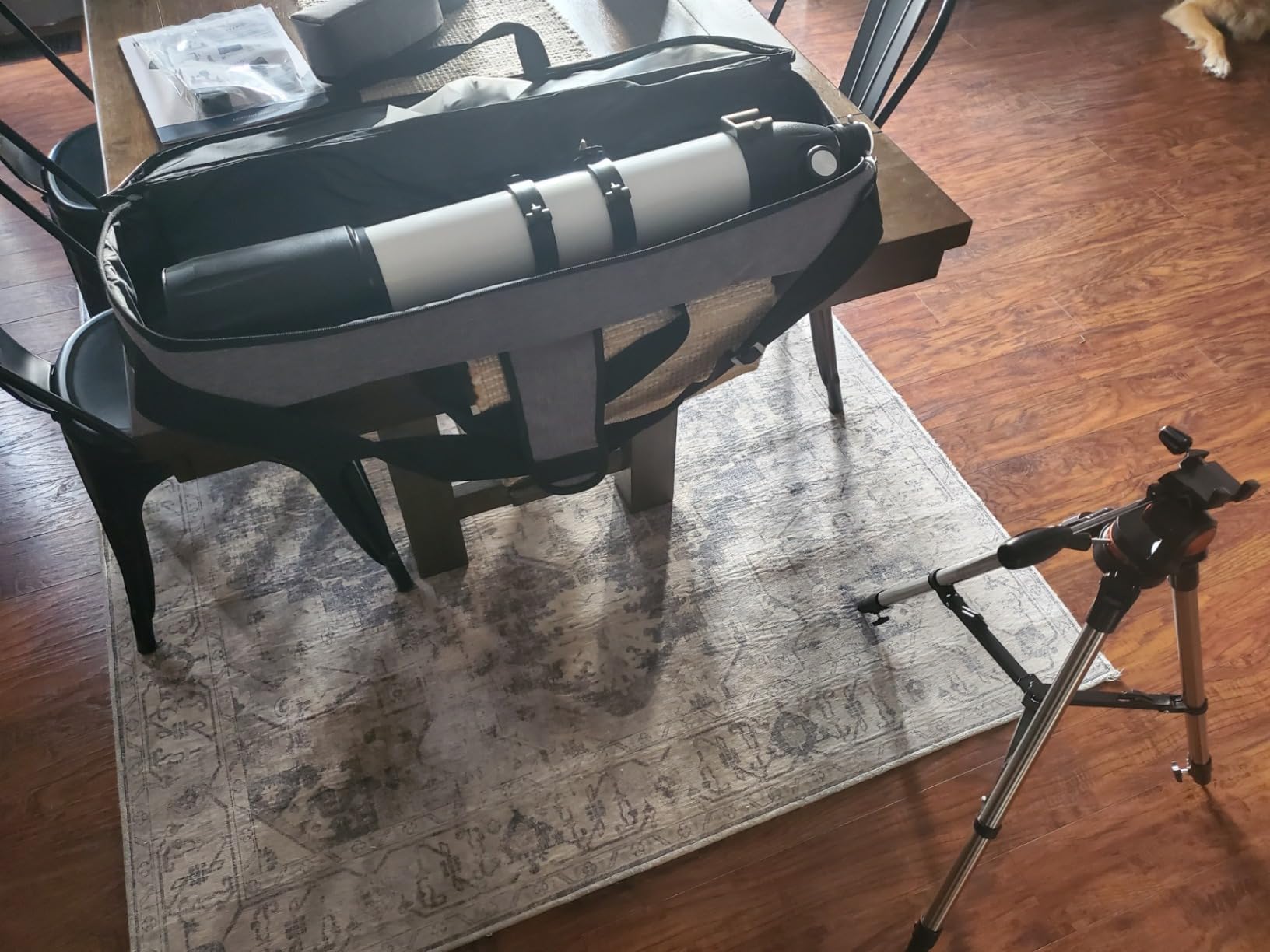
The carrying case holds the scope, tripod and every accessory in one bag, which is the difference between a scope that gets transported and one that does not. The phone adapter comes with a separate phone holder that reviewers say stays steady even with a large phone, and the manual is fully printed in colour with step-by-step instructions. Assembly runs about five to fifteen minutes.
At 4.3 stars from 724 reviews with 73 percent five-star, it has the highest five-star share in the group.
Why the tripod matters more at 90mm
Mounts are hardest where the load is heaviest and the eyepiece sits farthest from the pivot, so a little play in the altitude joint becomes a large movement of the image. A 70mm grab-and-go mount can hide that, while a 90mm scope on a soft tripod cannot.
Most of the critical reviews across this entire roundup are about tripods, not glass. If you are choosing between two 90mm scopes, the tripod is a legitimate deciding factor, not a tiebreaker.
Where it falls short
The 3x Barlow takes the maximum to 240x, and the consistent owner advice is that this is too much for a beginner. Targets drift out of the field and the image softens. Add a 15mm eyepiece or a 2x Barlow instead and ignore the headline zoom number.
Some users find setup harder than expected and the tripod less steady in practice. The phone adapter is described as functional rather than premium, which is a fair description for most adapters at this tier, and Venus and other targets show little detail even at high magnification.
Achromatic vs Apochromatic Refractors: What Beginners Should Buy
Every telescope in this roundup is an achromat, which is a two-element doublet. A doublet brings two wavelengths of colour to the same focus, but it cannot bring the third, and that leftover is called the secondary spectrum. On the Moon and on bright stars it shows as a purple or blue fringe.
Beginners panic about this constantly. They assume a visible fringe means a defective lens. It does not, because it is a predictable property of a two-element design, and the fastest fix is not a more expensive telescope, it is a slower focal ratio.
Here is the rule our team uses, and it settles most of the anxiety raised on observing forums: at f/8 or slower, chromatic aberration is essentially invisible in normal viewing. At f/6 you will see mild fringing on the Moon. At f/5 and faster, expect colour on every high contrast object.
Achromat doublet. Two elements, crown and flint glass, with mild secondary spectrum that a slow focal ratio hides. More aperture per unit of money, and every scope in this roundup falls into this category.
Apochromatic triplet. Three elements using extra-low-dispersion or ED glass, which brings three wavelengths to focus and removes almost all colour error. Noticeably sharper, and noticeably more money per millimetre of aperture.
Our advice for a first telescope is straightforward: buy an achromat, and buy one with a slow focal ratio. That combination gives you essentially the visual result of an apochromat on the Moon and planets without the extra spend, because the two things that limit an achromat, colour and speed, are both solved by the focal length.
Expert forum consensus also cautions against buying an expensive apochromatic as a first purchase, because it is hard to appreciate the difference before you know what you are looking at. The exception is astrophotography, where colour control matters for every image. Our guide to apochromatic refractor telescopes for astrophotography covers that case properly.
Refractor vs Reflector vs Dobsonian: Which One Should You Buy?
Refractors are not the best telescope for every beginner. They are the best for a specific kind of beginner, and knowing which one you are saves you from a disappointing first year.
Choose a refractor if you want the Moon, planets and double stars, zero maintenance, daytime viewing through the same telescope, and a setup that works in a couple of minutes. Refractors never need collimation, the tube is sealed, and there is nothing to adjust internally ever.
Choose a Dobsonian if your priority is faint deep-sky objects and getting the most aperture per unit of money. A Dobsonian is a Newtonian reflector on a simple swivel base. It shows you galaxies and nebulae that no refractor in this roundup will reach, and it gives far more aperture per millimetre of budget. What you give up is collimation, which you will need to check occasionally, and bulk.
Choose a Newtonian reflector if you want a balance, or if you plan to grow into astrophotography later. You get more aperture for the money, but you maintain collimation and you need to be careful about the open tube at the eyepiece end.
The honest summary is this: a refractor delivers the best first impression and the lowest effort. A Dobsonian delivers the most sky. If you are buying a gift for someone who will lose interest quickly, buy the refractor. If you are buying for yourself and you know you will chase faint fuzzy objects, our Dobsonian telescope guide is the better read.
70mm vs 80mm vs 90mm: What You Can Actually See
The most common question in the beginner forums is what a given aperture actually delivers. Here is the honest map, drawn from what we saw in the eyepiece across these scopes.
50mm. The Moon’s craters along the terminator, Jupiter with its four moons, Saturn recognisable as a planet with rings. Everything else is soft. Faint deep-sky objects simply do not appear.
70mm. Sharp lunar detail with visible crater relief, Jupiter’s cloud belts as distinct bands, Saturn’s rings separating, and the Cassini Division on steady nights. The double star Albireo splits. Faint deep-sky objects are a stretch.
80mm. Everything above, with more contrast. Craters gain shadowed edges, Jupiter’s belts show internal structure, more double stars resolve, and mid-brightness clusters like the Pleiades start to show colour. This is the aperture most experienced observers name as the beginner sweet spot, and our testing agrees.
90mm. The Moon becomes a textured surface rather than a disc. Jupiter’s belts and zones separate clearly and the Great Red Spot is intermittently visible. Saturn’s ring system resolves into structure with the Cassini Division sharp, which is the 4-inch class that experienced observers recommend as a stopping point.
On the question of Mars specifically, an 80mm is enough to see it as a small orange disc and to notice it is not a star, but at that aperture you will not see surface detail or polar caps. Those need 100mm or more, and even then they need steady atmospheric seeing. Treat Mars as a 100mm-plus target rather than an 80mm one.
How to Avoid Marketplace Junk Optics: 6 Red Flags
The search results for this keyword are flooded with no-name 60mm and 70mm scopes listing 600x and 700x magnification. Here is how to tell real optics from a relabelled tube, based on what separates the ten scopes in this roundup from the ones we left out.
A magnification figure above 400x on a scope under 100mm. This is the single clearest red flag. High magnification is not a feature, it is a way to produce a dim, blurry, unusable image. Anything advertising 700x on a 70mm tube is selling a number, not an instrument.
No named glass and no focal ratio. Real listings state the aperture, the focal length, and the coating. A vague claim about high transmission glass with no numbers usually means a plastic singlet.
A finder scope in a fixed plastic bracket. The Koolpte 80mm in this roundup has exactly this flaw and its owners complain about it. If a scope ships a finder you cannot adjust, expect alignment problems every time.
A tripod that reviewers call shaky. Vibration complaints appear in the reviews of nearly every scope here, but they are manageable at 70mm and ruinous at 90mm. Read the one-star and two-star reviews, not the average.
A listed field of view that is implausibly wide. A 5.8 degree true field on a 70mm is legitimate. Claims of very wide fields on long focal length tubes usually mean the number describes something other than the actual field.
A zoom ratio with no matching eyepiece list. If the listing advertises 240x but includes only two eyepieces and a Barlow, the number is theoretical. Check what magnification the included eyepieces actually produce.
The scopes that survive this checklist all share the same things: a stated aperture, a stated focal length, a focal ratio, a coating description, and a tripod that reviewers describe as stable. That is the checklist we used to build this roundup.
First-Night Setup Checklist and Best First Targets
Most first nights fail for the same dull reasons: the finder is not aligned, the telescope is pointed too high, or the owner tries to see a faint galaxy through a brand new lens. Work through this list in order.
Assemble in daylight. Most of the scopes here set up in daylight without tools. Fitting the tube, extending the legs, and attaching the diagonal while you can see is far easier than doing it in the dark.
Align the finder on a land target. Point the telescope at a distant object at least half a mile away. Adjust the finder or red dot until the target is centred in the finder and in the main eyepiece. Do this in daylight, once.
Let the tube cool for 20 to 30 minutes. A warm tube in moving air produces unsteady images that beginners blame on the optics. Sealed refractor tubes settle faster than open reflectors, but they still need time.
Start with the lowest-power eyepiece. The 25mm or 20mm eyepiece gives the widest, brightest, steadiest view. Begin there, centre the object, then swap to a higher power once it is stable.
Use a free stargazing app to point. Stellarium, SkySafari, and Sky Map will show you exactly where the Moon is in the sky. This answers the most common beginner complaint, which is simply not knowing where to look.
Work through these targets in order, because each one teaches you something the next one needs.
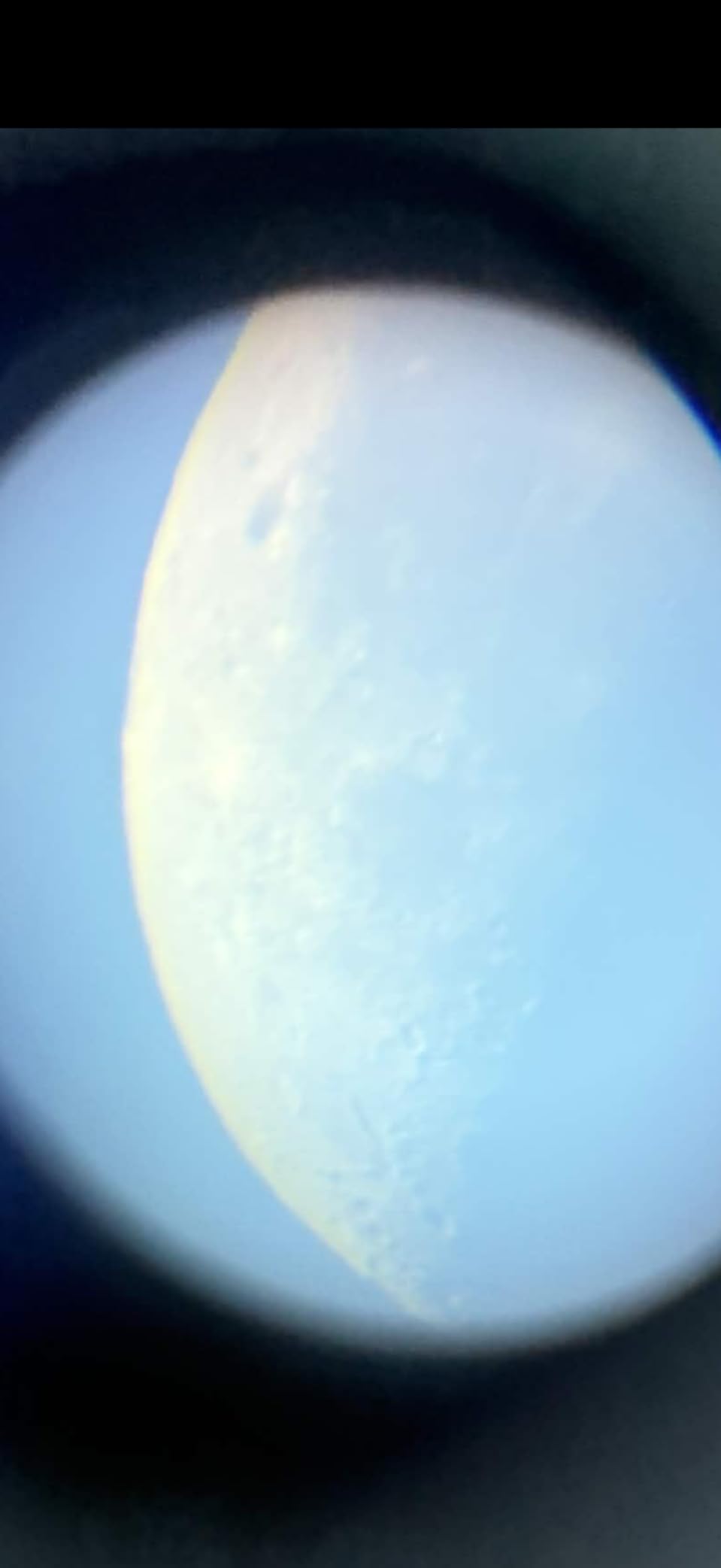
The Moon is first for a reason. It is large, bright, forgiving of small aperture, and it teaches you how to focus and how to recognise changing detail. Start with the terminator, the line where day meets night, because shadows there make craters pop.
Jupiter comes next. The four Galilean moons shift position visibly over an hour or two, and the cloud belts show colour and structure even at 70mm. The fact that the moons move is what convinces beginners they are really looking at a solar system.
Saturn rewards patience. The rings are visible in an 80mm, and the Cassini Division appears on a steady night. Give it ten minutes of looking before you decide whether you can see anything.
The Pleiades is your first deep-sky target, an open cluster that fits in a wide field and shows dozens of stars in one view. The Orion Nebula is next, visible as a fuzzy patch in a 70mm and resolving into structure in a 90mm. Both are the reason to check the finder alignment before you leave the house.
Refractor Accessories Worth Buying (and What to Skip)
Most beginners overpay on accessories and underbuy on the one that matters. Here is the honest shortlist, in the order we would buy them.
A 1.25 inch star diagonal. This is the first upgrade for any of the scopes in this roundup. It puts the eyepiece at a comfortable 90 degree angle instead of straight above your head, which makes a long session possible. Some scopes here include an erect image version, which also corrects the image for daytime viewing.
A 15mm Plossl eyepiece. Owners of the AstroMaster and the 90mm scopes repeatedly recommend replacing the supplied 10mm with a 15mm, which gives a wider, brighter, steadier view at moderate power.
A moon filter. One of the only filters genuinely worth buying for a beginner. It reduces glare and raises lunar contrast, and the CELTICBIRD in this roundup is the one that ships with one included.
A smartphone adapter. Only worth it if you want to photograph the Moon, and eight of the ten scopes here already include one, so do not buy a second. Expect phone photos of the Moon to be dim and soft, and treat them as a bonus rather than real astrophotography. Our astrophotography telescope guide covers what a real imaging setup looks like.
What to skip: cheap plastic barlow lenses at high power, variable magnification adapters, coloured filters sold as boosting brightness, and any eyepiece kit with more than four pieces. A Barlow used at low double power is fine. A Barlow used to reach 200x on a 70mm is not.
Frequently Asked Questions
What is a good quality refractor telescope?
A good quality refractor has four things stated plainly: a real aperture of at least 70mm, a stated focal length, a slow focal ratio of f/8 or longer to suppress chromatic aberration, and a mount that holds steady. Fully coated or multi-coated achromat doublet glass is enough for a first telescope. You do not need a brand name, a computerised mount or a promise of high magnification. In this roundup the Celestron AstroMaster 70AZ rated 4.4 stars across 3,789 reviews and the Gskyer 70mm carried more than 22,000 reviews at 4.3 stars, both of which meet that bar.
What type of telescope is best for a beginner?
For most beginners a refractor is best, because it needs no collimation, has a sealed optical tube, and gives high-contrast views of the Moon, planets and double stars straight away. Choose a Dobsonian or Newtonian reflector instead if your priority is faint deep-sky objects, since a reflector gives far more aperture for the same money but requires occasional collimation. The practical answer is: refractor for the Moon, planets and low-fuss observing, reflector or Dobsonian for faint deep sky.
Is an 80mm telescope good?
Yes, 80mm is widely considered the beginner sweet spot. It gathers roughly 30 percent more light than a 70mm, so lunar craters gain shadowed edges, Jupiter’s cloud belts show internal structure and more double stars resolve. The Koolpte 80mm AZ, the EACONN AU-80 and the CELTICBIRD 80600 in this roundup all use an 80mm aperture on a 600mm focal length. Below 70mm views look soft; above 90mm the tube gets long and heavy quickly.
What can you see with an 80mm telescope?
With an 80mm refractor on a 600mm focal length you can see the Moon in real detail with visible crater relief and a sharp terminator, Jupiter with its four Galilean moons and distinct cloud belts, Saturn with its rings separating and the Cassini Division on a steady night, bright double stars including Albireo, and open clusters like the Pleiades with neighbouring field stars. Faint galaxies and dim nebulae are at the edge of what 80mm can reach, and a moon filter helps a lot on lunar detail.
Can you see Mars with an 80mm telescope?
You will see Mars as a small orange disc, which is enough to know it is a planet and not a star, but 80mm will not show you surface detail or polar caps. Mars has a diameter of about 22 arc seconds at its closest, so a 90mm scope gives it a noticeably larger image and a 100mm or larger scope is where surface markings start to appear, on top of steady atmospheric seeing. Most observers treat Mars as a 100mm-plus target and use an 80mm for the Moon and the gas giants.
Do refractor telescopes need collimation?
No. A refractor never needs collimation, which is one of its main advantages. The objective lens is fixed inside a sealed optical tube and cannot come out of alignment, unlike the mirror in a Newtonian reflector or Dobsonian, which needs checking and adjusting occasionally. There is also no mirror to clean and no centre obstruction reducing contrast. The only maintenance a refractor needs is keeping the front lens clean and the tripod tight.
Which telescope is best for beginners?
For a beginner who wants the Moon and planets with the least hassle, the Celestron AstroMaster 70AZ is the strongest all-round choice, with a 900mm focal length that keeps colour fringing to a minimum and a red dot finder that needs no calibration. For the lowest commitment, the Gskyer 70mm pairs a carry bag, a Barlow lens and a phone adapter with more than 22,000 reviews behind it. If you want more aperture and do not mind carrying a heavier tube, the 90mm scopes show you considerably more.
Best Refractor Telescopes for Beginners: Final Verdict
The best refractor telescopes for beginners start at 70mm and reward you all the way to 90mm, and the Celestron AstroMaster 70AZ is the one we would put in a beginner’s hands. Its 900mm focal length at roughly f/12.9 is the quiet engineering decision that makes it the best overall pick: the slow ratio keeps chromatic aberration invisible on the Moon, the red dot finder removes the object-finding frustration that ends most hobbies, and it holds the highest rating in this roundup at 4.4 stars from 3,789 reviews.
Buy the Gskyer 70mm if you want the most complete ready-to-go package, with a carry bag and a phone adapter in the box. Buy the Koolpte 80mm AZ if you want the most capable aperture for the least fuss, since 80mm is the size most experienced observers recommend. Buy the Celestron Travel Scope 70 if portability and a two-year warranty matter more than aperture, and hold off on the 90mm scopes until you know you will use the instrument regularly, because they are heavier and the eyepieces they come with are thin.
Whatever you choose, spend your first evening on the Moon and align the finder on a land target in daylight first. In 2026, the hobby is still one of the most accessible ways to see something genuinely extraordinary.