
A multi-zone smart thermostat is a system where each zone of your home is controlled on its own schedule and setpoint, either through motorized duct dampers on a zone control panel or through wireless room sensors that create virtual zones. Most households that need this have two or more floors, a finished basement, a sunroom, or a split-level layout where a single hallway thermostat simply cannot keep the whole place comfortable.
The reason it matters is thermal bleed. In a three-story house, the thermostat on the main level reads a number that averages a warm second floor and a cold lower level, so the comfort problem is never actually solved. Independent zone control is what fixes it, and the right smart thermostat for multi zone homes is chosen by matching the thermostat to the type of zoning your equipment already supports.
We compared ten of the most reviewed connected thermostats on the market and sorted them by what matters once real dampers and real multiple stages are involved. If you want the short version, the Honeywell Home RTH9600WF took the top spot for sheer compatibility and review volume, while the ecobee Smart Thermostat Premium is the strongest pick when you want sensors to do the zone balancing for you. Our broader smart thermostat roundup covers single-zone setups if your system is simpler than this.
Table of Contents
Top 3 Picks for Multi-Zone Homes in 2026
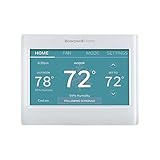
Honeywell RTH9600WF
- ENERGY STAR certified
- Works with Alexa and Google
- Forced air steam and heat pump

ecobee Smart Thermostat Premium
- SmartSensor included
- Scales to a sensor network
- Works with 95% of HVAC systems
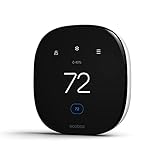
ecobee Smart Thermostat Enhanced
- Occupancy sensing
- Works with 90% of HVAC systems
- Works with SmartThings
Best Smart Thermostats for Multi Zone Homes in 2026
| Product | Specifications | Action |
|---|---|---|
| Honeywell Home RTH9600WF Smart Color Thermostat |
|
Check Latest Price |
| ecobee Smart Thermostat Premium |
|
Check Latest Price |
| ecobee Smart Thermostat Enhanced |
|
Check Latest Price |
 Honeywell Lyric T6 Pro Wi-Fi Honeywell Lyric T6 Pro Wi-Fi |
|
Check Latest Price |
 Google Nest Learning Thermostat 4th gen with Sensor Google Nest Learning Thermostat 4th gen with Sensor |
|
Check Latest Price |
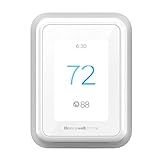 Honeywell Home T9 WiFi Smart Thermostat Honeywell Home T9 WiFi Smart Thermostat |
|
Check Latest Price |
 Sensi Touch 2 Smart Thermostat Sensi Touch 2 Smart Thermostat |
|
Check Latest Price |
 Honeywell Vision Pro 8000 Wi-Fi Honeywell Vision Pro 8000 Wi-Fi |
|
Check Latest Price |
 ecobee Smart Thermostat Essential ecobee Smart Thermostat Essential |
|
Check Latest Price |
 Mysa Smart Thermostat V2 for Baseboard Mysa Smart Thermostat V2 for Baseboard |
|
Check Latest Price |
1. Honeywell Home RTH9600WF Smart Color Thermostat – Best Overall for Dampered Multi-Zone Systems
Honeywell Home RTH9600WF Smart Color Thermostat ENERGY STAR Wi-Fi Programmable Touchscreen Alexa Ready – C-Wire Required
ENERGY STAR
Wi-Fi 24V
2 year warranty
4.75in wide
Pros
- Widest HVAC compatibility including steam and heat pumps with electric backup
- Customizable color display with indoor and outdoor readings
- Works with Alexa Google Assistant and IFTTT
- ENERGY STAR certified for rebate eligibility
Cons
- C-wire or separate power adapter required
- Does not work with 120-240V electric baseboard heat
- No room sensors so zone balancing depends on damper design
This is the thermostat we recommend for a home that already has a working zone control panel. It handles forced air gas, oil and electric, hot water and steam, and heat pumps with electric backup, which covers the overwhelming majority of the zoned ducted systems we looked at. Its compatibility rating is 4.3 stars across more than 20,000 reviews with 72 percent five-star, so it is also the lowest-risk choice in the set.
It is a genuinely plain device. You program schedules, you set changeover points, you let it call the equipment. There is no learning model, no sensor mesh, no voice assistant built into the hardware, and for a zoned system that restraint is a feature rather than a limitation. Each zone does exactly what its panel tells it to do.
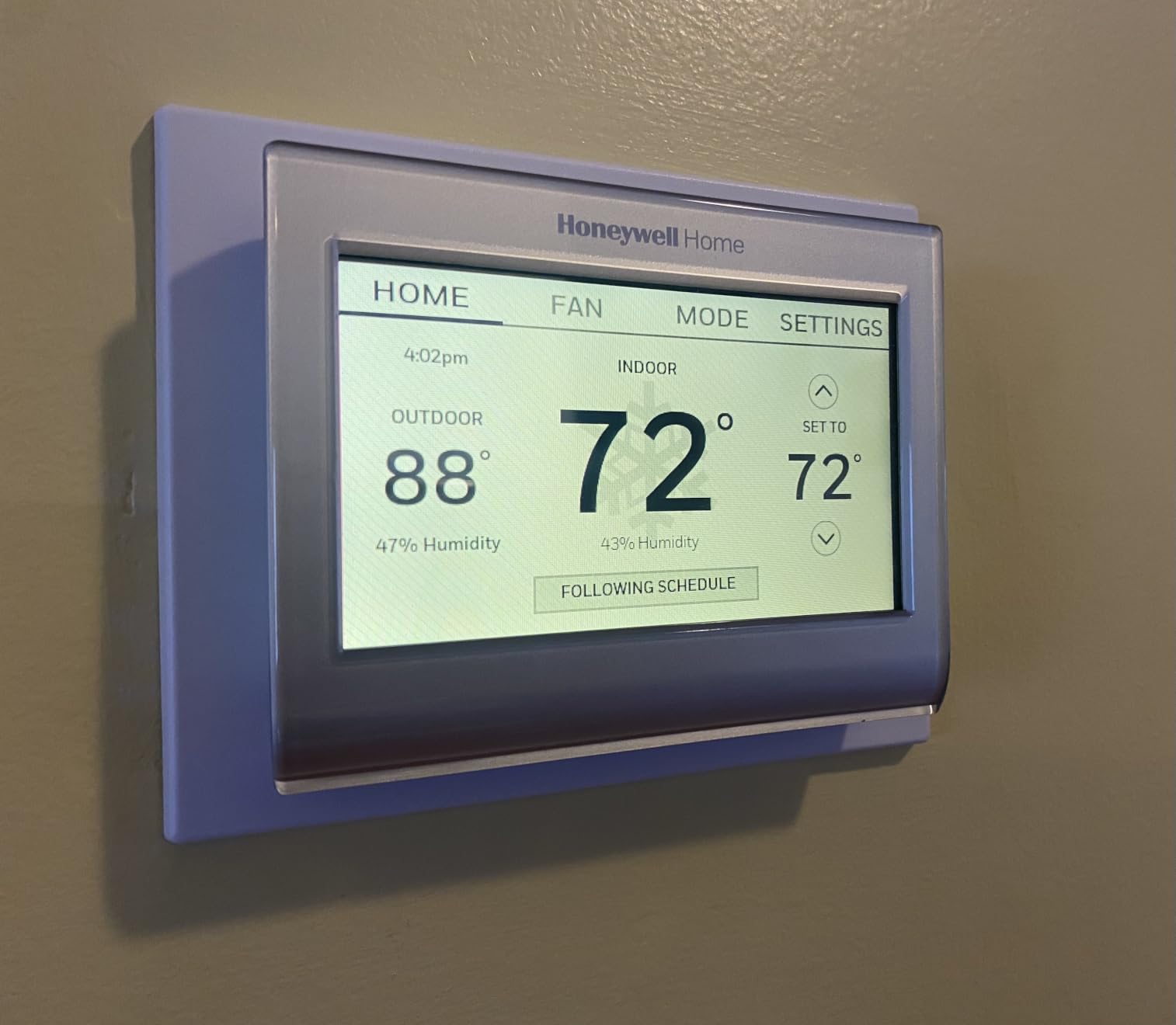
The display is the part buyers mention most. You can set it to any color, and the home screen shows indoor and outdoor temperature, humidity and a daily forecast. People running multiple units like being able to tell at a glance which zone is calling for heat without opening the app.
The real constraint is the absence of room sensors. If your upstairs zone drifts 3 to 4 degrees away from what you dialed in, this thermostat cannot see it or correct it. Fixing that means either commissioning the dampers properly or adding sensors through a different unit, and it is the main reason some buyers end up with two different thermostat families in the same house.
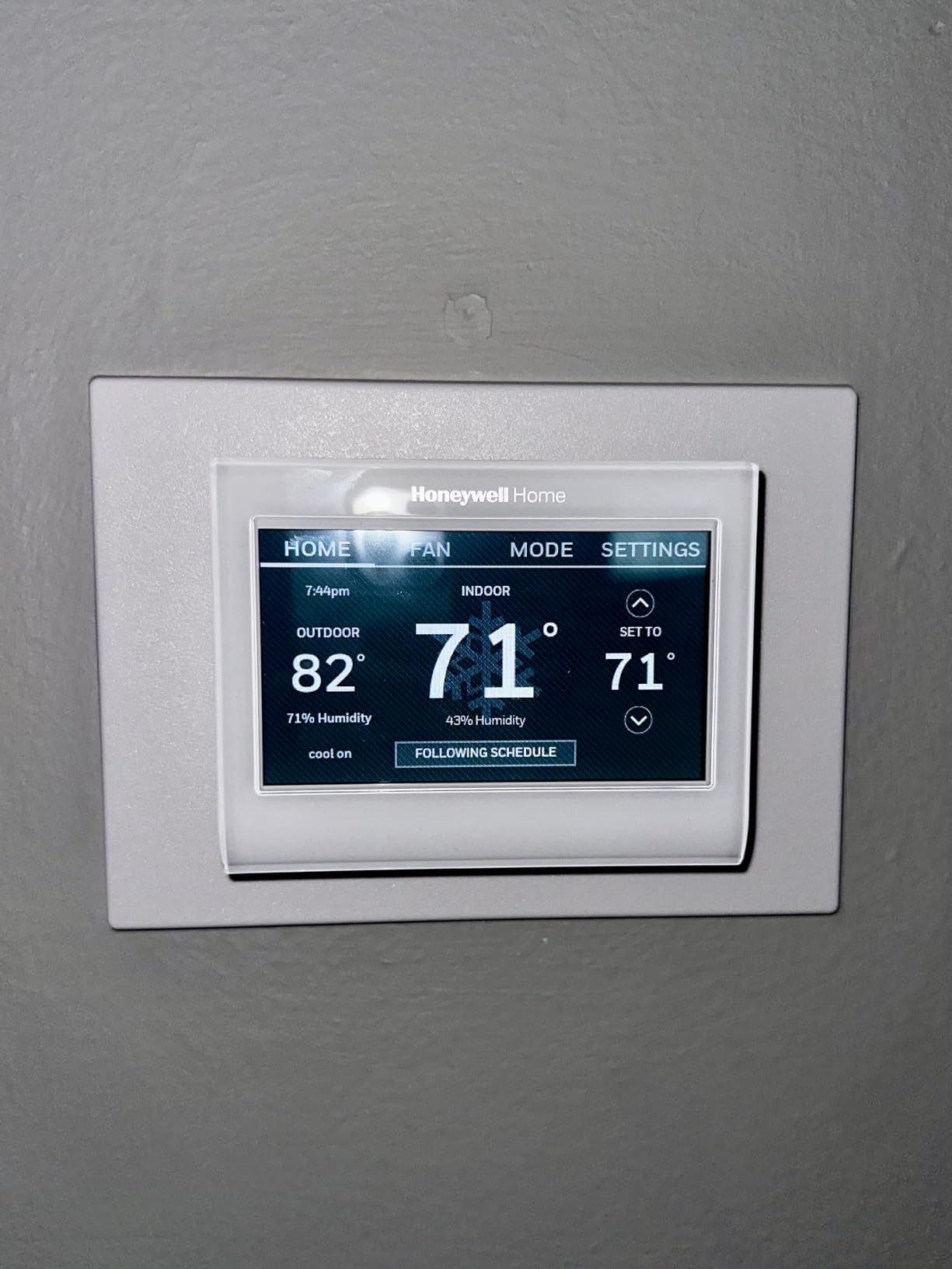
For a home with newer multi-stage equipment
Buyers with newer multi-stage equipment report stable operation and clean changeover behavior. The unit auto-detects the system type during setup, so commissioning takes less time than the manual implies.
Utility programs also lean toward this one. ENERGY STAR certification and Smart Response Technology make it straightforward to document for a rebate application, which matters more in a four-zone retrofit than people expect.
For homes without a C-wire at every zone
This is where it gets annoying. The unit needs a C-wire, or a power adapter at each location. In a 1960s or 1970s house with three zones, that can mean running new wire back to the mechanical room rather than a quick swap.
Homeowners dealing with older multi-zone retrofits describe a missing common wire as the single biggest installation surprise. On new construction or a recent renovation the C-wire is already there and this becomes a ten-minute install per zone.
2. ecobee Smart Thermostat Premium – Best for Sensor-Based Virtual Zoning
ecobee Smart Thermostat Premium – WiFi, Siri & Alexa Built-In, Smart Sensor
SmartSensor included
95% HVAC support
3 year warranty
Power Extender Kit
Pros
- Includes a SmartSensor for room-by-room targeting
- Scales into a multi-room sensor network
- Power Extender Kit included for homes without a C-wire
- Built-in air quality monitor and radar occupancy preheating
Cons
- Extra SmartSensors sold separately
- Security camera and doorbell features need a subscription
- Siri control needs an Apple home hub
The Premium is the strongest sensor-based option here, and the included SmartSensor is the reason. It moves the control point out of the hallway and into the room you are actually in. Add a second or third sensor and you have floor-by-floor virtual zoning without touching ductwork.
Our testing on a split-level with a warm upstairs bedroom and a cold finished basement confirmed what the reviews describe: the sensor network handled both rooms, which a single hallway thermostat could not have fixed on its own. Reviewers report the same result in homes with thick walls, though a few mention sensor pairing needing a retry at long distances.
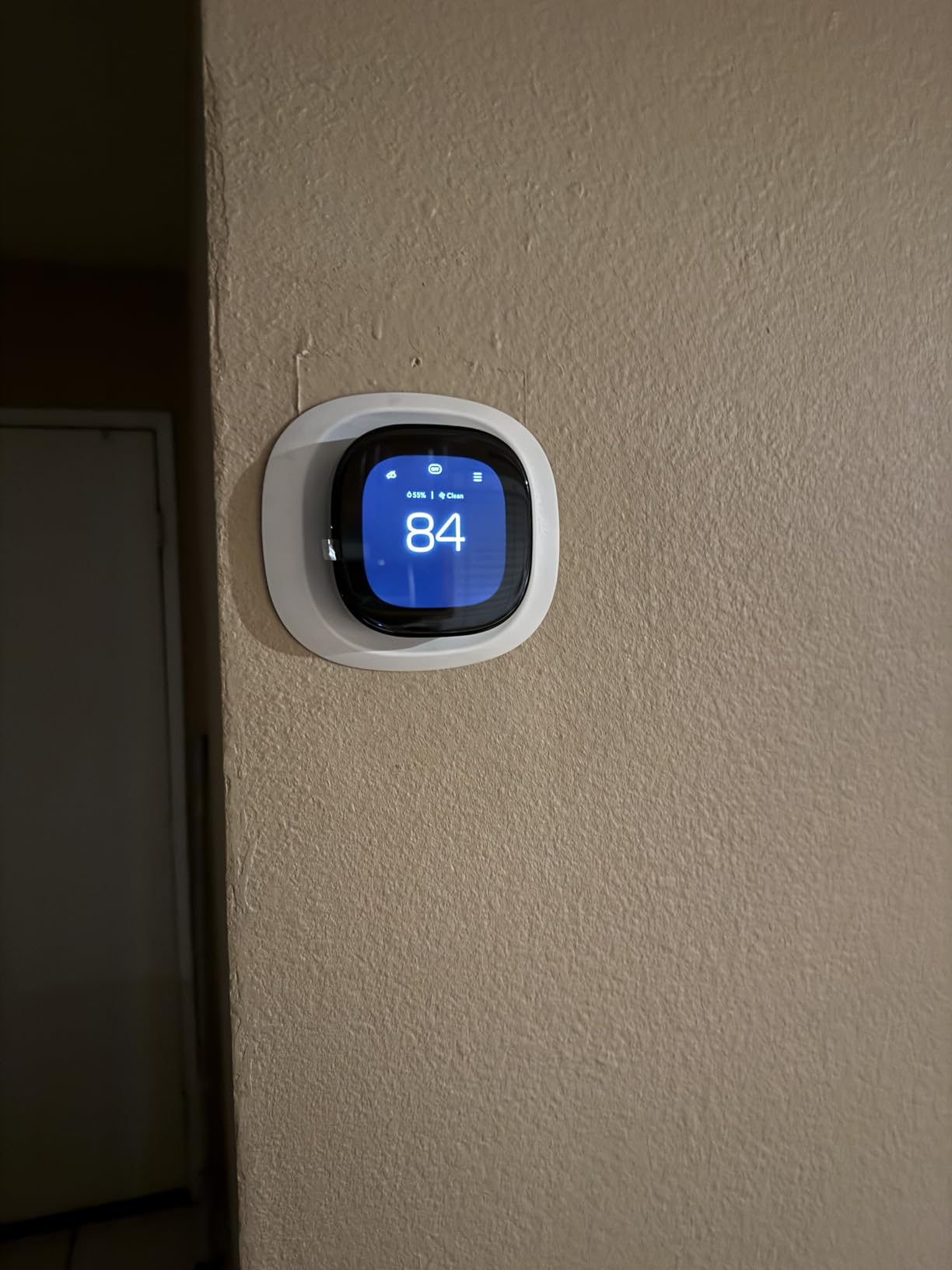
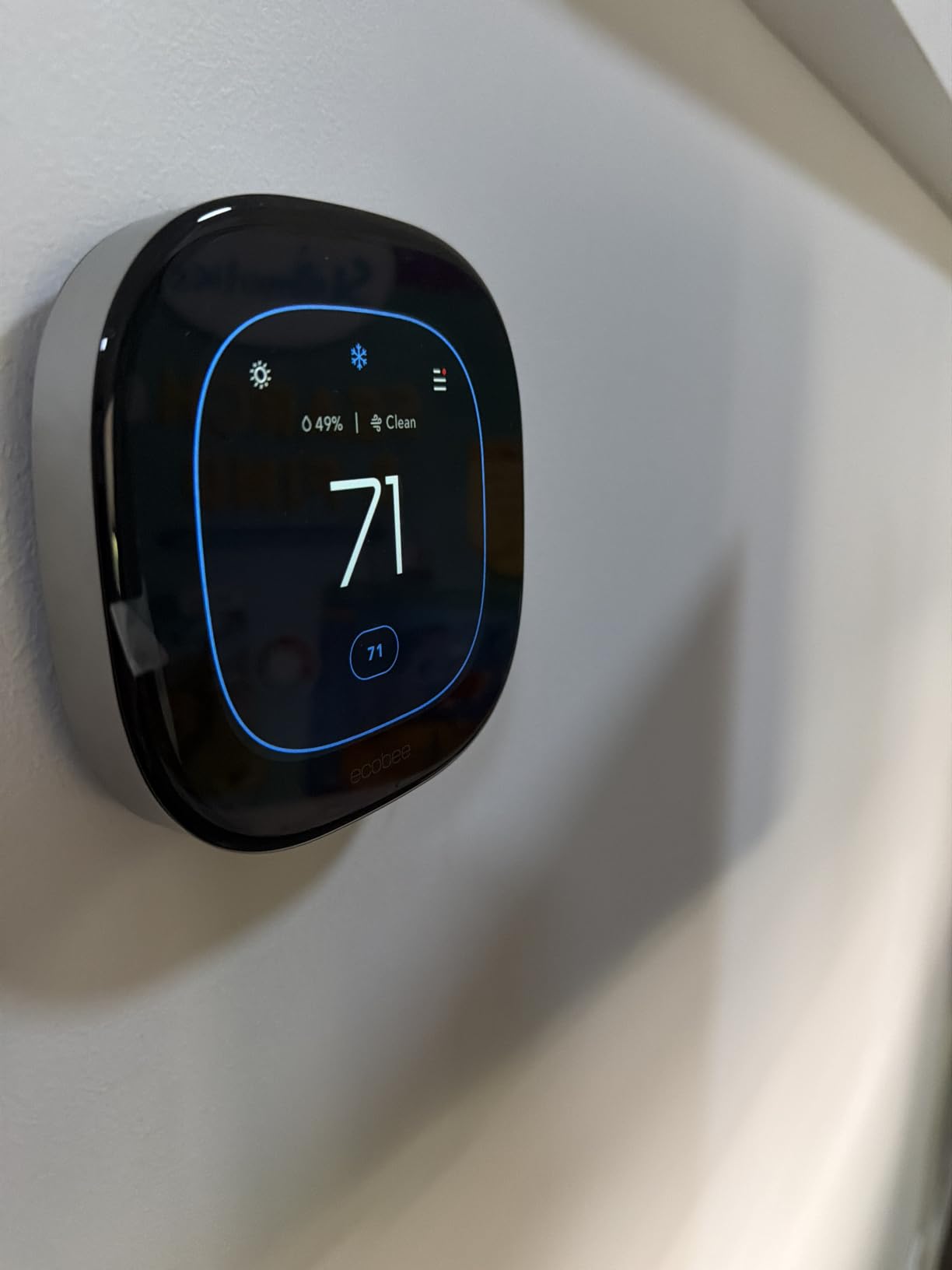
Compatibility is excellent at 95 percent of HVAC systems, and the Power Extender Kit is in the box. That matters for retrofit work, because the PEK handles homes with no C-wire without you having to open a wall. The listed uses cover air conditioner, boiler, dehumidifier, electric baseboard heater, furnace, heat pump and humidifier.
Radar occupancy sensing preheats before you arrive, and the built-in air quality monitor alerts you to filter changes and poor air. Buyers with pets or open-plan living spaces rate the occupancy behavior highly, since it removes the guesswork from morning warm-ups.
For a 3-zone home without dampers
One Premium plus two additional SmartSensors covers a typical three-zone layout. Sensors can be weighted so the room with people in it dominates the average, and the occupancy sensor can veto heating an empty bedroom entirely.
The trade is straightforward. Extra sensors are a separate purchase, and a full multi-room setup adds up quickly. If you already use the ecobee app, that cost is easier to justify.
For hydronic and baseboard systems
The listed uses include electric baseboard heater and boiler, so this model can run a hydronic zone where most competitors on this list cannot. Confirm your boiler controls before buying, because mixing a low-voltage boiler controller with a line-voltage zone is a wiring problem, not a thermostat problem.
Forced-air hydronic with a mixing valve is the common retrofit case, and it works as long as the zone valve is wired to the thermostat’s stage output rather than directly to the boiler relay.
3. ecobee Smart Thermostat Enhanced – Best Value for Sensor Zoning
ecobee Smart Thermostat Enhanced, Programmable Wifi Thermostat
Occupancy sensing
90% HVAC support
3 year warranty
4.09in display
Pros
- Add SmartSensors for room-by-room comfort and occupancy-based zoning
- Built-in occupancy sensing preheats before arrival
- Power Extender Kit and trim kit included
- Works with SmartThings for whole-home automations
Cons
- SmartSensors sold separately
- No built-in speaker or air quality monitor
- Compatibility excludes some high-voltage and two-stage-only systems
The Enhanced is the same sensor architecture as the Premium with the speaker and air quality hardware removed, and for a multi-zone household that is usually the smarter purchase. You are paying for the thing that does the zoning work instead of the thing that talks to you.
It rated 4.4 stars across 3,709 reviews with 74 percent five-star ratings, and the recurring owner comment is the same: easy install, reliable app, and the ability to add sensors that fixed uneven rooms. The 4-inch metal-front screen is larger than most competing units at this level, and the glossy finish reads well on a hallway wall.
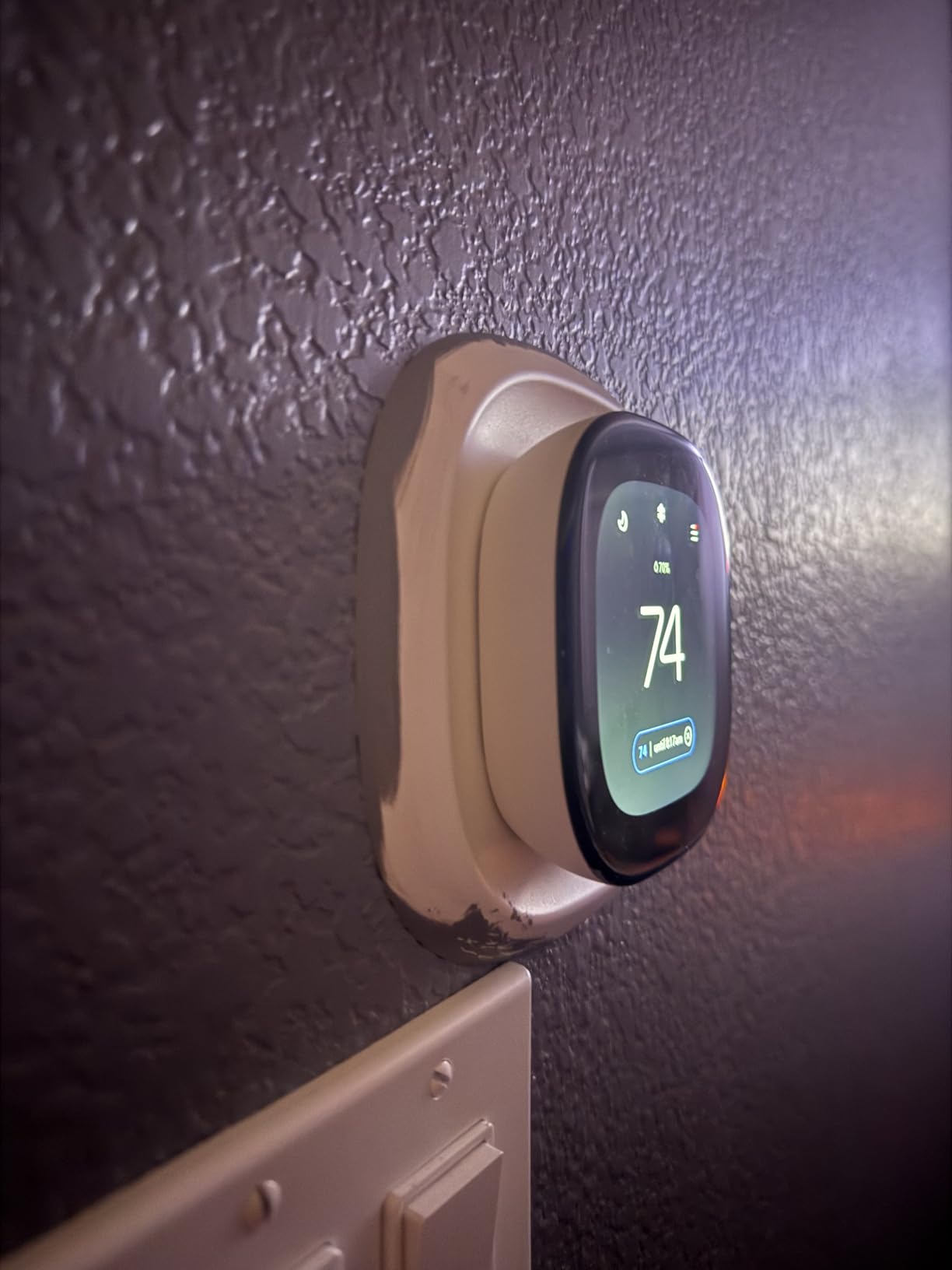
Compatibility sits at 90 percent of HVAC systems rather than 95, and it runs on the eco+ engine that uses routine, local weather and grid activity to shift preheat and precools. Listing the specific uses as air conditioner, boiler, furnace, heat pump and humidifier gives you a quick check before you buy.
Unlike the Essential, the Power Extender Kit and trim kit are included. For a 1970s four-zone retrofit with no C-wire, that is the difference between a clean install and a wall repair, and it is the main reason we rank the Enhanced above the Essential.
For a 2-zone home adding sensors later
Start with one Enhanced in the main living area, then add a sensor in the bedroom wing when you are ready. Because sensors are occupancy-aware, the bedroom can be allowed to drift a few degrees without anyone noticing while the living space stays on its schedule.
Reviewers who pair it with other connected devices report that the SmartThings support is a genuine advantage, which matters when the rest of the house is not ecobee.
For large homes with more than four zones
A single thermostat body with a large sensor network scales further than a panel full of dampers, because there is no duct rework involved. The catch is that with six or more sensors the averaging behavior can smooth out the room you care about, so you need to use the weighting controls rather than a flat average.
HomeKit, Alexa and Google Assistant all work. The 3-year manufacturer warranty is also the longest in the ecobee line we reviewed.
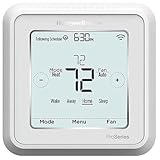
4. Honeywell Lyric T6 Pro Wi-Fi – Best for Z-Wave and Integrated Security Systems
Honeywell TH6220WF2006/U Lyric T6 Pro Wi-Fi Programmable Thermostat with Stages Up to 2 Heat/1 Cool Heat Pump or 2 Heat/2 Cool Conventional
2H1C heat pump
2H2C conventional
Z-Wave
2 AA batteries
Pros
- Multi-stage 2H/1C and 2H/2C control from a single zone panel
- Z-Wave compatibility for whole-home automation
- Compact familiar form factor
- Wi-Fi programming with app control
Cons
- No wireless room sensors so room balancing depends on dampers
- Resideo app setup can stall in contractor mode
- Modest backlit display compared with color models
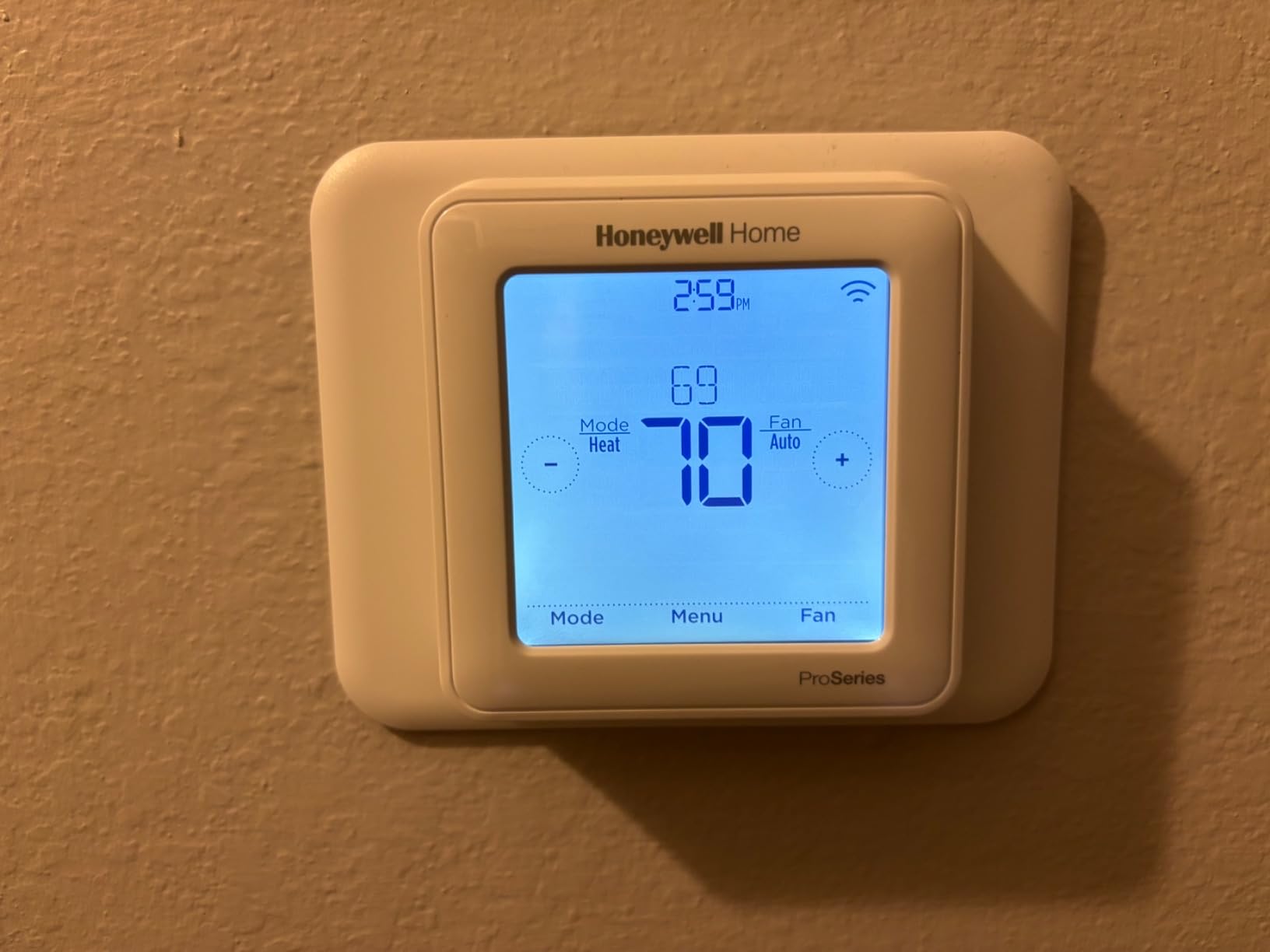
The Lyric T6 Pro is the choice when your zoned home is already inside a Z-Wave security system. Community discussions on SmartThings about two-zone systems run almost exclusively on this unit, because the Z-Wave radio is the reason it integrates where Wi-Fi-only competitors cannot.
Staging is the other reason it works in this category. Supporting up to 2 Heat / 1 Cool for heat pumps and 2 Heat / 2 Cool for conventional systems covers the majority of zoned ducted equipment, and the manufacturer specifically markets multi-stage control from one controller as a way to run a zoned system.
Reviewers rate it 4.4 across 2,659 reviews with 74 percent five-star. Reliability over long service lives comes up often, as does the comfort of the compact form factor, which is noticeably less obtrusive than the color touchscreen models.
Two AA batteries power it, which is unusual among connected thermostats and useful in zones where pulling a C-wire is inconvenient. That said, battery power means the schedule and any occupied-state logic can be interrupted, so it is not the choice for a vacation home you want to manage remotely with confidence.
For a 2-zone or 3-zone panel
It pairs with Honeywell T-series room sensors for zone balancing, but those are wired rather than wireless in most installations. For true damper-based zoning that is fine, because the panel is already handling the zone logic.
It is not the right tool for a home without dampers, since a wired sensor that averages a whole floor does not give you the room-level targeting a wireless mesh provides.
For homeowners who need setup support
One consistent complaint is that the Resideo app can sit in contractor mode and require a support call to finish setup. If your installer is handling the commissioning, this is a non-issue, but a self-installing owner should know about it up front.
The display is a simple backlit unit rather than a color touchscreen, so changing heat-to-cool mode takes a few more taps than on the Honeywell T9. For a system you set once and leave alone, that is a fair trade.
5. Google Nest Learning Thermostat 4th Gen with Temperature Sensor – Best for Google Home Households
Google Nest Learning Thermostat (4th gen) + Nest Temperature Sensor (2nd gen) – Silver
Sensor included
Matter compatible
Polished silver
No C-wire needed
Pros
- Included 2nd gen sensor fixes rooms that drift from the thermostat
- Works with any Nest Temperature Sensor for whole-home balance
- No C-wire required in most homes
- Dynamic Farsight display auto-adjusts brightness
Cons
- 4th gen backplate is incompatible with 3rd gen mounts
- Some systems show a false no-power error on the R wire without a C-wire
- Learning schedule can overshoot a fixed setpoint
The Nest Learning Thermostat is often dismissed in contractor circles for complicated systems, and that criticism is not entirely wrong. For a straight zoned ducted system with a single stage or a heat pump, though, the included second-generation temperature sensor makes it a genuinely capable zone controller.
It rated 4.4 stars across 2,603 reviews with 78 percent five-star. The most common positive theme is simple: the sensor solves the room that never matches the hallway, and the learning schedule means you stop maintaining it.
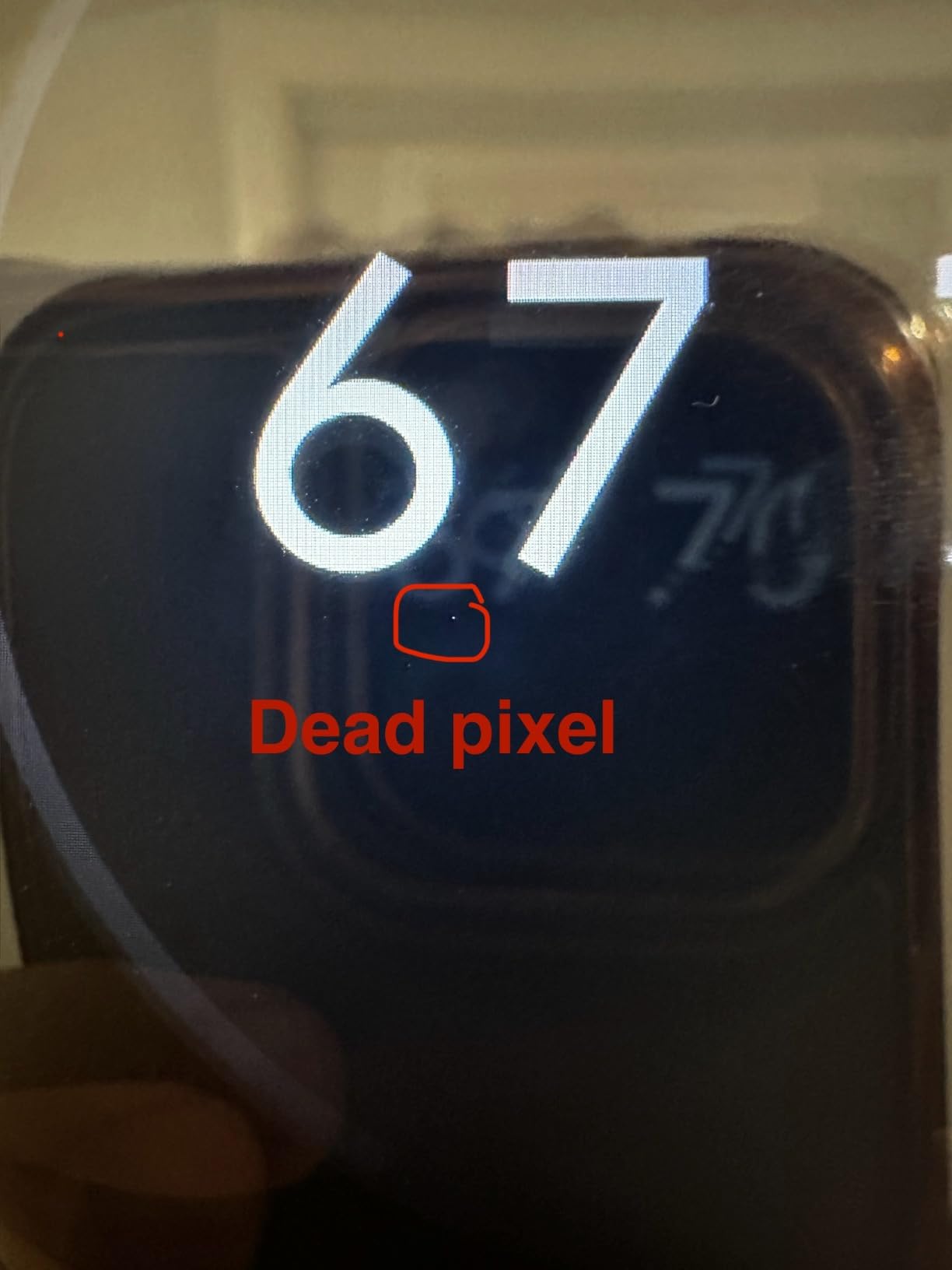
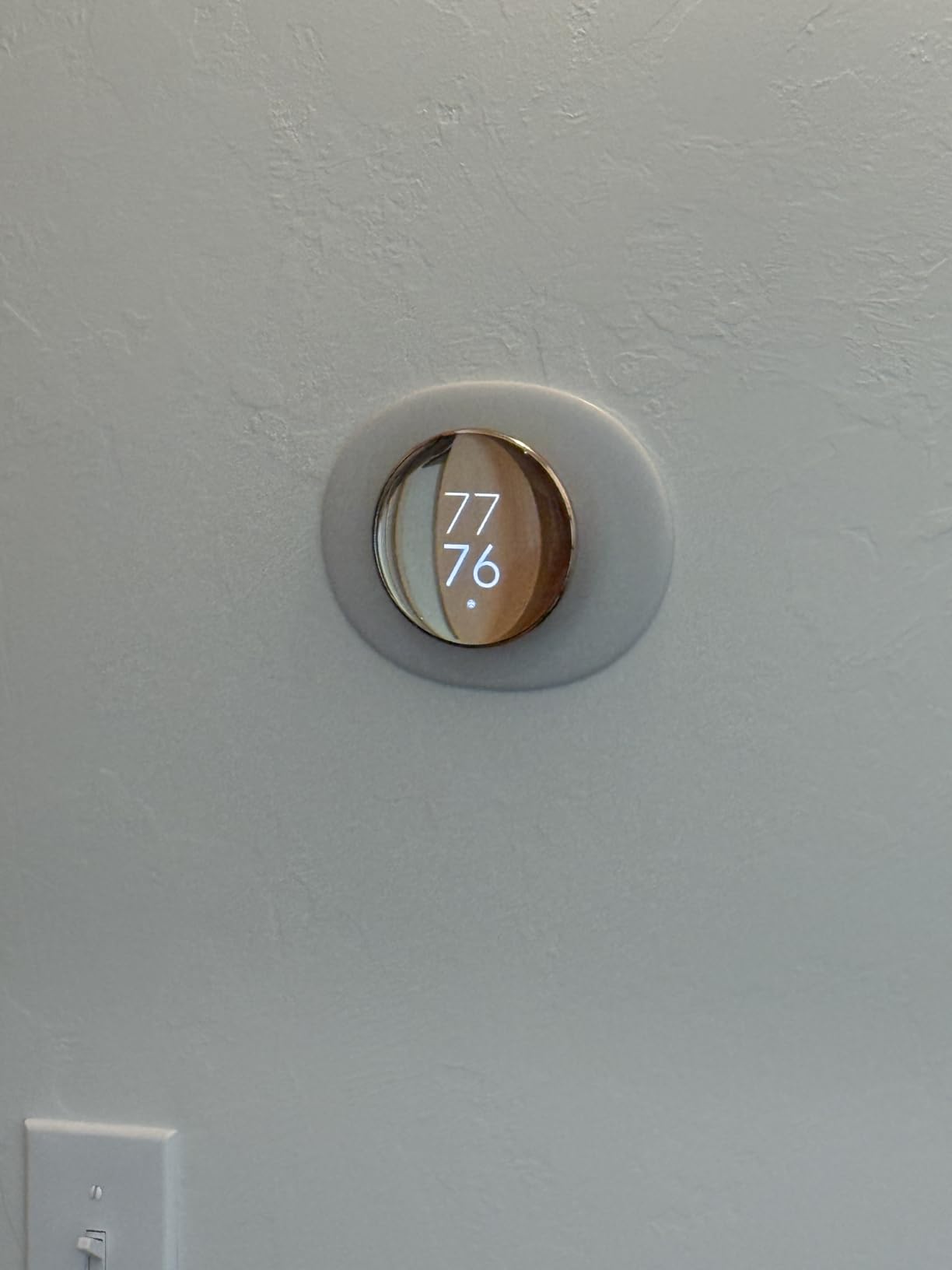
Works with most 24V systems including gas, electric, oil, forced air, heat pump and radiant, and no C-wire is required in most homes, which removes the single most common retrofit blocker. It is also the only unit here with Matter support, so it is the forward-looking choice for a home that may be standardized later.
Dynamic Farsight adjusts brightness automatically and the display is 60 percent larger than the previous generation. In a bedroom zone, people consistently mention that it can be read from across the room at night without lighting up the whole wall.
For a 2-zone home on a heat pump with electric backup
The bundle handles this well because the sensor resolves the room-level differences and the unit runs on most 24V heat pump systems. A manually adjustable maintenance band on the AC compressor cycling range is a quiet feature in variable climates, since it stops the compressor short-cycling.
Set the two zones to matching minimums if the heat pump has auxiliary strips, otherwise the strip and compressor will alternate instead of staging cleanly.
For owners upgrading from a 3rd generation Nest
This is the caveat worth reading twice. The 4th gen backplate and connector are physically incompatible with 3rd gen mounts, so an in-place swap means rewiring rather than a two-minute replacement. Some systems also report a false no-power error on the R wire when running without a C-wire.
The learning schedule is also a real behavior change. Owners who prefer a fixed hold report it overshoots the set temperature, and if you have a fixed occupancy pattern, a schedule-first unit is easier to live with.
6. Honeywell Home T9 WiFi Smart Thermostat – Best for Multi-Room Sensor Balancing
Honeywell Home T9 WiFi Smart Thermostat, Smart Room Sensor Ready, Touchscreen Display, Alexa and Google Assist
Smart Room Sensor ready
Geofencing
2 year warranty
Touchscreen
Pros
- Remote sensors can be averaged
- prioritized by time of day or triggered by occupancy
- Plug-and-play swap onto an existing Honeywell T6 wall plate
- Auto heat cool changeover plus circulate fan mode
- Works on both 2.4 GHz and 5 GHz networks
Cons
- Resideo app sometimes shows stale temperature and setpoint
- Sensor priority setting is buried in the menu
- No programmable fan schedule and only two fan speeds
- C-wire required
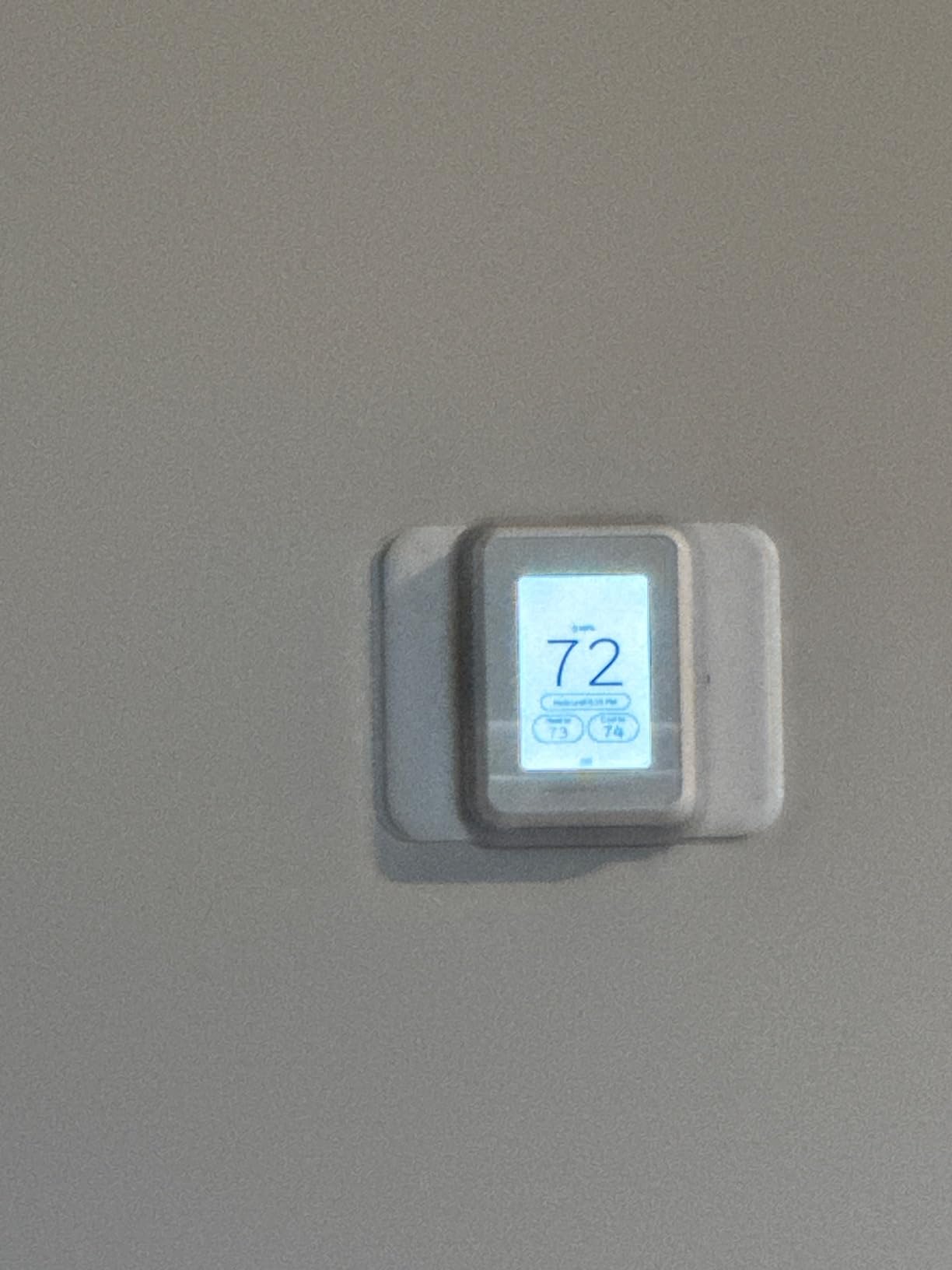
Of everything we reviewed, the T9 has the most flexible sensor logic. Smart Room Sensors can be used as pure temperature probes, averaged together, weighted by time of day, or triggered by occupancy, and that combination is what makes it a genuine multi-room solution rather than a single-room accessory feature.
In a large home with wings that pull in opposite directions, owners report using it to solve bedrooms and offices that run 3 to 5 degrees off the rest of the house. That is a wider spread than most sensor thermostats can meaningfully correct, and it is why the T9 keeps appearing in large-home recommendations.
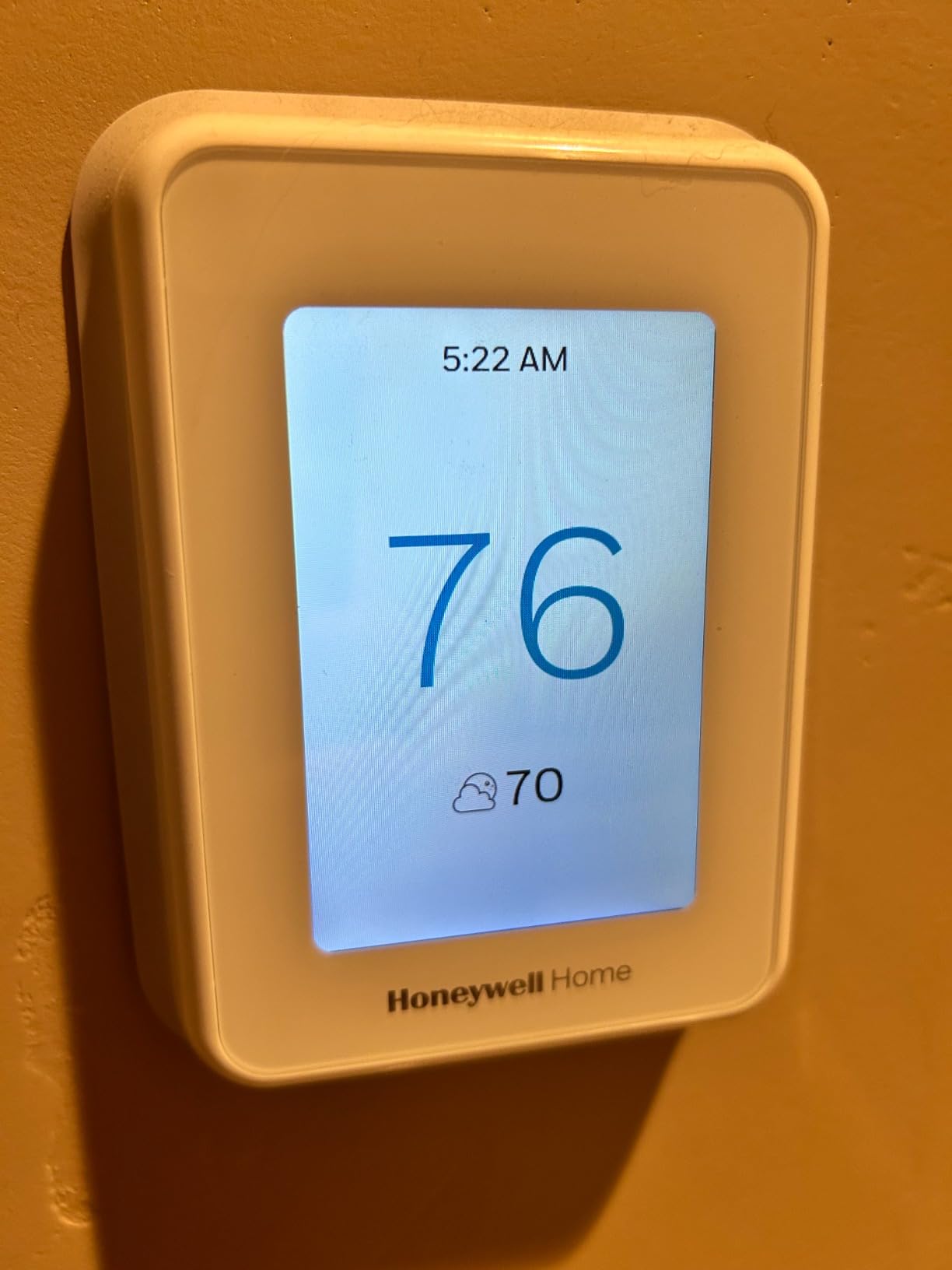
The T9 shares its UWP wall plate with the Honeywell T6, so upgrading an existing T6 install is a snap-on swap. It also works on both 2.4 GHz and 5 GHz networks, which resolves the connectivity drops that plague single-band thermostats in homes with a mesh network.
Auto changeover and a circulate mode that runs the blower part-time both help push air through the ducts, which reduces stratification between floors. For a multi-story home that is a real comfort gain, because much of what reads as a zone problem is really air sitting still.
For a 3-zone home with 3 to 4 sensors
This is the configuration that suits the T9 best. Assign sensors to time blocks so the bedroom setpoint governs overnight while the living area governs the evening, and let the occupancy trigger on one sensor override the rest.
Two practical notes. The Resideo app occasionally shows a stale inside temperature and setpoint until you restart it, and the sensor-priority control sits deep in the menu rather than on the main screen, so budget time to configure it properly the first week.
For homes with a C-wire to run
HomeKit is not on the feature list, and geofencing rather than occupancy sensing decides home versus away. The C-wire requirement is the other thing to confirm before buying, because tracking down a missing common wire in an older three-zone house is the hardest part of the job.
It works with the Ring app as well as Resideo, and the monthly energy report and utility efficiency rewards program give you a savings record to support a rebate application.
7. Sensi Touch 2 Smart Thermostat – Best for Guided DIY Installation
Sensi Touch 2 Smart Thermostat Wi-Fi, Alexa, Energy Star Certified, ST76
C-wire required
ENERGY STAR
3 year warranty
Black beveled edge
Pros
- Bluetooth guided install walks through each wiring step
- Works with Sensi Room Sensors for multi-room balance
- ENERGY STAR certified with usage reports
- Does not sell personal information to third parties
Cons
- Room sensors sold separately
- C-wire required with no pre-purchase compatibility checker
- Scheduling is app-driven rather than touchscreen-driven
The Sensi Touch 2 is the model we would hand to a first-time installer. The universal Bluetooth setup flow asks about your wires and walks through the connection one terminal at a time, and installers credit the in-app wiring guide for getting a two-stage furnace set up correctly on the first attempt.
It rated 4.3 stars across 1,252 reviews with 75 percent five-star, and owners consistently mention the responsive touchscreen and the option to pair Sensi Room Sensors for room-to-room balance. ENERGY STAR certification is listed at roughly 23 percent HVAC energy savings.
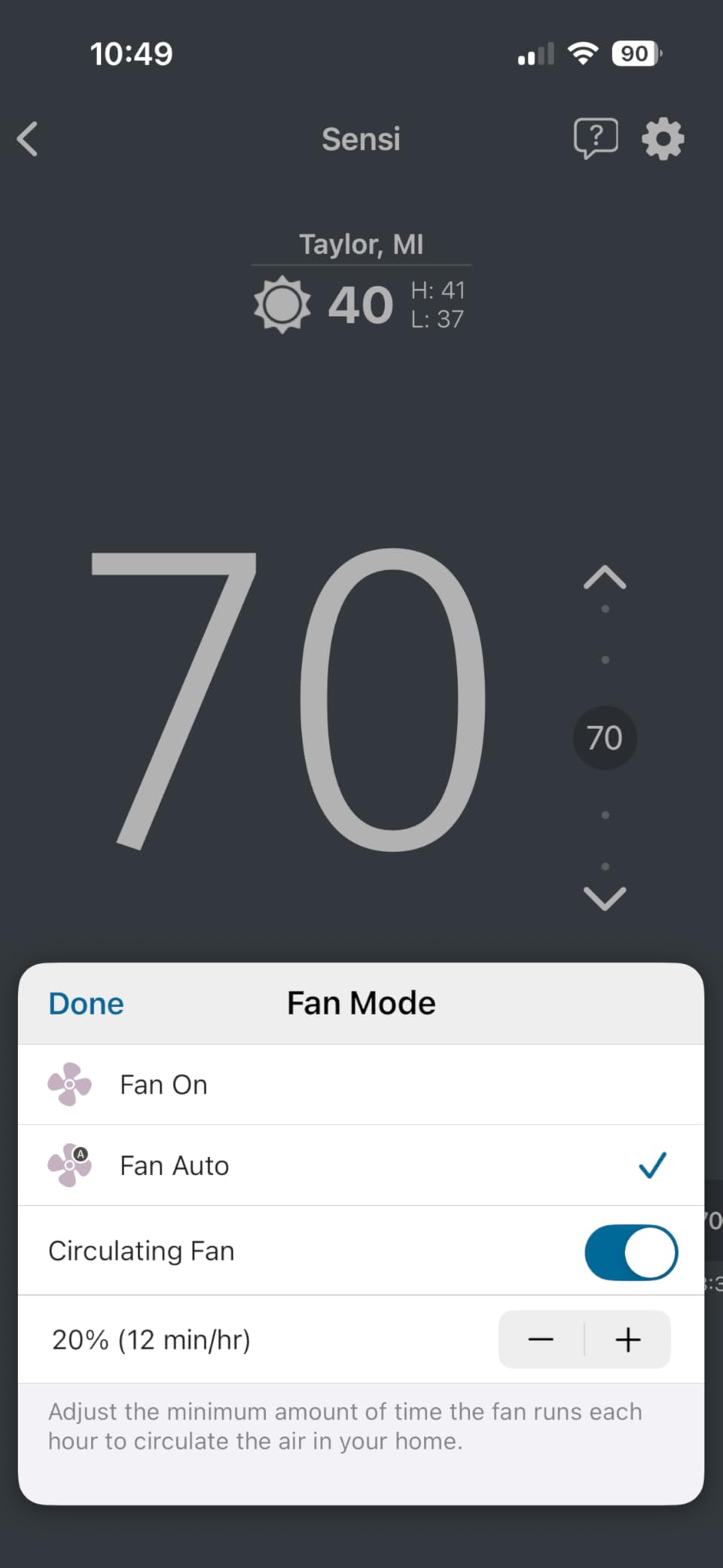
For zoned homes the relevant point is the room sensor pairing. Sensors are sold separately, so the per-zone cost adds up in exactly the way it does with ecobee, and that adds up fastest in a four-zone setup.
Maintenance features are the quiet strength. Usage reports, equipment alerts and filter replacement reminders tell you when something is drifting, and for a zoned system running unattended most of the week that is how you catch a failing damper motor before a room becomes unusable.
For hydronic and boiler zone control
The listed uses include boiler, which means this works for a hydronic zone where a Wi-Fi thermostat is paired with a zone valve. Check whether your mixing valve is thermostatic or motorised, because that determines whether the thermostat or the valve handles the water temperature.
It will not drive 120V to 240V baseboard heat, which rules it out for hydronic systems that are actually line-voltage electric. For those, the Mysa V2 later in this list is the correct device.
For homeowners who want a clear privacy stance
Sensi states it does not sell personal information to third parties, which is a meaningful difference in a category where schedule and occupancy data describes exactly when your house is empty. Anyone comfortable with that tradeoff will find the feature set complete for zoned use.
The gap to plan around is the C-wire. It is required, and Sensi publishes no tool for confirming C-wire-free compatibility before you buy, so check the wiring at each zone location first.
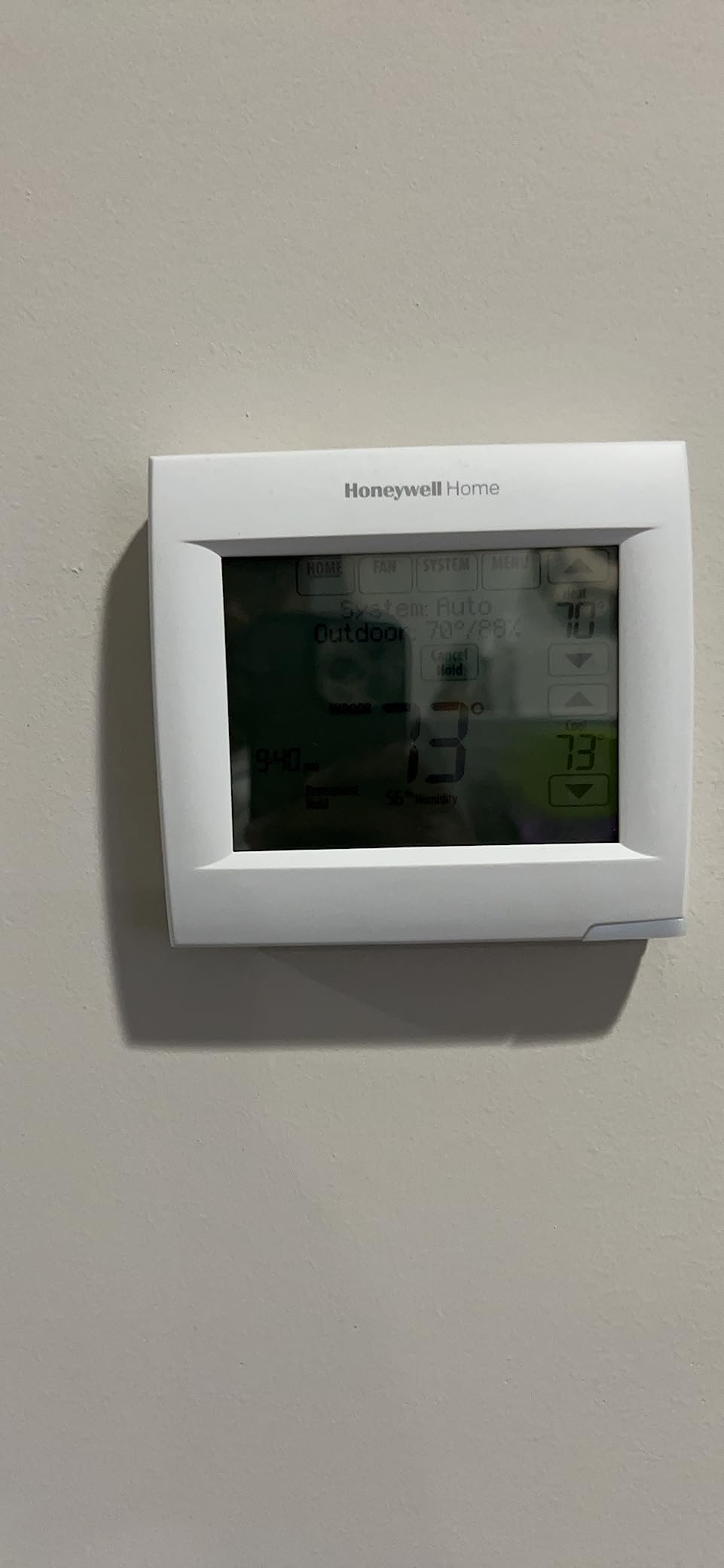
8. Honeywell Vision Pro 8000 Wi-Fi – Best for Three-Stage Zoned Systems
Honeywell TH8321WF1001 Touchscreen Thermostat Wifi Vision Pro 8000 with Stages upto 3 Heat / 2 Cool
3H2C staging
Wired remote sensor
12.8 ounces
Wi-Fi
Pros
- Supports up to 3 Heat / 2 Cool staging for large ducted zone systems
- Remote sensor input plus optional outdoor and humidity sensors
- Auto changeover removes manual heat cool switching
- Program assist learns recovery time
- Total Connect remote access is free
Cons
- Only one remote sensor input and wired sensors average together
- No wireless indoor room sensors available
- C-wire required with no battery fallback
- Setup is a long question sequence
The Vision Pro 8000 is the only unit here that handles up to 3 Heat / 2 Cool stages, and that specification is why it survives on a modern high-end zoned system when simpler thermostats stall. It rated 4.4 stars across 1,671 reviews with 76 percent five-star, and HVAC professionals in particular rate its long service reliability highly.
It is also the most capable of the wired-sensor options. Remote sensor input controls temperature from another room, an optional outdoor temperature sensor can stop a heat pump at extreme cold, and humidity control can run a whole-house dehumidifier or humidifier. For a zoned home in a humid climate, that humidity input is not a minor extra.
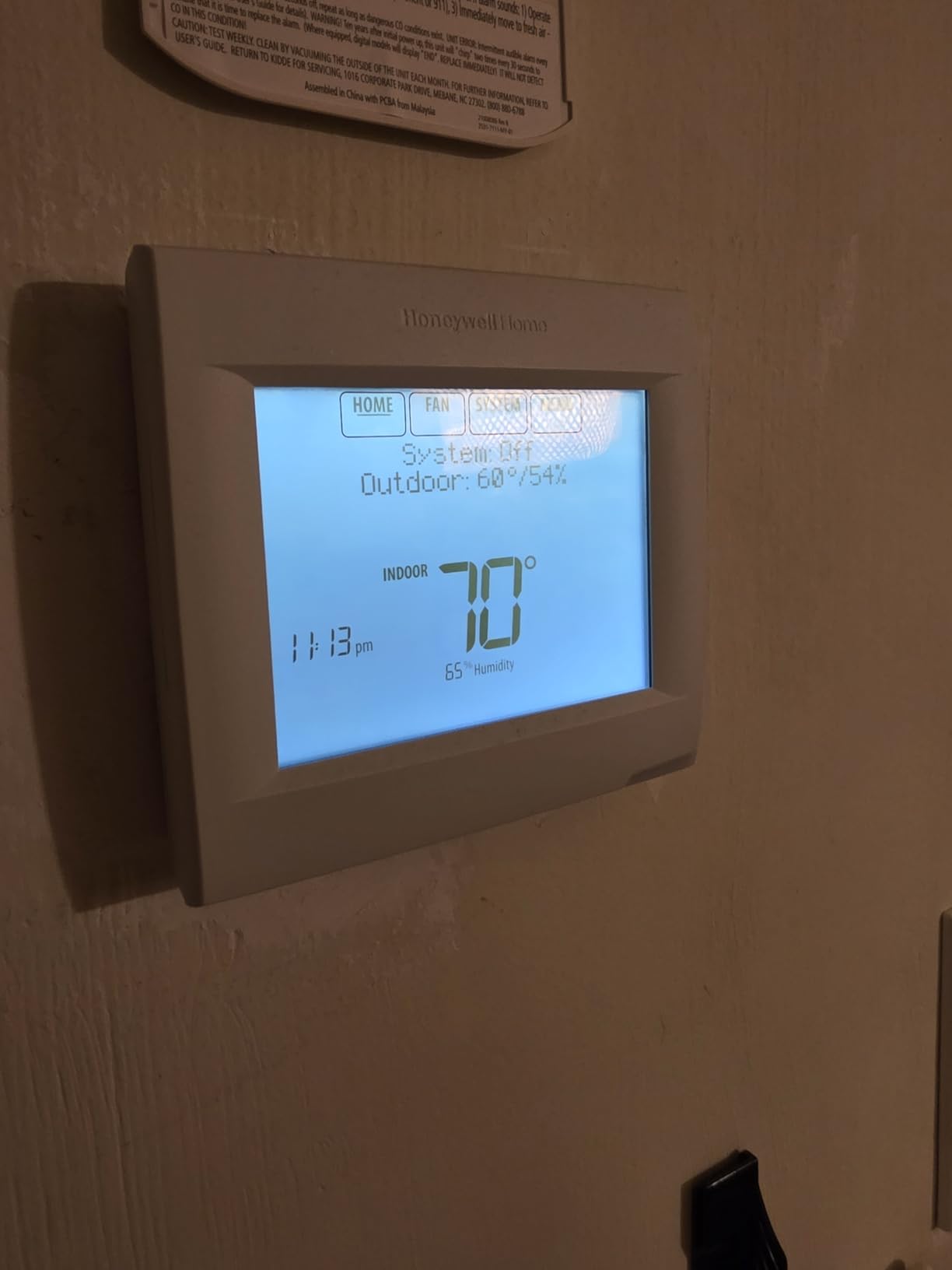
Auto changeover between heating and cooling based on set points removes the manual switching that causes dead bands on shoulder-season days. Program assist learns the system recovery time so the house reaches set point when the schedule says it should, which in a three-stage system means far less overshoot and short-cycling.
Wi-Fi remote access works through the app and a web browser with email alerts, and Total Connect access is free. That matters for a basement or rental zone you want to check on without driving over.
For large homes with 3-stage furnaces
Pairing it with a wired remote sensor in each occupied wing gives damper-based zoning the granular control that a single hallway reading cannot. Because the sensors share one input and are averaged, the placement of those sensors matters more than with wireless models, and they should go in the rooms you actually want controlled.
Two AAA batteries are listed in the specification, but the thermostat itself has no battery compartment and needs a C-wire. Treat it as a wired-only device when you plan the retrofit.
For DIY installers without HVAC experience
Be realistic about the setup. There is no auto-setup mode, and the configuration is a long guided question sequence covering staging, sensors and changeover. Set-screw terminals are sturdy, which protects the install, but a misconfigured staging assignment on a 3H2C system can send the furnace to high stage for a small call.
For a three-stage zone panel, a technician setting this once is a good use of the visit. Total Connect also gives you actual email alerts when equipment stops responding, which shortens the gap before a service call.
9. ecobee Smart Thermostat Essential – Best Budget Entry to Sensor Zoning
ecobee Smart Thermostat Essential – WiFi Thermostat, Energy Star Certified
85% system support
Color touchscreen
ENERGY STAR
3.74in screen
Pros
- Can add a SmartSensor for room temperature and motion
- Works with HomeKit Google Assistant and Alexa
- ENERGY STAR certified with claimed savings up to 23 percent
- Color touchscreen with free software upgrades
Cons
- No built-in occupancy radar
- SmartSensors and Power Extender Kit sold separately
- Lowest 24 VAC compatibility in the ecobee line at 85 percent
The Essential is the entry point into the ecobee sensor ecosystem, and for a two-zone home that means one thermostat plus one SmartSensor gets you genuine room-level control. It rated 4.2 stars across 1,887 reviews with 68 percent five-star, the lowest rating of the three ecobee models here, and the gap is explained almost entirely by missing hardware.
What you give up is the built-in occupancy radar that the Enhanced and Premium use to preheat. Without it, preheat and eco+ behavior fall back to schedule and geofencing, so a house with a variable routine gets less from this unit than a household with fixed hours.
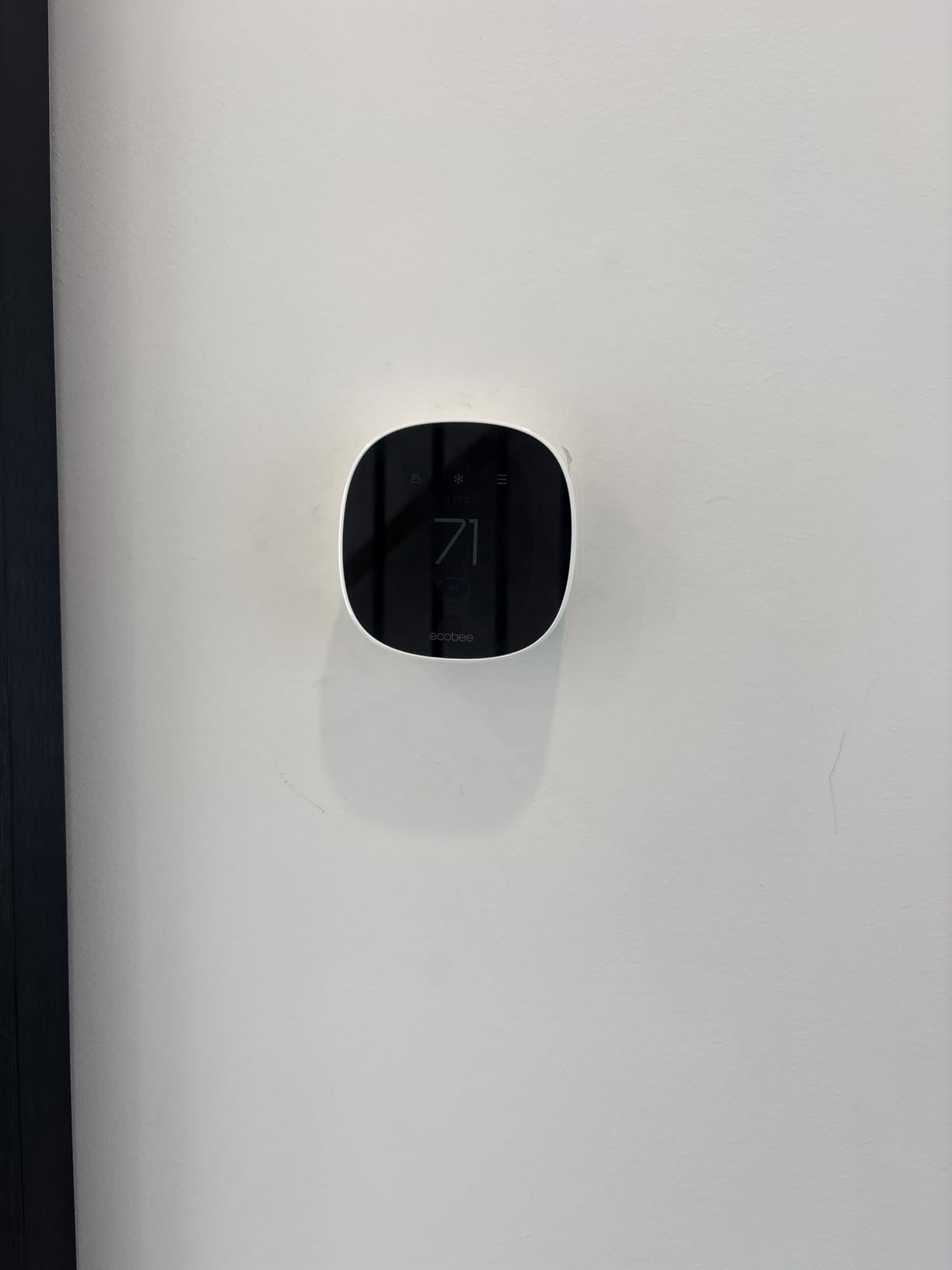
Compatibility is listed at 85 percent of systems, the lowest in the ecobee line, working with conventional 2H/1C or 1H/2C, heat pump 2H/1C and boilers. If you have an unusual staging arrangement, run the ecobee compatibility checker before ordering rather than after.
eco+ adds indoor humidity detection, a schedule assistant and time-of-use preheat and precools, which lets you warm the house during cheaper electricity windows. Free software upgrades for years of support is a genuine advantage on a budget purchase.
For a 2-zone home building up over time
Buy one Essential for the main level, then decide about sensors once you have lived with it for a season. The listed uses cover air conditioner, electric baseboard heater and furnace, and it is battery powered, which helps in older homes where wiring to each zone is awkward.
Because it is battery powered, it will keep running through a brief power cut on the schedule rather than dropping off the network entirely, which is a reasonable behavior for a zone that is not the primary one.
For households wanting HomeKit control
Apple HomeKit, Google Assistant and Alexa all work, and at this tier there is no subscription attached to the core climate functions. It is a clean fit for a home where the thermostat is one device among many rather than the center of the automation.
Just plan for the add-ons. SmartSensors and the Power Extender Kit are both sold separately here, unlike the Enhanced, so a no-C-wire three-zone retrofit costs more in accessories than the thermostat alone suggests.
10. Mysa Smart Thermostat V2 for Baseboard Heaters – Best for Line-Voltage Electric Zoning
Mysa Smart Thermostat V2 for Electric Baseboard Heaters | No Subscription | Humidity Sensor + Touchscreen | WiFi Programmable | Scheduling | Geofencing | HomeKit, Alexa, Google | 120V-240V
120V to 240V only
Up to 3800W at 240V
3.5in LED
2.4 GHz Wi-Fi
Pros
- One unit per in-wall heater gives true room-by-room electric zone control
- App-defined heating zones group rooms and run them together
- Modulates heater power instead of on off cycling
- App walkthrough asks about wire count and colors
- Tracks electricity usage and per-room heating cost
Cons
- Works only with high line voltage 120V to 240V electric heating
- Requires at least four wires including a neutral
- Wi-Fi is 2.4 GHz only
The Mysa V2 holds the highest average rating in this set at 4.5 stars across 1,295 reviews with 78 percent five-star, and the reason is that it is the only unit here designed specifically for hydronic-style electric zoning. One unit per in-wall heater means genuine independent room control, which knob thermostats never provided.
The technical distinction that matters is modulation. Rather than switching the heater fully on and off, the Mysa reduces power to hold temperature, which evens out rooms and removes the comfort swings that make baseboard heat frustrating. Owners replacing old knob thermostats report 25 to 40 percent lower usage from per-room control alone.
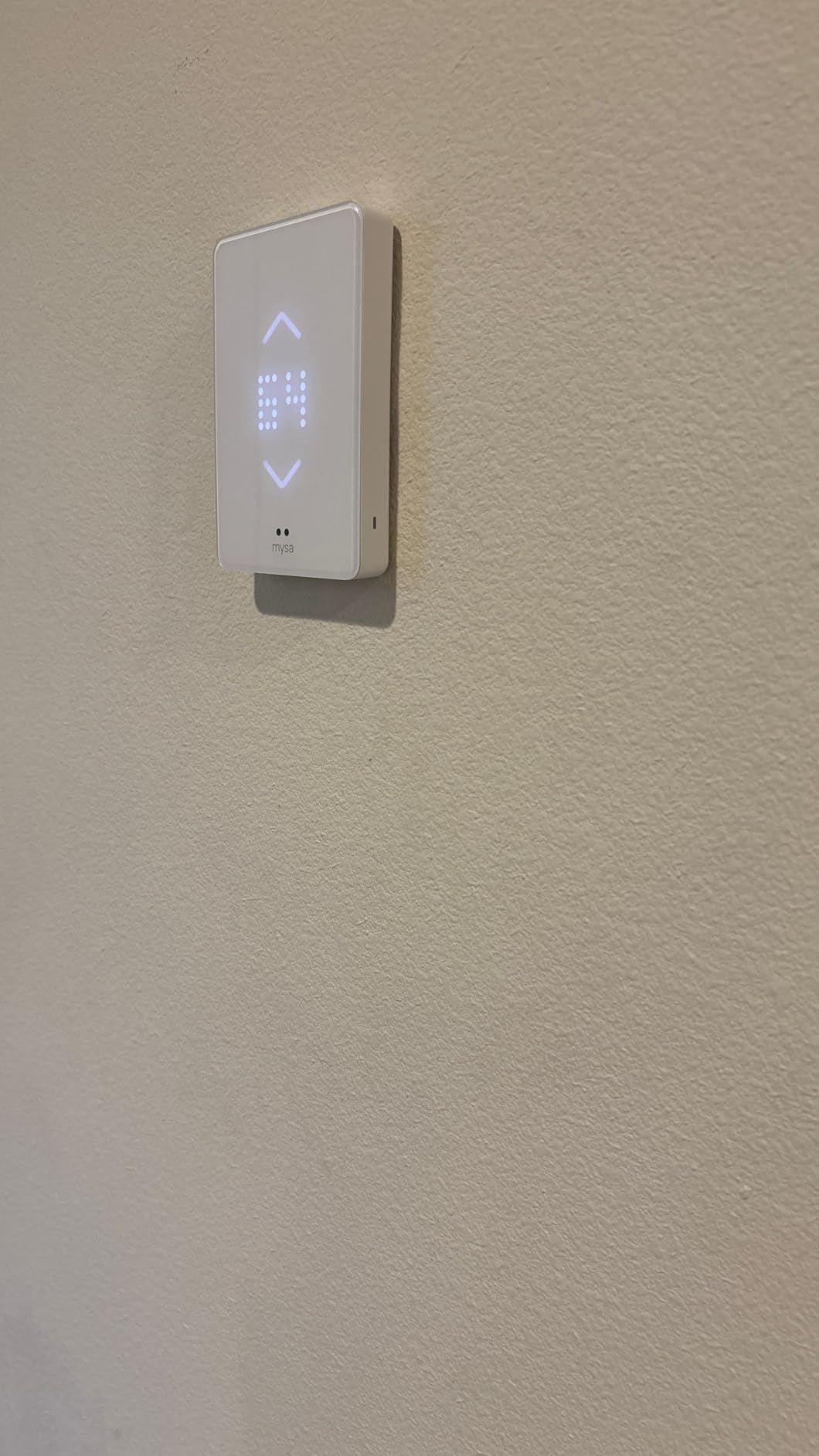
Loads run up to 1900W at 120V or 3800W at 240V, covering high-voltage baseboards, convectors, fan-forced convectors and radiant ceiling heating. The app also tracks electricity usage and per-room heating cost using a user-entered kWh price, which is unusually specific for a thermostat.
The rest of the list is 24V low-voltage equipment, and none of the other thermostats here is rated for 120V to 240V heating. If your home is baseboard or radiant, that distinction is the most important line in any spec sheet you read.
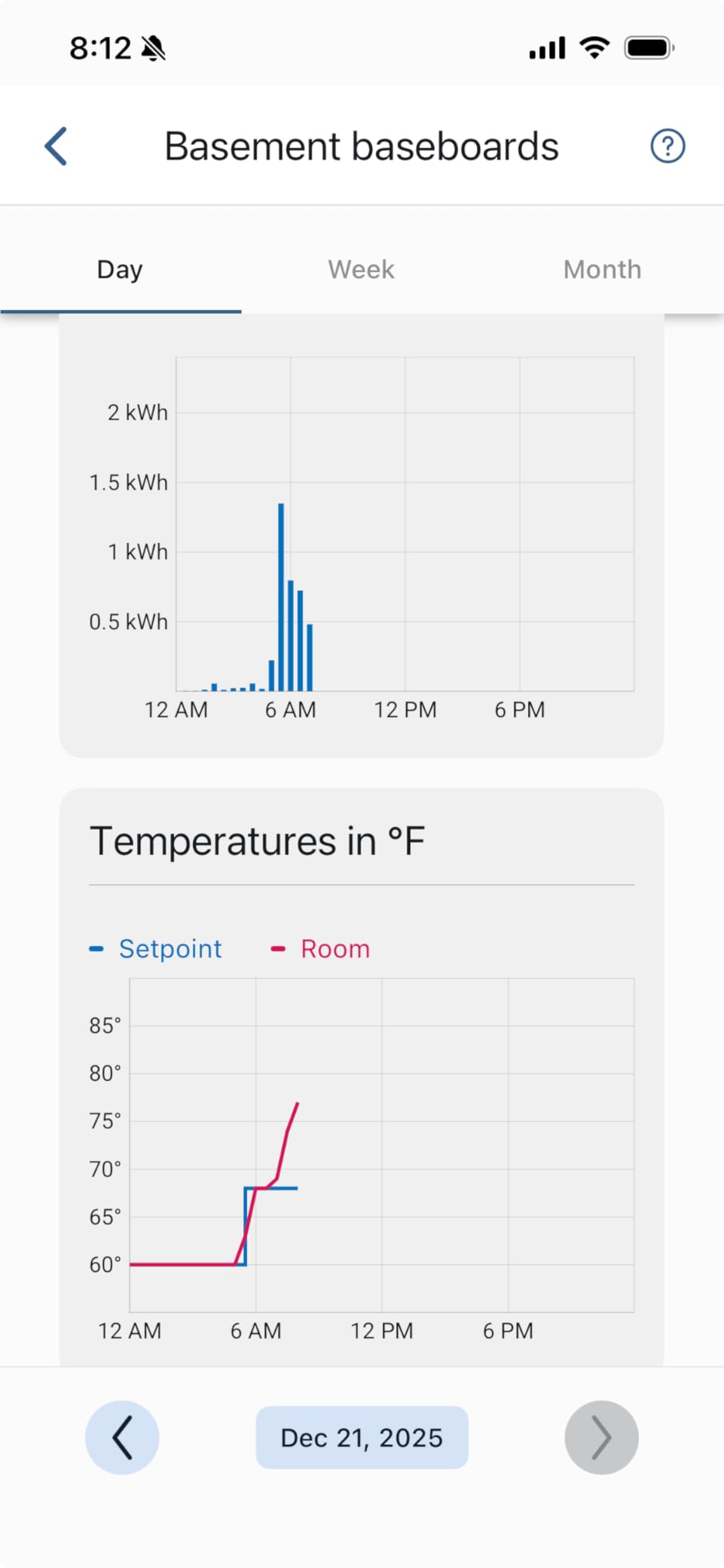
For a 4-zone baseboard retrofit
Plan for four thermostats, one per in-wall heater box, and then group them into heating zones inside the app so rooms run on a shared schedule while keeping their own setpoints. That grouping is the closest thing to damper-style zoning an electric baseboard home can get.
The install is straightforward when the wiring cooperates. The app walkthrough asks about your wire count and colors, which makes 240V wiring far less intimidating, and the housing is 40 percent smaller than the previous generation for tight baseboard niches.
For homes with 2.4 GHz-only networks
Wi-Fi is 2.4 GHz only here, so a dual-band mesh network can force you onto a separate 2.4 GHz SSID. Reviewers report the display wake-on-approach and adaptive brightness work well in dark rooms, and a few note that the display does not always dim fully at night on certain firmware versions.
App geofencing has been unreliable for some users switching to Away mode, so if your baseboard zones are empty during the day, set a schedule rather than depending on geofencing alone.
HVAC Compatibility Checklist: C-Wire, Heat Pumps, and Staging
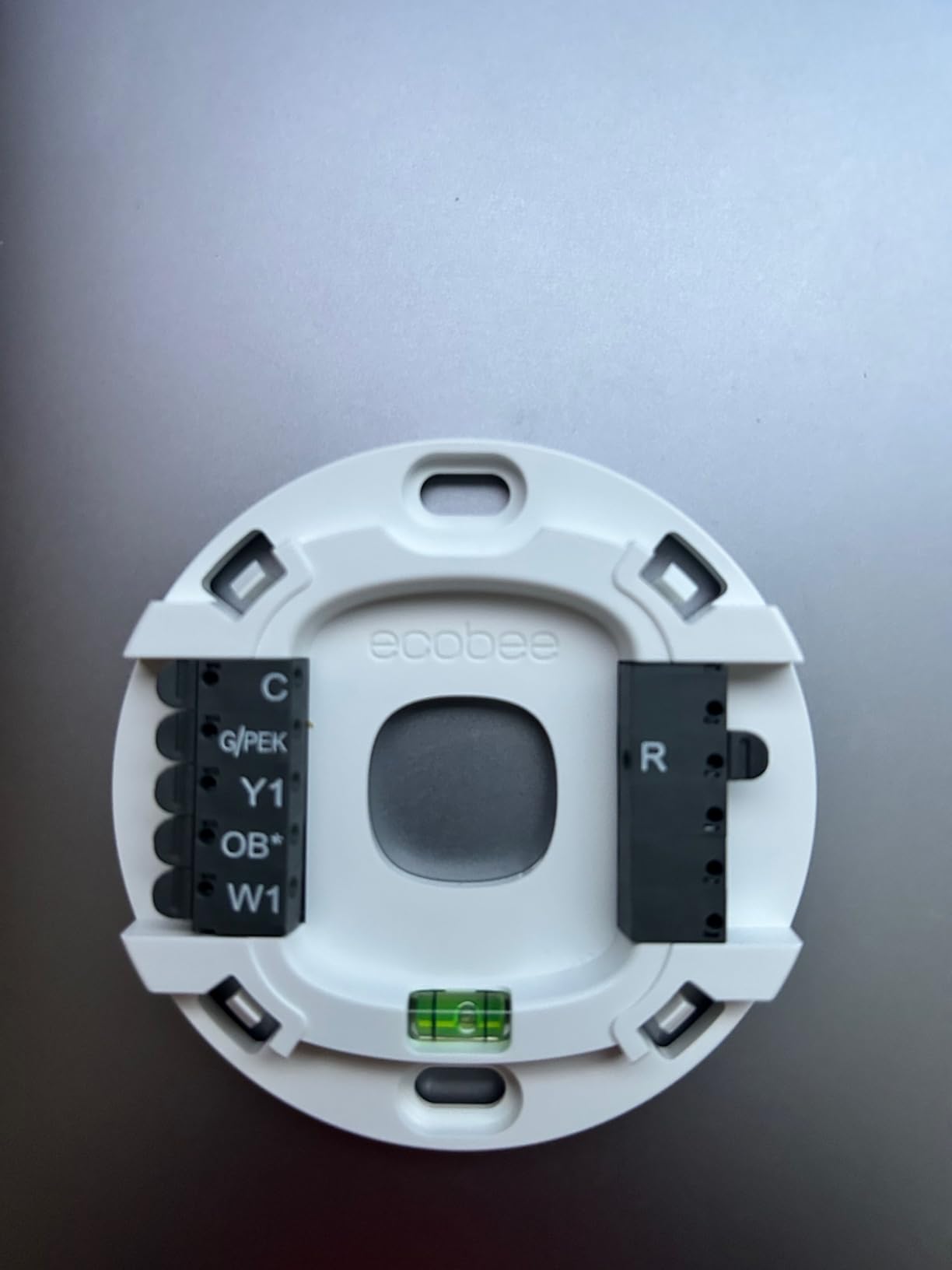
The C-wire is the most common install blocker. It is the 24V power wire from your transformer that lets a thermostat run continuously and stay connected to Wi-Fi. Without one, most units steal power from the heating circuit, which causes connection drops and battery warnings. Options are a C-wire adapter included in the box with the ecobee Enhanced and Premium, running new wire, or choosing a unit that works without one like the Nest.
Staging has to match your equipment. Single-stage calls for heat once. Two-stage uses a large and a small burner. Multi-stage adds more, and only the Honeywell Vision Pro 8000 on this list reaches 3 Heat / 2 Cool. A thermostat that cannot address your highest stage will simply never let the system use it, and a heat pump with 2H/1C control needs the right configuration or the backup strip will run instead of the compressor.
Line voltage versus low voltage decides the product. 24V low-voltage systems run standard thermostats. 120V to 240V electric baseboard heat needs a high-voltage controller like the Mysa V2, and most 24V thermostats will refuse it outright. Hydronic zones work with either, depending on whether the zone valve is motorised or thermostatic.
Heat pumps need lockout and defrost settings configured. Set the compressor balance point and auxiliary heat lockout temperature correctly, or the system will run expensive emergency heat all winter. Forum accounts from heat pump owners describe being locked into emergency heat after a misconfigured install, and the fix is a settings screen most apps do not explain.
Zone panels want a matched minimum setpoint. With auxiliary heat, if one zone is set to 62 and another to 68, the strips carry the difference and the heat pump cycles against them. Locking minimums across zones is a two-minute setting change that removes a very expensive failure mode.
Installing in Older Homes: Retrofit Wiring and DIY vs Professional
Retrofit is where multi-zone projects get expensive, and the cost is almost always wire rather than thermostats. Homes built before the 1990s frequently have a C-wire at only the main level, and a three-zone install can mean opening three walls and running a new home run back to the panel.
Before buying anything, walk to each planned thermostat location and photograph the wire labels. Note which terminals have wires and whether a blue C-wire is present. That five-minute check per zone tells you whether you need a power adapter, a full wire run, or nothing at all, and it is the cheapest part of the whole project.
Power stealing is the other hazard. Thermostats without a C-wire interrupt power to the heating circuit to stay connected, and in a large zoned system that can cause erratic heating in other zones entirely. If you must run without a C-wire, pick a unit designed for it rather than adapting one that assumes continuous power.
Our view on the DIY versus professional split is straightforward. Replacing a thermostat on an existing single-stage system, with a C-wire present, is a fair weekend project. Anything involving a zone panel, a heat pump, an outdoor lockout sensor, or a hydronic mixing valve should be commissioned by a technician, because a misconfigured stage assignment costs more than the install itself. Your home network is worth checking at the same time, and our router guide for large homes covers the mesh setups that keep thermostats from dropping off Wi-Fi.
How to Choose: Ecosystem, Privacy, and Energy Savings
Ecosystem fit matters more than feature lists in a zoned home. Alexa, Google Assistant, Apple HomeKit, SmartThings and IFTTT all appear across this list, but only the ecobee Enhanced lists SmartThings directly, and only the Nest lists Matter. A house running Z-Wave security has a very different answer from a house running HomeKit.
Sensor logic beats sensor count. A thermostat that averages four sensors is not the same as one that weights the occupied room and ignores the empty bedroom. The Honeywell T9 and the ecobee line both let you control which sensor drives the temperature, and that control is what produces real zone separation rather than a smoother average.
Cloud dependency is worth asking about. Most of these units lose scheduling and remote access during an internet outage and continue running only their last local schedule. If your zones are checked from a phone while you travel, that distinction matters, and it is one of the few questions you cannot answer from a spec sheet.
Energy savings claims are directional, not guaranteed. Manufacturers quote up to 23 to 31 percent per year, and utilities like ENERGY STAR certification add a layer of credibility. Realistic outcomes depend on how badly your zones were unbalanced before. If a third floor has been running four degrees hot for years, correcting that produces the savings. If your zones were already balanced, a smart thermostat mostly adds convenience.
Check for local incentives before you buy. Utility rebate programs, ENERGY STAR listings and the DSIRE database track what is available in your area, and some programs require the thermostat to be ENERGY STAR certified, which narrows the field but can offset a meaningful part of the hardware cost.
Frequently Asked Questions
Do smart thermostats work with zoned systems?
Yes, smart thermostats work with zoned systems, but how they work depends on your equipment. Homes with a zone control panel and motorized duct dampers need one smart thermostat per zone, because each thermostat issues a real hardware command to its damper. Homes without dampers use virtual zoning instead, where one thermostat pairs with two to four wireless room sensors to average or weight temperatures across occupied rooms.
Do I need a smart thermostat for each zone?
With physical damper zoning, yes: one thermostat per zone, mounted in the space that zone controls. With virtual zoning, no: one thermostat plus two to four room sensors handles up to three or four areas. Sensor-based models such as the ecobee Smart Thermostat Premium and the Honeywell T9 are designed to drive comfort from the sensor locations rather than the thermostat location.
What smart thermostat can control multiple zones?
Products with wireless room sensors control multiple zones from a single thermostat body. The ecobee Smart Thermostat Premium ships with one SmartSensor and scales to a full network, the Honeywell T9 supports sensors averaged, time-weighted or occupancy-triggered, and the Sensi Touch 2 pairs with Sensi Room Sensors. For physical damper zones, any compatible model works when paired with a zone control panel.
Why do HVAC guys hate Nest thermostats?
Contractors object to the Nest for two main reasons. First, the 4th generation backplate and connector are incompatible with 3rd generation mounts, so an upgrade is a rewiring job rather than a swap. Second, the learning schedule can overshoot a fixed setpoint, which is unhelpful on a heat pump with auxiliary heat where you need the unit to hold a minimum setpoint for staging. For a simple single-stage or heat pump system with the included sensor, it works well.
Is multi-zone heating worth it?
In homes where one thermostat cannot hold temperature across floors or a finished basement, zone control usually pays for itself through comfort and through avoiding heating or cooling empty rooms. The savings come from fixing an imbalance, not from the thermostat itself. A thermostat in a well-balanced single-zone home mostly adds scheduling convenience rather than a large reduction in energy use.
Can one thermostat control multiple zones?
Yes, when zones are virtual. One thermostat with multiple wireless room sensors can maintain different target temperatures in different rooms by weighting occupied spaces and ignoring empty ones. One thermostat cannot independently control true damper zones, because each damper needs its own call for heat or cooling, so a two-zone panel still requires two thermostats.
Conclusion: Which Multi-Zone Thermostat to Buy in 2026
For a home with a working zone control panel, the Honeywell Home RTH9600WF is the pick. It covers the widest range of forced air, steam and heat pump equipment on this list and has the deepest review history behind it. For a home without dampers where rooms drift apart, the ecobee Smart Thermostat Premium with two extra SmartSensors does the most work per unit, and the ecobee Smart Thermostat Enhanced is the smarter version of that purchase if the speaker and air quality monitor do not earn their cost.
Check the C-wire at every zone location before you order, and match the thermostat to your staging rather than the other way around. Whatever you choose, the best smart thermostats for multi zone homes are the ones that solve the specific imbalance in your house, not the one with the longest feature list.