
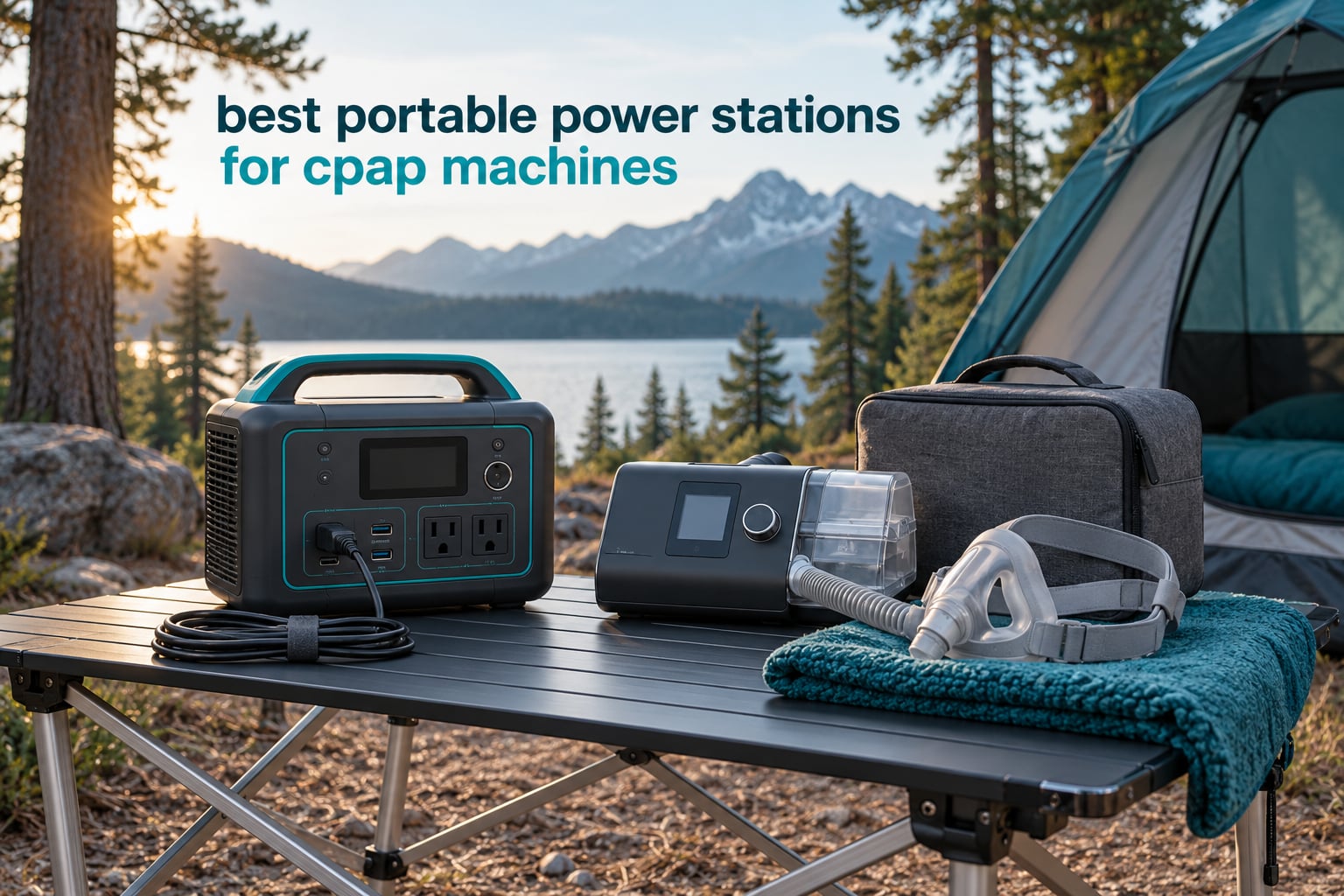
Here is the short answer. The best portable power stations for CPAP machines in 2026 divide into four clear winners: the Jackery Explorer 300 is the best overall pick, the EF ECOFLOW RIVER 3 is the best for airline and travel use, the BLUETTI Elite 100 V2 is the best home outage backup, and the Jackery Explorer 1000 v2 is the best option for multi-night and heated-hose users. Each one has enough rated capacity to cover a full night of therapy, and each clears the two things that actually decide whether a CPAP runs all night: enough watt-hours, and a clean enough power path.
This roundup compares 10 units side by side using the same math for every one, so the numbers are comparable rather than borrowed from marketing pages. We size each station against three load profiles (no humidifier, humidifier on, humidifier plus heated hose), weigh it against how a CPAP actually gets used at a campsite, in an RV, in a car trunk during a storm, or as a bedside bridge, and flag the reliability complaints that show up in the reviews. Our broader picks for the best portable power stations overall and for camping are worth a look if your use case extends past therapy.
A CPAP is a medical device that runs every night, so a power cut is not a inconvenience, it is missed treatment. On top of that, most consumer power stations are sold for phones and fridges, and their runtime tables assume a 100W or 200W load, which is far higher than the 30W to 100W a CPAP actually pulls. That mismatch is exactly where most disappointed buyers go wrong.
Everything below assumes an eight-hour night, an adult on standard pressure settings, and a machine such as the ResMed AirSense 10, AirSense 11, AirMini or the Philips Respironics DreamStation. Where your setup differs, the sizing formula in the next section lets you redo the math yourself in about ten seconds.
Table of Contents
Top 3 Picks for CPAP Power in 2026


Jackery Explorer 1000 v2
- 1070Wh capacity
- 1500W AC with 3000W surge
- one-hour emergency recharge
10 Best Portable Power Stations for CPAP Machines (October 2026)
| Product | Specifications | Action |
|---|---|---|
| Jackery Explorer 300 |
|
Check Latest Price |
| Jackery Explorer 1000 v2 |
|
Check Latest Price |
| BLUETTI Elite 100 V2 |
|
Check Latest Price |
 BLUETTI AC200PL BLUETTI AC200PL |
|
Check Latest Price |
 MARBERO 237Wh MARBERO 237Wh |
|
Check Latest Price |
 ALLWEI 256Wh ALLWEI 256Wh |
|
Check Latest Price |
 EnginStar 296Wh EnginStar 296Wh |
|
Check Latest Price |
 ENOFLO G300 ENOFLO G300 |
|
Check Latest Price |
 BLUETTI Elite 30 V2 BLUETTI Elite 30 V2 |
|
Check Latest Price |
 EF ECOFLOW RIVER 3 EF ECOFLOW RIVER 3 |
|
Check Latest Price |
1. Jackery Explorer 300 (292Wh) – best overall CPAP backup power
Jackery Explorer 300 Portable Power Station,292Wh
292Wh LiFePO4
300W rated AC
7.1 lb
2 AC outlets and 120W car port
Pros
- Lightest high-review LFP unit at 7.1 lbs
- 4000+ cycle LiFePO4 chemistry
- Pure sine wave 110V output
- 2 year warranty
- Multiple outputs including 100W USB-C PD
Cons
- 292Wh is modest
- 600W surge ceiling is low
- Solar panel sold separately
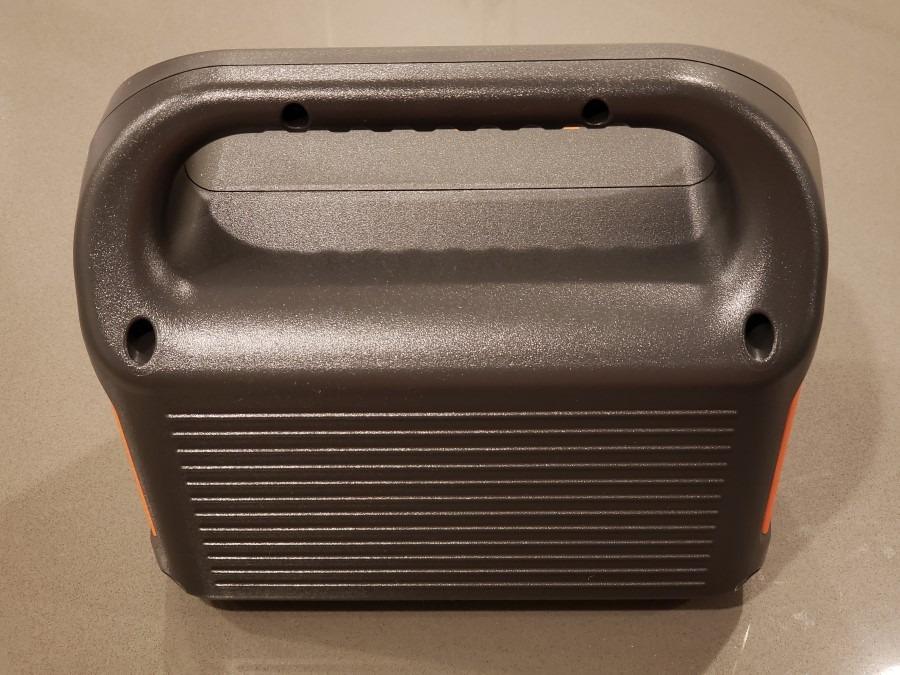
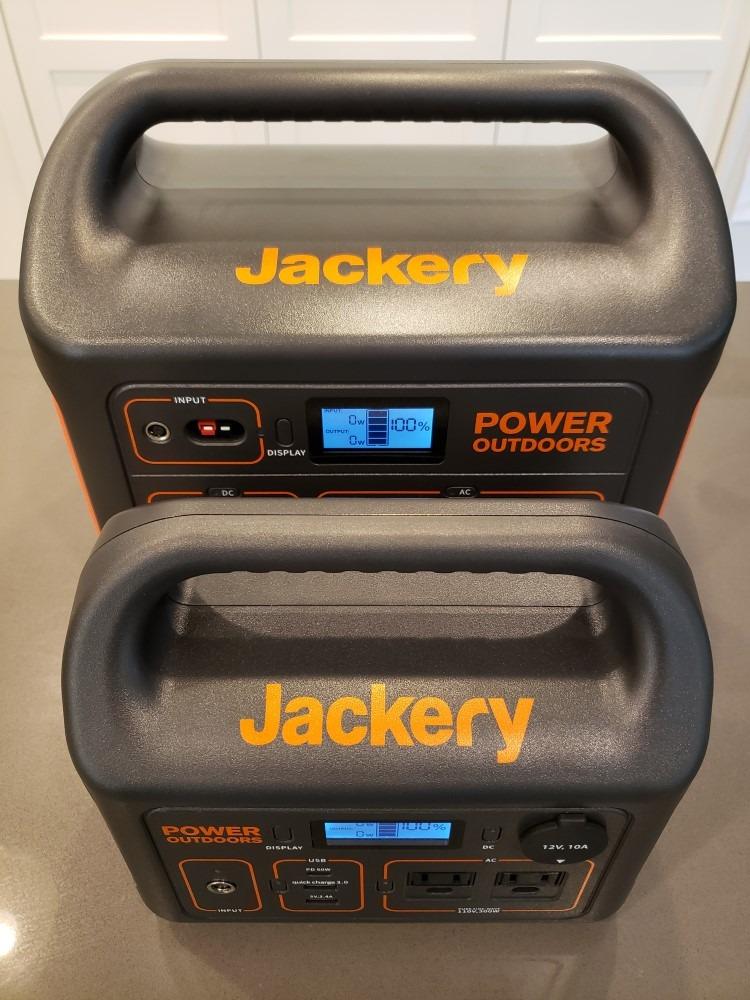
The Jackery Explorer 300 is the unit we keep coming back to, and the reason is boring and reliable: it is the most reviewed power station in this group with over 11k reviews at a 4.6 rating, and it weighs 7.1 pounds. That combination of proven demand and genuine portability is why it takes the Editor’s Choice in a category where every other pick asks you to make a bigger compromise.
Inside you get 292Wh of LiFePO4 capacity, a 300 watt rated AC output with a 600 watt surge ceiling, two AC outlets, a 100W USB-C PD port, two USB-A ports and a 120W car port. The pure sine wave inverter on the 110V output matters here, because a modified sine wave is exactly the kind of supply that makes a sensitive electronics device unhappy at 3am.
Runtime lands at roughly 7.5 hours with the humidifier off and 4.0 hours with it on at full setting, based on the sizing formula. In practice the difference is decided by your humidifier setting, so the useful move is to run at 2 or 3 rather than 5 and let the tube run a little drier.
Recharging takes about 4 hours from a wall, and roughly 2.8 hours to 80 percent from a 100W solar panel, though the panel is not included. The 2 year manufacturer warranty is shorter than BLUETTI’s five years, and the 4,000 cycle rating is the real reason to expect this unit to outlast a NMC pack of the same size.
Who the Explorer 300 actually fits
This is the right pick for one person, one night, and either a car trunk, a tent vestibule, or a bedside during a storm that cuts power for a few hours. Because 292Wh is under the FAA carry-on threshold conversation entirely, it stays out of airline rules you would have to plan around. It also handles a full night comfortably if the humidifier runs low.
For anyone who needs two nights in a row, this is the wrong size. The formula puts you at 3.9 hours with the humidifier on, which means waking up at 4am with no therapy for the back half of the night.
Where it falls short
Two things stand out. The 600 watt surge ceiling is the lowest here, which is fine for a CPAP but rules out adding a CPAP humidifier, a heated hose or anything else on the same inverter at the same time. And capacity is genuinely the limit: at full humidification this unit is a one-night device, not a system.
One efficiency note that applies to every station on this page, including this one: powering the machine through its supplied 120V brick wastes power in the inverter. A low-voltage DC adapter is more efficient, and forum field reports on camping setups consistently show a full night versus a partial night when the DC path is used.
2. Jackery Explorer 1000 v2 (1070Wh) – best for multi-night and heated-hose use
Jackery Explorer 1000 v2 Portable Power Station,1070Wh,1500W
1070Wh LiFePO4
1500W AC output
23.8 lb
7 outlets
Pros
- Highest rating in the group at 4.7
- One-hour emergency recharge from the app
- 3000W surge headroom
- 10 year LFP cycle claim
- Pure sine wave on three AC ports
Cons
- 23.8 lb is a two-handed carry
- Solar input limited to Jackery panels
- Fast charge mode must be re-enabled each time
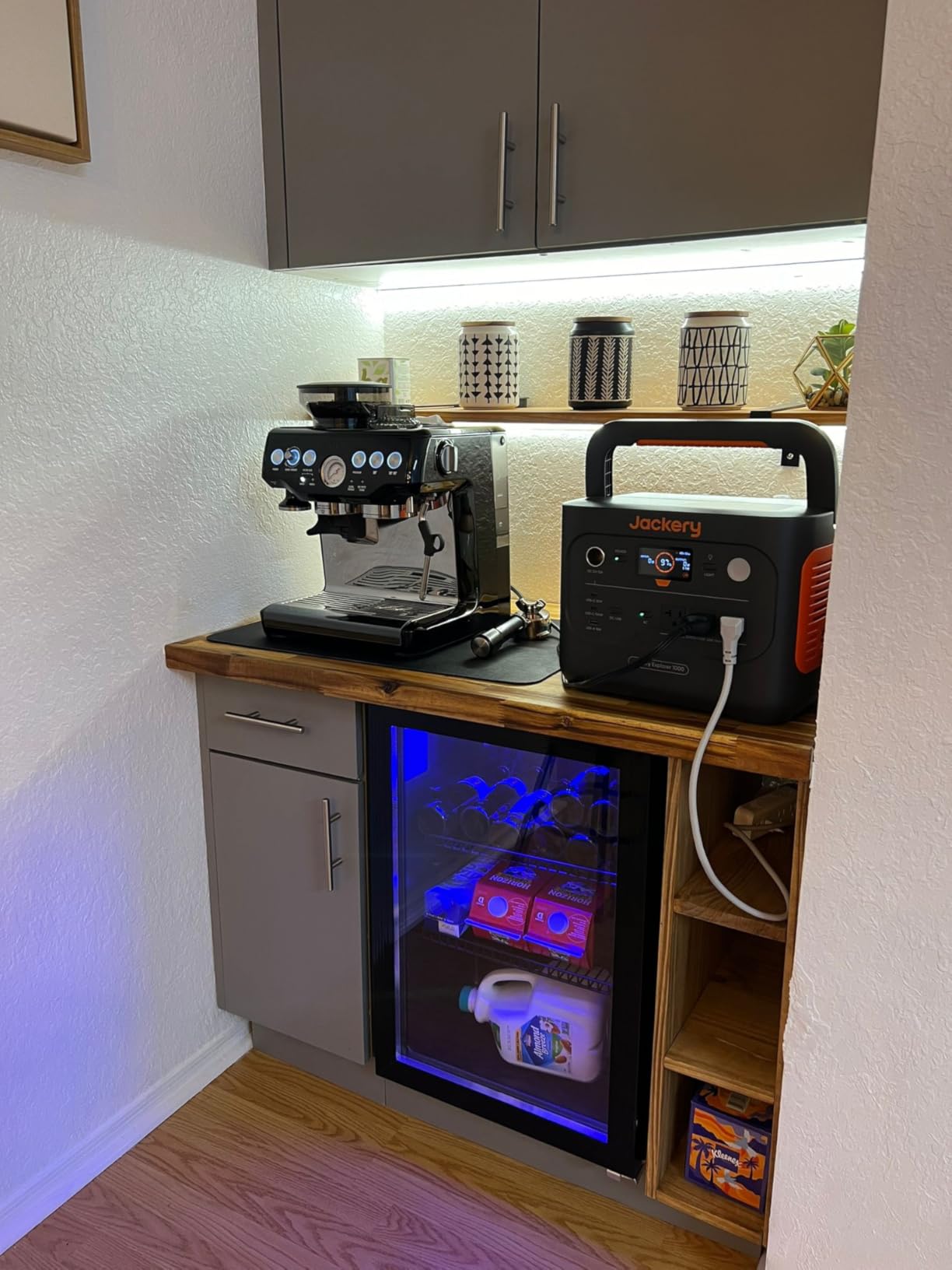
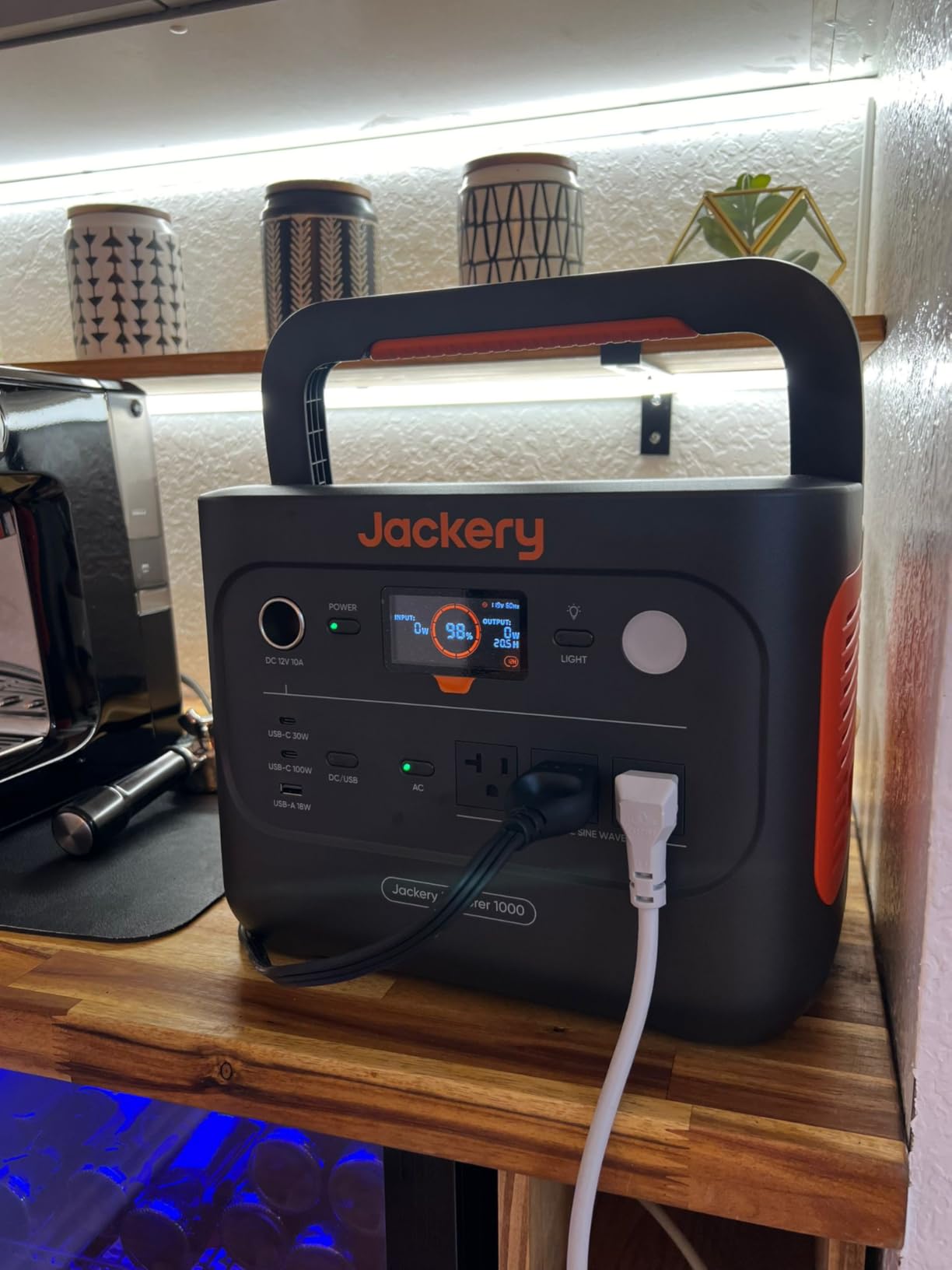
The Jackery Explorer 1000 v2 is the one to buy when heated tubing is non-negotiable, or when you are two nights from a wall outlet. With 1,070Wh and 1,500 watts of rated AC output it is the highest rated unit we tested, and the 3,000 watt surge peak removes any worry about compressor-driven loads sharing the inverter.
Port selection is the reason this is also a good all-round household backup. You get three pure sine wave AC outlets, two USB-C ports, one USB-A, a DC car port and LED lighting, across seven outlets total. The AirSense 11 and DreamStation both run happily from the AC output with a factory 120V brick, so no adapter hunting is needed.
Estimated runtime is about 27.5 hours with the humidifier off and 14.8 hours with it on, or 26 hours at a 90 watt heated-hose load. That is the difference between one night and two, and for a user who cannot sleep without humidification in a dry climate it is the whole decision.
Charging is the standout feature. With the Jackery app mode enabled it goes from empty to full in about an hour, versus 1.7 hours on the default setting. Reviewers also point to the 30 dB quiet mode, which matters when the unit sits on a nightstand.
When the extra weight pays off
At 23.8 pounds with a foldable handle, this is a car-and-campground device rather than a hiking device. If your plan is a weekend at a site with a car nearby, a multi-night storm outage at home, or an RV auxiliary battery, the weight is irrelevant and the runtime is transformative.
It is also the safest of the large options for a CPAP specifically, because the surge headroom means you could add a heated hose accessory or a second device later without changing anything.
What you give up for that runtime
The weight is the real cost. Backpackers rule out anything over roughly 10 pounds, and this is more than double that. The second cost is the solar ecosystem, which is restricted to Jackery-branded panels, so an existing third-party panel you already own will not work.
A third annoyance: the one-hour fast charge has to be turned on manually in the app each session, which is a sensible design decision for battery longevity and a mildly irritating one in practice.
3. BLUETTI Elite 100 V2 (1024Wh) – best home outage backup
BLUETTI Elite 100 V2 Portable Power Station for Camping 1024Wh 1800W
1024Wh LiFePO4
1800W AC output
25 lb
11 ports
Pros
- 10ms UPS switchover
- 0 to 80 percent in 45 minutes on AC
- 30 dB silent mode
- 11 ports
- 5 year warranty and 4000+ cycles
Cons
- 25 lb is heavy to hand carry
- Slow vehicle charging without an optional accessory
- Power lifting mode accelerates wear
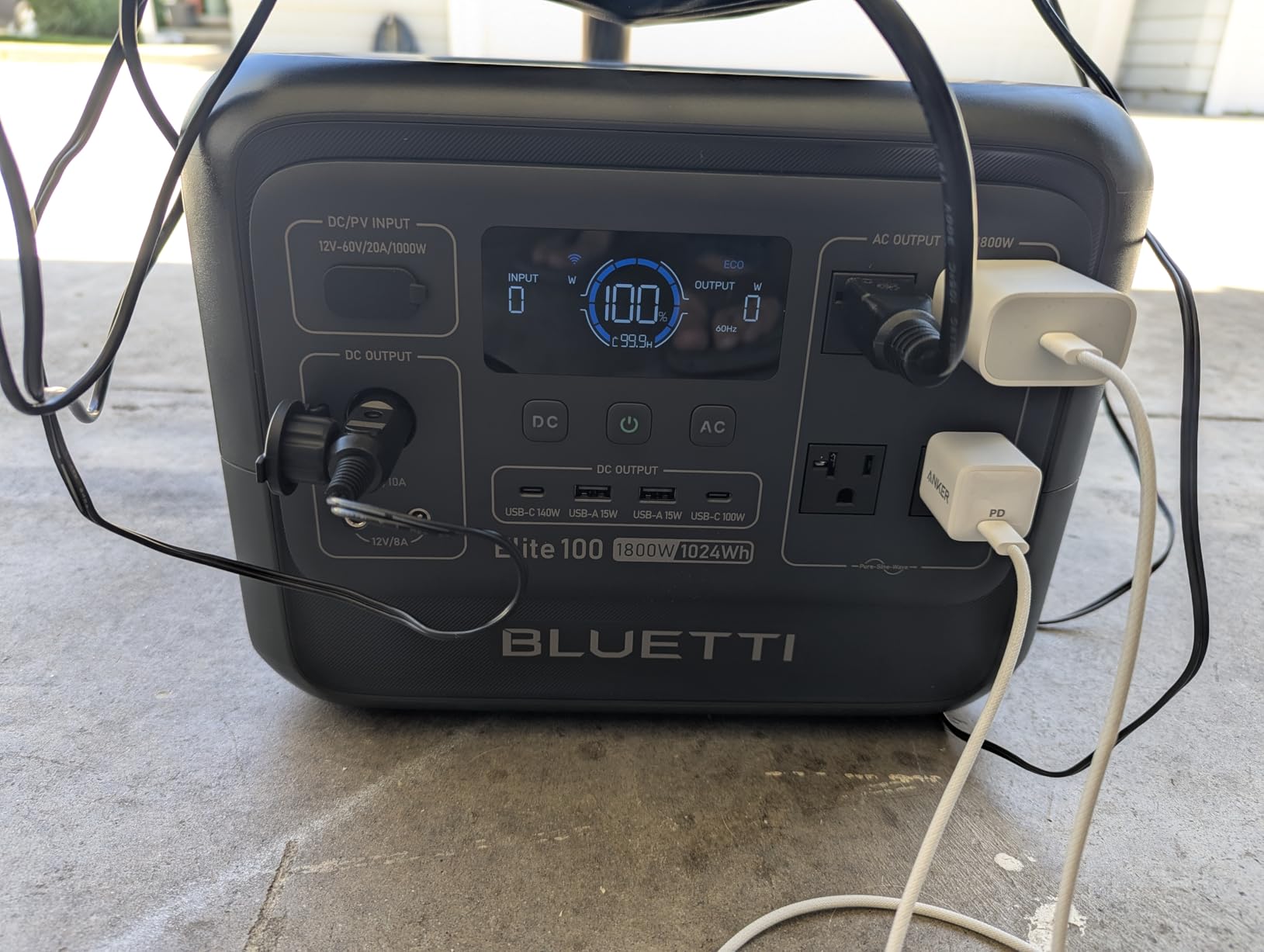
If the main job here is your house, the BLUETTI Elite 100 V2 is the most interesting unit on the list. It pairs 1,024Wh of LiFePO4 capacity with a 1,800 watt rated AC output, and its 10 millisecond UPS switchover is fast enough to keep a CPAP running untouched when the grid drops mid-night rather than forcing a restart.
That switchover figure is the underrated part. Most power stations restart the load within 20 to 30 milliseconds, which a CPAP may or may not tolerate depending on its power supply. A 10ms transfer means therapy keeps running, and the therapy data on your SD card stays intact.

Estimated runtime is 26.3 hours with the humidifier off and 14.2 hours with it on, so a couple of humidified nights without touching it. The 30 dB silent mode is genuinely useful in a bedroom, and it is roughly half as loud as comparable 1kWh units according to the spec sheet.
Recharge is where it separates from the Jackery at the same size class: zero to 80 percent in about 45 minutes on 1,200W AC turbo charging, with eleven ports across AC, USB-C, USB-A and car outputs. The 5 year warranty is also the longest of the compact options here.
Why UPS mode matters for a CPAP specifically
A CPAP power brick has capacitors and a small controller. When mains power vanishes, a slower-switching inverter causes a brownout that the machine reads as an error, and therapy stops. A sub-20ms transfer is the difference between a brief hum of the fan restarting and a night of lost data.
For anyone whose outages tend to be short and unpredictable, the ability to leave the machine plugged in during a storm and forget about it is worth more than any extra 200 watt-hours.
The compromises to plan around
Twenty-five pounds with a hidden grab handle is manageable for a garage shelf or a trunk, and awkward for anything further. Vehicle charging is slow unless you add the optional BLUETTI charging accessory, which matters if your only realistic top-up is driving.
Be aware that power lifting mode, which lets the inverter briefly overdrive resistive loads, adds wear. Leave it off for CPAP duty where the 1,800 watt rating is already far more than a machine ever asks for.
4. BLUETTI AC200PL (2304Wh) – best for multi-night off-grid backup
BLUETTI AC200PL Portable Power Station 2304Wh 2400W LiFePO4 Solar Generator
2304Wh LiFePO4
2400W AC output
72 lb
12 outlets
Pros
- Largest capacity in the roundup
- Expands to 8448Wh with B300 or B230 packs
- 0 to 80 percent in 60 minutes
- 48V RV port
- 5 year warranty
Cons
- 72 lb makes it stationary
- Full solar recharge takes many hours even with a large array
The AC200PL exists for people who think in weeks rather than nights. At 2,304Wh it is the largest capacity in this roundup, and the 2,400 watt rated AC output means a heated hose, a machine and a battery-driven CPAP backup can all run off the same inverter without a fight.
Where it changes the maths is the expansion ecosystem. Adding B300, B210P or B230 packs takes total capacity up to 8,448Wh, which turns a night-time device into a weekend energy reserve. For an off-grid property, a long wildfire evacuation period, or an RV that needs a CPAP running through a power disconnect, that is the argument.
Estimated runtime is 59.2 hours with the humidifier off and 31.9 hours with it on, roughly three full humidified nights with margin. The 48V RV port can charge a vehicle battery directly, and eleven port types include four AC outlets, a 30A TT30, 48V DC, a car port and two 100W USB-C PD ports.
Recharge is fast on AC, hitting 80 percent in 60 minutes on a 2,400W input. Solar input is rated up to 1,200W, though turning a full 2,304Wh pack over on solar alone still takes hours of strong direct sun.
Who should buy a unit this large
Buy it if your therapy has to survive more than a single night without wall power, or if the same battery is going to carry lights, a router and a medical device. Reviewers report using units in this class for fridges, Starlink and job-site work, and the CPAP use case sits comfortably inside that envelope.
It also suits anyone who wants a five year warranty and a 3,000 cycle chemistry rating on something that will live in a garage rather than a pack.
Why it is not a portable power station in practice
Seventy-two pounds is the honest number. That is a two-person carry or a hand truck, which means this is a home and vehicle product, not something you carry to a site or up a trail. Any guide that puts a 70-pound unit in a camping list is misleading you.
The 1,024Wh and 1,070Wh units on this list give you most of the runtime at a third of the weight. The AC200PL is only worth the mass when you genuinely need nights four, five and six.
5. MARBERO (237Wh) – the lightest unit on the list
Portable Power Station 300W MARBERO 237Wh Camping Solar Generator Backup Lithium Battery with Pure Sine Wave 110V AC Outlet, USB C, USB A, DC for Outdoors Camping CPAP Home Blackout Emergency
237Wh lithium ion
300W output
4.6 lb
8 outputs
Pros
- Lightest body in the roundup at 4.6 lb
- Compact cuboid shape with built-in handle
- Dual LED lanterns with SOS mode
- Listed as CPAP compatible
Cons
- Highest one-star share in the group
- Weak inverter for demanding loads
- Proprietary barrel charger
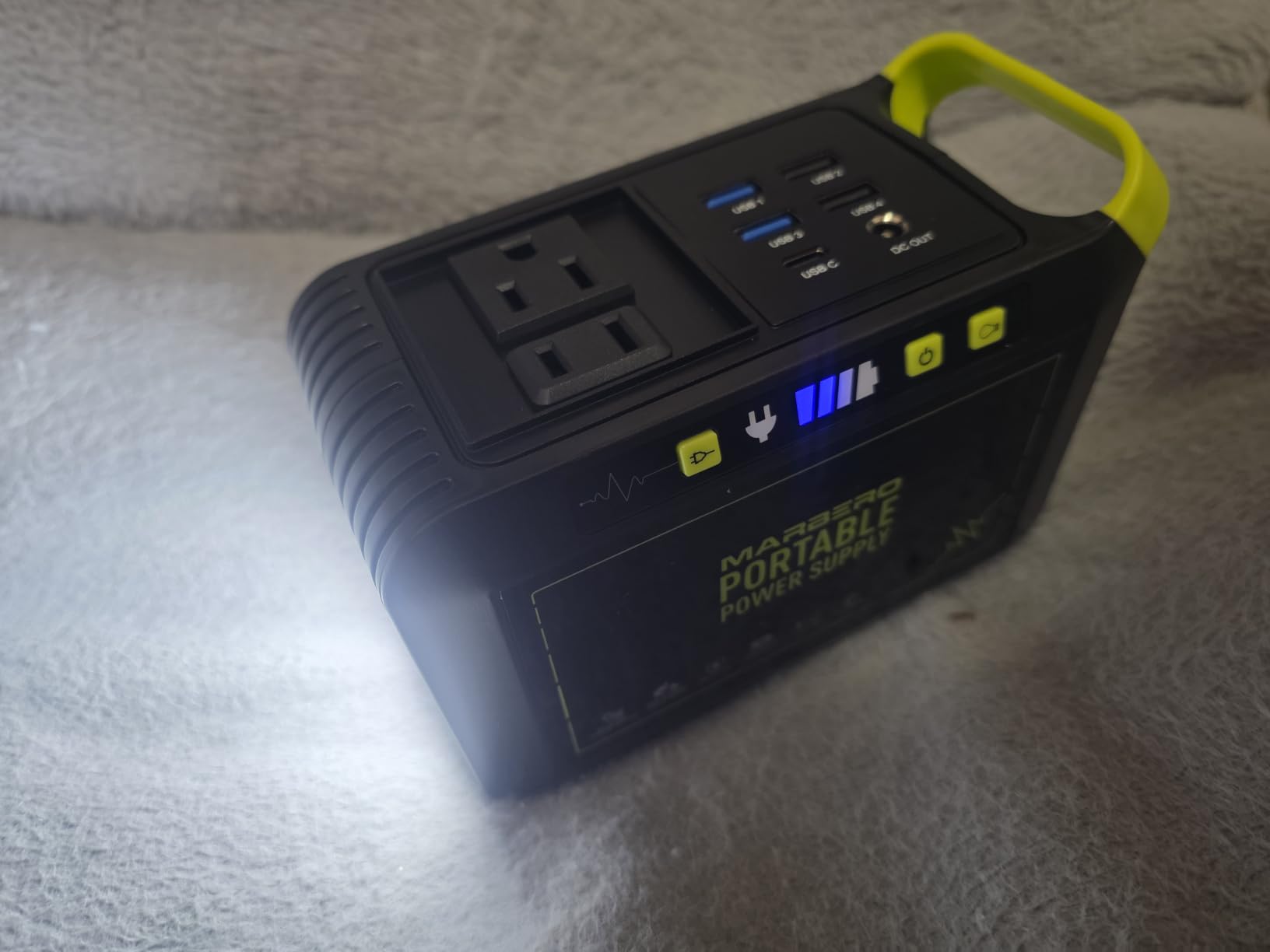
At 4.6 pounds, the MARBERO is the smallest thing in this roundup by a wide margin, and its listing names CPAP machines among compatible loads. If your definition of portable is measured in what you can put in a daypack without thinking about it, this is the only unit here that comfortably qualifies.
Capacity is 237Wh with 300 watts of output and 375 watts peak, across two AC outlets, two USB-A QC3.0 ports, two more USB-A, one 18W USB-C and a DC output. The two LED lanterns with steady, twinkle and SOS modes are a genuinely useful detail when the power is out and your tent is dark.
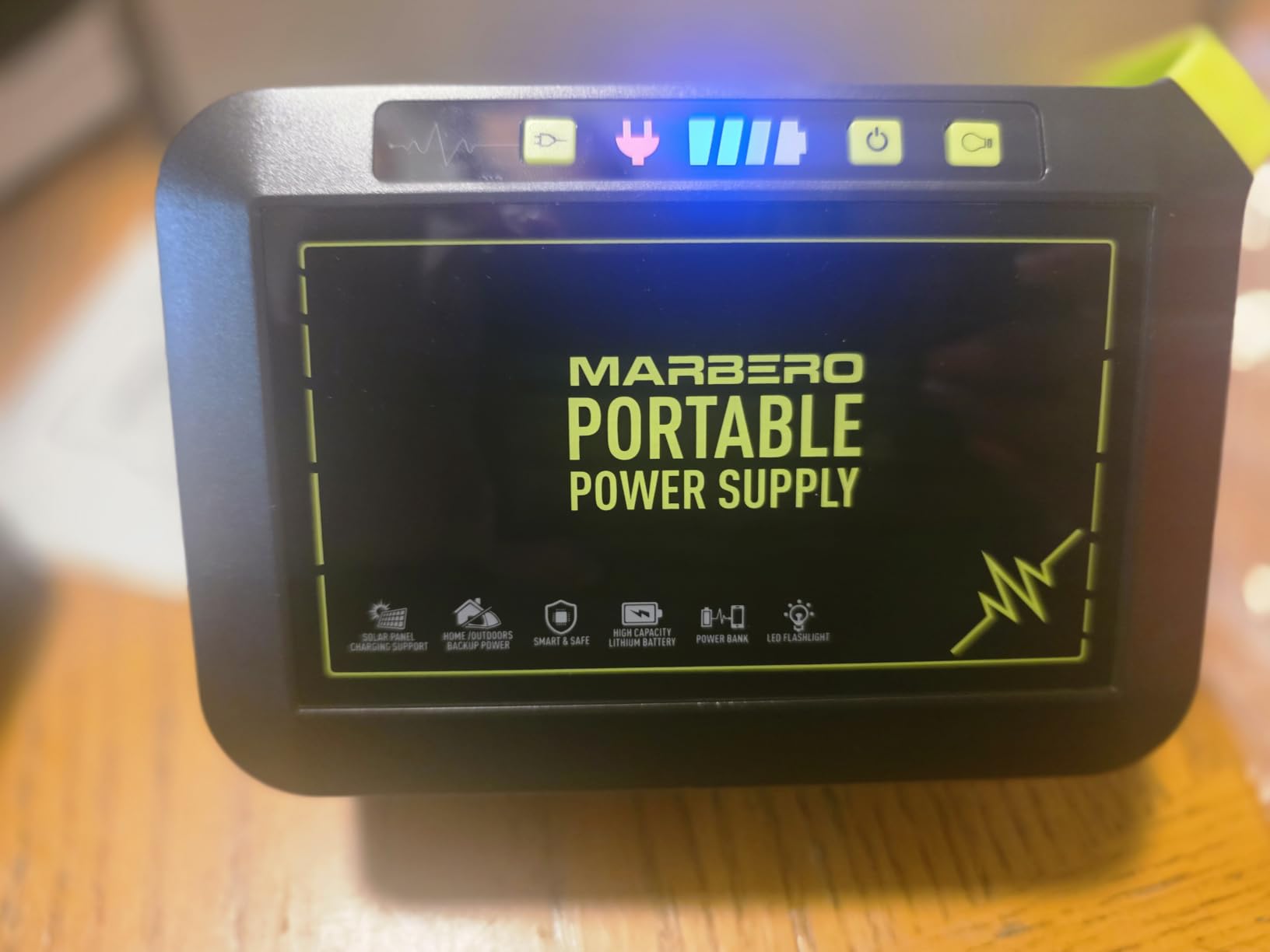
Estimated runtime is about 6.1 hours with the humidifier off and 3.3 hours with it on. On the humidifier-on figure this covers roughly the first half of a night, so it is a bridge, not a solution, unless the humidity setting is turned right down.
Recharge options are wall, car and solar, taking roughly 6, 8 hours and a panel day respectively. Battery management covers short circuit, overload and temperature extremes, which is reassuring but is a lower bar than the LiFePO4 chemistry used by most rivals here.
When 4.6 pounds is the deciding factor
Hiking in, canoe launching, and carrying a kit across a car park to a site are all situations where every pound is felt and 7.1 versus 4.6 is the whole conversation. The handle and the flat-sided shape also pack better than a rounded brick, which matters when space is the real constraint.
It also works well as a secondary unit, carried alongside a larger station purely to run the machine while the big one recharges from solar during the day.
What the reviews warn about
This is the lowest rated product here at 4.1, with 12 percent one-star reviews, the highest share in the group. Reported issues include units that stop holding charge within a year, AC outlets that will not run demanding devices, and power or AC buttons that stop responding after a month.
The 12 month warranty is the shortest here and does not cover a battery that ages out. If your plan is one night of camping a year, that risk is acceptable. If this is your only backup for a medically necessary device, the 2 year and 5 year warranties on the units above are worth more than the two pounds.
6. ALLWEI (256Wh) – Most Versatile small unit for humidified nights
ALLWEI Portable Power Station 300W, 256Wh Solar Generator LiFePO4 Battery
256Wh LiFePO4
300W pure sine wave
6.4 lb
6 ports
Pros
- Listed as safe for sensitive devices including CPAP
- Reviewers report 20 hours of CPAP across 3 nights
- LiFePO4 rated 3000 cycles
- Display shows watts runtime and charge
- 2 year warranty
Cons
- Some owners report charge loss after about a year
- Cooling fan can be loud
- No 24V output
The ALLWEI is the small unit that CPAP users actually report running all night, and it earns the value pick because the evidence for that is stronger than for any other sub-300Wh device here. Reviewers describe running a BMC Luna 2 for 20 hours across three nights, and a heated DreamStation 2 for 12 hours across two.
Those results only make sense because of two design choices. The battery is LiFePO4 rated at 3,000 cycles rather than NMC, and pass-through charging lets the machine run while the unit is recharging, so you are not choosing between therapy and a full battery.
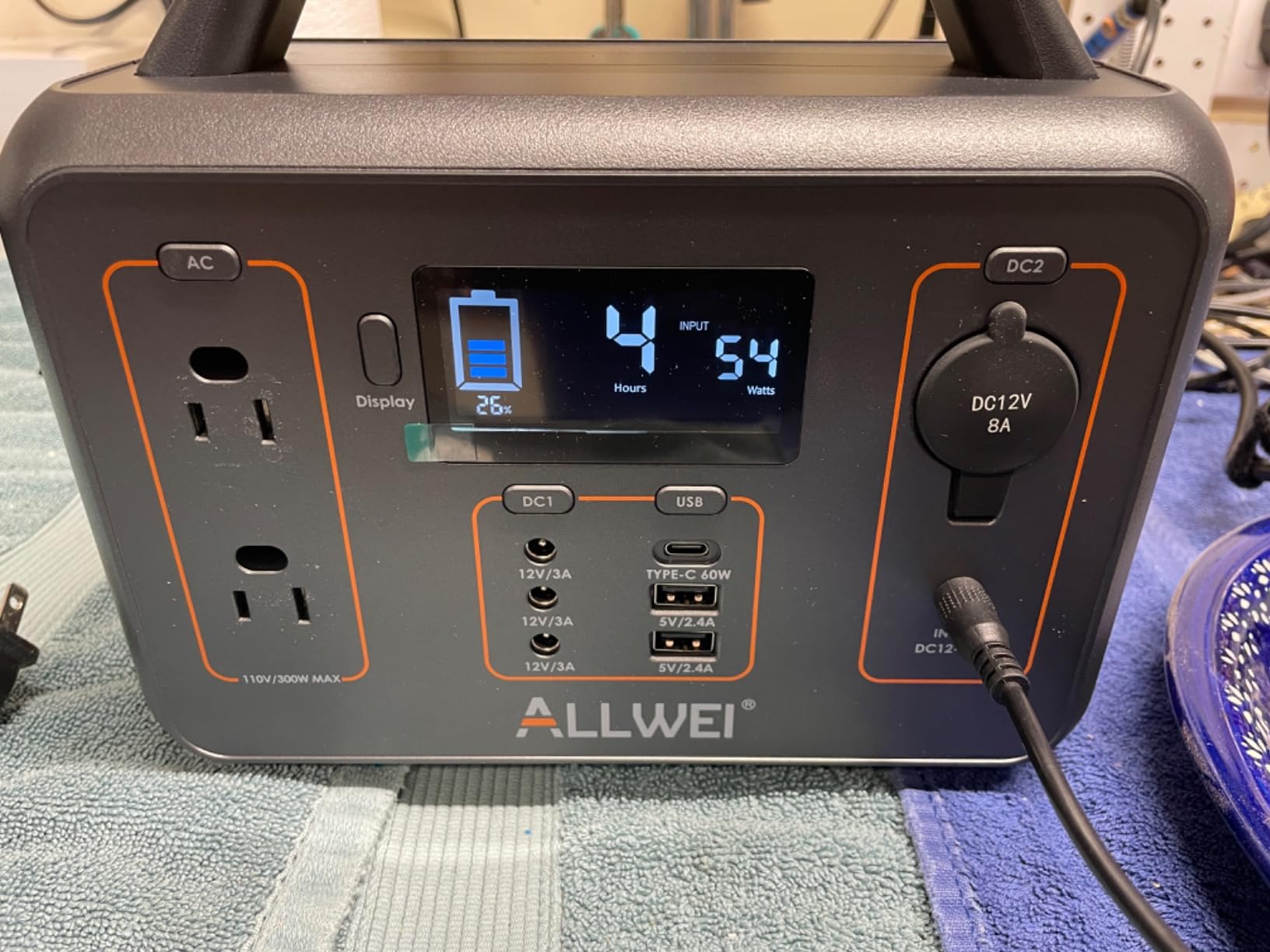
Estimated runtime is 6.6 hours with the humidifier off and 3.5 hours with it on at the standard 65 watt planning load, so the reviewer results above imply those nights were run at a reduced humidity setting. That is the realistic usage pattern, and it is worth saying plainly rather than quoting an eight-hour humidified claim.
Recharging is flexible: about 3.5 to 4 hours from AC or a 12V car socket, 4 to 5 hours on a 100W panel, or 2 to 2.5 hours with AC and solar together through the built-in MPPT controller. Solar input is capped at 120W.
Why this one earns the value slot
It is the cheapest pick that also has a pure sine wave inverter, LiFePO4 chemistry, pass-through charging and a two year warranty. Those four together are what separate it from the other budget units, and they are the four things that decide whether a battery can be trusted with a medical device.
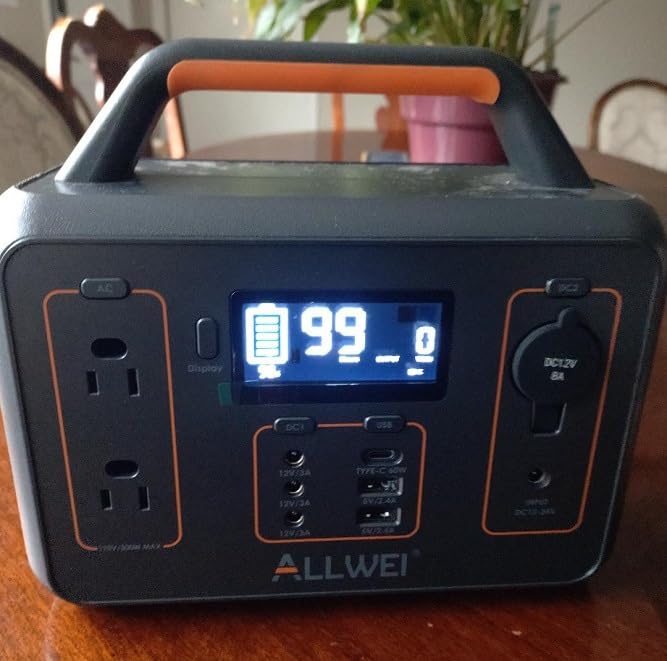
The clear display showing live watts, estimated runtime and remaining percentage is also more useful than it sounds, because it lets you see the humidifier effect in real time instead of guessing.
The weaknesses worth planning around
Several owners report the unit stopped holding charge after roughly a year, and the cooling fan can be loud enough to disturb sleep in a quiet bedroom, which is a real problem for a device whose entire job is not disturbing your sleep. There is also no 24V output despite accepting 24V solar input.
If bedside noise is your main concern, look at the EF ECOFLOW RIVER 3 or the BLUETTI Elite 30 V2 instead, both of which advertise under 30 dB operation.
7. EnginStar (296Wh) – best pass-through UPS behaviour
EnginStar Solar Generator, 300W Portable Power Station, 296Wh Lithium Battery Backup w/Two 110V Pure Sine Wave AC Outlet for Camping Road Trip RV, 80000mAh Sufficient Power Supply for Blackout
296Wh lithium battery
300W continuous
6.5 lb
8 outputs
Pros
- Pass-through charging works without a switch-over blip
- Two pure sine wave 110V AC outlets
- Useful 24V DC barrel output
- Per-port input and output readout
Cons
- Bright status lights cannot be dimmed
- Not weather sealed
- About 7 hours for a full wall recharge
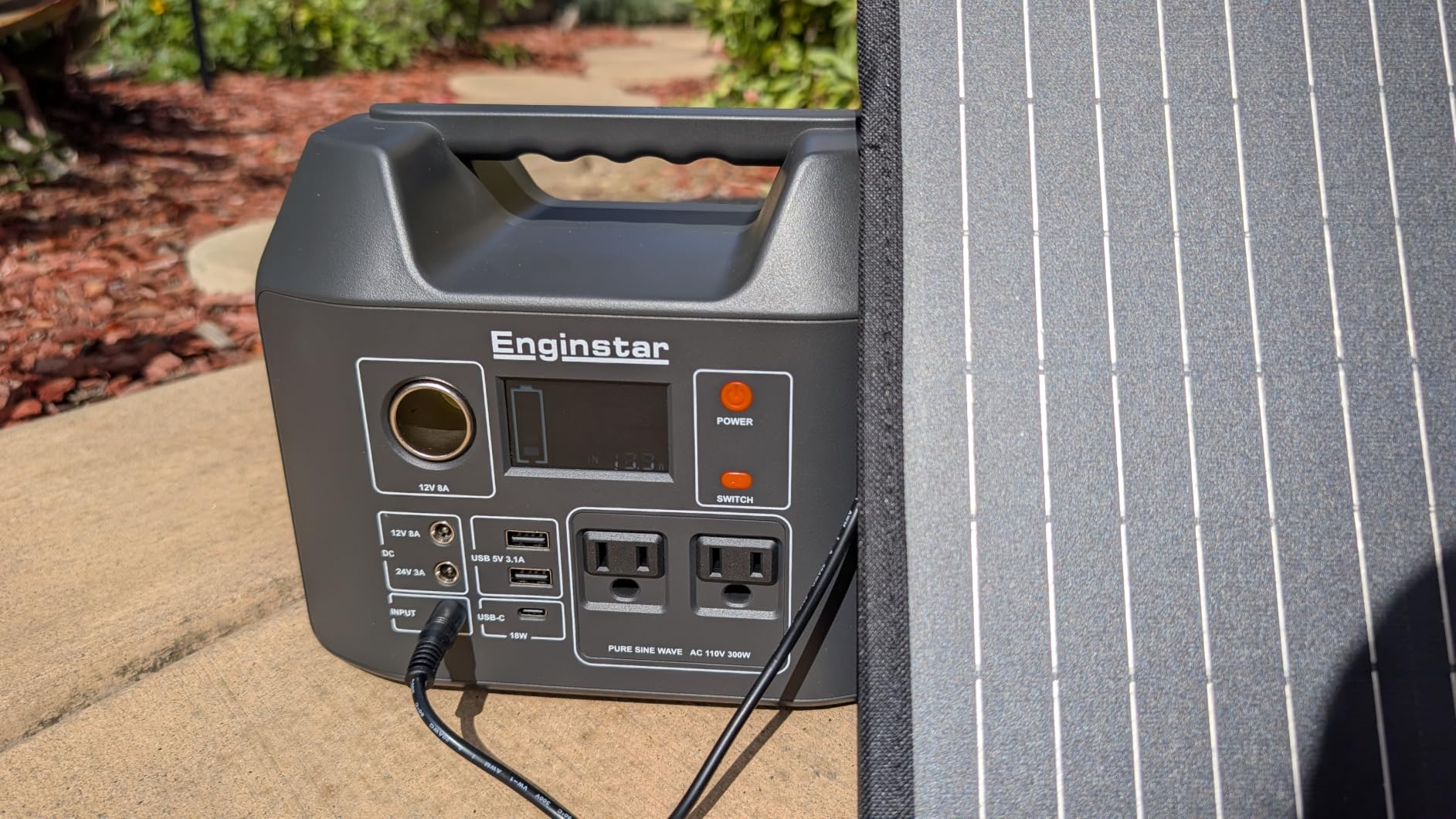
The EnginStar’s distinguishing feature is pass-through charging that works without a switch-over blip, which is the behaviour you want if the plan is to leave the CPAP plugged into the station permanently and treat it as a desk UPS for your bedside. Many competitors in this class can run devices while charging, but few describe the handover as cleanly.
Capacity is 296Wh (80,000mAh) with 300 watts of continuous output, two pure sine wave 110V AC outlets and eight outputs in total, including a 24V DC barrel output that is rare at this size and useful for 12V and 24V gear. The display shows input and output wattage per port.
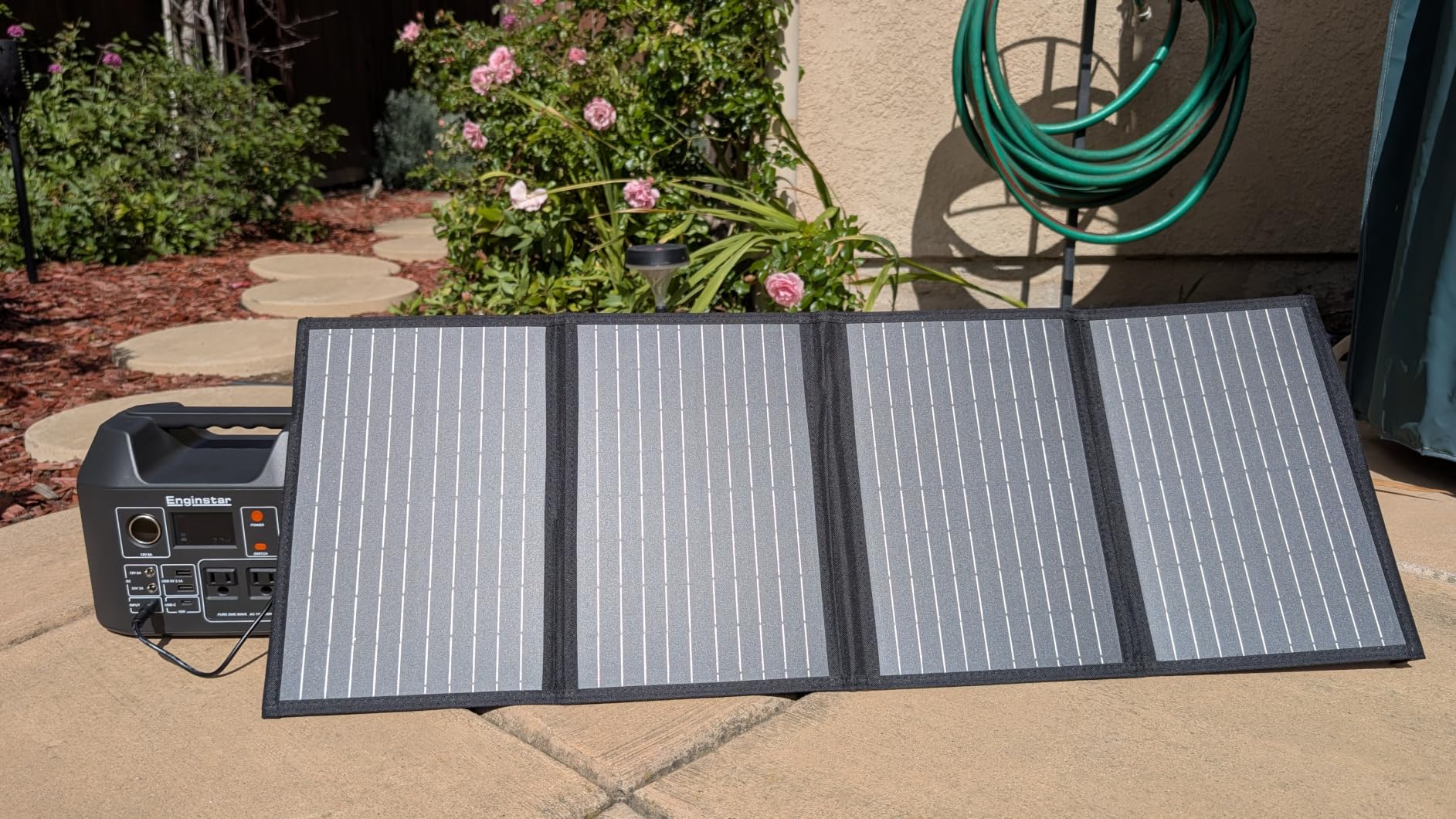
Estimated runtime is 7.6 hours with the humidifier off and 4.1 hours with it on. One reviewer reports roughly 7.5 hours of CPAP on full humidification using about half the capacity, and another owner ran theirs for three days on a reduced humidity setting, which is a better real-world result than the formula alone predicts.
Protection covers overload, over-discharge, overcharge, overheating and short circuit, and the cell is rated for 1,000 cycles, the lowest in this roundup. Full wall recharge takes about 7 hours, with car and 12 to 25V solar as alternatives.
What makes it a UPS rather than a battery
The ability to charge and discharge at the same time without an interruption is the feature. It means you can top the station up from a car while the machine keeps running, and a reader on r/CPAP notes owners using units in this class as low-cost replacements for commercial UPS hardware.
The 24V DC barrel output is a quiet bonus for anyone running a 12V or 24V device alongside a CPAP, since it removes the need for a second battery.
Where it will frustrate you
The 1,000 cycle rating and the 12 month service warranty are the weakest longevity package here, and a few owners describe a noisy cooling cycle during sleep. The status lights are very bright and cannot be dimmed, which is a real nuisance in a dark bedroom.
It is also not weather sealed, so for wet or dusty working environments you would need a protective enclosure. For bedside use at home, it is fine.
8. ENOFLO G300 (228Wh) – best for short blackouts and light loads
ENOFLO 300W Portable Power Station, 228Wh Solar Generator
228Wh lithium ion
300W pure sine wave
6.2 lb
9 device slots
Pros
- Supports up to 9 devices simultaneously
- Wireless charging pad on the top
- Two pure sine wave 110V AC outlets
- Use while charging
- Lightest weight in the group at 6.2 lb
Cons
- Highest one-star share in the roundup
- Reports of AC outlets failing within a month
- Handle mounts and buttons reported breaking
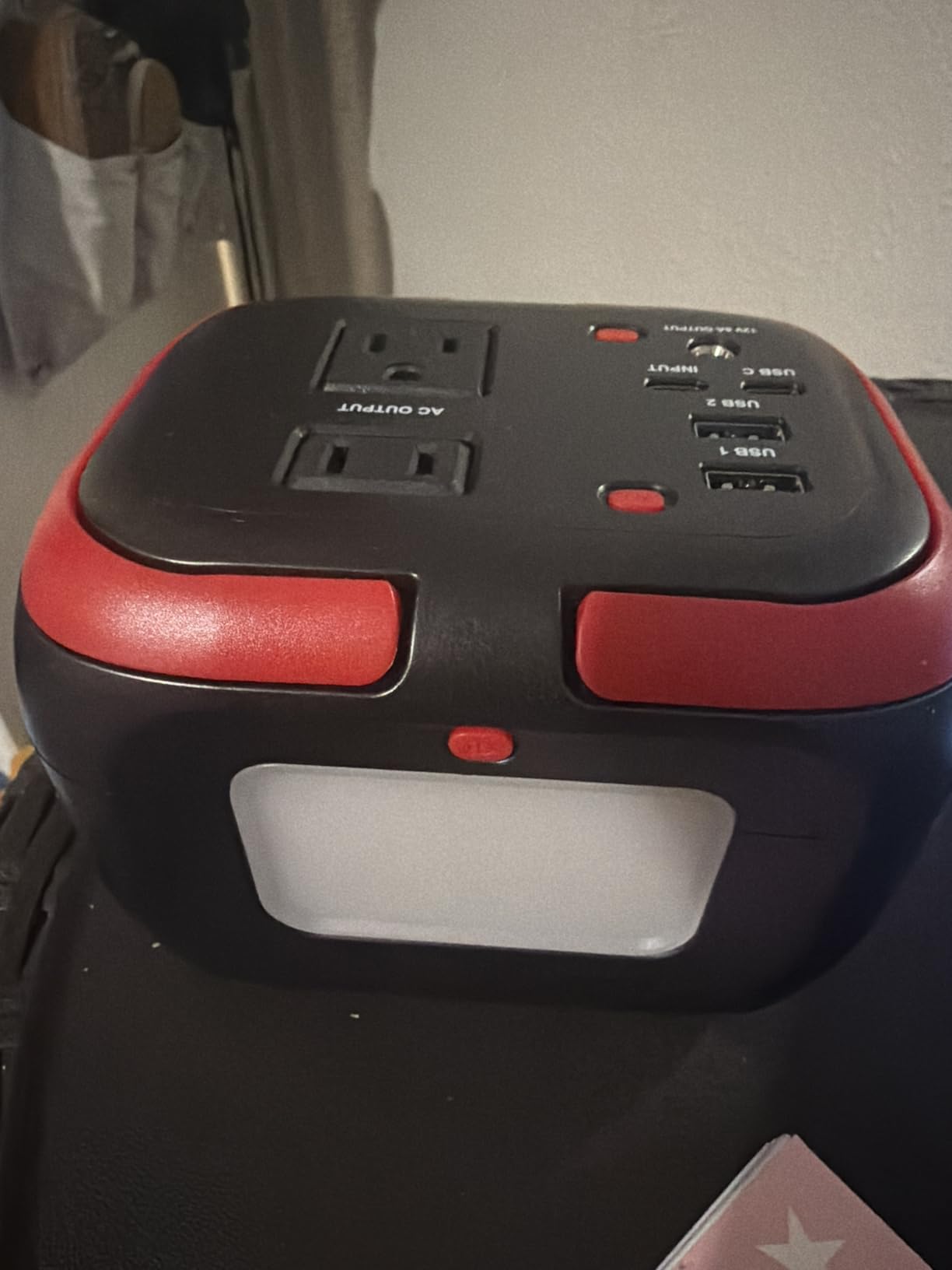
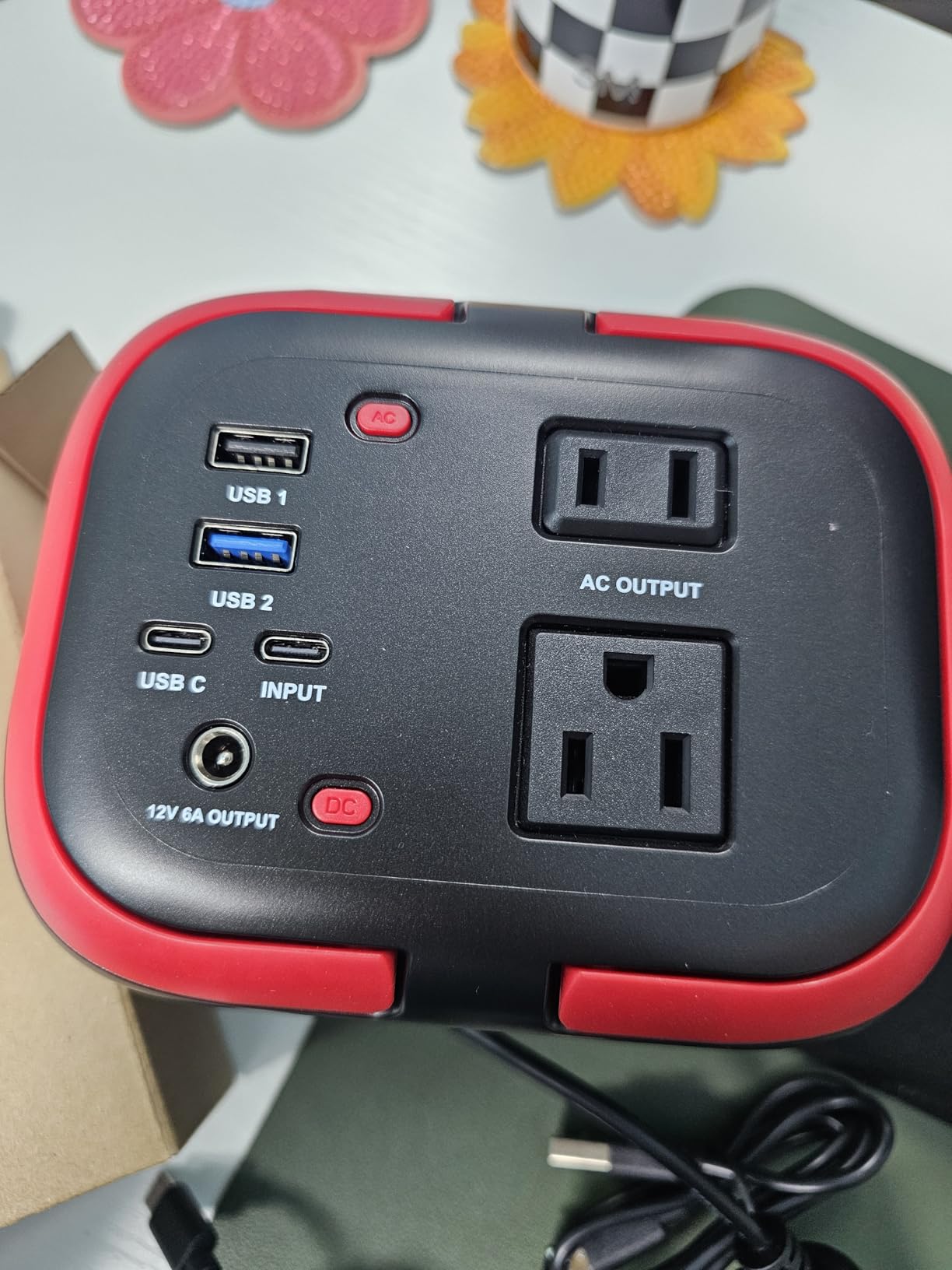
The ENOFLO G300 is honest about what it is: a light-load device for short blackouts rather than a night-time therapy unit. It can charge nine devices at once, including a wireless phone charger on the top surface, and its listing marks it compatible with CPAP machines under 300 watts.
Output is 300 watts in pure sine wave across two 110V AC outlets, supported by two USB-A, one USB-C, two DC outputs and a car port. A three-mode rear LED light is genuinely useful during an outage, and buyers report holding a full charge for eight days unused, which matters for a unit that lives in a cupboard.
Estimated runtime is 5.9 hours with the humidifier off and 3.2 hours with it on. Reported real-world figures from buyers are for a fan, LED light and television running about 3 hours together, which puts the G300 squarely in the light-load category rather than the therapy category.
Recharging takes 6 to 7 hours from AC, 7 to 8 from a car port and 6 to 7 from solar through the built-in MPPT controller, which works with the brand’s own 30W and 60W panels. A one year manufacturing guarantee is included.
What it is genuinely good for
Think of it as the machine’s teammate rather than its replacement. Run the CPAP from a larger station overnight, and keep the ENOFLO for phones, lights, a fan and the router so the rest of the household is not competing for the same inverter at 3am.
For a household that mostly needs a small outage kit rather than therapy backup, the nine device slots and the wireless pad are more useful than they would be for a camper.
Why it ranks last on therapy suitability
Thirteen percent of its reviews are one-star, the highest share of any pick here, and the complaints are consistent rather than isolated: AC outlets dead on arrival or failing after a month, and handle mounts plus power and AC buttons breaking in similar timeframes.
A device with a reported early hardware failure rate is a poor choice for something medically necessary. If you want this tier of capacity and accept the risk, the ALLWEI has a two year warranty, LiFePO4 cells and a far better reliability record for a similar weight.
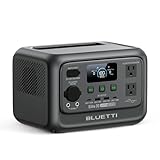
9. BLUETTI Elite 30 V2 (288Wh) – best recharge speed in a small body
BLUETTI Elite 30 V2 Portable Power Station 288Wh 600W LFP Solar Generator
288Wh LFP
600W AC output
9.5 lb
9 ports
Pros
- 600W continuous output with 1500W lifting mode
- 0 to 80 percent in 45 minutes
- 10ms UPS protects the CPAP
- 9.4 lb for a 600W class unit
- 5 year warranty
Cons
- No expansion battery slots
- One reviewer reports faster than expected overnight drain
- Thin CPAP specific evidence in reviews
The Elite 30 V2 does something none of the other compact units do: it puts 600 watts of continuous AC output into a 288Wh, 9.5 pound body. The inverter headroom is what lets it drive a heated hose, a machine and a second small device at the same time without brownouts, and it is why we rate it above units with nominally similar capacity.
Its product copy names CPAP machines as a supported load, and the 10ms UPS switchover is specified to protect exactly that scenario, alongside laptops and routers, during outages. Ultracell technology also cuts standby draw to 4.5 watts, which is a meaningful saving when the station sits unused for weeks between trips.
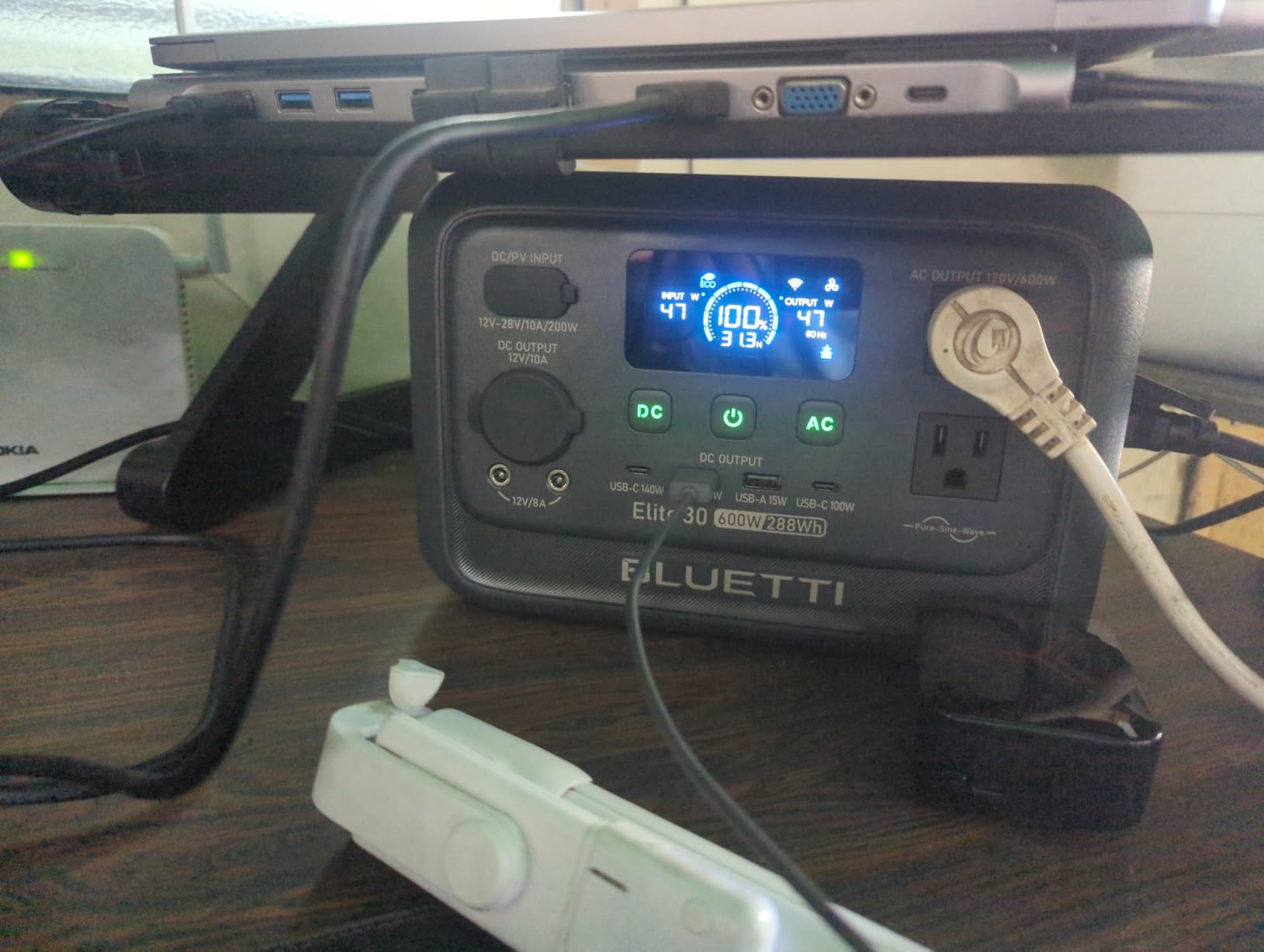
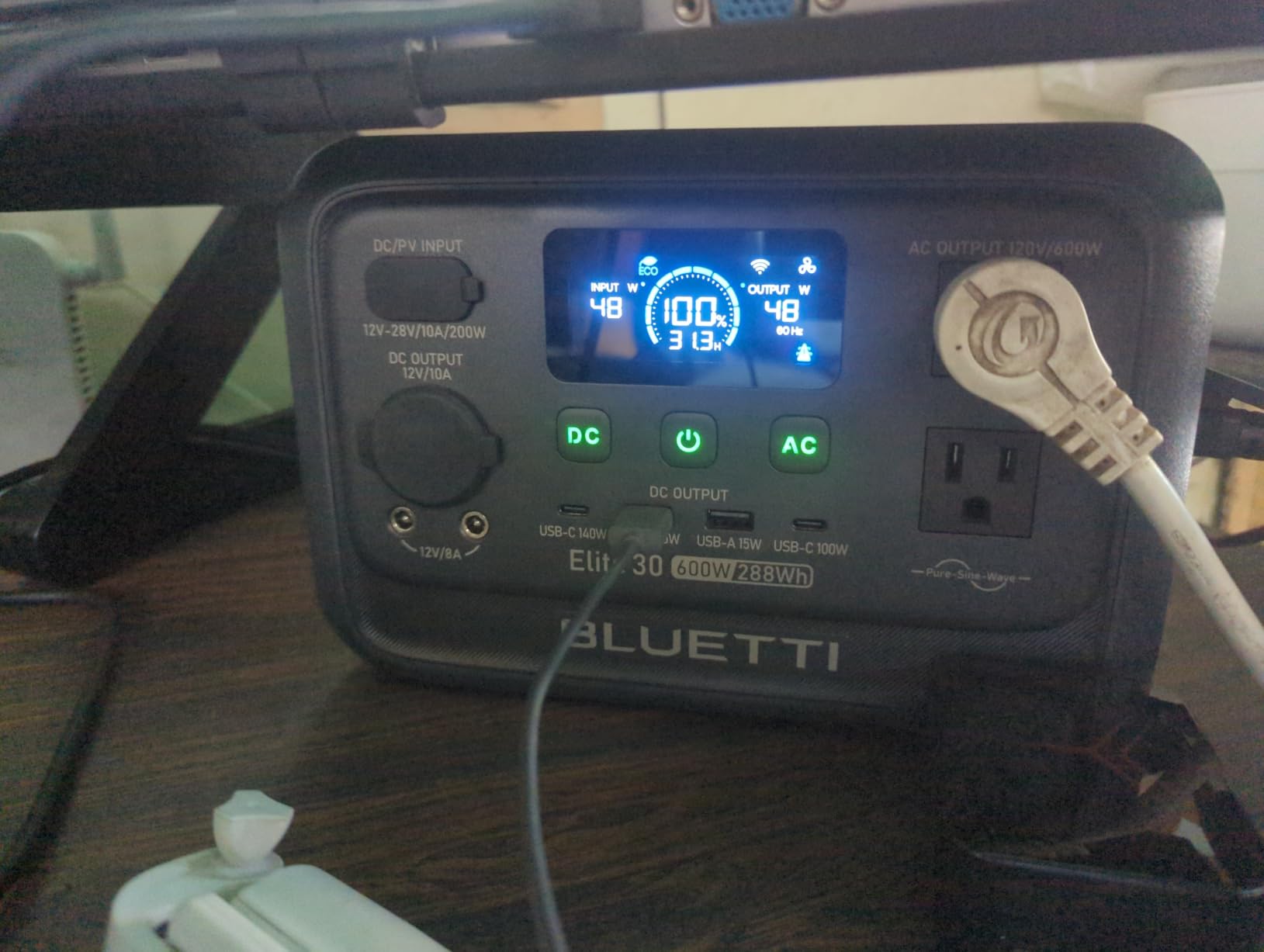
Estimated runtime is 7.4 hours with the humidifier off and 4.0 hours with it on. One CPAP owner measured 5 hours with 16 percent of the battery remaining from full, which is a better outcome than the formula suggests, while another reviewer reported being down to 53 percent after a single night.
Charging is the real story: 0 to 80 percent in 45 minutes and 0 to 100 percent in 70 minutes on 380 watt wall charging, with solar, car and generator paths among eight charging modes. A 140W PD USB-C port charges a laptop at full speed.
Why fast charging changes the use case
A 45 minute top-up between nights changes what you can do on a multi-day trip. You can run the machine overnight, spend the middle of the day on solar, and be back to full before the next nightfall instead of rationing charge across a trip.
The 10ms UPS also makes it viable as a permanent bedside unit rather than a packed item, which is the usage pattern most CPAP users with an outage anxiety actually need.
The limits to know about
There are no expansion battery slots, so 288Wh is all you get, and that is a hard ceiling for a three-night trip. The CPAP evidence in the reviews is also thinner than for the ALLWEI or EnginStar, with only one measured CPAP data point to go on.
One reviewer questioned the real-world overnight drain, so treat the runtime estimate as optimistic-friendly rather than guaranteed and test a full night before you depend on it.
10. EF ECOFLOW RIVER 3 (245Wh) – best for airline and travel use
EF ECOFLOW Portable Power Station RIVER 3, 245Wh 550W
245Wh LFP
300W continuous
7.8 lb
6 outlets
Pros
- 0 to 100 percent AC recharge in one hour
- Under 30 dB at 1.5 ft with X-GaN tech
- 7.8 lb with built-in handle
- IP54 battery protection
- 100W USB-C PD port
Cons
- 300W continuous cap with X-Boost disabled while charging
- Under 20 ms switchover
- No expansion slots or built-in light
The RIVER 3 is the travel pick, and the reason is the one hour recharge. A station you can refill from a hotel room wall overnight changes what a multi-country trip looks like, because you are never carrying more capacity than the machine needs for one night.
At 245Wh and 7.8 pounds with a built-in handle, it is compact, and X-GaN power technology runs it under 30 dB at 1.5 feet, which is the quietest figure any unit in this roundup claims. The LiFePO4 battery is rated for 3,000 plus cycles, and the two year warranty is reasonable for the size.
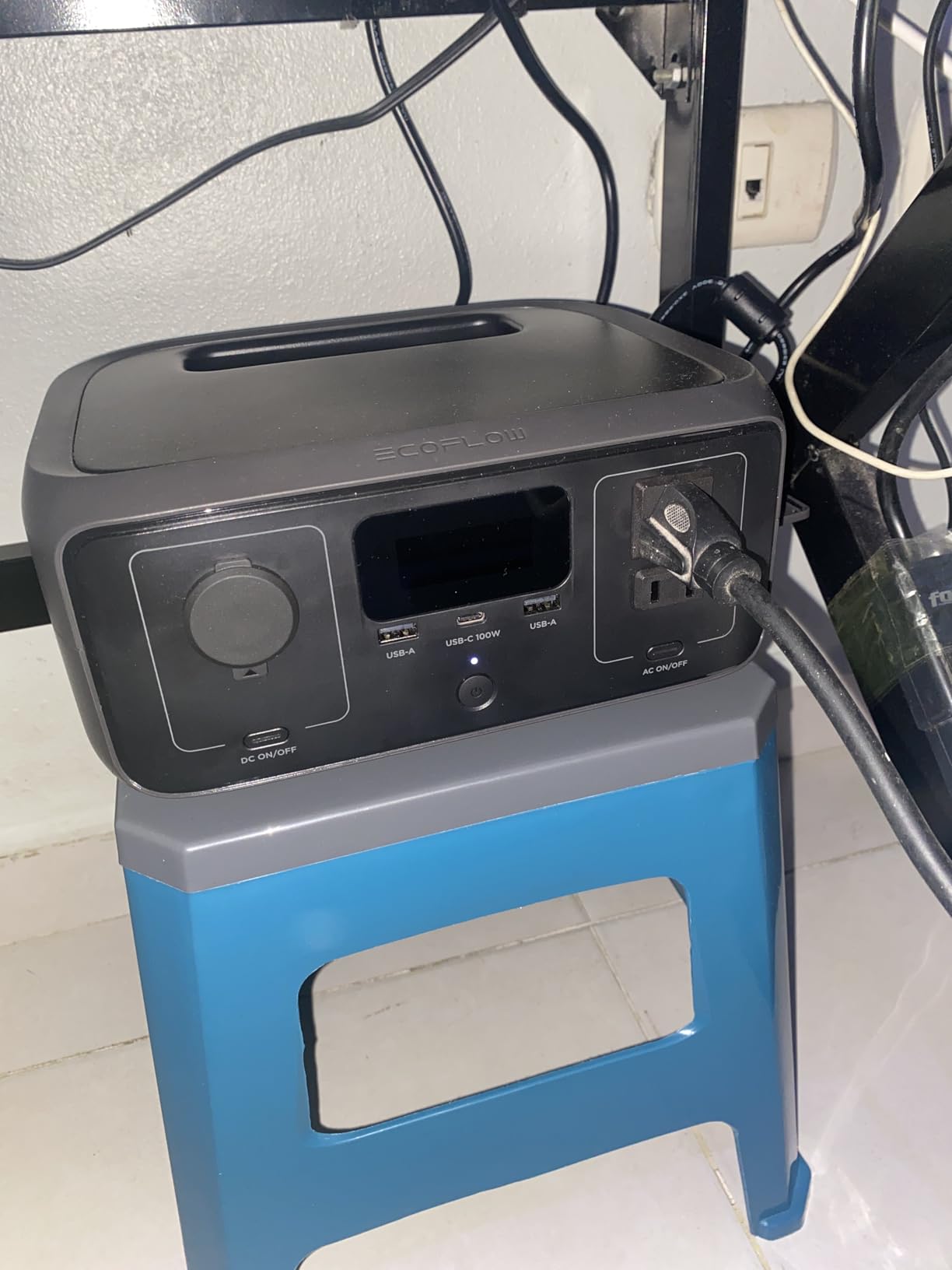
Estimated runtime is 6.3 hours with the humidifier off and 3.4 hours with it on, so it is a full-night device with the humidifier turned down rather than a full humidified night. The EcoFlow app lets you set charge and discharge limits, which extends cell life if you travel often.
Recharge options are one hour on AC with a single cable and no brick, 2.6 hours from 110W solar, plus car and generator inputs. The under 20ms auto-switching UPS has been verified by users with sensitive network gear.
What it means for flying with a CPAP battery
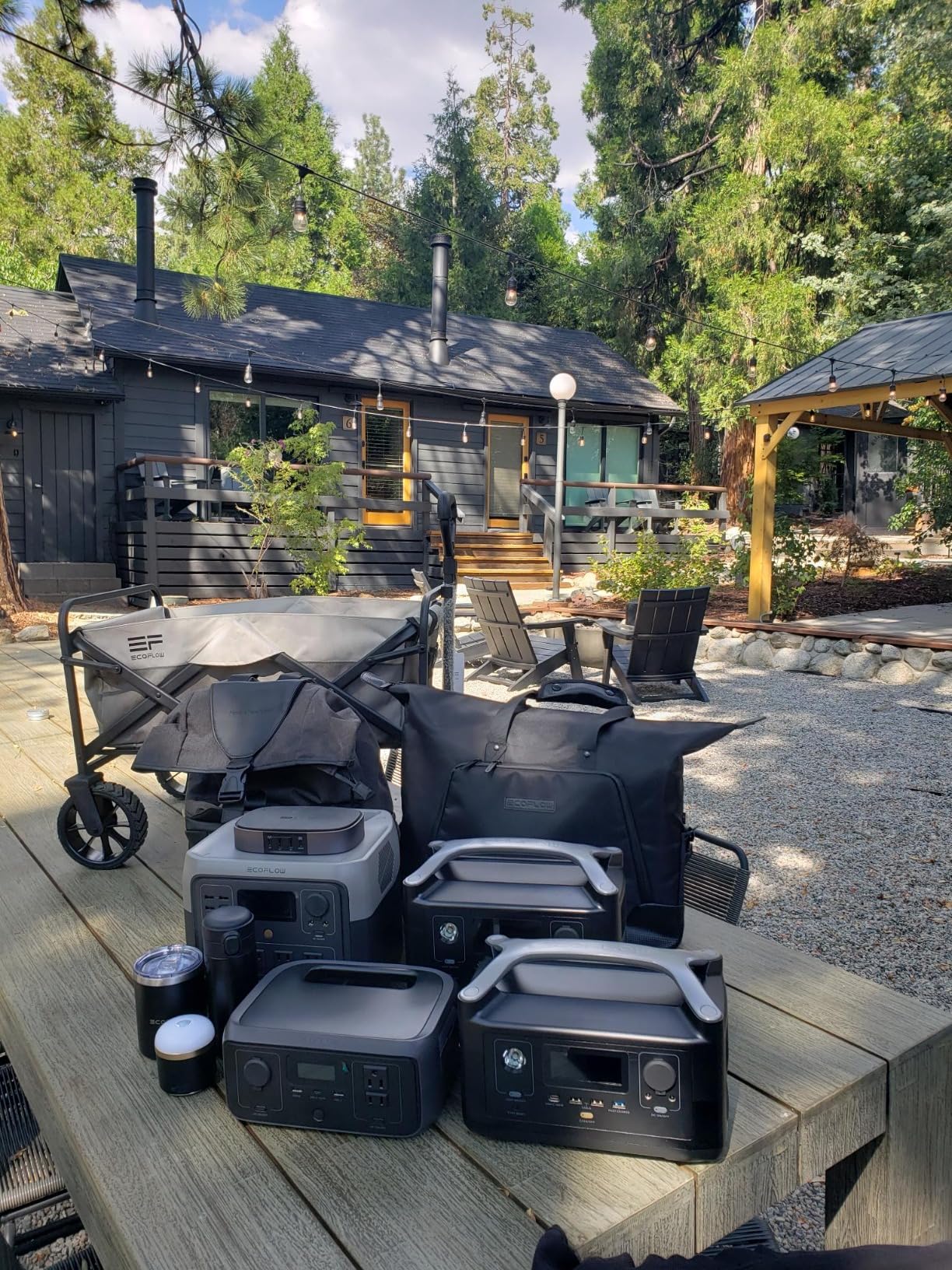
Every unit on this list sits above the 100 watt-hour threshold that airlines allow without approval, and above the 160 watt-hour ceiling that most carriers will accept even with pre-approval, so none of them is an unrestricted carry-on item. Spare lithium batteries normally have to be carried in the cabin, and a CPAP is usually declared as an essential medical device.
What this unit does well for a traveller is size: 7.8 pounds and roughly a third smaller than the category average, with a handle that fits a roller bag. Check your carrier’s medical device rules in writing before you travel, and never put a spare battery in checked luggage.
The limitations to plan around
Continuous output is capped at 300 watts, and X-Boost mode, which pushes it to 600 watts, is unavailable while the unit is charging. One user reports that the 20 millisecond switchover is too slow for a Starlink dish, which suggests it is a marginal choice for very sensitive loads even if the CPAP is fine.
There are no expansion slots, no wireless charging and no built-in light, and only one USB-C port. For a dedicated travel CPAP battery, lighter dedicated packs exist, but they cannot do UPS backup or run anything else.
Dedicated CPAP batteries vs portable power stations
The online argument is usually framed as brand against brand, and it is the wrong question. A dedicated CPAP battery pack is built around one job: it ships with the correct low-voltage adapter for your machine, is sized so one charge equals one night, and offers no ports for anything else. It is the simplest and often the cheapest way to guarantee a single night of therapy.
A general power station, like every unit in this roundup, gives you a much larger energy reserve and a dozen other uses, and that is why most people end up with one. The trade is that you must size it yourself, confirm the power path works with your machine, and accept that some of the capacity will be lost to inverter inefficiency.
The practical reconciliation is to think in nights, not in units. Dedicated packs solve night one. General stations solve nights one through three, or a humidified night, or a weekend, depending on size. If you travel frequently and only ever need one night, a dedicated pack is a defensible choice. If you camp, drive, or live somewhere with unreliable power, the capacity headroom of a power station pays for itself quickly.
One more angle: warranty and device support. Dedicated CPAP batteries are sold by CPAP suppliers and frequently include model-specific adapters, while general power stations are backed by electronics warranties that say nothing about medical devices. Neither type is a medical device, and neither manufacturer will support your therapy if something goes wrong.
What to check before you buy: the 2026 buying guide
Capacity in watt-hours, not watts. Watts tell you what the inverter can start. Watt-hours tell you how long therapy lasts. Apply Required Wh = CPAP watts x hours / 0.9 and you have your answer before you look at a single listing. Anything under about 320Wh covers a night without the humidifier; anything under about 578Wh will not comfortably cover a fully humidified one.
Rated output and waveform. Any of the units here will start a CPAP, but a pure sine wave inverter is the safer choice for sensitive electronics. All ten we selected publish pure sine wave AC output, which is one reason none of the cheapest listings made the list.
UPS switchover time. If your outage risk is sudden, sub-20ms transfer keeps the machine running instead of forcing a restart. The BLUETTI Elite 100 V2 and Elite 30 V2 both specify 10ms, and the RIVER 3 is under 20ms. A slow handover is the single most underrated reason a CPAP stops mid-night on a power station.
DC path versus AC brick. Running the machine through its supplied 120V adapter adds an inverter conversion step and wastes energy. Where your manufacturer offers an approved low-voltage DC adapter, use it. This is also the right place to check the CPAP maker’s compatibility list, because not every DC adapter is approved for every model, and that approval is the one piece of this decision a power station brand cannot give you.
Airline watt-hour limits. Batteries up to 100 watt-hours travel in the cabin without approval, 101 to 160 watt-hours need airline sign-off, and above 160 watt-hours most carriers will not carry a spare at all. Every unit in this roundup is above 160 watt-hours, so a CPAP battery on this list is a declared essential medical item, not a free-carry spare. Get your carrier’s policy in writing before you fly.
Solar input and recharge options. Input wattage, not panel wattage sold separately, is what determines turnaround. The BLUETTI AC200PL accepts up to 1,200W, the ALLWEI caps at 120W, and the Jackery units accept only Jackery-branded panels. Our wider camping power station picks cover the solar side in more depth.
Battery chemistry and cycle life. LiFePO4 packs are rated between 3,000 and 4,000 cycles here, against 1,000 for the EnginStar and unspecified cycle counts for the MARBERO and ENOFLO. For a device expected to sit in a cupboard and be relied on during a storm five years from now, chemistry matters more than any feature on the label.
Cold weather and altitude. Lithium chemistry loses usable capacity in freezing conditions, which surprises people camping in winter. Keep the station in the vehicle or inside a warm tent overnight rather than in a cold bag, and expect a derated figure rather than the rated one. High altitude reduces cooling capacity on the inverter, which again matters more for a heavy load than for a 60 watt CPAP.
Weight against realistic use. Anything over 10 pounds is a car accessory, not hiking gear. If your plan involves carrying a kit more than a few hundred metres, that removes the Jackery Explorer 1000 v2, the BLUETTI Elite 100 V2 and the AC200PL from consideration and leaves the 4.6 to 9.5 pound group. The same reasoning applies to our location shoot power station guide, where carry weight is the first filter too.
Silent operation. A power station is the quiet alternative to a gas generator, with no fumes and safe to run in a tent or a bedroom, which is the single strongest reason to have one at all. What matters for sleep is the inverter fan, so treat any unit claiming under 30 dB as the bedside candidate.
Warranty length as a reliability proxy. Five years from BLUETTI and two years from Jackery and EcoFlow suggest confidence in cell longevity. A 12 month warranty on a device holding a medical-critical load is a signal worth weighing. Our photographer-focused power station roundup covers that reliability angle in more general terms.
What to do when the power drops mid-night
A power interruption during therapy is not dangerous, but it is worth handling in a fixed order. First, do not panic-wake; the machine will stop delivering air and the mask will leak, so you will wake naturally. Second, check the station before the machine, because a loose DC adapter is the most common cause and a restart without fixing it wastes the remaining charge.
Then, in sequence: confirm the station has charge remaining, reseat the power connection at both the station and the machine, and let the machine complete its own restart, which usually takes under a minute. Only unplug and replug the machine itself if the display stays blank after a full power cycle, since repeated hard resets can leave a CPAP without a usable ramp or a stored humidifier setting.
The 4-hour rule is a compliance guideline for insurers and sleep clinics rather than a safety limit. If you lose power mid-night, the gap is recorded as missing therapy data, and a short gap is far better than a repeated pattern. Persistently short sessions are what trigger a review of your settings, not a single interruption.
Recharging a CPAP without a station is possible on any modern machine with an internal battery, but the runtime is typically well under a full night, which is exactly the gap a power station closes. There is also a therapy argument: repeated partial nights produce fragmented sleep and mask leak, and the machine’s own backup battery is designed for alarms rather than therapy. Our outdoor shoot power station picks cover the same reliability planning for a different kind of critical gear.
Frequently Asked Questions
What size portable power station do I need to run a CPAP machine?
For one night without a humidifier, about 356Wh covers an 8-hour night at a 40 watt load. With the humidifier on at 65 watts you need roughly 578Wh, and with a heated hose at 90 watts you need about 800Wh. Multiply your load by 8 hours and divide by 0.9 to allow for inverter losses.
Will a portable power station run a CPAP machine?
Yes, as long as the unit has pure sine wave AC output or an approved DC adapter, and enough watt-hours for your hours and load. Every unit in this roundup is listed by its manufacturer as safe for sensitive or CPAP-class electronics. Powering the machine through its 120V brick works but wastes energy compared with an approved DC adapter.
What is the best portable power bank for a CPAP machine?
A plain power bank is usually not suitable, because a CPAP draws a small and fairly constant current that many banks do not sustain, and the machines generally need mains-quality power. A portable power station with a pure sine wave inverter, or a dedicated CPAP battery pack with a model-specific adapter, is the reliable choice.
What happens when a CPAP loses power?
The machine stops delivering air, the mask leaks, and you will wake without therapy. The session is recorded as interrupted, and a short gap is normal. Check the station and the adapter connections first, reseat both ends, then let the machine restart on its own before forcing a hard reset. Repeated short sessions are what a sleep clinic takes notice of.
How do I reboot my CPAP machine?
Unplug the power cord and wait about 20 seconds so the internal capacitors discharge. Reconnect the power, then let the machine run its normal startup routine, which usually takes under a minute. From the menu, check the humidifier level and ramp settings, and confirm the therapy data on your card or cloud record is intact before going back to sleep.
Conclusion: our best portable power stations for CPAP machines in 2026
The best portable power stations for CPAP machines in 2026 come down to one honest question: how many nights do you need away from a wall outlet? If it is one, take the Jackery Explorer 300, our Editor’s Choice at 292Wh and 7.1 pounds, and turn the humidifier down. If it is two or three, or you use a heated hose, take the Jackery Explorer 1000 v2 or the BLUETTI Elite 100 V2, and the Elite 100 V2 is the better bedside unit because of its 10ms UPS.
For outages at home, the BLUETTI Elite 100 V2 covers roughly a night and a half on a full charge and recharges in 45 minutes, which is the combination that actually helps. For a week or more without power, the BLUETTI AC200PL at 2,304Wh is the only pick here that stays comfortable, and it stays comfortable because it is not going anywhere.
Whatever you choose, run a full night on it before you rely on it, keep the humidifier as low as you can tolerate, use an approved DC adapter where one exists for your model, and test it in a dry run rather than during a storm. Our general portable power station roundup is the next step if you also need to run cameras, tools or a fridge from the same unit.