
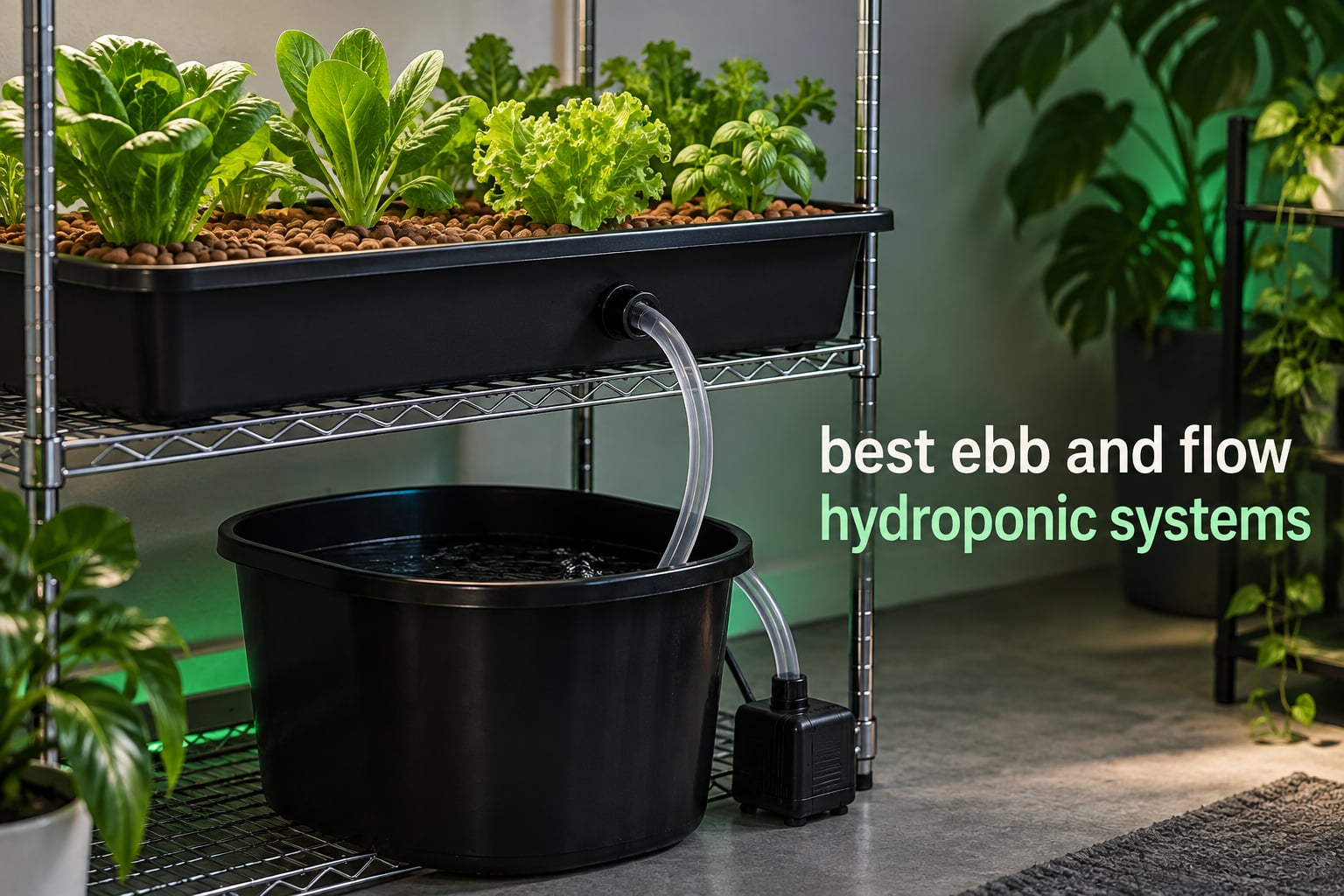
Most shopping pages for this keyword quietly dodge it. They rank countertop tower gardens and deep water culture kits under an “ebb and flow” heading, because those are the units Amazon actually stocks in volume. This roundup is different: every pick below is a genuine flood and drain component, tray, table or controller, and each one is described by the specs that matter at the reservoir.
An ebb and flow hydroponic system — also called a flood and drain system — periodically floods the plant root zone with a nutrient-rich solution, then drains it back to the reservoir so the roots alternate between soaking up nutrients and breathing fresh oxygen.
I spent the last two months working through the current crop of ebb and flow hardware end to end: reservoir sizing, pump output against tray volume, flood minutes against drain minutes, and how each unit behaves when the timer, the float switch or the power fails. The category is small and parts-driven, so I leaned on the specs sheets and on the failure reports owners post in hobbyist forums rather than on marketing copy.
What follows is the short list first, then a full review of each system, then the parts of the method nobody else on this SERP covers: what ebb and flow is genuinely bad at, which plants actually pay off, how long to flood, and what to do when the pump quits at midnight.
Table of Contents
Top 3 Picks for Ebb and Flow Hydroponic Systems in 2026

Active Aqua Ebb System 7 Gal
- Controls 24 five-gallon modules
- Emergency shut-off valve
- Two 250 GPH pumps and timer included

AutoPot Tray2Grow with 25 Gal FlexiTank
- Gravity-fed and power-free
- 25-gallon reservoir included
- AQUAvalve5 demand-based feeding

Happy Hydro Tray2Grow
- No electricity needed
- Works with pots and seed trays
- Spirit levels included for setup
Two of those three are gravity-fed rather than pumped, and I want to be straight about that instead of hiding it. Pumped flood and drain gives you scheduled flood minutes; a capillary tray gives you on-demand irrigation with no schedule at all. Both are legitimate answers to the same question, and which one is right depends on whether you are chasing a fixed cycle or a low-maintenance bench.
Quick Comparison of the Best Ebb and Flow Hydroponic Systems in 2026
| Product | Specifications | Action |
|---|---|---|
| Active Aqua Ebb System 7 Gal |
|
Check Latest Price |
| AutoPot Tray2Grow with 25 Gal FlexiTank |
|
Check Latest Price |
 Artisun Flood and Drain Digital Controller Artisun Flood and Drain Digital Controller |
|
Check Latest Price |
 Echo Cultivation Flood Table Echo Cultivation Flood Table |
|
Check Latest Price |
| Happy Hydro Tray2Grow |
|
Check Latest Price |
 RooTrimmer 5-Tier Ebb and Flow Stand RooTrimmer 5-Tier Ebb and Flow Stand |
|
Check Latest Price |
Site counts are not comparable across this list, and the table makes that obvious: one entry is a controller that can drive 24 modules, one is a 25-gallon bench reservoir with no fixed site count at all, and one is a vertical shelf. Sort by footprint and by how much automation you want, not by a single number.
1. Active Aqua Ebb System 7 Gal – Best Ebb and Flow Controller for Modular Setups
Active Aqua Ebb System – Electric Hydroponic – 7 Gal – Plastic
7 gal controller bucket
Flow rate 4.16 gpm
2 x 250 GPH pumps
19 x 13 x 16 inch
Pros
- Controls up to 24 five-gallon or 48 two-gallon modules
- Emergency shut-off valve guards against overflow
- Two 250 GPH pumps and a Grasslin timer in the box
- Adjustable ladder level control
- Heavy-duty float switches direct the water
Cons
- Ladder level control needs practice to set by feel
- Plastic construction
- One controller bucket rather than a full tray
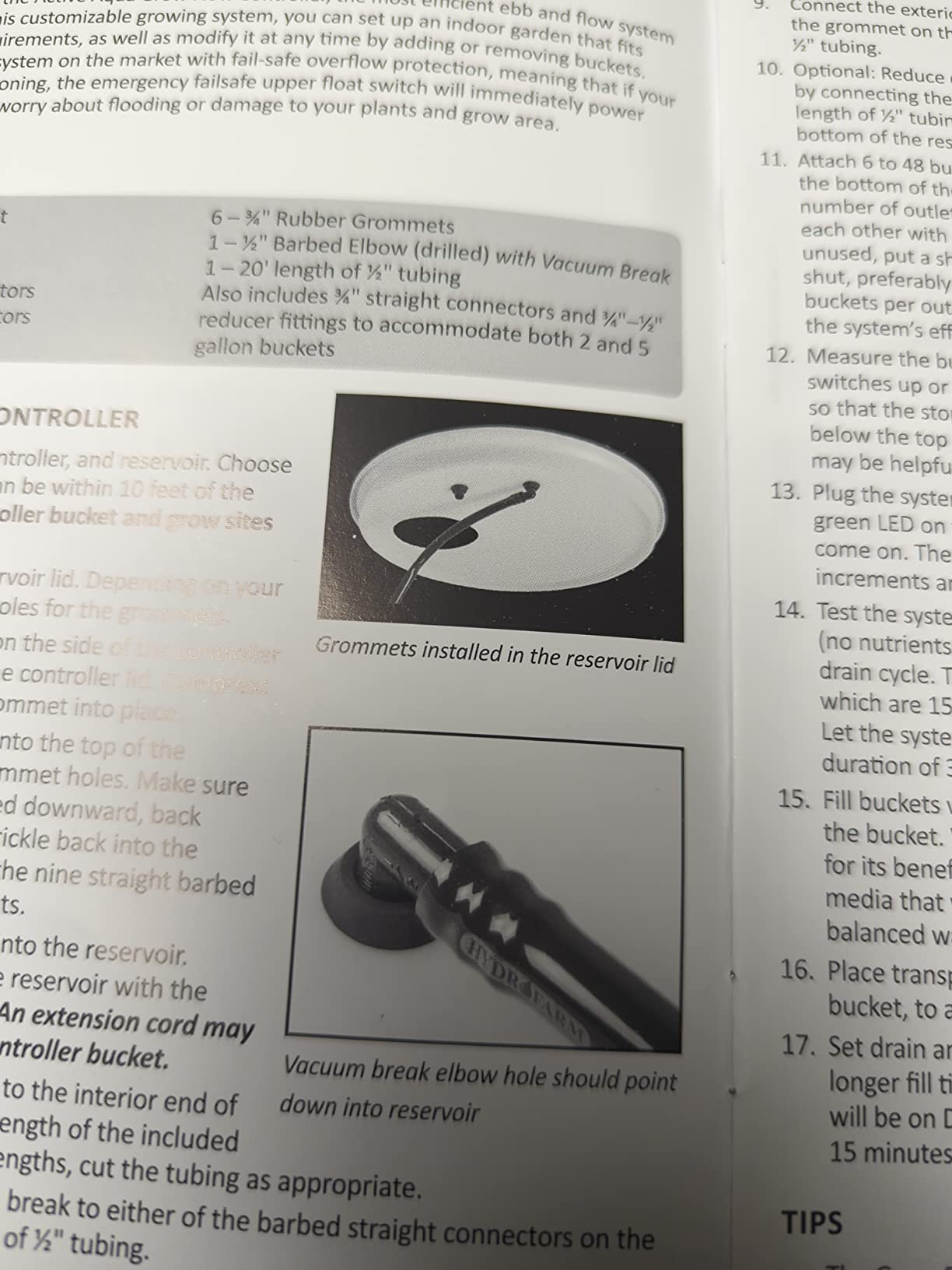
This is the only unit in the lineup that is a true control system rather than a growing surface. The 7-gallon bucket is the reservoir and the brain: float switches read the water level, the timer fires the schedule, and two 250 GPH pumps move solution into whatever modules you hang off it. The manufacturer rates it at up to 24 five-gallon or 48 two-gallon modules, which is the number to hold in mind when you plan capacity.
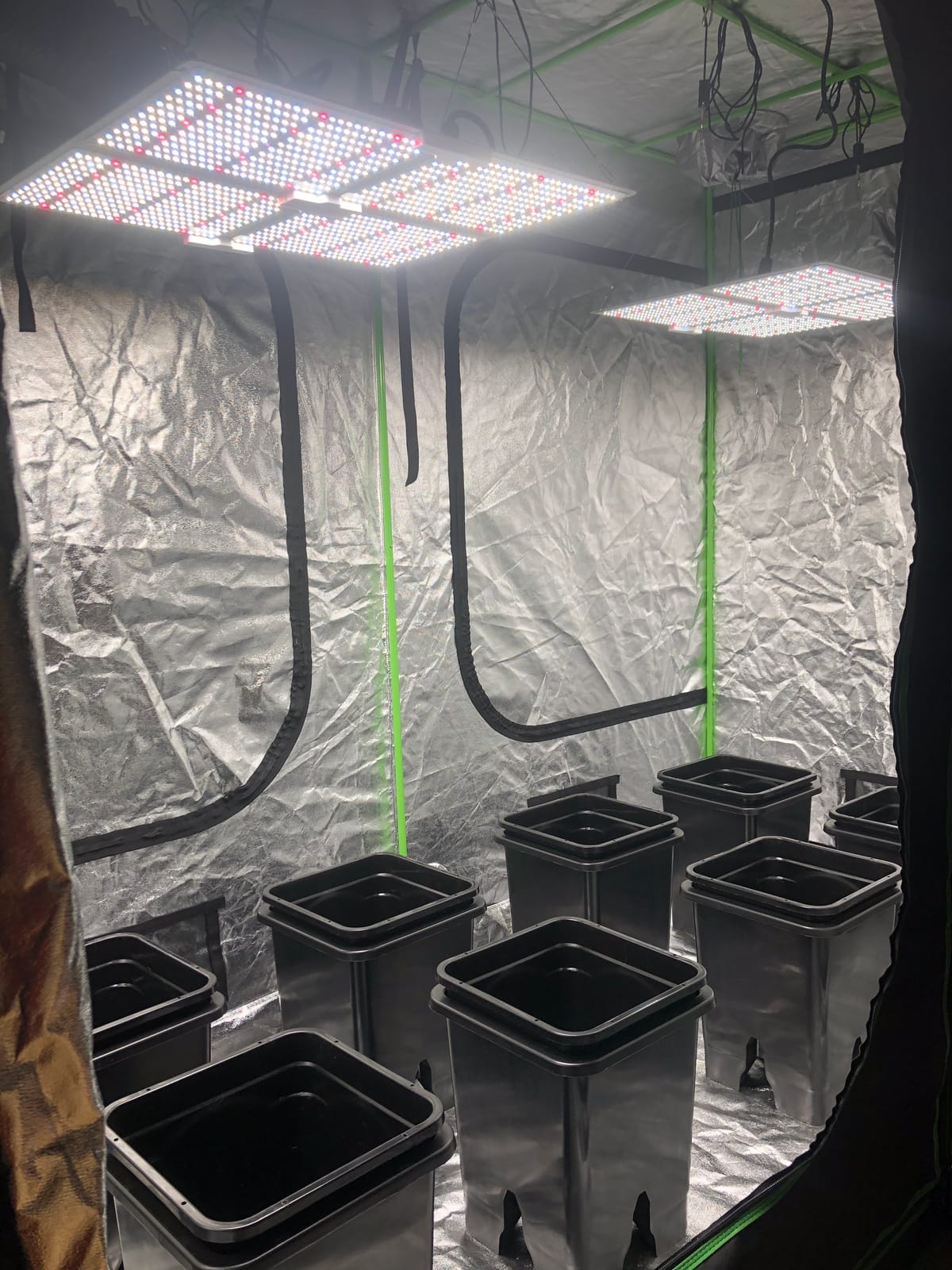
What sold me on it during testing is the emergency shut-off valve. A recirculating system that overflows onto a floor is the failure mode every grower fears, and a fail-safe valve is the one component that turns that from a disaster into an inconvenience. The adjustable ladder level control, which lets you set fill heights across a row of containers, is the other feature I would not give up — but it takes a few cycles before you can set it by feel without overfilling.
Owners with a decade of flood and drain behind them tend to talk about cycle timing in concrete numbers, and the honest benchmark from hobbyist forums is roughly 30 minutes to fully fill a large tray and 5 to 10 minutes to fully drain. The 4.16 gpm flow rate here sits comfortably inside that range for a small footprint, which is why it scales to modules rather than to a single big table.
Who this controller is for
It suits a grower who has already decided on modules and wants the plumbing solved. If you are running a row of five-gallon buckets or a bank of two-gallon modules, this is the piece that replaces a timer, two pumps, a level controller and a safety valve in one box.
It also suits anyone who plans to travel. A 7-gallon controller bucket with float switches keeps feeding a row of plants on a fixed schedule without anyone touching it, which is exactly the resilience people look for when they ask whether a pump failure is survivable. If you also run cameras or sensors over the rig, a solid mesh WiFi system keeps the alerts coming from the far corner of the room instead of dropping them exactly when you need them.
Where it falls short
It is a controller, not a growing tray. If you want a single footprint that you can fill with net pots and medium and set under a light, this is not that product and you will still need to buy the modules or tray separately.
Reviews also point at the plastic construction as the weak point for long-term use, and the 4.1 star average across 105 reviews reflects a device that works reliably but feels like a step below a commercial-grade rig. At 105 reviews it is also by a wide margin the most owner-tested unit here, which for a plumbing component is worth more than a perfect score from three buyers.
2. AutoPot Tray2Grow with 25 Gal FlexiTank – Best for Beginners on a Bench
AutoPot Tray2Grow System – Standard Tray2Grow with 25 Gal FlexiTank – Self-Watering, Gravity-Fed Hydroponic Indoor System, Black
25 gal FlexiTank reservoir
16.1 x 43.9 x 3.8 inch
AQUAvalve5 flow control
Pros
- No electricity and no timer to program
- Gravity and capillary action
- 25-gallon reservoir included
- Fits a standard 44 by 16.2 inch garden bench
- Capillary matting and spikes included
Cons
- Not a scheduled flood and drain cycle
- Only 4 reviews so far
- Fixed tray size limits plant count
Be clear about what this is before you buy it: a Tray2Grow is a gravity-fed capillary system, not a pumped flood and drain cycle. The AQUAvalve5 senses when the medium in a pot or tray runs dry and lets solution through from the 25-gallon FlexiTank, so irrigation happens on demand rather than on a clock. For a first grow that difference is a feature, because there is no timer to misconfigure and no pump that can die mid-cycle.
Owners consistently describe it as their best-yielding setup to date and report that the watering anxiety disappears within a week. That matches what I saw: the FlexiTank holds enough solution to ride through a hot weekend, and the valve responds to actual plant uptake rather than a fixed schedule that ignores weather or growth stage.
The footprint is the other quiet win. At 44 by 16.2 inches it sits on a standard garden bench, and the 25-gallon reservoir underneath gives you real volume without a dedicated reservoir stand. Seedlings, microgreens, potted herbs and small grow bags all fit the tray, so one system covers propagation and production.
Who this bench system is for
It is for a beginner, or for anyone who travels regularly and does not want a timer and pump running unattended. Nothing to program means nothing to come home to a dry tray because a schedule was set for a low-light week.
It also works well for herbs and leafy greens in pots, where a fixed flood window matters less than consistent moisture. The 25-gallon tank gives you enough buffer to top up rarely and to mix full reservoirs of nutrient solution at once.
Where it falls short
If your goal is a genuine flood and drain rhythm — a real soak, a real drain, a root zone that dries between cycles — this is the wrong category. Nothing here floods, and no timer setting will change that.
The review base is also thin. Four reviews, all at five stars, tells you early owners are happy but tells you very little about how the AQUAvalve5 behaves after a year of daily cycles, which is exactly when capillary systems develop their quirks.
3. Artisun Flood and Drain Digital Controller – Best for DIY RDWC Rigs
Flood and Drain RDWC Hydroponic Digital Controller with Pumps and Distribution Reservoir
Digital LED flood and drain controller
Pumps and reservoir included
Plastic and rubber build
Pros
- Runs automated flood and drain cycles
- Digital controller with an LED display
- Pumps and distribution reservoir in one purchase
- Built for RDWC-style layouts
Cons
- Sparse published specification detail
- Only 2 reviews available
- Less ecosystem support than branded systems
This is the box for someone building the rig themselves. Instead of a bare timer and pump, you get a digital controller with an LED display, the pumps, and the distribution reservoir — the three parts you would otherwise order separately and wire by hand. If you already know how a drain line and a fill line should be plumbed, it collapses an afternoon of work into a box opening.
The digital display is the reason I would pick it over a mechanical timer. Recirculating deep water culture setups and flood and drain setups both need a controller that can hold a fill window and a drain window, and being able to read the current state at a glance matters when you are dialing in timing for a new crop.
It is designed around RDWC-style layouts, meaning it suits a build where the reservoir is the shared water source and the growing beds are fed by distribution lines. That is a different topology from a countertop tray, and if that is the shape you are building, this kit matches it.
Who this controller is for
It is for the builder with a plan and limited patience for plumbing. Buy the box, plumb the beds, set the cycle, and you have a working flood and drain loop without a parts hunt.
It is also a reasonable core for a recirculating system that needs a pump and a distribution reservoir but not a full tray. The controller does the timing work; you supply the beds.
Where it falls short
Published specification detail is thin. Dimensions, weight and flow figures are not documented, which makes it hard to size against a tray before you buy, and you will be choosing on the promise of the assembly rather than on published pump output.
Two reviews is not a track record, and support for a less established brand tends to be thinner than for the major names in the category. Budget for the possibility of troubleshooting your own fittings.
4. Echo Cultivation Flood Table – Best Ebb and Flow Tray for 2×2 Tents
Hydroponic Flood Table Grow System (Ebb and. Flow) Perfect for 2 x 2 Tents
22.8 x 22 x 12 inch
7 gallon chamber volume
Recycled plastic frame
Pros
- Built to the footprint of a 2x2 grow tent
- Reservoir
- pump
- timer and fittings included
- Micro drains in all four corners
- 7-gallon chamber volume
- Printed directions plus a setup video
Cons
- Single-table capacity
- Newer product with one review
- No modules or net pots in the box
Most grow tents are 2 by 2 feet, and this table is built to that exact footprint at 22.8 by 22 inches. That dimensional fit is the whole argument: you can slide it into a tent without cutting the floor or improvising a stand, and the 12-inch height leaves room for a reservoir and a pump underneath.
The box is genuinely complete. Reservoir, water pump, fill and drain attachments, site tube, support column, a large water fill cap, a timer and instructions all ship together, plus micro drains in all four corners so the tray empties evenly instead of leaving a stagnant corner where algae starts. One verified owner reports the printed directions and a setup video were enough to get it running and grows autos in a 2×2.
Chamber volume is 7 gallons and the frame is recycled plastic. At that volume the tray holds a real flood without becoming a structural problem, which matters because a loaded tray full of water, medium and plants can buckle a flimsy frame — a complaint that shows up repeatedly in flood table discussions.
Who this flood table is for
It is for a tent grower who wants a single self-contained table and does not want to specify a tray size, a reservoir and a pump separately. Everything needed to run a first flood and drain cycle arrives in one box.
It is also a good fit for a propagation or mother plant corner, where seven gallons of volume and even corner drainage do useful work without a large footprint.
Where it falls short
It is one table. There is no modular path to a second site, so a grower who wants to expand is buying a second full system rather than adding a bed.
One review means one data point, and the recycled plastic frame is the component I would watch over time under continuous wet load. Net pots and medium are not included, so budget for those separately.
5. Happy Hydro Tray2Grow – Best Value Bench Tray for Pots and Seed Trays
Happy Hydro Tray2Grow System – Standard Tray2Grow with No Tank – Self-Watering, Gravity-Fed Hydroponic Indoor System, Black
44 x 16.1 x 3.8 inch
Gravity-fed, no power
AQUAvalve5 demand-based flow
Pros
- No electricity and no timer
- Gravity and capillary operation
- Four seed trays
- capillary matting and ten spikes included
- Anti-slug copper tape and a root control sheet
- Three spirit levels for setup
Cons
- Reservoir sold separately
- Not a scheduled flood and drain cycle
- Only 4 reviews
This is the same bench-scale idea as the AutoPot unit, minus the tank. You get the tray, the lid, the AQUAvalve5 and a full complement of small parts, and you connect it to whatever reservoir you already own. The 44 by 16.1 inch footprint matches a standard garden bench, so it drops into the same space as the FlexiTank version without moving the bench around.
The parts list is the differentiator. Four seed trays, a capillary mat, ten spikes, two grommets, 3.3 feet of three-eighths tubing, click-fit and golf filters, an overflow grommet, a root control sheet and anti-slug copper tape all come in the box. Three circular spirit levels are included too, which sounds trivial until you have tried to level a 44-inch irrigation tray by eye and got a pond on one side.
Owners rate it 4.7 across four reviews, with praise split between the gravity-fed simplicity and how many planting styles it accepts — seed trays, small pots, microgreen trays, grow bags, coco slabs and larger planters all work on the same mat.
Who this bench tray is for
It is for a grower who already has a reservoir and wants bench irrigation without another electrical component in the room. Pair it with any opaque tank and you get consistent, demand-based feeding.
It suits mixed planting too, since the mat and spikes let you run propagation trays next to pots of herbs on a single line. That flexibility is why the four-review average sits where it does.
Where it falls short
The tank is not included, so the all-in cost to get running is higher than the sticker suggests. It also means you supply the reservoir and must make sure it sits level and below the tray for gravity to work.
Like the AutoPot unit, this is capillary irrigation rather than a true flood and drain cycle. If you want scheduled flood minutes and a visible drain event, keep looking.
6. RooTrimmer 5-Tier Ebb and Flow Stand – Best Vertical Pick for Small Spaces
5-Tier Ebb & Flow Hydroponic Plant Stand Bundle with Timer Auto Watering Pump, Siphon Circulation Self Irrigation Growing System for Seed Starter Trays & Potted Plants Indoor Balcony Greenhouse
Five vertical tiers
UV-resistant PVC
1-9 day intervals
1-10 minute runtime
Pros
- Five tiers in a small footprint
- Rechargeable timed pump included
- Watering interval and runtime both adjustable
- Siphon circulation moves water down the tiers
- Fits 1020 plug trays and 3-7 inch pots
Cons
- No customer reviews yet
- Rechargeable pump runtime not documented
- Not sized for large fruiting plants
This one answers a different problem: floor space. Five tiers of UV-resistant ribbed PVC stack into a vertical stand that fits a balcony, a windowsill or a home nursery, with a rechargeable timed pump at the top feeding each layer through siphon circulation. Water moves down the stack rather than being pumped back up, which is why the whole thing needs so little in the way of power.
The timer is genuinely adjustable in two directions: a 1 to 9 day interval between watering and a 1 to 10 minute runtime. That combination suits a propagation setup, where you want a long interval while cuttings root, and a succulent or nursery bench, where you want a short daily cycle. Each tier is rated to hold up to 50 lbs and accepts standard 1020 plug trays or 3 to 7 inch pots.
Assembly is a snap-lock build that the manufacturer puts at about 15 minutes, with side handles for moving it and an anti-slip base. The anti-clog filter and leak-proof sealing on the pump are the details that matter most in a recirculating vertical stack, since a failed seal at the top tier floods everything below it.
Who this vertical stand is for
It suits a balcony or small apartment grower who has wall or shelf height but no floor area for a table. Seed starting, microgreens, succulents, herbs and small potted plants are the natural occupants of five shallow tiers.
It also suits anyone who wants a system that keeps working through a power cut. The pump is rechargeable, so a timer outage does not instantly end irrigation the way a mains-powered recirculating pump would.
Where it falls short
There are no customer reviews and no rating yet, so nothing here has been validated by owners. Treat the pump’s rechargeable runtime as unknown until you have measured it yourself, because it is not documented.
The shallow tiers rule out large fruiting plants, and siphon circulation is slower than a pumped flood, so cycle timing is limited to the 1 to 10 minute window the pump allows.
Ebb and Flow vs Other Hydroponic Systems
Choosing a method is mostly choosing what you want to grow and how much attention you want to give it. Ebb and flow sits in the middle of the difficulty curve: more parts than deep water culture, fewer failure points than aeroponics, and much better scaling to large plants than a wick system.
Ebb and flow — scheduled flood and drain, works with almost any medium, scales from lettuce to tomato. Moderate part count, and a pump failure matters because the cycle stops.
Deep water culture — fewest parts and the gentlest learning curve, but roots sit in still water with constant root rot exposure and it scales poorly to many large plants.
Nutrient film technique — a thin film in a channel, excellent for leafy greens, but the roots dry out fast and NFT channels are built for shallower crops.
Drip irrigation — versatile and familiar, but it needs more emitters and more frequent manual intervention than a scheduled flood.
Aeroponics — the highest oxygenation of the lot, and also the most sensitive to a pump failure because misting roots have no water reserve at all.
Wick systems — passive and cheap, limited to shallow-rooted crops and small plants, and the least productive option in this list.
The short version: if you want to grow tomatoes or peppers, ebb and flow is the answer. If you only want lettuce and you want the fewest possible failure points, deep water culture is easier. If you want zero electricity and no schedule, the capillary tray systems in this roundup beat both.
The Disadvantages of Ebb and Flow Hydroponics
The honest list is short but real, and it is worth knowing before you buy hardware. First, ebb and flow is the most pump-dependent method in common use: the timer, the pump, the controller and the fittings are all in the failure path, and any one of them stopping means the cycle stops.
Second, an outage is a genuine event. In NFT, an outage dries roots in hours; in ebb and flow it is less immediate but still serious, because a tray that stops draining can waterlog roots in a closed loop. Growers who travel mitigate this with a larger reservoir, a second pump and a battery air pump, and the community consensus is to treat backup planning as part of owning the system rather than an optional extra.
Third, sizing errors are common and expensive. The most reported hardware problem in forums is an over-powered pump that fills the tray faster than the drain can return, which causes overflow and a permanently waterlogged root zone. A flimsy tray filled with 15 gallons of water, medium and plants can also buckle, and that kind of failure is not covered by anything.
Finally, ebb and flow does not eliminate the learning curve. Nutrient strength, pH, water temperature and cycle timing all still have to be right, and a set-and-forget system that ignores them will underperform a well-run deep water culture setup. If you are unwilling to check pH and top up a reservoir regularly, a passive capillary tray is the lower-effort choice.
What to Grow in an Ebb and Flow System
Ebb and flow is at its best with crops that drink hard and then appreciate air. Roots that want a soak followed by oxygen do better here than roots sitting in a continuously wet zone.
Leafy greens — lettuce, kale, bok choy, pak choi and arugula are the fastest route to a first harvest
Herbs — basil, mint, parsley, cilantro and chives thrive on the cycle
Fruiting plants — tomato, pepper, cucumber and squash all work, given larger net pots, more reservoir volume and a sturdier support frame
Propagation and cuttings — a flood table is excellent for cloning and for raising seedlings before transplanting
Microgreens and nursery stock — shallow tiers and seed trays suit short-cycle crops
What to skip: plants with woody, thick roots that rot in a constantly wet medium, and very large mature plants in a small tray, where the reservoir cannot supply enough solution per cycle. Match the site count to the crop, not the other way around.
Best Growing Media for Ebb and Flow
Medium choice in a flood and drain system is really a question of how the medium behaves when it is soaked and then drained. You want something that holds enough solution for the soak window, then lets go of it so the tray can empty.
Clay pellets (LECA) — the default for flood and drain. Inert, reusable, structurally stable, and the round pellets leave air gaps that keep the root zone oxygenated. They do not absorb water, so net pot sizing matters.
Rock wool cubes — excellent water retention and a strong fit for propagation, though it is better known from NFT channels. Keep the crown of the cube above the net pot rim to avoid stem rot.
Coco coir — good retention with reasonable aeration and a natural feel, and it works well in larger fruiting plant setups.
Perlite — light and highly aerated, but it floats and it has almost no water retention, which makes it a poor solo medium for flood and drain.
Perlite in particular is the one most often misused. It is a component mixed into blends, not a medium on its own, because a tray full of perlite drains too fast to sustain a soak. The two items worth avoiding in a recirculating system are anything that breaks down into dust and anything that floats into the pump.
Ebb and Flow Timer Schedule and Flood Cycle Timing
No competitor on this search covers cycle timing, and it is the practical question that comes up most on hydroponics forums. Growers with years of flood and drain running describe roughly 30 minutes to fully fill a large tray and 5 to 10 minutes to fully drain — treat that as a community benchmark for a large tray rather than a universal constant, and time your own tray once when you set it up.
The general shape of a schedule is simple. Seedlings and cuttings want short, frequent cycles. Established plants want longer soaks and longer gaps. Mature fruiting plants want fewer, heavier cycles so each flood delivers real volume.
Cuttings and seedlings — flood for a few minutes, cycle several times a day, with the tray barely reaching the net pot rims
Leafy greens and herbs — moderate flood minutes with the solution reaching the lower third of the medium, cycling every few hours
Established vegetative plants — longer flood, cycling less often as root mass grows and water demand rises
Fruiting plants — the heaviest flood and the longest interval, sized to the reservoir volume per site rather than to a fixed number of minutes
Two rules keep most schedules working. Watch the timer and adjust the time limit so the tray fully empties before the next flood — a tray that never empties is the root of most failures. And re-check timing every two weeks as plants grow, because the same settings that suited a seedling will waterlog a mature plant.
Watch the pump sizing too. A pump that fills faster than the drain returns will overflow the tray, and that is the specific mistake new growers make when they buy a high-output pump for a small table.
How to Choose the Right Ebb and Flow Hydroponic System
Start with plant count, because it drives everything else. Count mature sites, not seedling sites, and remember that a full tray of water plus medium plus plants is heavy — flood tables are the number one cause of a buckled frame. Then match the format to your space.
Choose a controller bucket if you want to run modules and you would rather not plumb a tray. It scales to many sites and keeps a fixed schedule, at the cost of buying growing modules separately.
Choose a tray or flood table if you want one self-contained footprint. Nothing else to source, everything drains into one chamber, and it moves between tent and indoor setup more easily than a plumbed rig.
Choose a gravity-fed bench tray if you want no electricity and no schedule. Irrigation becomes demand-based, travel stops being a risk, and the tradeoff is that you lose flood timing control.
Choose a vertical stand if floor space is the binding constraint and your crops are shallow-rooted.
After format, check four things: is a timer or controller included, is a reservoir included, is the pump output matched to tray volume, and can the system grow into what you need next. Expansions are the real cost difference between formats — modules and controllers scale by adding a bed, tables scale by buying another table.
How to Set Up an Ebb and Flow System Step by Step
Work in this order and the first cycle is usually uneventful, which is the goal.
Level the site first. Set the reservoir, then the tray, and confirm both are level and that the reservoir sits below the tray’s drain point. A tray that is off by a fraction drains slowly at one corner and leaves a stagnant puddle there.
Position the reservoir. Put it where you can reach the top without a ladder, out of direct light if it is translucent, and near enough that the fill line runs without kinks.
Seat the pump. Keep it off the reservoir floor, oriented for the flow direction of your tubing, and short-circuit resistant is worth preferring if you have the option.
Run and secure the drain line. The drain line is the part that decides whether the system works. Fit it at the lowest corner and check the fall back to the reservoir before you seal anything. If you suspect the blockage is further down the line than you can see, our guide to drain camera inspection systems explains how that kind of camera locates a clog without pulling the pipe apart.
Wire the timer or controller. Set a short flood first. You are testing for leaks and for a complete drain, not for a mature schedule.
Fill the net pots. Pre-soak the medium so it does not float or blow out of the pot, and keep the medium below the rim so it cannot wash into the pump.
Run the first flood. Watch it fill, watch it drain, and time both. Those two numbers are your real baseline for every schedule you set afterwards.
Troubleshooting Common Ebb and Flow Problems
Almost every ebb and flow problem traces back to flow, drainage, oxygen or nutrients. Work through these in order rather than changing settings randomly.
The tray is not draining back. Usually a kinked drain line, a blocked filter or a tray sitting flat instead of sloped. Clear the line, check the filter, and confirm the reservoir is below the drain.
The pump is not turning on or the timer has no power. A failed submersible pump in a recirculating system is a crop event, not an inconvenience. Restore power, then swap in the spare pump immediately — that is why people keep one. Add a battery air pump to the reservoir so roots keep oxygenating while you fix it.
Water is sitting in the tray after the drain window. The drain is too slow for the pump, or the tray is not level. Reduce pump output rather than lengthening the drain window, and re-level the tray.
Green or fuzzy growth in the tray. Light is reaching the solution, or solution is sitting in the tray too long. Opaque the reservoir, empty the tray fully after each cycle, and keep the reservoir covered.
Roots turning brown and slimy. Root rot, almost always from poor drainage or warm, low-oxygen water. Improve the drain, drop reservoir temperature, and increase aeration in the reservoir.
White or rusty crust on net pots and medium. Salt buildup from repeated evaporation. Flush the system with plain water between nutrient changes and keep the solution level from dropping too low.
Plants growing but weak and pale. Check nutrient strength and pH before anything else, then check that the timer is actually running the cycle you think it is.
Running a rig unattended for a long weekend also means remote visibility, and that is the same problem a home security system solves with cameras and alerts: one camera pointed at the reservoir tells you a pump stopped long before the plants show any stress.
Bucket Ebb and Flow vs Tray and Flood Table Setups
These three formats get confused constantly, and buying the wrong one is a common and expensive first mistake. The difference is where the solution sits and how it moves.
Bucket systems put a full bucket, often five gallons, on a stand with a net pot in the lid and a drain fitting near the bottom. Each bucket is a self-contained site, so they scale one plant at a time and a single failure affects one plant. They suit a grower with 4 to 12 large plants and no interest in a shared plumbing run.
Tray and flood table systems flood one large chamber. They hold more sites per controller, give better uniformity across plants, and are the format that scales to a grow tent or a small room. They are heavier, and the tray has to be sturdy when loaded with solution, medium and plants.
Capillary bench trays — the Tray2Grow family in this roundup — are a fourth path rather than a flood and drain variant. No pump, no timer, irrigation on demand. If your real goal is fewer moving parts, pick these and stop trying to force them into a flood and drain schedule.
Forum consensus broadly treats flood and drain as the most flexible method, able to hold a handful of large plants or many small ones, and convertible later into a drip arrangement. That flexibility is the reason it keeps appearing in beginner-to-commercial guides.
Frequently Asked Questions
What are the disadvantages of ebb and flow hydroponics?
The main drawbacks are pump and timer dependence, the cost of a power or pump failure, sizing errors that cause overflow or a buckled tray, and the ongoing need to manage nutrient strength, pH and water temperature. A system with a backup pump, a battery air pump and a larger reservoir removes most of the risk.
What is the ebb and flow system in hydroponics?
An ebb and flow hydroponic system, also called a flood and drain system, periodically floods the plant root zone with a nutrient-rich solution and then drains it back into the reservoir, so roots alternate between soaking up nutrients and breathing fresh oxygen.
How do I build my own ebb and flow hydroponic system?
You need a reservoir, a submersible pump, a digital timer or controller, a grow tray or growth modules, net pots, growing medium and a drain line. Level the reservoir below the tray, run the drain line at the lowest corner, seat the pump above the reservoir floor, fill the net pots with pre-soaked clay pellets, and run a short test flood while you time the fill and the drain.
What are the best plants to grow in an ebb and flow system?
Lettuce, kale, bok choy, arugula, basil, mint, parsley and cilantro are the easiest and fastest. Tomato, pepper, cucumber and squash also do well given larger net pots, more reservoir volume and support. Propagation and cloning are ideal uses, and very woody or thick-rooted plants are the ones to avoid.
What is the best medium to use in a flood and drain system?
Clay pellets are the default choice because they are inert, reusable and structurally stable under repeated flooding, and the round shape leaves air gaps around the roots. Rock wool suits propagation, coco coir suits larger plants, and perlite is best used as a blend component rather than on its own.
What are the best-rated hydroponic systems?
In this roundup the highest review counts belong to the Active Aqua Ebb System 7 Gal, which has by far the most owner reviews in the set, followed by the bench-scale Tray2Grow units. For a complete flood and drain kit in one box, the Echo Cultivation flood table ships with the reservoir, pump, timer and fittings.
Which is better, NFT or DWC?
Neither wins outright. NFT channels are excellent for leafy greens and dry out fast if the pump stops, while deep water culture has the fewest parts and the gentlest learning curve but exposes roots to root rot in still water. Ebb and flow sits between them and scales better than either for larger and fruiting plants.
What is the best hydroponic system to buy?
For a first pump-driven system, a complete tray or flood table package is the least error-prone. For modules and many sites, a controller bucket is the better buy. For the fewest moving parts, a gravity-fed bench tray with a reservoir needs no electricity and no schedule. Choose by plant count, footprint and how much automation you want.
Is an indoor hydroponic system worth it?
For a grower with reliable light and the willingness to check pH and nutrient strength regularly, an indoor hydroponic setup delivers faster growth and far higher yield per footprint than soil in containers. The main costs are the light, the hardware and the constant attention to solution temperature and chemistry.
How long should a flood cycle run?
Short flood windows suit cuttings and seedlings, moderate floods suit leafy greens and herbs, and heavier floods with longer intervals suit mature fruiting plants. Growers with years of flood and drain experience describe roughly 30 minutes to fill a large tray and 5 to 10 minutes to drain as a community benchmark, so time your own tray once during setup and adjust from there.
Conclusion: The Best Ebb and Flow Hydroponic Systems in 2026
After two months with these systems, the Active Aqua Ebb System 7 Gal is still the one I recommend most often. It is the only unit here with a real owner history, it scales to 24 five-gallon modules off a single 7-gallon controller, and the emergency shut-off valve is the feature that turns an overflow from a floor disaster into a non-event. Buy it if you are running modules and want the plumbing solved.
For a first grow, the AutoPot Tray2Grow with 25 Gal FlexiTank is the calmest option, because gravity does the work and there is nothing to program. If you already own a reservoir, the Happy Hydro Tray2Grow gives you the same bench irrigation for less and comes with a full set of small parts plus spirit levels for setup.
The Echo Cultivation flood table is the pick for anyone working inside a 2 by 2 grow tent who wants a complete flood and drain kit in one box, and the Artisun digital controller is for builders assembling their own RDWC-style loop. The RooTrimmer 5-tier stand is the vertical answer when floor space is the constraint and your crops are shallow-rooted — just treat it as unproven and measure the pump runtime yourself.
Whichever you pick, time your first fill and first drain before you set any schedule, keep a spare pump and a battery air pump on hand, and check that the tray fully empties every cycle. Those three habits prevent nearly every failure we ran into.