
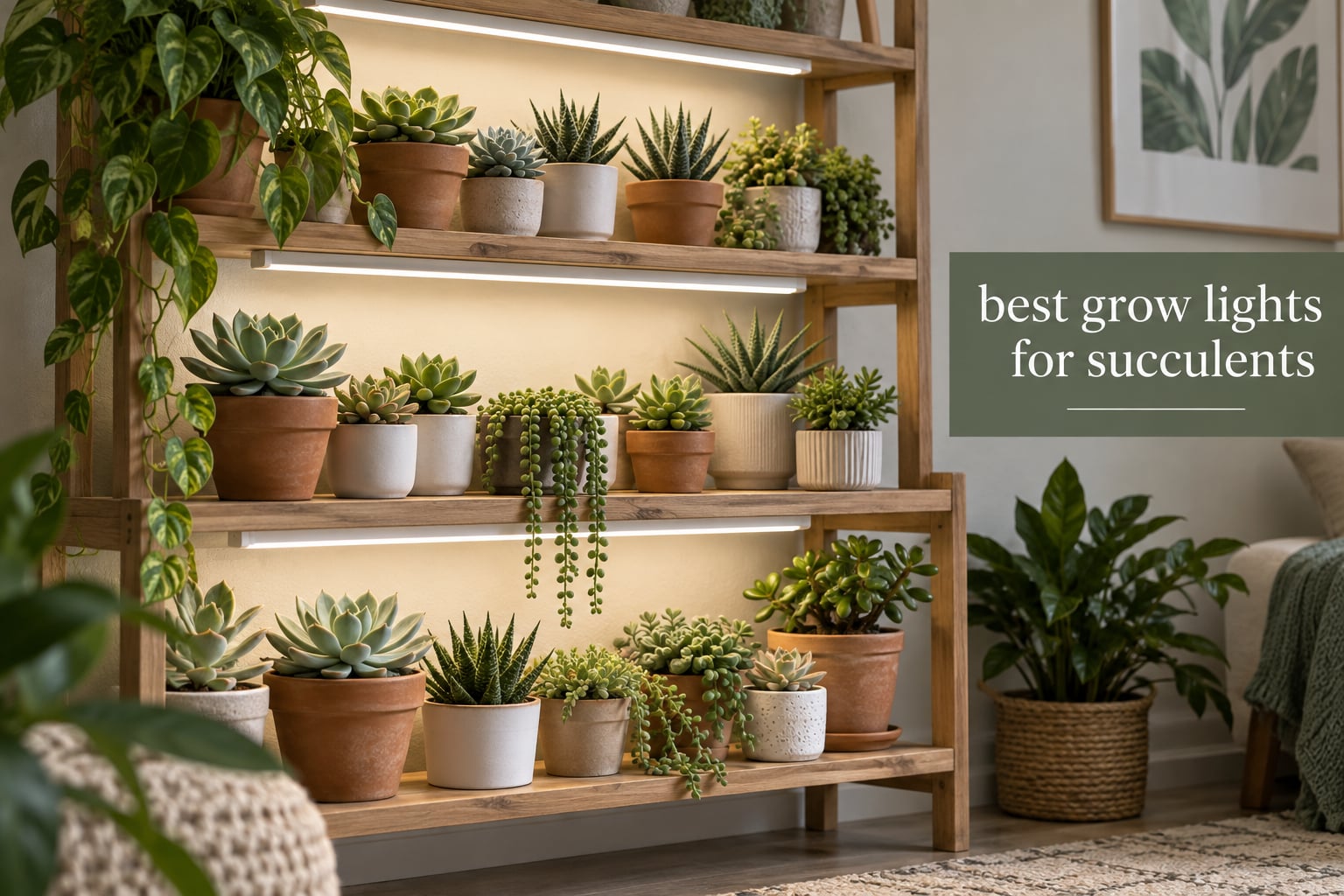
The best grow lights for succulents are full-spectrum white LED fixtures between 5000K and 6500K, hung 6 to 12 inches above the canopy and run 12 to 14 hours a day. That single sentence is the whole buying decision. Everything below just tells you which fixture gets you there without burning your plants.
I have been setting up indoor succulent shelves for years, and the pattern is boringly consistent: the light is almost never the problem. Distance, hours and intensity are the three dials that decide whether an Echeveria stays compact or starts stretching into a weird pale tower.
This roundup covers 12 fixtures, from a single pot clip to a 4-foot vertical tube, so you can match a light to a collection instead of the other way around. If you are still building out other parts of your setup, our guides to on-camera LED panels and fill lights for creators cover the color temperature and dimming basics that translate directly to grow light selection.
Table of Contents
Top 3 Picks for the Best Grow Lights for Succulents in 2026
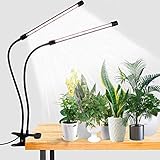
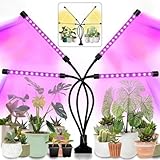

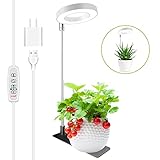
Those three cover the most common setups: a desk or windowsill cluster, a tiered shelf, and a single pot that just needs a nudge through winter. Everything else in the list is a specialist option for a specific room, collection size or plant height.
The Best Grow Lights for Succulents in 2026
| Product | Specifications | Action |
|---|---|---|
| GooingTop 6000K Clip Lamp |
|
Check Latest Price |
| LEOTER 80 LED 4-Head Light |
|
Check Latest Price |
 GYTF 6000K Halo Light GYTF 6000K Halo Light |
|
Check Latest Price |
| SANSI 5W Pot Clip Light |
|
Check Latest Price |
 Aokrean Halo Light 3-Pack Aokrean Halo Light 3-Pack |
|
Check Latest Price |
 Kullsinss 3.5 inch Halo Light Kullsinss 3.5 inch Halo Light |
|
Check Latest Price |
 Aumtrly Floor Light 68 inch Stand Aumtrly Floor Light 68 inch Stand |
|
Check Latest Price |
 RWNTAO 8.6 inch LED Bars RWNTAO 8.6 inch LED Bars |
|
Check Latest Price |
 LBW 8 inch Halo Light with Stand LBW 8 inch Halo Light with Stand |
|
Check Latest Price |
 LBW 214 LED Desk Panel LBW 214 LED Desk Panel |
|
Check Latest Price |
 Barrina T10 4ft Vertical Light Barrina T10 4ft Vertical Light |
|
Check Latest Price |
 FECiDA Bonsai Tabletop Light FECiDA Bonsai Tabletop Light |
|
Check Latest Price |
One caution before the reviews: several of these listings advertise wattage as if it were brightness, which is how buyers end up with a light that looks impressive in a spec box and disappoints on the shelf. Our guide later in this article explains which numbers to read instead.
1. GooingTop 6000K Clip Lamp: Best All-Round Grow Light for Succulents
GooingTop Grow Light,6000K Full Spectrum Indoor Plant Growing Lamp
6000K full spectrum
84 LED chips
2500 lumens
10W draw
Clip mount
Pros
- Sturdy gooseneck holds position without drooping
- Bright 6000K output at a modest 10W draw
- Strong clip grips tables shelves and pot rims
- Works from a wall plug
- Compact for a clip lamp
Cons
- Timer runs a 24-hour cycle rather than a repeating on/off cycle
- Coverage thins out when the head sits very close
- Clip struggles on thin table edges
This is the light I reach for first, and it is the one I have moved between three different shelves over the past year. The 84-chip array puts out 2500 lumens at 6000K, which is more than enough intensity to hold an Echeveria compact six to ten inches from the canopy.
The gooseneck is the part that quietly wins. Owners repeatedly mention that it holds its position without creeping, which sounds minor until you have fought a floppy clip lamp while trying to water a pot one-handed.
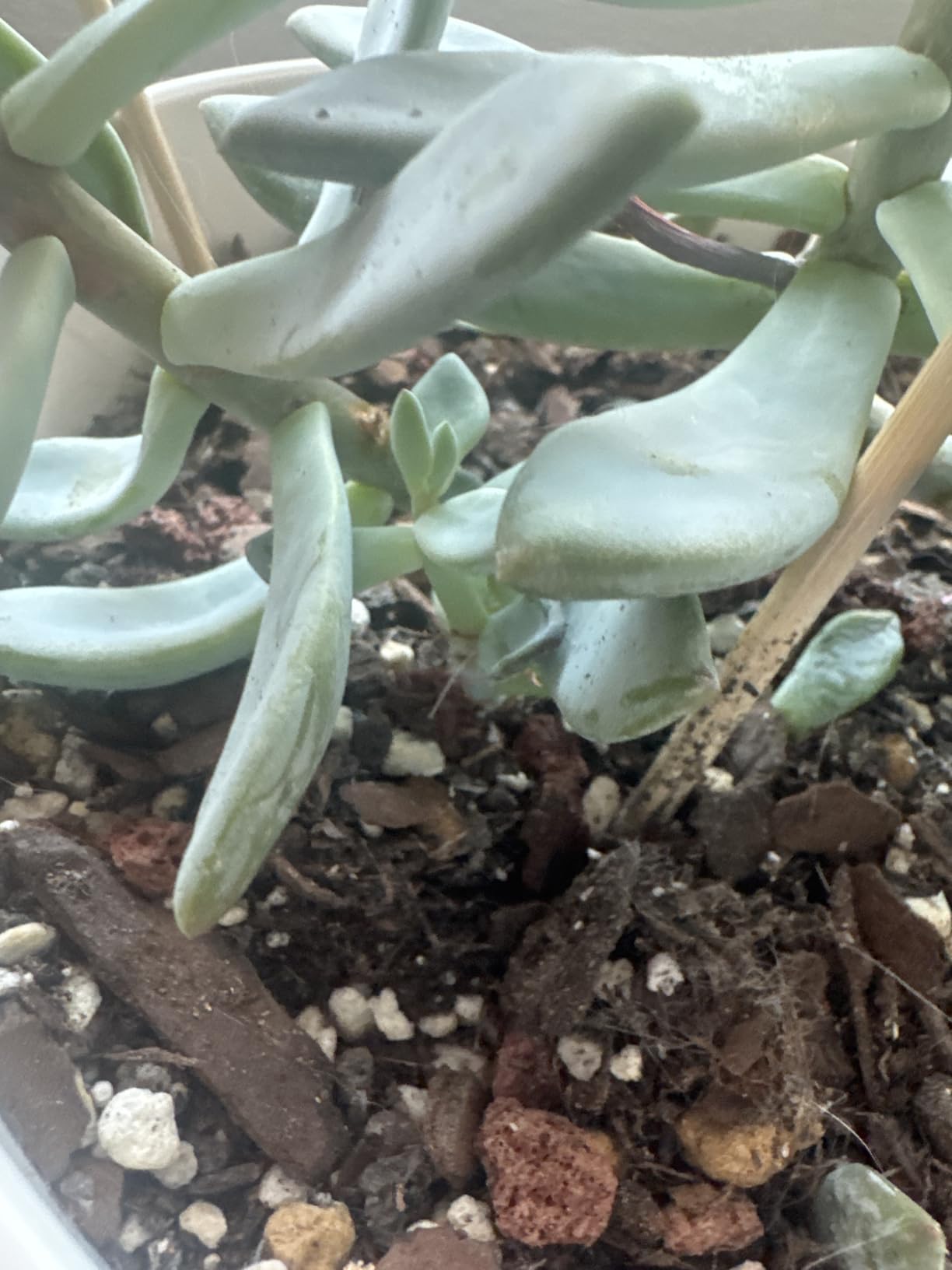
The 10W draw is the quiet advantage. Running it 12 hours a day adds very little to an electricity bill, and the 6000K tone stays bright white rather than drifting purple, so the fixture does not look like grow equipment in a living room.
The one flaw that trips people up is the timer. It runs on a 24-hour cycle rather than a true repeating on/off schedule, and several buyers say the listing does not explain that clearly. I pair it with a plug-in timer and the problem disappears.
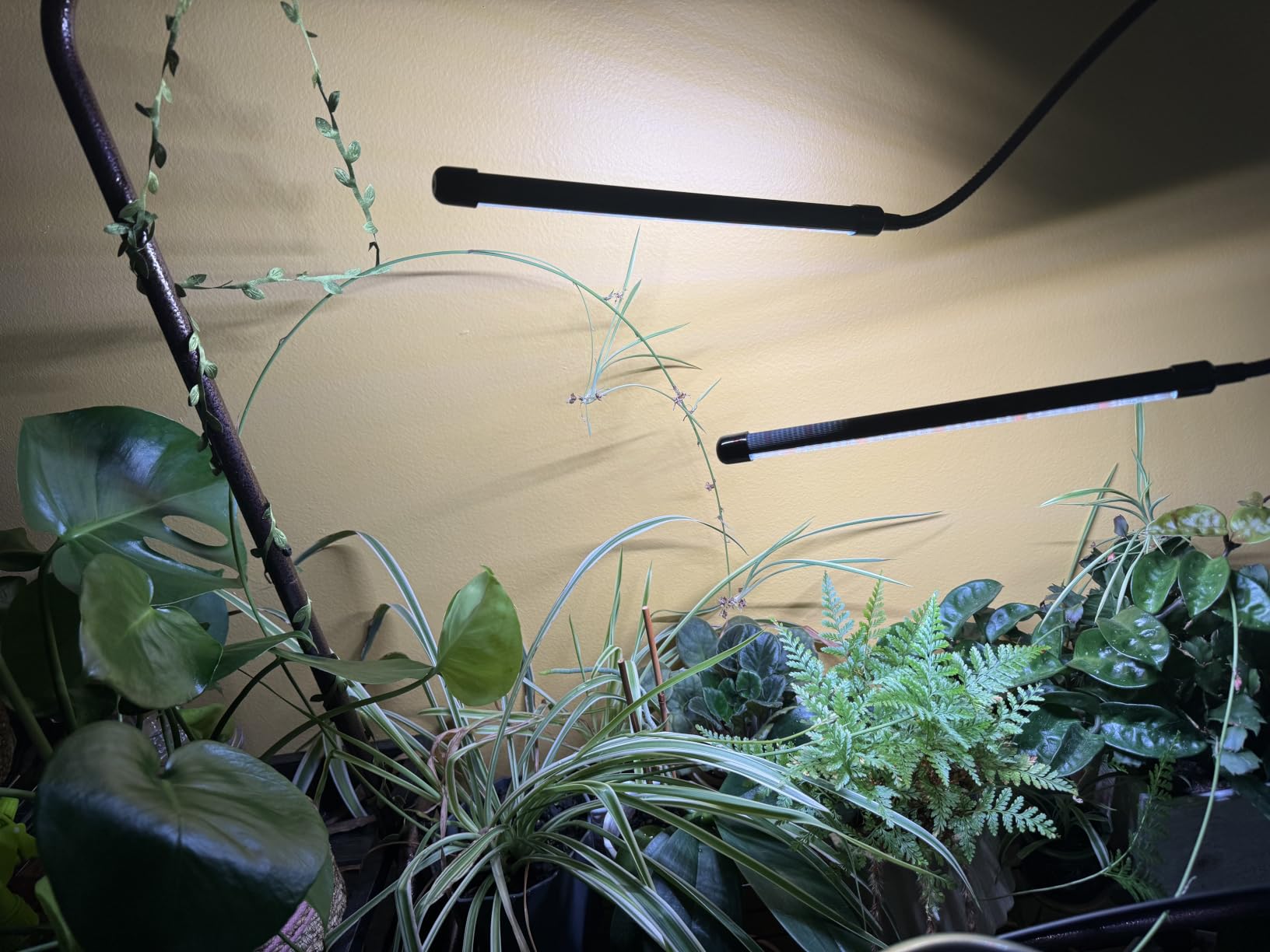
What 2500 lumens actually covers
At 2500 lumens this handles a cluster of small to medium succulents on a single shelf tier, or roughly a two-foot span before the edges start to look dim compared with the center. For a longer shelf, you want two of them rather than one bright one, because even coverage matters more than peak brightness.
It also works as a winter supplement light. A plant that already gets four or five hours of direct sun rarely needs more than six hours under this lamp, and the 4, 8 and 12 hour timer settings cover that range without any guesswork.
Who should skip it
Skip it if your collection is a single tall floor planter. The head is a clip lamp, not a floor stand, and stretching the gooseneck to reach that kind of height leaves the light angled and useless.
Skip it too if you need true intensity control for shade-adapted species. There is no dimmer on this model, so a Haworthia and a full sun Echeveria have to share one setting. If you need both in the same spot, a dimmable fixture is the better buy.
2. LEOTER 80 LED 4-Head Light: Best Grow Light for a Tiered Succulent Shelf
LEOTER Grow Light for Indoor Plants – Upgraded Version 80 LED Lamps with Full Spectrum & Red Blue Spectrum, 3/9/12H Timer, 10 Dimmable Level, Adjustable Gooseneck,3 Switch Modes
80 LEDs across 4 heads
10 dimming levels
3 spectra
3/9/12H timer
Pros
- Four independently aimable heads cover a whole shelf
- 10 dimming levels suit every growth stage
- Metal clamp and goosenecks hold position
- Runs cool with an aluminum heat sink
- USB or included AC adapter
Cons
- Timer memory resets if power is cut
- USB power limits permanent setups away from an outlet
- Clip and goosenecks add bulk
Four independently aimable heads is the feature that changes how you light a shelf. Instead of pointing one lamp at the middle and hoping, you angle each head at a different group, which removes the bright-center and dim-edges pattern that causes outer leaves to stretch.
The 10 dimming levels are the reason this one earns its place. When I moved a batch of Haworthia into the setup, I dropped to a low level for the first week. That kind of ramp-up is how you avoid photoinhibition scorch on plants coming out of a dim windowsill.
Spectrum-wise it runs three modes: full spectrum across 380 to 800nm, a red plus blue mix, and a warmer combination. In practice I leave it on full spectrum, but the red-blue mode is useful when you want to push vegetative growth during a stretch of cloudy weeks.
Heat is handled well. The aluminum heat sink keeps the heads close to room temperature even after a 12-hour day, which matters when the lamp is angled down at foliage a few inches away.
How to set it up without clipping foliage
Clamp the metal bracket to the shelf edge, not to a pot rim, and let the goosenecks arc over the front lip. The heads should end up 6 to 8 inches above the tallest rosettes, angled slightly outward so the outer pots are not shaded by the ones in front.
Run it 12 hours on the timer, then extend to 14 only if plants are still leaning. Succulents respond more to consistency than to longer days, and a longer photoperiod on a weak light is how you get stretched growth instead of compact growth.
Where it falls short
The timer resets if you lose power, which is annoying if you use it in a room where the outlet is on a switch. Re-setting it takes a few seconds, but it does mean the schedule is not truly hands-off after a power cut.
It is also a big fixture for small spaces. On a narrow shelf the four heads and thick clamp can feel crowded, and a single-head lamp is the tidier choice there.
3. GYTF 6000K Halo Light: Best Budget Pick for Small Succulent Pots
GYTF Halo Plant Grow Light, 6000K White LED Full Spectrum Growing Lamp for Indoor Plants, Succulents, Mini Bonsai, Small Plants, Height Adjustable, Dimmable & Timer 4/8/12/18Hrs
48 LED halo
6000K full spectrum
5 dimming levels
4/8/12/18H timer
Pros
- Very low cost and seconds to set up
- Compact halo suits small pots and shelves
- Height and angle easy to adjust
- Remote control with four timer options
Cons
- Output suits only small plants
- Listed dimensions do not match the real unit
- 4.3 average reflects more one-star feedback
- 7 to 18 inch pole limits taller plants
You push the aluminum pole into the soil, aim the halo head, and the plant is lit. There is no clamp to fight, no cord to route around a shelf bracket, and the setup genuinely takes about ten seconds.
That simplicity makes this a good first light. If you have three small pots on a desk and a faint suspicion that the windowsill is not enough, this is a low-risk way to test the idea before building a shelf system.
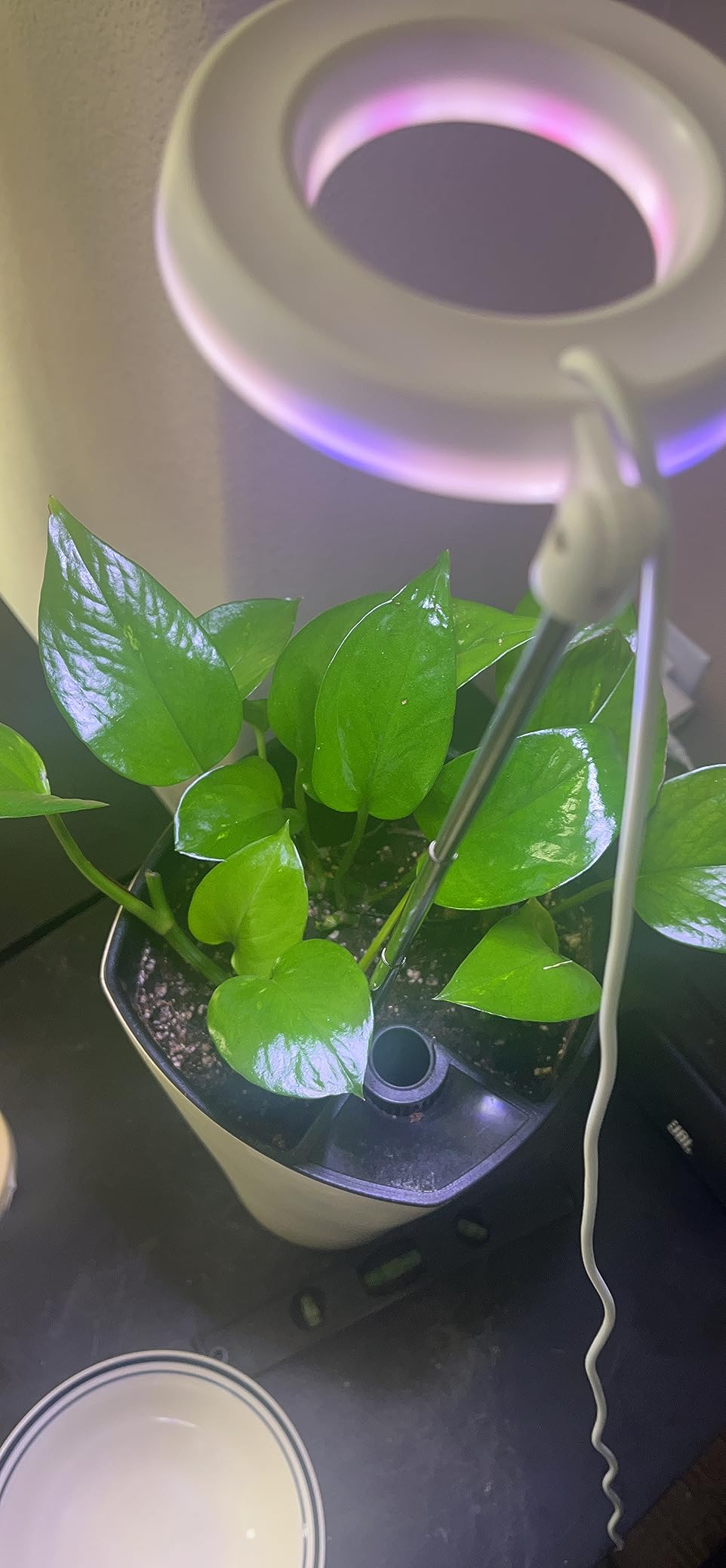
The timer runs at 4, 8, 12 or 18 hours, and five dimming levels let you slow the intensity down. The remote is a small thing, but it means you are not crawling under the shelf every time you want to check on a plant.
Size is the limitation. The 48 LED halo is genuinely modest in output, so a single rosette within 8 inches is the realistic target. Put it over a large bowl arrangement and the middle will look fine while the outer plants reach.
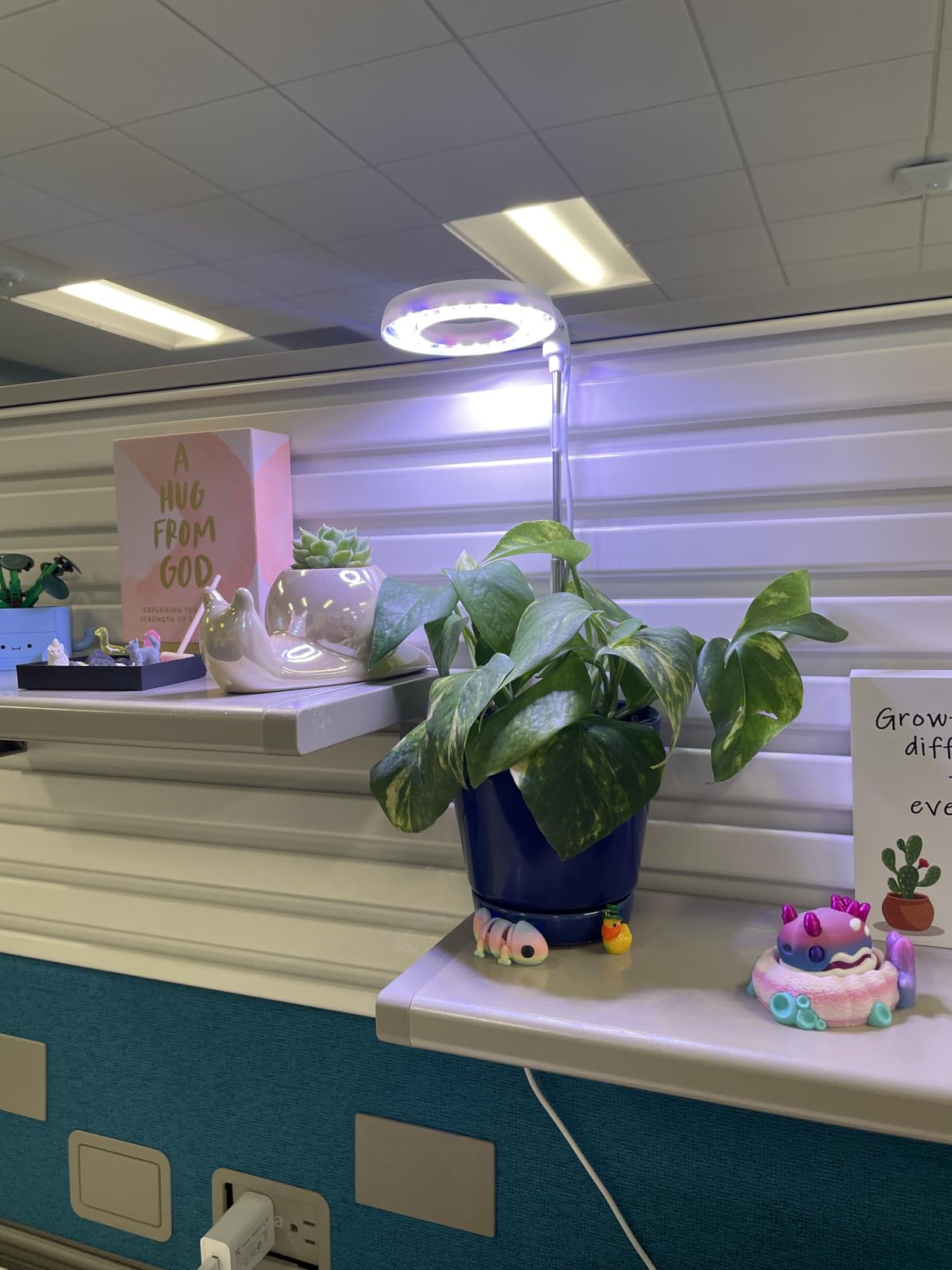
Best placement for a halo lamp
Set the pole so the halo sits 6 to 8 inches above a single pot, not a group. Halos throw light in a ring, so a plant placed directly under the center gets less than one sitting off to the side, which is counter-intuitive at first.
Use the 12-hour setting as your baseline and the dimmer at 3 or 4 for a plant that came in from a low-light room. A two-week ramp at low intensity prevents the bleached patches that show up on the sun-facing side of a rosette.
Honest limits to know about
The listed 1 by 1 by 1 inch dimensions are not representative of the unit, so measure your shelf before assuming it will fit. The pole only reaches 18 inches, which rules out anything on a tall stand.
The 4.3 average is lower than most lights here because buyers who expected more output were disappointed. Treat it as a single-plant tool rather than a collection solution, and you will rarely be disappointed by it.
4. SANSI 5W Pot Clip Light: Best Grow Light for a Single Display Plant
SANSI Grow Lights for Indoor Plants, Pot Clip-On Plant Light, 1-Pack
5W ceramic LED
35.78 PPFD at 6 inches
4000K
4 dimming levels
Pros
- Very low 5W draw with strong growth output
- Clips straight to the pot with no extra hardware
- 4000K tone is comfortable to look at
- Four dimming levels and three timer lengths
- Runs off a power bank or laptop
Cons
- One small head lights a single pot
- Clip can be tight on thin or ceramic rims
- Corded design needs a nearby outlet
This is the lowest-friction upgrade in the whole list. The clip grips the pot rim, the gooseneck arcs over, and nothing touches the plant itself. On r/succulents this pot-clip format comes up constantly as the first step for people who already own a desk lamp and just want a better bulb in it.
The spec that matters is 35.78 micromoles per square meter per second at 6 inches. That is a real PPFD number rather than a wattage figure, and at that distance it is enough intensity for most Echeveria, Haworthia and jade-type succulents.
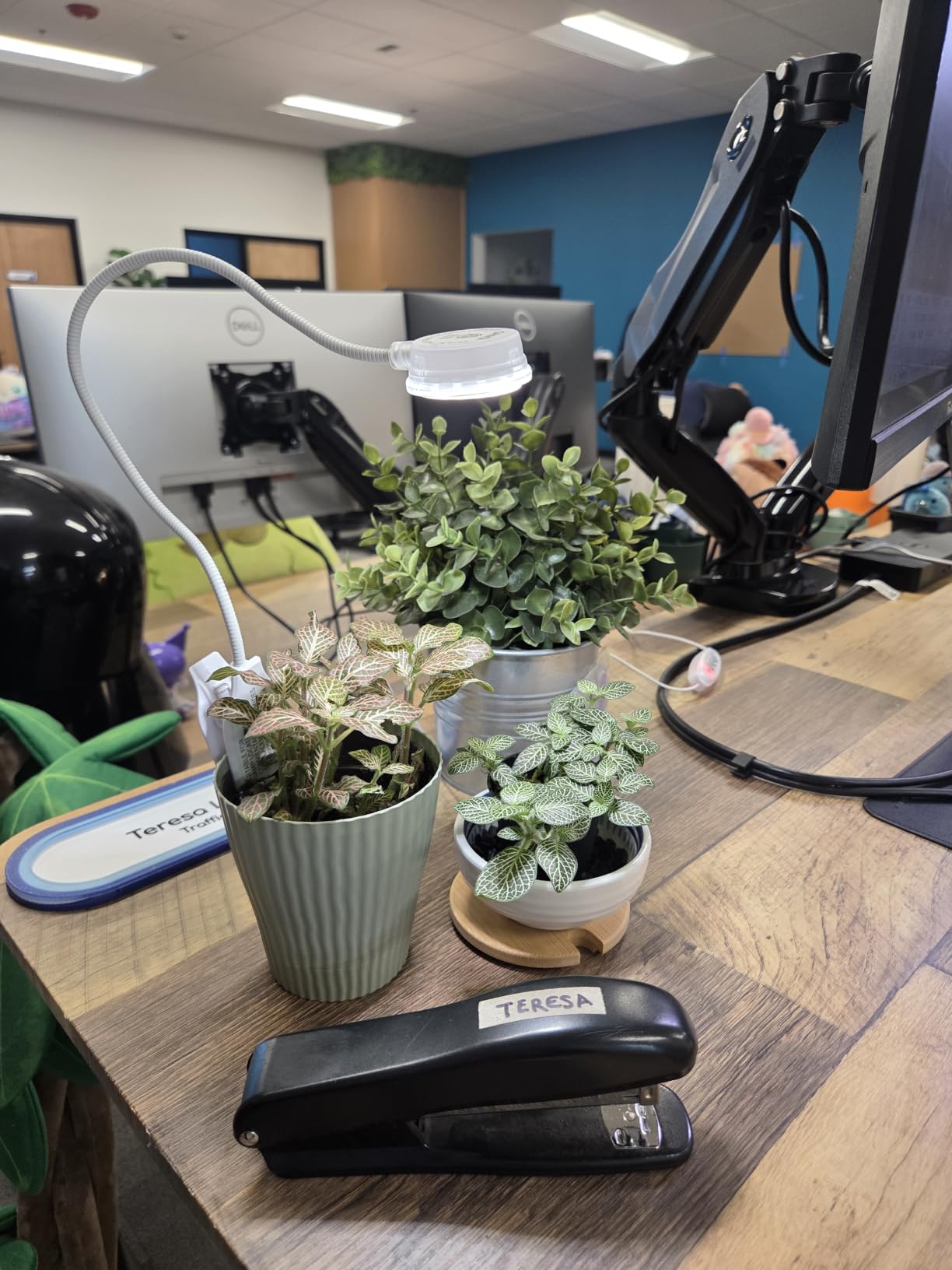
At 5W the running cost is negligible, and the 4000K tone is the most pleasant in this roundup. It is warm enough to sit on a desk next to a camera or a keyboard without the harsh glare that a 6500K fixture throws into a room.
Three timer options at 3, 6 and 12 hours cover a supplemental schedule, and four dimming levels from 25% to 100% let you run a sensitive plant on low while a sun-loving one sits closer.
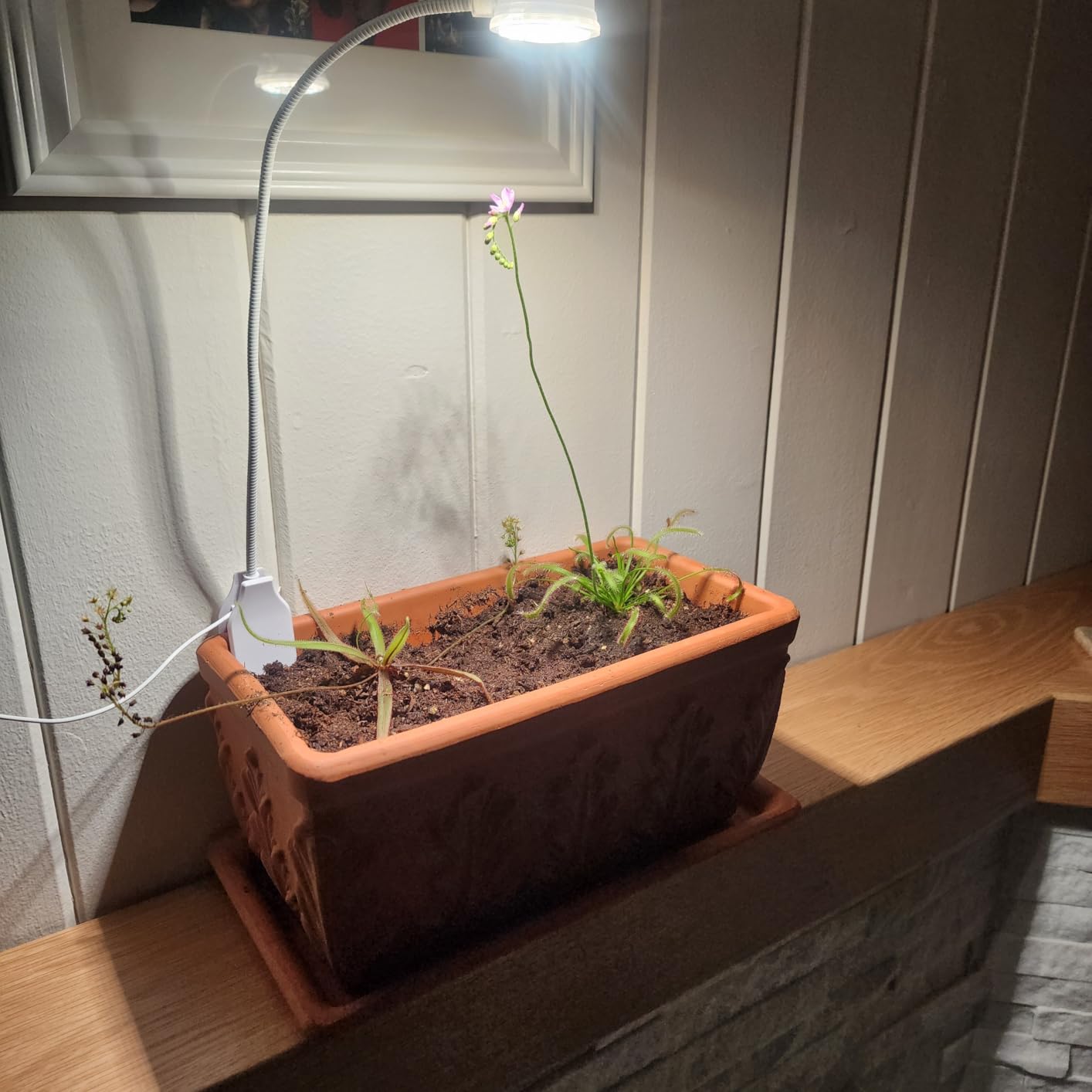
Why the 5V USB power changes the placement options
Because it runs off 5V USB, you can power it from a power bank, a laptop or a computer. That means a pot on a bookshelf six feet from the nearest outlet is still a realistic setup, which is not true for most of the fixtures in this list.
It also means a single travel power bank can run the light while you move a plant around for cleaning, repotting or a photo session, which is a small convenience that adds up.
Where it cannot keep up
One head lights one pot. If you have a windowsill of nine succulents, you are talking about nine clips or a very wide fixture, and the narrow head does not spread enough light to cover a cluster.
The clip can also bite down on thin or glazed ceramic rims. If your pots are delicate, drape a thin strip of rubber around the rim before clipping, or use a different mount.
5. Aokrean Halo Light 3-Pack: Best Value for Lighting Several Plants at Once
Aokrean Grow Lights for Indoor Plants, Full Spectrum Plant Light with Base
3 count halo pack
Telescoping pole to 26 inches
10 brightness levels
3H/9H/12H timer
Pros
- Three lights in one pack for several plants
- Telescoping pole reaches a tall floor plant
- Ten brightness levels and three spectra
- Switches between soil insert and freestanding base
Cons
- Base is unstable without a weighted pot
- Wired design with no wireless option
- Cord must reach an outlet
Three units in a pack is the argument here. If you have a living room corner with plants at three different heights, buying one lamp and stretching it across them means the far plant gets a fraction of the light. Three separate halos solve that properly.
Each unit telescopes up to 26 inches with 90-degree pole rotation and ten brightness levels. In practice I set the tallest plant on a high setting, medium plants mid, and a Haworthia on the lowest level, all on the same 12-hour timer.
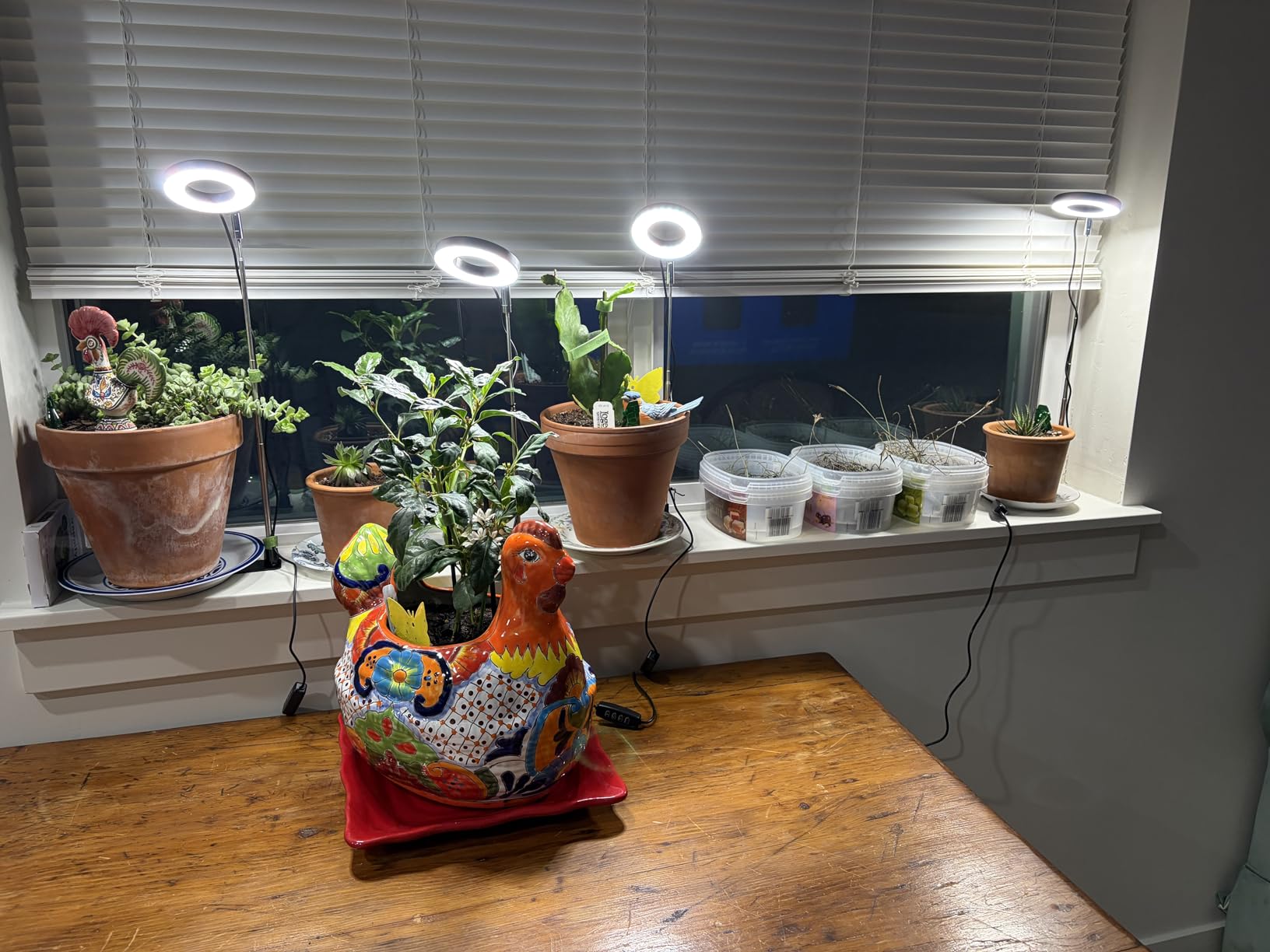
The dual installation is genuinely useful. Push the pole into the soil for a clean look on a desk plant, or stand it on the weighted base next to a floor planter where there is no soil to reach.
That base needs a caveat. It is stable only when a heavy pot is pressed down onto it, which is the single most repeated note in the reviews. Treat the base as a shelf, not a free-standing tripod.
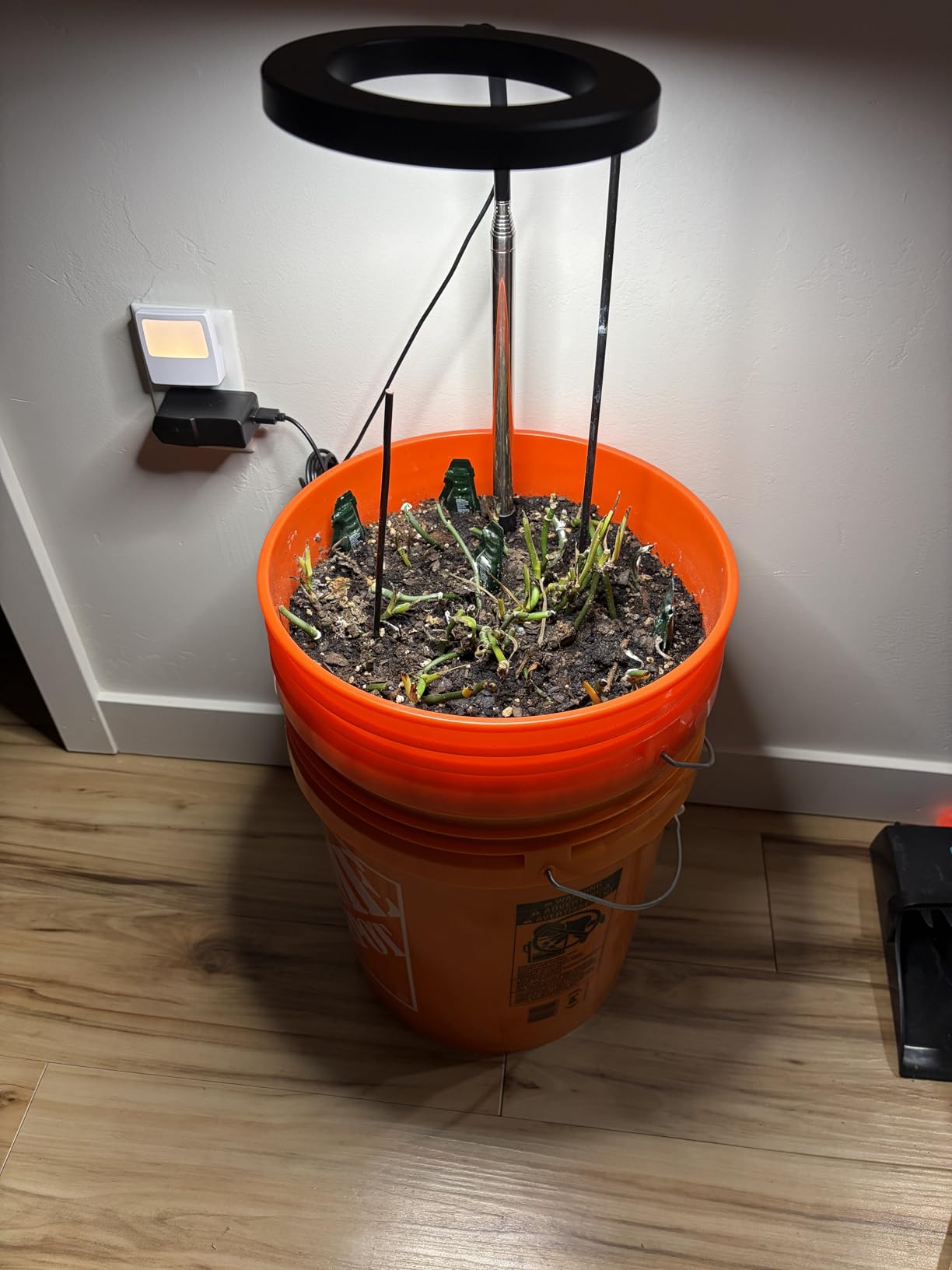
How to use the three-pack well
Space them 12 to 18 inches apart rather than clustering them. Three halos at close range create a hot center and leave the gaps between plants dark, which is the coverage pattern that produces uneven stretching across a row.
Run all three on the same timer length. Mismatched photoperiods across a single shelf confuse growth patterns more than the intensity differences do.
Who should return it
Return it if your plants are nowhere near a wall outlet. The cord is short enough that mid-room placement is awkward, and since there is no battery or wireless option, you are working around the outlet rather than the other way around.
Also reconsider if you only have one or two plants. The extra heads will just sit in a drawer, and a single clip lamp is a better spend for a smaller collection.
6. Kullsinss 3.5 Inch Halo Light: Best Grow Light for Desk and Office Plants
Kullsinss 3.5in Small Grow Lights for Indoor Plants, 48 LEDs Full Spectrum
48 LEDs at 380-760nm
5 dimming levels
3H/9H/12H timer
6.5 to 26 inch pole
Pros
- Very inexpensive for a single small plant
- Halo design looks decorative not industrial
- Pole inserts into soil for a clean look
- Controls sit on the inline cord
Cons
- Brightness is lower than expected
- Cord and telescoping top can slip or fall short
- Some settings differ from the listing
This is the one I recommend when a plant lives on an office desk next to a monitor. The 3.5 inch halo is small enough to disappear into a cluster of succulents, and the aluminum body does not glow or look industrial under office lighting.
Owners report dramatic results on individual plants, including roses, tomato starts and orchids putting out new leaves within weeks of use. That makes sense given the 48 diodes and the 380 to 760nm spread.
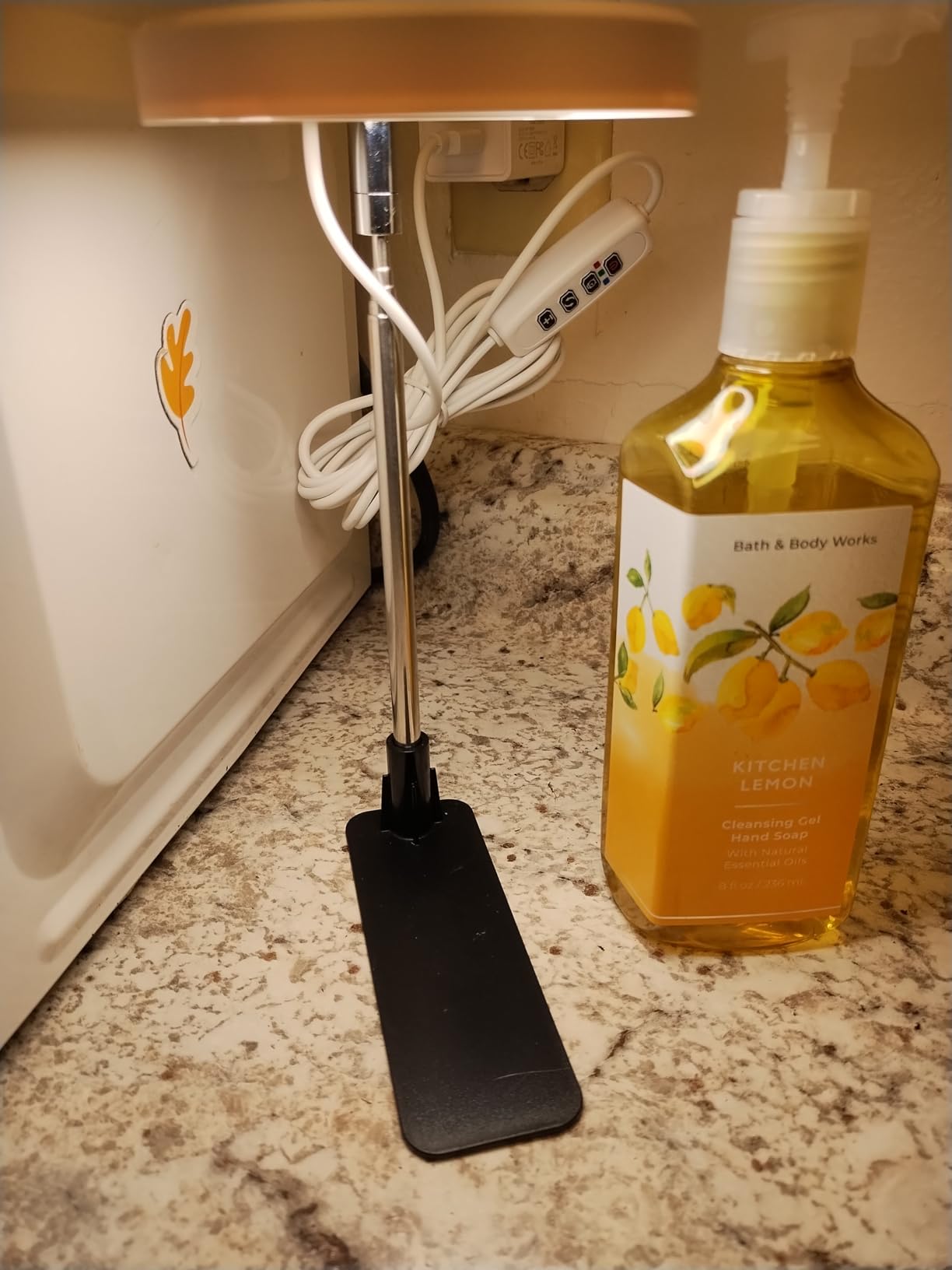
The controls on the inline cord are a quiet quality-of-life win. Five dimming levels and three spectra modes are adjusted without reaching over the plant, and the 3, 9 and 12 hour timer handles the daily schedule.
Height adjusts from 6.5 to 26 inches, which covers everything from a 3 inch starter pot to a medium floor plant. The detachable base gives you the choice of a weighted pot or a soil insert.
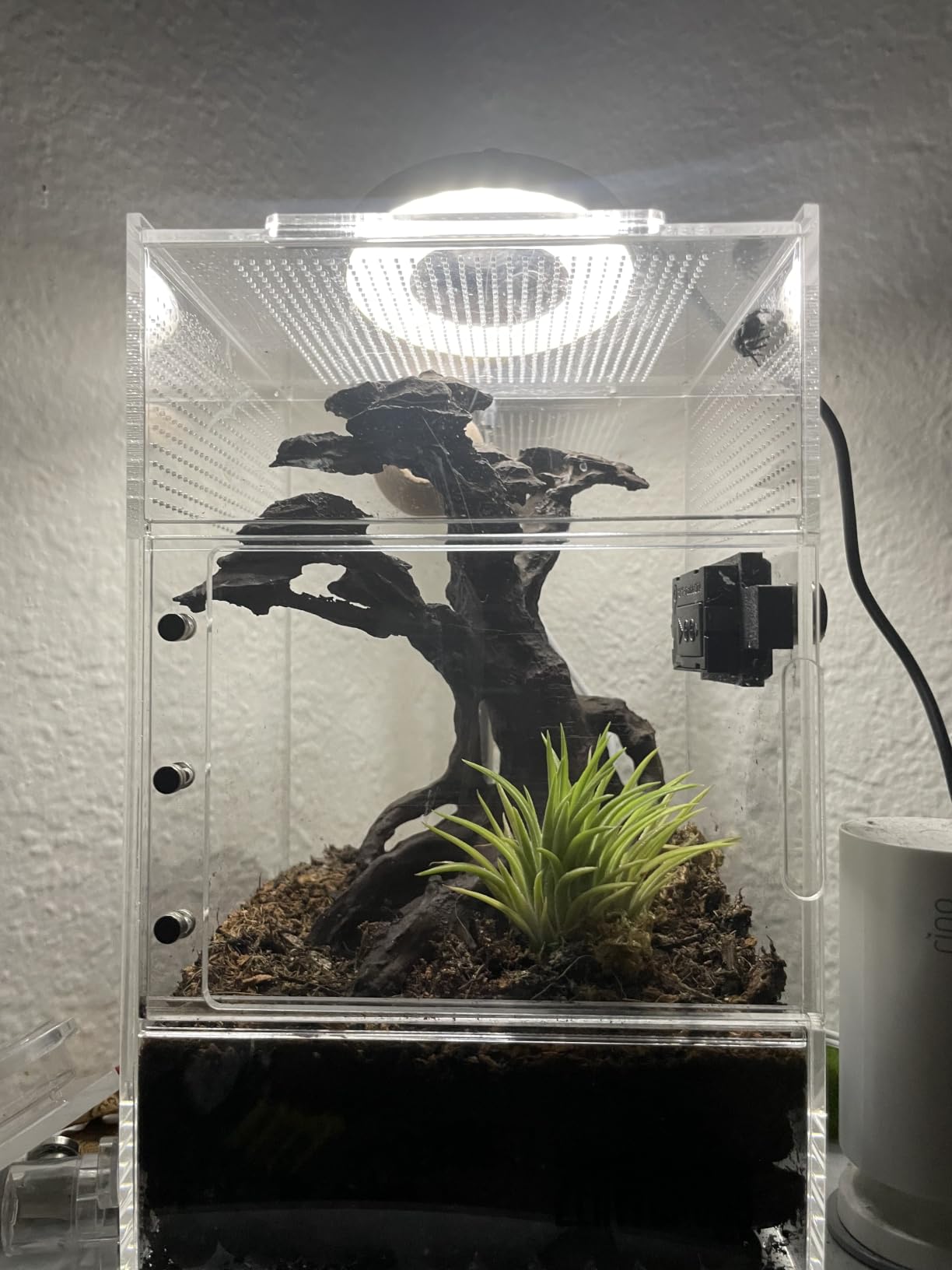
Desk placement that avoids scorch marks
Keep the halo at least 8 inches above a compact rosette, especially for the first two weeks. A low setting at 8 inches is safer than a high setting at 4 inches, and the dimming steps make that adjustment easy.
Aim the ring slightly off-center rather than straight down. Halo lights are brightest at the edges of the ring, so an off-center plant catches the stronger output.
What reviewers complain about
Output is dimmer than the LED count suggests, so buy it for one plant rather than a group. Coverage falls off fast beyond about 10 inches, and the center plant outpaces anything at the edge.
A minority of buyers report that the dimming levels and timer options do not match the listing, or that the telescoping section slips. Check the settings on day one so you are not surprised a month in.
7. Aumtrly Floor Light 68 Inch Stand: Best for Tall Floor Planters
Aumtrly Floor Grow Light Full Spectrum with 68″ Stand for Tall Indoor Plant
17 to 61 inch adjustable stand
16 hour timer
3 modes
5 dimming levels
Pros
- Tall stand reaches floor plants clip lamps cannot
- 16 hour timer allows a longer cycle
- Three modes and five dimming levels
- Neutral white finish suits home or office
- Folds down when not in use
Cons
- Multi-part stand needs assembly
- 7.87 inch base takes up floor space
- Corded 5V adapter limits placement
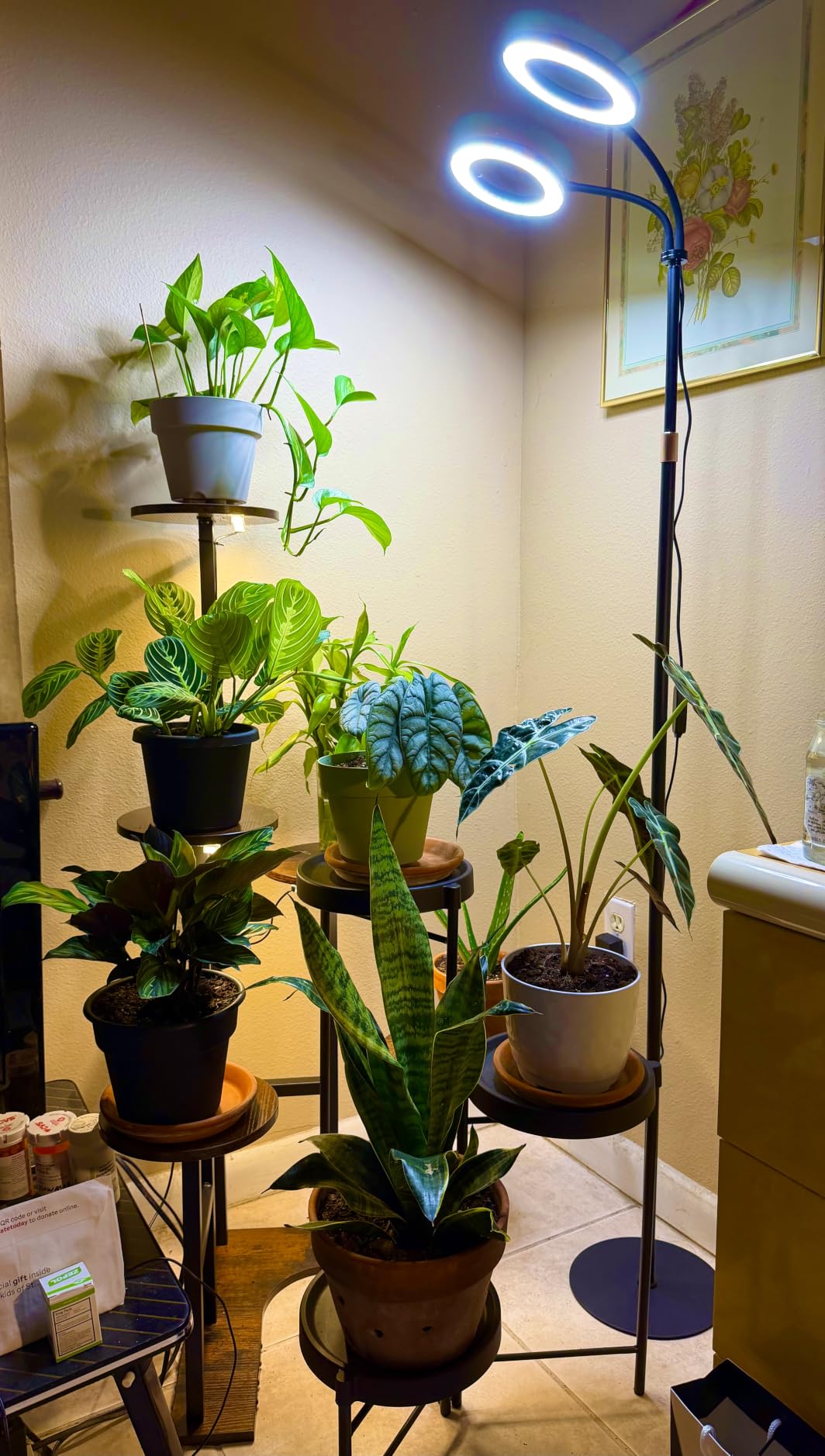
A clip lamp simply cannot serve a floor planter. This one adjusts from 17 to 61 inches and carries a 7.8 inch gooseneck that aims the head down into the canopy of a tall plant, which is why it earns a place in a lineup otherwise full of desk fixtures.
The 16-hour timer is the sleeper feature. Most compact grow lights top out at 12 hours, and if you are running a plant through a dark winter, the extra headroom matters.
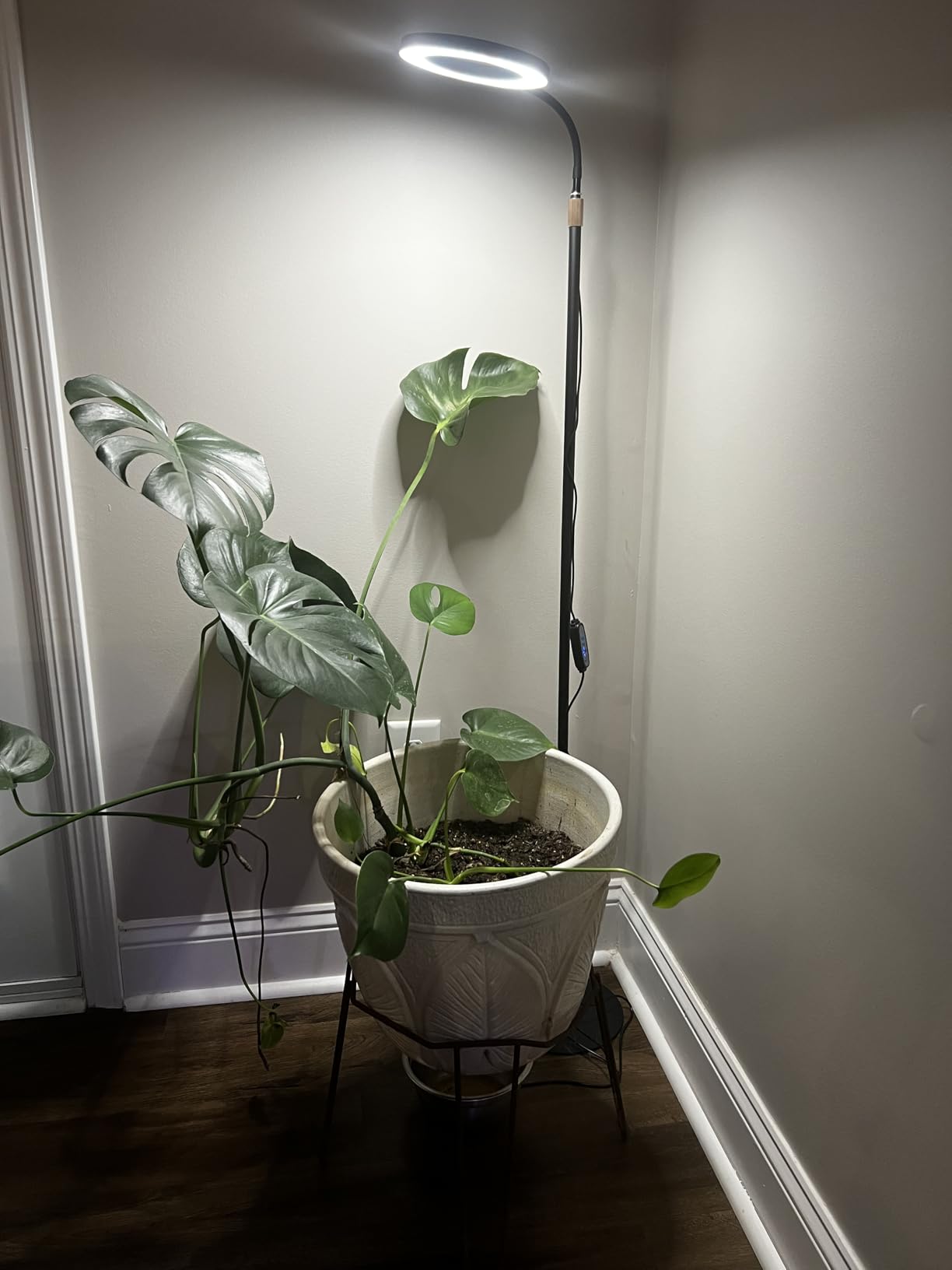
Spectrum output combines 660nm red, 3200K warm and 5000K white across three modes. The white finish is deliberate, and it looks far more like a floor lamp than a piece of grow equipment, which matters in a room where guests can see it.
Five dimming levels help with acclimation, and the fold-down footprint means the stand is not a permanent obstacle when the plant goes outside for summer.
How to get even coverage on a tall plant
Set the stand height so the head sits at the top third of the plant rather than directly above the tallest leaf. A head parked at full height lights the crown and leaves the lower growth in shadow, which encourages the plant to grow toward a single point.
Use the 16-hour setting only for a plant that is already established and compact. Hold new arrivals at 12 hours and only extend after two or three weeks of healthy, non-stretched growth.
Where the design fights you
Assembly takes a few minutes because the head, rods and base are separate pieces, and reviewers mention the alignment step specifically. Budget ten minutes rather than assuming it is plug and play.
The 7.87 inch base is wider than most floor plants and can crowd a corner. If your planter is in a tight alcove, this is the wrong footprint even though the height is right.
8. RWNTAO 8.6 Inch LED Bars: Best Grow Light for Under-Shelf Mounting
8.6” Mini LED Grow Light Strips, Full Spectrum 3000K, 52 LED Plant Light with 3/9/12H Timer, 10 Dimmable Levels for Seedling, Succulent and Plant Shelf, 2 Head
Two 8.6 inch bars
52 LEDs total
10 dimming levels
3/9/12H timer
Pros
- Tape ties screws and magnets for no-drill mounting
- Flexible bars bend around shelves and corners
- Runs cool enough to sit close to foliage
- Ten dimming levels protect lower-light species
- Timer holds the schedule without re-setting
Cons
- Cord cannot be disconnected from each bar
- Bars are shorter than buyers expect
- Flexible strip gives less precise aiming
Under-shelf lighting is the setup people actually want and the one most fixtures make awkward. These bars are 8.6 inches long and 0.28 inches thick, with four mounting options: screws, zip ties, double-sided tape and magnets.
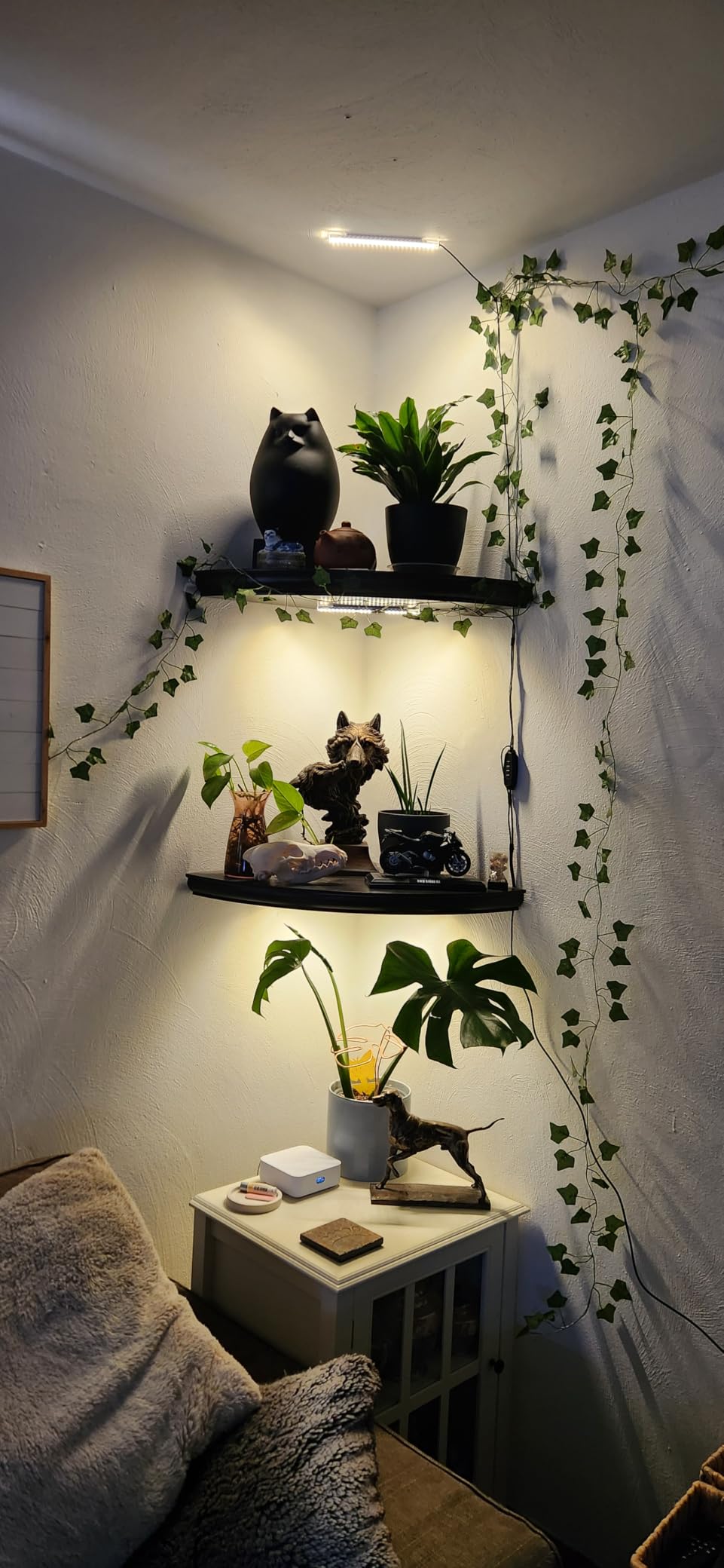
That thickness is the whole point. You can tape one to the underside of a shelf with the head sitting flush against the wood, then route the cord to an outlet with a single zip tie. No drilling, no visible bracket, no dangling gooseneck.
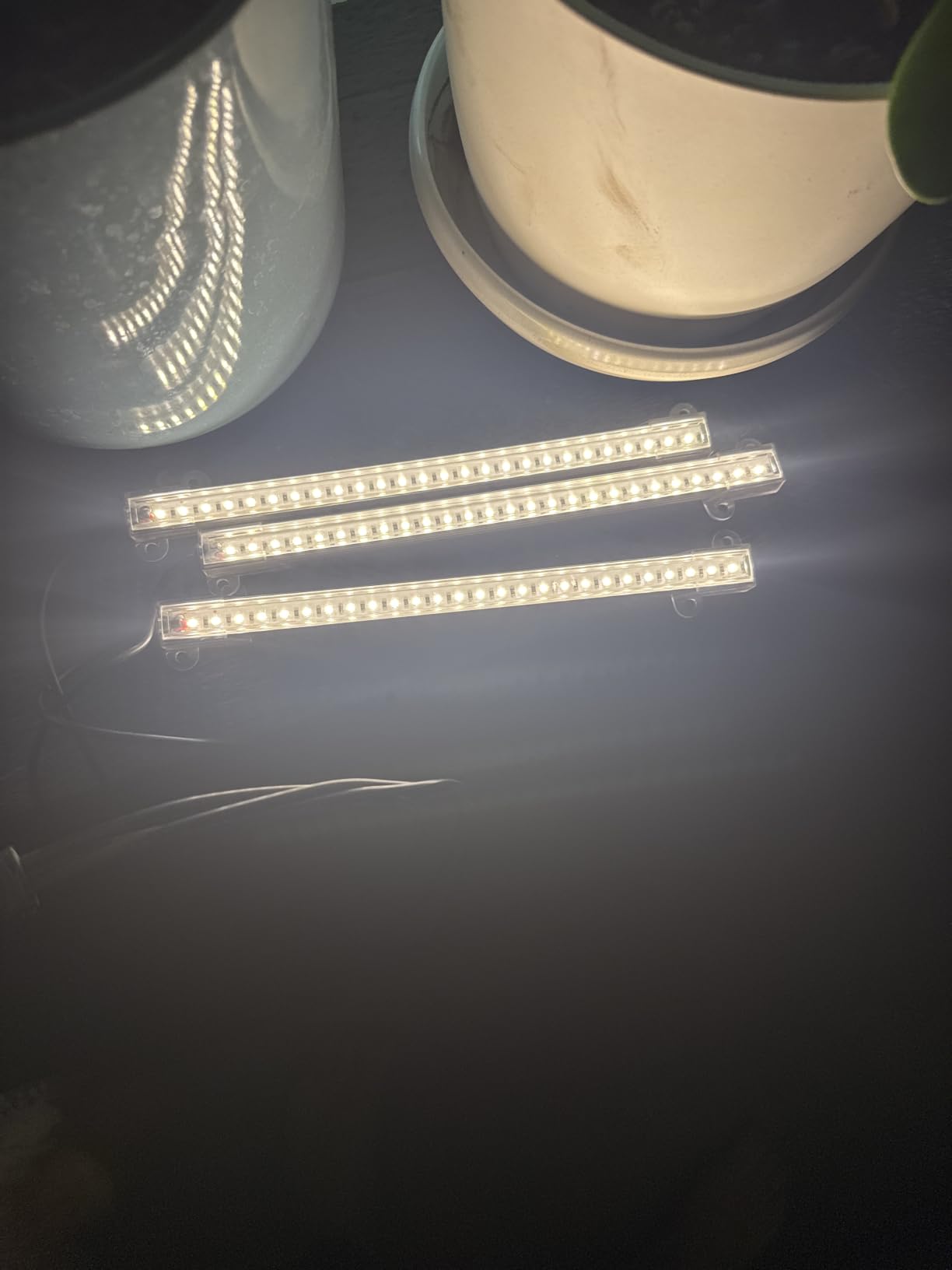
Owners report visible improvement in low-light shelf plants within a few weeks, and the low heat output means the bars are safe to run close to foliage. I run mine at 6 inches from the canopy with the dimmer on a low setting for Haworthia and higher for Sedum.
Each bar carries 26 of the 52 3500K LEDs, and you can run bar A, bar B or both. Splitting the run is how you compensate when one side of a shelf gets more ambient light than the other.
Getting even coverage on a wide shelf
Two 8.6 inch bars will not light a 48 inch shelf evenly on their own. Space them at 18 to 24 inch intervals and stagger them front to back so a plant between two bars still catches light on both sides.
Measure first. Several buyers expect longer bars and find 8.6 inches short for their shelf, which is a sizing problem rather than a quality problem.
The cable problem to plan for
The cord is permanently attached to each bar, so you cannot unplug a single head to re-route it. Plan your cable path before you stick anything down, running the cord along the shelf back edge and using clips rather than tape on the cable itself.
A 71 inch cord gives decent reach, but in a wide shelving unit you will likely need an extension to reach the nearest outlet. That is a planning step, not a defect.
9. LBW 8 Inch Halo Light with Stand: Best Panel Coverage for One Large Plant
LBW Grow Light with Stand for Indoor Plants, 8″ Halo Full Spectrum Grow Light, Adjustable Height up to 68″, Auto Cycle Timer (4/8/12H), 6-Level Dimmable, Plant Light for Indoor Growing
8 inch panel
108 LEDs at 380-800nm
20 to 68 inch height
6/8/12/16H timer
Pros
- Large panel spreads light evenly over tall plants
- Heavy base with non-slip pads needs no ballast
- Four timer lengths including a 16 hour cycle
- Tool-free assembly in minutes
- 20 to 68 inch range fits floor and shelf plants
Cons
- Corded 24V adapter keeps it near an outlet
- Large panel footprint takes floor space
- Some units needed a replacement power supply
An 8 inch diameter panel is a different shape of coverage from a strip or a single head. Light spreads across the whole face of it rather than a narrow beam, so a tall plant with foliage at several heights gets lit more evenly than it would under a head lamp angled from above.
The 108 LEDs across 380 to 800nm give this one a genuinely full spectrum, and the telescoping pole and gooseneck adjust from 20 to 68 inches. That range covers everything from a low coffee table plant to a ceiling-height floor planter.
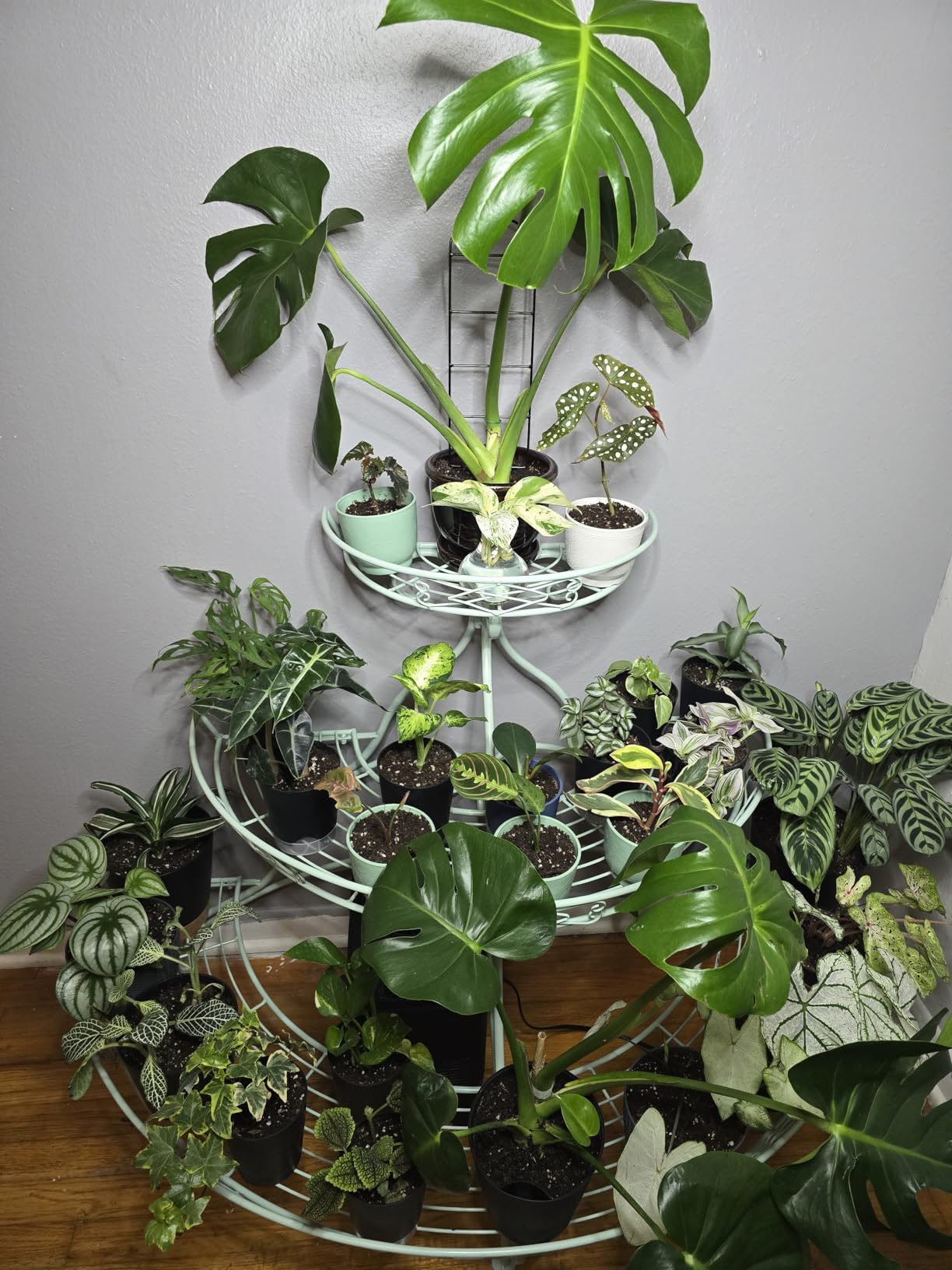
The base is the part that gets praised more than you would expect. Buyers with large floor planters mention that the heavy-duty metal base and non-slip pads stay put without adding a brick or a bag of soil, which solves a problem most lightweight stands create.
Timer options run 6, 8, 12 and 16 hours, with three light modes and five brightness levels from 20% to 100%. The 16-hour setting is useful for overwintering.
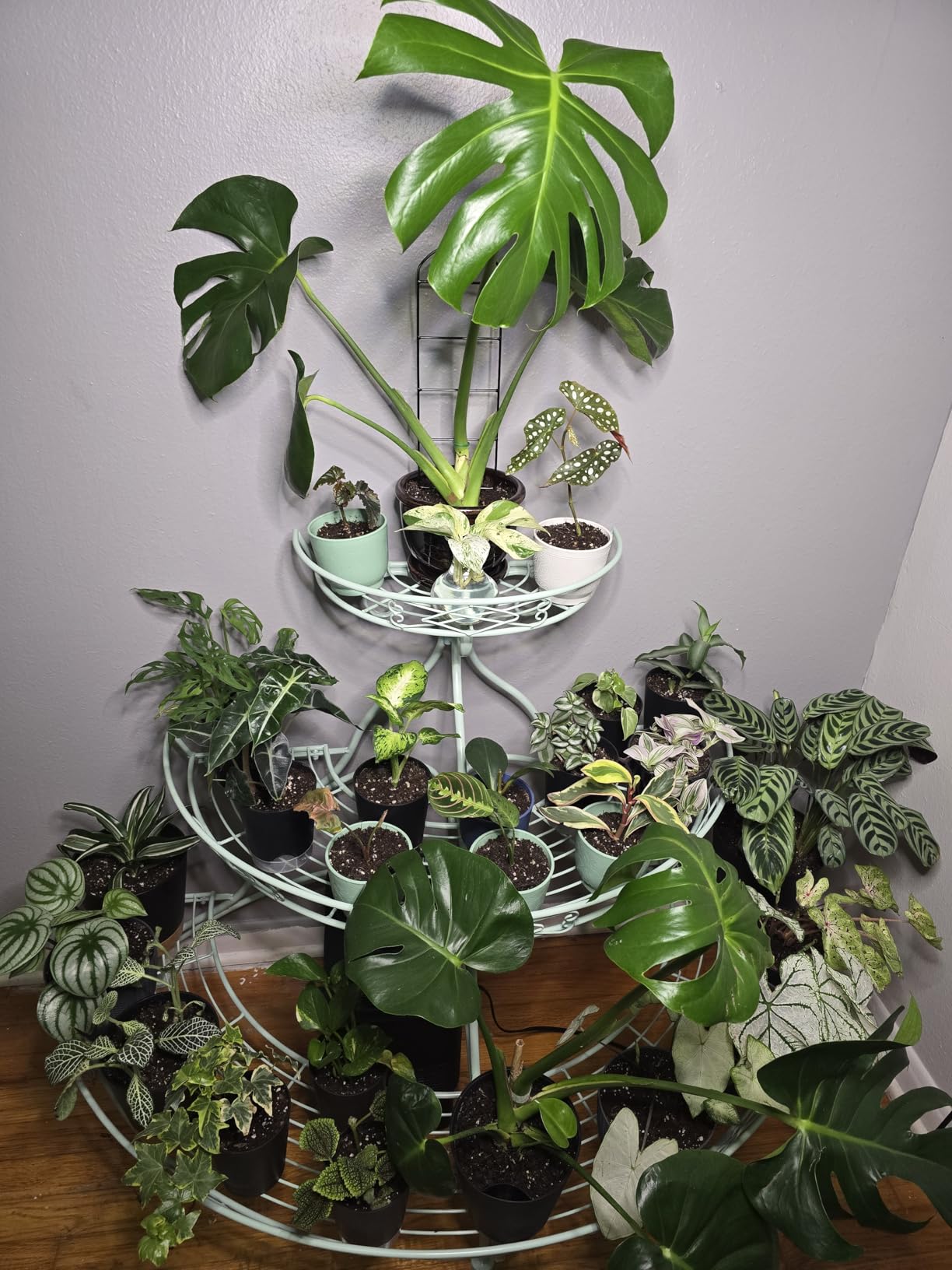
Choosing the height before you build the setup
Measure from the floor to the top of the plant and set the panel head at the plant’s mid-height rather than at the tallest leaf. A head at mid-height lights the whole silhouette and avoids the single-point growth pattern that comes from overhead-only light.
Leave 10 to 12 inches between the panel and the nearest leaves. This panel is broad and bright, and pushing it closer is the fastest route to bleached patches on the sun-facing side.
Watch the power supply over time
A few reviews mention replacing the power supply after extended daily use. It is not a widespread failure, but if you are running this 12 hours a day for months, keep the model number handy in case you need a replacement unit.
The 24V corded adapter also anchors the light near an outlet. Plan the position of the plant and the outlet together rather than choosing the plant position first.
10. LBW 214 LED Desk Panel: Best for Seed Starting and Dense Pot Groups
LBW Desk Grow Light, 214 LEDs Full Spectrum Plant Light for Indoor Plants
214 LEDs at 380-780nm
11 by 4.7 inch panel
6 dimming levels
3/6/12H timer
Pros
- Very bright even output with visible new growth
- Panel covers a 10 to 14 inch pot or several small pots
- Stands or hangs under a shelf with included hooks
- Timer holds schedule with no re-setting
- Runs only slightly warm after long daily use
Cons
- Base can tip when goosenecks bend outward
- 26 inch maximum height is short for tall plants
- One reviewer reported a missing bolt and later adapter failure
- Very intense if plants sit too close
Reviewers describe this as one of the brightest grow lights they have used, and 214 LEDs across an 11 by 4.7 inch panel is where that comes from. For dense pot groups and seed trays, panel geometry beats a single head because the whole surface is lit evenly.
The dual mounting is the practical feature. It stands on its metal base at 10 to 26 inches, or it hangs under a shelf using the included wire hooks, which is how I use it during propagation of leaf cuttings.
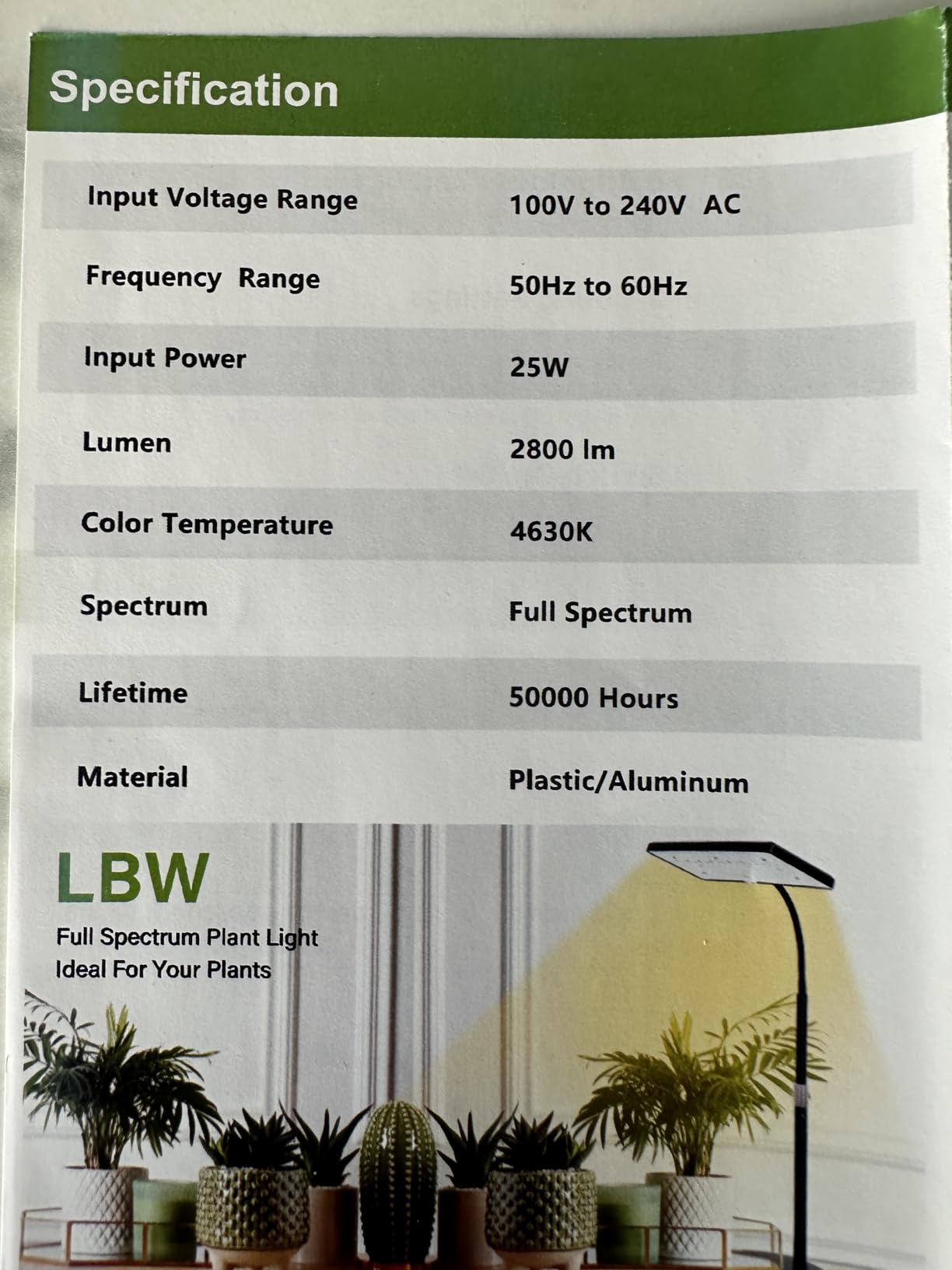
Six dimming levels give you a real ramp. Propagation trays sit close to the panel, so starting on the lowest setting for the first week and stepping up is the difference between rooted cuttings and scorched ones.
Heat is well managed. The panel has heat-dissipating holes and reviews describe it as running only slightly warm after long daily use, even at close range.
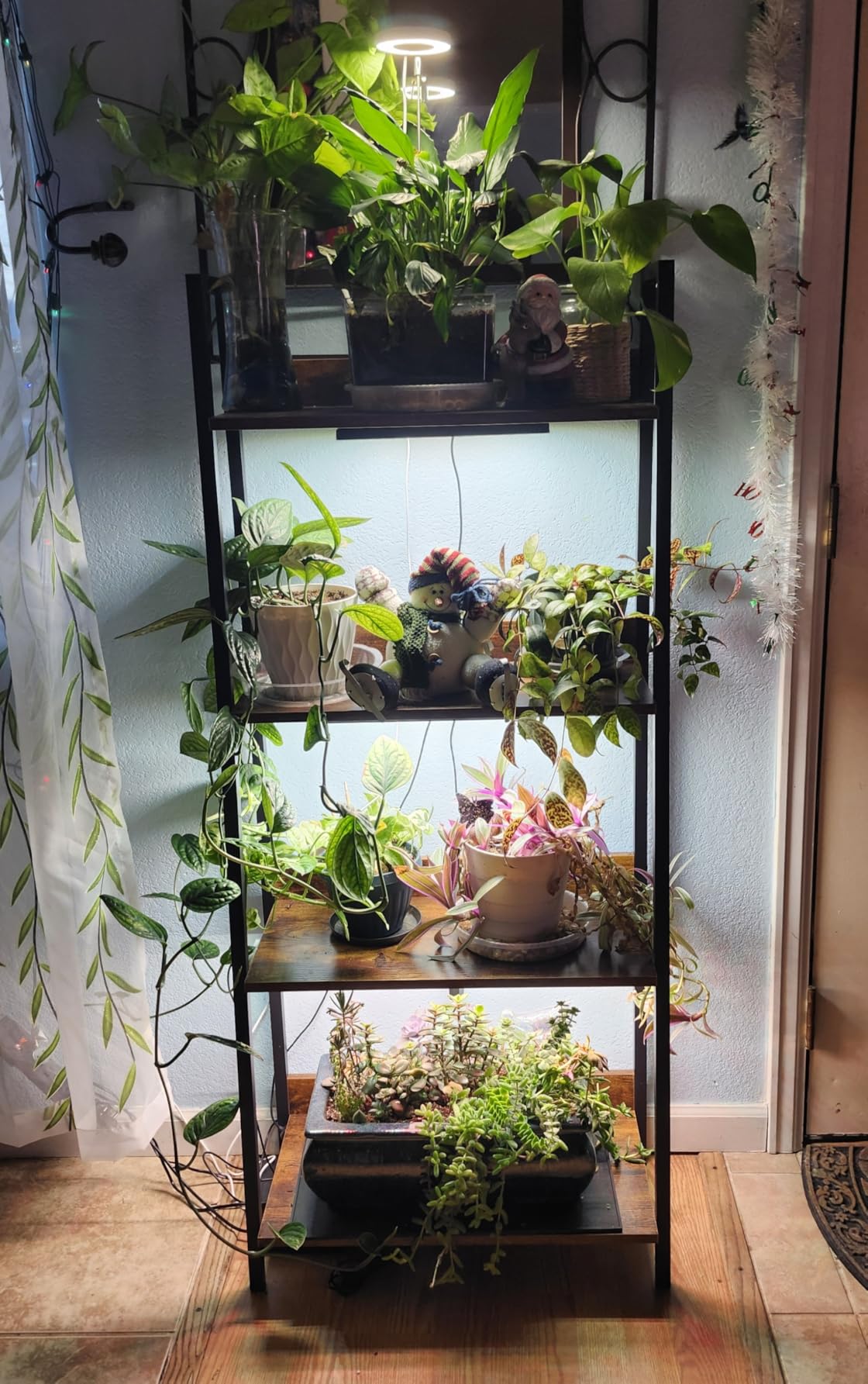
Use the dimmer as an acclimation tool
New arrivals from a dim windowsill should spend three to four days at the lowest level, then step up one level every three or four days. Skipping the ramp is the most common cause of the bleached white or red patches that appear on the top leaves of Echeveria.
When mounted under a shelf, the panel hangs 4 to 6 inches below the wood, which puts it closer to the plants than a floor stand would. Set the dimmer lower or add a spacer to compensate.
Know the two mechanical weaknesses
The base is light enough to tip when both goosenecks are bent outward, and some users weighed it down with a plate. If you go wide, anchor the base before you angle the arms.
The 26 inch height ceiling is the other limit. This is a desk and shelf fixture, not a floor lamp, and any plant taller than about two feet needs a different stand.
11. Barrina T10 4ft Vertical Light: Best for Large Collections and Grow Spaces
Barrina T10 Vertical Grow Light, 4FT 42W, Full Spectrum, High PPFD
4 foot vertical tube
42W with up to 169 LEDs
CRI 88
Tripod stand
Pros
- Side lighting reaches the full height of the plant
- Highest output fixture in this roundup
- Slim footprint for a floor-standing light
- Works on a tripod or hangs from a shelf
- Arrives in a foam-lined double box
Cons
- No built-in timer so a plug-in timer is required
- Tripod screw joint can strip
- Tube gets warm to the touch on long runs
- Very bright when aimed into a room
This is the only true vertical fixture in the group, and that changes how it works. Instead of shining down onto the canopy, it throws light sideways along the full 4 foot length, so every level of a tall plant gets hit rather than just the top.
Owners who switched from arm-style lights report plants putting out new leaves within weeks. At 42W with up to 169 LEDs including 660nm red chips, this is the highest output option here, and it is the one to move up to when a collection outgrows shelf lighting.
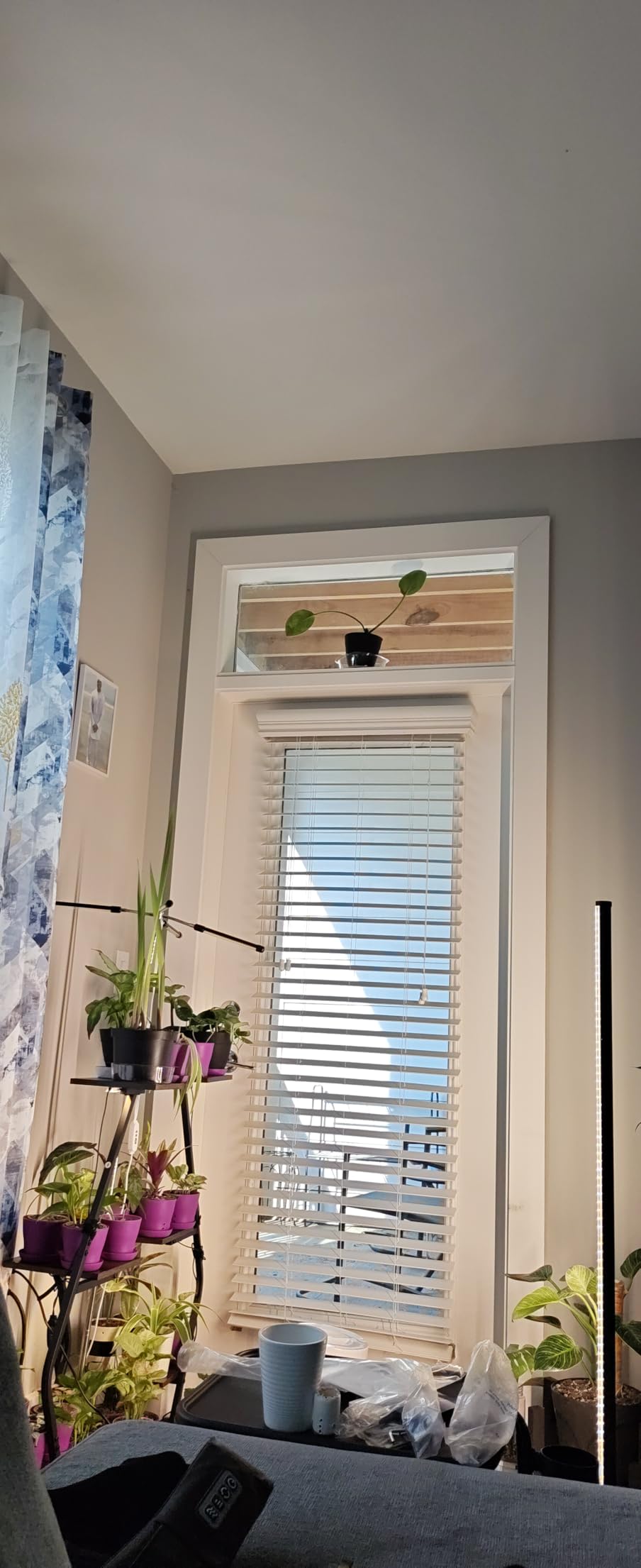
The CRI of 88 matters for anyone who displays plants. Accurate color rendering means an Echeveria looks like its own photo rather than a washed-out or oddly saturated version of itself, which you notice immediately on a display shelf.
Mounting is flexible. It assembles tool-free onto a tripod stand, and the two included hanging clips let you run it horizontally from a plant rack instead, which is how a lot of growers use it in a closet or grow space.
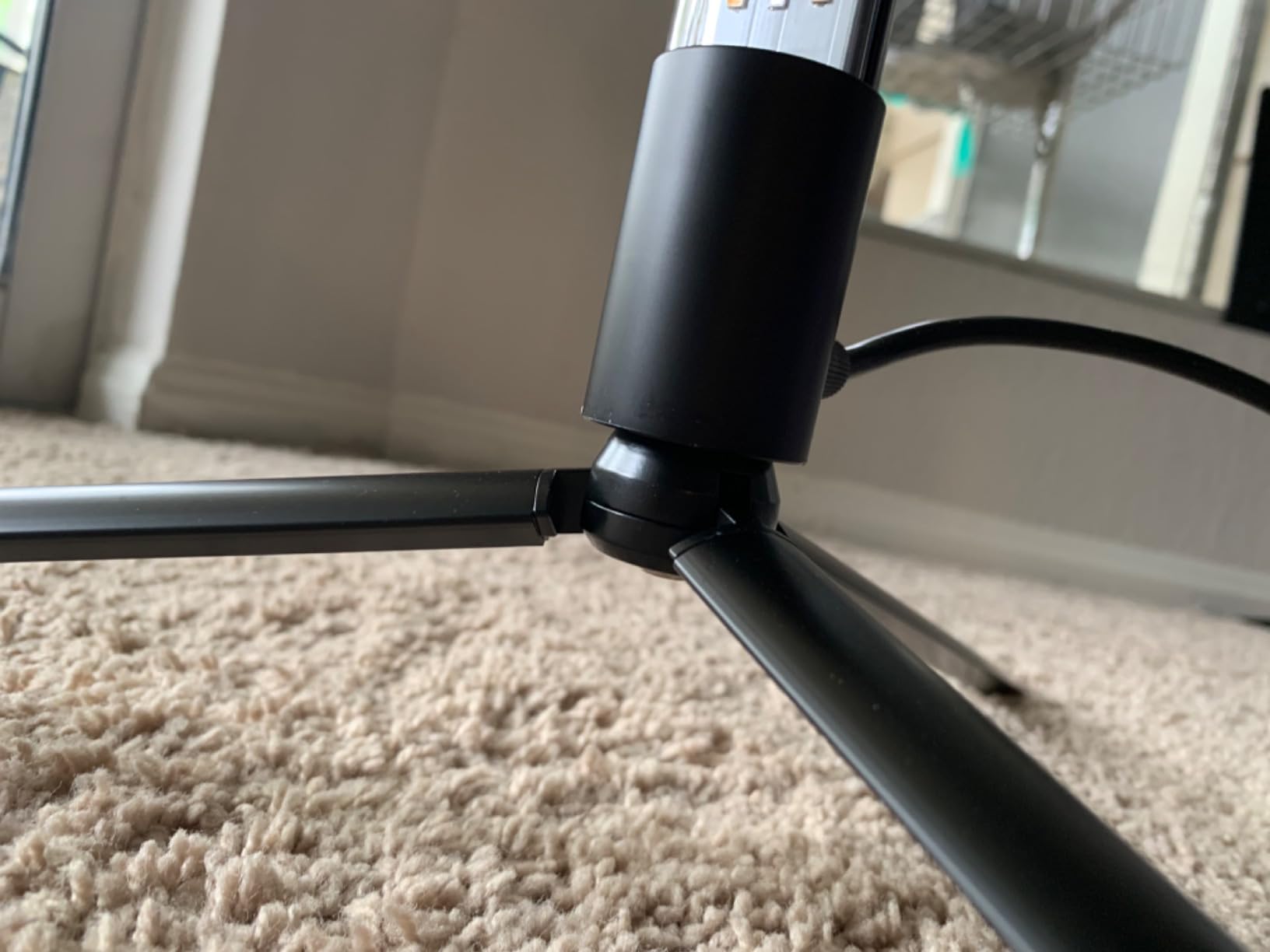
Angle it before you turn it on
Stand the tripod 12 to 18 inches from the plants and angle the tube toward a wall rather than into the room. Buyers mention that it is bright enough to be uncomfortable across a living space, and a wall bounce solves it in one move.
Give it at least 8 inches of clearance from leaves on all sides. This is the highest output fixture in the roundup, and the combination of heat and intensity at close range is what produces scorching.
What to plan before buying
There is no built-in timer, so budget for a plug-in timer or smart plug. That is a small addition, but it is a hard requirement if you want a consistent photoperiod.
The tripod screw joint can strip or stop short, leaving the light leaning. Check the thread after assembly, and tighten it fully before you move the stand to its final spot.
12. FECiDA Bonsai Tabletop Light: Best for Bonsai and Display Collections
FECiDA Bonsai Grow Light, Table Grow Lights for Indoor Plants Collection
208 LEDs at 2000 lumens
3000K 5000K 660nm
Adjustable stand
Daisy chain
Pros
- Bright output relative to its size
- Daisy chain runs three lamps from one socket
- Adjustable stand covers bonsai cactus and seedling trays
- Physical switch outlasts touch controls
- Direct plug-in removes the adapter brick
Cons
- Switch version has no built-in timer
- 930 g base takes real desk space
- Bright output needs distance from sensitive plants
This is the light I recommend when the plants are on display rather than in production. 208 LEDs producing 2000 lumens on an adjustable tabletop stand covers a bonsai, a cactus collection or a tray of seedlings without the look of a grow rig.
The daisy chain function is the sleeper feature. Up to three units run from a single wall socket, which solves the problem every multi-light setup hits, where a shelf of planters outnumbers the outlets on the wall.
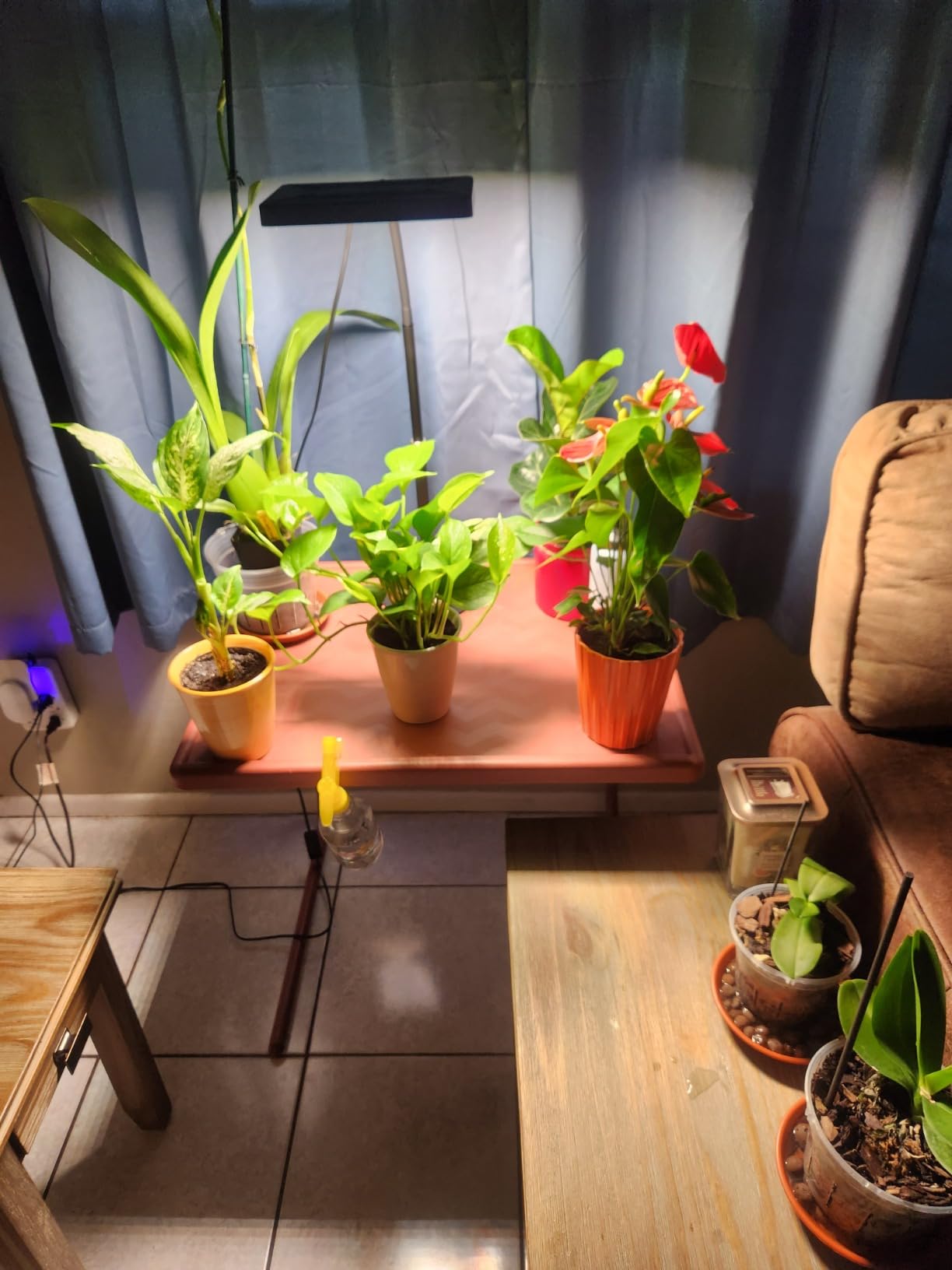
Spectrum is 3000K, 5000K, 660nm red plus UV and IR diodes in one array. Having warm and daylight white in the same fixture means you can dial toward whichever suits a species without buying a second lamp.
The physical push switch is a small durability choice that pays off over years. It pairs with an external smart timer, and it does not have the touch-control failure mode that leaves a lamp permanently on.
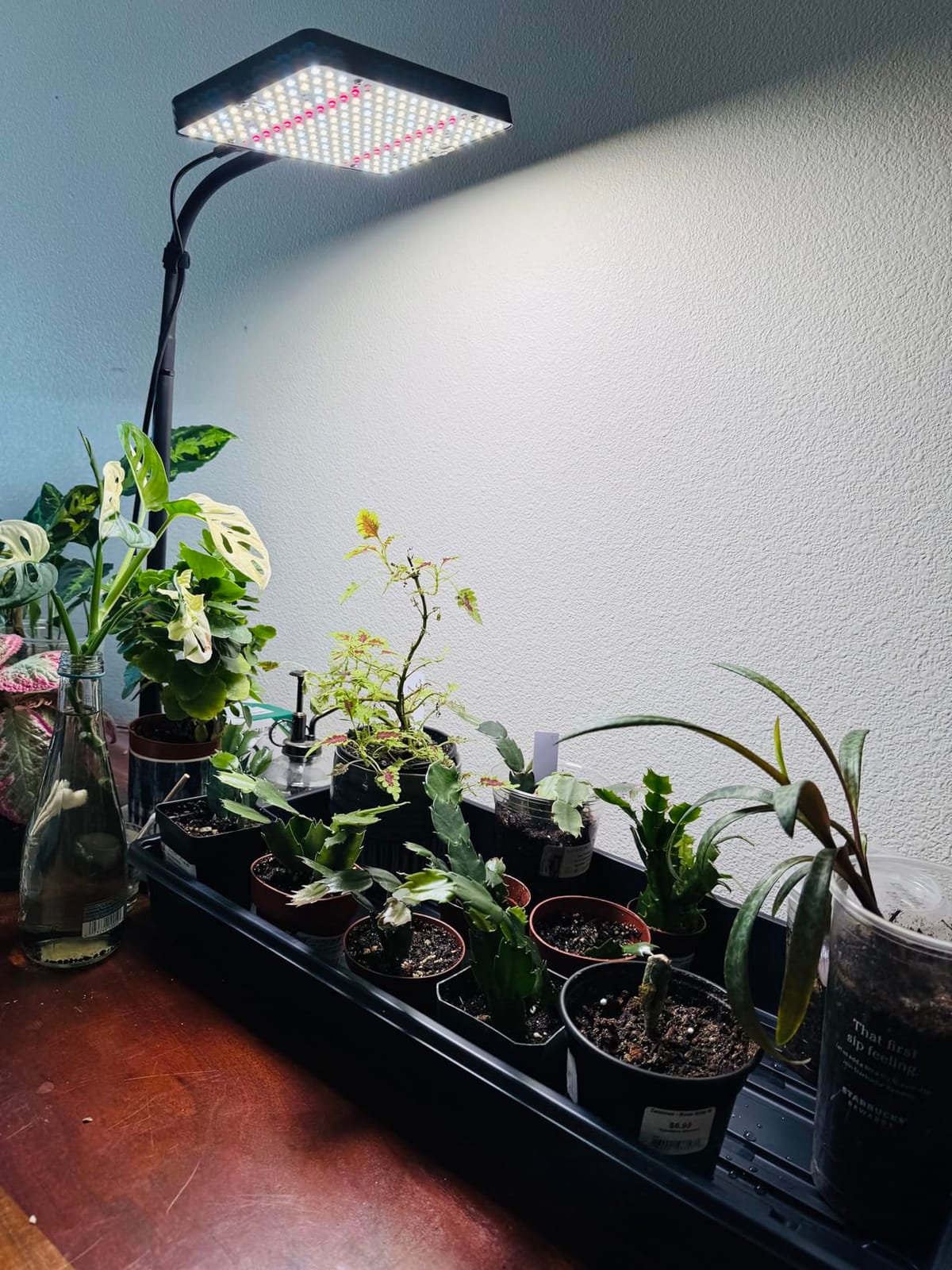
Matching the stand height to a display tray
Set the head 10 to 14 inches above the tallest plant in the tray and angle it to cover the whole footprint evenly. A display arrangement reads badly if the back row is brighter than the front, so check coverage from where you normally sit.
For a low-light species in the same collection, either daisy chain a second unit with a dimmer or move the sensitive plant to the outer edge where the fixture reaches less directly.
Pick the right variant
This is the switch version, which has no built-in timer. If you want automation, choose the timer variant instead, or pair this one with an external smart plug. The direct plug-in design has no adapter brick, which keeps the setup visually clean.
At 930 g the base is heavy and stable, and that weight is a real cost on a small desk. Make sure the surface has room for the footprint before you commit.
Key Specs to Look For in a Grow Light
Before you compare any two lights in this roundup, check these four numbers. They tell you more than the product name, and they are the four things the buying decision actually turns on.
Spectrum: look for white light in the 5000K to 6500K range. Lights advertising only red and blue diodes produce a purple blurple glow that works but makes a living room look like a grow room. Most of the fixtures here carry a white-dominant array with supplementary red and blue.
Brightness: read the PPFD figure in micromoles per square meter per second where it is listed, and treat watts as a cost measure rather than a brightness measure. One product in this roundup publishes a real PPFD number at 6 inches; most do not. A wattage-only listing tells you what you will pay for electricity, not how much light lands on a leaf.
Placement: 6 to 12 inches above the canopy is the working range. Closer for high-light Echeveria, Sedum and cacti at low dimmer settings, further for shade-adapted Haworthia, Gasteria and Sansevieria.
Duration: 12 to 14 hours a day with a genuine dark period. Longer runs on a weak light produce stretching, not growth. A built-in timer at 12 hours removes the most common source of inconsistency.
If you want the short version of the color temperature question, our guide to RGB panel lights explains the same Kelvin logic that applies to grow fixtures. The principle is identical: cooler white light carries more blue, and blue is what keeps succulent growth compact.
How Far Above the Plants Should the Light Sit?
Start at 8 to 10 inches and adjust from there. Community consensus across grower threads is consistently 6 to 12 inches, and most of the mistakes we see come from mounting at 20 inches because the cord was too short to reach lower.
High-light species such as Echeveria, Sedum, Graptopetalum and most cacti do well at 6 to 8 inches. Shade-adapted types like Haworthia, Gasteria and Sansevieria do better at 12 to 18 inches, or at the same distance on a low dimmer setting.
If a light is physically fixed in place and you have a mixed collection, the dimmer matters more than the distance. Every fixture in this roundup with 5 or more dimming levels can serve both categories from one mounting point.
Symptoms of incorrect distance are easy to read. Pale, stretched, widely spaced leaves mean too far. Bleached white or red patches and dry crispy tips on the sun-facing side mean too close, and the fix is to back the light off or drop the dimmer.
How Many Hours a Day Should Grow Lights Run?
Twelve hours a day is the baseline, and 14 is the ceiling for most setups. Succulents are photoperiod-sensitive plants, and a genuine dark period is part of how they behave, so running a light around the clock is not a shortcut to faster growth.
Ramp up rather than jumping. Start new or recently moved plants at 8 to 10 hours for the first week, then step to 12, then to 14 only if growth stays compact and evenly colored. Growers on r/succulents consistently recommend this gradual approach over an instant jump to a long photoperiod.
Seasonal adjustment matters more than people expect. In a bright summer spot with several hours of direct sun, a supplement light might only need 6 hours. In a north-facing room in midwinter, a full 14 hours is reasonable.
Automation solves almost every photoperiod complaint. A built-in timer is convenient, but a plug-in timer or smart plug works just as well and covers fixtures that lack one, including the Barrina and the FECiDA switch variant in this roundup.
Blurple vs Full-Spectrum White: Which Color Wins?
Full-spectrum white wins for almost every home setup, and the reason is not primarily botanical. Red and blue diode-only lights are marginally more efficient at photosynthesis, which is the argument the blurple camp makes, and it is technically correct.
The problem is what it does to a room. A purple fixture in a living space is the single most common complaint in grower threads, and it is a legitimate one. Nobody wants to display succulents inside a grow room.
White fixtures also tend to carry higher CRI values, which means plants render their true color. That matters for a collection you look at daily rather than one you grow purely for propagation.
The technical reason white works so well is that a daylight-balanced array still contains blue energy, just mixed with red, green and far-red rather than isolated. Blue is the wavelength that suppresses elongation, so you keep the compact growth response without the purple cast.
LED vs T5 Fluorescent vs HID
LED is the default answer in 2026, and the gap has widened since the last few roundups we have published.
LED runs cool, uses roughly a fifth of the power of an equivalent fluorescent or HID fixture, lasts far longer, and dims. Every product in this roundup is an LED, and nine of the twelve dim.
T5 HO fluorescent is cheaper and still works, and growers frequently report that a good T8 performs nearly as well as a pricier fixture. It runs warmer, dims with age, and needs a matching fixture.
HID and metal halide deliver serious intensity for flowering and fruiting crops but run hot, draw heavy power and need ventilation and a distance of well over a foot. For a succulent shelf this is disproportionate.
One practical note on wattage: sellers list it prominently because it is easy to compare and easy to market, but wattage measures consumption, not brightness. Two 10W fixtures can differ enormously in output depending on diode efficiency and lens design, which is why the PPFD figure is the number worth searching for.
Why Your Succulents Still Stretch, and How to Fix It
If plants are stretching under a grow light, the light is almost never the first problem. Work through these four fixes in order of effort, and stop when the new growth comes in compact.
1. Move the light closer. This is the cheapest fix and the most common. A light at 20 inches delivers a fraction of the intensity of the same light at 8 inches. Check the mounting height before you change anything else.
2. Add hours. If the light is already close and the photoperiod is only 8 hours, extend to 12. Going beyond 14 rarely helps and can cause stress in some species.
3. Add a second light. When one fixture cannot cover a wide shelf evenly, the edges will always be dimmer than the center. A second unit with offset placement fixes coverage where raising intensity on the first will not.
4. Upgrade the fixture. If a small halo lamp is being asked to cover a 20 inch pot cluster, the hardware is the limit. A panel or vertical tube solves it properly.
Stretched growth is permanent. A plant that has already elongated will not shorten back, so the recovery route is to beheading the rosette, letting the compact top grow as a new plant, and the bare stem re-rooting into a back-up.
One interaction surprises people: soil under grow lights dries more slowly than soil in real sun, because artificial fixtures emit less infrared than the sun does. Most growers find they need to water somewhat less often once plants are fully under lights, and that overwatering is a faster killer than underwatering in a low-light room.
Frequently Asked Questions
Can you put succulents under grow lights?
Yes. Succulents grow well under grow lights, and many growers keep collections under artificial light with no direct sun at all. The key is intensity, distance and photoperiod: 6 to 12 inches above the canopy, 12 to 14 hours a day, with a full dark period.
What kind of light do most succulents need?
Most succulents need bright, blue-enriched light. High-light types such as Echeveria, Sedum and cacti want the strongest light and the closest mounting distance. Shade-adapted types such as Haworthia, Gasteria and Sansevieria do well with less intensity, often from the same fixture on a low dimmer setting.
What color LED light is best for succulents?
Full-spectrum white between 5000K and 6500K is the best all-round choice. It contains the blue wavelengths that keep growth compact, renders plant color accurately and does not turn a living room purple. Red and blue diode-only blurple lights are slightly more efficient but are not worth the appearance in most homes.
How many watts should my grow light be for succulents?
Wattage measures energy use, not brightness, so treat it as a cost figure rather than an output figure. A 5W to 10W LED fixture is plenty for a small shelf of succulents at 6 to 12 inches. Look for a published PPFD figure in micromoles per square meter per second when a listing provides one.
How far away should a grow light be from succulents?
Between 6 and 12 inches above the canopy is the working range. Mount closer at 6 to 8 inches for high-light Echeveria, Sedum and cacti, and further at 12 to 18 inches for shade-adapted Haworthia, Gasteria and Sansevieria, or use a low dimmer setting to cover both.
Will grow lights burn succulents?
They can, usually from being mounted too close or from an instant jump to full intensity. Warning signs are bleached white or red patches and dry crispy tips on the side facing the light. Ramp new plants up over one to two weeks, keep at least 6 inches of clearance, and drop the dimmer setting if you see damage.
Which Grow Light Should You Buy?
Start with the GooingTop 6000K clip lamp for a desk or windowsill cluster, the LEOTER 4-head light for a tiered shelf, and the SANSI pot clip for a single display plant. Those three cover most homes, and the other nine are for larger collections, tall floor planters and under-shelf mounting.
Whichever one you choose, the spec matters less than the setup. Mount at 6 to 12 inches, run 12 hours, and ramp new plants up over two weeks. If you are still choosing, count your plants, measure the distance to your nearest outlet and pick the fixture that fits both. That is the fastest route to the right answer, and it is why these are the best grow lights for succulents in 2026.