
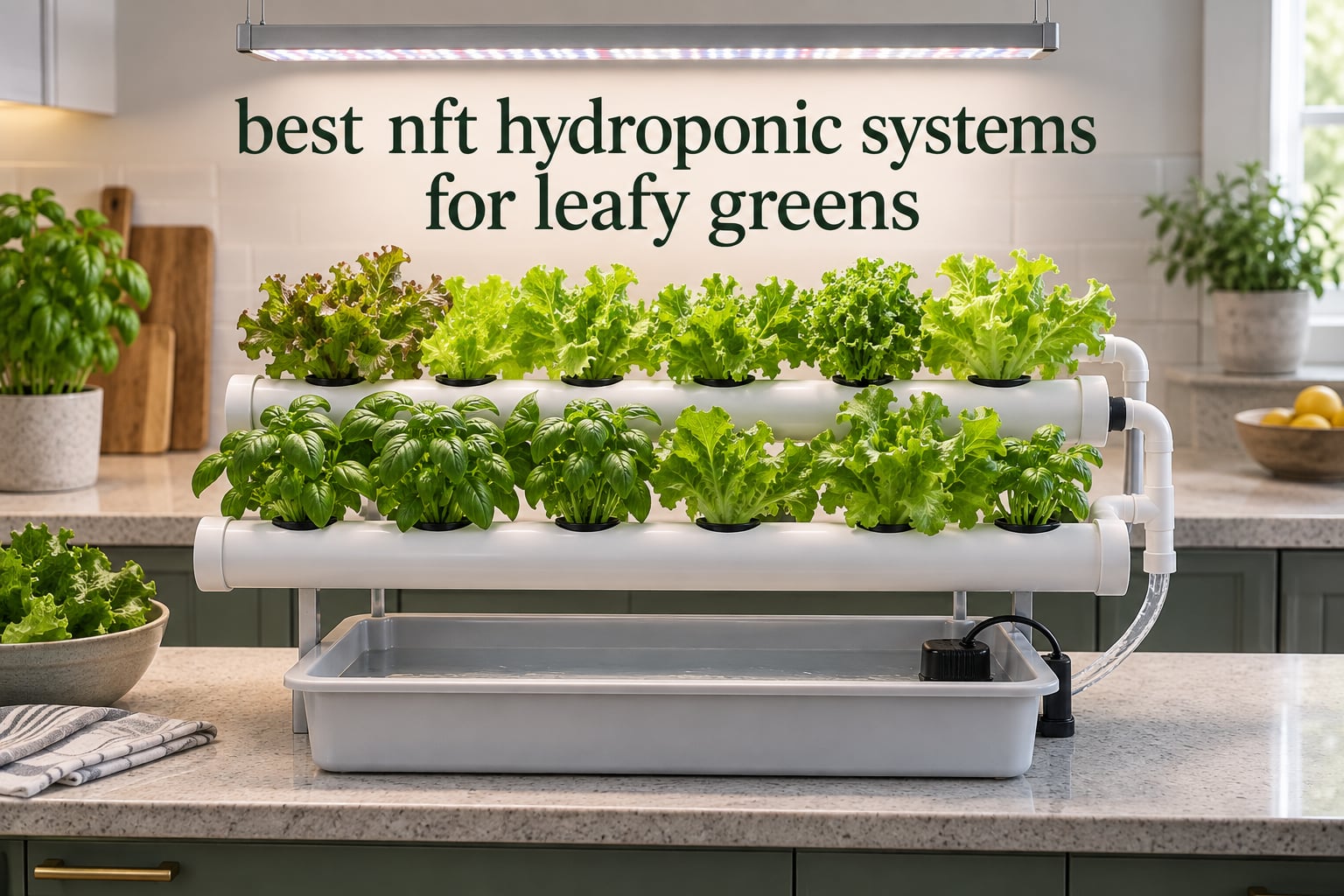
Choosing the best NFT hydroponic systems for leafy greens comes down to one question nobody asks out loud: do you want a real nutrient film channel kit, or a lit indoor tower that happens to circulate water? Those are two different machines sold under the same label, and most buyer guides blur them together.
An NFT (nutrient film technique) system moves a shallow film of nutrient solution through sloped channels. A submersible pump lifts solution from a sealed reservoir, the film runs a few millimetres deep across the plant roots, and the water drains back into the reservoir to be recirculated. Roots sit in constant contact with solution while still touching oxygen-rich air in the upper part of the channel.
That thin film is why NFT suits lettuce, spinach, kale, bok choy, arugula and herbs. It is also the single most misunderstood thing about the method: a film this shallow does not need a big pump. Forum growers on r/Hydroponics keep pointing out that a very small circulation pump is enough for a household channel run, and that people routinely overspend on hardware they do not need.
We spent weeks comparing ten systems that are actually on the market, looking at channel geometry, plant-site count, whether a grow light is included, and what happens when a part fails. Only two of the ten are true channel NFT builds. The rest are recirculating DWC towers and pod benches that grow leafy greens perfectly well but for a different reason. We have flagged which is which in every section below so you do not pay for a channel kit and end up with a tower.
Table of Contents
Top 3 Picks for NFT Hydroponic Picks for Leafy Greens in 2026
Our top three cover three genuinely different needs: a real channel kit, a fully lit indoor tower, and the best-balanced system if you already have lighting in the room.

VIVOSUN 36-Site PVC Channel Kit
- 36 plant sites across 4 PVC-U pipes
- Pump with programmable timer
- Indoor and outdoor use

Best NFT Hydroponic Systems for Leafy Greens (September 2026)
| Product | Specifications | Action |
|---|---|---|
| VIVOSUN 36-Site PVC-U Channel Kit |
|
Check Latest Price |
| DRYADES 81-Pod 3-Tier Indoor Tower |
|
Check Latest Price |
 GARDYN Home 4 Vertical System GARDYN Home 4 Vertical System |
|
Check Latest Price |
 Growell 32-Pod 2-Tier System Growell 32-Pod 2-Tier System |
|
Check Latest Price |
 Growell 90-Pod 3-Tier System Growell 90-Pod 3-Tier System |
|
Check Latest Price |
 Growell 81-Pod 3-Tier System Growell 81-Pod 3-Tier System |
|
Check Latest Price |
 GENORTH A-Type 72-Site Kit GENORTH A-Type 72-Site Kit |
|
Check Latest Price |
 ALTO GARDEN GX Tower ALTO GARDEN GX Tower |
|
Check Latest Price |
 LYCereal 30-Plant Tower LYCereal 30-Plant Tower |
|
Check Latest Price |
 SJZX 5-Layer Tower SJZX 5-Layer Tower |
|
Check Latest Price |
1. VIVOSUN 36-Site PVC-U Channel Kit: the Only True NFT Build Here
VIVOSUN Hydroponic Grow Kit, 1 Layer 36 Plant Sites 4 Food-Grade PVC-U Pipes Hydroponics Planting System with Water Pump, Pump Timer, Nest Basket and Sponge for Leafy Vegetables
36 plant sites
4 PVC-U pipes, 31.1 in long
Pump on 5 min on / 30 min off timer
Pros
- Food-grade PVC-U channels
- Simple assembly for beginners
- Timed pump included
- Steady multi-cycle lettuce harvests
- Indoor or outdoor use
Cons
- Pipes arrive level so film flow needs modifying
- Small bore fills with roots quickly
- Included pump is not dry-run safe
This is the kit most people mean when they search for the best NFT hydroponic systems for leafy greens. Four food-grade PVC-U pipes, each 31.1 inches long and 2.8 inches in diameter, sit in a frame that gives you 36 planting sites per layer. A pump moves solution on a timer that ships set to run five minutes every half hour.
Owners report the same thing again and again in reviews: assembly takes an afternoon, the joints stop leaking once they are properly seated, and the first harvest of lettuce, spinach and arugula arrives on schedule. The kit comes with planting baskets, sponges, tweezers, tube, power plug, instructions and a one-year warranty. The whole thing weighs 9.73 pounds, so it moves easily when you want to reconfigure the layout.
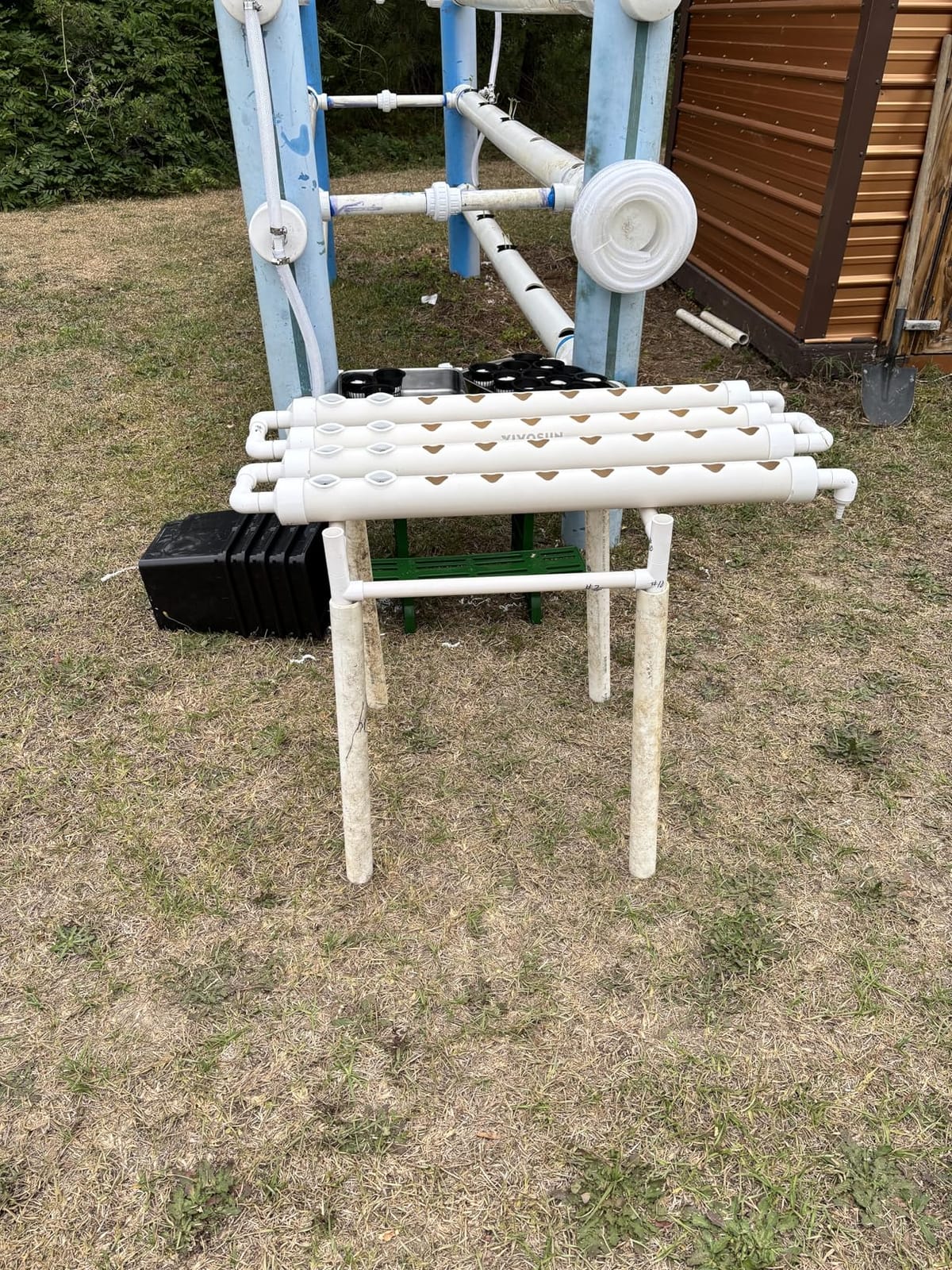
The catch is real and worth stating plainly. The pipes ship level, not sloped, and a level pipe is not a nutrient film. Solution pools instead of running as a thin sheet, and growers have reported stagnant patches and early root issues in unmodified setups. The fix is not complicated: raise one end of each pipe with a small shim and re-seat the connections. It takes an hour and it turns this into what the name promises.
Two other limits shape how you use it. The 2.8-inch bore is narrow by channel standards, so mature root masses fill it and can cause overflow and puddling at the far end. And the supplied pump is not dry-run safe, which matters because a thin-film system has almost no water buffer between the pump and the plants. A backup pump on hand is not a luxury here.
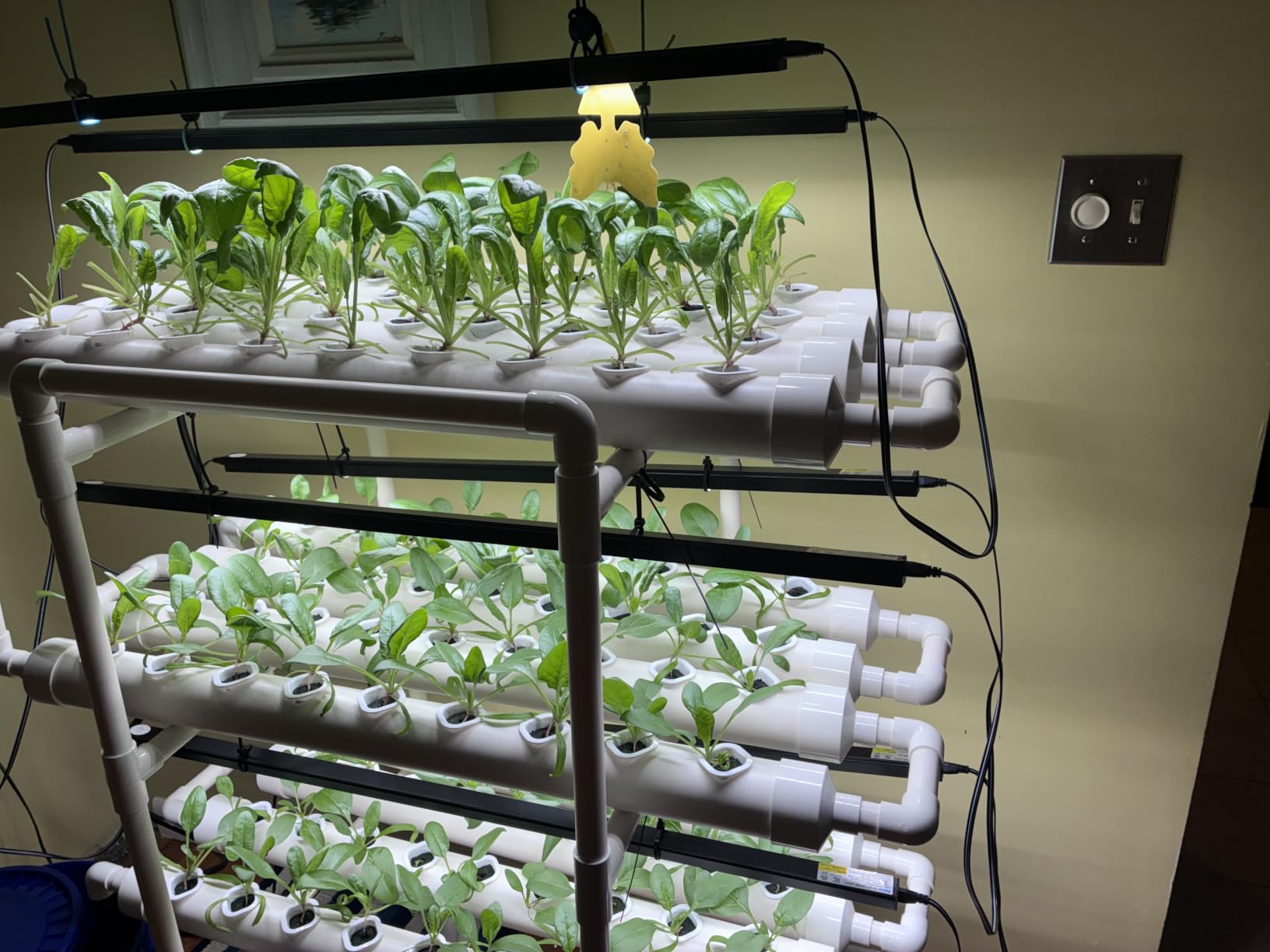
Who this is right for
Pick this if you want lettuce and other shallow-rooted greens in a greenhouse, on a balcony, or under your own lighting, and you are willing to spend an hour sloping the pipes before you plant. It is also the simplest kit here to expand, since identical pipe runs can be added side by side as your growing space allows. Growers in Facebook hydroponic groups repeatedly single out this style of system for leafy greens, and this model is the version with by far the largest body of owner feedback at more than thirteen hundred reviews.
Who should skip it
Skip it if you want an indoor unit that works the moment you plug it in. There is no grow light in the box, no timer for a light, and no reservoir, which means you are also buying a tank, nutrients and a lighting setup. It is also a poor match for anyone who wants fruiting crops: the channel is too shallow and short for tomatoes or peppers to set fruit properly.
2. DRYADES 81-Pod 3-Tier Indoor Tower: Lights and Pump in One Box
Indoor Hydroponic Growing System with 81 Pods Herbs Garden Kit with 30W Led Grow Light Large Movable 3-Layer Floor-Standing Hydroponic Gardening System for Vegetable Fruit
81 pods, 27 per layer
30W LED per tier
14L tank, per-layer panels
Pros
- Very easy assembly with labelled parts
- Quiet 30-minute pump cycling
- 14L tank needs infrequent refills
- Doubles as a germination tray
Cons
- Base or middle tank can arrive cracked
- Weak base plugs leak if moved when full
- Hard to reach support for light failures
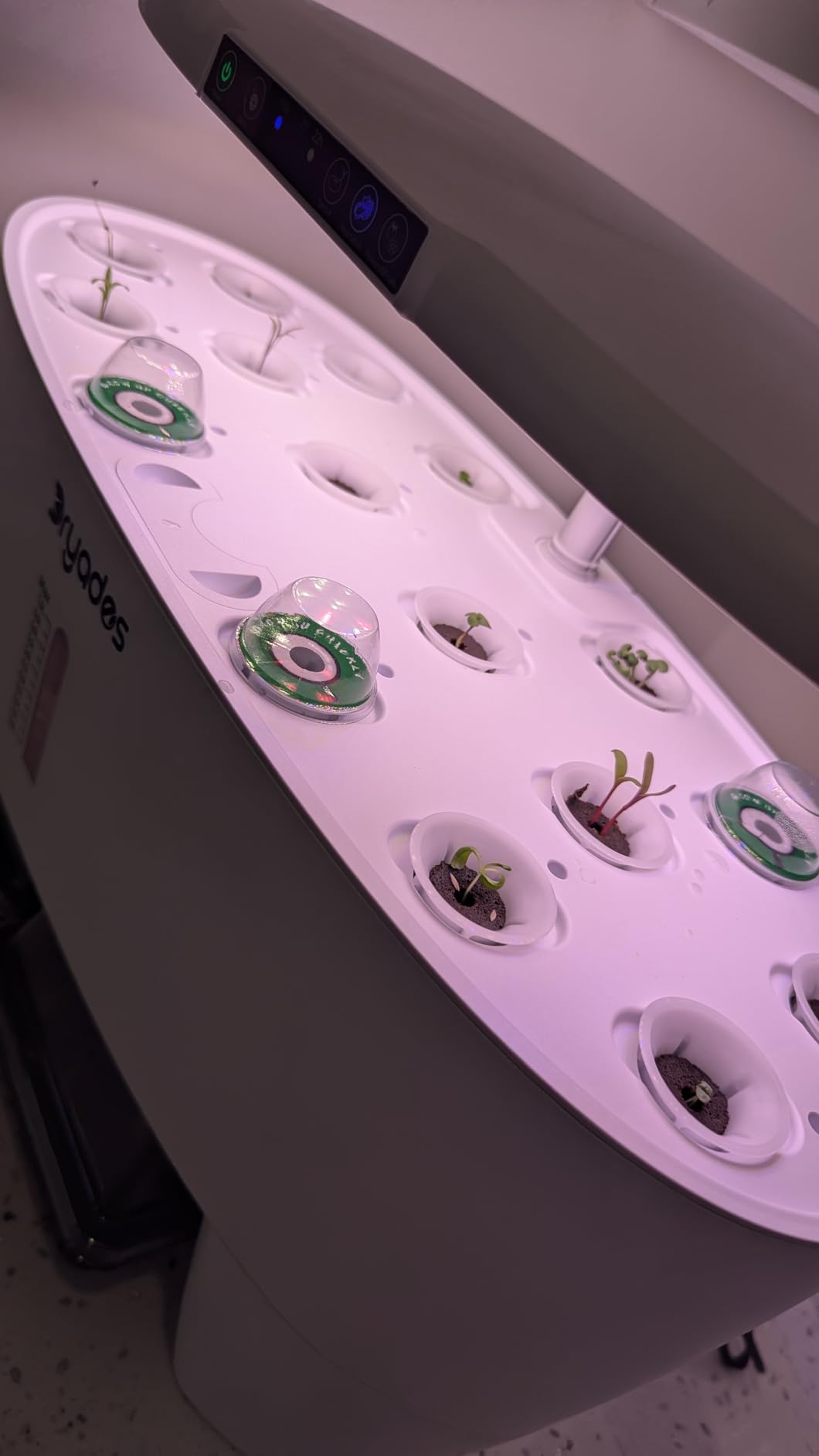
Where the VIVOSUN kit needs a light and a tank bolted on, this one arrives as a complete indoor garden. Three floor-standing tiers hold 81 planting pods, 27 on each level, and each tier has its own 30-watt full-spectrum LED bar with a vegetable mode and a flower and fruit mode. The whole unit measures 26.77 by 11.81 by 64.17 inches and weighs 33.1 pounds.
The 14-litre reservoir is the feature we like best for leafy greens. Owners say they top it up roughly every seven to ten days, which for a system holding 81 plants is a genuinely light maintenance load. The pump cycles quietly on a 30-minute on and off schedule, per-tier control panels let you run lights independently, and universal casters mean the whole thing rolls to a sunny window.
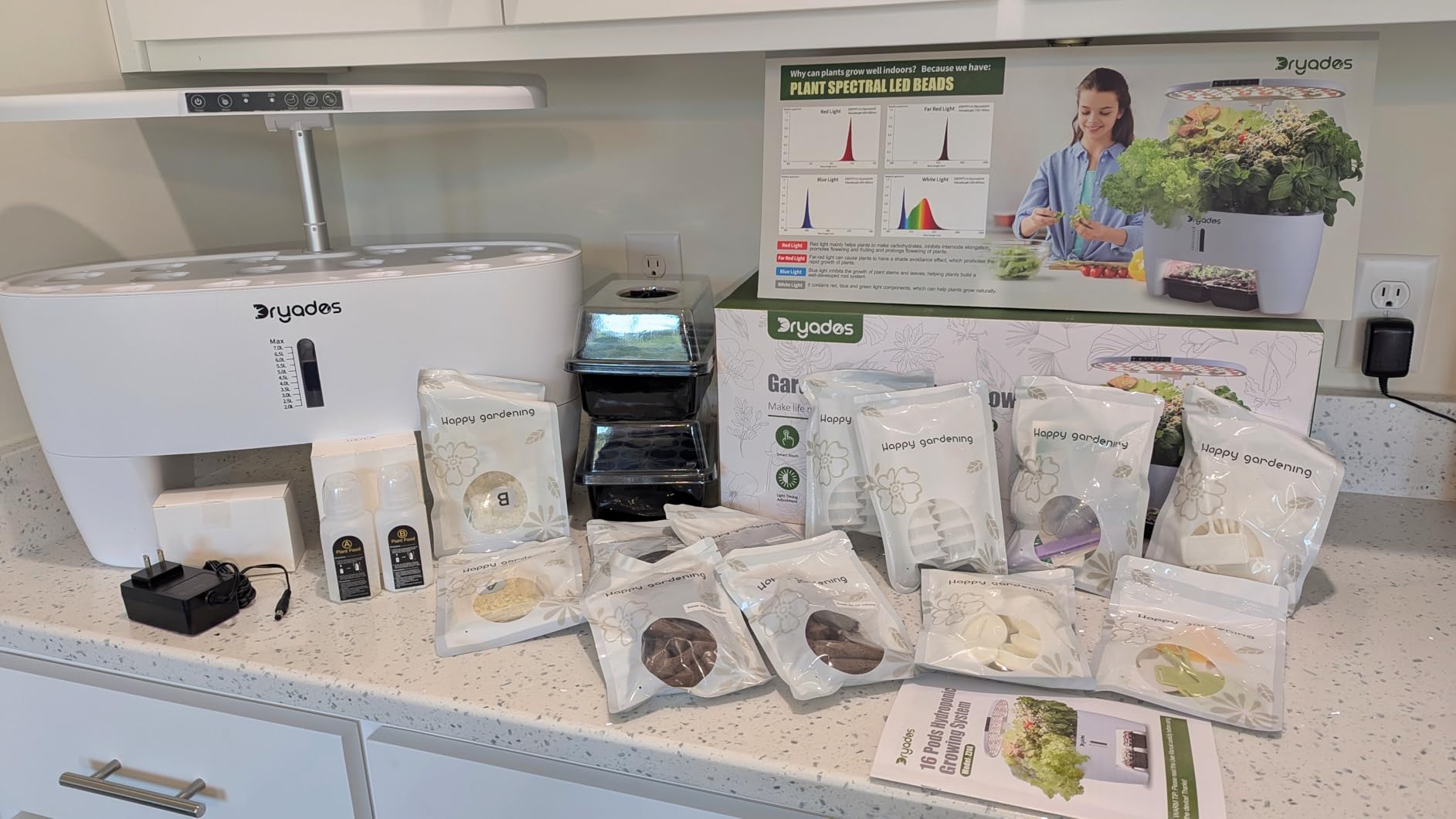
This is a deep water style bench, not a nutrient film system. Roots hang into an aerated reservoir rather than running through a shallow channel, which is why it is far more forgiving of a missed pump cycle. That forgiving nature is the honest reason to buy it over a channel kit if your goal is a steady salad supply rather than a faithful NFT build.
Reviewers raise three recurring issues. The base or middle tank can arrive cracked and leak, so inspect the tank on arrival before filling it. The base plugs are weak, meaning you should never roll the unit while it is full. And support for a failed light or pump is genuinely hard to reach, which is a bigger deal when the light is the thing making the whole crop possible.
Who this is right for
This suits households and small apartments that want a large salad supply indoors without buying a light, a tank, or a reservoir separately. Lettuce, basil and mixed salad greens germinate and grow well in it, and the 27-pod-per-tier layout makes it easy to run one tier for a crop you already know while you experiment on another. For anyone who wants a large plant count in a single footprint, it is the strongest pick in this roundup.
Who should skip it
Skip it if you want a true NFT channel to build your system knowledge, or if you plan to move it regularly once it is filled. The 33-pound weight plus water means the casters carry a real load, and reviewers report the base plugs leaking when the unit gets nudged. It is also too tall for many shelves and alcoves at just over 64 inches.
3. GARDYN Home 4 Vertical System: 30 Plants in About 2 Square Feet
Gardyn Home 4 Vertical Hydroponics Growing System Kit – 30 Plants
30 plant sites, 4 levels
Footprint of about 2 sq ft
Sunrise and sunset LED modes
Pros
- 30 plants in roughly 2 square feet
- Uses about 95% less water than soil
- Redesigned columns are easier to clean
- 30 seed starter cubes included
Cons
- Reservoir capacity is small so water needs regular checks
- App features add a learning curve
- Best suited to compact greens and herbs
Where the previous two systems sprawl, this one concentrates. The Gardyn Home 4 is a four-level vertical unit that grows 30 large plants in roughly two square feet of floor space, built from alloy steel, aluminium and metal. It is designed for indoor use, and the pitch is a complete guided garden rather than a component kit you assemble yourself.
What sets it apart is the column redesign. The growing columns are easier to pull apart and clean than the previous generation, which matters far more than it sounds for a recirculating system. Energy-efficient LED lighting offers sunrise and sunset modes so plants get a rest cycle, and real-time water measurement removes the guesswork from daily checks. The company states the system uses about 95% less water than soil cultivation.
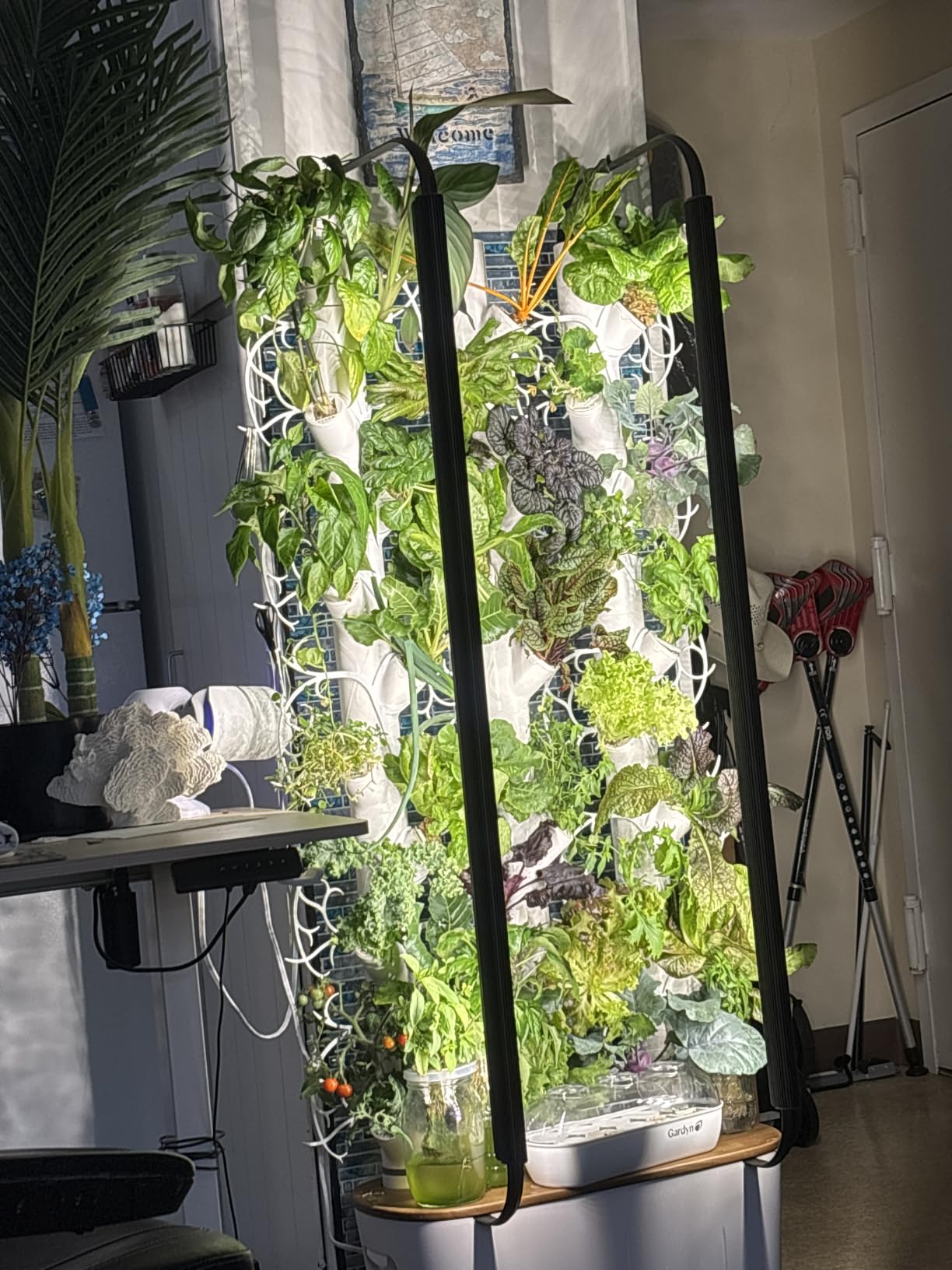
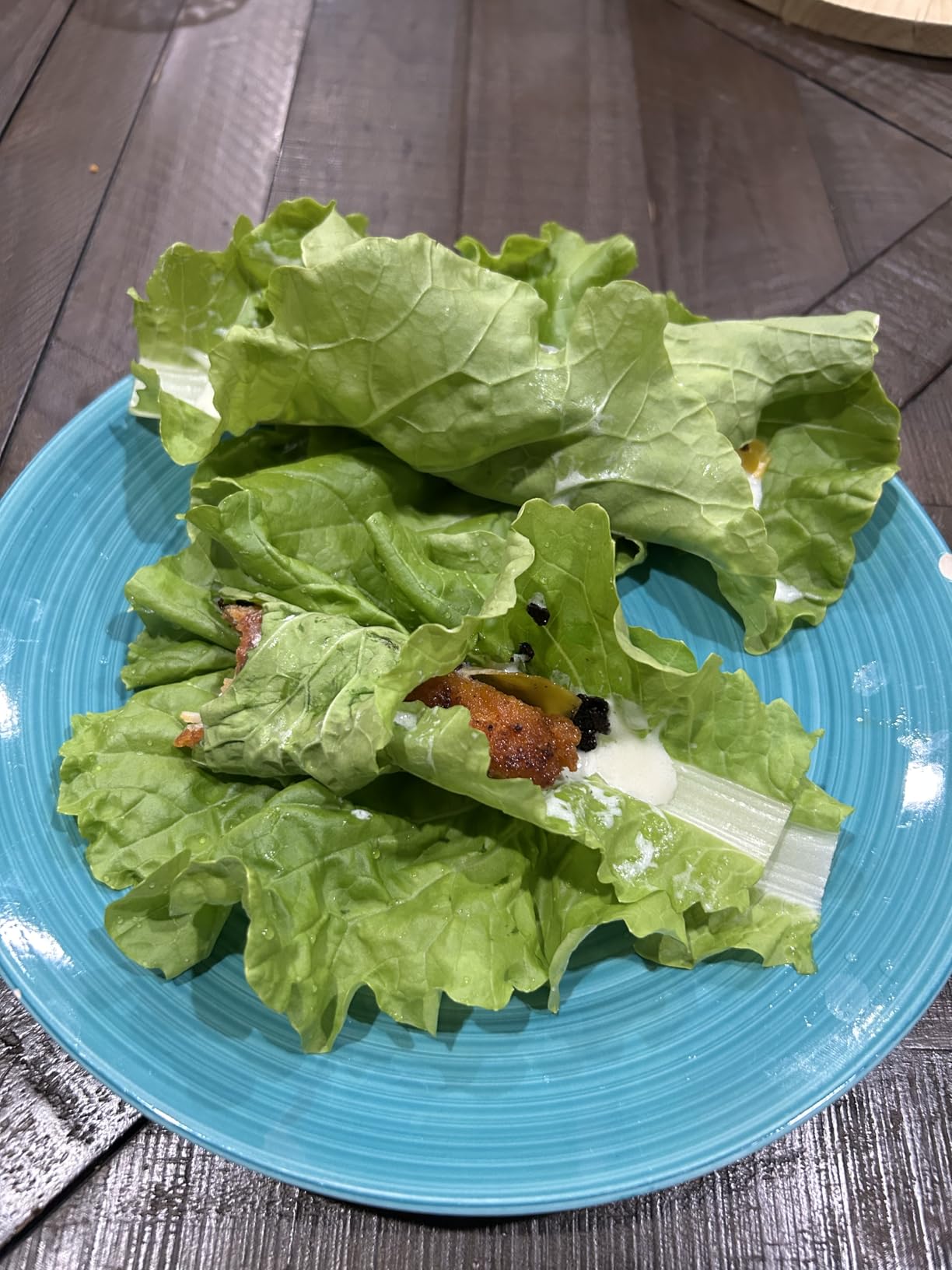
Thirty seed starter cubes with non-GMO seed varieties in rockwool come included, so the unit is productive on day one without a separate seedling purchase. Owners like that the footprint frees up counter space and that lettuce, spinach and salad mixes all perform well in it. There is also an AI plant coach with a trial period and sensor monitoring for anyone who wants prompts instead of a manual.
The trade-off is dependence on the app. Guided care runs through a companion app, which some people find genuinely helpful and others find an extra layer between them and their plants. The reservoir is also small in volume, so you will be checking water more often than with a bulk-tank system. Plant a heavy-fruiting crop in the top tier and the frame will feel it; this is built for leafy greens and herbs.
Who this is right for
Choose this if floor space is the constraint, whether that is a small apartment, a narrow balcony or a countertop corner. It is a good fit for someone who wants guidance rather than a build project, since the seed cubes, lighting schedule and water monitoring are all handled for you. Thirty plant sites is plenty for a household salad habit, and the compact column layout keeps greens within easy reach.
Who should skip it
Skip it if you dislike app-driven routines or if you already have a lighting and reservoir setup you trust. Because it is a recirculating column system rather than a nutrient film channel, it will not teach you the NFT technique or translate directly to a commercial channel bed. The compact reservoir also means more frequent attendance than a large tank.
4. Growell 32-Pod 2-Tier System: Roomy 3-Inch Baskets
Growell Large Basket Hydroponics Growing System Kit, 32 Pods Vertical Hydroponic Garden with 2 Grow Light Modes, Auto Circulating Water System, 32L Indoor Gardening System for Herb Vegetable Fruit
32 large 3-inch baskets
32L tank, 24L plus 8L
60W light, two modes
Pros
- 3-inch baskets give roots real room
- 32L tank means roughly weekly top-ups
- Quiet even circulation
- Quick intuitive assembly
Cons
- No covers for unused planting holes
- Tank cannot be fully drained for cleaning
- Casters can fail under the filled weight
This is the two-tier Growell, and its distinguishing feature is basket size. Thirty-two large 3-inch grow baskets give root systems genuine room, which is exactly what most pod towers take away from you. At 10.2 by 36.6 by 51.5 inches, it is also the shortest of the larger systems here, so it clears under a normal worktop in places a 64-inch tower will not.
Water is handled by a self-circulating system with a 24-litre plus 8-litre tank configuration, 32 litres in total, moved by a quiet automatic pump. Lighting is 60 watts total, 30 watts across two full-spectrum panels with adjustable height, and two modes with 16-hour or 22-hour timers. The frame is food-grade ABS plastic with aluminium alloy uprights.
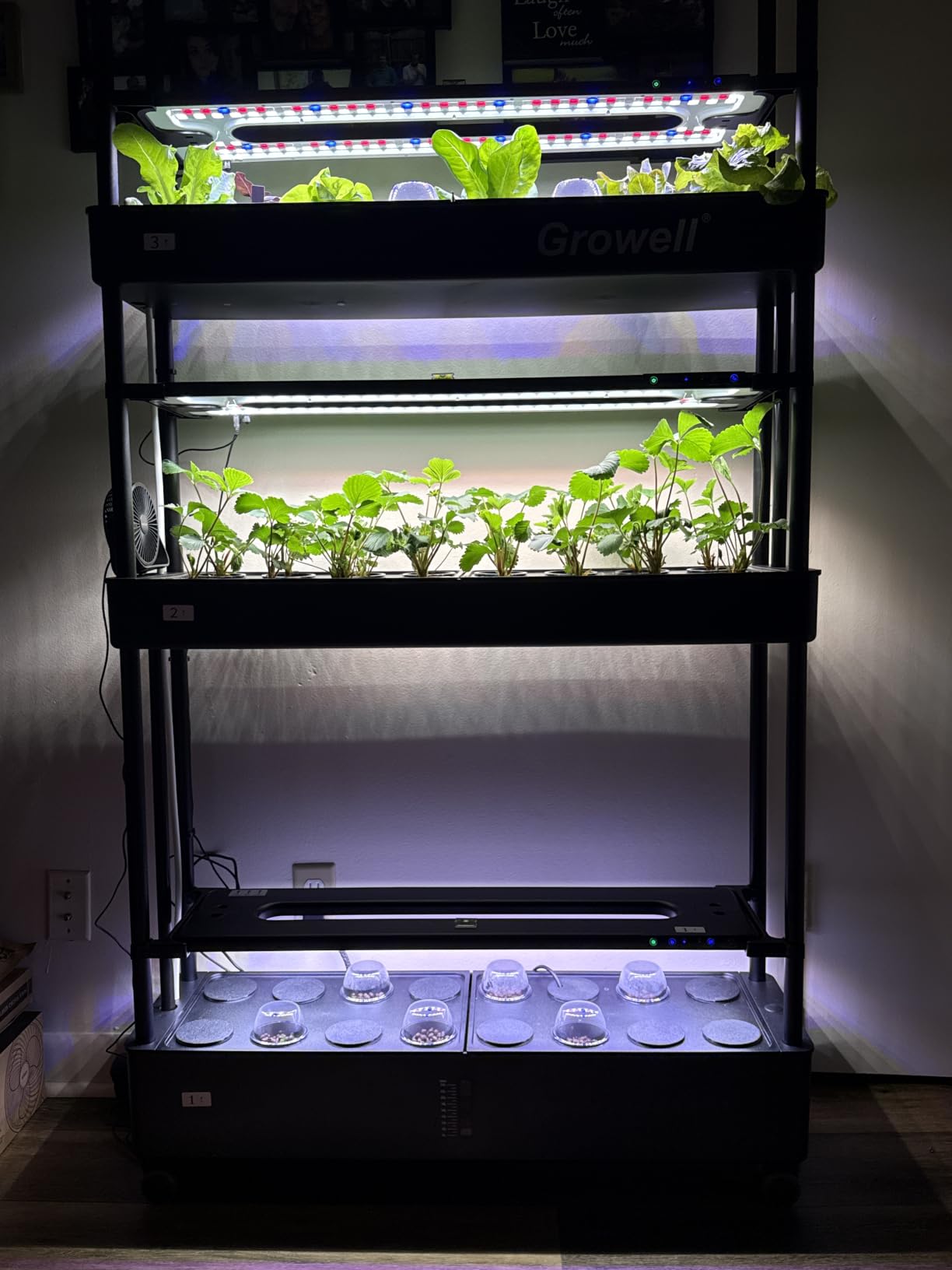
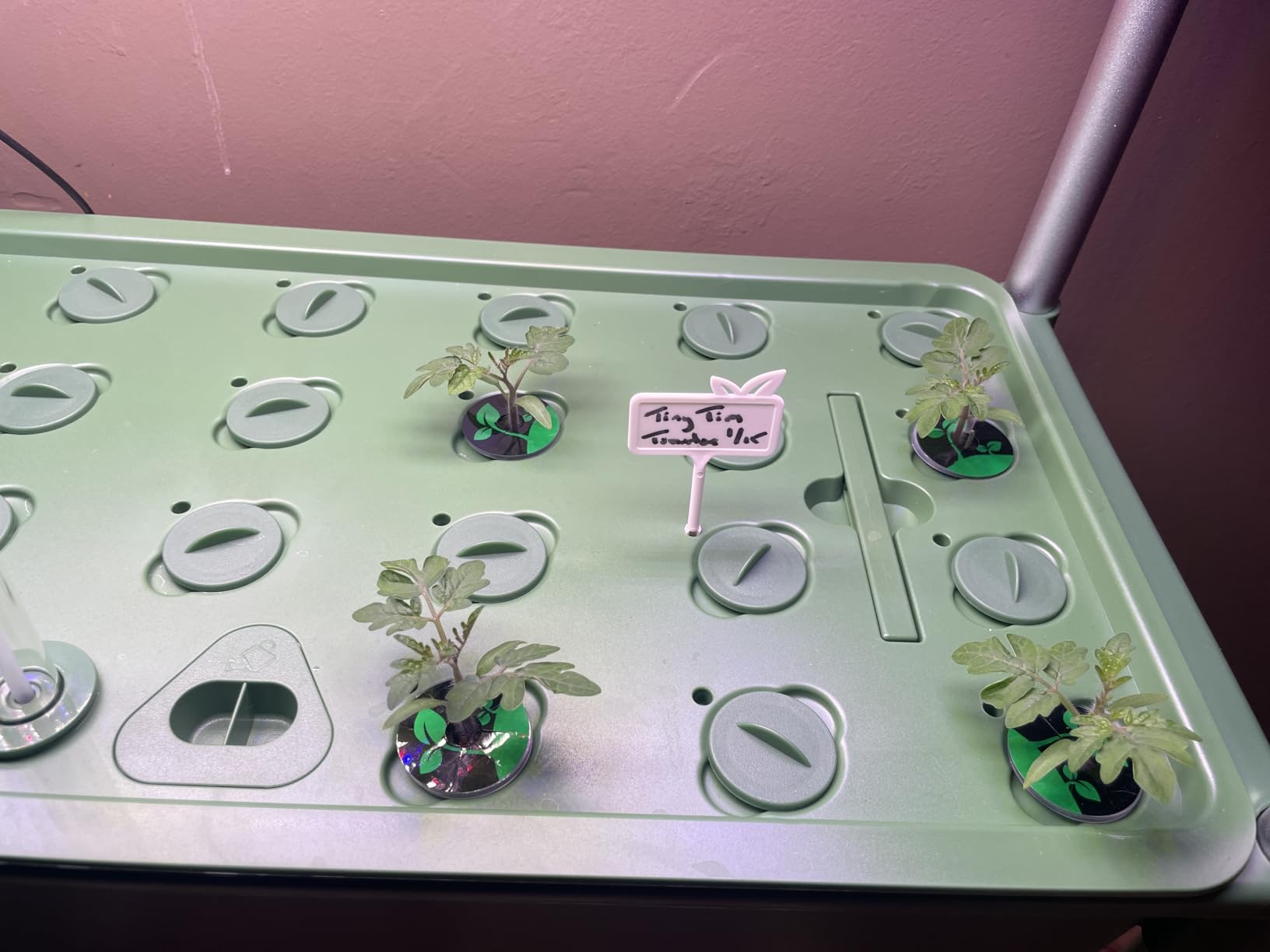
Reviewers consistently report good harvest quality, particularly for lettuce and herbs, and one comparison worth repeating is that growers describe the flavour as holding up against outdoor summer harvests. The bigger baskets are why: more root volume means steadier uptake, and less crowding means fewer days of stalled growth after transplant.
Design flaws account for most of the complaints. There are no covers for unused planting holes, so unoccupied sites dry out and can invite algae. The tank has no proper drain, which makes the recommended water change every two to three weeks awkward. The internal drain plug can be pulled loose during a pod swap and flood the base, and reviewers report casters breaking under the filled weight. Plan to keep the unit in one spot.
Who this is right for
This suits growers who have been disappointed by cramped pod wells. The 3-inch baskets support a wider variety of plants and let roots establish without constant pruning, which makes it a good fit for anyone rotating between lettuce, kale, bok choy and herbs. If you have a worktop-height space rather than a full-height corner, the two-tier footprint is the reason to choose it.
Who should skip it
Skip it if you want to fill every site from day one, because there are no blanking covers to stop unused holes drying out. It is also the wrong shape of machine for a commercial-scale plan, and anyone who needs to fully drain and sanitise the reservoir between cycles will find the plumbing awkward. Treat it as a two-tier indoor unit you set up once and leave alone.
5. Growell 90-Pod 3-Tier System: The Biggest Plant Count in the Group
Growell Large Hydroponics Growing System Kit, 90 Pods Vertical Hydroponic Garden with 2 Light Modes Grow Light, Auto Circulating Water System, 40L Indoor Gardening System for Herb Vegetable Fruit
90 pods across 3 tiers
40L tank, 24L plus 8L plus 8L
90W light, per-layer control
Pros
- Largest plant count in this roundup
- 40L tank cuts watering frequency
- Per-layer light control
- Adjustable light height for all stages
Cons
- Tallest footprint at over 67 inches
- Heavy frame and casters when full
- No covers for unused planting holes
- Seeds not included
Ninety pods across three tiers is more than any other system in this roundup, and it is the only one where the stated tank size is genuinely matched to the plant count. The reservoir configuration is 24 litres plus 8 plus 8, totalling 40 litres, which is the difference between topping up twice a week and topping up once. At 10.2 by 36.6 by 67.3 inches it is also the tallest unit here.
Lighting is 90 watts in total, 30 watts per tier, in full-spectrum panels with adjustable height, running in vegetable or flowers-and-fruits mode on 16-hour and 22-hour timers. Individual per-layer light control lets you stagger crops so a freshly transplanted tier is not lit on the same schedule as one about to be harvested.
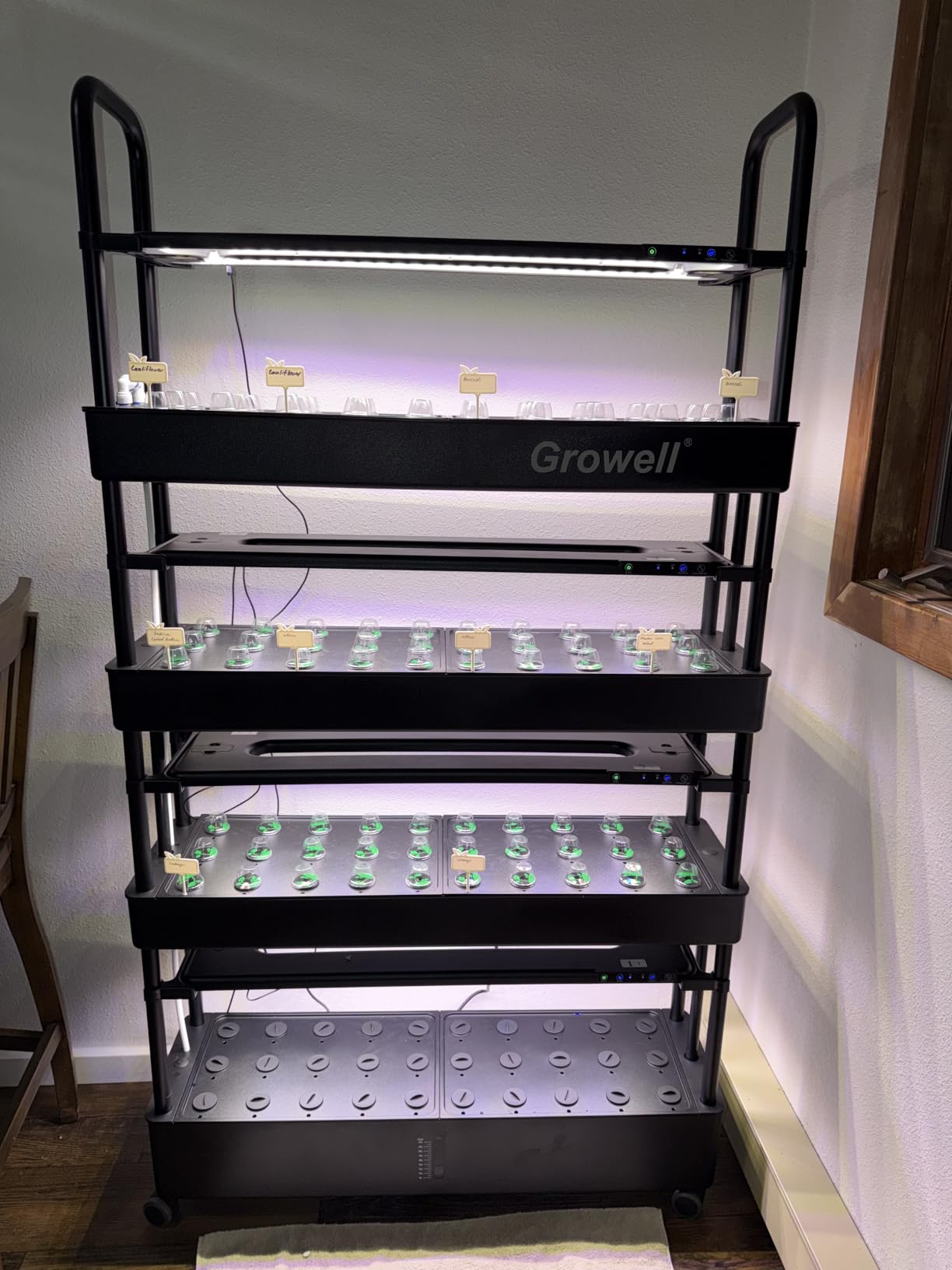
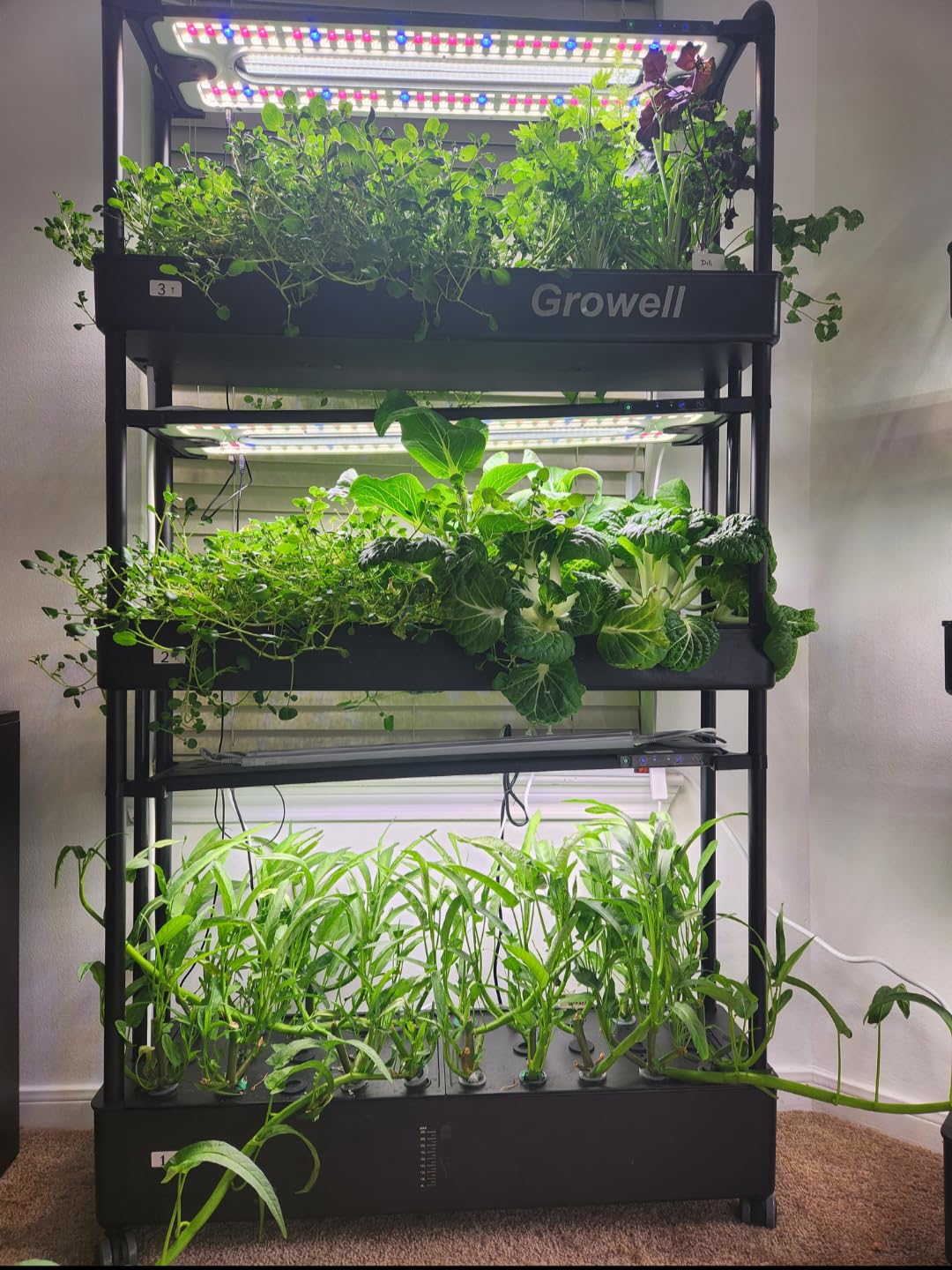
Owners value exactly what you would expect from a machine this size: the ability to produce more greens than a household can eat in one pass. Buyers report the large tank carrying it through weeks between water changes, and the quiet pump circulating evenly to all roots. A 563-piece accessory kit is included for propagation and handling, though seeds are not part of the package.
Size is the cost. Over 67 inches tall with a wide footprint, this is a floor-standing unit that needs its own corner, and reviewers describe the frame and casters as heavy when filled. The missing hole covers are the same design flaw found across this range, so unused sites will still dry out. If you cannot move it, the missing covers matter less.
Who this is right for
This is the pick for a household that eats a lot of salad, cooks with fresh herbs most days, or shares produce with neighbours. Ninety sites at 40 litres means you can plant a full rotation and still have capacity while earlier tiers finish. The staggered per-tier light control is the detail that makes a three-tier machine manageable rather than chaotic.
Who should skip it
Skip it in a small flat, a low-ceilinged room or anywhere the unit would have to be moved after filling. A heavy three-tier frame with casters is a commitment to a permanent spot. It is also not a channel system, so if your goal is to learn nutrient film technique, you would be buying capacity rather than method.
6. Growell 81-Pod 3-Tier System: Separate Pump and Tank per Tier
Growell 81 Pods Hydroponics Growing System Kit with Independent Water Pump
81 pods, 3 tiers
Pump and 14L tank per tier
26W LED per tier, under 20dB
Pros
- Independent pump and tank per tier
- Very quiet running
- Digital timer display is simple
- Height-adjustable light panels
Cons
- 64-inch frame limits where it fits
- Three tanks to top up
- Seeds and nutrients not included
The other 81-pod Growell solves a different problem. Instead of one shared reservoir, each tier has its own independent water pump and its own dedicated 14-litre tank, cycling every 30 minutes. That separation is the whole point: a disease, an algae outbreak or a pH problem in one tier does not propagate through a shared body of solution to the other two.
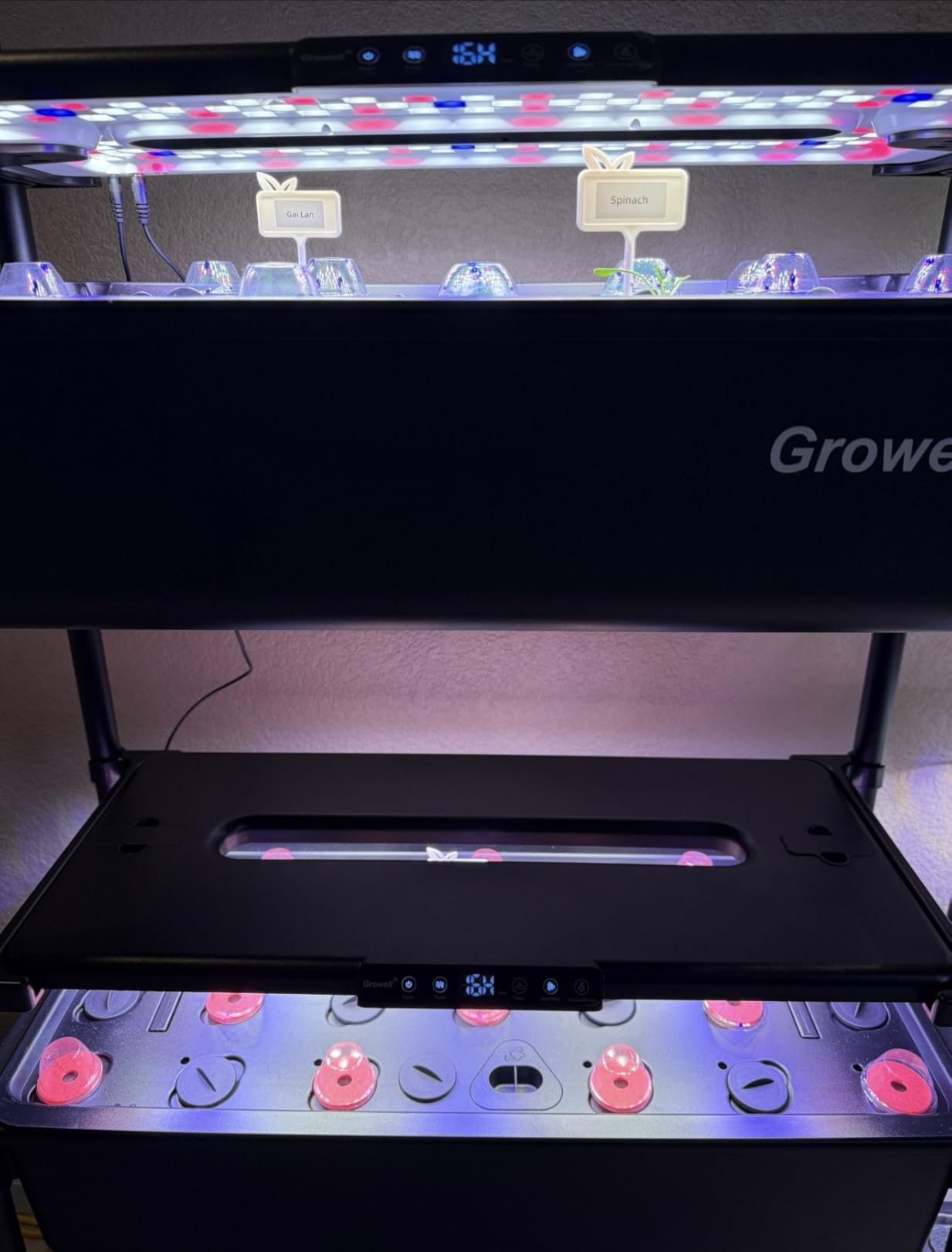
Lighting is 26 watts per tier with a digital timer and display, running in vegetable or flower-and-fruit mode. Operating noise is stated at under 20 decibels, and with casters and a detachable easy-clean design it is the quietest large system in this group. The unit measures 11.96 by 25.98 by 64.37 inches, built from aluminium and polypropylene.
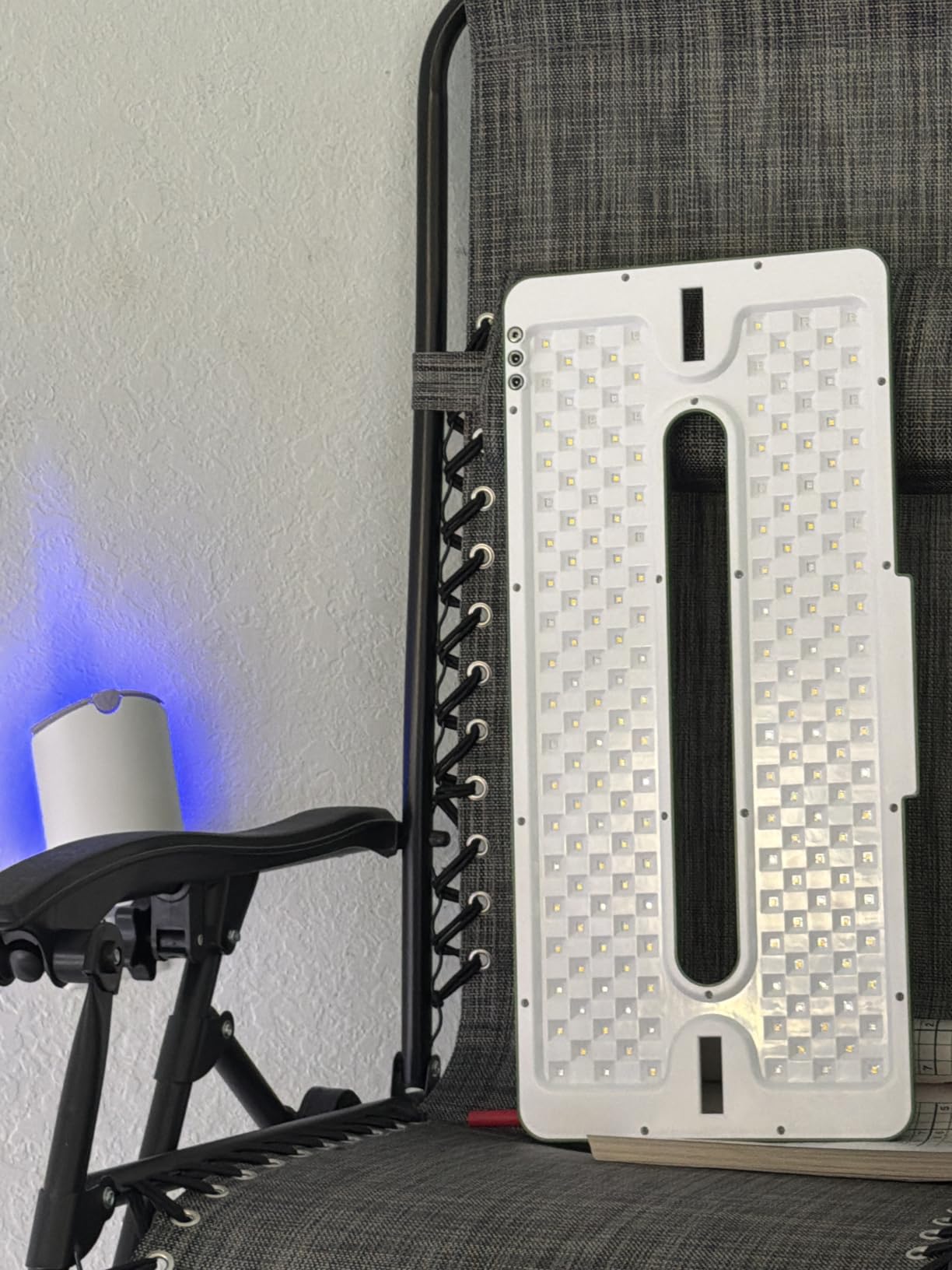
Owners single out the digital display and button controls as making timer programming straightforward, and the height-adjustable light panels as handling every stage from seedling to full head. Reviews also praise the fact that the design detaches for cleaning, which is the single most neglected task in recirculating systems. The per-tier isolation is what makes it possible to grow a delicate lettuce tier next to a heavier herb tier.
Three tanks means three top-ups, and that is a real recurring chore rather than a one-off. The 64-inch frame is tall and the footprint is wide, so placement is a planning problem, not a purchase decision. Seeds and nutrients are both absent from the box. As with the rest of the range, there are no covers supplied for unused planting holes.
Who this is right for
Choose this if you plan to grow more than one crop type at once or at different stages, or if you have had an algae or root issue in a shared-reservoir system before. The independent pumps and tanks are what let you quarantine a tier. It is also the pick for anyone who works or sleeps near the system and needs it to run quietly, plus it suits a full-height corner of a room.
Who should skip it
Skip it if you want one reservoir to manage or if weekly maintenance time is tight, because three separate tanks multiply the top-up routine. It will not fit under a standard worktop at 64 inches. And if you are buying to expand a crop rather than to isolate one, the shared-reservoir models in this roundup do the same job with less plumbing.
7. GENORTH A-Type 72-Site Kit: Light-Blocking Pipes That Beat Algae
A-Type 72 Plant Sites Hydroponics Growing System Kit with Light Blocking
72 sites, A-Type frame
Dark blue light-blocking pipes
Detachable tubes, timed pump
Pros
- Light-blocking pipes limit algae
- Gravity-fed flow reduces waterlogging
- Tubes detach individually for cleaning
- 72 baskets
- 72 sponges
- 30 covers
Cons
- No grow light included
- 72 sites can crowd roots
- Lower tiers rely on external lighting
If you have read forum threads about cheap kits turning into algae-black pipes within a month, this design answers that complaint directly. The A-Type 72-site kit uses dark blue PVC pipes that block light, which is the single most effective thing you can do against algae in a recirculating channel. The multi-surface layout also gives omnidirectional gravity-fed flow, so solution spreads rather than sitting in one low spot and logging.
The frame design matters too. The A-Type arrangement keeps upper levels from shading the plants below, so you are not fighting your own structure for light reach. Tubes and brackets detach, and each planting tube lifts out individually, which makes cleaning and nutrient changes far quicker than a fixed channel. At 41 by 21 by 43 inches and 31.5 pounds it is a substantial unit, and the pump has an anti-dry-burning design with an adjustable timer and flow valve.
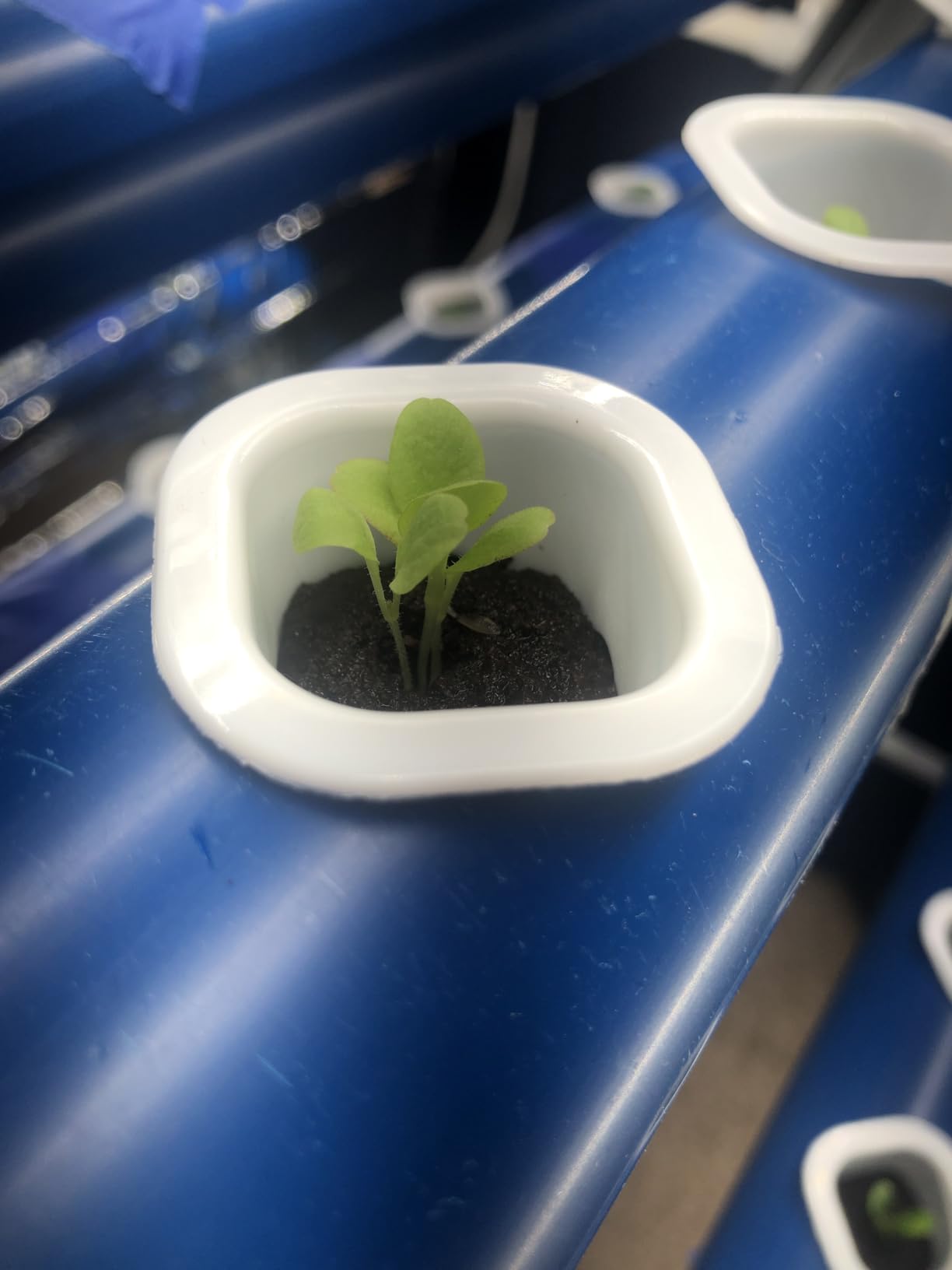
The box is unusually complete for a channel kit: 72 planting baskets, 72 grow sponges and 30 hole covers, plus three instruction manuals. Those covers matter more than they sound, since blanking unused sites is the difference between a clean channel and one that grows algae in the gaps. This is the best-balanced channel-style system in the roundup for anyone who already has lighting in place.
The critical caveat is that there is no grow light. That is not a small omission, because indoors the light is the crop. The light-blocking pipes also mean lower tiers depend entirely on external lighting, so a single lamp above the top tier will not be enough. Seventy-two sites in a frame this size can also produce root crowding in the upper runs once everything matures.
Who this is right for
This suits anyone with a greenhouse, a bright conservatory or a room with a proper lighting rig already installed. If algae in clear tubing has been your problem, dark pipes and included hole covers remove the main entry points. It is also the right shape of kit for anyone who wants to expand into a larger channel bed later, since the same design scales in multiples.
Who should skip it
Skip it for an indoor first attempt unless you are prepared to buy a light before you plant, because nothing grows without one. It is also a heavy unit at over 31 pounds, so the frame is not something you want to reposition often. If you need a plug-and-play indoor garden instead, one of the lit towers further up this list will serve you better.
8. ALTO GARDEN GX Tower: Fully Kitted With Nutrients, Rockwool and a pH Pen
ALTO GARDEN GX Hydroponic Tower | Vertical Planter Tower | Hydroponics Growing System Kit | Food Grade with 24 Net Pots (with LED Grow Lights)
24 net pots, 6 layers
10 gallon reservoir on casters
Nutrients, rockwool and pH pen included
Pros
- Nutrients
- rockwool and a pH pen in the box
- Solid 2mm tower walls with no leaky joints
- Support ships replacement parts quickly
- No subscription fee
Cons
- Cost sits high against enclosed units
- About 10 gallons needs care when moving
- Some tower sections separate during assembly
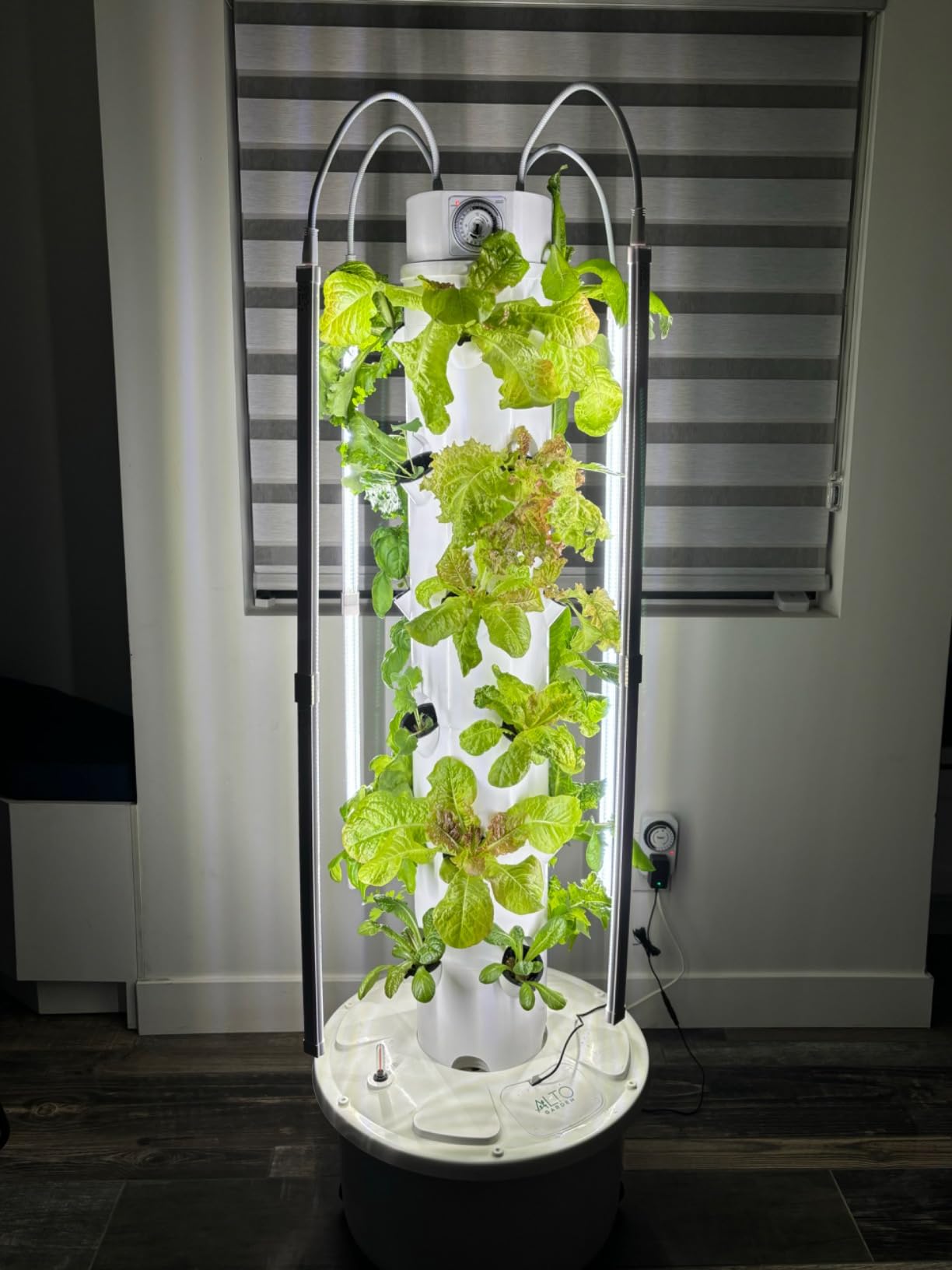
This tower is the most complete package in the roundup and the best rated. Twenty-four net pot sites spread across six layers, a 10-gallon recirculating reservoir on casters, and adjustable LED grow lights with a built-in timer plus a separate pump timer. There is no subscription and no app requirement to use the features.
The box is where it separates itself. You get A+B nutrients, 30 rockwool cubes, a digital pH pen and a four-head germination light alongside the tower. In a hobby where the pH pen alone is often the first thing people forget to buy, including one removes an entire failure mode from day one. The 2mm-thick walls and 360-degree construction per layer are designed to eliminate the leaky joints that plague stacked towers.
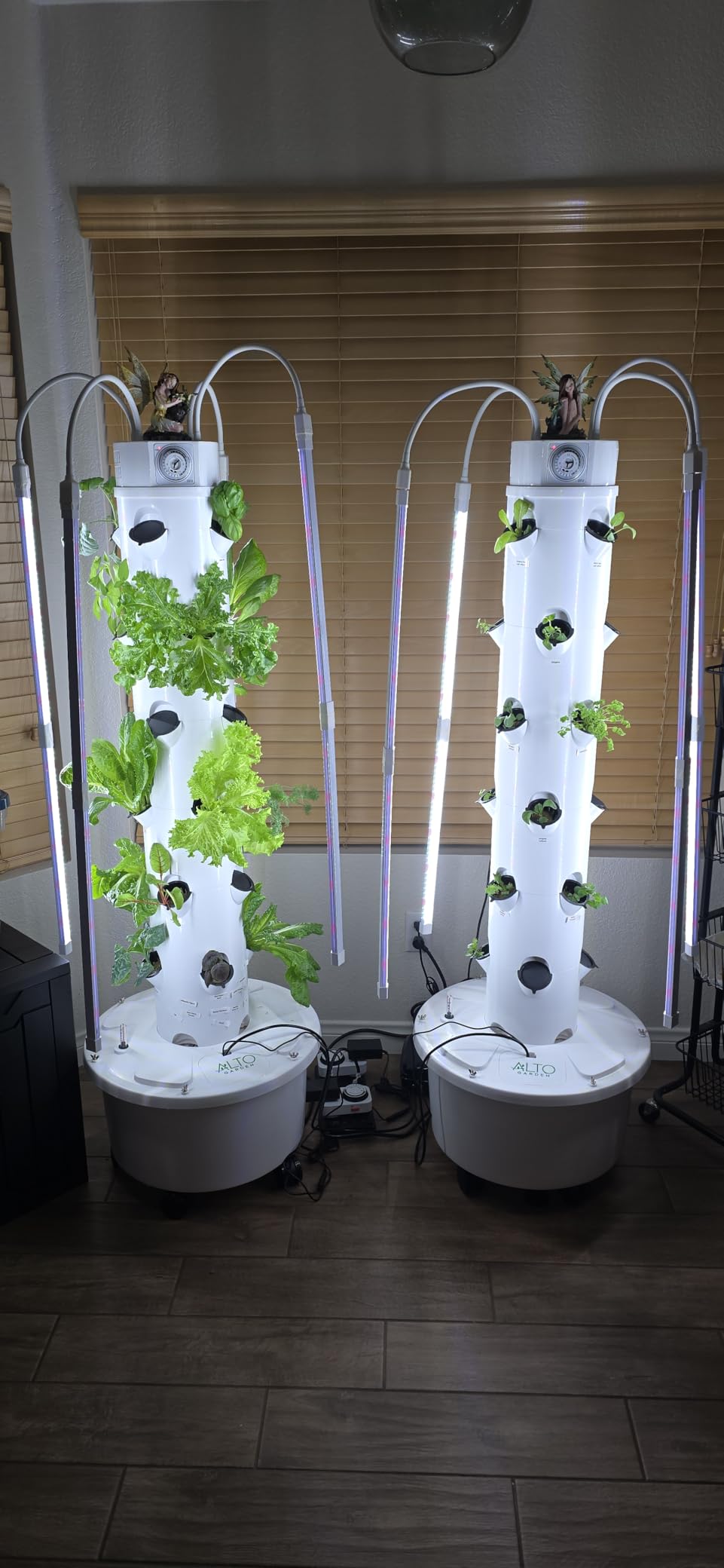
Customer support is the other standout. Owners report that missing parts and faulty LEDs are resolved quickly, with replacements sent out, and the company states a no-monthly-subscription policy with no hidden fees. The 10-gallon reservoir is large enough to give a real buffer against pump cycling problems, and the casters make refilling and repositioning straightforward. Growers rate the harvest result and build quality above almost everything else tested here.
Twenty-four sites is the smallest plant count of any system in this roundup, and that is the trade-off for the build quality and the accessories. At 20 by 20 by 66 inches it needs a full-height footprint, and filling the reservoir with roughly 10 gallons means moving it takes two people or real care. A few buyers report tower sections separating during assembly, so build it in one session.
Who this is right for
This suits first-time growers who want everything in one delivery. Having nutrients, medium, a pH pen and a germination light included means you can start a full cycle without a second shopping list, which is the most common reason new growers stall. It is also a good fit for anyone who plans to extend beyond lettuce into kale, chard and larger herb plants, since the six layers give more vertical room per site.
Who should skip it
Skip it if your priority is the highest possible plant count on a small budget, because 24 sites is modest and the tower sits at the top of this roundup’s price range. It is also not a channel system, so the technique is deep-water culture rather than nutrient film. Anyone planning a high-volume harvest should look at a higher-count bench instead.
9. LYCereal 30-Plant Tower: Under 1 Square Foot
LYCereal Hydroponics Growing System, 30-Plant Indoor Hydroponic Tower with Pump System, Plants Germination Kit, Smart Aeroponic Herb Garden, Vertical Hydroponic System for Gardening Lover (No Seed)
30 planting spots, 6 sections
10L tank with level gauge
Under 1 square foot footprint
Pros
- Arrives largely pre-assembled
- Under 1 square foot footprint
- Water gauge and pump timer keep it simple
- Stable base under tall growth
Cons
- No grow light included
- No nutrients or seeds included
- Plastic has no stated food-grade rating
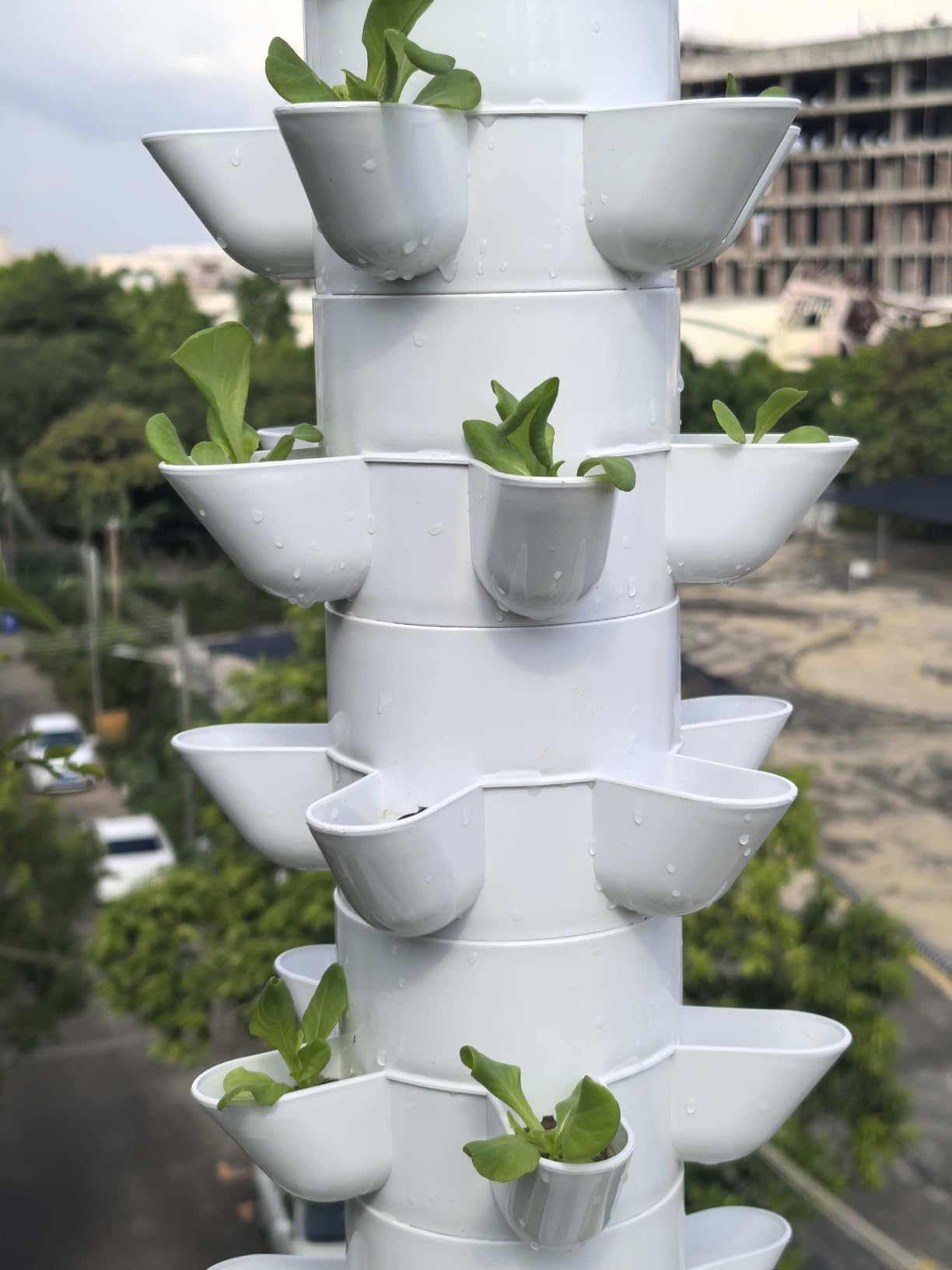
The smallest footprint in the roundup, and the one to look at if your floor space is measured in inches. Six tower sections give 30 planting positions in a 9.84 by 9.84 by 33.86 inch footprint, which is genuinely under one square foot. At just over 33 inches tall it is the only unit here that works on a counter without a step stool.
Water lives in a 10-litre tank with a level gauge on the side, and a timer-controlled pump handles circulation and oxygen delivery. It arrives largely pre-assembled, which owners consistently call out as the reason setup was quick. The base stays stable even when plants grow tall and top-heavy, and 64 growth sponges come in the box along with a filter, funnel, hose, shower cap and power adapter.
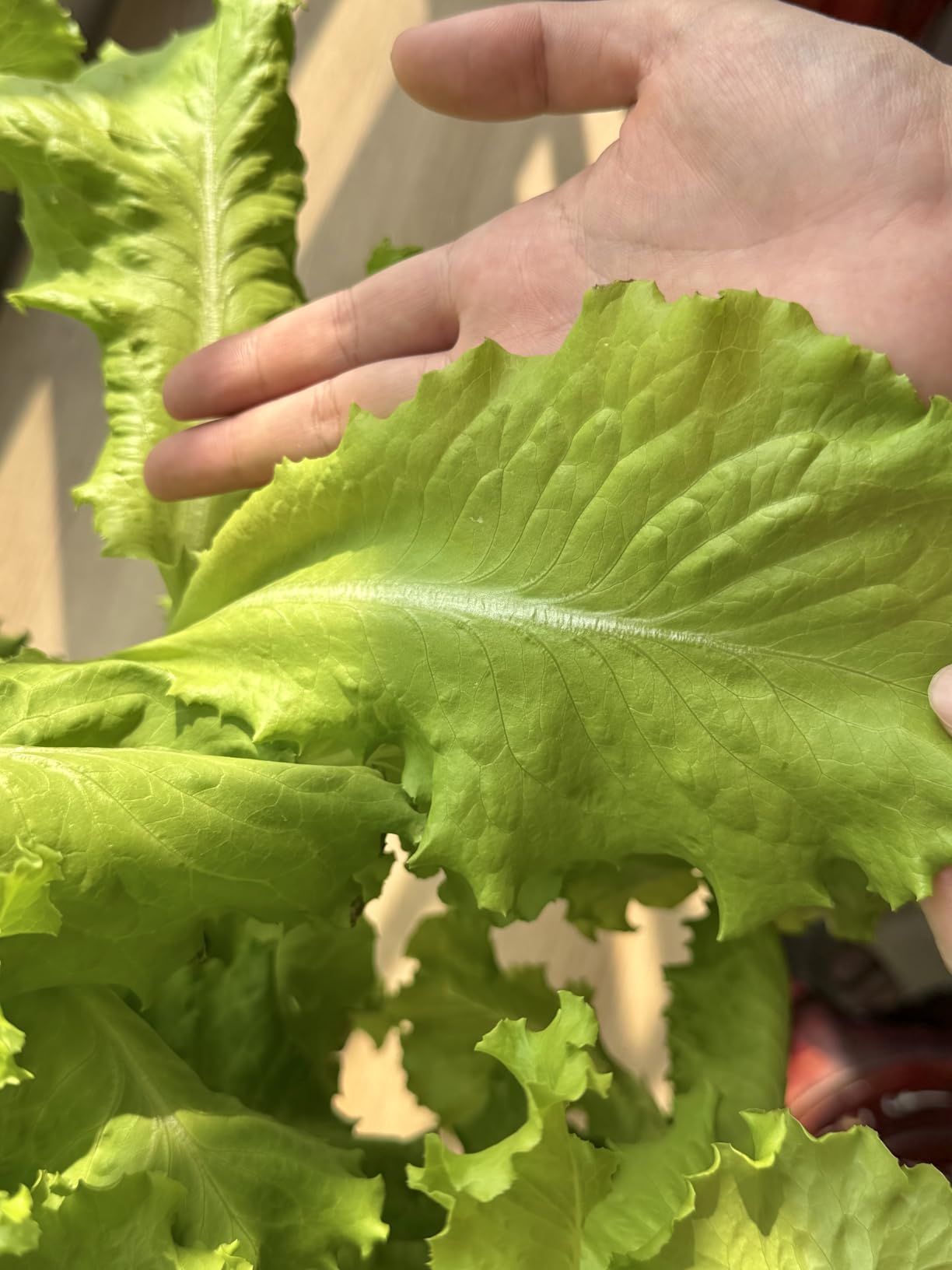
For leafy greens that is a complete footprint solution. Thirty sites of basil, lettuce, pepper and other herbs or vegetables in under a square foot beats almost any channel kit for balcony and small kitchen use. The level gauge and pump timer keep maintenance to a glance rather than a measuring session, and the listed dimensions are honest about how little room it takes.
What is missing is what you have to add. There is no grow light in the box, which means indoors it is inert until you add lighting. There are no nutrients and no seeds either, so budget for both before you start. One reviewer also questioned whether the listed plastic carries a food-grade certification, since the material is described only as plastic, and that is a fair question for anything touching an edible crop.
Who this is right for
Look at this for a balcony, a windowsill-adjacent corner, a small kitchen or a rental where nothing can be fixed to the wall. Thirty sites is enough for a steady supply of salad leaves and cooking herbs for one or two people. If you have already solved indoor lighting, this is the cheapest way to add a full recirculating footprint in this roundup.
Who should skip it
Skip it if you want everything in one box, because the light, nutrients and seeds all have to be sourced separately. It is not a nutrient film channel either, so it will not teach the NFT method. And if you plan to grow anything large, the 10-litre tank moves quickly at 30 sites and the deep tower wells suit herbs more than full-size heads.
10. SJZX 5-Layer Tower: Phone-Controlled Pump Scheduling
SJZX Hydroponics Growing System Kit, 5-Layer Hydroponic Tower, 30 Planting Holes, Space-Saving Vertical Gardening System, Suitable for Both Indoor and Outdoor use Germination Kits
30 planting holes, 5 sections
12L BPA-free tank
App-controlled smart socket
Pros
- App controls pump timing remotely
- BPA-free food grade plastic tank
- Biochar seed bases included
- Works indoors and outdoors
Cons
- Pump has no low-water shutoff
- Water level can be too shallow for seedlings
- No grow light included
- Deep wells can limit root growth
The last system is the one with the most unusual feature set. Five tower sections give 30 planting holes over a 12-litre BPA-free food grade plastic tank, and the pump plugs into a smart socket that lets you set run times and switch circulation remotely from a phone. For a grower who travels or simply forgets, that scheduling control is the main draw.
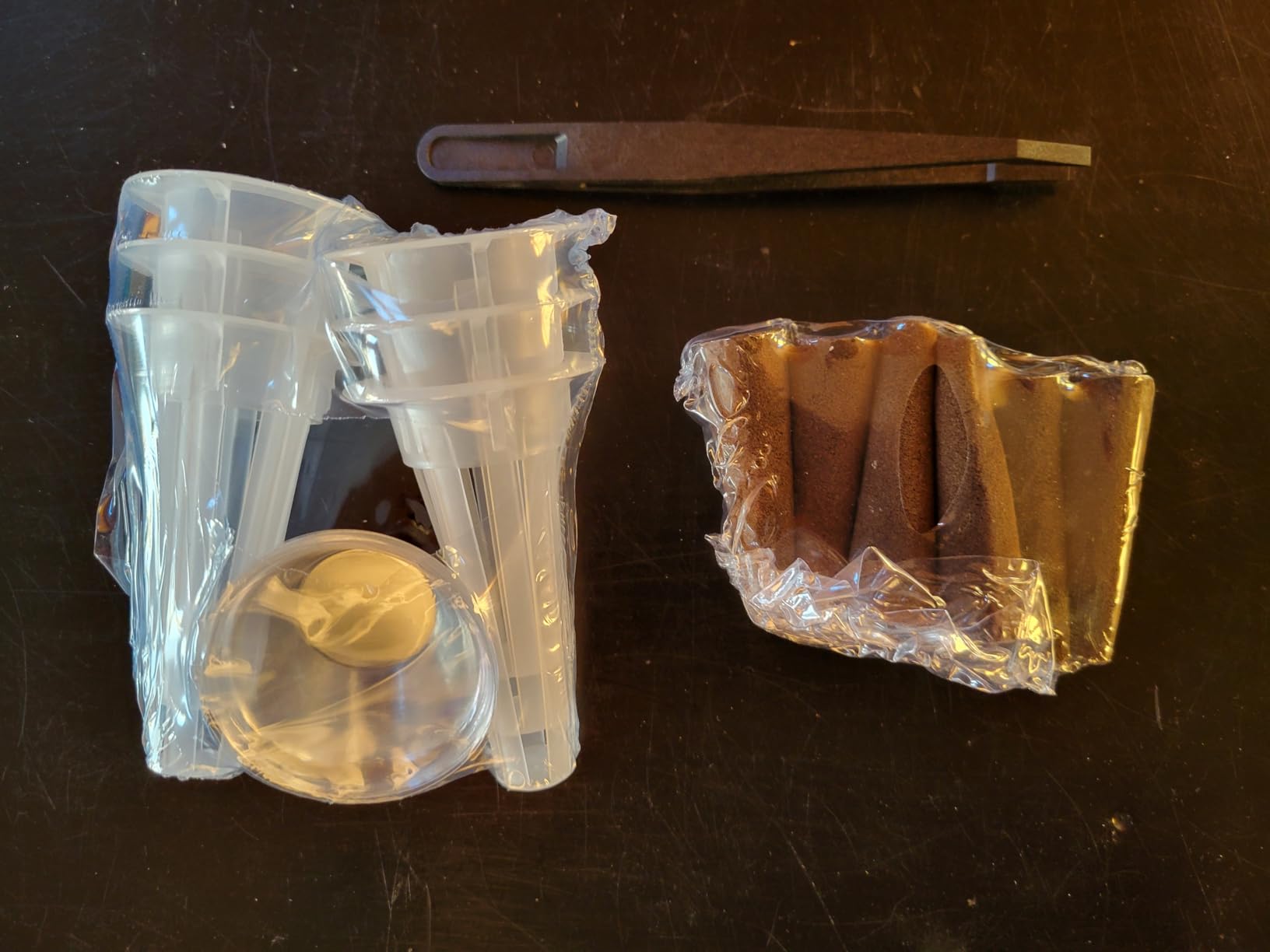
The rest of the package is well judged. Thirty biochar seed bases help germination of lettuce and herbs, and biochar is a better choice than plain sponge if you are worried about the plug rot growers report. It also includes planting baskets, filter sponges, a funnel, hose, tweezers and labels, and the manufacturer lists it as suitable for both indoor and outdoor use. The package measures 27 by 11 by 11 inches and the unit weighs 8.98 pounds.
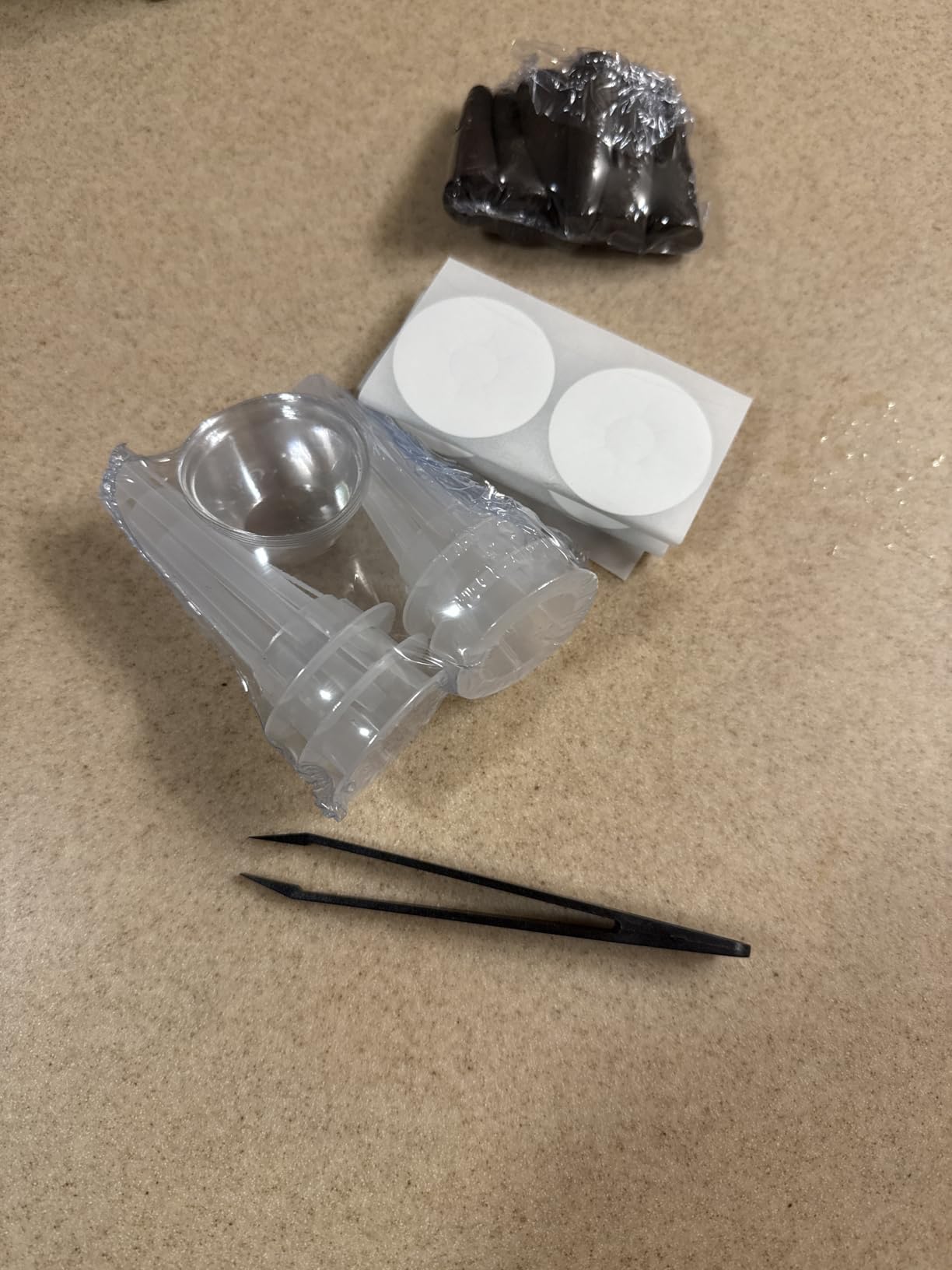
Owners like the sturdy build, noting it holds up well even inside a grow tent, and the detailed instructions make assembly straightforward. The biochar bases produce reliable lettuce and herb germination for most buyers, and the ability to move the tower between indoors and outdoors extends the season for anyone with a balcony. The app scheduling genuinely removes a daily chore.
The pump is the weak point. It has no low-water automatic shutoff, so a dry tank can burn the pump out, and a failed pump in a recirculating tower is a fast problem. Several buyers also found the water level sits too shallow for early-stage seedlings to reach it, which slows down or kills the first transplant. Deep wells can restrict root growth and limit total yield, and there is no grow light in the box.
Who this is right for
This suits growers who travel, work long shifts or simply want the pump schedule handled by a phone rather than a mechanical timer. The biochar seed bases are a genuine improvement for lettuce and herb germination, and the BPA-free food grade tank is properly specified in a way some competitors here are not. Its light weight and dual indoor-outdoor rating also make it a genuine balcony unit.
Who should skip it
Skip it if you want a system that protects itself. Without a low-water shutoff, a pump failure is a matter of when rather than if, and this roundup has a tanked tower that will not dry out as fast. There is no grow light, and if you have not already solved lighting the system cannot run indoors. Seed germination is also reported as inconsistent by a minority of buyers.
How to Choose an NFT Hydroponic System for Leafy Greens
Most buying mistakes in this category come from comparing plant-site counts. Site count tells you how many plants, not whether the roots can stay wet, fed and oxygenated for six weeks. These are the criteria that actually change results.
Match channel width to the crop head
A 2 to 4 inch channel is the usual working range for leafy greens, and the crop head size decides where inside that range you should sit. Butterhead and leaf lettuce want a narrower channel, roughly 2 inches, so the film passes over a small root mat without being displaced. Romaine grows taller and wider, so it needs the upper end of the range, and kale and Swiss choy are chunkier still. A narrow channel filled with mature roots is a clogging problem, and reduced flow is the single most reported fault in channel kits.
Decide what kind of machine you actually want
Only the VIVOSUN and GENORTH systems here are true channel nutrient film builds. Everything else is a recirculating reservoir system, whether that is a pod bench or a tower, and it grows leafy greens through a different mechanism: roots hang into aerated solution rather than running under a moving film. Both work. Pick a channel if you want the NFT method specifically, and pick a tower if you want a lit, forgiving indoor appliance.
For the towers, the same question applies between the reservoir styles. Deep water culture submerges roots in an aerated reservoir and buffers pump outages, while a tower or aeroponic arrangement showers the root zone and uses less water. Kratky needs no pump at all, which is its appeal, but it is a single-batch system that does not recirculate continuously.
Check the grow light situation before anything else
Three of the ten systems in this roundup ship with no grow light: the VIVOSUN channel kit, the GENORTH 72-site kit and both budget towers. Indoors, an unlit system is an expensive box of hardware. If you already run a proper full-spectrum light above a bench, the unlit systems are often the better value. If you do not, buy the system with lighting and skip the second purchase.
Indoor systems also carry a running cost that is easy to ignore. The Growell 90-pod draws 90 watts, the 32-pod model draws 60 watts, and tower lights run 26 to 30 watts per tier. Multiply that by a 16-hour photoperiod, seven days a week, and you get a realistic number for a monthly electricity bill before you add the circulation pump.
Size the pump correctly, not generously
This is where the most common piece of misinformation sits. NFT moves a film only a few millimetres deep, so a very small submersible pump is genuinely sufficient for a household channel run. Growers on r/Hydroponics repeatedly point out that oversizing the pump wastes money and can disturb the film. The real requirement is steady, complete flow along the full channel length back to the reservoir, not raw power.
Do check for two things instead. An anti-dry-run or low-water shutoff matters more than wattage, and a flow control valve lets you slow the return so a low pipe does not simply overflow. A pump that cannot run dry will fail at the worst possible moment, because a nutrient film system has almost no water buffer between the pump and the crop.
Give the reservoir enough buffer to survive an outage
In a true channel system, pump failure means crop failure within hours because the film disappears the moment circulation stops. A larger reservoir buys you time, and a backup pump on the shelf is cheap insurance. This is the strongest argument for the 10-gallon reservoir on the ALTO GARDEN tower and the 40-litre tank on the 90-pod Growell: not that they grow bigger plants, but that they survive a mistake.
It is worth pairing the hardware with the building around it. A garage or garden room with poor wireless coverage is a common complaint with app-controlled setups, and our [8 Best Mesh WiFi Systems](https://ffotografoshop.net/best-mesh-wifi-systems/) roundup covers how to remove dead zones before you rely on a phone to schedule a pump.
Know the parameters before you plant
Almost every failure we saw traced back to a parameter drifting rather than a broken part. For leafy greens, hold nutrient solution at pH 5.5 to 6.5 and an EC of 1.2 to 2.0 mS/cm, keep air temperature between 18 and 24C, hold relative humidity around 50 to 70 percent, and run a 14 to 18 hour photoperiod. Most greens reach harvest in 25 to 45 days, and cut-and-come-again varieties regrow for several cuts if you harvest above the crown.
Start seedlings separately. Transplant into a channel once the root system is established and the first true leaves are up; seedlings moved too early die out after starting, and that is one of the most common beginner losses. Rockwool or a solid plug holds moisture better than a bare sponge, and a foam starter that will not hold water gives you uneven germination from day one.
Recording what you do matters more than most beginners expect. If you want to film time-lapses of a channel run, the [8 Best Camera Dolly Systems](https://ffotografoshop.net/best-camera-dolly-systems-for-smooth-tracking-shots/) guide covers smooth tracking moves, and the [8 Best Camera Insert Divider Systems](https://ffotografoshop.net/best-camera-insert-divider-systems/) roundup covers framing close-up detail of roots and leaves.
Price the whole system, not the box
Divide the total cost by plant sites rather than looking at the headline number. A low-cost channel kit needs a tank, a lighting rig, nutrients and seed to become functional, and it holds around 36 sites in one layer. A 90-pod bench costs several times more but arrives with lighting, and per site it often lands lower. Add the ongoing cost of nutrients, replacement pumps, pH pens and electricity to the purchase before you decide.
Finally, decide honestly whether to build. A DIY kitchen-scale NFT build from PVC is an active trend on r/Hydroponics, and forum growers commonly pair a handful of buckets with a small pump to run mixed channels successfully. Building teaches you every failure mode because you own every part. Buying a kit is faster and takes the frame engineering and pump sizing off your hands. For a first system in a small home, either is defensible.
Common Problems With NFT Hydroponics and How to Fix Them
Almost every complaint we read in reviews and forum threads falls into one of seven buckets, and most are preventable at setup rather than diagnosed afterwards.
1. Algae clogging the lines
Algae grows anywhere light reaches water, and clear tubing is the main entry point. Growers report cheap clear channels turning green within about a month. Use light-blocking channels, cover unused planting sites, keep the reservoir lid on, and flush lines with a dilute hydrogen peroxide solution between cycles. The GENORTH kit in this roundup ships dark blue pipes and 30 hole covers specifically for this reason.
2. Low flow and stalled growth
If roots lose constant contact with the film, growth stops, and this is the most repeated complaint on channel-style kits. Check for root mats blocking the channel before anything else, confirm the pipes are actually sloped, and open the flow valve fully. A small pump is enough for a film this thin, but it does have to run continuously while plants are established.
3. Pump failure
This is the failure mode unique to NFT. A stopped pump removes the film immediately and a channel system has no water buffer, so a crop can be lost in a single day. Choose a pump with a dry-run or low-water cutoff, keep a spare of the same model, and size the reservoir large enough to give you time to react. Controllers with app scheduling help, but they do not replace a backup.
4. Root rot
Root rot looks like roots turning brown, then slimy, then stringy, with a distinct smell. It comes from low oxygen, warm water and stagnant zones, not from the crop itself. Hold water temperature down, keep the pump running continuously, avoid dead water pockets in the channel, and clean between cycles. Do not add corrective chemicals to a channel that is already low on flow, because the flow is the actual problem.
5. Clogged channels
Mature roots fill a narrow channel, the film stops passing, and the far end floods. The fix is spacing plants to match the channel width, harvesting before root mats mat together, and cleaning the channel on a schedule rather than when it fails. In the towers, the same idea shows up as deep wells restricting root volume, which is why larger baskets tend to produce more reliable results.
6. pH and EC drift
Nutrient uptake changes pH as plants grow, so a system that started at the right reading will drift within a week or two. Check pH and EC two to three times a week rather than once, top up with plain water rather than nutrient solution, and change the solution rather than dosing an old batch repeatedly. A digital pH pen is not optional equipment at any price bracket.
7. Seedling loss and plug rot
Seedlings transplanted too early die out after starting, which wastes a whole tray before anything goes wrong later. Grow them in a separate propagation tray or the unit’s own germination mode, transplant once roots are established, and use sterile medium. Rockwool and biochar bases have fewer rot complaints than bare foam sponges, and a sponge that will not hold water gives patchy germination.
One last practical note: if a fault is inside a wall, duct or pipe rather than in the grow area, a camera is faster than a spanner. Our [8 Best Drain Camera Inspection Systems](https://ffotografoshop.net/best-drain-camera-inspection-systems/) roundup covers the small rigs that settle most of those questions in an afternoon.
Frequently Asked Questions
Can lettuce be grown in an NFT system?
Yes. Lettuce is the single best crop for NFT because its roots are shallow and it grows fast, which matches the thin nutrient film perfectly. Butterhead and leaf lettuce suit narrower channels around 2 inches, while romaine needs closer to 4 inches. Growers typically see a first harvest between 25 and 45 days, and cut-and-come-again varieties regrow for several cuts.
Which is better, NFT or DWC?
It depends on your tolerance for risk. NFT uses far less water and grows faster, but a pump failure can kill a crop within hours because there is no water buffer. Deep water culture submerges roots in an aerated reservoir, so a short outage is survivable. Choose NFT for efficiency and fast turnover, and DWC if you want a more forgiving system or a larger, heavier root mass.
What are the best plants to grow in NFT hydroponics?
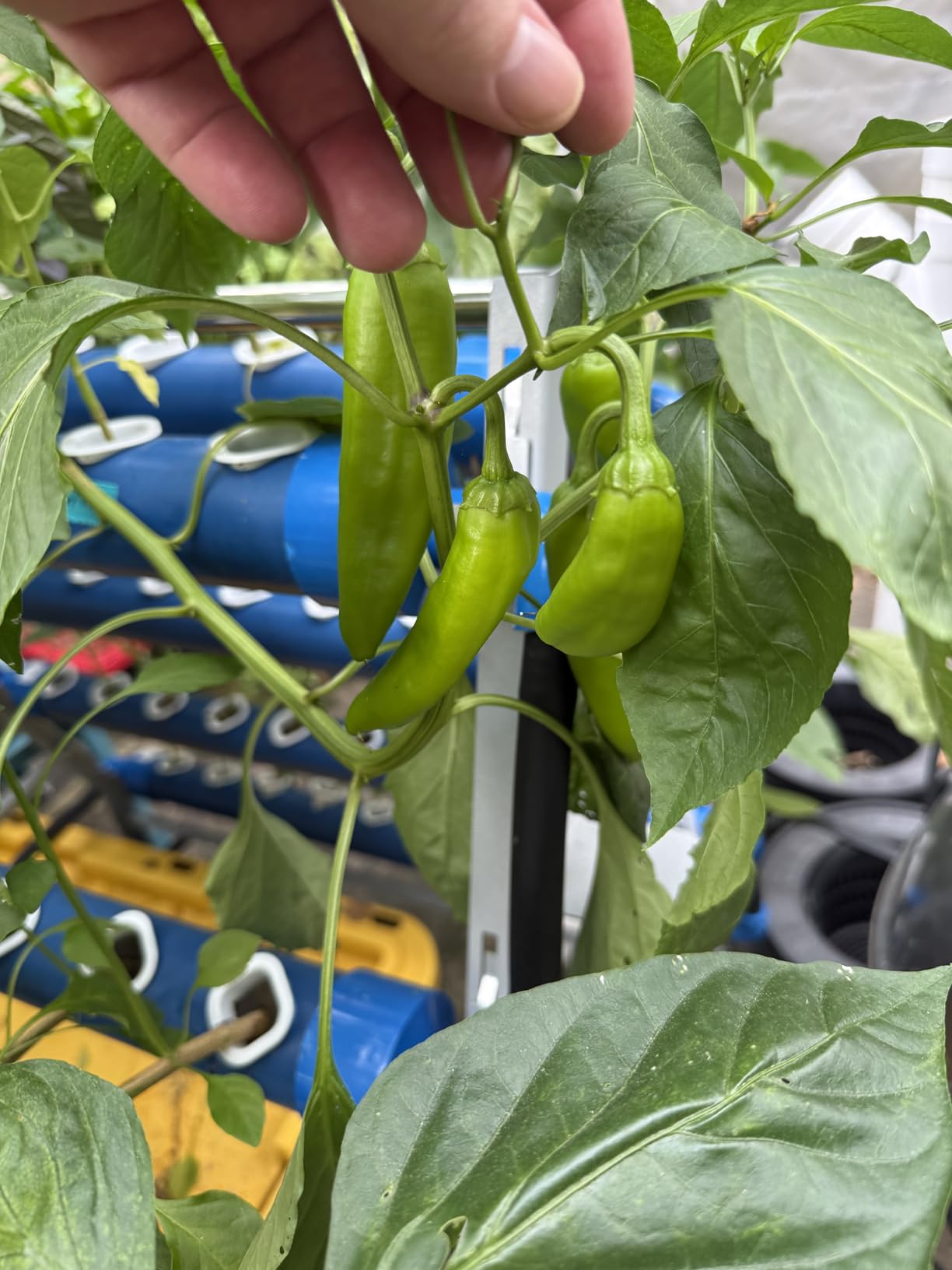
The ranking starts with lettuce, then spinach, kale, bok choy, arugula, basil, mint, cilantro and Swiss chard. All have shallow root systems and fast turnover, which is what a thin nutrient film supports. You can also grow strawberries and certain other shallow-rooted crops. Avoid tomatoes, cucumbers and peppers, which need deep root zones and heavy fruiting.
What are common problems with NFT hydroponics?
The recurring issues are algae in clear tubing, low flow from root mats blocking the channel, pump failure, root rot in warm stagnant water, clogged channels from mature roots, and pH drift as plants grow. Nearly all of them trace back to light reaching the water, insufficient circulation, or parameters left unchecked for too long between cycles.
Do NFT hydroponic systems need a grow light?
Outdoors in full sun, no. Indoors, yes, and this is where many buyers go wrong. Several channel kits and budget towers ship with no light at all, which makes them unusable until you add one. If you already run a full-spectrum light above a bench, an unlit channel kit is good value. If you do not, buy a system that includes lighting and avoid a second purchase.
What are three plants that are not recommended for hydroponics?
Tomatoes, cucumbers and peppers are the three to avoid in NFT channels. All three develop deep, heavy root systems that fill a narrow channel and block flow, and all three need substantial support and fruiting nutrition. Peppers also occupy far more root volume than a leafy green bed allows. Large fruiting crops suit Dutch buckets or drip systems instead.
Which NFT Hydroponic System Should You Buy?
For a genuine nutrient film channel you can scale, the VIVOSUN 36-site kit is the pick. It is the only true channel system in this group with a large body of owner feedback, and sloping the pipes yourself is an hour’s work that makes it perform as named.
For a lit indoor garden with a large plant count, the DRYADES 81-pod tower covers the most ground per footprint. For the most complete first-time package, the ALTO GARDEN tower ships with nutrients, rockwool and a pH pen. If you already have lighting, the GENORTH 72-site kit gives you the cleanest channel design with light-blocking pipes and hole covers included.
Whatever you choose, check the pump and the light before you buy, because in NFT those two parts decide whether your harvest happens. Use the buttons on each system to check current availability and details.