
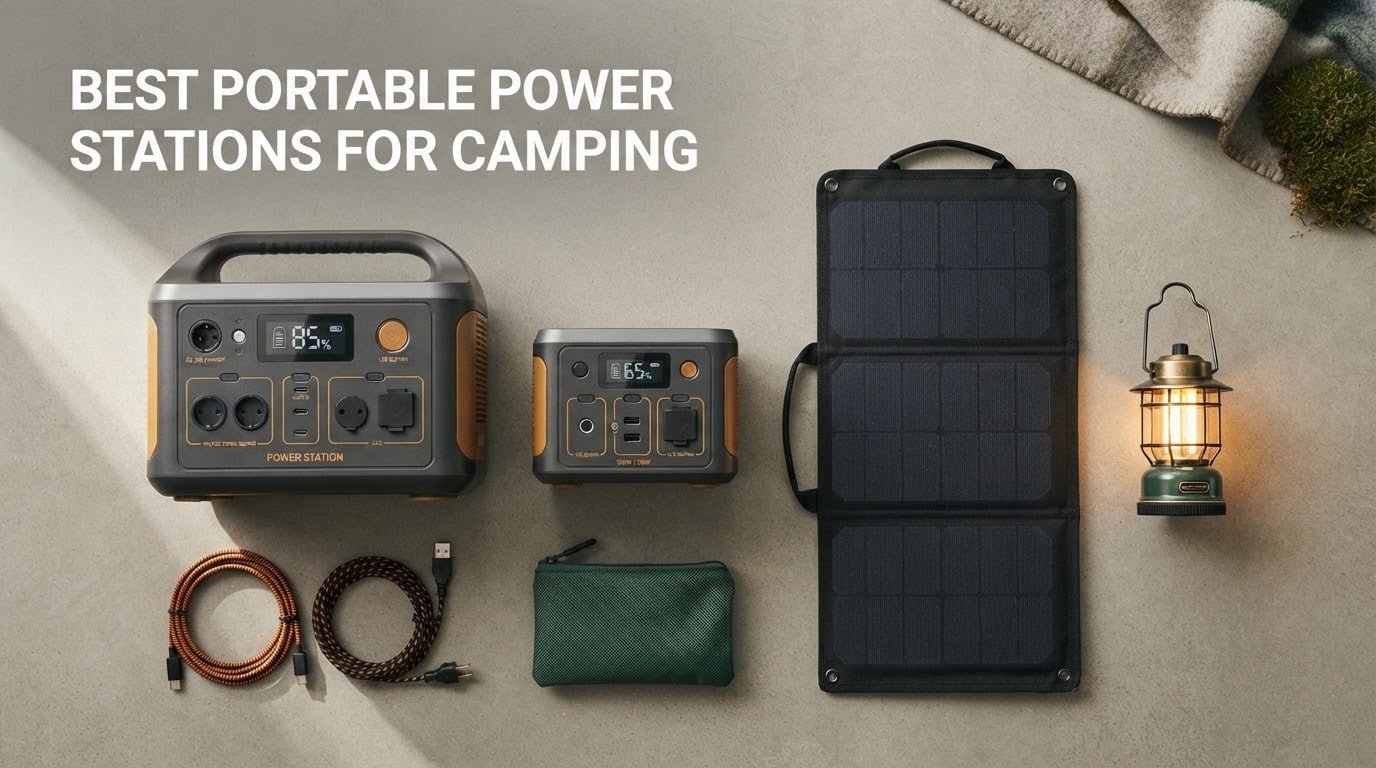
The Jackery Explorer 300 is the best portable power station for most camping trips in 2026, because 292Wh, a 300W continuous output and a 7.1 lb body cover phones, camera batteries, a laptop and a CPAP machine without turning into a 30 lb chore. Most campers never need more than that, and a 1kWh unit covers the majority of setups that also run a compressor fridge.
What actually decides this purchase is capacity in watt-hours, not the headline wattage on the box. Watts tell you what you can switch on at once; watt-hours tell you how long it stays on. Get those two numbers mismatched and you either carry 40 lb you never use, or you kill your fridge at 2am on the second night.
We went through ten current units and compared capacity, continuous and surge output, solar input, weight, port mix, battery chemistry and warranty. Our general portable power station roundup covers the whole category, and our picks for camera and lighting setups cover the lighter end. This list is the camping-specific version, weighted toward fridges, medical gear and bad weather.
Table of Contents
Top 3 Picks for Portable Power Stations for Camping (October 2026)

Jackery Explorer 300
- 292Wh capacity
- 300W continuous output
- 7.1 lb weight
- 4000+ cycle LiFePO4 battery

Jackery Explorer 1000 v2
- 1070Wh capacity
- 1500W continuous
- 3000W surge
- 3 pure sine wave outlets

Anker SOLIX C1000 Gen 2
- 1024Wh capacity
- 2000W continuous output
- 49 minute recharge
- 600W solar input
Best Portable Power Stations for Camping (October 2026)
Capacity, output and weight are the three numbers that decide compatibility with your camp. This is the whole shortlist in one table.
| Product | Specifications | Action |
|---|---|---|
| Jackery Explorer 300 |
|
Check Latest Price |
 EF ECOFLOW RIVER 2 EF ECOFLOW RIVER 2 |
|
Check Latest Price |
| Jackery Explorer 1000 v2 |
|
Check Latest Price |
 BLUETTI AC180 BLUETTI AC180 |
|
Check Latest Price |
 ALLWEI 300W ALLWEI 300W |
|
Check Latest Price |
 Anker SOLIX C300 Anker SOLIX C300 |
|
Check Latest Price |
| Anker SOLIX C1000 Gen 2 |
|
Check Latest Price |
 OUPES Mega 1 OUPES Mega 1 |
|
Check Latest Price |
 EF ECOFLOW Delta 3 Classic EF ECOFLOW Delta 3 Classic |
|
Check Latest Price |
 BLUETTI Elite 100 V2 BLUETTI Elite 100 V2 |
|
Check Latest Price |
1. Jackery Explorer 300 – the proven lightweight pick
Jackery Explorer 300 Portable Power Station,292Wh
292Wh
300W continuous
600W surge
7.1 lbs
4000+ cycle LiFePO4
Pros
- Only 7.1 lb with a real 292Wh capacity
- 4000+ cycles before 70 percent capacity
- 100W USB-C PD plus two AC outlets
- 80 percent solar charge in about 2.8 hours
Cons
- 292Wh cannot carry a compressor fridge overnight
- AC overload trips need a manual restart
- Solar charging is locked to Jackery panels
This is the highest-volume model in the category, with 11273 reviews at a 4.6 average. That matters more than any spec line, because a design this widely owned has been through rain, sand, two years of storage and a thousand camping trips already.
Is 292Wh really enough for a weekend?
What 292Wh actually buys you is roughly a full day of small electronics. Two USB-C phone charges, a couple of camera battery refills, a laptop top-up, or a CPAP machine running overnight with the light off. Two AC outlets, two USB-A ports, a 100W USB-C PD port and a 120W car port cover the standard camp load.
Where the lightweight trade-off bites
Two things catch people out. Anything above 300W on AC trips the inverter, and you have to switch it back on by hand rather than have it recover. Solar input only accepts Jackery-branded panels, so a generic 100W foldable from another brand may do nothing at all. The box holds an AC adapter, a car charging cable and a user guide, and no panel, which is normal across this whole category.
Owners consistently treat the roughly 7 lb weight as the deciding factor for hikes and pack-in trips, and it holds charge well over a long trip. For cameras and location work specifically, our power station picks for location shoots go deeper on runtime math.
2. EF ECOFLOW RIVER 2 – fastest recharge in the small class
EF ECOFLOW Portable Power Station RIVER 2, 256Wh 300W
256Wh
300W rated
600W surge
7.7 lbs
Full AC recharge in 1 hour
Pros
- Full AC recharge in one hour via X-Stream
- 7.7 lb with a built-in handle
- 3000+ cycle LiFePO4 cells
- Pass-through charging while devices run
Cons
- 300W AC ceiling rules out coffee makers and heaters
- Only one USB-C port
- Some owners report drifting battery gauge
The RIVER 2 does one thing better than anything else its size: it refills from a wall outlet in a single hour. That single spec changes trip planning, because you can top it up during a lunch stop instead of planning an overnight recharge.
X-Boost lifts the 300W rated output to 600W for resistive loads, which is useful for a small kettle or a travel kettle. EPS mode switches in under 30ms, so it can sit between a battery and a router without a visible dropout.
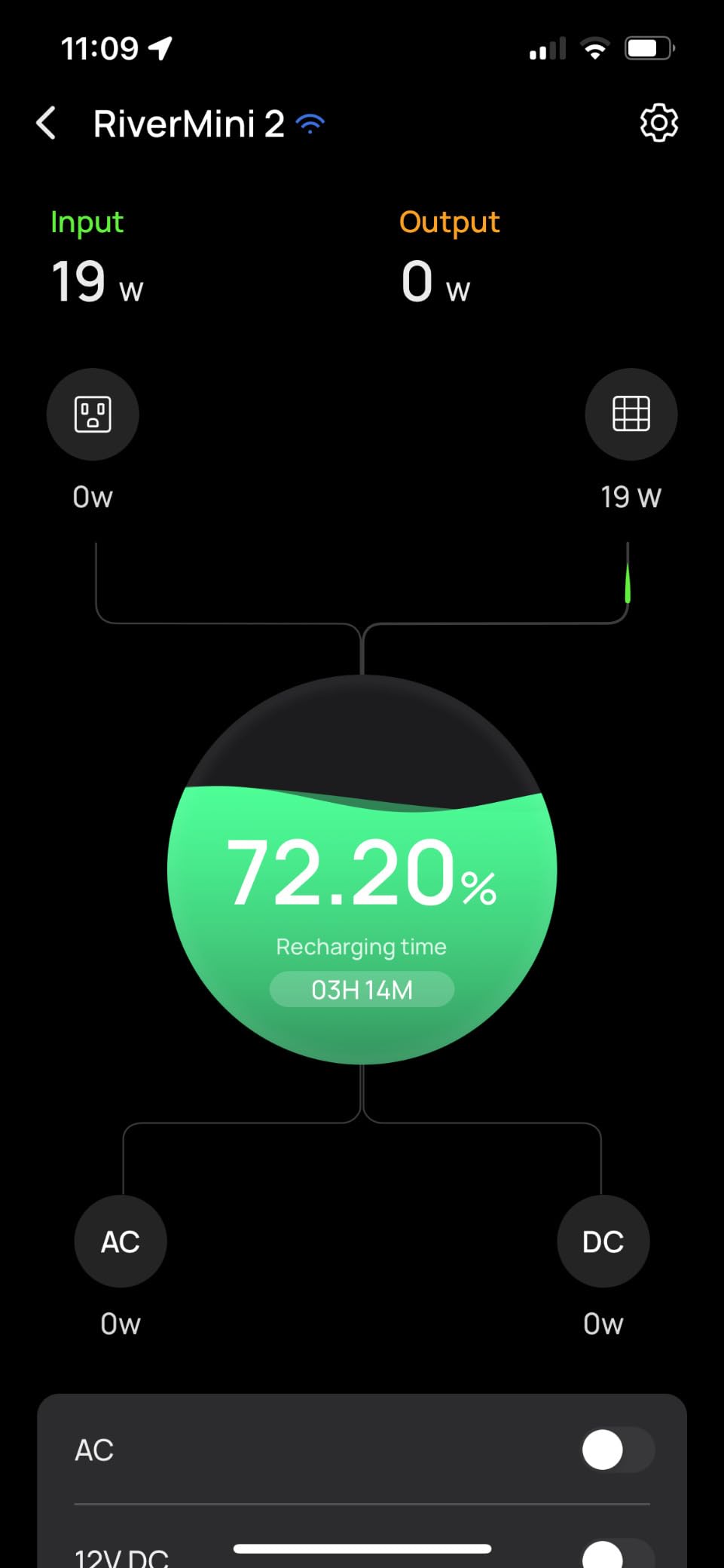
The rating here is 4.3 across 4530 reviews, the lowest average in our group, and the reason is worth reading. Some owners report a charge display that drifts from reality, plus a smaller group who say their unit stopped holding charge earlier than the 3000-cycle rating suggests. That is a real durability split, not a rounding error.
Solar input tops out at 110W, which is fine for a weekend top-up and slow for anything longer.
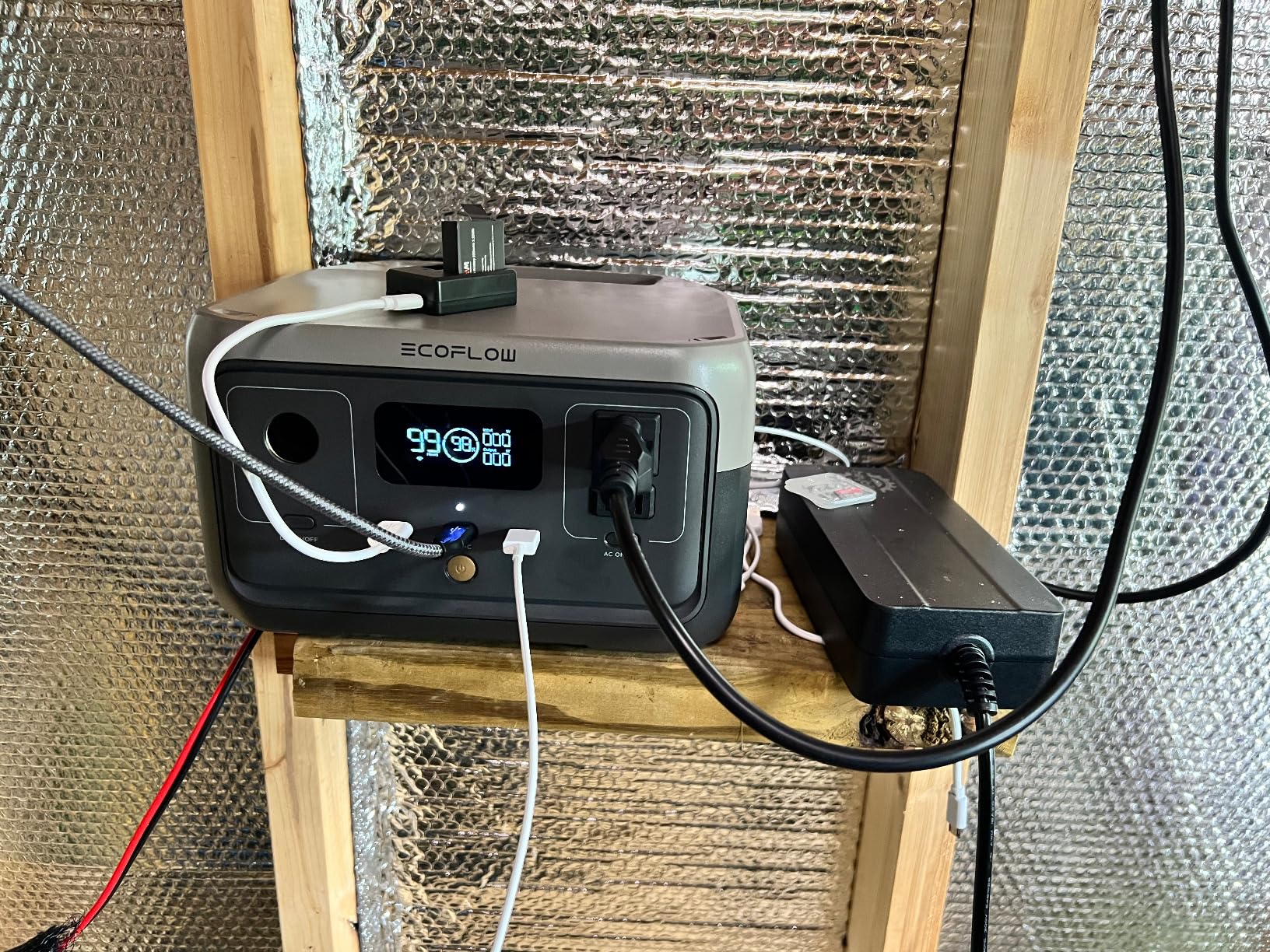
Is the one-hour recharge worth the trade-offs?
For weekend car camping where you drive through a mains-powered site nightly, yes. You effectively refill overnight and never think about solar. For a van buildout where the unit lives on solar alone, the 110W ceiling is the number that matters and it is unremarkable.
Who should pass on it
Anyone whose load is above 300W, and anyone sensitive to a single USB-C port when a laptop and earbuds both need power. For high-draw medical or tool use, the Jackery 1000 v2 in the next section has far more headroom.
3. Jackery Explorer 1000 v2 – for a fridge and a CPAP
Jackery Explorer 1000 v2 Portable Power Station,1070Wh,1500W
1070Wh
1500W continuous
3000W surge
23.8 lbs
7 outlets
Pros
- 1500W continuous and 3000W surge for fridges and pots
- Only 23.8 lb for a 1 kWh class
- Optional 1 hour emergency charge from the app
- 70 percent capacity retained past 4000 cycles
Cons
- 1 hour fast charge must be enabled in the app each time
- Solar input limited to Jackery panels
- Box contains only a user manual
This is the version of the category that most campers should be looking at. 1070Wh covers a compressor fridge cycling all night, a CPAP machine, lights and phone charging without anyone rationing anything, and 1500W continuous means an electric pot or a small kettle is not a negotiation.
The weight figure is the surprise. At 23.8 lb it sits at the light end of the 1 kWh class, with a foldable handle, and that is roughly 13 lb less than the BLUETTI AC180 further down this list. Three pure sine wave AC outlets plus two USB-C PD ports, one USB-A and a car port give you seven outlets.
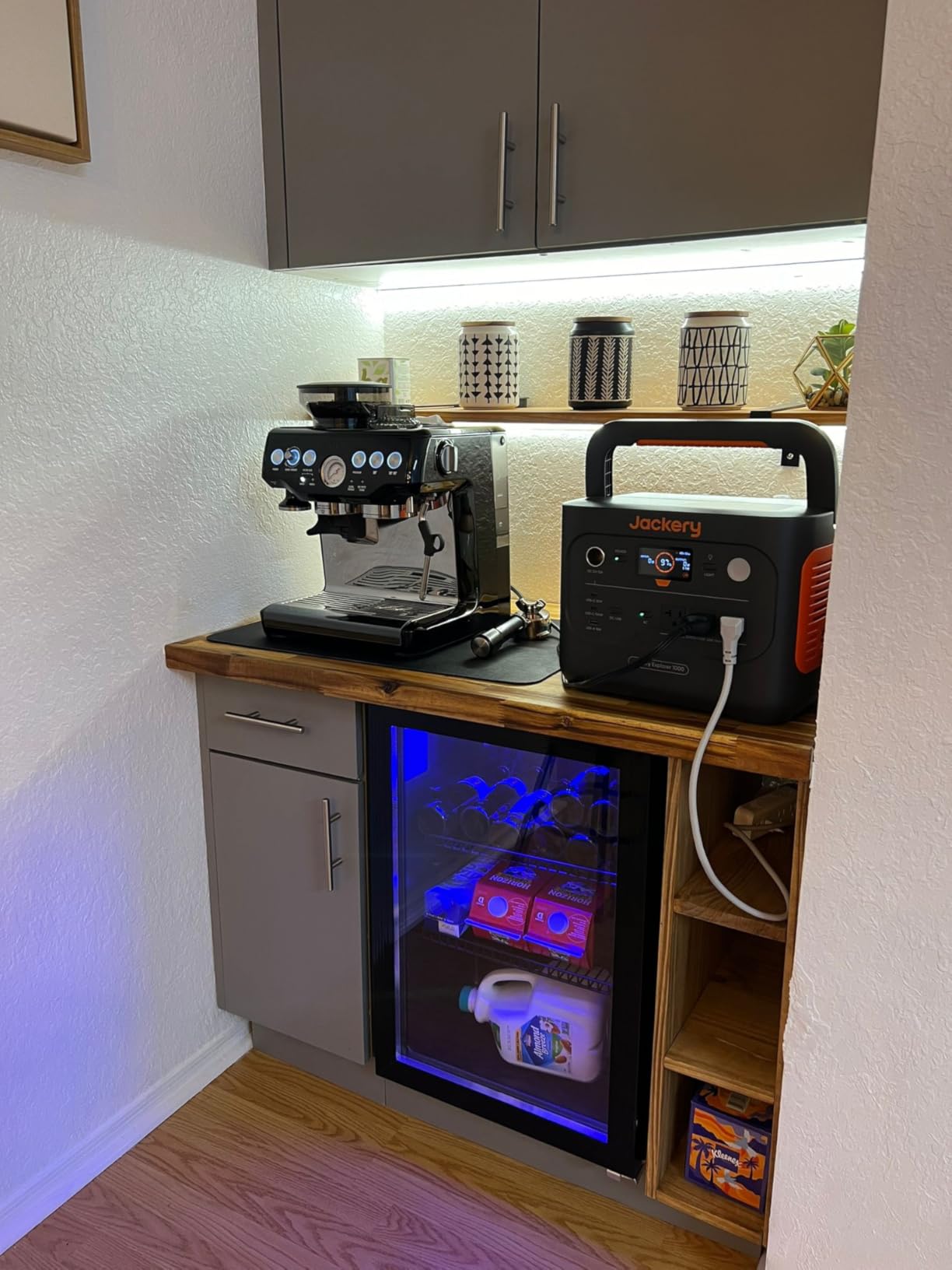
Three pure sine wave outlets matter more than most buyers realise. Modified sine wave output makes fans and some medical devices run warm and louder; pure sine wave is the safe default for anything with a motor or a compressor.
Charge time is the one thing to understand before you leave. It goes 0-100 percent in one hour, but only if you turn emergency charging on in the app. The default is 1.7 hours to protect long-term battery health, which is the right trade for a machine you expect to own for a decade.
There is a 30dB quiet overnight mode in the same app, and ChargeShield 2.0 manages the charging curve. Reviewers consistently praise the balance of output against weight. The complaints are predictable: Jackery-only solar panels, and a fast-charge mode you have to remember to enable.
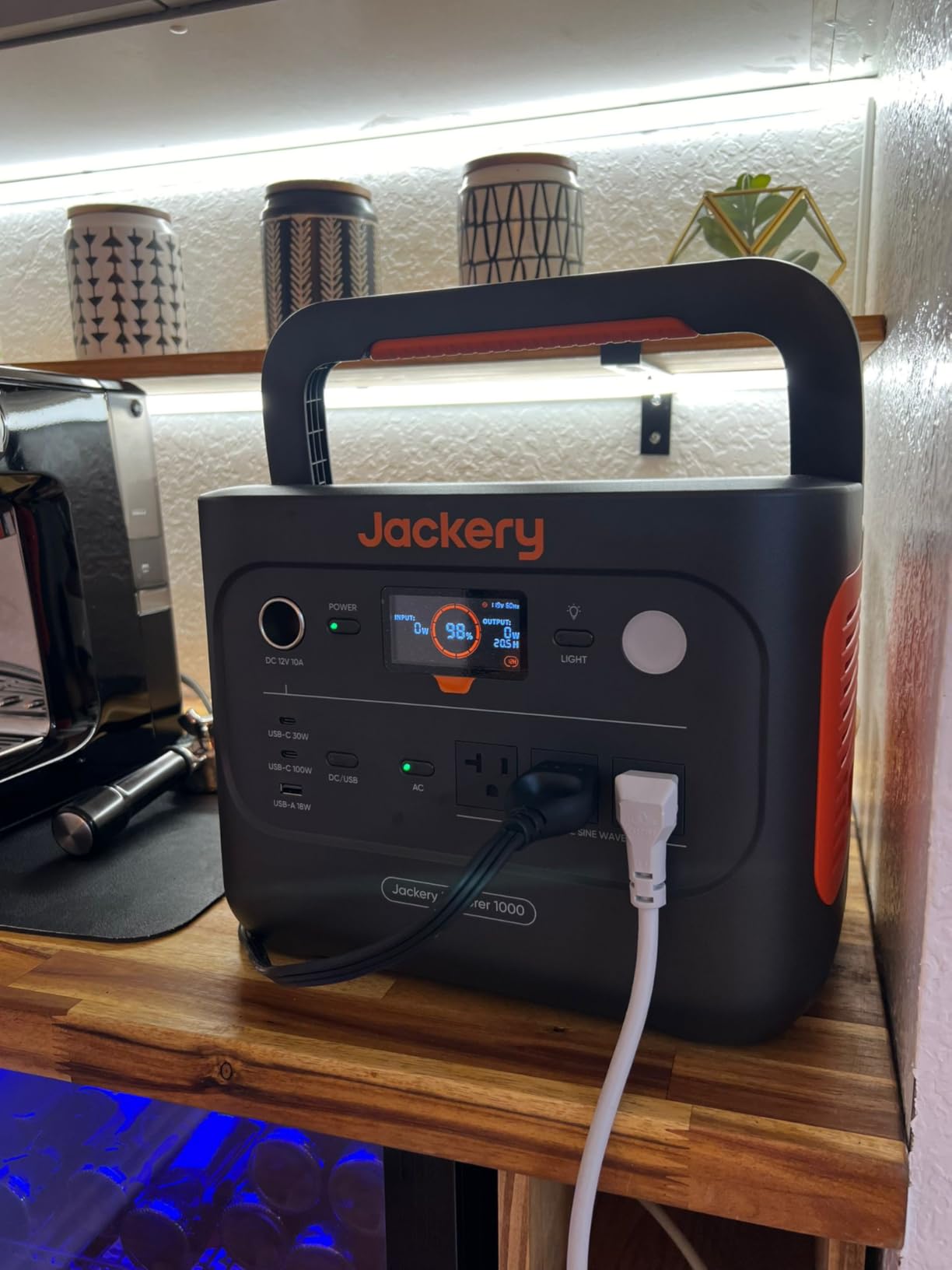
How long does the 1070Wh class really last?
For a typical weekend load – a 45W fridge compressor duty-cycled, a 40W CPAP, one LED lantern and two phone charges – you get two full nights with charge to spare on the third morning. A single 60W laptop workload eats roughly 14 hours of pure inverter time, less once conversion losses are counted.
Where it falls short
If you plan to add expansion batteries or run more than a couple of large panels, this Jackery-branded ecosystem narrows your options. It also has no included cables at all, so budget a spare set for the vehicle.
4. BLUETTI AC180 – the 1kWh workhorse with 500W solar
BLUETTI AC180 Portable Power Station 1152Wh 1800W LiFePO4 Solar Generator
1152Wh
1800W output
2700W app boost
37.4 lbs
500W solar input
Pros
- Full charge in about 1 hour at 1440W AC input
- 500W solar input for a 3 hour solar refill
- Under 20ms UPS transfer for home backup
- 8 outlets including a wireless charging pad
Cons
- Heaviest option here at 37.4 lbs
- Wireless pad often fails to hold a phone
- About 20W idle draw cuts usable capacity
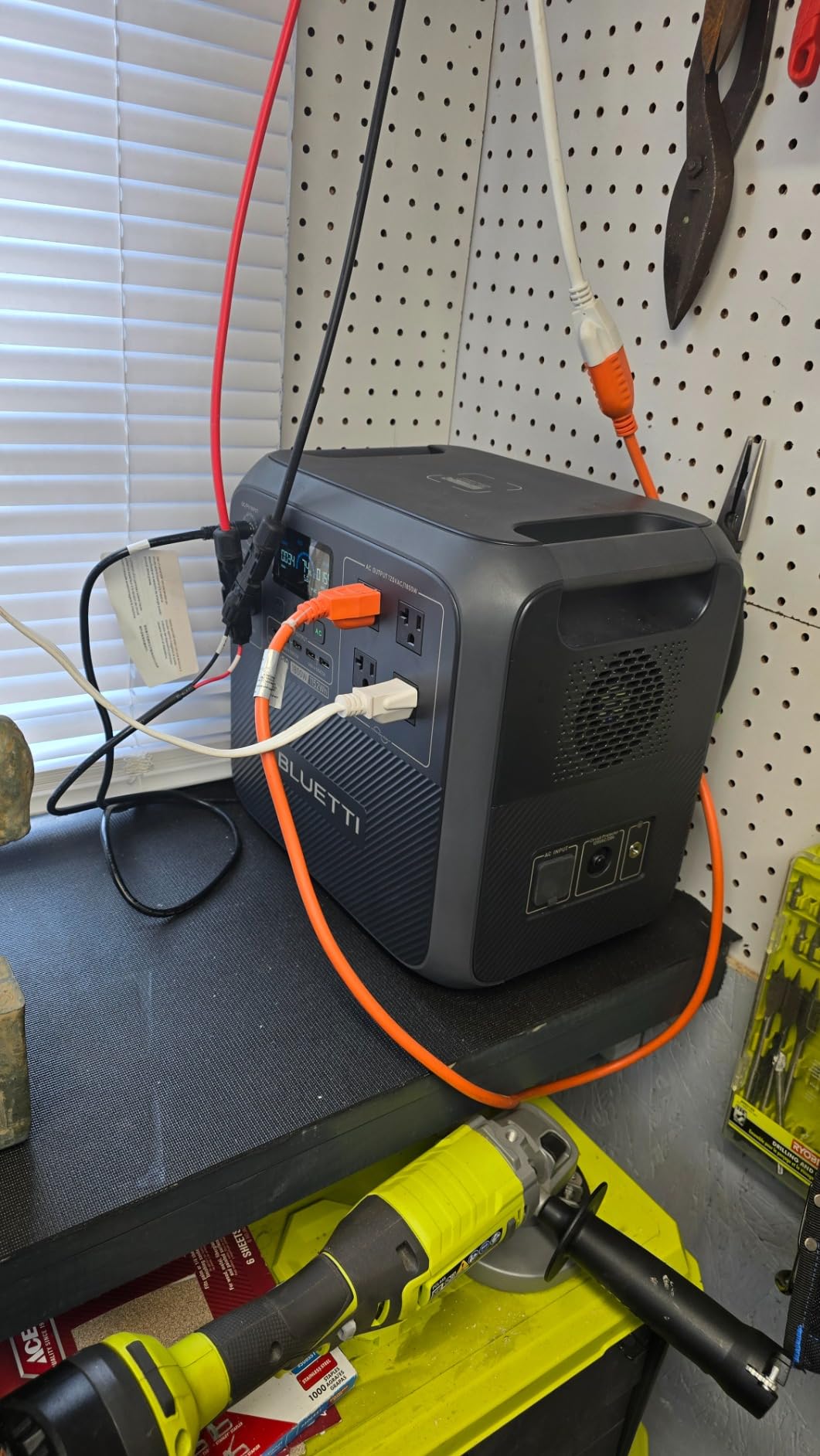
The AC180 is the pick when solar throughput matters as much as capacity. A 500W solar input recharges it in roughly three hours, which no other unit on this list matches, and 1152Wh sits at the top of the 1 kWh band.
Eight outlets cover AC, USB-C, USB-A, car port and a wireless charging pad on the top surface. The app can boost 1800W output to 2700W for loads that need a push. Full recharge on AC takes about an hour at 1440W input.
The weight is the dealbreaker for some people. At 37.4 lb this is the heaviest model here, and getting it from the car to the picnic table is a two-person job or a cart.
Two practical findings from reviews. Idle self-consumption runs around 20W with the inverter on, so usable capacity is meaningfully below the 1152Wh nameplate over a long trip. Outlets must be enabled by pressing the right AC or DC button first, which trips up nearly every first-time user. On the positive side, owners who hit a calibration issue report BLUETTI support sorting it with firmware updates and a free exchange.
Is the weight a problem at a normal campsite?
For car camping at a drive-in site, no. You unload once and the unit lives under the awning. For anything where you carry it more than 100 yards, yes – the BLUETTI Elite 100 V2 later on does the same job 12 lb lighter.
Who this suits
Campers with a large solar budget, people running a home backup circuit alongside a trip, and anyone who wants a 5-year warranty with proven after-sales support.
5. ALLWEI 300W – the budget pick that runs CPAP all weekend
ALLWEI Portable Power Station 300W, 256Wh Solar Generator LiFePO4 Battery
256Wh
300W continuous
600W surge
6.4 lbs
6 output ports
Pros
- Lowest cost here with LiFePO4 cells rated 3000 cycles
- Lightest and smallest at 6.4 lb
- Pure sine wave output owners use for CPAP machines
- Display shows remaining time and exact percentage
Cons
- Only one AC outlet so no two AC loads
- No 24V output for RV users
- Solar input capped below larger panel capability
At 256Wh and 300W this does not sound like much, yet it is the cheapest way on this list to get LiFePO4 chemistry, pure sine wave output and a 3000-cycle rating. The clinical use case people describe is a CPAP machine running through several nights, which fits inside 256Wh if you keep everything else off.
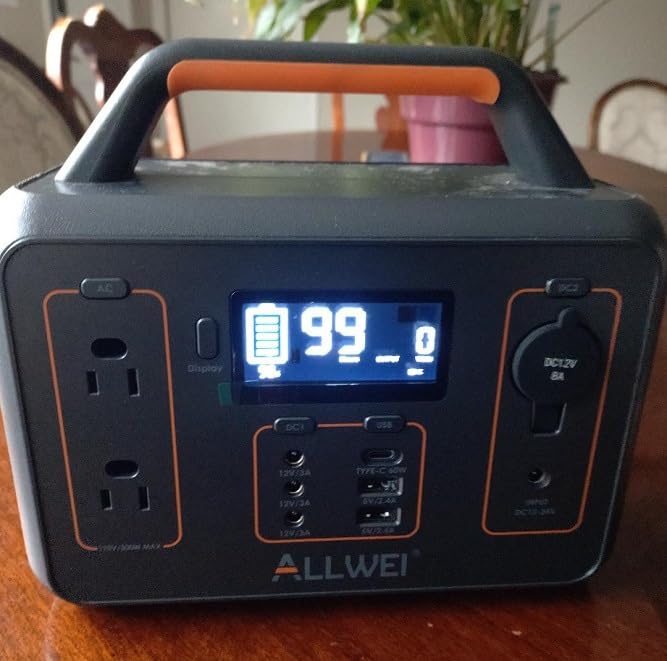
Six outputs: one AC outlet, two DC5521 ports, a car socket, an 18W USB-A and a 60W USB-C PD. Recharge runs 3.5-4 hours from a wall or a car, 4-5 hours on a 100W panel, and 2-2.5 hours when you combine AC and solar through the built-in MPPT controller.
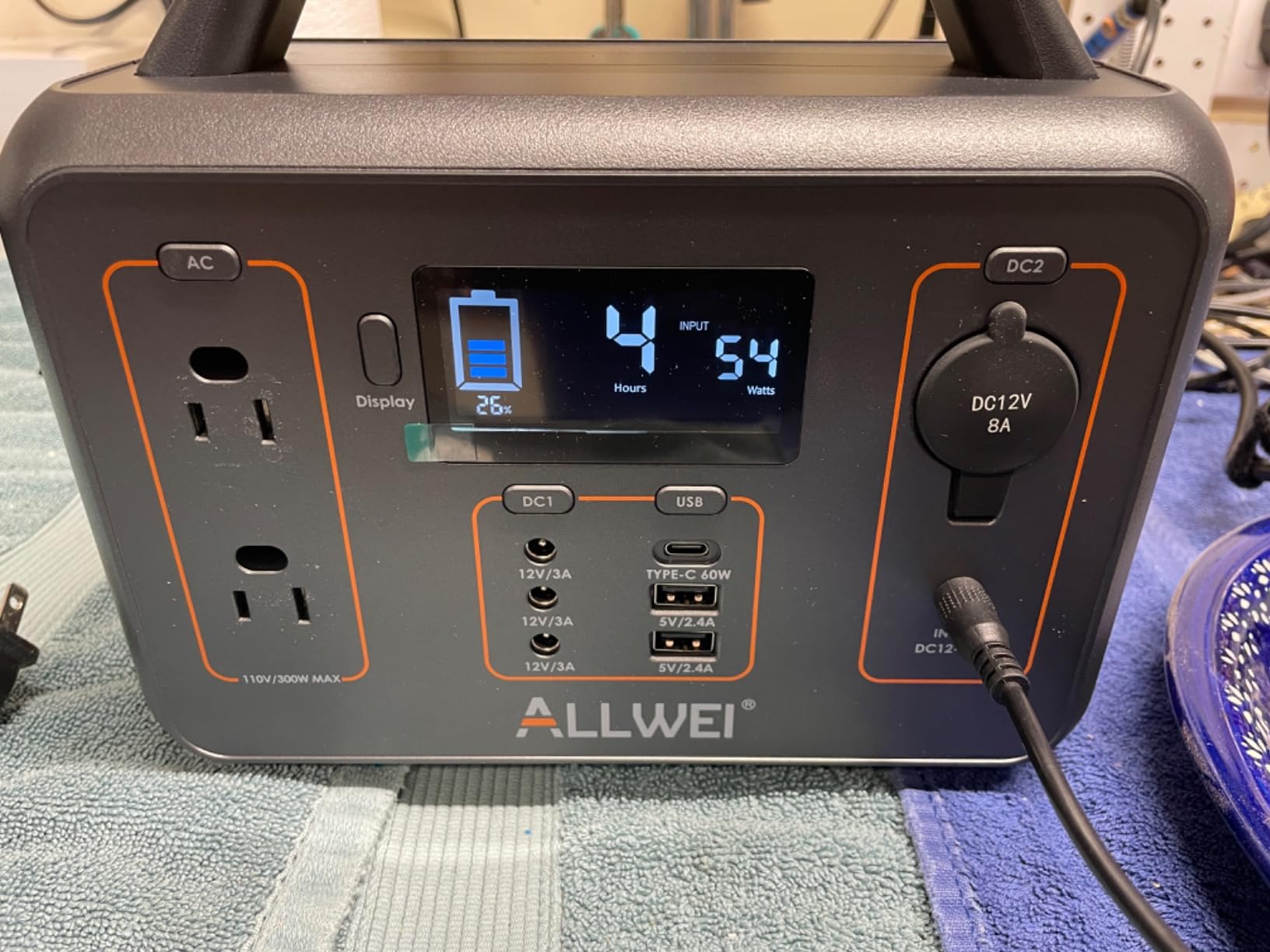
It weighs 6.4 lb, the lightest here, and has a three-level LED light with an SOS mode that earns its place.
The one AC outlet is the structural limit. You cannot run a fridge and a CPAP at the same time from AC, though the DC ports cover small items. There is also an 8 percent one-star share across 2450 reviews, driven mostly by durability complaints from owners who kept theirs past a year, plus one report of a car tip running hot at sustained input.
Is a budget 256Wh unit safe for medical gear?
Pure sine wave output is the right start, and 3000-cycle LiFePO4 cells behave predictably. For a CPAP, keep a backup battery and confirm your machine’s power supply tolerates the inverter. For anything life-critical, we would not lean on a single budget box as the only source.
When to spend more instead
Buy the Explorer 300 or RIVER 2 instead if you want two AC outlets and a wider port mix. The saving here is real, but the single-outlet layout shapes how you camp.
6. Anker SOLIX C300 – premium ultralight with fast USB-C
Anker SOLIX C300 Portable Power Station, 288Wh Solar Generator for Camping
288Wh
300W continuous
600W surge
9.1 lbs
25dB at 3.3 ft
Pros
- Two 140W two-way USB-C ports that fast-charge laptops
- 80 percent recharge in about 50 minutes
- Quiet at 25dB measured from 3.3 ft
- Compact body roughly 15 percent smaller than rivals
Cons
- Shoulder strap sold separately
- Only select Anker panels supported for solar
- 300W is a shared ceiling across all AC outlets
The C300 is the one small unit where the port layout genuinely beats the others. Two 140W two-way USB-C ports mean a laptop charges at full speed and a phone charges fast at the same time, which no competitor in this class offers.
Eight ports in total: three AC outlets, a 120W car socket, two 140W USB-C ports, one 15W USB-C and one 12W USB-A. It reaches 80 percent from a wall in about 50 minutes.
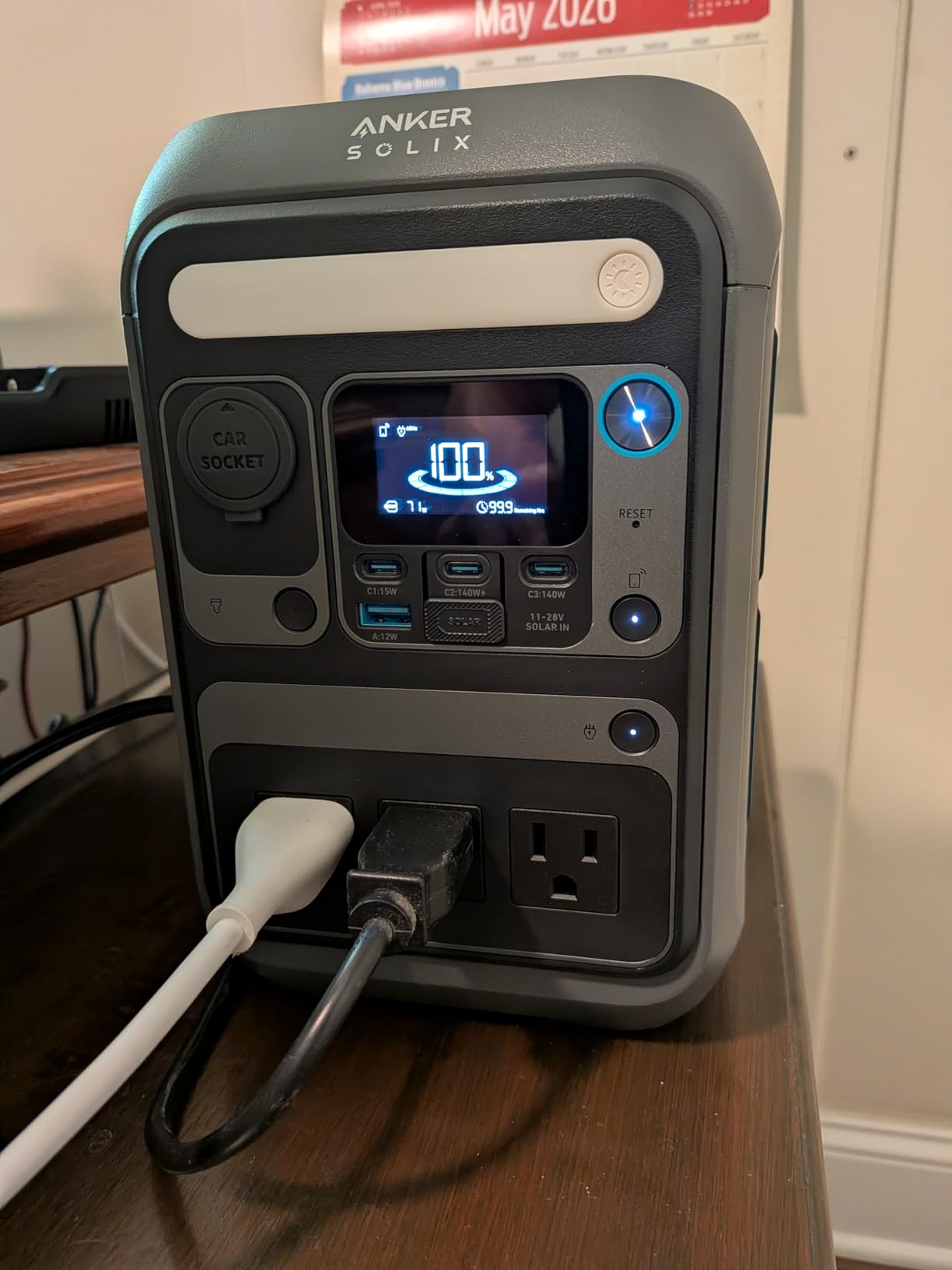
At 25dB measured from 3.3 ft, it is the quietest figure any manufacturer publishes on this list, and 288Wh is slightly more than the Jackery 300 in the same weight bracket at 9.1 lb.
Two limitations. The 300W AC rating is shared across all three outlets, so you cannot run two high-draw appliances at once. And solar works only with 100W and 60W Anker panels – the PS30, PS200 and PS400 are excluded.
The shoulder strap is not in the box, which is the complaint reviewers mention most often. Plan on a separate strap or just use the built-in handle.
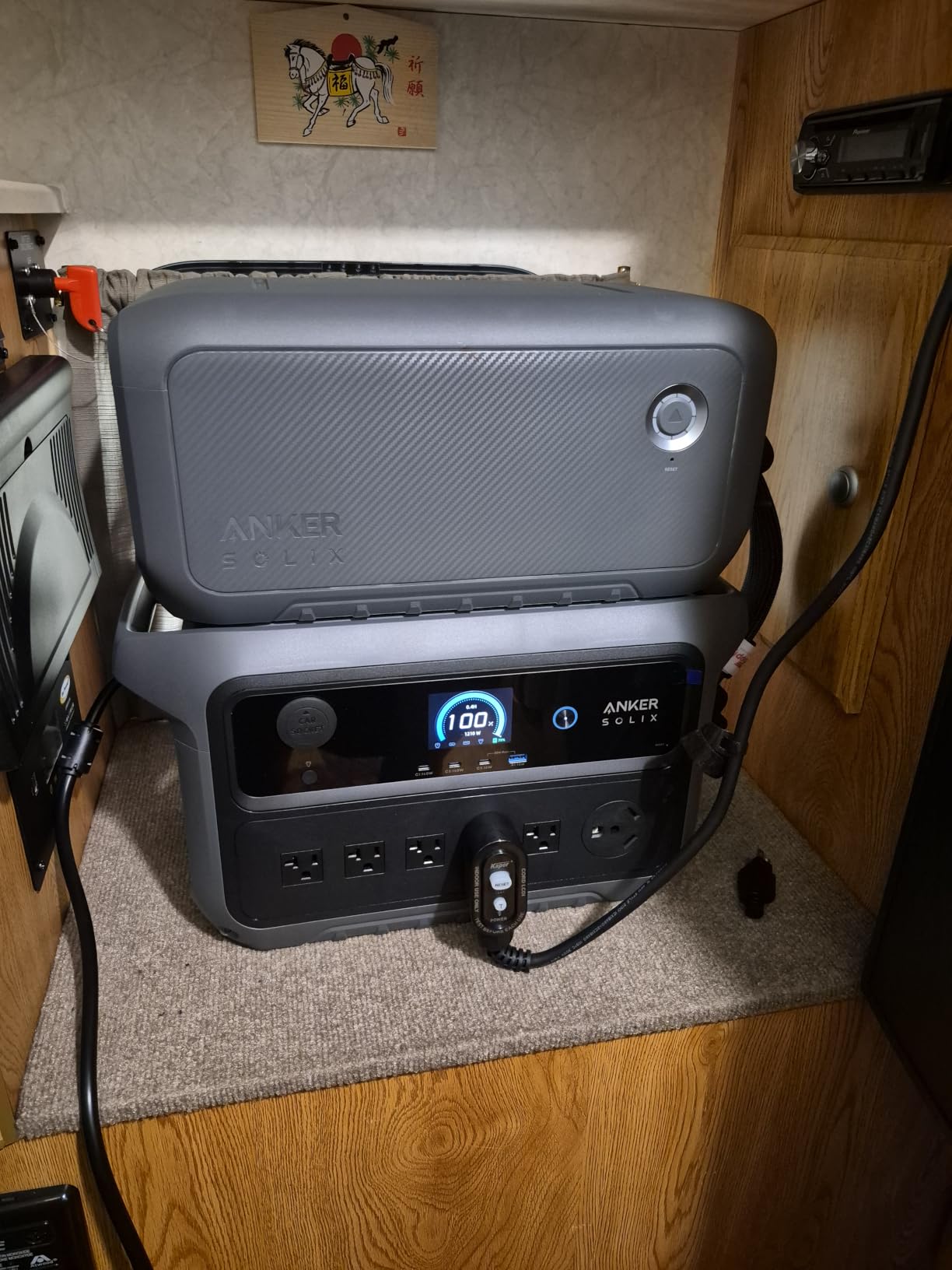
Is the USB-C advantage worth it for campers?
If your camp loads are laptops, tablets, camera batteries and phones, absolutely. Those four chargers collapse into two ports and you free up an AC outlet for a kettle. If you are running AC appliances, the port layout matters far less than raw inverter wattage.
Where it will disappoint
Anyone planning a large solar array. With a 100W panel ceiling and a brand-restricted compatibility list, this is a mains-and-car-refill tool rather than a solar-first platform.
7. Anker SOLIX C1000 Gen 2 – Most Versatile output in a 1kWh box
Anker SOLIX C1000 Gen 2 Portable Power Station
1024Wh
2000W continuous
3000W peak
24.9 lbs
600W solar input
Pros
- 2000W continuous output from a 1024Wh capacity
- Full recharge in 49 minutes at 1600W with HyperFlash
- 10ms UPS transfer keeps a router and CPAP running
- At least 80 percent capacity after 4000 cycles
Cons
- Gen 2 drops the expansion battery option
- Some reported harmonic distortion on microwave loads
- About 25 lb needs two hands
This is the highest-output unit in the group at a 1kWh capacity. 2000W continuous with a 3000W peak means you can run power tools, a microwave, or two heavy AC loads at once, which nothing else at this capacity manages.
Charging is the headline: a full recharge in 49 minutes at 1600W with HyperFlash switched on in the app, and one owner reported going from 83 to 100 percent in about 15 minutes. Solar input accepts up to 600W at 60V max, refilling in 1.8 hours.
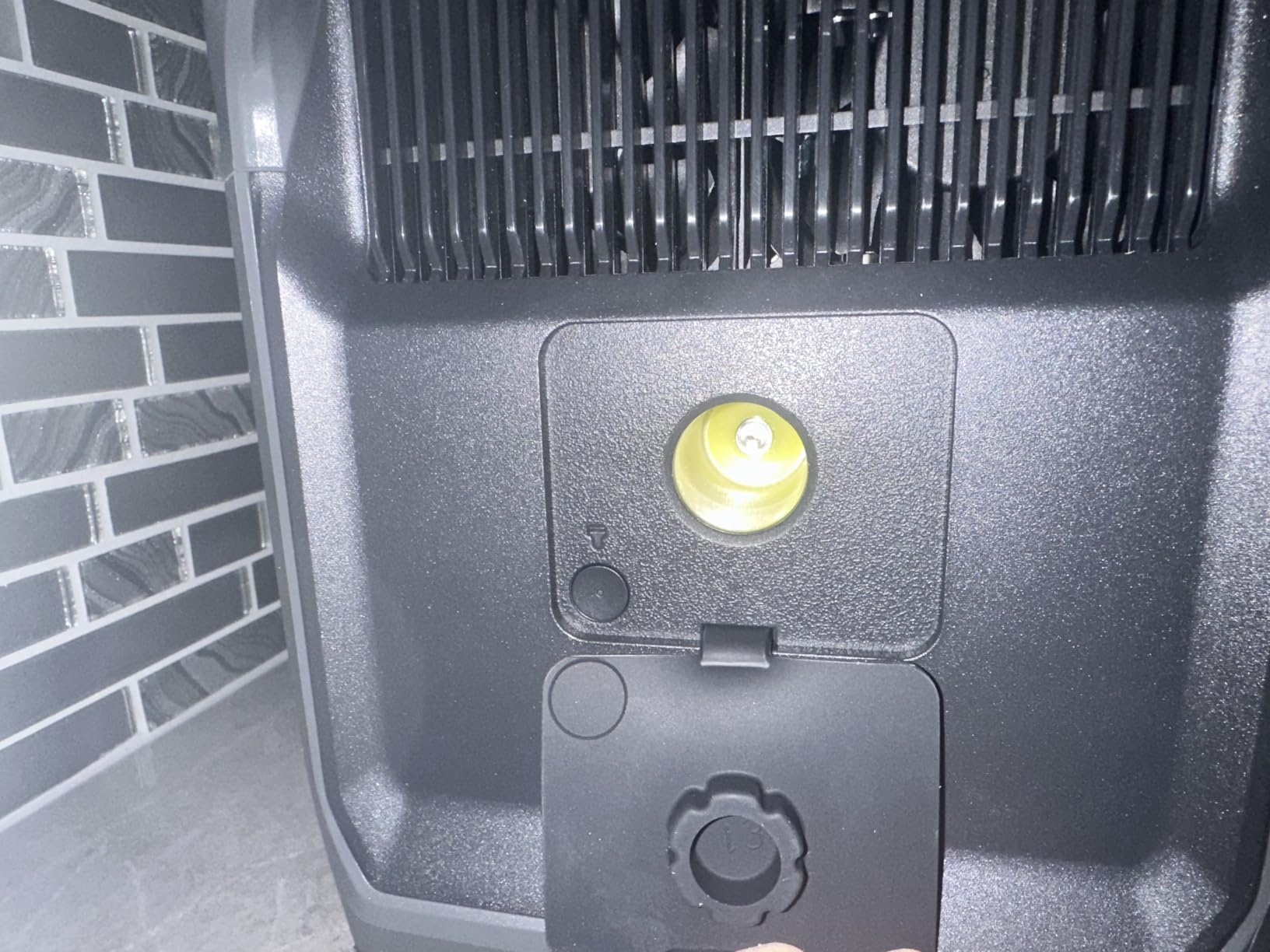
The InfiniPower battery holds at least 80 percent of rated capacity after 4000 cycles, rated for a 10-year life. UPS switchover is 10ms, quick enough for CPAP machines, laptops and network gear without a reset.
Owners report it carrying a fridge, internet and a CPAP machine through multi-day outages, and quiet enough that they cannot hear it running. One measured case holds a full-draw CPAP for three nights plus a 60W laptop workload while solar charging without dipping below 99 percent.
The one substantive technical criticism came from an engineer who measured roughly 15-20 percent harmonic distortion on microwave loads. The bigger structural change is that the Gen 2 design drops the expansion battery option from earlier Anker models.
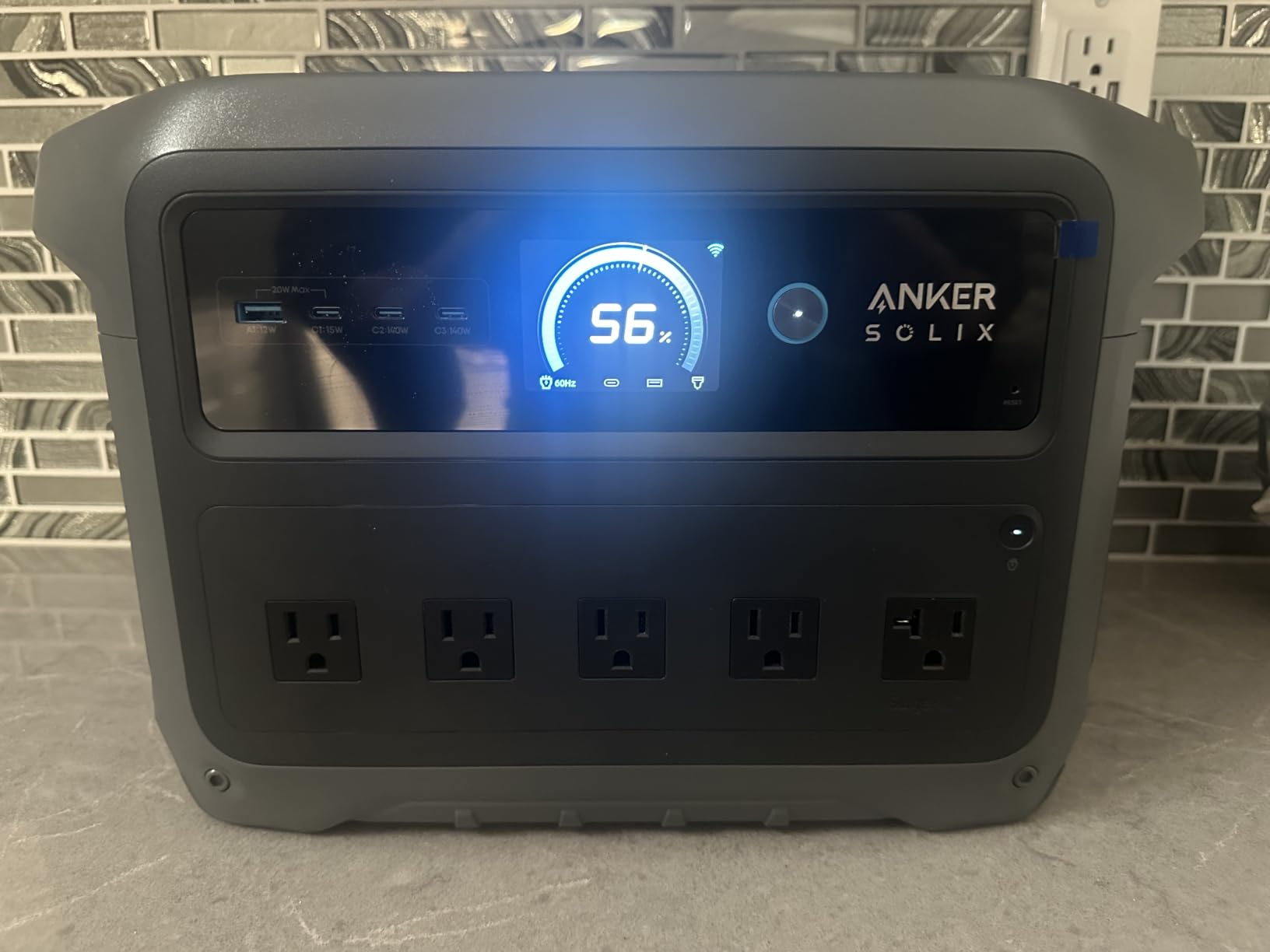
How much headroom does 2000W really give you?
Enough to run a 1500W microwave, a portable air conditioner or a small heater without a soft-start dance. Combined with a small expansion-free footprint and 600W solar, it suits people who need both serious AC output and serious solar in the same box.
Who should look elsewhere
If you plan to add capacity later, the OUPES Mega 1 next expands to 5120Wh. If you want the quietest possible operation for a tent, the BLUETTI Elite 100 V2 is the better sleeper.
8. OUPES Mega 1 – expand to 5120Wh with 800W solar input
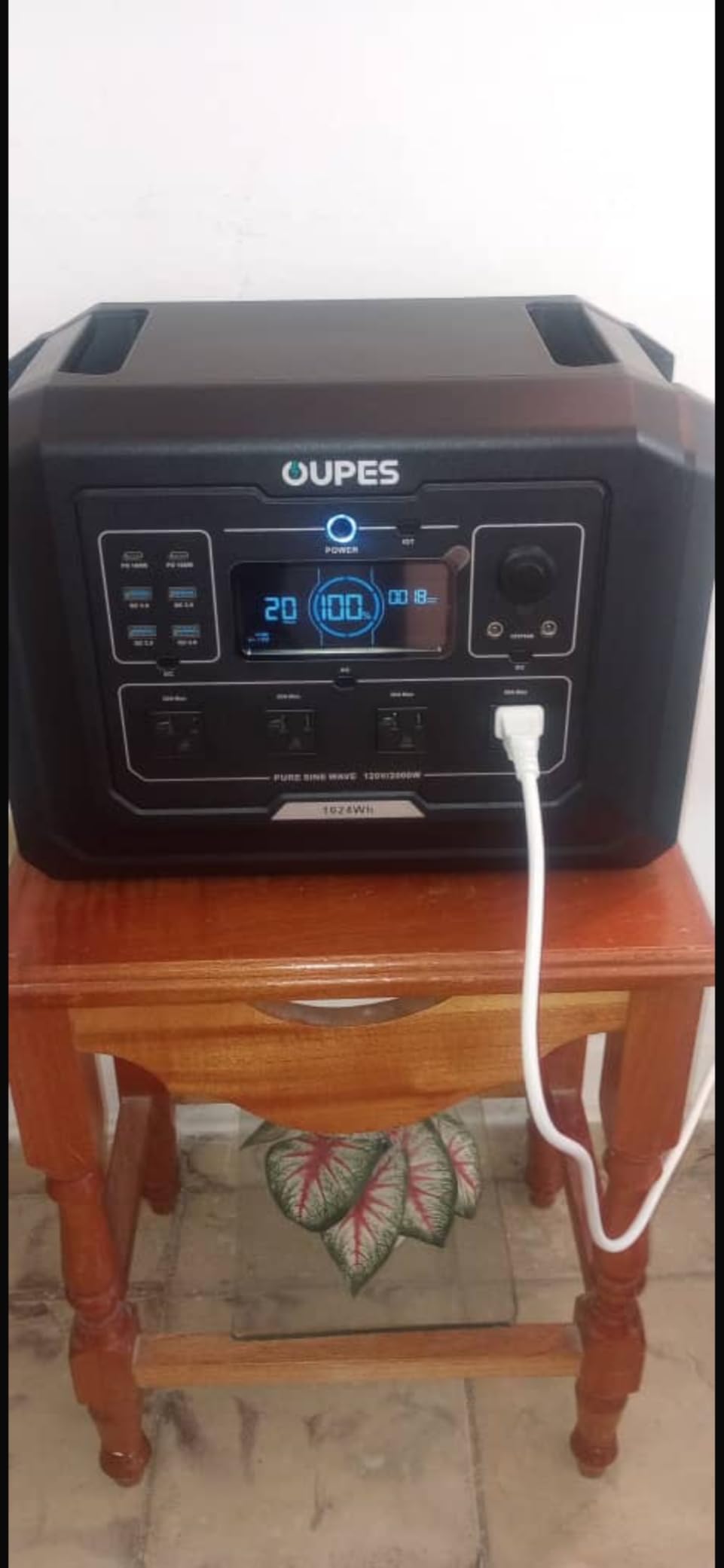
OUPES Mega 1 Portable Power Station 1024Wh 2000W (4500W Surge)
1024Wh expandable
2000W continuous
4500W surge claim
27.8 lbs
800W solar
Pros
- Expands to 5120Wh with up to two extra batteries
- 0-80 percent recharge in 36 minutes on AC
- 800W solar input on standard MC4 connectors
- Four AC outlets with well spaced plugs
Cons
- 4500W surge figure not achieved in practice
- Proprietary charging cable is hard to replace
- Cooling fans are loud under heavy load
The Mega 1 is the only unit here that grows with you. Starting at 1024Wh, it accepts up to two extra B2 batteries for a combined 5120Wh, and it does that without needing a second inverter.
Solar is the other headline. 800W input over standard MC4 connectors means you are not locked into one brand of panel, which removes the single most common complaint about this category. AC recharge hits 80 percent in 36 minutes, or 26 minutes when you combine AC and solar.
Output is 2000W continuous pure sine wave, and there are four 120V AC outlets, dual 100W USB-C PD, four QC3.0 USB-A and 12V DC outputs. Cells are rated 3500+ cycles, and the app supports pass-through charging.
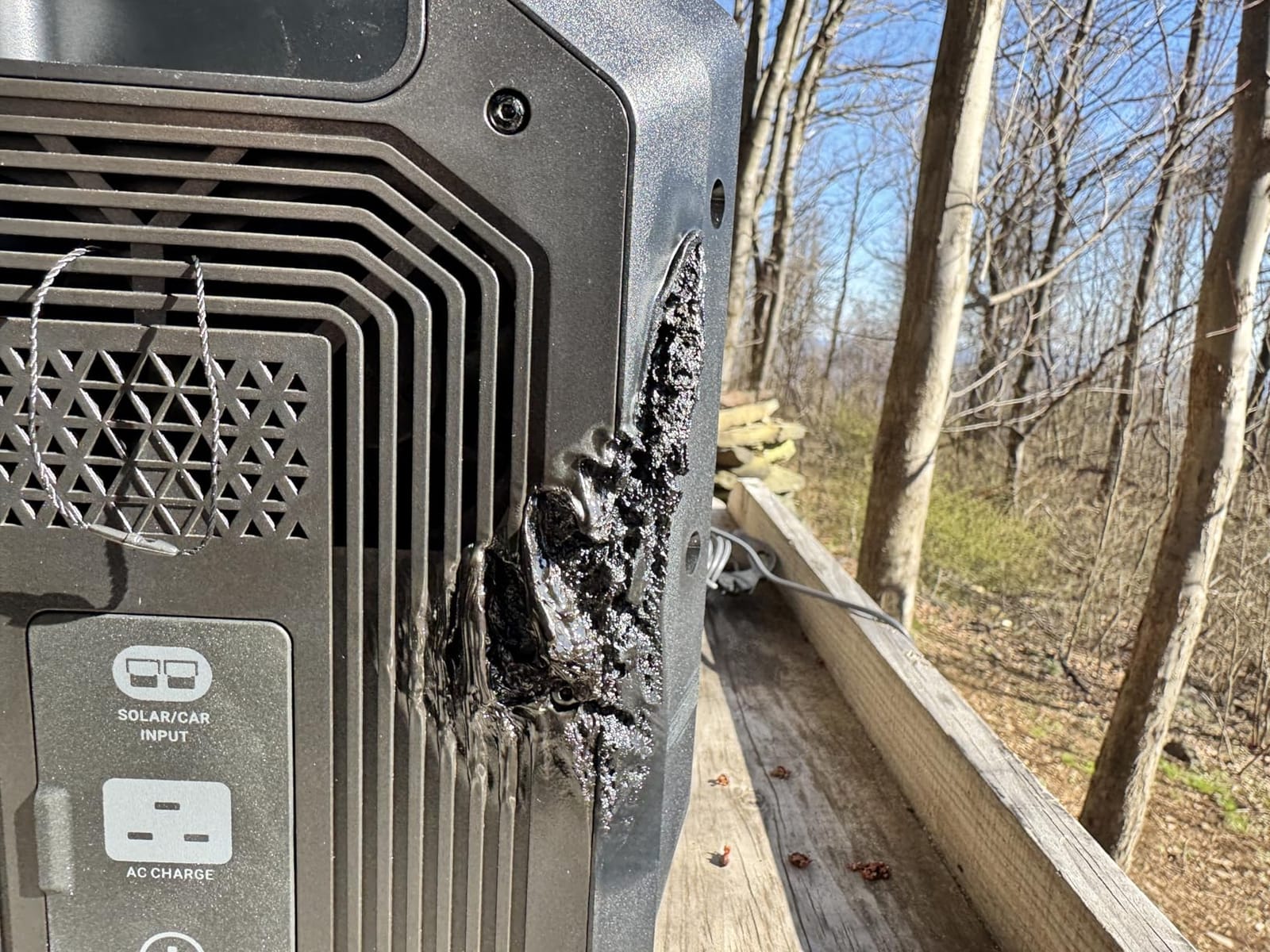
Now the honesty part. The advertised 4500W surge does not happen in practice; at least one owner measured consistent tripping between 2050W and 2200W. Treat the continuous 2000W figure as the real ceiling. The charging cable is proprietary and was stranded for one owner during a move.
The plastic housing is not water resistant, cooling fans get loud under heavy loads, and the bundled app is basic with unreliable Wi-Fi. Support, though, is repeatedly praised, including a full unit replacement.
Does expansion actually pay off?
If you are building a van or a basecamp rig and expect to add capacity in year two, yes – it is the cheapest expansion path in the category. If you are buying for two seasons of weekend trips, the money is better spent on a good 400W solar panel.
What about campsite noise?
The fans are the weak point in a quiet tent. On light loads they rarely spin up, but sustained heavy draw is audible. Test it at home before relying on it as an overnight fridge power source.
9. EF ECOFLOW Delta 3 Classic – for event and van work
EF ECOFLOW Portable Power Station Delta 3 Classic, 1024Wh 1800W AC
1024Wh
1800W continuous
3600W surge
26.7 lbs
10ms UPS transfer
Pros
- Highest five-star share in this group at 90 percent
- Under 10ms UPS transfer for seamless bridging
- 0-80 percent recharge in 45 minutes
- Full solar recharge in 2.5 hours with a 500W panel
Cons
- 26.7 lb is heavy to carry any distance
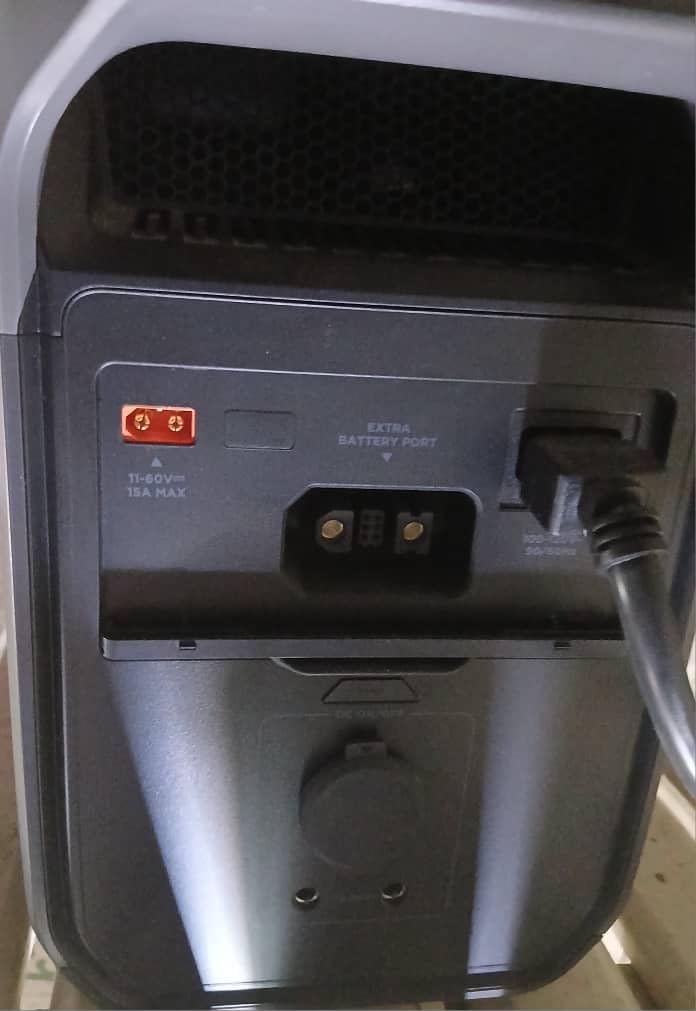
- No compatibility with DELTA 2 or Delta 3 extra batteries
- 12V vehicle charging tops out near 100W
The Delta 3 Classic has the strongest owner satisfaction in this roundup, with a 4.7 average across 1294 reviews and a 90 percent five-star share. The reason is the under-10ms UPS behaviour, which lets you use it as a bridge between a vehicle alternator and a fridge, or between a loud gas generator and the loads you actually care about.
Specs are well balanced: 1024Wh, 1800W continuous, 3600W surge, with X-Boost pushing heavy resistive loads up to 2600W. Six outlets, 0-80 percent in 45 minutes on X-Stream AC, and a full solar recharge in 2.5 hours on a 500W panel.
Owners describe real professional use: wedding ceremonies, photo booths, sump pumps and 12V fridges. Bluetooth connection is reported as flawless, and the unit accepts low-wattage solar input that other units ignore.
Physical design gets mentions too, with side-flared AC outlets, dual top handles and non-skid base pads. For our outdoor shoot power station guide, those handling details are what decide whether a 26 lb box is manageable.
The negatives are narrow. There is no expansion path – it will not take DELTA 2 or Delta 3 Series extra batteries. 12V vehicle charging caps near 100W, so it will not meaningfully refill while parked. A thin tail of reviews report units arriving dead or as pre-opened returns.
Is the 10ms UPS switchover worth paying for?
Yes for medical devices, network gear and anything with a boot sequence that breaks on a power blip. That is the whole reason a UPS mode exists, and 10ms is tight. For a phone charger, it is invisible.
Who should skip it
Anyone whose plan includes adding capacity later. No expansion means you replace the whole box rather than adding a battery, which changes the ownership maths over five or more years.
10. BLUETTI Elite 100 V2 – compact 1kWh with Power Lifting
BLUETTI Elite 100 V2 Portable Power Station for Camping 1024Wh 1800W
1024Wh
1800W rated
3600W surge
25 lbs
11 ports
30dB silent
Pros
- 2700W Power Lifting mode rescued a 1200W space heater for nearly an hour
- Quietest mode here at 30dB for overnight camping
- 0-80 percent in about 45 minutes on 1200W TurboBoost
- 11 ports with 4000+ cycles to 80 percent capacity
Cons
- 25 lb still feels heavy for a carry
- 12V truck adapter charges too slowly under load
- Cooling fans spin up immediately at power on
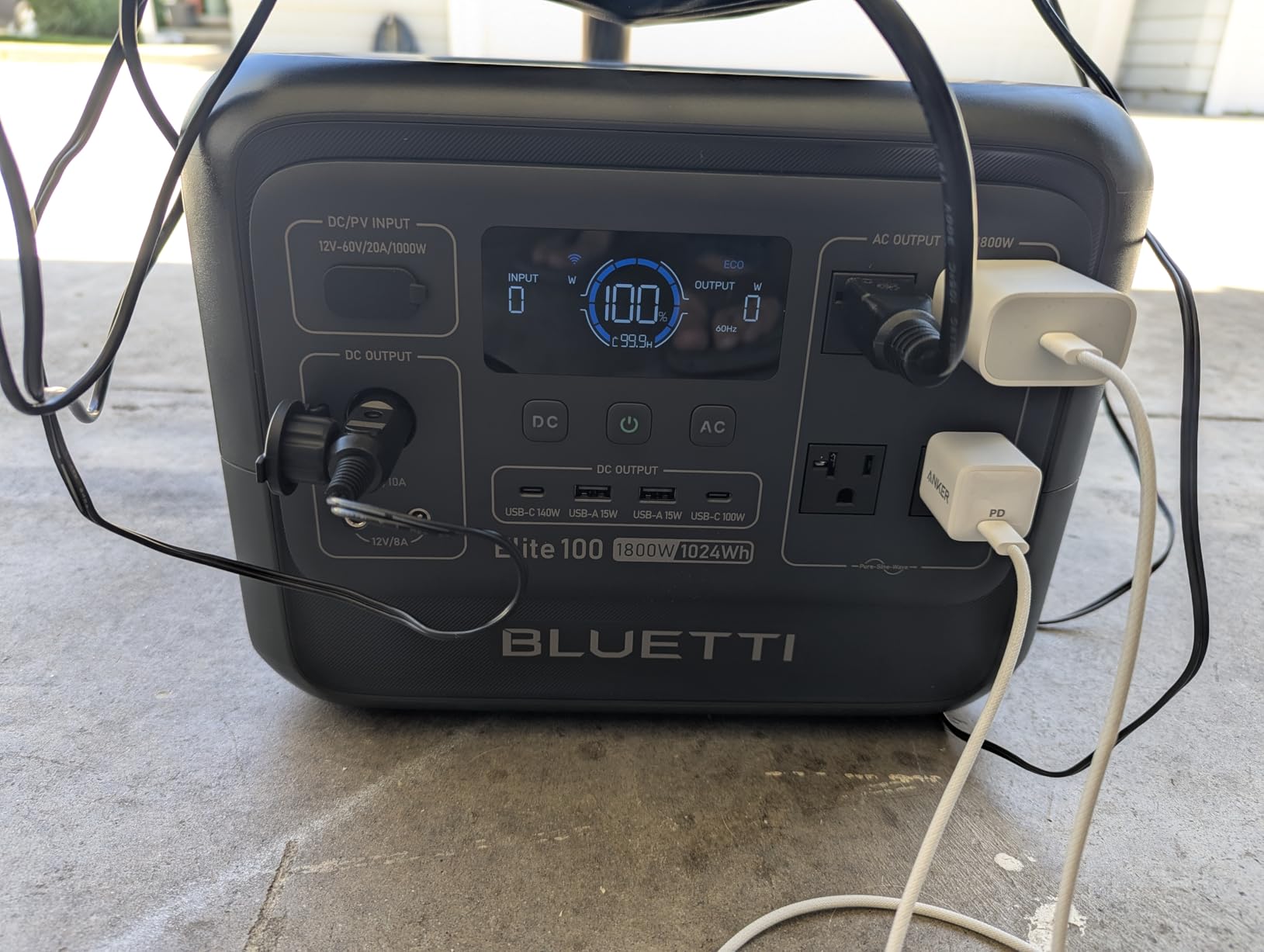
This is the most compact 1 kWh unit here, at 25 lb in a 17L footprint, with a hidden top grab handle for one-handed lifting. BLUETTI states it is 35 percent smaller and 30 percent lighter than the previous generation.
Power Lifting is the feature that earns the enthusiasm. It runs a 1800W rated output at 2700W for resistive loads, and owners report a 1200W space heater running for nearly an hour. Understand what it is: it reduces voltage to squeeze a high-draw appliance under the ceiling. It will not start a compressor motor.
Eleven ports cover simultaneous charging, 0-80 percent arrives in about 45 minutes on 1200W TurboBoost AC, and the app works over both Wi-Fi and Bluetooth with OTA updates. A 5-year warranty backs it up.
One report stands out: owners cite roughly a week of runtime for a Starlink Mini plus a battery charger and USB devices from one full charge. For satellite internet campers, that is the single most useful number on this page.
Persistent complaints are weight, fans that spin up the instant it powers on, and a 12V car socket that runs warm above about 12W. A truck adapter alone will not keep pace with a heavy draw – the optional Charger 1 is what makes fast vehicle charging work.
Is Power Lifting a gimmick?
No, if your loads are resistive: heaters, kettles, hair dryers, some coffee makers. It buys real runtime on those. It is not a substitute for a higher continuous rating when you are starting a compressor fridge or a power tool.
What about overnight noise?
At 30dB in silent mode this is the one to sleep beside. Our camping stove roundup covers the other high-output device that shares your camp budget, and quietness matters there for the same reason.
How to Choose a Portable Power Station for Camping
Pick the tier by capacity, not by wattage. Under 400Wh covers phones, laptops, cameras and a CPAP for a night or two. Around 1kWh covers a compressor fridge, medical gear and normal camp living. Above 2kWh is for basecamp, RV hookups or running power tools, and it means accepting 50 lb or more.
Read continuous output, not surge. Continuous watts is what the inverter sustains. Surge watts is a brief peak, often only a few seconds, intended for compressor startup. A 300W continuous inverter with 600W surge will start a small fridge but trip on a microwave. Budget 1.5x the running wattage of your largest appliance for startup headroom.
Check the battery chemistry. LiFePO4 is now the default across this list, and it is the right choice: 3000 to 4000+ cycles, far better cold tolerance, and a flatter discharge curve. NMC units offer more energy per kilogram but a much shorter life. A 2-year warranty on the Explorer 300 versus 5 years on the EcoFlow, Anker and BLUETTI models is a real signal of where the manufacturers place their confidence.
Verify solar input before buying panels. Every unit here takes different ceilings – 100W on the Jackery 300, 110W on the RIVER 2, 500W on the AC180, 600W on the Anker C1000 Gen 2, 800W on the OUPES Mega 1. Several brands restrict compatibility to their own panels, and the Anker C300 excludes specific models outright. Also remember that foldable panels deliver well under their rated wattage in real conditions, so a 400W panel is often a full day of recharge rather than an afternoon top-up.
Prefer DC ports where the device allows it. Running a 12V fridge from the car port skips the inverter entirely and avoids roughly 10-15 percent conversion loss, which can be the difference between a full night and a morning of ice melt.
Count idle draw. A unit with the inverter left on can pull around 20W, which over a three-day trip is a meaningful slice of a small battery. Switch to a small unit for daytime electronics and only wake the big one when needed.
Weight is the real portability limit. As a rough rule, every extra 100Wh adds 2 to 4 lb depending on chemistry. Anything under 30 lb is a car-camping unit; under 12 lb is genuinely carryable to a picnic site.
Check safety and site rules. Look for UL 2743 certification, and note that many National Forest campgrounds restrict or prohibit generators during fire season. A battery unit is usually treated differently, but check the specific rules for your campground before relying on it.
Plan for storage. Between trips, park it at 30-60 percent charge if it will sit for more than three months, keep it somewhere between freezing and warm, and avoid charging below 32F. Lithium cells held at full charge in a hot vehicle age faster than the cycle rating suggests.
Runtime Math: What Each Capacity Class Actually Runs
These are estimates from rated capacity assuming about 85 percent inverter efficiency and average draw, not best-case numbers. Compressor fridges vary enormously, so treat them as a range.
256-292Wh class: A 40W CPAP runs roughly 6 hours. A 60W laptop gets about 4 hours. A phone charges 8 to 10 times. A small fan runs about 8 hours. A 45W compressor fridge manages roughly half a night.
1024-1152Wh class: A 40W CPAP runs about 24 hours. A 60W laptop gets roughly 15 hours. A 45W compressor fridge runs two to three nights depending on ambient temperature and duty cycle. A 25W Starlink Mini runs past 30 hours. A fan runs all night and most of the next day.
2kWh and above: A 60W laptop gets around 30 hours, a compressor fridge a full week, and you can run a 1500W microwave in short bursts without touching anything else.
To size your own, multiply each device’s watts by the hours you need, add them up, then divide by 0.85 to cover inverter losses. Add about 20 percent headroom for a compressor fridge, since its compressor cycles rather than runs flat out.
How We Picked
We compared published specifications for all ten models against the aggregated owner feedback on each product page. We weighted real capacity over nameplate marketing, verified continuous and surge figures against the same source, and used review volume as a durability signal – a design with 11273 reviews has been tested far harder than one with 300.
We did not run our own lab discharge cycles, and we are not claiming we did. Where a figure is a manufacturer claim rather than a verified measurement, the review section says so. Two examples worth noting: the OUPES 4500W surge figure is not achieved in practice, and the BLUETTI AC180’s 20W idle draw means usable capacity sits well below its nameplate.
Frequently Asked Questions
What is the best portable battery station for camping?
For most trips the Jackery Explorer 300 is the best portable battery station for camping, covering phones, laptops, camera batteries and a CPAP at 7.1 lb. If you run a compressor fridge overnight or need higher output, move up to a 1 kWh class such as the Jackery Explorer 1000 v2 or the Anker SOLIX C1000 Gen 2.
Which portable power station is the most reliable?
Reliability tracks owner review volume and battery chemistry. The Jackery Explorer 300 has 11273 reviews at a 4.6 average and a LiFePO4 rating past 4000 cycles, which is the strongest evidence base in this group. The EcoFlow Delta 3 Classic has the highest five-star share at 90 percent, while the EF ECOFLOW RIVER 2 sits lowest at 4.3 with reported battery gauge drift.
What can a 1000W portable power station run?
A 1000W continuous inverter comfortably runs a 45W compressor fridge, a CPAP machine, LED lighting, phone and laptop charging, a 60W fan and small kitchen appliances like a kettle. It will not run a microwave or a space heater, which draw 1200W or more. Check your appliance’s running wattage plus startup surge before relying on any unit.
Can I run a camping fridge off a portable power station overnight?
Yes, if the unit has roughly 1000Wh or more. A 45W compressor fridge cycling through the night typically draws 15-30W average, so a 1070Wh unit covers two to three nights. Run it from the 12V car port where possible, since that skips the inverter and avoids 10-15 percent conversion loss. Below 400Wh, expect only half a night.
What size portable power station do I need for camping?
Under 400Wh covers phones, laptops, cameras and one night of CPAP. Around 1kWh covers a compressor fridge, medical gear and normal camp living, and that tier handles the majority of camping use cases. Above 2kWh is for basecamp, RV use or power tools, and it means carrying 50 lb or more. Add about 20 percent headroom for compressor appliances.
How long does a portable power station last while camping?
It depends on capacity and load. A 1024Wh unit runs a 40W CPAP about 24 hours, a 60W laptop roughly 15 hours, and a 45W compressor fridge two to three nights. A 256Wh unit manages a single night of CPAP or half a night of fridge duty. Multiply your device watts by hours needed, divide by 0.85 for inverter losses, then add headroom.
Bottom Line
The best portable power stations for camping in 2026 come down to two honest choices. Take the Jackery Explorer 300 if your trip is electronics, cameras and a CPAP and you care about weight above everything else. Take the Jackery Explorer 1000 v2 or the Anker SOLIX C1000 Gen 2 if a compressor fridge, medical gear or real cooking is part of the plan, since the 1 kWh tier is where camping stops being a compromise.
Whichever you choose, buy the panel that matches the unit’s actual input ceiling and check the brand compatibility list before you commit. A station that cannot be recharged where you camp is a battery with a weekend attached.