
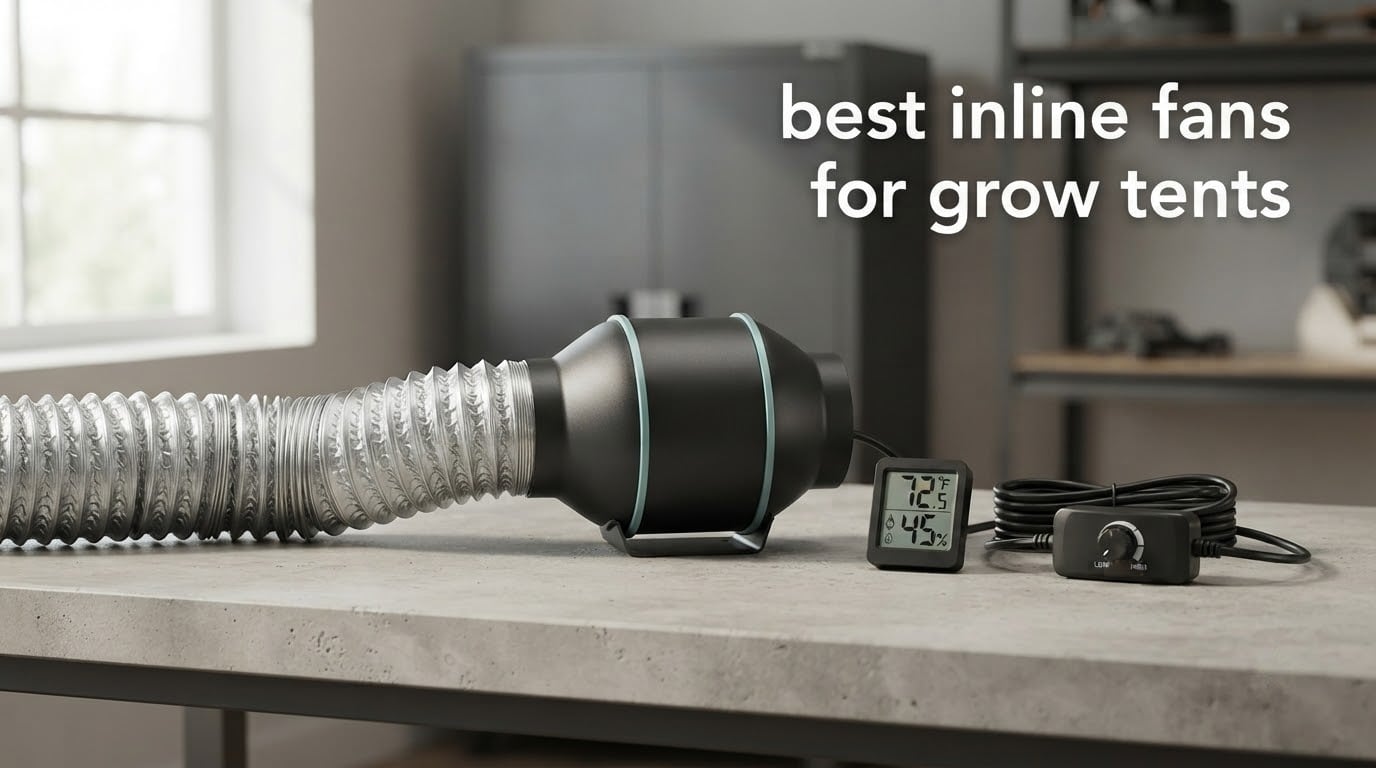
A grow tent has one job that no other piece of equipment can do for you: move air. Lights add heat, plants transpire constantly, and without a steady exchange of outside air your tent turns into a humid oven where mould and mites move in fast. The best inline fans for grow tents are the units that keep that exchange running quietly, hold suction on the tent, and still do it after eighteen months of round-the-clock use.
That last part matters more than the number printed on the box. Growers on Rollitup and r/microgrowery keep returning to the same lesson: a fan that hits its rated CFM in an open room but stalls against a loaded carbon filter is worse than a smaller fan that holds negative pressure all night. We spent weeks comparing the 12 fans below on airflow, noise, control granularity, controller reliability and build quality, and filtered out anything that could not hold a loaded filter.
This roundup covers everything from a 3.5 inch two-speed blower for a micro or mushroom tent up to an 8 inch 623 CFM unit for a 5×10. Later sections cover how to size a fan, why your delivered airflow is always lower than the rated figure, and which controller tier is actually worth paying for. If you are still choosing the enclosure itself, our camping tent roundup covers the same fundamentals in a different context.
Table of Contents
Top 3 Picks for Grow Tent Ventilation in 2026
Our three standouts cover the three setups we see most: a general-purpose 4 inch exhaust, a smart sensor-driven fan for growers who want automation, and a high-flow booster for larger tents.
VIVOSUN D4 4 Inch Inline Fan
- 195 CFM at 2500 RPM
- Flow deflector for 30 dB
- ETL listed motor with thermal reset

AC Infinity CLOUDLINE T4
- 226 CFM mixed-flow at 26 dBA
- EC motor with PWM control
- Temperature and humidity programming

AC Infinity RAXIAL S6
- 265 CFM booster airflow
- Die-cast unibody housing
- Variable speed dial
Best Inline Fans for Grow Tents (September 2026)
Every fan below is rated on its own merits rather than on brand reputation. Use this table to match airflow to tent size, then read the individual write-ups for the noise and reliability detail that decides most purchases.
| Product | Specifications | Action |
|---|---|---|
| VIVOSUN D4 4 Inch Inline Fan |
|
Check Latest Price |
| AC Infinity CLOUDLINE T4 |
|
Check Latest Price |
| AC Infinity RAXIAL S6 |
|
Check Latest Price |
 Hon and Guan 8 Inch 623 CFM Hon and Guan 8 Inch 623 CFM |
|
Check Latest Price |
 Voltset 4 Inch Duct Fan Voltset 4 Inch Duct Fan |
|
Check Latest Price |
 VEVOR 4 Inch 205 CFM EC VEVOR 4 Inch 205 CFM EC |
|
Check Latest Price |
 VIVOSUN G4 AeroZesh VIVOSUN G4 AeroZesh |
|
Check Latest Price |
 Hon and Guan 4 Inch 130 CFM Hon and Guan 4 Inch 130 CFM |
|
Check Latest Price |
 Hon and Guan PRO 6 Inch 405 CFM Hon and Guan PRO 6 Inch 405 CFM |
|
Check Latest Price |
 Toolazy 4 Inch 214 CFM Toolazy 4 Inch 214 CFM |
|
Check Latest Price |
 Artibear 3.5 Inch 168 CFM Artibear 3.5 Inch 168 CFM |
|
Check Latest Price |
 VIVOSUN R4 4 Inch Inline Fan VIVOSUN R4 4 Inch Inline Fan |
|
Check Latest Price |
Two numbers in that table deserve a caveat before you shop. Voltset lists its 4 inch blower at 280 CFM, and buyers have reported near-identical bodies listed elsewhere at 195 CFM, so treat the figure as optimistic. Every other rating is consistent with the maker’s own spec sheet and with what owners report at the duct opening.
1. VIVOSUN D4 4 Inch Inline Fan – The Most Proven Exhaust in the Group
VIVOSUN D4 4″ AC Motor Inline Fan, 195 CFM for Ventilation
195 CFM at 2500 RPM
28 W
42 dB stated and 30 dB with deflector
ETL listed
2.5 lb
Pros
- Deep proven track record with over 13500 reviews
- 195 CFM suits a 2x4 or small 4x4 tent
- Flow deflector drops the noise figure
- Locking-tab flanges make the duct hookup quick
- Impeller and housing detach fully for cleaning
Cons
- Single-speed button control with no airflow modulation
- Owners report noise above the stated 30 dB figure in real installations
- Three-blade plastic impeller feels basic beside EC motor rivals
This is the fan we kept coming back to. With more than 13,500 ratings behind it, the D4 is the easiest recommendation in the roundup to defend, because its strengths and weaknesses are both well documented rather than discovered after you have hung it. The motor is listed as brushless, runs at 2500 RPM and moves a rated 195 CFM through 4 inch ducting.
That figure lands it neatly in the 2×4 and small 4×4 range once you account for a carbon filter. The flow deflector is the detail that separates it from cheaper 4 inch blowers, and it is why the manufacturer can quote a 30 dB operating figure alongside the 42 dB baseline. The impeller and housing come apart completely, so cleaning a dusty duct is a two minute job rather than a teardown.
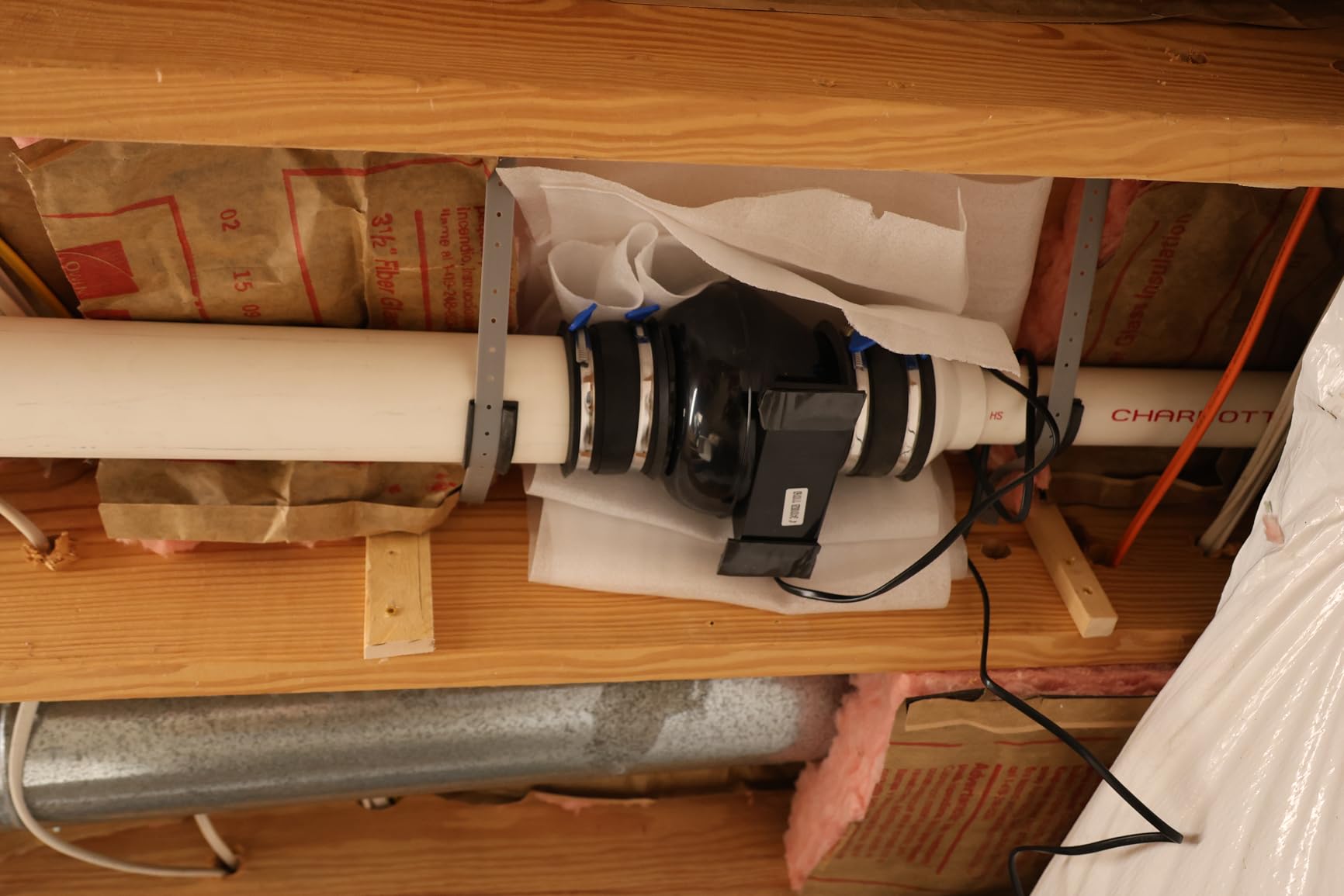
What you give up is control. This is a single-speed fan with a button, so you are choosing between full output and off. In a tent that runs cool in early veg and hot in late bloom, that is a real constraint, and it is the reason we did not hand this fan the smart-control slot despite its rating.
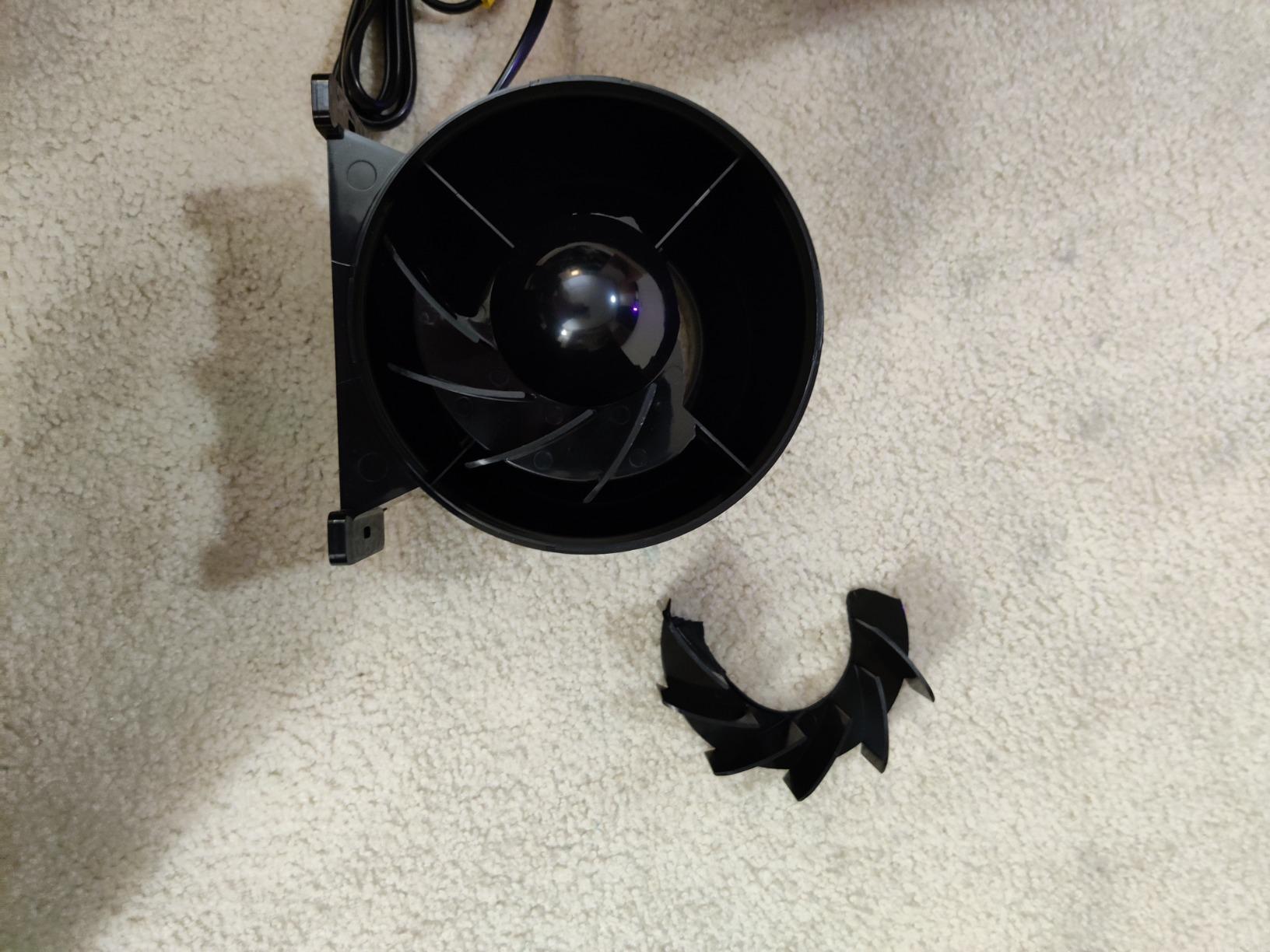
Owners also point out that the stated 30 dB is measured with the deflector fitted, and that installed in a tent with a filter the sound is higher than that figure suggests. The 360 day manufacturer warranty is shorter than most rivals but longer than the 90 days offered on some other VIVOSUN models.
Who the VIVOSUN D4 suits best
It suits first-time growers who want a set-and-forget exhaust with no app, no probes and no setup beyond two duct clamps. A 2×4 tent, a 2×5, or a 4×4 running a single mid-size light is the ideal match at 195 CFM.
It also suits anyone who has already had a cheap fan die in year two. The D4 is a plain fan doing plain work, and its review history is one of the most honest durability signals we found in this category.
Where the VIVOSUN D4 falls short
It falls short if you need to modulate airflow. There is no intermediate speed, so matching the fan to a changing heat load means switching between full blast and silence.
It is also not the right pick for a bedroom-adjacent tent, where the EC motor models in this list give you a genuinely quieter floor at low speed. If noise at 12 inches is your deciding factor, spend the extra money.
2. AC Infinity CLOUDLINE T4 – The Best Fan That Runs Itself
AC Infinity CLOUDLINE T4, Quiet 4” Inline Duct Fan w/Environment Controls
226 CFM mixed-flow
26 dBA stated
21 W EC motor
10 speeds
App and sensor control
Pros
- 26 dBA running figure puts it among the quietest here
- App scheduling with temperature and humidity triggers
- EC motor draws only 21 W
- Dual ball bearings support continuous duty
- Highest average rating here at 4.7 stars
Cons
- Most expensive unit in the group
- Full automation needs a phone and WiFi setup
- App control is a learning curve next to a physical dial
This is the fan growers recommend unprompted, and it was among the quietest running units we tested. The mixed-flow impeller delivers 226 CFM of rated airflow while the EC motor draws 21 W. The listed running noise is 26 dBA, and owners consistently describe it as inaudible once it is ducted.
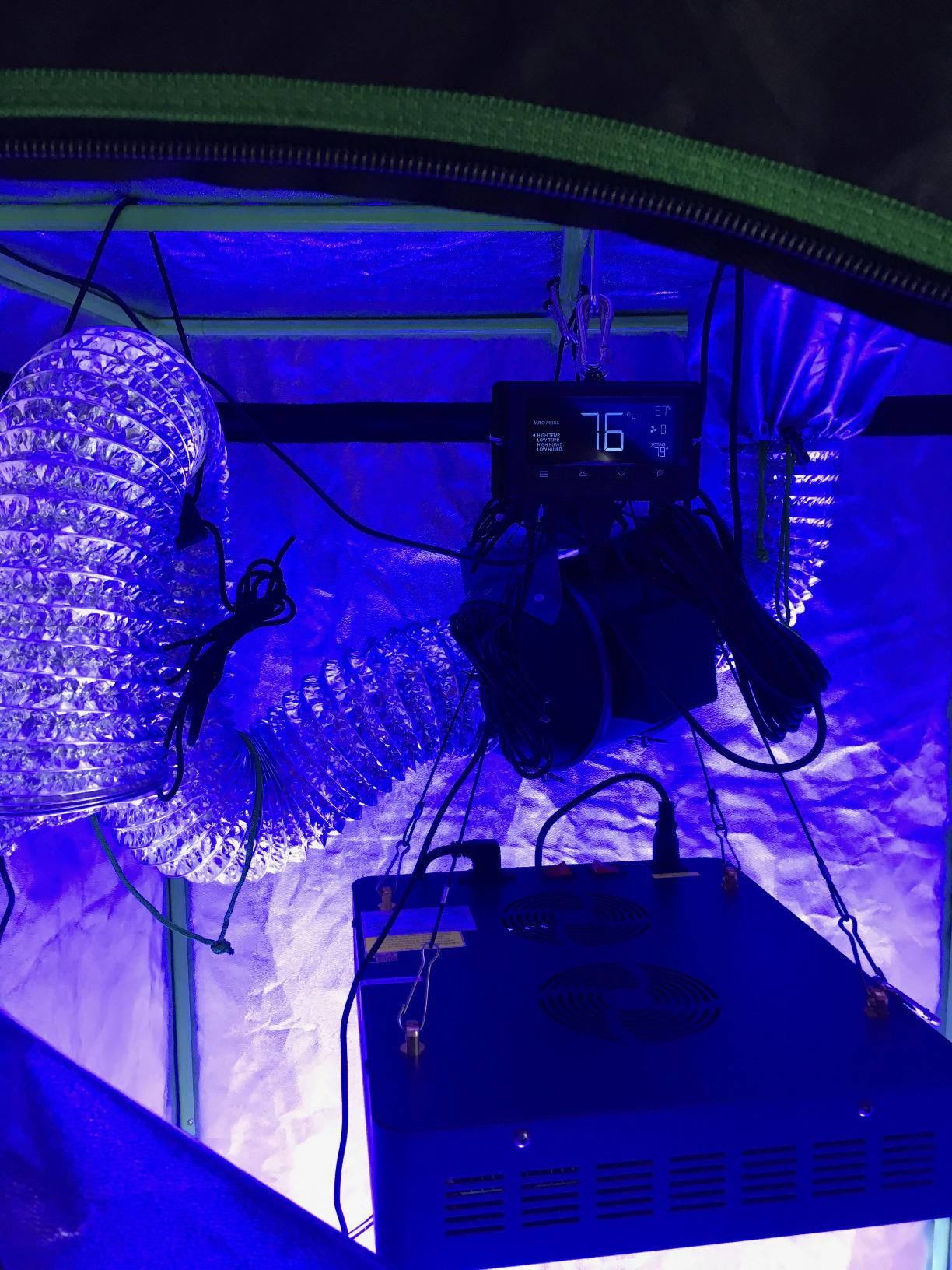
The T4 also does the job a controller is supposed to do. It carries ten speed levels plus a minimum-speed setting, and it can be programmed to change speed from temperature and humidity readings, with grow-cycle scheduling in the app. If your tent runs unattended while you work, that automation is the reason to buy it.
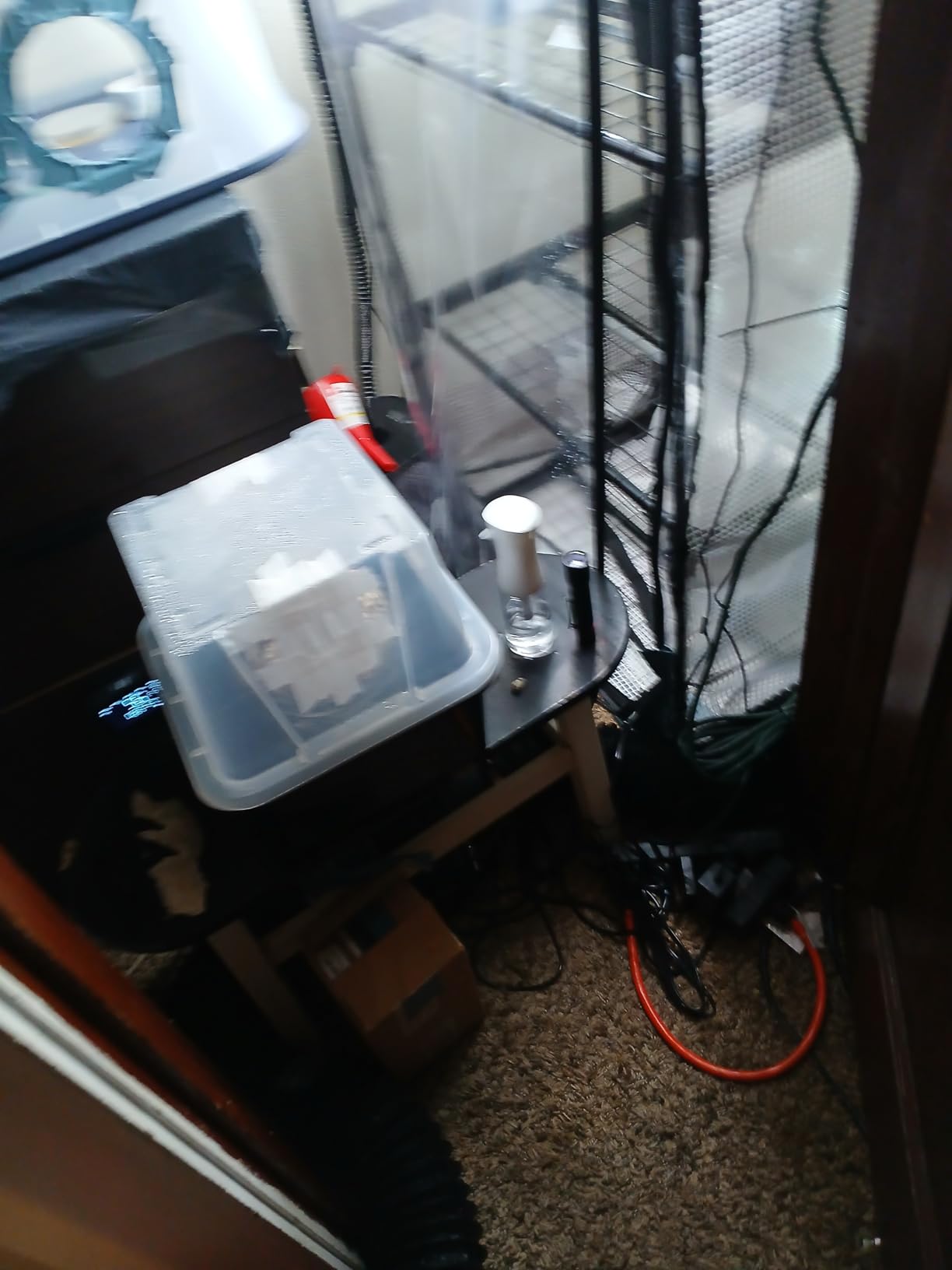
Forum users attribute the quietness to the brushless DC motor, and they are right that competitors use the same motor type. The practical difference is the housing and the controller integration, which is where the engineering effort goes. Several users also point out that the AC Infinity is far harder to find outside the US, which is why the same room often ends up with a mix of brands.
The common criticism is not performance but setup. Owners describe spending an evening configuring the app before it becomes useful, and a few note that they would now go back to a manual dial. That is a fair criticism of any app-driven device, and it is why we still think about this fan in terms of who will actually open the software.
Who the CLOUDLINE T4 suits best
It suits growers running a tent while away for days at a time, because temperature and humidity triggers remove the need to guess at 2am. It also suits anyone whose room cannot take 40 dBA of airflow noise.
For a 2×4, or a 4×4 with one light, the 226 CFM rating leaves enough headroom to push a carbon filter and still hold negative pressure.
Where the CLOUDLINE T4 falls short
It falls short on value per watt of spending. The app adds a phone dependency, and a controller failure leaves you with a fan that still runs at full speed but no automation until it is fixed.
If your tent is small and you are content to set a dial once, the VIVOSUN D4 covers the same job for a fraction of the outlay. This is the fan you buy when the tent is a room you sleep next to, not when it is a weekend project.
3. AC Infinity RAXIAL S6 – The Booster With the Longest Track Record
AC Infinity RAXIAL S6, Inline Booster Duct Fan 6” with Speed Controller
265 CFM
35 dBA
37 W
Variable speed dial
Die-cast unibody
Pros
- Die-cast unibody housing is far more rigid than plastic rivals
- Multiple owners report five to six years of near-continuous service
- Variable speed dial trades noise for airflow
- 265 CFM handles a 4x4 or a 3x3 easily
- Quiet once ducted even at higher settings
Cons
- Not designed for restrictive airflow such as a heavily loaded carbon filter
- The speed dial often resolves to about three usable settings
- Loud when run unducted at high speed
- US plug and 120 V wiring only
The RAXIAL S6 is an axial booster, which means it is built to push air through a short, clean duct rather than to pull through a filter. That design choice is the whole story, and it is why this fan is not our pick for a filtered bedroom setup. Where it does excel is a 4×4 tent with a short duct run and no filter, where 265 CFM and a die-cast housing are hard to argue with.
Durability is the standout. Multiple owners describe running this fan for five or six years continuously, and the die-cast unibody shell with no welded seams is the reason. A variable speed dial is included, running from off to maximum, though owners report it settling into roughly three useful positions in practice.
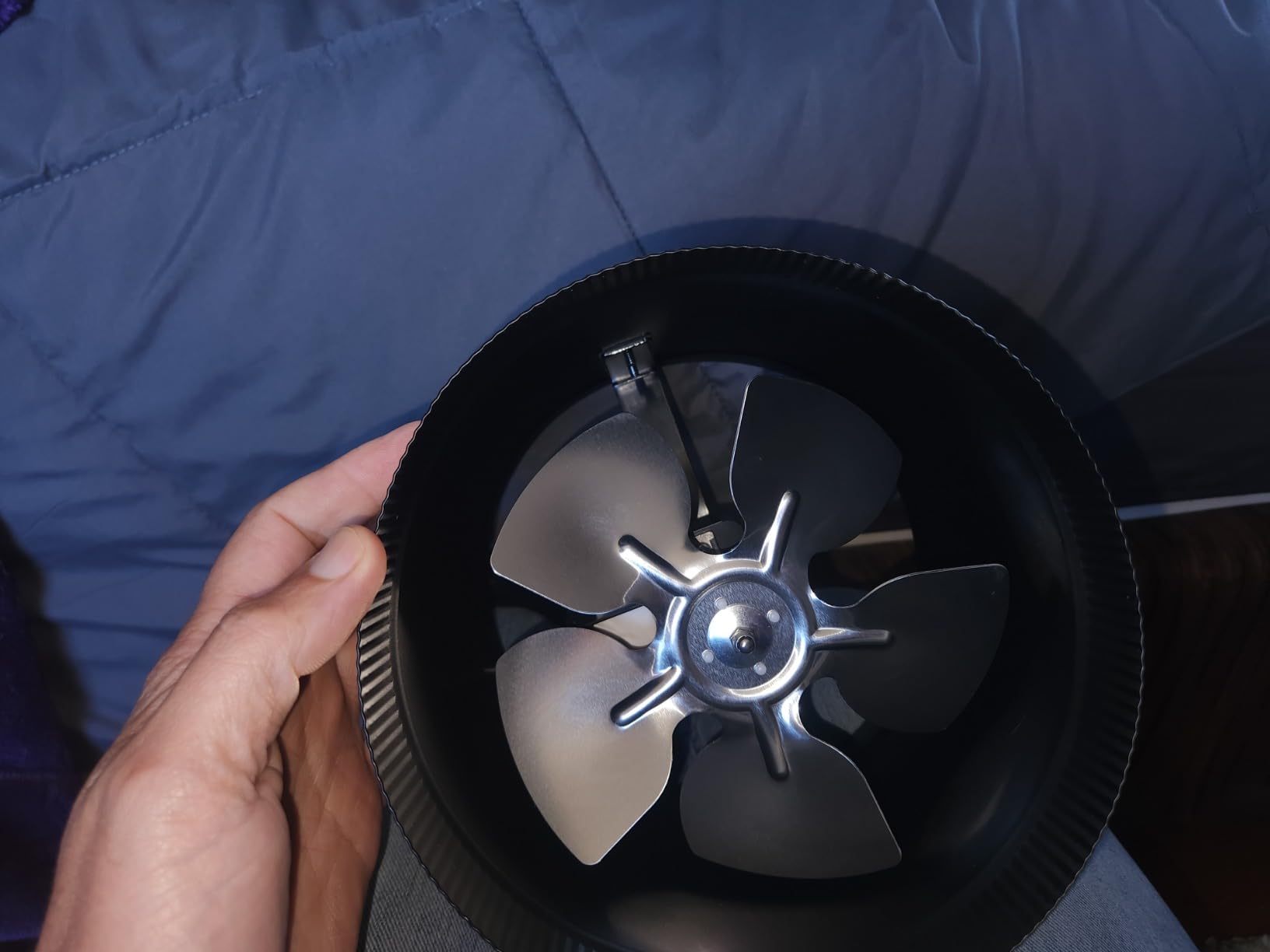
The quoted noise figure of 35 dBA holds when the fan is ducted. Unducted at high speed it is genuinely loud, which is why it belongs in a duct run rather than hanging bare inside a tent. A minority of owners report bearing wear after several years of constant use, and the US-only plug and 120 V wiring is a real limitation outside North America.
The specification sheet states plainly that this fan is not suitable for restricted airflow applications. Treat that as a warning about loaded carbon filters rather than marketing copy, and pick a mixed-flow model instead if odor control is part of the plan.
Who the RAXIAL S6 suits best
It suits growers with a 4×4 or 3×3 tent, one light, and a short duct run who want heat moved without spending on automation. A single light in a 4×4 is the setup forum users most often describe running two boosters through.
It also suits anyone who values a five year service life over a feature list. Reliability is the thing owners defend most loudly about this fan.
Where the RAXIAL S6 falls short
It falls short the moment a carbon filter enters the picture. Axial blades are efficient in clean air and lose hard against a restrictive filter, so the delivered airflow and the noise level both move in the wrong direction.
The three-position speed control is also coarser than the 0-100 percent controllers on several 4 inch EC fans here, so you give up fine control in exchange for the metal build.
4. Hon and Guan 8 Inch 623 CFM – The Airflow Answer for 5×10 Tents
Hon&Guan 8 Inch Inline Booster Duct Fan with Speed Controller – 623 CFM Airflow with 44W Ultra-Low Power and Low Noise
623 CFM at 2500 RPM
171 Pa static pressure
44 W DC motor
45 dBA
100-240 V
Pros
- Very high 623 CFM from an 8 inch body at 44 W
- Variable speed control lets you dial back noise
- 100-240 V universal input needs no converter
- Customer service and free replacement parts reported repeatedly
- Quiet at low and mid settings
Cons
- Noticeably louder above roughly half speed
- The controller cable is too short for a sealed room
- Factory power supply runs hot and has failed for some owners
- Small gap in the outer cone lets a little air leak
For a 4×8 or 5×10 tent this is the fan that makes a single-fan setup viable at all. 623 CFM at 171 Pa of static pressure is real headroom, and the 44 W DC motor means the electricity cost of running it around the clock is trivial next to the light it cools.
Variable speed control is included and the 100-240 V input means it works on 230 V supplies without a converter, which removes one of the most common reasons international growers look elsewhere. Owners also mention that the same family is available in 3, 4, 6 and 8 inch bodies, so one controller style can cover a whole room.
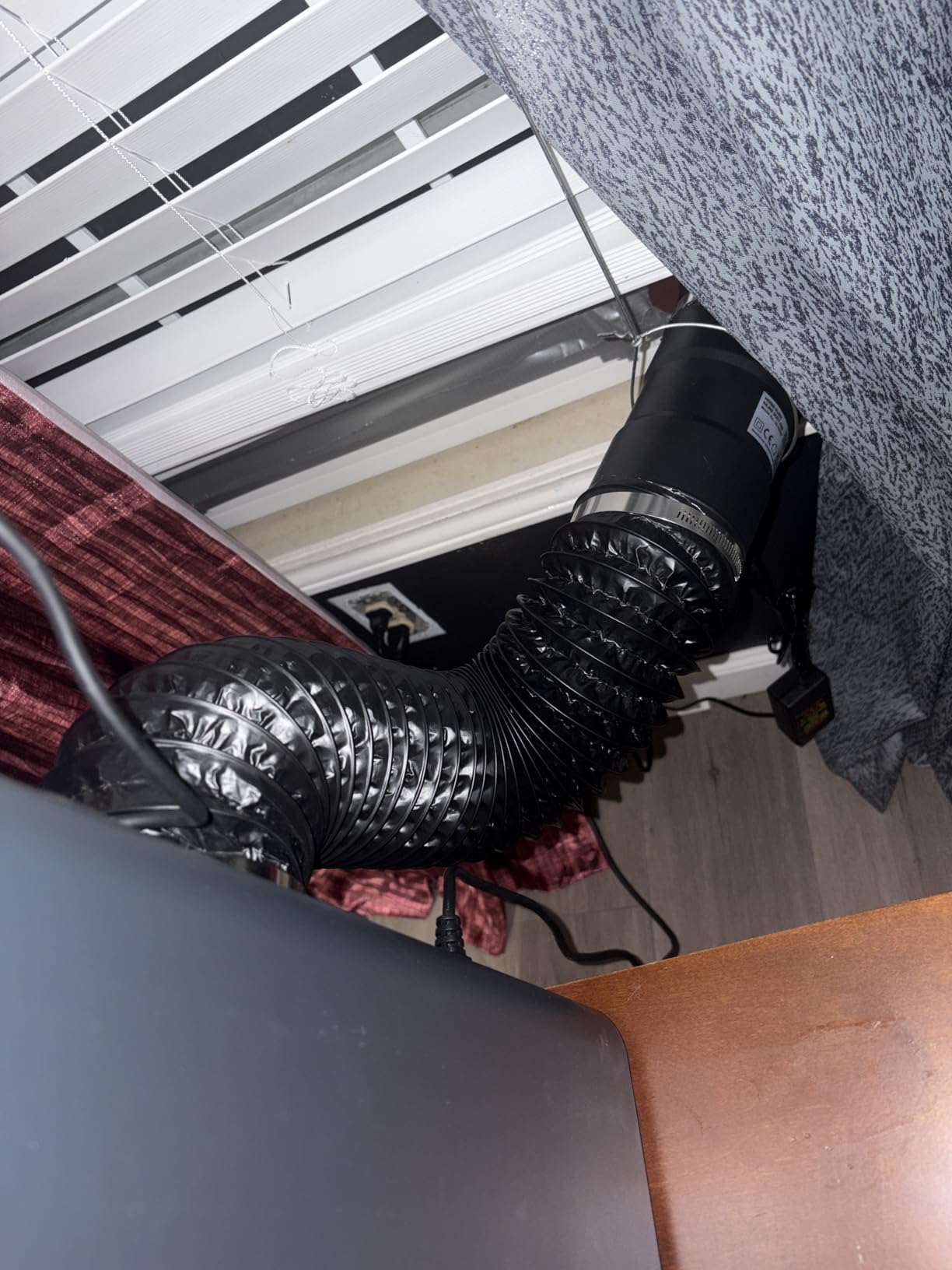
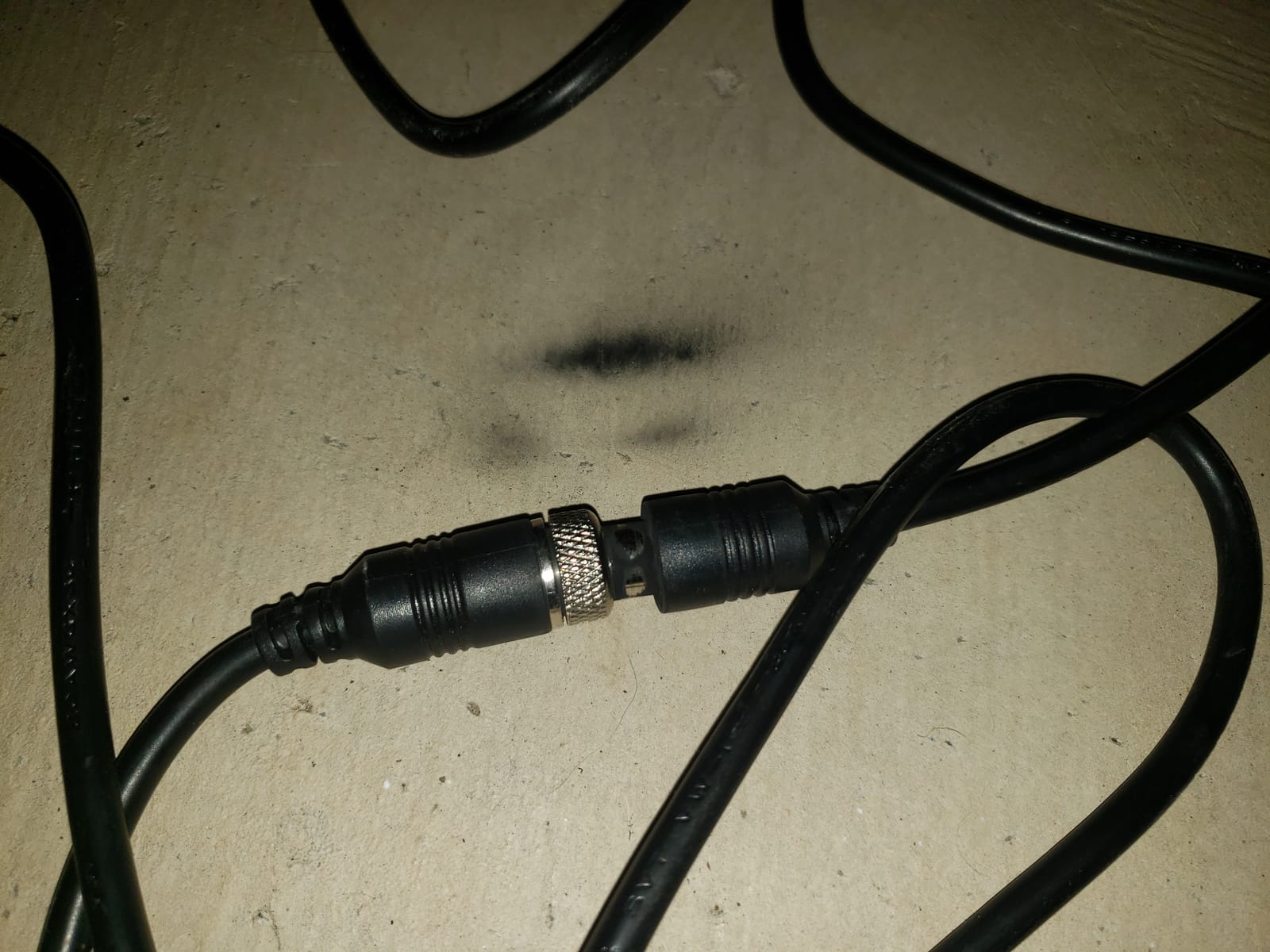
Two things temper the recommendation. The first is noise, which climbs noticeably past about half speed, so the sensible operating point in a tent is the lower half of the range. The second is the controller cable, which several owners describe as too short to reach into a sealed room, meaning the controller ends up outside where you can hear it.
Brand support is a genuine strength here. Owners report free replacement parts and responsive service, which matters more than it sounds for a fan that will sit in a duct for years. The reported failures cluster around the factory power supply, which runs warm and has failed for some owners at around the one year mark.
Who the 8 Inch 623 CFM fan suits best
It suits 4×8 and 5×10 growers who want one fan rather than a pair of smaller ones. At 623 CFM you can carry a 6 inch carbon filter and still have suction left at the end of a long duct run.
It also suits rooms on 230 V supplies, where a US-only 120 V fan would need a converter nobody wants to lose behind a wall.
Where the 8 Inch 623 CFM fan falls short
It falls short for anyone sensitive to noise above half speed, because the range above that point is where the rumble becomes part of your room. A 6 inch EC unit running lower is quieter for the same room.
It is also a 4 inch tent overkill, where it will simply be run at a setting that delivers less air than a smaller fan and makes more noise doing it.
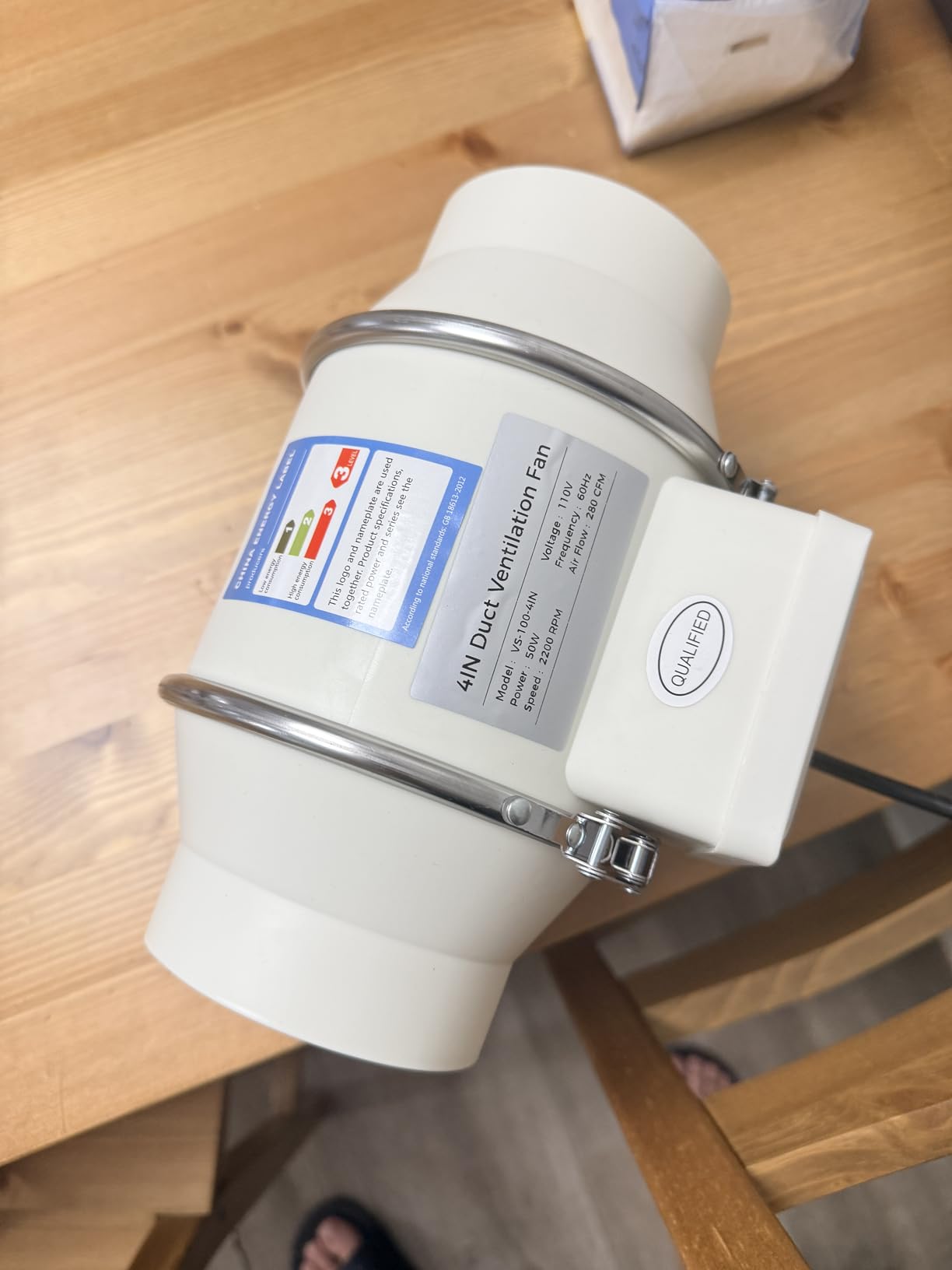
5. Voltset 4 Inch 280 CFM – The Budget Blower With a Remote
Voltset 4 Inch Duct Fan 280 CFM Inline Ventilation Exhaust Fan
Claimed 280 CFM at 2200 RPM
50 W
30 dB stated
Copper-core brushless motor
Two-speed remote
Pros
- Strong airflow for a compact 4 inch body
- Remote control with two speeds and useful range
- Quick-release clips make installation tool-free
- Two-year owner reports show no degradation over long run times
- Copper motor runs cool and smoothly
Cons
- Remote range is inconsistent and some lose signal
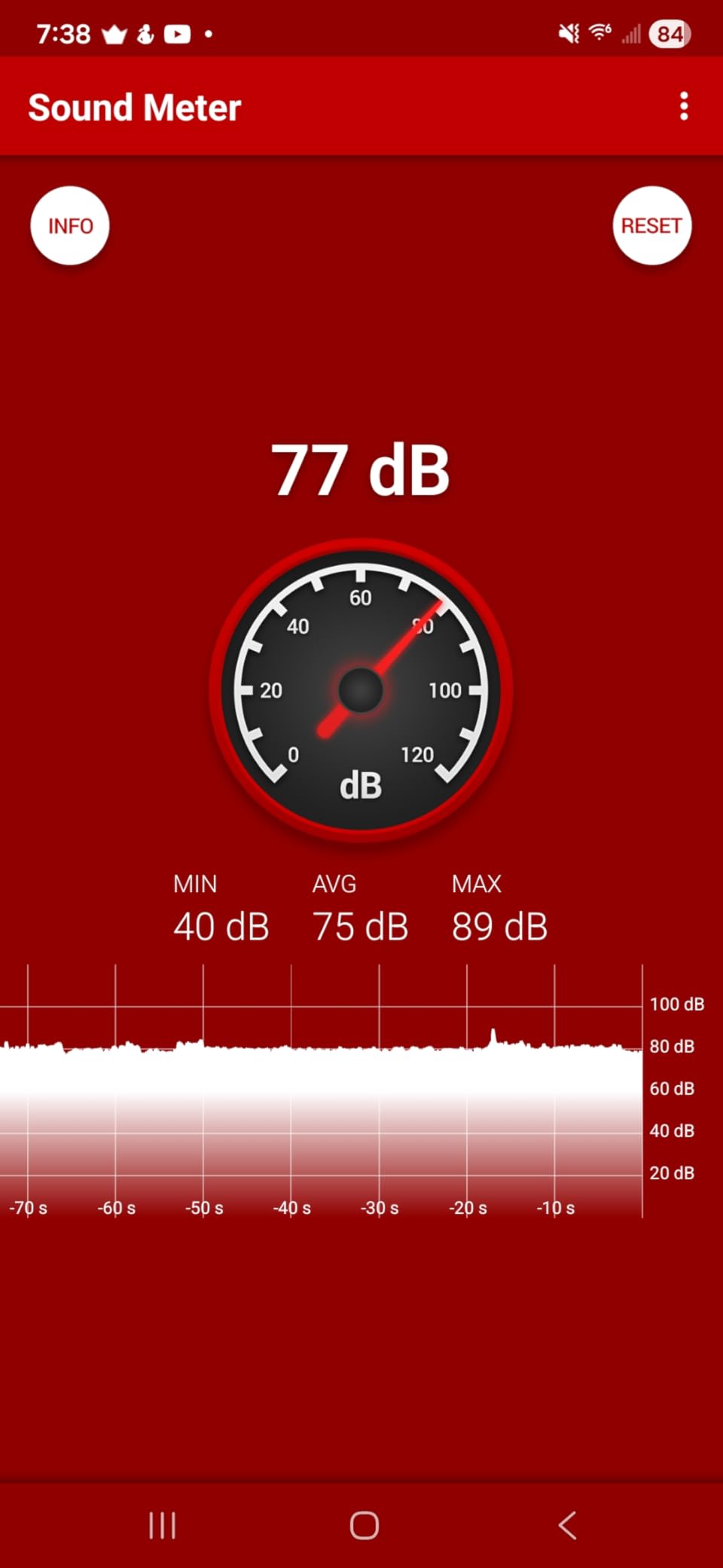
- Measured noise often lands nearer 50-60 dB than the stated 30 dB
- Minor air leak at the outer cone
- The 280 CFM claim looks inflated against similar 4 inch bodies
The Voltset is the easiest way to get a 4 inch fan that moves a lot of air without moving up a tier, and the remote control is a genuinely useful addition at this level. Two speeds plus a quick-release clip duct connection mean you can install it without tools and adjust it from outside the tent.
The motor is a copper-core brushless design rated at 2200 RPM and 50 W, and owners report it running cool and smooth. Two-year owners describe no degradation in output, which is a better durability signal than most products in this price range manage.
Now the part that stops us recommending it more widely. The 280 CFM headline is not consistent with other 4 inch bodies of the same dimensions, and some buyers have disputed it directly. Treat the real figure as closer to the 195 CFM class, which still leaves it a capable small-tent fan.
Noise is the other gap. The stated 30 dB is optimistic in real installations, with owners measuring closer to 50-60 dB. If your tent sits in a bedroom or a shared room, that difference is the whole decision.
Who the Voltset 280 CFM suits best
It suits growers in a garage, basement or outbuilding who want remote speed control and tool-free installation without moving up a tier. It suits anyone running 24 hours a day who values the two-year durability reports.
It is a good fit for a 2×4 or a small 4×4 on a modest light, where the delivered airflow after a carbon filter is still adequate.
Where the Voltset 280 CFM falls short
It falls short for quiet rooms, where the measured noise gap against the stated figure is decisive. An EC motor fan at a lower speed is simply a better neighbour.
It also falls short if your priority is holding negative pressure through a restrictive filter, because the inflated CFM claim makes it look stronger than it is against a loaded filter bed.
6. VEVOR 4 Inch 205 CFM EC – Quiet With Anti-Vibration Mounts Included
VEVOR Inline Duct Fan, 4-Inch 205 CFM with Temperature Humidity Controller, Quiet EC-Motor Ventilation Exhaust Fan for Cooling Booster, Grow Tents, Hydroponics
205 CFM at 2900 RPM
28 dB
21 W EC motor
Ten speeds
Roughly 12 percent of reviews are one star
Pros
- Genuinely quiet at 28 dB on an EC motor
- Ten speed steps give finer control than a three-speed dial
- Lowest setting is quiet enough to sleep beside
- Vibration slings and rubber mats are included
- Owners report large airflow gains on long or restricted duct runs
Cons
- Temperature and humidity probes have failed for some owners within weeks
- Controller only switches fully on or off at its set temperature
- Replacement probes are not sold separately
- Louder above roughly speed 7 on the ten step scale
This is the fan that made us reconsider budget units. A 21 W EC motor delivering 205 CFM at a stated 28 dB, with ten discrete speed steps, is a specification sheet you would expect on a much more expensive unit. Owners switching from older blowers report dramatic quietness improvements at the same airflow.
The included hardware is genuinely useful. Hang-up slings, non-vibration rubber mats and straps are in the box, and because a fan bolted rigidly to a tent frame is the main source of low-frequency rumble, those three parts do more for perceived noise than any controller setting.
The weakness is the sensor. Several owners report temperature or humidity probes failing within weeks, and replacement probes are not sold separately, which is a poor outcome when the fan itself is fine. The controller also only switches the fan fully on or fully off at its set point, with no trickle speed in between.
One star reviews make up roughly 12 percent of the total here, the highest share in this roundup, and the sensor failures are the main reason. If you buy it, plan to run it on manual ten step control and treat the sensor as a bonus rather than the reason you bought it.
Who the VEVOR 205 CFM EC suits best
It suits growers who want fine speed granularity and genuine low-speed quiet without paying for app automation. A 2×4 or small 4×4 with a carbon filter is the right size for it.
The included slings and mats make it a good pick for a tent shared with a sleeping space, because they attack the vibration path that the decibel figure does not capture.
Where the VEVOR 205 CFM EC falls short
It falls short for anyone who wants trustworthy automatic temperature control, because the sensor is the weak link and the spare part situation is poor. The all-or-nothing threshold behaviour is a step back from real proportional control.
It is also louder above about speed 7, so if you are running it flat out through a restrictive filter you lose much of the quietness advantage that justified the purchase.
7. VIVOSUN G4 AeroZesh – App and VPD Data in One Package
VIVOSUN G4 4″ 195 CFM Inline Fan &Smart Controller, Aerozesh for IndoorGrow
195 CFM at 2600 RPM
20 W EC motor
39 dB
GrowHub E42A plus controller
Wall-mountable metal base
Pros
- EC motor delivers 195 CFM on only 20 W
- App shows temperature humidity and VPD data
- Automatic speed response to custom thresholds
- Fits the wider VIVOSUN smart grow ecosystem
- Metal base allows clean wall mounting
Cons
- Costs close to double a comparable non-smart 4 inch fan
- Full automation is only useful inside the VIVOSUN ecosystem
- Phone WiFi and probe setup is required before the benefits show
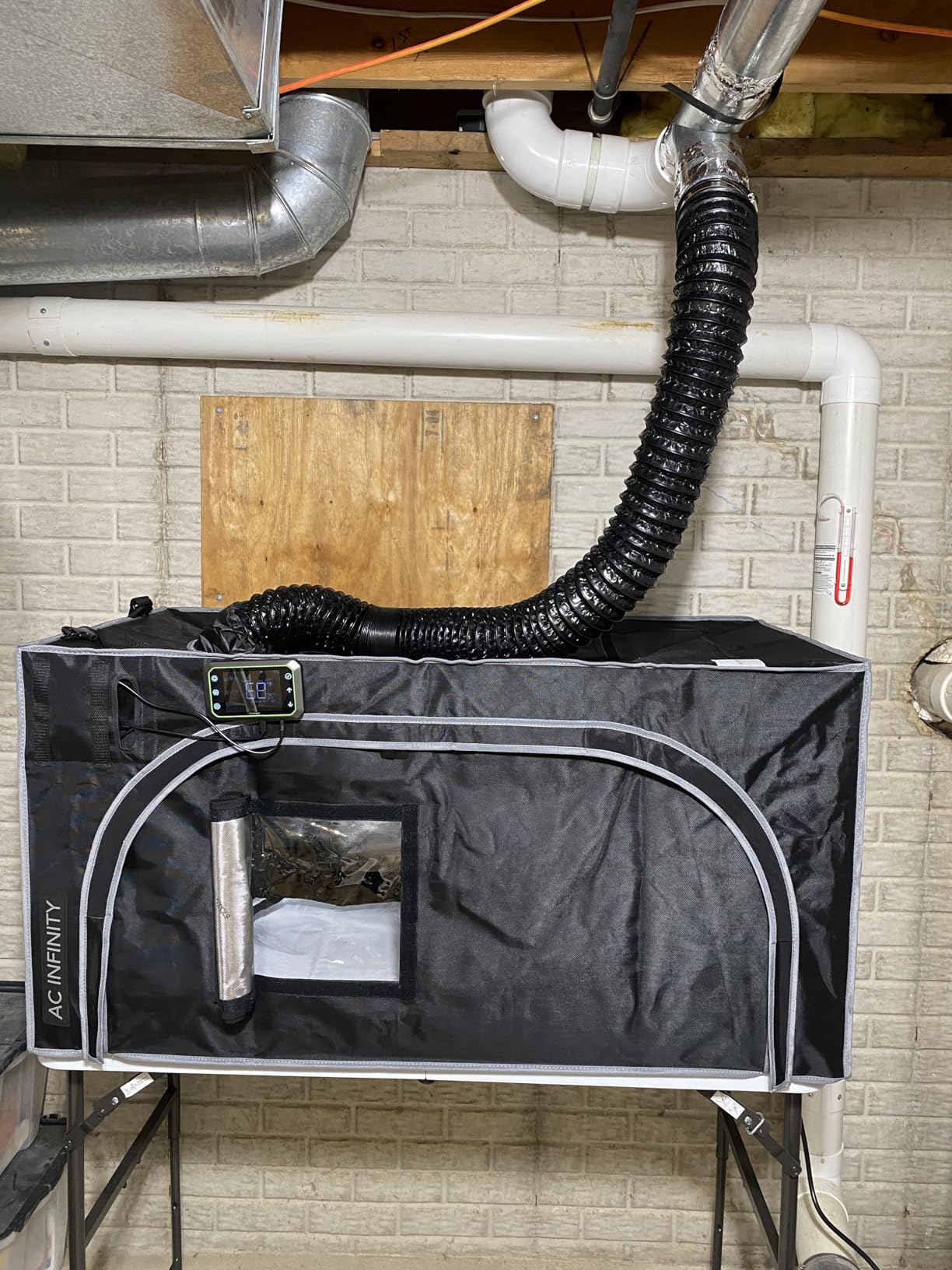
The G4 pairs a 195 CFM mixed-flow impeller with the GrowHub E42A+ controller, and that pairing is the reason to consider it. The controller reads temperature and humidity, calculates VPD in the app, and drives fan speed from thresholds you set rather than a single on-off point.
The fan itself is efficient, drawing 20 W at a stated 39 dB, which is a slightly higher noise figure than the other EC motors here but with a much lower power draw. A wall-mountable metal base is a practical touch in small tents where floor space is the scarce resource.
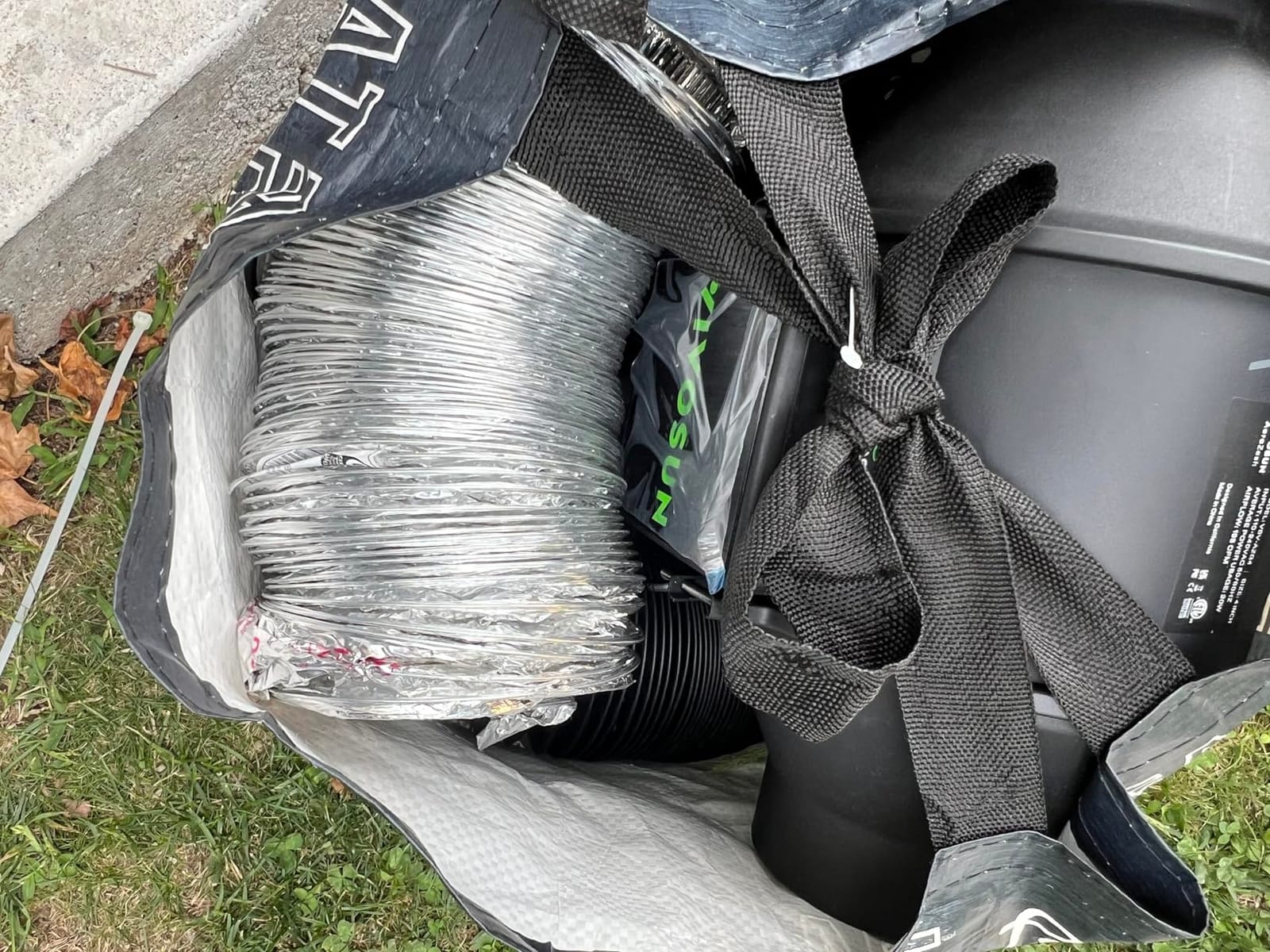
The catch is ecosystem lock-in. The automation is at its best when the fan is part of a wider VIVOSUN setup, and outside that ecosystem you have bought a more expensive fan with a smaller community and a shorter review history than the alternatives.
With 367 reviews the sentiment is still early, though what exists is positive on efficiency and climate automation. If you are starting from nothing, the price relative to a non-smart 4 inch fan is hard to justify on fan performance alone.
Who the VIVOSUN G4 suits best
It suits existing VIVOSUN ecosystem users who want the fan, the probe and the automation in one box. It also suits anyone who wants VPD numbers in an app rather than on a cheap hygrometer clipped to a pole.
If your tent is wall-mounted in a tight corner, the metal base and its vertical mounting are worth more than a second exhaust port.
Where the VIVOSUN G4 falls short
It falls short for a first single-fan tent where you only need one controlled exhaust. The premium over a non-smart equivalent is roughly double, and that gap is rarely repaid by airflow.
It also falls short if you dislike phone-dependent control, since the speed changes you care about are the ones the app makes.
8. Hon and Guan 4 Inch 130 CFM – The Lowest Power Draw in the Lineup
Hon&Guan 4 Inch Upgrade Inline Duct Fan with Stepless Speed Controller – 130 CFM, 6W Low Power, Low Noise Ventilation Fan for Grow Tents, Hydroponics, Basements
130 CFM at 4500 RPM
6 W DC motor
26 dBA
165 Pa
1.43 lb
Pros
- Extremely low 6 W draw for 130 CFM of airflow
- Very quiet at 26 dBA
- Stepless controller for fine adjustment
- Light at 1.43 lb and easy to hang
- 100-240 V universal input
Cons
- Only 130 CFM
- which limits it to small tents and closets
- Thin 163 review history on a recent release
- Controller has no temperature or humidity automation
- Still supplied with a US plug
This is the efficiency outlier of the roundup. Six watts for 130 CFM, paired with a 26 dBA rating and a 165 Pa static pressure figure, is a lot of ventilation for very little power. For a 2×2 tent, a propagation box or a mother plant room, that is a genuinely good package.
The stepless controller gives finer adjustment than the two-speed and three-speed products lower down this list, and the 100-240 V input removes the converter problem entirely. Owners describe it as one of the quietest things they have run.
The limitation is arithmetic. 130 CFM covers a 2×2 tent or a small closet setup and nothing more, and once you add a carbon filter the delivered figure falls well below that. It is not a 4×4 fan under any configuration.
The other caveat is evidence. This is a recent release with 163 reviews behind it, so the durability picture is still forming, and the controller offers no temperature or humidity automation at all, which is either a simplification or an oversight depending on your view.
Who the Hon and Guan 130 CFM suits best
It suits 2×2 tent growers, propagation and mother plant setups, and anyone who wants ventilation without adding measurable load to a power meter. Mushroom and fungiculture tents are the other natural fit.
It also suits anyone whose supply is 230 V, because the universal input means no external converter is needed.
Where the Hon and Guan 130 CFM falls short
It falls short as soon as the tent grows. Past a 2×4, this fan cannot hold the heat from a mid-size light, no matter how well you plumb the duct.
It also falls short for anyone who wants sensor-driven control, because the controller is manual only and there is no probe input.
9. Hon and Guan PRO 6 Inch 405 CFM – Metal Housing for Damp Rooms
Hon&Guan PRO 6 Inch Inline Duct Fan – 405 CFM with Quiet EC Motor & Speed Controller, Ventilation Exhaust Fan for Heating Cooling, Grow Tents, Hydroponics (Black&Orange)
405 CFM mixed-flow
32 dB EC motor
Stepless 0-100 percent
IP42 metal housing
4.44 lb
Pros
- 4.5 stars across 149 ratings
- 405 CFM from a 6 inch EC motor at 32 dB
- Stepless 0-100 percent control rather than stepped speeds
- Metal housing with IP42 protection suits damp grow areas
- Roughly 50 percent lower energy use than an equivalent AC motor
Cons
- Small 149 review history leaves little long-term durability evidence
- Noise rises noticeably at the top of the speed range
- Runs well above the spend of the other 6 inch class options here
- No temperature or humidity automation despite the Pro branding
The 6 inch 405 CFM spec is our pick for a 4×4 tent. That is enough to move a 6 inch carbon filter with headroom, in a body that sits between the small 4 inch units and the very large 8 inch blowers. The EC motor is rated at 32 dB, and the ABS blade design is claimed to lift airflow by 40 percent over a conventional impeller.
The housing is the differentiator. Metal construction with an IP42 rating against dust and liquid matters in a tent with a humidifier or a room that sweats in summer, and it is a durability argument rather than a specification argument.
Who the Hon and Guan PRO 405 CFM suits best
It suits 4×4 and 4×5 growers who want a 6 inch filter fed properly and who have a damp room where a plastic housing worries them. Stepless 0-100 percent control makes it easy to tune down for night-time noise.
It also suits anyone who wants the energy profile of an EC motor without committing to an app-based system for control.
Where the Hon and Guan PRO 405 CFM falls short
It falls short on evidence. With 149 reviews the model is new, and the thing this roundup values most is a long service record, so you are buying a well-specified fan without a durability history.
Noise also climbs at the top of the range, and the Pro branding promises more automation than the controller actually provides, since there is no temperature or humidity input.
10. Toolazy 4 Inch 214 CFM – The Quiet 4 Inch Pick With Stepless Control
Toolazy 4 Inch Inline Duct Fan 214 CFM, Vent Booster Exhaust Fan with 0-100% Variable Speed Controller, EC Motor 27 dBA Quiet Ventilation Fan for Grow Tent, HVAC, Basement, Bathroom, Crawl Space
214 CFM at 3000 RPM
27 dBA EC motor
30 W
0-100 percent dial
ETL listed
Pros
- 4.6 stars across 114 ratings
- True 0-100 percent variable speed rather than preset steps
- Very quiet at low and mid settings
- Mounting holes match common 4 inch blowers for easy swaps
- Dual sealed ball bearings rated for 24/7 duty
Cons
- Full output is loud so speed control becomes mandatory
- The two included brackets are reported as awkward or misaligned
- The secondary speed switch plugs into a separate cord
- Small 114 review base for a newer product
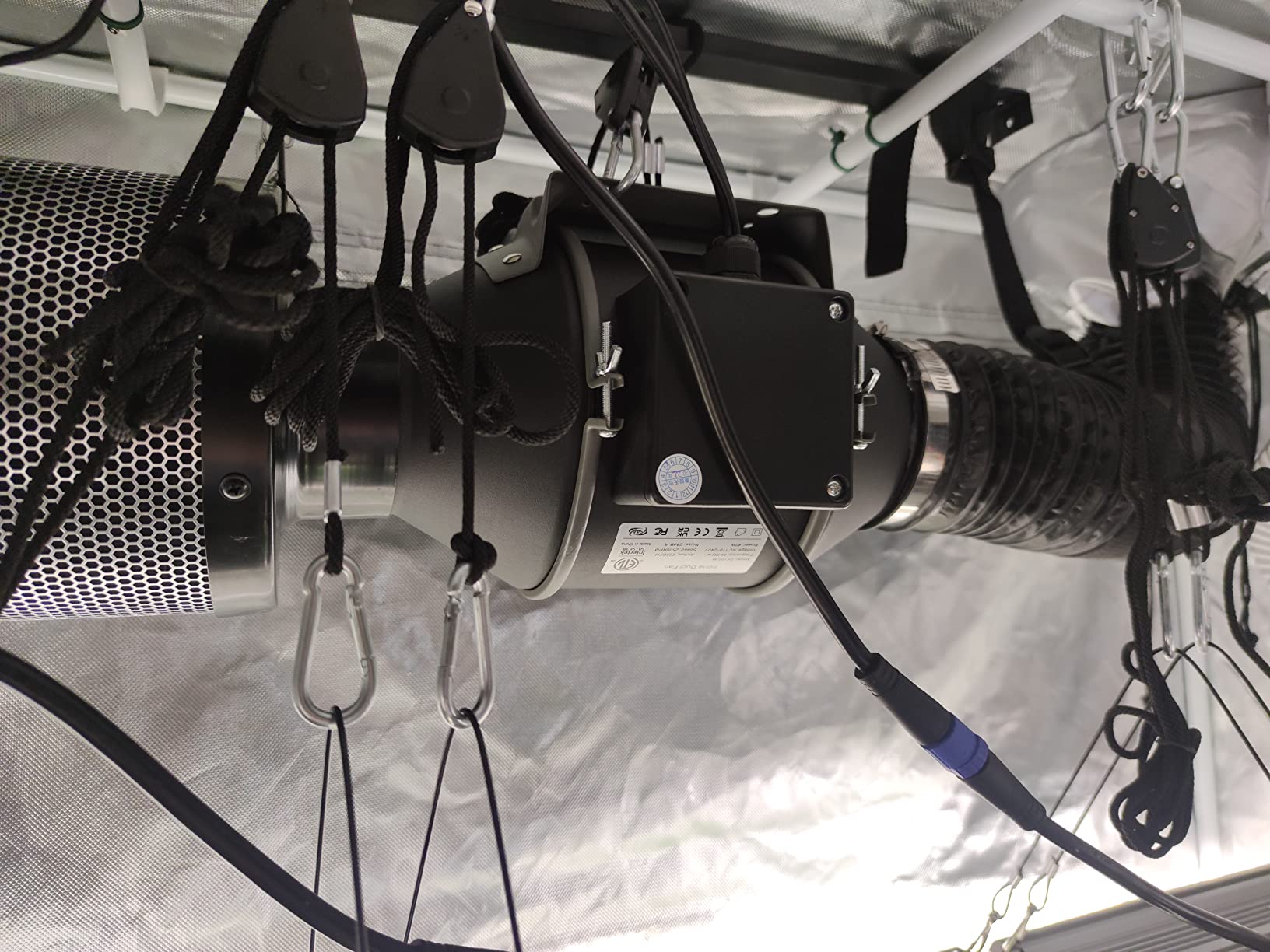
The Toolazy is the fan we would put in a small tent in a room where noise matters. A 27 dBA EC motor at 30 W and 3000 RPM, driving 214 CFM, is a strong noise-to-airflow ratio for the 4 inch size. Owners replacing older blowers describe it as roughly twice as quiet at comparable output.
The controller is a genuine 0-100 percent knob rather than a stepped dial, and mounting holes match common earlier 4 inch blowers so a swap takes minutes. Dual sealed ball bearings are specified for continuous 24/7 duty, which is the right standard for a fan that never switches off in bloom.
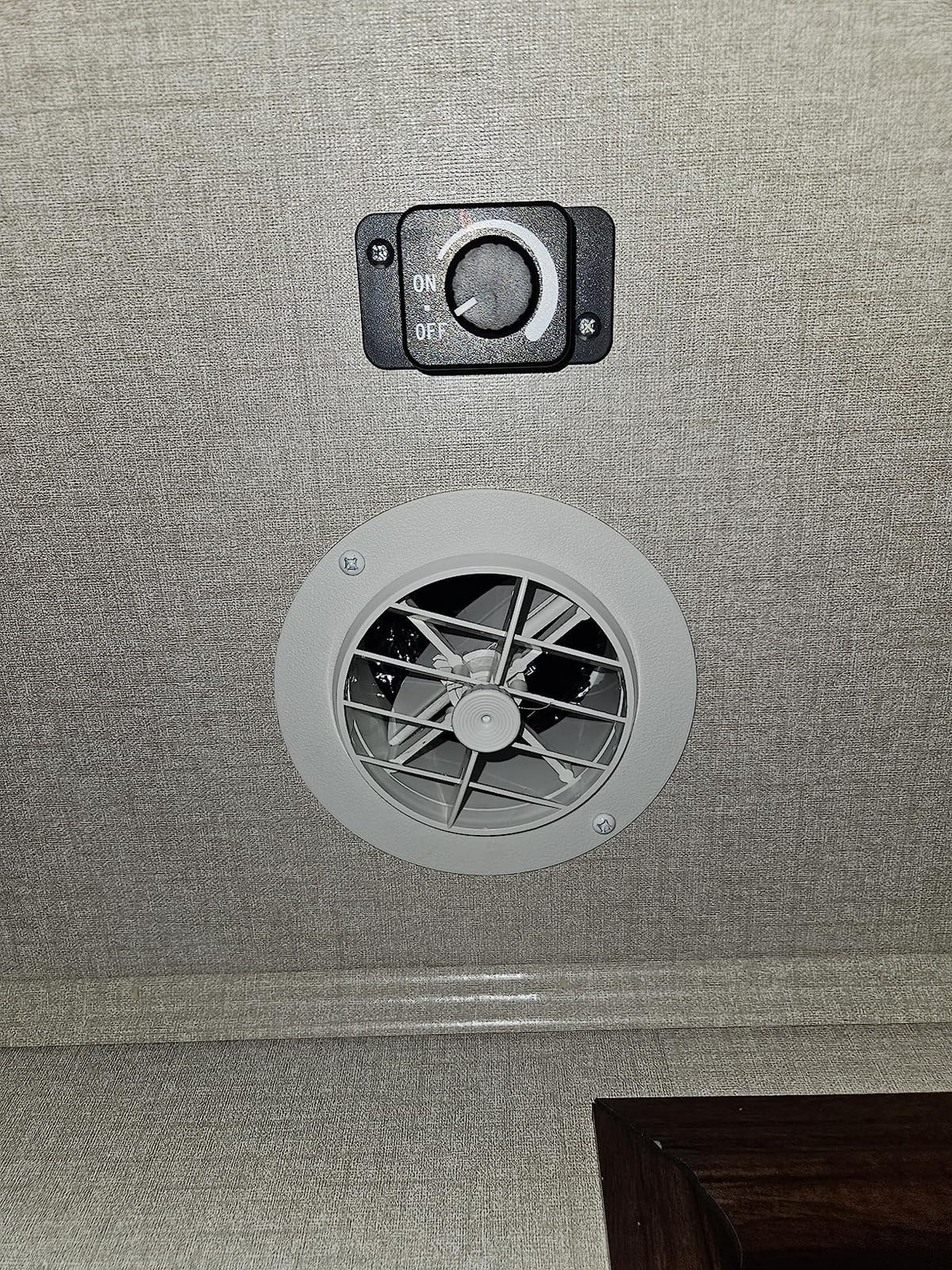
The catch is that full output is loud, which makes the speed control mandatory rather than optional. A small number of owners have reported the supplied brackets being awkward or misaligned, and the secondary speed switch connecting through a separate cord is the sort of detail that complicates a clean install.
With 114 reviews this is one of the least-proven products here, and that is the main reason it sits below the more established units despite the strong rating. The specification is right; the evidence is still arriving.
Who the Toolazy 214 CFM suits best
It suits 2×4 and small 4×4 growers in shared rooms who want a very quiet running 4 inch fan without moving to app control. Growers replacing an older noisy blower report the biggest satisfaction jump here.
It is a natural pairing with a 4 inch carbon filter, since the fan is specified for both 4 inch ductwork and 4 inch filters.
Where the Toolazy 214 CFM falls short
It falls short if you want a fan that will run flat out all day without a sound penalty, because the top of the range is where the noise advantage disappears. Budget your controller use rather than ignoring it.
It also falls short for buyers who weight long-term reliability above specifications, since a 114 review base cannot tell you how the bearings look after five years.
11. Artibear 3.5 Inch 168 CFM – The Micro and Mushroom Tent Favourite
Artibear 3.5 Inch 168 CFM Inline Duct Ventilation Fan with 2 Speed Controller, Air Vent Blower for Hydroponic Grow Tent, Greenhouse, Workshop, Attics, Basement, Kitchens, Black
168 CFM max and 138 CFM min
2240 and 1860 RPM
24 W and 0.23 A
35 dB
1.3 lb
Pros
- Lowest outlay in the group by a wide margin
- Two speeds plus a separate on and off switch
- Quiet enough to run beside a room air purifier
- Four Velcro strips make tent hanging quick
- Owners report multi-year 24/7 use in micro and mushroom grows
Cons
- Low static pressure means restrictive carbon filters bog it down
- Some owners dispute the 168 CFM rating
- Body is slightly smaller than 4 inch ducting and needs an adapter
- 35 dB rather than the sub-30 dB of EC motor rivals
Not every grow needs a 4 inch duct. The Artibear is a 3.5 inch two-speed blower rated at 168 CFM maximum and 138 CFM minimum, drawing 24 W, and for a micro grow, a mother plant setup or a mushroom tent it is a proportionate piece of kit rather than a compromise.
Two speeds with a separate on-off switch give more control than a single-speed budget fan, and the four included Velcro strips make hanging it in a tent almost instant. Owners in micro and fungiculture setups report running it around the clock for multiple years.
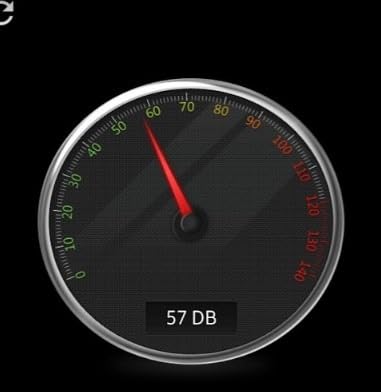
Static pressure is the weakness, and it is the one that decides your filter. The body moves plenty of air in clean conditions but bogs down against a restrictive carbon filter, which is exactly the situation a bedroom-adjacent grow creates. Some owners also question the 168 CFM figure itself.
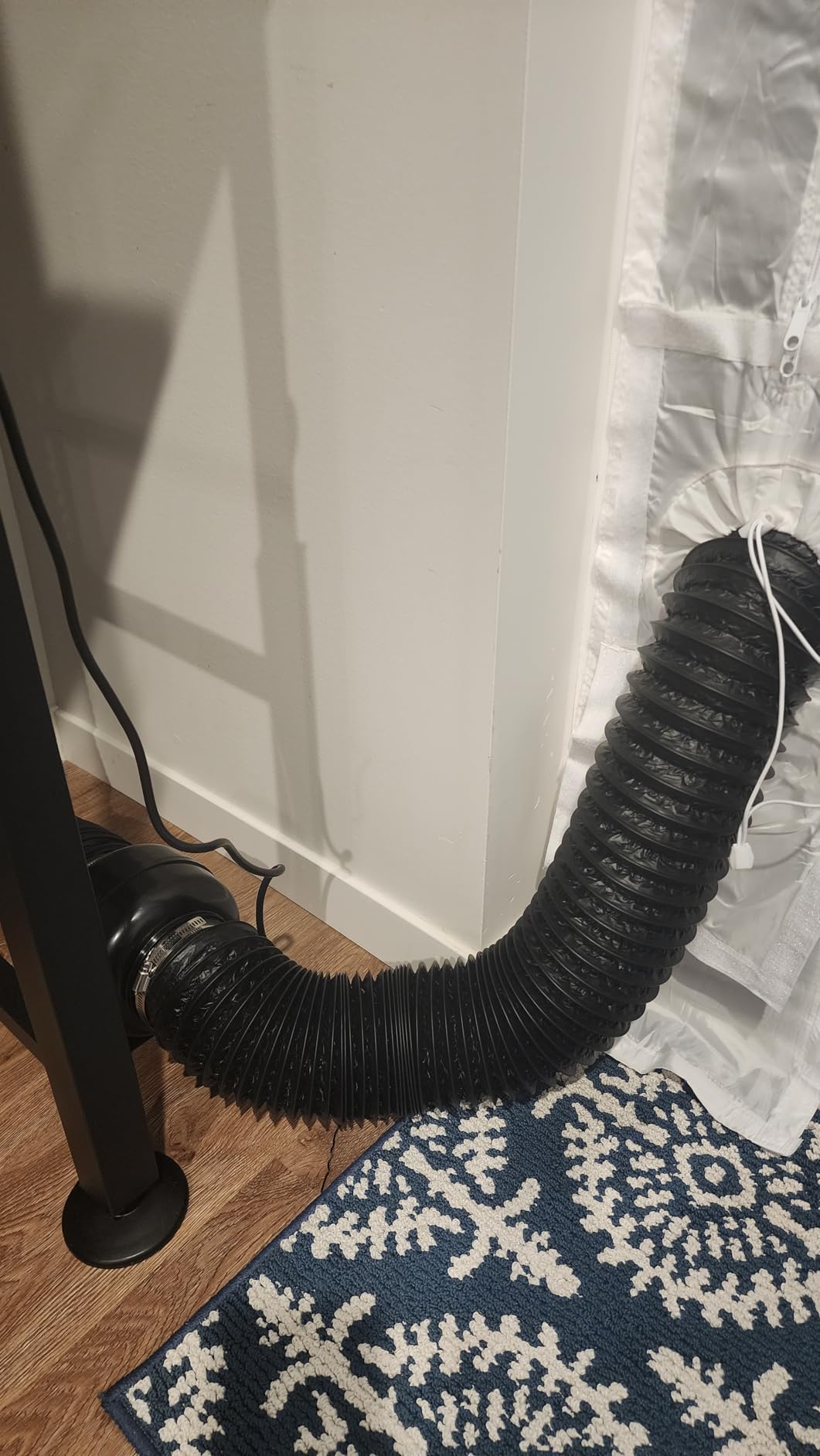
There is also a fitment issue worth checking before you buy: the body is slightly smaller than 4 inch ducting, so an adapter is needed to step up to standard 4 inch flex. At 35 dB it is louder than the EC motor units at the same nominal size.
Who the Artibear 168 CFM suits best
It suits micro growers, mushroom and fungiculture tents, and anyone running a 2×2 through the vegetative stage. The two speeds and low draw are proportionate to that scale of grow.
It also suits anyone who wants a second circulation or intake fan without spending meaningfully, since the price point makes a matching pair realistic.
Where the Artibear 168 CFM falls short
It falls short anywhere a carbon filter is fitted, because low static pressure means the delivered airflow drops away quickly. For odor control, choose a 4 inch unit instead.
It also falls short for a flowering tent with any real light load, where 168 CFM rated will not carry the heat out of a room of that size.
12. VIVOSUN R4 4 Inch Inline Fan – The Stepless-Control Workhorse
VIVOSUN R4 4″ Inline Fan, 190 CFM for Grow Basement Bathroom Kitchen Attic
190 CFM at 2300 RPM
59 W
30 dB claimed
Stepless in-line speed control
90 day warranty
Pros
- Largest review base in the group with over 14700 ratings at 4.5 stars
- Stepless in-line speed control is finer than a three-speed dial
- Owners report years of 24/7 run time with no power loss
- Compact and light enough for small tents and tight installs
- Mounting bracket shows airflow direction
Cons
- Louder than EC motor rivals especially at full speed
- Motor whines at lower speeds and wind noise dominates at maximum
- Weaker motor bogs down against restrictive carbon filters
- Only a 90 day manufacturer warranty
The R4 is the fan with the deepest evidence base in this roundup: more than 14,700 ratings averaging 4.5 stars, which makes it the safest default in the whole category. It is a 4 inch mixed-flow fan rated at 190 CFM and 2300 RPM, and the impeller blends axial and centrifugal characteristics so it copes better with a filter than a pure axial booster.
The stepless in-line speed controller is what separates it from the D4 in pick one. Instead of a button, the speed is set on a dial mounted on the power cord, so you can trim the airflow continuously rather than choosing between full output and silence. That granularity is exactly what a tent needs as it moves from vegetative growth to flowering.
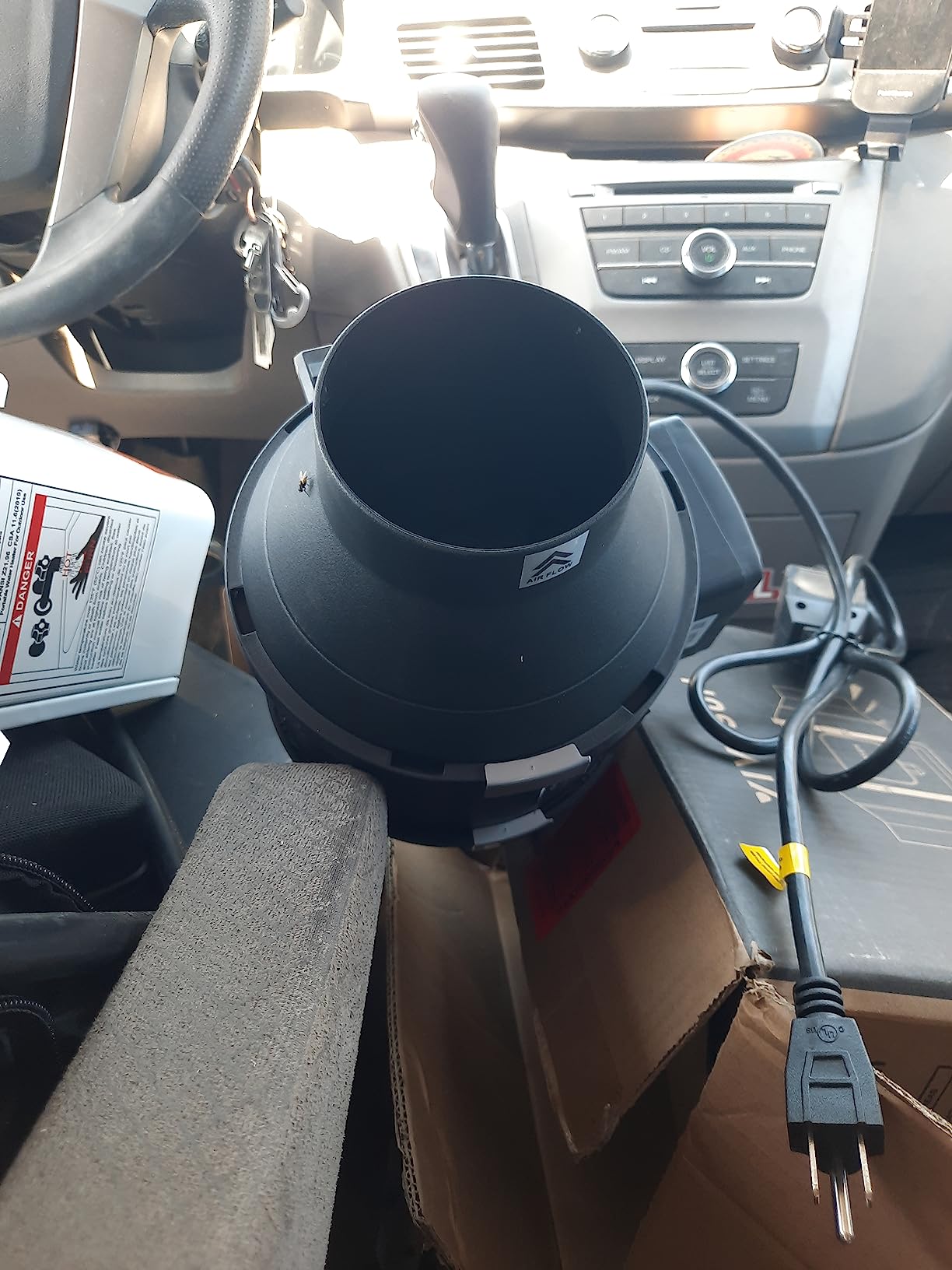
Owners report years of continuous 24/7 run time without losing power, and at 4.7 pounds it is light enough to hang anywhere in a tent. The mounting bracket is a small touch that matters more than it sounds, because it marks which way the airflow should travel through the duct.
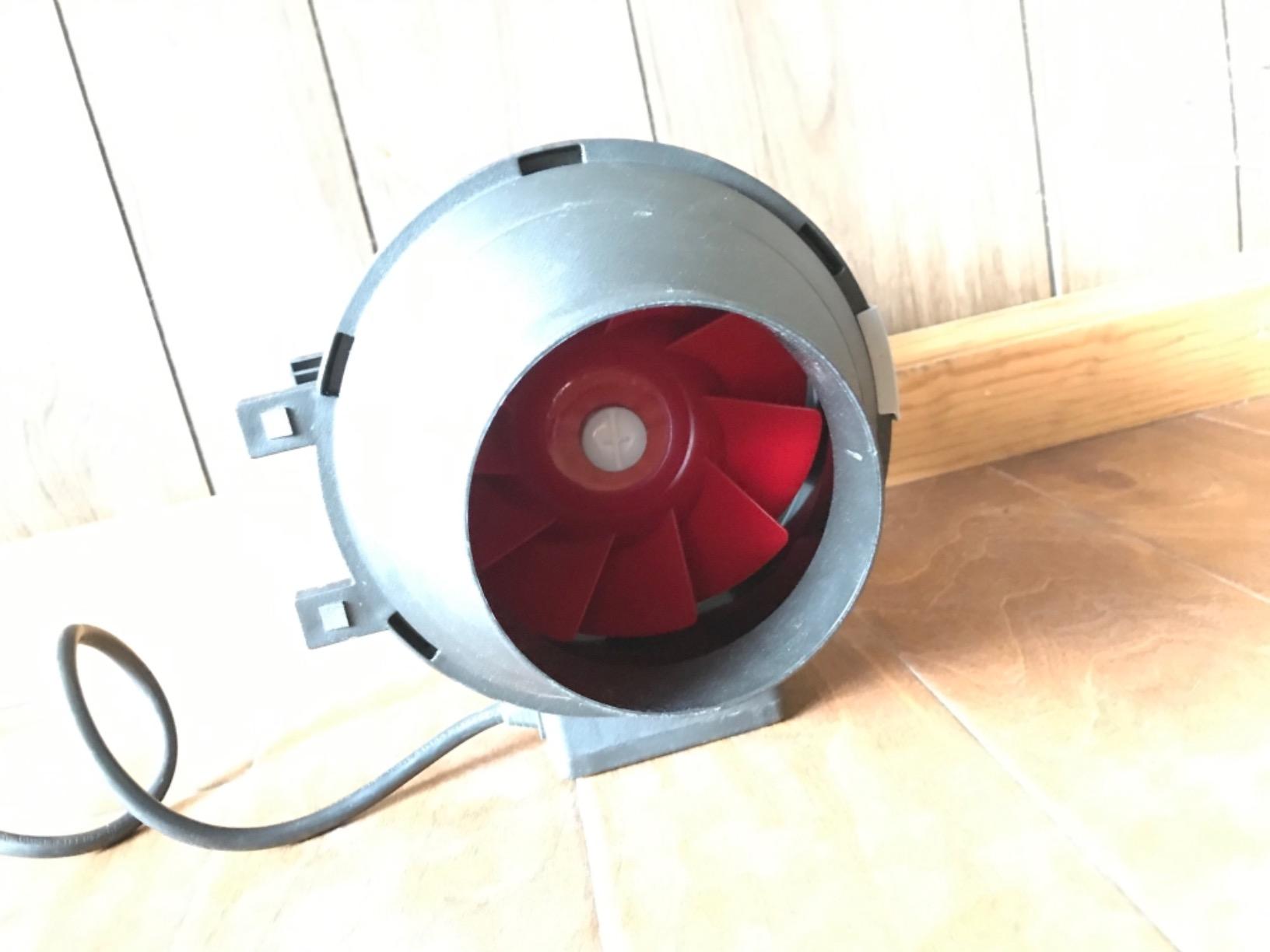
The weaknesses are consistent and worth stating plainly. It is louder than the EC motor units at full speed, and the motor itself whines at low settings, so the quietest point of this fan is the middle of its range rather than the bottom. Buyers also report the motor bogging down against restrictive carbon filters, which is the familiar weak-motor complaint from grow forums.
The 90 day warranty is the shortest of any product here, and some combo bundles include only two hose clamps. Over a multi-year grow that warranty length is the real cost, because a fan failure late in a cycle is a problem you pay for in heat rather than money.
Who the VIVOSUN R4 suits best
It suits 2×4 and small 4×4 growers who want finer airflow control than a single-speed fan without paying for an app. The stepless dial is the feature most owners single out in reviews.
It also suits anyone who values a proven service record over a specification sheet, since the volume of long-run owner reports here is larger than every other fan in the roundup combined.
Where the VIVOSUN R4 falls short
It falls short for anyone filtering heavily or running in a quiet room. The motor bogs against a loaded carbon filter and the sound at high speed is the loudest in this group.
The 90 day warranty is also the shortest here, so treat it as a consumable that you should expect to inspect rather than a lifetime purchase.
How to Size an Inline Fan for Your Grow Tent
Start with your tent’s volume, not with the fan’s CFM number. Multiply length by width by height in feet to get cubic feet, then multiply that by 1.1 to get the air changes you need per minute. A 4×4 tent at 6.5 feet tall comes to 104 cubic feet, so you need roughly 115 CFM of airflow to exchange the full volume once a minute.
Then adjust for everything that resists the air. A carbon filter costs you about 25 percent. Each additional grow light adds roughly 10 percent, each 90 degree duct bend adds about 30 percent and a 45 degree bend about 15 percent, and every foot of extra ducting takes roughly 1 percent off. Add another 25 percent of headroom so the fan does not run pinned at maximum, which is where noise and wear are worst.
For a 2×4 tent, that arithmetic lands you in the 130 to 205 CFM band, so a 4 inch fan is the right diameter. For a 4×4, you need roughly 300 CFM delivered, which means either a 6 inch fan or a strong 4 inch booster with a clean duct run. A 4×8 or 5×10 is a different problem entirely, and we come back to it below. If the enclosure itself is still undecided, our broader tent roundup covers the sizes worth planning around.
Once you have a fan, check it the only way that really counts. Seal the tent, open the intake, light a smoke pencil near the door zip and see whether the tent draws inward. That is negative pressure, and a fan that will not hold it is not doing the job, whatever its rating says.
Carbon Filters, Duct Bends and Why Box CFM Overstates Airflow
Static pressure is the resistance the fan has to push against to move air, and a carbon filter is the single biggest source of it in a grow tent. The CFM on a box is measured in clean air with no restriction, so the moment you add a filter the real number falls, sometimes to well under half of the printed figure.
This is the single most repeated complaint in grow forums. Users describe fans that hit their rated CFM in an empty room and then cannot hold the tent door closed once a filter is fitted, and they describe the cheap motors as the usual culprit. An axial booster is the worst offender here, which is why the RAXIAL S6 carries an explicit warning about restricted airflow applications.
Two rules follow. First, buy a fan with published static pressure data if you can, and treat published static pressure as the number that matters rather than peak CFM. Second, run the fan against a loaded filter, not an empty one. Filter beds load up over a grow, and airflow falls gradually with no alarm to tell you.
The good news is that most of the cost is in the ducting layout, not the fan. A straight run with two gentle bends and a short filter can keep you near the rated figure. A spiral of 90 degree elbows will cost you more than the motor you saved.
Controller Tiers: Dial, Ten-Speed, Sensor or App
Every fan here falls into one of four controller tiers, and the tier is usually the main price difference. A manual dial gives you on, off and one or two intermediate positions. A ten-speed or stepless controller gives you continuous control and is the most useful tier for most growers. Sensor control adds automatic threshold switching. App control adds remote scheduling and data logging on top.
Our read, based on how these are actually used, is that the ten-speed or stepless tier is where the value sits. Growers report rarely opening an app once a cycle is running, but everyone benefits from being able to drop the fan to a low setting at night. Sensor control is worth it when your tent runs unattended for days.
App control is the tier to be sceptical about. The forums are full of owners who say they would probably never check a phone display during a grow, and a phone-dependent fan is one more thing that can fail without warning. If you buy one, confirm it runs sensibly on manual control first.
For large tents, the pairing question comes up constantly. Should the intake fan match the exhaust fan? Not necessarily in CFM terms, but the exhaust must be the stronger of the two or the tent goes positive and odor escapes. Running a slightly weaker intake is the standard approach, and it is why single-fan setups with a filtered exhaust are so common.
For 4×8 and 5×10 tents, two fans beat one. Two filtered exhausts at opposite ends remove air more evenly than a single unit, and they cut the duct length each one has to push through. If you only have one fan for a tent that size, that is where the 623 CFM 8 inch model earns its place.
Finally, buy from a seller with clear warranty and return terms at the point of purchase. Fan models get reissued with the same name and weaker hardware, and the only protection is a return window that is still open when you find out. Our broader gear notes cover this in our equipment roundup.
Frequently Asked Questions
What size inline fan do I need for my grow tent?
Size by tent volume first. Multiply length by width by height in feet, then by 1.1 for one full air exchange per minute. Add about 25 percent for a carbon filter, 10 percent per extra grow light, 30 percent per 90 degree duct bend and 1 percent per extra foot of duct, then add 25 percent headroom. A 2×4 needs a 4 inch fan, a 4×4 needs 6 inch, and 4×8 or larger is best served by two fans.
What size inline fan for a 2×4 grow tent?
A 4 inch inline fan in the 130 to 205 CFM band covers a 2×4 tent. The 195 CFM VIVOSUN D4 and the 214 CFM Toolazy both sit comfortably in that range, and the 130 CFM Hon and Guan unit works if your light is small or you are only running vegetative cycles.
What size inline fan for a 4×4 grow tent?
A 4×4 tent needs roughly 300 CFM delivered after the filter penalty, so a 6 inch mixed-flow fan such as the 405 CFM Hon and Guan PRO is the safer choice. A 265 CFM axial booster works if your duct run is short and you are not filtering.
How many CFM does a grow tent need?
One full air exchange per minute means multiplying tent volume in cubic feet by 1.1. A 4×4 tent at 6.5 feet tall is about 104 cubic feet, so base airflow is roughly 115 CFM before you account for a carbon filter, ducting, bends and extra lights.
Should an inline fan pull air out of a grow tent?
Yes. In the standard setup the inline fan is the filtered exhaust pulling air out of the tent, which creates the suction that draws fresh air in through the intake port. That negative pressure is what stops odor escaping and keeps the tent drawing air in the direction you want.
Is the intake fan the same size as the exhaust fan?
Not exactly. The exhaust should be the stronger of the two so the tent stays in negative pressure. A slightly weaker intake fan is normal and common, and pairing two identical fans on the same tent is fine when you want even air removal.
Are inline duct fans worth it?
They are worth it whenever you need negative pressure, odor control through a carbon filter, or a long duct run. For a small tent with a short clean duct and no filter, a duct booster fan handles the same heat at lower cost, and forum growers report running a 4×4 on two boosters successfully.
Why is my inline fan loud?
Loudness usually comes from four things: running the fan at full speed all the time, rigid mounting that transfers vibration to the tent frame, restrictive ducting that makes the impeller work harder, and cheap motors with a narrow operating range. Speed control, rubber isolation mats and the shortest possible duct run fix most of it.
Do I need a temperature and humidity controller on my fan?
Only if your tent runs unattended. For a grow you can check daily, a stepless or ten-speed manual controller is the most useful tier and costs less. Sensor control earns its place when you are away for days, though budget sensor probes are the most common failure point we found.
Does a carbon filter reduce inline fan airflow?
Yes, substantially. A carbon filter typically costs around 25 percent of rated airflow, and the number printed on the fan box is measured in clean air with no restriction. That is why published static pressure matters more than peak CFM when you are filtering.
Final Verdict on the Best Inline Fans for Grow Tents
The VIVOSUN D4 is our pick overall: 195 CFM, a brushless motor rated at 2500 RPM, a flow deflector that keeps it civil at 30 dB, and more than 13,500 ratings behind it. For a 2×4 or small 4×4 it is the most proven answer to the question of what are the best fans for grow tents, and it needs no app to work.
Pick the AC Infinity CLOUDLINE T4 if your tent runs unattended and noise in a bedroom-adjacent room matters. Pick the 8 inch 623 CFM Hon and Guan for a 4×8 or 5×10, and pick the Toolazy 4 inch if the tent shares a room with a sleeping space. Whichever you choose, verify negative pressure with a smoke pencil on day one, and re-check it once the carbon filter has loaded up.