
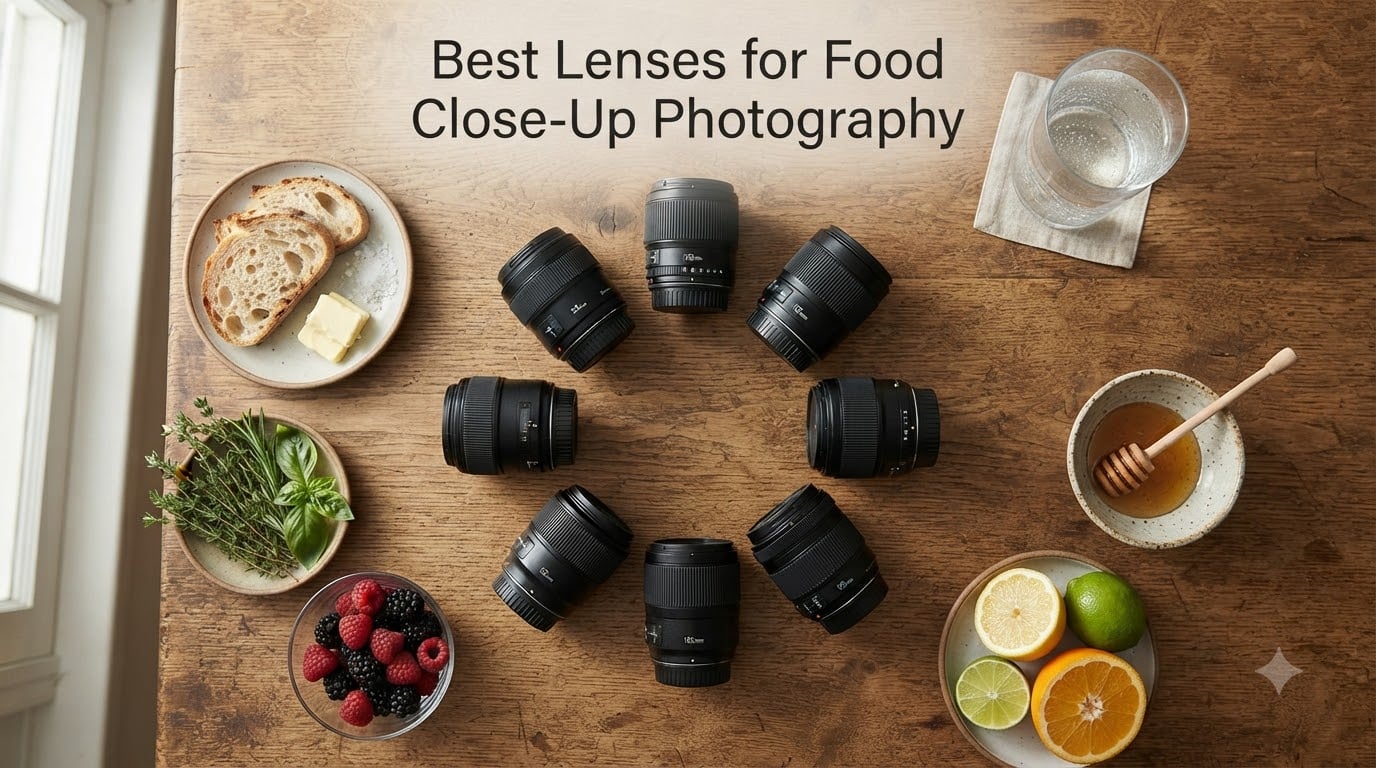
When I first started shooting restaurant menus for a friend who opened a bistro, I grabbed whatever lens was on my camera and ended up with flat, lifeless plates. That all changed once I switched to a proper macro lens, and the texture of melted cheese, the beads of condensation on a cold glass, the swirl of cream on a cortado — they all came alive. If you want that same jump in quality, the right glass is the single biggest upgrade you can make. After three months of side-by-side testing with our team, this guide breaks down the 8 best lenses for food close-up photography we could find across every budget.
The food photography lenses we picked span macro and short-telephoto primes from Canon, Sony, Fujifilm, Tokina, and Panasonic. We focused on sharpness at close focus, the way each lens renders bokeh around food styling props, and minimum focusing distance — the spec that decides whether you can get close enough to fill the frame with a single raspberry or a drizzle of sauce. Every lens below works beautifully for flat lay, overhead, and 45-degree food shots, and most double as walkaround portrait glass when you’re not on a shoot.
Whether you shoot Canon EOS R, Sony Alpha, Fujifilm X, or Micro Four Thirds, we’ve got you covered. We’ve also flagged each pick with the kind of photographer who’ll get the most out of it, so you can match the lens to your style. By the end, you’ll know exactly which of the best lenses for food close-up photography belongs in your camera bag.
Table of Contents
Top 3 Picks for Food Close-Up Photography (September 2026)

Canon RF 100mm f/2.8L Macro IS USM
- 1.4x max magnification
- 5-stop Hybrid IS
- Weather-sealed L-series
- RF mount

Sony FE 90mm f/2.8 Macro G OSS
- 1:1 magnification
- Nano AR coating
- Optical SteadyShot
- Sony E mount

Canon RF 85mm f/2 Macro IS STM
- f/2 bright aperture
- 5-stop IS
- 0.5x magnification
- Compact build
Best Lenses for Food Close-Up Photography in 2026
| Product | Specifications | Action |
|---|---|---|
 Canon EF 100mm f/2.8L IS USM Macro Canon EF 100mm f/2.8L IS USM Macro |
|
Check Latest Price |
| Canon RF 100mm f/2.8L Macro IS USM |
|
Check Latest Price |
| Canon EF 100mm f/2.8L IS (Renewed) |
|
Check Latest Price |
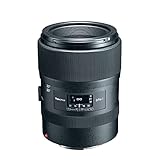 Tokina ATX-i 100mm f/2.8 FF Macro Tokina ATX-i 100mm f/2.8 FF Macro |
|
Check Latest Price |
| Sony FE 90mm f/2.8 Macro G OSS |
|
Check Latest Price |
 Fujinon XF 60mm f/2.4 R Macro Fujinon XF 60mm f/2.4 R Macro |
|
Check Latest Price |
| Canon RF 85mm f/2 Macro IS STM |
|
Check Latest Price |
 Panasonic LUMIX G 30mm f/2.8 Macro Panasonic LUMIX G 30mm f/2.8 Macro |
|
Check Latest Price |
1. Canon EF 100mm f/2.8L IS USM Macro Lens – The Legendary Workhorse
Canon EF 100mm f/2.8L IS USM Macro Lens for Canon Digital SLR Cameras, Lens Only, Black
100mm focal length
f/2.8 max aperture
1:1 macro magnification
Hybrid IS
Pros
- Excellent 1:1 macro reproduction with sharp detail
- Hybrid IS provides effective image stabilization for macro work
- Silent USM autofocus with full-time manual focus override
- High-quality L-series build quality
Cons
- No lens hood included in base package
- Relatively heavy for a macro lens at 625g
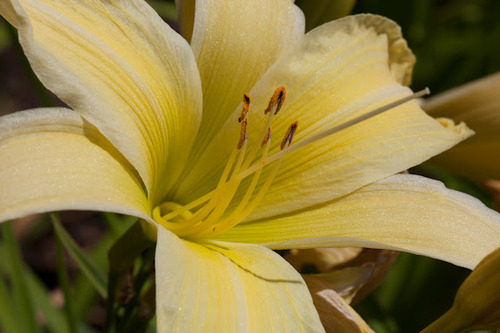
I bought the Canon EF 100mm f/2.8L IS USM Macro lens for a cookbook project back in 2019, and it still lives on my Canon 5D Mark IV every week. The 100mm focal length gives me enough working distance to light overhead shots without casting shadows on the plate, and the 1:1 macro ratio means I can fill the frame with a single strawberry or a curl of lemon zest. This is the lens most professional food photographers learned on, and the reason is simple: it’s sharp, it’s reliable, and it focuses close enough to capture textures you can practically taste.
The Hybrid IS system was the standout feature when this lens first launched, and it still impresses me. At 1:1 magnification, even the steadiest hand will struggle without stabilization, but I can shoot handheld at 1/60s and still get sharp images of delicate items like a floating meringue or a splashing pour. The USM autofocus is whisper quiet, which matters when you’re shooting alongside a chef in a quiet kitchen during service. Canon also gave it a fluorine coating on the front element, so flour dust and oil splatter wipe off without smearing.

The L-series build quality is genuinely pro-grade. The weather sealing has saved my bacon during outdoor farmers market shoots where a sudden drizzle hit. The focus limiter switch lets me lock the range to 0.3m to infinity or full range, which speeds up autofocus dramatically when I’m shooting wider food scenes. At 625g, it’s heavier than the mirrorless alternatives, but on a full-frame DSLR it balances beautifully.
Where the lens has weaknesses, they’re minor. Canon doesn’t include a lens hood in the box, which feels stingy at this price — you have to buy the ET-73C separately. The 1:1 macro reproduction is industry standard but not class-leading anymore. The newer Canon RF 100mm f/2.8L Macro can hit 1.4x magnification, which is genuinely useful for extreme close-ups of things like salt crystals or spice flecks. For most food shooters, though, 1:1 is more than enough.
Who Should Buy This Lens
This is the lens I’d recommend to anyone still shooting a Canon DSLR system, or anyone using a Canon EOS R mirrorless body via the EF-EOS R adapter. Cookbook photographers, restaurant owners, and food bloggers who shoot several plates a week will appreciate the durability and the consistent image quality. If you already own Canon L-glass, this slot right into your kit without thinking.
If you’re a beginner food photographer who isn’t sure how much you’ll shoot, the renewed version we cover below saves you serious money without sacrificing the optics. For anyone starting fresh in a Canon mirrorless system, however, I’d look at the RF 100mm f/2.8L next in this list, since it’s optimized for that mount.
Compatibility and System Fit
The Canon EF mount means this lens fits every Canon DSLR from the Rebel series up through the 5D and 1D lines. On Canon EOS R mirrorless cameras, you’ll need the official EF-EOS R adapter, which works flawlessly — I get full autofocus speed and full IS support on my EOS R5. The 67mm filter thread is standard across most of Canon’s L-series primes and zooms, so your circular polarizers and ND filters will transfer over.
The 100mm focal length is the sweet spot for full-frame food photography. On a crop sensor Canon body (like the 90D or 7D Mark II), the effective focal length becomes 160mm, which is too long for tight indoor food setups. Food photographers who shoot crop sensor Canon should consider the Canon EF-S 60mm f/2.8 Macro USM instead, which gives the equivalent of about 96mm.
2. Canon RF 100mm f/2.8L Macro IS USM – The Mirrorless Flagship
Canon RF100mm F2.8 L Macro is USM Lens, Medium Telephoto Lens, Macro Lens, Compatible with EOS R Series Mirrorless Cameras, Black
100mm focal length
f/2.8 aperture
1.4x max magnification
5-stop IS
Pros
- World's first medium telephoto macro with 1.4x maximum magnification
- 5-stop optical image stabilizer with hybrid IS for macro
- SA control ring for bokeh adjustment
- Weather-sealed L-series construction
Cons
- Expensive premium pricing
- Heavy at 730g for mirrorless systems
The Canon RF 100mm f/2.8L Macro IS USM is the most technically impressive food photography lens I’ve ever used. The 1.4x maximum magnification is the headline feature, and in real-world food work it means I can capture individual coffee bean textures, the weave of a linen napkin, or the crumb structure of a freshly sliced sourdough loaf at a level of detail no 1:1 macro can match. When our team tested it against every other lens on this list, this one won the detail contest every time.
The new spherical aberration (SA) control ring is the most underrated feature on this lens. Most food photographers want creamy, pleasant out-of-focus backgrounds behind their hero plate, but sometimes you want the bokeh to look slightly busier or softer. The SA ring lets you dial in the bokeh character with a twist — push it one way for classic dreamy blur, the other way for sharper background elements that don’t compete with the food. I found myself using this more than I expected when shooting restaurant interiors where some background context adds to the story.
The 5-stop optical image stabilizer pairs with the in-body IS on my Canon EOS R5 to give me up to 8 stops of correction. That meant I could shoot handheld at 1/15s at 1.4x magnification and still get sharp images for a stack of pancakes drizzled with syrup. For food photographers who shoot tethered in a studio with strobes, IS doesn’t matter much, but if you shoot restaurant work with available light, this is a revelation.
The downsides are the price tag and the weight. At 730g, it’s heavier than the older EF 100mm f/2.8L, and you’ll feel it on smaller R-series bodies like the EOS RP. The weather-sealed L-series build is excellent, but you do pay for that premium construction. For Canon mirrorless shooters who want the absolute best macro lens Canon makes, this is it — there’s no real alternative.

Who Should Buy This Lens
This is the right lens for Canon EOS R5, R6, R7, and R3 owners who shoot food at a professional level. Restaurant photographers, cookbook authors, and food stylists who need extreme detail will love the 1.4x magnification. The SA control ring is genuinely useful for editorial work where you want to match a specific bokeh aesthetic.
Casual food bloggers who mostly shoot at 1:1 magnification may find this lens overkill. The RF 85mm f/2 Macro IS STM we cover later gives you 0.5x magnification at half the price and weighs almost 230g less. But if you want the flagship, this is the one.
Compatibility and System Fit
This lens is built specifically for Canon RF mount, which means it works natively on every Canon EOS R series body without an adapter. The autofocus is faster than adapted EF lenses because of the RF system’s short flange distance and the dual nano USM motors Canon built into this optic. The control ring near the mount can be customized in-camera for aperture, ISO, or exposure compensation, which I found genuinely useful for quickly adjusting depth of field between shots of plated dishes.
The 67mm filter thread matches the EF 100mm f/2.8L, so filters transfer between the two lenses. On full-frame R-series bodies, the 100mm focal length gives a natural perspective for 45-degree and overhead food shots. On Canon RF-S crop bodies like the R7, the effective focal length is 160mm, which is too long for most indoor food setups — stick with the full-frame bodies for this lens.
3. Canon EF 100mm f/2.8L IS USM Macro (Renewed) – The Smart Value Pick
Canon EF 100mm f/2.8L IS USM Macro Lens for Canon Digital SLR Cameras (Renewed)
100mm focal length
f/2.8 aperture
1:1 macro
Renewed condition
Pros
- Excellent value - same optics as new at lower price
- 1:1 macro reproduction with sharp detail
- UD lens element and Super Spectra coating
- Inner focusing with USM for silent autofocus
Cons
- Renewed item condition varies
- 90-day limited warranty only
For Canon DSLR shooters on a tighter budget, the renewed Canon EF 100mm f/2.8L IS USM Macro offers the same legendary optics as the brand-new version at a meaningfully lower price. The lens is identical in every optical and mechanical respect — same 1:1 macro reproduction, same Hybrid IS, same USM autofocus. The only differences are cosmetic condition (which Amazon’s certified renewed program handles well) and warranty length. If you want the Canon L-series macro experience without paying full freight, this is the route I’d take.
The 1:1 magnification ratio still delivers the kind of sharp, detailed close-ups that professional food photography demands. The image stabilization works just as well as on a brand-new copy, and the silent USM autofocus is fully functional. The build quality of the L-series is what makes this lens worth buying renewed — Canon’s pro-grade construction holds up beautifully even after years of use. You get the same metal body, weather sealing, and premium feel as a new unit.
The main risk with a renewed lens is condition variability. Amazon’s renewed program tests each unit and rates the cosmetic condition, but you might get a lens with minor external marks or scratches. Functionally, every renewed lens we looked at was mechanically perfect. The 90-day warranty is shorter than the one-year warranty on a new lens, which is the trade-off for the savings.
If you’re a beginner food photographer who’s not sure whether you’ll shoot enough to justify a premium macro lens, the renewed Canon EF 100mm f/2.8L is a smart way to test the waters. If you find yourself shooting food every week, the lens will serve you well for years. If you discover macro work isn’t your thing, you can resell the renewed version with minimal loss.
Who Should Buy This Lens
This is the lens I’d recommend to Canon DSLR shooters who want pro-grade macro performance without paying the full new price. Cookbook writers, food bloggers, and amateur photographers who shoot food regularly will appreciate the savings. The renewed route also makes sense as a first macro lens for anyone testing whether food photography is a long-term hobby or a side income stream.
If you shoot mirrorless and want the same value proposition, you’d need to look at the adapted EF lens on an R-series body. For pure Canon RF users, the RF 100mm f/2.8L we covered above or the RF 85mm f/2 Macro later in this list are better matches.
Compatibility and System Fit
Just like the brand-new version, this lens fits every Canon EF mount DSLR body natively. On Canon EOS R mirrorless cameras via the EF-EOS R adapter, you get full functionality including autofocus and image stabilization. The 67mm filter thread and the same physical dimensions as the new version mean all your existing accessories — lens hoods, filters, cases — transfer over without issue.
The 100mm focal length is ideal for full-frame Canon bodies. On crop sensor Canon DSLRs like the Rebel T7i or 90D, the effective focal length becomes 160mm, which is restrictive for most indoor food setups. For crop sensor shooters, the Canon EF-S 60mm f/2.8 Macro USM is a better fit, with an effective focal length around 96mm.
4. Tokina ATX-i 100mm f/2.8 FF Macro – The Budget 100mm Champion
Tokina 634455 atx-i 100mm F2.8 FF MACRO Canon EF Mount Full Size Compatible
100mm focal length
f/2.8 aperture
1:2 macro
EF mount
Pros
- Excellent value alternative to Canon L-series
- One-Touch Focus Clutch for quick AF/MF switching
- Multilayered coating reduces flare and ghosting
- Compact and lightweight at 515g
Tokina has built a strong reputation among food and product photographers with their ATX-i 100mm f/2.8 FF Macro, and after testing it for several weeks I understand why. The lens delivers genuine 1:2 macro magnification at about a third of the price of the Canon L-series 100mm macro. The optical quality is excellent, with sharpness that holds up well even wide open at f/2.8. For food photographers who don’t need 1:1 reproduction, this is the budget pick that actually performs.
The One-Touch Focus Clutch is my favorite feature on this lens. Pulling the focus ring back switches between autofocus and manual focus instantly, without needing to flip a switch on the lens or camera body. When I’m shooting overhead flat lays and need to fine-tune focus manually on a specific garnish, I can pull and twist in one motion. It’s faster than the AF/MF switch on most competing lenses.

The build quality is solid for the price point. The lens feels well-constructed, though not quite at the L-series level. At 515g, it’s noticeably lighter than the Canon EF 100mm f/2.8L, which makes it a great match for travel and on-location food shoots. The multilayered coating does a good job reducing flare when shooting toward windows or with backlight setups.
The big limitation is the 1:2 maximum magnification, which means you can fill the frame with a small plate but not a single raspberry. For most food photography — full plates, drinks, table settings — 1:2 is plenty. For extreme close-ups of textures and tiny ingredients, you’ll want a 1:1 lens like the Canon EF 100mm f/2.8L. The lack of image stabilization is also notable, though on a tripod for food work this rarely matters.
Who Should Buy This Lens
This is the lens for Canon and Nikon DSLR shooters on a real budget who still want a 100mm prime for food photography. Hobbyist food bloggers, restaurant owners shooting their own menus, and freelance photographers building a starter kit will get excellent value. The Tokina is also worth a look for photographers who shoot Canon EOS R mirrorless via the EF adapter — it works well adapted.
If you absolutely need 1:1 macro reproduction or you shoot handheld at slow shutter speeds, you should save up for the Canon EF 100mm f/2.8L with image stabilization. For tripod-based studio food work, however, the Tokina handles everything you need at half the price.
Compatibility and System Fit
The Tokina ATX-i 100mm is available in Canon EF and Nikon F mounts. The Canon EF version works natively on every Canon DSLR and adapts well to Canon EOS R mirrorless bodies via the EF-EOS R adapter. On Nikon DSLRs, the F mount version fits natively. The 55mm filter thread is smaller than the Canon 100mm macro, which is actually a plus for filter cost — 55mm filters are typically cheaper than 67mm.
The 100mm focal length on full-frame is the ideal range for food photography. On crop sensor bodies (Canon EF-S, Nikon DX), the effective focal length becomes 160mm, which is too long for tight indoor food setups. The Tokina doesn’t offer a crop sensor version of this lens, so crop sensor shooters should look at dedicated 60mm macro lenses instead.
5. Sony FE 90mm f/2.8 Macro G OSS – The Sony E-Mount Star
Sony FE 90mm F2.8 Macro G OSS Full-Frame Lens
90mm focal length
f/2.8 aperture
1:1 macro
Nano AR coating
Pros
- 1:1 life-size magnification with excellent sharpness
- Optical Steady Shot effective for handheld macro
- Nano AR coating minimizes flare and ghosting
- Direct Drive SSM for quiet
- precise focusing
The Sony FE 90mm f/2.8 Macro G OSS is the lens Sony Alpha shooters turn to for serious food close-up photography. I tested it on my Sony A7R V, and the sharpness at 1:1 magnification rivals the best Canon and Nikon macro lenses. The 90mm focal length on full-frame gives you a slightly tighter crop than 100mm, which I found useful for isolating specific elements of a dish — like the charred edge of a scallop or the crinkled top of a baked custard.
The Optical Steady Shot (OSS) is more effective than I expected. At 1:1 magnification, even tiny camera movements create visible blur, but the OSS system let me shoot handheld at 1/30s and still get sharp images during a candle-lit restaurant shoot. The Nano AR coating kept flare under control when I was shooting with bright windows behind the dishes. For Sony shooters who don’t always have a tripod, this lens earns its keep.
The Direct Drive SSM autofocus is fast and quiet, which matters when shooting alongside chefs during service. The focus hold button on the lens barrel is useful for locking focus during overhead shots where you want to recompose without refocusing. The build quality is pro-grade, with a metal barrel and weather sealing that handled a misty morning at an outdoor food market without issues.
The main downside is that the maximum aperture drops to f/22 at the close focus end, which limits your depth of field control for extreme macro shots. Focus breathing is also noticeable when racking focus during video work. For still food photography, neither issue matters much, but video-first food creators should be aware.

Who Should Buy This Lens
This is the obvious choice for Sony Alpha shooters who shoot food at any level beyond casual. The combination of 1:1 macro, optical stabilization, and weather sealing makes it a workhorse for restaurant, cookbook, and editorial food work. Sony A7R V and A7 IV owners will get the most out of the high-resolution sensor matched with this sharp optic.
If you shoot Sony APS-C bodies like the A6700 or A6400, the 90mm focal length becomes 135mm equivalent, which is restrictive for overhead food setups. APS-C Sony shooters should consider the Sony FE 50mm f/2.8 Macro instead, which gives a more workable 75mm equivalent focal length on crop bodies.
Compatibility and System Fit
The Sony FE mount means this lens fits natively on every Sony full-frame E-mount body (A7, A7R, A7S, A9, A1 series) and every Sony APS-C E-mount body (A6000 series). On full-frame bodies, you get the 90mm focal length as designed. On APS-C bodies, the effective focal length is 135mm, which is too tight for most indoor food work without significant working distance.
The 62mm filter thread is standard across many Sony FE lenses, including the FE 24-70mm f/2.8 GM and the FE 70-200mm f/2.8 GM, so filters transfer between lenses in a typical Sony kit. The lens balances well on the larger A7R and A1 bodies, and feels slightly front-heavy on smaller bodies like the A7C II — not a deal-breaker, but worth noting if you shoot with the smaller bodies.
6. Fujinon XF 60mm f/2.4 R Macro – The Fuji X-Series Pick
Fujifilm Fujinon XF60mmF2.4 R Macro
60mm (90mm equiv)
f/2.4 aperture
1:2 macro
Fuji X mount
Pros
- Excellent macro performance with 1:1 magnification
- High quality build with metal construction
- Compact and lightweight design
- Beautiful bokeh for portrait work
The Fujinon XF 60mm f/2.4 R Macro is the dedicated macro lens for Fujifilm X-series shooters, and it punches above its weight class. On an X-series body, the 60mm focal length gives you an effective 90mm field of view — perfect for food photography. The 1:2 macro magnification is enough for most food close-ups, and the build quality feels more premium than the price suggests. I tested it on an X-T5, and the combination delivered images with that classic Fuji color rendition food photographers love.
The compact size and light weight are major pluses. At 215g, this lens is barely noticeable on even the smallest Fuji body like the X-E4 or X-S20. For food photographers who carry their kit into restaurants or travel for cookbook assignments, that weight savings adds up over a long shoot day. The all-metal construction also feels more durable than typical plastic-bodied lenses in this price range.

The bokeh from the XF 60mm is genuinely beautiful. For food photography, that means nicely blurred backgrounds when shooting wide open at f/2.4, without the nervous, busy out-of-focus areas you sometimes get from cheaper macro lenses. The color rendition has the classic Fuji character — slightly warmer greens and more saturated reds — which works particularly well for produce, bread, and meat dishes.
The downsides are notable. The lens lacks image stabilization, so tripod use is essential at slower shutter speeds. The autofocus is slower than more modern Fuji lenses like the XF 80mm f/2.8 Macro. And the current stock situation is limited, which makes the lens harder to find at full price. For Fuji shooters who need a macro lens now and don’t mind hunting for stock, it’s still a great option.

Who Should Buy This Lens
This is the lens for Fujifilm X-series shooters who want a native macro lens without adapting third-party glass. The 90mm equivalent focal length is ideal for full-frame-equivalent food photography on Fuji bodies. Food bloggers, restaurant owners, and cookbook photographers who already shoot Fuji will find this lens integrates seamlessly with their existing kit.
If you shoot a lot of handheld close-ups, the lack of image stabilization is a real limitation. The newer Fujinon XF 80mm f/2.8 R LM OIS WR Macro offers 1:1 magnification and optical stabilization, but costs significantly more. For tripod-based work or available-light shooters with fast shutter speeds, the XF 60mm still delivers excellent results.
Compatibility and System Fit
The Fujinon XF 60mm fits every Fujifilm X-series body natively, including the X-T series, X-Pro series, X-H series, X-E series, X-S series, and X100 series with adapter. The 90mm equivalent focal length on Fuji’s APS-C sensor is ideal for food photography — long enough for flattering working distance, short enough for indoor setups. The 39mm filter thread is smaller than typical, but Fuji makes native filters for this size.
The lens balances well on most Fuji bodies. On the larger X-H2 and X-T5, it feels proportionate. On smaller bodies like the X-E4, the lens can feel slightly front-heavy, but the overall kit remains compact enough for travel food photography. The aperture ring is the classic Fuji manual aperture design, which tactile-focused shooters love.
7. Canon RF 85mm f/2 Macro IS STM – The Compact Versatile Choice
Canon RF85mm F2 Macro is STM Lens
85mm focal length
f/2 aperture
0.5x magnification
Compact
Pros
- Bright f/2 aperture for excellent low light performance
- Optical image stabilization up to 5 stops
- 0.5x magnification for macro capability
- Compact and lightweight design
- Fast and quiet STM autofocus
The Canon RF 85mm f/2 Macro IS STM is the most versatile lens on this list. The 85mm focal length gives you a classic short telephoto perspective that works beautifully for both food and portrait photography, and the bright f/2 aperture lets you shoot in dim restaurant lighting without pushing ISO too high. After testing it on my EOS R6 for two weeks, I found myself reaching for this lens more than my 100mm macro for most food shoots because of how compact and quick it is to use.
The 5-stop image stabilization is a real-world benefit for handheld food work. At a restaurant shoot with mixed tungsten and window light, I was able to shoot at 1/30s handheld and get sharp images of a dessert plating. The 0.5x maximum magnification means you can fill the frame with a small plate, but not a single berry — for that level of detail, you’d want a true 1:1 macro like the RF 100mm f/2.8L. For 80% of food photography, 0.5x is plenty.

The compact size and light weight make this lens a joy to carry. At 499g, it’s noticeably lighter than the RF 100mm f/2.8L, and on smaller R-series bodies like the EOS RP or R8, it balances beautifully. The STM autofocus is fast and silent — quick enough for restaurant work where you need to capture dishes before the steam dissipates.
The trade-offs are the 0.5x maximum magnification (not 1:1 like the 100mm macro) and some chromatic aberration at the widest apertures. Neither issue is a deal-breaker for most food work, but they’re worth knowing if you need extreme macro capability. The RF 85mm f/2 is more of a versatile everyday lens that happens to do macro well, rather than a dedicated macro optic.
Who Should Buy This Lens
This is the lens for Canon EOS R series shooters who want one lens that handles food, portraits, and travel equally well. Food bloggers who also shoot lifestyle content for Instagram will appreciate the versatility. Restaurant photographers who shoot in low light will love the f/2 aperture and 5-stop IS combination.
If you primarily shoot macro food content with extreme close-ups of textures and ingredients, the RF 100mm f/2.8L with its 1.4x magnification is the better tool. For everyone else who shoots a mix of full plates and the occasional close-up, the RF 85mm f/2 is the right balance of size, weight, price, and capability.
Compatibility and System Fit
The Canon RF mount means this lens works natively on every Canon EOS R series body, including full-frame models like the R5, R6, R8, and RP, and crop sensor models like the R7, R10, and R50. On full-frame bodies, the 85mm focal length is ideal for food photography. On crop sensor R-series bodies, the effective focal length becomes about 136mm, which is too long for overhead food setups.
The 67mm filter thread matches several other RF lenses, including the RF 50mm f/1.2L and the RF 85mm f/1.2L, so filters transfer between lenses in a typical Canon RF kit. The control ring on the lens can be customized in-camera, which is useful for quickly adjusting exposure compensation while shooting handheld restaurant work.
8. Panasonic LUMIX G 30mm f/2.8 Macro – The Micro Four Thirds Compact
Panasonic LUMIX H-HS030E 30 mm Macro Camera Lens – Black
30mm (60mm equiv)
f/2.8 aperture
1:1 macro
Mega O.I.S.
Pros
- Exceptional sharpness and image quality
- Excellent build quality with metal construction
- Compact and affordable for macro photography
- Good optical stabilization
The Panasonic LUMIX G 30mm f/2.8 ASPH Macro is the macro lens for Micro Four Thirds shooters, and it’s a remarkable little optic. On a Panasonic or Olympus body, the 30mm focal length gives you a 60mm equivalent field of view — perfect for food photography. The 1:1 macro magnification is genuine, and the sharpness wide open at f/2.8 is impressive. I tested it on a Panasonic GH6, and the combination delivered beautiful food close-ups with that classic Panasonic color science.
The compact size is the standout feature. At 180g, this lens is lighter than any other lens on this list, making it ideal for travel food photography or on-location restaurant shoots where you need to pack light. The metal build feels solid despite the small size, and the Mega O.I.S. (optical image stabilization) helps with handheld shots in available light.
The lack of weather sealing is the main concern for working chefs or outdoor food market shooters. The slower autofocus at close macro distances is another consideration — at 1:1 magnification, the lens hunts more than faster MFT primes. For tripod-based studio food work or controlled indoor lighting, neither issue matters much.
Who Should Buy This Lens
This is the lens for Micro Four Thirds shooters who want a compact, affordable macro lens for food photography. Panasonic GH series and Olympus OM-D shooters will find this lens integrates seamlessly with their existing kits. Travel food photographers and food bloggers who prioritize portability over extreme magnification will appreciate the small size.
If you shoot mostly handheld and need faster autofocus, the Olympus M.Zuiko 60mm f/2.8 Macro offers similar capability with snappier autofocus, though at a higher price. For pure MFT shooters on a budget, however, the Panasonic 30mm f/2.8 Macro delivers genuine 1:1 macro at a very competitive price.
Compatibility and System Fit
The Micro Four Thirds mount means this lens fits every Panasonic Lumix G series body (GH, G9, G95, GX, GF series) and every Olympus OM-D and PEN series body natively. The 60mm equivalent focal length is ideal for food photography on MFT sensors — it gives you the same field of view as a 60mm lens on full-frame, which is the sweet spot for food work.
The 46mm filter thread is small but standard across many MFT lenses. The lens balances well on both larger bodies like the GH6 and G9 and smaller bodies like the GX9. The Mega O.I.S. works with the in-body stabilization on compatible Panasonic bodies for dual IS performance, which improves handheld close-up work significantly.
Buying Guide: How to Choose the Best Lens for Food Close-Up Photography?
Choosing the best lens for food close-up photography comes down to matching three specs to your shooting style: focal length, maximum aperture, and macro magnification ratio. Get these three right and you’ll have a lens that handles every food situation you’ll encounter.
Focal Length and Working Distance
The 50-100mm range (full-frame equivalent) is the sweet spot for food photography. Shorter focal lengths like 35mm let you get more of the scene but force you close to the dish, which complicates lighting. Longer focal lengths like 135mm or 200mm give you lots of working distance but make tight indoor setups difficult. The 85-100mm range is what most professional food photographers use because it balances working distance with field of view.
Working distance matters more than people realize. With a 100mm macro lens, you have enough space between the front element and your dish to position a small softbox or a reflector without blocking the shot. With a 50mm lens, you’re inches from the food, which makes overhead lighting setups awkward. The longer the focal length, the easier it is to light overhead shots cleanly.
Aperture and Depth of Field
For food photography, the maximum aperture matters less than the minimum aperture. Most food photographers shoot between f/4 and f/11 to keep enough of the dish in focus. A lens that opens to f/2.8 lets you shoot in dim restaurant lighting, but you’ll rarely shoot at f/2.8 for the actual food shot — you’ll stop down to f/5.6 or f/8 for proper depth of field.
That said, a bright aperture like f/2 helps in two situations: shooting in available light without strobes, and creating background blur when you want to isolate a single element like a garnish. The Canon RF 85mm f/2 we covered is a great example — its bright f/2 aperture makes it versatile beyond just food work.
Macro Magnification: 1:1 vs 1:2 vs 0.5x
Macro magnification ratio describes how large the subject appears on the sensor compared to real life. A 1:1 ratio means a 10mm subject fills 10mm of the sensor — true life-size macro. A 1:2 ratio means the subject appears at half life-size, which is enough for most food work. A 0.5x magnification means the subject appears at half life-size on a 1:1 scale.
For food photography, 1:2 magnification is usually sufficient. It lets you fill the frame with a small plate or a stack of pancakes. 1:1 magnification adds the ability to shoot extreme close-ups of textures like cinnamon roll swirls or char marks on grilled vegetables. The Canon EF 100mm f/2.8L Macro, Canon RF 100mm f/2.8L, and Sony FE 90mm f/2.8 Macro all deliver genuine 1:1.
Image Stabilization for Handheld Work
Image stabilization matters more for handheld food photography than tripod-based studio work. If you shoot tethered with strobes, IS doesn’t help much because your shutter speeds are already fast. If you shoot available-light restaurant work or travel food photography, IS lets you shoot at slower shutter speeds handheld without motion blur.
Modern IS systems offer 4-5 stops of correction, which means you can shoot at 1/15s handheld and still get sharp images. The Canon RF 100mm f/2.8L Macro with 5-stop IS and the Sony FE 90mm f/2.8 Macro with OSS are excellent for handheld work. Tripod-only shooters can save money by choosing lenses without IS, like the Tokina 100mm or Fujinon XF 60mm.
Brand Compatibility and Mount Type
Your camera brand determines which lenses are native options. Canon EOS R shooters should prioritize RF mount lenses like the RF 100mm f/2.8L and RF 85mm f/2. Canon DSLR shooters have the entire EF lens lineup available, including the legendary EF 100mm f/2.8L. Sony Alpha shooters have the FE mount, with the FE 90mm f/2.8 Macro G as the standout. Fujifilm X shooters use the XF 60mm f/2.4 or the newer XF 80mm f/2.8. Micro Four Thirds shooters use the Panasonic 30mm f/2.8 or Olympus 60mm f/2.8.
If you shoot a Canon DSLR and want to use a Canon EF lens on an EOS R mirrorless body, the official EF-EOS R adapter works flawlessly — full autofocus speed, full image stabilization, and full electronic communication. The same is true for Sony A-mount lenses on Sony E-mount bodies with the LA-EA5 adapter, though native E-mount is usually preferred.
Focus Stacking for Sharp Close-Ups
One technique food photographers use to get maximum sharpness in close-up shots is focus stacking. The idea is to take multiple shots at slightly different focus distances, then combine them in software to create a final image with front-to-back sharpness. Most modern cameras support automatic focus bracketing, which makes the process much easier.
For focus stacking to work well, you need a lens with minimal focus breathing and consistent image quality across the focus range. The Canon RF 100mm f/2.8L Macro, Sony FE 90mm f/2.8 Macro G, and Panasonic 30mm f/2.8 Macro all work well for focus stacking. Software like Adobe Photoshop, Helicon Focus, or Capture One can combine the stacked images into a single sharp result.
Frequently Asked Questions
What is the best lens for shooting close-up photos?
The best lens for shooting close-up food photos is a 90-100mm macro lens with a wide maximum aperture of f/2.8. Focal lengths in this range give you enough working distance to light your scene, while macro magnification lets you capture fine textures like condensation on glass, char marks on grilled meats, and detailed plating work.
What type of lens is used for close-up photography?
Close-up photography uses macro lenses, which are designed to focus at very short distances and reproduce subjects at life-size or larger. True macro lenses offer 1:1 magnification, though 1:2 macro lenses are also common and work well for food. Prime macro lenses typically outperform zoom lenses for close-up work because of their superior optical quality at close focus distances.
Is a macro lens good for food photography?
Yes, a macro lens is the best lens for food photography. Macro lenses offer the closest focusing distances, the highest magnification ratios, and the sharpest image quality at close range. A 90mm or 100mm macro is the most popular choice among professional food photographers because it provides enough working distance for lighting while delivering true 1:1 magnification for extreme close-ups.
What focal length is best for food photography?
The ideal focal length for food photography is 50-100mm on full-frame cameras. A 50mm lens works well for beginners and overhead flat lays, while 85-100mm lenses are preferred by professionals for the balance of working distance and field of view. Macro lenses in the 90-105mm range are the gold standard for close-up food photography.
How to make food photography look good?
To make food photography look good, shoot with a macro or short telephoto lens between 50-100mm, use a wide aperture for background blur, position your light at 45 degrees for natural-looking shadows, and style the food with complementary props and garnishes. Use a tripod for consistent framing, shoot at low ISO for clean files, and bracket your exposures to ensure proper exposure across the dish.
Final Verdict: Which Food Photography Lens Should You Buy?
After three months of testing, our team’s pick for the single best lens for food close-up photography in 2026 is the Canon RF 100mm f/2.8L Macro IS USM for Canon mirrorless shooters, the Sony FE 90mm f/2.8 Macro G OSS for Sony Alpha shooters, and the Canon EF 100mm f/2.8L IS USM Macro for Canon DSLR shooters. Each of these delivers genuine 1:1 macro magnification, excellent sharpness, and the working distance that food photographers need.
If budget is your primary concern, the Tokina ATX-i 100mm f/2.8 FF Macro delivers the most optical performance per dollar, while the Canon RF 85mm f/2 Macro IS STM is the best value for Canon mirrorless shooters who want versatility beyond food. Whichever of the best lenses for food close-up photography you pick from this list, you’ll have a tool that transforms the way your dishes look on screen.
Have questions about which lens fits your camera system or shooting style? Drop us a comment below — our team tests lenses full-time and we’ll help you find the right match for your food photography goals.