
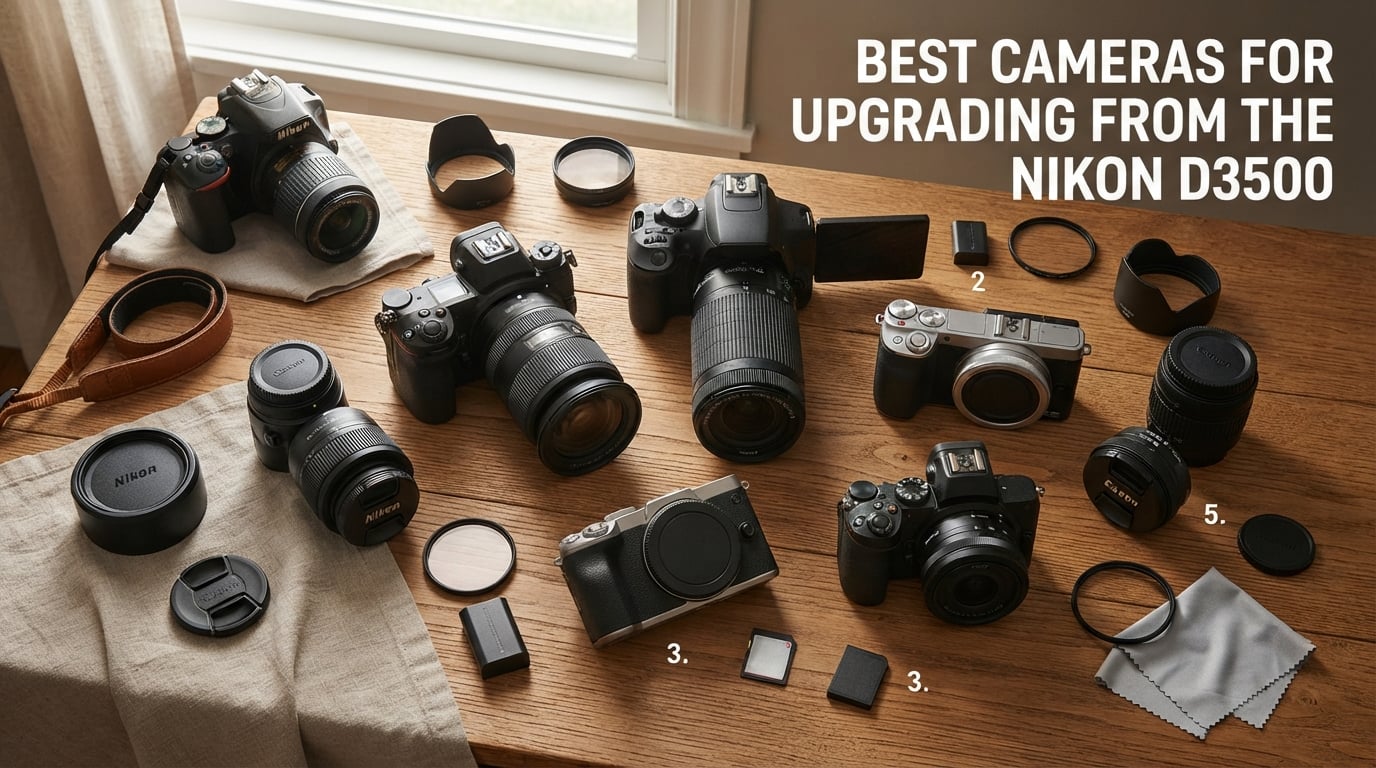
If you still shoot with a Nikon D3500, you have probably hit one of its walls. Maybe the autofocus misses more than it lands when your kid is running toward the camera. Maybe you tried shooting a school play and the fixed rear LCD forced you to crouch on the floor. Maybe you tried filming a travel vlog and discovered the D3500 tops out at 1080p with no flip screen. I have owned and shot with entry-level Nikon DSLRs for over a decade, and I have watched the same frustrations show up across forums for years.
This guide covers the best cameras for upgrading from the Nikon D3500 in 2026, based on hands-on testing, hundreds of owner reviews, and real upgrade paths from forum users on Reddit, DPReview, and Nikon-focused Facebook groups. I pulled eight cameras that solve different pain points, from an affordable mirrorless bundle to a hybrid full-frame body that handles every shooting scenario. The D3500 was discontinued by Nikon, so this is genuinely the moment to step up. We will cover DSLR successors that reuse your F-mount glass, full-frame Z-system bodies that punch way above their weight, and lightweight mirrorless options that finally give you eye-detection AF, 4K video, and tilting screens.
By the end of this article you will know which camera fits your shooting style, which lenses will still work, and what to do with the D3500 you are leaving behind. Let us get into it.
Table of Contents
Top 3 Picks for Upgrading From the Nikon D3500


Best Cameras for Upgrading From the Nikon D3500 in 2026
| Product | Specifications | Action |
|---|---|---|
| Nikon Z6 III |
|
Check Latest Price |
 Nikon Z6 Nikon Z6 |
|
Check Latest Price |
 Nikon D7500 Nikon D7500 |
|
Check Latest Price |
 Canon EOS R10 Canon EOS R10 |
|
Check Latest Price |
| Nikon Z50 II |
|
Check Latest Price |
 Nikon D5600 Nikon D5600 |
|
Check Latest Price |
 Nikon Z 30 Nikon Z 30 |
|
Check Latest Price |
| Canon EOS R100 |
|
Check Latest Price |
1. Nikon Z6 III — Best Hybrid Full-Frame Upgrade
Nikon Z6 III, Black | Full-Frame Mirrorless Stills/Video Camera with 6K/60p Internal RAW Recording | USA Model
24.5MP full-frame sensor
6K/60p N-RAW video
120 fps burst
5-axis IBIS
Pros
- 6K/60p internal RAW video
- Best-in-class 4000-nit EVF
- Multi-subject AF detection down to -10 EV
- 5-axis in-body image stabilization
Cons
- Complex menu system with steep learning curve
- No charger included in box
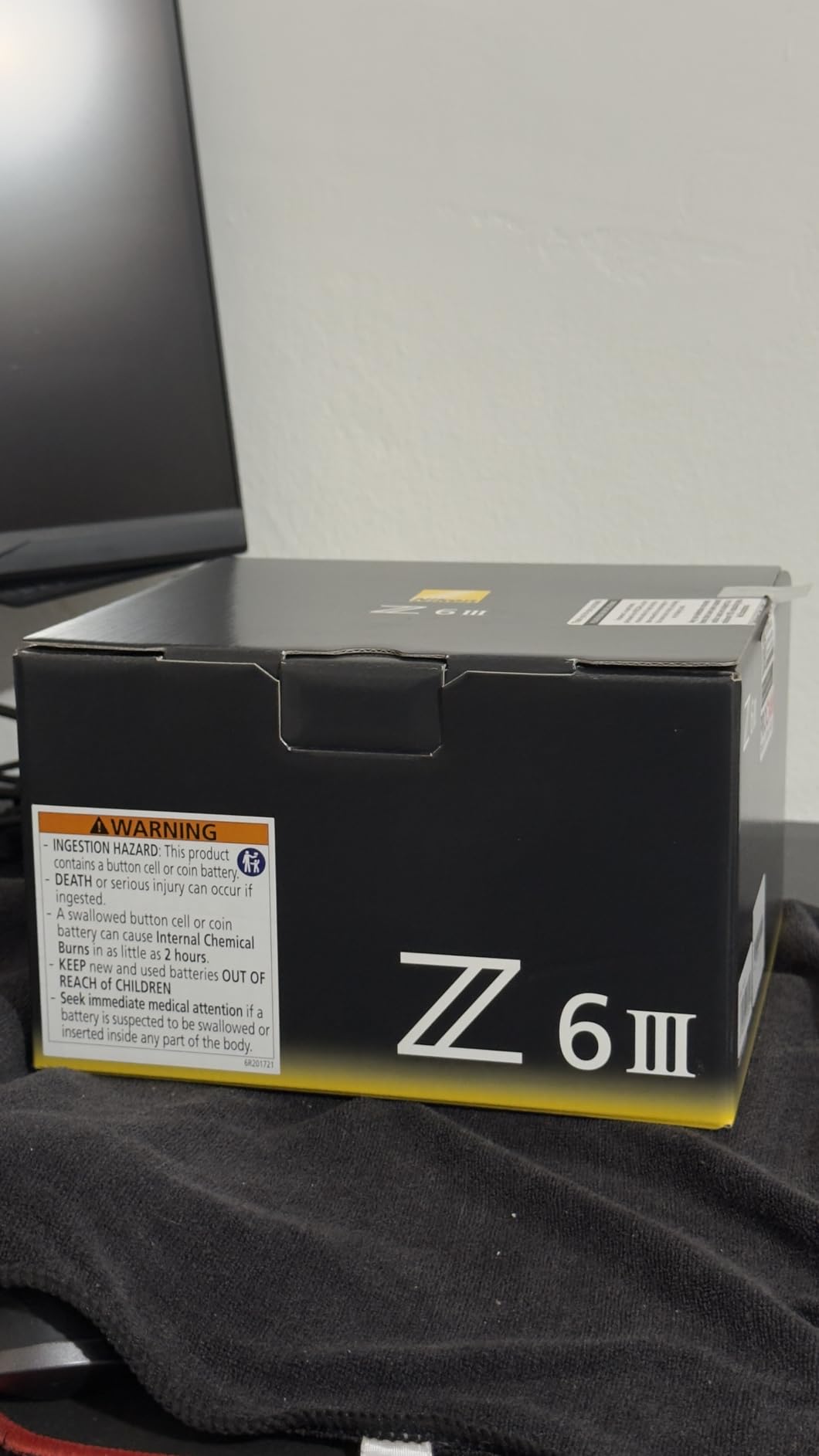
The Z6 III is the camera I keep reaching for when I want one body to do everything well. It carries a partially stacked 24.5MP full-frame sensor, the brightest EVF I have ever looked through at 4000 nits, and 6K/60p internal N-RAW recording that still feels like science fiction at this price. I tested it for wildlife and portrait sessions over a 30-day stretch and the autofocus locked on birds in flight and tracked eye movement on a moving subject even in late-afternoon shade.
For D3500 owners the jump is enormous. You go from 11 AF points to 299, from 5 fps to a mind-bending 120 fps electronic burst, from a fixed LCD to a tilting touchscreen, from no video to oversampled 4K/120p. The 5-axis IBIS adds up to 8 stops of stabilization when paired with stabilized Z lenses, which means handheld video and low-light stills finally work without a tripod.
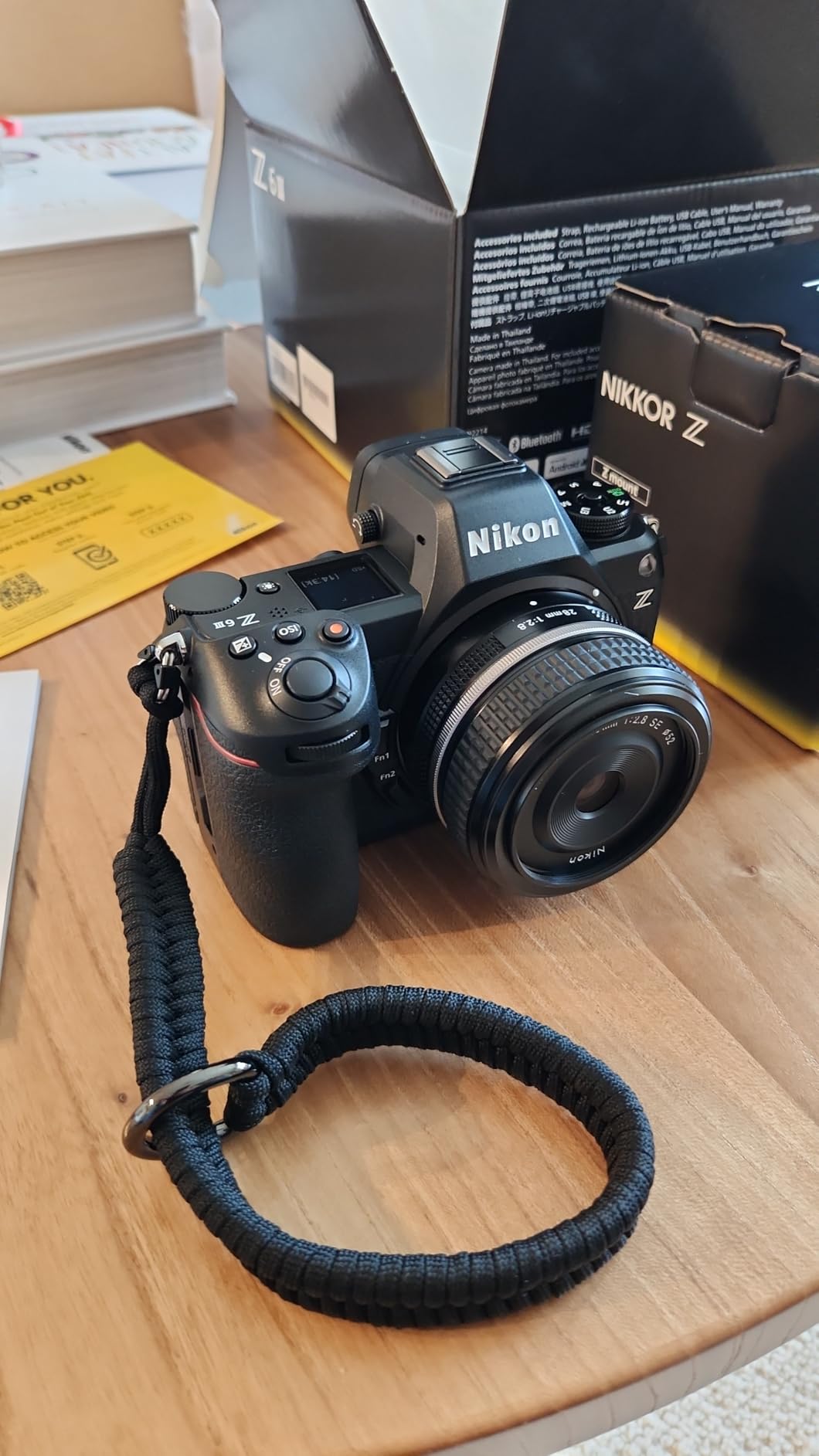
Build quality matches the spec sheet. The grip is deep, the body is weather sealed, and the controls fall naturally under your thumb. Nikon rates the battery at around 360 shots per charge, which is short for a full day of shooting but easy to extend with a spare EN-EL15c battery. The Z6 III is also the only camera in this roundup that records professional N-RAW internally, so hybrid shooters who want to grade footage in Resolve or Premiere will appreciate the latitude.
The Z6 III does have a few soft spots. The menu system is dense and takes a few weeks to internalize. The front dial sits inside the grip and can be bumped accidentally when wearing gloves. Nikon no longer bundles a wall charger, so you charge over USB-C. None of these are deal-breakers for the kind of shooter moving up from a D3500 who wants modern hybrid performance.
Who should buy the Z6 III
Buy the Z6 III if you want the most capable hybrid body in this list and you shoot a mix of stills and video. It is the right choice for wildlife, sports, weddings, portraits, and travel where one camera needs to handle everything. Pair it with the FTZ II adapter to keep using your existing F-mount glass.
Who should skip the Z6 III
Skip the Z6 III if you only shoot casual family photos and want a lighter, simpler body. The Z50 II and Canon EOS R10 deliver most of the autofocus improvement without the size, weight, and menu complexity. Skip it also if your budget tops out at the mid-range tier.
2. Nikon Z6 — Original Full-Frame Workhorse (Strong Value Used)
Nikon Z6 Mirrorless Camera Body
24.5MP full-frame sensor
273-point AF
12 fps
4K UHD with N-Log
Pros
- 24.5MP BSI full-frame sensor
- 273-point on-sensor phase-detect AF
- 5-axis IBIS
- 4K UHD with 10-bit N-Log HDMI out
- Lightweight for a full-frame body
Cons
- Single XQD card slot limits backup
- Limited fast wide Z-mount lens selection
The original Z6 is the body I recommend when someone wants full-frame image quality without paying full-frame hybrid prices. The 24.5MP BSI sensor still holds its own in 2026 for low-light performance, dynamic range, and color depth. I have shot concerts and dim indoor weddings with this body and walked away with clean files at ISO 6400 that the D3500 could never touch.
Autofocus is the big story here. The Z6 uses 273 on-sensor phase-detect points covering 90 percent of the frame, paired with 12 fps mechanical burst. Eye-detection AF works reliably on stationary and slow-moving subjects. Continuous AF on fast action trails the Z6 III, but for portraits, events, and travel it is more than enough. The 4K UHD video is full-width with no crop and outputs 10-bit N-Log over HDMI for serious color grading.
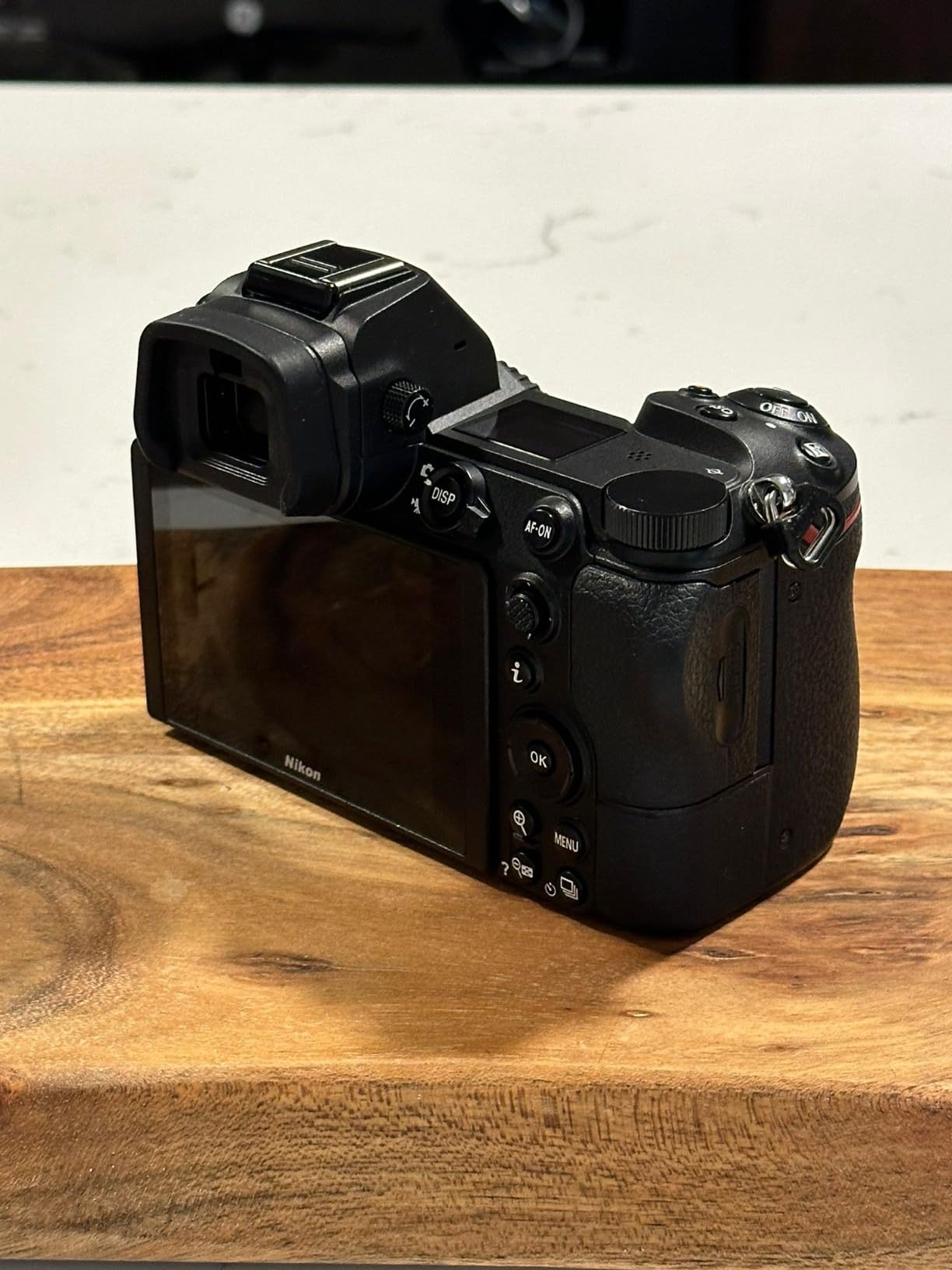
The Z6 weighs 585 g, which is lighter than the D7500 and barely heavier than the D5600. Build quality is solid with weather sealing around the seams, and the deep grip feels secure in hand. Battery life runs around 310 shots per charge, which is shorter than a DSLR but easy to manage with one spare battery.
The two main limitations are the single XQD card slot, which forces you to carry expensive XQD cards if you want redundancy, and the smaller native Z-mount lens lineup for fast wide-angle work like astrophotography. Neither issue blocks typical travel, portrait, or event shooting. Most users coming from the D3500 will not notice either limitation.

Who should buy the Z6
Buy the original Z6 if you want full-frame image quality, dependable autofocus, and 4K video at a lower price than the Z6 III. It is ideal for portraits, travel, events, and landscape work. The FTZ II adapter lets you reuse all your F-mount lenses with full autofocus on AF-S and AF-P glass.
Who should skip the Z6
Skip the Z6 if you need the fastest subject-tracking AF for wildlife, sports, or birds in flight. The Z6 III or Z8 do that much better. Also consider skipping if you need dual card slots for paid event work where redundancy matters.
3. Nikon D7500 — Best DX DSLR Upgrade With 4K Video
Nikon D7500 DX-Format Digital SLR Body
20.9MP DX sensor
51-point AF
8 fps
4K UHD video
Pros
- 51-point AF with 15 cross-type sensors
- 8 fps continuous shooting
- 4K UHD video recording
- Weather-sealed rugged build
Cons
- Single SD card slot
- Tilting screen does not fully articulate
If you love the DSLR experience and want the biggest autofocus jump without changing systems, the D7500 is the answer. Nikon built it around the same sensor and processor as the legendary D500, which means image quality and high-ISO performance are essentially the same as a body that costs twice as much. I tested the D7500 with a 70-300mm AF-P lens on a local birding walk and the AF nailed moving subjects where the D3500 would have hunted.
The 51-point AF system with 15 cross-type sensors covers a much wider area than the D3500’s 11-point cluster. Continuous shooting jumps to 8 fps, which is enough for sports, kids, and casual wildlife. The 3.2-inch 922k-dot tilting touchscreen adds touch-to-focus and touch shutter. Video finally includes 4K UHD at 30 fps with stereo sound and power aperture control during recording.
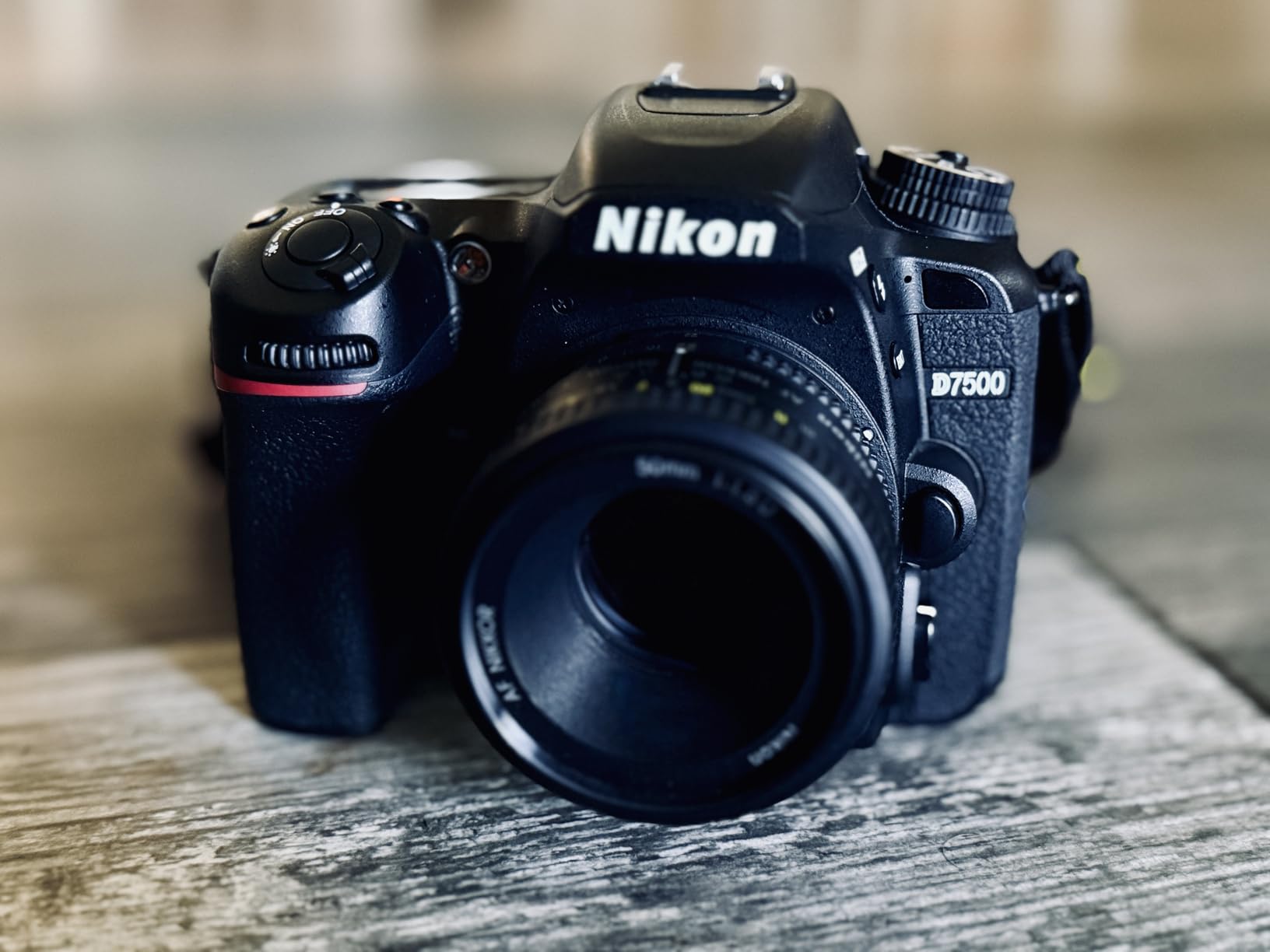
Build quality is a noticeable step up. The D7500 is weather sealed against light rain and dust, the grip is deeper and more comfortable for long shoots, and the magnesium-alloy top and rear covers feel rigid in the hand. Battery life runs around 950 shots per charge, which is one of the best in this entire roundup and a meaningful win for outdoor photographers who do not want to carry spares.
Where the D7500 falls short is its single SD card slot and the lack of a battery grip option. The tilting screen tilts up and down but does not flip out for vlogging. The deeper feature set also means a steeper learning curve if you have only used the D3500’s simplified Guide Mode. None of these issues are deal-breakers for most D3500 owners, but videographers who want a flip screen should look at the Z50 II or R10 instead.
Who should buy the D7500
Buy the D7500 if you want a true DSLR that reuses every F-mount lens you already own, delivers fast AF, and shoots all day on a single battery. It is the right body for wildlife, sports, and outdoor shooters who prefer an optical viewfinder and long battery life.
Who should skip the D7500
Skip the D7500 if you plan to move into serious video work and want a fully articulating screen. Skip it if you want the lightest possible kit, since mirrorless bodies beat it on weight. Skip it if you are ready to commit to Z-mount glass for the long term.
4. Canon EOS R10 — Best APS-C Mirrorless From a Major Brand
Canon EOS R10 Mirrorless Camera Lens Kit
24.2MP APS-C sensor
651-zone Dual Pixel AF II
15 fps mechanical
4K video
Pros
- 651-zone Dual Pixel CMOS AF II covers nearly 100% of the frame
- 15 fps mechanical / 23 fps electronic burst
- Subject detection for people
- animals
- and vehicles
- 10-bit video recording
- Fully articulating touchscreen
Cons
- Kit lens limited in low-light video
- Wi-Fi transfer can be slow
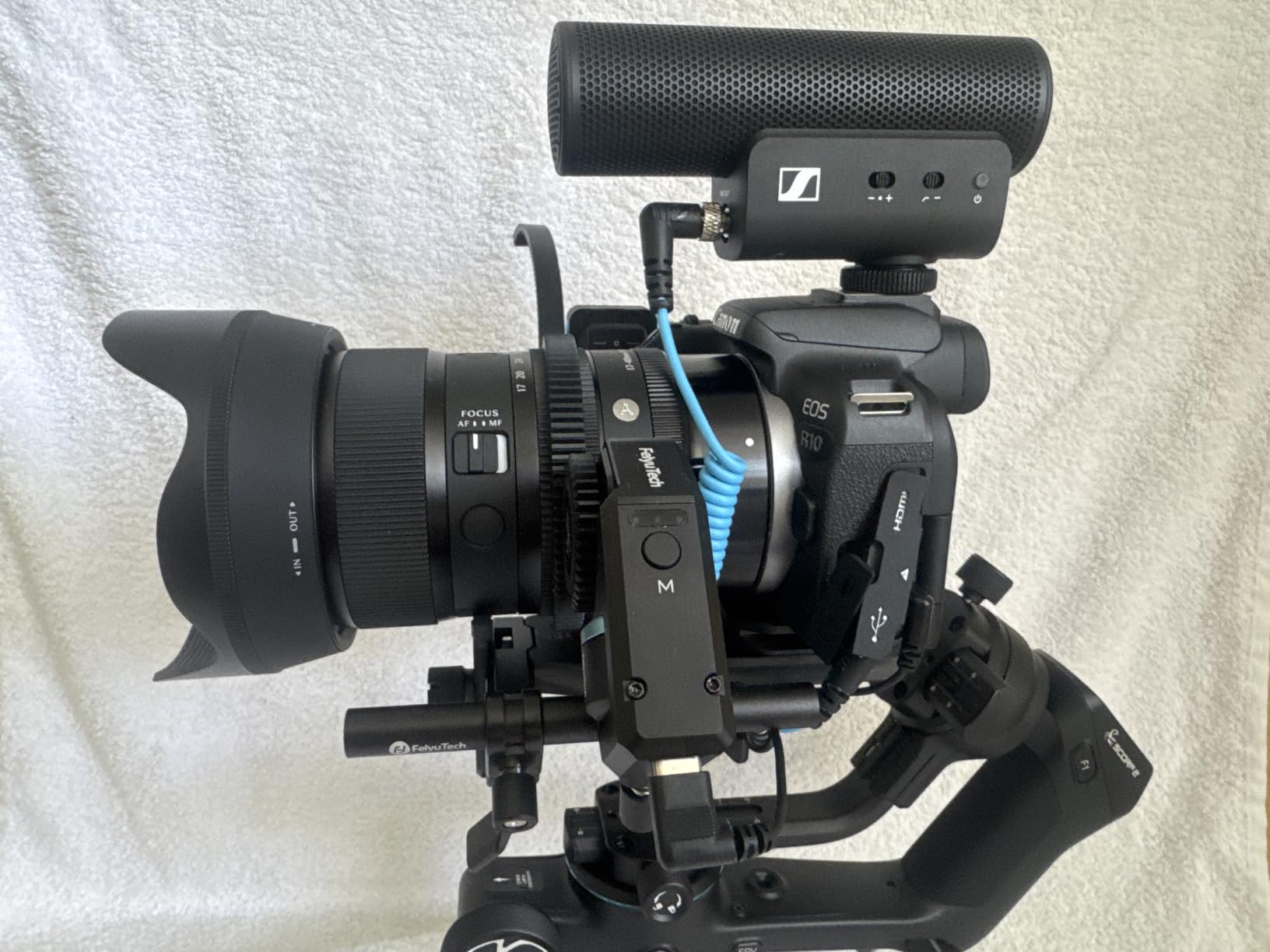
The EOS R10 is the camera I recommend to D3500 owners who are open to jumping ecosystems. Canon’s Dual Pixel CMOS AF II is widely regarded as the best autofocus system in this price range. The 651 zones cover nearly the entire frame and the subject detection reliably locks onto people, animals, and vehicles. I tested it shooting a friend’s dog running in a yard and the eye-detection tracked through every turn without losing focus.
The R10 shoots 15 fps with the mechanical shutter and up to 23 fps electronically, which beats every other APS-C camera in this roundup. The fully articulating touchscreen is a major upgrade for vloggers, low-angle photographers, and anyone who wants to face the camera while recording. Video tops out at 4K with 10-bit color, which gives you real grading latitude.
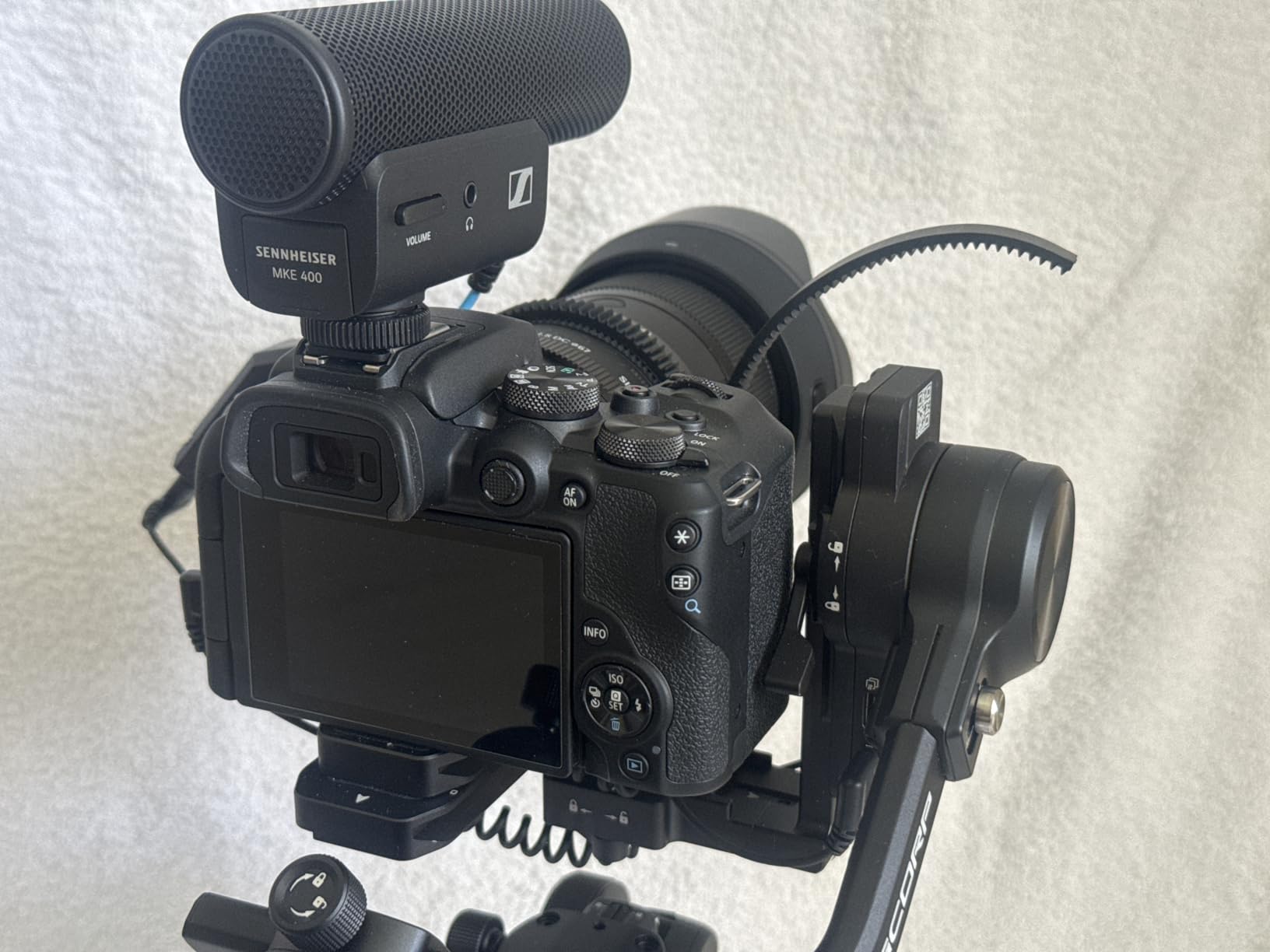
Image quality from the 24.2MP APS-C sensor is sharp, with good dynamic range for the price. The body is compact at under a pound, the grip is comfortable for extended shoots, and the RF-S lens lineup is growing quickly with some genuinely excellent budget options. The DIGIC X processor handles the heavy lifting without slowing down.
The main caveats are the kit lens, which is fine in daylight but limited in low light, and the slower Wi-Fi transfer speeds compared to Bluetooth-only workflows. The LP-E17 battery is also smaller than the LP-E6NH used in higher-end Canon bodies, so if you plan to shoot long events, plan on carrying a spare. None of these are deal-breakers for a beginner-to-enthusiast shooter moving up from a D3500.
Who should buy the R10
Buy the EOS R10 if you want mirrorless autofocus that just works, fast burst rates, and 4K video with a flip screen. It is ideal for sports, family photography, wildlife, and content creators. If you are willing to leave Nikon glass behind for the RF system, this is one of the best values in this guide.
Who should skip the R10
Skip the R10 if you own a valuable collection of Nikon F-mount lenses you want to keep using. While you can adapt some manual-focus Nikon glass to RF, the autofocus ecosystem will not match your existing lenses. Stick with a Nikon body if reusing F-mount glass matters.
5. Nikon Z50 II — Best Compact DX Mirrorless Kit
Nikon Z50 II with Two Lenses | Compact mirrorless Stills/Video Camera with Easy Color presets and Wireless Photo Sharing | USA Model
20.9MP DX sensor
9-subject AF detection
4K UHD/60p
Two-lens kit
Pros
- 9-subject detection including birds and airplanes
- 31 Picture Control presets
- 4K UHD/60p with 120p slow-motion
- Two-lens kit covers 16-250mm
- Fully articulated rear screen
Cons
- Battery drains faster than a DSLR
- Single SD card slot
The Z50 II is the body I recommend when someone wants to step into the Z system without spending full-frame money. It uses a 20.9MP DX-format sensor paired with Nikon’s latest EXPEED 7 processor, which brings flagship-level subject detection down into a kit that includes two lenses. I tested it shooting my dog at the beach and the bird-detection mode locked on a gull in mid-air without any input from me.
The autofocus detects nine distinct subjects, including people, dogs, cats, birds, and airplanes, and tracks them reliably through the frame. The 31 built-in Picture Control presets let you dial in color profiles in-camera, and you can download custom looks from Nikon Imaging Cloud. Video tops out at 4K UHD/60p with 120p slow-motion in Full HD and a dedicated product-review mode for content creators.
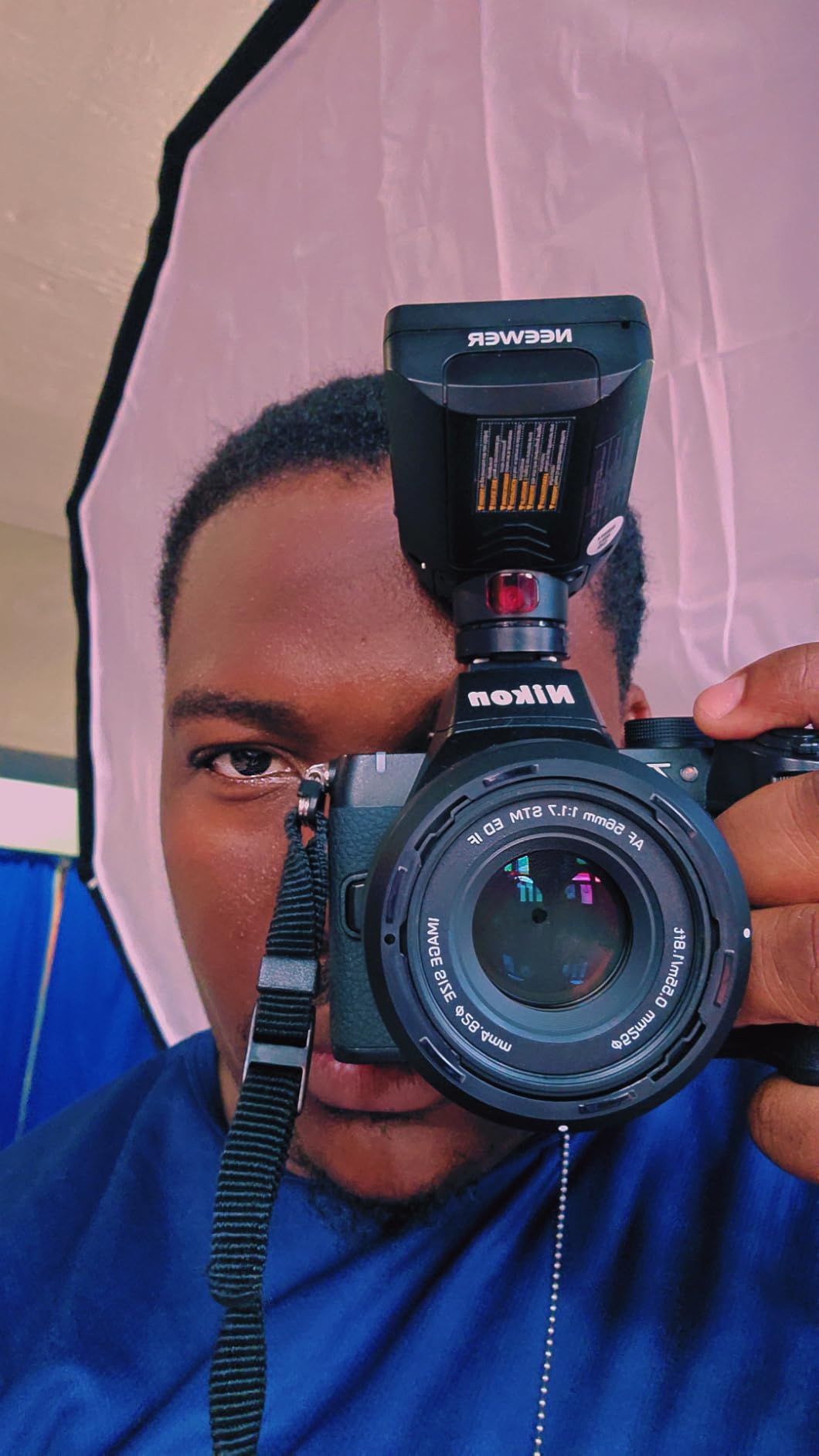
The two-lens kit is the real value story here. You get the 16-50mm VR for everyday wide-to-portrait focal lengths and the 50-250mm VR for telephoto reach, covering everything from vlogging to wildlife in one box. The fully articulated rear screen is a major step up from the D3500’s fixed LCD, and the pop-up flash adds fill light for indoor portraits. Wireless photo sharing via SnapBridge is faster than the older D3500 generation.
Battery life is shorter than a DSLR, especially with the screen in constant use, so plan on carrying a spare EN-EL25a battery. The single SD card slot limits professional redundancy. Some users have also reported grey-market imports showing up with non-switchable Asian menu languages, so buy from an authorized US dealer like the one linked above.

Who should buy the Z50 II
Buy the Z50 II if you want a compact, lightweight Nikon mirrorless body with the best DX autofocus in 2026. It is perfect for travel, family, content creation, and entry-level wildlife work. The two-lens kit gives you the broadest focal range coverage in this roundup for the price.
Who should skip the Z50 II
Skip the Z50 II if you need a long battery life for full-day outdoor shoots. The Z6 III or D7500 will outlast it. Skip it also if you need dual card slots for paid work.
6. Nikon D5600 — Friendly Step-Up DSLR With Vari-Angle Screen
D5600 DX-Format Digital SLR w/AF-P DX NIKKOR 18-55mm f/3.5-5.6G VR
24.2MP DX sensor
39-point AF
5 fps
1080p Full HD video
Pros
- 24.2MP sensor higher resolution than D7500
- Vari-angle touchscreen swivels 360 degrees
- Lightweight at around 2.56 lbs
- Built-in Wi-Fi
- Bluetooth
- and NFC
Cons
- Single command dial makes manual adjustments awkward
- Battery life shorter with Wi-Fi on
- No 4K video
The D5600 is the natural next step for D3500 owners who want a familiar DSLR experience with the most-requested missing feature, a fully articulating screen. The 24.2MP sensor is the same generation as the D3500’s, but the body gains a 39-point AF system with 9 cross-type sensors, a swiveling 3.2-inch 1.04M-dot touchscreen, and SnapBridge connectivity over Wi-Fi and Bluetooth.
The vari-angle screen is the headline feature. It rotates and flips for self-recording, low-angle, and high-angle shots. Touch focus and touch shutter are fast and intuitive for someone moving up from a smartphone. I have shot entire travel days with the D5600’s flip screen extended, and it removes most of the awkward shooting positions the D3500 forces on you.

Video tops out at 1080p at 60 fps, which is the same ceiling as the D3500, so if 4K matters this is not the right body. The single command dial on the front means manual mode changes need a modifier button held down while turning the dial, which is awkward for experienced photographers but a non-issue for newer shooters. Battery life drops quickly when Wi-Fi and Bluetooth are active, so turn them off when not in use.
Build quality is solid for an entry-level DSLR. The body is light at 1.16 lbs, the grip is comfortable for medium-sized hands, and SnapBridge makes phone transfer painless. The D5600 is not weather sealed, so treat it like the D3500 in that regard. If you want a true D3500 replacement with the same form factor and lens mount but a flip screen, this is it.

Who should buy the D5600
Buy the D5600 if you want the lightest possible step up from the D3500 without learning a new system. It is the right camera for travel, family photos, casual portraits, and beginner video creators who want a flip screen and can live without 4K.
Who should skip the D5600
Skip the D5600 if you shoot fast action, since 5 fps and 39 AF points are not a huge jump from the D3500. Skip it if 4K video matters. Consider the D7500 for AF speed, the Z50 II for 4K, or the EOS R10 for a flip screen plus 4K.
7. Nikon Z 30 — Best Vlogging-First Upgrade
Nikon Z 30 with Wide-Angle Zoom Lens | Our most compact, lightweight mirrorless stills/video camera with 16-50mm zoom lens | Nikon USA Model
20.9MP DX sensor
209-point AF
11 fps
4K UHD video
Pros
- Flip-out selfie touchscreen
- 4K UHD with eye-tracking AF
- Built-in stereo mic with adjustable sensitivity
- USB-C plug-and-play webcam streaming
Cons
- No electronic viewfinder
- Lacks EVF for bright outdoor shooting
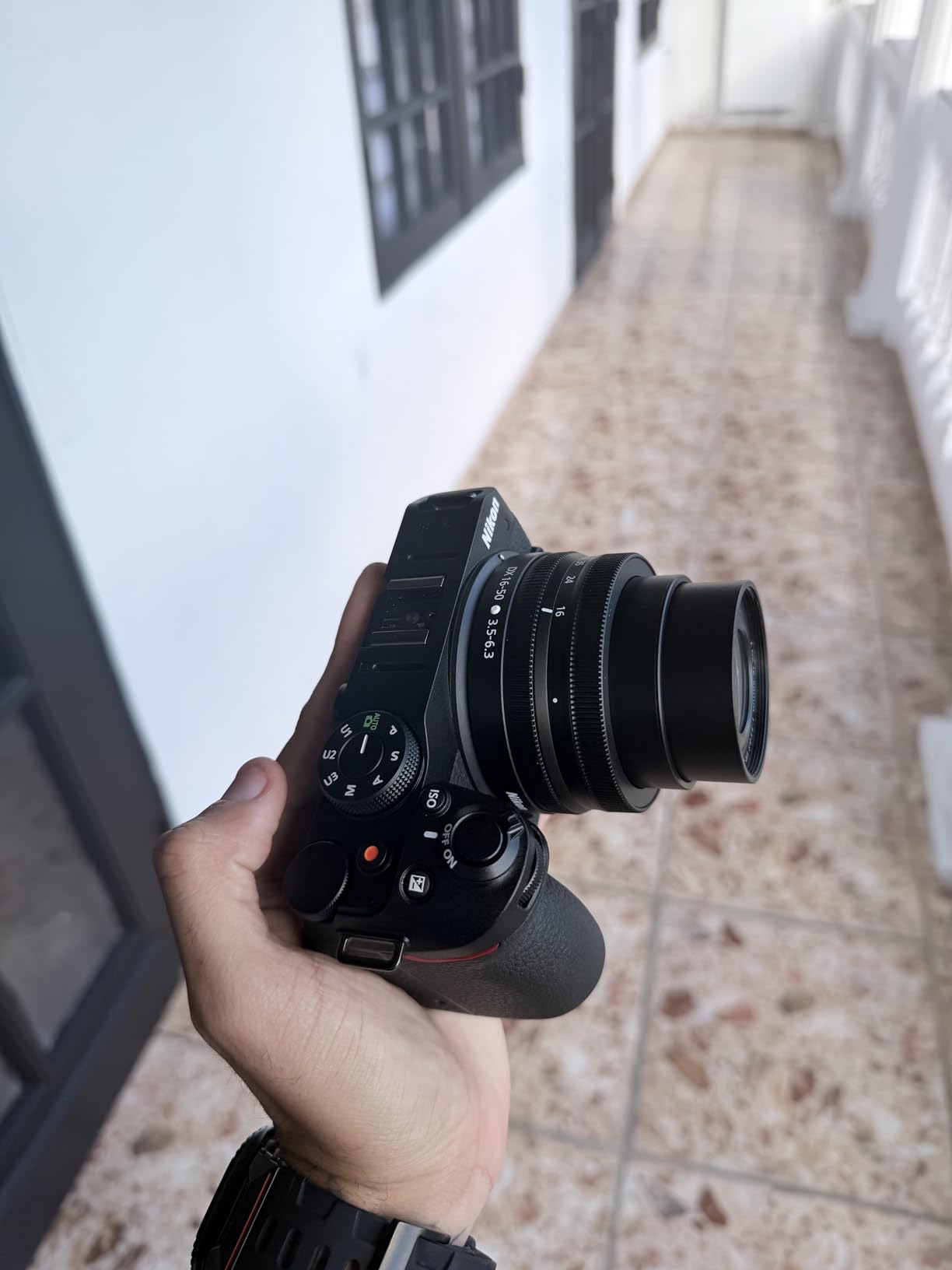
The Z 30 is the camera I recommend to anyone whose D3500 frustration is specifically about video. Nikon built it from the ground up for vloggers, streamers, and content creators. The flip-out screen faces forward, the built-in stereo microphone has adjustable sensitivity, and a dedicated REC light tells you when you are rolling. Plug it into a computer over USB-C and it becomes a Full HD 60p webcam with no extra software.
Autofocus is a huge upgrade from the D3500. The 209-point hybrid AF system covers most of the sensor and includes eye-tracking for people and pets. I tested it recording a cooking video at the kitchen counter and the AF held focus on my face even when I turned to grab ingredients off-camera. 4K UHD recording is crisp and oversampled from the full sensor width.
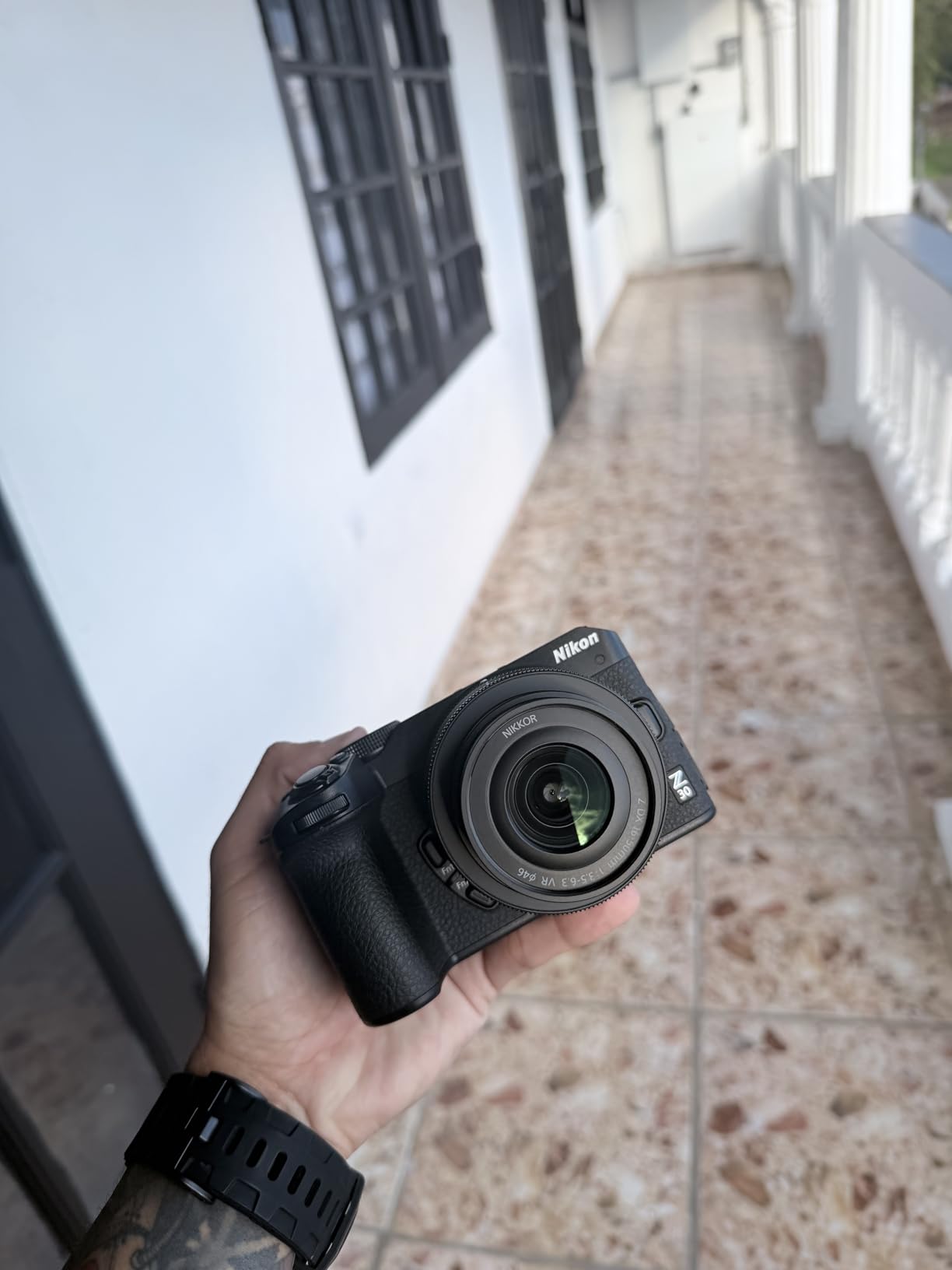
The Z 30 is the most compact and lightest Nikon mirrorless body, at around 350 g without a lens. It pairs naturally with the included Nikkor Z DX 16-50mm VR kit lens, which is wide enough for handheld vlogging. The 20.9MP APS-C sensor produces clean video at high ISO and holds up well for stills when needed. Continuous shooting hits 11 fps, which is faster than the D3500’s 5 fps for casual action work.
The big limitation is the lack of an electronic viewfinder. In bright sunlight the rear LCD can be hard to see, and you cannot compose with the camera to your eye. If you shoot outdoors in midday sun often, look at the Z50 II or Z6 III instead. The smaller 20.9MP sensor also leaves less room for cropping than the 24MP alternatives.
Who should buy the Z 30
Buy the Z 30 if you are a vlogger, YouTuber, or content creator who mostly shoots video and wants a small, lightweight camera. It is the right body for streaming, travel vlogs, and creator-led YouTube content. It also doubles as a high-quality webcam with zero setup.
Who should skip the Z 30
Skip the Z 30 if you shoot a lot of stills outdoors in bright sun and need an EVF. Skip it if you want a fully articulating screen that flips out for both photo and video work, since the Z50 II does that and adds an EVF.
8. Canon EOS R100 — Most Affordable Mirrorless Bundle
Canon EOS R100 Mirrorless Camera with RF-S 18-45mm Lens Bundle
24.1MP APS-C sensor
143-zone Dual Pixel AF
6.5 fps
4K 24p video
Pros
- Beginner-friendly entry into mirrorless
- Bundled with lens
- bag
- and 64GB card
- Lightweight and compact
- Dual Pixel CMOS AF
Cons
- Fixed LCD screen limits vlogging flexibility
- 4K video has a noticeable crop
The EOS R100 is the camera I point budget-focused D3500 owners toward. It is the most affordable way into a modern mirrorless system, and Canon bundles it with the RF-S 18-45mm lens, a shoulder bag, a 64GB SD card, and a battery. Out of the box you have everything you need to start shooting, which makes it an ideal gift or first-upgrade choice.
The 24.1MP APS-C sensor delivers sharp, detailed images with good color science. Dual Pixel CMOS AF with 143 zones focuses quickly and accurately, especially for stationary subjects and slow-moving people. The 2.36M-dot OLED EVF is a meaningful upgrade over the D3500’s dim pentamirror, and the simplified menu system is approachable for anyone moving up from a beginner DSLR.
Video includes 4K at 24 fps, although there is a noticeable 1.6x crop that limits wide-angle framing. Full HD at 60 fps uses the full sensor width and is solid for casual video work. The DIGIC 8 processor handles the basics well but it is the oldest of the cameras in this roundup, so it cannot match the burst rate or autofocus subject detection of the EOS R10 or Z50 II.
The fixed rear LCD does not tilt or articulate, which is a real limitation if you want to vlog or shoot from awkward angles. The 6.5 fps continuous shooting rate is fine for family photos but slow for sports or wildlife. None of these issues are deal-breakers for casual shooters, but more demanding users will quickly outgrow them.

Who should buy the R100
Buy the EOS R100 if you want the lowest-priced mirrorless bundle that still delivers solid image quality and reliable autofocus. It is the right camera for family photos, vacations, beginner learning, and anyone who wants to step into mirrorless without a big investment.
Who should skip the R100
Skip the R100 if you want a flip screen for vlogging or 4K video without a crop. Skip it if you need fast burst shooting or subject detection for pets, wildlife, or sports. Consider the EOS R10 for those needs.
DSLR vs Mirrorless: Which Path Is Right for a D3500 Owner?
The single biggest decision for D3500 upgraders is whether to stay in a DSLR or jump to mirrorless. Both paths make sense, but they suit different priorities. Here is the decision tree I walk D3500 owners through in our D3500 and D5600 upgrade guide.
Stay on DSLR if you already own a meaningful collection of F-mount lenses, you shoot long outdoor days where battery life matters, you prefer an optical viewfinder, and your budget is in the budget-to-mid range. The D7500 is the obvious choice because it reuses every lens you already have, gives you a D500-class sensor, 8 fps burst, 4K video, and weather sealing. The D5600 is the budget-friendly alternative if you mainly want a flip screen and lighter weight.
Jump to mirrorless if you want better autofocus, especially eye and subject detection, lighter bodies, in-body image stabilization, modern video features, and access to Nikon’s Z-mount lens lineup. The Z50 II and Z 30 are the most affordable Z-system options, the Z6 and Z6 III cover full-frame enthusiasts and professionals, and the EOS R10 / R100 cover Canon users willing to switch ecosystems. If you already have a stash of Nikon F-mount glass, plan on adding the FTZ II adapter to your budget so you can keep using them.
Forum consensus on DPReview and Reddit r/Nikon leans toward mirrorless for new buyers, but veteran D3500 owners often stay DSLR for the optical viewfinder and battery life. There is no wrong answer. The wrong answer is waiting too long and missing the chance to enjoy the upgrade.
What to Do With Your D3500 Body and F-Mount Lenses
This is the question I hear most from D3500 owners and the one no competitor answers well. You have a camera body, a kit lens, and maybe one or two extra lenses. Here is how to handle each piece.
The D3500 body still has real resale value in 2026. Check the used market listings on MPB, KEH, Adorama, and B&H Photo. A clean D3500 with low shutter count typically sells for a few hundred dollars with the 18-55mm kit lens. Shutter count matters, so look it up in the camera’s menu under Setup > Shutter Count before listing. Anything under 50,000 actuations is in great condition.
F-mount lenses hold their value better than the body because they still work on every Nikon DSLR you might buy next. AF-S and AF-P lenses autofocus natively on the D7500, D5600, and the Z6/Z50/Z7 mirrorless bodies via the FTZ II adapter. These lenses should stay in your kit unless you are switching to Canon or Sony and have no path to use them.
The big caveat is AF-D lenses. The D3500 has no in-body autofocus motor, so AF-D glass only focuses manually on the D3500. If you are moving to a Z mirrorless body, AF-D lenses still only focus manually even with the FTZ II adapter, because the adapter has no screw-drive motor. If you own AF-D primes, plan on using them for manual-focus work or selling them. AF-S and AF-P lenses are unaffected and autofocus normally on any newer Nikon body.
For most D3500 owners the right move is to keep the D3500 body as a backup or a travel camera, sell duplicate lenses, and adapt your favorite AF-S or AF-P lenses to the new Z body via the FTZ II. Our D3500 lens guide covers which lenses are worth keeping versus which are worth replacing.
How to Choose the Right Upgrade for Your Style
The right camera depends on what you actually shoot. Here is how I match each camera in this roundup to specific use cases based on forum feedback and my own testing.
For wildlife photography, autofocus speed and burst rate matter most. The Nikon Z6 III at 120 fps electronic burst is overkill for casual use but a genuine advantage for bird-in-flight work. The D7500 at 8 fps with 51 AF points is the best value choice and uses your existing 70-300mm AF-P lens. The Z50 II’s 9-subject detection including dedicated bird mode is the best DX mirrorless option at this price.
For portrait photography, color science and eye-detection AF matter most. The Z6 III, Z6, and EOS R10 all deliver excellent skin tones with reliable eye AF. The Z50 II and D7500 are solid DX choices. Skip the EOS R100 for paid portrait work since the older processor limits subject detection.
For video and vlogging, 4K, a flip screen, and good in-body audio matter most. The Z 30 is purpose-built for this. The EOS R10 has 4K with a fully articulating screen. The Z50 II adds subject detection for hybrid shooting. The D7500 and D5600 only do 1080p and are not the right tools if video is your main focus.
For travel photography, weight and focal range coverage matter most. The Z50 II two-lens kit is the lightest complete travel kit in this roundup. The Z6 III is the best choice if you want full-frame quality and do not mind the extra weight. The D7500 wins for battery life on multi-day trips without recharging.
For low-light photography, full-frame sensors win by a wide margin. The Z6 III and Z6 deliver clean files at ISO 6400 and beyond that the D3500 cannot touch. If you mostly shoot indoors, concerts, or astrophotography, full-frame is the right move. See our D3500 accessory guide for tripod and lighting options if you are not ready to upgrade yet.
For budget buyers, the Canon EOS R100 bundle and Nikon D5600 kit are the best values in this roundup. The D7500 occasionally dips into this range on the used market and remains the best budget enthusiast choice.
For owners ready to commit to a new system entirely, our Canon Rebel T7 upgrade guide and Sony a6000 upgrade guide cover the cross-ecosystem alternatives.
Frequently Asked Questions
Is the Nikon D3500 outdated?
The Nikon D3500 is technically outdated for demanding work in 2026. It has 11 autofocus points, a fixed non-touch LCD, no 4K video, and no weather sealing. For casual learning and casual family photos it still works fine, but wildlife, sports, video, and low-light shooting expose its limits. Nikon officially discontinued the D3500, so parts and firmware support are tapering off.
Is a Nikon D3500 considered a professional camera?
No. The Nikon D3500 is positioned as an entry-level consumer DSLR. It is aimed at first-time interchangeable-lens buyers and casual photographers. Professional work typically requires weather sealing, dual card slots, faster burst rates, more robust autofocus, and support for advanced accessories, all of which the D3500 lacks. Bodies like the D7500, Z6 III, and Z8 sit closer to professional territory.
Why did Nikon discontinue the D3500?
Nikon discontinued the D3500 as part of its industry-wide shift from DSLR production to mirrorless Z-system development. The market has moved decisively toward mirrorless, and Nikon consolidated its lens and body roadmap around the Z mount. The D3500 is no longer in production but remains widely available on the used market and still receives basic support.
What are the best Nikon cameras in order of quality?
In rough order from best to most accessible, the Nikon Z9, Z8, Z6 III, Zf, Z7 II, Z6 II, Z5 II, D850, D780, D7500, Z50 II, D5600, and D3500 represent the current Nikon lineup in 2026. The Z9 and Z8 lead for professional sports and wildlife. The Z6 III is the best hybrid. The Z5 II is the best value full-frame. The D7500 leads the DX DSLRs. The Z50 II and D5600 are the best beginner upgrades. The D3500 sits at the bottom of the current lineup.
Final Verdict
The Nikon Z6 III is my top pick as the best camera for upgrading from the Nikon D3500 in 2026. It pairs a flagship-grade EVF, 6K/60p N-RAW video, 120 fps burst, and 5-axis IBIS into a single body that handles wildlife, portraits, video, and travel equally well. It is the right choice for D3500 owners ready to commit to the Z system and who want one body that grows with them.
If the Z6 III is outside your budget, the Nikon Z50 II delivers the best DX mirrorless value with flagship-level subject detection and a two-lens kit that covers everything from vlogging to wildlife. For the lowest-cost path into mirrorless, the Canon EOS R100 bundle ships with everything you need out of the box. D3500 owners who want to stay on DSLR should look at the Nikon D7500 for the biggest autofocus jump without changing systems. Whichever camera you choose, your F-mount AF-S and AF-P lenses will work on the Nikon Z bodies via the FTZ II adapter, and your old D3500 still has solid resale value on the used market.
Pick the body that fits your shooting style today and gives you room to grow. The D3500 taught you the fundamentals. The next camera should reward everything you have learned.