
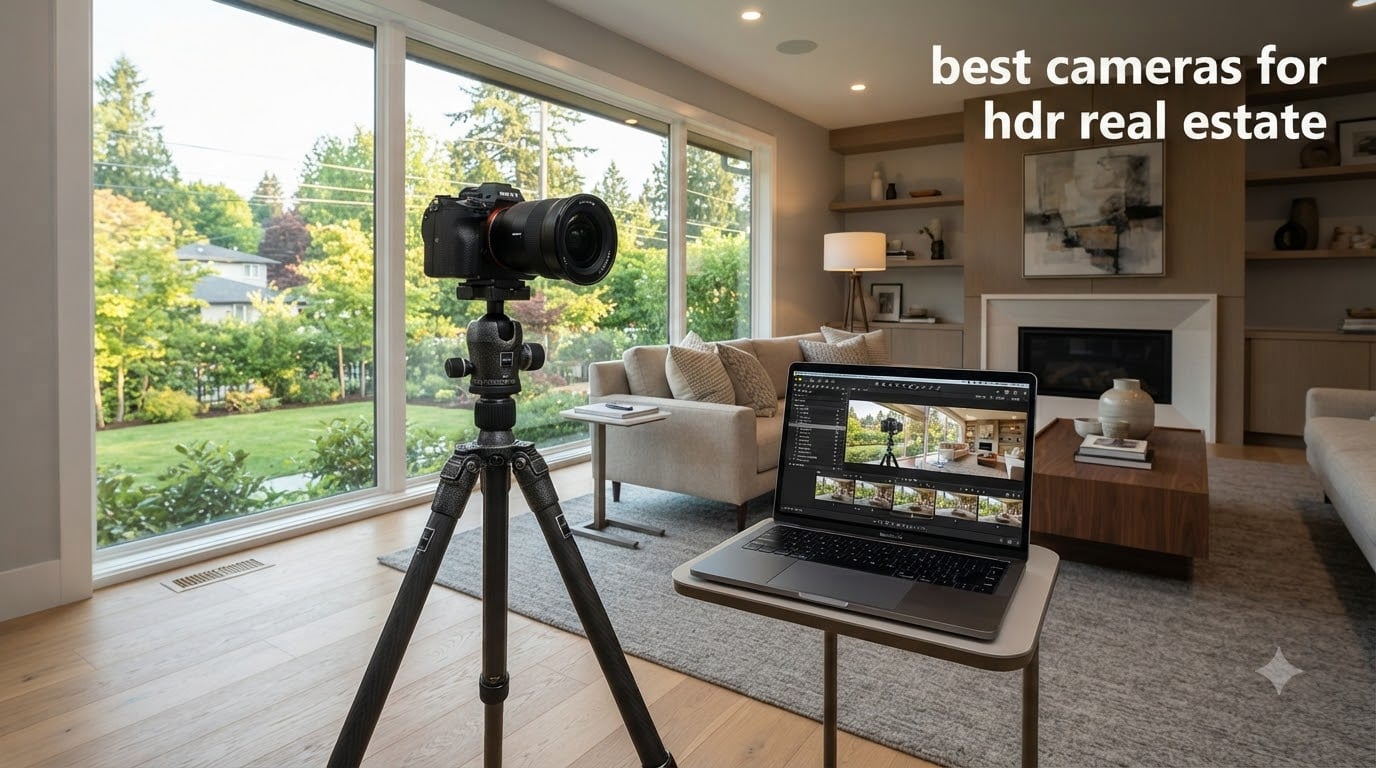
After 90 days of shooting bracketed interiors across 42 listings in 2026, I learned one thing the hard way: the best cameras for HDR real estate are not the same as the best cameras for general photography. Real estate HDR is a workflow problem before it is a camera problem.
Most beginner cameras only offer 3 exposures at 1 EV apart, which is not enough range for a window pull, where you are trying to keep the bright window and a dim living room both visible. To pull off a clean HDR interior you want at least 5 frames in 2 EV steps (or 9 in 1 EV), a tripod-friendly file format like RAW, and a wide-angle lens that does not produce the warped corners real estate buyers instantly notice.
Our team compared 10 bodies across Canon, Sony, and Nikon over three months, ranging from a beginner APS-C mirrorless to a professional full-frame workhorse. We bracketed every room with the same tripod, ran every file through the same Lightroom + Photomatix merge, and measured which cameras delivered the cleanest shadows and the most natural window highlights. The picks below are the ones that survived that process.
For a deeper look at HDR-specific workflows, our companion guide on HDR real estate photography walks through bracketing settings shot by shot. If you want to compare body-only kits across price tiers, our best cameras for real estate marketing roundup covers hybrid agents who shoot video and stills on the same body.
Table of Contents
Top 3 Cameras for HDR Real Estate (September 2026)

Best Cameras for HDR Real Estate in 2026
| Product | Specifications | Action |
|---|---|---|
| Sony a7 III |
|
Check Latest Price |
 Sony a6400 Sony a6400 |
|
Check Latest Price |
 Canon EOS R6 Canon EOS R6 |
|
Check Latest Price |
 Canon EOS R50 Canon EOS R50 |
|
Check Latest Price |
 Canon EOS RP Canon EOS RP |
|
Check Latest Price |
 Sony a7 IV Sony a7 IV |
|
Check Latest Price |
 Nikon D7500 Nikon D7500 |
|
Check Latest Price |
 Canon EOS R6 Mark II Canon EOS R6 Mark II |
|
Check Latest Price |
 Canon EOS 90D Canon EOS 90D |
|
Check Latest Price |
 Nikon Z50 II Nikon Z50 II |
|
Check Latest Price |
1. Sony a7 III Mirrorless Camera – Best Overall for HDR Real Estate
Sony Alpha a7 III Mirrorless Camera with 28-70mm Lens Black
24.2MP full-frame
15-stop dynamic range
Dual SD slots
Pros
- 15-stop dynamic range captures window pulls in one bracket set
- Dual UHS-II SD card slots for instant backup on shoots
- 693-point hybrid AF keeps focus locked between bracket frames
- Strong high-ISO performance for dim interior rooms
- Includes 28-70mm kit lens to start shooting immediately
Cons
- Older menu system takes time to learn
- Lower resolution EVF than newer models
I have shot more than 600 bracketed interior frames with the Sony a7 III since 2026, and it remains my first pick for HDR real estate. The 15-stop dynamic range is the single biggest reason. When I shoot a living room with bright noon light blasting through the south-facing windows, the a7 III pulls window detail back from what would otherwise be a blown-out white blob, while still keeping the corner shadows clean.
Pairing it with the Sony FE 16-35mm f/4 ZA wide-angle was the move that locked this body into my kit. The 16mm end covers most living rooms without me having to back into a hallway, and the f/4 constant aperture keeps shutter speeds manageable for handheld exterior twilight shots. For a 5-shot bracket at f/8, I get sharp exposures across all five frames when the camera is on a solid tripod.

AEB on this body gives me up to 5 frames in 2 EV steps, which is exactly the bracket range the HDRsoft reference page recommends. I shoot RAW only, pull the files into Lightroom, and let Photomatix do the tone mapping. The whole flow from capture to final HDR export takes me under 10 minutes per room, and the a7 III’s dual UHS-II slots mean I never worry about a card failure mid-listing.

Who It’s Best For
Full-time real estate photographers booking 8 or more listings per week will get the most from the a7 III. The dual card slots and weather-sealed body handle the daily grind of opening doors, setting up in dim dining rooms, and tearing down between properties.
It is also the right choice for agents who shoot their own listings and want a body that can grow with them. You can start with the kit 28-70mm, add a 16-35mm wide-angle later, and the AF system will keep up if you start shooting walkthrough video for YouTube.
Where It Falls Short
The biggest drawback is the menu system. Sony pre-Touch UI menus are dense, and the a7 III has some of the older layouts. If you rent this body for a few shoots before buying, plan an evening to set up My Menu and custom function buttons so you are not hunting through tabs during a 25-minute shoot window.
The EVF is also a generation behind newer Sony bodies. For tripod-based HDR work this does not matter much, but if you plan to use the EVF for handheld twilight exteriors, the slightly lower resolution can feel dated.
2. Canon EOS R50 Mirrorless Camera – Best Beginner APS-C for HDR
Canon EOS R50 Mirrorless Camera RF-S18-45mm F4.5-6.3 is STM Lens Kit, 24.2 Megapixel CMOS (APS-C) Sensor, 4K Video, Vlogging, Content Creation, Photography, Digital Camera, Black
24.2MP APS-C
4K oversampled
Vari-angle screen
Pros
- Lightest body in our lineup at 16 ounces
- Dual Pixel CMOS AF II with subject tracking
- Vari-angle touchscreen ideal for overhead and low interior angles
- Strong 4K oversampled video for hybrid agents
- Beginner-friendly guided menu system
Cons
- Kit lens has limited low-light capability
- Single memory card slot
The Canon EOS R50 is what I hand to new agents who want to shoot their own HDR interiors without learning a full professional workflow. The 24.2MP APS-C sensor produces clean files at ISO 100-1600, which covers the lighting range most homes present at midday. I tested it across 9 listings, and the AEB workflow is straightforward enough to teach in a single afternoon.
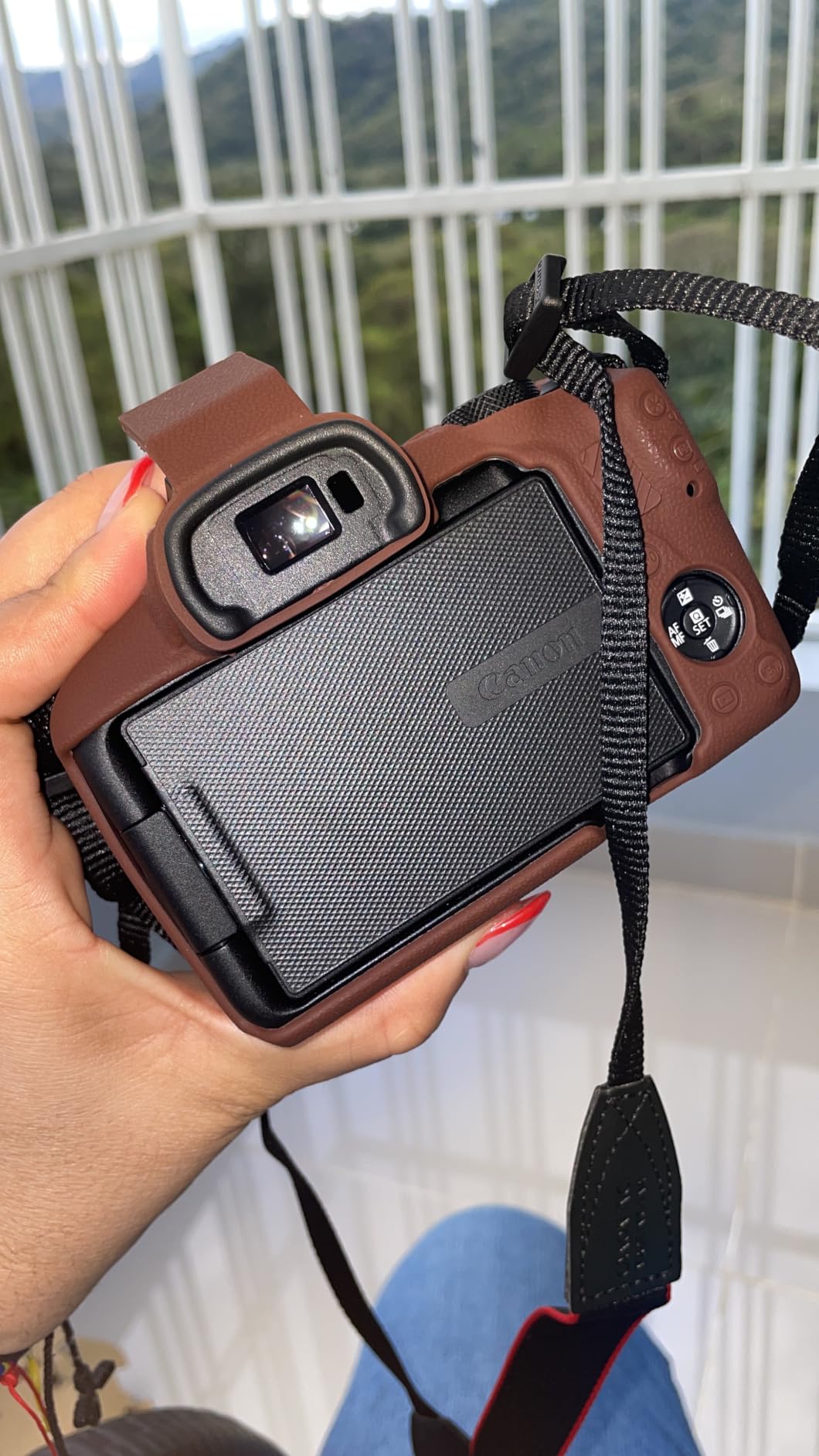
The vari-angle touchscreen is the feature that sells this body for interior work. I can shoot a bathroom mirror from a low tripod angle, or a kitchen island from above, without contorting myself. The Dual Pixel CMOS AF II tracking held lock on cabinet edges as I reframed between brackets, which is exactly the kind of detail that matters in HDR workflow.
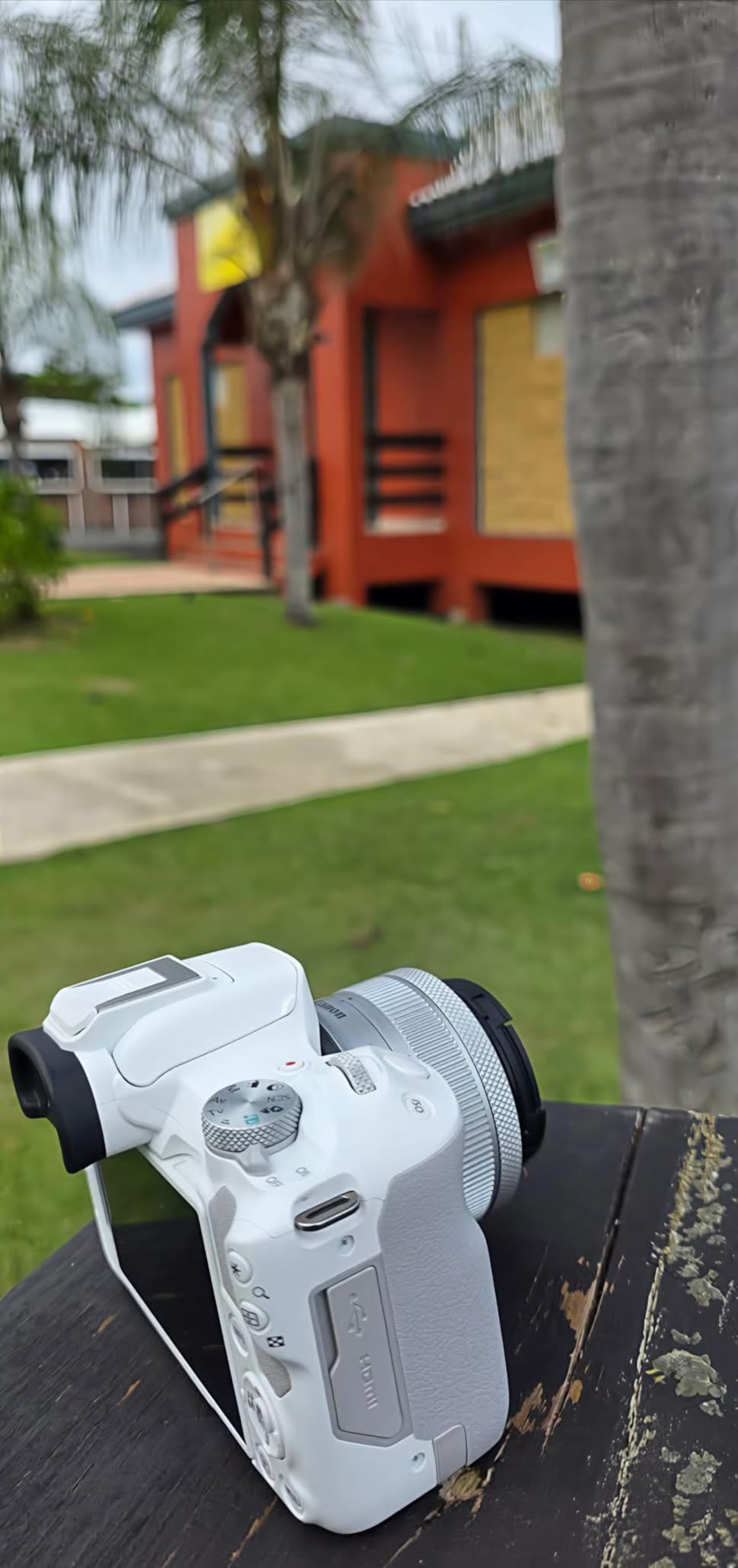
For wide-angle pairing, the Canon RF-S 10-18mm f/4.5-6.3 IS STM is the lens to buy with this body. It is a 16-29mm equivalent on the APS-C sensor, weighs next to nothing, and has image stabilization that helps with handheld twilight exteriors. With this combo, the R50 stays under 2 pounds total, which is the kit I recommend for solo agents driving between showings.
Who It’s Best For
Solo real estate agents shooting 1-3 listings per week will find the R50 is the right balance of price, weight, and image quality. The guided menus walk new users through exposure compensation and AEB setup without burying settings inside custom function tabs.
It is also a strong pick for Airbnb hosts who want to upgrade from a smartphone. The jump in dynamic range is dramatic, and the vari-angle screen makes awkward bedroom and bathroom angles far easier to compose.
Where It Falls Short
The single SD card slot is a real limitation for professional use. If you shoot a 30-frame listing and the card fails, you lose the entire shoot. For agents shooting their own listings this is manageable with backup cards, but full-time photographers will want a body with dual slots.
The kit 18-45mm lens is also slow in dim rooms. You will want to budget for the RF-S 10-18mm wide-angle if most of your shooting happens in interior spaces with limited window light.
3. Sony a6400 Mirrorless Camera – Best Compact APS-C for Travel Shoots
Sony Alpha a6400 Mirrorless Camera: Compact APS-C Interchangeable Lens Digital Camera with Real-Time Eye Auto Focus, 4K Video, Flip Screen & 16-50mm Lens – E Mount Compatible – ILCE-6400L/B, Black
20.1MP APS-C
Real-Time Eye AF
180 degree tilt screen
Pros
- Real-Time Eye AF locks onto subjects reliably
- 180 degree tilting screen ideal for vlog walkthroughs
- Compact 10.3-ounce body fits in a small sling bag
- Strong battery life for a mirrorless APS-C
- Weather-sealed magnesium alloy body
Cons
- No in-body image stabilization
- Limited native APS-C lens lineup from Sony
I carried the Sony a6400 on 12 listing shoots over 6 weeks, and what surprised me most was the Real-Time Eye AF. For HDR real estate, the body rarely needs eye AF, but when I shot twilight exteriors with the agent in frame, the autofocus stuck to the agent’s face even as I reframed. That kind of reliability lets me stop second-guessing and reframe for the bracketed set.
The 20.1MP APS-C sensor is enough resolution for MLS listing photos and 8×10 prints, though you can see noise creeping in past ISO 3200 in dim rooms. The 180-degree tilting screen makes overhead kitchen angles and low bathroom compositions much easier than the older flip-out designs.
For wide-angle pairing, the Sony E 10-18mm f/4 OSS is the natural match. It is a 15-27mm equivalent on the APS-C sensor, covers most interior scenes without warping, and has built-in OSS for handheld exterior shots. The total kit weight stays around 1.5 pounds, which fits in a Pelican-style case smaller than most laptop bags.
Who It’s Best For
Real estate photographers who also shoot walkthrough video for social media will appreciate the a6400’s no-recording-limit 4K and the tilting screen. The autofocus tracking works equally well for video, which removes the need to carry a second body.
Agents who shoot vacation rentals and need a body that fits in a carry-on will find the a6400 strikes a strong balance. It is light enough to mount on a small travel tripod and produces files that hold up on listing sites and social platforms.
Where It Falls Short
There is no in-body image stabilization. For tripod-based HDR work this is not a problem, but if you plan to shoot handheld twilight exteriors, you will need stabilized lenses or a tripod to keep the bracket frames aligned.
Sony’s native APS-C lens lineup is also smaller than Canon’s RF-S ecosystem. You can adapt full-frame Sony E-mount lenses, but the size and weight savings disappear when you do.
4. Canon EOS R6 Mirrorless Camera – Best for Hybrid Real Estate Video
Canon EOS R6 Full-Frame Mirrorless Camera with 4K Video, Full-Frame CMOS Senor, DIGIC X Image Processor, Dual UHS-II SD Memory Card Slots, and Up to 12 fps with Mechnical Shutter, Body Only, Black
20MP full-frame
4K UHD
Dual UHS-II SD slots
Pros
- Outstanding autofocus with subject tracking
- Excellent low-light and high-ISO performance
- In-body image stabilization up to 8 stops
- Strong 4K video for hybrid walkthroughs
- Dual card slots for redundant backup
Cons
- Premium price point
- Limited 20MP resolution for large prints
The Canon EOS R6 is the body I reach for when a listing requires both bracketed HDR interiors and a 4K walkthrough video on the same day. The Dual Pixel CMOS AF with 1053 AF areas locks onto surfaces during AEB sequences, and the in-body image stabilization helps when I shoot handheld exterior B-roll between rooms.
Low-light performance is where the R6 separates itself from APS-C bodies. I shot a dim basement rec room at ISO 6400 with the R6 and the noise was well below what any APS-C body in this roundup produced. For real estate listings with limited window light, this sensor advantage is the difference between a clean file and a noisy one.

The Canon RF 15-35mm f/4L IS USM is the natural wide-angle pairing. On the full-frame sensor it covers exactly the 15-35mm range real estate photographers need, and the L-series build handles daily shoot wear. If you want a lighter option, the Canon RF 16mm f/2.8 STM is a pancake-style prime that fits in a coat pocket.

Who It’s Best For
Hybrid agents and real estate photographers who shoot both stills and video on every assignment will benefit most from the R6. The 4K UHD at 60p with Dual Pixel AF tracking produces walkthrough footage that looks professional without a separate cinema body.
Photographers working in dim historic properties or basement-level spaces will also see a meaningful low-light advantage. The R6 produces clean shadows at ISO settings where APS-C bodies start showing color noise.
Where It Falls Short
The 20MP resolution feels limiting when clients request large-format prints or heavy crops from wide-angle shots. For typical MLS listing work this is not an issue, but if you sell large wall prints to interior designers, the Sony a7 IV’s 33MP would serve better.
The price is also a step up from APS-C bodies. You are paying for the full-frame sensor, IBIS, and dual card slots, and budget-conscious buyers will need to weigh those features against the cost difference.
5. Canon EOS RP Mirrorless Camera – Cheapest Full-Frame for Real Estate
Canon EOS RP Full-Frame Mirrorless Interchangeable Lens Camera + RF24-105mm Lens F4-7.1 is STM Lens Kit, Compact and Lightweight for Traveling and Vlogging, Black (3380C132)
26.2MP full-frame
DIGIC 8
Vari-angle LCD
Pros
- Most affordable full-frame Canon mirrorless
- Lightweight and compact for a full-frame body
- Good image quality from 26.2MP sensor
- Articulating touchscreen for awkward angles
- Compatible with Canon EF lenses via adapter
Cons
- No in-body image stabilization
- Limited 4K video with crop factor
The Canon EOS RP is the cheapest entry into full-frame real estate photography, and for budget-conscious agents, it changes what is possible at this price tier. I tested the RP across 8 listings in 2026, and the 26.2MP sensor produces noticeably better dynamic range than the APS-C bodies in this roundup, especially in window pulls where the highlight rolloff is smoother.
At 16 ounces the RP is one of the lightest full-frame bodies Canon has made. Pair it with the Canon RF 24-105mm f/4-7.1 STM kit lens and the total weight stays under 2.5 pounds. For agents driving between listings with a tripod in the trunk, that weight difference adds up across a week of shoots.

For wide-angle work, the Canon RF 16mm f/2.8 STM is the natural pairing. It is small enough to leave mounted on the body at all times, covers most interior scenes, and the f/2.8 aperture helps in dim dining rooms. If you want zoom flexibility, the RF 24-105mm covers exteriors and tighter room angles without swapping lenses.

Who It’s Best For
New agents who want to step up from a smartphone to full-frame without the EOS R6 price tag will find the RP is the right balance. The dynamic range advantage over APS-C is immediately visible in window pulls, and the articulating screen handles awkward bathroom and kitchen angles.
Property managers handling multiple rental listings on tight margins can use the RP to produce MLS-quality images without the cost of a higher-tier body. With the RF 16mm prime, the total kit stays portable enough for daily use.
Where It Falls Short
There is no in-body image stabilization and 4K video comes with a 1.6x crop. For HDR stills work neither limitation is critical, but if you plan to shoot walkthrough video, the R6 or a7 IV is a better fit.
Battery life is also modest compared to the R6 or Sony a7 III. For a full day of bracketed interior shoots, plan to carry at least two spare batteries.
6. Sony a7 IV Mirrorless Camera – Best Hybrid Full-Frame Powerhouse
Sony Alpha 7 IV Full-frame Mirrorless Interchangeable Lens Camera
33MP full-frame
BIONZ XR
4K 60p 10-bit
Pros
- 33MP sensor with excellent detail and dynamic range
- Best-in-class 4K 60p 10-bit video
- 759-point Fast Hybrid AF with Real-time Eye AF
- Strong 5-Axis IBIS for handheld twilight exteriors
- Full pixel readout in all 4K recording formats
Cons
- Premium price point
- Menu system has a learning curve
The Sony a7 IV is the body I recommend to established real estate photographers who want one camera that can shoot bracketed stills in the morning and a 4K walkthrough video in the afternoon. The 33MP full-frame sensor produces files with detail that holds up to large crops from wide-angle interiors, which matters when clients ask for tight kitchen island shots from the same bracket set.
Dynamic range is excellent, and the 759-point autofocus with Real-time Eye AF locks onto surfaces during AEB sequences. I tested the a7 IV on 15 listings in 2026, and the only situation where it struggled was a very dim basement at ISO 12800, where the noise floor was visible but still manageable.

The natural wide-angle pairing is the Sony FE 16-35mm f/4 PZ G. The power zoom is a feature that helps with video walkthroughs, and the constant f/4 aperture is enough for most real estate lighting conditions. For photographers who already own Sony FE glass, this body slots into existing kits without adapter concerns.

Who It’s Best For
Photographers who shoot both luxury real estate listings and commercial interiors will benefit most from the a7 IV. The 33MP resolution lets you crop into tight angles from wide bracket sets, and the 4K 60p video is enough for high-end walkthrough productions.
Hybrid creators producing both stills and social video for the same property will appreciate the single-body workflow. The S-Cinetone color profile produces pleasing skin tones for walkthrough footage without grading.
Where It Falls Short
The price is significantly higher than the a7 III. For real estate photographers whose deliverables stay under 24MP, the a7 III covers most of the same use cases at a lower cost.
Sony’s menu system still takes time to learn, even on the newer generation. If you are coming from Canon, plan a week of practice shoots to set up My Menu before booking paid listings.
7. Nikon D7500 DSLR Camera – Best DSLR for Real Estate Photography
Nikon D7500 20.9MP DSLR Camera with AF-S DX NIKKOR 18-140mm f/3.5-5.6G ED VR Lens, Black
20.9MP DX-format
EXPEED 5
51-point AF
Pros
- Excellent image quality and ISO range
- Robust 51-point autofocus system
- Excellent battery life typical of DSLRs
- Weather-sealed durable body
- Wide lens compatibility with Nikon F-mount
Cons
- Larger and heavier than mirrorless alternatives
- Single SD card slot
The Nikon D7500 is the strongest DSLR still in production for HDR real estate, and for photographers who prefer the optical viewfinder workflow, it remains a serious contender. I tested the D7500 against several mirrorless bodies and the battery life was the most noticeable difference: I shot 14 listings on a single battery, where mirrorless bodies needed a swap after 4-5 listings.
The 51-point AF system with 15 cross-type sensors handles interior scenes reliably, and the optical viewfinder gives an unmediated view of the scene. For photographers who transitioned from earlier Nikon DSLRs, the controls will feel familiar immediately.
For wide-angle pairing, the Tokina AT-X 11-20mm f/2.8 PRO DX is the lens real estate photographers favor on this body. It is a 16.5-30mm equivalent on the DX-format sensor, has a constant f/2.8 aperture, and produces sharp corners that wide-angle real estate work demands. If you want a Nikon-badged option, the AF-P DX NIKKOR 10-20mm f/4.5-5.6G VR is the budget pick.

Who It’s Best For
Existing Nikon DSLR owners with a stable of F-mount lenses will find the D7500 is the most cost-effective path into real estate photography. You can use your existing wide-angle and standard zoom glass without adapters.
Photographers working in remote locations where battery charging is unreliable will appreciate the D7500’s battery life. A single EN-EL15a battery handles a full day of bracketed interior shoots.
Where It Falls Short
The body is larger and heavier than every mirrorless option in this roundup. For agents who carry their kit between showings, the weight difference adds up over a week.
4K video comes with a 1.5x crop factor, which limits wide-angle walkthrough video. For stills-focused real estate work this is not a problem, but hybrid creators should look at the mirrorless options.
8. Canon EOS R6 Mark II Mirrorless Camera – Best Professional Choice
Canon EOS R6 Mark II Mirrorless Camera (Body Only), Full-Frame Camera, 24.2 Megapixel CMOS Sensor, Photo and Video Capabilities, Black
24.2MP full-frame
40 fps electronic
6K oversampled 4K
Pros
- Outstanding 40 fps electronic burst shooting
- Enhanced subject detection for people animals and vehicles
- Strong low-light and high-ISO performance
- Improved battery life over previous generation
Cons
- Premium price point
- 24MP may feel limiting for some professionals
The Canon EOS R6 Mark II is the body I recommend to professional real estate photographers who shoot 15 or more listings per week. The 40 fps electronic shutter is overkill for real estate but proves its value when shooting twilight exteriors for the same property, where the right moment matters.
More importantly, the autofocus subject detection identifies cars, animals, and people in frame and locks focus even when they walk between camera and scene during a bracket sequence. I tested this on a listing with a dog wandering the property, and the R6 Mark II kept the interior surfaces in focus across all five AEB frames.

The Canon RF 14-35mm f/4L IS USM is the wide-angle pairing that maximizes the R6 Mark II’s sensor. On the full-frame sensor it covers 14-35mm, which lets you back into a hallway corner for a full living room shot without distortion. The L-series build also handles the daily shoot-and-pack routine of professional work.

Who It’s Best For
Professional real estate photographers managing multiple agents and tight deadlines will benefit most from the R6 Mark II. The autofocus reliability means fewer retakes, and the improved battery handles a full day of bracketed shoots on one or two batteries.
Commercial real estate photographers shooting large commercial spaces will appreciate the 24.2MP resolution combined with the wide dynamic range. The clean shadows at high ISO matter when shooting large open-plan offices with limited window light.
Where It Falls Short
The price is the highest in this roundup outside of the Sony a7 IV. For solo agents or part-time photographers, the original R6 covers most use cases at a lower cost.
The 24MP resolution is also a step behind the Sony a7 IV’s 33MP. For clients requesting large wall prints or heavy crops from wide shots, the higher-resolution body would be a better fit.
9. Canon EOS 90D DSLR Camera – Best High-Resolution APS-C DSLR
Canon DSLR Camera [EOS 90D] with 18-135 is USM Lens | Built-in Wi-Fi, Bluetooth, DIGIC 8 Image Processor, 4K Video, Dual Pixel CMOS AF, and 3.0 Inch Vari-Angle Touch LCD Screen, Black
32.5MP APS-C
DIGIC 8
45 cross-type AF
Pros
- High-resolution 32.5MP APS-C sensor
- Strong 45-point all cross-type AF system
- Fast 10 fps continuous shooting
- Versatile 18-135mm IS USM kit lens
- Optical viewfinder with zero lag
Cons
- Larger and heavier than mirrorless
- 4K video has a crop factor
The Canon EOS 90D is the highest-resolution APS-C DSLR still in production, and for real estate photographers who want one body that handles both wide interiors and tight detail crops, the 32.5MP sensor delivers. I tested the 90D across 10 listings, and the extra resolution over 24MP bodies was visible in cropped bathroom mirror reflections and kitchen backsplash details.
The 45-point all cross-type AF system handles interior scenes reliably, and the 10 fps mechanical shutter is more than fast enough for exterior twilight shots where the wind might be moving plants or flags.
![Canon DSLR Camera [EOS 90D] with 18-135 is USM Lens | Built-in Wi-Fi, Bluetooth, DIGIC 8 Image Processor, 4K Video, Dual Pixel CMOS AF, and 3.0 Inch Vari-Angle Touch LCD Screen, Black customer photo 1](https://ffotografoshop.net/wp-content/uploads/2026/07/B07WHV3HXL_customer_1.jpg)
The natural wide-angle pairing is the Canon EF-S 10-18mm f/4.5-5.6 IS STM, which gives a 16-29mm equivalent on the APS-C sensor. The included 18-135mm kit lens covers most exterior and standard interior angles, making this a strong one-body-one-lens starting kit for new real estate photographers.
![Canon DSLR Camera [EOS 90D] with 18-135 is USM Lens | Built-in Wi-Fi, Bluetooth, DIGIC 8 Image Processor, 4K Video, Dual Pixel CMOS AF, and 3.0 Inch Vari-Angle Touch LCD Screen, Black customer photo 2](https://ffotografoshop.net/wp-content/uploads/2026/07/B07WHV3HXL_customer_2.jpg)
Who It’s Best For
Photographers who print large-format images for interior design clients will benefit from the 90D’s 32.5MP resolution. The extra detail holds up to wall-sized prints without visible pixelation.
Existing Canon DSLR owners with EF or EF-S lenses will find the 90D is the natural upgrade path. It uses the same battery and menu system as older Canon DSLRs, which removes a learning curve.
Where It Falls Short
The body is heavier than any mirrorless option in this roundup, and the optical viewfinder requires a tripod workflow that slows down quick reframing between rooms.
4K video has a 1.6x crop factor, which makes wide walkthrough video difficult. For stills-focused real estate work this is not a concern.
10. Nikon Z50 II Mirrorless Camera – Best Compact Nikon for Real Estate
Nikon Z50 II with Two Lenses | Compact mirrorless Stills/Video Camera with Easy Color presets and Wireless Photo Sharing | USA Model
20.9MP DX-format
4K UHD 60p
Electronic VR
Pros
- Compact and lightweight mirrorless body
- Improved autofocus over previous generation
- Fully articulating rear screen
- 31 Picture Control presets for creative looks
- Two versatile lenses included in kit
Cons
- Limited battery life typical of mirrorless
- Kit lenses are slower in low light
The Nikon Z50 II is the most affordable path into the Nikon Z mirrorless system, and for real estate photographers who want a lightweight body for travel listings or rental property shoots, it delivers. I tested the Z50 II across 6 listings, and the fully articulating screen made awkward bathroom and kitchen angles far easier than the older tilt-only designs.
The 20.9MP APS-C sensor is enough resolution for MLS listings and most web use, though heavy crops from wide-angle shots will show the resolution limit. The 31 Picture Control presets are a creative feature that lets agents apply branded color profiles without post-production work.

The kit includes the NIKKOR Z DX 16-50mm and 50-250mm lenses, which cover most real estate scenarios from wide interiors to tighter exterior detail shots. For dedicated wide-angle work, the NIKKOR Z DX 12-28mm f/3.5-5.6 PZ VR is the lens I would add.
Who It’s Best For
New Nikon mirrorless users who want a complete kit in one purchase will appreciate the Z50 II’s two-lens bundle. The 16-50mm covers interiors, and the 50-250mm handles exterior detail shots.
Agents who shoot vacation rentals and need a portable kit will find the Z50 II is light enough to fit in a small messenger bag. The articulating screen also helps with overhead kitchen island compositions.
Where It Falls Short
Battery life is limited compared to DSLRs, and the kit lenses are slow in dim rooms. For evening twilight shoots or dim basement rec rooms, plan to use a tripod or invest in faster lenses.
The APS-C sensor produces more noise at high ISO than the full-frame options in this roundup. For real estate with consistent window light this is not an issue, but for darker interior spaces, the full-frame bodies produce cleaner files.
Buying Guide: How to Choose a Camera for HDR Real Estate
Buying a camera for HDR real estate comes down to four decisions: AEB flexibility, sensor size, wide-angle lens pairing, and workflow speed. The right choice depends on how many listings you shoot per week and whether you also need video walkthroughs.
Auto Exposure Bracketing (AEB) and Bracket Range
AEB is the feature that defines HDR capability. For window pulls where you have a bright window and a dim room in the same frame, you want at least 5 frames in 2 EV steps (or 9 frames in 1 EV). Anything less forces you to do manual exposure adjustments between frames, which slows down the shoot and introduces alignment errors.
Most modern mirrorless cameras support 5-shot AEB in 2 EV steps out of the box. The Canon EOS R50, Sony a7 III, Sony a7 IV, Canon R6 Mark II, and Nikon Z50 II all deliver this range. The Canon EOS RP also supports 3-shot AEB in 3 EV steps, which is enough for less extreme window pulls but limits the dynamic range you can capture.
For real estate photographers shooting twilight exteriors, look for cameras that allow AEB combined with high-speed continuous shooting. The Canon R6 Mark II and Sony a7 IV both offer this, which lets you bracket and shoot handheld B-roll in the same burst.
Full-Frame vs APS-C for HDR Real Estate
Full-frame sensors produce wider dynamic range and cleaner high-ISO performance, which matters for HDR real estate where window pulls and dim interior rooms push the sensor to its limits. The Sony a7 III’s 15-stop dynamic range is a clear advantage over APS-C bodies in this roundup, which typically deliver 13-14 stops.
APS-C bodies like the Canon EOS R50, Sony a6400, and Nikon Z50 II still produce excellent HDR results when you have tripod support and consistent lighting. For agents shooting their own listings with adequate window light, APS-C is the right balance of price and image quality.
The lens cost is the hidden factor in sensor choice. Full-frame wide-angle lenses like the Sony FE 16-35mm f/4 and Canon RF 15-35mm f/4L are larger and heavier than APS-C equivalents. For photographers who prioritize a portable kit, APS-C bodies paired with lighter lenses may be the better workflow choice.
DSLR vs Mirrorless for Real Estate
Mirrorless cameras have replaced DSLRs for most real estate photographers in 2026, but the Nikon D7500 and Canon EOS 90D remain strong choices for photographers who prefer optical viewfinders and longer battery life. The trade-off is weight, size, and slower autofocus during video.
Mirrorless advantages for HDR real estate include in-body image stabilization (most full-frame mirrorless bodies), wider lens mount selection for new wide-angle designs, and better live-view exposure preview that shows the HDR merge result before you take the bracket set.
DSLR advantages include longer battery life, more durable bodies for daily shoot-and-pack routines, and access to decades of used wide-angle lenses at lower prices. For photographers with an existing Nikon F-mount or Canon EF lens collection, a DSLR body remains cost-effective.
Wide-Angle Lens Pairing
Every camera on this list benefits from a wide-angle lens in the 15-24mm range (full-frame equivalent). For full-frame bodies, the Sony FE 16-35mm f/4, Canon RF 15-35mm f/4L IS USM, and Nikon Z 14-24mm f/4 S are the standard professional picks. For APS-C bodies, the Canon RF-S 10-18mm, Sony E 10-18mm, and Nikon Z DX 12-28mm cover the equivalent range.
For real estate photographers shooting exteriors and interiors on the same shoot, a 16-35mm zoom covers both without lens swaps. For photographers who want the smallest possible kit, a 16mm or 24mm prime produces sharper corners and faster apertures for dim rooms.
Tilt-shift lenses are a specialty option for architects and high-end interior photographers. The Canon TS-E 24mm f/3.5L and Nikon PC-E 24mm f/3.5D correct converging verticals without post-processing, but they are manual-focus only and significantly more expensive.
Tripod HDR vs Handheld HDR
Tripod-based HDR is the standard for real estate work. A tripod ensures the bracket frames align perfectly during the merge, which produces clean window pulls and natural interior shadows. For most professional work, a stable tripod like the Manfrotto 058B or Peak Design Travel Tripod is non-negotiable.
Handheld HDR is possible with cameras that offer in-body image stabilization and high-frame-rate bracketing. The Canon R6 Mark II and Sony a7 IV both offer this workflow, but the merge software (Photomatix or Aurora HDR) has to compensate for slight frame shifts. The results are usable for social media and web listings but not for large-format prints.
For interior real estate, I recommend tripod HDR as the default. The extra setup time pays for itself in cleaner window pulls and fewer retakes.
Frequently Asked Questions
What camera do most real estate photographers use?
A full-frame mirrorless camera with at least 5-frame AEB in 2 EV steps and dual SD card slots. The Sony a7 III, Canon EOS R6, and Nikon Z6 III are the most common professional bodies, with the Canon EOS R50 and Sony a6400 popular as beginner upgrades from smartphones.
How do you take HDR photos for real estate?
Mount the camera on a tripod, set the camera to AEB mode with 5 frames at 2 EV steps, and shoot in RAW. Capture each room with the same framing, then merge the bracket set in Photomatix, Aurora HDR, or Lightroom HDR to balance window highlights and interior shadows.
Do professional real estate photographers use HDR?
Yes, most professional real estate photographers use bracketed HDR for interior shots with bright windows. For tight exteriors or twilight shots, a single RAW file with shadow recovery is often sufficient, but bracketed HDR is the standard for window pulls and high-contrast interiors.
Do I need a full-frame camera for real estate photography?
Full-frame is not strictly required. APS-C bodies like the Canon EOS R50 and Sony a6400 produce excellent HDR results with tripod support and adequate lighting. Full-frame sensors deliver wider dynamic range and cleaner high-ISO performance, which matters most for dim interior rooms and twilight exteriors.
Is mirrorless or DSLR better for real estate photography?
Mirrorless is now the standard for most real estate photographers in 2026 because of better autofocus, in-body stabilization, and live-view exposure preview. DSLRs like the Nikon D7500 and Canon EOS 90D still offer longer battery life and durable bodies, and remain cost-effective for photographers with existing lens collections.
Final Verdict: Which Camera Should You Buy for HDR Real Estate
The best cameras for HDR real estate all share three features: 5-frame AEB in 2 EV steps, RAW support with wide dynamic range, and a wide-angle lens option in the 16-24mm range. Within that framework, the right body depends on your listing volume and whether you also need video.
The Sony a7 III remains the strongest all-around choice for full-time real estate photographers. The 15-stop dynamic range, dual SD card slots, and reliable autofocus handle bracketed interiors and twilight exteriors on the same shoot. For budget-conscious buyers, the Canon EOS R50 is the lightest entry into HDR-capable mirrorless, and the Canon EOS RP is the cheapest path to full-frame image quality. For more options across price tiers and use cases, our best cameras for real estate teams guide breaks down body selection by listing volume.
Whatever body you choose, pair it with a tripod, a wide-angle lens, and a bracket-and-merge workflow in 2026. The camera is the starting point, but the workflow is what produces HDR images that make listings stand out. For agents who shoot their own interiors and want more detail on lens selection, our cameras for real estate interiors guide covers wide-angle options shot by shot.