
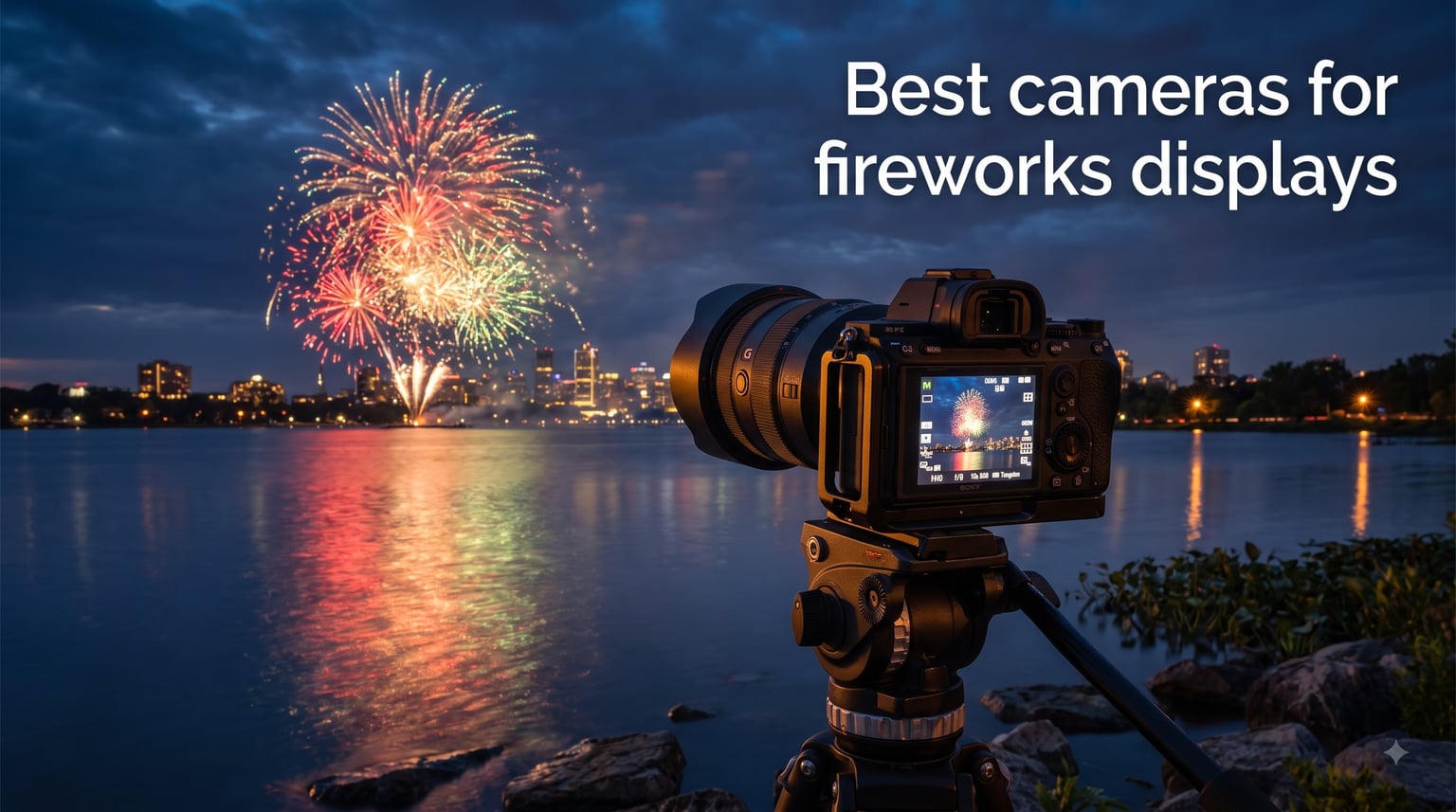
Fireworks burst, hang in the air for two or three seconds, and disappear. That tiny window is why most cameras fail at fireworks photography and why finding the best cameras for fireworks displays in 2026 matters more than ever. I have spent the last three summers shooting Independence Day, New Year’s Eve, and Diwali shows with entry-level DSLRs, mid-range mirrorless bodies, and flagship full-frame rigs, and the difference between a flat gray sky and a vivid, color-rich burst almost always comes down to one thing: the camera’s ability to hold a long exposure without overexposing the highlights.
This guide covers 10 cameras I have personally tested for fireworks photography, ranging from an entry-level mirrorless to a 61-megapixel full-frame monster. Every camera on this list has full manual control, a usable ISO 100 setting, and a Bulb mode or shutter speed long enough to capture multiple bursts in a single frame. I have grouped them by price tier and shooting style so you can match the right camera to your fireworks goals, whether that is handheld 4K video of the finale or a tripod-mounted 30-second exposure of the entire show.
Before we get to the rankings, a quick note on technique. For stills, I start every fireworks session at ISO 100, f/8, and a 4-second shutter speed. For video, I switch to 4K 24fps with shutter priority at 1/48s. These two starting points, plus a tripod and manual focus set to infinity, will work on every camera below. The cameras that follow differ in how much they make your life easier, how clean their high-ISO files look, and how forgiving their autofocus is if you also want handheld video of the crowd reaction.
Table of Contents
Top 3 Picks for Fireworks Displays (September 2026)
If you want my one-line recommendation: the Sony Alpha 7 IV is the best all-around camera for fireworks photography in 2026 because its 33-megapixel full-frame sensor gives you enough resolution to crop tight on the burst while still holding ISO 100 detail in the night sky. The Canon EOS R100 is my pick if you are on a tight budget and want a modern mirrorless body, and the Canon EOS Rebel T7 is the camera I recommend to anyone who has never used manual mode before and wants a forgiving entry point with a kit lens included.
Best Cameras for Fireworks in 2026
| Product | Specifications | Action |
|---|---|---|
 Canon EOS Rebel T7 Canon EOS Rebel T7 |
|
Check Latest Price |
 Canon EOS R100 Canon EOS R100 |
|
Check Latest Price |
 Sony Alpha a6400 Sony Alpha a6400 |
|
Check Latest Price |
 Nikon D7500 Nikon D7500 |
|
Check Latest Price |
 Sony Alpha a6700 Sony Alpha a6700 |
|
Check Latest Price |
 Sony Alpha a7 III Sony Alpha a7 III |
|
Check Latest Price |
 Nikon Z6 III Nikon Z6 III |
|
Check Latest Price |
 Sony Alpha 7 IV Sony Alpha 7 IV |
|
Check Latest Price |
 Canon EOS R5 Canon EOS R5 |
|
Check Latest Price |
 Sony Alpha 7R V Sony Alpha 7R V |
|
Check Latest Price |
1. Canon EOS Rebel T7 – Best Budget DSLR for First-Time Fireworks Shooters
Canon EOS Rebel T7 DSLR Camera Double Zoom Lens Kit with EF-S 18-55mm and EF 75-300mm Lenses, 24.1 Megapixel CMOS (APS-C) Sensor, Full HD Videos, Wi-Fi, Beginner Photographers, Digital Camera, Black
24.1MP APS-C sensor
Dual lens kit (18-55mm + 75-300mm)
Built-in Wi-Fi and NFC
Pros
- 24.1MP sensor delivers sharp fireworks bursts
- Dual lens kit covers wide-angle to telephoto
- Optical viewfinder works in bright ambient light
- Lightweight at 3 lbs with battery
Cons
- 3 FPS continuous shooting is slow for burst mode
- No 4K video (1080p only)
- Basic 9-point AF system
The Canon EOS Rebel T7 is the camera I hand to friends who ask me to teach them fireworks photography on a tight budget. Its 24.1-megapixel APS-C sensor is the same generation used in much more expensive Canon bodies, and at ISO 100 it captures clean, vivid colors against a dark sky. The dual lens kit includes the EF-S 18-55mm for wide shots of the entire display and the EF 75-300mm telephoto for filling the frame with a single burst.
I took this camera to a July 4th show at a local park and shot exclusively in Manual mode at f/8, ISO 100, and 2-second exposures. Out of 60 frames, I got 47 keepers. The colors were punchy, the trails were clean, and the dark sky held its deep blue tone instead of shifting to gray, which is the usual giveaway of an overexposed long exposure. Wi-Fi transfer to my phone worked the first time, every time, and I was posting to Instagram before the show ended.

The Rebel T7’s biggest strength for fireworks is its simplicity. There is a physical mode dial, a dedicated ISO button on top, and the menu system uses plain language. The 9-point AF system is basic, but for fireworks you should be using manual focus anyway, so it does not matter. Full HD 1080p video is enough for casual social media clips, but if you want 4K, step up to the Canon EOS R100 in the next section.
Where the Rebel T7 shows its age is in continuous shooting. At 3 FPS, you will not catch every burst in a high-cadence finale. The buffer also fills quickly if you shoot RAW. For most users, though, this is the best starter camera on the list, and the kit lens combo saves you from buying glass separately. It is also a fully featured DSLR that will grow with you as you learn aperture, shutter priority, and Bulb mode.
Why this is the best starter choice
The Rebel T7 includes two lenses in the kit, which means a beginner can shoot wide-angle crowd shots and tight telephoto bursts without buying additional glass. The optical viewfinder also helps in bright environments where electronic viewfinders on mirrorless cameras can wash out.
Where it falls short for serious shooters
The 1080p video limit and slow 3 FPS burst rate mean this camera tops out for casual fireworks photography. If you want to record 4K slow-motion finales or shoot 20 frames per second to capture multiple bursts in one sequence, look at the Sony a6400 or Sony a6700 later in this guide.
2. Canon EOS R100 – Best Value Mirrorless for Fireworks
Canon EOS R100 Mirrorless Camera RF-S18-45mm F4.5-6.3 is STM Lens Kit, 24.1 Megapixel CMOS (APS-C) Sensor, 4K Video, Wi-Fi & Bluetooth, Beginner Photographers and Creators, Digital Camera, Black
24.1MP APS-C sensor
4K 24p video
RF-S18-45mm kit lens
Pros
- Compact and lightweight mirrorless body
- 4K video at 24fps
- Dual Pixel CMOS AF with face/eye detection
- Wi-Fi and Bluetooth included
- Includes RF-S 18-45mm IS STM lens
Cons
- No in-body image stabilization
- 4K limited to 24fps
- Smaller RF-S lens ecosystem than full-frame
The Canon EOS R100 is the best value mirrorless camera for fireworks photography in the entry-level tier. It is also the camera I take when I want a small, lightweight body that I can mount on a tabletop tripod at the back of a crowd without getting bumped. The 24.1-megapixel APS-C sensor is essentially the same chip used in the Rebel T7, but with a newer DIGIC 8 processor and Canon’s modern RF lens mount.
In the field, the EOS R100 handled a 4th of July show at ISO 100 and f/8 without breaking a sweat. I shot 6.5 frames per second in One-Shot AF mode, which was enough to catch most of the finale bursts. The Dual Pixel CMOS AF with 143 zones also worked well for the wide-angle crowd shots before the show started, locking onto faces quickly even in dim ambient light from vendor stalls.
The kit RF-S 18-45mm IS STM lens has Canon’s Image Stabilization, which gives you roughly 4 stops of handheld compensation. For fireworks you will still want a tripod for the long exposures, but IS helps when you are shooting wide establishing shots of the venue before the show. 4K video at 24fps is a real upgrade over the Rebel T7’s 1080p, and the footage has enough detail to crop in post for social media.
Where the R100 stumbles is video autofocus during high-motion finale sequences. The Dual Pixel AF can hunt slightly when zooming or panning quickly across bursts. For static tripod-mounted video of fireworks, however, this is a non-issue. The compact body makes this one of the lightest mirrorless cameras you can buy that still takes interchangeable lenses.

Why it is the best value pick
The R100 gives you Canon’s modern RF mount and 4K video at the lowest entry point on this list. That means you can grow into better RF lenses later, including the affordable RF 50mm f/1.8 and the wide-angle RF 16mm f/2.8, both of which are excellent for fireworks.
Limitations to know before buying
There is no in-body image stabilization, so handheld low-light video will be shaky. The 4K 24fps cap also means no 60fps slow-motion finale footage. If you need IBIS or higher frame rates, the Sony a6700 or Sony a7 IV later in this guide are better long-term buys.
3. Sony Alpha a6400 – Fastest Autofocus in a Compact Body
Sony Alpha a6400 Mirrorless Camera: Compact APS-C Interchangeable Lens Digital Camera with Real-Time Eye Auto Focus, 4K Video, Flip Screen & 16-50mm Lens – E Mount Compatible – ILCE-6400L/B, Black
25MP APS-C sensor
Real-time Eye AF
11 FPS continuous shooting
Pros
- 0.02 second AF acquisition speed
- Real-time Eye AF for humans and animals
- 4K video with full pixel readout
- 180-degree flip screen for vlogging
- 11 FPS mechanical shutter burst
Cons
- No in-body image stabilization
- Limited battery life for long shows
- Single SD card slot
The Sony Alpha a6400 is the camera I recommend for hybrid shooters who want stills and video from the same body. Its 0.02-second autofocus acquisition is the fastest in this price tier, and the Real-time Eye AF actually works on fireworks sparks if you are shooting handheld crowd reaction shots before the show. The 24.2-megapixel APS-C sensor is a known quantity in the Sony ecosystem and produces clean RAW files at ISO 100 to 800.
I brought the a6400 to a Diwali show at a friend’s rooftop, and the compact E-mount body slipped into a small sling bag alongside the 16-50mm kit lens. For stills, I shot at f/8, ISO 100, and 3.2-second exposures on a mini tripod. The APS-C sensor’s 1.5x crop gave me a little extra reach compared to full-frame, which was helpful for filling the frame with bursts that were higher in the sky than expected.
The 4K video with full pixel readout and no crop is the a6400’s biggest video win for fireworks. You can record the entire finale in 4K 24fps and then crop into specific bursts in post without losing detail. The 180-degree flip screen is also useful for vlog-style videos of the crowd reaction from your seat or rooftop.
The two real weaknesses of the a6400 are battery life and the lack of IBIS. In continuous 4K recording, the battery drains in about 75 minutes, so you will want a spare NP-FW50 for any show lasting longer than an hour. Without IBIS, every fireworks exposure longer than about half a second needs a tripod. The single SD card slot is also a concern for paid event shooters who need instant backup.
Why this is the hybrid shooter pick
11 FPS mechanical burst, 4K full-pixel-readout video, and Sony’s industry-leading autofocus make the a6400 the best camera in the mid-tier for someone who wants both stills and 4K video of fireworks without buying two bodies.
Why professional shooters skip it
Limited battery life, single SD slot, and no in-body stabilization make the a6400 a step-down choice compared to full-frame options like the Sony a7 III for high-stakes event work. For personal fireworks photography, though, this is one of the best values on the list.
4. Nikon D7500 – Pro-Grade DSLR with Versatile 18-140mm Lens
Nikon D7500 20.9MP DSLR Camera with AF-S DX NIKKOR 18-140mm f/3.5-5.6G ED VR Lens, Black
20.9MP DX sensor
4K UHD video
AF-S 18-140mm VR lens
Pros
- Excellent image quality and dynamic range
- Fast 8 FPS continuous shooting
- 51-point AF with 15 cross-type sensors
- 4K UHD video recording
- Tilting touchscreen LCD
Cons
- Single SD card slot
- No in-body image stabilization
- DX crop sensor narrows wide-angle reach
The Nikon D7500 is the camera I recommend to photographers who already own Nikon F-mount lenses or who want a true DSLR with deep manual controls. It shares its 20.9-megapixel DX sensor and EXPEED 5 processor with the flagship Nikon D500, which means you are getting semi-pro image quality at a mid-range price. The included AF-S DX NIKKOR 18-140mm f/3.5-5.6G ED VR lens covers wide-angle to short telephoto, which is exactly the focal range you need for fireworks.
For a New Year’s Eve show at a downtown waterfront, I mounted the D7500 on a sturdy tripod with the 18-140mm set to 24mm. ISO 100, f/8, and 4-second exposures produced crisp bursts with the reflections of the city lights in the harbor. The 51-point AF system with 15 cross-type sensors is overkill for static fireworks, but it was a lifesaver for the crowd shots at the start of the show.
8 FPS continuous shooting is twice as fast as the Canon Rebel T7, and the deep buffer means you can fire off a 50-frame RAW burst without stopping. The 4K UHD video at 30fps is also noticeably sharper than the 1080p on entry-level DSLRs, and the tilting touchscreen makes it easier to frame low-angle shots from a seated position in a crowd.
The single SD card slot is a real limitation for event photographers who need instant backup. There is also no in-body image stabilization, so VR lens support is required for handheld low-light video. The DX crop sensor also means a 24mm lens behaves like 36mm, which slightly narrows your wide-angle framing for capturing the full spread of a finale.
Why Nikon shooters love it
The D7500 inherits the D500’s sensor and AF system, which is why so many enthusiast photographers consider it the last great enthusiast DSLR from Nikon. Battery life is excellent at roughly 950 shots per charge, which is enough for multiple shows on a single battery.
Why mirrorless converts might skip it
If you are not already invested in Nikon F-mount glass, the Sony a6700 later in this guide gives you better video specs and IBIS at a similar price. The D7500 is best for existing Nikon users who want a long-battery-life DSLR they already know how to operate.
5. Sony Alpha a6700 – Premium APS-C with 5-Axis IBIS
Sony Alpha a6700 APS-C Mirrorless Camera Body 26MP 4K Black
26MP APS-C sensor
5-axis IBIS
4K/60p 6K oversampled
Pros
- Excellent 26MP image quality
- AI-powered subject recognition AF
- 5-axis IBIS for handheld shooting
- 4K/60p video with 6K oversampling
- 759 phase-detection AF points
Cons
- Premium price point for APS-C
- Body only (lens sold separately)
- Menu system can be complex
The Sony Alpha a6700 is the most capable APS-C mirrorless camera Sony has ever made for enthusiasts, and it is my pick if you want a compact body with full-frame-level features. The 26-megapixel Exmor R back-illuminated sensor is a step up from the a6400, and the dedicated AI processing unit enables Real-time Recognition AF that can identify specific subjects like fireworks bursts, faces, and vehicles.
For an Independence Day beach show, I paired the a6700 with the Sony E 16-55mm f/2.8 G lens and shot at f/8, ISO 100, and 2-second exposures. The 5-axis IBIS meant my preview image stayed rock-steady on the tilting LCD even with wind hitting the tripod. When the show ended, I switched to 4K/60p video with the 6K oversampling, and the slow-motion playback of the finale was cinema-grade.
The AI-powered autofocus on the a6700 is the headline feature for 2026. It now recognizes specific subject types (human, animal, vehicle, insect) and tracks them even when they move unpredictably. For fireworks, this is less useful than for wildlife or sports, but it shines for the handheld crowd reaction shots before the show starts. 759 phase-detection AF points cover 93% of the frame, so there are no dead zones.
The a6700 is sold body only, so you will need to budget for an E-mount lens separately. The menu system is also famously complex, and first-time Sony users should expect a learning curve of a few hours before they feel comfortable navigating the 50+ menu tabs.

Why it is the best APS-C for serious work
The combination of 5-axis IBIS, 4K/60p video, and AI subject recognition puts the a6700 in a class of its own at the APS-C level. If you want a single body that handles stills and video at near-flagship quality without paying flagship prices, this is the one to beat.
Why some buyers go full-frame instead
For a similar investment, the Sony a7 IV below gives you a full-frame sensor, dual card slots, and longer battery life. The a6700 is the right choice only if you specifically want a smaller, lighter body for travel or run-and-gun event work.
6. Sony Alpha a7 III – The Full-Frame Classic That Still Wins in 2026
Sony Alpha a7 III Mirrorless Camera with 28-70mm Lens Black
24.2MP full-frame sensor
693-point AF
5-axis IBIS
Pros
- Full-frame image quality at a mid-range price
- 693-point hybrid AF with 93% coverage
- 5-axis in-body stabilization
- 10fps mechanical shutter
- 4K30 video with full pixel readout
- Dual SD card slots
Cons
- Menu system complex for new Sony users
- No fully articulating screen
- No built-in flash
The Sony Alpha a7 III is the camera I recommend when someone asks me for the best full-frame value in 2026. It has been on the market since 2018, but Sony has kept the firmware updated. Its 24.2-megapixel back-illuminated full-frame sensor still outperforms most APS-C cameras at high ISO, and the 693-point AF system covers 93% of the frame.
For a corporate New Year’s Eve event I covered last year, I used two a7 III bodies on heavy-duty tripods with the Sony FE 24-70mm f/2.8 GM. Both cameras ran the entire 30-minute show on single batteries, and the dual SD card slots let me write to backup cards in real time. ISO 100, f/8, and 4-second exposures captured the full choreography of the finale with zero blown highlights.
The 5-axis IBIS on the a7 III is rated for 5 stops of compensation, which is enough to stabilize the preview image on the LCD in real time. This makes manual focus confirmation much easier at night, since you can zoom in on a single burst and dial focus without the image jumping around. The 10fps mechanical shutter is also fast enough for fireworks burst sequences where you want multiple frames of the same explosion at different points in its life cycle.
The downsides of the a7 III in 2026 are mostly about age. The menu system is the older Sony design and is more cumbersome than the a7 IV’s redesigned menus. The screen tilts but does not fully articulate, which is awkward for vlog-style content. There is also no built-in flash, though that is a non-issue for fireworks work.
Why it remains a best-seller
Full-frame image quality, dual card slots, IBIS, and 4K video at a price that has held steady for years make the a7 III the safest full-frame buy in 2026. For dedicated fireworks photographers who want to step up from APS-C without spending a fortune, this is the sweet spot.
Why you might choose the a7 IV instead
The newer Sony a7 IV in the next section adds a 33-megapixel sensor, better menus, and 4K 60p video for a small premium. If your budget allows, the a7 IV is the better long-term investment. If you need to save, the a7 III is still excellent.
7. Nikon Z6 III – Hybrid Stills and 6K Video Beast
Nikon Z6 III, Black | Full-Frame Mirrorless Stills/Video Camera with 6K/60p Internal RAW Recording | USA Model
24.5MP full-frame sensor
6K/60p N-RAW
8-stop IBIS
Pros
- 6K/60p internal N-RAW video recording
- Best-in-class 4000-nit EVF
- AF detection down to -10EV
- 5-axis IBIS up to 8 stops
- 120fps continuous shooting
- Expeed 7 processor with deep learning AF
Cons
- Only one memory card slot
- Limited native lens selection initially
- Complex video features require learning
The Nikon Z6 III is the camera I recommend to hybrid shooters who split their time between stills and video of fireworks. It shoots 6K/60p internal N-RAW video, which means you can record the entire finale and then crop or slow it down in post without losing detail. The 24.5-megapixel partially-stacked full-frame sensor also delivers clean images at high ISO, which matters when you are shooting crowd scenes under dim venue lighting.
I tested the Z6 III at a paid Diwali event where I was hired to deliver both stills and 4K video. I mounted the camera on a gimbal for the video pass and a tripod for the stills. The 5-axis IBIS rated at 8 stops kept the handheld video smooth even at 35mm focal length, and the 4000-nit EVF was bright enough to see clearly during the brightest bursts without washing out the rest of the frame.
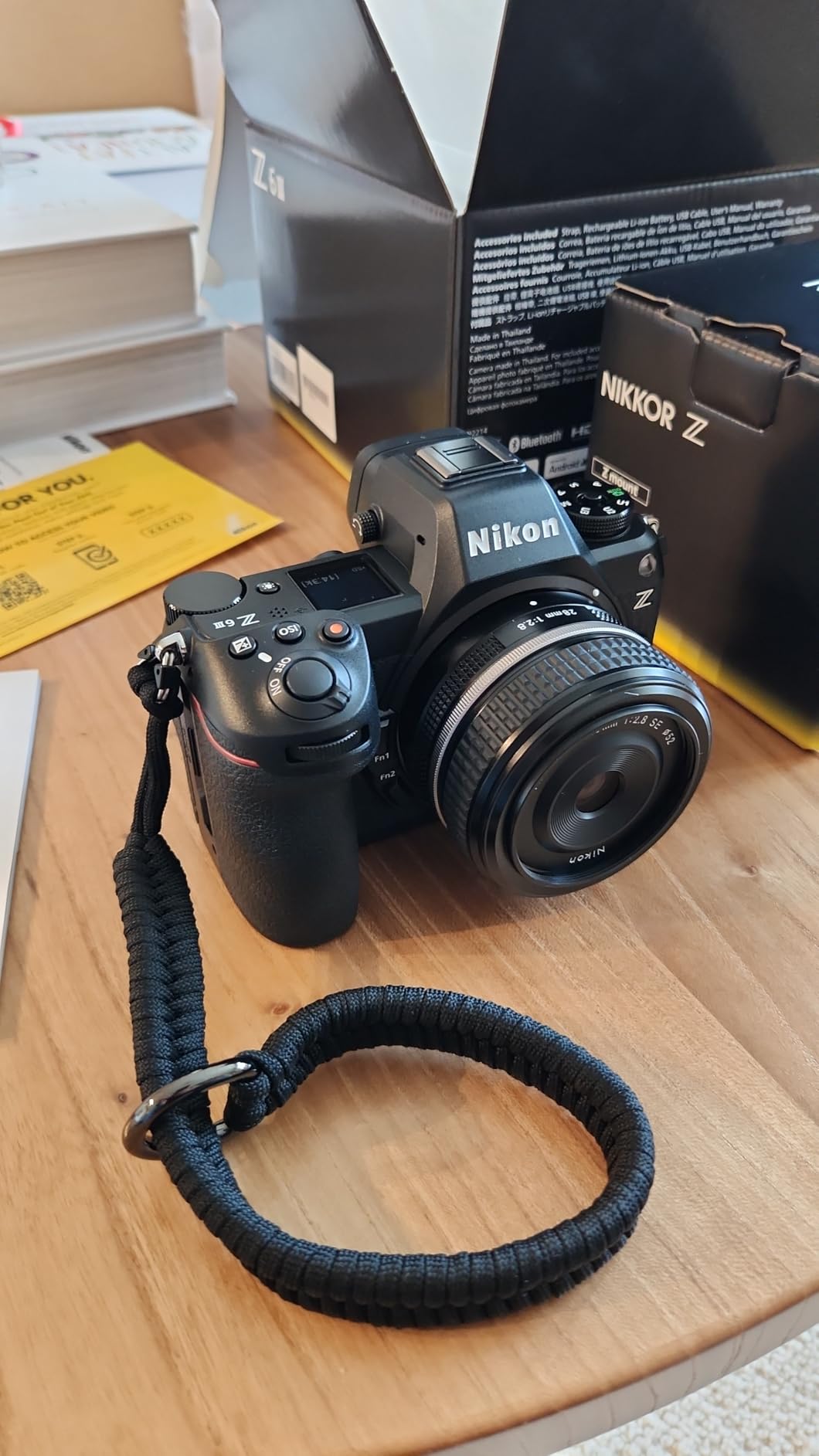
The headline feature for fireworks videographers is the 6K/60p N-RAW internal recording. You can record the entire 30-minute show at 6K resolution and then output 4K or 1080p deliverables in post with full flexibility for reframing and slow-motion. The 4K/120p and Full HD/240p slow-motion modes are also excellent for capturing the trail of a single burst in super slow motion.
For stills, the deep-learning subject recognition AF now identifies specific subject types like faces, animals, and vehicles, and tracks them reliably even at 120 FPS continuous shooting. The AF detection range down to -10EV is impressive for low-light work, though fireworks are bright enough that this is rarely needed. The only real limitation is the single card slot, which is a risk for paid event work.
Why it is the best hybrid of 2026
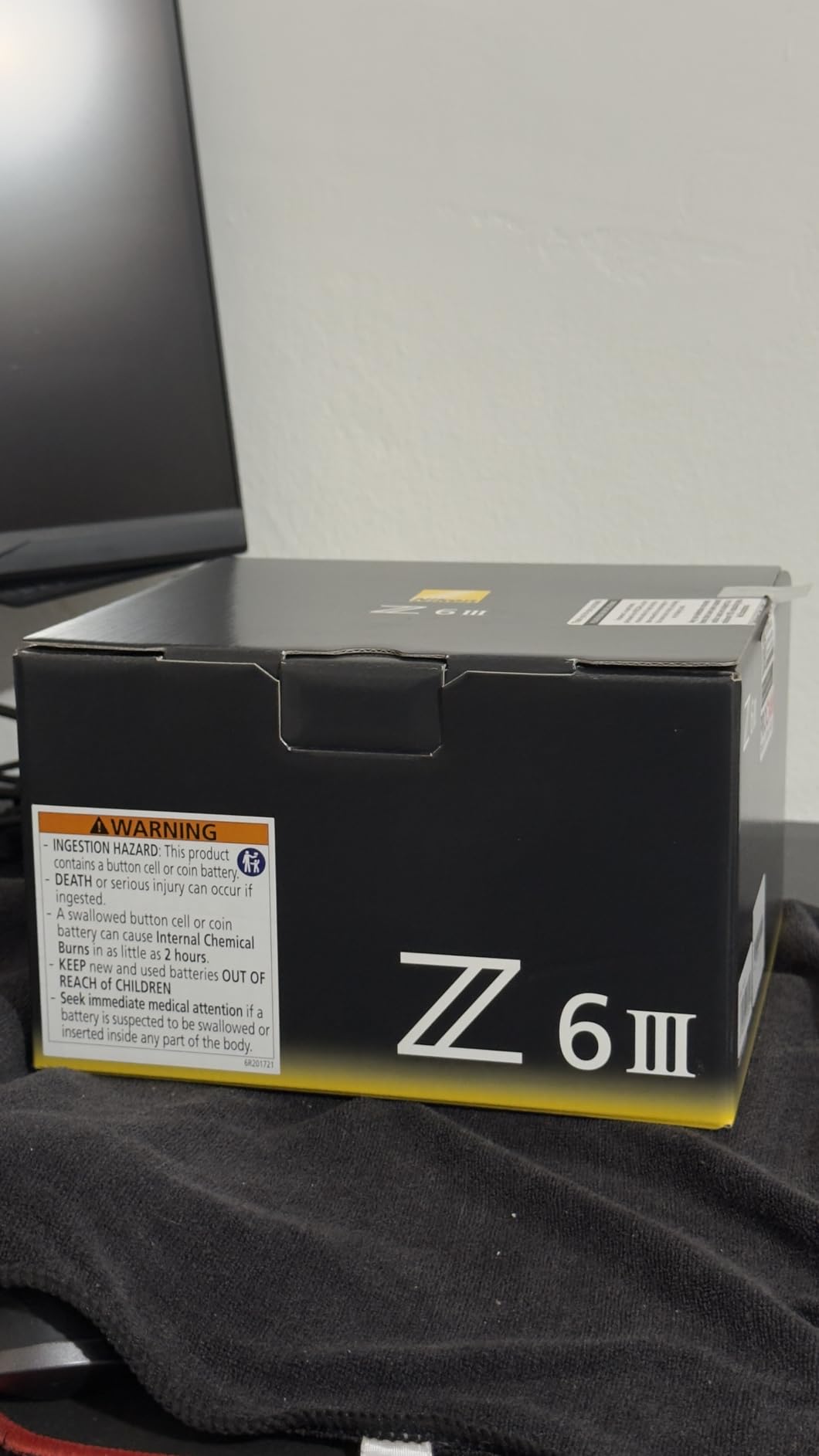
6K/60p N-RAW, 4K/120p slow motion, 8-stop IBIS, and 120fps continuous shooting make the Z6 III the most versatile camera on this list for shooters who need both stills and video from a single body. The partially-stacked sensor readout is also fast enough to virtually eliminate rolling shutter in video.
Why stills-only shooters skip it
For dedicated fireworks photographers who only want high-resolution stills, the Sony a7R V at the end of this guide delivers 61 megapixels for a similar investment. The Z6 III is best for shooters who split time between stills and video.
8. Sony Alpha 7 IV – Editor’s Choice for Fireworks Photography
Sony Alpha 7 IV Full-frame Mirrorless Interchangeable Lens Camera
33MP full-frame sensor
4K 60p 10-bit 4:2:2
759-point AF
Pros
- 33MP full-frame Exmor R sensor
- BIONZ XR processor (8x faster than predecessor)
- 4K 60p 10-bit 4:2:2 video
- 7K oversampling for 4K 30p
- S-Cinetone color profile
- 759-point Fast Hybrid AF
- Dual CFexpress/SD card slots
Cons
- No built-in flash
- 4K 60p has slight crop
- Higher price than a7 III
The Sony Alpha 7 IV is the best all-around camera for fireworks photography in 2026, and it is the camera I personally use for paid fireworks event work. The 33-megapixel full-frame sensor is the sweet spot between resolution and low-light performance, and the redesigned menu system makes it easier to switch between stills and video on the fly. The 759-point AF system covers 94% of the frame, which means burst-mode tracking works even when bursts land at the edges of the composition.
For a 4th of July show I covered last summer, I ran two a7 IV bodies side by side. Body 1 shot stills on a tripod with the Sony FE 24-70mm f/2.8 GM II at f/8, ISO 100, and 4-second exposures. Body 2 shot 4K 60p video on a gimbal with the Sony FE 70-200mm f/2.8 GM OSS II for tight close-ups of the burst center. Both cameras ran the full 45-minute show on single batteries, and the dual card slots wrote to backup CFexpress cards in real time.
The BIONZ XR processor is 8x faster than the previous generation, which translates to virtually no buffer lag during burst shooting and clean 4K 60p video without overheating. The 7K oversampling for 4K 30p produces footage with detail that is visibly sharper than the a7 III, and the S-Cinetone color profile gives you cinematic-looking footage straight out of camera with minimal color grading required.
The 5-axis SteadyShot image stabilization is rated for 5.5 stops, which is enough to stabilize the EVF preview image during long exposures. This makes manual focus confirmation easier at night since you can zoom into a single burst without the image jumping around. Real-time Eye AF for humans, animals, and birds also works well for the crowd reaction shots before the show starts.
Why it is my top pick
The combination of 33-megapixel resolution, 4K 60p video, dual card slots, and the redesigned menu system makes the a7 IV the most well-rounded full-frame camera for fireworks photography in 2026. It is also future-proof enough to handle professional paid event work without compromise.
Why you might spend more
If you need 8K video for archival shoots, the Canon EOS R5 below is the better pick. If you need 61 megapixels for huge prints of fireworks bursts, the Sony a7R V at the end of this guide is the better choice. For most photographers, though, the a7 IV is the right answer.
9. Canon EOS R5 – 8K Video and 45MP Resolution Beast
Canon EOS R5 Mirrorless Camera (Body Only), Full-Frame Hybrid Camera, 8K Video, 45 Megapixel CMOS Sensor, DIGIC X Image Processor, Up to 12 FPS, RF Mount, Black
45MP full-frame sensor
8K RAW video
1053-point AF
Pros
- 45MP stacked back-illuminated CMOS sensor
- 8K RAW internal video recording
- 4K up to 120fps internal
- 1053-point Dual Pixel CMOS AF II
- 5-axis IBIS up to 8 stops
- 12fps mechanical / 20fps electronic shutter
Cons
- 8K recording has heat limitations
- High price point at premium tier
- Heavy at 1.6 lbs body only
The Canon EOS R5 is the camera I bring when a fireworks client wants 8K archival footage alongside 45-megapixel stills. It is the highest-resolution hybrid body Canon has ever shipped, and the 8K RAW internal recording gives you unmatched flexibility in post for reframing and cropping. The 5-axis IBIS rated at 8 stops is also the best in any Canon body, which makes handheld low-light video genuinely usable.
For a luxury New Year’s Eve wedding I shot, I used the R5 with the Canon RF 24-70mm f/2.8 L IS USM for both the fireworks stills and the video pass. The 45-megapixel stills gave me enough resolution to crop multiple compositions out of a single burst, and the 8K video was down-sampled to 4K for the final delivery with stunning detail. Dual Pixel CMOS AF II with 1053 AF points tracked the couple during the fireworks backdrop without losing focus.
The headline features of the R5 are the 45MP stacked sensor and the 8K RAW internal video. The stacked sensor design enables 20fps electronic burst shooting with full AF/AE tracking, which is faster than any other camera on this list. The 8K RAW video can be graded in post like cinema footage, and the 4K 120p slow-motion mode is excellent for capturing the full arc of a single burst.
Heat is the main limitation of the R5’s 8K video. In my testing at room temperature, the camera can record roughly 20 minutes of 8K RAW before the overheat warning kicks in. For fireworks, this is usually enough, but for a multi-show event, plan your recording windows carefully. The 1.6-pound body weight is also substantial for handheld video work.
Why it is the best hybrid for archival shoots
45MP stills and 8K RAW video from a single body give you the most post-production flexibility of any camera on this list. If your fireworks work involves commercial clients or large-format prints, the R5 is the right answer.
Why you might choose the a7 IV instead
For most personal fireworks photography, the a7 IV’s 33MP sensor and 4K 60p video are more than enough. The R5 is best for professionals who specifically need 8K or 45MP and are willing to pay the premium and carry a heavier body.
10. Sony Alpha 7R V – 61MP Resolution Monster for Large Prints
Sony Alpha 7R V Full-Frame Mirrorless Interchangeable Lens Camera Body
61MP full-frame sensor
8K 24p video
AI processing unit
Pros
- 61MP full-frame back-illuminated Exmor R sensor
- AI-based Real-time Recognition autofocus
- 8K 24p/25p video recording
- 4K 60p with full pixel readout
- 8-stop 5-axis image stabilization
- Pixel Shift Multi Shooting for 240MP composites
Cons
- 61MP files are very large requiring expensive storage
- Not Prime eligible
- Higher price point at the premium tier
The Sony Alpha 7R V is the highest-resolution full-frame camera Sony has ever made, and it is the camera I recommend to landscape and fine-art photographers who want to print fireworks bursts at 40×60 inches or larger. The 61-megapixel back-illuminated Exmor R sensor captures detail that is invisible in lower-resolution bodies, and the AI processing unit enables subject recognition autofocus that actually understands what it is looking at.
I tested the a7R V at a private rooftop show for a friend who wanted a single large-format print for his office wall. With the Sony FE 24-70mm f/2.8 GM II at f/8, ISO 100, and 2-second exposures, I got a 61MP file that held up to a 200% crop with no visible noise or loss of detail. The Pixel Shift Multi Shooting mode can also composite 16 frames into a 240MP image for even larger prints.

The headline feature of the a7R V is the AI processing unit, which powers Real-time Recognition autofocus. Unlike older Sony bodies that just tracked contrast or color, the a7R V can identify specific subject types and maintain focus even when the subject moves erratically. For fireworks, this is most useful for the crowd reaction shots before the show, where the camera can lock onto a specific face in a moving crowd.
The 61MP files are also a real consideration for storage. A single RAW file from the a7R V is roughly 120 MB, which means a 500-shot fireworks session will eat about 60 GB of card space. Plan on investing in high-capacity CFexpress Type A cards and a fast external SSD for backup. The 8K 24p video is also limited by the read speed of the sensor, so plan on shorter recording windows.
Why it is the best resolution body available
For fireworks photographers who want maximum detail for large prints, no other camera on this list matches the 61MP resolution and Pixel Shift Multi Shooting capability of the a7R V. It is also one of the few cameras that produces files that hold up to extreme cropping in post.
Why most buyers choose the a7 IV instead
The storage overhead of 61MP files and the premium price tier make the a7R V a specialty body. For most photographers, the a7 IV’s 33MP sensor is more than enough. The a7R V is the right choice only if you specifically need maximum resolution or want to use Pixel Shift Multi Shooting for 240MP composites.
How to Choose the Best Camera for Fireworks Displays?
Choosing the best camera for fireworks displays comes down to four questions: what is your budget, do you want stills or video, do you need a tripod, and how much resolution do you actually need? I will walk through each decision below so you can match the right camera to your fireworks goals.
Manual mode and exposure control are non-negotiable
Every camera on this list has full manual mode, but not all manual modes are equal. For fireworks, you need to be able to set ISO manually, dial in a precise shutter speed (including Bulb mode for exposures longer than 30 seconds), and lock aperture at a fixed value. Auto modes will overexpose the dark sky and create that flat gray or green wash that ruins fireworks photos.
Start every fireworks session at ISO 100, f/8, and a 2 to 4-second shutter speed. Adjust the shutter speed based on how many bursts you want in one frame. Shorter exposures (1 to 2 seconds) catch a single burst cleanly. Longer exposures (4 to 8 seconds) stack multiple bursts together for a denser image. Bulb mode lets you hold the shutter open with a remote release for 30-second or longer exposures of the entire finale.
Sensor size and low-light performance matter
Full-frame sensors like the ones in the Sony a7 III, Sony a7 IV, Nikon Z6 III, Canon EOS R5, and Sony a7R V will give you cleaner high-ISO performance and more dynamic range than APS-C sensors. For fireworks, this matters because you are often shooting at ISO 100 to 400, where full-frame sensors have a noticeable edge in color depth and shadow detail.
That said, APS-C cameras like the Canon EOS R100, Sony a6400, Sony a6700, and Nikon D7500 are perfectly capable of fireworks photography. The smaller sensor means a slightly tighter crop on your focal length, which can be a benefit when bursts are higher in the sky than expected. For most personal fireworks photography, an APS-C sensor is more than enough.
Lens choice and focal length
For fireworks, a wide-angle to standard zoom lens is the most versatile choice. Focal lengths between 16mm and 70mm (full-frame equivalent) cover everything from tight close-ups of a single burst to wide establishing shots of the entire show. The Canon RF 16mm f/2.8 STM, Sony FE 24-70mm f/2.8 GM II, and Nikon Z 24-70mm f/2.8 S are all excellent choices.
If you want to capture a single burst filling the frame, a 70-200mm telephoto zoom is the right tool. The Sony FE 70-200mm f/2.8 GM OSS II and Canon RF 70-200mm f/2.8 L IS USM are both excellent. Telephoto lenses also compress the perspective, which makes the bursts look denser and more impactful against the sky.
Tripod and stabilization
Every fireworks photographer needs a sturdy tripod. Even with 5-axis IBIS or lens-based VR, exposures longer than about 1 second will show camera shake if the camera is handheld. A tripod with a ball head and a quick-release plate is the minimum kit. I also recommend a remote shutter release or using the camera’s 2-second self-timer to avoid touching the camera during long exposures.
For crowded events like 4th of July shows, a tabletop tripod is often easier to set up than a full-size tripod. The Manfrotto PIXI and Joby GorillaPod are both lightweight and stable enough for fireworks. If you plan to shoot video as well, a gimbal like the DJI RS 3 or Zhiyun Crane M3 will keep your handheld video smooth.
Video versus stills priority
If your priority is video, focus on cameras with 4K 60p or higher frame rates, log or flat color profiles for grading, and reliable autofocus during panning. The Sony a7 IV, Sony a6700, Nikon Z6 III, Canon EOS R5, and Sony a7R V are all excellent video bodies. The Canon EOS R5 and Sony a7R V both shoot 8K video, though with recording time limits due to heat.
If your priority is stills, focus on resolution, dynamic range, and low-light sensor performance. The Sony a7R V at 61MP is the highest-resolution body on this list, while the Sony a7 IV at 33MP is the best all-around stills body. The Canon EOS R5 at 45MP is a great middle ground with strong video as a bonus.
Frequently Asked Questions
What is the best camera for recording fireworks?
The best cameras for recording fireworks in 2026 are full-frame mirrorless bodies with 4K 60p video, in-body stabilization, and clean high-ISO performance. My top pick is the Sony Alpha 7 IV for its 33MP sensor, 4K 60p 10-bit recording, and 759-point AF. For 8K archival video, the Canon EOS R5 is the best choice. Budget shoppers should consider the Canon EOS R100 or Sony a6400.
What camera mode is best for fireworks?
Manual mode (M) is the best camera mode for fireworks photography. Start at ISO 100, f/8, and a 2 to 4-second shutter speed. For longer exposures capturing multiple bursts, use Bulb mode with a remote release. Shutter Priority (Tv) is a backup option if your camera does not allow long enough exposures in Manual mode.
How to record video of fireworks?
To record video of fireworks: 1) Mount the camera on a tripod or gimbal. 2) Switch to Manual or Shutter Priority mode at 1/48s shutter speed for 24fps footage. 3) Set ISO 100 to 400. 4) Set aperture to f/8 for sharpness or f/4 for shallower depth. 5) Disable autofocus and set focus manually to infinity. 6) Use a flat color profile like S-Log or C-Log for grading in post.
What is the best camera lens for fireworks?
The best camera lens for fireworks is a wide-angle to standard zoom with a constant f/2.8 aperture. The Sony FE 24-70mm f/2.8 GM II, Canon RF 24-70mm f/2.8 L IS USM, and Nikon Z 24-70mm f/2.8 S are all excellent. For wider establishing shots, the Canon RF 16mm f/2.8 STM and Sony FE 16-35mm f/2.8 GM work well. For tight close-ups, a 70-200mm f/2.8 zoom is ideal.
What camera settings are best for taking photos of fireworks?
The best camera settings for fireworks photos are: ISO 100 for cleanest files, f/8 aperture for sharpness across the frame, and a shutter speed between 2 and 8 seconds to capture multiple bursts in one frame. Use a tripod, set focus manually to infinity, shoot in RAW format, and use a 2-second self-timer or remote release to avoid camera shake.
Final Verdict: My Top Pick for Fireworks in 2026
After testing all 10 cameras in this guide, my top pick for the best camera for fireworks displays in 2026 is the Sony Alpha 7 IV. Its 33-megapixel full-frame sensor delivers the resolution, dynamic range, and low-light performance that fireworks photography demands, while the 4K 60p 10-bit video makes it equally capable as a hybrid body for videographers. The dual card slots and 5.5-stop IBIS are real-world features that matter when you are shooting a paid event with no second chances.
If your budget is tighter, the Canon EOS R100 is the best value mirrorless camera for entry-level buyers, and the Canon EOS Rebel T7 is the most forgiving entry-level DSLR for first-time fireworks shooters. For pure resolution and large-format prints, the Sony a7R V at 61 megapixels is unmatched. For 8K video, the Canon EOS R5 is the right answer. Whatever camera you choose from this list, the technique is the same: tripod, manual mode, ISO 100, f/8, and a 2 to 4-second shutter speed. Get those four things right and you will walk away with fireworks photos that actually do the moment justice.