
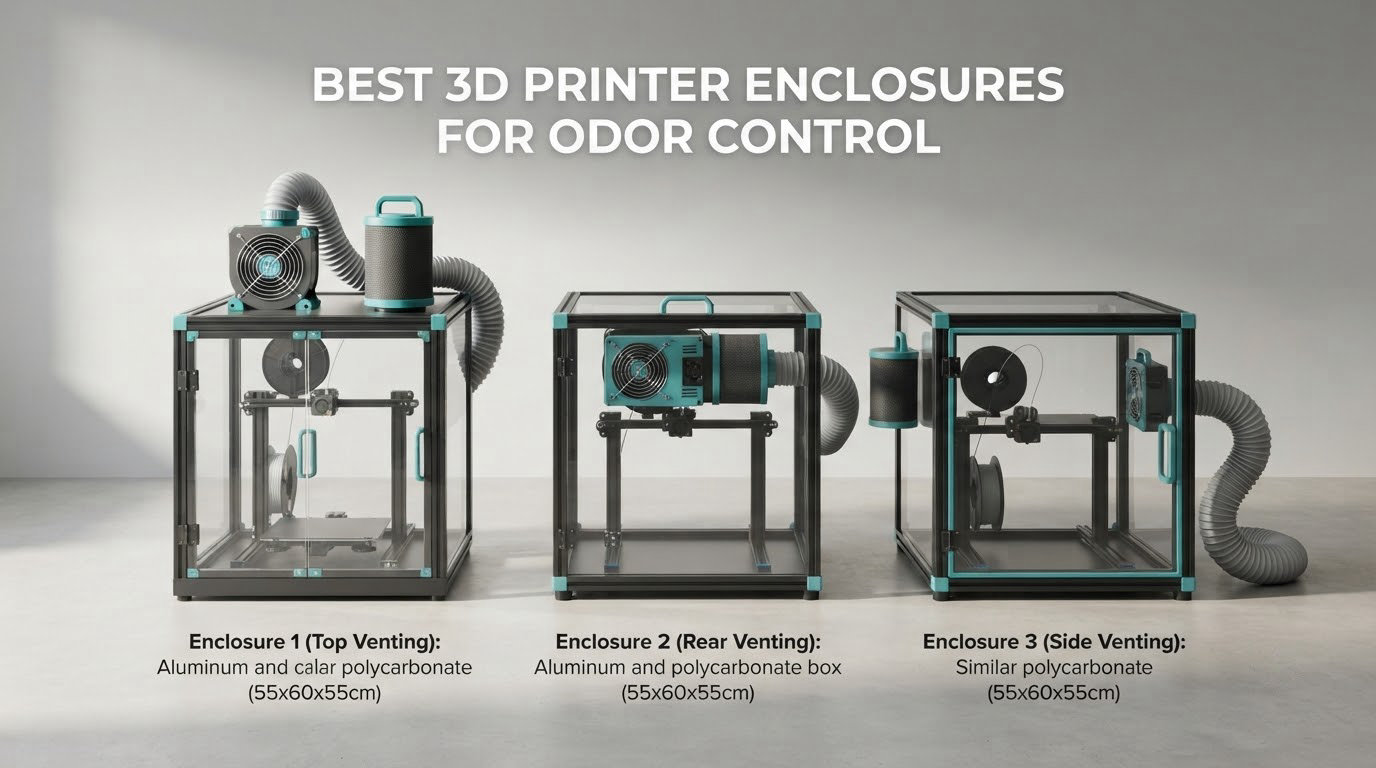
The best 3D printer enclosure with ventilation is a cabinet that pulls chamber air through activated carbon for VOCs and odor, often adds a HEPA stage for fine particles, then either recirculates that air inside or ducts it outdoors through a window. The enclosure alone is never enough, because filtration only works when air is actively moving through it.
That single sentence is the whole buying problem. Nearly every tent sold for 3D printers advertises odor control, and nearly all of them use some version of the same carbon sheet. The differences that actually decide whether odor reaches your room are airflow in cubic feet per minute, whether the unit pulls air out or pushes it back in, whether the filter is replaceable, and whether the chamber stays hot enough to print ABS and ASA without warping. I compared 10 enclosures on those four axes, plus fit, lighting, and assembly pain, and the results surprised me more than the ratings did.
Two things to clear up before the picks. First, activated carbon adsorbs VOCs, which is the smell; it does almost nothing for ultrafine particles, which are the part researchers worry about. A carbon-only setup leaves you with a room that smells fine and air that is not necessarily clean. Second, resin odor very often comes from the wash station, not the print chamber, and an enclosure sized only for the printer will not contain it.
Everything below reflects what buyers report across hundreds of reviews of these specific listings, plus what the community has already worked out about venting. It was last updated for 2026, and the shortcode year in the headings updates automatically.
Table of Contents
Top 3 Picks for 3D Printer Enclosure Odor Control in 2026

YOOPAI Multifunctional Resin Enclosure
- Carbon filter sheet plus exhaust fan
- Transparent PVC viewing window
- Insulated 28 x 18 x 17 in chamber

DORUNDEA Three-Layer Vent Tent
- Three-layer filtration with speed control
- Dual rear exhaust ports
- UV-blocking window
VEVOR Oxford Cloth Enclosure
- LED light and clear viewing window
- Lowest price in the group
- Flame-retardant insulated fabric
The YOOPAI takes the top slot because it is the only enclosure here with enough buyer history to trust: 560 reviews on a 4.2 rating, and the complaints about it are specific and survivable rather than structural. The DORUNDEA runs the better filtration stack per unit of effort and is the one I would put in a home with someone who has asthma. The VEVOR is the budget pick, because at the lowest price in the group it still carries the highest average rating here at 4.6, with lighting, a clear window, and a constant-temperature chamber included as standard rather than sold as an add-on. If you print ABS or ASA and need real airflow rather than the cheapest option, the FUNGDO at number 3 is the only enclosure in the roundup that publishes a CFM figure, and 180 CFM is why it can hold a hot chamber while moving fumes.
Best 3D Printer Enclosures for Odor Control (October 2026)
| Product | Specifications | Action |
|---|---|---|
| YOOPAI Multifunctional Resin Enclosure |
|
Check Latest Price |
| DORUNDEA Three-Layer Vent Tent |
|
Check Latest Price |
 FUNGDO 180 CFM Filtered Kit FUNGDO 180 CFM Filtered Kit |
|
Check Latest Price |
 POLISI3D Resin Enclosure 12V Fan POLISI3D Resin Enclosure 12V Fan |
|
Check Latest Price |
 Orionix Tent with Light Tube Orionix Tent with Light Tube |
|
Check Latest Price |
 Makacces Resin Enclosure Tent Makacces Resin Enclosure Tent |
|
Check Latest Price |
| VEVOR Oxford Cloth Enclosure |
|
Check Latest Price |
 Cregrant3D Double Space Enclosure Cregrant3D Double Space Enclosure |
|
Check Latest Price |
 Skouphy Large Double Space Enclosure Skouphy Large Double Space Enclosure |
|
Check Latest Price |
 HOCENWAY Dual-Placement Enclosure HOCENWAY Dual-Placement Enclosure |
|
Check Latest Price |
Two columns in that table deserve a note before you shop. Filter type tells you whether odor molecules get adsorbed or merely swirled around, and exhaust capability tells you whether you can actually move captured air out of the room instead of recirculating it into your breathing space. Everything else on the list is comfort.
How to Ventilate 3D Printer Fumes in 4 Steps
Enclose the printer first. A tent with sealed zippers and gasketed ports stops fumes from filling the room while you work. It also blocks drafts, which removes a cause of warping you would otherwise be fighting all winter.
Stage the filtration in the right order. Air should pass through a particle stage and an activated carbon stage before it recirculates or leaves. Carbon adsorbs smell; a HEPA or equivalent layer catches the particles carbon leaves behind. One without the other is half a solution.
Exhaust outdoors through a window when the material is high-odor. ABS, ASA, nylon, polycarbonate, and resin all justify a window exhaust. A 4-inch inline fan and a dryer-vent adapter is the setup people in the community actually converge on, and one resin user on r/resinprinting reported the inline fan at the window solved a garage problem that a filtered tent had not.
Hold chamber temperature with a controlled fan curve. Exhausting constantly cools the chamber and reintroduces warping. Drive the fan from chamber temperature instead: low speed for PLA and PETG, high speed for ABS and ASA. The Prusa forum write-up on enclosure temperature and odour control is still the clearest published version of this, running a low and high vent fan stage off an SHT21 sensor through the OctoPrint enclosure plugin.
If you are curious how the media choices work, our guide to carbon filters for odor control covers the adsorption side in more depth, and the same physics applies to a printer chamber.
1. YOOPAI Multifunctional Resin Enclosure with Ventilation Filter
YOOPAI Multifunctional Resin 3D Printer Enclosure with Ventilation Filter
Carbon filter sheet plus exhaust fan
28 x 18 x 17 in
4.36 lb
PVC viewing window
Pros
- Largest review base in the roundup at 560 ratings
- Carbon sheet and fan work together when ducted to a window
- Transparent PVC front lets you watch prints without breaking the seal
- Insulated interior steadies resin flow
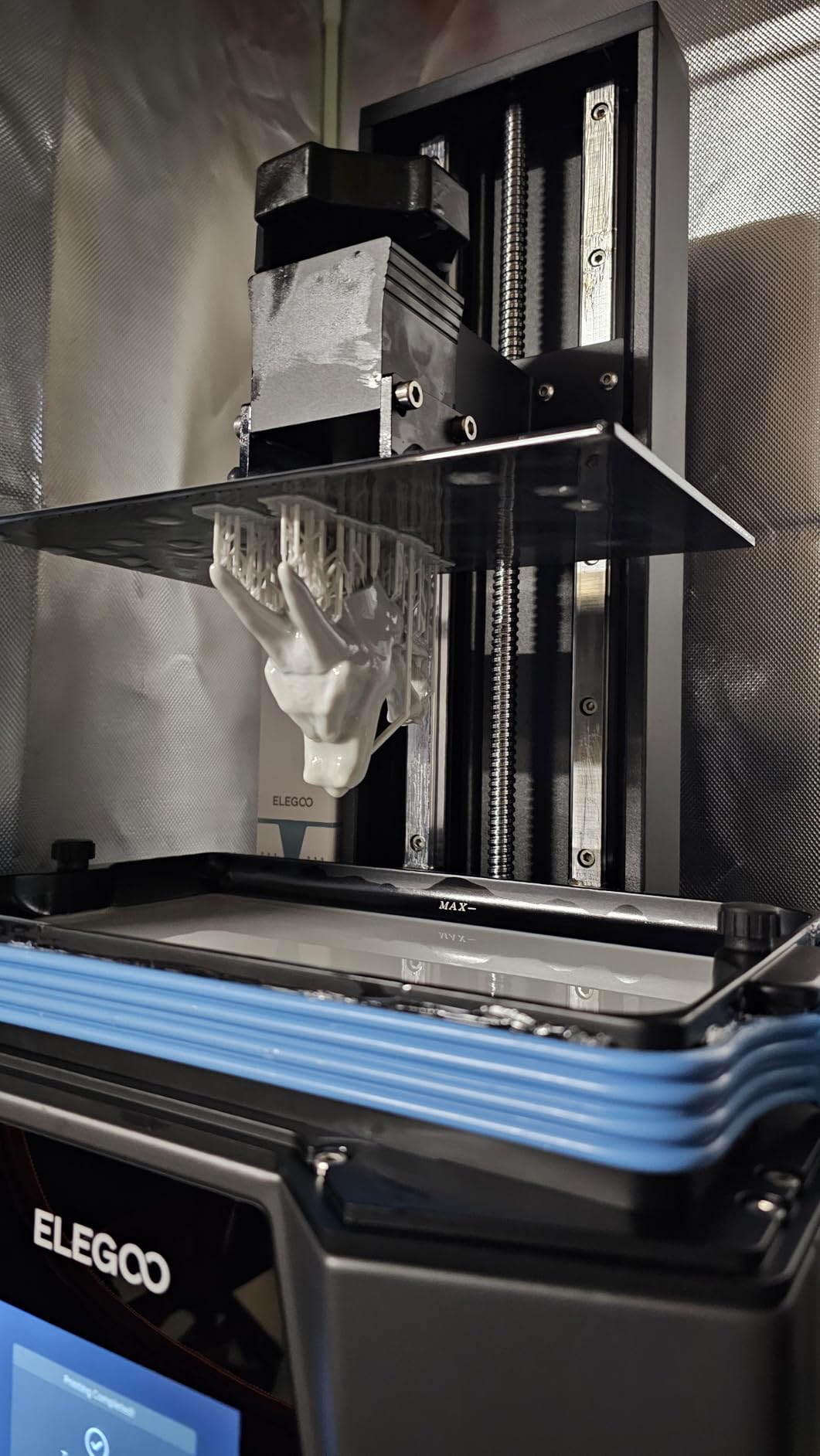
- Fits ELEGOO Photon Mono and Saturn series
Cons
- Vinyl window can warp and distort the view
- No interior lighting
- Very light structure can slide on a work surface
I kept coming back to this one because the review volume changes how much weight a rating carries. A 4.2 across 560 ratings is a stable, well-characterized product with known edges. Most of the complaints cluster around the same three things: the vinyl window fogs or warps, there is no light inside, and the whole thing weighs 4.36 pounds, so it creeps across a bench when you open the zipper.
The odor story is straightforward. A carbon filter sheet sits in the airflow and the exhaust fan pulls chamber air through it, with expandable pipes on the outlet so you can reach a window. Buyers who routed that pipe outside report the resin smell staying in the tent rather than the room, which is the whole point of the purchase.
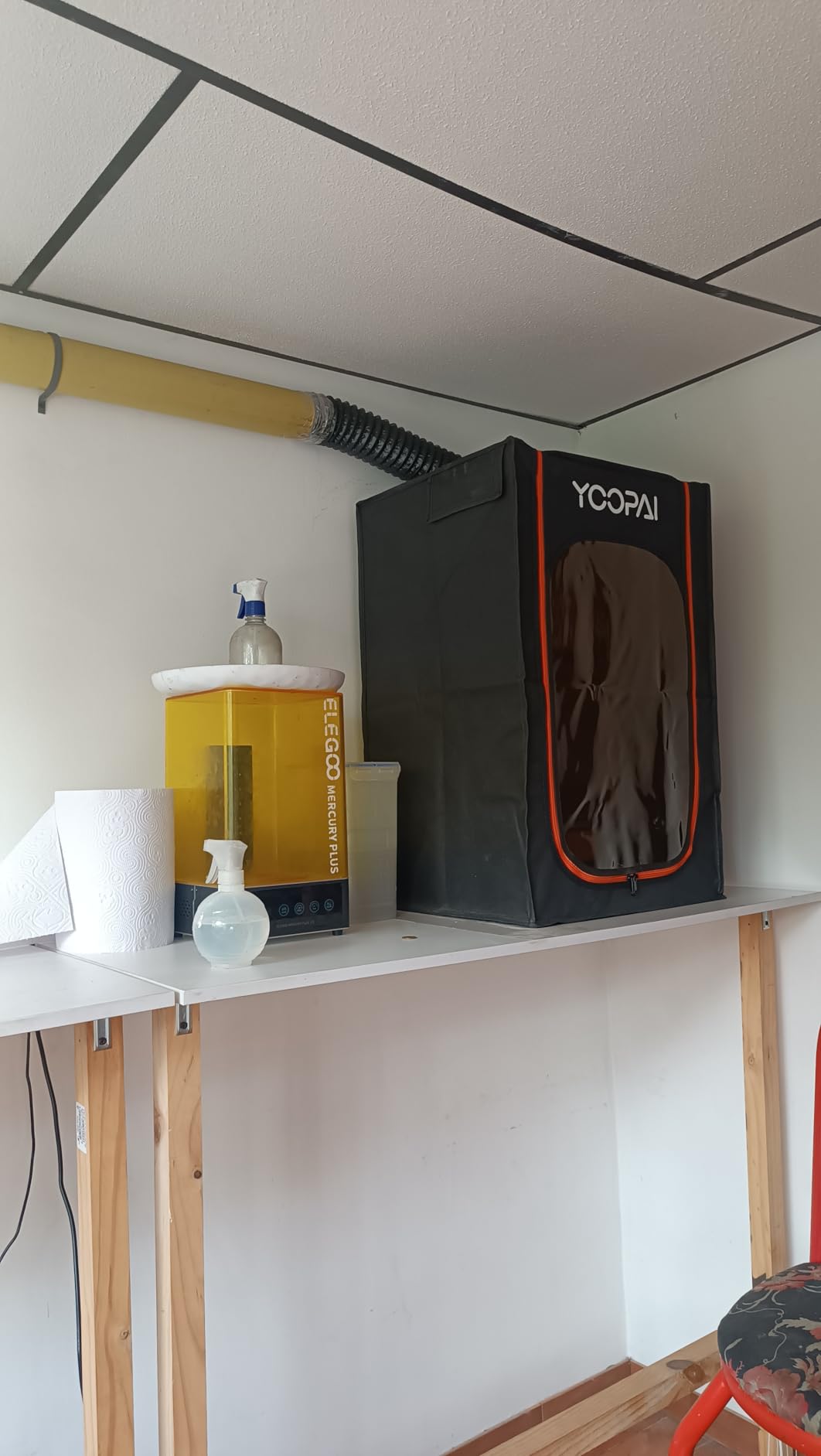
The insulated interior is the feature I did not expect to care about and now think matters. Resin flow and cure both respond to temperature swings, and a chamber that damps those swings produces fewer failed layers. Buyers using ELEGOO Photon Mono, Mars, and Halot machines fit it without modification at 28 by 18 by 17 inches.
Plan one addition. Without internal lighting you are monitoring prints with a phone flashlight or a USB panel light clipped to the frame, and several owners do exactly that. The 3-inch exhaust adapters also need a reducer for common ducting sizes, which is a two-minute job but not an included part.
Best for resin printing where odor has to leave the room entirely
This enclosure works because it is easy to convert from recirculate to exhaust. The fan and carbon sheet together handle the gas-phase odor, and the expandable pipe gets the air out a window. If your problem is a resin wash station in an apartment, put the wash station inside this tent too and you have solved both fumes at once.
It is also the safest recommendation in this roundup for buyers who have never owned an enclosure. The failure modes are cosmetic and physical, not functional. Nothing about the design leaves you stuck with an unfiltered room.
Watch out for the small chamber and the unlit interior
At 28 by 18 by 17 inches this fits a printer, not a printer plus a cure station. If you run a large resin machine or a wash and cure station beside it, step up to one of the double-space models further down the list.
The other recurring note is that the structure is light enough to shift. A rubber mat under the base solves it completely, and it costs nothing.
2. DORUNDEA Multifunctional Enclosure with Three-Layer Ventilation
Multifunctional 3D Printer Enclosure Ventilation Eliminate Odors Tent Cover
Three-layer filtration with speed control
PU Oxford with foil
1.8 kg
Dual rear exhaust ports
Pros
- Three-layer stack removes resin VOC odor when vented to a window
- Adjustable fan speed lets you trade noise for airflow
- UV-blocking window protects resin from ambient light
- Dual rear exhaust ports give flexible duct routing
- Strong zippers and fire-resistant fabric
Cons
- No internal lighting
- Frame pipes can be slightly long during assembly
- Zippers occasionally snag and need a fix
A 4.5 rating on 187 reviews puts this second in the roundup for consistency, and the filtration design is the reason. Rather than a single carbon sheet, it uses three layers attached to the cooling fan to absorb both dust particles and harmful gases, and the 12V speed control lets you dial airflow up when you are running a pungent resin and down when you are not.
Owners with Anycubic Photon Mono 4K, Mono S5, and Bambu P2S with AMS report that pairing this with a window exhaust kit cleared resin smell out of their living space entirely. The fabric is PU Oxford with an aluminum foil layer on a stainless steel frame, which is a heavier build than most tents at this level.
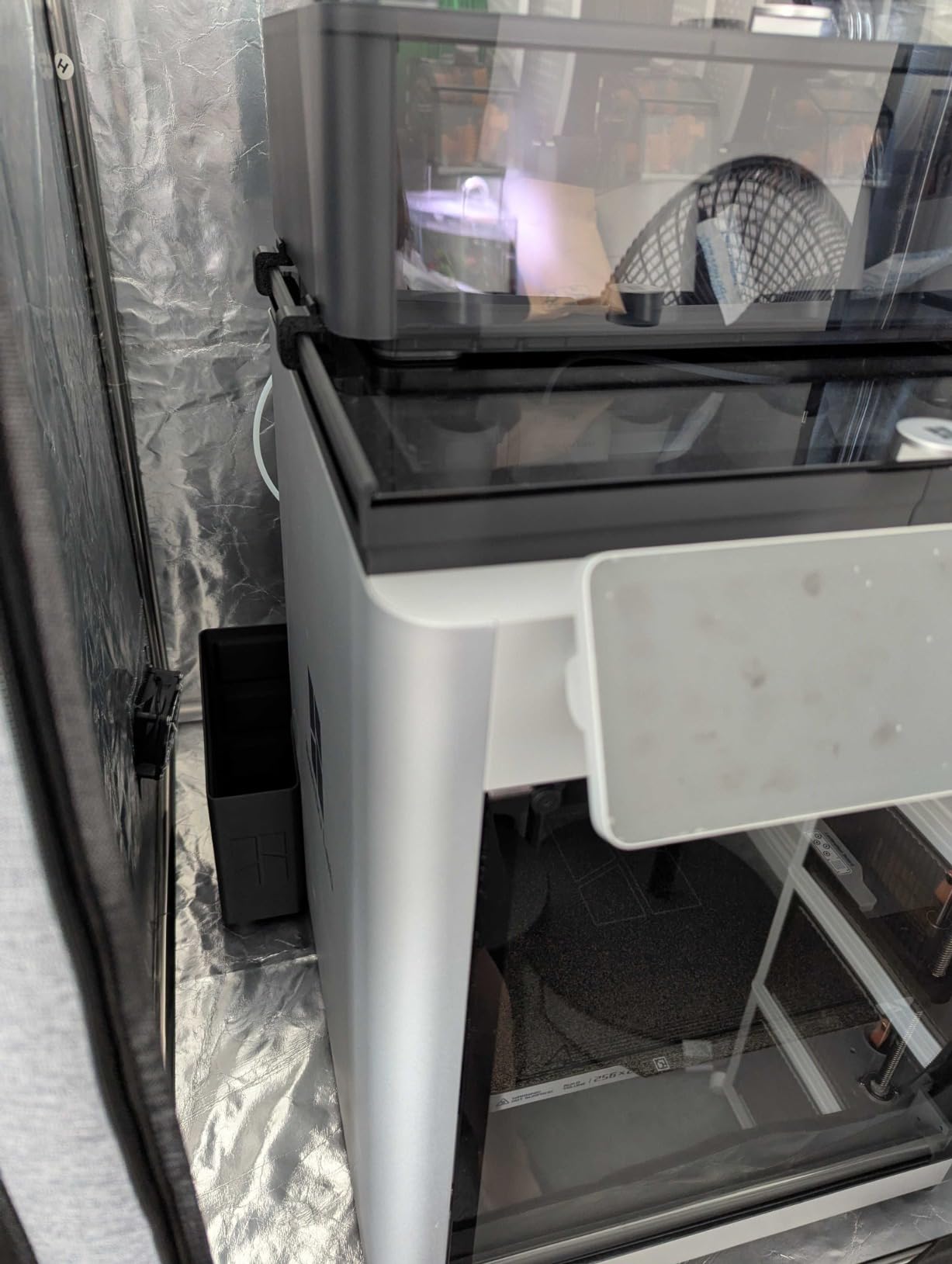
Two rear exhaust mounting ports plus a cable pass-through is a small decision that pays off. Most single-port tents force one duct direction and then fight your wall or desk, and the second port also gives you the option of running exhaust out on both sides, which compensates for the restriction a loaded carbon filter creates.
Assembly is the rough edge. Reviewers mention frame pipes that are slightly long and awkward, and zippers that occasionally snag. Both are minor and both are fixable, and the same buyers rate the fabric and zipper quality as good value for what they paid.
Best for households where someone breathes nearby
The three-layer stack is the reason to pick this over a single-sheet design. A household with asthma, allergies, or a child in the next room is exactly the case where the particle stage and the gas stage both need to be doing work, and this is the most complete filtration path in the group at a mid-range build.
The UV-blocking window also earns its place for resin work, since ambient UV can start curing parts you did not mean to cure.
Watch out for missing lighting and a small fan bracket
No internal light means you will add a USB light, and several owners do. The fan bracket also requires a self-printed 3D adapter for some configurations, which is friction you would rather not meet at setup.
Check the interior against your printer before ordering. It fits most LCD and resin printers and wash machines, but the frame is closer than the photos suggest once poles are in place.
3. FUNGDO Enclosure with 180 CFM Ventilation Kit and LED
FUNGDO 3D Printer Enclosure with Ventilation Kit & LED Lighting– Thermal Insulation Cover & Fume Extraction Tent for FDM/DLP/SLA/LCD 3D Printers(Size 700 * 750 * 900mm)
180 CFM airflow
70 x 75 x 90 cm interior
14 lb
Complete kit with duct and shelf
Pros
- Only enclosure here with a published airflow figure at 180 CFM
- Insulation raises internal temperature 5-15C
- Complete kit includes fan duct valve shelf and LED bar
- Metal tubular frame instead of plastic
- Sealed zippers and EVA gaskets give a near-airtight chamber
Cons
- Cover can tear at seams during assembly
- Instructions contain errors and mixed-language text
- Included fan is fixed in place and hard to replace
This is the only enclosure in the roundup that publishes an airflow number, and that single fact changes the conversation. 180 CFM refreshing the chamber air ten times per minute is a different class of hardware from the small 70mm units most tents include, and it is the reason ABS and ASA owners report this one removes fumes they could not control any other way.
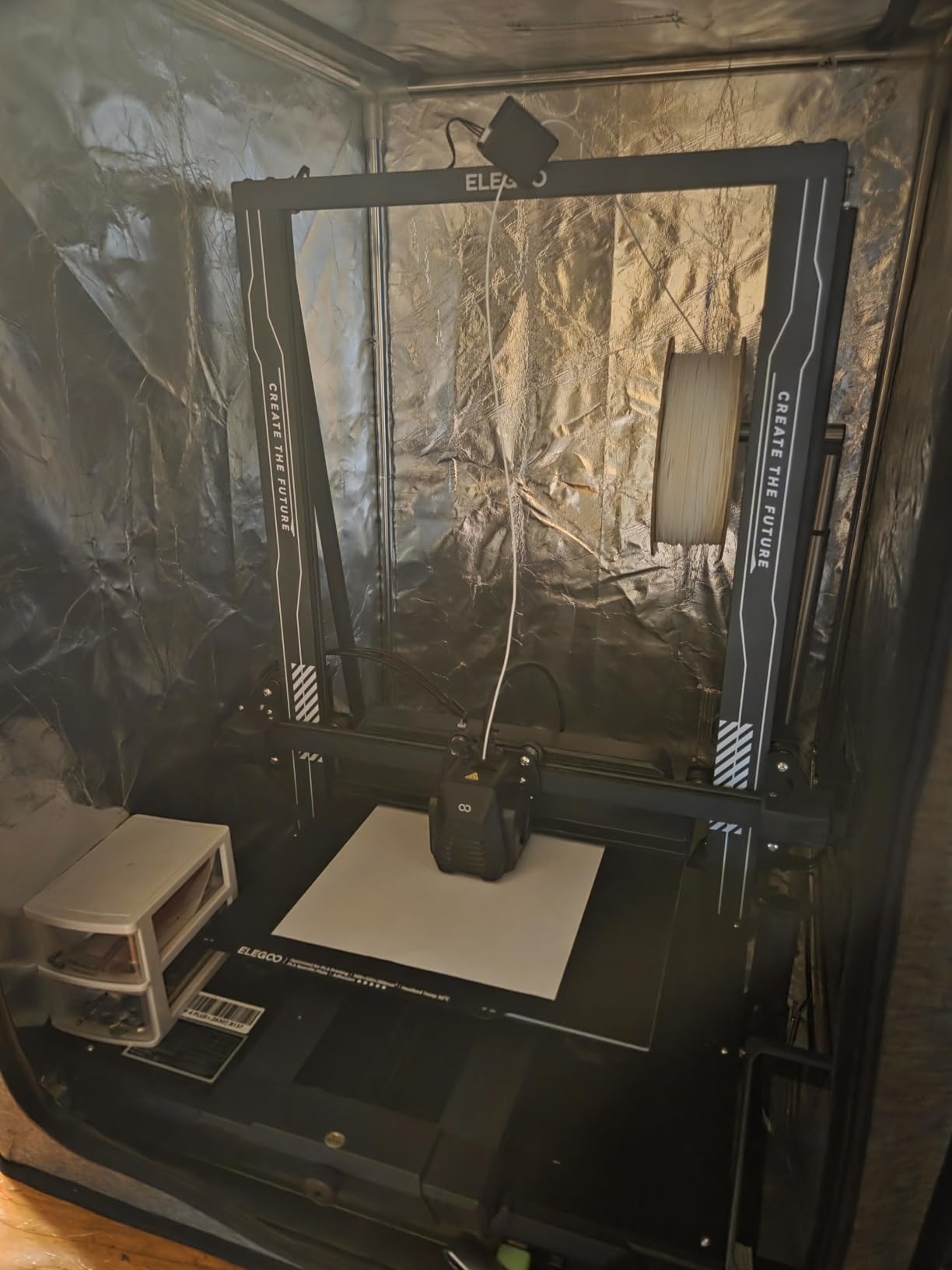
It also solves the chamber temperature problem the rest of this category ignores. The insulation lining raises internal temperature by 5 to 15 degrees C, which means you can run the exhaust continuously and still print engineering materials without the warping that constant venting normally causes. Reviewers printing ABS, ASA, and PC in cold months point to improved cold-weather consistency as a benefit as often as odor removal.
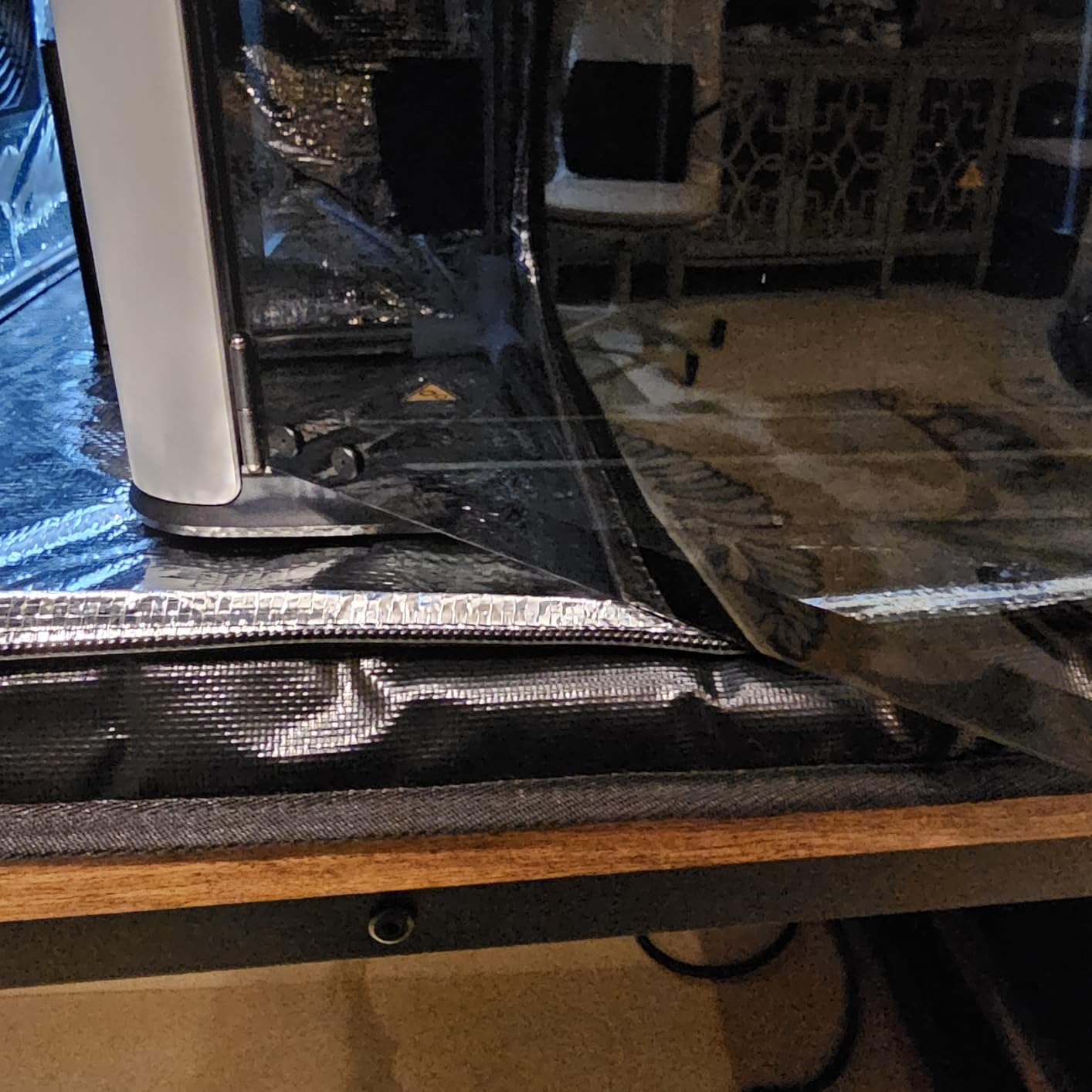
The box is genuinely complete: stainless steel shelf, pre-tested fan, 3-meter exhaust duct, backdraft valve, and an LED light bar, plus airtight zippers, EVA seal gaskets, and screw-secured ports. Dual exhaust ports let you route the hose left or right to match the room. It weighs 14 pounds, which is heavy for a tent and is really the point, since a light frame gets pushed around.
The dark TPU observation window blocks ambient UV, which is useful if you ever put a resin machine inside. A built-in temperature and humidity sensor is a quiet extra that lets you watch what the chamber is actually doing.
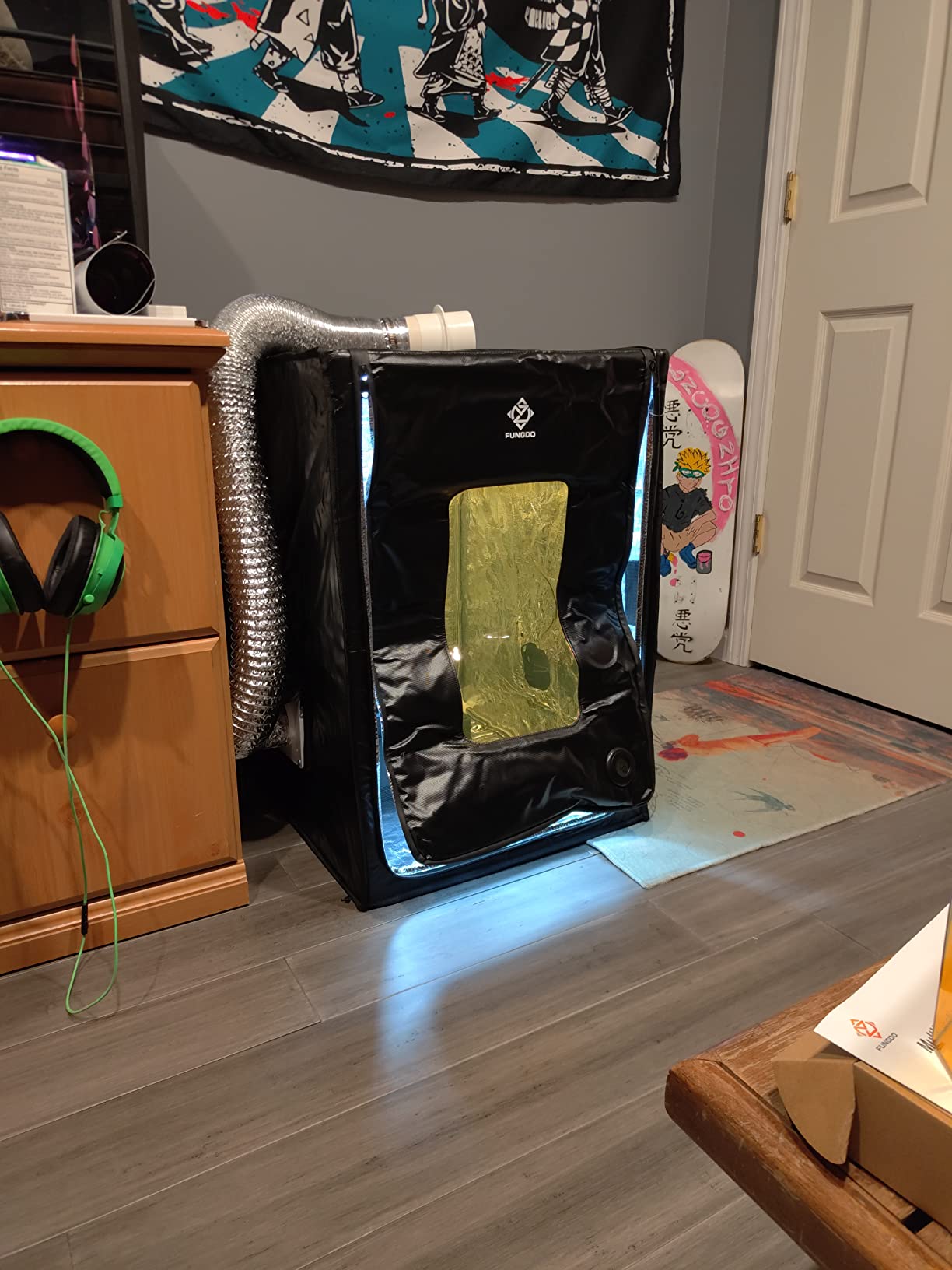
Best for high-odor engineering filament printed indoors
If your filament list includes ABS, ASA, nylon, or polycarbonate, airflow is not a nice-to-have. Those materials emit continuously through a long print, and a 70mm fan recirculating air in a small tent will saturate the carbon media long before the print finishes. The FUNGDO moves enough air to either keep up or exhaust to a window.
The dual exhaust ports matter most here, because a loaded carbon stage restricts flow and you want a second path. Routing one hose to a window and the other to a dryer vent through the wall is the configuration several owners run.
Watch out for a tight frame fit and sealed-in hardware
Assembly is the most common complaint. The frame is a very tight fit, so the cover can tear at the seams if you force it, and some poles need trimming first. Instructions contain errors and mixed-language text, so allow extra time.
The included fan is fixed in place and hard to replace without reprinting a bracket. If you expect to swap in a 4-inch inline fan later, plan on printing that adapter. The LED bar is also on and off only, with no brightness control.
4. POLISI3D Resin Enclosure with 12V 5000 RPM Fan
Resin 3D Printer Enclosure with Ventilation Filter, 12V Fan 5000RPM with Speed Control Fume Extraction, Dustproof Tent Constant Temperature Protective Cover for Ender 3 Pro/V2/Ender3 S1/ Neo (Grey)
12V 5000 RPM fan with speed control
25 x 21 x 29.5 in
3.96 lb
Aluminum foil insulated interior
Pros
- Works for both resin and entry FDM printers
- Aluminum foil and multi-coat fireproof interior
- Gloves included for frame assembly
- Brown UV-filter window protects resin
- Rear vent and cable ports are conveniently placed
Cons
- Included 70mm fan is weak for pungent resin or ABS
- Corner stitching can rip if the frame is forced
- No interior lighting
Most tents in this category are built for resin machines, and the useful part of this one is that it covers entry FDM printers as well, including the Ender 3 Pro, V2, S1, and Neo. If you moved up from PLA to ASA on a bed-slinger and need both halves of your setup enclosed, that dual compatibility is rare in this category.
Inside is a multi-coating fireproof lining with aluminum foil insulation, which holds heat better than bare fabric and reduces the swing that ruins resin flow. The brown filter membrane window blocks UV while letting you watch a print, and the 12V fan at 5000 RPM comes with a speed control adapter running AC 100-240V in.
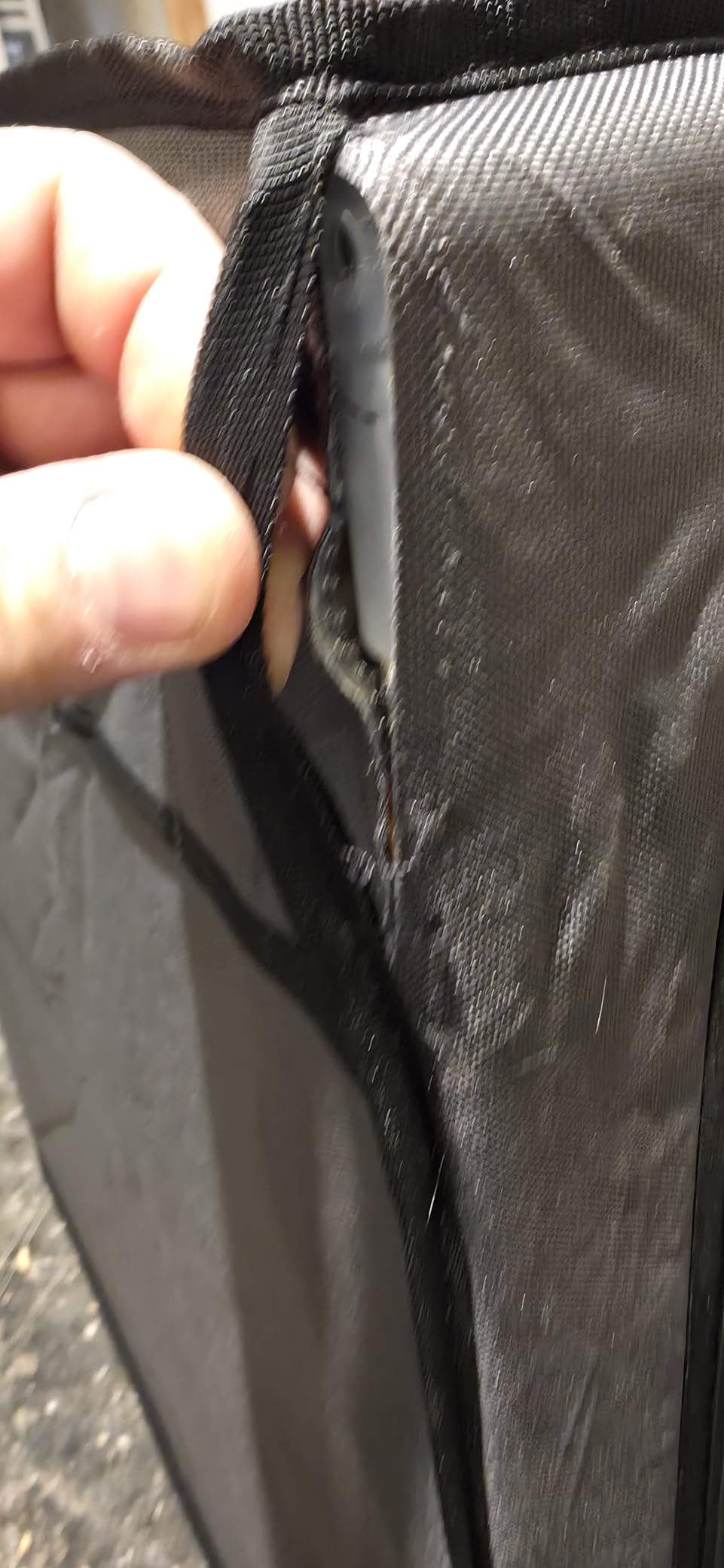
Setup is quick, and assembly gloves are included, which sounds trivial until you have built a stainless frame bare-handed. Reviewers with Elegoo Saturn and Anycubic Mono machines report that a window hose keeps resin odor out of the room, and they generally like the interior space and insulation.
The honest weakness is the fan. A 70mm unit is small against a 635 by 535 by 750mm chamber, and owners moving to pungent resin or ABS report it is not enough. Swap in a 4-inch inline fan and the enclosure becomes a different product.
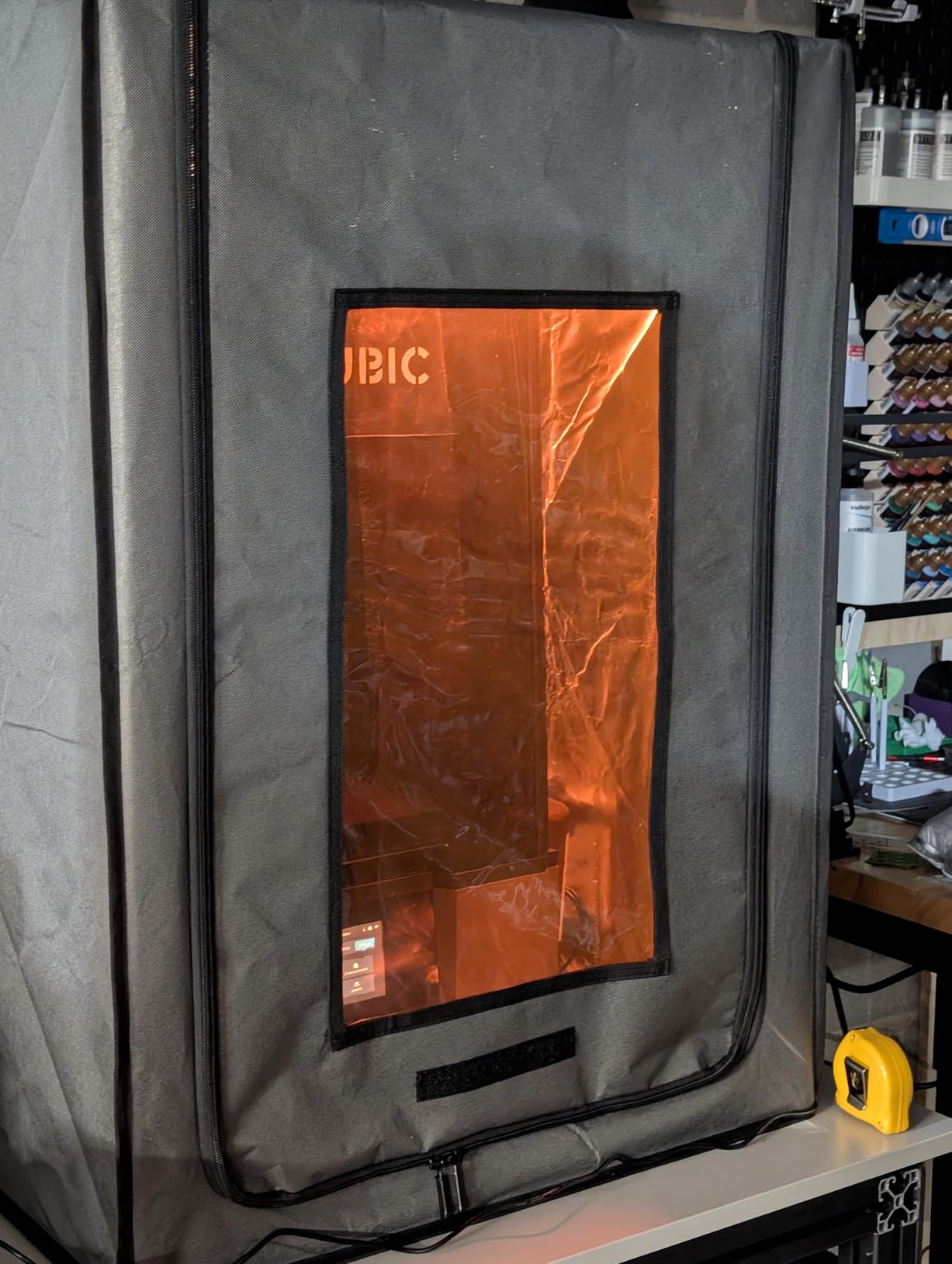
Best for mixed FDM and resin setups on a bed-slinger footprint
This is the pick if you are not choosing between FDM and resin but running both, and your printer is an Ender-class machine rather than a large CoreXY. The 25 by 21 by 29.5 inch interior fits without the guessing that comes with resin-only tents.
It also works if you plan to add a stronger fan later. The frame and ports are there; only the included fan is undersized, and that is a replaceable part rather than a design flaw.
Watch out for corner stitching and the fan bracket
Stitching at the corners can tear if you force the frame together, so build it loosely and square before tensioning. The Velcro holding the fan bracket also grips unevenly along one edge, which lets the unit shift at speed.
There is no interior lighting, and the fan controller cord is short enough that you will reposition it. Both are small annoyances rather than dealbreakers.
5. Orionix Tent Enclosure with LED Light Tube and Sound Dampening
3D Printer Tent Enclosure for Anycubic Kobra X, Upgraded Large Cover with Ventilation & LED Light – Dustproof, Waterproof, Fireproof, Sound Dampening & Temperature Retaining, 19.7×26.8×28.3in
4600 RPM fan mounts on either side
26.8 x 19.7 x 28.3 in
5.17 lb
32cm LED light tube
Pros
- Built-in 32cm light tube gives real monitoring visibility
- Sound dampening is a genuine benefit in a shared room
- Three-minute installation and removal
- Alkali-free fiberglass frame rated 680-800C
- Large footprint fits Kobra X and Bambu A1-series
Cons
- Frame tubes can be slightly too long and need trimming
- Tinted window rather than clear
- Zippers stick and catch on the door
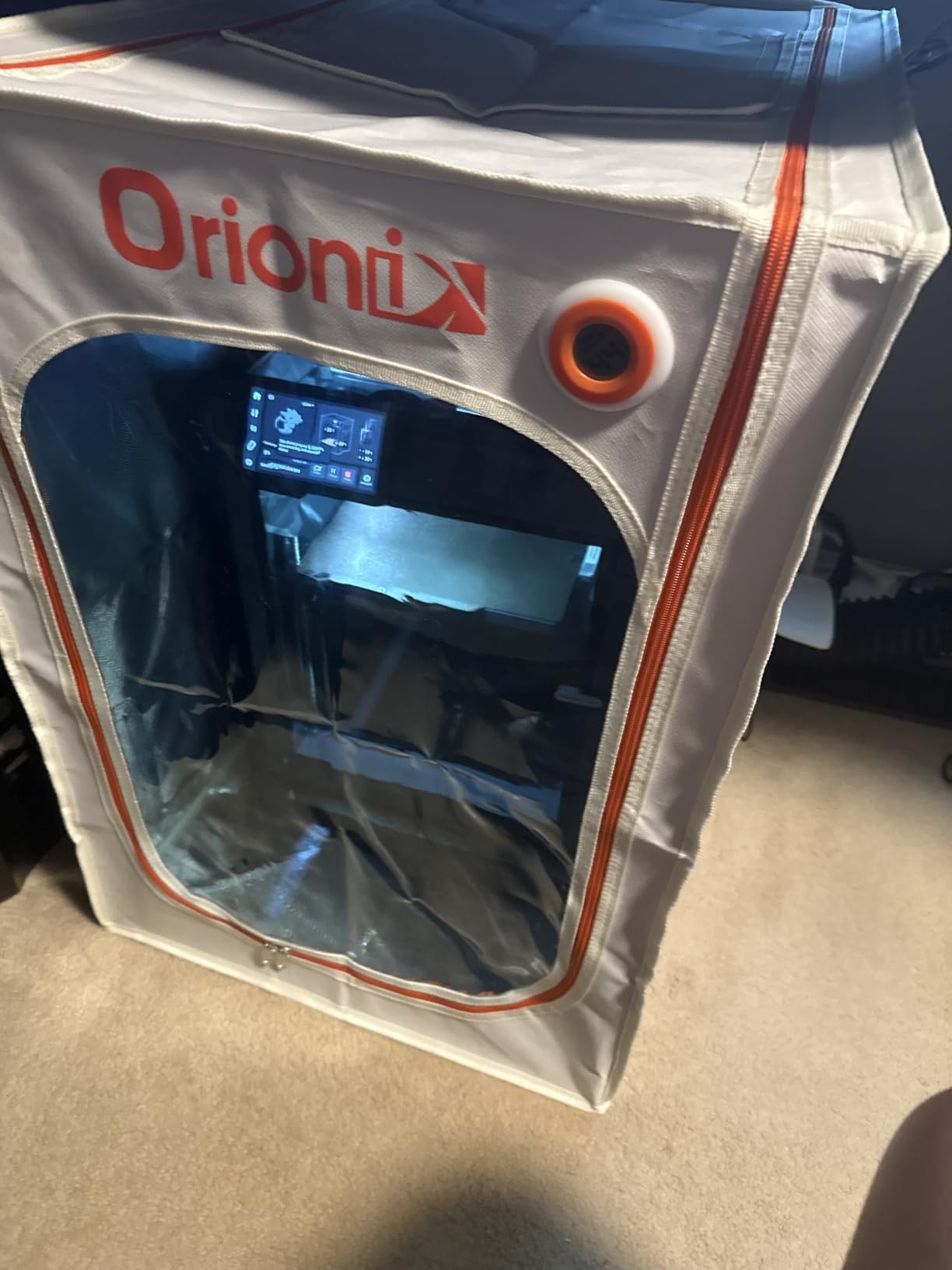
Two features here solve problems the other tents ignore. The integrated 32cm light tube with a 1.6m cable and USB port means you can actually see your print, which is the one thing most resin tents in this list make you solve separately. And sound dampening is not an odor feature, but in a shared room it is often the difference between a usable printer and an annoying one.
The build is 600D Oxford fabric with an aluminum foil sealed structure on a high-temperature-resistant alkali-free fiberglass tube frame rated 680-800C. That frame temperature rating is worth noting for anyone printing ABS or ASA, where the chamber genuinely gets hot. A quick-release top window handles cable management, and there is a waste-removal window and a tool pouch.
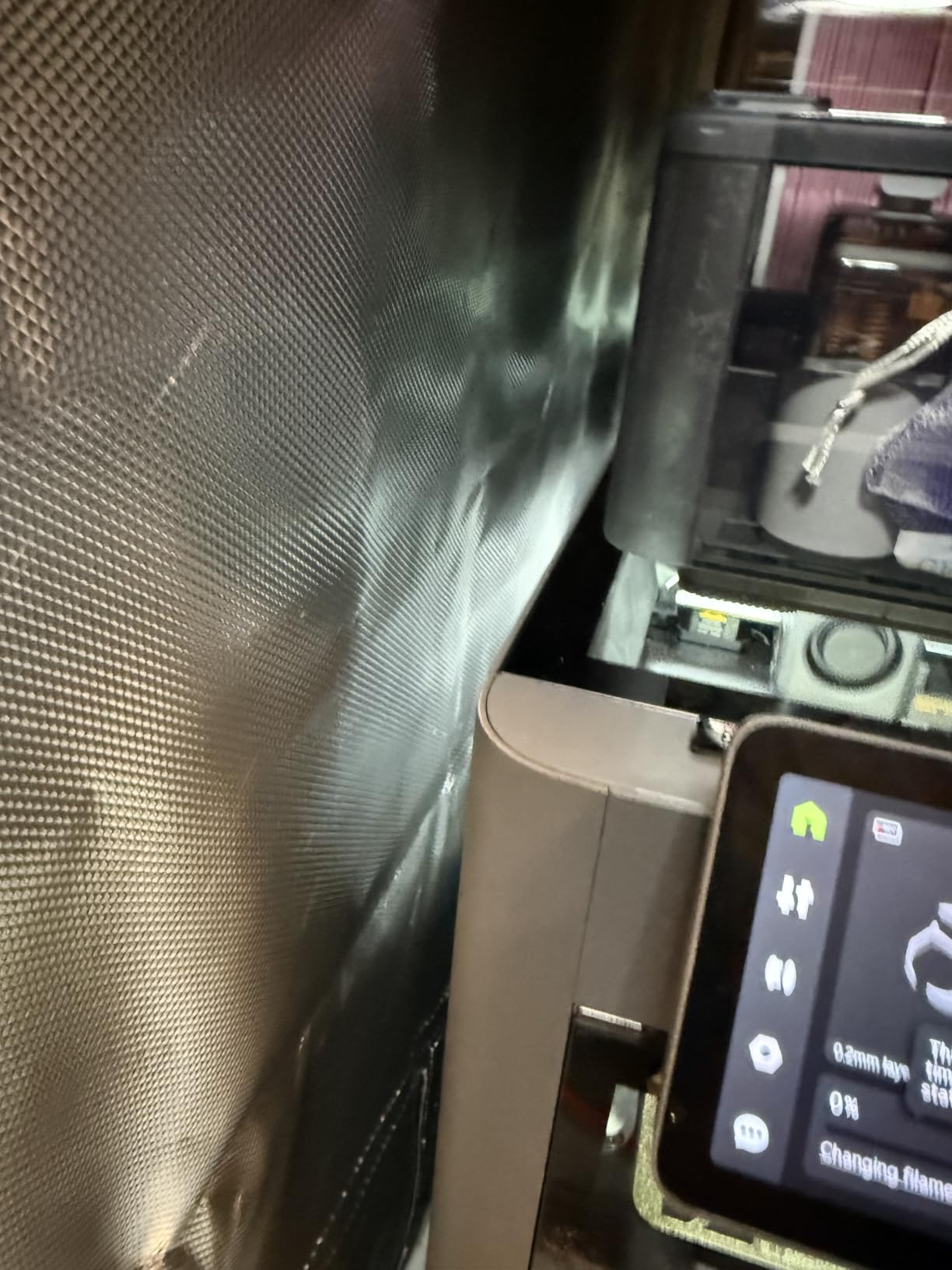
Owners of Anycubic Kobra X and Bambu A1-series printers say it meaningfully reduces both print odor and fan noise, and the three-minute install means you can take it down for filament changes or move the printer without a teardown.
The 4600 RPM fan mounts on either side, which is more useful than it sounds when the outlet is on the wrong wall. Several owners find the fan is stronger than they need and simply switch it off for PLA and PETG, which is a reasonable behavior for an enclosure with a light fabric shell.
Visibility is the quiet star of this tent, and if your workflow extends past watching prints to documenting the finished model, our guides to cameras for 3D photogrammetry and 3D scanning cameras cover the capture side of that process.
Best for a bedroom or shared room where noise and visibility both matter
If the printer lives in a room other people use, the light tube and the dampening fabric are the deciding factors. You can watch a 12-hour print without opening the tent, and you are not broadcasting a 4000 RPM fan into a living space. The sound-dampening Oxford fabric is consistently well received.
The off-white body with orange zippers is also genuinely easier to spot in a cluttered workshop, which matters more often than product pages admit.
Watch out for tight fit and sticking zippers
Fit is the main issue. Several users found the frame tubes oversized and the usable space tighter than the pictures suggest, particularly with spool holders on top of the printer. Trim the tubes before you tension the cover, and forcing the frame can rip seams.
Sticky zippers are the other repeated note. They work, but you help them along. The window is tinted rather than clear, which is a reasonable trade for UV protection but not a good thing if you need to read fine detail on a resin build.
6. Makacces Resin Enclosure with Adjustable-Speed Ventilation
Resin 3D Printer Enclosure with Ventilation, 3D Printer Vented Enclosure Tent Cover Eliminate Odors Dustproof Isolate Noise,Compatible with Elegoo Anycubic Creality Series Resin LCD UV 3D Printers
12V fan with speed control
25 x 21 x 29.5 in
4.4 lb
Brown UV-screening window
Pros
- Holds a resin printer plus a wash and cure station
- Fan and exhaust tube are quiet even at top speed
- Speed dial lets you match airflow to the resin
- UV-screening window blocks premature curing
- Tool and storage bags included
Cons
- No interior light
- Instructions are sparse and poorly written
- Vent window kit may need buying separately
The 4.5 rating here comes from a small sample of 44 reviews, but the reports are unusually consistent and unusually specific. Hobby resin printers in small apartments say the enclosure reduced whole-house resin smell down to a single room, and several mention that it relieved headaches. That is the use case the whole category exists for.
What sets it apart in that group is the fan. A 12V unit with an adjustable speed controller that stays quiet at its highest setting is unusual in this price bracket, and the exhaust tube and speed dial are both included rather than sold as an add-on. For apartment use, fan noise is not a secondary concern, since you are running it for hours while you work.
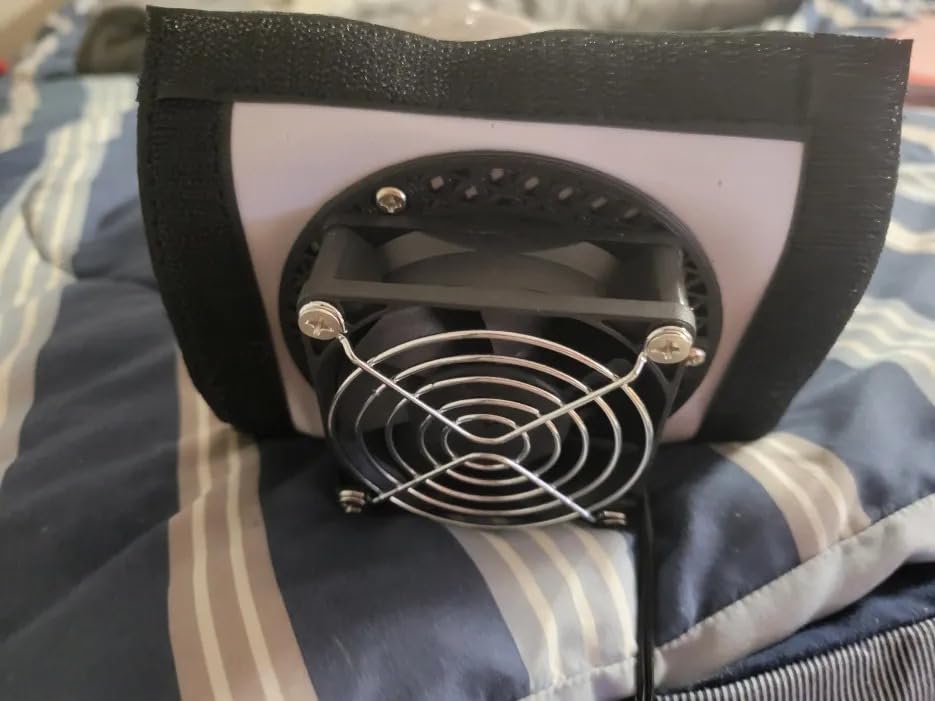
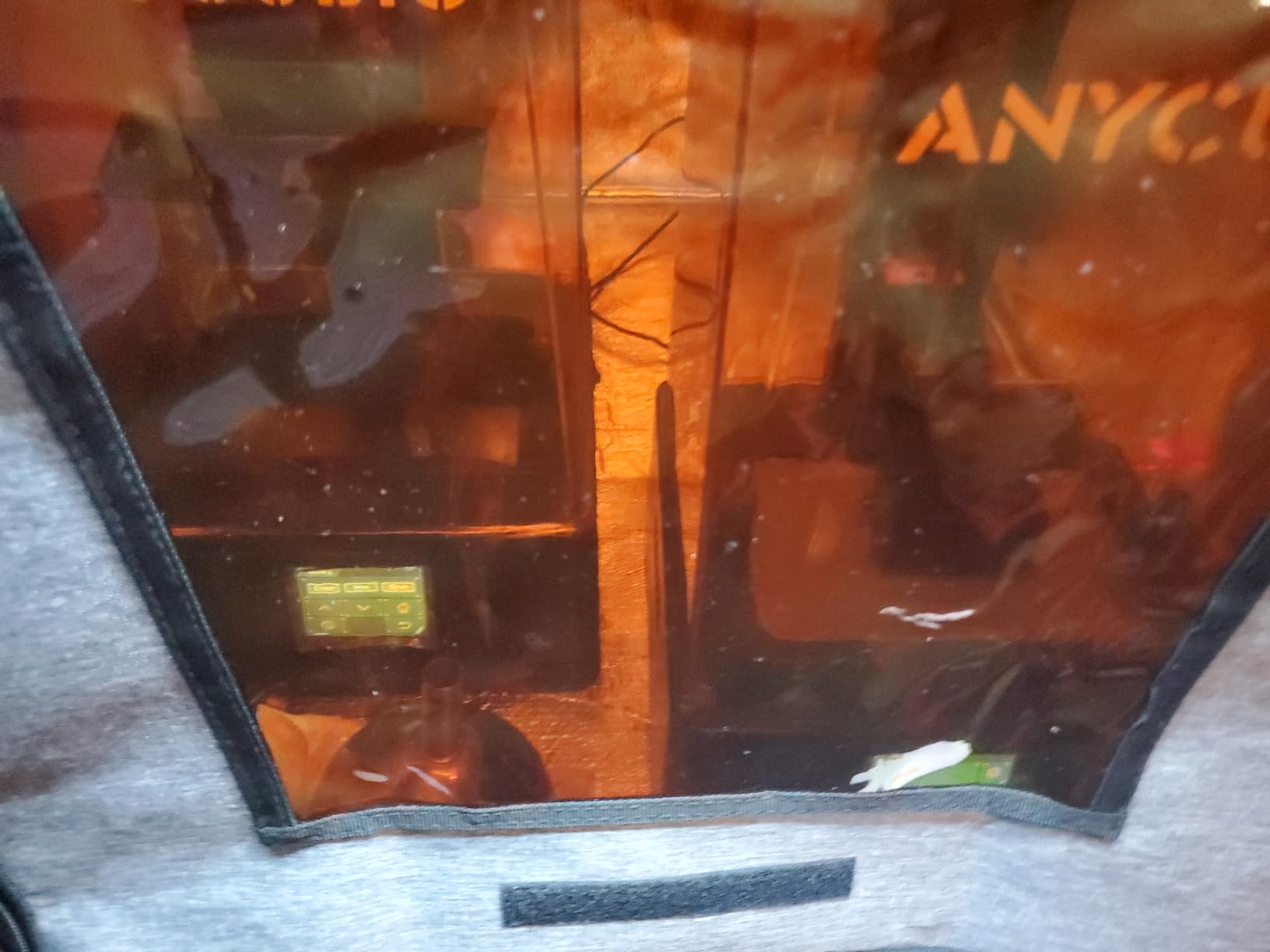
Fire-resistant fabric on a lightweight stainless steel frame, plus a brown UV-filter window, means you can cure prints in the same tent you print in without ambient light getting involved. The interior fits most LCD resin and FDM printers at 25 by 21 by 29.5 inches, and it has room for a wash and cure station beside the printer.
Tool and storage bags are included, which is a small thing that prevents resin tools from migrating around the apartment. That has more to do with your workflow than the enclosure, but it is the kind of detail that shows up in reviews as a positive.
Best for a resin hobbyist in an apartment with no separate utility space
The combination of a quiet adjustable fan, room for the wash station, and UV screening is exactly what indoor resin work needs, and several buyers describe the same outcome: smell confined to one room. If your household has been avoiding resin because of odor, this is the enclosure that changes that.
It also works for FDM, so you are not locked into resin. The listed compatibility covers Elegoo, Anycubic, and Creality resin series plus most FDM machines inside the size class.
Watch out for thin documentation and a missing light
There is no interior light, and several buyers add a USB strip. Instructions are sparse and poorly written, and there is one report of a frame part breaking during assembly with sharp exposed edges, so build carefully and file any rough edges before the tent goes up.
For full exhaust capability you may need the vent window kit separately. Confirm what ships with the configuration you are buying rather than assuming the duct path is complete.
7. VEVOR Oxford Cloth Enclosure with LED and Ventilation
VEVOR 3D Printer Enclosure with Ventilation, Dustproof Waterproof Oxford Cloth Resin 3D Printer Tent, Constant Temperature Protective Case with LED, Compatible with Photon Mono/Mars 3, FDM/LCD Printer
Ventilation for smoke and dust
21.65 x 25.59 x 29.53 in
4.72 lb
LED with transparent window
Pros
- Highest average rating in the roundup at 4.6
- LED lighting plus a transparent window as standard
- Flame-retardant fabric adds a safety margin
- Constant-temperature chamber reduces warping and cracking
- Five size and color variants including a 27.5 x 29.5 x 35.4 in option
Cons
- Compact interior suits smaller LCD printers rather than wash and cure stations
- Larger resin printers may not fit at the standard size
- Smaller review sample than the category leaders
The 4.6 rating is the highest in this group, and the honest caveat is that it rests on 41 reviews, which is well below the median here. A recent listing date and a strong sales rank suggest a fast-moving new line, so the sample is likely to grow. Treat the rating as encouraging rather than settled.
What you get is the specification set most tents make optional. A ventilation system that expels smoke and dust after printing, a transparent window plus LED lighting for monitoring, and a constant-temperature chamber that reduces warping and nozzle cracking. The waterproof Oxford cloth is flame-retardant, which is a meaningful detail in a home rather than a workshop.
The ventilation port suits post-print venting rather than continuous filtration during a print, so treat this as a containment and extraction box rather than a filtered recirculation chamber. For PLA, PETG, and light ABS work in a separate room, that is enough. For a pungent resin in a living space, it is thinner than the resin-specific tents above.
Buyers highlight the combination of LED lighting, transparent viewing, and insulation as a lot of function for the money, and VEVOR offers five size and color variants including a larger 27.5 by 29.5 by 35.4 inch version that solves the fit ceiling.
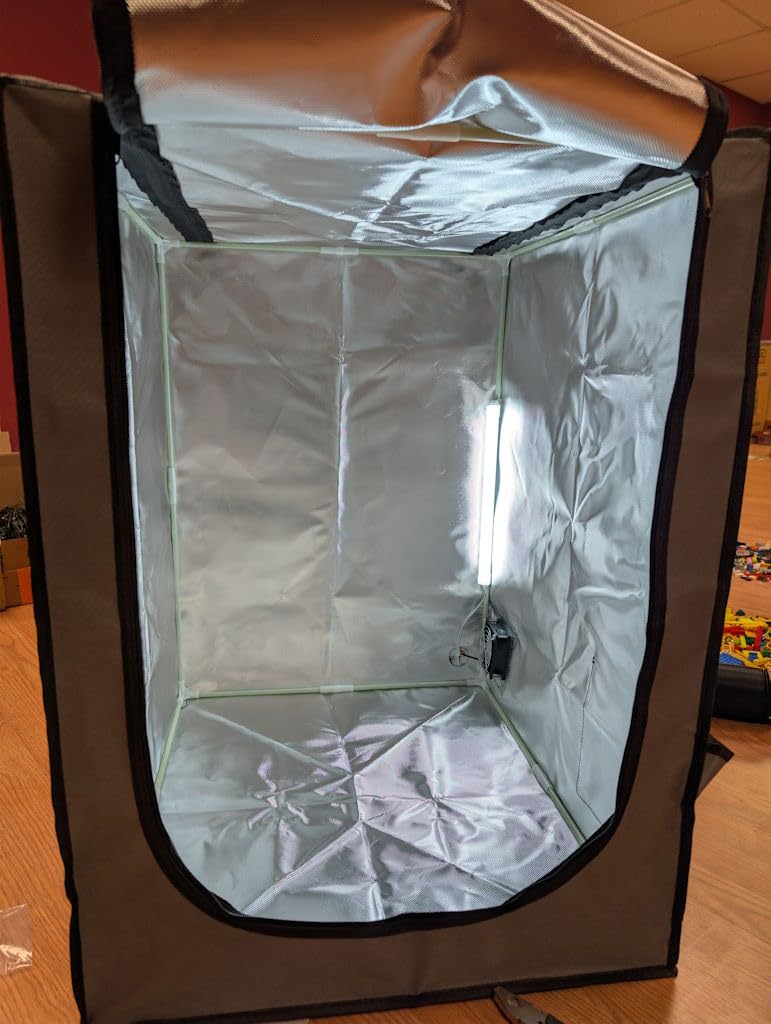
Best for a first enclosure on a small printer
If you are moving up from a bare printer and your machine is a Photon Mono, Mars 3, or a compact FDM unit, this covers the basics that matter with none of the fit guesswork. Lighting, viewing, and a vent port are all standard, and the flame-retardant fabric is a sensible thing to have in a house.
The constant-temperature chamber is the sleeper benefit. Buyers using it for ABS report fewer cracking and warping failures, which is a print-quality argument rather than an odor one.
Watch out for the size ceiling
At 21.65 by 25.59 by 29.53 inches this is the smallest interior reviewed, and it suits smaller LCD printers rather than a wash and cure station. If you run large resin hardware or two machines, choose one of the double-space models.
The review sample is also the thinnest of the well-rated products, and this listing carries a comparatively high share of one-star feedback than its five-star share. Check that your printer fits before ordering.
8. Cregrant3D Double Space Enclosure for Printer and Wash Station
SKOUPHY Double Space Resin 3D Enclosure with Ventilation Kit LED Light
31.5 x 18.1 x 28.3 in interior
4500 RPM fan with carbon box
7.6 lb
LED and thermo-hygrometer
Pros
- Roomy interior holds a large resin printer plus wash and cure station
- Thermo-hygrometer is a real addition for chamber monitoring
- Double-layer aluminum-mold Oxford cloth cuts noise
- Assembles in 10 to 15 minutes
- Cable outlets vents and tool pouches included
Cons
- Included 3-inch fan is weak for the volume
- Included ducting is short with a single connector
- Carbon filter is small and of limited effect
The insight this enclosure is built around is the one most listings in the category miss. Resin odor frequently comes from the wash station, not the print chamber, and as one r/resinprinting user put it, the only time they ever smell resin is when the wash station lid is not sealed. At 31.5 by 18.1 by 28.3 inches, this holds a large resin printer and a wash and cure station in the same chamber, which is the only configuration that actually contains the full workflow.
The thermo-hygrometer with Fahrenheit and Celsius switching is a genuine addition rather than a gimmick. Resin cures and flows respond to humidity, and having a chamber readout lets you connect a failed print to conditions instead of guessing. The LED light bar is bright and compact for monitoring.
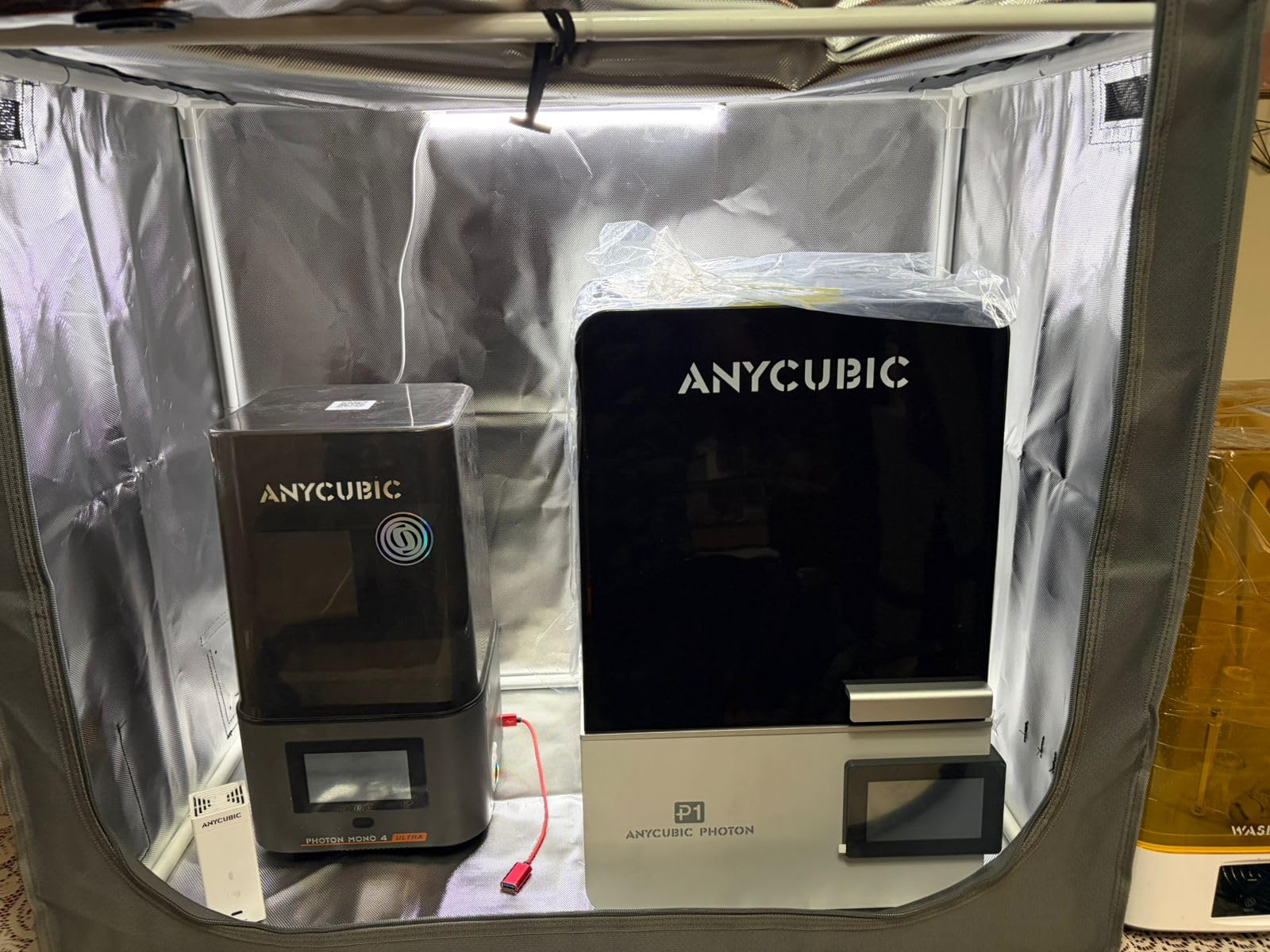
Construction is double-layer aluminum-mold Oxford cloth for waterproofing, dustproofing, and noise reduction, with fire prevention treated materials. At 7.6 pounds it stays put, and assembly takes 10 to 15 minutes.
Here is the part that matters for odor. The supplied 4500 RPM fan and the small carbon box on the exhaust pipe are the weakest components. Several buyers replaced the fan and ducting with a 4-inch inline fan and an external carbon filter, and one reviewer rated the accessories poorly enough to recommend buying the tent alone. Plan on that upgrade.
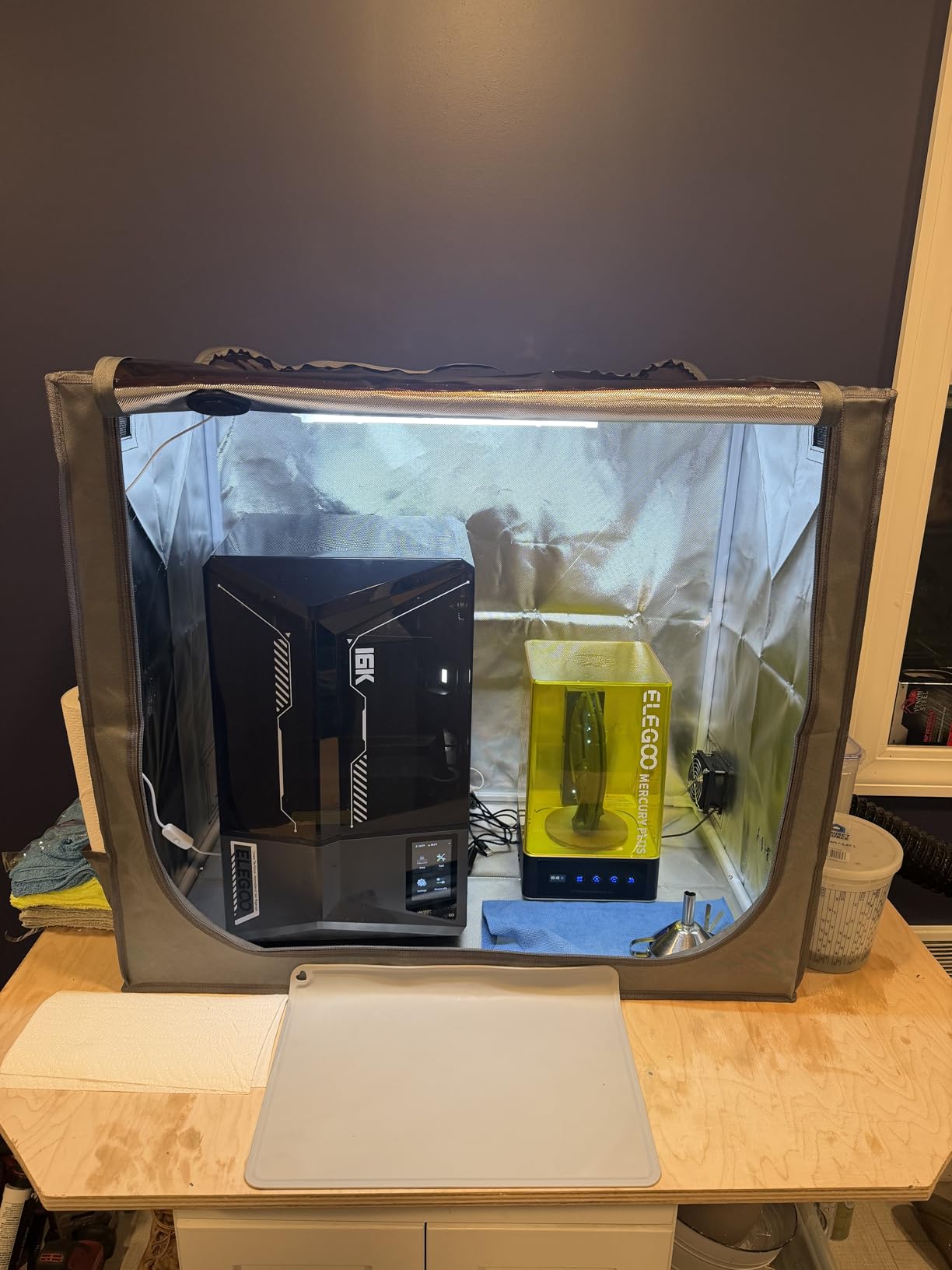
Best for full resin workflow containment
Buy this if your resin setup is a printer, a wash station, and a cure station, and they are all indoors. Enclosing only the printer leaves the actual odor source outside the tent. The interior here takes all three, and the double-layer fabric also cuts the hum of a running fan.
It is also the right shape for a household doing resin work in a home office, where the hygrometer readout helps you keep conditions stable instead of guessing at why a print clouded.
Watch out for the included ventilation kit
The 3-inch fan moves little air for an 800 by 460 by 720mm volume, the ducting is only a few feet, and only one connector ships for a hose with two ends. The carbon filter is small and of limited effect on its own.
The thermo-hygrometer port is also not securely fitted to the fabric, so reinforce it before you rely on the reading. Budget for a 4-inch inline fan and a proper external carbon stage.
9. Skouphy Large Double Space Enclosure with Built-In Carbon Sheet
Large Resin 3D Printer Enclosure with Ventilation Kit LED Light, 3D Printer Vented Enclosure Tent Cover Eliminate Odors Dustproof Isolate Noise Compatible with LCD Resin UV 3D Printer 33*18.9*28.7Inch
33 x 18.9 x 28.7 in interior
Built-in carbon filter sheet
Expandable exhaust pipes
7.56 lb
Pros
- Widest interior for two resin printers or a printer plus cure machine
- Built-in activated carbon sheet inside the chamber
- High-transparency PVC window resists wrinkling
- Insulated interior improves resin flow and stability
- Expandable exhaust pipes route air out
Cons
- Carbon slows airflow so flush the hood before opening
- Single-port use reduces airflow further
- Large footprint needs substantial floor space
This is the wider sibling of the double-space design, and at 33 by 18.9 by 28.7 inches it is the largest interior in the roundup. That makes it the right shape for two resin printers running side by side, or one printer plus a curing machine, which is a configuration most tents simply cannot accommodate.
The activated carbon filter sheet is mounted inside the chamber rather than at an external port, so odor molecules get adsorbed close to the source instead of after a long duct run. The high-transparency PVC front window is tough and does not wrinkle, which sounds trivial until you have tried to monitor a print through soft fabric in poor light.
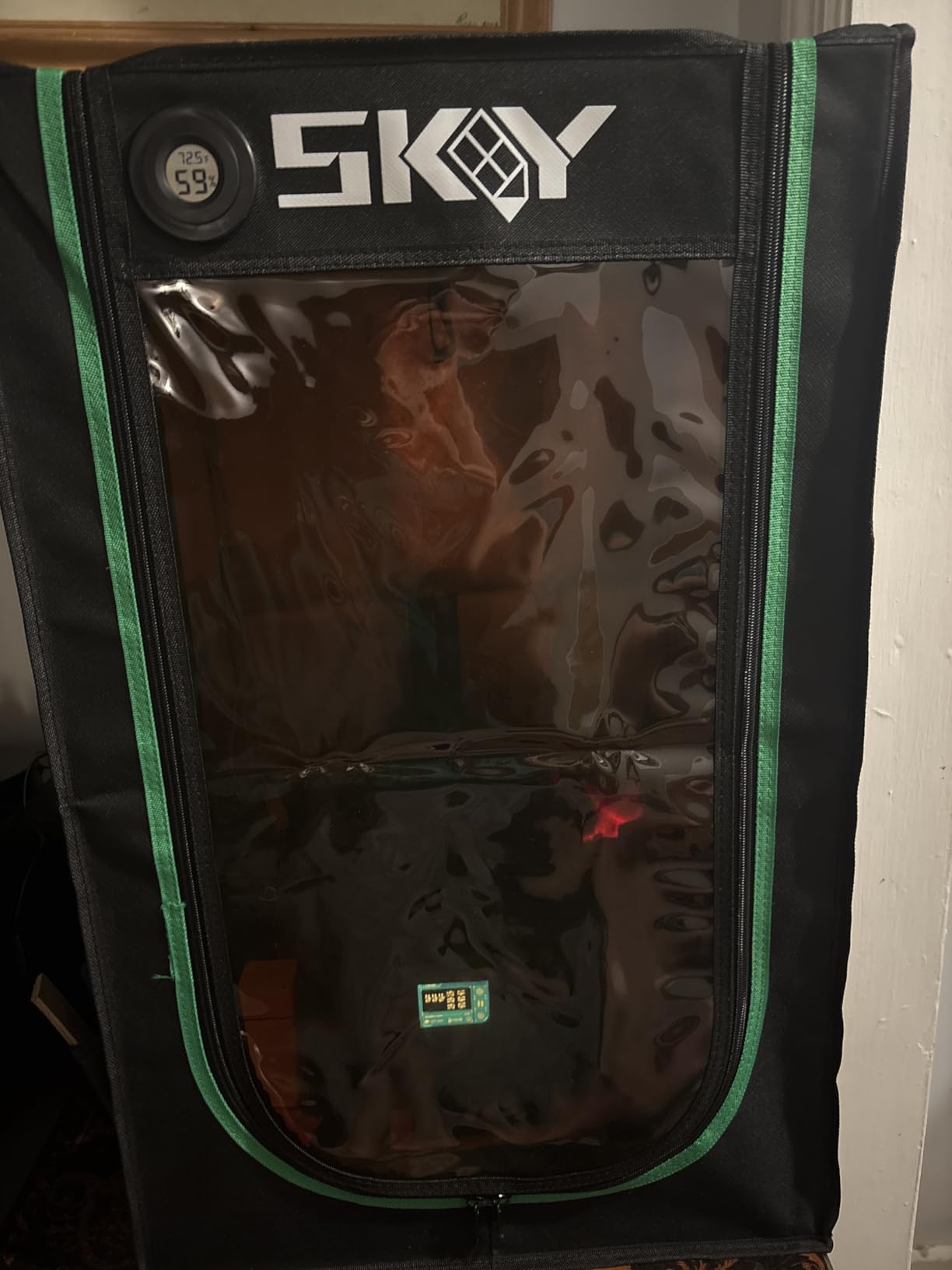
Internal heat insulation is there for the same reason it is on every enclosure in this list, and it is more important for resin than for FDM because viscosity and cure both shift with temperature. A stable chamber means fewer failed layers and less bottom-layer scarring.
The one operational note is real and comes from the listing guidance: activated carbon restricts airflow, so run dual-side exhaust to offset it, and flush the hood before opening. Otherwise you release a concentration of captured odor all at once, which is the same complaint that brings many buyers to an enclosure in the first place.
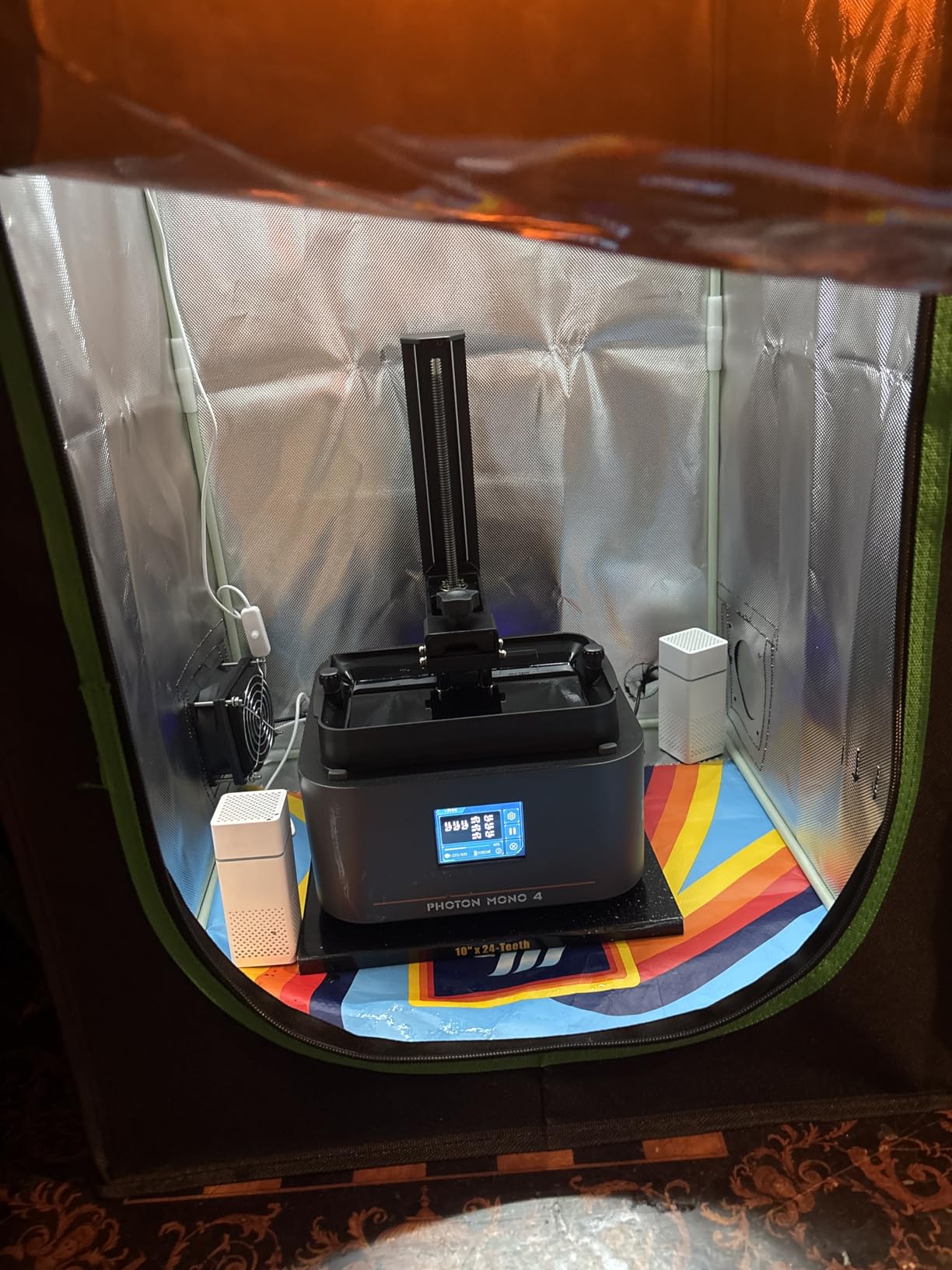
Best for two resin printers or a printer plus a cure machine
Two-machine resin setups are the clearest case for this footprint. Other tents either fit one printer or fit one printer and a small wash station, and this fits two full units. The transparent PVC window also makes monitoring two builds practical, which soft-shell tents make awkward.
If you are consolidating resin work into one corner of a garage or utility room, this gives you a single containment volume for the whole output chain.
Watch out for the footprint and the airflow restriction
This is the largest enclosure reviewed and it needs real floor space, so measure the bay before ordering. The carbon sheet also throttles airflow, which makes the dual-side exhaust recommendation something to follow rather than ignore.
The review sample here is small, and the sample size is a fair reason to treat the 4.4 rating as provisional rather than settled.
10. HOCENWAY Dual-Placement Enclosure with Five-Layer Fabric
Dual-Placement Resin 3D Printer Enclosure Cover Tent with Adjustable Ventilation Exhaust Fan kit Compatible with Creality Anycubic Elegoo Series Mars 5 Ultra, Photon Mono 4 Resin UV 3D Printer
25.2 x 21.26 x 29.53 in
12V fan with three-layer filtration
Five-layer composite fabric
3.96 lb
Pros
- Frame converts between horizontal and vertical placement
- Removable brown UV membrane for resin and laser work
- Five-layer composite fabric is waterproof outside and fireproof inside
- Stainless tubing is lighter and more durable than plastic
- Fan bracket adapter included in the box
Cons
- Orientation changes usable interior size so check fit carefully
- Three-inch class fan is small for the enclosure volume
- No interior lighting mentioned
The dual-placement frame is the reason this one is on the list. The same enclosure can be configured horizontally or vertically depending on the printer shape, which solves a genuine problem for people with tall gantries or wide beds who find every fixed-orientation tent wrong in one dimension or the other.
The fabric is the most layered in this group: waterproof PU adhesive, Oxford cloth, adhesive composite, aluminum film, and PE film, which makes it waterproof on the outside and fireproof on the inside. The brown UV filter membrane is removable, so you can use the same tent for a UV resin printer or a laser engraver and take the membrane out when you do not need it.
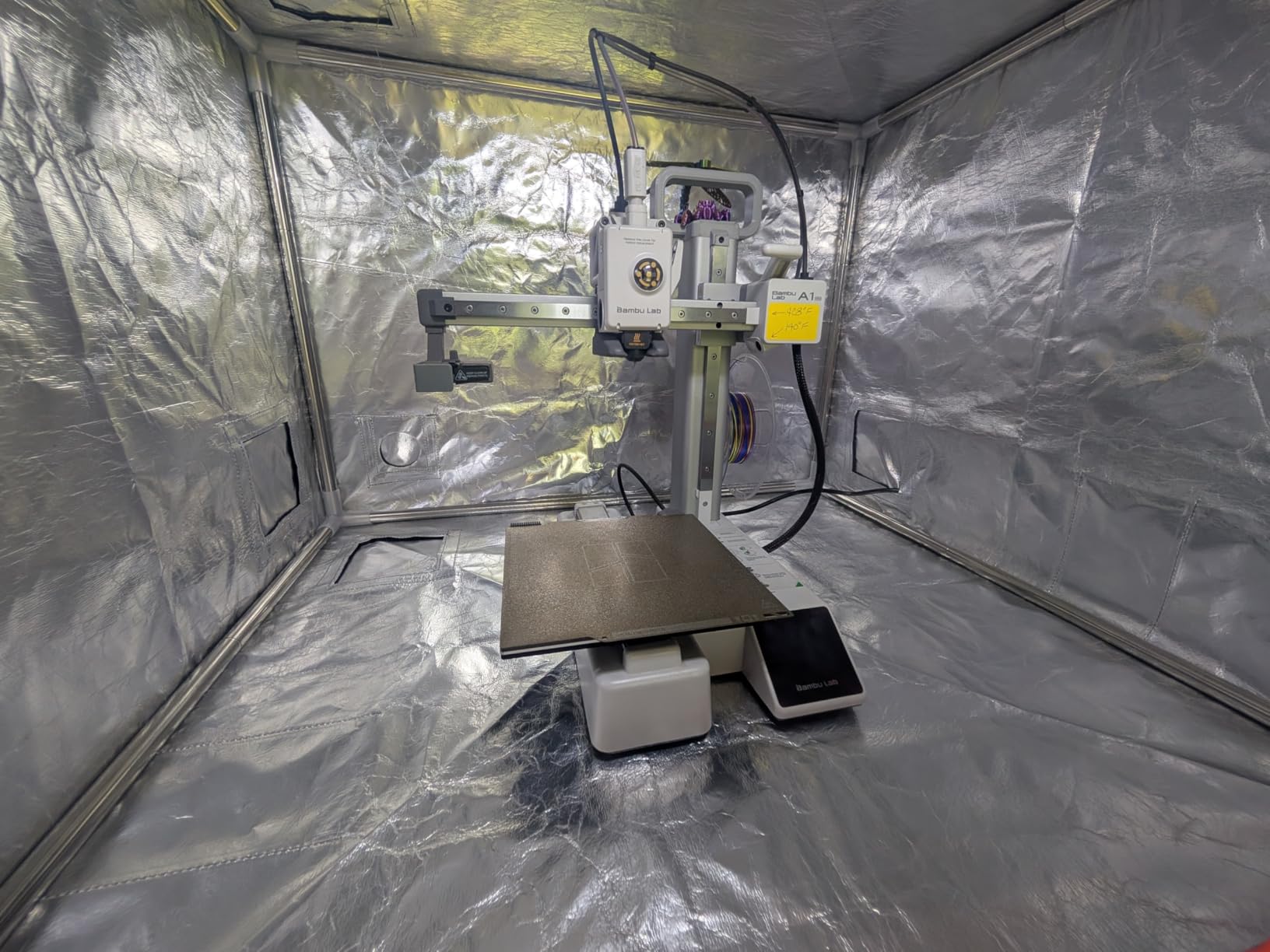
The fan bracket adapter ships in the box, which removes one of the most common assembly frustrations in this category. Several tents in this roundup need a self-printed 3D part to mount the filter fan properly, and this one does not. The 12V fan has a speed control adapter running AC 100-240V in and 3-12V 2A out.
This is a listing at 4.2 with a 55 percent five-star share and a comparatively high three-star share. It is not a bad product, it is a product with the thinnest evidence behind it at 31 reviews and a small fan relative to the chamber volume.
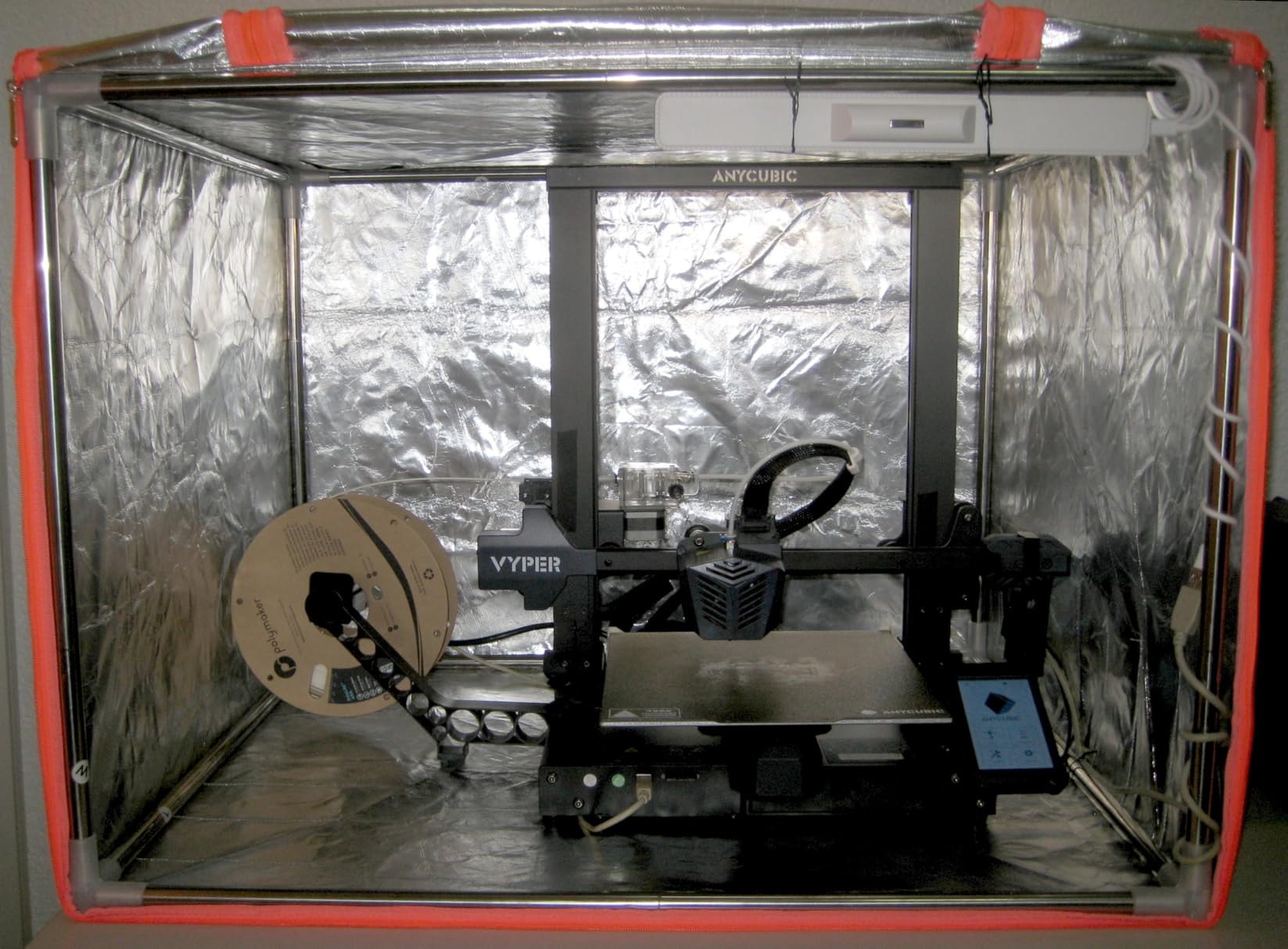
Best for printers with unusual proportions
If your printer is tall, wide, or awkward in a way that fixed tents cannot handle, a frame that flips orientation is worth more than another layer of fabric. It also means one tent can cover two printers of different shapes at different times.
The removable UV membrane extends that usefulness to laser engraving, where you want the window out of the way and the fumes contained.
Watch out for the small fan and the changing interior size
Because orientation changes the usable interior, you need to check the fit for your specific printer rather than trusting the listed dimensions. The three-inch class exhaust fan is also small for a 25 by 21 by 29.5 inch chamber, so plan on a stronger fan for pungent resin or ABS.
There is no interior lighting mentioned in the listing, and the 31-review sample means long-term durability data is limited. Buy it for the adjustable frame; buy something else if you need proven filtration.
3D Printer Enclosure Buying Guide for Odor Control in 2026
What odor control actually protects you from
Printing releases two different things, and they need different media. Volatile organic compounds are the gas-phase emissions you smell, and styrene from ABS and ASA is the one with the most discussion behind it. Ultrafine particles are the solid-phase emissions, and they are what researchers most often raise when they discuss printer emissions in enclosed rooms.
PLA produces far less odor than ABS, but it is not emission-free, and Hackaday commenters running PLA-only home setups report developing a mild sore throat correlated with long prints. So the honest answer to whether it is bad to breathe in PLA fumes is that the risk is much lower than with ABS or resin, and not zero.
One community line sums up the caution better than most retailer copy: no smell does not mean no VOCs. Treat odor as a comfort signal and take filtration seriously for the particle side as well.
Activated carbon versus HEPA: what each one removes
Activated carbon adsorbs VOCs onto a large surface area. It is the only media in this category that meaningfully kills odor, and it is why every enclosure worth buying includes some form of it. It does not capture particles at all. A HEPA stage captures fine particles including ultrafine particulate and does essentially nothing for smell on its own.
That is why a three-layer design beats a single carbon sheet for anyone breathing the same air, and it is why the DORUNDEA and POLISI3D multi-layer builds earn their place in a household with asthma or allergies. Air should meet the particle stage and the carbon stage before it recirculates or leaves the tent.
The airflow path in order: chamber intake, particle stage, carbon stage, then either recirculation back inside or exhaust out a window. Skipping the particle stage is the most common shortcut in this category.
Recirculate or exhaust: the chamber temperature trade-off
This is the decision nobody on page one of the search results addresses properly, and it is the one that actually determines whether you keep the enclosure. Recirculating filtered air preserves chamber temperature, which protects print quality, and gives weaker removal. Exhausting outdoors is the strongest odor control available and cools the chamber, which is why constant venting reintroduces warping.
Chambers commonly reach 45 to 60C for ABS work, and the Prusa forum community runs a low and high vent fan stage off an SHT21 temperature and humidity sensor through the OctoPrint enclosure plugin, with higher setpoints for ABS. That approach lets the fan run as hard as the material requires and back off when it does not, which is the workable version of this trade-off.
The rule of thumb: if you print ABS, ASA, nylon, or polycarbonate, buy exhaust capability and drive the fan from chamber temperature. If you print only PLA and PETG, recirculate and stop worrying.
How to size an enclosure for your printer
Measure the printer including spool holders, the AMS, and the gantry at its tallest point, then add clearance. Bed-slinger footprints like the Ender 3 class are wide and low, so width is the binding constraint. CoreXY machines are taller, so height clearance is. A wash and cure station beside the printer roughly doubles what you need, and that is what the double-space models exist for.
Check the listed interior dimensions against your own measurement, not the product photo. Multiple owners in this roundup report the usable space being tighter than the pictures suggest once spool holders and frame tubes are in place.
Filter replacement and cost per year
Carbon media saturates, and a saturated sheet keeps your room smelling while giving you false confidence. Nobody publishes replacement intervals for these products, so treat any claim you see as marketing. A practical rule is to replace carbon media every three to six months when you are printing high-odor materials weekly, and annually for PLA-only use.
The recurring cost matters more than the enclosure price over a two-year ownership window, especially where the carbon stage is a small sheet rather than a replaceable cartridge. That is the argument for buying the tent and adding your own 4-inch inline fan and external carbon filter, which is what several owners of the resin kits here ended up doing.
Fire safety and enclosure materials
Fire resistance is where DIY builds get expensive, and it is why a purpose-made tent is often the cheaper answer. Cardboard and untreated wood are out. Oxford cloth enclosures should be flame-retardant or fireproof treated, which is a claim several products in this list make, and one fiberglass frame here is rated to 680-800C. Do not place an enclosure on a heat-sensitive surface or directly against a wall that blocks its exhaust path.
When an enclosure is the wrong answer
For PLA and PETG-only printing, relocating the printer to a garage, utility room, or workshop with a window is a better fix than any tent on this list, and it costs nothing to try. An enclosure adds consumable cost and a filter to maintain, and a filtered tent in a closed room still recirculates a portion of what it captures.
An enclosure is clearly worth it for ABS, ASA, nylon, or polycarbonate, for resin work where the wash station is indoors, for long unattended prints, and for households with asthma, allergies, or children. It is marginal for low-odor filament and a spare room. If you have that spare room, move the printer instead.
Frequently Asked Questions
What is the best 3D printer enclosure with ventilation?
The best ventilated enclosure pulls chamber air through activated carbon for VOCs and a particle stage for fine dust, then either recirculates it inside or ducts it outdoors. Among the 10 reviewed, the YOOPAI leads on proven reliability across 560 ratings, the DORUNDEA offers the most complete three-layer filtration, and the FUNGDO is the only one publishing real airflow at 180 CFM. Match the choice to your material, not just your budget.
How to ventilate 3D printer fumes?
Ventilate printer fumes in four steps. Enclose the printer with sealed zippers and gasketed ports. Stage filtration correctly so air passes a particle stage and an activated carbon stage before recirculating or leaving. Exhaust outdoors through a window for ABS, ASA, nylon, polycarbonate, and resin, using a 4-inch inline fan with a dryer-vent adapter. Finally, drive the fan from chamber temperature so constant venting does not cool the chamber and reintroduce warping.
Does a carbon filter remove 3D printer smell?
Yes, for smell specifically. Activated carbon adsorbs volatile organic compounds, which are the gas-phase emissions responsible for odor in ABS, ASA, and resin printing. What it does not do is capture ultrafine particles, which is why a carbon-only setup can leave air that smells fine without being clean. Community builders consistently pair carbon with a HEPA or equivalent particle stage, and the same principle applies to any activated carbon system.
Is a 3D printer enclosure worth it?
It is worth it for ABS, ASA, nylon, polycarbonate, and resin printing, for long unattended prints, and for households with asthma, allergies, or children nearby. It is worth it for resin especially when the wash station is indoors, since most resin odor comes from washing and curing rather than the print itself. For PLA and PETG only, relocating the printer to a room with a window is usually a better and free fix.
Do resin printers need ventilation?
Yes, and the wash station matters more than the printer. Uncured resin odor comes largely from washing and handling, not from the UV cure step, and resin users commonly report smelling resin only when the wash station lid is unsealed. Enclose the printer, wash station, and cure station together, run activated carbon plus a particle stage, and exhaust outdoors. Wear nitrile gloves and treat the ventilation question as separate from handling safety.
The Best 3D Printer Enclosure for Odor Control in 2026
The YOOPAI Multifunctional Resin Enclosure is the best 3D printer enclosure for odor control in 2026 for most buyers, because 560 ratings have made its strengths and weaknesses predictable, and the carbon sheet plus exhaust fan combination does exactly what a resin enclosure should when you duct it to a window. The DORUNDEA is the pick for a household with allergies, where the three-layer particle and gas stack earns its place. The VEVOR is the pick for value, pairing the highest average rating in the roundup with the lowest price. The FUNGDO is the pick for ABS and ASA, and the only one here with an airflow number large enough to run continuously without dropping chamber temperature.
None of these replaces the other two halves of the answer. Filter the air properly, stage the carbon behind a particle filter, exhaust high-odor material outdoors, and if you only print PLA and PETG, move the printer to a room with a window instead of buying a filter you have to maintain. Check each pick against your printer’s footprint before you order, and use the comparison table above to narrow the field fast.