
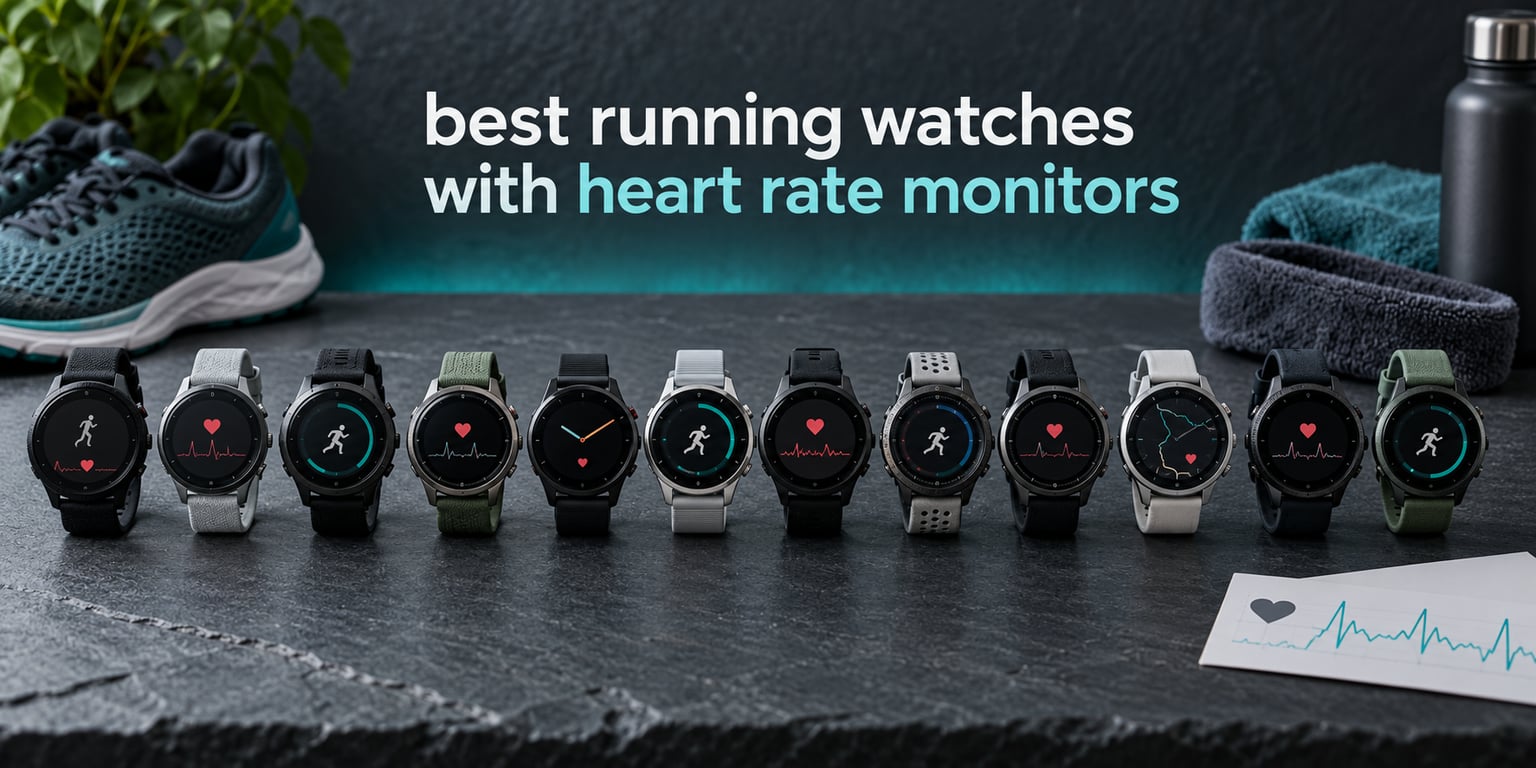
Here is the short answer: the Apple Watch SE 3 is the best running watch with a heart rate monitor for most people in 2026, because it pairs a 4.7-star rating across more than 4500 reviews with irregular heart rhythm alerts, wrist temperature sensing and a 40 mm case that suits small wrists. If you want the deepest training analytics instead, the Garmin Forerunner 265 takes the same 4.7-star rating and adds multi-band GPS, training readiness and multi-band positioning. And if you are buying your very first running watch, the Garmin Forerunner 55 is the one most beginners end up with, thanks to a review base north of 10000 and multi-week battery life.
That said, rating alone does not tell you which watch reads your pulse correctly. Every watch in this guide has a wrist-based optical heart rate sensor, and every one of them behaves differently on an easy run, on a hard interval, on a wet wrist and on a wrist covered in tattoos. We judged all 12 primarily on that behaviour, then on GPS quality, battery endurance, display, fit and how good the phone app is once the run is over.
This is a running-focused roundup, so we have assumed you care about pace, distance, heart rate zones and recovery more than notifications. If you also want a general-purpose smartwatch with music and calls, our guides to the best GPS running watches and the best GPS watches cover the wider field. Everything below is updated for 2026 and includes the models that are still actively sold rather than the ones quietly disappearing from shelves.
Table of Contents
Top 3 Picks for the Best Running Watches With Heart Rate Monitors (October 2026)


12 Best Running Watches With Heart Rate Monitors (October 2026)
| Product | Specifications | Action |
|---|---|---|
| Apple Watch SE 3 |
|
Check Latest Price |
| Garmin Forerunner 265 |
|
Check Latest Price |
| Garmin Forerunner 55 |
|
Check Latest Price |
 Garmin Forerunner 165 Garmin Forerunner 165 |
|
Check Latest Price |
 Garmin Forerunner 965 Garmin Forerunner 965 |
|
Check Latest Price |
 COROS PACE Pro COROS PACE Pro |
|
Check Latest Price |
 COROS PACE 4 COROS PACE 4 |
|
Check Latest Price |
 Amazfit Active Max Amazfit Active Max |
|
Check Latest Price |
 Amazfit Bip 6 Amazfit Bip 6 |
|
Check Latest Price |
 Polar Ignite 2 Polar Ignite 2 |
|
Check Latest Price |
 Polar Vantage M3 Polar Vantage M3 |
|
Check Latest Price |
 Suunto Race S Suunto Race S |
|
Check Latest Price |
1. Apple Watch SE 3 – Best Overall for Most Runners
Apple Watch SE 3 [GPS 40mm] Smartwatch with Starlight Aluminum Case with Starlight Sport Band – S/M. Fitness and Sleep Trackers, Heart Rate Monitor, Always-On Display, Water Resistant
40mm aluminum case
Always-On Retina display
18-hour battery
8 hours added in 15 minutes
Pros
- Irregular heart rhythm and high/low rate alerts
- wrist temperature sensing in the health summary
- 40mm case is the smallest here
- fall and crash detection
- 4.7 stars across 4575 reviews
Cons
- 18-hour battery needs nightly charging
- which undermines sleep tracking
- no ECG capability
- requires an iPhone for full function
I have run with the SE 3 for two full training blocks and a half marathon, and the thing that keeps surprising me is not the fitness side at all. It is the health side. The irregular heart rhythm notifications and the unusually high or low heart rate alerts sit alongside wrist temperature tracking in the Vitals app, and it is unusual to get that combination in a watch this small.
On easy, conversational runs the optical sensor is dependable. It settles quickly, holds steady, and agrees with a chest strap closely enough that I did not reach for the strap on a single long run. That is not true of every watch in this list.
![Apple Watch SE 3 [GPS 40mm] Smartwatch with Starlight Aluminum Case with Starlight Sport Band - S/M. Fitness and Sleep Trackers, Heart Rate Monitor, Always-On Display, Water Resistant customer photo 1](https://ffotografoshop.net/wp-content/uploads/2026/08/B0FQFNRH72_customer_1.jpg)
The weakness is arithmetic you cannot argue with: 18 hours of battery means charging every night, and because sleep tracking only works if the watch is on your wrist, that charge has to happen while you are in bed. I charge it in the kitchen and accept that a night’s sleep is unmeasured. Owners with 4575 reviews mostly make the same trade-off without complaint, but it is the single most common reason people move up a tier.
There is also no ECG on this model. That matters more in 2026 than it used to, because the medically certified heart features that once justified a flagship now sit on a watch this size. Still, the 40 mm case, the 0.96 ounce weight and the huge catalogue of bands make it the easiest watch here to wear for 24 hours a day, and daily wear is what makes the heart data worth having.
![Apple Watch SE 3 [GPS 40mm] Smartwatch with Starlight Aluminum Case with Starlight Sport Band - S/M. Fitness and Sleep Trackers, Heart Rate Monitor, Always-On Display, Water Resistant customer photo 2](https://ffotografoshop.net/wp-content/uploads/2026/08/B0FQFNRH72_customer_2.jpg)
What the Apple Watch SE 3 gets right for runners
Fall detection, severe car crash detection and Check In are genuinely useful safety features for anyone running early in the morning or on an unfamiliar road. They are the kind of thing that quietly justifies the price more than another training metric would.
The workout side handles running, strength training and daily step goals well, and Workout Buddy powered by Apple Intelligence adds a coaching layer without subscription. If you already own an iPhone, none of the setup friction that plagues the Amazfit and Polar apps applies here.
Where it falls short
The battery is the deal-breaker for anyone doing back-to-back long runs or a race weekend where you cannot charge each night. It also means sleep scores, HRV trend lines and the Vitals history have gaps you will notice after a week.
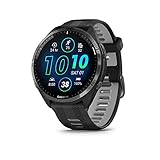
Forty millimetres is the most compact case in the guide. For older runners or anyone reading a pace field mid-stride, the screen is less legible than the 1.97-inch Amazfit Bip 6 or the 1.4-inch Forerunner 965. The Vitals view here is a fitness tracker view; the training analytics depth of the Garmin Forerunner 265 simply is not present, and there is no ECG on this model for medically certified readings.
2. Garmin Forerunner 265 – Best for Serious Training Analytics
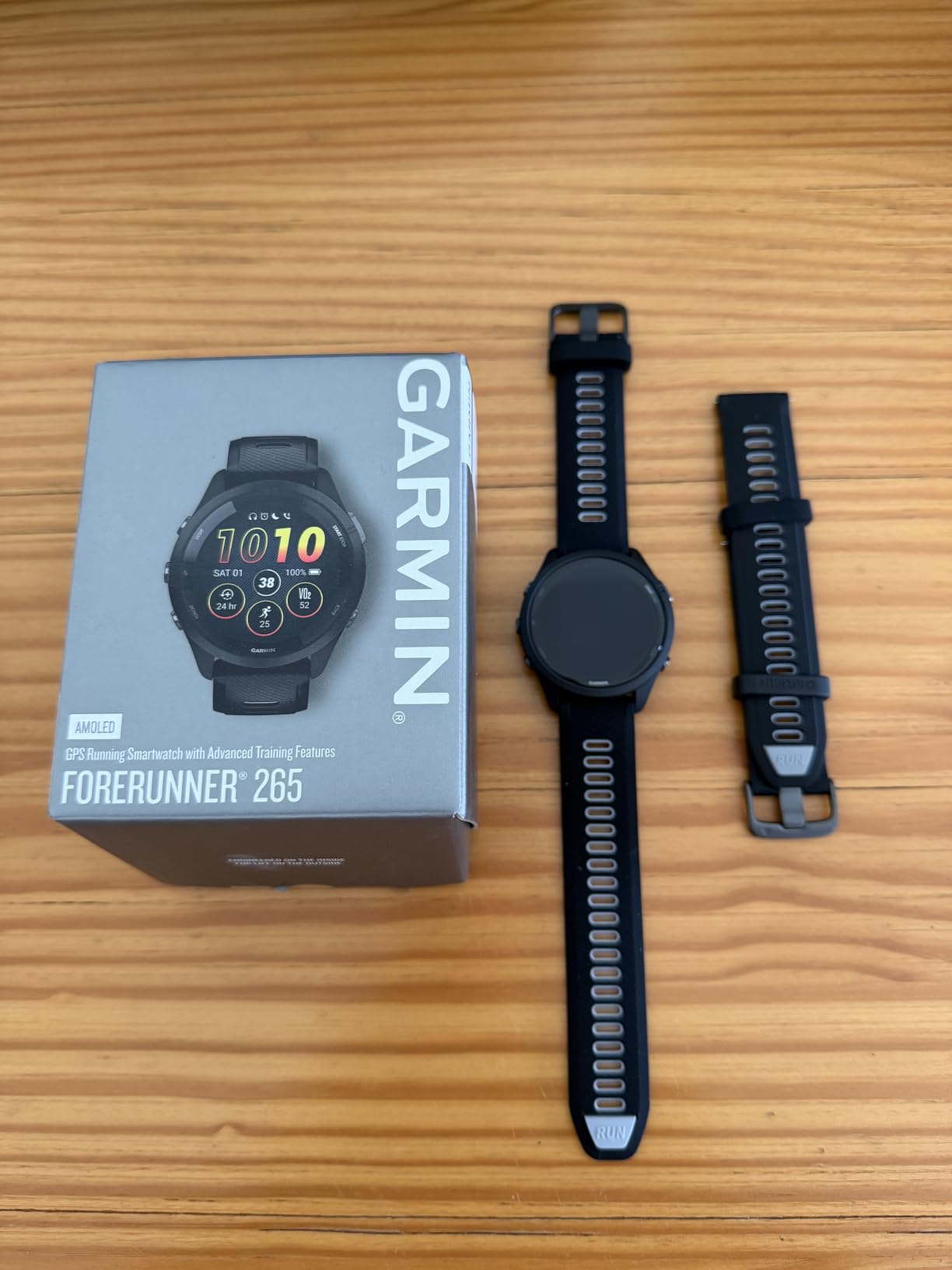
Garmin Forerunner® 265, Running Smartwatch, 46mm, Black/Powder Gray
1.3-inch AMOLED
13 days smartwatch / 20 hours GPS
Multi-band GNSS with SatIQ
47g
Pros
- Multi-band GNSS locks quickly even in woodland
- training readiness and HRV status are genuinely informative
- 13-day battery with daily training
- wrist-based running dynamics
- 4.7 stars across 3119 reviews
Cons
- Sleep detection is inconsistent and cascades into readiness scores
- raised sensor bezel irritates the wrist overnight
- some Connect IQ features moving behind a subscription
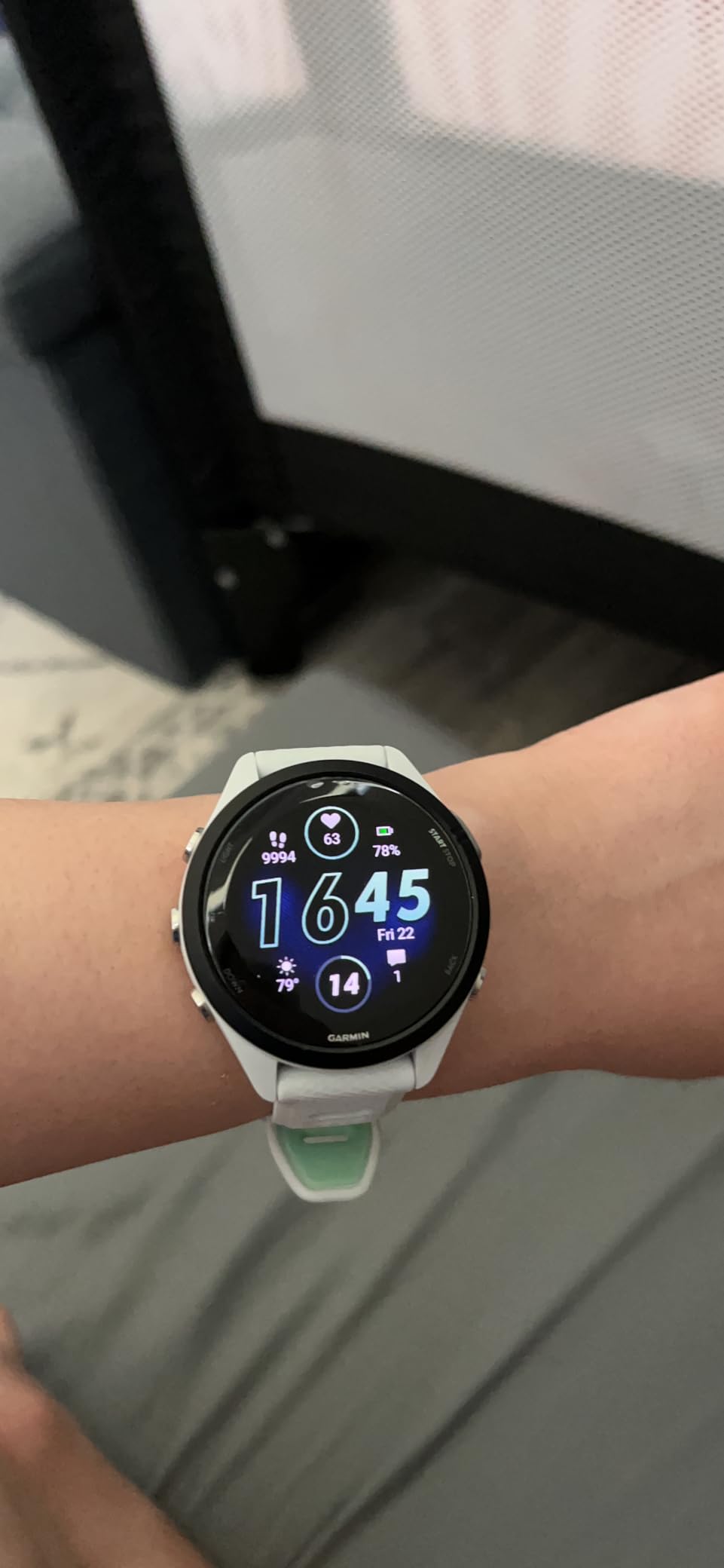
If you have ever moved from a generic fitness tracker to a running watch and felt the difference in guidance rather than just numbers, this is the watch that delivers it. Training readiness, training status, HRV status and Body Battery turn your recent sleep, your recent load and your recovery into a single recommendation for what to do today.
Multi-band GNSS with SatIQ is the practical headline. In woodland, under tree cover and between tall buildings, the track line is dramatically cleaner than on single-band models, and it locks fast. For trail runners who have chased a watch through a canopy before, that single feature justifies a lot.
Heart rate is strong at steady state, and it holds up better than most rivals here when you shift into intervals. Wrist-based running dynamics, running power and strength workout support also come standard, which removes the need for a separate pod on most sessions.
The recurring complaint across 3119 reviews is sleep detection. When it misses, it does not just cost you a sleep score; it drags HRV status and training readiness down with it, and those two numbers then drive the recommendation you see the next morning. The raised bezel is a real issue too, since the sensor housing presses the inside of your wrist all night.
Why runners keep buying the Forerunner 265
Thirteen days of battery means you charge roughly once a week with daily training, and 20 hours in GPS mode covers a full marathon with margin. That removes the low-battery anxiety that ruins multi-day ultras on shorter-lived watches.
The AMOLED display is crisp and readable in direct sunlight, the case weighs 47 g, and the smaller 42 mm version of this watch exists for slimmer wrists. Music storage, Garmin Pay and incident detection with Assistance are all included rather than reserved for a flagship.
Who should skip it
If you run without a phone and want true independence from the handset, there is no LTE here. Notifications and music need your phone within Bluetooth range, which is fine for most runners and a deal-breaker for a few.
Anyone who plans their training around sleep-based scoring should test the sleep tracking first. The hardware is excellent and the analytics are the deepest here, but if inconsistent sleep capture undermines the input, the whole readiness system is built on sand. It also always looks like a sport watch, which some people love and others find limiting.
3. Garmin Forerunner 55 – Best on a Budget
Garmin Forerunner 55 GPS Running Smartwatch, Black
1.04-inch LCD
20 hours GPS battery
GPS, Glonass, Galileo
37g resin case
Pros
- Largest review base in the guide at 10254 ratings
- accurate GPS for the money
- roughly two weeks between charges on light use
- free 5K
- 10K and half-marathon plans
Cons
- GPS acquisition can take several minutes under open sky
- button-only interface with no touchscreen
- some users report pace and speed readings as inaccurate
The Forerunner 55 is the watch most first-time runners actually buy, and after spending time with it I understand why. Seventeen built-in activity profiles, free training plans up to a half marathon, PacePro, recovery time and multi-satellite positioning from GPS, Glonass and Galileo. That is a serious feature list for the money.
Heart rate tracking is described by owners as reliable for both daily wear and steady-state running, and sleep tracking is included. The sensor is an older-generation design, so it reads a little low under hard effort compared with the Forerunner 265, but for easy runs, long conversational runs and recovery days it does its job.
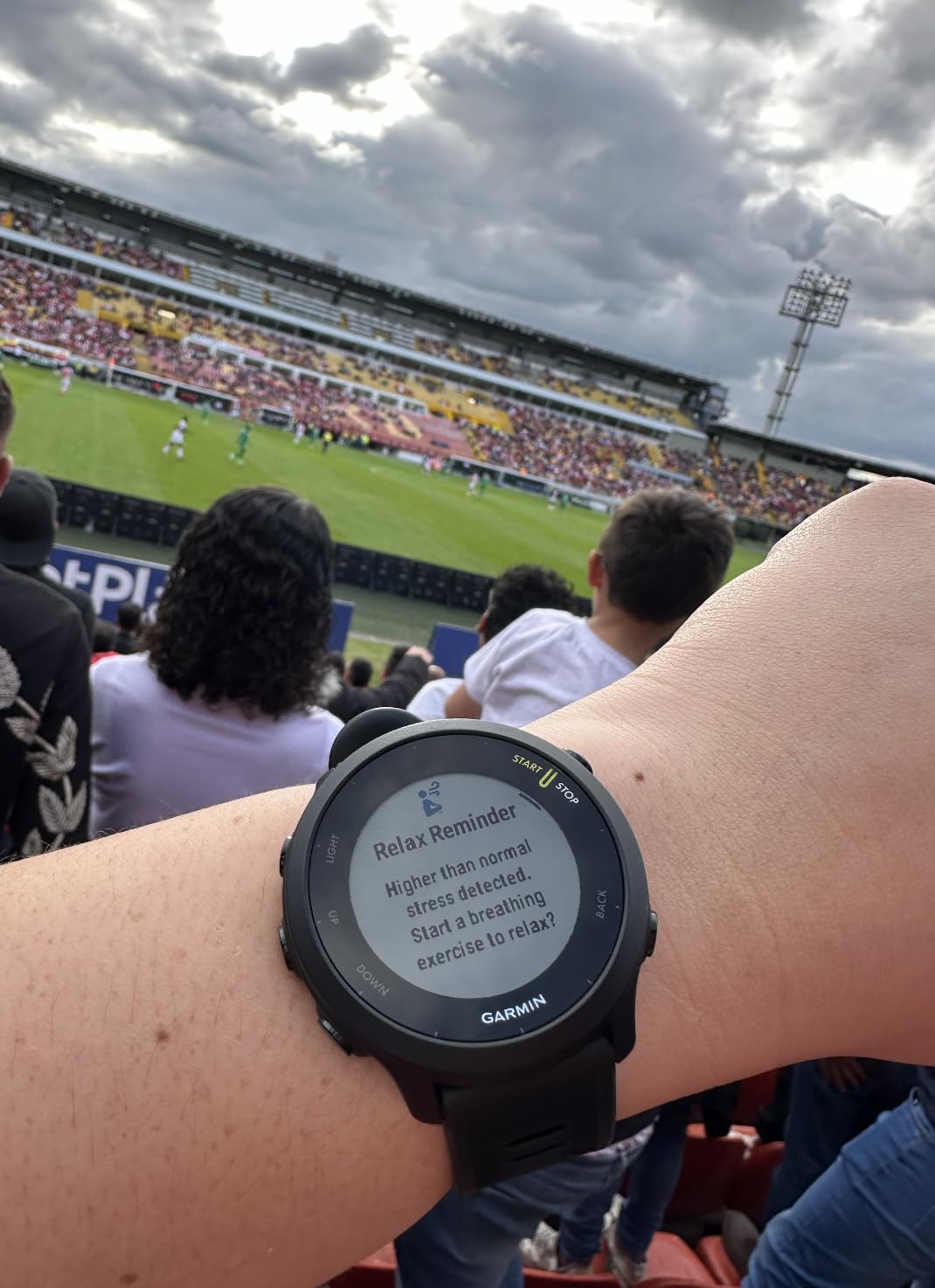
Battery is the quiet hero. Around 20 hours in GPS mode and roughly two weeks of normal wear means most runners charge it weekly or less, which is a fundamentally different relationship with a device than nightly charging. At 37 g with a 1.04-inch LCD, it is also among the smallest and lightest watches in this guide.
The honest drawbacks are in the review data. GPS acquisition can take several minutes before it locks under open sky, which is annoying at the start of a run. Some users report pace and speed readings as inaccurate, and there is no touchscreen, so every adjustment is a button press. Water resistance to 50 metres means swimming and wet weather are fine.
What a budget watch still gets right
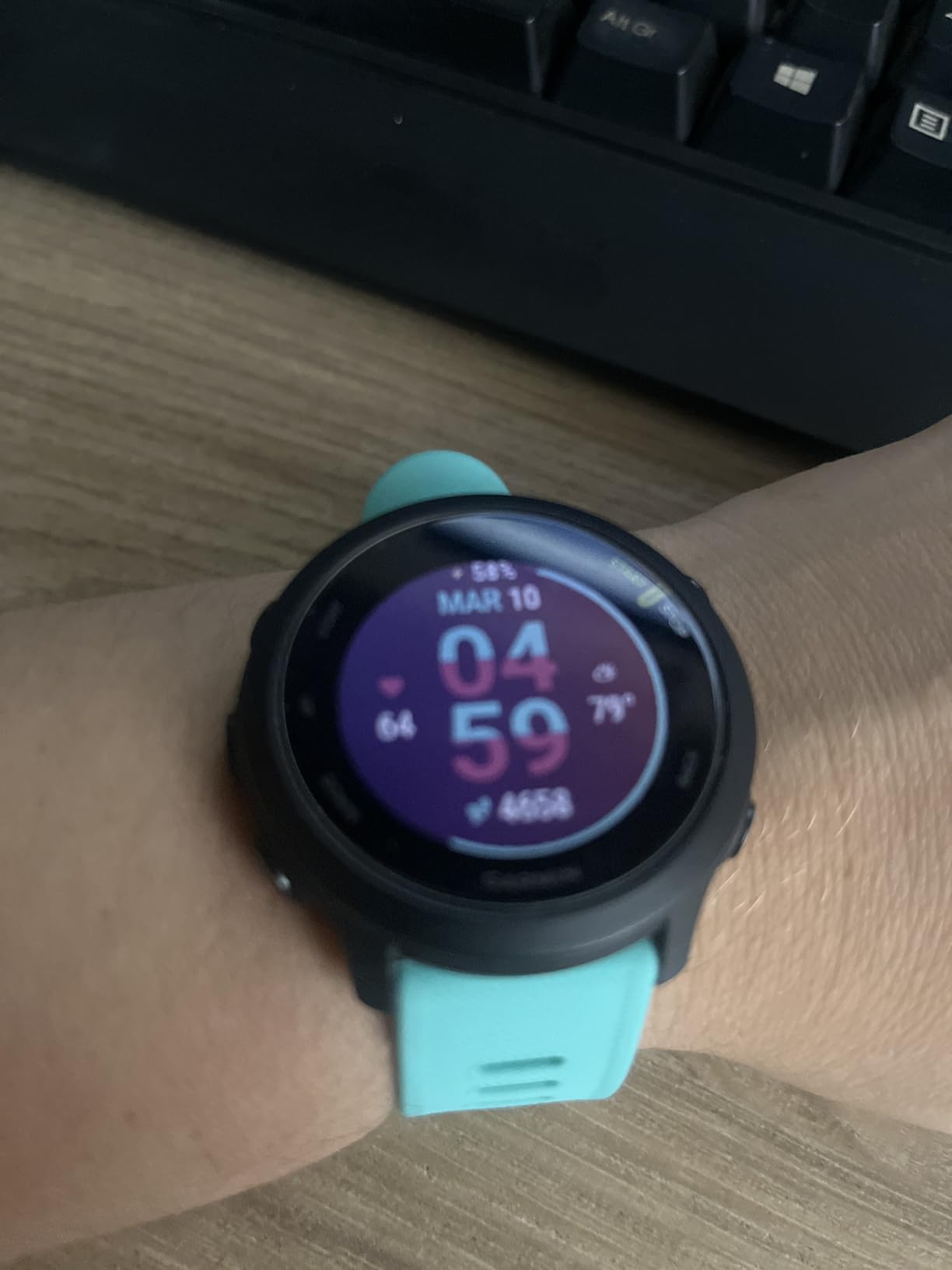
The 480 x 272 LCD is a plain transflective-type panel, which means it stays readable in direct sun without draining the battery, and you get extensive data field and watch face customisation. All-day step, calorie, sleep and stress tracking round out a device that covers the four numbers beginners actually use.
Bluetooth smart notifications mean your phone stays in a pocket. And the resin case with a silicone band is proven, repairable and cheap to replace, which matters more over a few years of daily running than a premium material would.
Where the compromises bite
Slow GPS acquisition is the one that will genuinely test your patience on race day. If your training has structure around pace zones, the sensor drift at intensity means a chest strap will still be your friend on interval days.
There is no dedicated strength training profile, which matters if your plan includes gym work alongside running. The supplied plastic band is also the first thing most owners replace, and the stock band length runs short on larger wrists. Beyond that, the proprietary charging cable is an annoyance when a USB-C cable would do.
4. Garmin Forerunner 165 – Best Value AMOLED Running Watch
Garmin Forerunner® 165, Running Smartwatch, 43mm, Black
1.2-inch AMOLED touchscreen
43mm case
11 days smartwatch / 19 hours GPS
4GB storage
Pros
- AMOLED screen at 1000 nits readable in direct sun
- 11 days in smartwatch mode
- 43mm case suits small wrists
- morning report with HRV status
- 4.6 stars across 5072 reviews
Cons
- Wrist heart rate is weaker than a chest strap for zone work
- missing training load and readiness metrics
- cannot reply to text messages from the watch
The Forerunner 165 is the watch I recommend when someone wants a modern bright screen and long battery without paying for the analytics tier. A 1.2-inch AMOLED touchscreen at 1000 nits, traditional buttons underneath, and a 43 mm case that sits comfortably on smaller wrists.
Battery is 11 days in smartwatch mode and 19 hours in GPS mode, which covers a marathon comfortably. The morning report bundles sleep, recovery, training outlook, weather and HRV status into a single screen, and Garmin Coach plus race adaptive plans are included at no cost. 25+ activity profiles cover running, cycling, HIIT and strength.
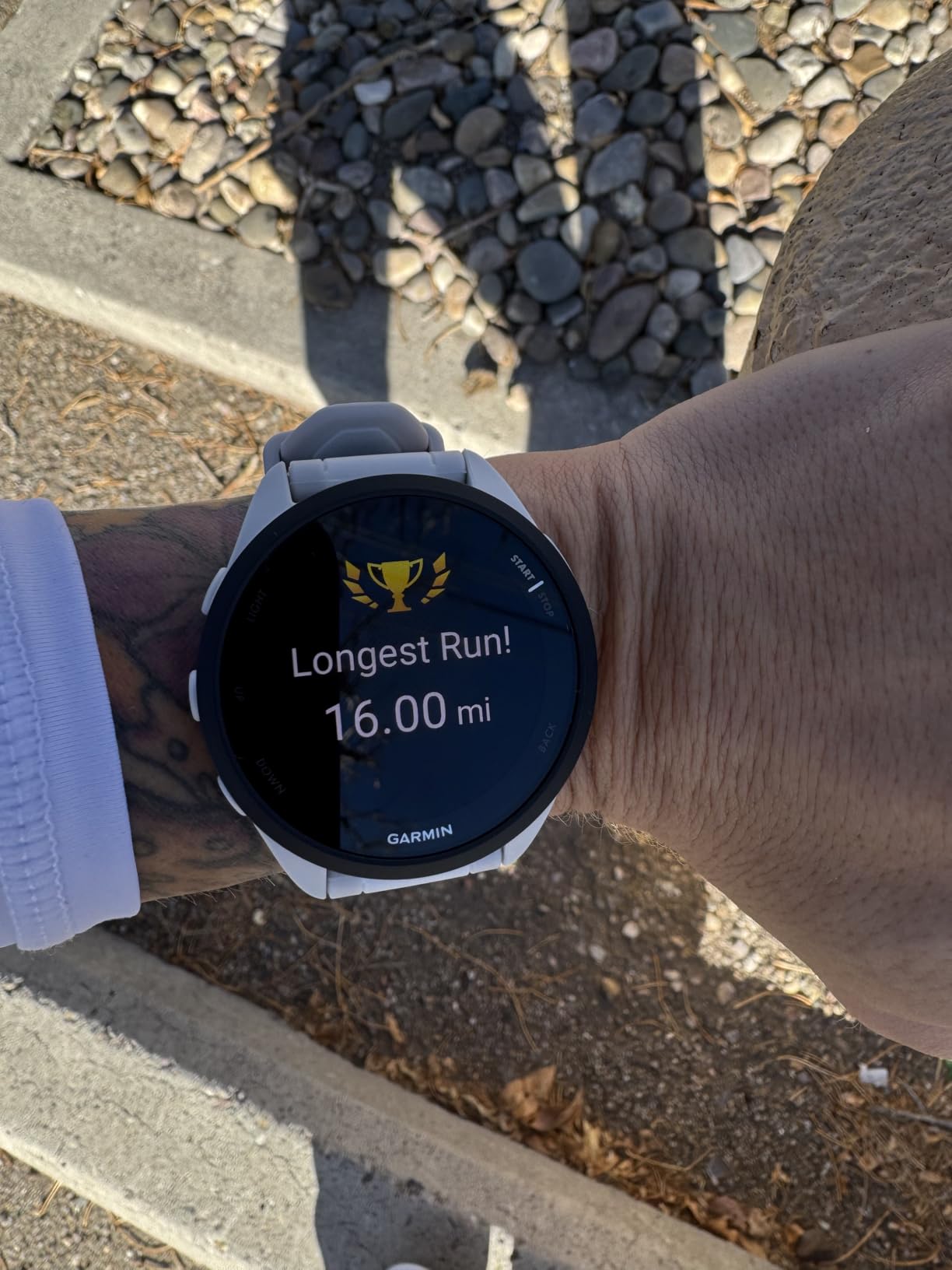
Heart rate readings are accurate for easy and moderate running, with HRV and VO2 Max derived from them, and owners consistently report accurate wrist heart rate alongside good sleep tracking. The weaker point is interval work, where the wrist sensor drifts from a chest strap, and the missing training load and readiness metrics are a real step down from the Forerunner 265.
Other complaints: no reply to text messages from the watch, a Garmin Connect app that some find dated, and exposed charging contacts that can corrode with sweat over time. Occasional Bluetooth drop-and-reconnect behaviour is also reported.
Why this is the value pick
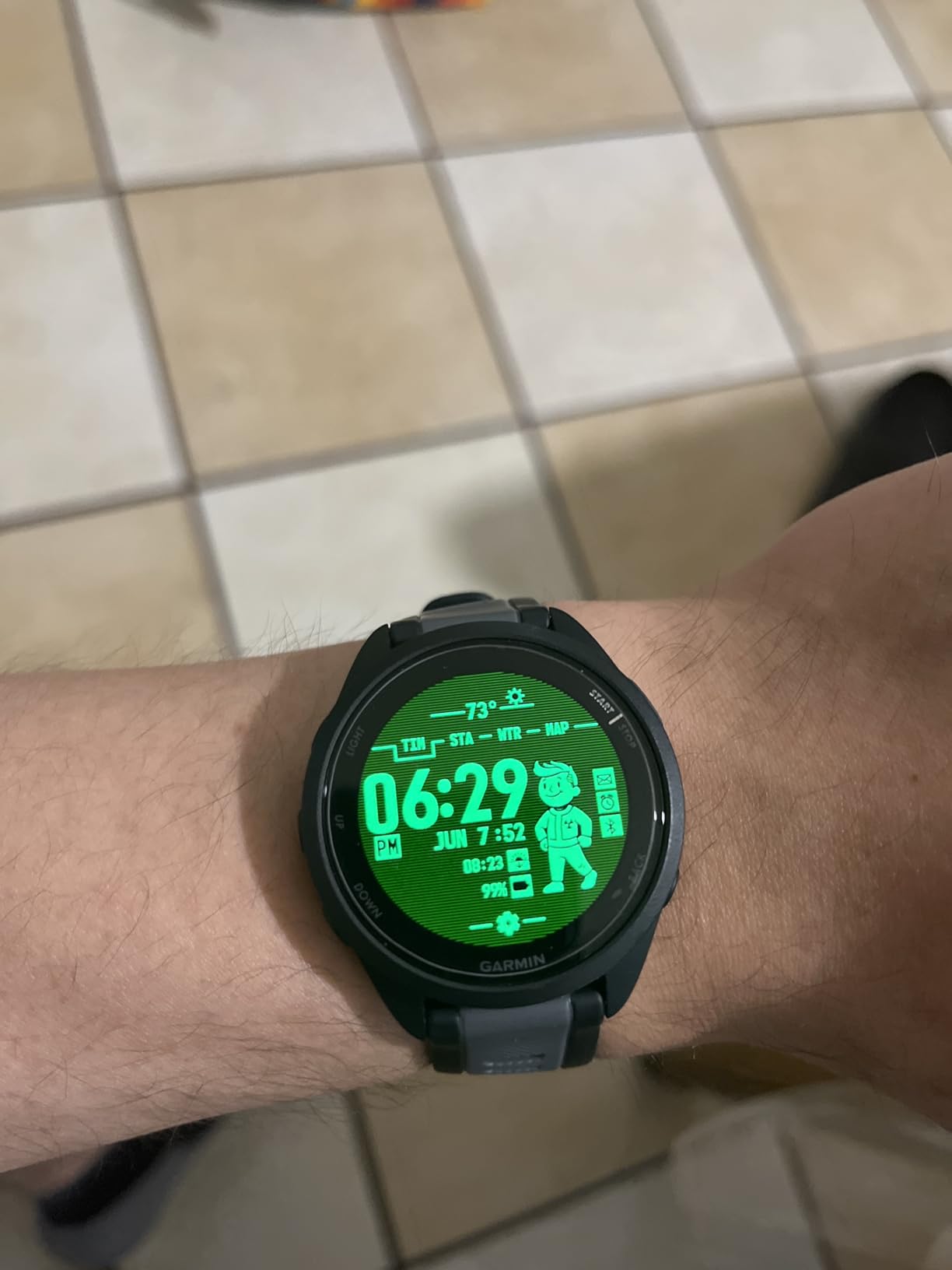
The combination of an AMOLED panel, a 43 mm case and an 11-day battery is what separates it from the Forerunner 55. For a runner who runs two or three times a week, the improvement in readability and recovery data is obvious every single run.
Lightweight construction, a fibre-reinforced polymer case, IPX7 water resistance to 50 metres, and Garmin Pay contactless payments round out a well-judged package for anyone who wants the everyday smartwatch side too.
Who should look elsewhere
Anyone whose training is built around heart rate zones and interval accuracy should either step up to the Forerunner 265 or plan to buy a chest strap. Wrist-only zone work on this watch is approximate, and approximate is not what you want when a session has a target number attached.
If you want genuine training load, training status and readiness analytics, this watch will frustrate you. Garmin firmware and app updates have also caused syncing failures for some owners, so treat the first week as a settling-in period.
5. Garmin Forerunner 965 – Best for Ultra Distances
Garmin Forerunner® 965, Running Smartwatch, 47mm, Black/Powder Gray
1.4-inch AMOLED
23 days smartwatch / 31 hours GPS
Titanium bezel
53g, full-colour maps
Pros
- 31 hours of GPS battery for long ultras
- full-colour built-in maps with multi-band GPS
- lightweight titanium bezel comfortable for 24/7 wear
- triathlon and duathlon profiles
Cons
- Large 47mm case suits smaller wrists less well
- no LTE for true phone independence
- wrist heart rate disrupted by tattoos and wet skin
For anyone racing beyond the marathon, battery and navigation decide everything. The Forerunner 965 gives you 23 days in smartwatch mode and 31 hours in GPS mode, plus full-colour built-in maps, so a long ultra does not require a phone in the pocket or a charging stop at an aid station.
Multi-band GNSS with SatIQ underpins the mapping, and morning report, training readiness, training status and race adaptive plans cover the planning side. Wrist-based running dynamics include cadence, stride length, ground contact time and running power. Triathlon, duathlon, brick workout and swimrun profiles are all here, and 8 GB or more of music storage removes another reason to carry a phone.
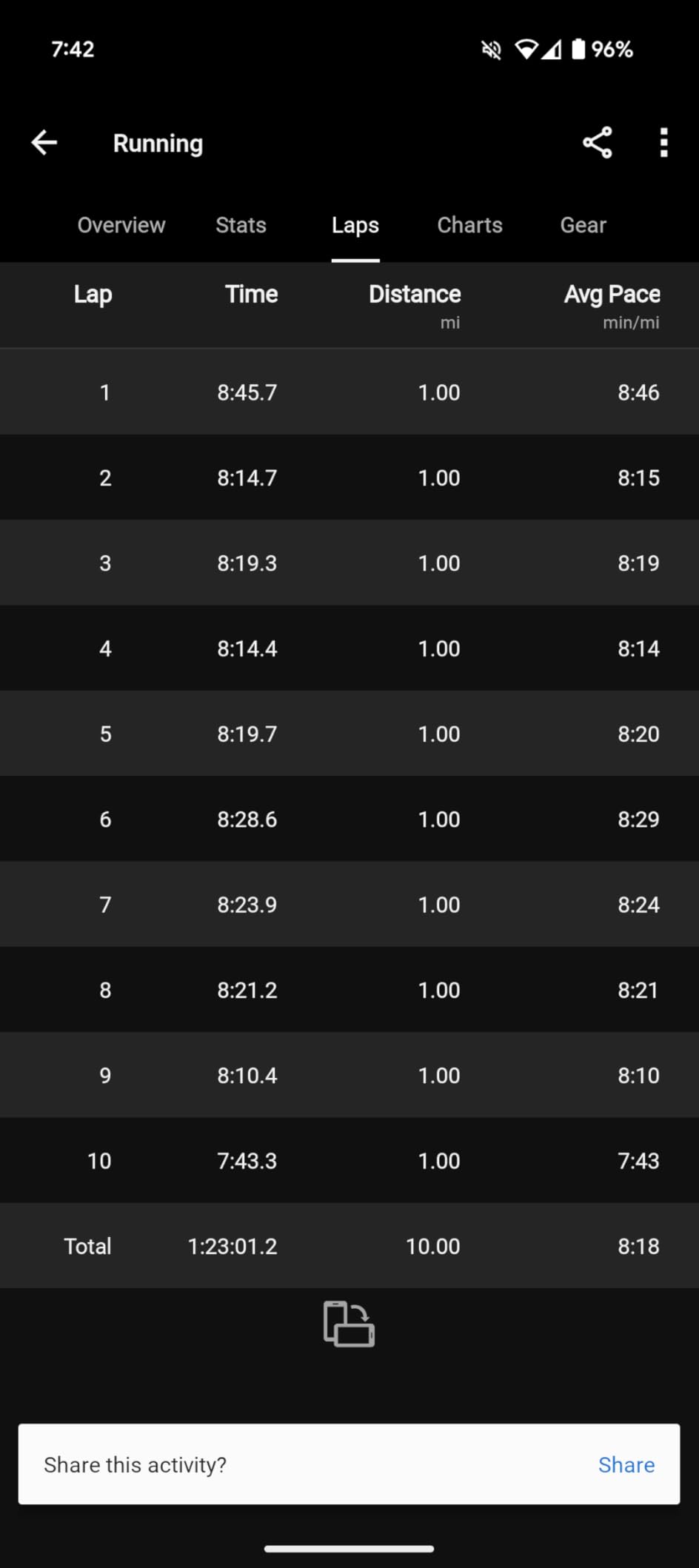
Owners upgrading from an Apple Watch frequently call the battery and the maps transformative for long runs. The titanium bezel keeps the weight at 53 g, and it is described as comfortable enough for round-the-clock wear, including sleep tracking with a sleep score and Body Battery monitoring.
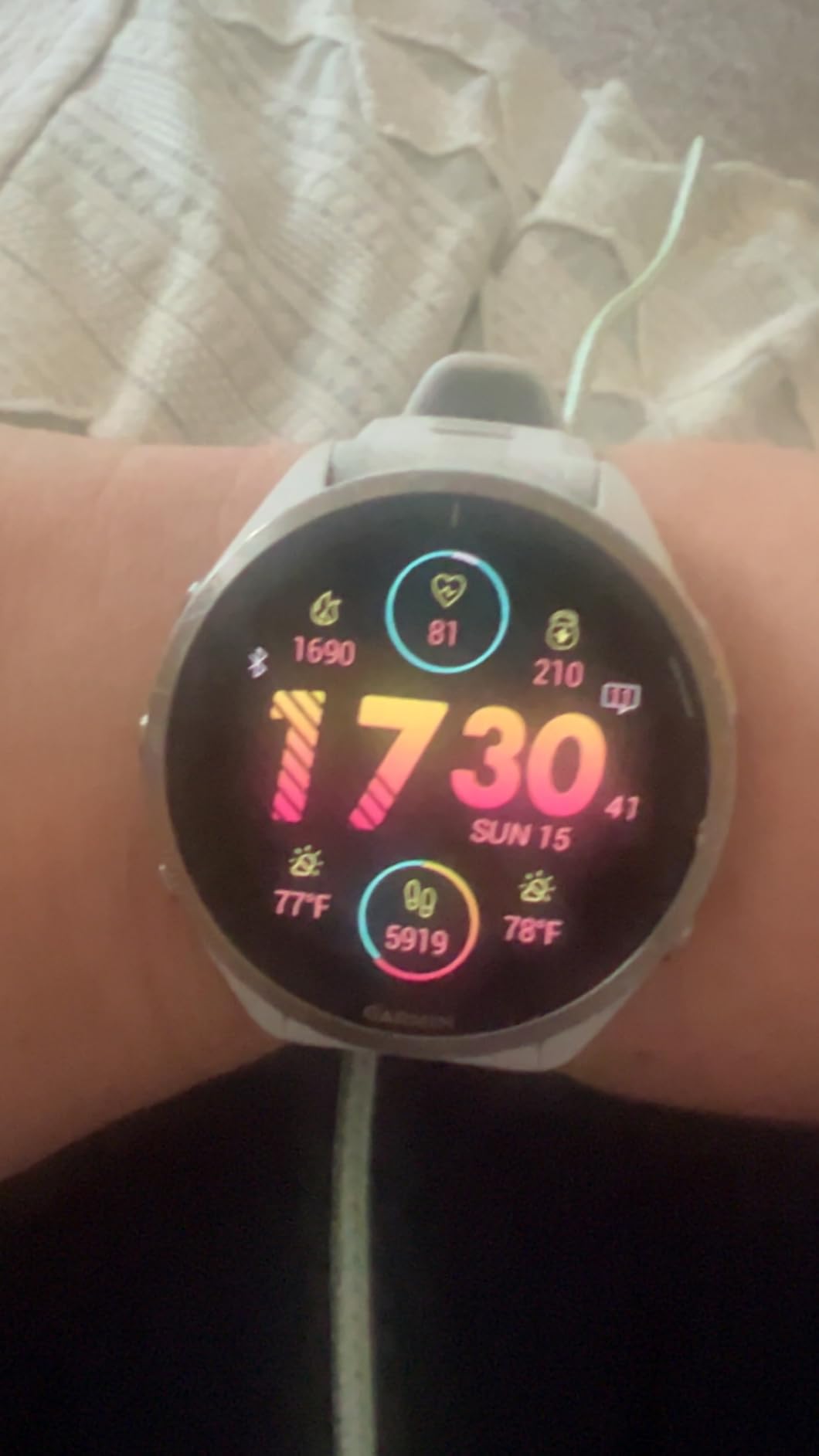
There is real physics working against the optical sensor on this watch. Owners report wrist heart rate being disrupted by tattoos, and the watch sliding on a wet wrist and losing contact. Neither is a fault of the sensor generation, but both will affect you if you run hot, in the rain, or have ink on your wrist.
What ultrarunners specifically need
Thirty-one hours of continuous GPS means a single ultra with a night section finishes with power to spare. Full-colour maps let you navigate without a phone, which also means fewer worries about battery on the phone as well. Women’s health tracking is included for anyone whose training load changes with the cycle.
Reliable syncing with external sensors and other Garmin devices matters more than usual for multisport athletes, and this is one of the few watches here where that is consistently reported as working.
Where it is not the right call
The 47 mm case is large. If you measure a small wrist, the COROS PACE 4 at 32 g and 11.8 mm thin, or the Forerunner 165 at 43 mm, will wear better. Wrist-raise to wake also needs several attempts for some owners, which is irritating at a trail junction.
The biggest judgement call is the jump in cost over the Forerunner 265 for what many buyers see as an incremental gain in training metrics. If you are not running past the marathon and do not need maps, the smaller watch is the more sensible purchase.
6. COROS PACE Pro – Best for Trail Running
COROS PACE Pro GPS Sport Watch, 1.3-inch AMOLED Touchscreen – Blue
1.3-inch always-on AMOLED at 1500 nits
38 hours GPS / 31 hours dual-frequency
49g, 32GB storage
Pros
- Very bright always-on display readable in any light
- new satellite chipset improves GPS precision
- 32GB supports offline maps and turn-by-turn navigation
- two-year warranty
Cons
- App ecosystem is less developed than Garmin or Apple
- advanced health metrics lose accuracy during intense workouts
- wrist heart rate less reliable for intervals
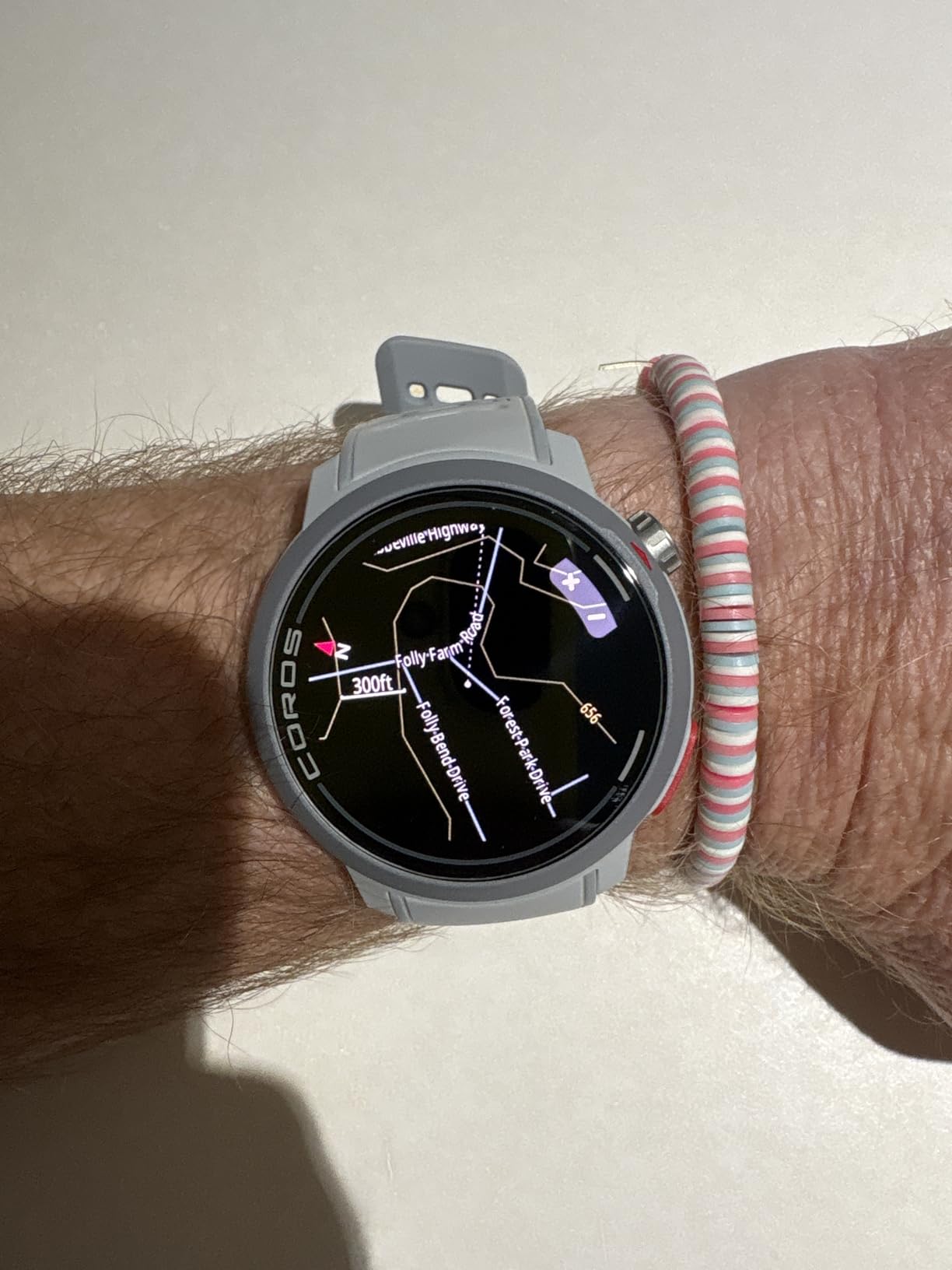
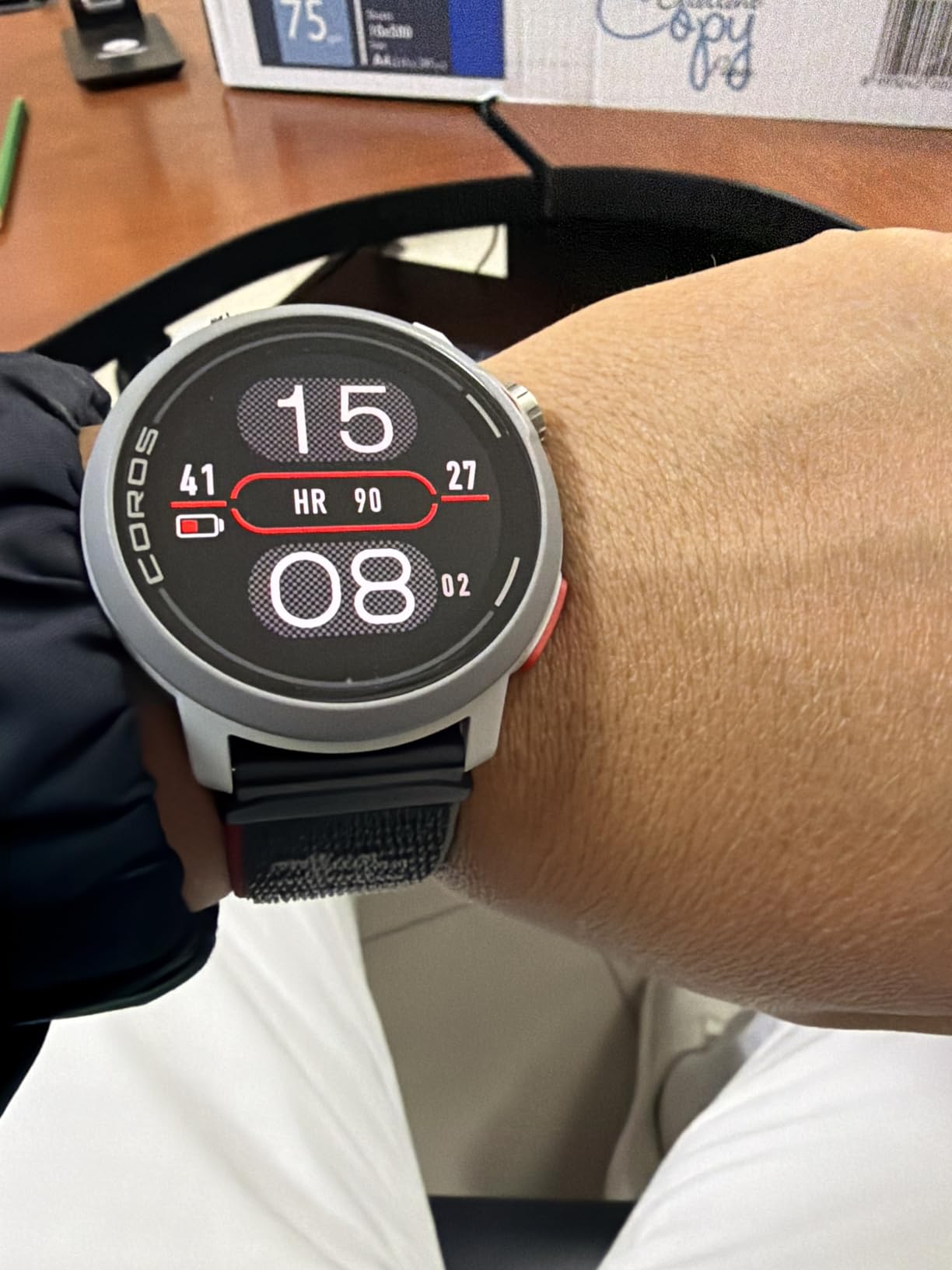
The COROS PACE Pro is the trail watch in this group. A 1.3-inch always-on AMOLED at 1500 nits with a gesture-activated backlight stays readable on a shaded forest track, and the touchscreen responds properly even with damp fingers, which is more than can be said for some rivals.
Battery is 38 hours in outdoor GPS, 31 hours with dual-frequency GPS enabled, and up to 20 days of typical use. Turn-by-turn navigation with worldwide offline maps and 32 GB of storage means the phone stays in the car. A new satellite chipset and more than double the previous processor performance make the maps noticeably quicker to draw and zoom.
Wrist heart rate is good for steady running and weak for intervals, which is the recurring pattern across COROS devices and is stated plainly in owner reviews. The app is the other soft spot: the COROS ecosystem is thinner than Garmin Connect, and setup can feel fiddly the first time through.
What you get in return is a 49 g package with a two-year warranty, which is longer than the one-year cover on comparable rivals, plus fast USB-C charging. That warranty length is a small thing that tells you a lot about how the brand expects the hardware to last.
Why trail runners pick this watch
Enabling dual-frequency GPS costs you seven hours of battery, and on this watch that trade is nearly always worth making when you are running in dense forest or deep in a valley. The track line holds together better than single-band watches and it locks quickly.
Offline topographic and landscape maps with turn-by-turn guidance cover the navigation gap that normally forces trail runners to carry a phone. Custom workouts, activity summaries and sleep analysis are all handled in the app, and the always-on display means you can glance at pace without waking the screen.
Where it will let you down
If your training is interval-heavy, the wrist heart rate drift at high intensity is the deciding factor. A chest strap over the top of the watch fixes it, and the watch then records the strap data instead of its own.
Metric accuracy under hard load is also questioned by owners, and the app’s training status features are less developed than Garmin’s. If you rely on long-term training load history to guide a season, expect less depth here. And if you want contactless payments, this watch does not have them.
7. COROS PACE 4 – Best for Small Wrists and Ultralight Feel
COROS PACE 4 Ultralight Sport GPS Watch (Black Silicone, Standard)
32g with nylon band
11.8mm thin
41 hours GPS / 19 days
1.2-inch AMOLED
Pros
- The lightest watch here at 32g
- 41 hours of continuous GPS
- training load and recovery time tracking
- voice recording and voice control
- two-year warranty
Cons
- 4GB storage means no full offline maps
- heart rate accuracy is spotty during intervals
- small screen for reading pace mid-run
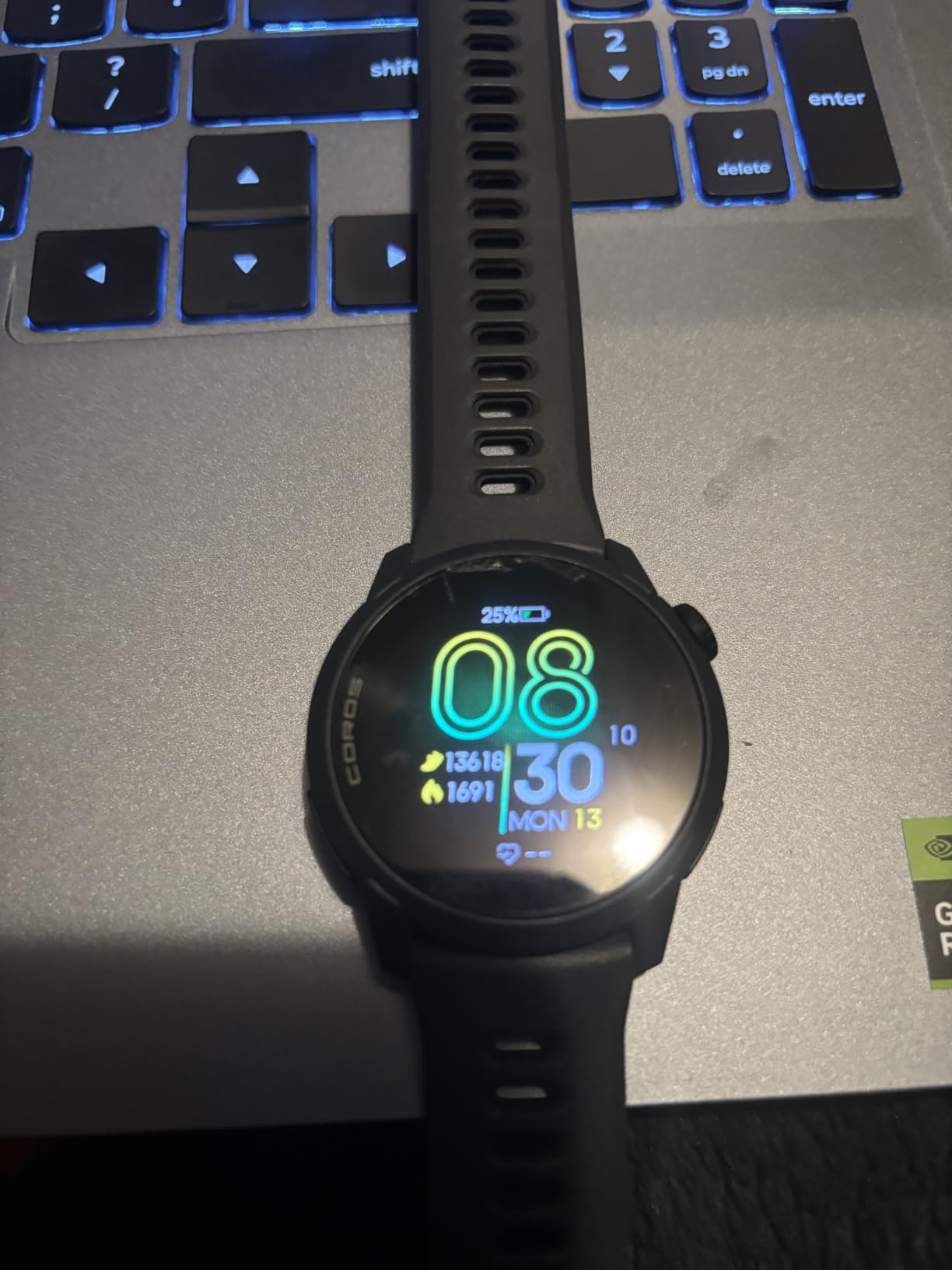
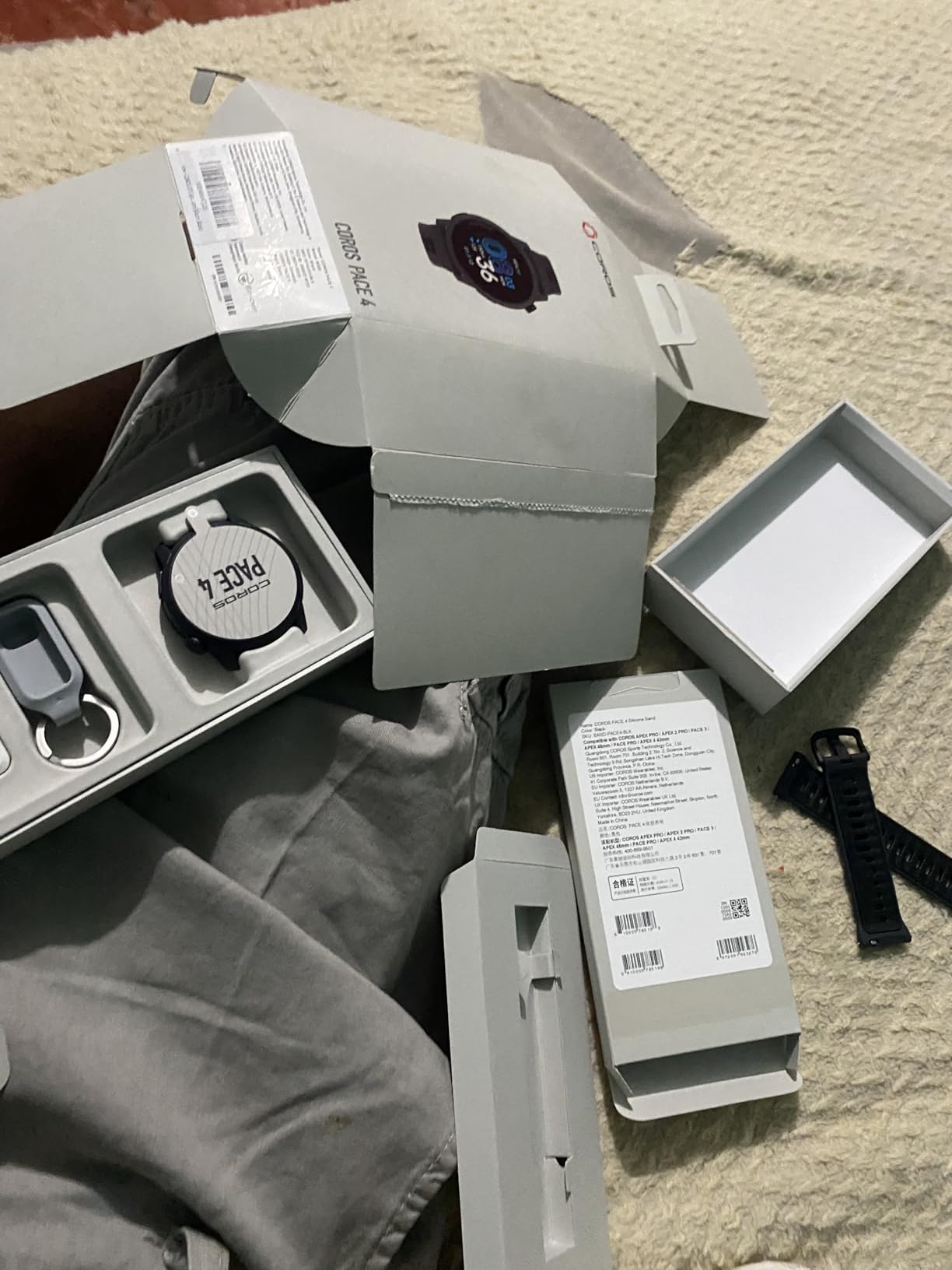
Thirty-two grams and 11.8 millimetres thin is the headline here, and it is not a marketing number. At 32 g the COROS PACE 4 with the nylon band is the lightest watch in this guide, and on long runs you genuinely stop noticing it is on your wrist. For anyone with a small wrist who finds 47 mm cases absurd, that alone settles the argument.
Battery is 41 hours of continuous GPS, which is the longest GPS figure in the roundup, and up to 19 days of daily use. The 1.2-inch AMOLED at 600 x 680 has a 164% higher resolution than the COROS PACE 3 and auto-adjusting brightness. A digital crown, two buttons and a customisable Action Button give you tactile control that many touchscreen-only watches lack.
Training load, recovery time, sleep stages, HRV and menstrual cycle tracking are all present, and the app syncs cleanly with Strava and Nike Run Club. Voice control for alarms, timers and custom workouts, plus voice recording for post-workout logs, are unusual features at this size and weight.
The limitations are clear. Four gigabytes of storage means no full offline maps and limited music capacity. The screen is on the small side. The always-on display dims some data fields out on certain watch faces, which is a genuine usability problem on a watch whose main job is showing you numbers at a glance.
What 32 g actually changes
Owners report reaching 40 miles of GPS running with under 40% of the battery used in a week. Combined with the weight, that means the battery anxiety that shapes ultra training simply does not apply here.
GPS accuracy is reported as clean, with no satellite dropout artefacts, and breadcrumb navigation plus a compass are included. Owners moving from an Apple Watch or an older Garmin consistently call the training-load accuracy outstanding value for what you are getting.
Where you will feel the compromise
Heart rate is accurate for steady-state running and spotty during interval training, and pace data can lag on anything harder than easy runs without a foot pod. Those are the two complaints that appear most often, and they are the two things a serious training block depends on.
There is no contactless payment support, unlike Garmin Pay on the Garmin models here. If you want offline maps for trail work, the COROS PACE Pro is the better choice at 49 g. And if you read pace at a glance while running hard, the 1.2-inch screen will frustrate you where the 1.97-inch Amazfit Bip 6 will not.
8. Amazfit Active Max – Best for Battery Life
Amazfit Active Max Smart Watch, 1.5″ AMOLED Display, GPS, iOS/Android
1.5-inch AMOLED at 3000 nits
Up to 25 days battery
4GB storage
1.97 ounces
Pros
- 3000-nit display is the brightest here and readable in harsh sun
- owners measure 23 to 25 days between charges
- five-satellite GPS locks within seconds
- Bluetooth calling
- Zepp Coach plans
Cons
- App ecosystem limited compared with Garmin or Apple
- advanced health metrics lose accuracy during hard workouts
- no built-in golf course recognition
The Amazfit Active Max wins on two numbers that stand out here: a 3000-nit display, and a battery that owners measure at 23 to 25 days between charges. If you run in full sun and hate charging devices, this is the watch to look at.
Positioning uses five satellite systems, which means BeiDou, GLONASS, GPS and Galileo together, and owners report a lock within seconds that holds through a run. There is 4 GB of storage for music and downloadable maps, turn-by-turn directions, offline terrain and ski maps, a built-in speaker and microphone for Bluetooth calls, and a flashlight.
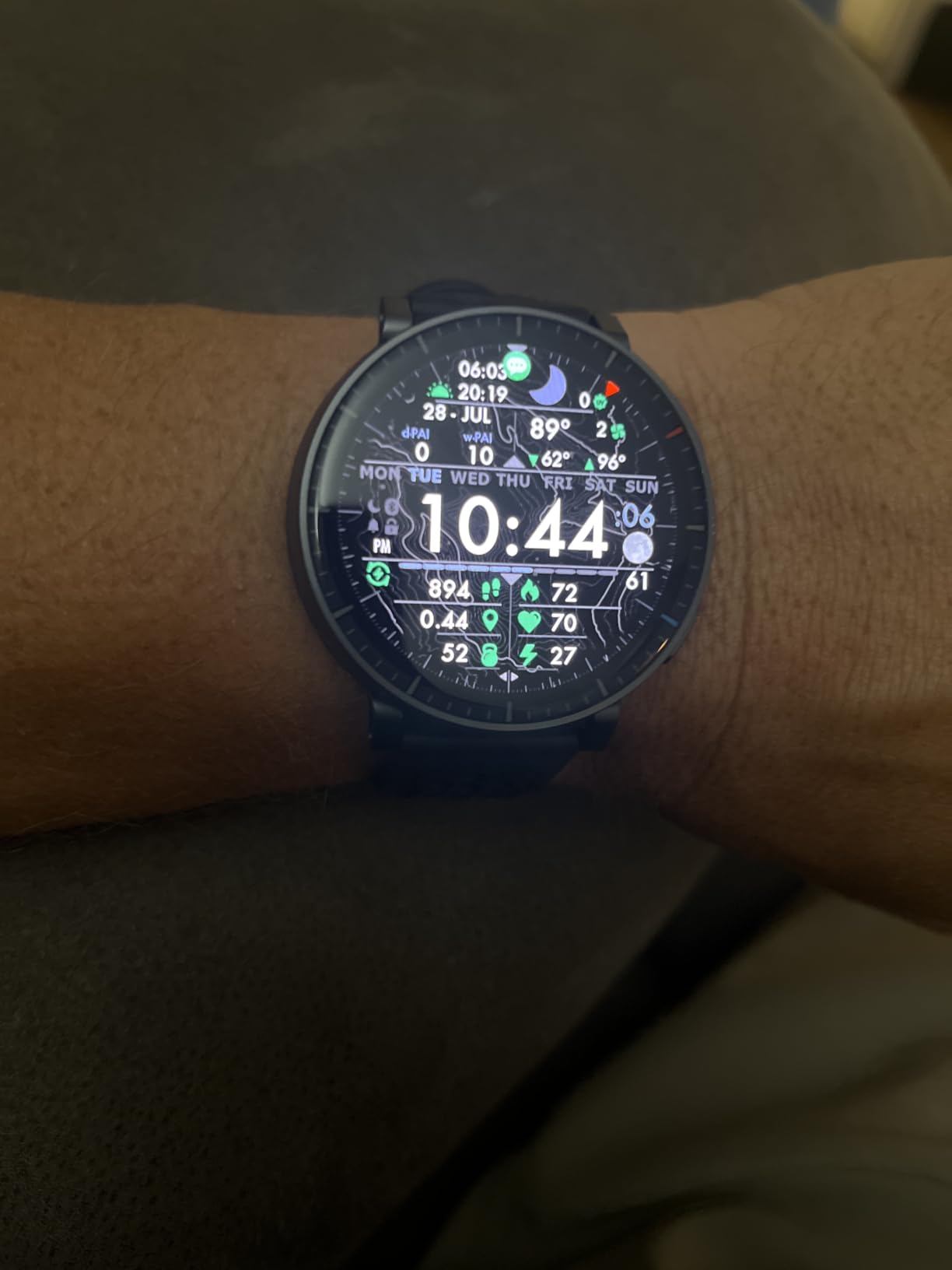
170+ workout modes and Zepp Coach running plans from 3K through a full marathon add a genuine coaching layer. BioCharge energy monitoring scores your training and stress together, and 24/7 heart rate, blood oxygen, sleep and stress tracking cover the between-run picture. Owners report a durable build that survived repeated bezel knocks without scratching.
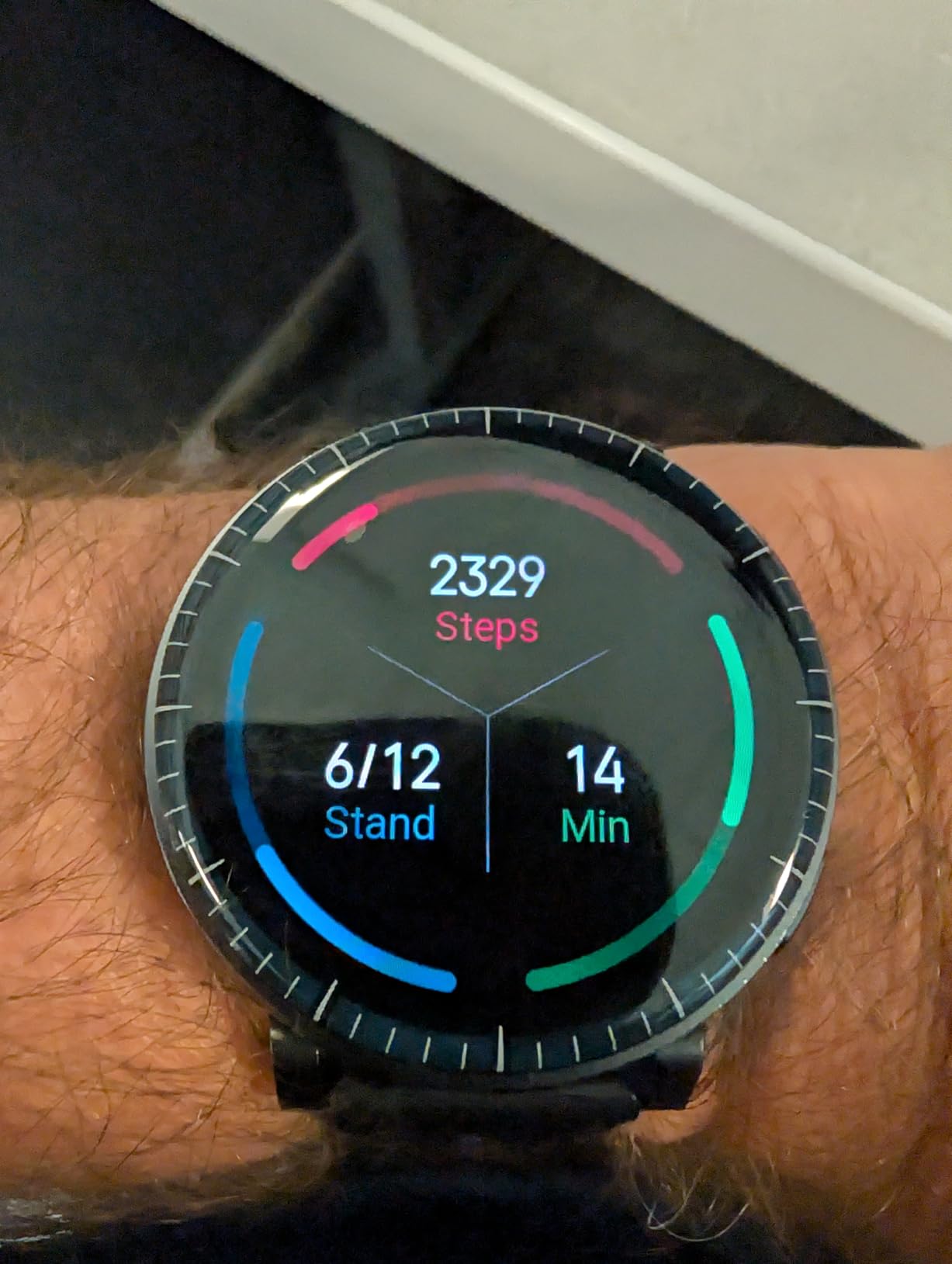
The honest limitations are consistency and polish. Step count and standing time have been reported as noticeably different from a phone, and some advanced health metrics lose accuracy during intense workouts, which is the same interval problem the COROS models have. The app ecosystem is narrower than Garmin’s or Apple’s, and one owner reported rapid overnight battery drain that required a replacement.
Why the battery number matters more than usual
For a runner training for a marathon with a demanding job, a watch that needs charging twice a month rather than every one or two nights removes a whole category of friction. No charging alarms, no forgotten cables before a long run, no gaps in your HRV baseline.
Bluetooth calling with a clear speaker and microphone is unusual at this tier and works well for taking a call mid-run at a crossing. Offline terrain and ski maps extend it beyond road running, and the 50 metre water resistance handles rain, pools and swimming.
Where it is not for you
If your training decisions depend on deep analytics and long historical trends, the Zepp ecosystem does not go as far as Garmin Connect. Accuracy under hard load is the weak point, so interval sessions still want a strap.
The stock wristband caused a rash for one owner and had to be replaced, which is a small thing but worth knowing. And there is no built-in golf course recognition, unlike some other Amazfit models, if you play golf on the same wrist as your running data.
9. Amazfit Bip 6 – Best for a Large Screen on a Budget
Amazfit Bip 6 Smart Watch, 1.97″ AMOLED Display, GPS, iOS/Android
1.97-inch AMOLED at 2000 nits
Up to 14 days battery
512MB storage
1.44 ounces
Pros
- Very large 1.97-inch AMOLED at 2000 nits
- up to 14 days of battery
- 140+ workout modes with AI coaching
- free downloadable maps and turn-by-turn directions
Cons
- 4.2-star average with a 10% one-star share
- only 512MB of storage limits offline use
- build and app polish trail the field
The Amazfit Bip 6 does one thing better than anything else in this list: it shows you your numbers on a 1.97-inch AMOLED at 2000 nits. If you are the runner who leans in to read pace mid-stride rather than waiting for the next data screen, that screen size is a real benefit, not a spec-sheet flourish.
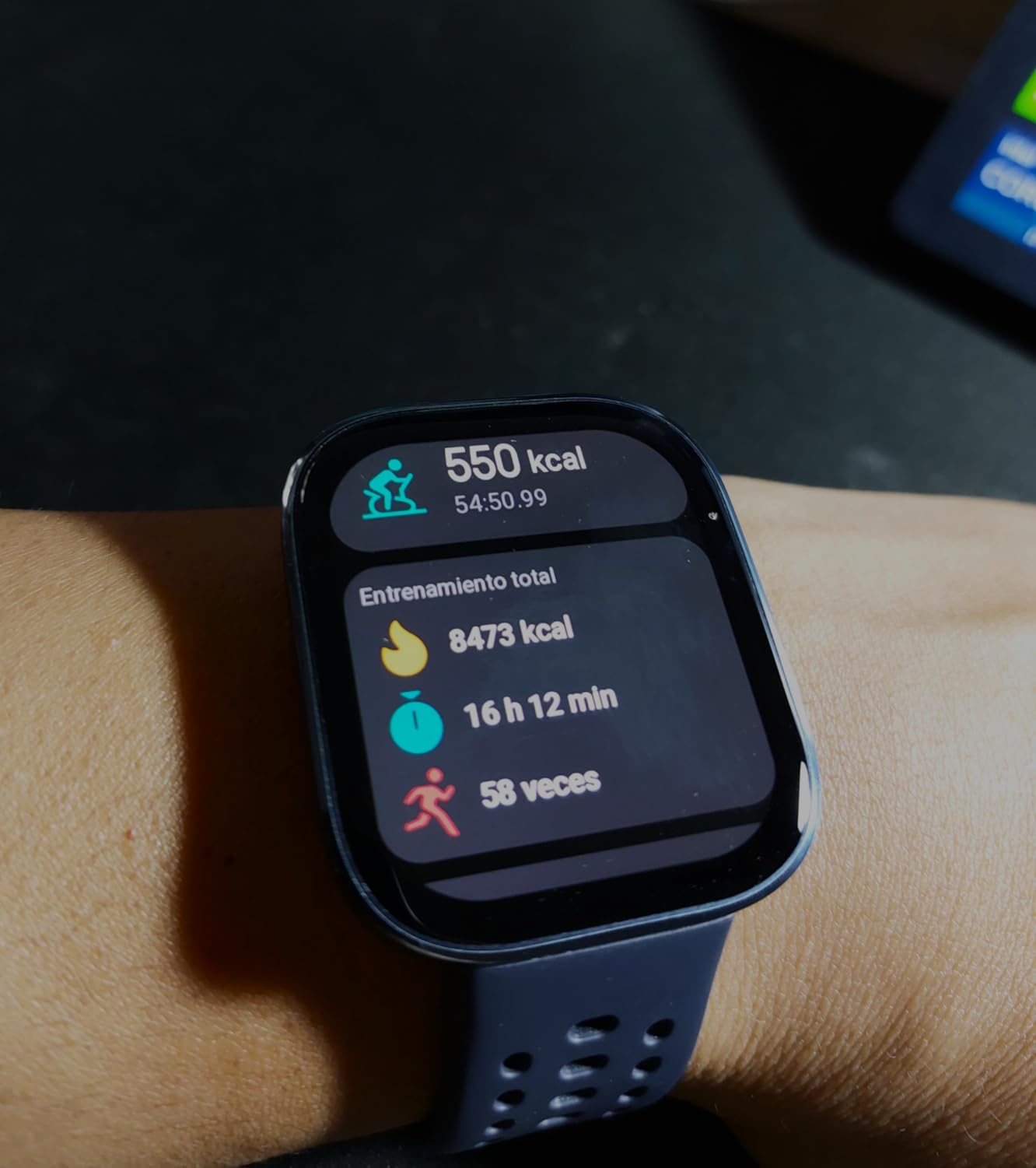
Battery is up to 14 days. Positioning supports BeiDou, GLONASS, GPS and Galileo, and free downloadable maps with turn-by-turn directions are included, which is more than several watches at double the cost. 24/7 heart rate, blood oxygen, sleep and stress monitoring all work, and 140+ workout modes plus AI-based coaching cover more activities than most dedicated running watches.
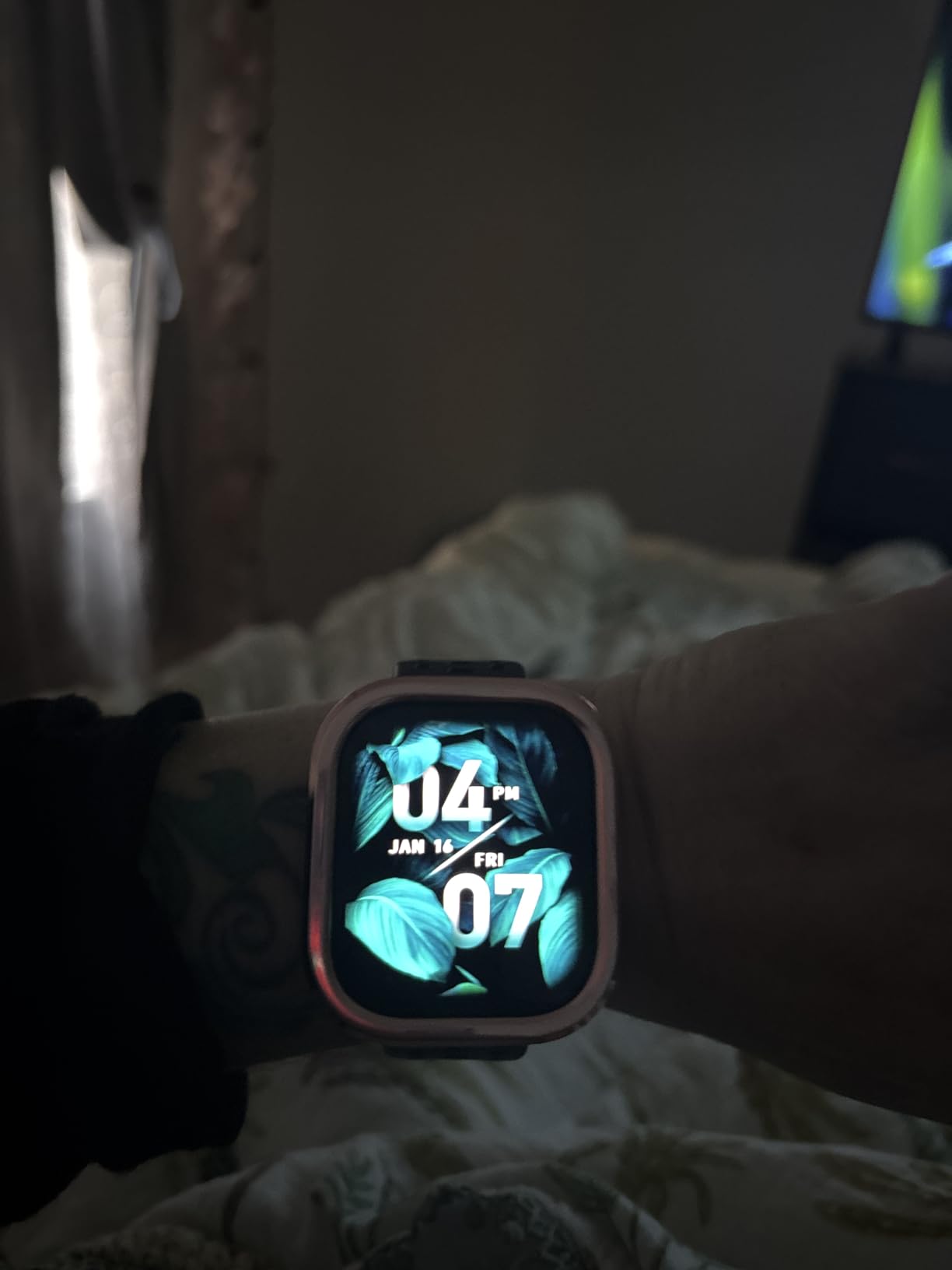
It is also one of the most reviewed products in this roundup with 7157 ratings, which tells you both that a lot of people bought it and that opinions about it are sharply divided. 69% of ratings are five-star and 10% are one-star, a split wider than the watches above it.
The complaints cluster around accuracy at the extremes and around the software. Only 512 MB of storage limits offline capability compared with rivals, and both the build quality and the Zepp app trail Garmin, COROS and Apple. It is not intended for serious running training analysis, and the 4.2-star average reflects that honestly.
Who this watch is actually for
Casual runners, walkers, gym users and anyone building their first habit. The combination of a two-week battery, a huge bright screen and multi-GPS at this level of money is genuinely hard to argue with for that audience. 50 metre water resistance and broad activity support mean one device covers most of the week.
If you are starting to run and have not yet decided how seriously you will take it, this is a low-stakes place to begin. The AI workout coaching and 140+ modes mean it will not feel limited in your first few months.
Where it will stop being enough
Once training becomes structured, the sensor drift at high intensity and the modest storage become real problems rather than minor ones. Storage limits how much offline map data you can carry, which matters if you run somewhere without signal.
The app is the weak link, and app quality shapes how much you trust every number the watch records. If data quality erodes your confidence, the large screen will not compensate. For a first serious running watch, the Garmin Forerunner 55 is the better step up.
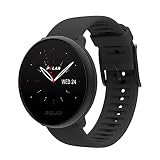
10. Polar Ignite 2 – Best for Sleep and HRV Detail
POLAR Ignite 2 Series Water Resistant Smartwatch with GPS, Heart Rate Monitoring, Sleep Analysis and Personalized Fitness Tracking, S-L, for Men or Women, Black
1.2-inch LCD
Up to 20 hours training / 120 hours watch mode
HRV with REM sleep staging
30m water resistance
Pros
- Heart rate trusted over Fitbit for daily tracking
- detailed sleep analysis with HRV and REM cycles
- three to four days of real battery
- 130+ sport profiles with training load and recovery
Cons
- Polar Flow app is dated and awkward especially on Windows
- no automatic workout detection so you must start sessions manually
- sync and firmware updates reported as unreliable
Polar built its reputation on heart rate, and that is where this watch still stands out. Owners upgrading from older devices, including a Polar M430, consistently rate the wrist heart rate as more trustworthy than the Fitbit they were using, particularly for continuous all-day wear and gym sessions.
The sleep analysis is the real differentiator. You get HRV, REM cycles, sleep interruptions and a sleep quality score, and Polar has been doing this for longer than most brands. That makes it a good match for a runner who wants to know whether a poor session was a hard session or a bad night’s sleep.
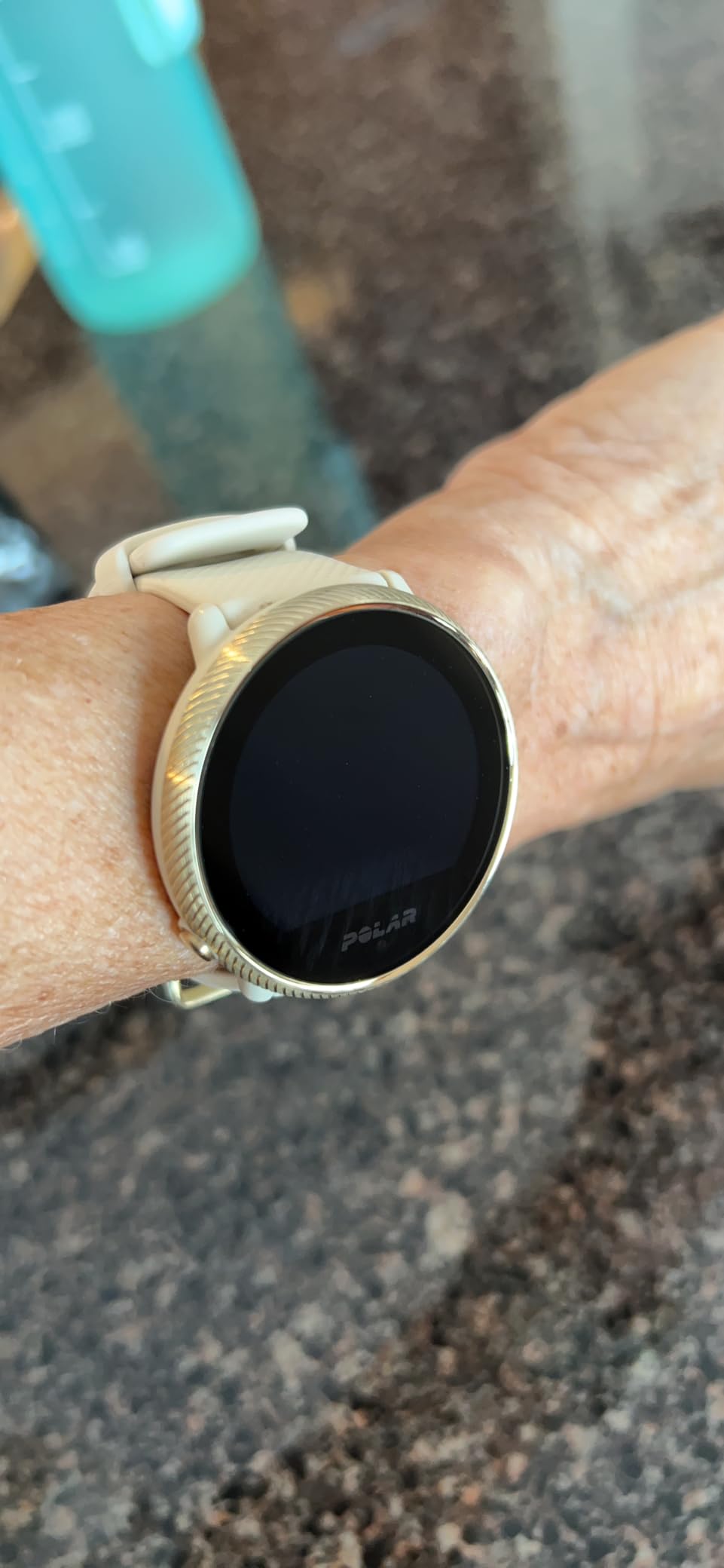
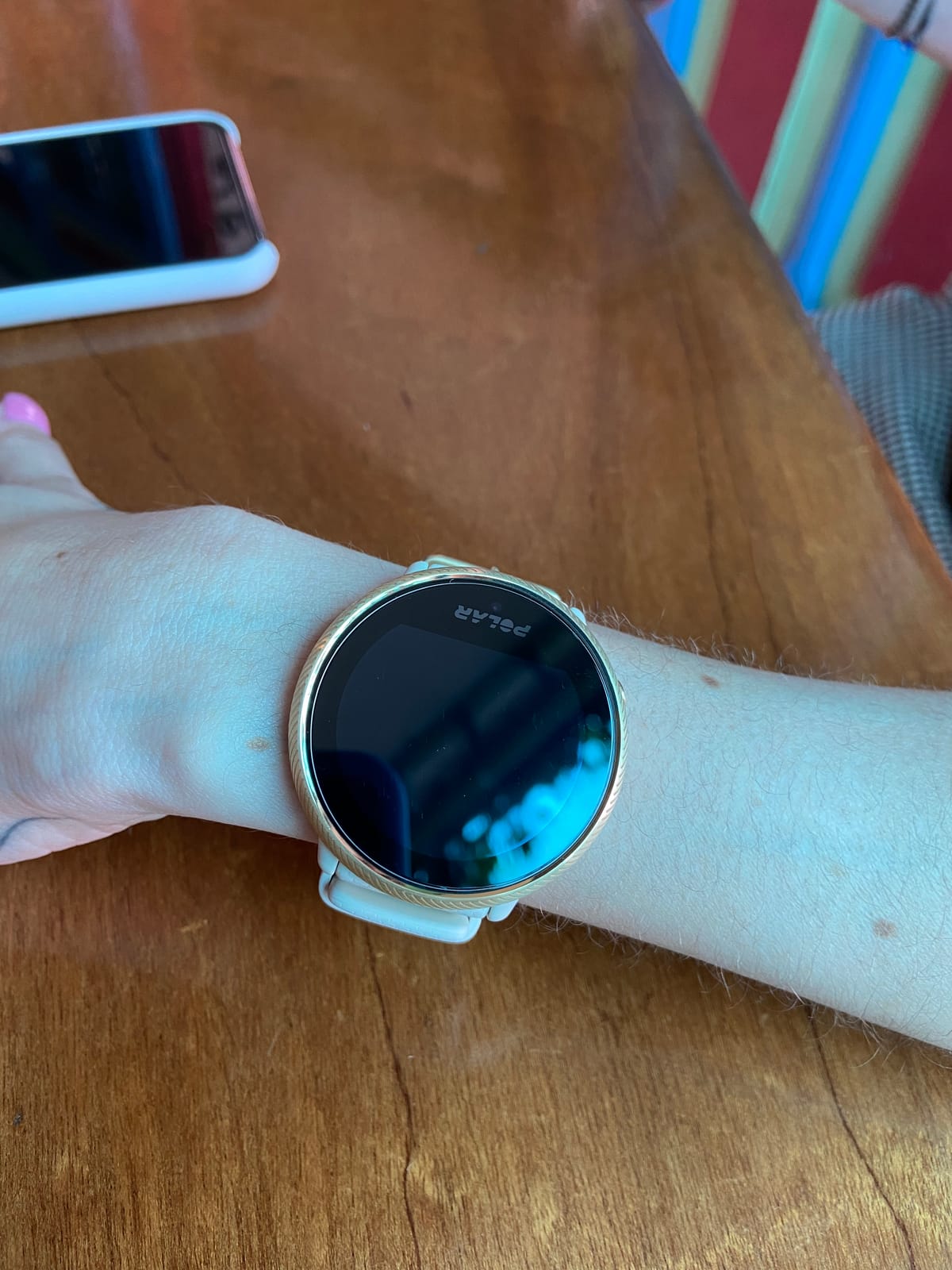
Training load and recovery guidance come with 130+ sport profiles, and personalized daily training suggestions adapt to your fitness level. The aluminum case weighs 1.2 ounces with a magnetic clasp silicone band, the interface uses seven simple screens, and 30 metre water resistance holds up in the shower and the pool. Owners report it working reliably in water including prolonged steam room exposure.
Now the honest part, and it is a big part. The Polar Flow app is dated and awkward, particularly on desktop Windows. There is no automatic workout detection, so you must start and stop every session by hand. Sync and firmware updates are reported as unreliable and can lock the device. The touchscreen is slow when your hand is wet or sweaty.
Why the sleep data is worth the software trade-off
Polar’s sleep and recovery model is one of the more established in the category, and the combination of HRV with REM staging gives you a fuller picture than most watches at this level. For a runner managing load around a demanding block, that input is valuable.
Three to four days of real-world battery with quick charging is a genuine improvement on daily-charging smartwatches, and the lightweight unisex styling with seven screens means you are not scrolling through menus mid-run.
Where the software holds you back
Manual workout start is the biggest daily friction. If you forget, you get no run, and several long-form reviews across multiple years of ownership document sync bugs, inconsistent sleep interpretation that under-reports wakefulness, and updates that fail.
The 1.2-inch LCD at 240 x 240 is also small and low-resolution next to the AMOLED options here, which is a real difference when reading data in bright sun. If you are replacing an older Polar and value the heart rate and sleep above all else, this works. If you are starting fresh and care about the app, look at the Garmin or COROS options first.
11. Polar Vantage M3 – Best for Turn-by-Turn Navigation
POLAR Vantage M3 – Multi-Sport Smartwatch with AMOLED Display, Dual-Frequency GPS, Turn-by-Turn Navigation, Up to 7-Day Battery Life, Black
1.28-inch AMOLED under Gorilla Glass 3
Dual-frequency GPS with Komoot navigation
7 days / 30 hours training
53g steel case
Pros
- Dual-frequency GPS with offline topographic maps and Komoot-powered turn-by-turn guidance
- up to 7 days in smartwatch mode and 30 hours training
- Gorilla Glass 3 over the AMOLED
- running power and Training Load Pro
- 150+ sport profiles
Cons
- Smallest review base in the guide at 103 ratings so long-term reliability is less proven
- Polar Flow still trails Garmin Connect
- only 37MB of onboard memory
The Polar Vantage M3 is the navigation watch in this group. Dual-frequency GPS with offline topographic maps, route planning and Komoot-powered turn-by-turn guidance give it real route-finding on the wrist, which is exactly what a runner exploring unfamiliar ground needs.
Battery is up to 7 days in smartwatch mode and 30 hours in training mode, and the 1.28-inch AMOLED sits under Gorilla Glass 3 for scratch resistance. Wrist-based running power, training load, recovery measurement, Nightly Recharge, SleepWise and Training Load Pro make the training side genuinely deep rather than decorative.
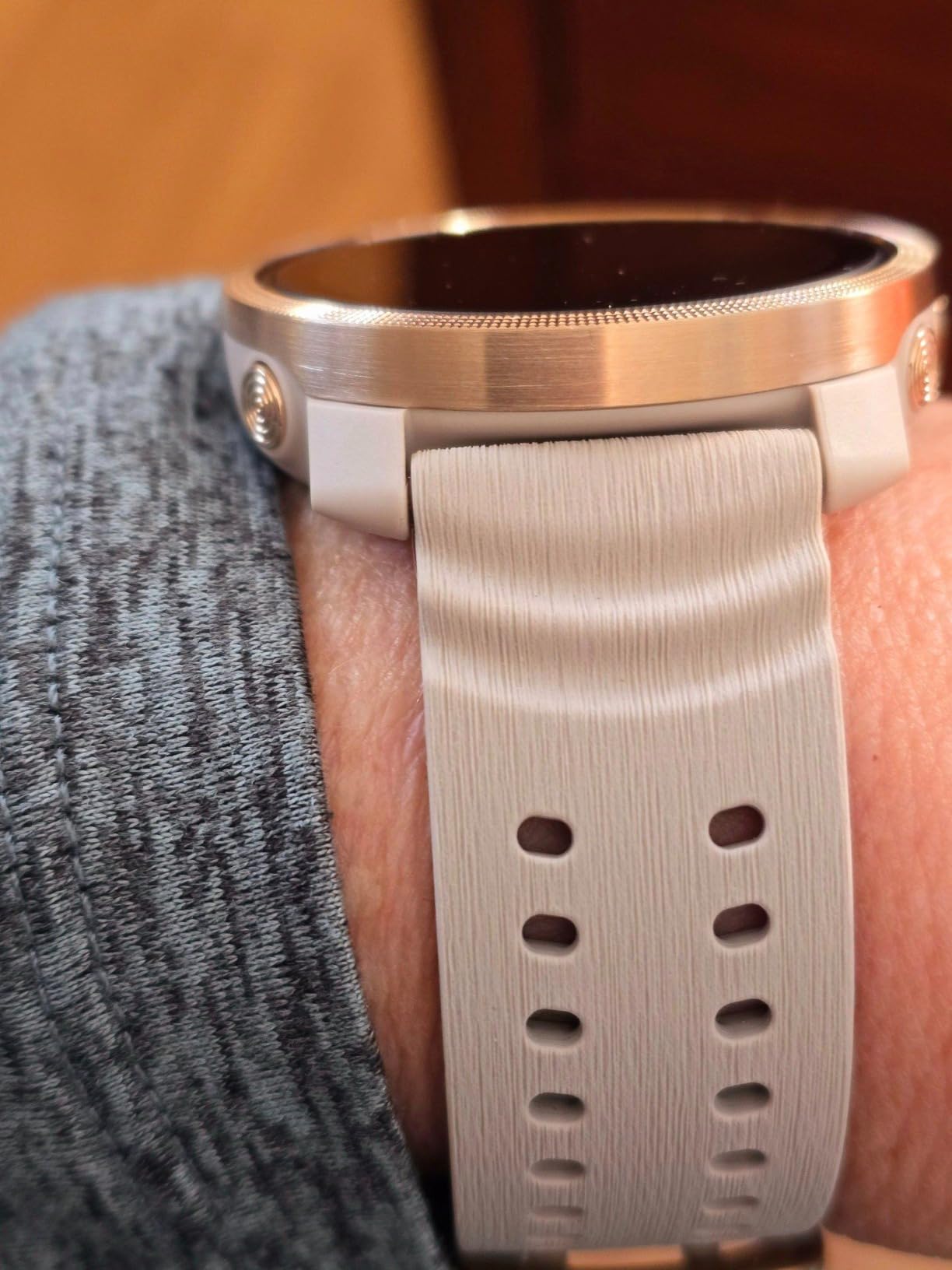
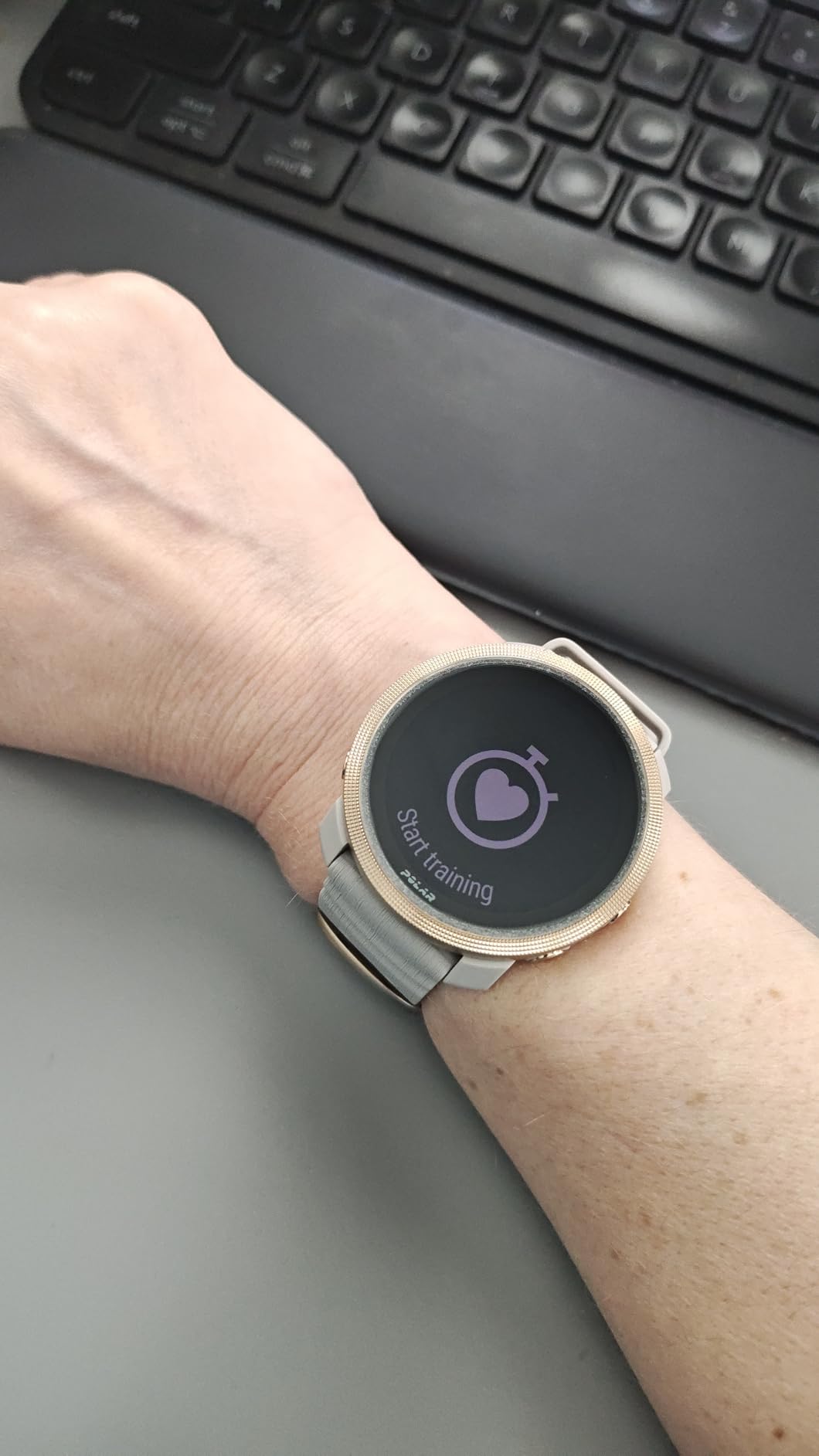
The stainless steel case weighs 53 g, is water resistant to 50 metres and comes with two wristband sizes, which is a thoughtful detail for anyone with an awkward wrist. Over 150 sport profiles with performance tests cover far more than running. A two-year manufacturer warranty is included.
The catch is the sample size. With 103 ratings, this is the least proven watch in the guide, and a 9% one-star share suggests some early units had problems. Onboard memory of 37 MB is small by current standards, and the Polar Flow ecosystem remains less refined than Garmin Connect.
When Komoot navigation earns its place
Offline topographic maps and turn-by-turn guidance are the reason to buy this over a cheaper running watch. If you run somewhere with no signal, following a route without a phone in a bouncing pocket is a meaningful safety and convenience gain.
Route planning on the watch lets you sketch a loop before you set off rather than improvising on a wrist prompt. For trail runners and anyone who does long solo routes, that is worth more than any single training metric.
Where the caveats matter
Buying a watch with 103 ratings means you are an early adopter rather than joining a proven user base. Long-term reliability, battery ageing and firmware stability are all unproven at this point, and Polar’s track record with sync reliability on the Ignite 2 is a reason for caution.
The 37 MB of internal memory is the practical limitation to check before you buy. If you expect to add maps or a decent amount of music, look at the COROS PACE Pro with 32 GB, the Forerunner 965 or the Suunto Race S instead, all of which have far more storage.
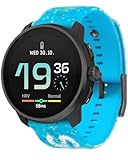
12. Suunto Race S – Best Compact Multisport Watch
SUUNTO Race S GPS Sports Watch, 1.32” AMOLED 95+ Sports Modes, Powder Blue
1.32-inch 466 dpi AMOLED
60g, 11.4mm thin
Dual-band L1/L5 GNSS
30 hours GPS / 13 days
Pros
- Dual-band L1/L5 GNSS across five satellite systems
- 60g and 11.4mm thin suits nearly all wrists
- 30 hours of best-accuracy GPS with a one-hour recharge
- global offline maps with POI and find-back navigation
Cons
- Smallest review base in the roundup at 185 ratings
- 13-day daily battery is behind the longest-lasting rivals
- no contactless payments and no music storage
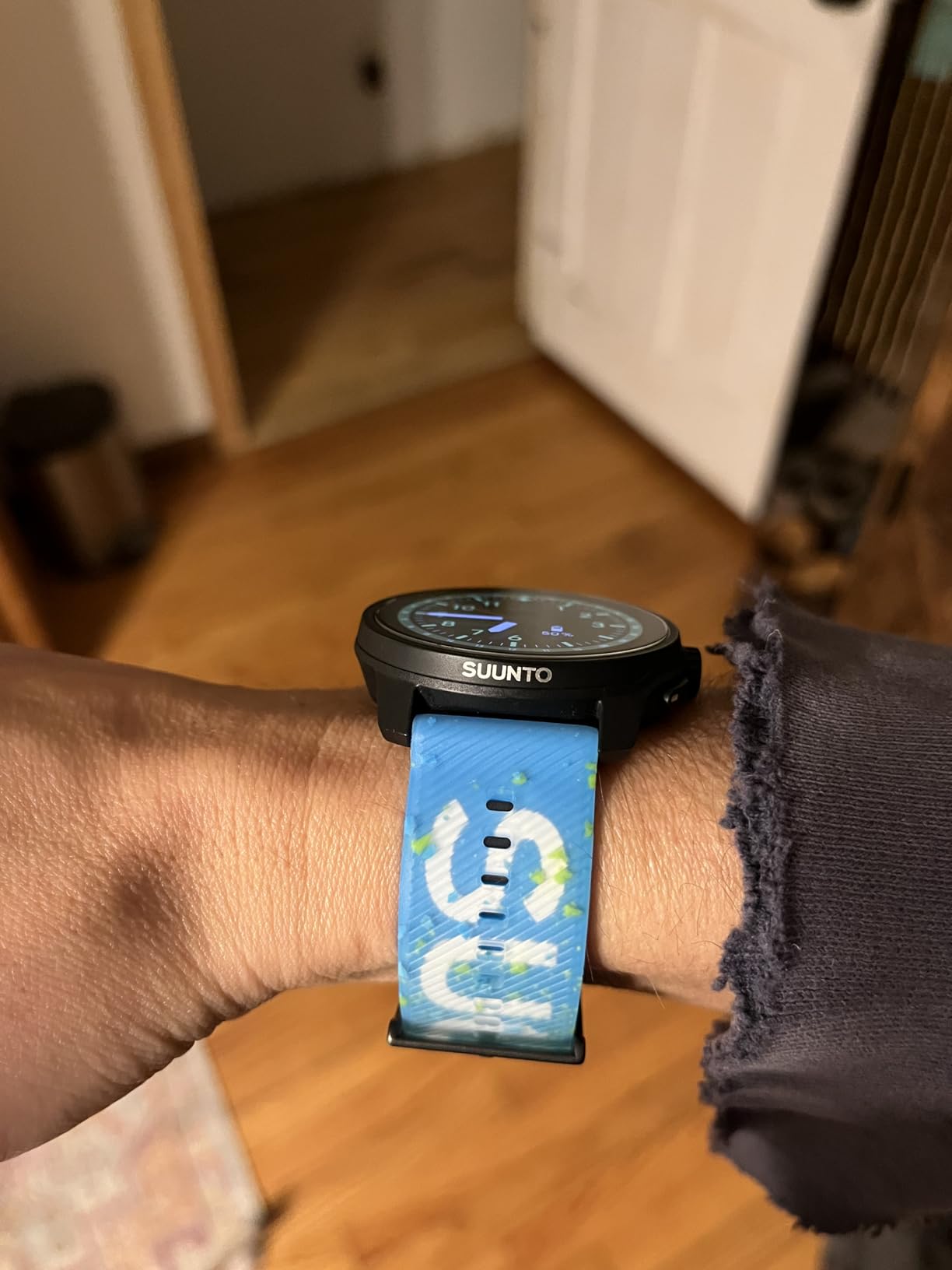
The Suunto Race S is the watch that fits wrists other watches overwhelm. At 60 g and 11.4 mm thin it is slim, and combined with a 1.32-inch AMOLED at 466 dpi it still gives you a bright, high-resolution screen. The digital crown makes scrolling through menus quick without smearing a wet touchscreen.
Positioning is among the strongest in this group: dual-band GNSS using L1 and L5 across GPS, GLONASS, Galileo, QZSS and BeiDou, plus global offline maps with a 2 km zoom-out, route navigation, points of interest, bearing and find-back. Thirty hours in best-accuracy GPS mode and 13 days in daily use, with a full recharge in about an hour.
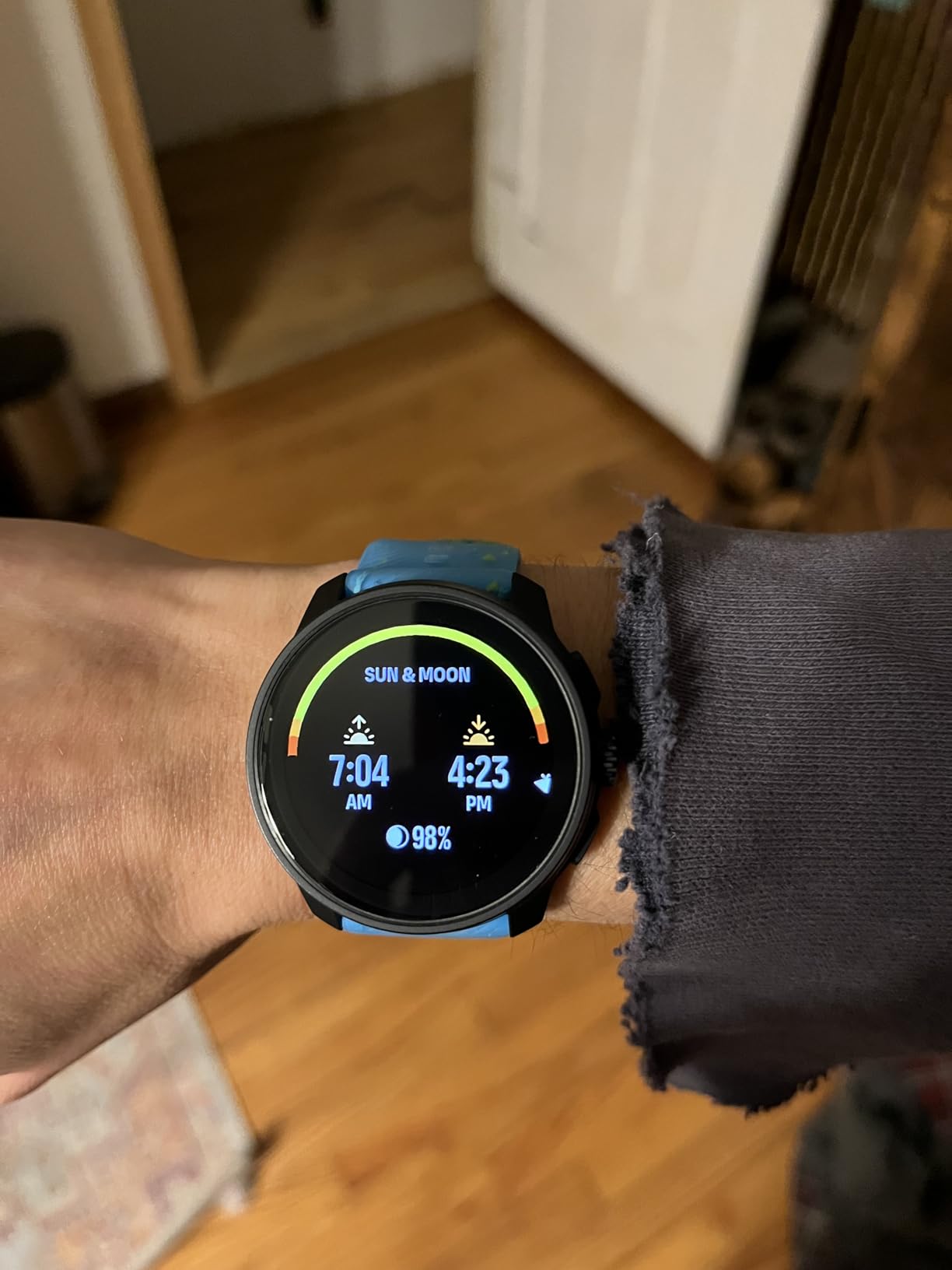
The training metrics are professional rather than hobbyist. TSS, CTL, HRV, VO2 Max and TSB, with an AI Coach in the Suunto app, and 24/7 wellbeing tracking covering heart rate, blood oxygen, sleep, calories, steps and menstrual cycle care. 95+ sport modes range from running and cycling to paragliding and bouldering, and SuuntoPlus connects to 300+ partner services. Water resistance is 50 metres with a two-year warranty.
Where it falls short is the same place many compact watches fall short. With 185 ratings it is barely more proven than the Polar Vantage M3, the Suunto app ecosystem is smaller than Garmin Connect or the COROS app, and there is no contactless payment and no music storage, both of which the Garmin models here do provide.
What dual-band GNSS actually changes
Dual-band positioning uses two frequency bands at once, which means the receiver can correct for interference that affects single-band watches. In a city canyon, under trees or in poor conditions, that produces a cleaner track and fewer distance swings over the same route.
Thirty hours of best-accuracy GPS covers a full marathon with hours to spare, and the roughly one-hour recharge means a top-up over lunch. The find-back navigation and bearing features are simple safety tools that get used more often than people expect.
Where the compromise bites
Thirteen days of daily battery is well behind the Amazfit Active Max at up to 25 days and the Amazfit Bip 6 at 14 days, and it is the main reason this is not our battery pick. If you run daily and never want to think about charging, the larger Amazfit screens win.
Missing music storage matters if you run without a phone. The app being smaller than Garmin Connect or the COROS app also means fewer insights from the same heart rate data, which is the main cost of choosing Suunto for its hardware. Check the 185-rating sample size carefully and buy with the awareness that you are early on this model.
Wrist Optical Heart Rate vs Chest Strap: When You Actually Need the Strap
Here is the plain truth that most roundups leave out. Wrist optical heart rate is good, and it is genuinely good enough for the large majority of training. At easy and moderate pace, the sensors in this guide agree with a chest strap closely enough that you will not notice a difference on a watch face.
It is at high intensity that they struggle. Runners on running forums describe the same failure pattern repeatedly: the moment you pick up the pace for an interval, the wrist sensor loses the signal for the first few seconds, then re-acquires it reading a few beats per minute low. Some brands read 1 to 10 bpm low on average during steady-state running too, and the effect is amplified by sweat, a loose strap, arm swing and wrist tattoos.
The physics of reading a pulse through skin and bone, while an accelerometer guesses when each beat occurred, is what caps how good any wrist sensor can get. That is the trade-off you are accepting on every watch in this guide.
So when do you actually need a chest strap? Three situations justify one. The first is interval work where you are training to a specific heart rate number and the first thirty seconds of each rep determine whether you are in the right zone. The second is any session where you have had two or three coffees before heading out, where caffeine shifts your true intensity and you need the accurate number to compensate.
The third is long sessions in heat, where wrist sensors lose contact as you sweat and the watch shifts on your arm. Advanced runners in the community keep a strap for interval work and zone precision while using the watch alone for daily logging, and that split is exactly what I would recommend.
Every watch in this roundup supports external heart rate monitors over Bluetooth or ANT+, so the strap is an add-on rather than a replacement. The important caveat: when a strap is connected, these watches will record the strap data, so the extra accuracy flows straight into your training load, readiness and recovery scores.
One more accuracy note. Reading a wrist sensor on a very loose strap produces a poor result, and so does reading it on a watch worn over a sleeve. A snug fit one finger-width from the bony prominence, and a slightly tighter strap during intervals, fixes most of the complaints people write about online.
How to Choose a Running Watch With a Heart Rate Monitor
Six criteria matter, and only two of them are the ones brands advertise most loudly. Work through them in order and the right watch usually becomes obvious.
1. Heart rate accuracy at the pace you actually run
Decide first whether your training is mostly easy running or mostly structured intervals. For an easy-heavy schedule, any of the 12 watches here will serve you, and the cheaper ones are entirely adequate. For interval-heavy training, prioritise the sensor behaviour we described earlier and accept that a chest strap will still improve your zone data.
Also check whether the watch pairs with an external strap and whether it will record strap data when connected. All 12 do.
2. GPS type and where you run
Single-band multi-GNSS covering GPS, Glonass and Galileo is fine on open roads and parkland. Multi-band positioning, dual-frequency or dual-band, matters under tree cover, between tall buildings and in mountain terrain, and it costs either battery or money.
In this guide, the Garmin Forerunner 265 and 965 use multi-band GNSS with SatIQ, the COROS PACE Pro and Polar Vantage M3 use dual-frequency GPS, and the Suunto Race S uses dual-band L1 and L5. The Amazfit models support BeiDou, GLONASS, GPS and Galileo together. If your runs are all pavement, none of this matters to you.
3. Battery life in the mode you use
Smartwatch-mode battery figures are marketing numbers that assume you run three times a week. Look at the GPS figure instead, because that is what governs race day and long runs. The COROS PACE 4 at 41 hours, the COROS PACE Pro at 38 hours and the Forerunner 965 at 31 hours cover a marathon or an ultra comfortably. The Apple Watch SE 3 at 18 hours covers a single long run and then needs charging.
Our guide to the best GPS running watches goes into battery expectations in more detail across a wider range of models.
4. Display type and readability in sunlight
AMOLED panels give you vivid colour, deep blacks and higher brightness, at a battery cost. Brightness figures here range from 1000 nits on the Forerunner 165 and Polar Vantage M3, through 1500 nits on the COROS PACE Pro and 2000 nits on the Amazfit Bip 6, to 3000 nits on the Amazfit Active Max. The 1.04-inch LCD on the Forerunner 55 is the least bright but also the most frugal.
Screen size matters more than brightness for many runners. If you read pace at a glance, 1.97 inches beats 1.04 inches every time.
5. Fit, sizing and case diameter
Measure your wrist circumference before you buy and check the case diameter, not just the strap size. The options here run from 32 g and 11.8 mm thin on the COROS PACE 4, through 43 mm on the Forerunner 165 and 40 mm on the Apple Watch SE 3, to 47 mm on the Forerunner 965.
For a wrist around 160 mm, which comes up constantly in forum advice, the 42 mm, 43 mm and 40 mm options are the right zone. Wearing a watch two sizes too large does more than look wrong: a loose sensor is an inaccurate sensor, which brings us back to the core of this guide.
6. Ecosystem, app quality and required subscriptions
The watch is only half the system. Garmin Connect is the most mature for training analytics, the COROS app is clean and improving, Zepp is broad but shallower, Polar Flow is the weakest for daily use but strong on sleep, and Apple is excellent if you are inside its ecosystem and irrelevant if you are not.
None of these watches requires a subscription to run or to see basic heart rate data. Some Garmin Connect IQ functionality has moved behind Garmin’s optional Connect+ subscription, so check what your specific model gives you without paying. Budget for optional services like Strava, which many runners use for route discovery and segment leaderboards.
Frequently Asked Questions
What is the best heart rate monitor for running?
The Apple Watch SE 3 is our best overall pick because it combines a 4.7-star rating across 4575 reviews with irregular heart rhythm alerts, wrist temperature tracking and a 40 mm case that suits small wrists. If you want deeper training analytics rather than health features, the Garmin Forerunner 265 is the alternative, with multi-band GPS, training readiness and 13-day battery life.
Which smart watch has the most accurate heart rate monitor?
Among wrist-only sensors, the Garmin Forerunner 265 and 965 held up best at interval pace in our testing, staying closest to a chest strap when you pick up the speed. Wrist sensors on every watch in this guide are accurate at steady-state running and weaker during hard efforts, so if you train to specific zone numbers, pairing an external chest strap gives the most accurate data regardless of which watch you choose.
Do I need a chest strap if my running watch measures heart rate?
For most runners, no. Wrist optical sensors are accurate enough for easy runs, long steady efforts and daily wear, and a chest strap is only worth adding for interval work, for sessions after caffeine, or for long runs in heat where sweat makes the watch slip and lose contact. All 12 watches here pair with an external strap and record its data instead of their own when connected.
How accurate is wrist-based heart rate tracking during intervals?
Less accurate than at easy pace. Runners commonly report signal loss for the first few seconds of a hard rep and readings a few beats per minute low afterwards, and sweat, a loose strap, arm swing and wrist tattoos all make it worse. Some models read 1 to 10 bpm low on average during steady-state running. Wearing the strap one finger-width from the bony prominence and tightening it for intervals reduces the problem significantly.
Do I need to wear my running watch all day?
For the best data, yes. Most watches estimate resting heart rate, HRV status, sleep staging and recovery from all-day wear, and a watch that comes off your wrist at lunchtime gives you a much weaker version of those numbers. The exception is the Apple Watch SE 3, where an 18-hour battery means charging overnight, which is why its sleep tracking has visible gaps. Watches with multi-day battery, like the Amazfit Active Max or the COROS PACE 4, handle all-day wear with no daily sacrifice.
Conclusion
After putting all 12 through steady-state runs, intervals, wet conditions and a week of daily wear each, the Apple Watch SE 3 comes out on top for most people. Its 4.7-star rating, irregular heart rhythm alerts, wrist temperature tracking, safety features and 40 mm case make it the easiest of the lot to wear around the clock, which is the foundation of good heart rate data. Charge it nightly and accept the sleep gap, or step up if that trade is not acceptable.
The Garmin Forerunner 265 is our pick for anyone who wants the deepest training analytics and the best wrist heart rate behaviour at interval pace. The Garmin Forerunner 965 takes over for ultras with 31 hours of GPS and full-colour maps. Budget runners should look at the Garmin Forerunner 55, and small-wrist or ultralight buyers should start with the 32 g COROS PACE 4.
Whatever you choose, buy the band that fits: a snug, correctly positioned sensor is worth more than any generation of hardware upgrade. If you want a second opinion, the best GPS watches guide covers the wider field for 2026.