

The best window fan for a bedroom is the Bionaire BW2300-N. It pairs a published 47 dB noise figure with reversible intake, exhaust and exchange airflow, a programmable thermostat and a remote, so you can change settings from bed without getting up. The Genesis A1WINDOWFAN moves the most air, the COMFORT ZONE CZ310R gives the most airflow per watt, and the Vornado TRANSOM is the quietest of the ten at 45 dB.
A window fan is a box-style fan that mounts in a window sash to pull hot, stale air out of a bedroom while cooler outside air enters through a second opening. It moves air; it does not cool it, and it cannot remove humidity. That distinction matters more than any specification on the box.
What separates a bedroom fan from a kitchen fan is the noise floor. A fan that is fine in a busy living room can keep a light sleeper awake all night. On running cost, the gap is not close: the Genesis draws 30 watts and the Vornado 25, while a window air conditioner in the same room typically draws more than a thousand. That is why a window fan makes sense overnight even in a hot climate, provided the outdoor air is cooler than the indoor air when you run it.
Table of Contents
Top 3 Picks for the Best Window Fans for Bedrooms in 2026

Bionaire BW2300-N
- 47 dB noise figure
- Reversible intake exhaust exchange
- Programmable thermostat and remote
- 3 year limited warranty

Comfort Zone CZ310R
- 3 airflow modes
- 431 CFM at 57.5 watts
- Auto-locking expanders to 37 inches
- Bug screen and remote included
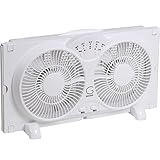
Genesis A1WINDOWFAN
- 706 CFM airflow
- Only 30 watts
- Max Cool thermostat
- Reversible twin 9 inch heads
Best Window Fans for Bedrooms at a Glance in 2026
| Product | Specifications | Action |
|---|---|---|
| Bionaire BW2300-N Reversible Fan |
|
Check Latest Price |
| Comfort Zone CZ310R 9 Inch Twin |
|
Check Latest Price |
 Holmes Dual 8 Inch Twin Holmes Dual 8 Inch Twin |
|
Check Latest Price |
| Genesis A1WINDOWFAN Twin |
|
Check Latest Price |
 Vornado TRANSOM Vornado TRANSOM |
|
Check Latest Price |
 shinic BP2-9A 9 Inch shinic BP2-9A 9 Inch |
|
Check Latest Price |
 Amazon Basics WDF9-1D Amazon Basics WDF9-1D |
|
Check Latest Price |
 shinic BP6-9D Twin shinic BP6-9D Twin |
|
Check Latest Price |
 BEYOND BREEZE BBWF9-01 BEYOND BREEZE BBWF9-01 |
|
Check Latest Price |
 BLACK+DECKER BFW9M BLACK+DECKER BFW9M |
|
Check Latest Price |
How We Picked
We scored every fan on the same six points: a published noise figure, a published airflow figure, wattage, the window width it actually fits, how easily it reverses airflow, and the controls available at night. Warranty length broke ties on build quality.
Decibel figures below are manufacturer ratings. Where we describe how a fan sounds in a room, that comes from patterns across thousands of buyer reviews rather than a sound meter in our lab. Fit ranges reflect stated panel expansion, not chassis width, because the expanders decide whether your window works.
1. Bionaire BW2300-N — Best Window Fan for Bedrooms Overall
Bionaire Window Fan with Reversible Airflow Blades – 3-Speed Settings, Programmable Thermostat, LED Display, Remote Control, Fits 24–36″ Windows, No Assembly Required
47 dB
120 watts
3 speeds
Fits 24-36 inch windows
Pros
- Reversible intake exhaust and exchange airflow
- Programmable thermostat with remote control
- Shallow enough to fit with the window screen down
- 3 year limited warranty
Cons
- Bright LED display cannot be fully switched off
- On-board sensor reads airflow temperature not room temperature
- Short 6 ft power cord
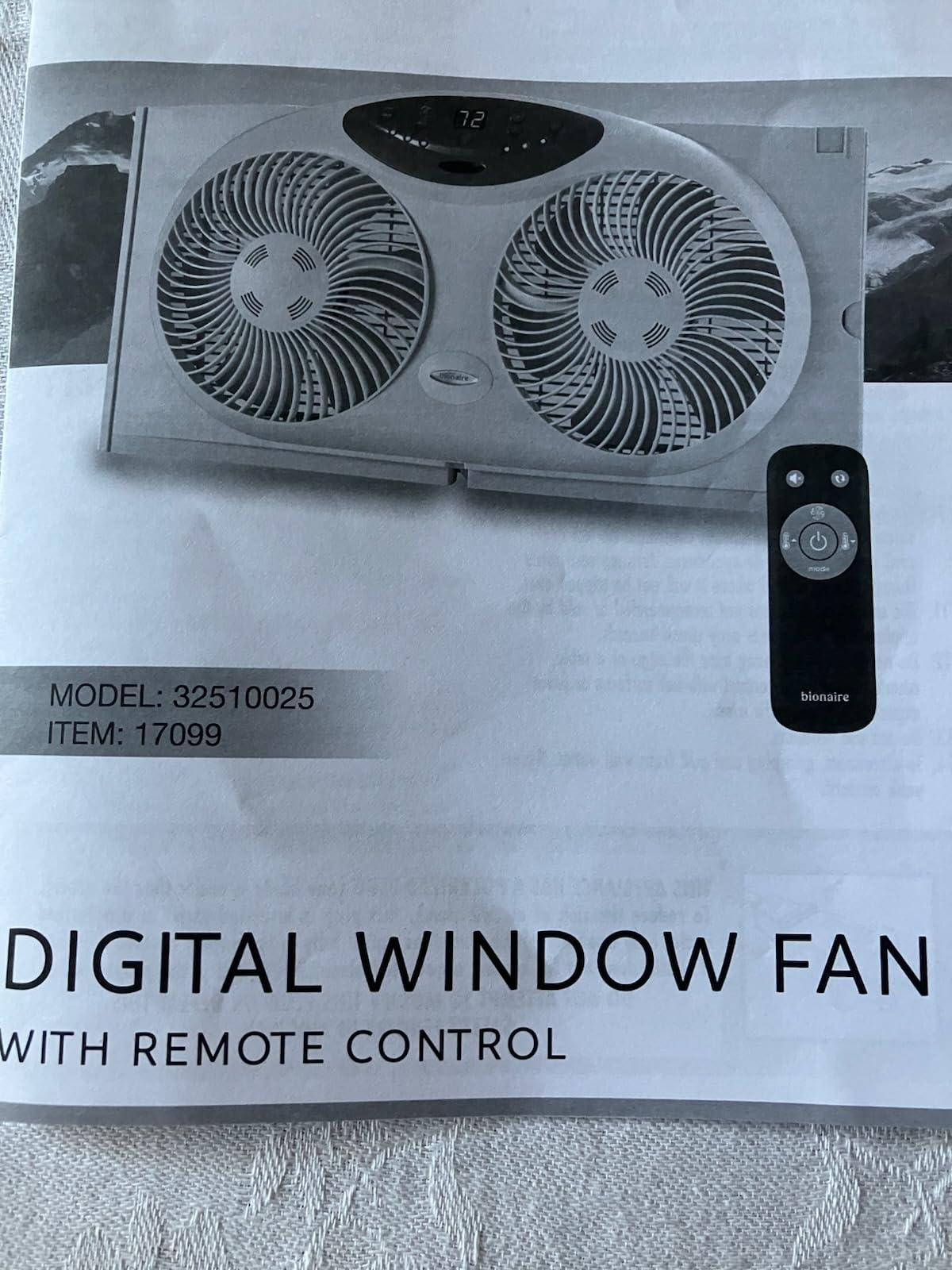
This is the fan we keep returning to for a bedroom. It is the only unit here that pairs a genuinely quiet published figure of 47 dB with a programmable thermostat, a remote and reversible airflow, across more than 21,000 reviews at 4.3.
Owners report a 75 degree room heading toward 68 degrees in about an hour on a mild evening, which is airflow working rather than a marketing claim. At 6.6 pounds it lifts into a sash with one hand, and the extender plus bonus panel covers 24 to 36 inch windows.
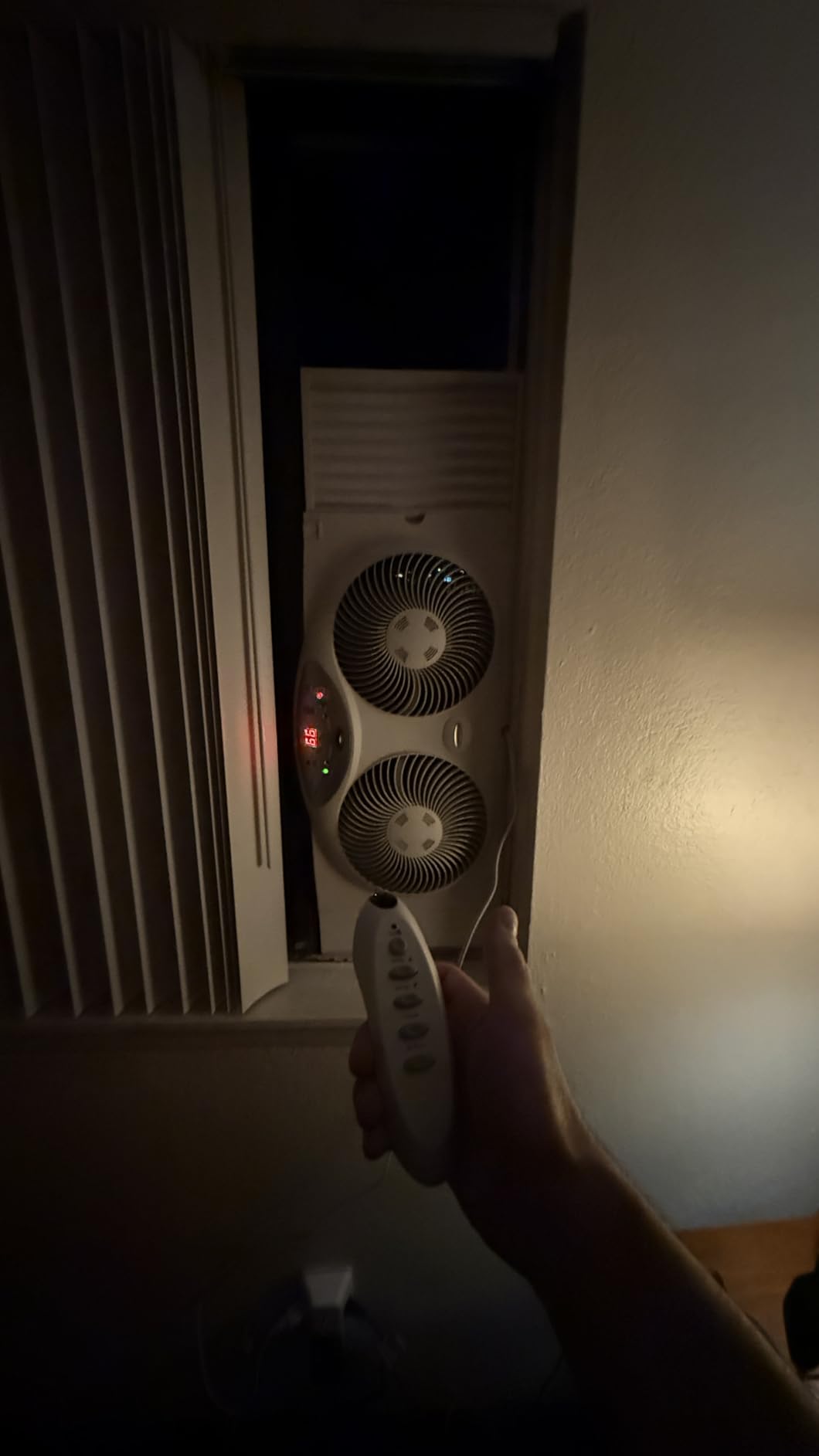
The one genuine bedroom complaint is light. The LED indicator and display are bright enough that several owners tape over them, and no setting kills them completely.
The sensor also sits in the fan’s own airstream and can read a few degrees off the room average, and the 6 foot cord is standard short length. Some owners on auto mode report random shutdowns.
Is the Bionaire quiet enough to sleep beside?
On low and medium it is described as quiet enough to run next to a bed, and the 47 dB figure supports that. Owners moving from louder twins say the drop in motor hum is the single biggest improvement to their sleep.
Who should pick a different fan?
If your window is wider than 36 inches, choose the COMFORT ZONE or a shinic, which reach 37. If a standby LED is a dealbreaker, the Vornado TRANSOM has no bright numeric display.
It installs horizontally only, so it cannot be rotated for a narrow vertical opening. For most bedrooms, though, this remains the pick.
2. COMFORT ZONE CZ310R — Best Value for a Bedroom
COMFORT ZONE Window Fan for Bedroom, 9 inch 3 Speed Dual Fans with Auto-Locking Expanders, 3 Modes (Cool, Circulate, Exhaust), Remote Control, Fabric Cover plus Bug Screen, White
52 dB
431 CFM
57.5 watts
3 modes
Fits 23.5-37 inches
Pros
- Three airflow modes covering intake circulation and exhaust
- Auto-locking expanders reach 23.5 to 37 inches
- Remote plus fabric cover and bug screen
- Lightweight body that stays cool after long runs
Cons
- Audible beep on every button press
- Motor hum and rattle that can worsen over time
- 1 year warranty and remote batteries not included
At 431 CFM from 57.5 watts, this is the strongest airflow-per-watt combination we found, and owners say it cools a room faster than several tower fans together. The three modes, cool, circulate and exhaust, are labelled plainly enough to leave running overnight without thinking.
It is the only fan here that ships with both a fabric cover and a bug screen, two genuinely useful bedroom extras. At 5.6 pounds the body stays cool after long daily runs, and 4.2 across roughly 14,900 reviews speaks to how settled the design is.
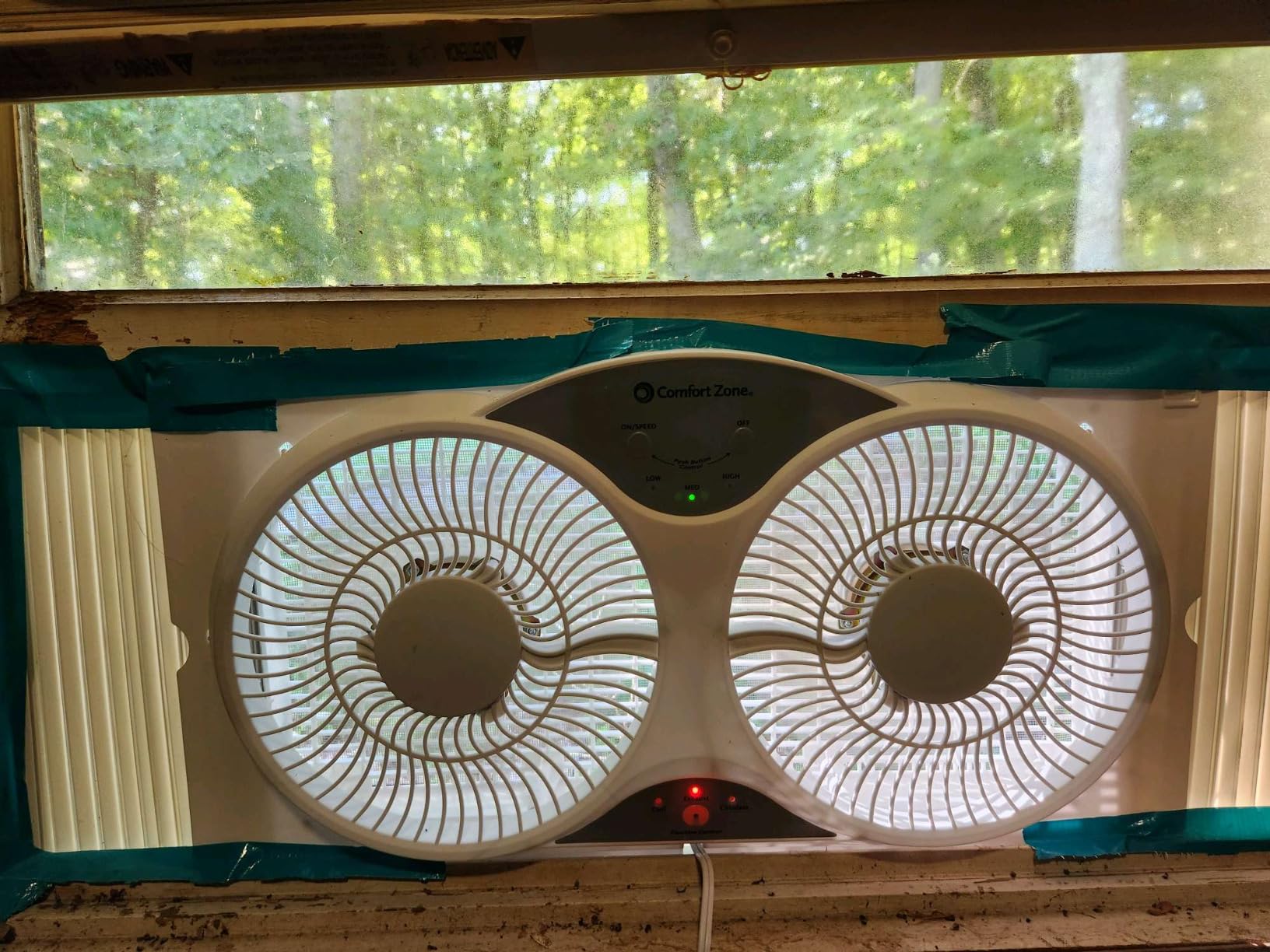
Where it falls short is sound. The 52 dB figure is the highest among the twins here, and reviewers mention a beep on every button press plus motor hum and a rattle that some units develop into a wobble over time.
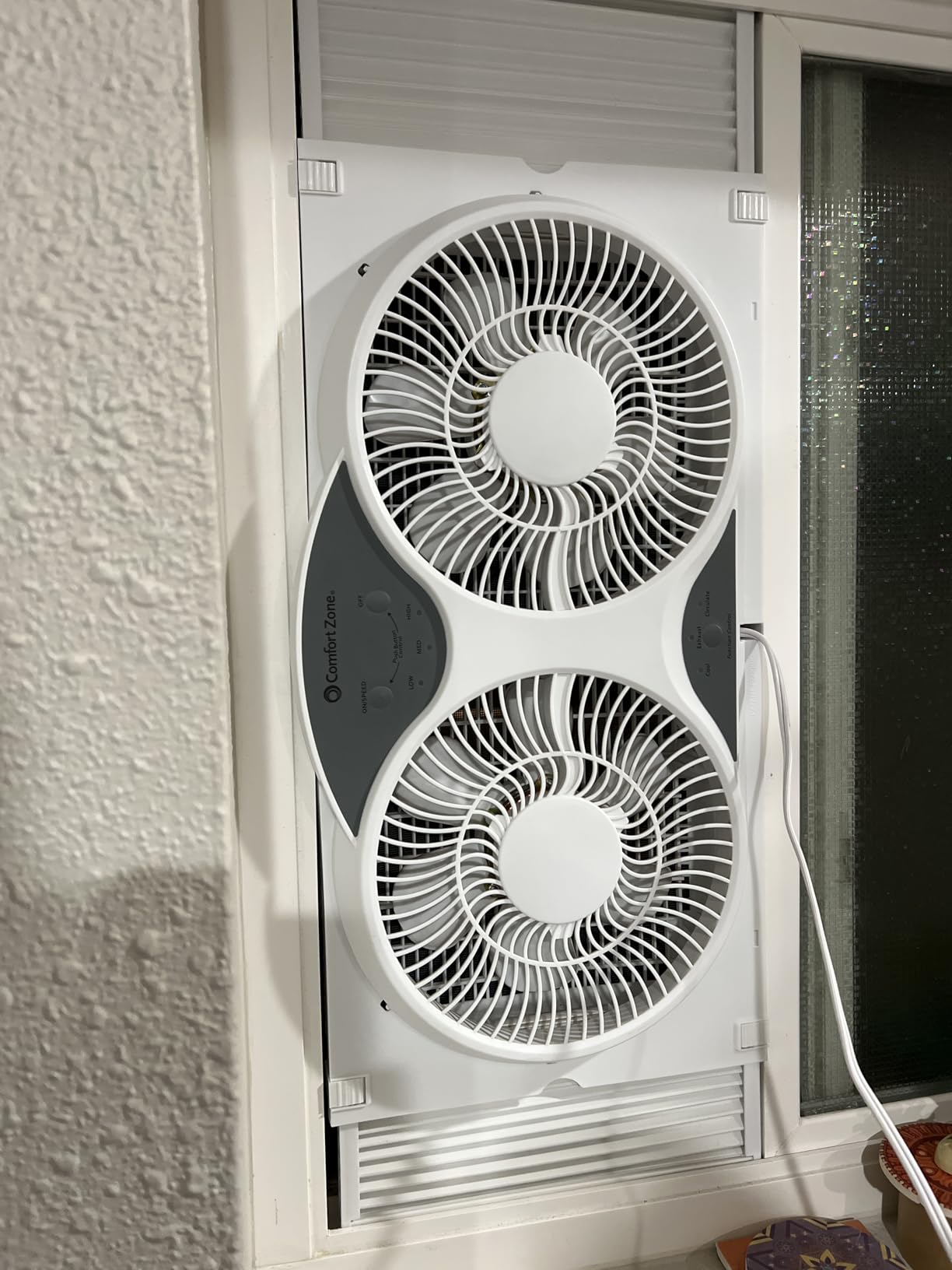
The expanders span 23.5 to 37 inches, the widest range here, but a minority report the locks not holding in vertical windows without tape. The remote also ships without batteries.
Will the CZ310R fit a wide or vertical window?
It fits more window shapes than anything else on this list, and owners run it horizontally or in a vertical slider after taping the locks. Measure the opening at its widest and narrowest points before any purchase.
Who should pick a different fan?
If you are a light sleeper, the 52 dB figure and the beeps point to the Vornado TRANSOM or shinic BP2-9A. This one has modes and a remote but no temperature control.
The one-year warranty is the shortest here, so weigh it against the three and five-year terms on the Bionaire and Vornado.
3. HOLMES HAWF2043-N — Best for Compact Window Openings
Holmes Dual 8″ Blade Twin Window Fan with LED One Touch Thermostat Control
2 speeds
75 watts
Independent reversible motors
Extends to 37 inches
Pros
- Each fan reverses independently for true exchange
- Slim profile fits inside the window with the screen down
- Two-minute tool-free install
- Owners report 12-plus years of running
Cons
- Low speed carries an electronic buzz
- High speed is loud and only moderately powerful
- Panel locks and motor quality control are inconsistent
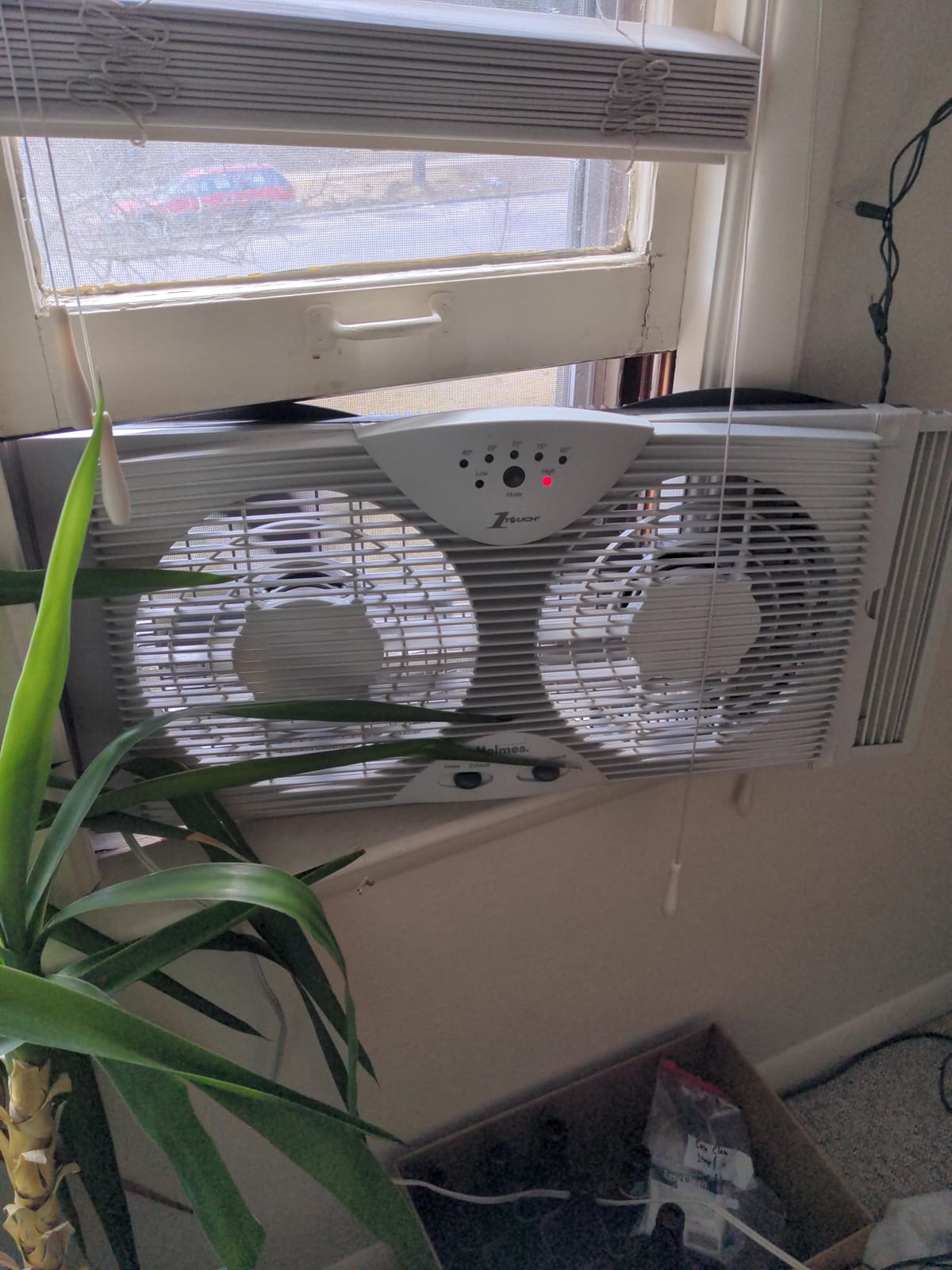
The slim housing is the reason to consider this one. At 13.3 inches wide it fits inside the window with the insect screen still down, which almost nothing else here manages, and that single feature decides it for awkward sashes.
Each motor reverses independently, so one can run as intake and one as exhaust with the door closed. Long-term owners report 12-plus years of continuous operation, and the 4.1 rating across nearly 13,000 reviews is backed by longevity rather than spec-sheet excitement.
The noise profile is unusual. On low there is an electronic buzz reviewers call barely usable for sleeping, and on high it is loud while still delivering only moderate airflow between those two settings.
Quality control is the other flag, with reports of side panel locks breaking over time and units arriving with dead or grinding motors. The single touch control can feel stiff unless pressed squarely.
Does it fit with the window screen in place?
Yes, and that is the headline advantage. The 6 inch deep body and narrow width let the sash stay lowered, so you keep your bug barrier and your security bar.
Who should pick a different fan?
Light sleepers should look elsewhere, because the buzzy low setting is exactly what wakes people up. There is also no remote, so changing speed means reaching the unit.
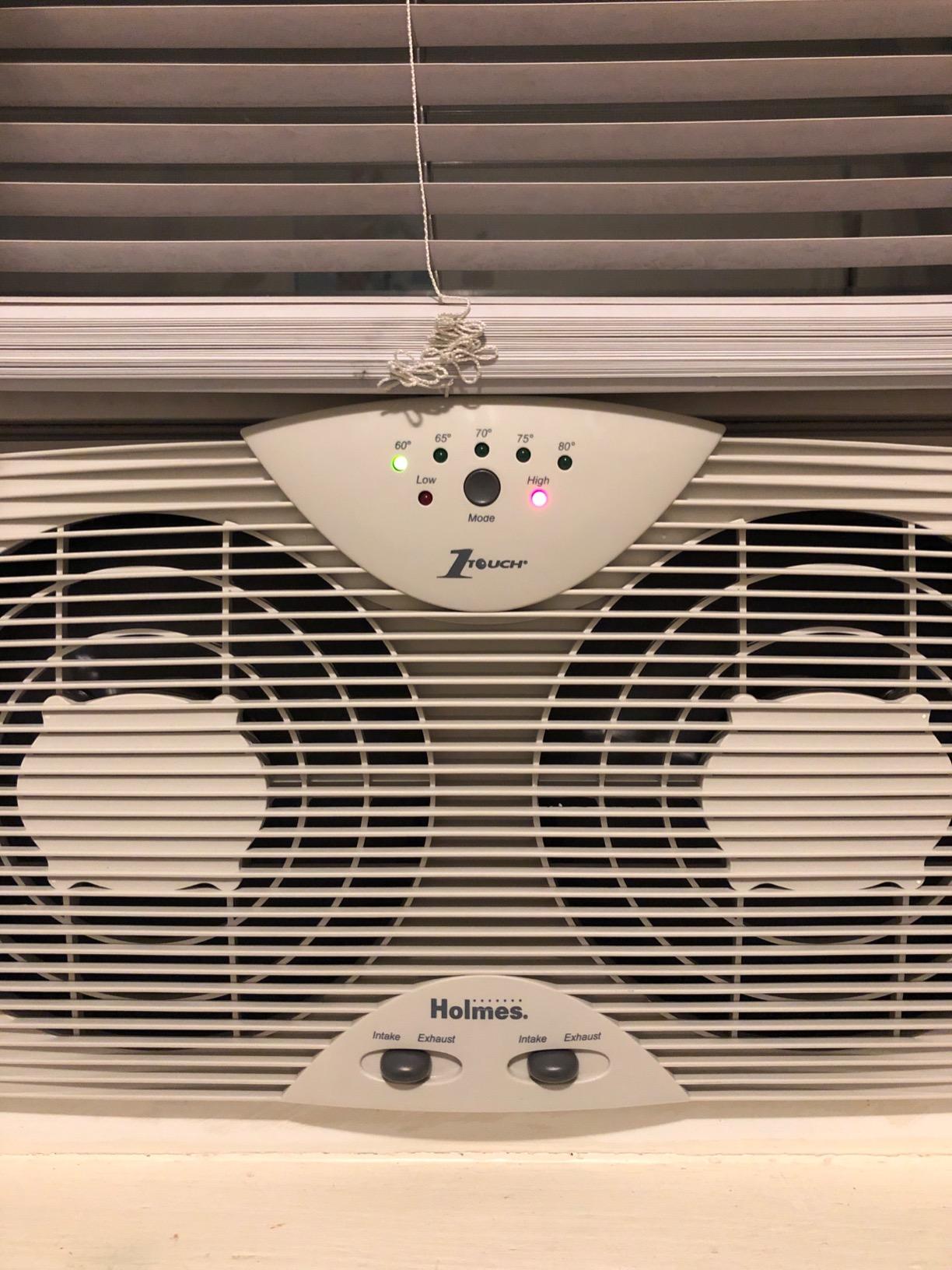
Choose this one for the fit rather than the airflow. Where the screen must stay down, it solves a problem none of the other nine solve.
4. Genesis A1WINDOWFAN — Most Airflow in the Roundup
Genesis Twin Fan High Velocity Reversible AirFlow Fan, LED Indicator Lights Adjustable Thermostat & Max Cool Technology, ETL Certified, White (A1WINDOWFAN)
706 CFM
30 watts
3 speeds
Thermostat 60-80F
Pros
- Highest published airflow figure here at 706 CFM
- Independent switches reverse each fan separately
- Runs on 30 watts so overnight cost stays low
- Removable legs for freestanding use
Cons
- Bright red LED indicators cannot be switched off
- Electrical buzz on the two lower speeds
- No remote and thermostat reads about 5 degrees high
This is the highest-rated fan in the set at 4.4 across more than 10,000 reviews, and the reason is 706 CFM paired with a 30 watt draw. Owners say it pushes air strong enough to replace air conditioner use on moderate nights.
The two 9 inch heads have independent reversible copper motors with separate switches, so exchange works in a single-window room with the door closed. The Max Cool thermostat covers 60 to 80 degrees, and detachable legs let it stand on a sill or floor.
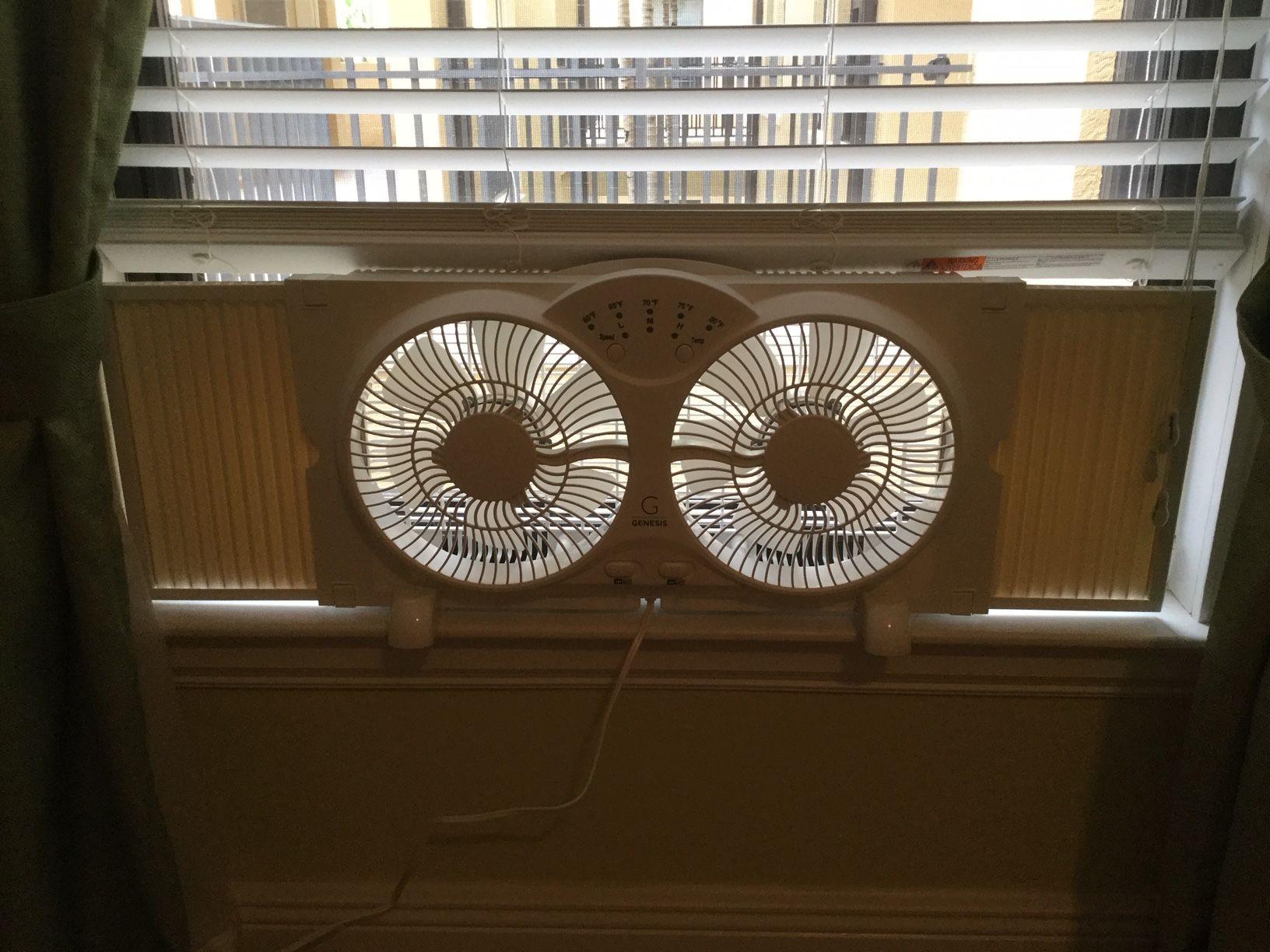
For a bedroom the LED weaknesses are real. The red indicators light up a dark room with no way to switch them off, and there is an electrical buzz on the two lower speeds. The thermostat also reads roughly 5 degrees high.
There is no remote, so every change means getting out of bed, and a small number report a fan head or motor failing after a short period.
Will it cool a large bedroom?
With 706 CFM rated it is the strongest mover of air here, and owners use it in rooms past the 200 square foot mark. The side panels add 6.5 inches per side, so the fit is generous.
Who should pick a different fan?
If you want to change settings from bed, the missing remote rules it out in favour of a Bionaire or COMFORT ZONE. A glowing LED in a dark room also points to the Vornado TRANSOM.

Remember the honest limit: it moves air, it does not cool it or strip humidity. On a hot, humid night with no cool outdoor air, no fan here helps.
5. Vornado TRANSOM — Quietest Pick in the Roundup
Vornado TRANSOM Window Fan with 4 Speeds, Remote Control, Reversible Exhaust Mode, Weather Resistant Case, Whole Room, Ice White
45 dB
185 CFM
25 watts
4 speeds
Fits 26-40 inches
Pros
- Lowest published noise figure here at 45 dB
- 25 watt draw suits all-night running
- One-button electronic reversal
- Low profile blocks little light and view
Cons
- Moves less air than the airflow spec suggests
- Highest speed only felt from about six feet away
- No timer and no louvers to aim airflow
If noise is what keeps you awake, this is the fan. The 45 dB published figure is the lowest here, and owners describe low speed as soft white noise rather than motor hum, a meaningfully different sound to fall asleep to.
At 25 watts it is also the lowest power draw we found in this roundup, which makes it the least costly of the set to run all night. The body is 5.73 inches deep, so it blocks almost no light or view, and the weather-resistant case lets it stay in the window from spring through autumn.
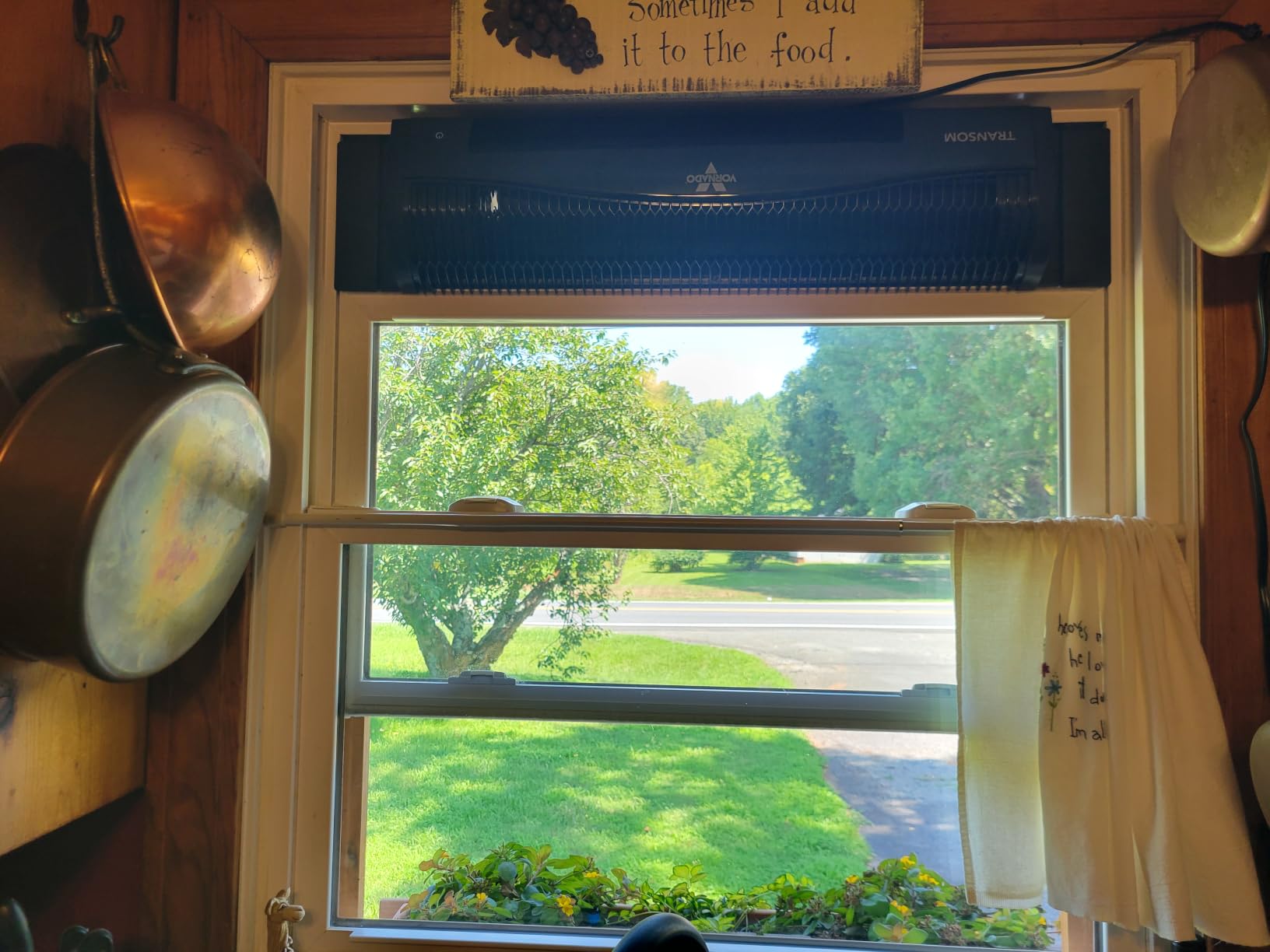
The trade-off is airflow. Despite the 185 CFM rating, buyers report noticeably less air than a standard dual-blade window fan, and the top speed is only felt from about six feet away.
There are no louvers to aim air away from the bed and no timer, which several buyers wanted. The soft-fit foam block needs adapting on modern windows with hospital sills.
Is it quiet enough for a light sleeper?
It is the best of the ten for that, and the only one whose noise owners describe as something to sleep beside rather than tolerate. Keep it on the lower speeds overnight, where the advantage is widest.
Who should pick a different fan?
Anyone needing serious cooling at distance should look at the Genesis or COMFORT ZONE. If you want a timer, you will not find one on this unit.
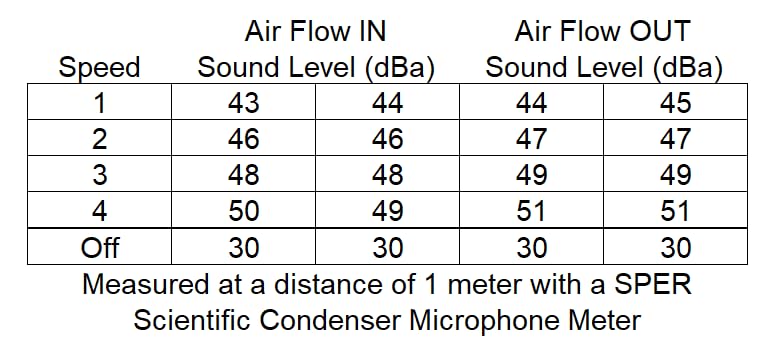
Apartment dwellers on thin frames should also be cautious, since structure-borne vibration can travel through a light frame even when the motor is quiet.
6. shinic BP2-9A — Best Fit Range for an Average Bedroom
shinic 9″ Window Fan Low-Noise Reversible Remote Control 3-Speed, ETL
49 dB
450 CFM
70 watts
3 modes
Fits 23.5-37 inches
Pros
- Three airflow modes covering intake exhaust and circulation
- Locking panel from 23.5 to 37 inches
- Foam seal strip included to close window gaps
- Carry handles and detachable feet
Cons
- Remote takes 2 AAA batteries not included
- Still audible on the low setting
This is a well-rounded 9 inch twin with a 49 dB published figure, sitting between the noisy COMFORT ZONE and the very quiet Vornado. The 450 CFM figure puts it ahead of the other 9 inch twins here on airflow.
The included foam seal strip is the detail owners thank it for most, because it closes the gap around the unit and cuts both rattle and wasted air. The locking panel spans 23.5 to 37 inches, and removable feet plus carry handles let you use it away from the window.
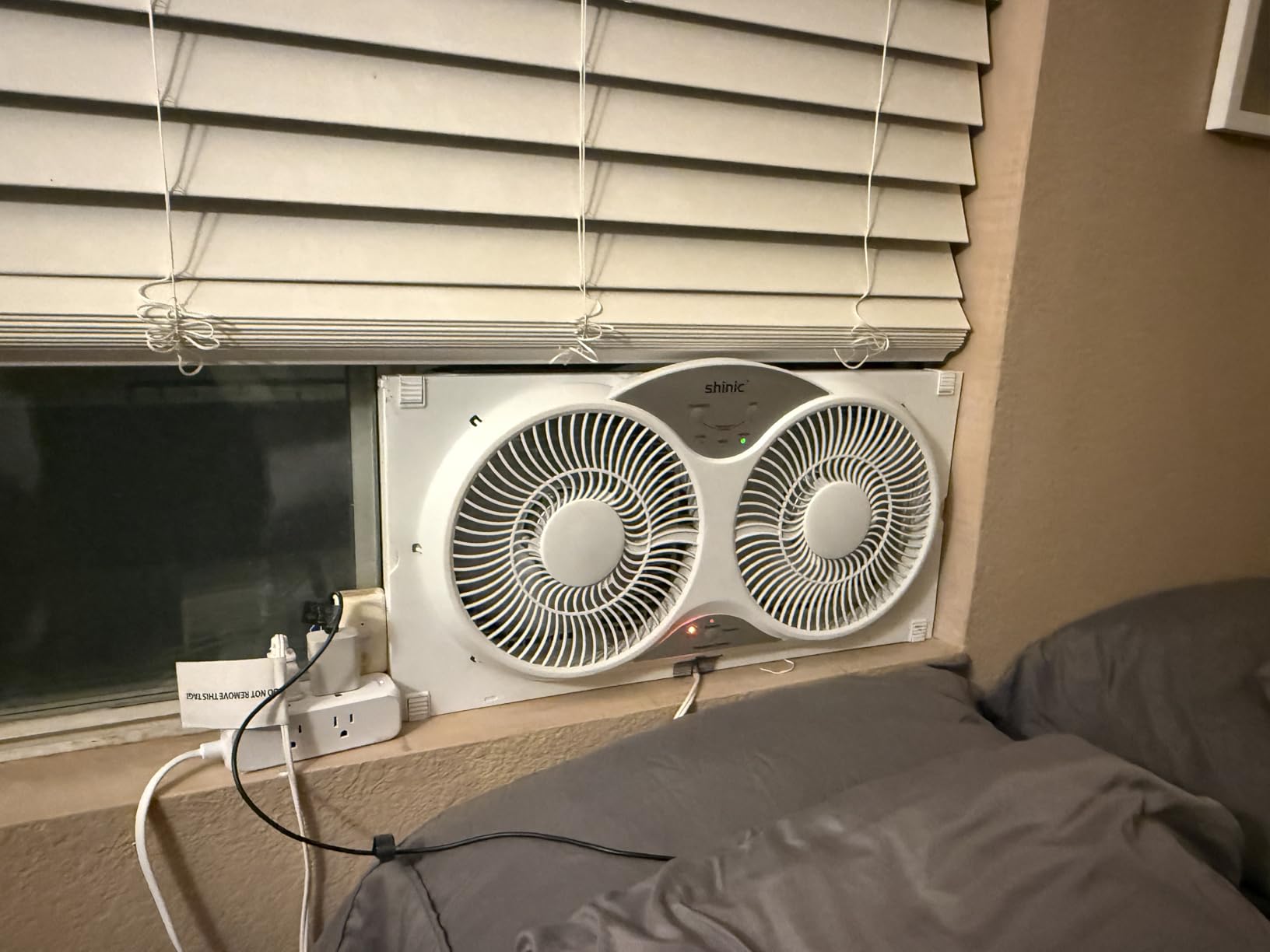
The recurring practical complaint is the remote, which takes two AAA batteries that are not supplied, catching people on the first night. At 70 watts it also draws more than the Genesis for comparable cooling.
Sound is acceptable rather than excellent, with reviewers rating it quiet at lower speeds but still audible on low.
How important is the foam seal strip?
More than it looks. An open gap leaks a share of the air back out and rattles against the frame, which is structure-borne noise rather than airflow noise. Including the strip saves you cutting foam blocks to size.
Who should pick a different fan?
If you need more airflow in a bigger room, the Genesis moves substantially more at a lower wattage. Very light sleepers should try the Vornado first.
It is a horizontal-format install, so it does not rotate for a tall narrow vertical sash.
7. Amazon Basics WDF9-1D — Best for Home Office and Voice Calls
Amazon Basics Twin Window Fan with Reversible Airflow, 3 Speeds, Exhaust, Expandable Side Panel, Digital Control, 9 inch, 78W, White
63 watts
3 speeds
Fits 25-32 inch windows
Built-in thermostat
Pros
- Built-in thermostat cycles the fan overnight
- Quiet enough that owners record voice work beside it
- Runs for months at a time without failure
- Expandable side panels fit 25-32 inch windows
Cons
- A motor mounting nut sometimes arrives loose and rattles
- Narrower fit range than most competing models
- High speed can feel like a low speed
The reason this shows up in home-office recommendations is the review pattern: owners mention running it during voice calls and recordings without it picking up a microphone, a direct noise observation that fits a 63 watt draw and three speeds.
The built-in thermostat cycles the fan to hold a set temperature overnight, so you set it once and stop thinking about it. Many owners run theirs for months with no failure, credited to the copper motor design.
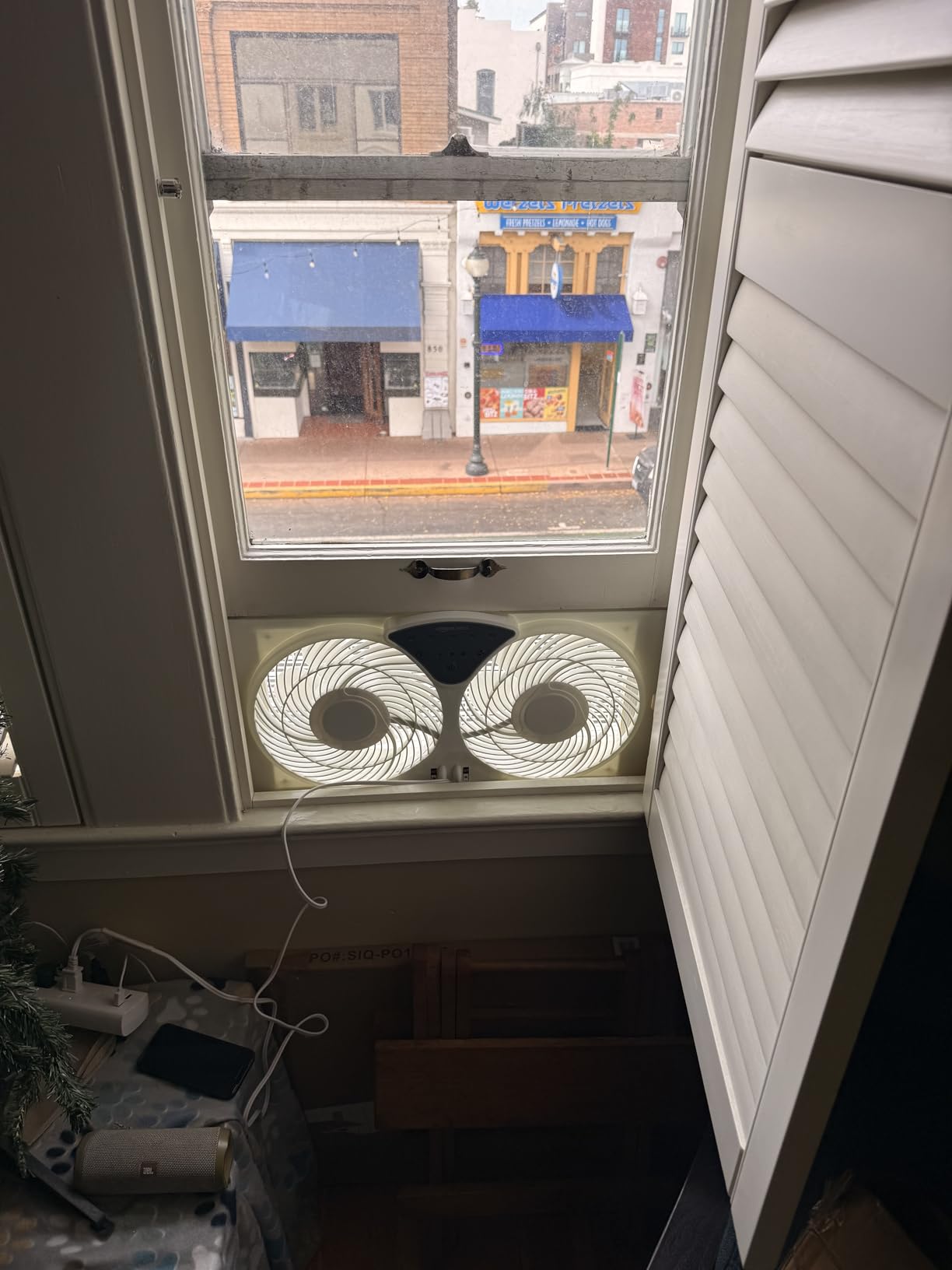
There is one fixable defect. A motor-mounting nut sometimes arrives loose shortly after unpacking, causing a rattle until you tighten it, and doing that work yourself can affect the warranty. Check it before the first night.
The 25 to 32 inch fit range is also the narrowest of the twin fans here, and some buyers find the individual motors weak.
Is it quiet enough for a home office?
It is the quietest-feeling of the twin reversible fans here for close-range work, which is the use case buyers describe. On high it becomes audible across a room like any other fan motor.
Who should pick a different fan?
Measure your window first, because openings outside 25 to 32 inches need the wider expanders on the COMFORT ZONE or the shinics. Near-total silence points to the Vornado on low.
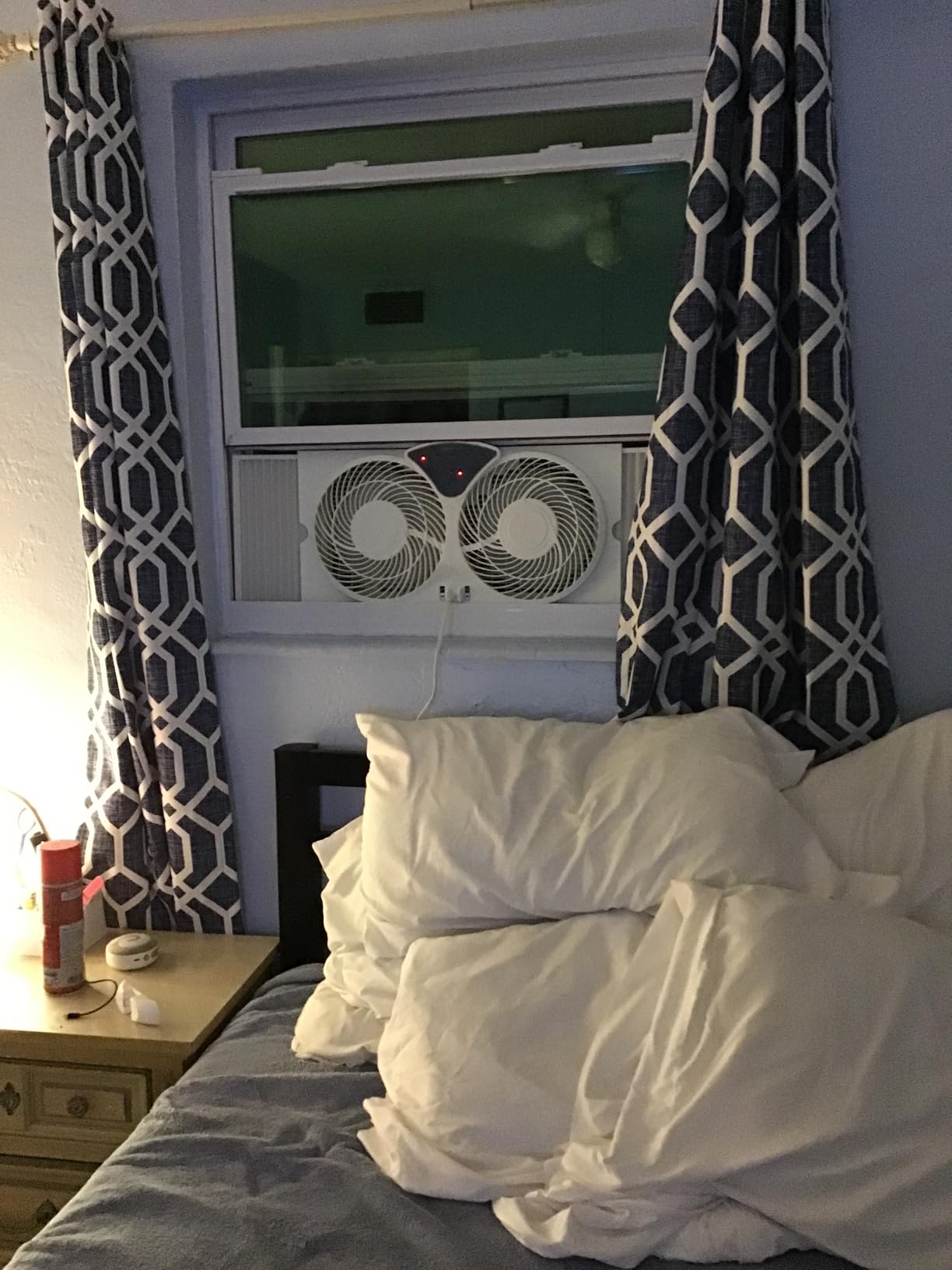
Pick this for a room where you work or record during the day and want overnight airflow without babysitting it. Tighten that motor nut on day one.
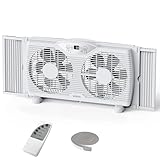
8. shinic BP6-9D — Best Thermostat Control on a Twin Fan
shinic Twin Window Fan, 9-Inch Blades Reversible Airflow, Thermostat Control, 3 Speeds, 3 Functions, 23.5″-37″ Expandable Width, Window Exchaust Fans for Home Bedroom, ETL Certified
80 watts
3 modes
Thermostat 60-85F
Fits 23.5-37 inches
Pros
- Programmable thermostat from 60 to 85F with LED display
- Slim enough to fit while the blind still closes
- Remote controls speed direction and temperature
- Side panels work horizontally or vertically
Cons
- Audible on the lowest setting for sensitive sleepers
- Bright LCD needs masking tape in a dark room
- Resets to intake mode rather than remembering the last setting
This is the model owners who switch from a Bionaire tend to land on, and the reason is usually noise. Reviewers describe it as quieter than higher-powered window fans while still moving plenty of air, which is unusual at 80 watts.
The programmable thermostat runs from 60 to 85 degrees with an LED readout, and the remote handles speed, direction and temperature so nothing needs a trip to the sash. The body is slim enough that a blind still closes over it.
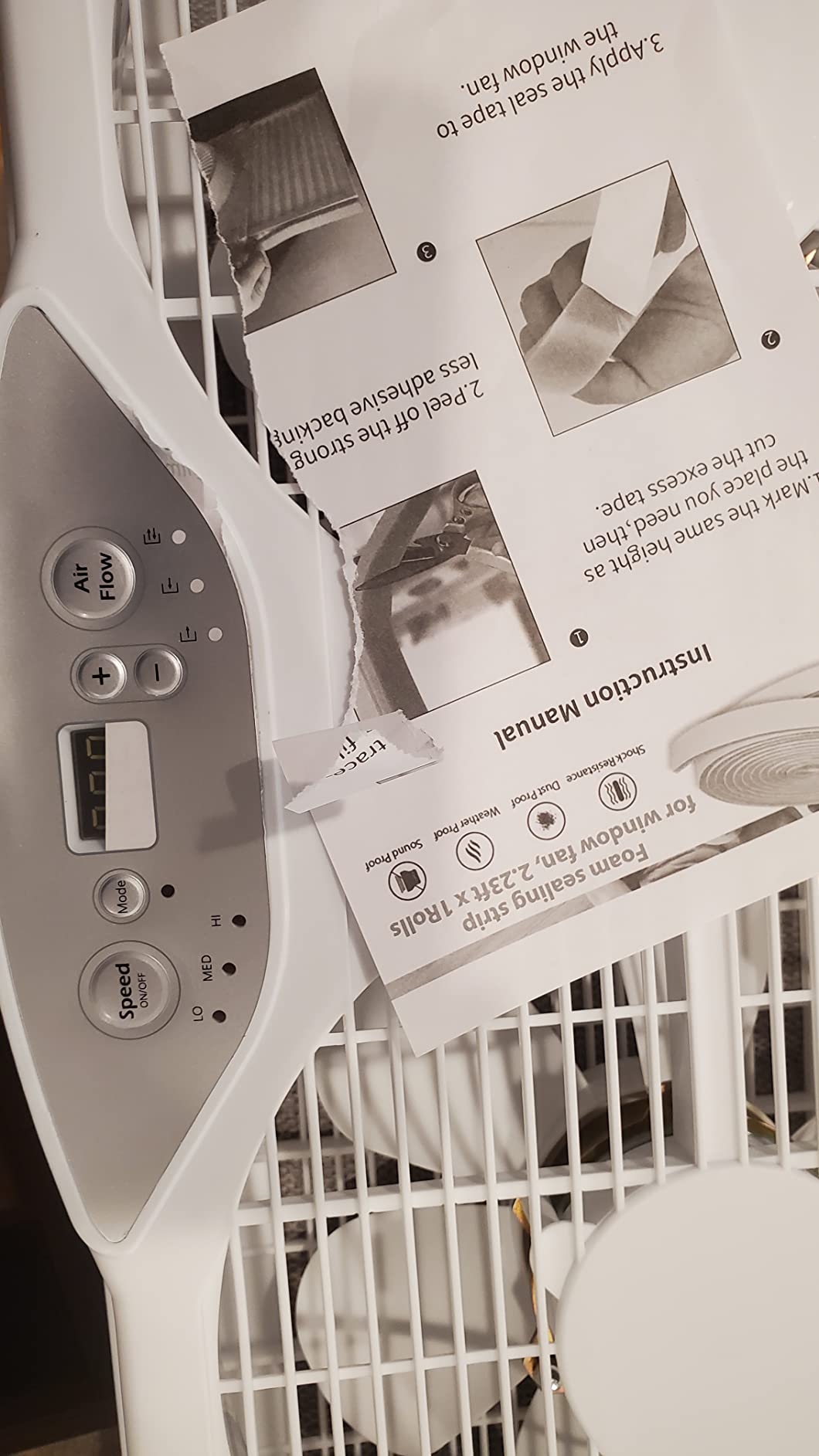
Three things hold it back: residual hum on the lowest speed, an LCD bright enough that owners mask it with tape, and a fan that always restarts in intake mode rather than remembering last night’s setting.
There is also a tail of strongly negative feedback from buyers who felt almost no airflow, a real quality-control signal even against a 4.2 average.
Does the thermostat really help overnight?
Yes, and it is the reason to pick this over a plain three-speed fan. The room reaches set temperature, the fan cycles down, and you get airflow without a steady cold draft all night.
Who should pick a different fan?
If a nightly reset to intake mode would annoy you, accept the extra morning step or choose a model with memory. For the quietest running, the Vornado TRANSOM is still ahead at 45 dB.
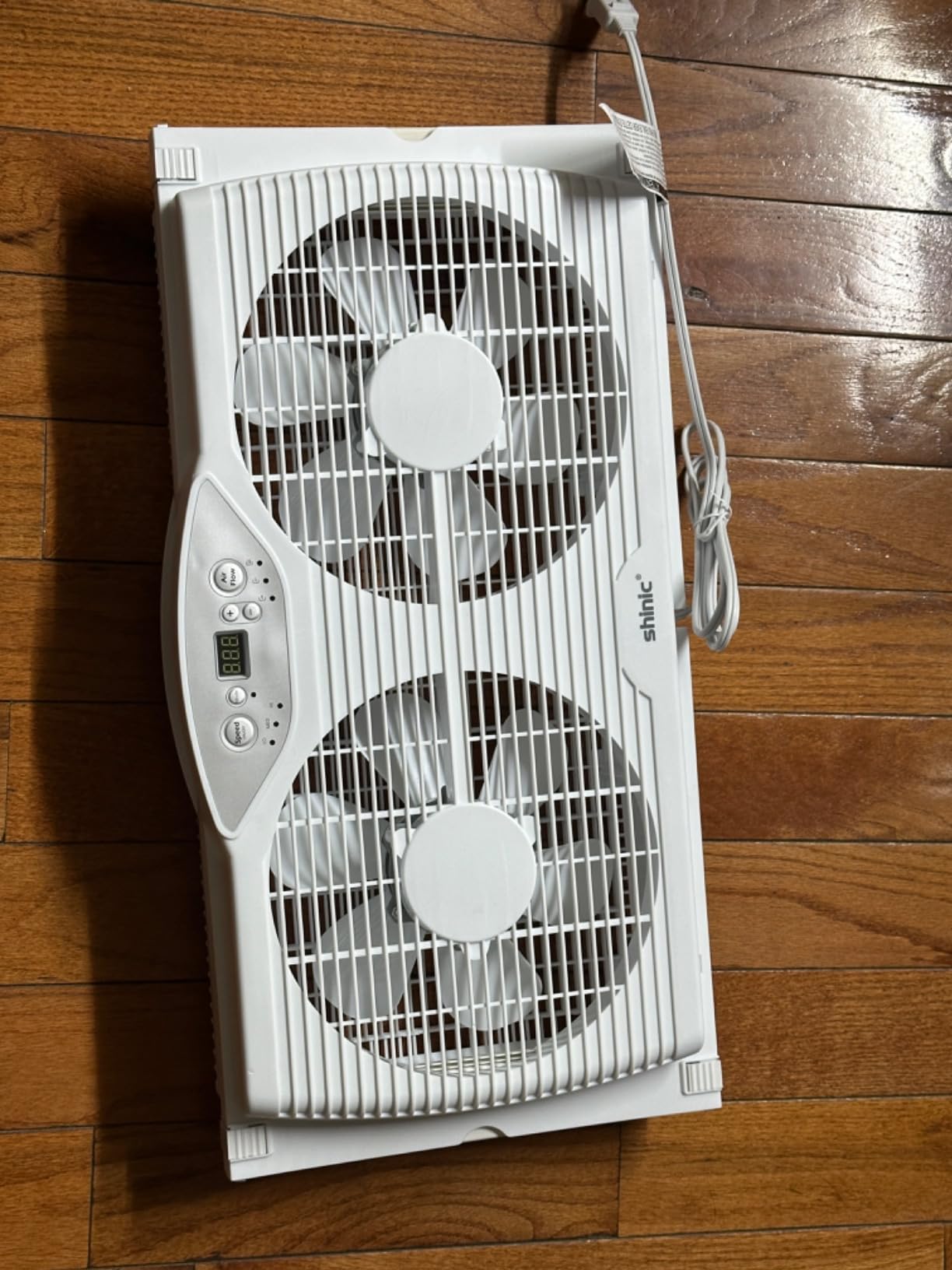
The vertical mounting option is genuinely useful in a narrow sash, which is where this one earns its place.
9. BEYOND BREEZE BBWF9-01 — Best Portable Window Fan
BEYOND BREEZE 9″ Dual Window Fan Reversible Airflow with Exhaust and Intake
40 watts
3 modes
3 speeds
Fits 23.5-37 inches
Pros
- Independently reversible cool exhaust and circulate modes
- Locking side panels from 23.5 to 37 inches
- Removable legs and handle for floor use
- Brushless motor at only 40 watts
Cons
- Modest 40 watt output means lighter airflow
- No published noise figure in the listing
This is the one to buy if the window fan is only part of the plan. The removable legs and built-in handle let it come out of the sash and work as a table or floor fan, and the brushless motor runs at just 40 watts.
The modes are independently reversible, with cool, exhaust and circulate on the remote, and the side panels lock from 23.5 to 37 inches. Owners value the secure fit and the ability to move the unit between rooms.
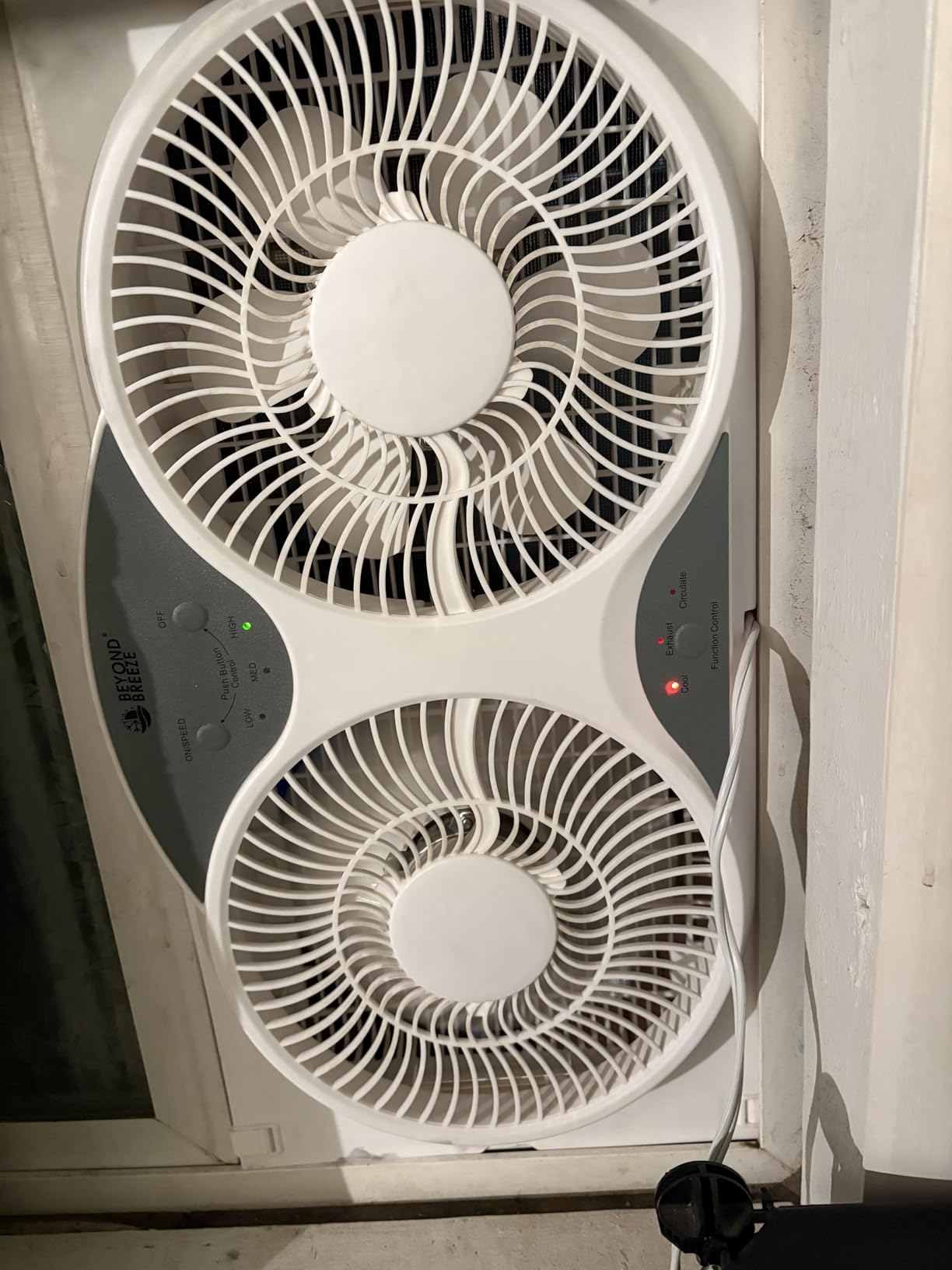
The honest limitation is output. At 40 watts the airflow is modest next to the Genesis or COMFORT ZONE, so it ventilates well but does not push air across a large bedroom. The listing also carries no published decibel figure, so treat its noise as unmeasured.
It also has a smaller review base than the twins above it, with 466 reviews, so there is less long-term history behind it.
Can one fan cover a room and a spare space?
That is exactly the use case. Run it in the window overnight for ventilation, then pull the legs off and use it on the floor in the daytime. Do not expect the portable mode to move serious air.
Who should pick a different fan?
If the bedroom is your only target, the Genesis is dramatically stronger on the same outlet. If you are noise-sensitive, choose a model with a published decibel figure rather than guessing.
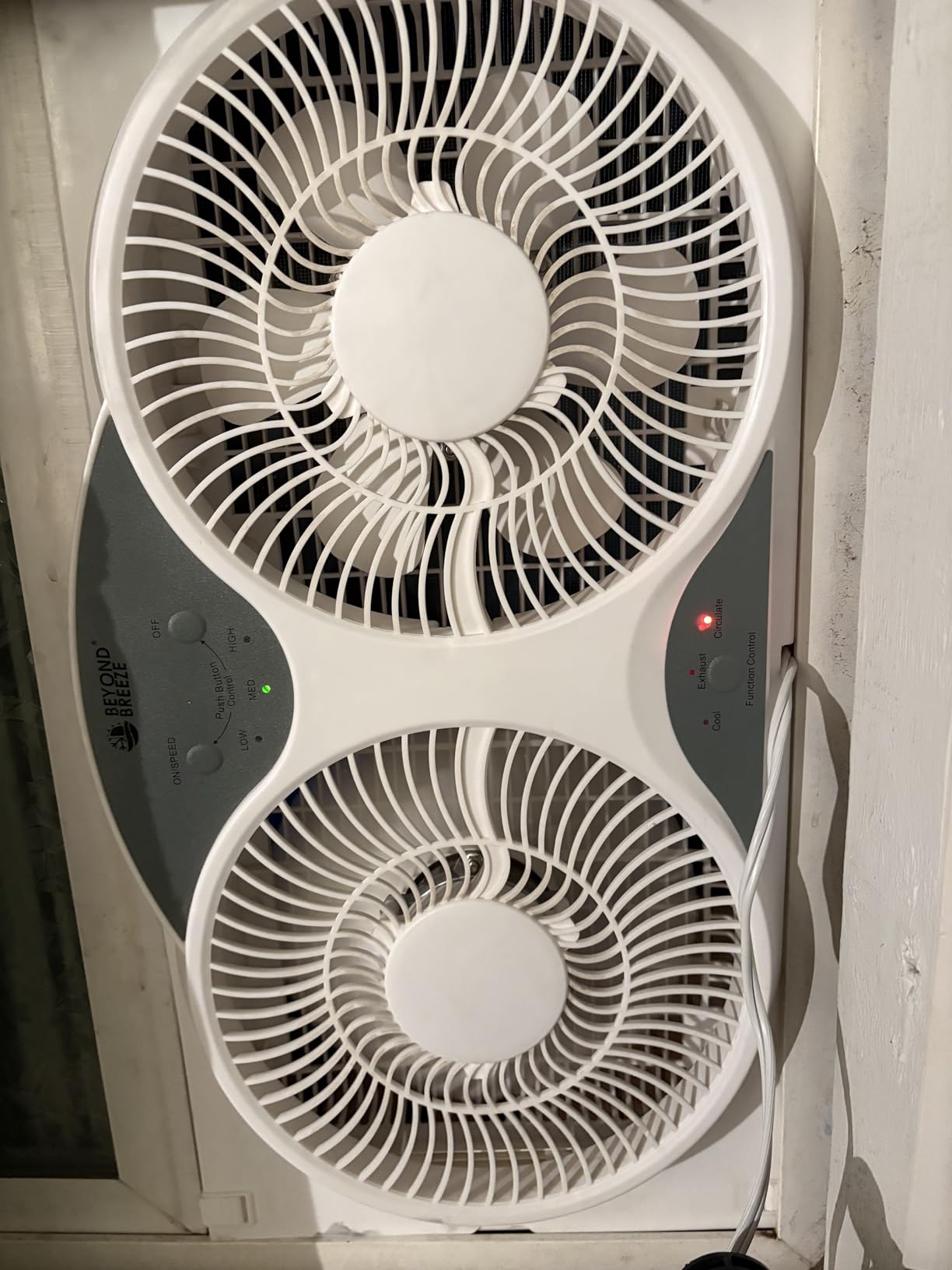
Buy it for flexibility rather than power. A unit that handles the window at night and the floor by day is a different proposition from a fixed sash fan.
10. BLACK+DECKER BFW9M — Lightest and Simplest Option
BLACK+DECKER 9″ Dual Window Fan with 2 Speed Settings, BFW9M, White
56 watts
2 speeds
Fits 22.5-33 inches
Weighs 4.5 lb
Pros
- Lightest option here at 4.5 lb and easy to reposition
- Accordion expanders from 22.5 to 33 inches
- Removable legs allow freestanding placement
- Rust-resistant construction
Cons
- Reversal requires turning the whole unit around
- Narrower expanders may not reach wider windows
- 2 speeds and no remote control
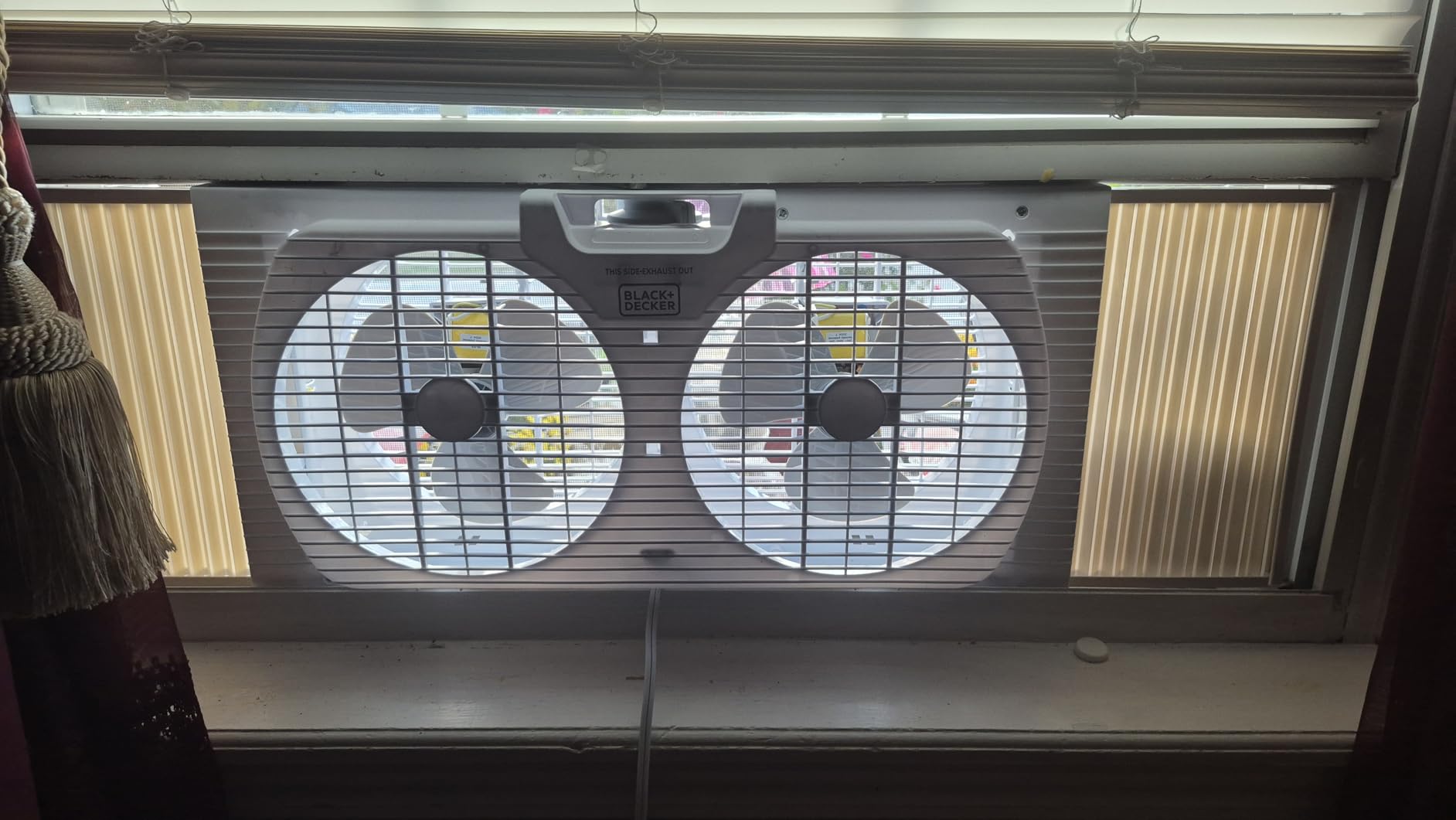
At 4.5 pounds this is the easiest unit here to lift in and out of a sash, which matters if you move it between seasons or carry it to a second room. Reviewers also call its airflow strong for the size and its noise level reasonable.
It is a simple design: two speeds on a mechanical dial, expanders from 22.5 to 33 inches, and removable legs for freestanding placement, with no remote and no display to mask in a dark room.
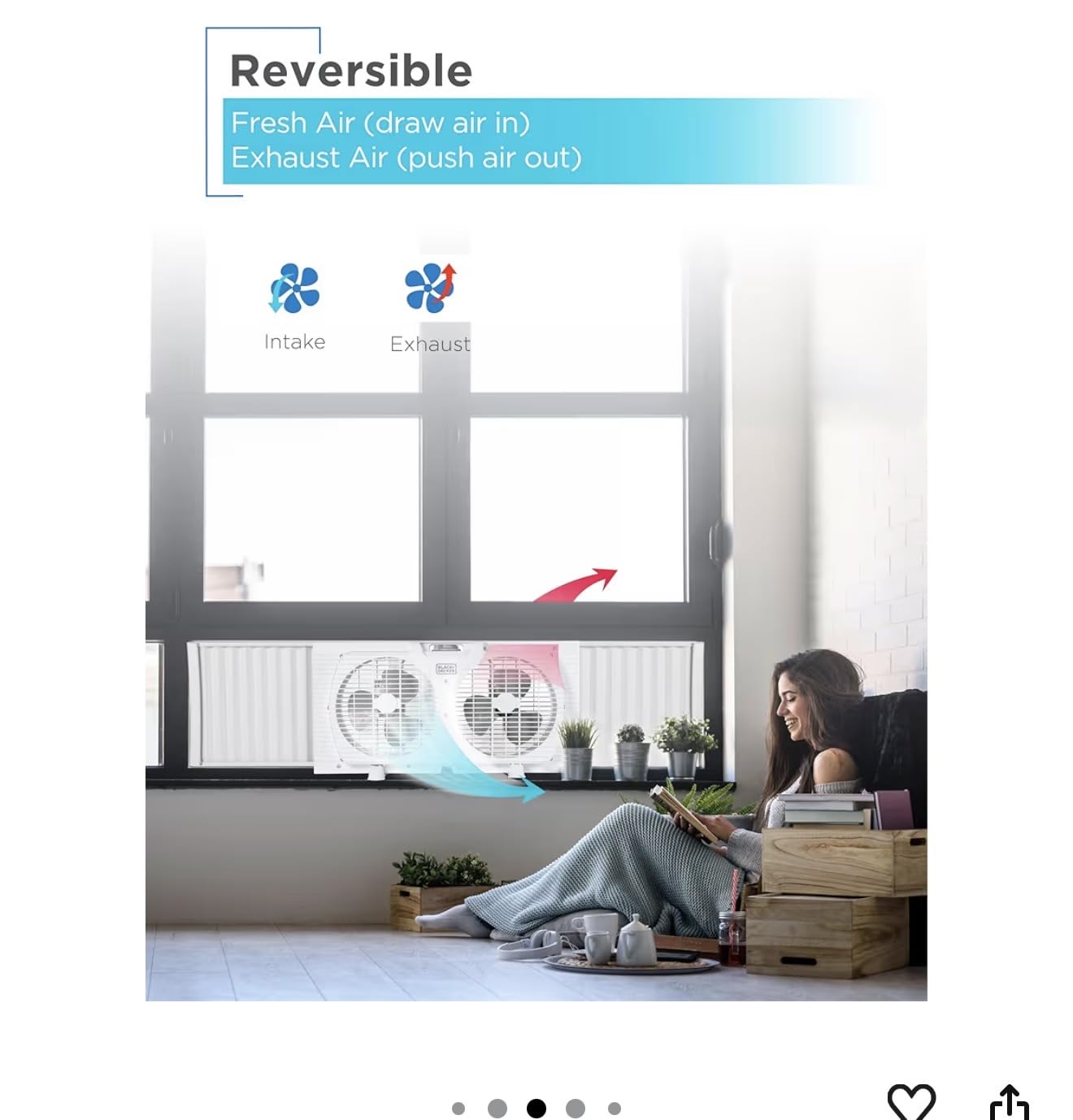
Reversal is the catch. You physically turn the whole unit around to switch between intake and exhaust, which makes a mid-night airflow change a two-handed job. Several buyers also say the listing oversells its dual capability.
Only two speeds, a narrower expander range, and a 1-year limited warranty complete the compromises.
Is it good enough for a small bedroom?
For a small room or a conservatory, yes. Owners describe it as good value for basic bedroom ventilation, and at 56 watts it stays cheap to run. The limitation is control granularity rather than capability.
Who should pick a different fan?
If you need to reverse airflow without getting up, the electronically reversible models here do it from a remote. If your window is wider than 33 inches, several rivals stretch further.
Measure before buying, because the expanders stop at 33 inches and many bedroom sashes are wider. It has none of the glowing indicators that bother sleepers.
How to Choose a Window Fan for a Bedroom
Noise is the first filter, and decibel figures are the only honest comparison. A quiet window fan generally sits at 45 dB or below. Here the Vornado TRANSOM at 45 dB, the Bionaire at 47 dB and the shinic BP2-9A at 49 dB are the sleep-friendly end, while the COMFORT ZONE at 52 dB sits at the other. Watch for structure-borne noise too, since a rattling frame carries through a bedroom wall even when the motor is quiet.
Match airflow to room size, not to marketing language. A common rule is roughly one CFM per square foot plus a 50 CFM allowance, which puts a 12 by 12 bedroom near 200 CFM. Well above that you are ventilating faster than one window and one open door can exchange air, so extra CFM stops adding comfort.
Reversible airflow is what makes it useful at night. In intake mode the fan pushes cool outside air into the bedroom. In exhaust mode it pulls hot air out. In exchange mode, which independently reversible twin motors give you, one side does each at once, so the room changes air with the door closed.
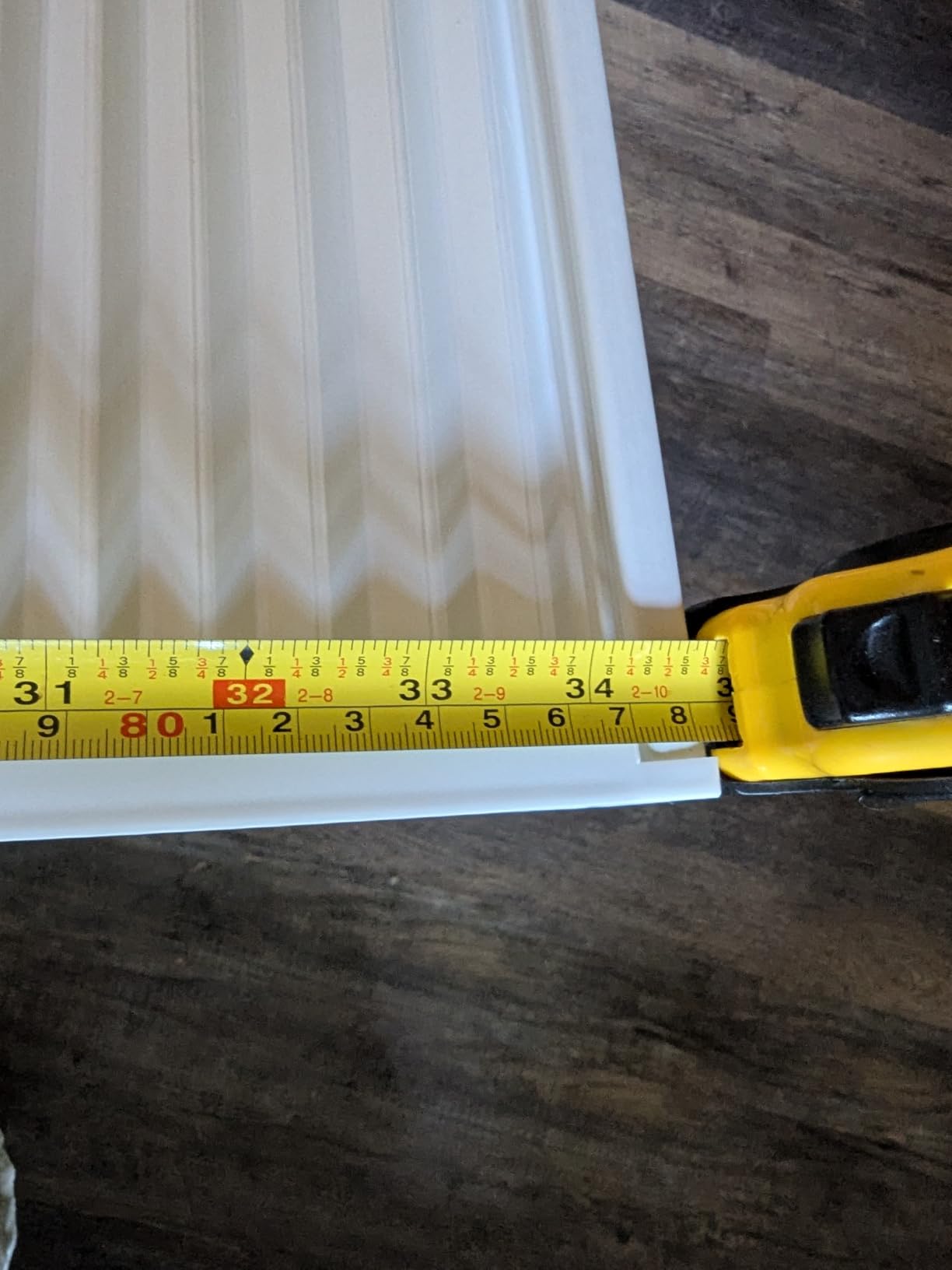
Fit and sealing decide whether any of that works. Measure the opening at its widest and narrowest points, because expanders here span from 22.5 inches on the BLACK+DECKER up to 37 inches on several twins. Then close the gaps with a foam strip or fitted block, since a leak wastes much of your airflow and makes the housing vibrate against an uneven frame. Add a bug screen; only the COMFORT ZONE includes one here.
Set up cross-ventilation for a multi-window room. Put the fan in one window as an exhaust and simply open another to act as the intake, rather than filling every opening. Sealing two windows tight stops the air path. A shaded window on the shaded side of the house often decides whether air moves at all.
Know the limits before you commit. A window fan moves air; it does not cool it, strip humidity, or filter anything. If outdoor air is warmer at bedtime, running one makes the room warmer. Allergy sufferers should also know it pulls in unfiltered outdoor air, including pollen and smoke, which a filtered window air conditioner does not.
Know when to buy a window air conditioner instead. The fan wins on running cost, quietness and fresh air. The air conditioner wins when nights stay hot, humidity is high, or the bedroom needs filtered air. For many households the practical split is a fan for the shoulder season and a small air conditioner for the weeks when outdoor air offers nothing.
Frequently Asked Questions
What is the best air cooling fan for a bedroom?
The Bionaire BW2300-N is the best all-round window fan for a bedroom in our roundup, with a published 47 dB figure, reversible intake, exhaust and exchange airflow, a programmable thermostat and a remote control. If you move more air than anything else matters, the Genesis A1WINDOWFAN leads on rated CFM at 706. If quiet decides it, the Vornado TRANSOM at 45 dB is the lowest-noise pick here.
Is it a good idea to put a fan in a window?
Yes, in most climates and most bedrooms, provided outdoor air is cooler than indoor air when you run it. A window fan moves air rather than cooling it, so it helps most on mild nights and in the early morning and late evening. In sustained heat or high humidity it does little, and a small window air conditioner is the better tool.
What type of fan is good for a bedroom?
A reversible twin-fan window fan with at least three speeds, remote or touch control and a published noise figure below 50 dB is the most sleep-friendly type. Independently reversible motors let one side exhaust while the other draws air in, changing air faster with the door closed. Avoid models with bright LED displays you cannot switch off.
Do those window fans work?
They do, but the mental model matters. A window fan does not cool a room, it moves air, which makes you feel cooler as moving air evaporates moisture from your skin. You need at least one other opening for air to flow, and the benefit drops sharply when outdoor temperatures exceed indoor temperatures.
Is there a window fan that closes when not in use?
Most do not. The fan body sits in the opening and has to be removed in cold weather, which is the gap the Vornado TRANSOM’s weather-resistant case is designed to reduce. Most of these models also lack louvers for aiming airflow, so check whether you can direct air away from the bed before buying.
How do I stop bugs coming through the window?
Fit the insect screen that ships with the unit, which in this roundup is only included with the COMFORT ZONE CZ310R, and add a second screen behind the fan as insurance. Seal the gap around the fan body with a foam block or strip so there is no air path along the frame, and check the expanders in the corners where gaps usually form.
The Best Window Fan for Bedrooms, Final Word
After weighing noise, airflow, fit and night-time controls across these ten, the Bionaire BW2300-N remains our best window fan for bedrooms in 2026. A 47 dB published figure, reversible airflow in all three directions, a programmable thermostat and a remote put it ahead of every alternative for the way most people actually use a bedroom fan: quietly, all night, without getting up.
Pick the Genesis A1WINDOWFAN if airflow is your priority and a panel-only control suits you, and the Vornado TRANSOM if noise is the only thing standing between you and a good night’s sleep. In every case, measure your window and seal the gaps before the first night, because a well-fitted fan outperforms a better fan that rattles.