
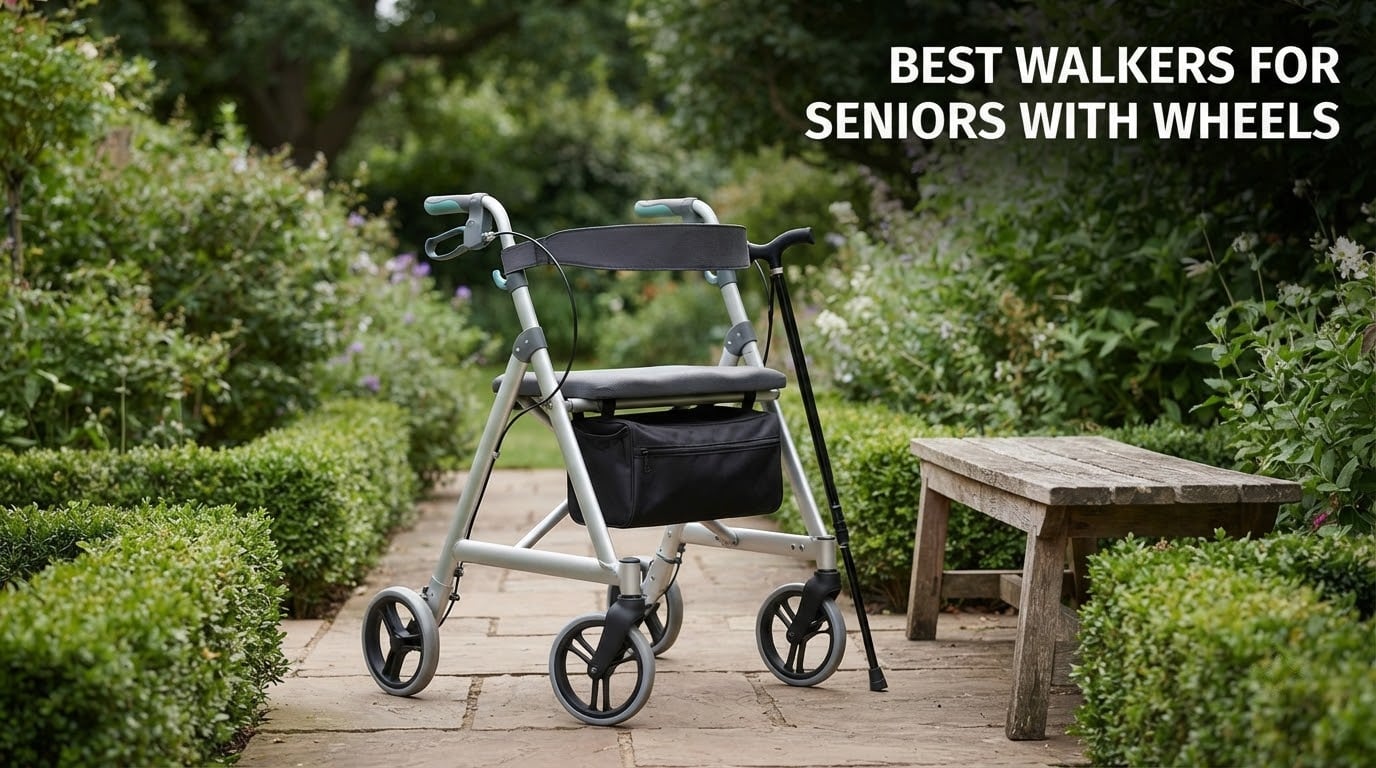
If you are shopping for the best walkers for seniors with wheels, the three models I would put at the top of a short list are the Drive Medical steel rollator for sheer dependability, the Medline steel rollator for value, and the VOCIC Z21 for comfort on rough ground. Add those three to a shortlist and the rest of this roundup narrows the field further for tall users, heavy users, tight hallways and travel.
What most people call a walker with wheels is officially a rollator. It is a four-wheel frame, usually aluminium or steel, with hand brakes, a padded seat and an under-seat bag, so the user can walk with support, stop whenever fatigue hits, and sit down without hunting for a chair. The seat is what separates a rollator from the two-wheel rolling walker that many seniors are handed first.
We compared twelve of the most-bought rollator walkers for this guide, reading the specifications against what buyers report back after living with them. We focused on the four things that decide whether a rollator works for a specific person: whether the handle height actually fits, whether the brakes lock without a fight, whether the wheels suit the ground the user walks on, and whether the unit weighs enough to defeat car transport.
A note before you go further. The single most common reason a rollator gets returned is not a defect. It is a height mismatch, where an adult child ordered a model for a parent who ends up hunched over because the handles stop well short of the wrist. Measure before you buy, and the section on handle height later in this guide walks through it step by step.
Two other things came up constantly. Buyers describe a rollator as a confidence tool rather than only a stability tool, and the mental benefit of walking to the mailbox alone decides more purchases than any specification. And the buyer is often a family member, not the user, so a shopping trip to a physical therapy-supply store is worth more than a week of guessing online.
If you are also putting together a broader independence setup for a parent or relative, our guides to the best smartwatches for seniors and the best cameras for seniors cover two devices that sit alongside a rollator in the same independence conversation.
Table of Contents
Top 3 Picks for Best Walkers for Seniors with Wheels (September 2026)

Best Walkers for Seniors with Wheels (September 2026)
Here is the short version. The Drive Medical steel rollator is the safest general answer, with the highest review count in this roundup by a wide margin. The Medline steel rollator is the one to buy when weight capacity matters more than wheel size. The VOCIC Z21 takes the top spot for comfort, thanks to a genuinely thick seat and a backrest that is not a bare tube. For a narrow hallway or a restaurant booth, the PLANETWALK three-wheeler wins on weight and turning circle. For a user above 6 feet, the HOMLAND 17 lb model reaches 40 inches of handle height, the tallest range in this group.
1. Drive Medical Steel Rollator with Seat 7.5 Inch Wheels – Best Overall
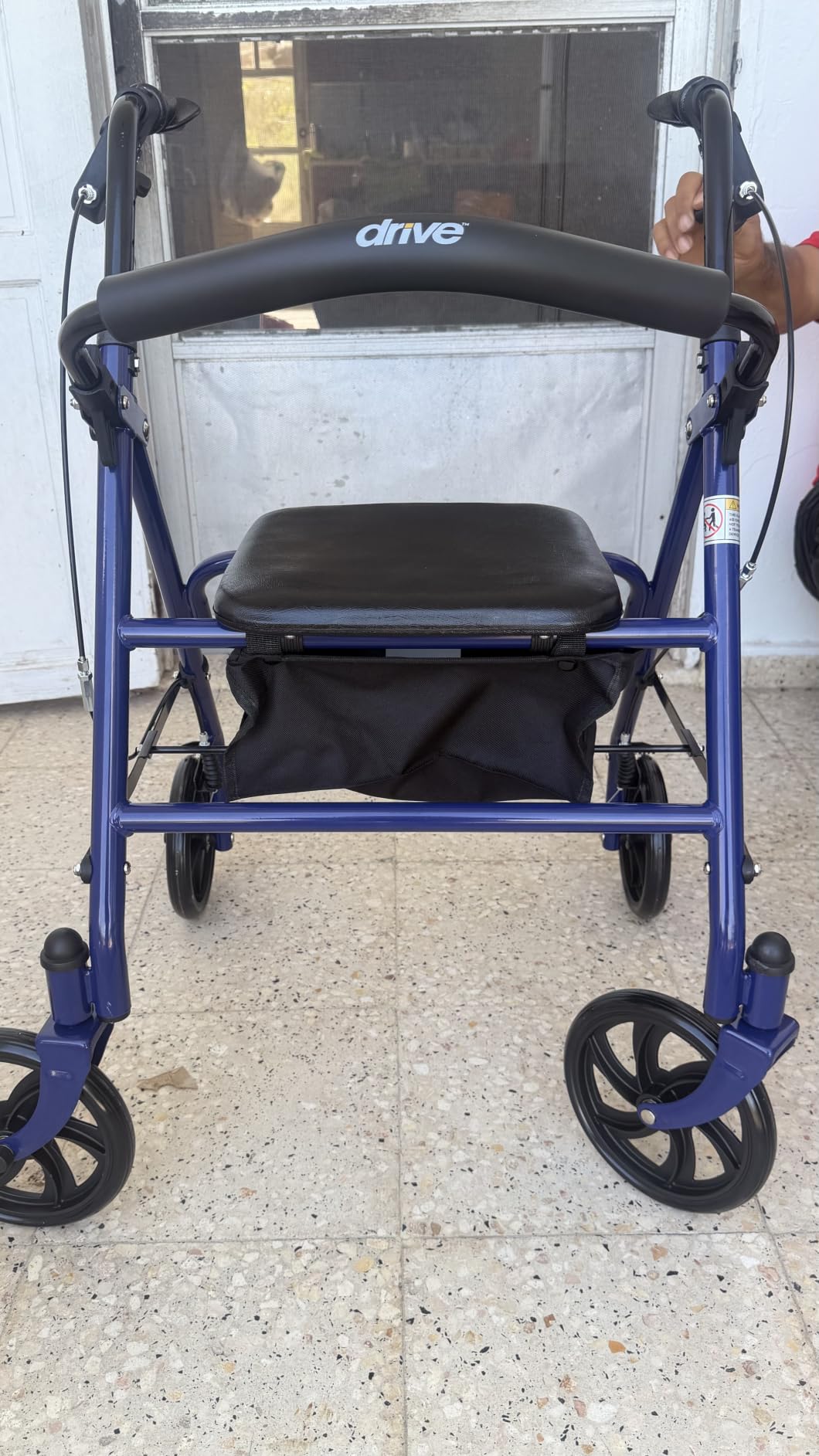
Drive Medical Rollator Walker with Seat, 7.5 Inch Wheels, Blue
Weight: 20 lb
Wheels: 7.5 inch
Frame: steel
Folded: 31.5 x 24.5 x 10.75 in
Pros
- Sturdy steel frame owners report lasting years
- Light enough for one person to lift into a car
- Quick tool-light assembly in two to five minutes
- Rolls on carpet tile grass and thresholds
- Under-seat pouch plus padded seat
Cons
- Thin foam backrest is uncomfortable for long rests
- Frame does not lock open on its own
- Utilitarian styling and basic accessories
More than 51,000 ratings sit behind this model, and that volume is the point. In our comparison of the twelve, this is the rollator that owners most often describe as having changed how they get through the day, which matches what we heard repeatedly about restoring independence rather than simply adding a support handle.
The build is a steel frame with a padded seat and a fold-down backrest, riding on 7.5 inch smooth-rolling casters. The locking hand brake is adjusted with a lever, so a caregiver can set it once rather than guessing every time. Assembly is close to tool-free and most owners report two to five minutes from box to usable.

What impressed us most during the spec comparison is how unremarkable the design is. There is no clever mechanism to fail, and the folded footprint of 31.5 by 24.5 by 10.75 inches fits behind a seat or in a closet without a fight. Several owners report buying two or three of these over the years, which says more about durability than any rating score.
The 7.5 inch casters are the limiting factor. They handle carpet, wood, tile, grass and door thresholds without complaint, but a cracked sidewalk or a gravel driveway will feel every bit as rough as it looks. For a user whose walking happens on pavement, this is not a dealbreaker. For a user who wants gravel paths, look further down the list.
Who this rollator suits
This suits a senior who walks mostly on flat, firm ground, wants a seat they can trust, and does not want to overthink their purchase. It suits a household that is willing to accept a slightly heavier steel frame in exchange for a frame that reviewers consistently describe as wobble-free after years.
It also suits anyone whose first thought at the shop is about durability rather than weight. This is not the model to choose for a cross-country trip, but for a fixed daily routine it is the version with the fewest reported surprises.
Where it falls short
The backrest is the recurring complaint. Owners describe a foam-covered tube that is fine for a five-minute breather and unpleasant to lean on for twenty. If the user tires slowly and rests often, treat the backrest as a limitation and move to a model with a full-width padded back panel.
The other two recurring notes are that folding is fiddly and the folded frame does not stay locked without being held, and that the styling and accessories are purely functional. Neither is a safety problem, but both are reasons a household might prefer a more refined model.
2. Medline Steel Rollator Walker 350 lb Capacity – Best Value

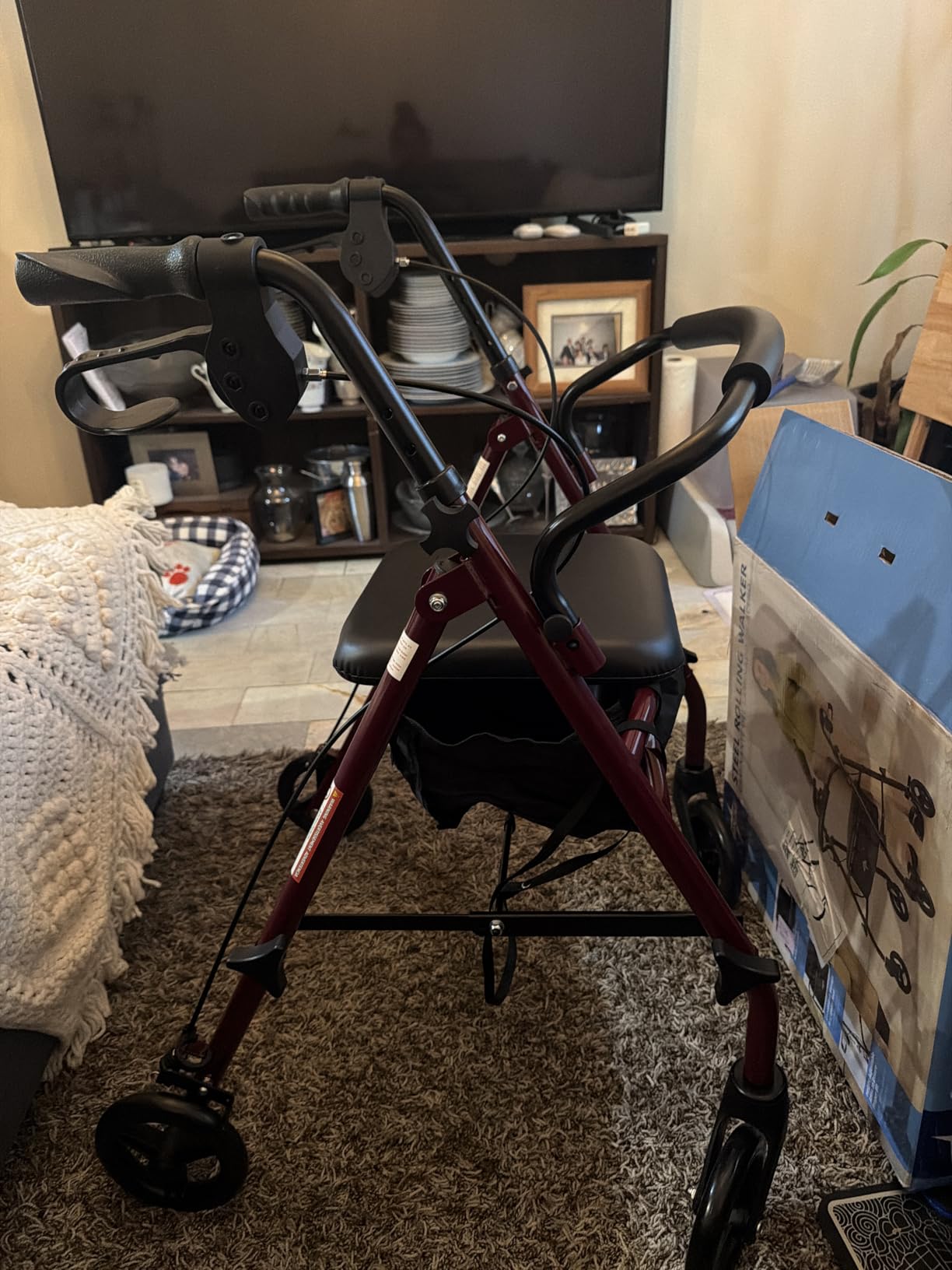
Medline Steel Rollator Walker with Seat, Burgundy, 350 lb. Weight Capacity, 6” Wheels, Foldable, Adjustable Handles, Rolling Walker for Seniors, Walker for Mobility Impaired
Weight: 16.5 lb
Wheels: 6 inch
Capacity: 350 lb
Handle: 31-35 in
Pros
- Heavy-duty steel frame rated to 350 lb
- Only 16.5 lb for a four-wheel rollator
- Large brake handles easy to grip with weak hands
- 12 x 12 inch padded seat and backrest
- Folds down for storage and transport
Cons
- 6 inch wheels rough on uneven outdoor ground
- Fixed backrest with no recline adjustment
- Basic styling versus newer aluminium designs
The Medline stands out on one number that matters more than most: 350 lb of rated capacity on a frame that weighs only 16.5 lb. That combination is unusual. Most frames strong enough for a heavier user tip the scales, and most lightweight frames stop well short of 350 lb.
More than 25,000 ratings describe the same experience: durable, easy to adjust the height, and a brake that locks without fuss. Buyers frequently describe it as the step up from a two-wheel walker they were using before, which is a common point in this category.
The brake design is worth understanding before you commit. Handles work in two directions: push up to brake gradually, push down to lock the rear wheels. That is a larger and easier target than a small lever, which matters a great deal for someone with arthritis or limited grip strength in both hands.
Handle height adjusts from 31 to 35 inches, and the padded 12 by 12 inch seat has an under-seat storage pocket. The whole unit folds for storage. Assembly and adjustment are the kind of straightforward work an adult child can do in a single sitting.
Who this rollator suits
This is the one I would point a family toward when a parent is heavier, or when the original buyer needs a solid frame and a brake that works without fine motor control. A 350 lb rating gives real headroom, and the 16.5 lb weight means a caregiver can still lift it into a vehicle.
It also suits a user on hard flooring or short indoor routes, where 6 inch wheels are effectively invisible in performance terms. For a bathroom, a hallway and a kitchen, this model does everything the bigger-wheeled options do.
Where it falls short
The 6 inch wheels are the honest weak point. Owners on uneven outdoor ground, gravel or broken pavement notice the difference against 8 inch and 10 inch models, and the small wheel diameter is the single most common criticism across thousands of reviews.
The backrest is fixed, with no recline or height adjustment, and some owners wish for a more contoured panel. The handle range also tops out at 35 inches, so anyone taller than roughly 5 foot 10 inches will be leaning forward. Measure the wrist height first if height is a concern.
3. VOCIC Z21 8 Inch All Terrain Rollator – Most Versatile

VOCIC Z21 Rollator Walker for Seniors with Seat, 8″ All Terrain, 350 LBS
Weight: 22.85 lb
Wheels: 8 inch
Capacity: 350 lb
Handle: 31.5-36.6 in
Pros
- Widened breathable backrest and 1.6 inch thick seat
- 8 inch puncture-proof tires handle gravel and bumps
- Dual adjustment on handle and seat height
- Three-mode brake is easy for weak hands
- Reflective strips for low-light visibility
Cons
- 22.85 lb is heavy for solo car loading
- Seat height tops out at 22 inches
- Reflective strips do not replace proper lighting
This is the comfort leader of the group. The 1.6 inch thick cushioned seat and a widened breathable backrest are the two features buyers name again and again when explaining why this feels better than the cheaper six-inch-wheel models it sits against on the shelf.
The Z21 currently holds the top position in its category, and the reason is the combination of ride quality and adjustability. The 8 inch puncture-proof textured tires and 360 degree swivel front wheels handle bumps, gravel and slippery surfaces that defeat smaller casters.
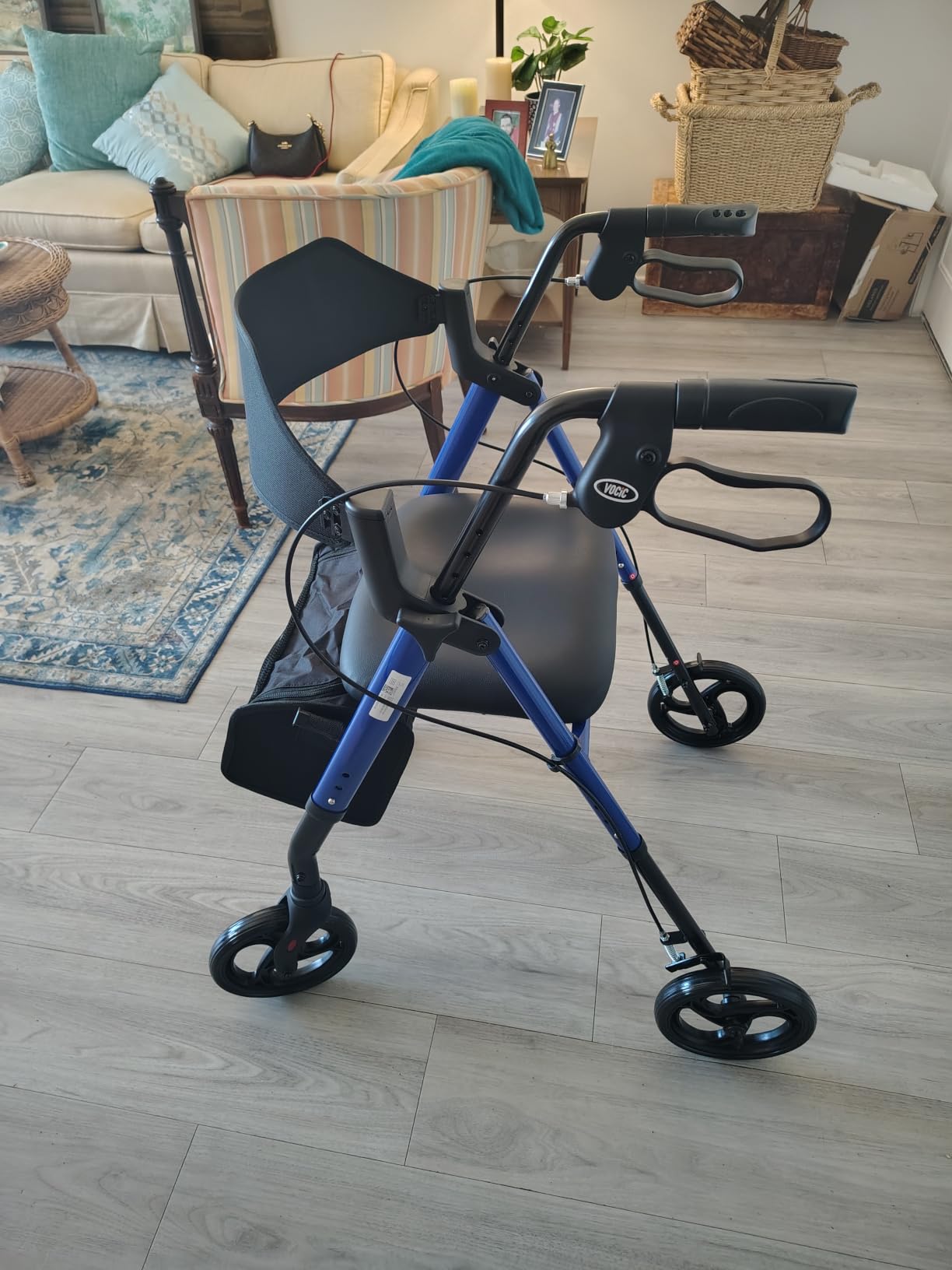
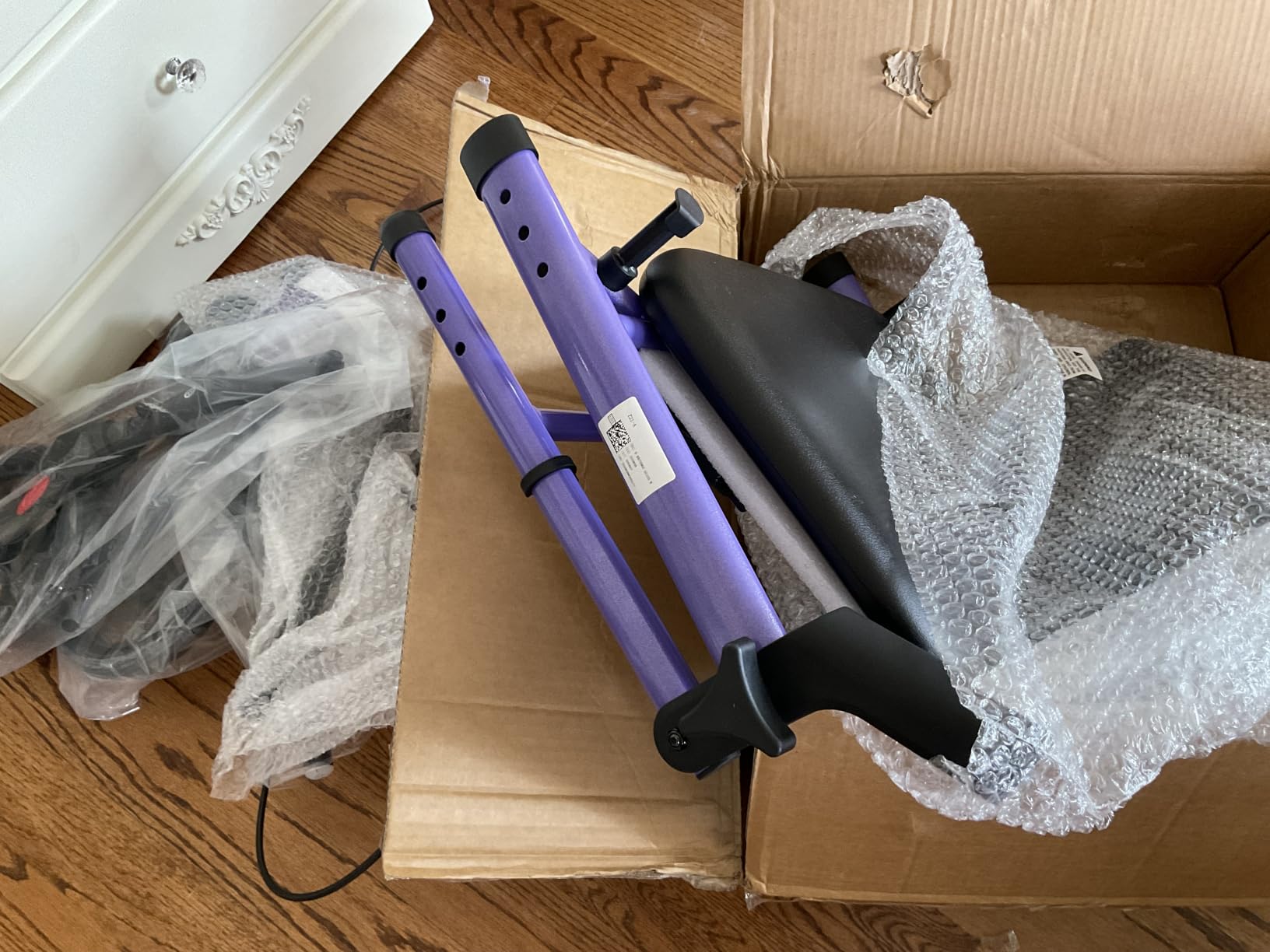
Adjustment is the standout. The handle adjusts across five levels from 31.5 to 36.6 inches, and the seat across three levels from 20 to 22 inches, so a short rider and a tall rider can both get a proper fit from the same frame. That dual adjustment is rarer than the specification sheets suggest, and it matters for households buying for one specific person.
The three-mode braking system covers free rolling, deceleration and a full stop, which is a genuinely useful spread on a slope or uneven ground. A three-second quick fold takes it down to 31.5 by 23.6 by 13.8 inches, and reflective strips on the front wheels and storage bag help in poor light.
Who this rollator suits
This suits a user who tires quickly and needs a real place to sit, combined with an outdoor routine that includes sidewalks, park paths or driveways. It is the model I would suggest when comfort during rests matters as much as the walking itself.
It also suits short-to-average-height users who want seat height control. The listed fit runs from about 4 foot 11 inches to 6 foot 3 inches, and the recommended user weight goes to 350 lb.
Where it falls short
At 22.85 lb it is among the heavier four-wheel models, and owners regularly recommend a second person for loading it into a car. For a user who loads and unloads their own walker without help, that is a meaningful drawback.
The seat height range tops out at 22 inches, which suits shorter riders far better than tall ones. Taller users should look at a model with a 23 to 24 inch seat ceiling instead, and note that the reflective detailing helps but never substitutes for a light or for walking at dusk on unlit roads.
4. HOMLAND 16 Inch Extra Wide Seat Rollator – Best for Resting Comfort

HOMLAND Foldable Rollator Walker with Seat for Seniors, 16″ Enlarged Seat
Weight: 20.4 lb
Seat: 16 x 12 in
Wheels: 8 inch
Fits: 4 ft 7 in to 6 ft 6 in
Pros
- Widest seat in this roundup at 16 by 12 inches
- Loop brakes are easy to squeeze with weak hands
- Wobble-free alloy frame on uneven ground
- Responsive US-based parts replacement
- Wide pouch fits a small oxygen tank
Cons
- 22 inch wide frame will not fit tight doorways
- Too heavy to fold and load alone
- Small set screws are fiddly for stiff hands
- Occasional reports of a loose handlebar
The seat is the reason to look here. A 16 by 12 inch seat with 1.6 inch of cushioning inside a 22 inch wide frame is the most generous resting surface in this roundup, and it is a genuine answer for a user who can walk but cannot stand for long.
Everything else follows the same logic of stability. The frame uses dual-reinforced front supports and a tri-angle load-bearing geometry, and reviewers describe it as wobble-free on uneven outdoor ground. A lifetime metal frame warranty backs that up, which is unusual in this price bracket.
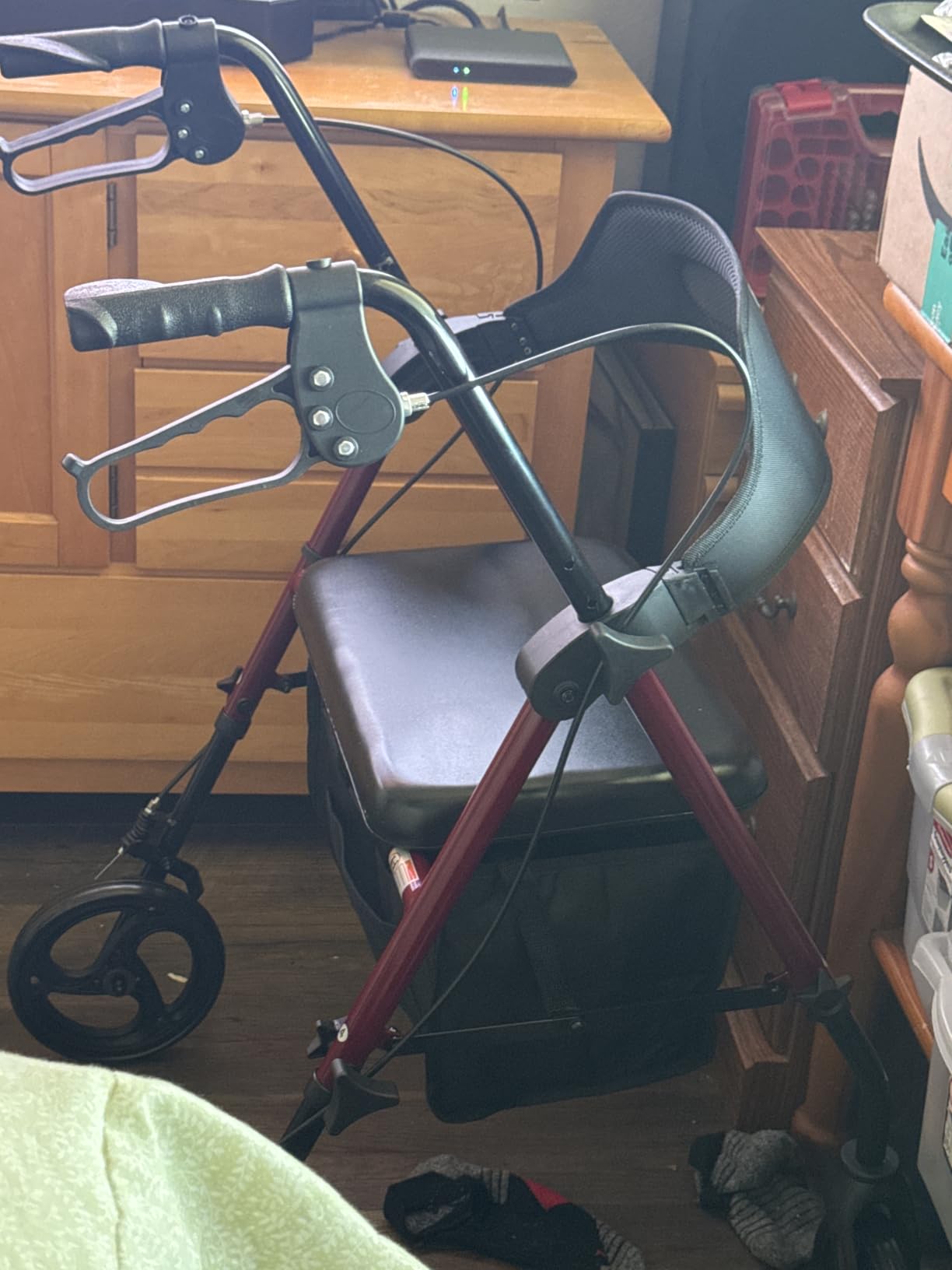
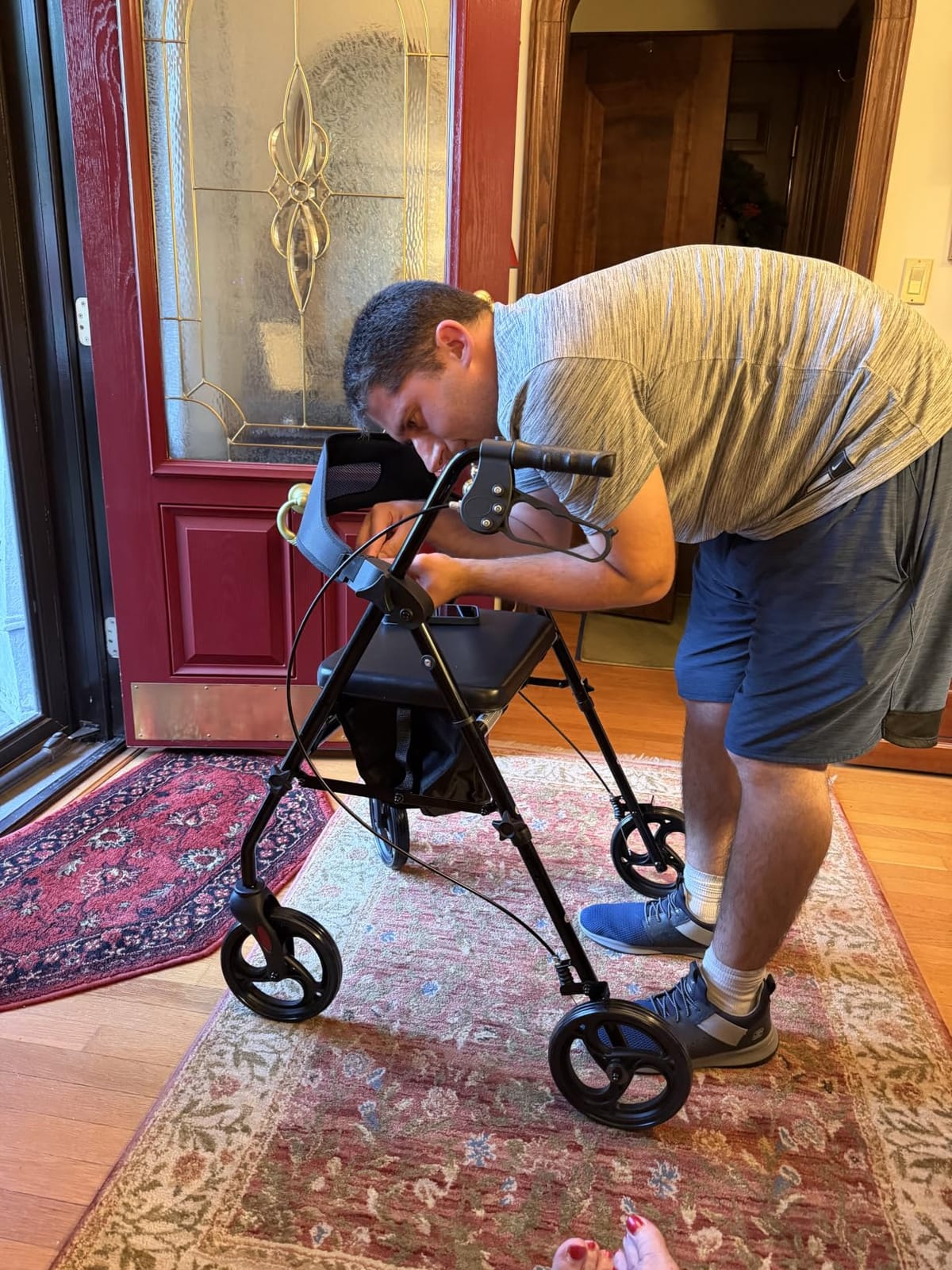
The brakes come with a three-mode system plus loop handles that physical therapists commonly recommend, because a loop can be squeezed with a whole hand rather than pinched between two fingers. That single design choice is often the difference between a rollator that gets used and one that stays in the hallway.
Folding is described as a three-second quick fold, and the mechanisms are enclosed to guard against pinching. Multi-reflective strips help with night visibility, and the under-seat pouch is wide enough to hold a jacket or a small oxygen tank. Assembly is tool-free.
Who this rollator suits
This suits a user who needs to sit often and sit comfortably, and whose home has standard-width doorways and hallways. The listed fit range runs from about 4 foot 7 inches to 6 foot 6 inches, so it covers a broad height band.
It also suits a household that wants parts replaced rather than a whole new unit. Owners report customer service shipping replacement components quickly, which is a meaningful service over a five-year ownership period.
Where it falls short
Footprint is the honest problem. A 22 inch wide frame does not pass through every doorway and bathroom constriction without angling or lifting, and multiple owners note that standard door measurements can check out while the frame still catches.
At 20.4 lb it is too heavy for an older user to fold and load into a car alone, and the small set screws require fine dexterity to tighten. A small number of frames have also arrived with a loose or unseatable handlebar, which customer service resolved.
5. PLANETWALK 3 Wheel Rollator 11 lb – Best for Travel
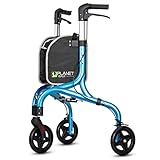
PLANETWALK Premium 3 Wheel Rollator Walker for Seniors – Ultra Lightweight Foldable Aluminum Mobility Aid with Height Adjustable Handle and 7.5 Inch Wheels, Brilliant Blue
Weight: 11 lb
Wheels: 7.5 inch
Capacity: 253 lb
Handle: 32.7-36.7 in
Pros
- Only 11 lb so it can be loaded one-handed
- Tight turning circle fits narrow halls and booths
- Self-locking fold stays folded when parked
- Large removable basket fits a purse or laptop
- Feels sturdier than lighter three-wheel rivals
Cons
- No seat so there is nowhere to rest
- Some frame flex above roughly 150 lb
- Not for heavy users or heavy leaning
- Front wheels can run fast on some surfaces
Eleven pounds changes what a walker can be. This is the only model in the roundup that a senior in their eighties can lift into a car with one hand, and owners say that single fact decides more purchases than any comfort feature.
The trade is the seat. This is a walking aid only, and the specification is explicit that it must not be sat on. Anyone who needs to rest on the way to the shops should skip straight past this one, no matter how much they like the weight.
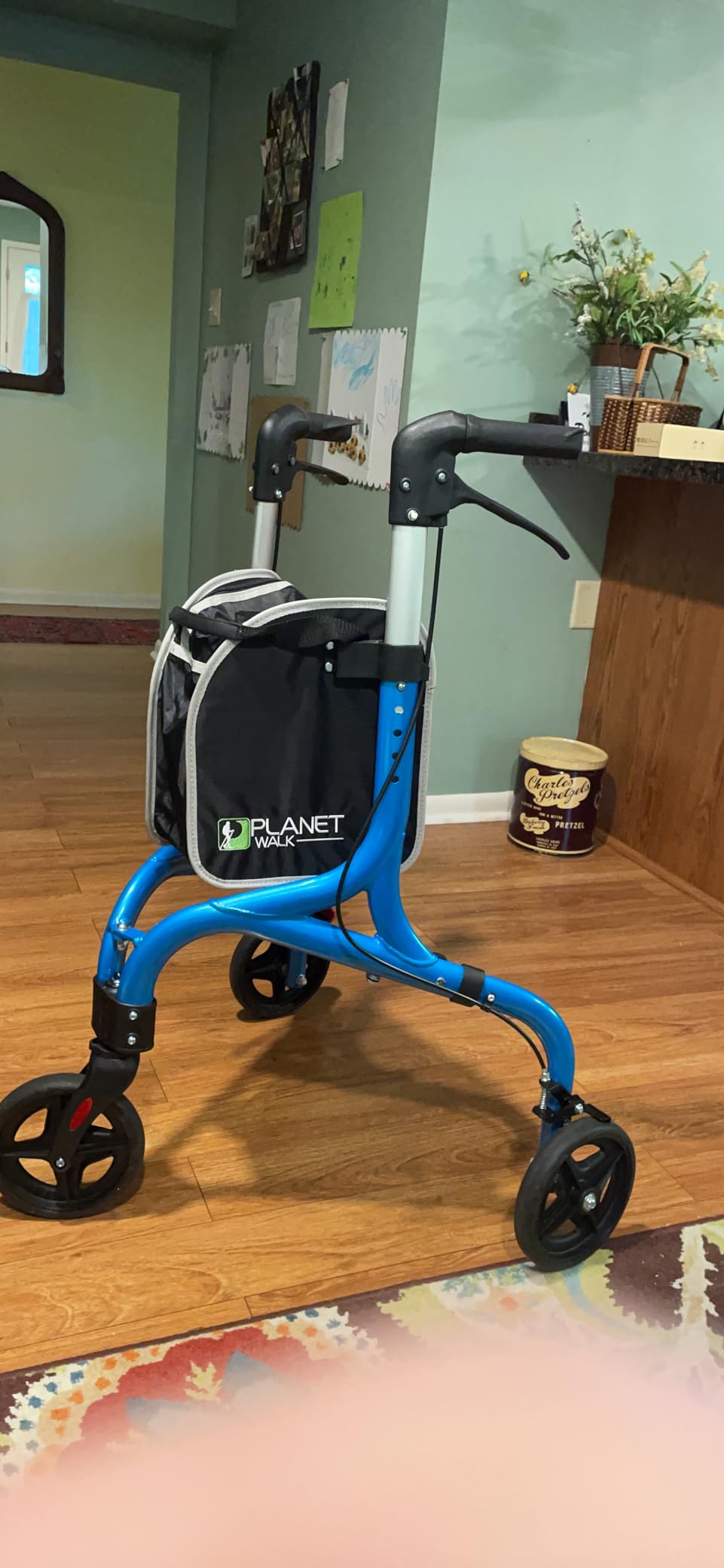
What you get instead is manoeuvrability. Three wheels with a 360 degree rotating front caster turn far tighter than any four-wheel model, which is why this one moves through narrow hallways, restaurant booths and small apartments that a wider rollator struggles with.
The frame is aluminium rated to 253 lb, and the self-locking spring latch folds and unfolds in about a second, staying folded and upright when parked. The two-way parking brake works with upward pressure for downhill speed control and a press to lock. A large removable basket holds everyday items.
Who this rollator suits
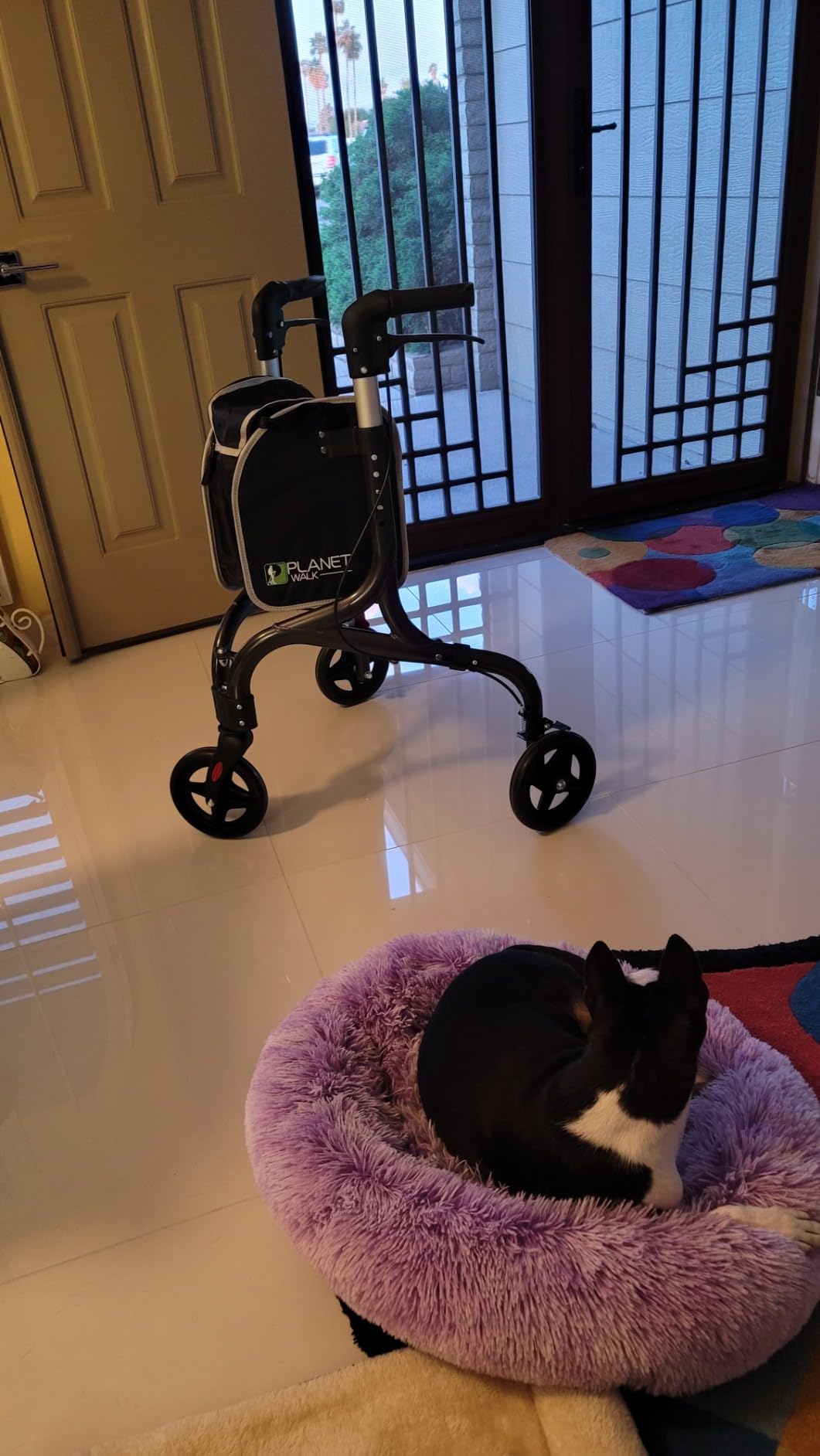
This suits a user who covers short distances independently, has good trunk access or travels frequently, and does not need to sit down mid-route. The listed fit runs from 4.8 to 5.8 feet, with handle height across five levels from 32.7 to 36.7 inches.
It also suits a caregiver who is the one lifting the walker. A single-hand lift removes the single hardest part of owning a mobility aid, and the tight turning radius makes it practical in a home with narrow passages.
Where it falls short
There is no seat, and that is the dealbreaker for a user with fatigue or limited endurance. It is also not built for heavy users, and heavier owners report some wobble and flex in the frame at around 150 lb and above.
The wheels can run slightly fast on some surfaces and need light brake pressure to stay under control, which is worth testing before committing. Anyone who leans heavily on the walker should choose a four-wheel model instead.
6. Drive Medical Nitro Foldable Rollator – Best for All Terrain
Drive Medical RTL10266BK Nitro Foldable Rollator Walker with Seat, Black
Weight: 17.5 lb
Front wheels: 10 inch
Fold: one hand
Rating: 4.8 stars
Pros
- Highest rating in this roundup at 4.8 stars
- 10 inch front casters clear curbs and rough ground
- One-hand fold with a lock that holds it closed
- Tool-free thumb screw moves the backrest height
- Light aluminium frame with a removable pouch
Cons
- Costs the most in this selection
- Limited colour options compared with cheaper models
- No self-lock on the frame when opened
At 4.8 stars across more than 1,800 ratings, this is the highest-rated product in the roundup, and the distribution is heavily concentrated in five stars. Owners repeatedly single out one feature: the 10 inch front casters, which glide over curbs and uneven pavement in a way smaller wheels cannot.
It is also the most credible choice for car transport in this group. The one-hand fold with an under-seat locking mechanism is a real engineering solution rather than a folding frame you have to hold closed, and the 17.5 lb weight keeps the whole task to one person.
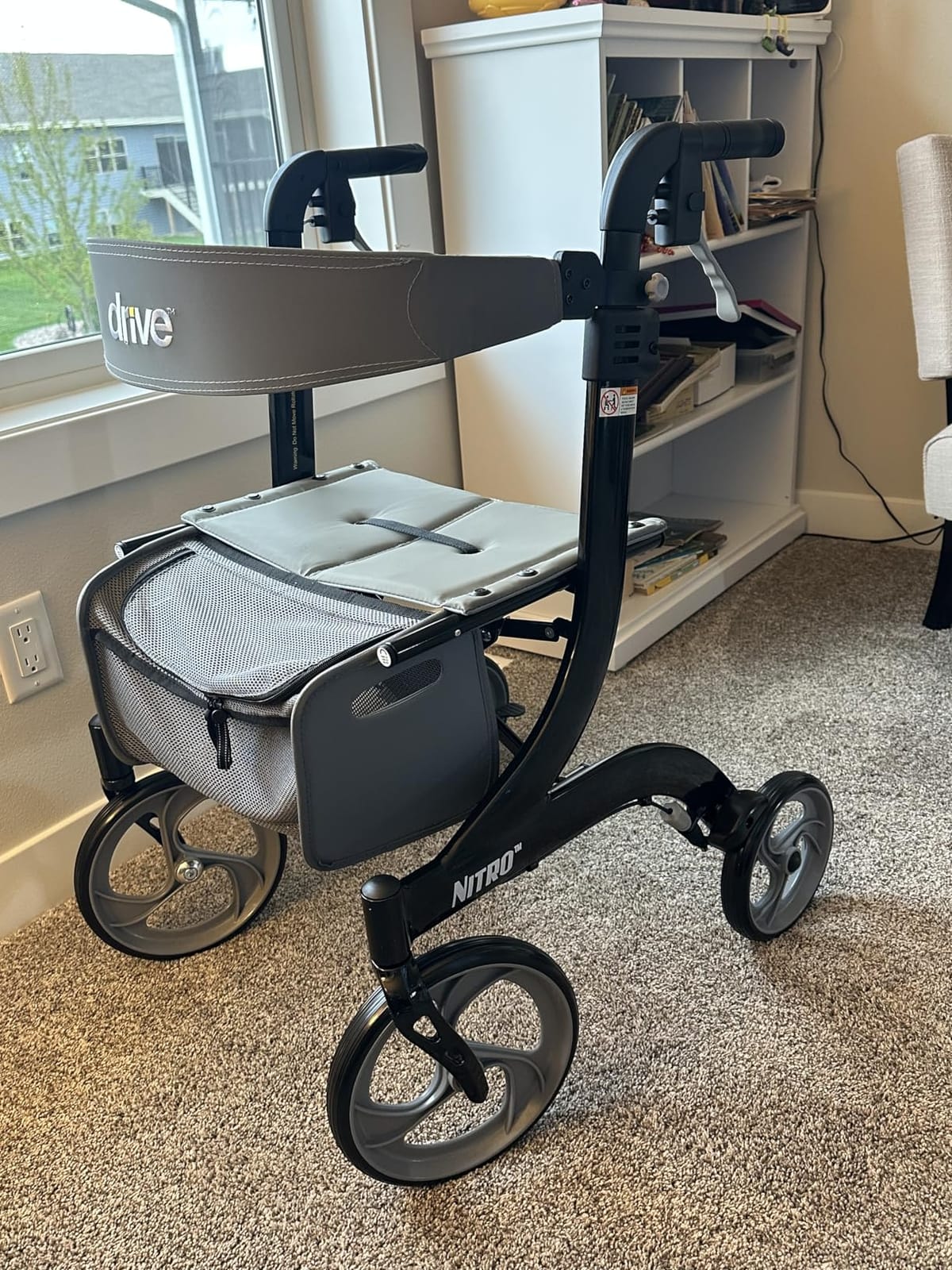
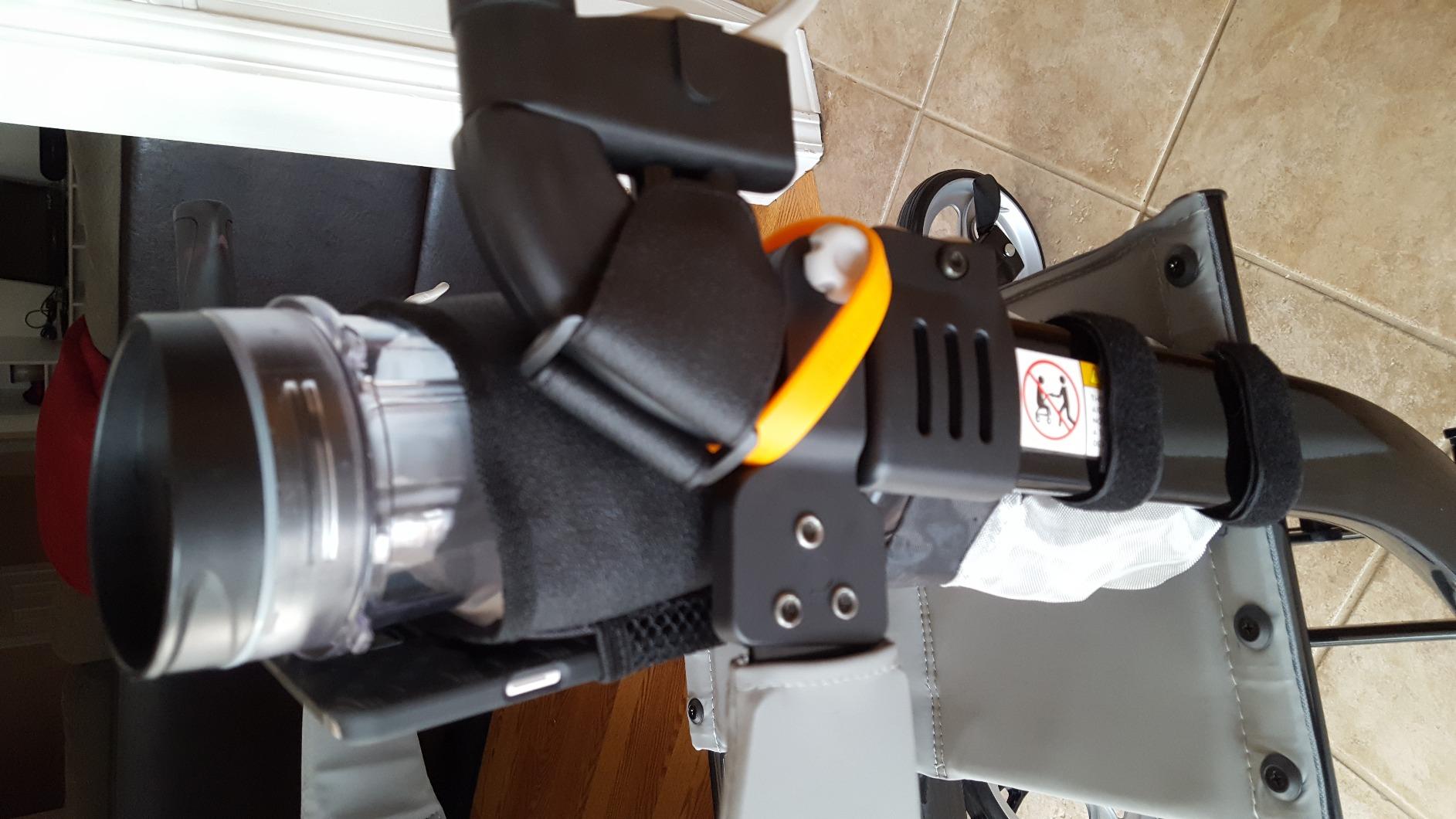
Adjustment is tool-free throughout. Push-button handle height adjustment takes seconds, and a thumb screw moves the backrest height without tools, so a user can reposition the support rather than waiting for a family member. The removable zippered pouch detaches for cleaning or swapping.
This is the model I would steer a user toward if their walks start at a curb and end at a park bench. The wheel diameter is doing the work here. Where smaller casters transmit every crack in the pavement into the handlebars, these roll over it.
Who this rollator suits
This suits a user with a routine that includes curbs, uneven sidewalk and grass, and a household willing to pay more for a frame that lasts. It suits anyone whose daily walk is longer than a trip from bedroom to bathroom.
It also suits a caregiver handling transport alone. The locking one-hand fold is the feature that changes the practical reality of owning a rollator, because the folded unit stays put in a trunk without being wedged.
Where it falls short
The straightforward drawback is cost. It is the most expensive model in this selection, and the premium buys the wheel size, the frame and the folding mechanism rather than softer upholstery or more accessories.
Colour options are limited compared with cheaper imports, and the frame does not self-lock when opened, so a user needs to confirm it is fully seated before leaning on it. Buyers focused purely on indoor use on carpet will find cheaper models that serve them better.
7. Vive Mobility Narrow 3 Wheel Walker – Best for Tight Hallways

Vive Mobility 3 Wheel Walker for Seniors – Foldable Narrow Rollator Walker
Weight: 11 lb
Frame: narrow three-wheel
Lifetime guarantee
Package: 28.5 x 16.5 in
Pros
- Narrow frame clears tight doorways and small apartments
- Wide back wheel spacing and cross-brace add stability
- 11 lb and folds flat enough for a car
- Removable washable bag for storage
- Lifetime guarantee from an established brand
Cons
- No seat for resting on longer walks
- Narrower handle range than most aluminium rivals
- Light suspension means more vibration on rough ground
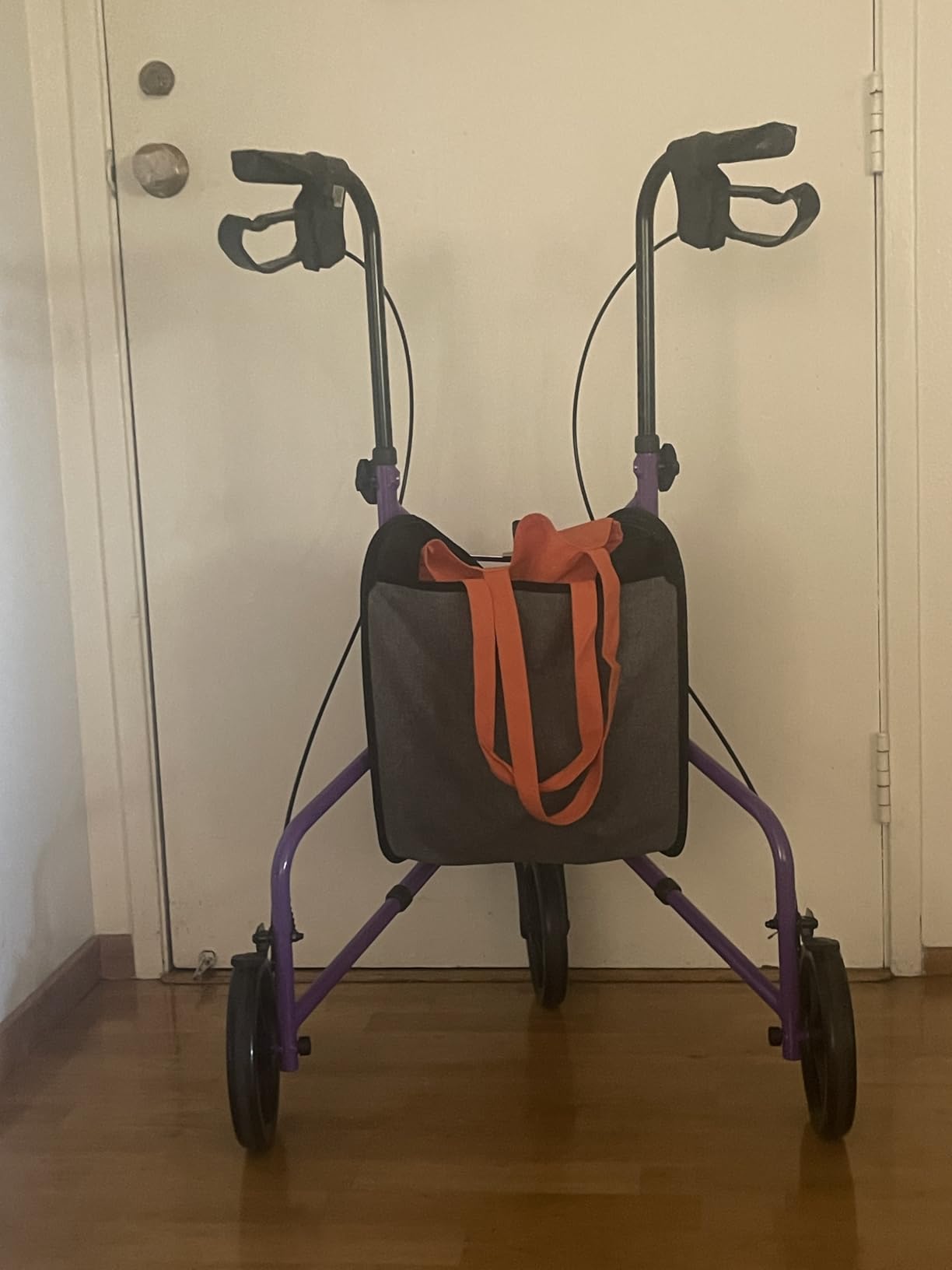
The narrow footprint is the entire point of this model. Buyers choose it because it moves through the doorways and corridors that other rollators jam against, which in an older home is often the difference between using the walker and leaving it in one room.
Stability is the question that always follows a three-wheeler, and here the answer is the wide back wheel spacing with a cross-brace design. Owners credit that layout with better standing stability than many competing three-wheel models, and it is a genuine design answer rather than a marketing claim.
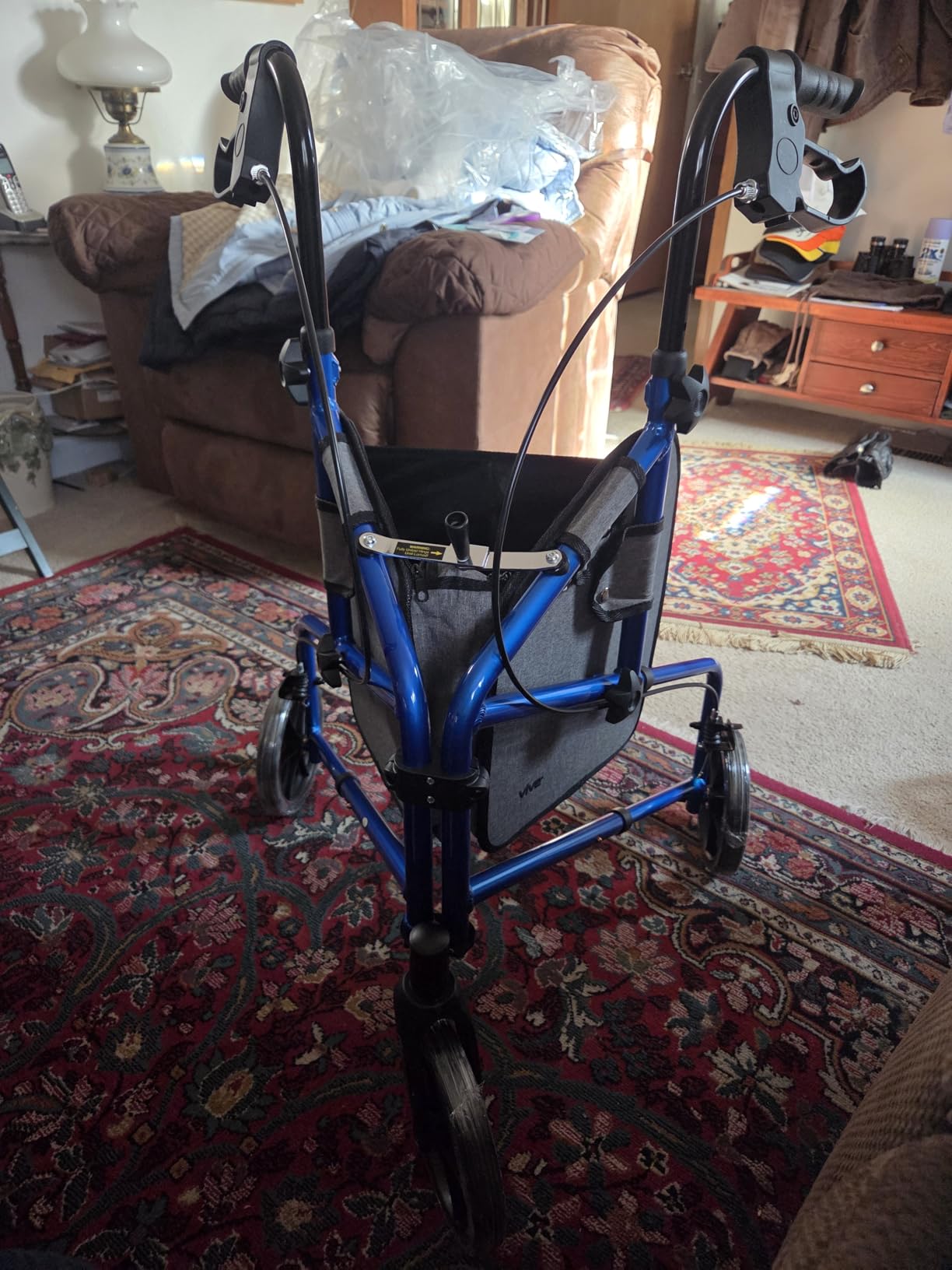
At 11 lb with a foldable frame, it is easy to move between rooms and to put in a car. The handles adjust for a natural hand angle and easy brake access, and the accessory bag is removable and washable, which matters in a home where a walker gets handled often.
The lifetime guarantee is the quiet advantage here. A mobility aid is a long-term purchase, and a brand that stands behind the frame for the life of the product changes the calculation for a buyer who expects to keep it for years.
Who this rollator suits
This suits a user in a small apartment or a home with narrow passages, and a family that wants a walker they can move between rooms without a fight. It also suits anyone who needs to load a walker into a vehicle regularly.
It suits users who walk short distances and stay upright, because there is no seat and no backrest. Think kitchen, hallway, front garden and a route to a parked car, rather than a long walk across a park.
Where it falls short
No seat means no rest, which limits its use on longer outings or for a user with low endurance. The handle height range is also narrower than most aluminium competitors, so a very tall or very short user may not find a comfortable setting.
Light suspension means more vibration on uneven ground, and the narrow frame offers less lateral stability than a four-wheel model when a user leans heavily to one side. Anyone who needs to push down hard on the walker should choose four wheels.
8. Helavo Extra Wide Bariatric Rollator 550 lb Capacity – Best for Heavy Duty

Helavo 28.3″ Extra Wide Bariatric Rollator Walker, 550 lbs Capacity
Weight: 21.4 lb
Capacity: 550 lb
Handle: 33.1-39.0 in
Folds: 37.8 x 28.3 x 13.8 in
Pros
- Only 550 lb rated model in this roundout
- Extra-wide seat larger users rate as comfortable
- Handle seat and backrest all adjust independently
- Large basket plus cane holder and cup holder
- Two-year warranty extendable to three
Cons
- Bulky at 21.4 lb and hard to load or carry upstairs
- Short users under 5 foot 4 inches cannot adjust it low enough
- Brake can still be nudged while locked
- Cup holder catches on doorframes
For a user who needs a real heavy-duty frame, this is the only credible option in the roundup. The reinforced aluminium frame is rated to 550 lb with 22.4 inches of handle spacing, and owners above 250 lb describe it as rigid and stable rather than merely adequate.
The size is not incidental. A wider frame and a wider seat are what allow a heavier user to sit and to push with both hands without the frame twisting, which is where lighter walkers fail for this group of buyers.
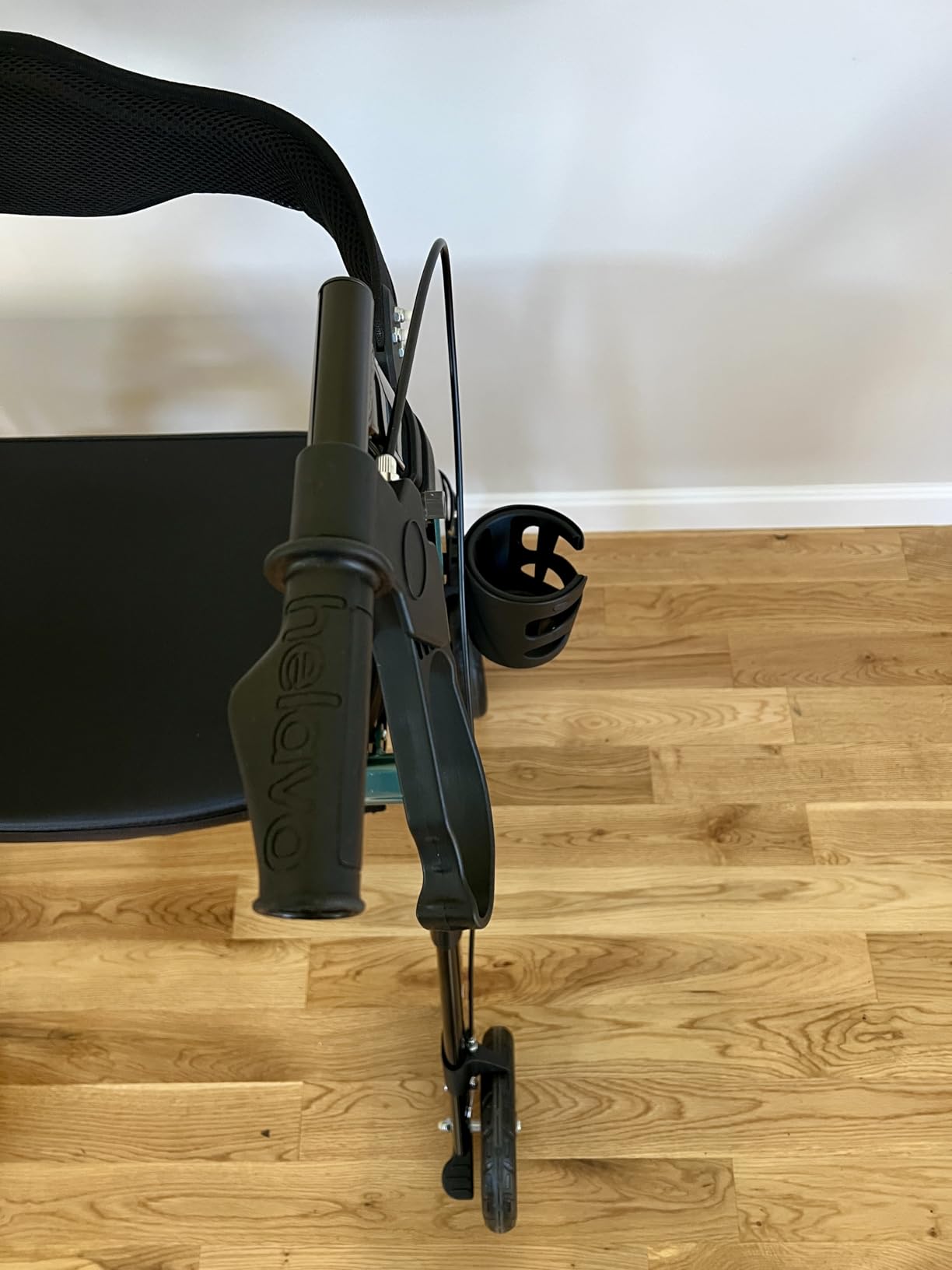
Adjustment is unusually thorough. The handles run from 33.1 to 39 inches, the seat from 20.9 to 22.8 inches, and the backrest adjusts vertically on its own. Being able to set all three independently is what keeps a tall heavy user from hunching over an otherwise capable machine.
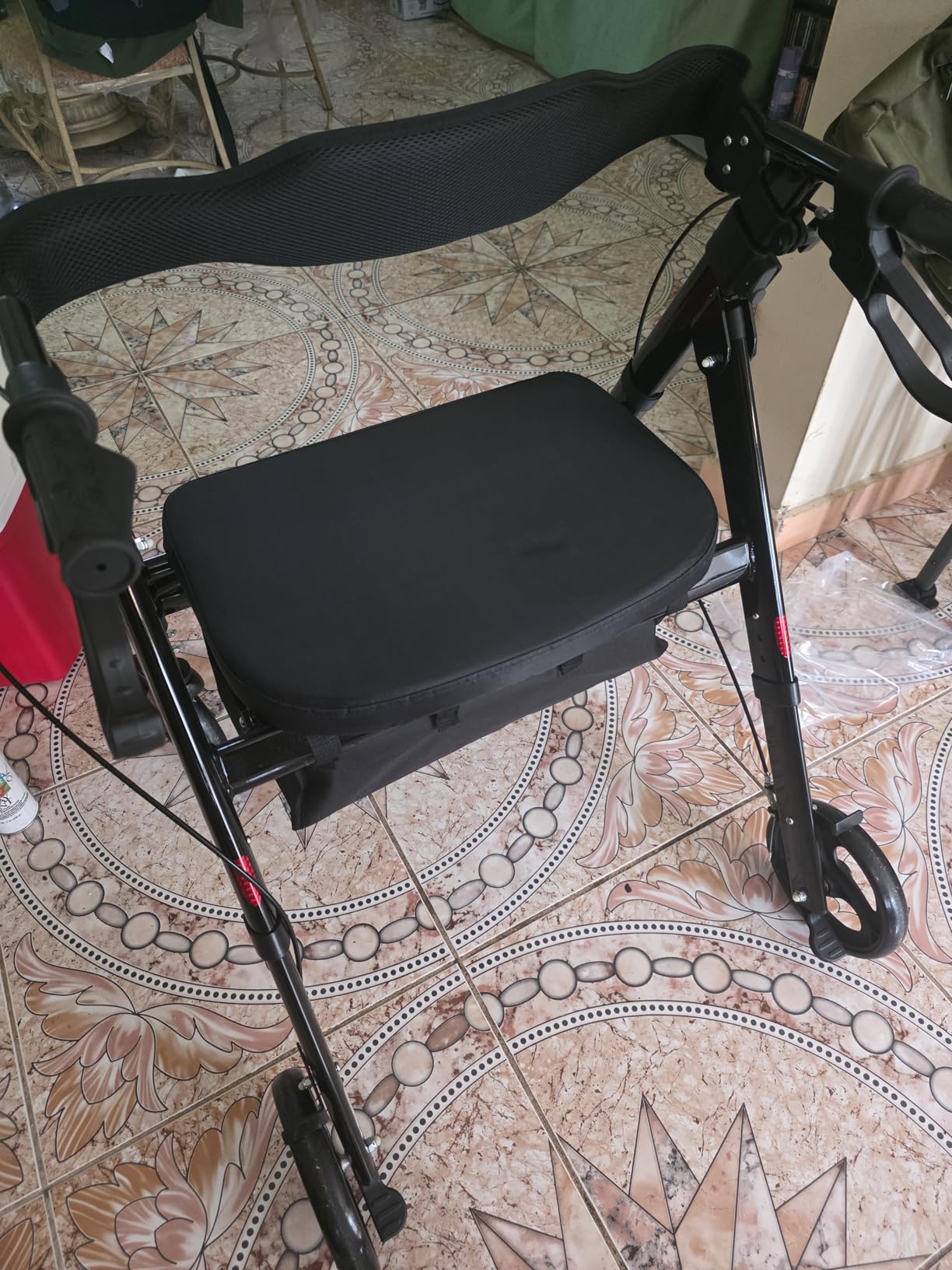
The 8 inch wheels have reinforced spokes, and the braking system includes a parking brake so the frame cannot roll away while a user is sitting or transferring. Under the flip-up seat there is a transport basket, and there are dedicated cane and cup holders. The warranty runs two years and can be extended to three.
Who this rollator suits
This suits users who need a weight capacity well beyond the usual 250 to 300 lb range, and anyone who needs a genuinely wide seat. Buyers at the top of the capacity range confirm it stays stable, which is the question that matters most here.
It also suits tall users who need to get close to 39 inches of handle height with a frame that can take the load. The height range, width and capacity together are the reason this is on the list.
Where it falls short
Size and weight are the unavoidable trade-off. At 21.4 lb with a 28.3 inch folded width, it is genuinely hard to load into a vehicle or carry up a single step, and it will not fit a small trunk or a narrow closet.
Short users under about 5 foot 4 inches cannot adjust the handles down far enough for a comfortable fit. A few owners also note that the brake can still be nudged when locked and that the cup holder catches on doorframes, and the firm seat cushioning can be uncomfortable for a bony user over long sits.
9. HOMLAND 17 lb Rollator with 33 to 40 Inch Handles – Best for Tall Seniors

HOMLAND Foldable Rollator Walkers for Seniors with Seat, 17 lb Lightweight
Weight: 17.6 lb
Handle: 33-40 in
Seat: 20-23 in
Fits: 4 ft 7 in to 6 ft 6 in
Pros
- Handle range reaches 40 inches for users over 6 feet
- Only 17.6 lb while staying sturdy
- 8 inch rubber wheels cross cracked and stony paths
- Memory foam seat plus removable cup holder
- Customer service replaced a backrest and a wheel free
Cons
- Assembly instructions are confusing with small set screws
- Backrest is narrow and sits low
- Folded package is not especially compact
The handle range is the headline. Adjusting from 33 to 40 inches makes this the tallest-adjusting model in the roundup, and several owners who are six feet or over mention specifically that the higher setting is what let them walk upright instead of leaning forward.
Hunching is not a cosmetic issue. A rollator set too low pushes the user into a bent posture, which loads the neck and shoulders and, over months, produces exactly the back pain the walker was meant to prevent. Getting the height right matters more than any feature on the list.
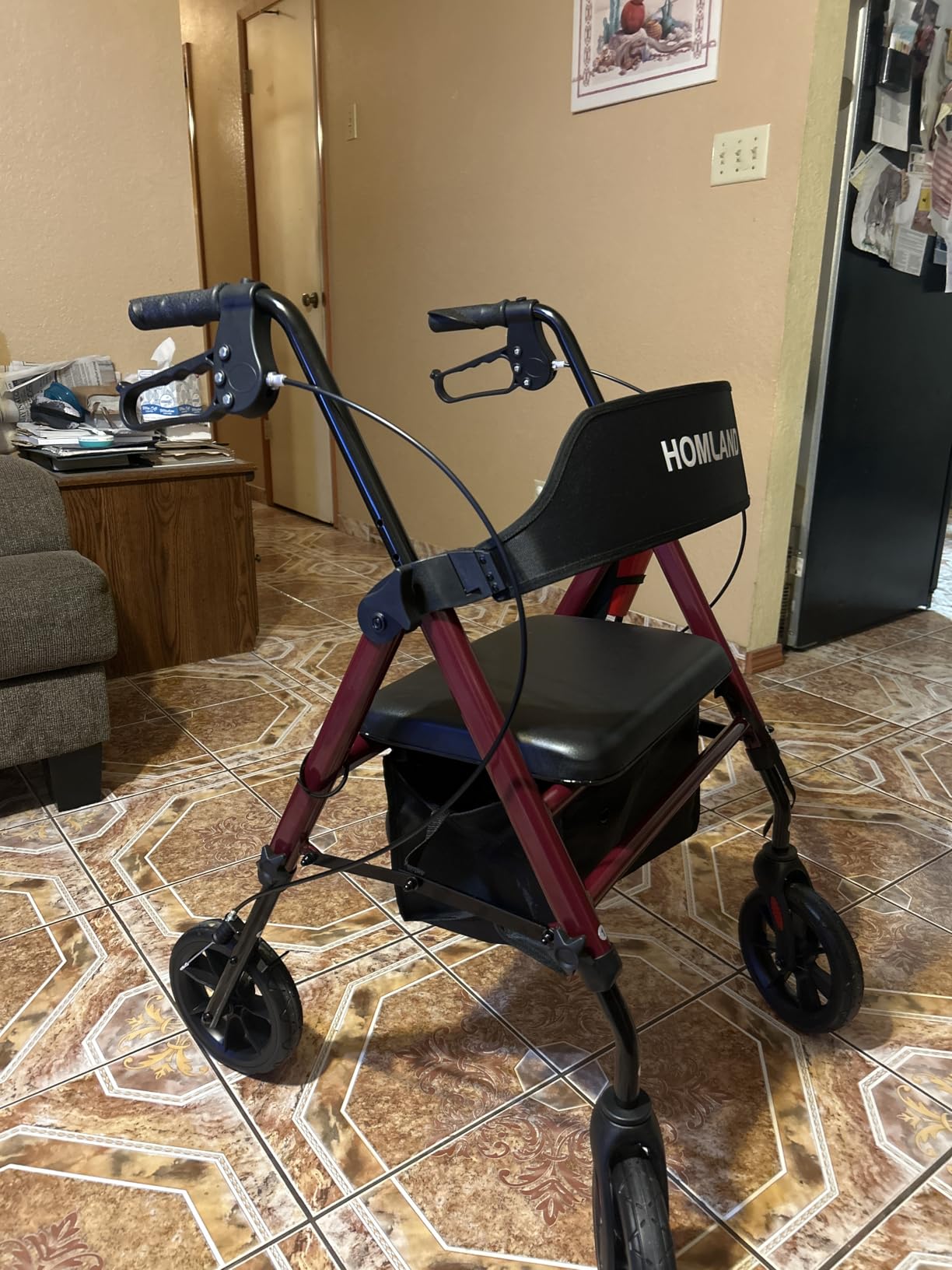
Ride quality is the second strength. The 8 inch premium rubber wheels roll quietly over cracked pavement and stony paths, and the reinforced aluminium alloy frame with double support bars holds a recommended 350 lb while weighing only 17.6 lb.
Seat height adjusts from 20 to 23 inches, which is a higher ceiling than most of the four-wheel models here and matters for a tall user who needs their knees at roughly a right angle when sitting. The fit range runs from about 4 foot 7 inches to 6 foot 6 inches.
Who this rollator suits
This suits a user above six feet who has been unable to find a comfortable height on a standard model, and anyone who needs both a high handle and a high seat. It is a rare combination in a category where handle height usually tops out around 35 to 36 inches.
It also suits households that need a capable outdoor walker without a heavy-duty bulk, since 17.6 lb is light for a frame rated to 350 lb with this wheel size. Removable cup holder, large storage pouch and reflective strips round out the practical details.
Where it falls short
Assembly is the most common complaint, with confusing instructions, mislabelled parts and small set screws that are difficult to tighten with limited dexterity. Budget time for it and have the manual open before starting.
The backrest is narrower and sits lower on the back than the padded panels on the comfort-led models, and the folded package is not especially compact for a car trunk. Buyers who prioritise seating comfort over height range should look at the wider-seat model instead.
10. MAXWALK 12 Inch All Terrain Rollator – Best for Rough Outdoor Ground

MAXWALK Rollator Walker for Seniors with Seat, 12″ All Terrain Wheels, Gold
Weight: 20.3 lb
Wheels: 12 in front / 10 in rear
Capacity: 300 lb
Handle: 33.5-37.4 in
Pros
- Largest wheels in the roundup at 12 inch front and 10 inch rear
- Anti-skid tread and shock absorption on uneven ground
- Brake cables routed inside the frame to avoid tangling
- Dual brakes for downhill control and a parking lock
- Cup holder cane holder and storage pouch included
Cons
- 20.3 lb is heavy for a user with limited strength
- Handle range stops at 37.4 inches
- 300 lb capacity is lower than the heavy-duty options
- Seat is only 17.5 inches wide
If your walking route involves gravel, grass or badly broken pavement, wheel diameter is the variable that decides how the day feels. These are the largest wheels in the roundup at 12 inches in front and 10 inches at the rear, and buyers on loose ground report a noticeably smoother ride than with 6 to 8 inch models.
The triangular aluminium frame adds stability, and anti-skid tread plus shock absorption improve control where the surface is uneven. The whole point of the design is that the user pushes the walker forward rather than lifting it over every irregularity.
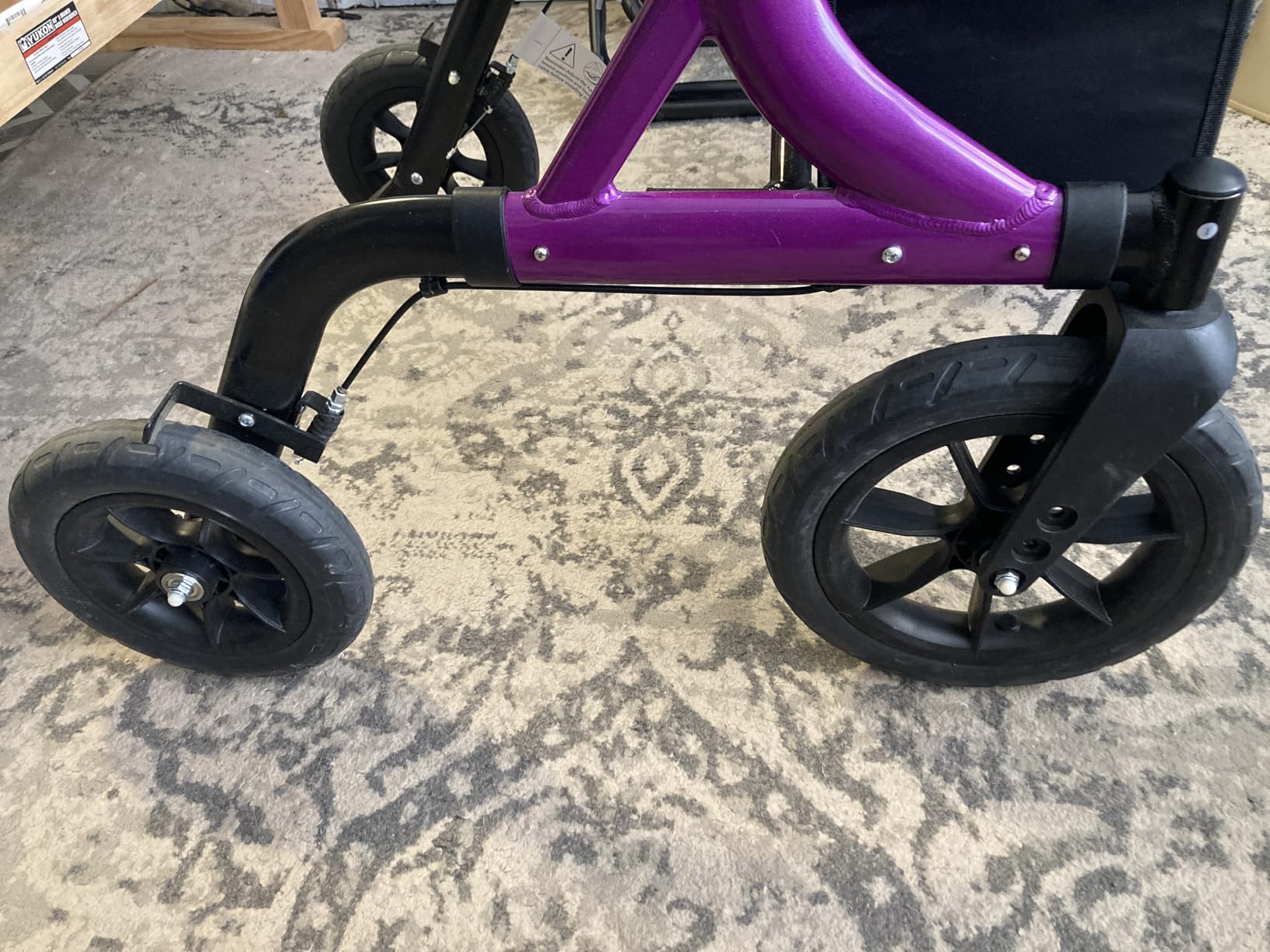
One design choice stands out for its practical effect. The brake cables are routed inside the frame rather than hanging externally, which removes the tangling and snagging that causes trips on external cable models. It is a small decision with a real safety consequence over thousands of outings.
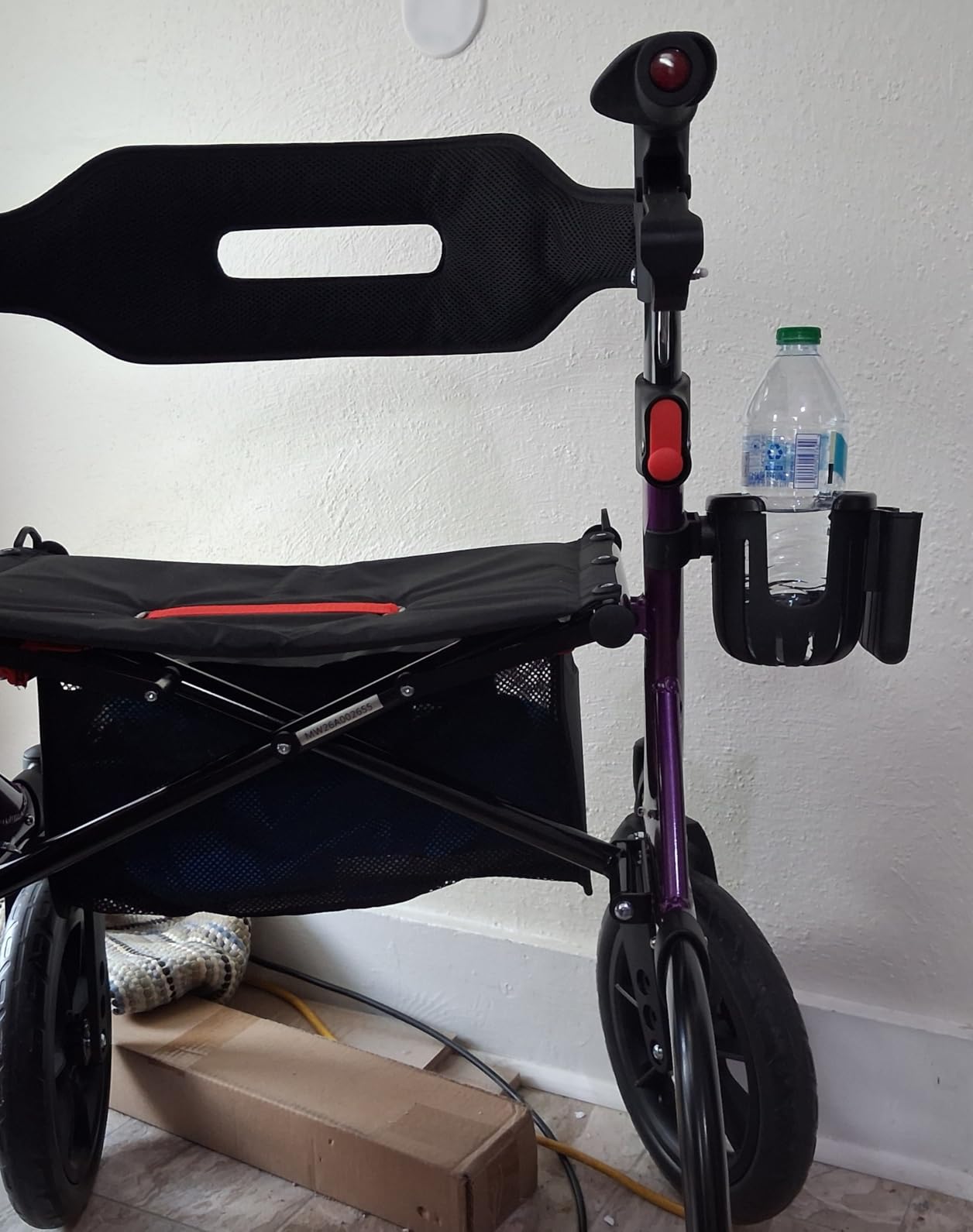
Dual brakes give both downhill speed control and a secure parking lock, and folding takes seconds using a pull cord on the seat. Handle height adjusts across five levels from 33.5 to 37.4 inches, and the listed fit runs from 5 to 6.5 feet. An 18-month warranty is backed by lifetime support.
Who this rollator suits
This suits a user whose route crosses gravel driveways, grass, garden paths or country lanes, and whose home has thresholds or uneven entry points. It also suits anyone who tires on longer outdoor walks and wants to sit when the seating is adequate.
It suits users who are light to moderate in weight, since the frame is rated to 300 lb. The internal cable routing is a genuine safety upgrade for anyone walking near pets, kerbs or garden clutter.
Where it falls short
At 20.3 lb this is a heavy lift for a user with limited upper-body strength, and buyers regularly note the difficulty of loading it into a car. Wheel size, weight and folded bulk are the price of that off-road capability.
Handle adjustment stops at 37.4 inches, which limits the fit for anyone over 6.5 feet, and the 300 lb rating sits below the heavy-duty models. The seat at 17.5 inches wide also offers less lateral room than the extra-wide and bariatric options, so a larger user will feel the difference.
11. PLANET WALK 13 lb Lightweight Rollator – Best for Car Transfers

PLANET WALK Super Lightweight Rollator Walker for Seniors, Foldable Rolling Walker with Seat and 8″ Rubber Wheels for All Terrain, Unique Design Aluminium Frame Sturdy Walkers for Traveling – Blue
Weight: 13 lb
Wheels: 8 inch
Capacity: 300 lb
Folds: 26.5 x 10.9 x 35 in
Pros
- Only 13 lb for a four-wheel rollator with a seat
- One-hand quick fold with a detachable frame
- 18.5 inch wide waterproof seat and widened backrest
- 8 inch anti-skid wheels for uneven ground
- Five handle levels with a two-way parking brake
Cons
- Lowest average rating in this group at 4.4
- 300 lb capacity is among the lower figures
- Handle range starts high at 35 inches
- Fits users from about 4.8 to 5.8 feet
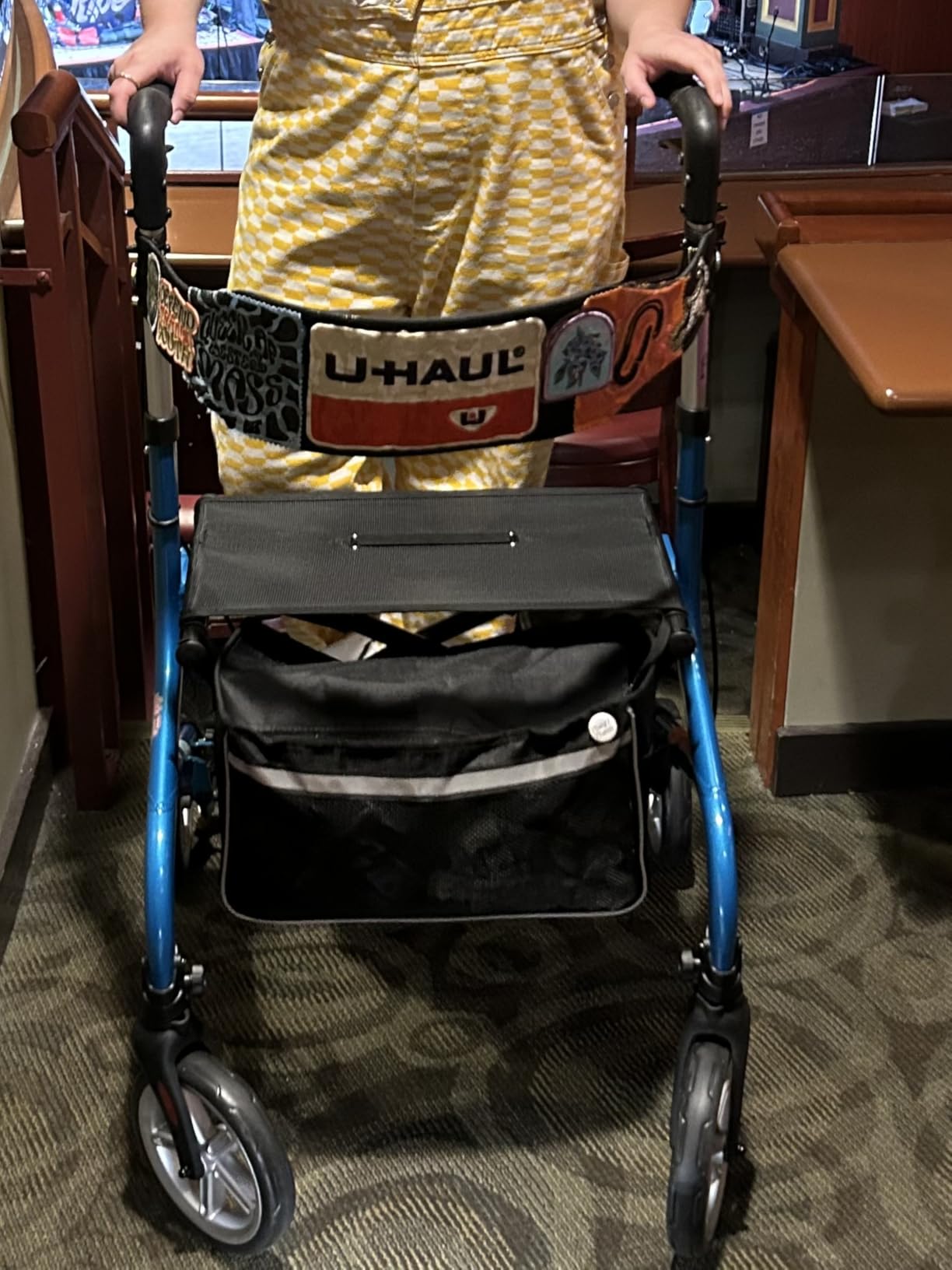
A thirteen-pound frame with a seat is unusual, and that is the entire appeal. Buyers consistently praise the combination because the alternative in this category is usually a four-wheel rollator in the twenty-pound range that a single person cannot load into a car.
The one-hand quick fold and detachable frame design take it further. Once collapsed it measures 26.5 by 10.9 by 35 inches, so it slots into a trunk or a rear footwell rather than needing to be laid across the cargo area.
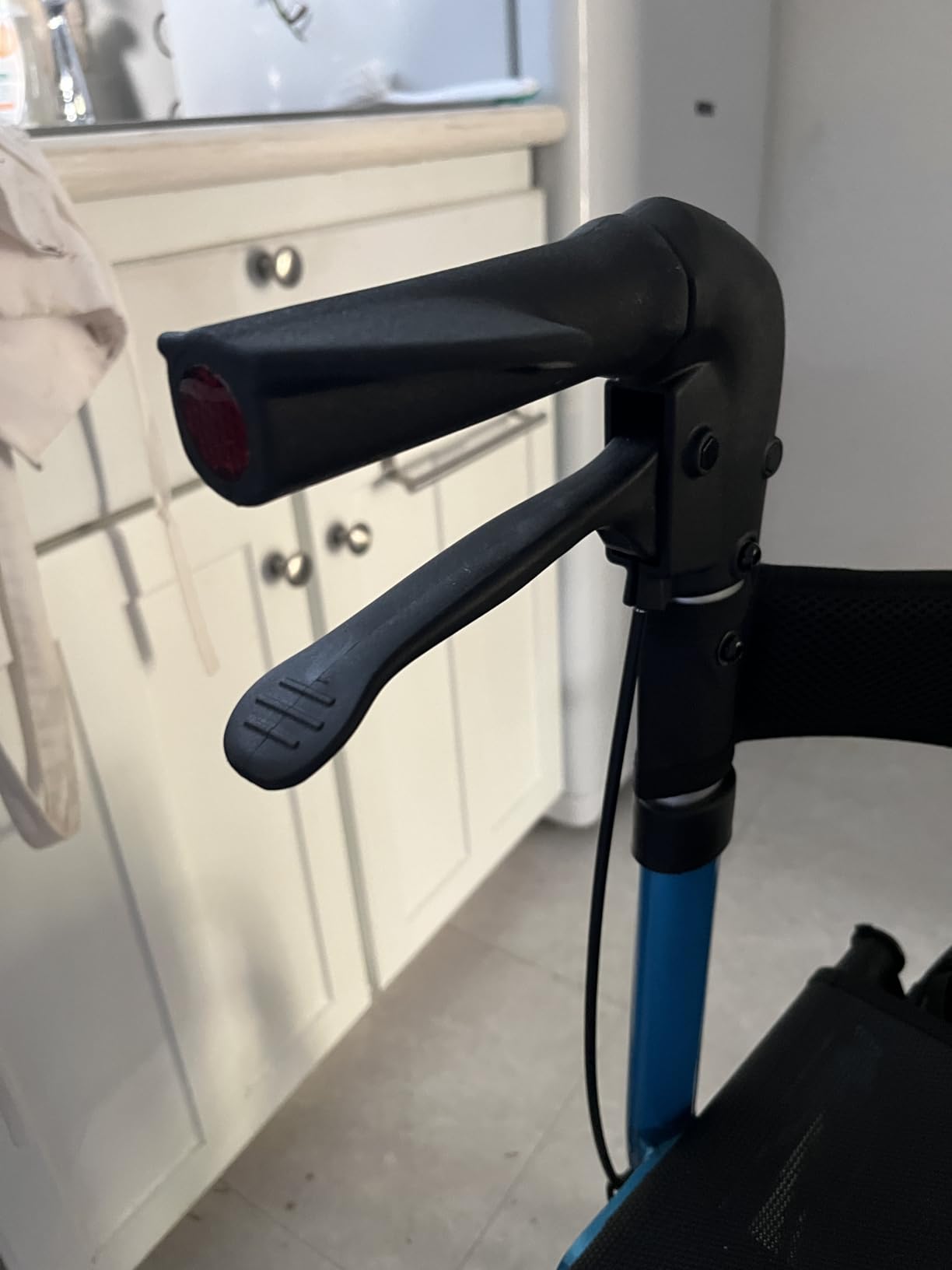
Comfort is better than the weight class suggests. The 18.5 inch wide breathable waterproof seat and a widened backrest give a proper place to rest, and the four 8 inch rubber wheels with anti-skid tread and a 360 degree rotating front caster handle obstacles indoors and out.
The frame is hardened aluminium alloy rated to 300 lb, with a two-way parking brake, dual brakes and reflective strips. Installation videos and an illustrated manual are included, which matters more than it sounds for a product this light and this involved to assemble.
Who this rollator suits
This suits a user who wants a seated rollator they can load into a car without help, or who travels and needs something that breaks down quickly. It also suits a caregiver who moves the walker between rooms and vehicles several times a day.
It suits users around 4.8 to 5.8 feet tall who can manage a handle range of 35 to 39 inches. The waterproof seat is a small but real advantage for a user who spends time outdoors in all weather.
Where it falls short
It carries the lowest average rating in this group at 4.4, with a higher share of two and three-star reviews than the others. The two and three-star themes point to fit limits for taller users and a capacity ceiling below the heavier-duty models.
The handle range starts high at 35 inches, so a shorter rider may struggle to find a comfortable setting, and the 300 lb rating excludes anyone heavier. The 18 inch frame is also less accommodating than the extra-wide and bariatric models through narrow doorways.
12. FlyingJoy 25.6 Inch Wide Rollator with 3 Second Fold

Foldable Rollator Walkers for Seniors with Seat,4 Wheel Rolling Walker
Weight: 17.64 lb
Width: 25.6 in
Capacity: 300 lb
Handle: 32.7-40.2 in
Pros
- Narrow 25.6 inch width passes most standard doorways
- Handles reach 40.2 inches for taller users
- Folds in 3 seconds one-handed
- Tool-free assembly in about 10 minutes
- Modular design allows parts to be replaced
Cons
- Plastic pieces on the leg bases can bump ankles
- Brake cables may need adjusting over time
- 8 inch wheels take more trunk space
- Fits users from 5 foot 3 inches to 6 foot 2 inches
This model solves a specific problem well: a full four-wheel rollator with a 40 inch handle range that still passes through a standard doorway. At 25.6 inches wide, it is among the narrowest full-size frames in this roundup, and the width figure is published rather than vague.
It also has the widest handle span here at 32.7 to 40.2 inches, which makes it a viable tall-user option for anyone who also needs a narrow footprint. The listed user height range is 5 foot 3 inches to 6 foot 2 inches.
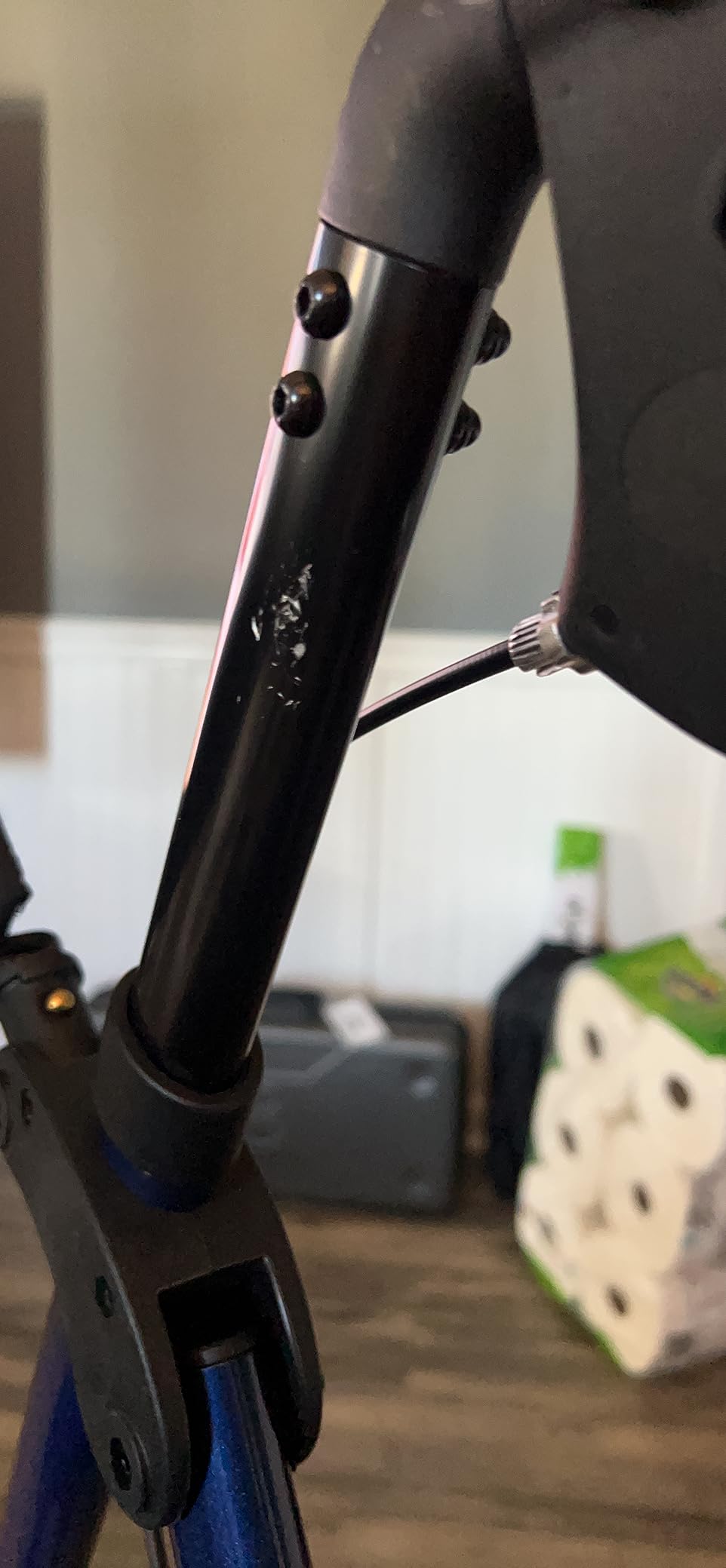
Practical details are well handled. The triangular frame supports 300 lb, the three-mode brakes cover free rolling, deceleration and a parking lock, and the 8 inch airless all-terrain tyres resist punctures and absorb some shock. Reflective strips sit on the front wheels.
Assembly is tool-free and takes about ten minutes with numbered parts that snap together, and the under-seat bag holds up to 11 lb with a cup holder and a cane holder attached. The modular design means worn components can be replaced individually rather than forcing a whole new purchase.
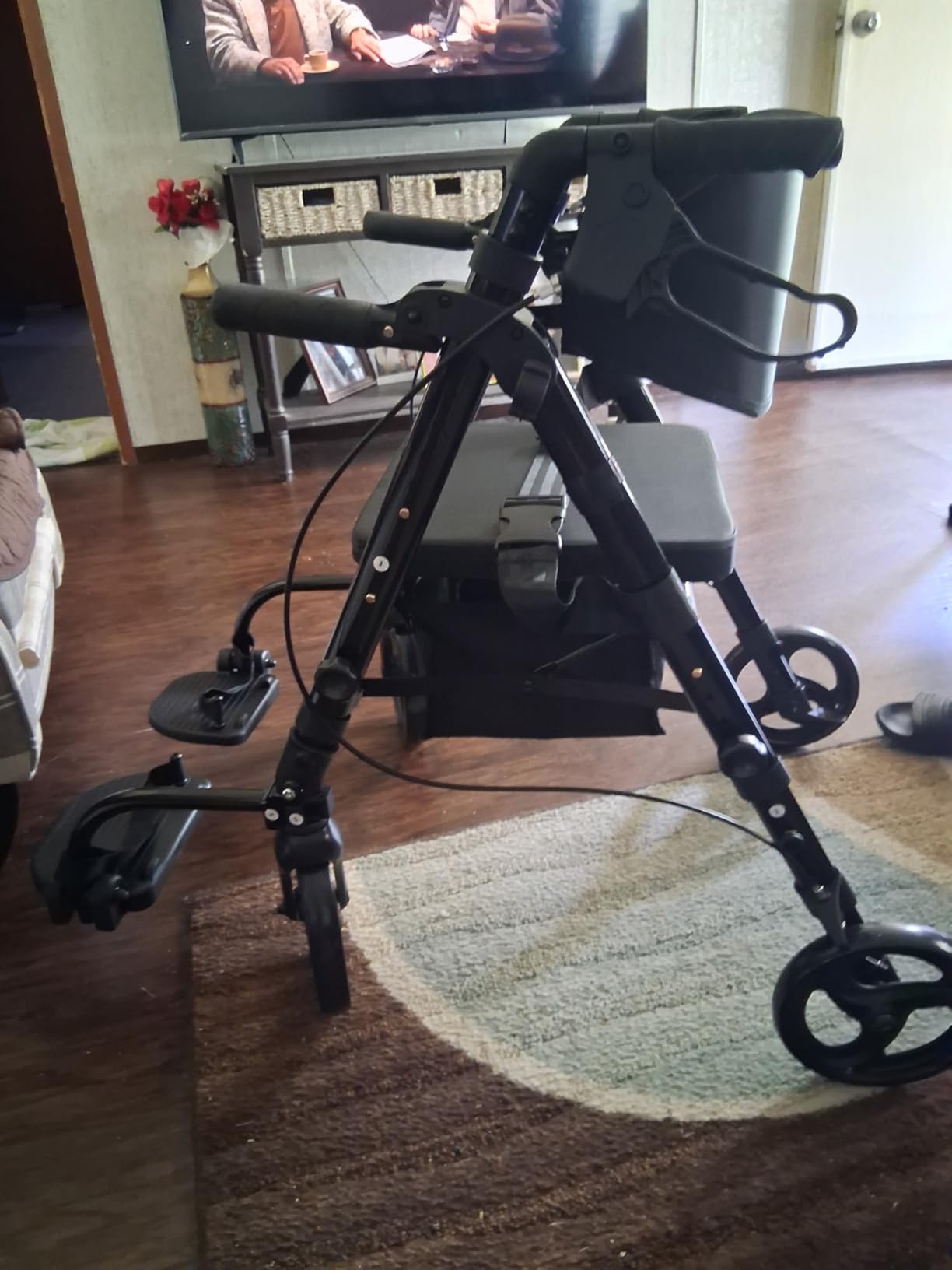
Who this rollator suits
This suits a household where the doorways are standard width but the previous walker was too broad, and a tall user who also needs a narrow frame. It suits anyone who prefers to replace parts over replacing an entire mobility aid.
It also suits buyers who want a clear, published specification sheet. Weight, width, capacity, handle range, seat range and wheel size are all listed, which removes the guesswork that makes rollator shopping frustrating.
Where it falls short
The plastic pieces on the bottoms of the legs are a recurring minor complaint, since they can catch an ankle when the frame is folded and pushed aside. Brake cables may also need occasional adjustment over time, which is normal but worth knowing.
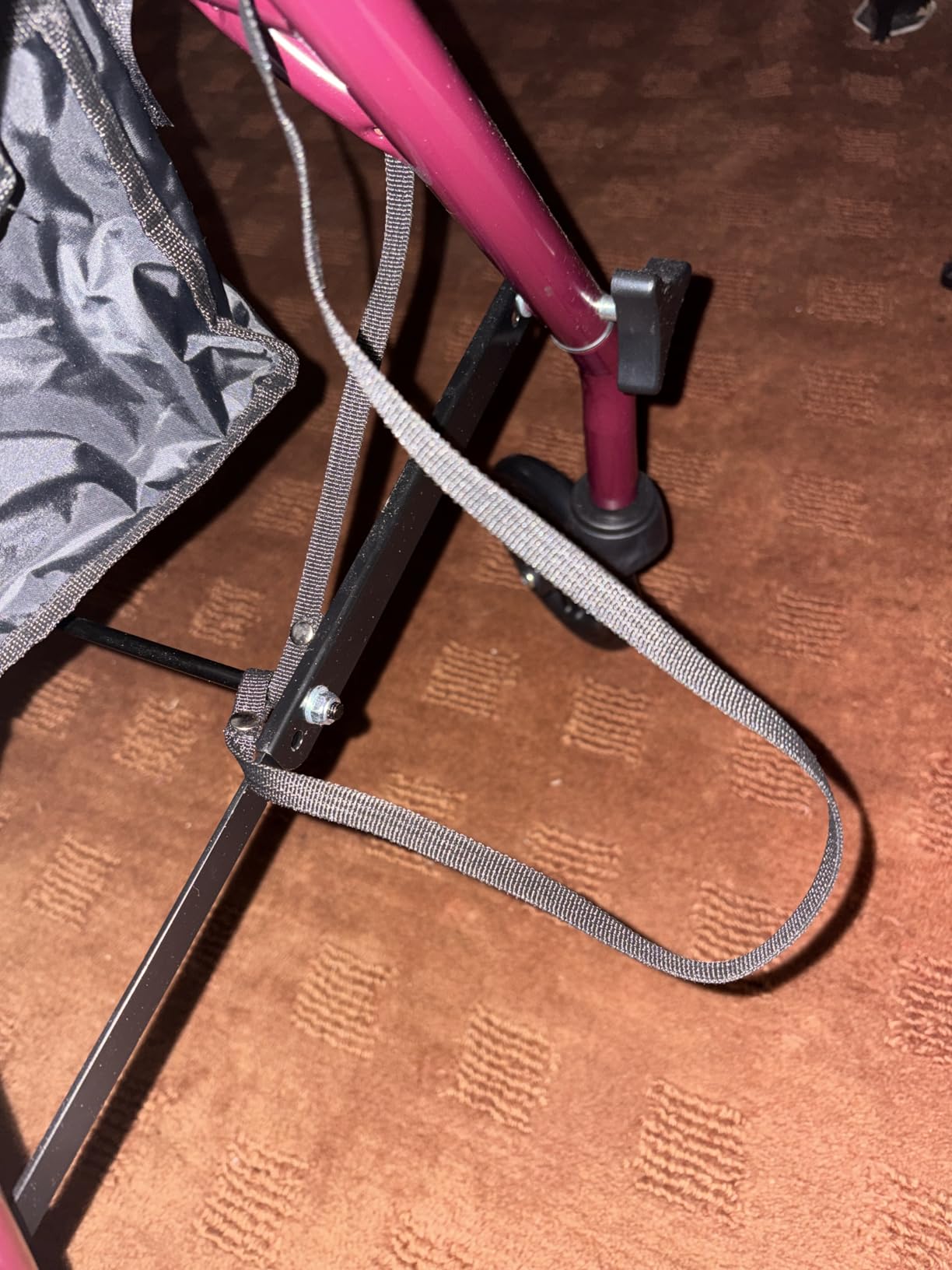
The 8 inch wheels take more space in a car trunk than smaller casters would, and the listed fit stops at 6 foot 2 inches, so the tallest users still have more headroom elsewhere in this roundup. Brake cable clips are fabric strips rather than plastic clips in some units, which can look different from product photos.
What Is a Walker With Wheels?
A walker with wheels is a rollator: a frame on casters with hand brakes, a padded seat, a backrest and an under-seat bag. The user walks behind it with both hands on the handles, releases the brakes to roll, and squeezes them to slow down or to lock the rear wheels when sitting down or stopping on a slope.
The distinction that confuses most buyers is between a two-wheel rolling walker and a rollator. A two-wheel rolling walker is lighter, has no seat, needs the user to lift and set it down with every step, and keeps the user in a slightly hunched posture. A rollator rolls continuously, has four wheels for a larger footprint, and lets the user sit whenever they need to.
A third option, the upright rollator, supports the forearms on padded armrests so the user stands taller. It suits users with arthritis, poor grip strength or conditions that cause a forward-leaning posture. None of the twelve models in this roundup is a forearm-support design, so if that is the requirement, you will need to look at a different product family entirely.
Four-wheel rollators are the most stable and the most common choice. Three-wheel rollators are lighter, turn much more tightly and fit narrow spaces, but they have no seat and offer less lateral stability when the user leans. That trade is the single most important decision in this category.
How to Choose a Rollator Walker: 3 Wheel vs 4 Wheel
Start by matching the frame to the ground. Six inch wheels, which appear on the value pick in this roundup, handle indoor flooring and short paved routes. Eight inch wheels are the sweet spot for most people because they clear thresholds and small cracks without the bulk of larger wheels. Ten to twelve inch wheels are for gravel, grass and broken pavement, and they cost you weight and trunk space.
Then match the wheel count to the user’s stamina and space. Choose a four-wheel model if the user needs to sit, if they lean on the frame, if the home has standard-width hallways, or if stability is the priority. Choose a three-wheel model if the user walks upright without needing rest, if the home is tight or the route includes restaurants and shops, and if a light frame that one person can lift matters more than having a seat.
Next, check the weight capacity against the user’s actual weight with some headroom. Most models in this roundup sit between 250 and 350 lb, and only one reaches 550 lb. A frame rated exactly at the user’s weight will feel less stable over time and offers nothing if the user’s weight changes.
Then check the frame width against the narrowest doorway on the route. This is where over-wide models disappoint their buyers. A nominal 36 inch door is not the same as a walker that turns without catching, and the difference matters most in a hallway with a turn in it.
Finally, test the brakes. Push the handles up and the wheels should roll freely with no drag. Squeeze them and the rear wheels should slow and then lock. If the levers feel squishy, if the wheels keep creeping after locking, or if the cables need several full pulls, keep looking. Loose brakes that will not lock are the most cited safety complaint in this category.
If a shopping trip is possible, we would strongly recommend one. Brakes, wheel glide, fold action and handle feel are all things that specifications cannot describe, and they take about ten minutes to assess in person. Related independence purchases are covered in our guides to the best smartwatches for seniors and the best cameras for seniors.
How to Measure Your Correct Handle Height
The rule is simple: with the user standing upright in shoes they would normally wear, the top of the handle should sit level with the crease of the wrist, with elbows relaxed at the sides. If it is higher, the user will lean forward. If it is lower, they will hunch and load their shoulders.
Step one, have the user stand against a wall in normal indoor shoes, arms hanging naturally. Do not measure barefoot or in slippers, and do not measure while sitting, because seated height and standing height differ.
Step two, measure from the floor to the crease of the wrist at the side of the body. That is the target number. Write it down before you open any product page, because most listings only publish the range.
Step three, compare that number against the published handle range of the model you are considering. If your measurement sits above the top of the range, that model will not fit and no amount of adjustment will change it. In this roundup, most models top out between 35 and 37 inches, only two reach 40 inches or more, and one is fixed at a low 31 to 35 inch range.
Step four, check the seat height the same way. Sit the user on a straight-backed chair and measure from the floor to the top of the kneecap. Knee height should be very close to the seat height, which gives the hips a right angle and reduces the strain that makes sitting worse than standing for some users.
Step five, for a shorter user, measure before ordering. Short users are the most commonly underserved group in this category, because most rollators are designed around an average-height adult male. A user under five feet four inches needs a low seat and low handles, and a model whose handle range begins above their target will leave them bent forward from the first day.
Red Flags to Check Before You Buy
Brakes that do not fully lock are the number one red flag. Test the lock in the shop or immediately on arrival, and if the rear wheels creep while locked, return it. A rollator that rolls away while a user is transferring is a genuine fall risk, and a brake that needs several squeezes to engage is usually a cable tension problem that will worsen.
A weight capacity claim that is not printed on the frame is the second red flag. Capacity is a structural fact about a specific frame, and a listing that states it only in marketing copy is worth treating carefully. Check the specification, and be sceptical of any capacity well above what comparable models in the same weight class claim.
The third red flag is an undersized or flimsy seat. If the seat cannot comfortably carry the user’s weight, sitting becomes a worse option than standing, and the rollator’s main advantage disappears. Seat width matters more than seat height for larger users, and a thin foam pad over a tube is the cheapest version of this problem.
Also check the frame joints. Riveted and welded joints indicate a load-bearing frame. Stitched or glued tubing indicates a lighter-duty build that is more likely to develop wobble after a year of outdoor use, and wobble in a walker changes how safe it feels immediately.
Finally, look at the return window and the parts policy before you order. Mobility aids get returned for height mismatch far more often than for defects, and a seller with a generous return policy and a stocked parts department is worth more than a slightly better specification sheet elsewhere. Brands that replace individual components rather than only whole units are the ones to favour for a five-year purchase.
For existing owners, a weekly routine helps more than most people expect. Check the brakes before every outing, wipe the wheels and check the axles for hair and grit weekly, and keep the frame dry in storage. Wheel debris builds up quietly and announces itself only when the rollator stops tracking straight.
Will Insurance or Medicare Pay for a Rollator Walker?
Medicare coverage for rollator walkers is genuinely inconsistent, and families are often surprised. Original Medicare typically covers a standard walker and a standard rollator as Durable Medical Equipment when a doctor documents medical necessity and the equipment is ordered through an approved supplier. What frequently gets denied is a premium or feature-specific rollator, because the benefit is written to a basic standard.
In practice, the most common experience is that a standard rollator is approved but the chosen model is outside what the supplier can bill, or the request is denied as not meeting coverage criteria. Families then pay out of pocket for the model they actually need. The most useful step is to obtain the order and the documentation before purchase, not after.
Medicaid rules vary by state and are often more generous than Original Medicare for mobility equipment, particularly for people who need a bariatric frame or a narrow-frame model. A local medical supply store that is also a Medicaid-authorised supplier is the fastest way to find out what your specific plan covers.
Medicaid and insurance aside, the practical advice is to price in ownership rather than assume reimbursement. A rollator that fits the user’s height and weight will be used daily for years, and buying the wrong one means paying twice, because a height mismatch is the most common reason these products come back.
Please treat this section as general information rather than coverage advice. Coverage decisions are individual, and your doctor, physical therapist and insurance provider can tell you exactly what your plan allows.
A note on safety and fit: this roundup is general buying information, not medical advice. Balance, gait and strength conditions vary widely between individuals, and the right mobility aid depends on your specific situation. Talk to your doctor or physical therapist before choosing a walker, particularly if you are recovering from surgery or managing a neurological condition. If your ability to bear weight safely changes, ask a physical therapist to reassess your fit rather than adjusting it yourself.
Frequently Asked Questions
What is the highest rated rollator walker?
Among the twelve models reviewed here, the Drive Medical Nitro Foldable Rollator carries the highest average rating at 4.8 stars across more than 1,800 ratings, with the distribution concentrated in five stars. The highest-rated pick by volume is the Drive Medical steel rollator at 4.6 stars across more than 51,000 ratings. Rating volume matters as much as the score, because a very small sample can produce a flattering average.
What is the best rollator walker for older people?
The best rollator walker for most older adults is a four-wheel model with 8 inch wheels, a locking hand brake and a padded seat, because it works on both indoor flooring and ordinary pavement. The Drive Medical steel rollator is the safest general answer, the VOCIC Z21 leads on seating comfort, and the Medline model is the value choice with a 350 lb capacity. Height fit matters more than any specification.
Which is better, a 3-wheel or 4-wheel rollator?
Choose a four-wheel rollator if the user needs to sit down, leans on the frame, or has a standard-width home. Choose a three-wheel rollator if the user walks upright without resting, the route includes narrow hallways, restaurants or shops, and a light frame that one person can load into a car is the priority. Three-wheel models turn much more tightly but have no seat and less lateral stability.
Will Medicare pay for a rollator walker for seniors?
Original Medicare can cover a standard rollator as Durable Medical Equipment when a doctor documents medical necessity and the item is supplied by an approved supplier. Premium or feature-specific rollators are frequently denied, and families often pay out of pocket for the specific model they need. Medicaid varies by state and is often more generous. Get the order and documentation before purchase rather than after.
What is the difference between a rolling walker and a rollator?
A two-wheel rolling walker is lighter and cheaper but has no seat, and the user must lift and set it down with every step, which encourages a hunched posture. A rollator has four wheels, a continuous rolling action, a padded seat, a backrest and an under-seat bag, so the user can walk longer and rest whenever fatigue hits. A three-wheel rollator sits between them, with a tighter turning circle and no seat.
Are rollators suitable for tall people?
Yes, provided the handle range is tall enough. The correct setting is level with the wrist crease while standing upright in normal shoes. Most rollators top out at 35 to 37 inches, so users above about six feet often need a tall model, and two models in this roundup reach 40 inches or more. Check both handle height and seat height, since a seat that is too low increases hip and knee strain.
The Best Walkers for Seniors With Wheels in 2026
After comparing twelve rollator walkers, the best walkers for seniors with wheels fall into clear groups rather than one winner. The Drive Medical steel rollator is the default recommendation for most households because it has the largest review history, a frame that stays straight over years, and a weight that one person can manage. The Medline steel rollator is the better buy when weight capacity matters, and the VOCIC Z21 is the one to choose when the user rests often.
The rest are specialisations. The Nitro takes curbs and rough pavement in stride, the Helavo is the only true heavy-duty option, the two HOMLAND models cover oversized seating and tall users, the MAXWALK handles gravel, and the three-wheel models win on weight and turning circle. Whichever you pick, measure wrist height first and test the brakes before the walker leaves your hands.