
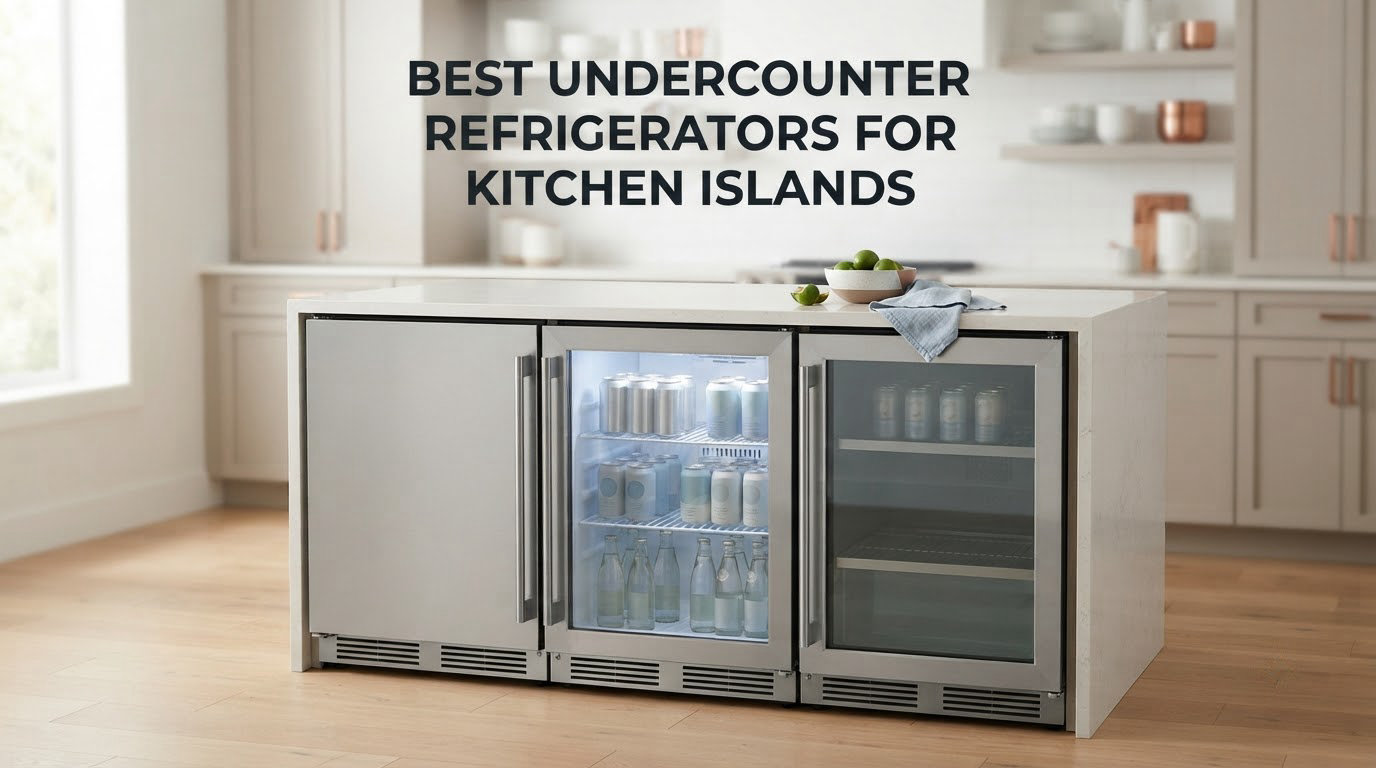
An undercounter refrigerator is a compact, low-profile fridge sized to slide into a 24-inch (or 15-inch) base cabinet so drinks, snacks and prep ingredients stay within arm’s reach at a kitchen island. If you are hunting for the best undercounter refrigerators for kitchen islands, this guide compares 10 real models on the things that actually decide whether a unit works in an island: venting, cutout width, how cold it actually gets, noise beside seating, and drawer access. Every spec below comes from the manufacturer listing and the customer reviews, verified against an independent fridge thermometer where owners reported doing so. Last updated in 2026.
The gap between an undercounter fridge and a full-size refrigerator is not capacity, it is placement. A full-size fridge is a destination you walk to. An island refrigerator is a tool you use without breaking conversation, which is why fit and venting matter more here than anywhere else in the kitchen. Get the venting wrong and the compressor runs hot inside an enclosed cabinet; get the width wrong and the cabinet has to be re-cut after the countertop is templated.
There is one more trap worth naming early. Almost every unit in this category is a beverage cooler, not a food-safe refrigerator. Their published ranges run from 37F up to 65F, and the food-safe band sits at or below 40F. A r/HomeImprovement owner put it plainly when a remodel buyer assumed otherwise: those units are designed to chill beverages, which is nowhere near as cold as an approved food storage temperature. We flag below which models actually hold the low end of their range.
Table of Contents
Top 3 Picks for Best Undercounter Refrigerators for Kitchen Islands in 2026

EUHOMY RU-DD05 Double Drawer
- 4.9 cu. ft.
- 21 bottles and 70 cans
- Front-vented for built-in install
- 304 stainless
- 37-65F

Tylza TYBC145 145-Can Drawer
- 4.9 cu. ft.
- 145 cans
- Under 38 dB running noise
- IPX4 304 stainless
- auto-close drawers

Velieta KMYL150 210-Can Glass Door
- 5.3 cu. ft.
- up to 210 cans
- Front-vented built-in or freestanding
- Double-tempered glass door
- 37-64F
Best Undercounter Refrigerators for Kitchen Islands
Every model below fits a standard 24-inch island cabinet opening, and all ten are front-vented or convertible, which is the first thing to confirm on any island install. Capacity is the manufacturer’s usable cubic footage; can counts assume tightly packed 12 oz cans, and real-world mixed-drink capacity runs lower.
| Product | Specifications | Action |
|---|---|---|
| EUHOMY RU-DD05 Double Drawer |
|
Check Latest Price |
| Tylza TYBC145 Drawer Beverage Fridge |
|
Check Latest Price |
| Velieta KMYL150 Glass Door Cooler |
|
Check Latest Price |
 FoMup FM24D-4 Drawer Cooler FoMup FM24D-4 Drawer Cooler |
|
Check Latest Price |
 Antarctic Star BC-145B Antarctic Star BC-145B |
|
Check Latest Price |
 Velivi KMCT145 Drawer Refrigerator Velivi KMCT145 Drawer Refrigerator |
|
Check Latest Price |
 EUHOMY BRU-04 Glass Door EUHOMY BRU-04 Glass Door |
|
Check Latest Price |
 Feelfunn BR002-150SI Feelfunn BR002-150SI |
|
Check Latest Price |
 HCK C150-SD HCK C150-SD |
|
Check Latest Price |
 ORYMUSE HXYC150E Double Drawer ORYMUSE HXYC150E Double Drawer |
|
Check Latest Price |
1. EUHOMY RU-DD05 Double Drawer Fridge – Best Overall for Islands
EUHOMY Under Counter Double Drawer Fridge, 24 Inch Outdoor Refrigerator
4.9 cu. ft.
22.6D x 23.4W x 34.3H
304 stainless
37-65F
1-year warranty
Pros
- Front vent design needs no cabinet modification
- 4.9 cu. ft. holds 21 wine bottles and 70 cans
- Self-locking side rails rated to 50 kg per drawer
- Digital panel with power-failure memory
- ETL DOE and CEC certified
Cons
- Condensation can form and freeze on interior side walls
- Bottom coils are exposed and need vacuuming about once a year
- Compressor noise rises noticeably when fully loaded
This is the unit we keep coming back to because of its review volume. Thirteen hundred and seventy-eight ratings is far more evidence than anything else in the category, and 65 percent of those ratings are five stars. Owners use it for drinks, snacks and overflow groceries, and the pattern across reviews is consistent: the front-vent design drops it under a counter with no cabinet modification, which removes the single biggest install risk on an island.
The layout is two drawers with self-locking side rails that hold 50 kg per drawer, and the top drawer is specced for 21 wine bottles while the lower holds 70 cans. Each drawer has an extendable shelf, so you can change the split between bottles and cans as hosting gets serious.
Construction is outdoor-grade 304 stainless steel with airtight wear-resistant door seals and a 360-degree three-dimensional air duct, and the refrigerant is R-600A. Energy use is disclosed at 175 kWh per year, which is a figure you can actually compare against your utility bill, and the listing also claims seven years of EU spare part availability. That matters more for an island unit than the sticker price, because a sealed cabinet cavity is a bad place to discover your compressor is no longer made.
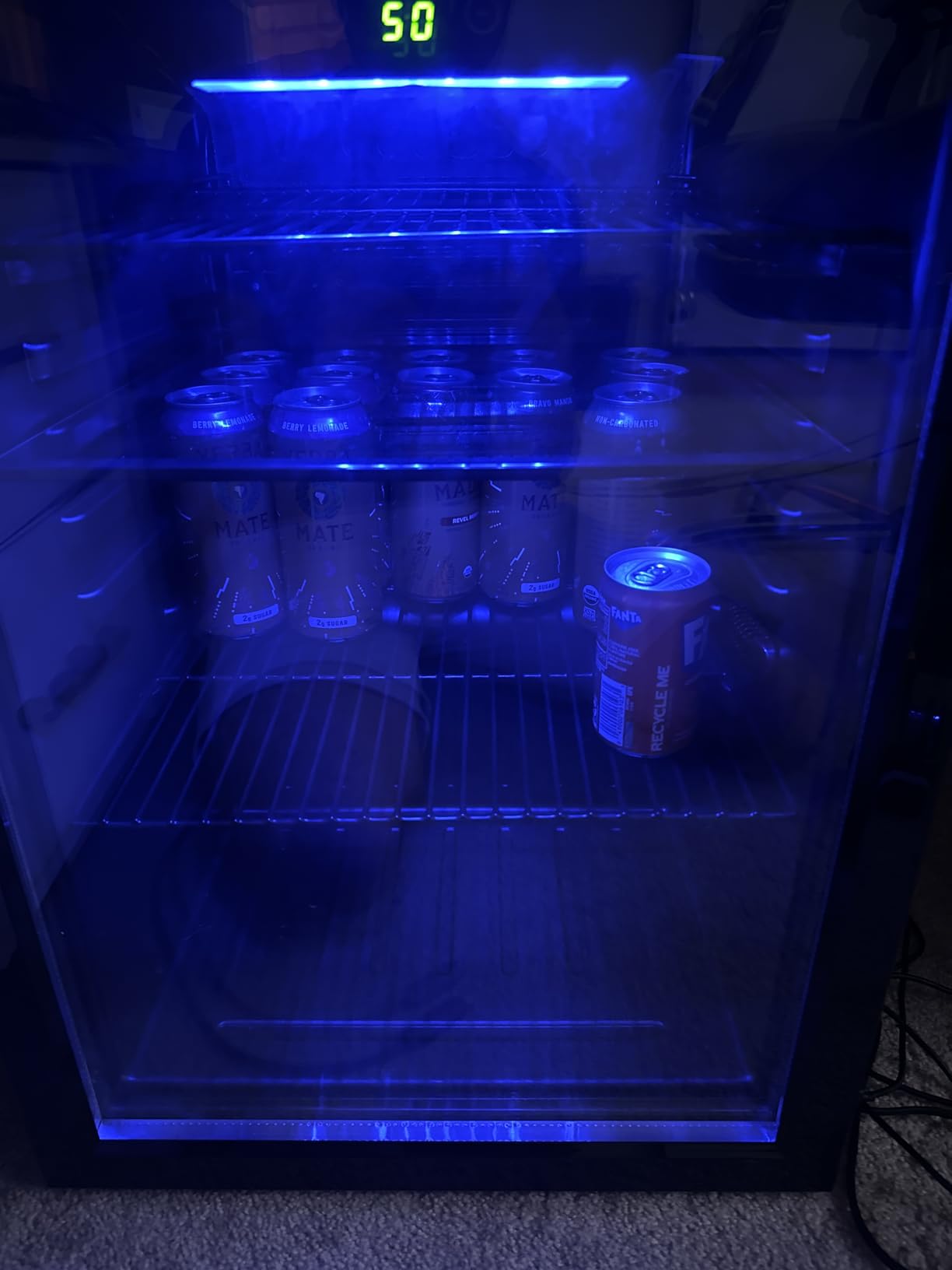
The temperature panel runs 37F to 65F with a real-time display, an LED cold light sensor and power-failure memory. The 1-year warranty is the shortest meaningful coverage on this list, and several owners report temperature drift upward after loading warm drinks with a slow recovery, so give it time before you judge the setpoint.
The recurring complaint is condensation, which can form and freeze on the interior side walls and drip onto contents. The bottom set of coils is also exposed, so plan on vacuuming them roughly once a year, and note that compressor noise increases noticeably when the cabinet is fully loaded. A small number of buyers also report a defective unit that never cooled properly.
What makes it work on an island
Front venting with bottom active cooling means it can sit flush in a cabinet with no rear or side clearance. At 23.4 inches wide and 34.3 inches tall, it drops into a standard 24-inch base cabinet opening without a custom cutout.
The two-drawer layout means nobody has to kneel and reach past a row of bottles for a water. For a cook working alone, that is the difference between the fridge being useful and being ignored.
Where it falls short
The 1-year warranty is thin, and the drawer rails are the first mechanical part likely to need replacing. If your island is next to a seating overhang where conversation happens, the noise increase under full load is worth listening to before you commit.
It is also a beverage-and-snack tool, not a grocery store. Nothing in the 37F floor suggests it holds food-safe temperature in a hot kitchen.
2. Tylza TYBC145 145-Can Drawer Fridge – Top Rated Runner for Open Kitchens
Tylza 24″ Drawer Beverage Fridge 145 Can Stainless Quiet
4.9 cu. ft.
22.63D x 23.42W x 34.25H
under 38 dB
IPX4 304 stainless
Pros
- Under 38 dB running noise with minimal vibration
- Consistent set temperatures across two drawer zones
- IPX4 waterproof 304 stainless door
- Built-in and freestanding installation
- Responsive customer support sending replacement parts
Cons
- Heavy and locking casters are not factory installed
- Bottle shelving is sized around 750 ml bottles
- Bottom shelf is fixed and does not slide out
- Upper and lower zone ranges are not identical
Noise is the reason this one makes the list. The published rating is under 38 dB, and owners repeatedly describe it as quieter than other appliances in the same room, which is exactly the concern that comes up when an island doubles as a bar with a seating overhang. Multiple multi-year owners report continued reliability, and 77 percent of ratings are five stars.
The dual-layer drawer design uses compartmentalized shelves with automatic closing, and the rotary scroll compressor holds set temperatures consistently across the two drawer zones. Capacity is 4.9 cubic feet, marketed at 145 standard 12 oz cans, with an outdoor-rated 304 stainless door carrying an IPX4 waterproof rating for corrosion, rain and rust resistance.
Both built-in and freestanding installation are supported, so it can sit proud in a cabinet run or flush in a designed opening. Minimal assembly is generally just attaching the door handle, and several buyers single out customer support as responsive even after a warranty issue, including sending replacement parts rather than pushing a return.
Two practical limits are worth planning around. The bottle shelving is designed around standard 750 ml bottles, so wider bottles reduce the advertised capacity, and the bottom shelf is fixed rather than sliding, which limits access to oversized bottles. Upper and lower zone temperature ranges are also not identical, so you cannot always set both zones to the same number.
At 99 pounds, plan a two-person install, and note that locking casters are not factory installed, which makes positioning awkward inside a tight cabinet.
Where this model earns its place
If your island has seating on the overhang, this is the one to demo. The sub-38 dB figure and the repeated owner comments about it being the quietest appliance in the room make it the safest pick for conversational spaces.
Two drawer zones also let you keep sparkling water at one setting and beer at another, which the identical-range competitors cannot do.
Where it falls short
The fixed bottom shelf is a real access problem in a drawer fridge, because the items you most want sit at the back with no way to slide them forward. Add that to the 750 ml bottle assumption and your true capacity drops fast if you store large-format bottles.
The 1-year warranty and the non-factory casters suggest this is built for a straightforward install in a cabinet, not a heavy-use bar that gets moved around.
3. Velieta KMYL150 210-Can Glass Door – Best Capacity per Cubic Foot
Velieta 24 Inch Beverage Refrigerator Cooler,210 Cans Wide Beverage and Beer Fridge with Glass Door and Powerful Cooling Compressor, Built-in/Freestanding Drink Fridge for Kitchen, Bar or Office
5.3 cu. ft.
22.6D x 23.4W x 34.3H
37-64F
3 detachable shelves
1-year warranty
Pros
- Up to 210 cans in a standard 24-inch body
- 5.3 cu. ft. with 3 detachable metal shelves
- Front ventilation supports true under-counter installation
- Low-vibration compressor with interior exhaust fan
- Key safety door lock and blue LED lighting
Cons
- Glass door loses cold air in hot rooms and sweats outside
- Internal exhaust fan adds a faint mechanical noise
- 210-can figure assumes shelves packed tightly
Capacity is the headline here. Five-point-three cubic feet with three detachable metal shelves is the most beverage volume we found in a body that still measures 23.4 inches wide, and owners consistently call out the unusually large can count packed into a standard undercounter footprint. The range is 37F to 64F with front ventilation for under-counter or freestanding installation.
Rather than drawers, it uses a single door in a stainless frame with two layers of tempered glass, plus an internal exhaust fan for air circulation and blue LED interior lighting. There is a key safety door lock, a large digital display, and power-off temperature history restore. Seventy-four percent of the 1128 ratings are five stars.
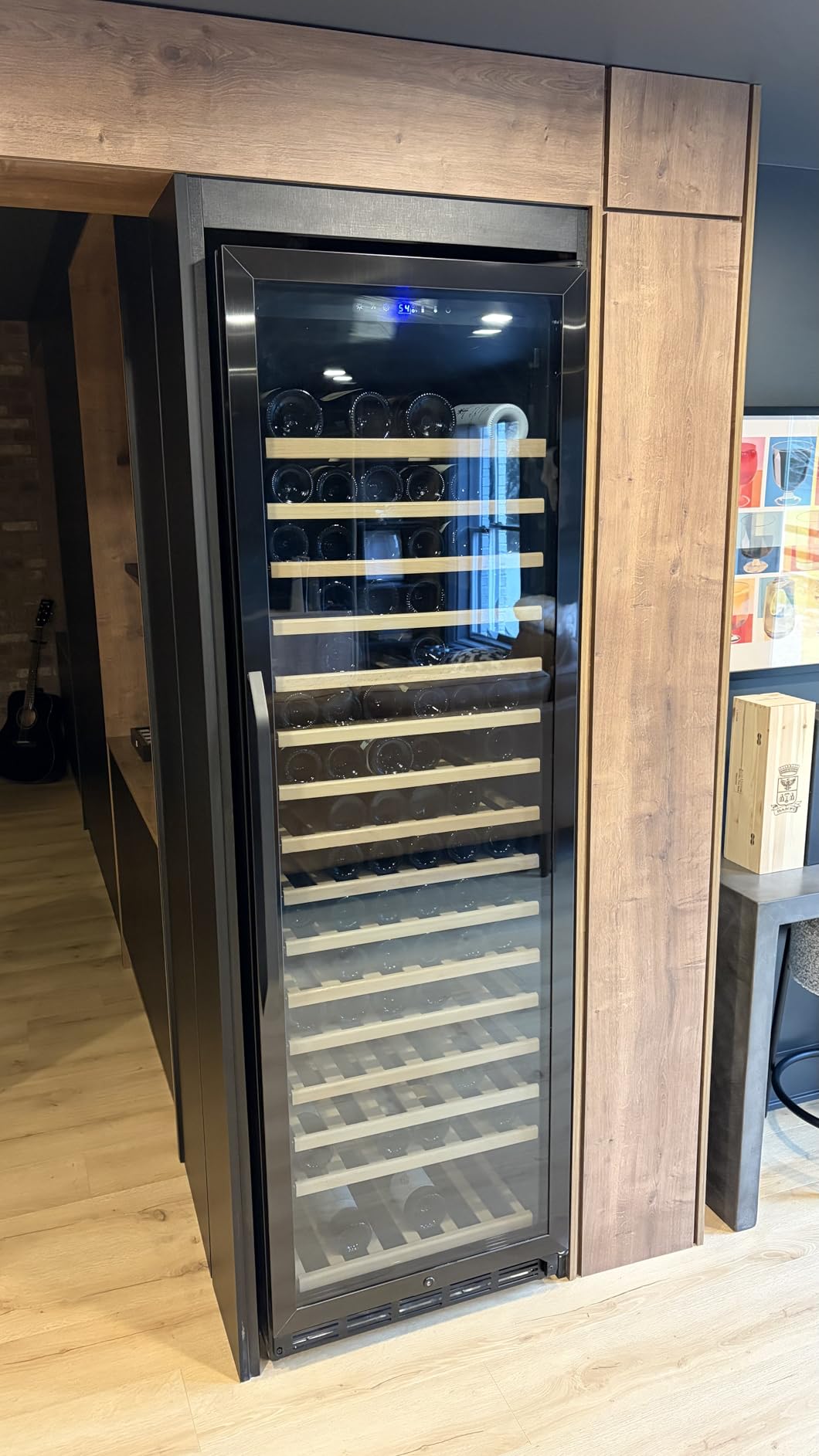
The detachable shelves adjust for different bottle and can heights, which is what makes the 210-can figure achievable in the first place. Owners describe temperature performance as strong and steady across the whole 37-64F range, and the compressor runs with low vibration and low noise even in an open kitchen.
Two honest caveats. A glass door loses cold air in a hot room, so you can expect condensation on the outside of the glass in humid conditions, and the internal exhaust fan adds a faint mechanical hum. The 210-can number also assumes shelves loaded tightly; mixed drinks, larger bottles and open space cut real capacity noticeably.
At roughly 104 pounds, it is one of the heavier units in the lineup, and it is listed as specific to beverages rather than general food storage.

Is this the right island fridge for you?
Choose it if the island is your main beverage station and you host often. Nobody crouches to count cans; they open a door and see the full inventory through glass at a glance.
The tempered glass also keeps contents visible in a dim room, which matters more on an island lit by pendants than it does in a garage.
Where it falls short
A glass door is a poor choice on an island that catches direct sun or sits in a humid climate, because the outside of the pane sweats and the interior works harder. External condensation on the glass is the most common complaint in the reviews.
It is a beverage unit, not a food-safe refrigerator, and the swing door needs clear floor space in front of the island to open past a seating overhang.
4. FoMup FM24D-4 Double Drawer Cooler – Best Reconfigurable Drawer Layout
24″ Undercounter Beverage Cooler, Outdoor Stainless Steel Drawer Fridge
4.9 cu. ft.
22.63D x 23.42W x 34.25H
37-65F touch panel
1-year warranty
Pros
- Removable grid organizers in each drawer
- Strong dual side slide rails with automatic closing
- Straightforward touch panel temperature control
- Stainless exterior suits kitchens and outdoor cooking areas
Cons
- Over 100 lbs so two people are needed to install
- Some arrive with a light scratch or dent on the front
- Slower temperature recovery after loading warm drinks
The distinguishing feature is the removable grid organizers in each drawer. Buyers like being able to switch the same compartment between cans for a party and snacks or prep containers for a normal week, which is a more practical argument than raw can count. Cooling is described as quick and steady within the 37-65F touch panel range, and 76 percent of 483 ratings are five stars.
Capacity is 4.9 cubic feet across two drawers holding up to 180 cans, on dual side slide rails with automatic closing. The reciprocating compressor handles fast pull-down, and the stainless exterior suits both an indoor kitchen and an outdoor cooking area. Dimensions are 22.63 inches deep by 23.42 wide by 34.25 tall, a clean fit for a standard 24-inch opening.
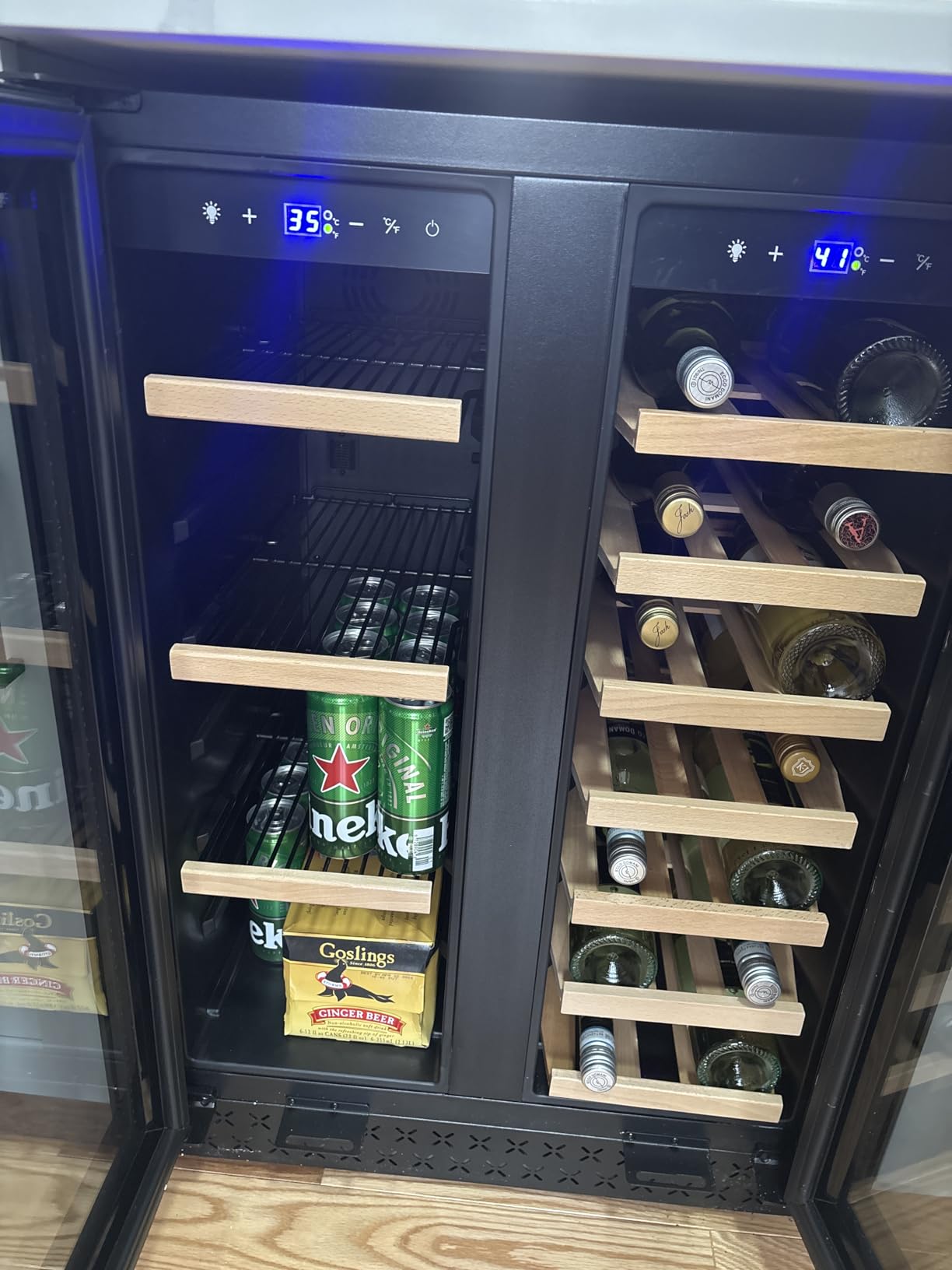
Satisfaction with this model centers on the drawer format itself. Sliding open a compartment rather than reaching into a cold cabinet is a real ergonomic gain when you are holding a plate in one hand, and the rails carry a strong load rating so a full drawer of glass does not sag.
The complaints are practical rather than functional. The unit weighs over 100 pounds, so two people are needed to move it into place under a counter, and some units arrive with a light scratch or small dent on the stainless front. Temperature recovery is slower than the digital setpoint implies right after you load warm drinks, which matters if you fill it immediately before guests arrive.
The 1-year warranty is on the short side for a unit you will be opening dozens of times a day.
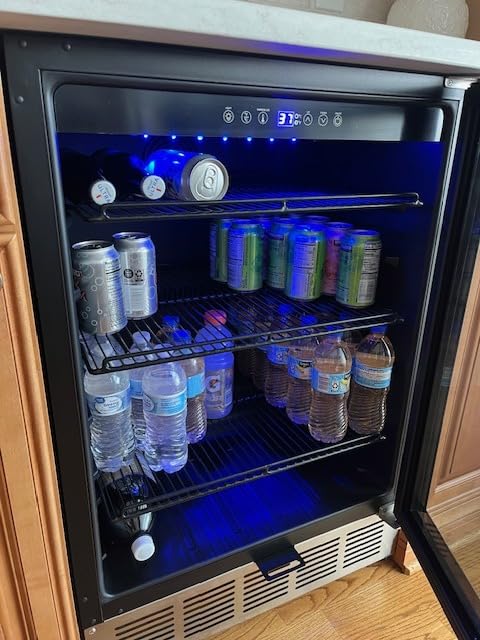
When the drawer format pays off
Drawer access means no blind reaching. Everything in the compartment is on the slide, so the back row is as reachable as the front, which is the whole argument for drawers in a working kitchen.
The grid organizers are the detail that tips it for households that use the island for prep as well as drinks, since you can pull one grid out and drop a container tray in.
When a swing door would serve you better
On a small island where the drawer faces are where guests lean or rest a glass, a full-extension drawer is a hard edge to sit against. If your island has a seating overhang on the fridge side, a door model leaves a flatter face.
Also skip this if you need true food-safe temperature. The 37F floor is a beverage figure and recovery is slow when the box is warm.
5. Antarctic Star BC-145B – Best for Precise Cold Control
Antarctic Star Outdoor Beverage Refrigerator 24 Inch Wide,Stainless Steel Mini Fridge 180 Can for Undercounter Built-in or Freestanding, Wine Cooler for Home and Patio,Fast Cooling, Low Noise, 32-50°F
4.8 cu. ft.
23.4D x 22.5W x 33.9H
32-50F plus or minus 1F
under 40 dB
Pros
- 32-50F control with plus or minus 1F fluctuation
- Adjustable foot pads need only 2 inches clearance
- 304 stainless liner with rust-proof coated shell
- Arrived well packaged without dents or scratches
- 0.8 kWh per day consumption
Cons
- Louder in practice than the sub-40 dB claim once built in
- Manual defrost and frost builds on interior walls
- A few units stopped working within roughly 16 months
- Outdoor-use marketing conflicts with the manual
This is the only model in the group with a published 32F floor plus or minus 1F fluctuation control, and that is the whole reason it earns a slot. Owners report it cools drinks very cold quickly once powered on, and several use it for garden harvest and overflow storage at gatherings, where a colder floor matters more than can count.
Capacity is 4.8 cubic feet on three shelves holding up to 180 cans. Installation is unusually forgiving: 360-degree adjustable foot pads mean it needs only 2 inches minimum clearance, which is the tightest fit requirement of any 24-inch unit here. The shell is a 304 stainless liner with a rust-proof coated shell, and it passed a 45-degree tilt transport test with a child safety lock and anti-tip warning. UL certified, under 40 dB, and disclosed at 0.8 kWh average daily consumption, roughly half the ENERGY STAR standard.

Styling is the quiet strength. Owners describe modern clean lines that look good freestanding or built in, and the blue door-activated interior light is a nice touch when hosting in a dim room. Packaging is solid, with multiple buyers noting the unit arrived without dents or scratches.
Now the complications. It is manual defrost, so frost builds on the interior walls and needs periodic attention. Several buyers report running noise that is louder than the sub-40 dB figure implies, especially once the unit is installed inside cabinetry, and a few report early failures with the unit not cooling or stopping entirely within roughly 16 months.
There is also a documentation conflict worth flagging: the outdoor-use marketing does not match the manual, which advises against patio or garage placement. And the display temperature unit cannot be changed from Fahrenheit, which is irritating if you cook in metric.

Why the 32F floor matters
Below 40F is where you get genuine cold beer rather than a cool can, and this is the model in the group that reliably gets there. If your island fridge doubles as a home bar for serious bottles, that is worth more than extra shelf space.
Adjustable foot pads and 2-inch minimum clearance also make it the easiest of the ten to retrofit into an existing island where the opening is not perfectly square.
Who should pass on it
Skip it if the island sits next to where people talk. Louder-than-claimed noise inside a cabinet is the most common complaint, and noise plus a seating overhang is a bad combination.
Manual defrost is a recurring chore, and the early failure reports plus the 1-year warranty make this a riskier bet if you want one appliance you never think about again.
6. Velivi KMCT145 Drawer Refrigerator – Best for Rolling Base and Flexible Layout
Velivi 24” Drawer Fridge Under Counter Beverage Refrigerator with Wheels
4.9 cu. ft.
22.63D x 23.42W x 34.25H
under 38 dB
IPX4 304 stainless
Pros
- Built-in caster wheels for moving and cleaning
- Under 38 dB with minimal vibration
- Two drawers with dual side rails and auto closing
- Precise
- stable temperature control
- 304 stainless resists rain and corrosion
Cons
- 100 lbs is very heavy to maneuver even with casters
- Divider shelves hold fewer cans than the 178 figure
- Some arrive with dents or scratches on the front
- A few report compressor or rail failures after months
The wheeled base is the reason this model is here. Casters are built in rather than retrofitted, so you can roll the unit out from the island to clean behind it, or move it entirely when the counter layout changes. Owners single that out as the practical touch, and 79 percent of 366 ratings are five stars.
Everything else follows the strong sub-38 dB drawer pattern: two drawers, 4.9 cubic feet, up to 178 cans with divider shelves, dual side slide rails and auto-closing fronts. The IPX4-rated 304 outdoor-grade stainless door resists corrosion and rain for outdoor bar use, and the rotary scroll compressor holds a precise, stable setpoint with minimal vibration.
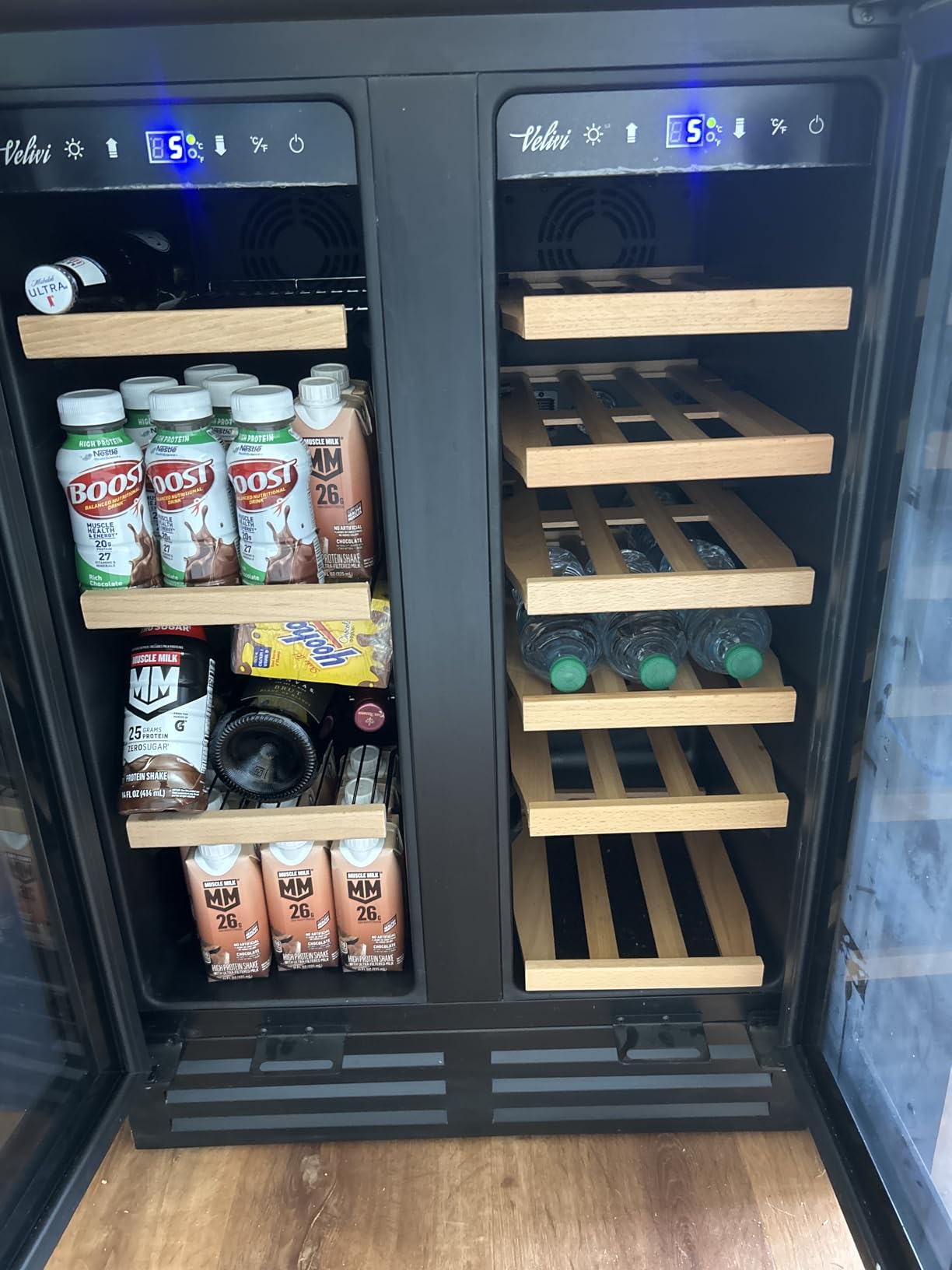
Buyers favor this model for the same two reasons as the other quiet drawer units: very low operating noise and a two-drawer layout that makes stored drinks easy to reach without crouching. Dimensions are 22.63 by 23.42 by 34.25 inches, so it drops into a standard 24-inch base cabinet, and the install type covers built-in, undercounter and freestanding placement.
The downsides mirror those competitors. At 100 pounds the cabinet is very heavy to maneuver even with the casters, and divider shelves hold fewer cans in practice than the advertised 178 figure. Some units arrive with visible dents or scratches on the stainless front, and a few buyers report the compressor or a drawer rail failing after several months.
Divider design is the quiet limitation. If you store large-format bottles, fixed dividers eat the width you were counting on.
Why the casters matter more than they sound
Cleaning behind an island fridge built in without wheels means moving 100 pounds of appliance on a hard floor. Casters turn a two-person job into a one-person job, and they matter even more if the cabinetry is later reconfigured.
The sub-38 dB rating also makes this a good fit beside a seating overhang, same logic as the Tylza.
Where it falls short
The advertised can count assumes a configuration most households do not use, and the dividers that create that count are not adjustable in the way the pull-out shelves on some competitors are.
With a 1-year warranty and a few reported rail and compressor failures, treat it as a mid-tier bet rather than a long-term appliance investment.
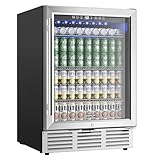
7. EUHOMY BRU-04 180-Can Glass Door – Best Budget Built-In With a Glass Front
EUHOMY 24 Inch Beverage Refrigerator, 180 Can Under Counter Refrigerator
5.3 cu. ft.
22.6D x 23.4W x 34.3H
37-65F
0.84 kWh per day
1-year warranty
Pros
- Front ventilation needs no side or rear clearance
- Three pull-out shelves across five fixed slot positions
- Accurate thermostat verified against an external thermometer
- Quiet and stable at about 40 dB
- Seller service is fast and replaced defective units
Cons
- Settles around 40-41F rather than the 37F setpoint
- Center-top LED does not light lower shelves when full
- Coated wire shelving instead of tempered glass
- Glass door sweats heavily in humid climates
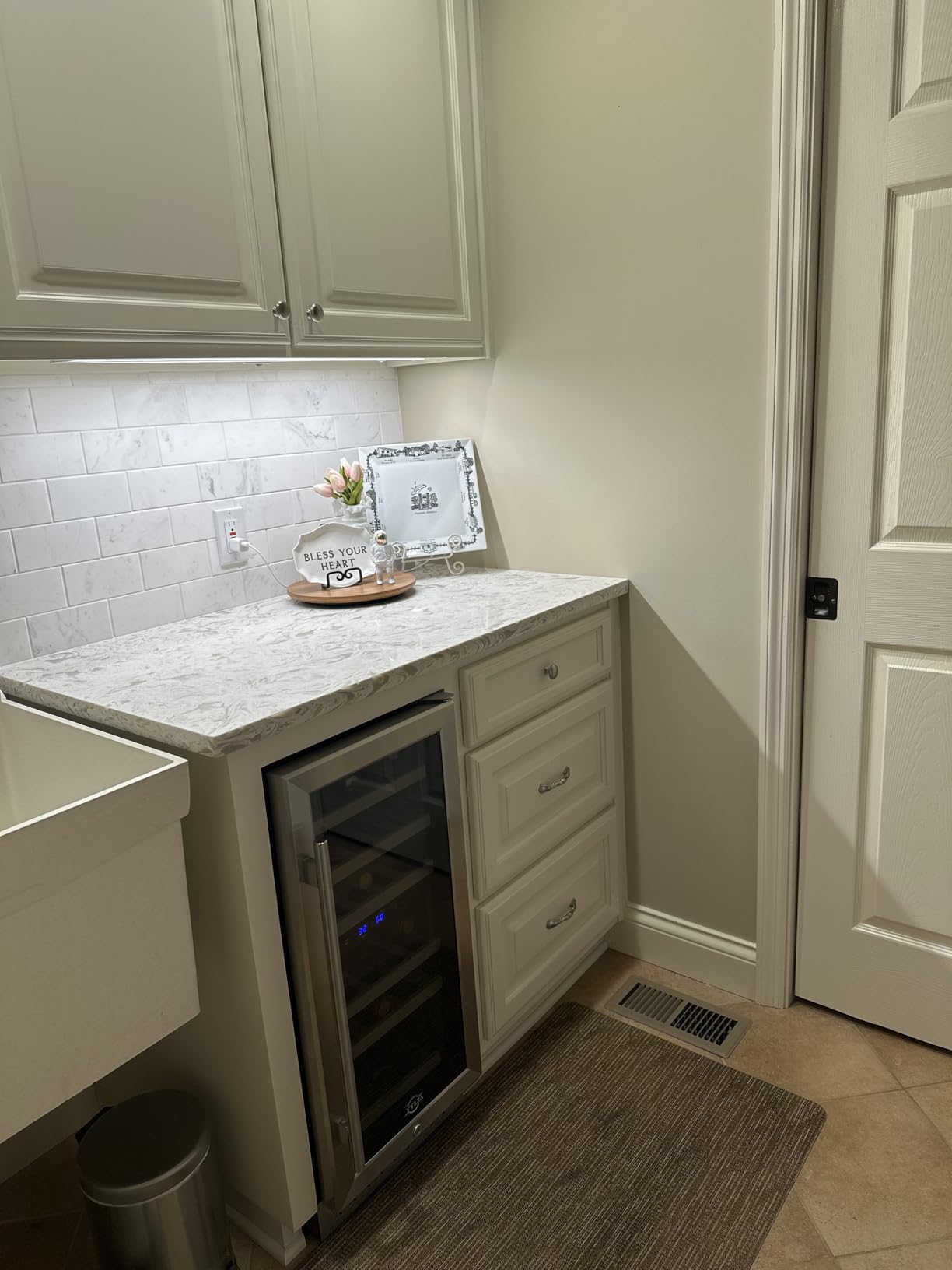
This model has a long owner track record on home bars and counters. Owners report genuinely quiet, stable cooling, a thermostat they checked against an external thermometer and found accurate, and solid build quality. Several buyers own multiple units, which is the clearest signal of satisfaction in the file. On an r/HomeSetup thread, a long-term small-space user named the BRU-04 specifically as a favourite after eight years because it fits a standard cabinet gap and can sit on either side of an island.
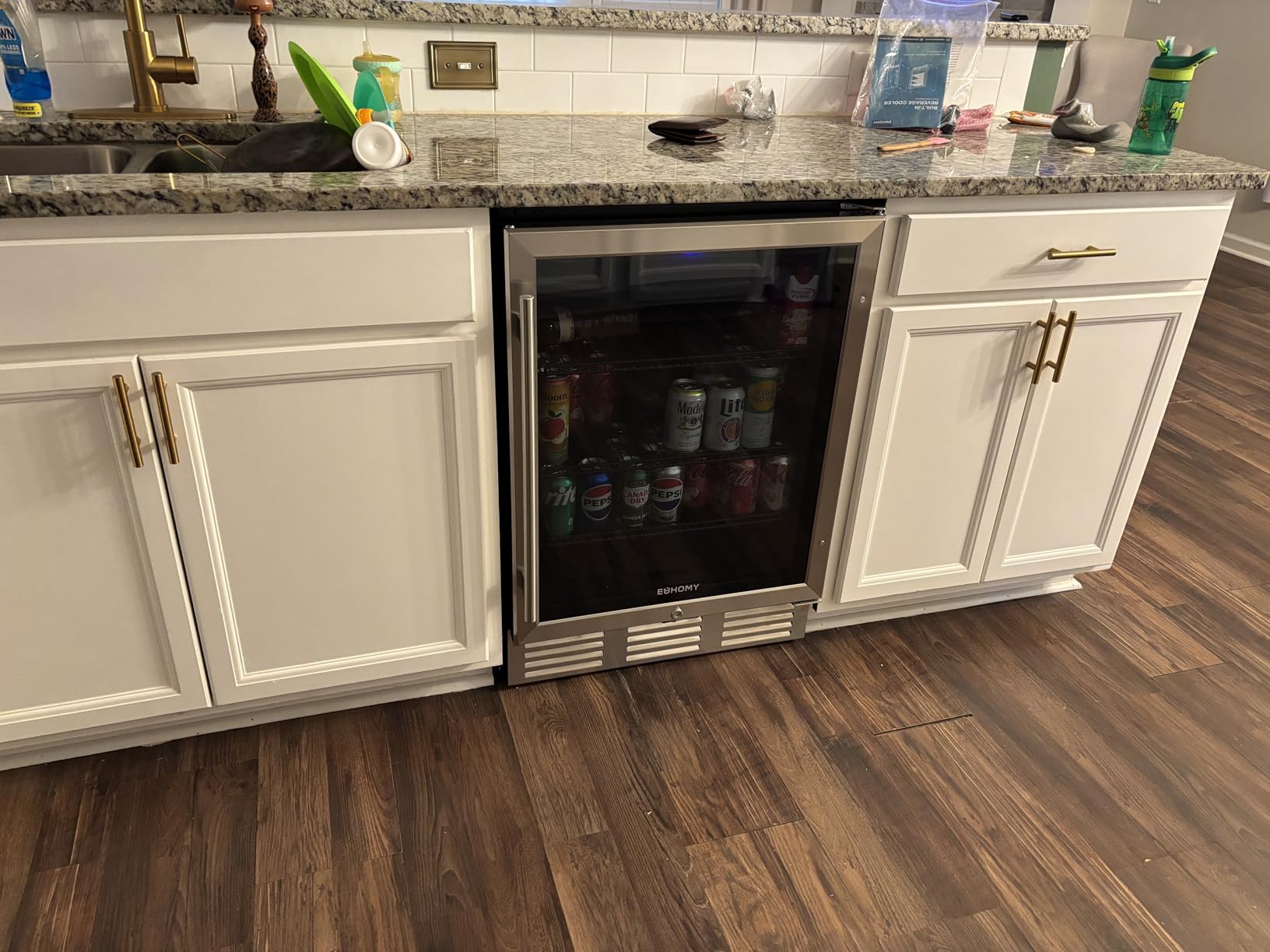
Capacity is 5.3 cubic feet with three pull-out shelves on five fixed slot positions, marketed at 180 standard cans. Front ventilation allows built-in installation without side or rear clearance, and the door is reversible. Disclosed consumption is 0.84 kWh per day at under 40 dB, with ETL, DOE and CEC certification and a one-year after-sales service window.
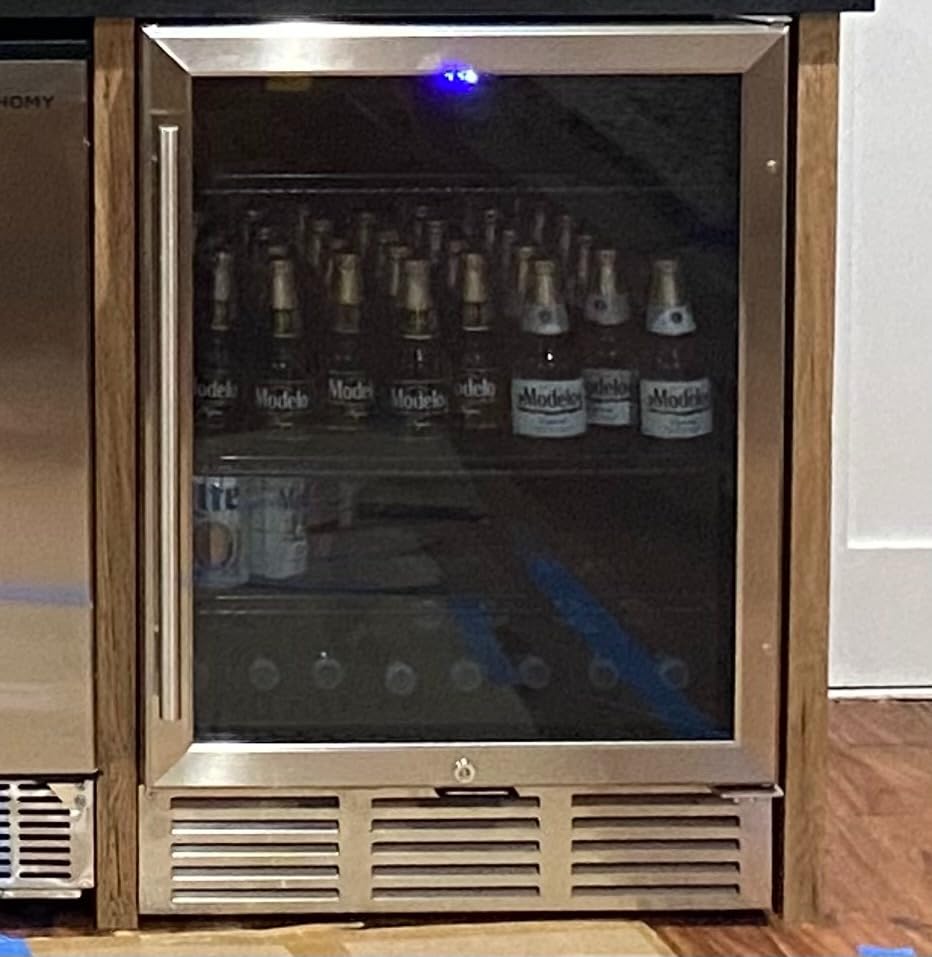
The pull-out shelves on five slot positions are the best interior layout in this group for mixed use. Where the drawer models give you one deep bin, this gives you three adjustable shelves you can slide out to reach, which makes loading a tall bottle far less awkward. The blue LED is door-activated, the touch panel has power-failure memory, and there is a hidden door lock.
The dominant complaint is temperature. Owners report it does not reach the advertised 37F floor in practice, settling around 40-41F and rarely below 40F. That is a real problem for beer storage, and it is the single most important thing to know about this unit.
Secondary issues are the center-top mounted LED that does not illuminate lower shelves when the unit is full, coated wire shelving rather than tempered glass so bottles sit lower than expected, and heavy condensation on the glass door that drips onto the floor in humid climates. Reversing the door swing is a fiddly job on a heavy unit, and some owners report units that stopped cooling within five months.
Is this the right budget island fridge?
If your island is a drinks and snacks station and you are on a tight budget, this is hard to beat. Front venting with no side clearance, five shelf positions and a quiet compressor cover most of what an island needs.
The 0.84 kWh per day figure also keeps running costs predictable, and several buyers report the seller replaced defective units fast.
Where it falls short
Do not buy it for groceries, dairy or anything you need held genuinely cold. Settling at 40-41F means it is a beverage cooler that runs warm at the bottom of its stated range.
The glass door is a problem in a humid room or on a sunlit island, and wire shelving plus a top-mounted light makes a full cabinet harder to see into.
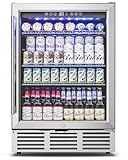
8. Feelfunn BR002-150SI – Best Double-Glazed Build in a Wide Body
Feelfunn 24 Inch Beverage Refrigerator Under Counter,180 Cans,Silver
5.3 cu. ft.
23.4D x 24.5W x 34.3H
37-65F
about 40 dB
0.84 kWh per day
Pros
- Double-glazed glass door blocks heat and UV
- 180-can capacity across three removable shelves
- Simple digital touch panel for one-touch control
- Adjustable feet for moving and repositioning
- Front vent for built-in or freestanding placement
Cons
- 24.5 inch width is wider than a true 24-inch opening
- Heavier and deeper than 23.4 inch-wide rivals
- Soft interior LED makes a full cabinet harder to read
- Smallest review base in the group
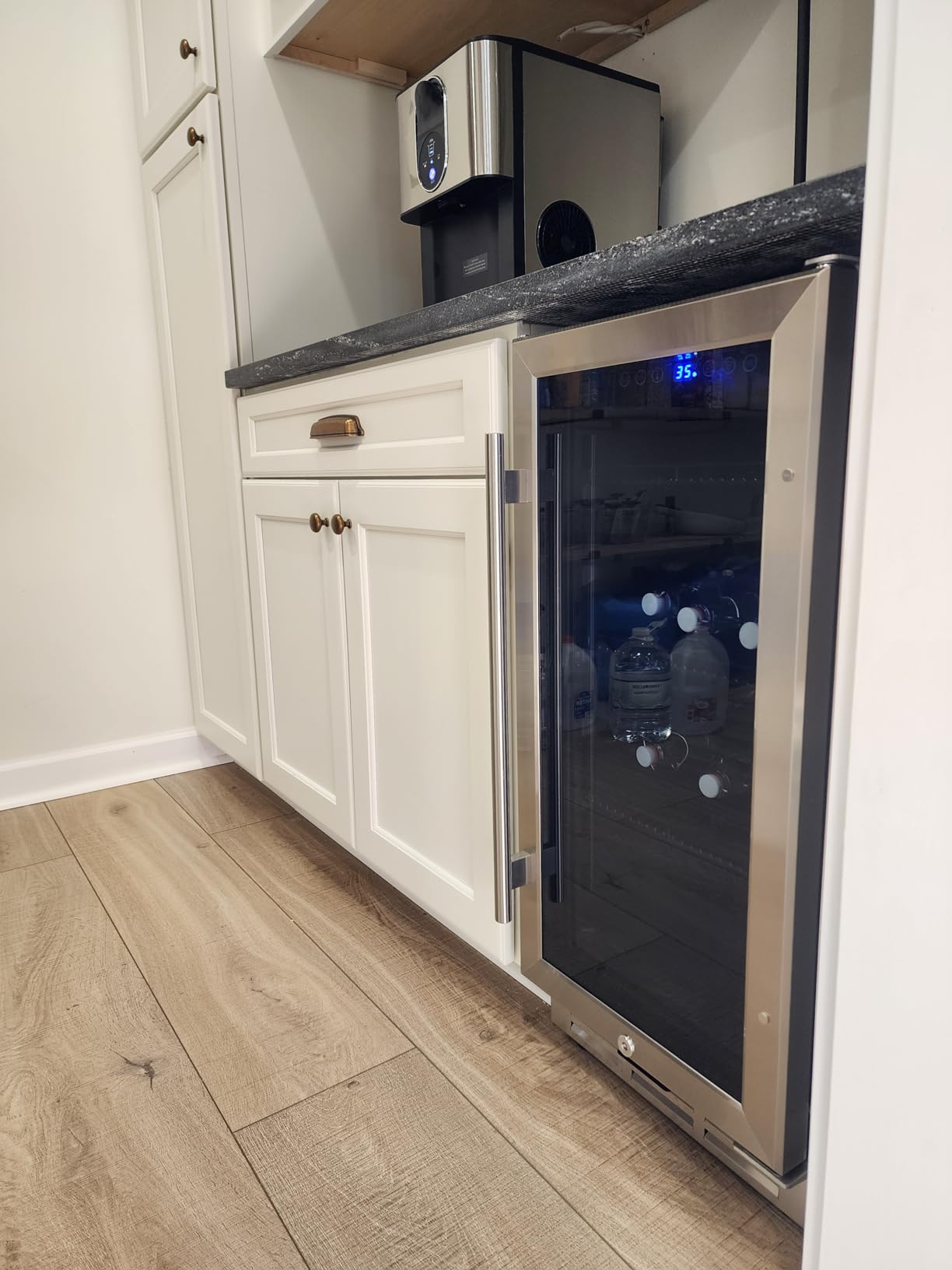
The double-glazed glass door is the reason this one is on the list. Two layers of glass block heat and UV, which means less external sweating on a humid day and less compressor work keeping the interior at temperature. Owners praise the visible contents plus the thermal performance, and 74 percent of 148 ratings are five stars.
Capacity is 5.3 cubic feet with three removable shelves, marketed at up to 180 cans, across a 37-65F digital touch panel with an LED display. The door is reversible, there is a bottom safety lock, and adjustable feet make the unit easier to move for cleaning or repositioning. Disclosed figures are about 40 dB and 0.84 kWh per day, with a one-year parts warranty.
Review volume is the smallest in the group, so treat the long-term durability picture as thin, but sentiment is strongly positive and centred on a generous can capacity in an undercounter box, straightforward one-touch temperature and mode switching, and a glass door that keeps contents visible while limiting outside heat.
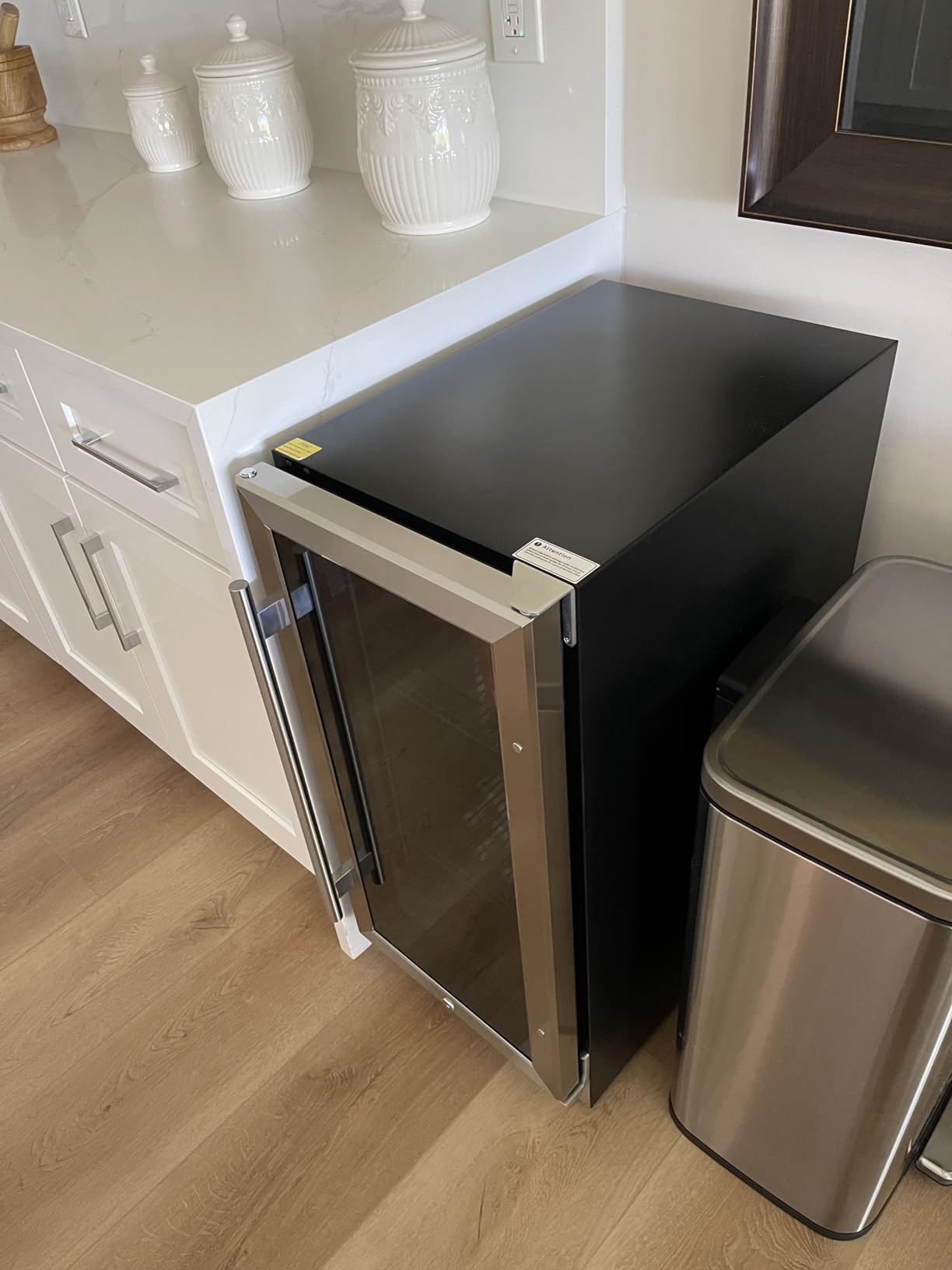
The recurring practical note is dimensional, and it is the one you must act on: at 24.5 inches wide and 23.4 inches deep, this body is wider than a true 24-inch cabinet opening, so measure the cutout before ordering. It is also slightly heavier and deeper than the 23.4-inch-wide competitors, at 84.9 pounds.
The interior LED is soft, so drink selection in a fully packed cabinet is less clear than it would be with a brighter unit. A minority of buyers report broken buttons or a thermostat that reads inconsistently, resolved by responsive seller support.
When double glazing earns its place
If your island is in a warm room, catches afternoon sun through glass doors, or sits in a humid climate, two layers of glass are the difference between a door that stays dry and a puddle on your countertop. It also reduces how hard the compressor works.
Adjustable feet make it easy to slide out for cleaning, which matters under an island where dust and spills collect.
When it is the wrong size
Skip it if your island cabinet is a standard 24-inch opening with tight side clearances. Half an inch of extra width is the difference between a clean install and a returns trip, and the 23.4-inch depth eats counter overhang on a shallow island.
With 148 ratings, you have less long-term evidence than any other model here, so plan for a shorter expected service life than a major-brand unit.
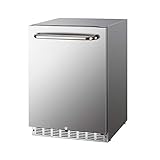
9. HCK C150-SD – Best Warranty and Widest Temperature Range
HCK Outdoor Refrigerator 24 Inch, Undercounter Refrigerators with Stainless Steel Door, 161 Can Beverage Fridge for Home Bar, Kitchen, Patio, Outdoor, Commercial Use
5.12 cu. ft.
23.6D x 23.6W x 34.05H
32-72F
5-year compressor warranty
Pros
- Five-year compressor warranty
- the longest in this category
- Widest range at 32-72F for wine and beer settings
- Automatic defrost with pre-installed lock and blue LED
- Reversible door and front vent for flexible placement
- IPX4 stainless body for patio and bar use
Cons
- Most expensive model in the group with a 1-star BEE rating
- Square 23.6 inch footprint needs more width clearance
- 98.1 lbs requires a two-person install
- Some arrive with dents to the stainless panels
The warranty is the headline: 1 year on non-consumable parts and 5 years on the compressor, which is the strongest coverage offered by any model in this roundup. In a category where compressors are the most common failure point, that is worth real money, and the scroll compressor sits behind an IPX4-rated stainless body rated for patio, bar and commercial environments.
Capacity is 5.12 cubic feet for up to 161 standard 12 oz cans, and the temperature range runs 32F to 72F on a digital control panel with an LED display. The widest range here lets you hold wine and beer at different settings, which no other model in the group manages. Automatic defrost, a pre-installed lock and built-in blue LED lighting round out the feature set.

This is also the oldest and priciest entry with the smallest review base, and the ratings are notably more moderate than the newer models, with 66 percent five stars against 76 to 79 percent for the recent listings. Buyers still value the wide range, the automatic defrost, the built-in lock and the compressor warranty, which is the strongest in the category.
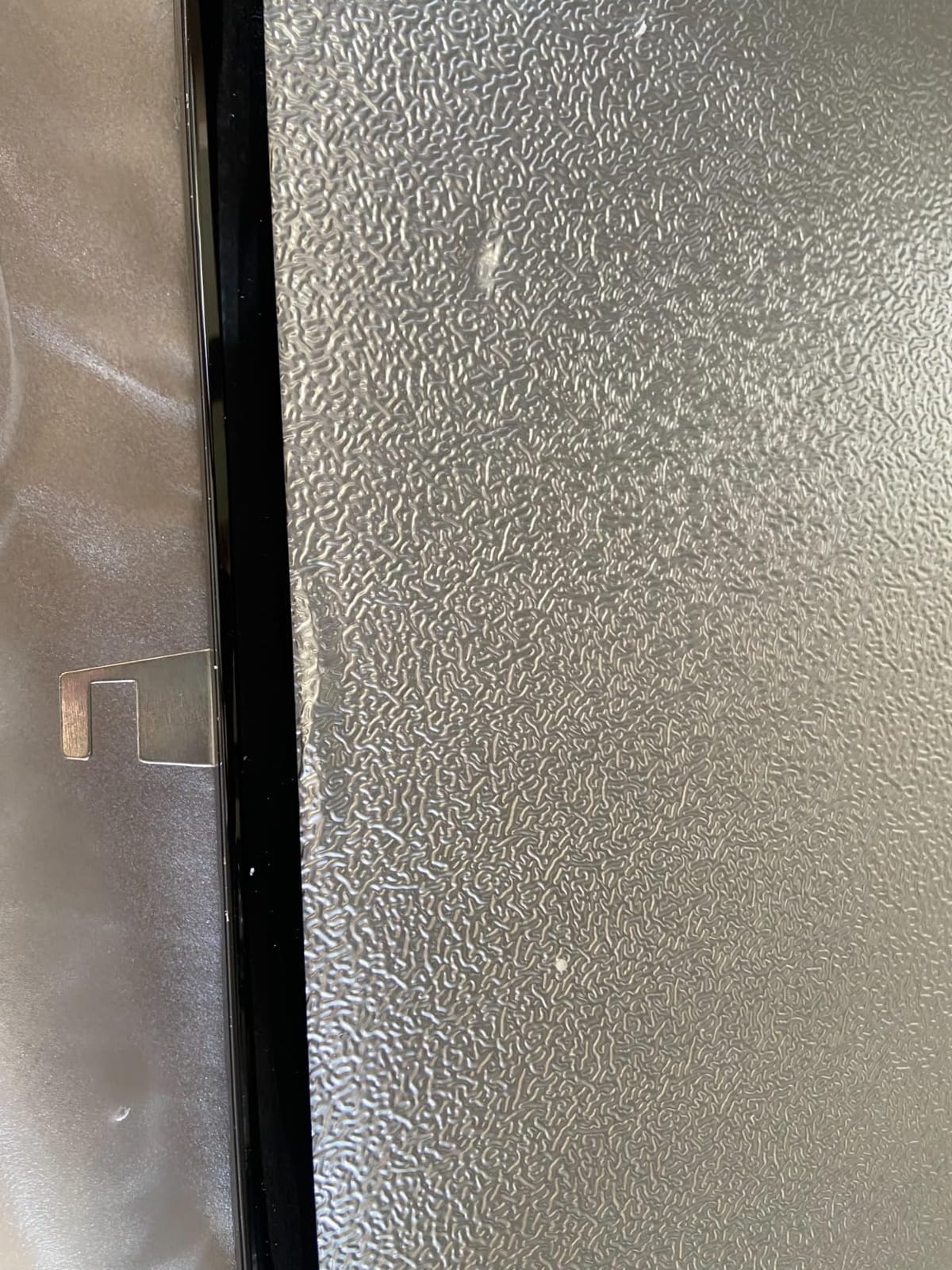
The footprint is the practical issue. At 23.6 by 23.6 by 34.05 inches the body is square, which demands more width clearance than the 23.4-inch slim models, and at 98.1 pounds it needs two people to install. It is also the most expensive model here while carrying a 1-star BEE energy rating, so the running cost is the highest of the group. Some units arrive with dents or damage to the stainless panels.
The door is reversible, which helps when hinge placement is awkward, and the front vent keeps it viable as a built-in.
Why the 5-year compressor warranty matters
Compressor failure is the failure that ends an undercounter fridge’s life, and it is the one most brands cover for one year. Five years on the compressor means the highest-cost repair is covered for half a decade, which changes the calculation if you are installing this into cabinetry you do not want to reopen.
The 32-72F range also makes it the only model here that can hold a proper wine setting as well as a beer setting in the same box.
Where it falls short
It is the most expensive unit in the lineup while carrying the worst energy rating, so your running cost over five years will be the highest of the ten. That is a poor trade against a premium up front.
The square footprint needs more clearance than the slim models, and with 121 ratings there is less long-term owner evidence than the quantity leads here.
10. ORYMUSE HXYC150E Double Drawer – Best Full-Extension Drawer Access
ORYMUSE 24 Inch Outdoor Double Drawer Refrigerator, 154 Can Beverage Cooler
4.9 cu. ft.
22.64D x 23.43W x 34.25H
37-65F
ETL
1-year warranty
Pros
- Drawers slide out completely so back-row items are visible
- Built-in organizers keep cans and bottles separated
- Frost-free compressor means no manual defrosting
- Temperature memory restores settings after a power cut
- Front-vented for built-in or freestanding installation
Cons
- 99.2 lbs needs two people to move into place
- 154-can capacity assumes tight packing
- Smallest review base means limited long-term data
Full extension is the feature that separates this from every other drawer unit here. Both drawers slide out completely, which removes the usual problem of reaching past a row of bottles, and built-in organizers keep cans and bottles separated and tidy. It carries the highest average rating in the set at 4.5 stars with 78 percent five-star ratings, though on 108 reviews.
Capacity is 4.9 cubic feet holding up to 154 standard 12 oz cans, with a 37-65F LCD touch panel, soft blue LED lighting and temperature memory after a power interruption. Frost-free compressor operation eliminates defrosting entirely, and the corrosion-resistant stainless construction with seamless drawer fronts suits both indoor kitchens and home bars.
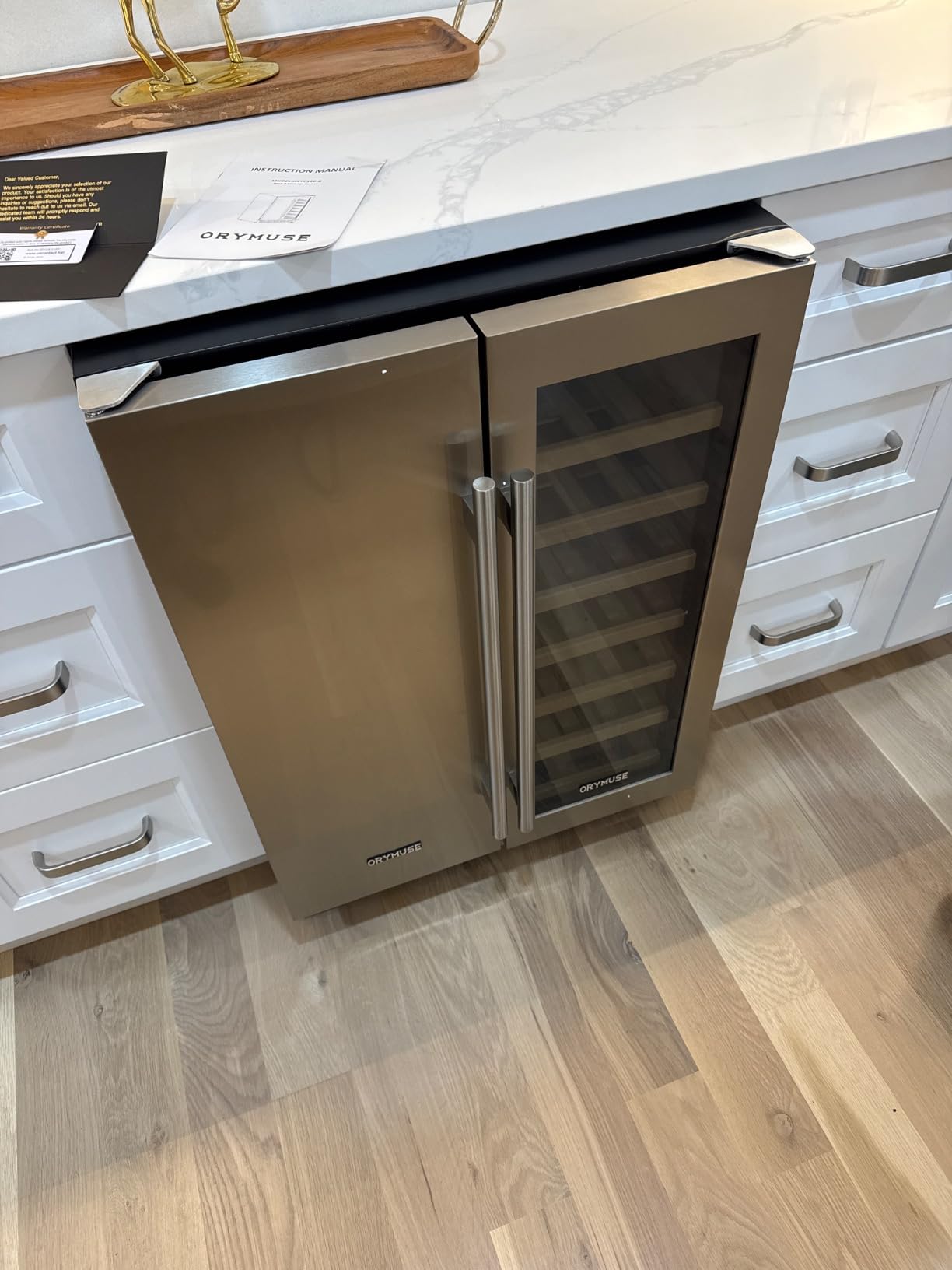
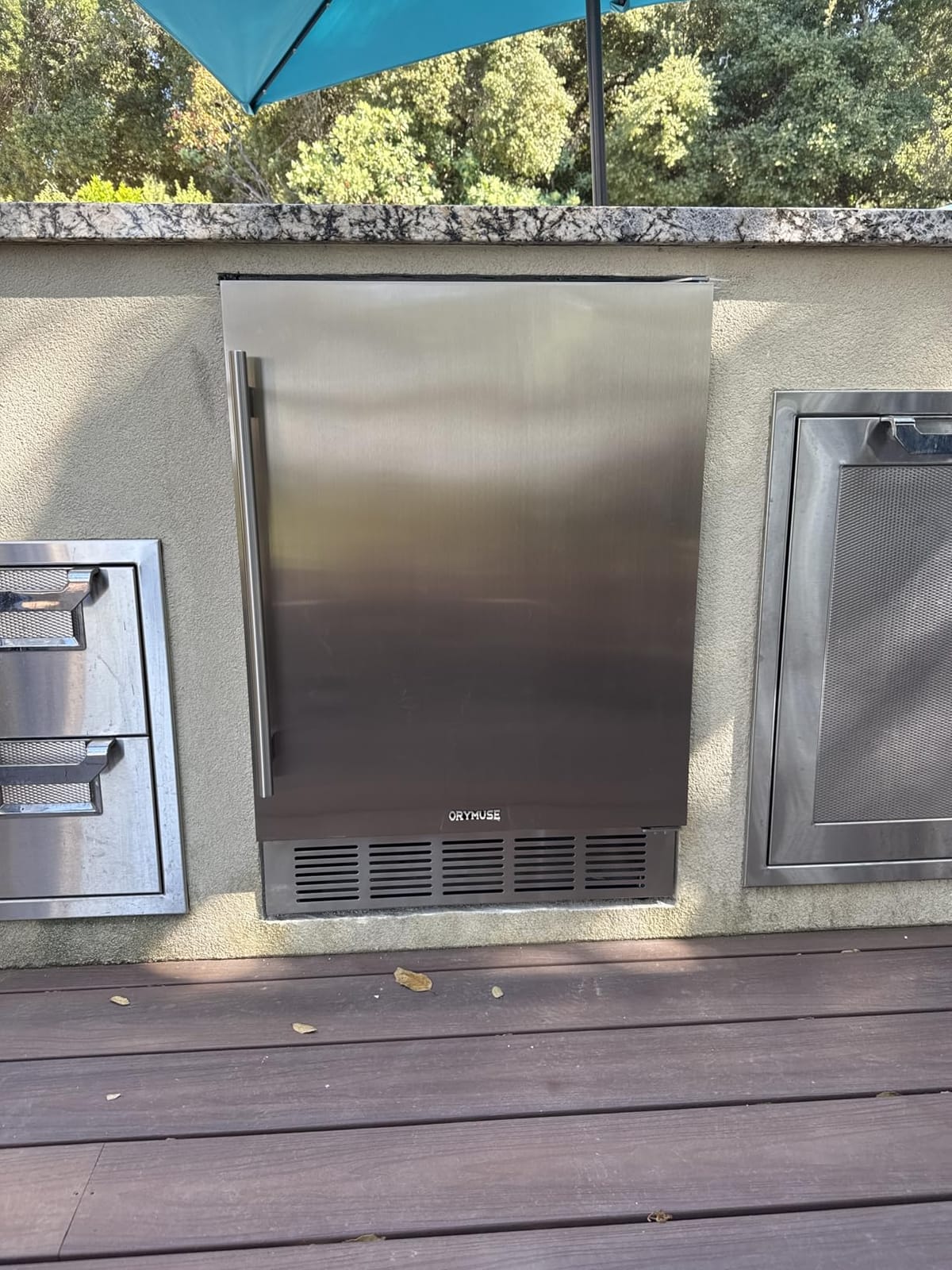
Fit is straightforward: 22.64 by 23.43 by 34.25 inches, front-vented for built-in or freestanding installation in standard 24-inch outdoor kitchen, bar and cabinet spaces, with no side venting required. The manufacturer also asks that you leave it upright for 24 hours before first use, which matters if it is transported on its side during install.
The limits are mostly practical. At 99.2 pounds it needs two people to move into place, and the 154-can figure assumes tight packing of standard cans rather than a realistic mix of bottles. Feedback volume is still limited, so long-term durability data is thin, and the warranty is 1 year.
Because the drawer fronts are full extension, plan the island cabinet with this in mind: the drawers need clearance in front of the unit when pulled out, which a seating overhang on the fridge side can block.
What full-extension drawers actually solve
In a half-extension drawer, the front row blocks the back row and you are still digging. Full extension puts the entire compartment on the slide, so the last can in the back is as visible as the first, which is the difference between a drawer fridge and a shallow bin.
The frost-free compressor also removes a recurring chore, and temperature memory means a power cut does not silently drop your beer setting back to factory default.
When it is not the right pick
Skip it if the fridge side of your island has seating, because a full-extension drawer pulled toward a guest is a collision waiting to happen, and a swing door leaves a flatter face. It is also the least-proven model here at 108 reviews, so expect less long-term evidence behind the warranty.
At 4.9 cubic feet it is not the capacity leader, and the 37-65F range makes it a beverage tool rather than grocery storage.
How to Choose an Undercounter Refrigerator for Your Island
Fit beats features in this category. A unit with better shelves and a better compressor is worthless if it does not go in the opening or cannot vent, so work through these five questions in order before you compare anything else.
Is it front-vented or rear-vented?
Front-vented units exhaust heat through a grille at the bottom of the door face, so they can be installed flush inside a cabinet with no rear or side clearance. Rear-venting units need space behind them, typically 2 to 4 inches, and inside a closed island they can overheat. Every model in our roundup is front-vented or convertible, which is why they all work in an island; a rear-vented box in the same cabinet is the most common deal breaker forum owners describe, and forcing it can void the warranty.
Is it a beverage cooler or a food-safe refrigerator?
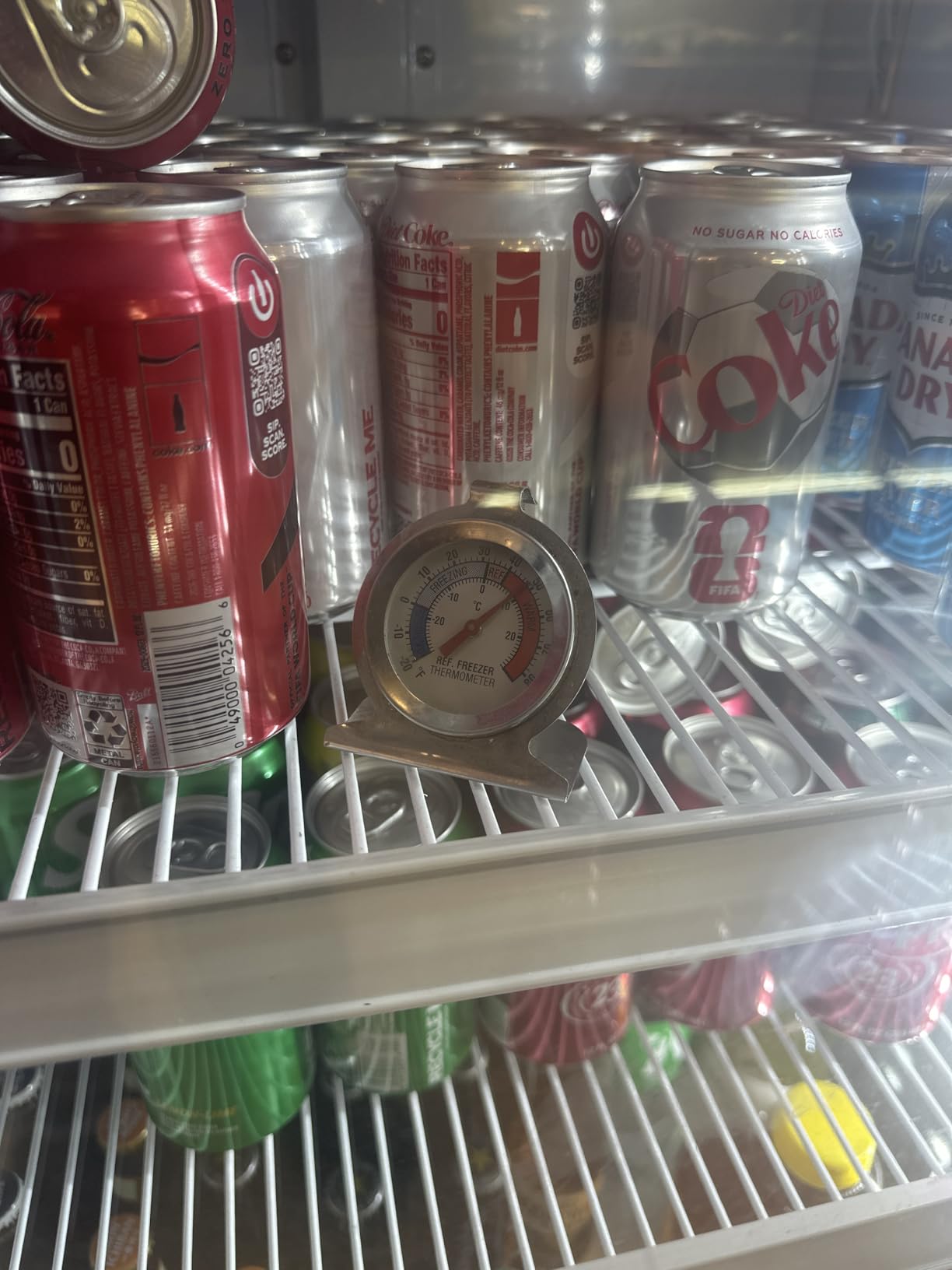
This is the question most buyers skip and most regret. Beverage coolers in this category are published from 37F up to 65F, and many settle well above the setpoint at the bottom of the range. Food-safe storage needs 40F or below. If you plan to keep groceries, dairy or meat in the island, look for a published low-end floor of 40F or under, and put a fridge thermometer in the unit for 24 hours after install to verify what the number actually becomes.
Which brands are most reliable?
Reliability in undercounter units tracks engineering choices rather than brand reputation. Forum owners consistently judge on compressor type, energy rating and thermal performance rather than logo, and the pattern matches what the review data shows here: rotary scroll compressors such as the one in the Tylza and Velivi are associated with stable, quiet holding, while the models with the most early failure reports are also the ones with the thinnest review base. Warranty length is the other strong signal, and the only model in this roundup covering its compressor for more than one year is the HCK at 5 years. Look for a disclosed kWh figure too, because an unlisted energy draw is usually also an unlisted test.
Brands to be cautious with are not a fixed list, but the pattern is consistent: any model whose outdoor-use marketing contradicts its own manual, and any unit that arrives without published cutout dimensions or clearance specs. One model in this roundup is marketed for outdoor use while its manual advises against patio placement, which is exactly the documentation gap to avoid.
How far should the island be from the main refrigerator?
There is no rule about the island itself, but there is a rule about the island refrigerator. Treat it as part of the prep triangle, and keep it within one or two steps of your main cooking surface. Households that report the best results put the island fridge near the cooktop and the sink rather than at the far end of the island, so ingredients, drinks and prep space are all within arm’s reach of the same work zone. Walking to a far end of a large island to grab a bottle is the workflow failure that makes people stop using the appliance.
How much does noise matter?
More than most buyers expect. An island fridge sits at ear level for anyone seated at the overhang, and this category is quiet at best, not silent. Two models in our roundup publish sub-38 dB figures and one publishes under 40 dB, and owner reports on the louder unit specifically note it is more audible once installed inside cabinetry. If seating is on the fridge side, treat the published dB figure as a real constraint rather than a footnote.
How to Measure Your Island Cabinet Opening
A quarter-inch mismatch between the appliance and the cabinet opening is the single most common install failure, and it is expensive to fix after the countertop is templated. Measure these six things, in this order, before you order anything.
1. Width. Measure the opening at the top, the middle and the bottom. A true 24-inch cabinet gives you roughly 24 inches of clear width, so any model wider than 23.5 inches needs either a wider cabinet or a modified opening. In our roundup, nine of the ten bodies measure between 22.5 and 23.43 inches wide, and one measures 24.5 inches.
2. Height. Standard undercounter height is around 34 inches. Every model here lands between 33.9 and 34.3 inches, so you need roughly half an inch of clearance above the unit for airflow and for the door to open fully.
3. Depth. The bodies here run 22.63 to 23.6 inches deep before any handle. Measure from the cabinet face to the back wall, and remember that a glass-door handle adds roughly 2 inches to the required depth. If your island is shallow, this is where the plan falls apart.
4. Vent clearance. Front-vented units need none at the back or sides, which is why every model here suits an island. Rear-vented units need 2 to 4 inches behind, and in a closed island that space often does not exist.
5. Door swing or drawer extension. For a swing door, check the arc clears the countertop overhang and the floor in front of the island. For drawers, check that a full extension pulls clear of any seating overhang, because a drawer opened toward a guest is a collision.
6. Toe kick and grille. Front-vented units exhaust air at the bottom of the door, so a solid toe kick across the full width of the opening will restrict airflow. Use a slotted or louvered toe kick, or a grille panel, under the appliance face.
Write the cabinet maker’s cutout number on your order, and confirm it against the appliance’s published cutout dimensions rather than the outside dimensions. Those are two different numbers and confusing them is how a clean install turns into a re-cut.
Built-In, Panel-Ready or Freestanding in a Cabinet?
The main difference between built-in and panel-ready is who supplies the face. A built-in refrigerator comes with its own stainless steel or glass front. A panel-ready refrigerator ships with flat metal skins that accept custom wood or painted panels, so it sits flush with surrounding cabinetry and disappears into the island face. A freestanding unit just gets pushed into an open shelf or cabinet bay with its own finish on show.
Panel-ready is the expensive end of the spectrum for two reasons, and both show up in the buying decision. The appliance itself costs more, and the custom panels add fabrication on top of that, which is why owners on a long-running Houzz thread about island drawers describe counter-depth panel-ready units as being far out of reach. The second disadvantage is reversibility: when a panel-ready unit eventually fails, the replacement has to match the same reveal and gap, so a future appliance swap means touching the cabinetry again. A stainless built-in can be replaced without anyone opening a cabinet.
For most island buyers, a stainless built-in in a 24-inch opening with a solid or glass front is the sensible middle. You get the flush look without panel fabrication, replacement stays simple, and the appliance reads as part of the kitchen rather than as a freestanding object pushed under a counter. Reserve panel-ready for a kitchen where the island face is a deliberate design feature and the cabinetry is custom throughout.
Integrated does have one real functional drawback worth knowing: a flush panel install can reduce usable interior width, because the door assembly and reveal take space from the cabinet. If you are counting on shelf width for bottle storage, check the interior dimensions with the door closed rather than the exterior footprint.
Frequently Asked Questions
What is the best 24 inch undercounter refrigerator for a kitchen island?
Among the 24-inch models we compared, the EUHOMY RU-DD05 double drawer is the best all-round island fridge because it is front-vented, fits a standard cabinet opening with no modification, and has by far the largest review base in the category. If noise beside seating is your priority, the Tylza TYBC145 publishes an under 38 dB rating. If you need the coldest drinks, the Antarctic Star BC-145B holds a 32F floor with plus or minus 1F control.
Are undercounter refrigerators food safe, or only good for drinks?
Most units in this category are beverage coolers, not food-safe refrigerators. Published ranges here run from 37F up to 65F, and owners report some settling around 40-41F instead of the setpoint. Food storage needs 40F or below, so put a fridge thermometer in the unit for 24 hours after install and check what it actually holds before you trust it with groceries, dairy or meat.
What is the most reliable brand of undercounter refrigerator?
Reliability in this category tracks engineering rather than brand name. Forum owners judge on compressor type, energy rating and thermal performance, and the review data agrees: rotary scroll compressor models are associated with stable, quiet holding, while models with the thinnest review bases also carry the most early failure reports. Warranty length is the clearest single signal, and only one model in our roundup covers its compressor for more than one year, offering 5 years on the compressor.
What is the main difference between built-in and panel-ready refrigerators?
A built-in refrigerator comes with its own stainless steel or glass front. A panel-ready refrigerator ships with flat metal skins that accept custom wood or painted panels, so it sits flush with your cabinetry. Panel-ready costs more up front and adds panel fabrication on top, and replacing it later means matching the same reveal and gap so the cabinetry has to be opened again.
Are refrigerator drawers better than a swing door on a kitchen island?
Drawers win on reach. Full-extension drawers let you see and remove items in the back row without digging past a front row, which matters most if the island is your main prep station. Doors win on ergonomics with seating. A drawer front is a hard edge for a guest to lean or rest a glass against, and a full-extension drawer opened toward a seating overhang is a collision risk, so check clearance before choosing drawers.
Which Undercounter Refrigerator Is Right for Your Island?
For most people, the EUHOMY RU-DD05 double drawer is the right answer. It is front-vented, it fits a standard 24-inch opening without touching the cabinet, and 1378 ratings make it the best-evidenced unit in a category where most models have under 150. The Tylza TYBC145 takes over if seating sits next to the island and you need the quietest running box, and the Antarctic Star BC-145B takes over if genuinely cold drinks matter more than anything else.
Measure the opening before you order, not after. Width, depth, door swing and toe kick grille are the four things that decide whether the install is clean, and all four are cheap to check and expensive to get wrong. Then decide honestly whether you need food-safe temperature, because every unit here is primarily a beverage cooler and only a few hold 40F or below in practice.
Those are the best undercounter refrigerators for kitchen islands in 2026, ranked on the evidence owners actually reported back rather than on the marketing on the box. Check the current model year and cutout dimensions before you order, since this category turns over with new releases.