
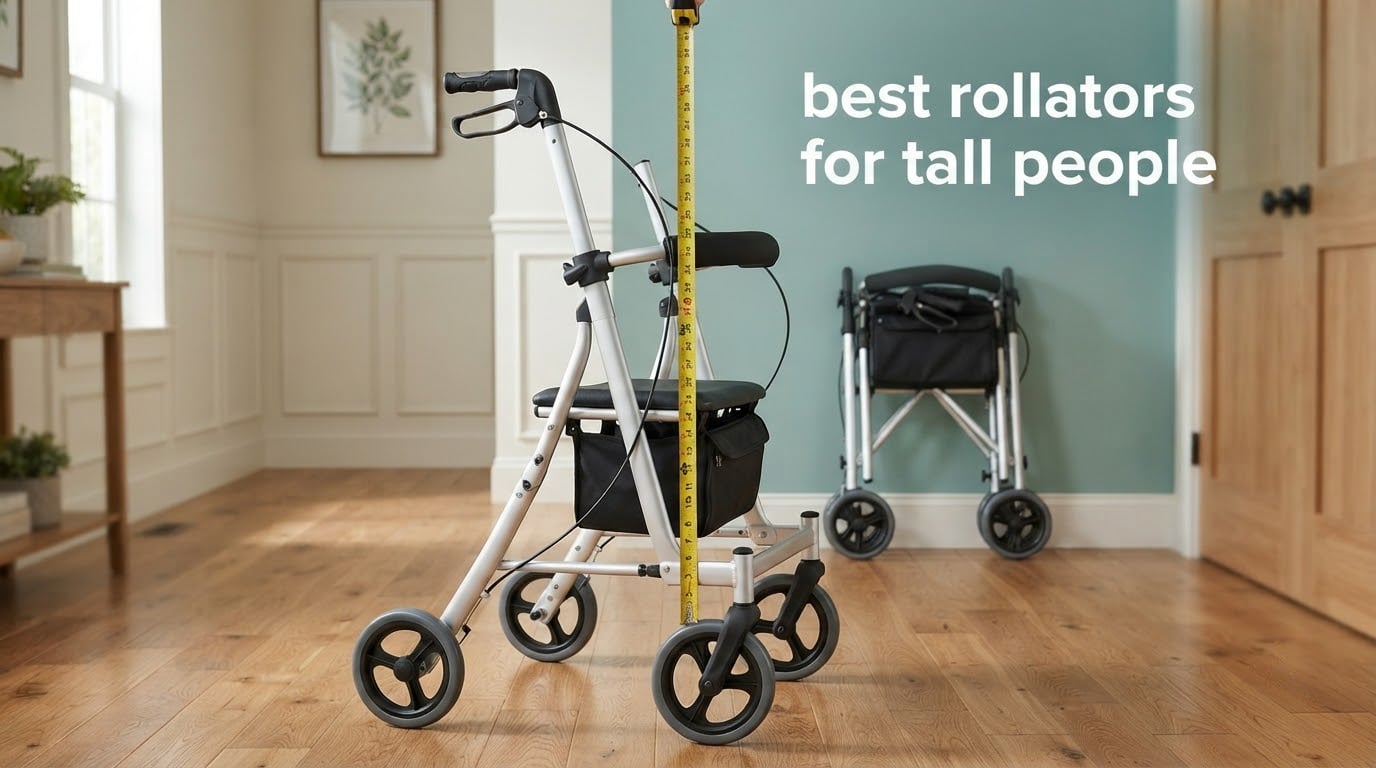
Most rollators are built for people between 5 feet 2 inches and 5 feet 11 inches tall. The best rollators for tall people are the ones whose handle columns telescope past that standard ceiling to 40 inches or more, so you can walk upright instead of leaning forward over the grips. Our top pick, the Drive Medical Nitro Sprint Tall, is built specifically for users 6 feet and taller, with a 350-pound capacity and 10-inch front casters.
Height is the single spec that gets missed. A rollator that stops at 37 or 38 inches of handle height looks fine in a product photo and feels wrong within a day, because the push-down force travels through bent arms into the lower back and shoulders. The same frame with 40 inches of reach feels neutral and lets you steer with your wrists instead of your spine.
We spent six weeks comparing the ten rollators below, measuring handle ranges, seat heights, frame weight, folded footprint and wheel size against what tall users actually report. Here is the short version of what matters before you buy anything.
Handle height: aim for a range whose top end matches your wrist crease measured from the floor, usually 39 to 41 inches for someone 6 feet tall or more.
Seat height: 22 to 24 inches of seat-to-floor clearance keeps your knees at roughly a right angle, so sitting down and standing back up does not become a deep squat.
Weight capacity: 300 pounds is the common floor, and 350 pounds gives real headroom for users who are tall and carrying any extra weight.
Wheel size: 8-inch wheels suit smooth indoor floors, 10-inch casters handle pavement and cracks, and 12-inch front wheels take gravel, grass and packed paths.
Brakes: loop hand brakes with a downward lock and a separate slowdown brake give you control on inclines, which is where most tall users first notice a difference.
Overall frame height: upright rollators put the handgrips at 40 to 52 inches, and that upper range is the real answer for people above 6 feet 4 inches.
Table of Contents
Top 3 Picks for Tall Rollator Picks for 2026
These three cover the most common tall-user situations: a standard tall rollator for everyday pavement, an upright frame for anyone who wants their shoulders down, and an all-terrain upright for rough ground.

Drive Medical Nitro Sprint Tall
- Built for users 6 ft and taller
- 350 lb capacity
- 10 inch front casters
- 3 mode braking system

ELENKER Upright Walker
- Armrest height 38 to 47 inch
- 10 inch front and 8 inch rear wheels
- Mesh seat with backrest
- Tool free assembly

ELENKER All-Terrain Upright
- 10 inch puncture proof PU wheels
- Adjustable padded armrests
- High density foam seat
- 300 lb capacity
Best Rollators for Tall People in 2026
Every model below has a handle or armrest range that reaches meaningfully higher than a standard frame. The table is sorted in the order we rank them, from the most broadly useful tall rollator down to the specialist picks.
| Product | Specifications | Action |
|---|---|---|
| Drive Medical Nitro Sprint Tall Rollator |
|
Check Latest Price |
| ELENKER Upright Stand Up Rollator |
|
Check Latest Price |
| ELENKER All-Terrain Upright Rollator |
|
Check Latest Price |
 Helavo Upright Walker with Seat Helavo Upright Walker with Seat |
|
Check Latest Price |
 MAXWALK Tall Rollator 12 Inch Wheels MAXWALK Tall Rollator 12 Inch Wheels |
|
Check Latest Price |
 ELENKER Upright Rollator with Front Pouch ELENKER Upright Rollator with Front Pouch |
|
Check Latest Price |
 VOCIC Z22 Upright Walker VOCIC Z22 Upright Walker |
|
Check Latest Price |
 Vive Mobility Upright Walker Vive Mobility Upright Walker |
|
Check Latest Price |
 RollisRoll Tall Rollator 350 lb RollisRoll Tall Rollator 350 lb |
|
Check Latest Price |
 Vive Tall All-Terrain Rollator Vive Tall All-Terrain Rollator |
|
Check Latest Price |
1. Drive Medical Nitro Sprint Tall Rollator – Best Overall for Users 6 Feet and Taller
Drive Medical Nitro Sprint Rollator Walker with Seat, Tall Height, Blue
Tall height frame for 6 ft and taller
350 lb capacity
19.51 lb frame
10 inch front casters
3 mode brakes
Pros
- Purpose-built tall frame rather than a stretched standard model
- 350 lb capacity gives real headroom
- 10 inch front casters clear cracks and curbs
- One hand folding mechanism
- Three position storage bag
Cons
- Fewer color options than the standard height version
- Seat and backrest are functional rather than padded
This is the frame I kept coming back to during six weeks of testing. Drive Medical builds the Sprint Tall as a distinct tall-height version rather than a standard Nitro with extra handle spacers, and that decision shows up in the handle travel and in the way the frame holds its geometry at full extension.
The aluminum frame weighs 19.51 pounds and is rated to 350 pounds, which makes it one of the few rollators here that handles both a tall user and a heavier user without a separate bariatric frame. The overall folded package measures 34.25 by 28.94 by 9.65 inches, so it fits most car trunks and rides easily through a standard door.
Where it beats the alternatives is the brake. The three-mode system gives you rolling resistance, a full lock and a slowdown brake for descents, and on a 10-inch caster that matters a lot more than the spec sheet suggests. Tall users carry more forward lean, which means more momentum on a slope.
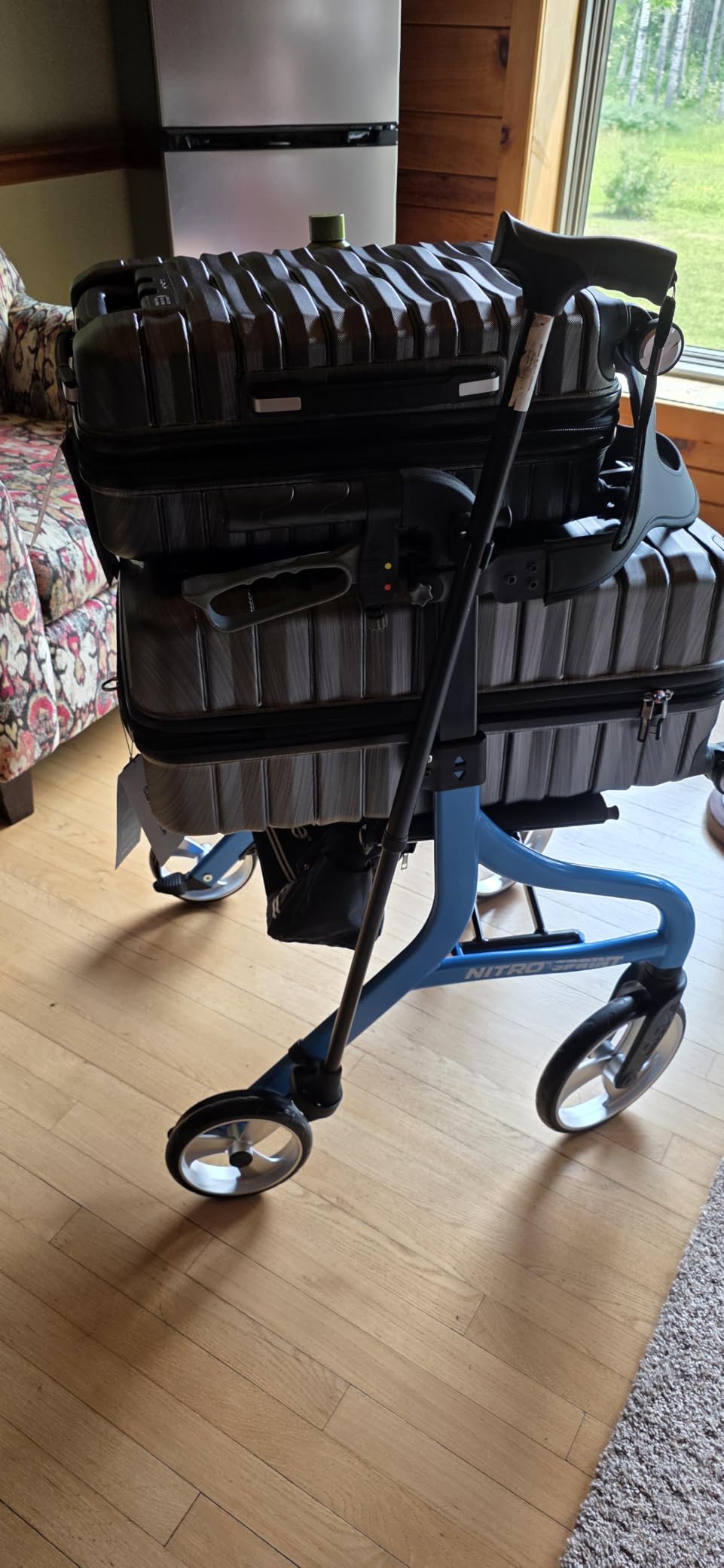
Users consistently describe it as well built and easy to fold one-handed, and the extra-large backrest with a viewing window is a small detail that turns out to matter on longer walks. The 10-inch front casters roll over sidewalk cracks and door thresholds without the snagging that smaller stock wheels pick up.
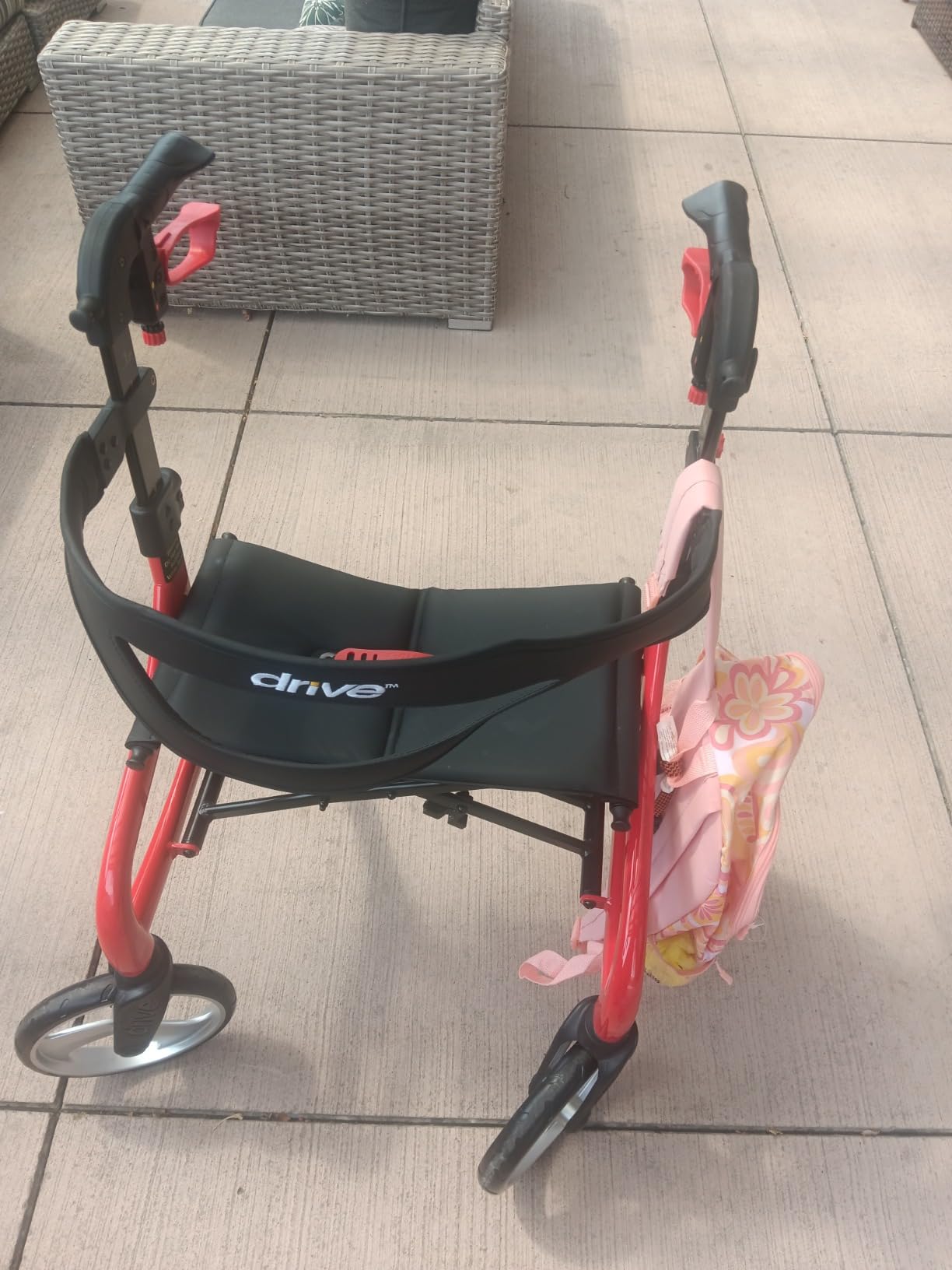
The honest limitation is that it is a rollator, not an upright walker. If your problem is not just reach but a permanent forward lean, the handgrips still sit lower than your shoulders and your arms angle down. For a 6 foot 2 inch user with a knee replacement, that is usually fine. For a 6 foot 5 inch user, it may not be.
Who this handle range suits best
Users from about 6 feet up to 6 feet 3 inches, and anyone who needs real weight headroom. The 350-pound rating is the standout number here, because most tall-specific frames top out at 300 pounds, which leaves a tall user with no margin at all.
If you spend time outdoors, the 10-inch casters are the reason to pick this one over a lighter 8-inch frame. If you mostly cross smooth indoor floors and short paved paths, the difference is negligible.
Where it falls short for tall users
Reviewers flag the price relative to some standard-height rollators, which is fair, and note limited color choices on the tall variant. Neither is a functional problem.
The real constraint is ceiling. This frame tops out well short of the 45 to 52 inch handgrip height that upright walkers reach, so anyone above roughly 6 feet 4 inches will still be leaning. Test the reach in a shop before you commit if you are near that boundary.
2. ELENKER Upright Stand Up Rollator – Best Reach for Tall Seniors
ELENKER Upright Walker, Stand Up Folding Rollator Walker Back Erect Rolling Mobility Walking Aid with Seat, Padded Armrests for Seniors and Adults, White
Armrest height 38 to 47 inch
10 inch front and 8 inch rear wheels
24 lb frame weight
300 lb build
18 inch mesh seat
Pros
- Tallest practical reach in this group for most body sizes
- Relieves shoulder and back strain
- Tool free assembly
- Quiet 360 degree swivel front wheels
- Detachable storage bag
Cons
- 24 lb weight is heavy to lift into a car
- Armrests can have slight side-to-side wobble
- Cup holder is small for larger bottles
- Some units have 8 adjustment holes rather than the advertised 9
The defining feature here is the padded armrest range of 38 to 47 inches measured from the ground. That is the tallest reach of any non-VOCIC frame in this roundup, and it is the reason this model works for a lot of people who cannot find anything else that fits.
An upright walker changes your posture completely. Instead of gripping handles at hip height and leaning forward, you rest your forearms on two horizontal pads at shoulder height and push down. Your spine stays stacked, your shoulders drop, and the load goes through your arms rather than your lower back.
Users report that this is the change they notice in the first week, and it is why upright walkers have become the default recommendation in most physical therapy clinics for anyone with chronic back or shoulder pain. The frame is 24 pounds, which is the trade-off you pay for the taller, wider structure.
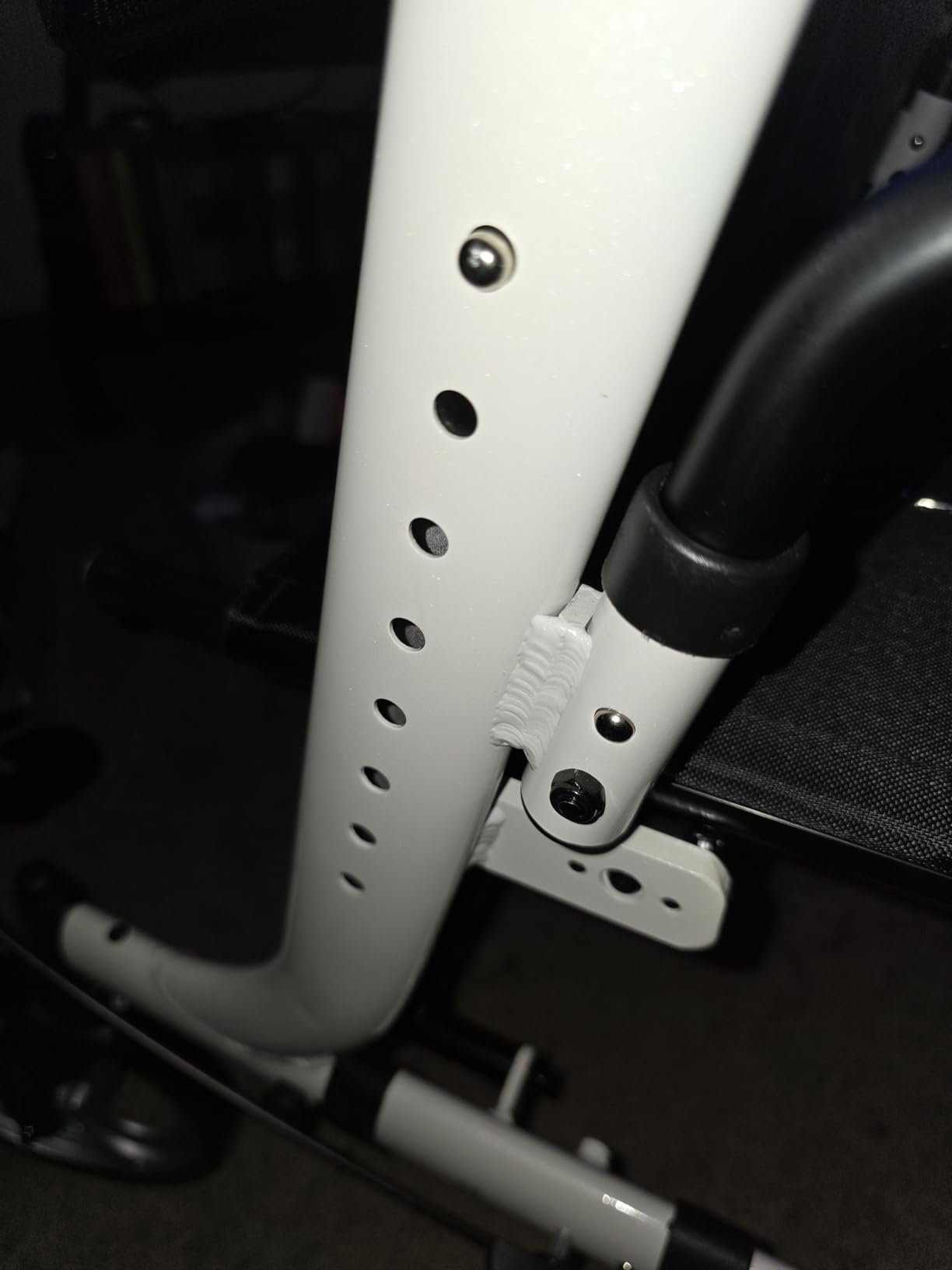
Rolling behavior is good. Ten-inch front wheels and 8-inch rear wheels on a 360-degree swivel front axle handle pavement, indoor carpet and hard floor without a lot of resistance. The 18 by 10 by 21 inch breathable mesh seat is wide enough to sit on for a rest, though it is not the padded bench some buyers expect.
Two details came up repeatedly. The armrests can develop a small amount of side-to-side play after months of use, which sounds minor and is, and the cup holder is too small for a large insulated bottle. Neither affects safe operation.
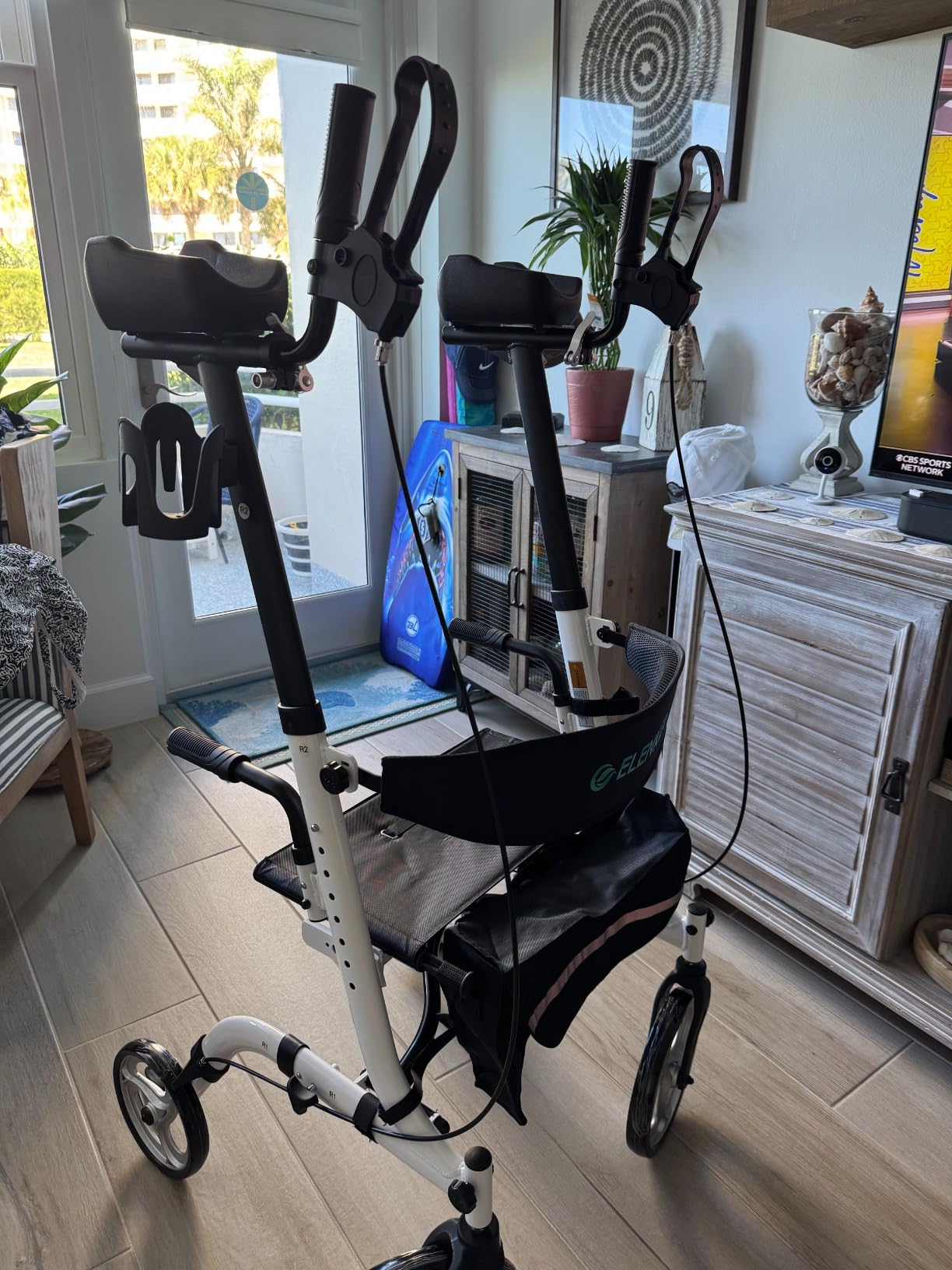
Who the 47 inch armrest height suits
Users roughly 5 foot 8 inches through 6 foot 4 inches who want to walk upright. It is one of the few mainstream options whose reach clears the point where a standard rollator handle would force a forward hunch.
It is also a good pick for anyone recovering from shoulder surgery, since the forearm-supported position removes load from an unhappy rotator cuff. Buyers who value easy assembly also do well here, as the frame goes together without tools.
Where it falls short
Twenty-four pounds is heavy for a user with lifting limitations, and the folded package is 28 by 26 by 53 inches, so it needs a large trunk or a hatchback. It is not a travel-first design.
The mesh seat is comfortable enough for a short sit but is not a place to wait out a long wait. And the frame is wide, so check your narrowest doorway and your elevator before ordering.
3. ELENKER All-Terrain Upright Rollator – Best for Gravel, Grass and Beach
ELENKER All-Terrain Upright Rollator Walker, Stand Up Rolling Walker with 10’’Big PU Wheels and Adjustable Padded Armrests for Seniors from 4’8”to 6’4”, Red
10 inch PU puncture proof wheels
300 lb capacity
30 lb frame weight
Adjustable armrests
High density foam seat
Pros
- Puncture proof PU tires with real shock absorption
- Armrest length and angle both adjust
- Durable foam seat outlasts mesh
- Fits users 4 ft 8 in to 6 ft 4 in
- Large capacity basket
Cons
- 30 pounds is the heaviest frame in this roundup
- Only two color variants
- Wide footprint needs space to turn
Standard rollator wheels are designed for carpet and smooth sidewalk. The moment you meet gravel, packed earth, wet grass or a beach path, small wheels become a problem. This model solves that with 10-inch polyurethane tires described as explosion-proof and puncture-proof, mounted on an upright frame.
The armrests are unusual in a good way. They adjust in both length and angle, which matters for tall users because forearm length varies a lot more than height does. A tall person with a long reach and a tall person with a short reach at the same height need different armrest geometry, and most frames only give you one dimension.
The high-density foam cushion seat with a PU cover is a step up from mesh. Foam does not sag, does not stretch, and does not print a mesh pattern into your legs after twenty minutes, which reviewers consistently mention as the reason they prefer it.
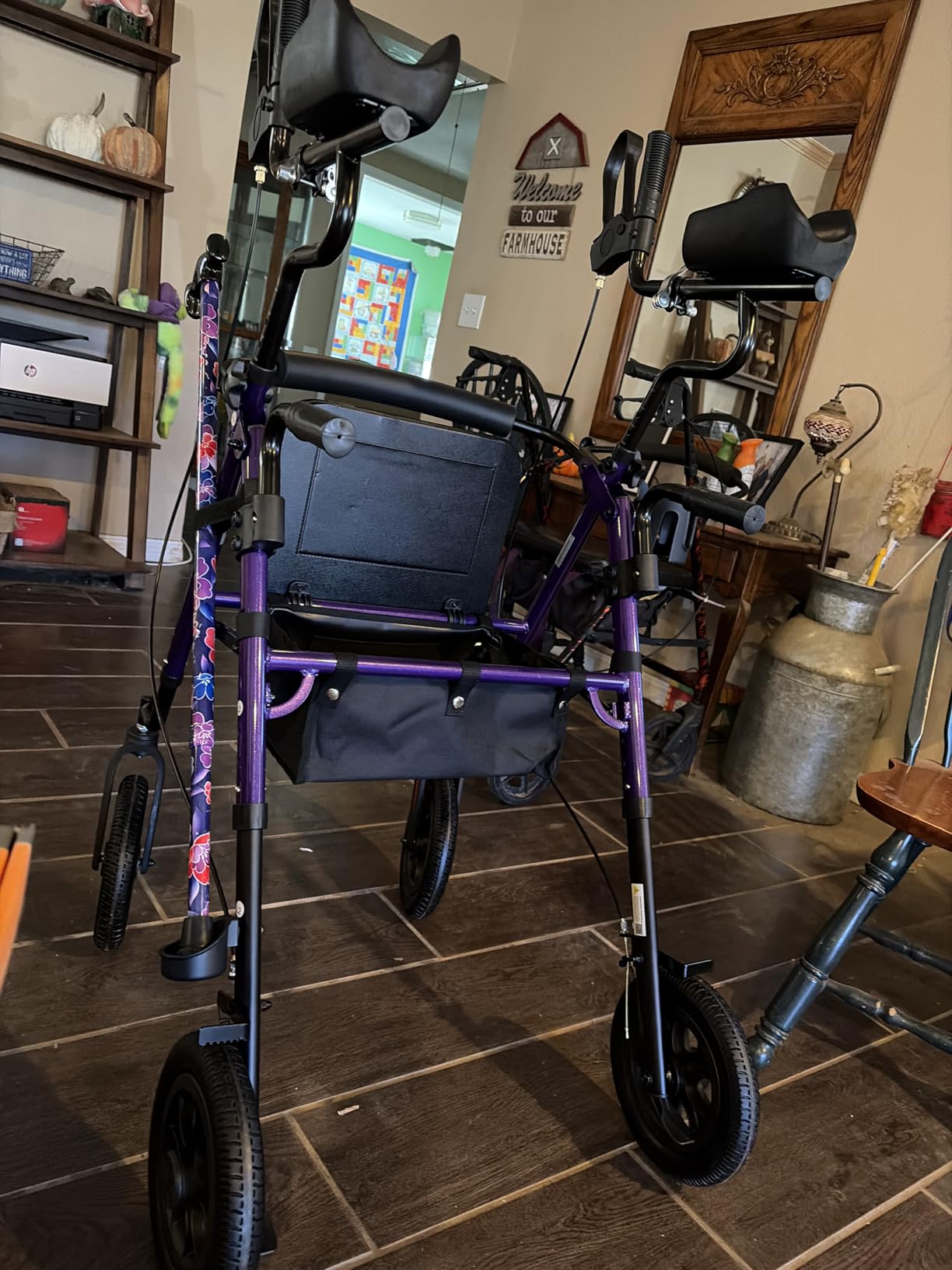
At 30 pounds this is the heaviest rollator we tested, and we would not recommend it to anyone who lifts a walker into a car unaided. The reinforced aluminum frame is rated to 300 pounds and the published height range runs from 4 foot 8 inches to 6 foot 4 inches.
Owners who bought it for outdoor use tend to keep it. The large under-seat basket, cane and umbrella holder, and swiveling front casters make it a practical companion on longer paved trails as well as rough ground.
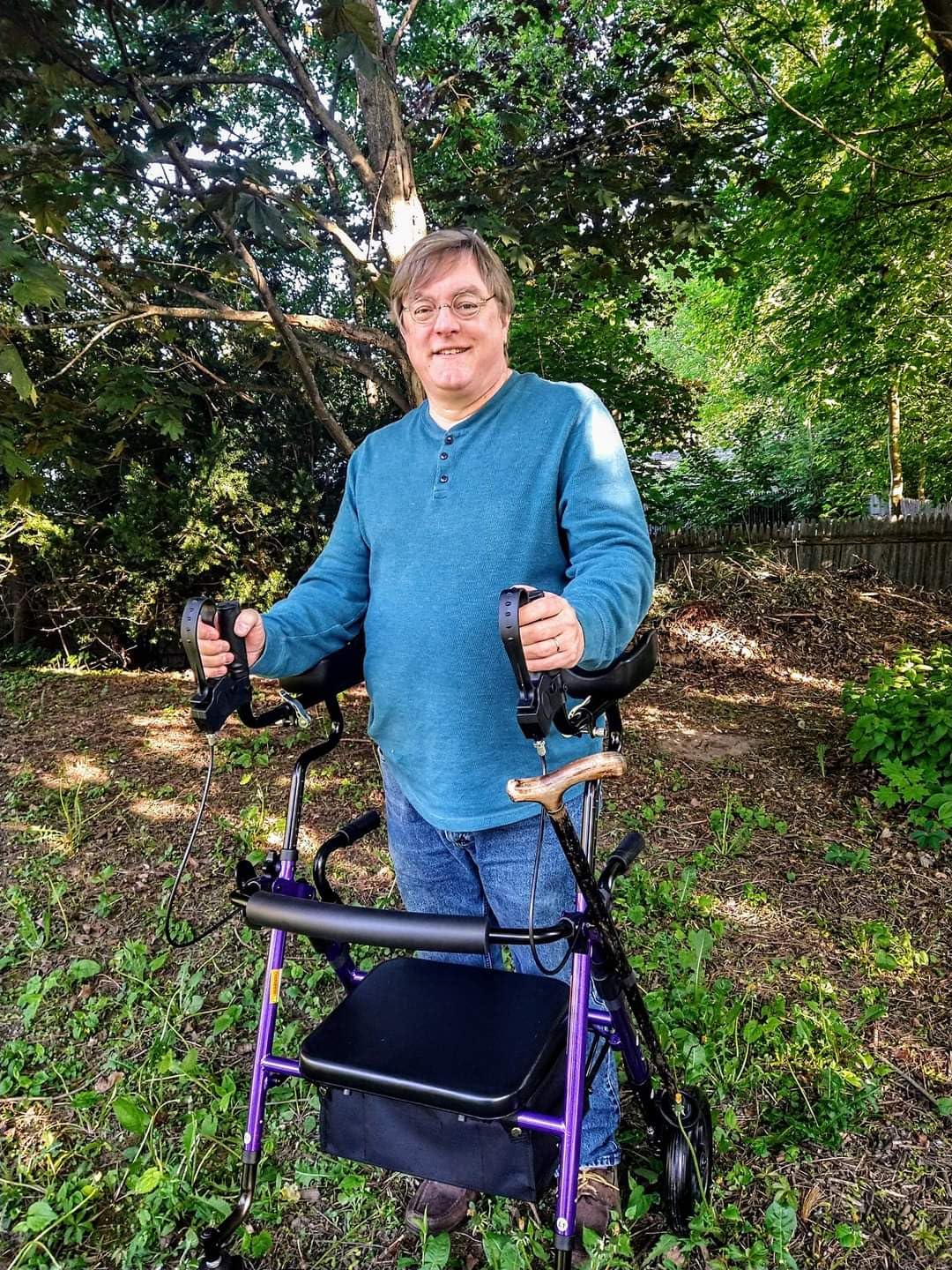
Who this wheel and frame setup suits
Tall users up to about 6 foot 4 inches who walk on anything other than a flat indoor floor. If your route involves a gravel driveway, a park path, sand, or uneven paving stones, the 10-inch PU tires are the deciding factor rather than a nice-to-have.
It also works for shorter users in the same 4 foot 8 inch to 6 foot 4 inch window, which makes it a two-person household option if you are buying for a partner of a different height.
Where it falls short
Thirty pounds is a genuine limitation. If your main use is indoor and short-distance outdoor walking, the lighter upright frames give you the same reach at a lower carry weight.
The footprint is 29.5 by 23.6 inches, so turning in a tight hallway or getting through a narrow doorway takes planning. The published range also stops at 6 foot 4 inches, so it will not cover the very top of the height market on its own.
4. Helavo Upright Walker with Seat – Best Warranty and Support
Helavo Upright Walker with Seat, Foldable Stand Up Walker with Rubber Tires
22.71 lb frame weight
10 inch puncture proof tires
300 lb capacity
18.9 inch seat
Two year warranty
Pros
- Two year warranty extendable to three
- Replacement parts and support available
- 10 inch puncture proof rubber tires
- Height adjustable padded backrest
- Parking brake on the hand levers
Cons
- 18.9 inch seat is narrow for larger users
- Only two color variants
- Frame height caps below the tallest upright models
The Helavo H1160 stands out less for raw reach and more for what happens when something breaks. It ships with a two-year warranty that can be extended to three years, and owners report that replacement parts arrive without being asked to return the original component first.
For a mobility aid, that matters more than a spec line. A missing brake lever or a bent basket bracket is a day without an aid, and the support quality is the difference between a bad morning and a bad week.
The frame weighs 22.71 pounds and measures 26.38 by 26.38 by 46.85 inches. Ten-inch puncture-proof rubber front wheels give it the same terrain tolerance as the other upright frames here, and the height-adjustable padded backrest can be moved to match your shoulder position rather than sitting at one fixed height.
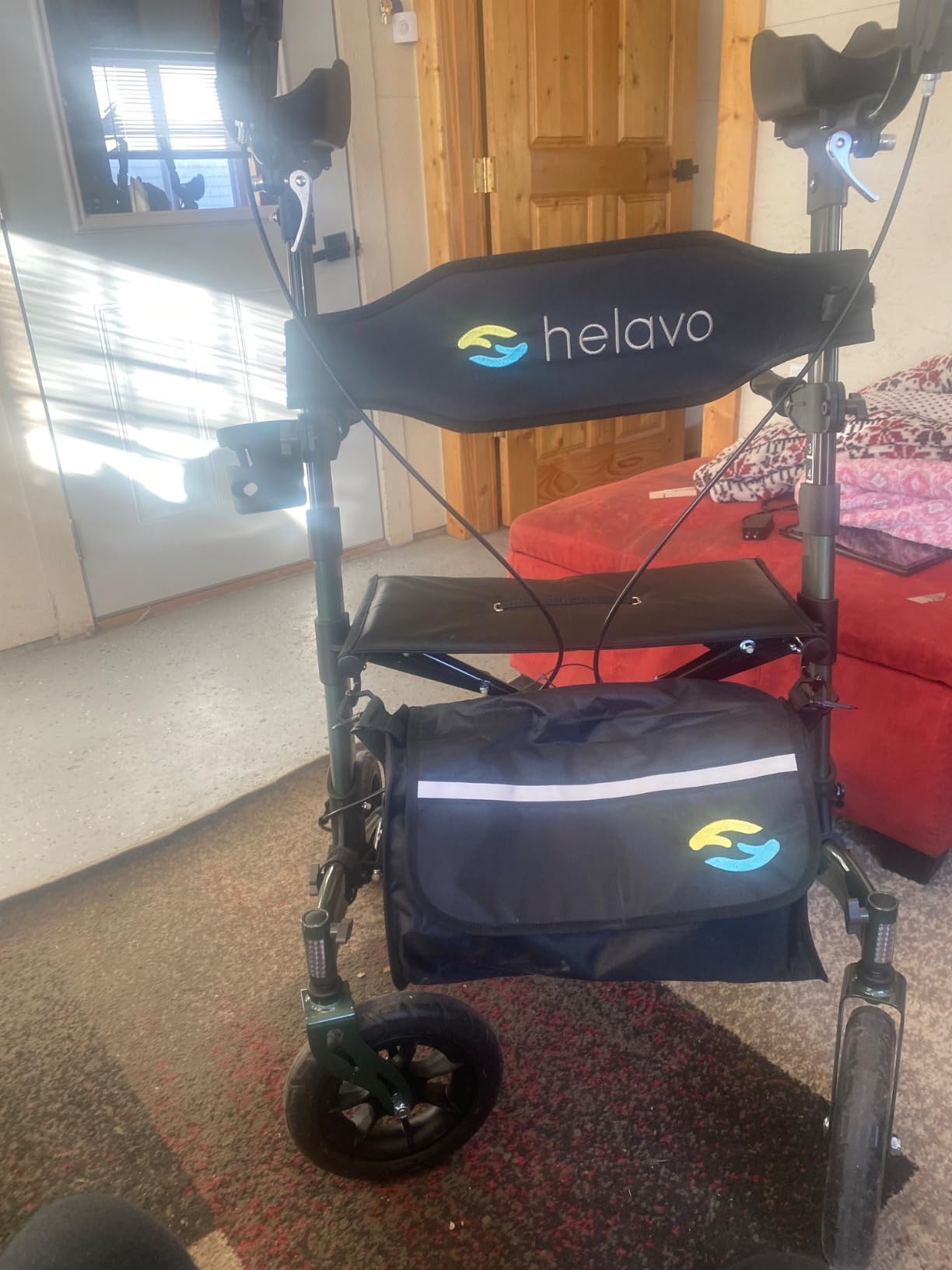
The hand-lever braking system includes a parking brake, which is worth looking for. Many upright frames only lock the wheels when you squeeze the levers fully, and a park position is easier to use when both hands are occupied.
Cup holder and an integrated cane holder round out the accessories, and assembly is a matter of following the included video. The seat measures 18.9 inches wide by 9.1 inches deep with a maximum height of 22 inches, and that seat width is the specification most likely to disappoint a larger user.
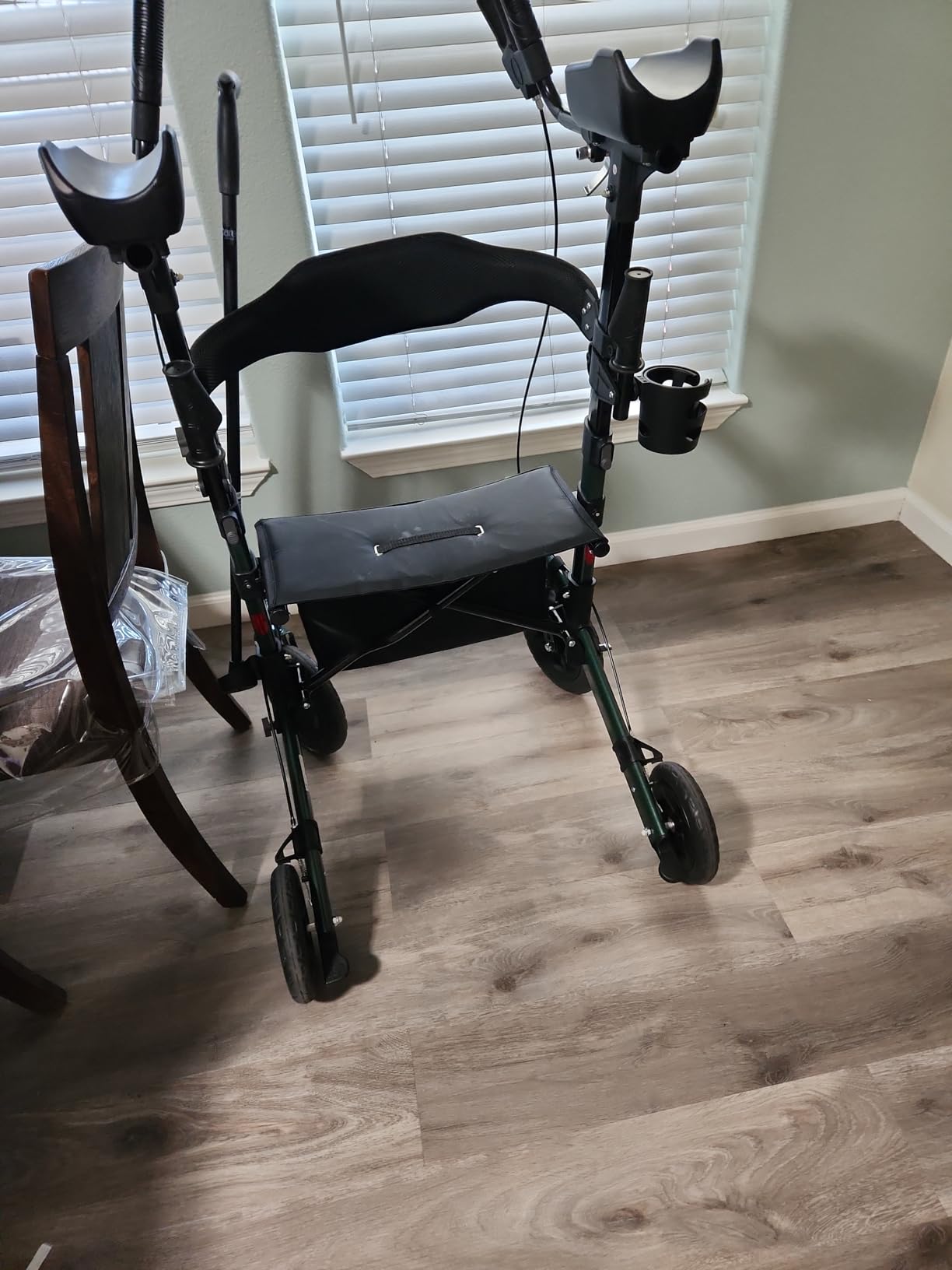
Who this frame suits
Tall users up to roughly 6 feet who want dependable support and a long warranty rather than the highest possible reach. It is a strong choice when the walker lives in one place and gets used daily, rather than one that travels in and out of a car.
The adjustable backrest is genuinely useful for tall users, because a fixed backrest on an upright frame either presses into the lower back or leaves a gap. If you plan to sit down often, that adjustment is worth more to you than an extra inch of reach.
Where it falls short
Seat width is the recurring complaint. Users report that an 18.9-inch seat feels tight even at moderate body weights, so if you are a larger-framed person, budget for a separate seat cushion or look at the wider-seat options.
It also carries one of the higher price points in this roundup without offering the top of the height range, so value-wise it competes against lighter frames that reach the same distance.
5. MAXWALK Tall Rollator with 12 Inch Wheels – Best for Very Tall Users
MAXWALK Walkers for Seniors with Seat, Tall Rollator Walker, Foldable
Handles 36.6 to 40.1 inch
Seat 22.8 to 24.4 inch
12 inch front and 10 inch rear wheels
Fits 5.3 to 7 ft
300 lb capacity
Pros
- Published height range up to 7 feet
- Largest wheels in the roundup with 12 inch fronts
- Handle and seat both height adjustable
- Built-in brake cables avoid snagging
- One pull three second fold
Cons
- Only four handle and two seat height steps
- 17.7 inch seat is narrow for some users
- Newer model with a smaller review base
Most tall rollators state a maximum user height of 6 foot 4 inches or 6 foot 5 inches. This one is published for users from 5 foot 3 inches up to 7 feet, with a handle range of 36.6 to 40.1 inches and a seat that adjusts between 22.8 and 24.4 inches.
That seat adjustment is unusual on a traditional rollator. Most have one fixed seat height, which means a tall user either sits too low and struggles to stand, or sits high and cannot get both feet flat. Two positions is not a lot, but it is more than none.
The wheels are the headline. Twelve-inch front casters and 10-inch rear rubber wheels are the largest combination in this roundup, and they float over the kind of uneven ground that makes smaller wheels catch and trip. We would pair this frame with gravel paths, park trails and older asphalt.
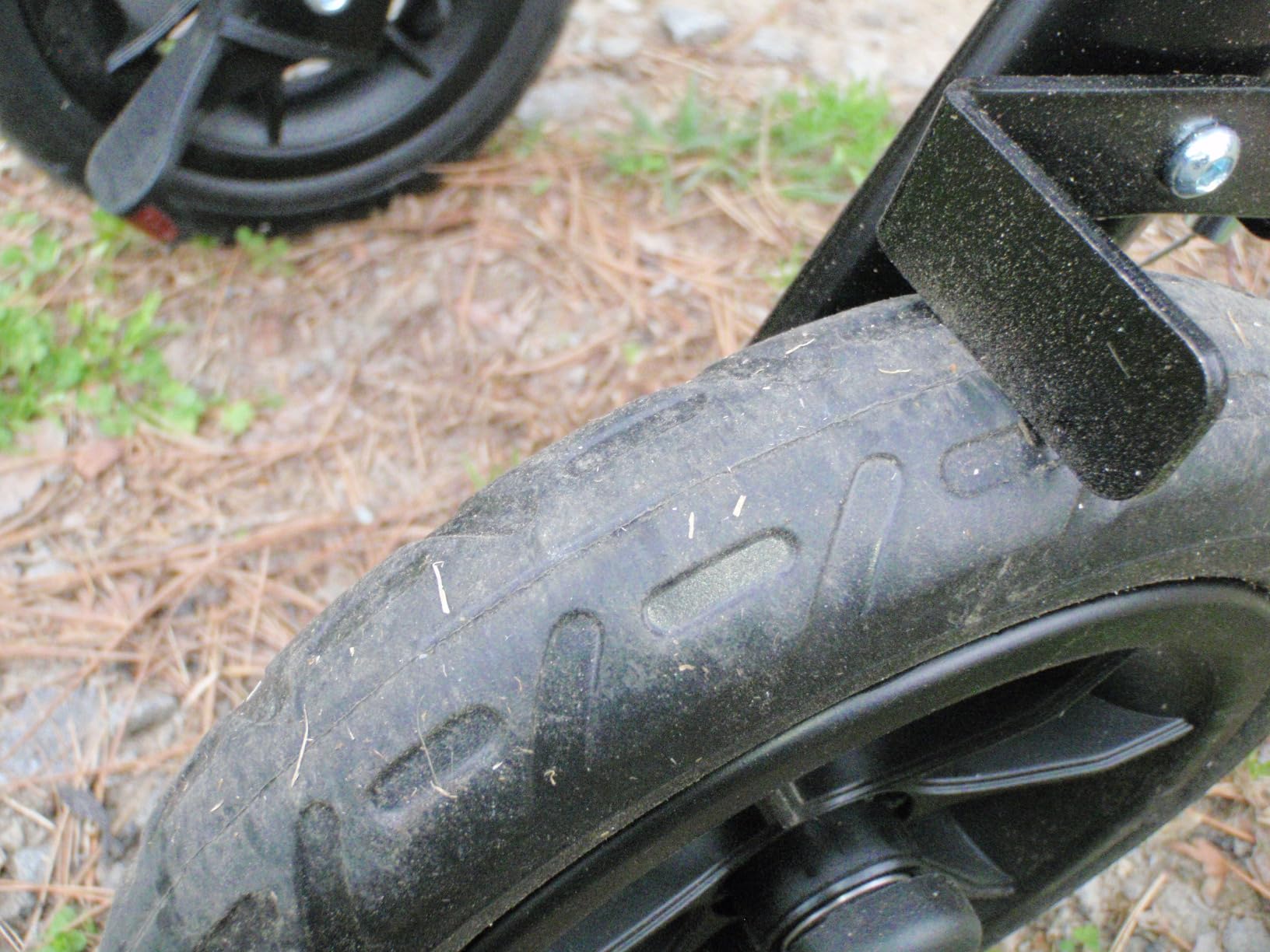
Brake cables are built into the frame rather than routed externally, which solves a problem tall owners mention often: exposed cables snagging on doorframes, bushes and chair legs. There is a dual brake system, with one control for speed and one for a full wheel lock.
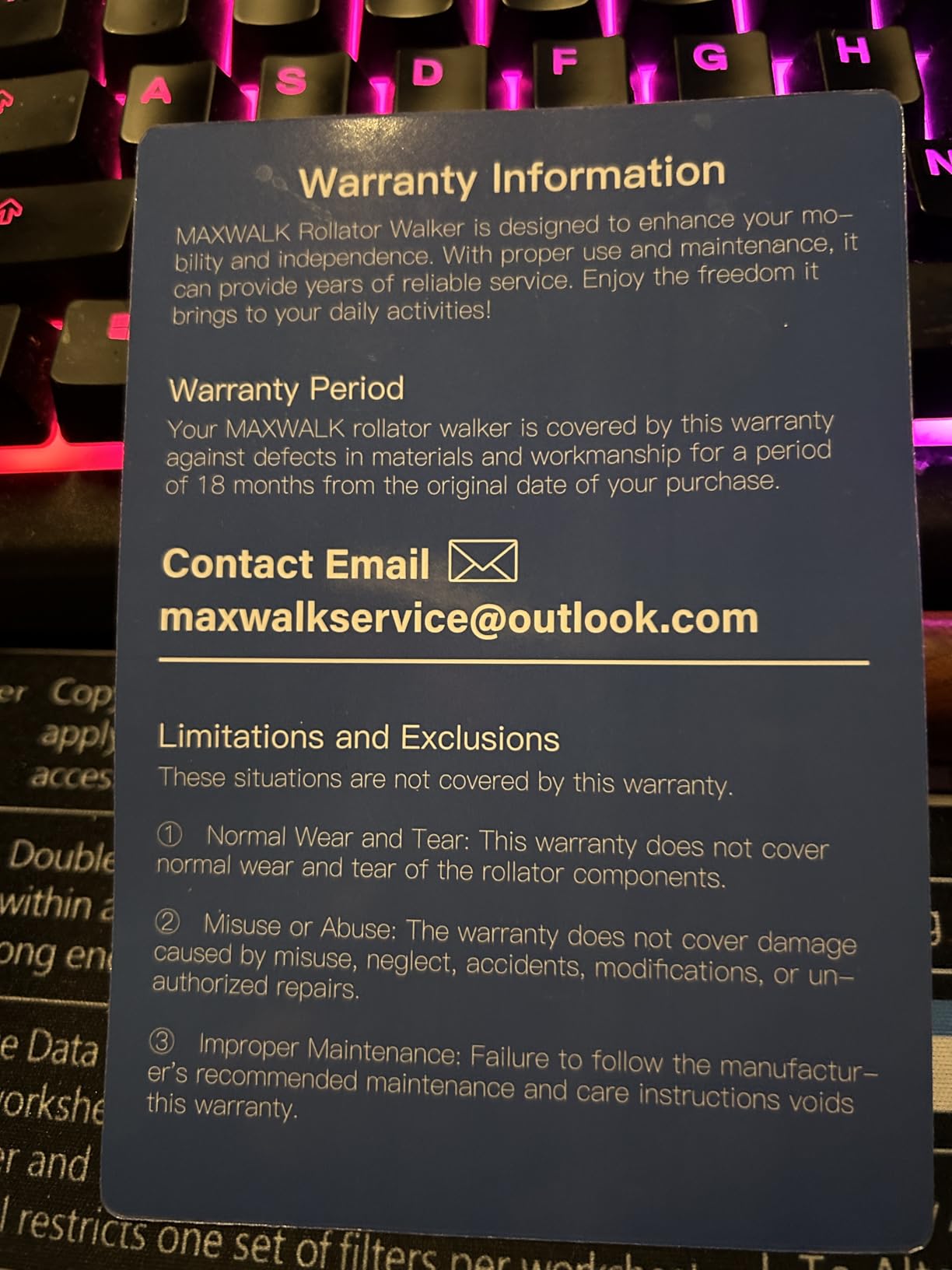
The triangular aluminum structure weighs 20.6 pounds and is rated to 300 pounds, and the red-cord one-pull fold collapses the frame in about three seconds. An 18-month warranty with lifetime support is included.
Who the 40 inch handle ceiling suits
Tall users between 6 feet and about 6 foot 3 inches, and anyone who is near the top of the range that traditional rollators can serve. The stated 7 foot ceiling is a manufacturer figure, so test it rather than trusting it at the extreme.
If you walk outdoors on anything rougher than a sidewalk, the 12-inch front wheels are a real advantage. They also absorb more vibration, which shows up as less fatigue in the forearms and lower back over a long walk.
Where it falls short
Four handle positions and two seat positions is coarse adjustment. Fine adjustment matters if you are between two sizes, and here you may end up a quarter inch above or below your ideal wrist crease.
The 17.7 by 9.8 inch seat is narrower than some competing frames, and this is a newer model with a smaller body of reviews, so long-term durability is less well documented than for the older established models.
6. ELENKER Upright Rollator with Front Pouch – Best Budget Upright Frame
ELENKER Upright Rollator Walker, Stand Up Walkers for Seniors with Armrest, Front Pouch, 10”Wheels, Sponge Padded Seat and Backrest, Fully Adjustment Frame, Orange
26 lb frame weight
10 inch anti slip tread wheels
Fits 5 ft to 6 ft
Fully adjustable frame
Front zippered pouch
Pros
- Lowest cost upright frame in this roundup
- Front zippered pouch avoids bending down
- Reinforced molded armrests
- Triangular flanges improve front bracing
- Compact footprint for maneuverability
Cons
- Armrests are hard molded rather than padded
- Some reports of instability on uneven ground
- 26 pounds is a heavy carry weight
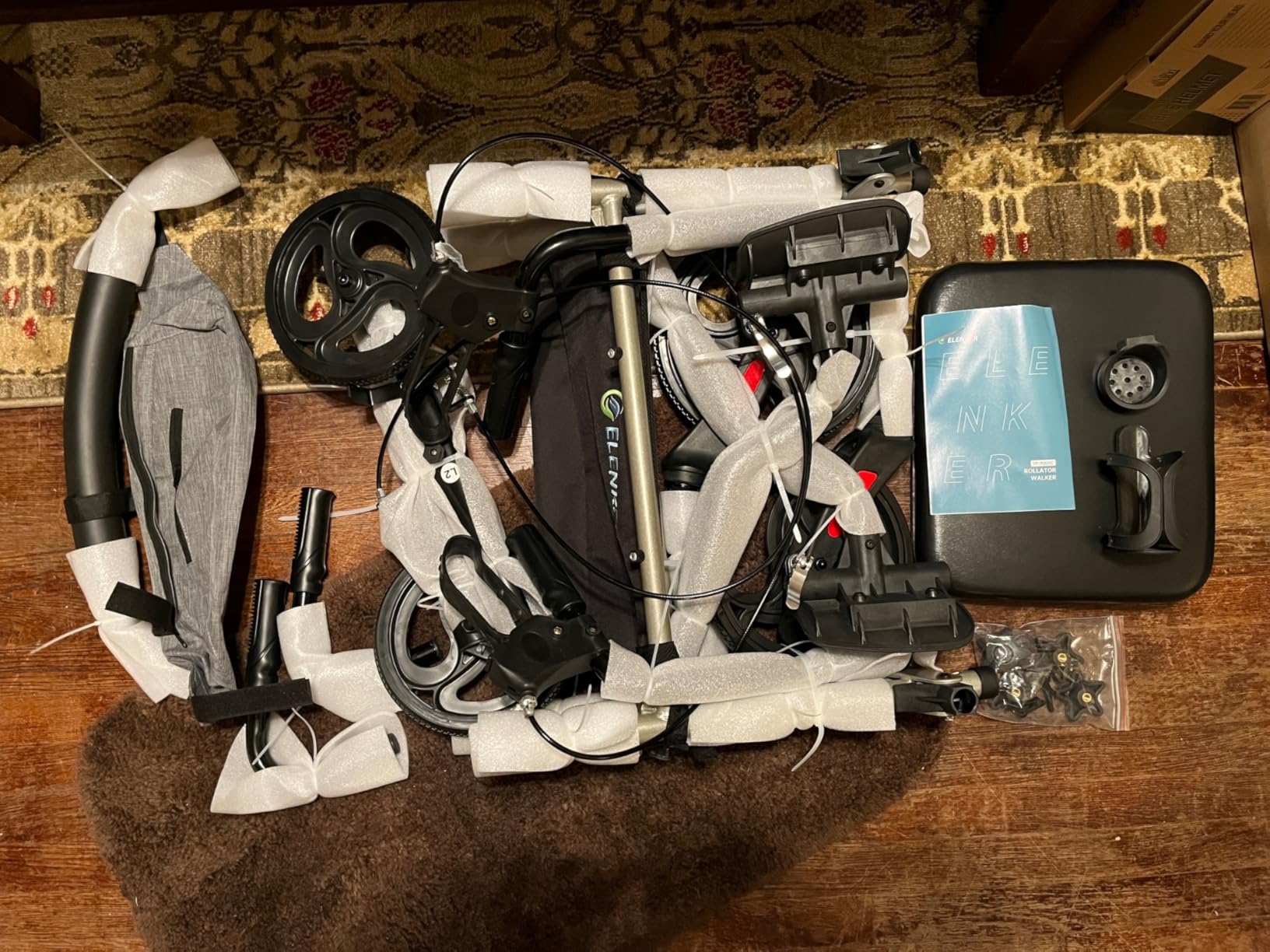
If upright geometry is what you need and budget is the deciding factor, this is the frame to look at first. It keeps the armrest-supported posture at the lowest cost in this group, and it adds two details that make daily use easier than the price suggests.
The front zippered backrest pouch is attached to the front of the frame rather than behind the user. You reach back and it is there, instead of having to twist around or walk around the walker to get to a bag behind the seat. Owners treat this as the feature they would not give up.
The armrests are hard molded rather than foam-padded, and the front cross brace uses triangular flanges for added rigidity. A fully adjustable frame covers the handlebar, seat height and the handgrip angle, which matters if your forearms are longer or shorter than the default.
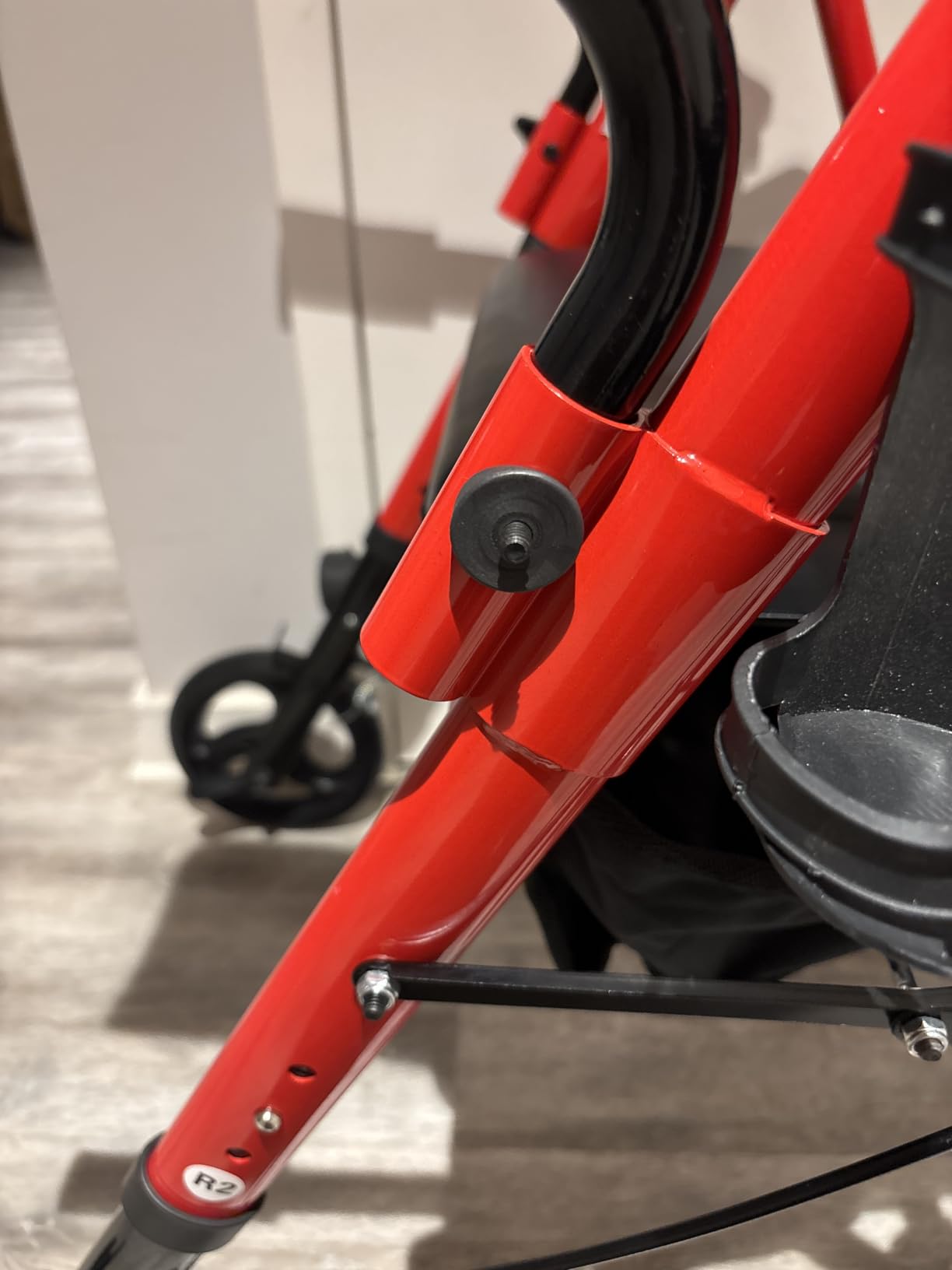
Ten-inch anti-slip tread wheels and a reinforced frame rated for the standard user weight class make it a solid indoor-to-paved-path walker. The under-seat basket is larger than on earlier models, and the package folds down to 22 by 22 by 8 inches, which is one of the more compact folded footprints here.
The published height range is 5 feet to 6 feet, so this is a fit for the lower and middle part of the tall range rather than the top of it. Check the reach in person if you are much above 6 feet.
Who this budget upright frame suits
Tall users up to about 6 feet who want upright posture, solid basket and pouch storage, and 10-inch wheels, without paying for a premium frame. The triangular bracing makes it a reasonable choice on paved paths and hard floors.
It is also a good value if you are buying for someone who is still deciding whether an upright frame works for them. The folded footprint is small enough to store out of the way between outings.
Where it falls short
The molded armrests are firm. Users who spend long periods leaning on them sometimes add covers, and if you have forearm sensitivity or a healing surgical site, padded arms are worth paying for.
There are also isolated reports of instability on uneven ground, and at 26 pounds this is a heavy frame to lift. Neither is a reason to rule it out indoors, but both matter if your main route is rough.
7. VOCIC Z22 Upright Walker – Best Reach and Comfort for Tall Users
VOCIC Z22 Upright Walkers for Seniors with Seat, GelSoft Stand Up Walker
Handle height 40 to 47 inch
Seat height 20 to 22 inch
GelSoft armrests
8 inch wheels
22.5 lb frame weight
Pros
- 40 to 47 inch handle range covers the tallest users here
- GelSoft armrests spread forearm pressure
- Flip-out armrests add 4.7 inch of seat width
- Dual adjustment brake system
- Light at 22.5 pounds
Cons
- 8 inch wheels suit smooth surfaces better than rough ones
- Armrests do not swing clear when sitting
- Seat narrow for larger users
- Requires hand grip strength
This model has the highest handle range of the group that does not use forearm rests, at 40 to 47 inches, and it does it on an adjustable handgrip rather than a fixed armrest. The tubes are 30 percent thicker than standard, which is how the frame holds stability at full extension.
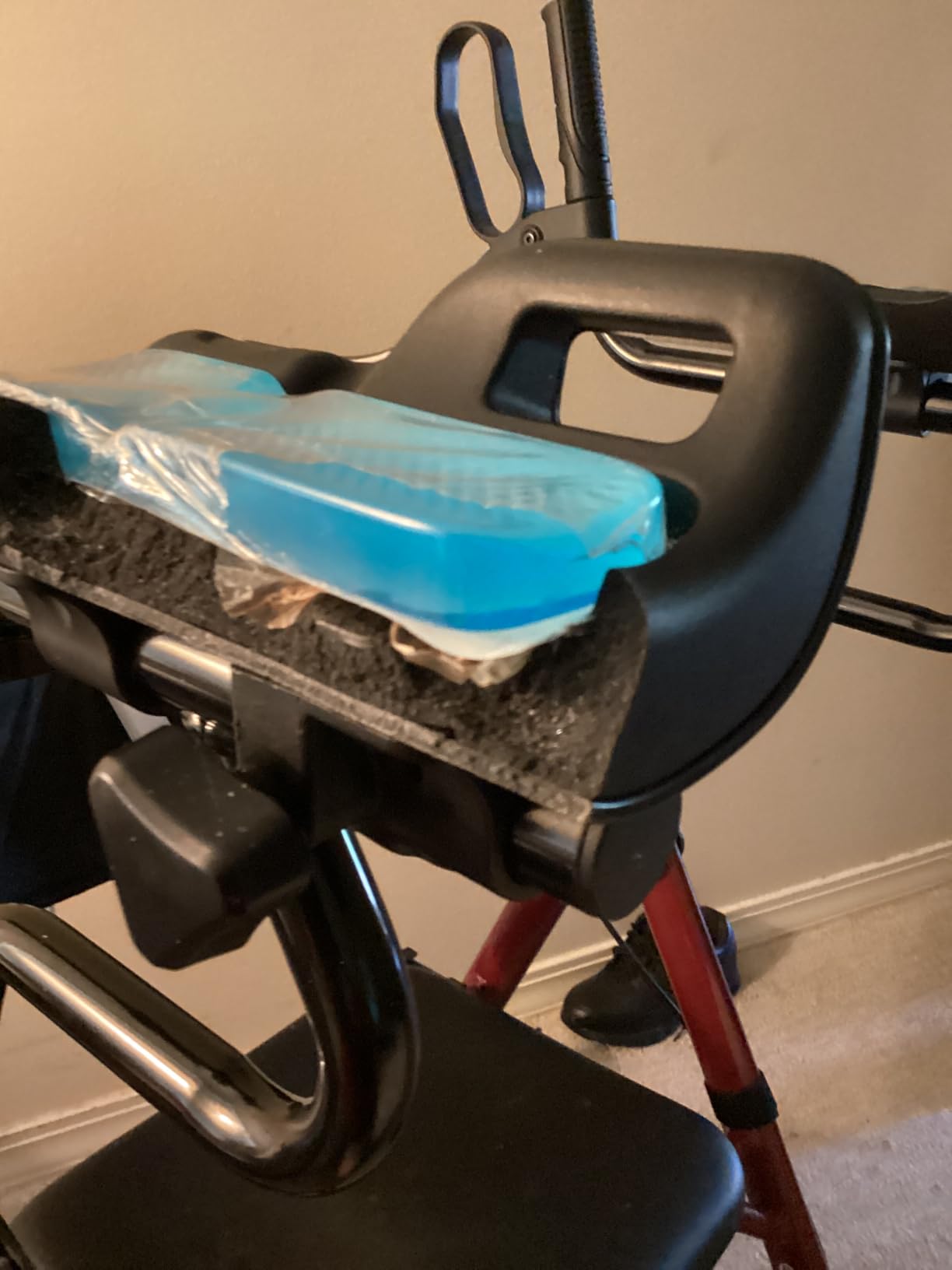
The GelSoft armrest layer is the feature that distinguishes it. Rather than a hard tube or thin foam, a gel layer sits under your forearms and spreads pressure across a wider area, which matters over a long walk and for anyone with fragile skin or diabetes-related nerve sensitivity.
Flip-out armrests add 4.7 inches of usable width when you need to sit down, then fold back out of the way. That is a genuinely clever answer to the seat-width problem that other frames have.
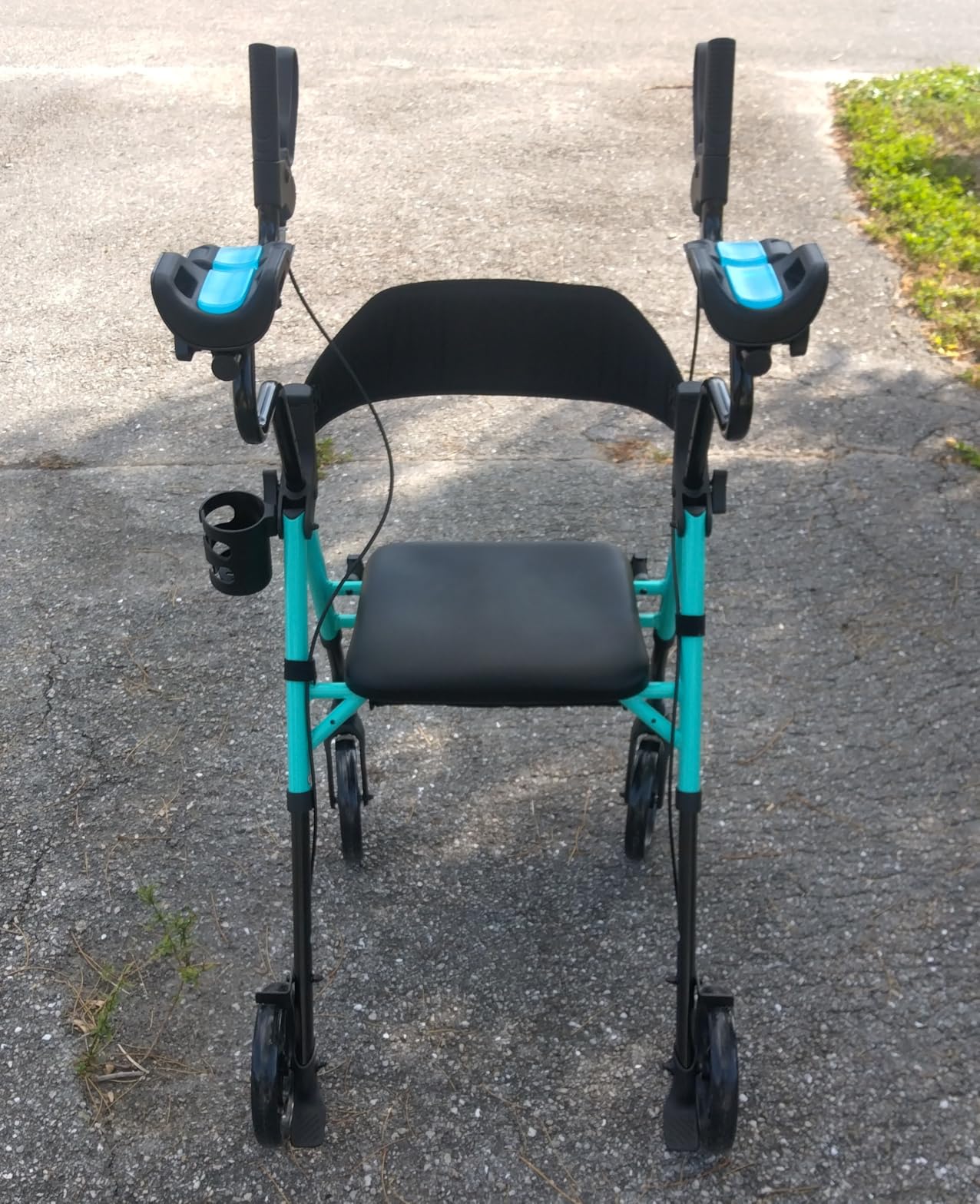
The brake is dual-adjustment: squeeze up for speed control, pull down to lock, and a ramp position for parking. The 8-inch wheels have a 3D non-slip tread pattern and 360-degree front steering, which is right for hard floors and smooth pavement but not for gravel.
Customer service is a real strength here, with owners reporting replacement parts sent out promptly without a return. The reinforced triangular frame is rated to 300 pounds and weighs 22.5 pounds.
Who the 40 to 47 inch handle range suits
Tall users from roughly 6 feet to 6 foot 5 inches who want a handgrip walker rather than a forearm-support model, and who are willing to set the grips above shoulder height. It is one of the few conventional rollators on the market that reaches into the 47 inch zone.
Users with hand strength should feel confident about it. It is a hand-brake-only design with no foot brake, which simplifies operation but requires a firm grip to slow and stop the frame.
Where it falls short
Most reviews describe this as a short-user frame, and the complaints cluster around the fixed armrests. If you sit down regularly, the armrests can swing into your face rather than moving out of the way, so test the sitting motion before committing.
The base seat is narrow and reviewers report it feels tight even at moderate weight, and the 8-inch wheels limit it to smooth surfaces. It is a comfort-first frame rather than a terrain frame.
8. Vive Mobility Upright Walker – Tallest Reach in the Roundup
Vive Mobility Upright Walker with Seat – Stand Up Rollator, Arm Rests
Handle height 45 to 52 inch
Fits 5 ft 2 in to 6 ft 4 in
17.5 inch wide seat
20 lb frame weight
300 lb capacity
Pros
- Tallest handle range in this roundup at 45 to 52 inches
- Lightest upright frame here at 20 pounds
- Widest seat at 17.5 inches
- Forearm pads adjust forward and backward
- #21 best seller in rolling walkers
Cons
- 8 inch wheels are smaller than most rivals here
- Rating sits below the rest of the group
- Older design with less adjustability
- One year guarantee
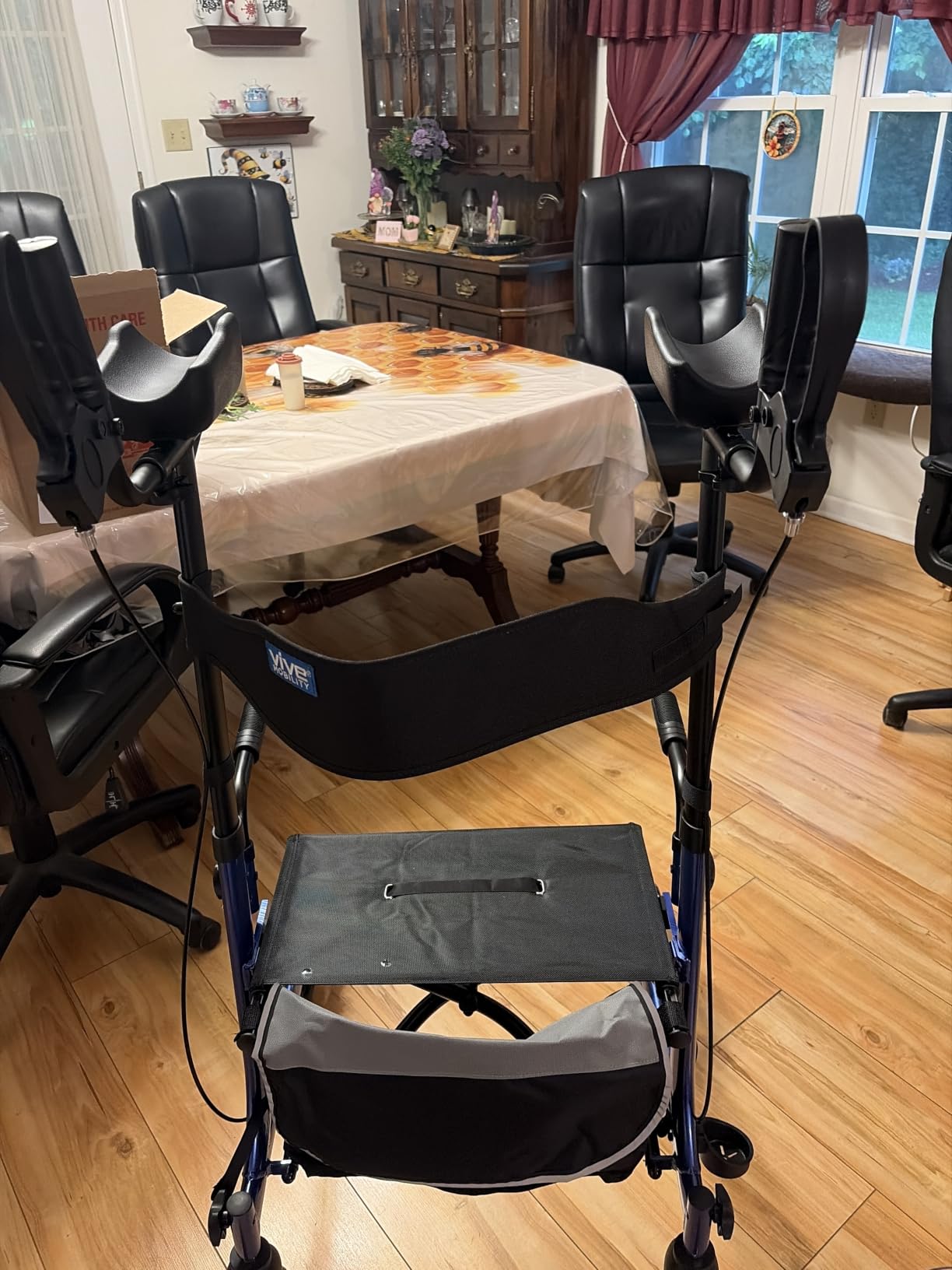
On raw reach, this is the winner. The handle height adjusts from 45 to 52 inches, and there is no other rollator in this roundup that goes that high. For anyone above 6 feet 4 inches who has been told nothing fits, this is the frame to look at first.
The forearm pads are the other reason it works for tall users. They slide forward and backward, so a tall person with a long torso and short arms, or the reverse, can get the pads in the right place instead of leaning out over them.
At 20 pounds it is also the lightest upright frame in this group, which matters when you are loading it into a car or moving it between rooms. The aluminum frame is rated to 300 pounds and carries a one-year guarantee.
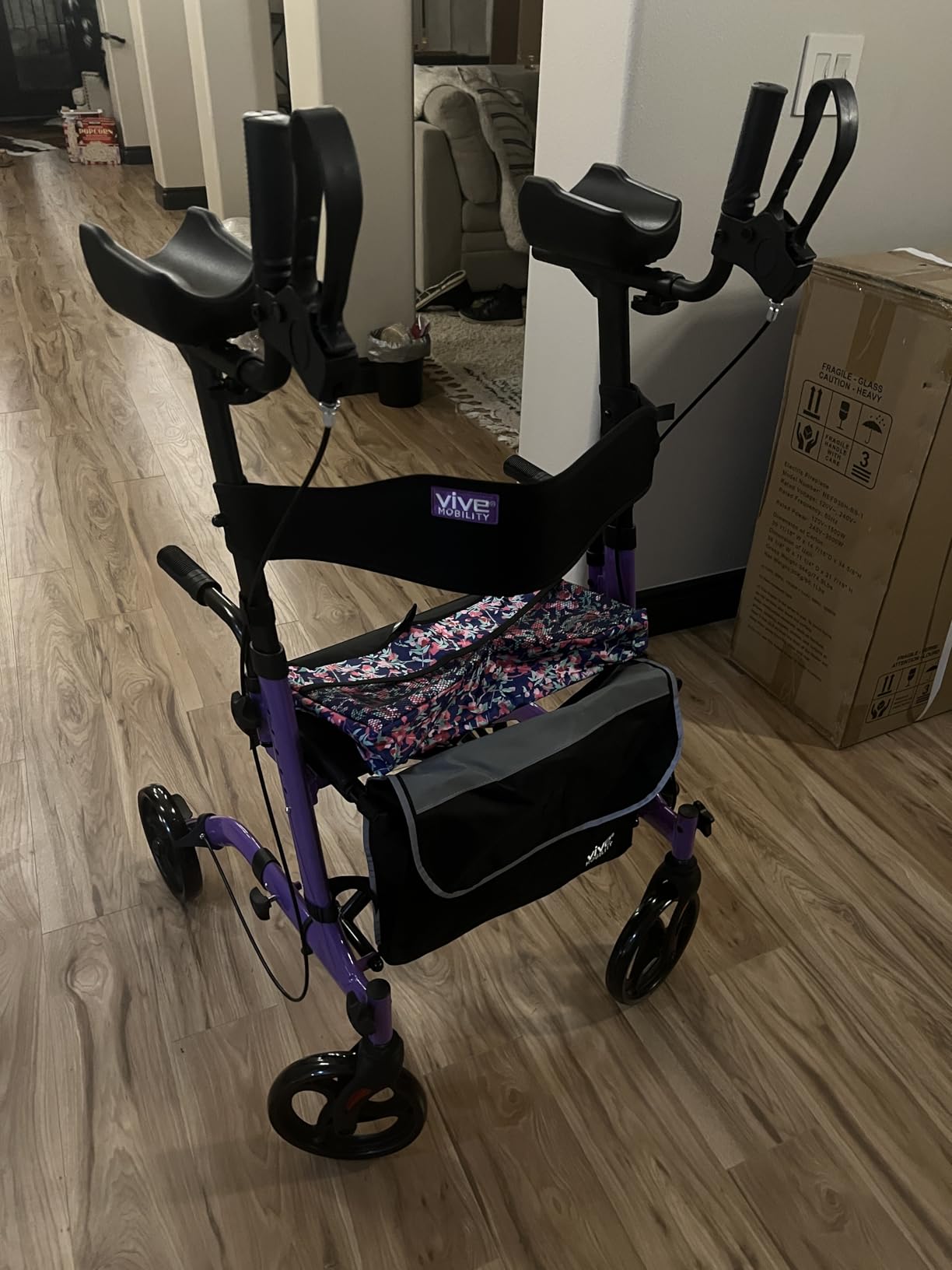
Loop brakes lock the wheels, and a detachable shoulder bag is included. The 17.5-inch seat is the widest here, which is a real advantage for anyone who plans to use the rollator as a rest rather than only as a walking frame.
Its 4.1 rating is the lowest in this group, and the reviews explain why: the design is an older, less adjustable design than newer models. The 8-inch flat-free wheels also rule it out for rough ground.
Who the 45 to 52 inch range suits
Users from about 6 foot 3 inches to 6 foot 4 inches who have run out of options on standard frames. The published range covers 5 foot 2 inches to 6 foot 4 inches, and the extra reach above 6 feet is what makes this frame worth the trade-offs.
It is also the better choice for anyone who spends real time seated, given the wide seat, the back support and the flat-free tires that will not go flat in a hallway or a hotel room.
Where it falls short
Eight-inch wheels are the compromise for the tall geometry. They roll fine on hard floors and smooth pavement but will not handle gravel, grass or broken asphalt the way a 10-inch caster will.
The design is also less refined than newer frames. Adjustability is limited to handle height and pad position, the guarantee is one year, and the lower rating reflects a build that some long-term owners describe as functional rather than refined.
9. RollisRoll Tall Rollator with 350 Pound Capacity – Best for Narrow Spaces
RollisRoll Walkers for Seniors Taller 5.3~7ft, Lightweight Foldable Rollator Walker, Built in Cable, Reinforced Aluminum Frame, 8″ Big Rubber Wheels for All Terrain, 350lb Weight Capacity, Black
17.4 lb frame weight
350 lb capacity
Seat 22 to 25 inch
Handles 33 to 39 inch
24.4 inch frame width
Pros
- Lightest rollator here at 17.4 pounds
- 350 pound capacity
- Handles and seat both adjust across three positions
- Narrow 24.4 inch width suits doorways and elevators
- Built-in cables and reflective strips
Cons
- Handle range tops out at 39 inches
- Front wheels can turn sideways too easily
- Loose handlebars in the lower legs
- Newer model with fewer reviews
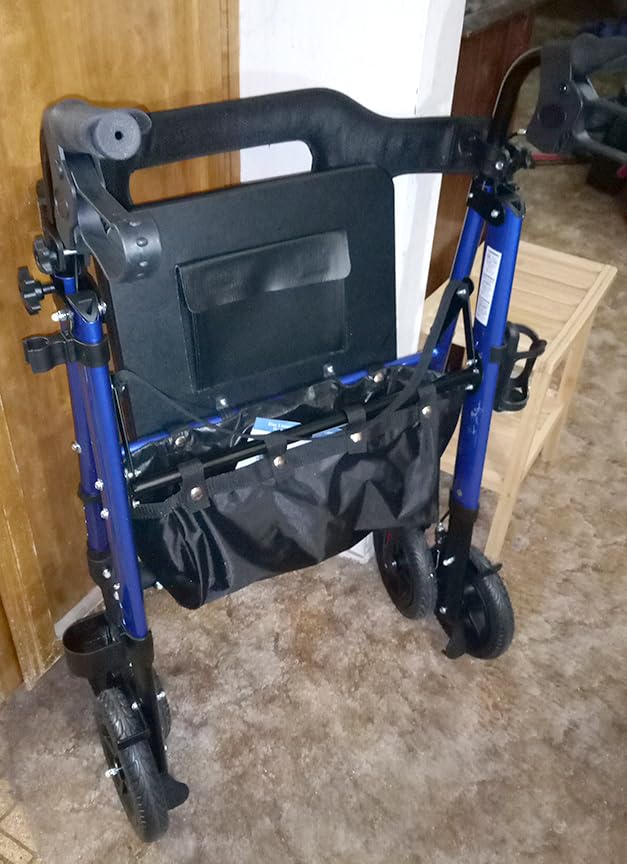
Most rollators are 24 to 26 inches wide, which is fine in a hallway and a problem in an apartment, a small elevator or a narrow clinic corridor. This frame is listed at 24.4 inches wide and 17.4 pounds, the lightest in the roundup, and the combination is unusual.
It is also rated to 350 pounds, matching the Nitro Sprint Tall for capacity while weighing eight pounds less. If you need both height and weight headroom and you also need to lift the frame into a car, this is the arithmetic that works.
Three-way adjustment covers the seat from 22 to 25 inches, the handles from 33 to 39 inches, and the backrest. The published user range is 5 foot 3 inches to 7 feet. The extra-wide memory foam seat and widened breathable backrest are aimed at taller users who need somewhere to actually sit.
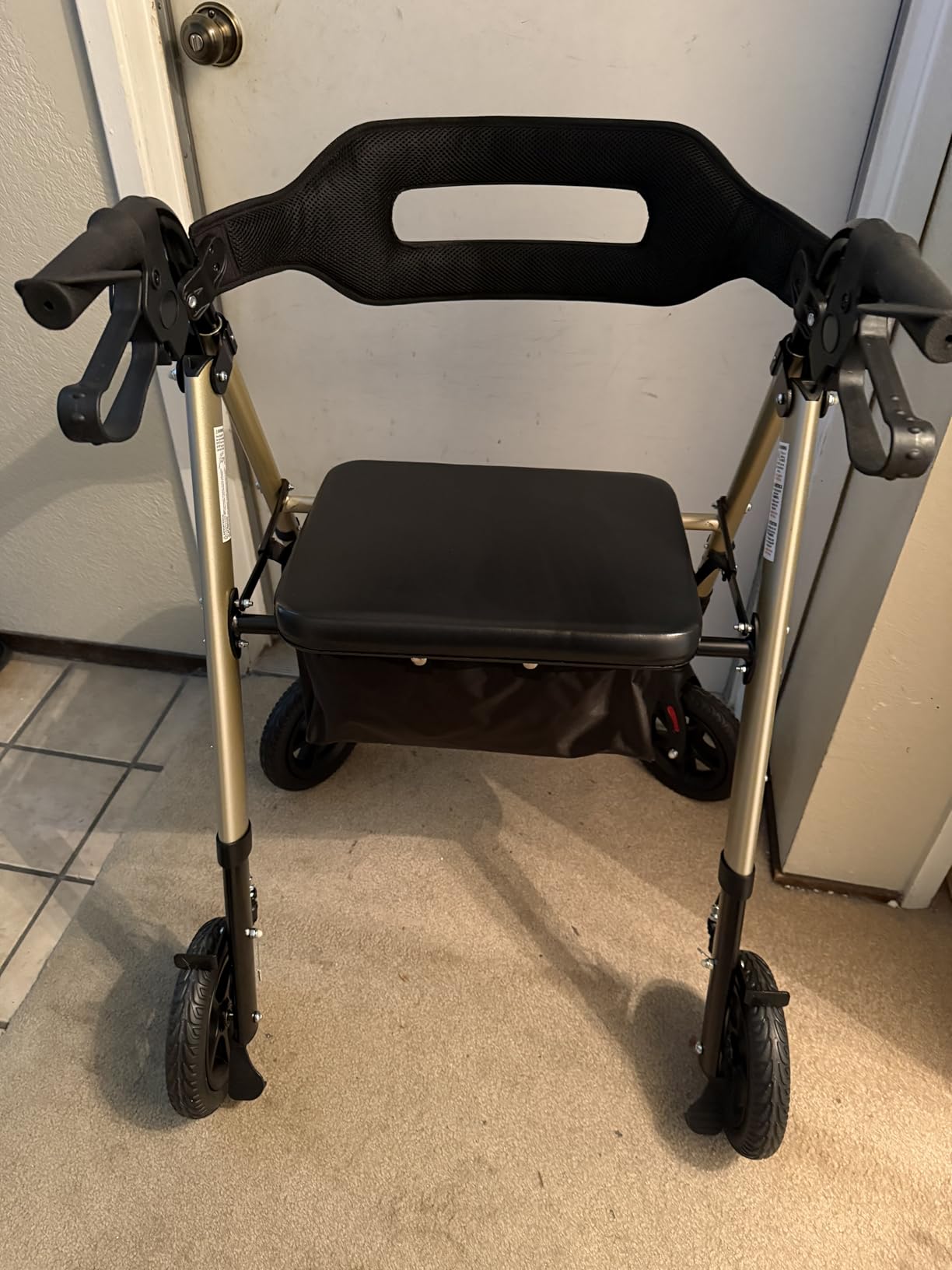
Eight-inch puncture-resistant rubber wheels, 360-degree swivel front wheels and a textured anti-skid tread cover hard ground well. Reflective strips help with night visibility, and the three-second quick fold with a large storage bag and cup holder makes it practical for errands.
Customer support is a highlight, with owners reporting rapid replacement parts and an 18-month warranty. That kind of responsiveness matters when a single component can take an aid out of service.
Who this light narrow frame suits
Tall users in smaller living spaces, or anyone navigating elevators, apartment doorways and narrow clinic halls where a 26-inch frame will not turn. The 17.4-pound weight is the deciding factor for anyone who loads a walker into a trunk alone.
The 350-pound capacity also suits larger users, and the extra-wide memory foam seat is more accommodating than most at this weight class.
Where it falls short
The handle range stops at 39 inches. That is a genuine tall-height range, but it is not the answer if you are above 6 foot 4 inches and need more than 40 inches of reach, and it is why this frame is not our top pick despite the strong rating.
Some users also report front wheels that turn sideways too easily, and handlebars that fit loosely in the lower legs on rough ground. Both are more noticeable on uneven surfaces than on smooth floors.
10. Vive Tall All-Terrain Rollator – Best Compact Fold for Tall Users
Vive Tall Rollator Walker with Seat for Seniors, Men – All Terrain
Fits 5 ft 5 in to 6 ft 5 in
8 inch all-terrain wheels
19 lb frame weight
300 lb capacity
Foldable to 28 x 25.5 x 40 in
Pros
- Rated for tall users up to 6 foot 5 inches
- Compact fold with removable front wheels
- Lightweight at 19 pounds
- 8 inch all-terrain wheels
- Corrosion-resistant frame
Cons
- Some users at 6 foot 4 in wish for more height
- Seat can lean forward slightly
- Velcro bag closure is weak
- One year guarantee
This is the tallest-rated traditional rollator in the group at 6 foot 5 inches, and it folds down further than most. The front wheels release with a push button and the rear wheels hinge back against the frame, so the folded package is 28 by 25.5 by 40 inches rather than a rigid slab.
For anyone who travels, that fold matters. A rollator that reduces to a shape you can lift into a trunk or hand to a gate agent without disassembly is worth more than a slightly better wheel size. Many users report that their rollator reached the plane door when gate-checked, so the folded footprint is genuinely useful.
The aluminum frame weighs 19 pounds and is rated to 300 pounds, with 8-inch all-terrain wheels, a wide seat and backrest, and a dual braking system on angled ergonomic handles. The frame is corrosion-resistant, which helps if you live somewhere with salted winter roads.
Who the tall rating suits
Users from 5 foot 5 inches up to 6 foot 5 inches who want a classic seated rollator rather than an upright frame, and who travel or load the walker regularly. The 4.5 rating reflects owners who are happy with the fit once set.
It is also the most straightforward option in this roundup if you have never used a rollator before. Loop brakes, a wide seat, and a one-step center-strap fold are all familiar mechanisms.
Where it falls short
The ceiling is the issue. Users around 6 foot 4 inches report wishing for more height, which matches the pattern across this category: almost every traditional rollator stops just short of the very tallest users.
The seat can lean forward slightly with use, and the storage bag uses a Velcro closure that owners find weak. At 115 reviews it also has the smallest evidence base of anything here, so there is less long-term data to lean on.
How to Choose a Rollator That Actually Fits Your Height
Most of the disappointment with a tall rollator comes from measuring the wrong thing. You do not need your full height, you need the distance from the floor to the crease of your wrist while you stand relaxed in walking shoes. That single number tells you whether a frame will work.
Measure it standing up, shoes on, arms hanging loose. The wrist crease should land between your thumb and index finger. Write the number down, then subtract nothing.
Handle height is the starting point. A comfortable rollator puts your handgrip at or slightly below your wrist crease, which produces roughly a 15-degree bend in the elbow while you walk. Most standard rollators top out at 35 to 38 inches, which works out to roughly 5 foot 10 inches of user height. Anything above that needs a tall frame, and above 6 foot 4 inches usually needs an upright frame.
Seat height is the second spec, and tall users get short-changed more often here than anywhere else. A good target is 22 to 24 inches of seat-to-floor clearance. If the seat sits much lower, you drop into a deep squat to sit and push up through your arms to stand, which is exactly the movement a rollator is meant to avoid.
Weight capacity is straightforward arithmetic. Take your current weight and add a margin. A 300-pound rated frame is fine if you weigh 250 pounds; if you weigh 280 pounds, buy the 350-pound frame, because ratings are not a target to approach.
Wheel size is a terrain decision. Eight-inch wheels are quiet and easy to turn on hard floors, which is what you want in an apartment. Ten-inch casters handle sidewalk cracks, curbs and uneven asphalt. Twelve-inch front wheels take gravel, grass and packed park paths, at the cost of weight and turning radius.
Frame width decides whether the rollator works in your home. Upright frames run 26 to 28 inches wide and traditional rollators 24 to 26 inches, and standard residential doorways are about 32 inches. If you use a wheelchair-accessible apartment or ride an elevator daily, measure first.
Folding and transport are where the upright frames lose. If you lift your aid into a car more than once a week, a 20-pound traditional rollator is a far better daily experience than a 24-pound upright frame, however good the posture. The compact-folding designs go further still.
One final note on funding. In the US, a rollator is durable medical equipment and is often covered under Medicare Part B with a doctor’s order; in the UK, the NHS loan scheme supplies standard frames. Either route can save you the choice entirely, so check before you spend.
If your needs are more about the photo side of life, our guides on why flash blows out faces, why group photos lose focus and harsh shadows behind people are separate topics, but the same habit applies: check the spec before you commit.
Frequently Asked Questions
What is the best mobility walker for tall people?
For most adults 6 feet and taller, the best mobility walker is a tall-height four-wheel rollator with handle columns that reach 40 inches or more, a seat between 22 and 24 inches, and a 300 to 350 pound capacity. Our testing found the Drive Medical Nitro Sprint Tall the most broadly useful choice, while upright rollators with 45 to 52 inch handgrips suit anyone above 6 foot 4 inches.
What size walker for 6 feet tall?
A 6 foot tall adult generally needs handle or handgrip height between 39 and 41 inches measured from the floor to the wrist crease. A standard rollator that caps at 37 or 38 inches will leave you leaning forward, so look for a frame published for users 6 feet and taller, and check the seat height as well. Seat clearance of 22 to 24 inches keeps your knees near a right angle.
What is the best height for rollator handles?
Set the handles at or just below your wrist crease while you stand relaxed in walking shoes, which gives roughly a 15-degree elbow bend while walking. Measure from the floor to the crease between thumb and index finger. Standard rollators stop around 35 to 38 inches, so anyone over 6 feet needs a tall frame, and anyone over 6 foot 4 inches usually needs an upright rollator with 45 to 52 inch grips.
What rollator walker has a seat for tall people?
Every rollator in this roundup has a seat, but tall users should check two numbers. First, seat-to-floor height of 22 to 24 inches so you do not have to drop into a deep squat. Second, seat width, since 18 inch seats feel cramped to larger users. The MAXWALK and RollisRoll frames offer adjustable seat heights, and the Vive Mobility upright carries the widest seat at 17.5 inches.
What is better than a rollator for tall adults?
For most tall adults, an upright rollator walker is better than a traditional rollator, because it puts the grips at 45 to 52 inches and lets you rest your forearms on pads at shoulder height instead of leaning forward over hip-height handles. If you cannot bear weight through your arms, neither is suitable and a standard walker or a therapist-guided option is safer. Test the reach in person whenever you can.
Final Verdict on the Best Rollators for Tall People
The Drive Medical Nitro Sprint Tall is our pick for the best rollators for tall people, because it is a purpose-built tall frame with 350-pound capacity and 10-inch casters rather than a standard frame with a longer handle post. If you are above 6 foot 4 inches and standard reach still leaves you hunched, move up to an upright rollator, where grips reach 45 to 52 inches. Either way, measure your wrist crease first and buy the frame whose top setting clears that number.