
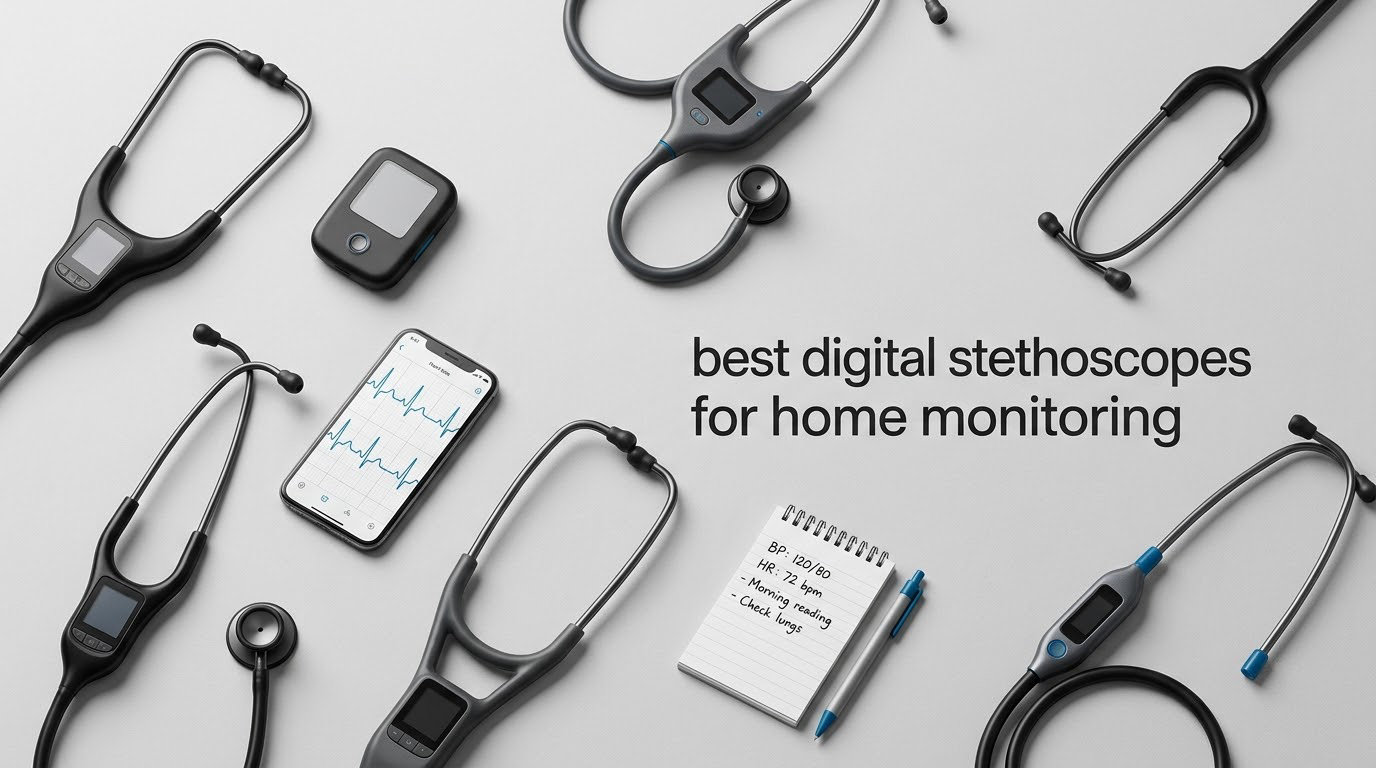
A digital stethoscope turns body sounds into a signal your phone can process, which means louder audio, noise filtering, and recordings you can save and forward to a doctor instead of describing from memory. That last part is the reason home monitoring has become the fastest-growing use case for these devices. Someone tracking an elderly parent’s heart failure, a family watching an asthmatic child, or a patient preparing for a telehealth appointment all need the same thing: a sound they can capture today and play back next week.
Our team compared the six models that pass the basic credibility bar for 2026, and the differences turned out to be bigger than the spec sheets suggest. Amplification is the least interesting number on the list. The decisions that actually change your experience are whether a smartphone is required, whether the useful features are locked behind a paid tier, whether a hearing aid can pair with the device, and whether the listing has enough reviews to prove it holds up.
Two of the six devices here are contactless sensors rather than traditional amplified chestpieces, and they solve a different problem. Three others have fewer than 30 reviews, which we treat as a warning rather than a ranking. We weighted the products with hundreds or thousands of reviews far more heavily for exactly that reason. If you want a broader view of how we handle home setups, our guides to nanny cameras for home monitoring and dog cameras for monitoring at home follow the same evidence-first approach.
Table of Contents
Top 3 Picks: Best Digital Stethoscopes for Home Monitoring (October 2026)

3M Littmann CORE Digital
- Up to 40x amplification
- Active noise cancellation
- Toggle analog and amplified modes

Eko CORE 500
- 3-lead ECG with AI insights
- Full-color on-device display
- Up to 60 hours of use

Best Digital Stethoscopes for Home Monitoring in 2026
| Product | Specifications | Action |
|---|---|---|
| 3M Littmann CORE Digital |
|
Check Latest Price |
| Eko CORE 500 |
|
Check Latest Price |
| Withings BeamO |
|
Check Latest Price |
 Lsvaha Digital Stethoscope Lsvaha Digital Stethoscope |
|
Check Latest Price |
 Niroga 470 Niroga 470 |
|
Check Latest Price |
 WELLDAYMED Digital Stethoscope WELLDAYMED Digital Stethoscope |
|
Check Latest Price |
1. 3M Littmann CORE Digital – Best Overall for Home Monitoring
3M Littmann CORE Digital Stethoscope, Our Most Advanced Stethoscope Yet, Up To 40x Amplification, Active Noise Cancellation, In-App Sound Wave Visualization, Black-Finish Chestpiece, 8480
Up to 40x amplification
Active noise cancellation
Analog and amplified toggle
87 g
Pros
- 40x amplification makes faint sounds easier to hear
- Active noise cancellation tames background noise
- Soft sealing ear tips give a good seal
- Tunable dual-sided stainless steel chestpiece
- Weighs only 87 g
Cons
- Smart device not included
- Some app features need an Eko subscription
- No integrated ECG
The Littmann CORE Digital is the one I recommend first for most households, and the reason is the review base rather than the feature list. It carries 3278 reviews averaging 4.6, with 83% of ratings at five stars. Nothing else in this roundup has that much evidence behind it.
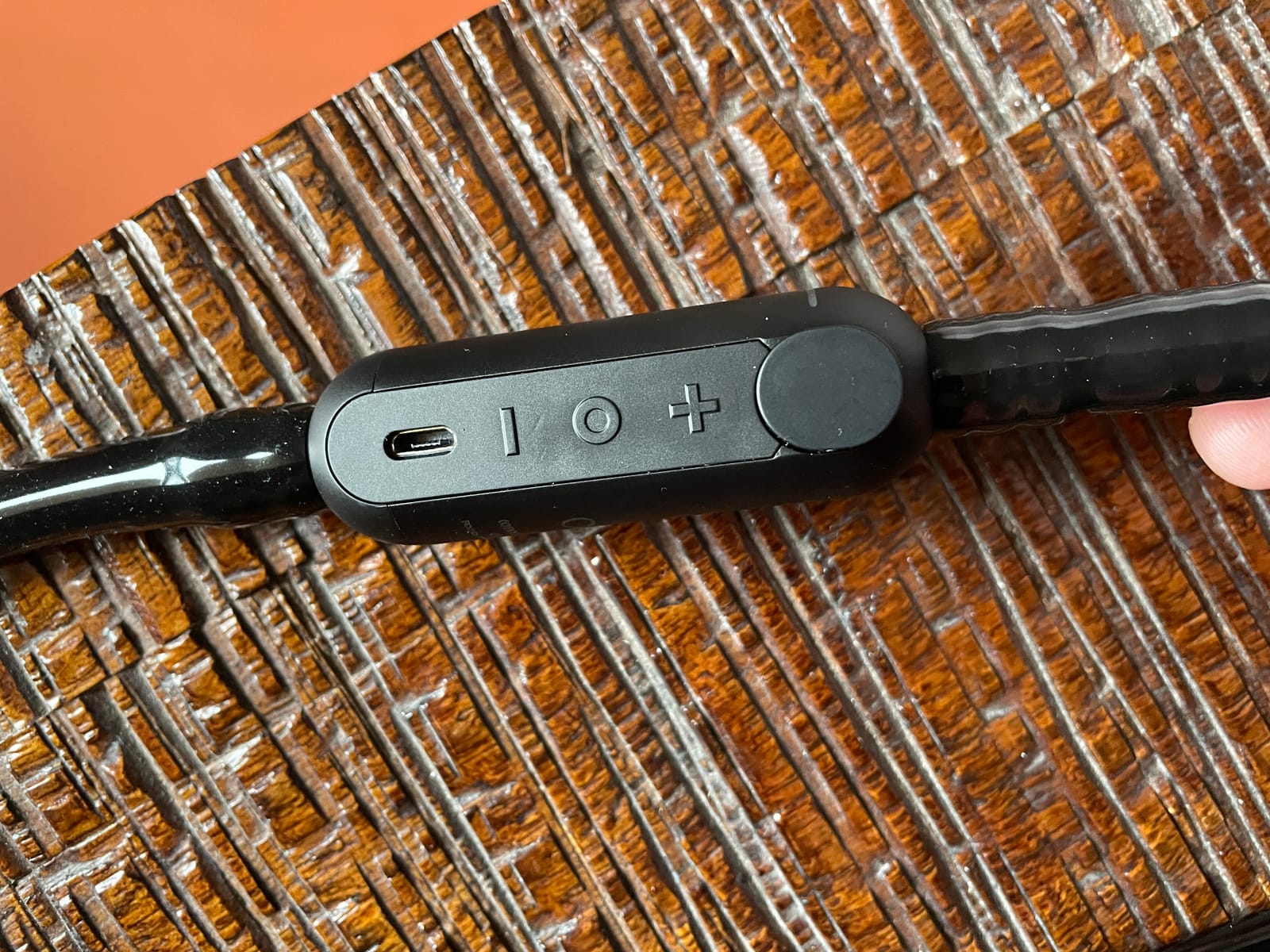
Out of the box it behaves like a normal acoustic stethoscope. The tunable dual-sided stainless steel chestpiece runs open or closed bell, and you toggle between analog and amplified listening with the same switch a clinician would use. That matters at home, because the first few listenings with any electronic stethoscope feel odd and the fallback to pure acoustic mode is what keeps the device from ending up in a drawer.
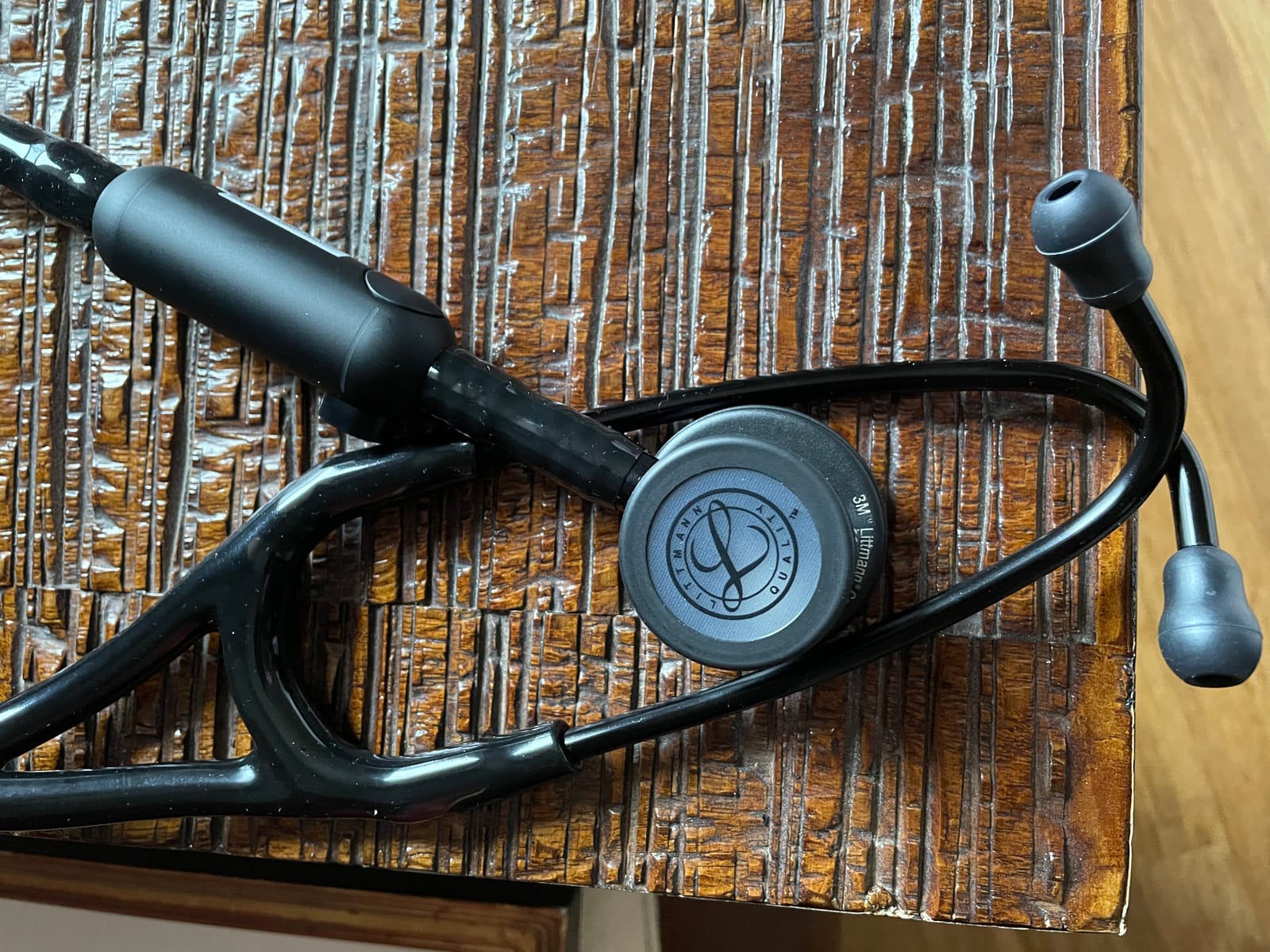
Amplification runs up to 40x at peak frequency compared with analog mode, and active noise cancellation reduces background sound. In a house with a running television or a fan, the noise cancellation is the feature you will notice first rather than the raw gain. The soft sealing ear tips also matter more than expected, since a poor seal at the ear cancels out most of the amplification benefit.
The honest drawback is the software side. The stethoscope connects to Eko software on a smart device to visualize, record and share data, and that smart device is not included. Some features also require an Eko subscription, which is the same paywall structure that draws complaints on the Eko CORE 500. If you already have a phone and are comfortable with subscription apps, this is a minor issue. If you want a device that records and saves with no recurring cost, keep reading.
What works well for home check-ins
The dual-sided chestpiece and the 87 g weight make this the most comfortable device here for repeat use on family members. A stethoscope you can comfortably hold for several minutes gets used; a heavy one gets handed off after one try. Owners on r/medicalschool describe it as a gift they would recommend, and note that many of them use the hardware more than the app features, which matches how most home users behave.
For longitudinal tracking, the record and share workflow is the part that pays off. You capture a sound during a symptomatic week, send it to a nurse line or your own doctor, and they can hear the same audio you heard. Patients with hearing loss also benefit from the amplification, and the soft-seal tips help keep the amplified output usable in a noisy room.
Where it falls short
There is no integrated ECG on this model, so it cannot record heart rhythm the way the Eko CORE 500 and Withings BeamO do. For someone whose main worry is an irregular heartbeat rather than a change in heart or lung sounds, that is a functional gap, not a cosmetic one.
The subscription-gated features also put it in direct competition with the Lsvaha listing further down, which offers 40x amplification and app recording with no subscription fees at all. You give up the Littmann name, the stainless steel chestpiece, and a decade of proven reliability to get that. For most families the trade is worth it, but for a parent with a strict budget and no interest in subscriptions it may not be.
2. Eko CORE 500 – Best for ECG and AI Screening at Home
Eko CORE 500™ Digital Stethoscope — 40x Amplification, Active Noise Cancellation, 3-Lead ECG, FDA-Cleared AI with Eko+, Full-Color Display, Reimbursement Eligible — Silver, COR503-SLV
3-lead ECG with AI insights
Up to 40x amplification
Full-color display
Up to 60 hours of use
Pros
- Combines 3-lead ECG and AI insights in one device
- Full-color display shows heart rate and ECG data
- Cardio and Pulmonary filters with 40x amplification
- Battery rated for up to 60 hours
- Water and shatter resistant
Cons
- Eko+ subscription after the 14-day trial
- Heaviest unit in the set at 2.19 pounds
- 12% of reviews are one-star
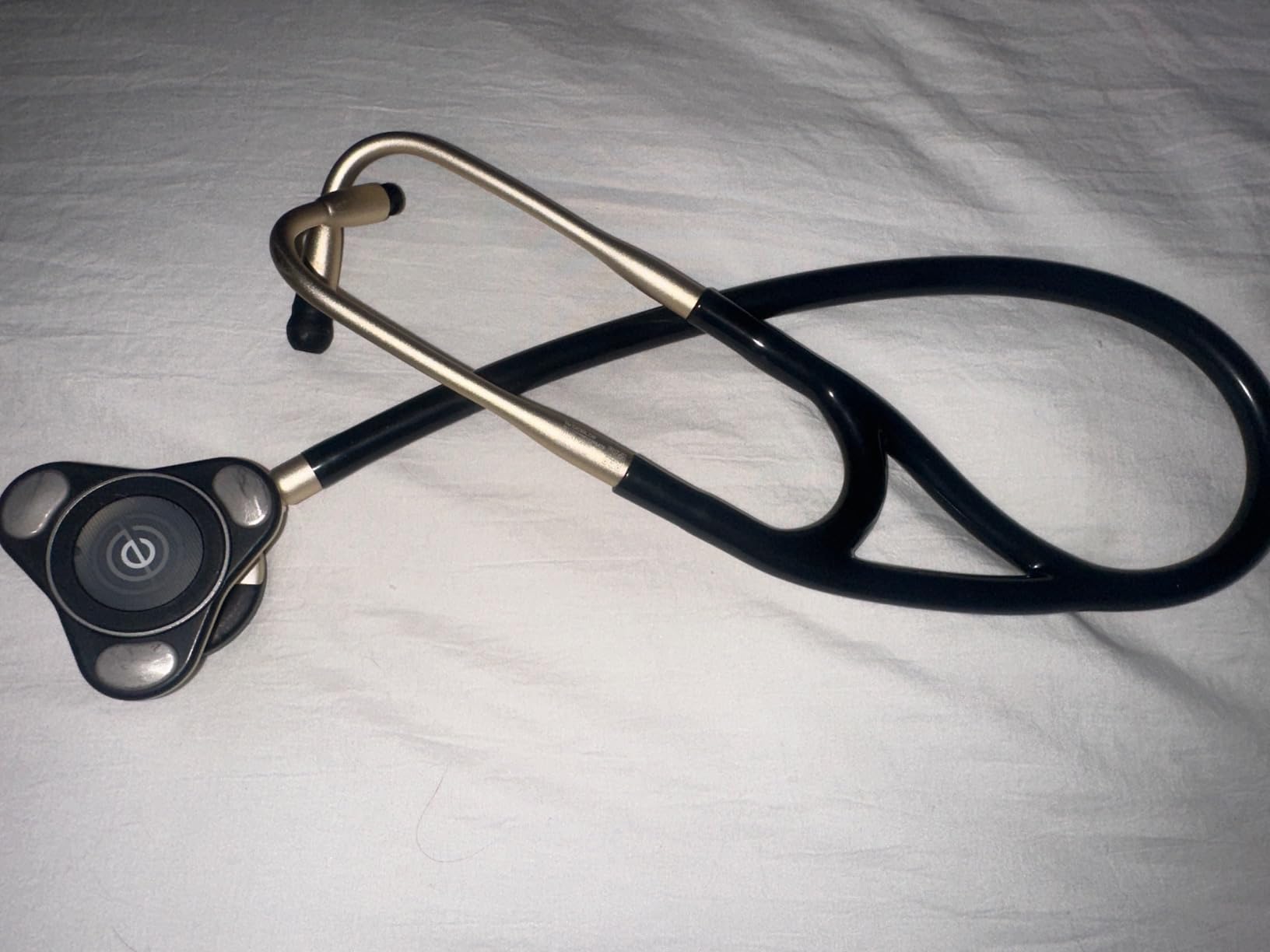
The Eko CORE 500 is the most capable device in the roundup on paper, and the one most likely to disappoint if you buy it for the wrong reason. It blends a 3-lead ECG with AI insights, audio amplification, waveform visualization and exam recording in a single unit, and it was the first item in this list to show a full-color display on the device itself.
That display is the real home-monitoring upgrade. Heart rate, ECG data, exam insights and settings all appear on the chestpiece, so you are not unlocking a phone to see whether a reading registered. Caregivers checking on an older relative can hand the device over and have the numbers visible without turning anything on.
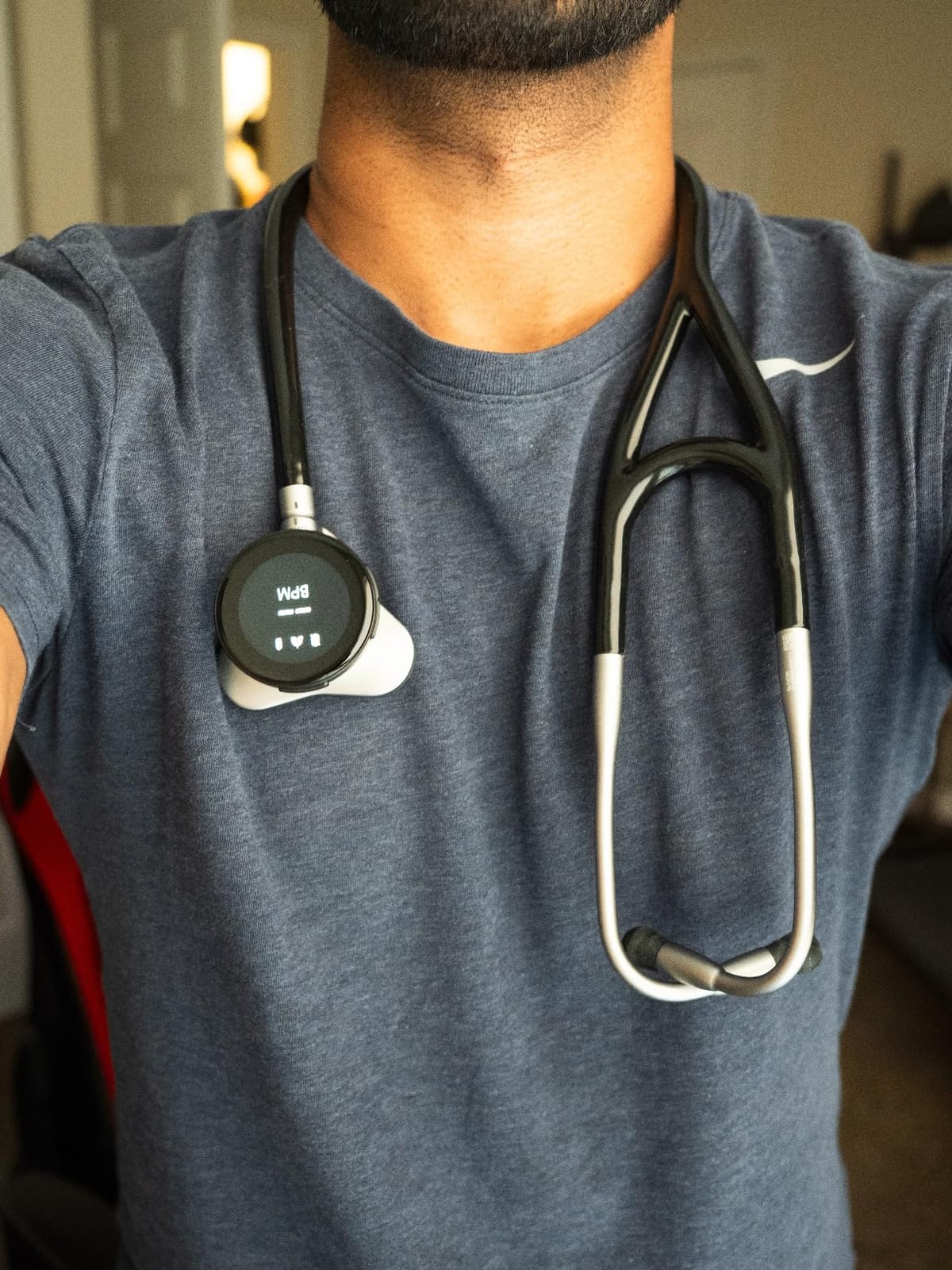
Audio performance is up to 40x amplification with background noise reduction and three filters: Cardio, Pulmonary and Wide. The rechargeable battery is rated for up to 60 hours of regular clinical use, which for a home device effectively means charging once a month or less. The water- and shatter-resistant build is designed for clinical shifts and holds up fine in a bathroom drawer or a busy hallway.
Now the paywall. A free 14-day Eko+ trial covers murmur and AFib detection plus unlimited recording, and the subscription is a paid annual tier afterwards. Murmur and atrial fibrillation detection are precisely the features a home user would want, so the most attractive parts of this device sit behind the paywall. That is the single most common complaint in its reviews, and it is worth factoring into any decision.
Who this suits at home
If someone in your household has a diagnosed heart condition and you want rhythm data between appointments, the 3-lead ECG is the reason to choose this over every other product here. A single-lead trace from a contactless sensor cannot tell you what three leads can about axis and intervals, and the on-device color screen means the reading is available even when the phone is charging in another room.
It is also the reimbursement-friendly option. The device is HSA/FSA eligible, and CME or employer reimbursement may apply, which can offset the subscription for anyone buying through work.
What to watch out for
At 2.19 pounds this is the heaviest unit in the roundup, and it is noticeably less convenient to keep in a jacket pocket than the 87 g Littmann CORE. If your monitoring happens on short visits rather than long sessions, the weight is a real annoyance.
The rating spread is also the widest here: 73% five-star and 12% one-star across 1373 reviews. Durability is the recurring theme in paramedic discussions on r/Paramedics, where the Eko CORE comes up repeatedly as a recommendation but with caveats about devices breaking. Budget for the possibility that a device used daily by a family member wears faster than one used occasionally.
3. Withings BeamO – Best for Contactless Family Check-Ups
WITHINGS BeamO – Contactless Smart Thermometer, ECG Monitor, Stethoscope
Contactless temperature
1-lead ECG in 30 seconds
5.3 inch body
Wi-Fi connected
Pros
- Three-in-one contactless thermometer ECG and stethoscope
- Full 1-lead ECG captured in 30 seconds
- Contactless readings suit checking the whole family
- Respiratory monitoring with sharing through Health Link
- Rechargeable and Wi-Fi connected
Cons
- Only 1-lead ECG
- Cardiologist review needs a paid upgrade
- Not a traditional amplified chestpiece
The BeamO answers a different question from the other five products. Nobody has to take off a shirt, put a cold chestpiece on a chest, or learn what a murmur sounds like. You point it at someone from a short distance and get a temperature, a heart rhythm trace and a respiratory reading in roughly a minute. For households where a stethoscope would be awkward or refused, that changes everything.
It carries 3294 reviews at 4.4 average, with 76% five-star and 11% four-star, so it is as well evidenced as the Littmann. Reviewers consistently point to the all-in-one convenience for family temperature, heart rhythm and respiratory tracking rather than to any single measurement.
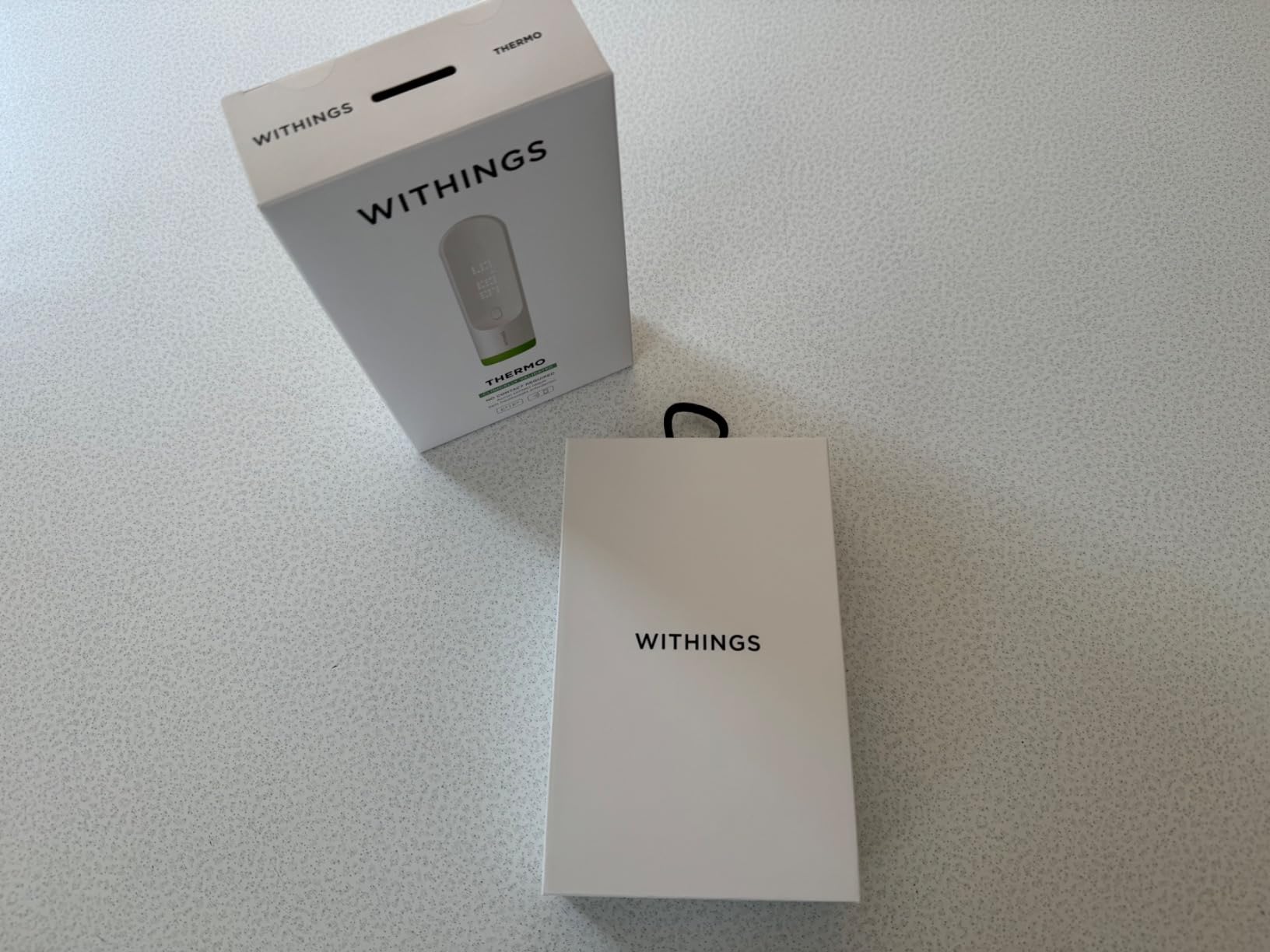
The 1-lead ECG takes 30 seconds and gives rhythm insights rather than a full diagnostic picture. On-demand respiratory monitoring shares data with healthcare professionals through Health Link, which is the feature that makes it useful before a telehealth appointment: the clinician receives a trend rather than a single number typed into a chat box.
Connectivity is Wi-Fi rather than Bluetooth, and the device is rechargeable and 5.3 inches long. The certification list is broad, covering CE, EMC, FCC, FDA, ISO 13485, ISO 9001, RoHS, UL and WEEE, and the upper temperature range is 42 degrees Celsius.

Why families end up choosing it
Contactless measurement means checking a sleeping child, a feverish teenager or a frail grandparent does not require cooperation. That single design decision removes the most common failure point of home auscultation, which is not the device failing but the person refusing to be listened to. Caregivers reviewing an elderly relative remotely also like that respiratory data can be shared with a clinician without a video call.
The 0.08 kg weight and short body make it practical to move between rooms and to pack for travel, which matters for families split across two homes or for anyone who travels for work and wants a baseline check on the road.
Where it does not substitute for a stethoscope
This is a contactless sensor, not an amplified chestpiece. There is no 40x amplification mode because there is no acoustic seal and no diaphragm, so a user who wants to hear heart and lung sounds directly will not find that experience here. If your concern is a change in how a valve sounds or whether breath sounds have a rattle, you need a physical chestpiece.
The single-lead ECG is also shallower than the Eko CORE 500’s 3-lead trace, and cardiologist review within 24 hours sits behind a paid upgrade. Home users have mentioned StethoMe and Withings BeamO together as AI-assisted monitoring tools, and BeamO is the one that is widely available as a complete consumer device.
4. Lsvaha Digital Stethoscope – Top Rated With No Subscription
Digital Stethoscope with App, 40x Amplification, Active Noise Cancellation
Up to 40x amplification
Active noise cancellation
App recording and playback
FDA-cleared
Pros
- 40x amplification for heart lung and body sounds
- Active noise cancellation helps in busy rooms
- App handles recording saving and playback
- No subscription fees for app features
- FDA-cleared and FSA/HSA eligible
Cons
- Only 25 reviews so reliability is unproven
- Very low category sales rank
- No built-in ECG or on-device display
This listing does the same core job as the Littmann CORE Digital, with a promise the bigger brands do not make: no subscription fees for app recording, playback and ongoing feature updates. Recording and saving a sound is the entire point of a home monitoring device, and putting that behind a yearly charge is where the Eko CORE 500 loses families on a budget.
It is FDA-cleared as a digital auscultation device, FSA/HSA eligible, and rated for up to 40x amplification with active noise cancellation. The app handles real-time listening, recording, saving, playback and sound review.
Now the honesty part. The 4.6 average comes from 25 reviews, split 65% five-star and 35% four-star with nothing below three. A sample that small reflects a very new listing rather than a proven track record, and the category sales rank of 184 in Stethoscopes confirms how little volume this has seen. A perfect-looking rating built on 25 reviews is a signal to test carefully, not to trust.
There is no built-in ECG and no on-device display, so everything happens through the app. That is a limitation for someone who wants to hand a reading to a relative without unlocking a phone, but it also means the device is simpler and cheaper to produce.
When this is the smarter buy
If your priority is capturing and keeping recordings with no recurring cost, this delivers exactly that and nothing else. A user tracking a parent’s breathing over a winter, or saving sounds to send to a doctor before an appointment, gets the same core workflow as the Littmann without the subscription structure that eventually shows up in reviews as a complaint.
The active noise cancellation is described for busy rooms and care settings, which matches a home environment with television, pets and other family members. Active noise reduction, paired with 40x amplification, covers the most common home use case of all.
Why we would not build a monitoring routine around it yet
Durability is the open question. No weight or dimension data is published, and a device you plan to use for a chronic condition should have a support path and a parts supply that lasts several years. Nursing students with hearing loss asking on r/HearingAids about Eko 500 versus Littmann CORE for hearing aid compatibility is a reasonable question, and it is one you cannot ask about a listing with 25 reviews.
Factory-direct pricing with ongoing feature updates included is a fair trade for buying a newer brand. Treat it as a solid second device or a backup rather than the primary tool for a long-term condition.
5. Niroga 470 – Best for Hearing Impaired Listeners
Niroga 470: Digital Stethoscope with up to 40x Audio Amplification, Heart/Lung/Wide-Band Filter Modes, Built-In AI Assist, Record & Share Sounds with NO Subscription, Spoken Heart Rate. Recommend for families with elder care, physicians, nurses, listening to prenatal sounds, and adjustable amplification for hearing impaired (Black)
Up to 40x amplification
Heart lung and wide-band filters
Spoken heart rate
AI assist
Pros
- 40x amplification with three filter modes
- No subscription to record save and share
- Spoken heart rate readout for accessibility
- Waveform display in the companion app
- Targeted at families and elder care
Cons
- Only 6 reviews with no reliability record
- 23% of ratings are one-star
- Generic brand listing with limited support
- Marketed for wellness and education only
The Niroga 470 is the only device here with a spoken heart rate readout, and that single feature makes it a genuinely different proposition for hard-of-hearing users. Instead of interpreting a waveform or a number on a screen, the device announces the rate aloud. Combined with 40x amplification and heart, lung and wide-band filter modes, it is built for people who struggle with a conventional amplified stethoscope.
Bluetooth connects to the Niroga mobile app for recording, storage, review and sharing, with sound waveform visualization while you listen. Recording and sharing carry no subscription requirement, and the listing positions the device for families, caregivers, elder care and wellness coaches, which is a closer match to home monitoring than most clinician-oriented products.
Why the accessibility angle matters
Hearing aid compatibility is the question home users ask most and the one manufacturers document least. Manual compatibility between a hearing aid and a Bluetooth stethoscope depends on the hearing aid’s streaming protocol, and a spoken readout sidesteps the problem entirely for the single most important measurement. A user who cannot hear a stethoscope can still hear a voice.
It is also marketed for prenatal listening, which is unusual among digital stethoscopes and is another reason non-clinician buyers keep it. The built-in AI assist adds a layer of interpretation without a paid tier, and the ergonomic design with durable tubing and a precision chest piece is aimed at long sessions rather than quick checks.
Where the risk sits
Six reviews, all recent, with 77% five-star and 23% one-star and nothing in between. That polarization in a tiny sample is the signature of inconsistent early experiences, not a settled product. The listing is also sold under a Generic brand entry with limited support information, and only a user manual is included in the box.
Most importantly, the listing states the device is for general wellness, listening and educational use only, not for diagnosis or monitoring of medical conditions. Anyone with a diagnosed condition should treat this as a supplementary listening tool and keep clinical decisions with a clinician.
6. WELLDAYMED Digital Stethoscope – Most Versatile for Students
Digital Stethoscope with 24x Amplification Hi-Fi Heart/Lung Mode Amplified
24x HI-FI amplification
Lung heart and full spectrum modes
Headphone output
Integrated storage
Pros
- Three listening modes for lung heart and full spectrum
- 24x amplification with a volume knob
- Drives headphones or speakers for teaching
- Integrated storage for recordings
- Non-slip grip for long sessions
Cons
- Lowest rated at 3.0 from 3 reviews
- 49% of ratings are one-star
- 24x amplification is well below the 40x models
- No app connectivity mentioned
This is the entry point for a nursing student or anyone who wants to learn what heart and lung sounds sound like before spending on a connected device. It runs 24x HI-FI amplification with an adjustable volume knob and offers three auscultation modes: Lung, Heart and Full Spectrum. Output connects to headphones or speakers, which makes it useful for private listening or for teaching a group without passing one chestpiece around.
Recordings are managed through integrated storage rather than an app. For a student practising on a roommate or a family member and keeping a personal library of sounds, that is enough. For longitudinal tracking with a clinician, it is not.
Where it earns its place
The non-slip grip is designed to reduce hand fatigue in long sessions, and that is a real consideration for a beginner who will spend hours listening before they learn to move the chestpiece correctly. Three filter modes also mean a student can compare the same chest with a Lung setting and a Heart setting and hear why clinicians switch between them.
The 24x figure is well below the 40x offered by the Littmann CORE, the Eko CORE 500, the Lsvaha and the Niroga, so this is a device for learning rather than for faint sounds in a noisy house.
Why the ratings concern us
A 3.0 average from three reviews, split 51% five-star and 49% one-star, is the weakest-supported listing in this roundup. The near-even split suggests inconsistent performance, though a sample of three cannot establish anything on its own. The category itself is thin on Amazon, which is the main reason this listing appears here at all.
For a nursing student, the headphone output and the low entry point are the deciding factors. For a household monitoring a chronic condition, the gap between 24x and 40x amplification and the lack of app sharing make this the wrong tool.
How to Choose a Digital Stethoscope for Home Monitoring
Decide between a chestpiece and a contactless sensor first
Every question after this one is easier once you answer it. A contactless sensor such as the Withings BeamO measures from a short distance and gives you temperature, a one-lead ECG and respiratory trends without touching the person. An amplified chestpiece gives you actual audio: heart sounds, lung sounds, the difference between an open and closed bell, and the ability to record a murmur and send it to a doctor.
Choose the sensor for families with young children, frail relatives, or anyone who would find a chestpiece on their skin intrusive. Choose the chestpiece when you want to hear a change and share that audio, when you are tracking a specific respiratory or cardiac symptom, or when you already know what normal sounds like for that person.
Amplification matters less than noise reduction
Every device in this roundup claims between 24x and 40x amplification, and the difference is not what changes your experience. Active noise reduction is. A television, a fan, a refrigerator and an air conditioner will overwhelm a faint sound long before the gain setting runs out of range. Every model here includes some form of background noise suppression, and the two chestpieces with the most reviews, the Littmann CORE and the Eko CORE 500, both pair 40x amplification with active noise cancellation.
Also check the weight. The Littmann CORE weighs 87 g, the Withings BeamO 0.08 kg, and the Eko CORE 500 2.19 pounds. A device you can hold comfortably for a five-minute listen gets used regularly.
Check what the app costs after the trial
This is where home buyers get caught. The Eko CORE 500 offers a free 14-day Eko+ trial with murmur and AFib detection, then a paid annual tier. The Littmann CORE Digital routes through the same Eko software with some features behind a subscription. The Withings BeamO puts 24-hour cardiologist review behind a paid upgrade. The Lsvaha and Niroga listings state no subscription for recording, saving and sharing.
Ask one question before buying: does the feature I actually want work without a yearly payment? Recording and playback are the baseline a home monitor needs. Murmur detection is a bonus that may justify a subscription, but only if you have a reason to use it.
App stability is the other half. Forum threads about digital stethoscopes repeatedly mention Bluetooth disconnects and sync problems, and telemedicine practitioners tend to praise the Thinklabs One for its direct audio cable simplicity, which sidesteps pairing entirely. The models here connect by Bluetooth or Wi-Fi to a phone app, so test the pairing with your own device before committing to a long monitoring routine.
Verify hearing aid compatibility yourself
No manufacturer in this roundup publishes a clear hearing aid compatibility statement, which is why the question comes up so often in forums. Two approaches exist. Some users connect the amplified output directly to hearing aids or speakers, which is why the WELLDAYMED listing highlights headphone and speaker output and the Littmann CORE Digital is often recommended to nursing students with hearing loss on r/HearingAids.
The other approach is to avoid the audio problem entirely with a spoken readout, which is what the Niroga 470 offers. Whichever route you take, verify it with your own hearing device. Hearing aid users on r/HearingAids are actively comparing models for exactly this reason, and their setups differ too much for anyone else’s answer to transfer.
Read the review count before the star rating
Two products here show ratings of 4.6 that mean very little: one with 25 reviews and one with 6. A 4.6 from 3278 reviews, with 83% five-star, describes a product that has been used hard by thousands of people for years. A 4.6 from 25 reviews describes a listing that launched recently.
For any device intended for monitoring a chronic condition, treat the review count as a durability filter. Also weigh distribution: the Eko CORE 500 has the widest spread in this set at 12% one-star, which tells you some buyers had a bad experience even though the average is solid.
Plan for a family routine, not a single check
A home monitoring device earns its place through consistency. Pick a fixed time, a fixed position and a fixed filter mode, and save each recording under a date. If you plan to share readings with a clinician, check that the sharing path works before you need it, and whether your doctor can receive files through their preferred portal. Patients who record for weeks and then cannot export anything tend to stop recording by week three.
Care is simple. Wipe the chestpiece between family members, keep the tubing away from heat sources, and charge rechargeable models on a schedule rather than waiting for a failure. For keeping track of other household measurements alongside these devices, our picks for EC meters for nutrient monitoring follow a similar approach.
Frequently Asked Questions
What is the best brand of stethoscope?
For home monitoring, 3M Littmann has the strongest combination of acoustic quality, weight and review history, and the Littmann CORE Digital is the model we recommend first. Eko leads on added hardware features such as a 3-lead ECG and an on-device color display. Withings covers contactless family check-ups rather than classic auscultation, and several newer brands match the amplification figures without matching the evidence.
What are the differences between the Eko CORE and Littmann CORE Digital stethoscopes?
The Eko CORE 500 adds a 3-lead ECG, a full-color on-device display, AI insights and a battery rated for up to 60 hours, and weighs 2.19 pounds. The Littmann CORE Digital is a 87 g chestpiece with up to 40x amplification, active noise cancellation and an analog or amplified toggle, with no integrated ECG. Both route recording and sharing through Eko software, and the Eko CORE 500 places murmur and AFib detection behind the Eko+ subscription after a 14-day trial.
Do digital stethoscopes really work?
Yes, within a clear limit. A digital stethoscope amplifies and filters body sounds, records them and shares them, which makes changes over weeks easier to spot than memory alone. It does not diagnose. A home device tells you a sound has changed or a rhythm looks irregular, and that result still belongs with a clinician who can interpret it in context.
Can you use a digital stethoscope with hearing aids?
It depends on the setup, and manufacturers rarely document it. The most reliable approach is a device with a spoken heart rate readout, such as the Niroga 470, which needs no audio interpretation at all. The second approach is a 3.5mm or similar output you can route into hearing aids or speakers, which is why nursing students with hearing loss on r/HearingAids often ask about the Eko 500 and Littmann CORE by name. Test with your own device before committing.
Which digital stethoscope is best for telehealth?
For sending a clinician audio, the 3M Littmann CORE Digital is the safest pick because of its review depth and light weight. For sharing structured data before a virtual visit, the Withings BeamO shares respiratory and heart rhythm trends through Health Link, and the Eko CORE 500 adds ECG plus on-device display. Confirm which telehealth platform your clinician actually uses, since sharing paths differ between apps.
Which Digital Stethoscope Should You Buy for Home Monitoring?
For most households, the 3M Littmann CORE Digital is the best digital stethoscope for home monitoring because 3278 reviews at 4.6 average prove it works, and 87 g with a dual-sided chestpiece keeps it usable on repeat listenings. Its one real cost is the app ecosystem, since a smart device is not included and some features sit behind an Eko subscription.
Choose the Withings BeamO instead if the person being checked will not tolerate a chestpiece, or if you want temperature and respiratory trends in the same minute. Choose the Eko CORE 500 if heart rhythm is the concern and a year of Eko+ is worth the murmur and AFib detection, and accept the 2.19 pound weight. Choose the Lsvaha listing if you want 40x amplification and app recording with no subscription, treating its 25 reviews as something to test rather than trust.
None of these replaces a clinician, and the Niroga 470 says so plainly on its own listing. Used as a consistent record that you can share, a digital stethoscope earns its place in a home health routine. You can compare the wider range of home monitoring gear we cover, including our guides to cameras for agricultural crop monitoring and cat cameras for home monitoring, to see how we weigh evidence over marketing.