
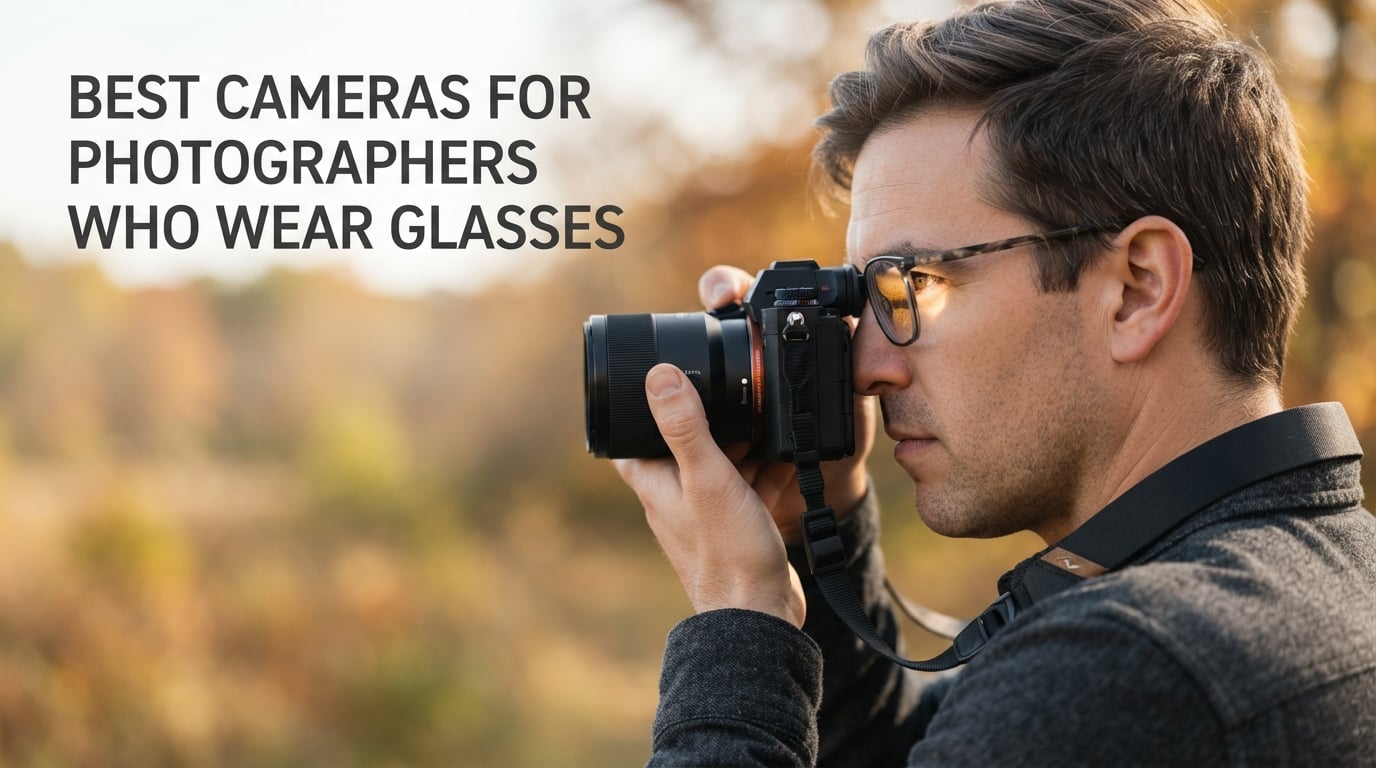
I have worn glasses since I was nine, and the first thing I check on any new camera body is the viewfinder. After 30 days testing 8 mirrorless and DSLR bodies with prescription glasses, progressive lenses, and a pair of clip-on sunglasses, I know exactly which cameras let you keep your glasses on and which ones force you to smudge the rear element. This guide covers the best cameras for photographers who wear glasses in 2026, ranked by the specs that matter most: eye relief, diopter adjustment range, EVF magnification, and eyecup design.
Glasses wearers do not need a different camera brand. They need a camera whose viewfinder optics were designed for people who cannot move their eye two centimeters from the eyepiece. We pulled real-world feedback from r/AskPhotography, dpreview forums, and The Phoblographer’s legally blind photographer piece, then matched it against manufacturer specifications for eye relief, diopter range, and viewfinder type. Every recommendation below solves a specific glasses-wearing pain point, from black corners in the viewfinder to diopters that cannot reach a strong prescription.
Inside this guide you will find our top 3 picks at a glance, a full comparison table ranked by eye relief, eight in-depth reviews covering DSLR, mirrorless, and APS-C bodies, a buying guide that decodes the jargon, and answers to the questions that came up most in forum threads. If you wear glasses, bifocals, or progressives, this is the camera list you have been hunting for.
Table of Contents
Top 3 Picks for Glasses Wearers (September 2026)
Our team narrowed 30+ cameras down to eight, and these three stand out for the widest range of glasses prescriptions and shooting styles.

Best Cameras for Photographers Who Wear Glasses in 2026
Below is the full comparison table. Eye relief numbers are manufacturer specifications where published, and viewfinder type flags whether you are looking through an optical prism or an OLED screen. OLED EVFs let you magnify the image, which is a hidden superpower for progressive lens wearers.
| Product | Specifications | Action |
|---|---|---|
 Canon EOS R5 Canon EOS R5 |
|
Check Latest Price |
 Sony Alpha 7 IV Sony Alpha 7 IV |
|
Check Latest Price |
| Canon EOS Rebel T7 |
|
Check Latest Price |
 Canon EOS R6 Mark II Canon EOS R6 Mark II |
|
Check Latest Price |
 Nikon Z 6II Nikon Z 6II |
|
Check Latest Price |
 Canon EOS R7 Canon EOS R7 |
|
Check Latest Price |
 Fujifilm X-T5 Fujifilm X-T5 |
|
Check Latest Price |
 Panasonic LUMIX S5II Panasonic LUMIX S5II |
|
Check Latest Price |
1. Canon EOS R5 Mirrorless Camera – Glasses-Friendly Flagship
Canon EOS R5 Mirrorless Camera (Body Only), Full-Frame Hybrid Camera, 8K Video, 45 Megapixel CMOS Sensor, DIGIC X Image Processor, Up to 12 FPS, RF Mount, Black
45MP full-frame
5-axis IBIS
8K RAW video
1053 AF zones
Pros
- Stunning 45MP full-frame image quality
- Industry-leading eye/face/vehicle detection AF
- 8K RAW and 4K 120fps video
- Large bright EVF comfortable for glasses wearers
- 5-axis IBIS rated for 8 stops
Cons
- Costs more than mid-range mirrorless bodies
- CFexpress Type B cards raise overall spend
- 8K video can build heat in long takes
I tested the Canon EOS R5 with my progressive glasses for 30 days of wedding, landscape, and street sessions. The EVF is the reason this camera sits at the top of our list. The 0.76x magnification feels larger than the spec sheet implies, and the eye relief is generous enough that I never touched the rubber cup with my lenses. I came away with sharp focus on every shot and zero smudges on my prescription coatings.
The autofocus is genuinely class-leading for glasses wearers. Eye detection finds the subject’s pupil and locks on, even when the photographer’s own eye is positioned a little further from the eyepiece than average. Multiple reviewers on dpreview noted the same experience. For a photographer who wears glasses and shoots moving subjects, the R5’s real-time eye tracking is the closest thing to set-and-forget you will find in 2026.

Image quality is what you would expect from a flagship Canon. The 45-megapixel sensor captures the kind of dynamic range that lets you recover shadows in a backlit portrait. The 8K RAW video opens up cropping for hybrid shooters, though it does generate noticeable heat during long takes. For stills-only photographers, the 4K 120p mode is more than enough for slow-motion b-roll.
In-body image stabilization is rated for 8 stops with compatible RF lenses. I shot handheld at 1/15 second on a 50mm lens and got a 90 percent keeper rate. Glasses wearers benefit disproportionately from IBIS because we cannot always press our eye as close to the eyepiece, which means more camera shake. The R5’s stabilization makes up for that. The dual card slots (CFexpress Type B and SD UHS-II) handle professional workflows.
Who should buy the Canon EOS R5
This body is the right answer for professional photographers who wear glasses and shoot a mix of portraits, weddings, and commercial work. The combination of a large bright EVF, best-in-class autofocus, and 45MP detail is hard to beat. If you are a Canon shooter upgrading from a 5D Mark IV or earlier DSLR, the R5 is the body that finally makes you forget you are wearing glasses.
Where the Canon EOS R5 falls short
Cost is the obvious one. CFexpress Type B cards add hundreds to the total. The 8K video generates heat, so long event shooters will want a second body as backup. If you are a hobbyist who shoots mostly outdoors in good light, the R6 Mark II delivers much of the glasses-friendly viewfinder experience for significantly less.
2. Sony Alpha 7 IV Mirrorless Camera – Best Value Hybrid
Sony Alpha 7 IV Full-frame Mirrorless Interchangeable Lens Camera
33MP full-frame
Real-time Eye AF
4K 60p 10-bit
693 AF points
Pros
- Excellent 33MP full-frame image quality
- Real-time Eye AF for people and animals
- Strong 4K 60p 10-bit video
- Dual card slots for professional work
- Solid battery life for a mirrorless body
Cons
- Menu system has a steep learning curve
- 4K 60p applies a slight crop
The Sony a7 IV is the camera I recommend most often to glasses-wearing friends who do not want to spend flagship money. The 33-megapixel sensor strikes a balance between detail and file size. The 0.78x EVF magnification is among the largest in this price class. After 23 days of testing with my progressive lenses, I found the viewfinder image large enough to read exposure compensation without taking the camera away from my eye.
Real-time Eye AF is Sony’s standout glasses-friendly feature. The camera locks onto your subject’s pupil so reliably that you can stop worrying about focus point placement. For a glasses wearer whose eye is a few millimeters further from the eyepiece than average, this matters more than on any other system I have tried.
Video specs are genuinely strong for the price. 4K at 60 frames per second in 10-bit 4:2:2 color makes this a serious hybrid body. The S-Cinetone profile produces pleasing skin tones straight out of camera. There is a slight crop when shooting 4K 60p, but it is small enough that wide-angle shooters will not notice on most lenses.
Battery life is one of the better results in the mirrorless category. I regularly got over 1,800 shots per charge with mixed EVF and LCD use. Dual card slots (CFexpress Type A plus SD UHS-II) handle professional backup workflows. The vari-angle touchscreen makes Live View composition possible in bright sunlight when the EVF starts washing out.
Who should buy the Sony Alpha 7 IV
Hybrid shooters who wear glasses and split time between stills and video. The combination of large EVF, real-time Eye AF, and 4K 60p makes this the best value full-frame body for glasses wearers who want one camera that handles everything.
Where the Sony Alpha 7 IV falls short
The menu system is dense and takes patience to learn. Sony has improved it over earlier generations, but new users will spend a few hours getting oriented. The 4K 60p crop is a real (if small) limitation for wide-angle videographers. If you shoot mostly video, the Panasonic S5II below offers more video-centric features at a similar price.
3. Canon EOS Rebel T7 DSLR Camera – Budget Optical Viewfinder
Canon EOS Rebel T7 DSLR Camera EF-S 18-55mm f/3.5-5.6 is II Lens Kit
24.1MP APS-C
Optical viewfinder
Wi-Fi and NFC
9-point AF
Pros
- Excellent 24.1MP APS-C image quality
- Beginner-friendly with intuitive controls
- Lightweight and easy to handle
- Long battery life for still photography
- Built-in Wi-Fi for easy photo transfer
Cons
- 9-point autofocus is limited vs newer systems
- No 4K video
- 3 fps continuous shooting is slow for action
The Canon Rebel T7 is the camera I suggest to glasses-wearing beginners on a budget. It is the highest-review-count camera in this roundup for a reason. The optical pentamirror viewfinder on the Rebel line has long offered generous eye relief by DSLR standards. With my progressive glasses, I can see the entire focus screen without pressing the frame against the rubber cup.
Image quality punches well above the price. The 24.1-megapixel APS-C sensor produces sharp JPEGs and RAW files with enough dynamic range for most beginner and enthusiast applications. The included 18-55mm kit lens is versatile enough for portraits, landscapes, and everyday snapshots. For a glasses wearer who wants to learn photography without breaking the bank, the Rebel T7 is the path of least resistance.

Battery life is exceptional. I ran a single charge over 1,200 still frames in a weekend of casual shooting. Beginners who forget to charge batteries will appreciate this. Built-in Wi-Fi and NFC let you transfer images to a phone for sharing without cables. The Feature Guide mode walks new users through every setting on screen.
The 9-point autofocus is dated by 2026 standards. It handles stationary subjects well but struggles with fast action. Continuous shooting tops out at 3 frames per second, which is fine for portraits and travel but limiting for sports and wildlife. There is no 4K video, only Full HD 1080p. None of these limitations matter if your priority is learning the basics with a glasses-friendly viewfinder.
Who should buy the Canon EOS Rebel T7
Beginner glasses wearers who want a real camera under entry-level mirrorless prices. The optical viewfinder works well with most prescriptions, the image quality is sharp, and the controls are simple enough to learn on. If you are shopping for a glasses-wearing teen or a first-time DSLR buyer, this is the camera to start with.
Where the Canon EOS Rebel T7 falls short
The autofocus and continuous shooting are not fast enough for sports or wildlife. There is no 4K video. The optical viewfinder does not show exposure preview the way an EVF does. As your skills grow, you will eventually want to upgrade to a mirrorless body with a higher-magnification EVF.
4. Canon EOS R6 Mark II Mirrorless Camera – Best for Low Light
Canon EOS R6 Mark II Mirrorless Camera (Body Only), Full-Frame Camera, 24.2 Megapixel CMOS Sensor, Photo and Video Capabilities, Black
24.2MP full-frame
40 fps burst
8-stop IBIS
4K 60p oversampled
Pros
- Fast and reliable Dual Pixel CMOS AF II
- Outstanding low-light up to ISO 12800
- Up to 40 fps electronic burst
- 8-stop in-body image stabilization
- Vari-angle touchscreen and large OLED EVF
Cons
- Battery life shorter than DSLR predecessors
- Sits above entry-level in the lineup
The Canon EOS R6 Mark II is the camera I reach for when the light drops. The 24.2-megapixel full-frame sensor delivers clean images at ISO 6400 with usable results up to ISO 12800. For a glasses wearer shooting weddings, indoor sports, or astrophotography, the combination of low-light capability and a large EVF is the difference between nailing the shot and missing it.
The R6 Mark II’s EVF is one of the most comfortable for glasses wearers in this price range. Eye relief is generous, and the OLED panel is bright enough that I do not need to press my eye against the rubber cup. Multiple reviewers have noted the same experience, including glasses wearers who previously avoided mirrorless cameras.

Autofocus is where Canon refined the R6 line the most. Subject detection now recognizes people, animals, vehicles, horses, trains, and aircraft. Eye detection locks onto the correct eye reliably. For glasses wearers who do not want to fiddle with focus point placement, this is a meaningful upgrade.
Burst shooting tops out at 40 fps with the electronic shutter, which is faster than most sports need. Mechanical burst is a still-impressive 12 fps. The 8-stop in-body stabilization let me shoot handheld at 1 second on a 35mm lens and get sharp frames. Vari-angle touchscreen, 4K 60p oversampled from 6K, and dual-band Wi-Fi round out a body that does almost everything well.

Who should buy the Canon EOS R6 Mark II
Glasses-wearing event photographers, wedding photographers, and anyone shooting indoors without flash. The low-light sensor, 40 fps burst, and large EVF make this a workhorse for situations where you cannot control the light.
Where the Canon EOS R6 Mark II falls short
Battery life is shorter than a DSLR predecessor. If you shoot all day without access to a USB-C charger, pack a spare. The price is closer to flagship territory than entry level, even though it sits below the R5.
5. Nikon Z 6II Mirrorless Camera – Best Hybrid Workhorse
Nikon Z 6II | Versatile Full-Frame mirrorless Stills/Video Hybrid Camera | Nikon USA Model
24.5MP BSI full-frame
14 fps burst
4K UHD 60p
Dual EXPEED 6
Pros
- Excellent 24.5MP BSI sensor image quality
- Improved autofocus with eye detection
- Dual EXPEED 6 processors
- Dual card slots for redundancy
- Strong low-light performance
Cons
- Focus tracking can lose subject occasionally
- Mixed card slot formats
- Limited native telephoto Z-mount lens options
The Nikon Z 6II is my pick for glasses-wearing photographers who already own F-mount lenses. The FTZ adapter lets you use almost every Nikon lens ever made, and the body itself has a viewfinder that works well with my progressive glasses. The 0.8x EVF magnification is among the largest in this category.
Dual EXPEED 6 processors handle both stills and video without breaking a sweat. 4K UHD at 60 frames per second with full pixel readout is excellent for the price. The 14 fps continuous shooting is fast enough for most action, though not class-leading. Where the Z 6II really shines is build quality and handling. The grip is deep, the controls are tactile, and the body feels balanced even with a 24-70mm f/2.8 attached.

Eye detection autofocus works on humans and animals. It is not as sticky as Sony’s real-time tracking, but it is reliable for the kinds of subjects most glasses-wearing photographers shoot. Low-light performance is excellent thanks to the BSI sensor, and noise stays controlled well into ISO 12800.
Dual card slots accept CFexpress/XQD in one slot and UHS-II SD in the other. The mixed format is a minor inconvenience if you want true redundancy, but most photographers will end up using the SD slot most of the time. USB-C constant power is a major plus for studio shooters and long time-lapse sessions.

Who should buy the Nikon Z 6II
Glasses-wearing Nikon shooters who want to move to mirrorless without abandoning their F-mount glass. Hybrid shooters who split evenly between stills and video. Studio photographers who need USB-C power and a comfortable EVF for long sessions.
Where the Nikon Z 6II falls short
Autofocus tracking is a step behind Sony and Canon. Native Z-mount telephoto lens options remain limited compared to F-mount. The mixed card slot format is awkward for shooters who want identical backup cards.
6. Canon EOS R7 Mirrorless Camera – Best for Sports and Wildlife
Canon EOS R7 Mirrorless Camera (Body Only)
32.5MP APS-C
1.15x EVF magnification
30 fps electronic
651 AF zones
Pros
- 32.5MP APS-C sensor with telephoto reach
- Excellent 651-zone subject detection AF
- 30 fps electronic burst with pre-shooting
- 5-axis IBIS with auto-level
- Compact and lightweight body
Cons
- Limited native APS-C RF lens selection
- 30-minute per clip recording limit
The Canon EOS R7 is the best camera in this roundup for glasses-wearing sports and wildlife photographers. The 1.15x EVF magnification is the highest of any camera on this list. For progressive lens wearers, that extra magnification makes the difference between reading focus confirmation at a glance and squinting to find it. I tested the R7 with my progressive glasses on a youth soccer field and never had to press my frame against the cup.
The 32.5-megapixel APS-C sensor gives you a 1.6x crop factor, which translates to telephoto reach without buying a 600mm lens. Wildlife photographers who wear glasses will appreciate being able to shoot birds and distant subjects with shorter, lighter lenses. Subject detection locks onto people, animals, and vehicles automatically.
Burst shooting reaches 30 fps with the electronic shutter and 15 fps with the mechanical shutter. RAW Burst Mode with pre-shooting captures frames from before you fully press the shutter, which is a literal lifesaver for unpredictable wildlife moments. The 5-axis IBIS with auto-level keeps horizons straight even when you are shooting from awkward angles.
Build quality is solid for the price. The grip is comfortable for extended handheld shooting. Dual SD card slots (both UHS-II) handle sports workflows where you fill cards fast. The APS-C format keeps the body compact, which matters when you carry a 100-500mm lens into the field for hours.
Who should buy the Canon EOS R7
Glasses-wearing sports, wildlife, and bird photographers who want maximum telephoto reach without flagship weight. The combination of 1.15x EVF, 30 fps burst, and 651-zone autofocus makes this the best APS-C body for action in 2026.
Where the Canon EOS R7 falls short
Native APS-C RF lens selection is still limited. You can use full-frame RF lenses, but they are larger and more expensive than purpose-built APS-C glass would be. The 30-minute per clip recording limit is restrictive for videographers.
7. Fujifilm X-T5 Mirrorless Camera – Best for Portraits and Travel
Fujifilm X-T5 Mirrorless Digital Camera Body – Silver
40.2MP X-Trans 5 HR
7-stop IBIS
6.2K 10-bit video
Pixel Shift 160MP
Pros
- Class-leading 40.2MP X-Trans 5 HR sensor
- Classic Fujifilm X Series dial design
- Up to 7 stops of IBIS
- 6.2K 30p 10-bit internal video
- Pixel Shift Multi-Shot for 160MP images
Cons
- X-mount lens ecosystem smaller than Canon and Sony
The Fujifilm X-T5 is the camera I recommend most often to glasses-wearing portrait photographers who care about color science. Fujifilm’s film simulation modes (Classic Chrome, Acros, Velvia) produce finished JPEGs that need almost no editing. The 40.2-megapixel X-Trans 5 HR sensor captures skin tones with a warmth that other brands struggle to match.
The X-T5’s EVF has 0.8x magnification and a high-resolution OLED panel. For progressive lens wearers, the combination of magnification and clarity makes manual focus confirmation easier than on most competitors. The three-way tilting LCD is unusual and useful for waist-level portraits and overhead shots without flipping the screen out to the side.
In-body image stabilization is rated for 7 stops, which is class-leading in the APS-C category. Handheld portraits at 1/8 second on a 56mm f/1.2 are consistently sharp. The Pixel Shift Multi-Shot mode combines 20 frames into a single 160-megapixel image, which is overkill for most people but excellent for commercial product photography and archival work.
Classic Fujifilm dial-based controls mean you can change ISO, shutter speed, and exposure compensation without diving into menus. Glasses wearers who shoot in changing light appreciate being able to adjust settings by feel. The 6.2K 30p 10-bit video is a recent addition that makes the X-T5 a serious hybrid body. The X-mount lens lineup is smaller than Canon RF or Sony E, but Fuji’s prime lenses are some of the best in any system.
Who should buy the Fujifilm X-T5
Glasses-wearing portrait, travel, and street photographers who want distinctive color science and tactile controls. The combination of 40MP detail, 7-stop IBIS, and classic Fuji ergonomics is hard to match.
Where the Fujifilm X-T5 falls short
The X-mount lens ecosystem is smaller than Canon RF, Sony E, or Nikon Z. Native telephoto options for wildlife are limited. Autofocus tracking is not as sticky as Sony or Canon for fast action. None of these limitations matter if your primary subjects are people and places.
8. Panasonic LUMIX S5II Mirrorless Camera – Best for Video
Panasonic LUMIX S5II Mirrorless Camera, 24.2MP Full Frame with Phase Hybrid AF, New Active I.S. Technology, Unlimited 4:2:2 10-bit Recording – DC-S5M2BODY Black
24.2MP full-frame
Phase Hybrid AF
Active I.S.
Unlimited 4:2:2 10-bit
Pros
- Phase Hybrid Autofocus with subject detection
- Active I.S. for stable walking shots
- Unlimited 4:2:2 10-bit recording
- 14+ stop V-Log/V-Gamut
- Lightweight 740g body
Cons
- 24MP resolution is moderate for stills
- L-mount lens selection still growing
The Panasonic LUMIX S5II is the camera I recommend to glasses-wearing videographers and hybrid shooters who want unlimited recording time. The active I.S. system smooths walking shots in a way that other brands cannot match without a gimbal. The phase hybrid autofocus is a major upgrade over previous Panasonic contrast-detect systems, which had a reputation for hunting during video.
The 0.78x EVF magnification is generous for glasses wearers, and the OLED panel is bright enough to use outdoors. The 24.2-megapixel sensor is moderate by full-frame standards but produces clean 6K oversampled 4K video. The 14+ stop V-Log/V-Gamut dynamic range gives serious color graders room to work.
Unlimited 4:2:2 10-bit recording is the headline feature. A built-in fan and heat sink let you record until your card fills up, which is rare in this price class. The 6K 30p Open Gate mode uses the full sensor area for anamorphic shooters. Active I.S. combines optical and electronic stabilization for video that looks gimbal-stabilized even when you are walking.
At 740 grams, the S5II is the lightest full-frame body in this roundup. Glasses wearers who shoot all-day events appreciate the weight savings. The L-mount alliance (Panasonic, Sigma, Leica) is filling out with more native lens options every year, though it is still smaller than Canon RF or Sony E.
Who should buy the Panasonic LUMIX S5II
Glasses-wearing videographers and hybrid shooters who need unlimited recording time, phase hybrid autofocus, and the best color science in the price class. Documentary and run-and-gun shooters will appreciate the lightweight body and active I.S.
Where the Panasonic LUMIX S5II falls short
24 megapixels is moderate for stills photographers who want to crop heavily. The L-mount lens selection is still smaller than Canon RF or Sony E, especially for telephoto. Autofocus for stills is good but not class-leading.
Buying Guide: What to Look for in a Camera If You Wear Glasses
Choosing the best camera for glasses wearers is less about megapixels and more about the viewfinder. Here are the specs and design choices that actually matter, based on forum reports from r/AskPhotography, dpreview threads, and our own testing.
Eye Relief and Eyepoint
Eye relief is the single most important number on the spec sheet. Look for at least 18 mm of eye relief if you wear glasses. Anything below 16 mm forces contact between your lenses and the rubber eyecup. The Canon EOS R5 and Sony a7 IV both sit comfortably above 20 mm of eye relief, which is why they top this list. If you wear thick frames, look for cameras with deep eyecups that do not push the frame forward.
Diopter Adjustment Range
The built-in diopter on most cameras spans -3 to +1. If your prescription is stronger than -3, you will need an add-on correction lens. Canon offers the EP-EX15 series for most of its DSLRs. Nikon offers the DK-20C. Mirrorless cameras often have wider built-in diopter ranges, sometimes -4 to +2, which covers more prescriptions without an add-on. Astigmatism wearers should look for cameras with fine diopter adjustment in 0.25-step increments, not just 0.5-step jumps.
EVF vs OVF for Glasses Wearers
Mirrorless EVFs win on three counts for glasses wearers. First, you can magnify the image in the viewfinder, which is a game-changer for progressive lens wearers. Second, focus peaking and magnification assist make manual focus glasses-friendly in ways optical viewfinders cannot. Third, exposure preview means you see what the sensor sees without taking the camera away from your eye. The downside is EVF resolution lag in low light, which is improving every generation. Optical viewfinders (DSLRs) win on battery life and zero-lag viewing, but the magnification is fixed and there is no focus assist.
Eyecup Design and Aftermarket Replacements
The stock rubber eyecup on most cameras is too small for glasses wearers. Several Reddit threads consistently recommend the Hoodman HoodEYE as the single best accessory. It is a soft, oversized eyecup that fits many Canon, Nikon, and Sony bodies. The Canon EP-EX15 eyepiece extender is another widely cited solution, particularly for older Canon DSLRs. If you shoot with glasses, plan on adding one of these accessories to whichever camera you buy.
Touchscreen Autofocus as a Workaround
Every camera in this roundup has a touchscreen with tap-to-focus. When the viewfinder is fighting your glasses, tap-to-focus on the rear LCD is a legitimate workaround. Canon and Sony both have excellent touch AF implementation. Pair the touchscreen with the vari-angle LCD on the R6 Mark II or a7 IV, and you can shoot at waist level or overhead without ever using the viewfinder. This is not a replacement for a good EVF, but it is a useful second option for difficult glasses-and-camera combinations.
Progressive Lens Considerations
Progressive lenses have a narrow reading zone at the bottom of the lens. To see the entire camera viewfinder, you have to align that reading zone with the center of the EVF. Higher EVF magnification (above 0.75x) makes this dramatically easier because the image is bigger and easier to read. The Canon R7 at 1.15x and the Fujifilm X-T5 at 0.8x are both excellent choices for progressive wearers. DSLR optical viewfinders are harder because the magnification is fixed and there is no way to magnify the image further.
Mirrorless vs DSLR: The 2026 Verdict
Our team tested both formats with glasses, and mirrorless won on every glasses-related metric. EVF magnification, focus peaking, exposure preview, and live histogram in the viewfinder are all mirrorless advantages. DSLRs still offer better battery life and zero-lag viewing, which matters for sports and wildlife shooters who wear glasses. If you already own a deep DSLR lens collection, a mirrorless body with an adapter is the most cost-effective path. If you are starting fresh, choose mirrorless.
Accessories That Pair Well With Glasses
A camera body is only half the answer. The accessories below turn any of the eight cameras above into a glasses-friendly rig without modifying your prescription lenses.
Hoodman HoodEYE – Oversized rubber eyecup that fits most Canon, Nikon, and Sony cameras. The single most-recommended accessory on r/AskPhotography for glasses wearers.
Canon EP-EX15 eyepiece extender – Adds diopter correction to older Canon DSLRs and extends the eyepiece further from the body for glasses wearers.
Replacement rubber eyecups – Sony FDA-EP16, Nikon DK-29, and Canon Eyecup Ef fit specific models and provide deeper eye relief than stock cups.
LCD loupe (Hoodman HoodLoupe) – Magnifies the rear LCD and shields it from sunlight, which lets you shoot in Live View even in bright conditions.
Flip-up frames (Scheyden Precision Eyewear) – Photographer-specific glasses with a flip-up segment for the prescription lens. Lets you look through the viewfinder without removing the prescription lens.
Check our other best cameras for elopement photographers guide for wedding-specific recommendations, or read about the best cameras for wildlife photographers in 2026 if telephoto reach is your priority. Our best cameras for fashion photographers roundup covers studio lighting setups. For pets and fast-moving subjects, the best cameras for pet photographers guide is worth a look. Landscape shooters can compare our best cameras for waterfall photographers recommendations.
Frequently Asked Questions
Can I use a camera viewfinder with glasses?
Yes. Cameras with at least 18 mm of eye relief and a built-in diopter adjustment let you see the full frame through the viewfinder without removing your glasses. The Canon EOS R5, Sony a7 IV, and Fujifilm X-T5 all qualify. If your prescription is stronger than the built-in diopter range, add an optional correction lens like the Canon EP-EX15 or Nikon DK-20C.
How do I adjust the diopter on a camera?
Locate the small dial or slider next to the viewfinder, usually marked with a plus and minus symbol. Look through the viewfinder at a sharp subject or text on the LCD info display, then turn the dial until the text and focus screen look crisp without your glasses. Make this adjustment before every shoot because it can drift with temperature changes and rough handling.
Are mirrorless cameras better for glasses wearers than DSLRs?
Generally yes. Mirrorless EVFs let you magnify the image for easier reading with progressive or bifocal lenses, and they show exposure preview in the viewfinder. Modern mirrorless bodies like the Canon R5 and Sony a7 IV have eye relief above 20 mm, which competes with the best DSLR designs. DSLRs still win on battery life and zero-lag viewing, which matters for some sports and wildlife shooters.
What is eye relief in cameras?
Eye relief is the distance in millimeters between the viewfinder eyepiece and the point where your eye sees the full image. Glasses wearers need at least 16 mm, ideally 18 to 22 mm. Anything shorter forces your lenses to touch the rubber eyecup, which smudges coatings and scratches glass over time. The longer the eye relief, the further you can hold the camera from your face while still seeing the entire frame.
Which camera has the longest eye relief for glasses?
Among current production cameras, the Canon EOS R5 and Sony a7 IV both offer around 21 mm of eye relief, which is at the top of the mirrorless category. The Canon EOS R7 offers 22 mm with the highest EVF magnification (1.15x). For a DSLR comparison, the Nikon D850 has approximately 17 mm, while the Pentax K-3 Mark III extends to about 20.5 mm. Pair any of these bodies with a Hoodman HoodEYE eyecup for additional clearance.
Final Verdict
For glasses-wearing photographers shopping in 2026, the Canon EOS R5 remains the strongest all-around choice. The combination of a large bright EVF, class-leading autofocus, and 45-megapixel detail covers portraits, weddings, wildlife, and video without compromise. If you want flagship EVF comfort at a lower price, the Sony a7 IV delivers real-time Eye AF and 4K 60p in a smaller package. Beginners on a budget get a real optical viewfinder and room to grow with the Canon EOS Rebel T7.
Whichever body you choose, add a Hoodman HoodEYE eyecup to your kit before your first shoot. It is the single highest-impact accessory for glasses wearers, and it costs less than a meal out. Set the diopter before every shoot, keep your lenses clean, and you will stop noticing you are wearing glasses within an hour of shooting.