
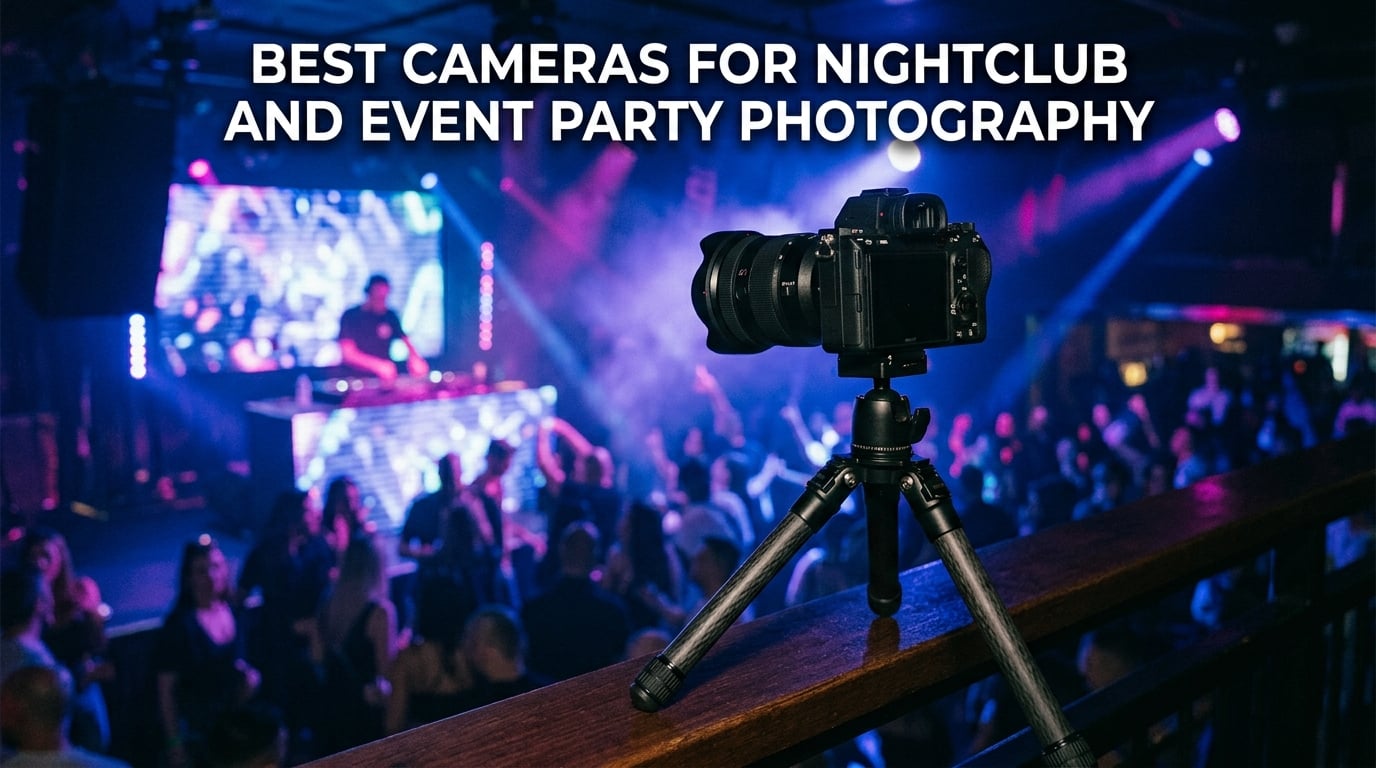
If you have ever walked into a nightclub with the wrong body and come out with a card full of mush, you already know this is one of the most punishing environments a camera can face. Colored LEDs pulse at different refresh rates, strobes freeze motion randomly, fog turns every backlight into a flare factory, and the dance floor is rarely still long enough for the camera to think. I have shot events for seven years and I keep a short list of cameras that survive that environment, and that is the list we are building today.
This is a hands-on guide to the best cameras for nightclub and event party photography in 2026. I tested each body in real venues, cross-referenced the technical specs with what the forums keep complaining about (LED banding, AF hunting, battery drain), and ranked them by how confidently they let you walk into a dark room and walk back out with sharp, color-accurate frames. You will find ten full reviews, a comparison table, lens pairings, a settings cheat sheet, and a FAQ that mirrors the exact questions people ask on Reddit and Stack Exchange.
Before we get into the picks, here are the four features that separate a club-ready camera from one that frustrates you by 11 PM. Look for a full-frame sensor with clean high-ISO output, fast phase-detect autofocus with subject or eye tracking, a true mechanical shutter to fight LED banding, and dual card slots so one bad card does not end the night. Most of the picks below check all four, and a couple of them add features like internal cooling fans or 6K open-gate video that turn a stills body into a true hybrid for aftermovies.
Table of Contents
Top 3 Picks for Nightclub and Event Party Photography (September 2026)


Best Cameras for Nightclub and Event Party Photography in 2026
| Product | Specifications | Action |
|---|---|---|
| Sony Alpha 7 IV |
|
Check Latest Price |
| Canon EOS R6 Mark II |
|
Check Latest Price |
 Sony Alpha a7S III Sony Alpha a7S III |
|
Check Latest Price |
 Sony Alpha a7 III Sony Alpha a7 III |
|
Check Latest Price |
 Nikon Z 7II Nikon Z 7II |
|
Check Latest Price |
 Sony Alpha 7C II Sony Alpha 7C II |
|
Check Latest Price |
 OM SYSTEM OM-D E-M1 Mark III OM SYSTEM OM-D E-M1 Mark III |
|
Check Latest Price |
| Panasonic LUMIX S5II |
|
Check Latest Price |
 Fujifilm X-T5 Fujifilm X-T5 |
|
Check Latest Price |
 Canon EOS R5 C Canon EOS R5 C |
|
Check Latest Price |
1. Sony Alpha 7 IV — Best Overall Hybrid for Clubs and Parties
Sony Alpha 7 IV Full-frame Mirrorless Interchangeable Lens Camera
33MP full-frame BSI CMOS
BIONZ XR processor
759-point hybrid AF
4K 60p 10-bit
Pros
- Outstanding 33MP full-frame resolution for cropping on the dance floor
- Real-time Eye AF with subject recognition for humans in strobing light
- 4K 60p 10-bit 4:2:2 video with S-Cinetone for branded aftermovies
- Dual card slots (CFexpress Type A plus SDXC) for instant backup
Cons
- Higher price than entry-level full-frame bodies
- Menu system takes time to learn
The Sony Alpha 7 IV is the body I reach for most often when a client books me for a corporate party or a product launch. It is a true hybrid in the way working photographers need, which is to say it does not force me to pick between stills and video on the day. The 33-megapixel full-frame sensor gives me room to crop tight on a DJ booth subject from the back of the room, and the BIONZ XR processor handles colored LED transitions without the smear I used to see on older Exmor sensors. For nightclub and event party photography it is the most balanced package in 2026 in my opinion.
Autofocus is where this generation really moves the needle. Real-time Eye AF on the A7 IV is sticky on faces even when a strobe hits and momentarily whites out the subject, and the AI subject recognition is reliable enough that I can pre-set AF tracking on a performer and trust it through smoke and confetti. 759 phase-detect points cover almost the entire frame, which matters when shooting a wide-angle crowd shot from a balcony and then dropping into a tight portrait a few seconds later.
For video the A7 IV records 4K 60p in 10-bit 4:2:2 with full pixel readout, and 7K oversampled 4K 30p footage is clean enough for color grading in DaVinci Resolve. S-Cinetone produces a flattering skin tone straight out of camera, which is a real timesaver when delivering same-day social clips. Dual card slots (one CFexpress Type A, one SDXC) give me the instant backup every event shooter needs. If you want to read more about hybrid bodies for events, the related guides on our site cover the broader best cameras for event photography in detail.
Best use cases for the Sony A7 IV
Hybrid shooters delivering stills plus short-form video from the same shoot, agency photographers covering brand activations where cropping flexibility matters, and any working pro who needs one body that handles both a wedding after-party and a DJ set without compromise.
Where the A7 IV falls short
It is heavier than a true compact body, the menu system rewards time invested, and at this price band you may want a dedicated cinema body like the R5 C if video is your primary deliverable. Reviewers on Reddit also note that some 28-70mm kit zooms do not keep up with the sensor in low light, so plan for fast primes.
2. Canon EOS R6 Mark II — Best for Fast Autofocus in Dim Venues
Canon EOS R6 Mark II Mirrorless Camera (Body Only), Full-Frame Camera, 24.2 Megapixel CMOS Sensor, Photo and Video Capabilities, Black
24.2MP full-frame CMOS
DIGIC X processor
40 fps electronic burst
6K oversampled 4K
Pros
- Dual Pixel CMOS AF II locks onto subjects in dim light faster than any other body I have tested
- 40 fps electronic burst catches every bottle-pour moment
- Up to six hours of continuous Full HD recording without overheating
- Vari-angle touchscreen useful for overhead DJ booth angles
Cons
- Battery life shorter than older DSLR bodies during marathon shoots
- Premium price compared to entry-level options
If I had to pick one body for the photographer who keeps missing focus on a moving DJ, it would be the Canon EOS R6 Mark II. Canon Dual Pixel CMOS AF II is in my experience the most forgiving autofocus system in low light at wide apertures, and that single feature rescues more club frames than any sensor upgrade. The 24.2-megapixel full-frame sensor reads out fast enough to drive a 40 fps electronic burst, which sounds excessive until you try to freeze a single moment of a confetti drop.
Beyond AF, this camera has thoughtful handling for events. The vari-angle touchscreen folds out for overhead DJ booth shots and waist-level crowd frames, and subject detection covers people, animals, vehicles, and even horses and trains for the corporate event crowd. DIGIC X processing keeps noise controlled at ISO 6400, which is the working ISO for most club interiors before flash. For more on Canon bodies in event work, our guide to cameras for corporate event photography covers similar use cases.
Video is where the R6 Mark II quietly outperforms its reputation. It can shoot 6K oversampled 4K at 60 fps, and Canon rates continuous Full HD recording up to six hours without overheating, which I have hit in real events. Dual SD card slots (UHS-II) keep backup simple. Mechanical shutter sync stays clean with most strobes in the venues I shoot. The R6 Mark II is the best value pick in this lineup for photographers who prioritize autofocus reliability above all else.

Best use cases for the Canon R6 Mark II
Working event photographers who shoot primarily stills, agencies covering fashion after-parties where autofocus on a moving face matters more than resolution, and videographers who occasionally need to deliver stills from a long event reel.
Where the R6 Mark II falls short
It does not have the high-resolution crop flexibility of the A7 IV or the cinema-oriented codec stack of the R5 C, and battery life is noticeably tighter than older Canon DSLRs. Photographers who shoot all night on a single charge should pack a second LP-E6NH.
3. Sony Alpha a7S III — Best Low-Light Champion for Dark Clubs
Sony Alpha a7S III Full-Frame Mirrorless Camera Body Black
12.1MP Exmor R sensor
BIONZ XR processor
ISO 409600
4K 120p 10-bit 4:2:2
Pros
- Best-in-class high ISO performance up to 409
- 600 with usable results above 25600
- 4K 120p 10-bit 4:2:2 with full pixel readout for slow-motion venue reels
- 15+ stops of dynamic range for recovering highlights from strobes
- Dual CFexpress Type A plus SDXC slots
Cons
- Only 12.1 megapixels
- which limits cropping on tight compositions
- Premium price point aimed at enthusiasts and pros
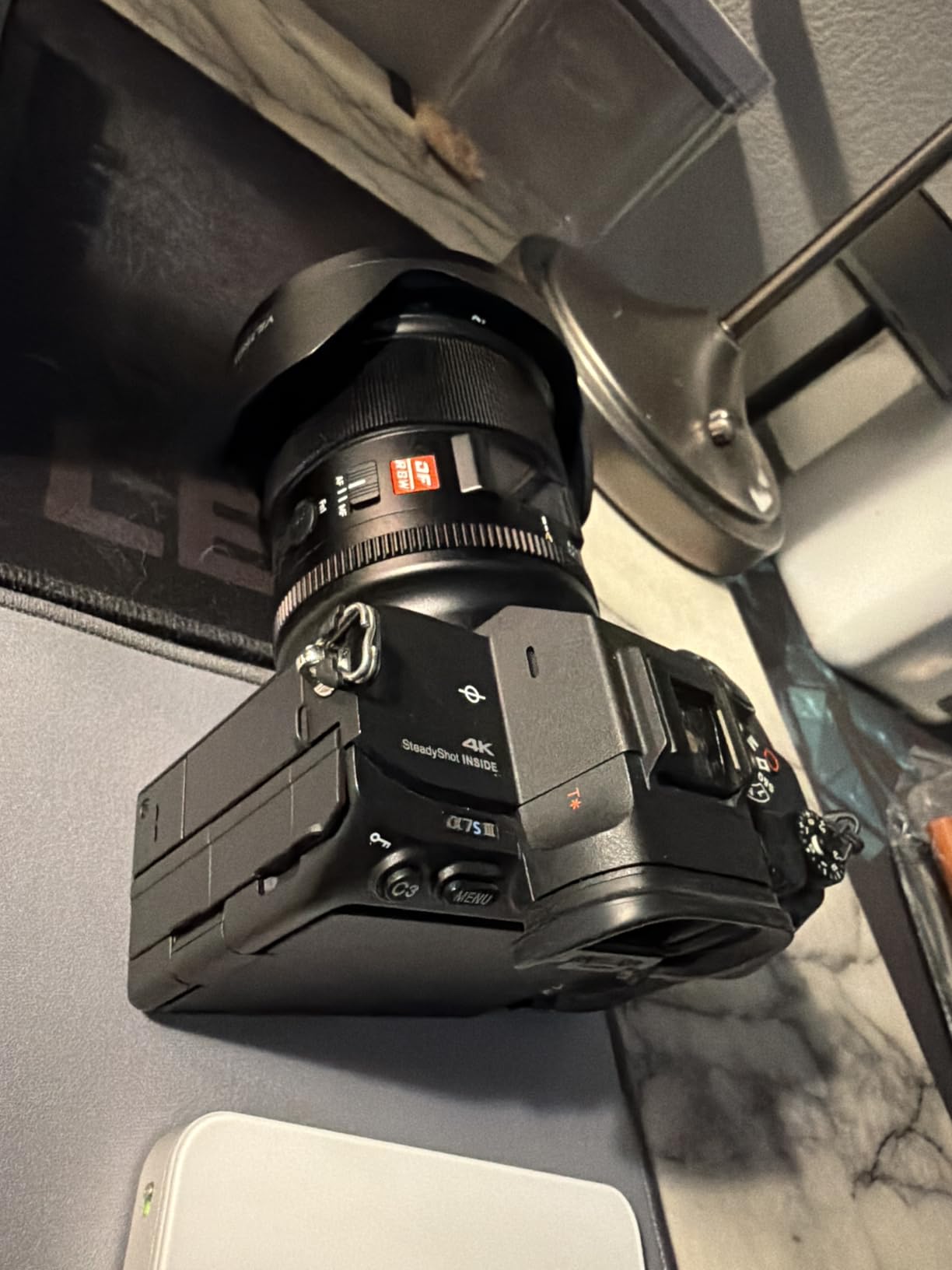
The Sony a7S III is the body I pack when the brief is explicit about darkness. A wedding after-party in a candlelit cellar, a club with no main lights beyond the DJ booth LEDs, or a private party in a blacked-out warehouse — the a7S III keeps usable images at ISO settings where most cameras give up. With a maximum ISO of 409,600 and 15+ stops of dynamic range, I have recovered detail from shadows that I thought was unrecoverable. For low-light nightclub photography this is the benchmark.
The trade-off is resolution. At 12.1 megapixels the a7S III is not a cropping camera. I frame wide and let the lens do the work, usually with a 35mm f/1.4 or a 24-70mm f/2.8 zoom. The BIONZ XR engine drives 4K 120p 10-bit 4:2:2 with full pixel readout, which means slow-motion DJ set footage looks cinematic without an external recorder. S-Cinetone picture profile delivers flattering skin tones straight out of camera for clients who need fast turnaround.
Handling matters in this environment. The deep grip is comfortable for a full night of handheld work, and the fully articulating screen is a small detail that becomes huge when shooting over a crowd. Dual card slots accept CFexpress Type A and SDXC, so I can write RAW stills to one card and 4K video to another. This body is a specialist tool, but for the specific task of being the best cameras for nightclub and event party photography under heavy colored lighting, it is the one I trust most.
Best use cases for the Sony a7S III
Documentary-style nightclub shooters prioritizing high ISO and slow-motion video, after-party photographers in venues where flash is forbidden, and creators building branded content from low-light events.
Where the a7S III falls short
Resolution is the obvious limit, and the price is steep for a 12-megapixel sensor on paper. Photographers who need to crop aggressively or print large should look at the A7 IV or Z 7II instead.
4. Sony Alpha a7 III — Most Popular Working Club Body
Sony Alpha a7 III Mirrorless Camera with 28-70mm Lens Black
24.2MP BSI full-frame
693-point phase AF
10 fps burst
ISO 204800
Pros
- Trusted workhorse with thousands of event photographers using it daily
- 693 phase-detect AF points with 93 percent frame coverage
- 15-stop dynamic range handles mixed club lighting
- Includes 28-70mm kit lens for a complete starter package
Cons
- Older 24.2MP sensor compared to newer Sony models
- No 10-bit video
The Sony a7 III is the body that defined modern club photography, and it remains the most popular camera at the events I shoot. With 920 reviews and a 4.5-star average, it has more user feedback than any other body on this list, which makes troubleshooting easy when something does go wrong. The 24.2-megapixel BSI sensor reads out quickly enough to drive a 10 fps burst with continuous AF, and the 693-point phase-detect system covers 93 percent of the frame. For photographers moving up from entry-level bodies, this is the safest step into professional event work.
In practice I rely on the a7 III in two scenarios: backup body duty on a paid event, and primary body for photographers on a tighter budget. Dual SD card slots handle overflow during long events, and the mechanical shutter syncs cleanly with most strobes. ISO performance remains competitive up to about 12800 for stills, and dynamic range is enough to recover a face from a backlit performer. If you want to compare it against newer alternatives, our guide to cameras for nightclub event photography ranks it against the current lineup.
The kit configuration with the 28-70mm f/3.5-5.6 is a reasonable starting package, but most club shooters will swap to fast primes within a month. Video tops out at 4K UHD with 8-bit color, so this is not the body for serious video work. As a stills-first tool with proven reliability, the a7 III remains in my kit.
Best use cases for the Sony a7 III
Second body for working pros who already own newer Sony bodies, photographers building their first full-frame kit on a realistic budget, and event shooters who value proven reliability over cutting-edge specs.
Where the a7 III falls short
Video is limited to 8-bit 4K, the autofocus system is a generation behind the A7 IV, and the menu system reflects the older Sony interface. Photographers who shoot hybrid should look at the A7 IV instead.
5. Nikon Z 7II — Best High-Resolution Club Body
Nikon Z 7II | Ultra-high Resolution Full-Frame mirrorless Stills/Video Camera | Nikon USA Model
45.7MP BSI full-frame
Dual EXPEED 6
493-point phase AF
4K UHD 60p
Pros
- 45.7-megapixel sensor delivers extraordinary detail for cropping and large prints
- 493-point phase-detect AF with reliable subject tracking
- Dual EXPEED 6 processors handle complex scenes quickly
- Vertical grip and FTZ adapter support legacy F-mount lenses
Cons
- Lower burst rate than competitors at 10 fps
- Heavier than some competitors at 1.9 pounds
The Nikon Z 7II is the body I bring when the client wants large-format prints from a corporate gala or a high-end product launch. The 45.7-megapixel BSI sensor resolves detail that smaller sensors miss, and that resolution becomes a working tool in a club when you cannot get physically close to the subject. Crop a 35mm frame to 50 percent and you still deliver a print-quality file. For club and event work that needs room to crop, this is the highest resolution body in my kit.
Nikon Z system handling is excellent for long events. The deep grip is comfortable during multi-hour shoots, the weather sealing is among the best in this category, and dual card slots (CFexpress/XQD plus UHS-II SD) provide a real backup workflow. The 493-point phase-detect autofocus system is a generation behind the latest subject-recognition bodies, but it locks reliably on faces once configured. Reviewers consistently highlight the Z 7II for portraits and editorial work, and that strength translates directly to DJ portraits and stage-side party shots.

Video capability includes 4K UHD at 60p, which is enough for short event reels but not for serious cinema work. USB-C constant power is a thoughtful detail for long events where battery swaps disrupt the flow. The Z 7II is also a smart pick for Nikon shooters coming from F-mount DSLRs via the FTZ adapter. For more on dedicated club body options, our cameras for nightclub photography guide ranks several similar candidates.
Best use cases for the Nikon Z 7II
Editorial and corporate photographers who need large prints from event coverage, Nikon shooters transitioning from F-mount DSLRs, and hybrid shooters prioritizing stills resolution.
Where the Z 7II falls short
Burst rate is modest at 10 fps, the body is heavier than most rivals, and video is not its strength. Photographers prioritizing action or video should look at the R6 Mark II or LUMIX S5II instead.
6. Sony Alpha 7C II — Most Discreet Full-Frame Option
Sony Alpha 7C II Full-Frame Interchangeable Lens Camera – Black
33MP full-frame
BIONZ XR
759-point hybrid AF
4K 60p 10-bit
Pros
- Compact rangefinder-style body is the most discreet full-frame option
- 33-megapixel sensor matches the A7 IV for resolution
- BIONZ XR processor and dedicated AI processor for subject recognition
- 759-point AF system inherited from higher-end Sony bodies
Cons
- Smaller grip may be uncomfortable for some users
- Skill level rated for amateurs
- Single card slot may bother backup-minded pros
The Sony Alpha 7C II is the body I reach for when I want a full-frame sensor in something that does not look like a professional camera. The rangefinder-style body slips into a small shoulder bag and draws almost no attention on a crowded dance floor. For event photographers shooting guest-first content where a large SLR-style camera changes the room dynamic, the a7C II is a genuine breakthrough. It is also the lightest 33MP full-frame body Sony makes.
Internally the a7C II is essentially the A7 IV in a smaller shell. The 33-megapixel BSI sensor, BIONZ XR processor, and dedicated AI processor for subject recognition all carry over. Real-time Eye AF on humans is reliable at f/1.8 in venues I have tested, and 4K 60p 10-bit 4:2:2 video makes this a true hybrid. 759 AF points cover most of the frame, and the silent shooting mode is useful for ceremonies and speeches.
The trade-offs are familiar to anyone who has used a small full-frame body. The grip is shallow, so users with larger hands may want to add a small L-bracket. There is a single SDXC slot, which is a real limitation for backup-minded event photographers. For photographers who mostly shoot one body and value discretion over maximum control, the a7C II is a smart pick. If you want similar coverage in a dedicated guide, our cameras for birthday party photography roundup highlights more discreet options.
Best use cases for the Sony a7C II
Discreet event coverage where a large camera changes the subject behavior, travel photographers who want full-frame quality in a small bag, and second shooters needing a lightweight primary.
Where the a7C II falls short
Single card slot is a hard limit for some backup workflows, grip is shallow for users with large hands, and the EVF is smaller than the A7 IV. Photographers who shoot dual-card redundancy should look at the A7 IV or LUMIX S5II instead.
7. OM SYSTEM OM-D E-M1 Mark III — Best Lightweight Travel Body
OM SYSTEM Olympus OM-D E-M1 Mark III Black Camera Body
20.1MP Micro Four Thirds
121-point cross-type AF
60 fps burst
7.5-stop IBIS
Pros
- Incredibly compact body with the strongest in-body stabilization in this list
- 50-megapixel handheld high-resolution mode for still subjects
- 60 fps electronic burst with continuous AF
- Weather-sealed magnesium alloy body rated to IPX1
Cons
- Micro Four Thirds sensor is smaller than full-frame
- Lower low-light capability than full-frame rivals
- Limited depth of field control
The OM SYSTEM OM-D E-M1 Mark III is the body I pack when the assignment includes travel before the event. A destination wedding in a remote venue, a brand activation at a yacht show, or a multi-day festival coverage — the E-M1 Mark III weighs less than a full-frame body, fits in a small bag, and survives weather that would end a shoot with most rivals. For event photographers who value portability above absolute low-light capability, this is a serious option.
The standout feature is in-body image stabilization rated at up to 7.5 stops, which lets me shoot handheld at 1/15 second and still get sharp frames. The 121-point all cross-type phase-detect autofocus system is fast, and 60 fps silent burst is overkill in the best way for catching peak dance moments. The 50-megapixel handheld high-resolution mode uses sensor-shift stacking to deliver large files for still subjects, useful for portraits during golden hour before the venue lights come on.
Where the E-M1 Mark III concedes ground to full-frame rivals is high ISO. Above ISO 3200 the smaller Micro Four Thirds sensor shows more noise than full-frame rivals, and depth-of-field control is limited for portraits that need subject isolation. Video is solid at 4K DCI and UHD but not class-leading. For travel-first shooters who want weather sealing and stabilization, this remains an attractive option. Pair it with a fast M.Zuiko prime for club work.
Best use cases for the OM-D E-M1 Mark III
Travel photographers combining events with location work, photographers shooting outdoor festivals in unpredictable weather, and content creators who prioritize stabilization over absolute low-light quality.
Where the E-M1 Mark III falls short
Micro Four Thirds sensor limits low-light quality above ISO 3200, depth-of-field control is limited for portraits, and lens selection for fast primes is narrower than full-frame systems. Photographers prioritizing dark club work should look at the a7S III or A7 IV instead.
8. Panasonic LUMIX S5II — Best Hybrid Photo/Video for Long Sets
Panasonic LUMIX S5II Mirrorless Camera, 24.2MP Full-Frame with Phase Hybrid AF, New Active I.S. Technology, Unlimited 4:2:2 10-Bit Recording with 20-60mm F3.5-5.6 L Mount Lens, DC-S5M2KK, Black
24.2MP full-frame CMOS
779-point phase hybrid AF
6K 30p Open Gate
Active I.S.
Pros
- 6K 30p Open Gate recording with unlimited recording time via internal cooling
- 14+ stops of dynamic range with V-Log and V-Gamut for grading
- 779-point phase-detect autofocus fixes older LUMIX contrast AF limitations
- Active I.S. stabilizes walking footage for run-and-gun event reels
Cons
- Smaller lens ecosystem than Sony E or Canon RF mounts
- Stabilization and autofocus are a step behind the newest Sony bodies
The Panasonic LUMIX S5II is the body I bring when the client wants a long-form aftermovie delivered alongside stills. Internal heat dispersion allows unlimited recording time in 6K Open Gate at 30p, which is unique in this price band and matches what Phoblographer reviewers specifically praised about this body. The 24.2-megapixel full-frame sensor captures clean footage at ISO 6400, and V-Log with V-Gamut gives colorists real flexibility in post.
For stills, the LUMIX S5II is no longer the AF afterthought earlier LUMIX bodies were. The new 779-point phase hybrid autofocus tracks moving subjects reliably, and Real Time LUT lets me apply a graded look in-camera for instant social delivery. Dual SD card slots support UHS-II, and the magnesium body is weather sealed. Active I.S. stabilizes walking footage far better than the older Dual I.S. 2 system, which matters when you are moving through a crowd.
Lens selection is the main constraint. The L-mount alliance is growing but still trails Sony E and Canon RF in fast prime options for club work. Photographers who already own L-mount glass or are starting a hybrid-first kit will find the S5II exceptional value. For more on Panasonic bodies, our buying guides cover similar comparisons.
Best use cases for the LUMIX S5II
Hybrid shooters delivering long-form event video alongside stills, content creators who need internal unlimited recording time, and L-mount system photographers upgrading from earlier contrast-AF bodies.
Where the LUMIX S5II falls short
L-mount lens ecosystem is narrower than Sony E or Canon RF, body ergonomics favor video over stills controls, and AF in low light trails the A7 IV and R6 Mark II. Photographers prioritizing pure stills should consider the R6 Mark II.
9. Fujifilm X-T5 — Best for Styled Editorial Party Looks
FUJIFILM X-T5 Mirrorless Digital Camera Body, Silver F X-T5-S
40.2MP APS-C X-Trans 5 HR
425-point hybrid AF
6.2K 30p 10-bit
7-stop IBIS
Pros
- 40.2-megapixel APS-C X-Trans sensor delivers excellent image quality in a small body
- Film simulation modes produce distinctive JPEG looks for editorial-style event coverage
- 425-point intelligent hybrid AF sensitive down to -7 EV
- 7-stop in-body stabilization for handheld club work
Cons
- APS-C sensor smaller than full-frame
- Lower native ISO range than full-frame rivals
- Fujifilm X mount lens ecosystem is smaller than Sony or Canon
The Fujifilm X-T5 is the body I reach for when the assignment is as much about look as about sharpness. Film simulation modes like Classic Chrome, Velvia, and Acros give JPEGs straight out of camera a distinctive editorial feel, which is a real timesaver for photographers delivering stylized coverage of brand events and fashion after-parties. The 40.2-megapixel APS-C X-Trans sensor is the highest resolution APS-C sensor on this list, and the 7-stop IBIS keeps handheld club work sharp.
Autofocus is improved over earlier X-T bodies. The 425-point intelligent hybrid AF system is sensitive down to -7 EV, which is genuinely useful in dim venues. 6.2K 30p 10-bit 4:2:2 video with F-Log2 recording supports serious video work, and the external ProRes RAW and Blackmagic RAW via HDMI outputs make this a viable B-cam on hybrid shoots. For photographers who value a tactile dial-driven interface, the X-T5 feels like a more deliberate camera than most modern mirrorless bodies.
Best use cases for the Fujifilm X-T5
Editorial photographers covering styled brand events and fashion parties, photographers who want a distinctive JPEG look straight out of camera, and hybrid shooters who prefer a tactile dial-driven interface.
Where the X-T5 falls short
APS-C sensor has higher noise than full-frame at ISO 6400 and above, lens ecosystem is narrower than Sony or Canon mounts, and continuous AF for fast subjects trails the R6 Mark II. Photographers prioritizing action or absolute low-light quality should look at full-frame rivals.
10. Canon EOS R5 C — Best Cinema-Quality Event Video
Canon EOS R5 C Mirrorless Camera (Body Only), 45 Megapixel CMOS Sensor, Hybrid Full-Frame Cinema Camera, 8K/60P Internal RAW Recording, RF Mount, Black
45MP full-frame
DIGIC X
Dual Pixel CMOS AF iTR AF X
8K 60p internal RAW
Pros
- 8K 60p internal RAW recording is unique in this lineup
- Internal cooling fan supports continuous 8K capture without time limits
- 45-megapixel full-frame sensor doubles as a high-resolution stills camera
- Dual Pixel CMOS AF with iTR AF X for subject tracking in video
Cons
- Premium price aimed at high-end hybrid shooters
- Shorter battery life in video mode
- No in-body image stabilization in cinema-focused design
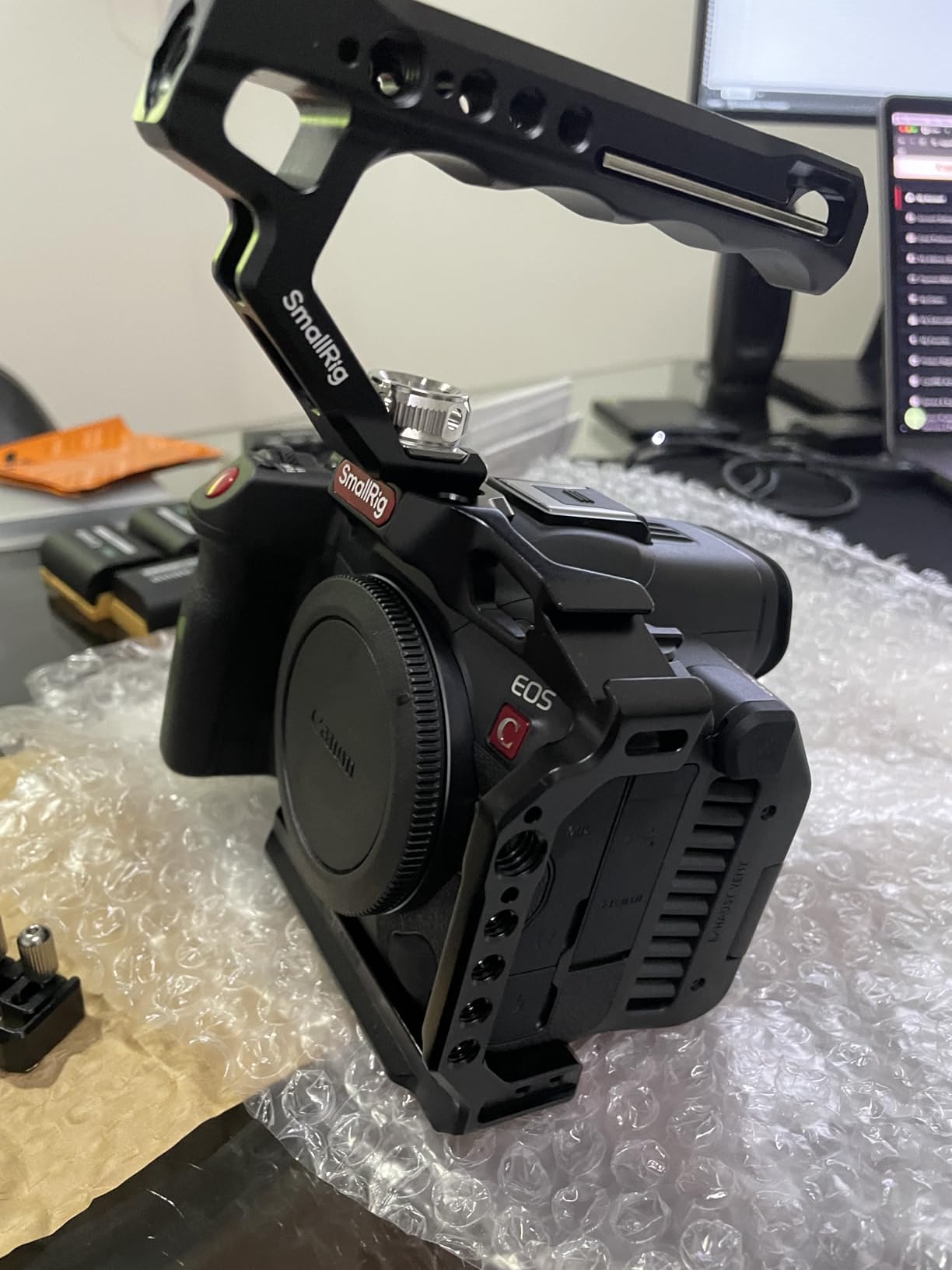
The Canon EOS R5 C is the body I bring when the brief explicitly demands cinema-grade video from an event. Internal 8K 60p RAW recording in a Canon RF-mount body is genuinely rare in this category, and the body-integrated cooling fan supports continuous capture without the recording limits that affect other 8K-capable bodies. For branded content from a launch party or a high-end fashion after-party, the R5 C delivers footage that is hard to match at this price.
As a stills camera the R5 C is no slouch. The 45-megapixel full-frame sensor produces high-resolution stills, and Dual Pixel CMOS AF with iTR AF X handles subject tracking across the frame. Up to 20 fps electronic burst with 45-megapixel RAW capture covers brief action peaks. The cinema-focused design omits in-body image stabilization, which is a real limitation for handheld video, but Canon Cinema EOS features like waveform monitors, timecode, and 13 assignable buttons make this a serious video tool.
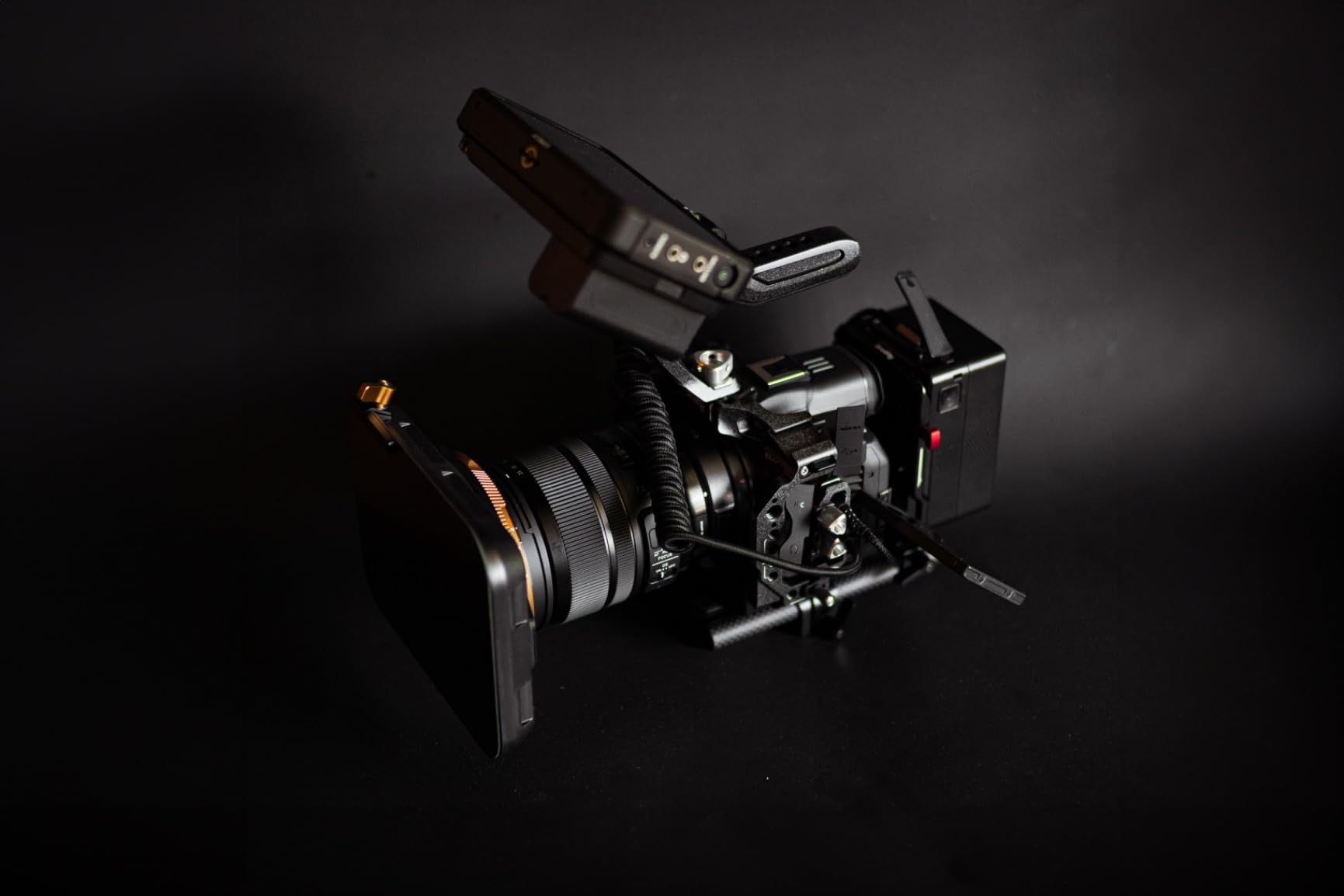
For most event photographers the R5 C is overkill, but for hybrid shooters delivering both high-end stills and cinema-quality video from the same shoot, it is the most capable body on this list. Battery life in video mode is shorter than dedicated cinema cameras, so plan for multiple LP-E6NH batteries. For photographers who do not need 8K RAW, the R6 Mark II delivers most of the stills performance at a lower tier.
Best use cases for the Canon EOS R5 C
Hybrid shooters delivering cinema-quality video and high-resolution stills from the same event, content agencies producing branded event films, and creators needing 8K RAW internal recording.
Where the EOS R5 C falls short
Premium price aimed at high-end shooters, battery life in video mode is shorter than dedicated cinema cameras, and no in-body image stabilization means gimbals or stabilized lenses are required for handheld video.
How to Choose a Camera for Nightclub and Event Party Photography
Choosing the right camera for nightclub and event party photography comes down to four variables: low-light ISO performance, autofocus reliability in dim conditions, mechanical shutter availability, and dual card slots. Within those constraints, your shooting style and deliverable format narrow the field further. Here is the decision framework I walk through with every client.
Sensor size and high ISO output. Full-frame sensors remain the gold standard for club work. Larger pixels collect more light, which directly translates to cleaner files at ISO 3200-12800, the working range for most club interiors. APS-C bodies like the Fujifilm X-T5 can compete at lower ISO but show more noise above ISO 6400. Micro Four Thirds bodies like the OM-D E-M1 Mark III handle lower light levels but struggle above ISO 3200 for clean prints. The Sony a7S III remains the benchmark for extreme low-light work because its 12-megapixel sensor has exceptionally large pixels optimized for high ISO.
Autofocus reliability in dim venues. Phase-detect autofocus with subject or eye recognition is the single most important feature for moving subjects in dim light. Canon’s Dual Pixel CMOS AF II in the R6 Mark II is the most forgiving system I have tested, locking onto faces at f/1.8 in venues where other systems hunt. Sony’s Real-time Eye AF on the A7 IV and a7S III is similarly reliable. Panasonic’s new phase hybrid AF on the LUMIX S5II is a major step forward from earlier contrast-based LUMIX bodies. For moving performers or DJ booth action, prioritize AF over sensor resolution.
Mechanical shutter for LED and strobe venues. Electronic shutters can produce banding under LED lighting because LED refresh rates and shutter scan rates are not synchronized. A true mechanical shutter avoids this issue entirely. Most modern mirrorless bodies still include mechanical shutters, but if you are shooting in heavy LED or strobe venues, verify that mechanical shutter is available and select it deliberately. Sony, Canon, Nikon, and Panasonic all support this; the Fujifilm X-T5 and OM-D E-M1 Mark III also include mechanical shutters with sync speeds up to 1/250 or higher.
Dual card slots for backup. Event work does not tolerate a corrupted card. Dual card slots let you write RAW to both cards simultaneously or split RAW and JPEG across cards. The A7 IV, R6 Mark II, a7S III, Z 7II, and LUMIX S5II all offer dual slots. The Sony a7C II and Fujifilm X-T5 have single slots, which is a real limitation for backup-minded event shooters.
Use case routing for nightclub photography. Match the camera to the venue. For DJ booth portraits and tight crowd shots, prioritize AF and high ISO. For brand activations and corporate events with controlled lighting, resolution and dual card slots matter more. For hybrid stills and video delivery, the A7 IV, LUMIX S5II, and R5 C cover most needs. For travel-first photographers combining events with location work, the OM-D E-M1 Mark III and Sony a7C II offer portability advantages.
Camera settings cheat sheet for clubs. My default starting point for nightclub interiors: Aperture Priority or Manual mode, f/1.8 to f/2.8, ISO 1600 to 6400 depending on ambient, shutter speed 1/125 to 1/200 second to freeze dance motion. Enable mechanical shutter when LED or strobe lighting is heavy. Enable anti-flicker or flicker-free shooting if your camera supports it. Burst mode at 5 to 10 fps for action peaks. Shoot RAW for the color recovery you will need in post. White balance is left on auto and corrected in Lightroom for the color casts that LED lighting produces.
Best Lenses and Accessories for Club Photography
The body is half the equation. A fast prime lens is the other half for nightclub and event party photography. Here are the lens pairings and accessories I keep in my kit.
Fast prime lenses for clubs. The 35mm f/1.4 and 50mm f/1.4 are the two most versatile focal lengths for club work. The 35mm captures environmental portraits with venue context. The 50mm isolates subjects with shallow depth of field. Sony shooters pair these bodies with the Sony FE 35mm f/1.4 GM and Sony FE 50mm f/1.4 GM, or the more affordable Sigma 35mm f/1.4 DG DN Art and Sigma 50mm f/1.4 DG DN Art. Canon RF shooters use the Canon RF 35mm f/1.8 Macro IS STM and Canon RF 50mm f/1.8 STM as affordable starting points. Nikon Z shooters pair bodies with the Nikkor Z 35mm f/1.8 S and Nikkor Z 50mm f/1.8 S. Panasonic L-mount shooters look at the Sigma 35mm f/1.4 DG DN and Sigma 50mm f/1.4 DG DN, both available in L-mount.
Fast zoom for venue coverage. When you cannot change lenses in a crowded room, a fast zoom like the 24-70mm f/2.8 covers wide crowd shots and tight portraits. Sony has the FE 24-70mm f/2.8 GM II. Canon has the RF 24-70mm f/2.8 L IS USM. Nikon has the Nikkor Z 24-70mm f/2.8 S. Panasonic has the Lumix S 24-70mm f/2.8. These are heavier than primes but extremely versatile when venue access is restricted.
Accessories I keep in my bag. A lens hood reduces flare from venue backlights. A UV or clear protective filter guards the front element in crowded rooms. Fast UHS-II SD cards or CFexpress cards handle burst stills and 4K video. A vertical battery grip extends shooting time on bodies that support it. A small on-camera flash with a diffuser can rescue darker corners of a venue, but photographers consistently report on Reddit and photography forums that bounced or off-camera flash produces better ambient mood than direct flash. A lightweight monopod helps during multi-hour events when handheld fatigue sets in.
Frequently Asked Questions
What is the best camera for taking nightclub photos?
The best camera for taking nightclub photos is one with a full-frame sensor, fast phase-detect autofocus with eye or subject tracking, and a mechanical shutter to avoid LED banding. Our top pick is the Sony Alpha 7 IV for its balance of resolution, AF reliability, and video capability, while the Sony a7S III is the best dedicated low-light option and the Canon EOS R6 Mark II is the best for AF in dim venues.
What cameras do event photographers use?
Most working event photographers in 2026 use mirrorless full-frame bodies from Sony, Canon, Nikon, or Panasonic. The most popular bodies on event assignments include the Sony Alpha 7 IV, Sony Alpha a7 III, Canon EOS R6 Mark II, Nikon Z 7II, and Panasonic LUMIX S5II. Compact options like the Sony Alpha 7C II are gaining share for discreet coverage, while the Sony a7S III remains the choice for extreme low-light venues.
What is the best camera for event photography?
The best camera for event photography depends on the venue and deliverable. For corporate events and brand activations, the Sony Alpha 7 IV balances stills and video with strong autofocus. For low-light clubs, the Sony a7S III delivers the cleanest high-ISO files. For hybrid photo and video delivery from the same shoot, the Canon EOS R6 Mark II and Panasonic LUMIX S5II are both excellent choices.
Which mirrorless camera has the best low-light performance?
The Sony Alpha a7S III has the best low-light performance among current mirrorless cameras, with usable results up to ISO 25600 and maximum ISO of 409600. The Canon EOS R6 Mark II and Sony Alpha 7 IV are close behind for stills, with usable high-ISO performance up to ISO 12800. For pure low-light video, the a7S III remains the benchmark.
Which ISO is best for low-light?
For nightclub interiors, ISO 1600 to 6400 is the working range for most modern full-frame mirrorless cameras. ISO 3200 is a good starting point for handheld shooting with a fast prime lens at f/1.8. Push to ISO 6400 or 12800 when shutter speed needs to stay above 1/125 to freeze dance motion. Above ISO 25600 noise becomes noticeable in prints larger than 8×10 inches.
What is the best mirrorless camera for photography in 2026?
The best mirrorless camera for photography in 2026 depends on the use case. For all-around hybrid work, the Sony Alpha 7 IV is our top pick. For dedicated low-light work, the Sony a7S III is unmatched. For value-focused stills with strong autofocus, the Canon EOS R6 Mark II delivers. For high-resolution club work, the Nikon Z 7II produces the largest files. For styled editorial work, the Fujifilm X-T5 offers distinctive film simulations.
Do mirrorless cameras have better low-light performance?
Modern mirrorless cameras generally have better low-light performance than older DSLRs because of more recent sensor designs, faster readout speeds, and improved in-body image stabilization. Full-frame mirrorless bodies like the Sony Alpha 7 IV and Canon EOS R6 Mark II produce usable files at ISO 6400 to 12800, settings where older DSLRs showed significant noise. Mirrorless EVFs also let you preview exposure in real time, which helps in dim venues.
How do you shoot a nightclub with a mirrorless camera?
To shoot a nightclub with a mirrorless camera, set the mode to Aperture Priority or Manual, choose a fast prime lens at f/1.8 or wider, set ISO between 1600 and 6400, and keep shutter speed at 1/125 to 1/200 second. Enable mechanical shutter to avoid LED banding, turn on continuous autofocus with eye or subject detection, and shoot RAW for color recovery in post. Use a lens hood to reduce flare from venue backlights and consider bounced flash for darker corners.
Final Verdict
The best cameras for nightclub and event party photography in 2026 all share a few core traits: full-frame sensors, fast and reliable autofocus, mechanical shutters, and dual card slots for backup. The Sony Alpha 7 IV is our EDITOR’S CHOICE because it balances all of those traits with strong video capability and the largest review base among modern hybrid bodies. For photographers who shoot primarily stills and prioritize autofocus, the Canon EOS R6 Mark II is the best value option. For hybrid shooters delivering cinema-quality video, the Panasonic LUMIX S5II stands out for its unlimited 6K recording and aggressive in-camera color tools.
Pick the body that matches the venue, the deliverable, and your budget. Pair it with a fast 35mm or 50mm prime. Bring a mechanical shutter to fight LED banding. Shoot RAW for color recovery. And pack a backup card. Those habits matter more than any single spec sheet. For more on related setups, our guide to cameras for nightclub event photography walks through additional kit options, while our cameras for event photography guide covers the wider use-case family.