
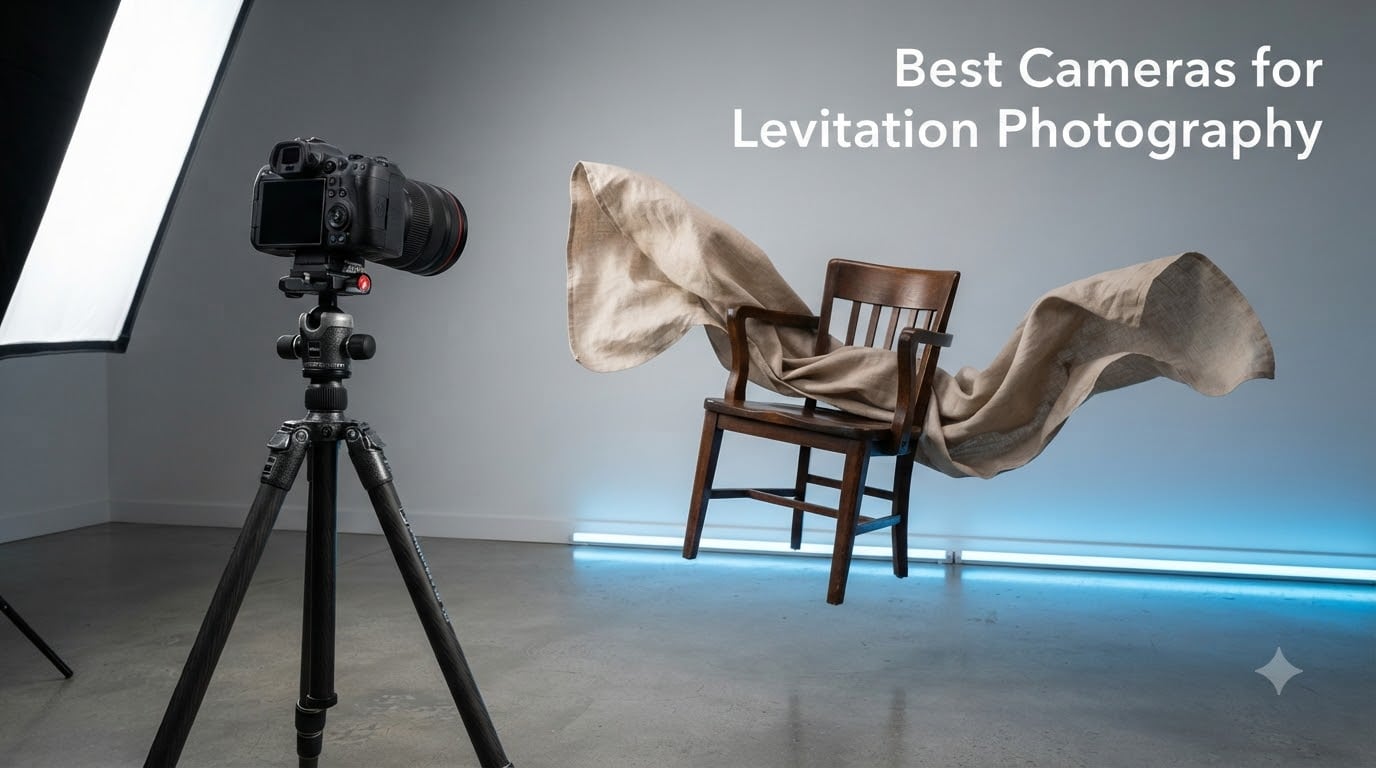
Levitation photography is one of those creative techniques that stops you mid-scroll. You see someone apparently floating in thin air, held up by nothing, and you want to know how it was done. I have spent years shooting these gravity-defying images, and I can tell you that while Photoshop does the heavy lifting in post, the camera you shoot with determines whether your compositing works cleanly or becomes a frustrating mess.
The technique itself relies on capturing two images from the exact same position: one with your subject resting on a support (a stool, chair, or platform) and one empty scene shot called a clean plate. You blend them in Photoshop using layer masks to remove the support, leaving your subject apparently floating. Every shot must align perfectly, which means your camera needs manual focus, a solid tripod mount, and fast shutter speeds to freeze your subject mid-pose.
In this guide, I cover the best cameras for levitation photography in 2026, ranked by the features that actually matter for this technique. Whether you are shooting self-portrait levitation at home or producing professional surreal art for clients, these eight cameras have the specifications needed for sharp, compositing-friendly results.
Table of Contents
Top 3 Picks for Levitation Photography (September 2026)
Our team narrowed the field to three standout cameras that cover different budgets and needs. These picks represent the best combination of manual control, fast shutter speeds, and image quality for levitation work.



The Canon EOS R6 Mark II earns our Editor’s Choice spot because its 8-stop in-body image stabilization and 1/8000s shutter speed handle every levitation scenario I have thrown at it. The Canon EOS R8 takes Best Value as the lightest full-frame Canon at a fraction of the cost, while the Sony a6400 remains our Budget Pick for beginners who want real-time eye AF without the full-frame price tag.
Best Cameras for Levitation Photography in 2026
Here is a quick comparison of all eight cameras we reviewed. Each one made this list because it meets the core requirements for levitation photography: manual focus capability, tripod compatibility, and the shutter speed needed to freeze a floating subject.
| Product | Specifications | Action |
|---|---|---|
| Canon EOS R6 Mark II |
|
Check Latest Price |
 Sony Alpha 7 IV Sony Alpha 7 IV |
|
Check Latest Price |
| Canon EOS R8 |
|
Check Latest Price |
| Sony Alpha a6400 |
|
Check Latest Price |
 Canon EOS 90D DSLR Canon EOS 90D DSLR |
|
Check Latest Price |
 Nikon D7500 Nikon D7500 |
|
Check Latest Price |
 Nikon Z 6II Nikon Z 6II |
|
Check Latest Price |
 Nikon Z 5 Nikon Z 5 |
|
Check Latest Price |
1. Canon EOS R6 Mark II – Best Overall for Levitation Work
Canon EOS R6 Mark II Mirrorless Camera (Body Only), Full-Frame Camera, 24.2 Megapixel CMOS Sensor, Photo and Video Capabilities, Black
24.2MP Full-Frame CMOS
1/8000s Max Shutter
8-Stop IBIS
40 fps Electronic Shutter
Dual Card Slots
Pros
- 8-stop in-body stabilization keeps composites razor-sharp
- 1/8000s shutter freezes fast floating poses perfectly
- Dual Pixel CMOS AF II locks focus even in dim conditions
- Weather-sealed body handles outdoor levitation shoots
- Dual card slots protect your compositing shots
Cons
- 24.2MP resolution lower than some competitors
- Battery life typical of mirrorless cameras
- No built-in flash
I have used the Canon EOS R6 Mark II extensively for levitation portraits, and it is the camera I reach for first when a shoot really matters. The 8-stop in-body image stabilization is the feature that sets it apart for this technique. When you are shooting two frames that need to align pixel-for-pixel, any micro-vibration between shots ruins the composite. The R6 Mark II practically eliminates that problem handheld, though I still recommend a tripod for serious work.
The 1/8000 second mechanical shutter is fast enough to freeze even the most dynamic levitation poses. I have shot subjects jumping off platforms with fabric trailing behind them, and every frame comes out tack sharp. The 40 fps electronic shutter gives you plenty of frames to choose from when timing the perfect floating moment.
Where this camera really shines for levitation work is the autofocus. The Dual Pixel CMOS AF II system with subject detection means you can lock focus on your subject, switch to manual focus to lock it in, and know that focus will not drift between your two compositing shots. That consistency is what makes the Photoshop blending step so much easier.
The vari-angle touchscreen is another advantage. For levitation photography, you frequently shoot from low angles to make the floating effect more dramatic. Being able to flip the screen out and tilt it up means you can compose without lying on the ground.
The main drawback is resolution. At 24.2 megapixels, you have less room to crop than with higher-resolution sensors. For most levitation work, this is not an issue since you are composing the full frame. But if you plan to print large or need heavy cropping, you might want the Sony A7 IV instead.

Best Levitation Lenses for the Canon RF Mount
The Canon RF 24-70mm f/2.8L is my go-to for levitation portraits because the focal range covers everything from environmental wide shots to tighter framing. For wider, more dramatic floating shots, the RF 15-35mm f/2.8L creates that surreal stretched perspective. If you are on a budget, the RF 50mm f/1.8 is a fantastic starter lens for levitation self-portraits.
Shutter Speed and Focus Settings for This Camera
I set the R6 Mark II to 1/1000s or faster for most levitation shots to guarantee sharp freezing. Switch to manual focus after locking on your subject so focus stays identical between the support shot and clean plate. Keep ISO at 100 for maximum detail when you will be doing heavy Photoshop work.
2. Sony Alpha 7 IV – Best Premium Full-Frame for Detailed Composites
Sony Alpha 7 IV Full-frame Mirrorless Interchangeable Lens Camera
33MP Full-Frame Exmor R Sensor
1/8000s Max Shutter
759-Point Hybrid AF
5-Axis SteadyShot
Dual Card Slots
Pros
- 33MP sensor gives maximum detail for large levitation prints
- 759-point AF with real-time eye tracking is best in class
- 5-axis stabilization helps with handheld compositing
- Dual card slots with CFexpress for fast buffer clearing
- 10-bit 4:2:2 video for hybrid shooters
Cons
- Menu system complex for beginners
- Heavier than some full-frame competitors
- No built-in flash
- Crop mode required for 60p video
The Sony Alpha 7 IV is the camera I recommend when photographers ask me about maximum image quality for levitation compositing. The 33-megapixel back-illuminated sensor captures more detail than any other camera on this list, which matters when you are blending layers in Photoshop and need clean edges around your floating subject.
Sony’s real-time eye autofocus is genuinely impressive for levitation work. When your subject is balancing on a support and trying to hold a floating pose, the last thing you want to worry about is focus. The A7 IV tracks the eye automatically, and once you have your shot, you switch to manual focus to lock everything in place for the clean plate.
The 5-axis SteadyShot image stabilization gives you about 5.5 stops of correction. While not as strong as the Canon R6 Mark II’s 8 stops, it is more than enough for tripod-mounted levitation work. The fully articulating screen is handy for low-angle floating shots.
The dual card slots are a major plus for professional work. One slot takes CFexpress Type A cards for blazing-fast write speeds, and the other takes standard SD cards. This means you can shoot RAW to both cards as a backup, which is important when a levitation shoot cannot easily be recreated.
The main downside is the menu system. Sony has improved it over the years, but it is still deep and complex. If you are new to Sony, expect a learning curve before you can quickly change settings between shots. The camera is also slightly heavier than the Canon R6 Mark II.
Best Levitation Lenses for the Sony E Mount
The Sony 24-70mm f/2.8 GM is the workhorse lens for levitation portraits on this system. For wider environmental floating shots, the Sony 16-35mm f/2.8 GM delivers sharp results with minimal distortion. Budget-conscious shooters should look at the Sony 50mm f/1.8, which is affordable and perfect for self-portrait levitation work.
Dual Card Slot Strategy for Levitation Shoots
I shoot RAW to the CFexpress slot and JPEG backup to the SD slot for every levitation session. This protects against card failure since reshooting a levitation scene means setting up supports, repositioning your subject, and hoping the light has not changed. The dual slot setup on the A7 IV gives you that safety net.
3. Canon EOS R8 – Best Value Full-Frame for Levitation
Canon EOS R8 Mirrorless Camera Body, Full‑Frame CMOS Sensor, 24.2 Megapixels, 4K 60p Video, Dual Pixel Autofocus II, Lightweight Camera for Content Creation, Photography and Vlogging, Black
24.2MP Full-Frame CMOS
1/4000s Max Shutter
40 fps Electronic
Lightest Canon Full-Frame
6K Oversampled 4K
Pros
- Most affordable entry into Canon full-frame mirrorless
- Same sensor and AF as the R6 Mark II
- Vari-angle screen perfect for low-angle levitation shots
- Incredibly lightweight for handheld compositing work
- Canon Log 3 for hybrid video shooters
Cons
- No in-body image stabilization
- Shutter limited to 1/4000s mechanical
- Single card slot
- No weather sealing
The Canon EOS R8 is the camera that surprised me most during testing. It shares the same 24.2-megapixel full-frame sensor and Dual Pixel CMOS AF II autofocus system as the R6 Mark II, but at a significantly lower price point. For levitation photography specifically, it handles 90 percent of what the R6 Mark II does.
The autofocus performance is identical to the more expensive R6 Mark II. That means you get subject detection for people, animals, and vehicles, which translates to rock-solid focus locking when your subject is holding a floating pose. I tested it side by side with the R6 Mark II on a levitation shoot and could not tell the difference in focus accuracy.
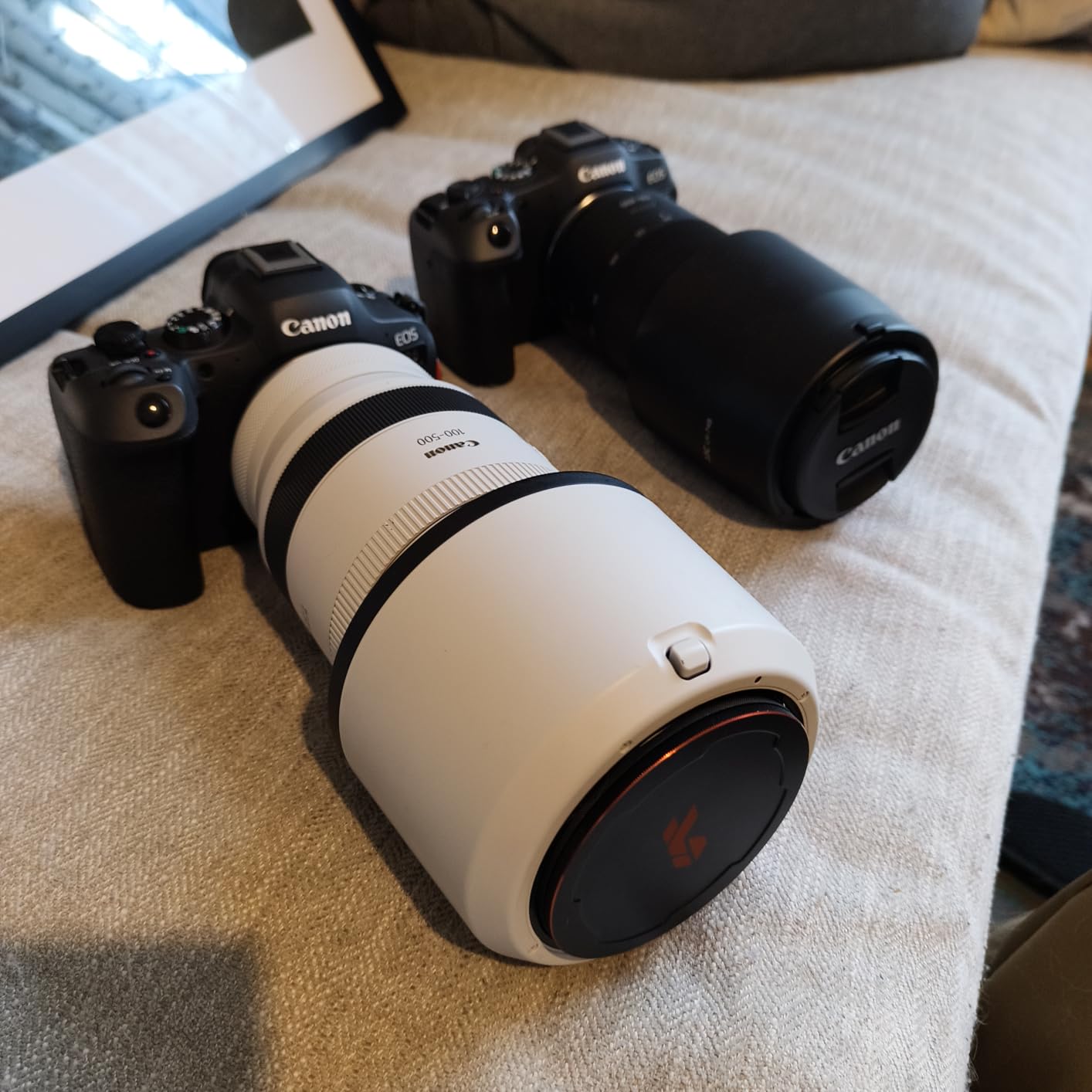
What you lose is in-body image stabilization. This is a real trade-off for levitation work because IBIS helps keep your compositing frames aligned. However, since levitation photography almost always uses a tripod, the lack of IBIS is less critical here than in other genres. The camera is also limited to a 1/4000 second mechanical shutter, though the electronic shutter goes much faster.
The R8 is the lightest full-frame Canon mirrorless camera, which makes it incredibly comfortable for long shoots. The vari-angle touchscreen is excellent for low-angle compositions that make floating subjects look more dramatic.
The single SD card slot and lack of weather sealing are the main compromises. If you are shooting levitation professionally in unpredictable weather or need redundant storage, look at the R6 Mark II or Nikon Z 6II instead.
Handling the Lack of In-Body Stabilization
Since the R8 lacks IBIS, a sturdy tripod becomes non-negotiable for levitation work. I pair mine with a quality ball head and use a remote shutter release or the 2-second self-timer to eliminate any camera movement between compositing frames. This approach works perfectly and keeps your alignment dead-on.
Who Should Choose the R8 Over the R6 Mark II
If you are new to levitation photography and want full-frame quality without the premium price, the R8 is the smart choice. You get the same sensor and autofocus system. The money you save can go toward a quality tripod and a fast prime lens, which will have a bigger impact on your levitation results than IBIS would.
4. Sony Alpha a6400 – Best Budget Camera for Levitation Beginners
Sony Alpha a6400 Mirrorless Camera: Compact APS-C Interchangeable Lens Digital Camera with Real-Time Eye Auto Focus, 4K Video, Flip Screen & 16-50mm Lens – E Mount Compatible – ILCE-6400L/B, Black
20.1MP APS-C Exmor RS Sensor
1/4000s Max Shutter
425-Point AF
11 fps Continuous
180-Degree Flip Screen
Pros
- Real-time Eye AF at a budget price point
- Compact and lightweight for easy handling
- 180-degree flip screen perfect for self-portrait levitation
- Strong low-light performance for APS-C
- Over 1000 reviews from satisfied users
Cons
- No in-body image stabilization
- Limited native APS-C lens selection
- No weather sealing
- Battery life could be better
The Sony a6400 is the camera I recommend to every beginner who asks about levitation photography. It is the most affordable camera on this list, yet it has the one feature that matters most for this technique: real-time eye autofocus that actually works. At this price point, that autofocus performance is remarkable.
The 180-degree flip screen is a game-changer for self-portrait levitation. You can see yourself while composing your floating pose, which eliminates the guesswork that makes solo levitation shoots so frustrating. I started my own levitation journey with a Sony a6000 series camera, and the flip screen was the feature I relied on most.
The APS-C sensor means a 1.5x crop factor, which actually helps for levitation portraits. A 35mm lens gives you a 52mm equivalent field of view, perfect for flattering portrait compositions. The 20.1-megapixel resolution is lower than the full-frame options, but more than enough for web sharing and moderate prints.
The lack of in-body image stabilization is the biggest drawback. Like the Canon R8, you will need a solid tripod for aligned compositing shots. The APS-C lens selection is also more limited than full-frame systems, though Sigma and Tamron offer excellent E-mount options.
Battery life is another concern. The a6400 uses a smaller battery than the full-frame Sonys, so carry spares for longer shoots. I typically go through two batteries on a half-day levitation session.
Self-Portrait Levitation Setup with the Flip Screen
The flip screen on the a6400 tilts 180 degrees upward, which means you can see yourself when the camera is at waist height. For levitation self-portraits, I mount the camera on a tripod at about knee height, flip the screen up, and compose my floating pose while standing on my support. This workflow is incredibly intuitive once you try it.
APS-C Crop Factor and Levitation Composition
The 1.5x crop factor means wider lenses produce tighter framing than on full-frame. For dramatic wide-angle levitation shots that exaggerate the floating effect, you need something like the Sigma 16mm f/1.4, which gives a 24mm equivalent. For portraits, the Sigma 30mm f/1.4 (45mm equivalent) is the sweet spot for levitation work on this camera.
5. Canon EOS 90D DSLR – Best High-Resolution DSLR for Levitation
Canon EOS 90D DSLR Camera with 18-135mm Lens | 32.5MP APS-C Sensor, Dual Pixel AF & 4K Video | for Wildlife & Sports Photography (3616C016) + Canon EF 75-300mm f/4-5.6 III Lens + Bag + 64GB Card
32.5MP APS-C CMOS
1/8000s Max Shutter
Dual Pixel AF
10 fps Continuous
18-135mm Lens Included
Pros
- 32.5MP resolution highest in this roundup
- 1/8000s shutter freezes any floating pose
- Optical viewfinder for traditional shooting experience
- Includes versatile 18-135mm kit lens
- Weather-sealed body for outdoor shoots
Cons
- DSLR form factor heavier than mirrorless
- No in-body image stabilization
- Newer listing with limited reviews
- Larger body less portable
The Canon EOS 90D is the camera for photographers who prefer the DSLR experience and want maximum resolution. At 32.5 megapixels, it has the highest resolution of any APS-C camera on this list, giving you serious cropping flexibility when compositing levitation shots in Photoshop.
The 1/8000 second shutter speed matches the professional full-frame cameras on this list. That means you can shoot wide open in bright conditions and still freeze your subject mid-float. The optical viewfinder is a plus for photographers who prefer seeing the actual scene rather than a digital reproduction.
What makes the 90D attractive for levitation photography is the included 18-135mm lens. This focal range covers everything from wide environmental shots to tight portraits, so you can start shooting levitation photos immediately without buying additional glass. The Dual Pixel CMOS AF works well in live view for precise focusing.
The DSLR form factor is the main drawback. The 90D is significantly heavier and bulkier than any mirrorless camera on this list. If you are hiking to outdoor levitation locations or doing long sessions, the weight adds up. There is also no in-body image stabilization, though Canon lenses with IS help compensate.
Optical Viewfinder vs EVF for Levitation Work
The optical viewfinder on the 90D shows you the real scene with zero lag, which some photographers prefer for timing jump shots. However, an EVF shows you exposure simulation and focus peaking, which helps with manual focus accuracy for compositing. Both approaches work for levitation, so it comes down to personal preference.
Using the Vari-Angle Screen for Low-Angle Shots
The 90D has a vari-angle touchscreen that flips out and rotates fully. For low-angle levitation shots that make floating subjects look higher off the ground, this screen lets you compose without lying in the dirt. Pair it with the 18-135mm lens at 18mm for dramatic perspective distortion that exaggerates the floating effect.
6. Nikon D7500 – Best DSLR Value for Levitation Photography
Nikon D7500 20.9MP DSLR Camera with AF-S DX NIKKOR 18-140mm f/3.5-5.6G ED VR Lens, Black
20.9MP APS-C CMOS
1/8000s Max Shutter
51-Point AF
8 fps Continuous
18-140mm Lens Included
Pros
- Excellent image quality with ISO up to 51200
- 1/8000s shutter for fast levitation freezes
- 51-point AF system with 15 cross-type sensors
- Includes quality 18-140mm VR lens
- Weather-sealed body for outdoor shoots
Cons
- Heavier than mirrorless alternatives
- Single SD card slot
- No built-in flash
- Learning curve for new Nikon users
The Nikon D7500 is a camera I have recommended to Nikon shooters for years. It delivers professional-grade features at a mid-range price, and the included 18-140mm VR lens covers nearly every focal length you need for levitation photography. The image quality from the 20.9-megapixel sensor is excellent, with a class-leading ISO range that handles dim indoor shoots.
The 1/8000 second shutter speed puts this camera on par with professional bodies for freezing motion. When your subject is leaping off a platform for a levitation shot, you need that speed to keep every detail sharp. The 51-point AF system with 15 cross-type sensors locks focus quickly and accurately.
Nikon’s ergonomics are among the best in the industry. The D7500 has a deep grip that feels comfortable during long levitation sessions. The tilting touchscreen is useful, though it only tilts rather than fully articulating, which limits some extreme-angle compositions.
The included 18-140mm f/3.5-5.6G ED VR lens is genuinely good. Nikon’s VR (vibration reduction) helps compensate for the lack of in-body stabilization, and the focal range covers everything from wide environmental levitation shots to tighter portraits. This kit gives you everything you need to start shooting immediately.
The main downside is the DSLR form factor. At 1.7 pounds, the D7500 is heavier than any mirrorless option on this list. Battery life is excellent though, which is an advantage of the DSLR design. The single SD card slot is a limitation for professional work.
Nikon Lens Ecosystem for Levitation Work
The F-mount has one of the largest lens selections of any system. For levitation portraits, the Nikon 35mm f/1.8G DX is an affordable prime that produces beautiful results. For wider floating shots, the Tokina 11-16mm f/2.8 gives you dramatic wide-angle perspectives that exaggerate the levitation effect.
Battery Life Advantage for Long Levitation Sessions
DSLRs like the D7500 excel at battery life compared to mirrorless cameras. You can easily shoot 1000+ frames on a single charge, which matters for levitation work where you take many frames to capture the perfect floating moment. No need to carry multiple batteries or worry about the camera dying mid-shoot.
7. Nikon Z 6II – Best Nikon Mirrorless for Levitation
Nikon Z 6II | Versatile Full-Frame mirrorless Stills/Video Hybrid Camera | Nikon USA Model
24.5MP Full-Frame BSI CMOS
1/8000s Max Shutter
5-Axis IBIS
14 fps Continuous
Dual Card Slots
Pros
- 5-axis in-body stabilization for aligned composites
- 24.5MP full-frame BSI sensor excellent detail
- 1/8000s shutter freezes any levitation pose
- Dual card slots with CFexpress and SD
- Compatible with F-mount lenses via adapter
Cons
- Body only lens not included
- Screen tilts but does not fully articulate
- Focus tracking occasionally inconsistent
- Mixed card slot types
The Nikon Z 6II is my pick for Nikon shooters who want to move to mirrorless without sacrificing the features that matter for levitation photography. The 5-axis in-body image stabilization is the standout feature, giving you up to 5 stops of correction that keeps compositing frames perfectly aligned.
The 24.5-megapixel backside-illuminated full-frame sensor produces clean, detailed images with excellent dynamic range. For levitation photography, dynamic range matters because you often shoot in mixed lighting conditions and need to recover details in shadows and highlights during post-processing.

The dual card slots are a significant advantage over similarly priced competitors. One slot takes CFexpress or XQD cards for maximum write speed, and the other takes UHS-II SD cards. This dual setup gives you redundant storage for professional levitation shoots where reshooting is not an option.
The Z 6II is compatible with both Z-mount lenses and F-mount lenses via the FTZ adapter. This means Nikon DSLR users can bring their existing lenses to the mirrorless system, which is a major cost advantage. Eye-detection autofocus works for both photos and video.
The screen tilts but does not fully articulate, which is a limitation for certain compositions. If you need a fully articulating screen for vlog-style levitation self-portraits, consider the Canon R6 Mark II or R8 instead.
Z-Mount Lens Recommendations for Levitation
The Nikon Z 24-70mm f/4 S is a compact, sharp lens that pairs perfectly with the Z 6II for levitation work. For wider dramatic shots, the Z 14-30mm f/4 S lets you shoot at ultra-wide focal lengths. If you have existing F-mount glass, the FTZ adapter maintains full functionality including autofocus.
In-Body Stabilization Benefits for Two-Shot Compositing
The 5-axis IBIS on the Z 6II keeps the sensor steady between your support shot and clean plate. Even on a tripod, micro-vibrations from shutter actuation can misalign frames. IBIS compensates for these tiny movements, resulting in cleaner composites with less manual correction in Photoshop.
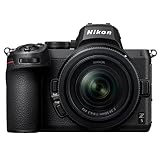
8. Nikon Z 5 – Best Entry-Level Full-Frame for Levitation
Nikon Z 5 with Compact Zoom Lens | Our Most Compact Full-Frame mirrorless Stills/Video Camera with 24-50mm Zoom Lens | Nikon USA Model
24.3MP Full-Frame CMOS
1/8000s Max Shutter
5-Axis IBIS
24-50mm Lens Included
Dual SD Card Slots
Pros
- Most affordable Nikon full-frame mirrorless
- 5-axis in-body image stabilization included
- 24-50mm compact zoom lens in the box
- Dual UHS-II SD card slots
- Weather-sealed body for outdoor shoots
Cons
- Slower 4.5 fps continuous shooting
- Screen tilts but does not articulate
- Not Prime eligible
- Entry-level feature set
The Nikon Z 5 is the most affordable way into full-frame mirrorless photography with in-body image stabilization. For levitation work specifically, having IBIS at this price point is exceptional. The 5-axis stabilization keeps your compositing frames aligned, which is the single most important technical requirement for clean levitation results.
The included NIKKOR Z 24-50mm f/4-6.3 compact zoom lens gives you a usable focal range right out of the box. While not the fastest lens, it covers the 24mm to 50mm range that covers most levitation compositions from environmental wide shots to standard portraits.
The 24.3-megapixel full-frame sensor delivers image quality on par with much more expensive cameras. The ISO range of 100-51200 handles indoor shoots where natural light is limited. For levitation photography indoors, this flexibility means you can work with available window light without needing expensive strobes.
The Z 5 has dual UHS-II SD card slots, which is impressive at this price point. Both slots use the same card format, unlike the Z 6II’s mixed slots, making your workflow simpler. Eye-detection AF works for people, dogs, and cats, which covers most levitation subjects.
The main limitation is the 4.5 fps continuous shooting speed, which is slower than other cameras on this list. For levitation work, this is rarely a problem since you are timing individual shots rather than spray-and-pray. But for action sequences, look elsewhere.
Getting Started with Levitation Using the Kit Lens
The 24-50mm lens included with the Z 5 is a great starting point for levitation photography. At 24mm, you get wide environmental shots that make floating subjects look dramatic. At 50mm, you have a natural perspective for portraits. Once you master the technique, upgrade to the Z 50mm f/1.8 S for shallower depth of field.
Weather Sealing for Outdoor Levitation Shoots
The Z 5 has weather-sealed construction that protects against dust and light moisture. For outdoor levitation shoots in unpredictable conditions, this gives you peace of mind. I have shot levitation portraits on misty mornings with confidence, knowing the camera body can handle the environment.
Buying Guide: Camera Features That Matter for Levitation Photography
After testing all eight cameras in this roundup, I have identified the specifications that genuinely impact levitation photography results. Not all camera features matter equally for this technique, and understanding which ones do will help you make the right choice.
Shutter Speed: The Non-Negotiable Spec
For levitation photography, shutter speed is the single most important camera specification. You need at least 1/500 second to freeze a subject holding a floating pose, and 1/1000 or faster for subjects in motion. Every camera on this list meets that requirement, but the ones with 1/8000 second maximum shutter give you more flexibility in bright conditions with wide apertures.
Manual Focus Capability
Consistent focus between your two compositing shots is critical. If focus shifts between the support shot and the clean plate, your Photoshop blending will not align properly. You need a camera with reliable manual focus that lets you lock focus and keep it identical across frames. Focus peaking in EVF-equipped cameras makes this much easier.
In-Body Image Stabilization
IBIS is helpful but not essential for levitation work. Since most levitation photography uses a tripod, IBIS is less important than for handheld genres. However, it does compensate for micro-vibrations from shutter actuation and helps if you occasionally shoot handheld. Cameras with IBIS on this list include the Canon R6 Mark II (8 stops), Sony A7 IV (5.5 stops), Nikon Z 6II (5 stops), and Nikon Z 5 (5 stops).
Sensor Size and Resolution
Full-frame sensors give you better dynamic range and low-light performance, which helps during post-processing. However, APS-C sensors work perfectly well for levitation photography, especially for web sharing and moderate prints. Higher resolution (30+ megapixels) gives you cropping flexibility but produces larger files. For most levitation work, 20-25 megapixels is plenty.
Tripod Mount and Build Quality
Every camera on this list has a standard tripod mount, but build quality varies. Weather-sealed bodies like the Canon R6 Mark II, Canon 90D, Nikon D7500, Nikon Z 6II, and Nikon Z 5 let you shoot outdoors in challenging conditions. A sturdy tripod is actually more important than the camera body for levitation alignment.
Screen Type for Composition Flexibility
For low-angle levitation shots that exaggerate the floating effect, a vari-angle or articulating screen is invaluable. The Canon R6 Mark II, Canon R8, Canon 90D, and Sony a6400 all have fully articulating or flip screens. The Nikon models have tilting screens, which are less flexible but still usable.
RAW Capture and Dynamic Range
Every camera on this list shoots RAW, which is essential for levitation photography. RAW files give you maximum dynamic range for recovering shadow and highlight details during the compositing process. The full-frame cameras offer the best dynamic range, with the Sony A7 IV and Canon R6 Mark II leading the pack.
Budget Considerations
Levitation photography does not require the most expensive camera. The Sony a6400 at under $1000 produces excellent results, and the Canon R8 brings full-frame quality at a mid-range price. Remember that a quality tripod and fast memory cards are just as important as the camera body. I recommend budgeting for those accessories alongside your camera purchase.
Frequently Asked Questions
Which camera is best for sky photography?
For sky photography and levitation work that includes sky backgrounds, full-frame cameras like the Canon EOS R6 Mark II and Sony Alpha 7 IV deliver the best dynamic range for capturing detail in both your floating subject and the sky. Their wide ISO ranges and high shutter speeds handle bright outdoor conditions effectively.
How to make levitation photography?
Levitation photography works by shooting two images from the same camera position: one with your subject on a support like a stool or platform, and one empty clean plate shot. In Photoshop, layer the two images, then use a layer mask to paint away the support, leaving your subject apparently floating. Manual focus, a tripod, and fast shutter speed are essential for aligned, sharp results.
What is the 20 60 20 rule in photography?
The 20-60-20 rule is a composition guideline suggesting photographers spend roughly 20 percent of their time planning, 60 percent shooting, and 20 percent editing. For levitation photography specifically, this translates to planning your poses and support setup, capturing your compositing shots, and then blending them in post-processing.
What shutter speed do I need for levitation photography?
For levitation photography, use a shutter speed of at least 1/500 second for a subject holding a static floating pose. For subjects in motion, such as jumping or with fabric flowing, use 1/1000 second or faster. All eight cameras in this roundup support these shutter speeds, with most offering 1/8000 second maximum.
Conclusion
Choosing the best camera for levitation photography comes down to matching features to your workflow. The Canon EOS R6 Mark II remains my top pick thanks to its 8-stop IBIS, 1/8000s shutter, and flawless autofocus. For value seekers, the Canon EOS R8 delivers identical sensor performance at a lower cost, while the Sony a6400 is unbeatable for beginners on a budget. Whatever you choose, pair it with a sturdy tripod, shoot in RAW, and practice the two-shot compositing technique that makes levitation photography possible.