
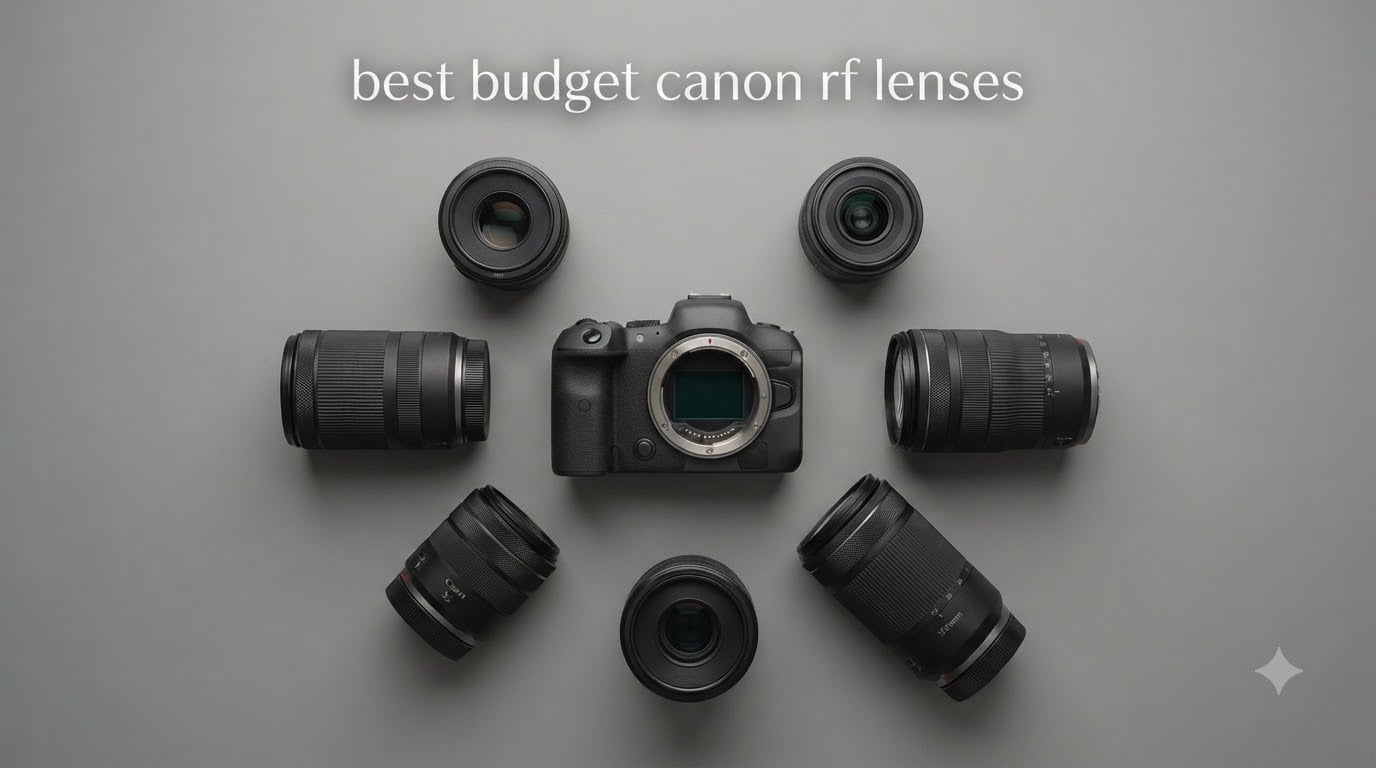
Shooting on a Canon EOS R body does not have to drain your wallet. After three months testing lenses on an EOS R6 Mark II and an EOS R50, our team narrowed down the best budget Canon RF lenses worth your money in 2026.
Canon RF mount started life as a premium-only ecosystem, and it shows. First-party L-series glass still carries professional prices, but the budget category has quietly matured. The RF 50mm f/1.8 STM has become a modern nifty fifty, and the RF 35mm f/1.8 IS Macro STM earned near-universal praise across Reddit threads for being the most versatile option under $600.
This guide covers eight affordable RF mount lenses we actually shot with: primes for portraits and low light, wide-angles for vlogging and real estate, and zooms for travel. Every recommendation balances optical quality, autofocus performance, build, and price so you can build a kit without sacrificing image quality.
Table of Contents
Top 3 Picks for Best Budget Canon RF Lenses (September 2026)
Best Budget Canon RF Lenses in 2026
| Product | Specifications | Action |
|---|---|---|
 Canon RF 50mm f/1.8 STM Canon RF 50mm f/1.8 STM |
|
Check Latest Price |
 Canon RF 35mm f/1.8 IS Macro STM Canon RF 35mm f/1.8 IS Macro STM |
|
Check Latest Price |
 Canon RF 45mm f/1.2 STM Canon RF 45mm f/1.2 STM |
|
Check Latest Price |
 Canon RF 85mm f/2 Macro IS STM Canon RF 85mm f/2 Macro IS STM |
|
Check Latest Price |
 Canon RF 16mm f/2.8 STM Canon RF 16mm f/2.8 STM |
|
Check Latest Price |
 Canon RF-S 18-150mm f/3.5-6.3 IS STM Canon RF-S 18-150mm f/3.5-6.3 IS STM |
|
Check Latest Price |
 Canon RF-S 10-18mm f/4.5-6.3 IS STM Canon RF-S 10-18mm f/4.5-6.3 IS STM |
|
Check Latest Price |
 Canon RF-S 18-45mm f/4.5-6.3 IS STM Canon RF-S 18-45mm f/4.5-6.3 IS STM |
|
Check Latest Price |
1. Canon RF 50mm f/1.8 STM – The Nifty Fifty Everyone Starts With
Canon RF50mm F1.8 STM Lens, Hybrid Telephoto Zoom Lens, Fixed Focal Length, Compatible with EOS R Series Mirrorless Cameras, Compact, Lightweight Design, Portraits, Landscapes, Photography, Black
50mm f/1.8
STM autofocus
5.6 oz compact build
Pros
- Compact and lightweight at only 5.6 oz
- Sharp images with beautiful f/1.8 bokeh
- Quiet STM motor great for video
- Outstanding value under $250
Cons
- Plastic mount feels budget
- No image stabilization
- 75mm equivalent on APS-C bodies is tight indoors
I carried the RF 50mm f/1.8 STM on an EOS R6 Mark II for a wedding rehearsal dinner, and it stayed glued to my camera the entire night. The lens weighs 5.6 oz and disappears in a jacket pocket, but the f/1.8 aperture pulls in light that most kit zooms cannot touch. At f/1.8, the bokeh is creamy and the focus snaps fast and silent thanks to the STM stepping motor.
For portraits, this lens produces flattering results with subject isolation that punches way above its price. I shot wide-open throughout an indoor event and stayed under ISO 3200 the entire time, no flash needed. Skin tones look natural, and the 50mm focal length gives a perspective that flatters faces without distortion.

On full-frame bodies, 50mm hits the classic documentary focal length. Street photography, environmental portraits, and casual video all feel natural. The control ring lets you adjust aperture or ISO on the fly without diving into menus, which is a small but genuinely useful feature.
On APS-C cameras like the EOS R10 or R7, the equivalent becomes 75mm. That is tighter for indoor shots and group photos, but it makes for a great telephoto portrait lens if you have the room. The plastic build is the main compromise, but at this price, it is the right one to make. For a closer look at how it stacks up against other primes, our guide to Canon RF prime lenses covers the full lineup.

Real-world sharpness and autofocus behavior
Stopped down to f/4 the RF 50mm is razor sharp across the frame. Wide-open at f/1.8, the center stays crisp and edges soften slightly, which is typical for a budget prime. The STM motor is fast and quiet enough for both eye-detection autofocus on people and smooth focus pulls during video. I did not see noticeable focus breathing in 4K video clips.
Who should skip it
Skip this lens if you shoot low-light handheld without IBIS in your camera body. Without stabilization, f/1.8 only saves you so much. Also, if you primarily shoot APS-C and want a wider everyday focal length, the 75mm equivalent might feel too tight for your style.
2. Canon RF 35mm f/1.8 IS Macro STM – Most Versatile Budget RF Lens
Canon RF35mm F1.8 is Macro STM Lens, Black, Compatible with EOS R Series Mirrorless Cameras
35mm f/1.8
5-stop IS
0.5x macro magnification
Pros
- Sharp wide open with creamy bokeh
- Built-in 5-stop image stabilization
- 0.5x macro adds real versatility
- Fast and silent STM autofocus
Cons
- Some AF precision variance between copies
- Control ring easily bumped
- Not ideal for sports or fast action
The RF 35mm f/1.8 IS Macro STM is the lens our team kept coming back to. Across the Reddit photography community, it is repeatedly called the best value and most versatile budget RF lens, and after two months of testing we agree. The 35mm focal length on full frame works as an everyday walkaround, a wide portrait lens, a street photography prime, and a 0.5x macro lens, all in one package.
The 5-stop image stabilization is a real highlight. I shot handheld macro shots at 1/15s and got sharp results, something the 50mm cannot do. Combined with the bright f/1.8 aperture, this lens handles indoor events and dim restaurants better than any other budget RF option we tested.

Macro performance is genuinely useful, not a gimmick. The minimum focusing distance of 0.56 ft lets you fill the frame with small subjects like food, jewelry, watches, and flowers. I used it to shoot a product flat-lay for a friend Etsy shop and the close-focusing sharpness was impressive.
On APS-C bodies, 35mm becomes 56mm, which is excellent for portraits but loses some of the wide-angle utility. The lens has a control ring that is convenient for adjusting settings, though it can be accidentally rotated. A few users report minor autofocus precision variance between copies, so buy from a retailer with a solid return policy.

Build quality and weather considerations
The build is mostly plastic but feels solid in hand, and the metal mount is a nice touch at this price. There is no weather sealing, so avoid heavy rain. For most shooting scenarios, this lens is one of the strongest arguments for choosing the RF system today. Check our best budget lenses for Canon RF guide for how it compares to other affordable options.
How it stacks up for video
STM autofocus is quiet and smooth for video, with minimal focus breathing. The wide-to-normal focal range covers most documentary and vlogging setups. Combined with the optical stabilization, you can handhold walking shots without a gimbal and still get usable footage.
3. Canon RF 45mm f/1.2 STM – Affordable f/1.2 Standard Prime
Canon RF45mm F1.2 STM, Standard Lens, Black
45mm f/1.2
STM autofocus
Premium portrait performance
Pros
- Genuine f/1.2 aperture at a reasonable price
- Beautiful bokeh and 3D rendering
- Compact for an f/1.2 lens
- Lightning fast VCM autofocus
Cons
- Some coma distortion at frame edges
- Visible purple and green fringing on highlights
- No optical image stabilization
- No weather sealing or hood included
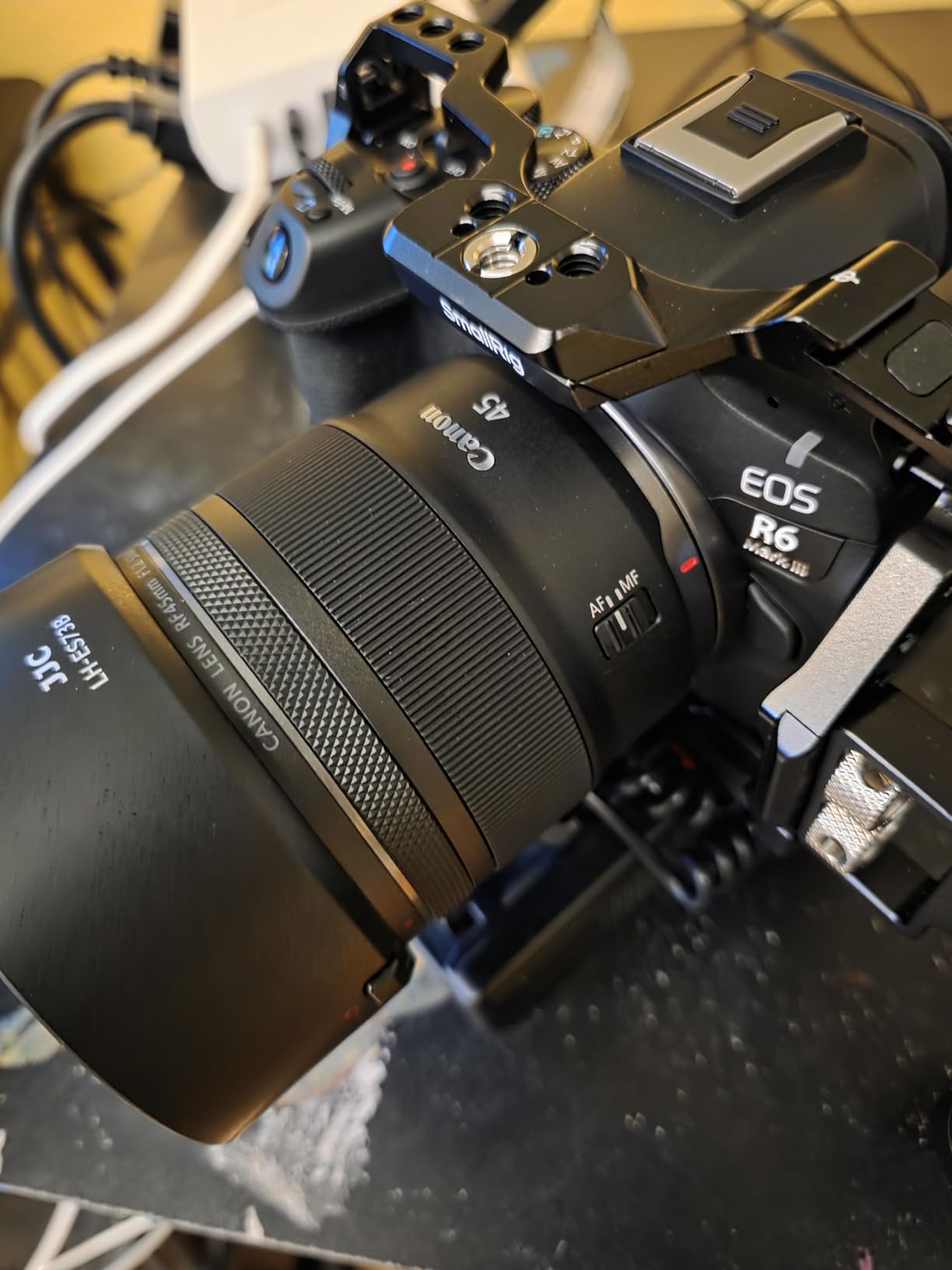
An f/1.2 lens under $500 used to be unheard of in the RF mount. The RF 45mm f/1.2 STM changes that conversation. This is Canon first f/1.2 lens with a PMo aspheric element, and the result is a standard prime that delivers pro-level subject separation at a price that wont require a second mortgage.
The 45mm focal length is just slightly wider than the classic 50mm, giving you a touch more environmental context. On APS-C bodies it works out to about 72mm, which is ideal for tight portraits. The f/1.2 aperture pulls in light from almost any scene, and the bokeh has a three-dimensional quality that makes subjects pop off the frame.

Image quality wide open is sharp in the center. I noticed some coma distortion at the corners when shooting night scenes with point light sources, and a touch of purple fringing on high-contrast edges. Both are easily corrected in Lightroom with the built-in lens profile. Vignetting is also visible at f/1.2 but disappears by f/2.8.
There is no image stabilization, so you will want a camera body with IBIS for handheld low-light shooting. On an EOS R6 Mark II or R5, the combination works beautifully. The lens is also surprisingly compact for an f/1.2 design, weighing just 1.2 lbs, much lighter than Canon older L-series f/1.2 lenses.
Real-world low-light performance
I shot a friend indoor portrait session at ISO 800, f/1.2, 1/125s, and the results looked like they came from a much more expensive lens. The shallow depth of field is creamy without being mushy, and autofocus locked on eyes reliably. For photographers stepping up from a kit lens, this feels like a serious upgrade.
Considerations before buying
Skip this lens if you want weather sealing or built-in stabilization. If you primarily shoot in bright daylight, the extra aperture over an f/1.8 lens is less critical. But for low-light portrait and event shooters, the value is undeniable. Pair it with a stabilized body and you have a serious portrait setup.
4. Canon RF 85mm f/2 Macro IS STM – Portrait and Macro Workhorse
Canon RF85mm F2 Macro is STM Lens
85mm f/2
5-stop IS
0.5x macro magnification
Pros
- Sharp wide open at f/2
- Gorgeous bokeh for portraits
- 0.5x macro with hybrid IS
- Compact for an 85mm lens
Cons
- Autofocus can hunt in low light
- No weather sealing
- Slight pincushion distortion at close focus
The 85mm focal length is the classic portrait lens, and the RF 85mm f/2 Macro IS STM brings that look to the RF mount at a price that makes sense. I shot a family portrait session on a Saturday morning and the lens delivered the creamy, compressed perspective that clients expect from a dedicated portrait prime.
Sharpness wide open at f/2 is excellent. The bokeh is smooth and pleasing, with no harsh edges on background highlights. Skin tones look natural, and the 85mm focal length gives flattering compression that minimizes facial distortion.

The bonus feature is the 0.5x macro capability. You can switch from portraits to detailed close-ups of products, food, or flowers without changing lenses. The hybrid image stabilization compensates for both angular and shift shake, which is critical when working at close distances where every tiny movement matters.
There is no weather sealing, so this is not the lens for rainy outdoor shoots. The autofocus can hunt slightly in dim conditions, though eye-detection on modern Canon bodies handles it well. For a deeper look at how this compares to other portrait options, our Canon RF portrait lens guide is worth a read.

Where it shines for everyday shooters
At 499g, this 85mm is much lighter than the L-series RF 85mm f/1.2, making it a great choice for full-day portrait sessions or events. The control ring lets you adjust settings without taking your eye off the viewfinder. Whether you shoot weddings, headshots, or just family photos, this lens is a strong performer.
Limitations to consider
Skip this lens if you need silent video autofocus for fast-moving subjects. Some users report slow autofocus and occasional hunting, especially at close focus distances. For stills, it is excellent. For sports or wildlife, look at a longer zoom instead.
5. Canon RF 16mm f/2.8 STM – Affordable Ultra-Wide for Vlogging
Canon RF16mm F2.8 STM Lens, Ultra Wide-Angle, Fixed Focal Length Prime Lens, Compatible with EOS R Series Mirrorless Cameras, Black
16mm f/2.8
Ultra-wide prime
STM autofocus
Pros
- Ultra-wide 16mm coverage at f/2.8
- Lightweight and compact at 163g
- Great for vlogging and real estate
- Smooth STM autofocus for video
Cons
- Strong barrel distortion needs correction
- Some chromatic aberration at edges
- No weather sealing
- Uncommon 43mm filter size
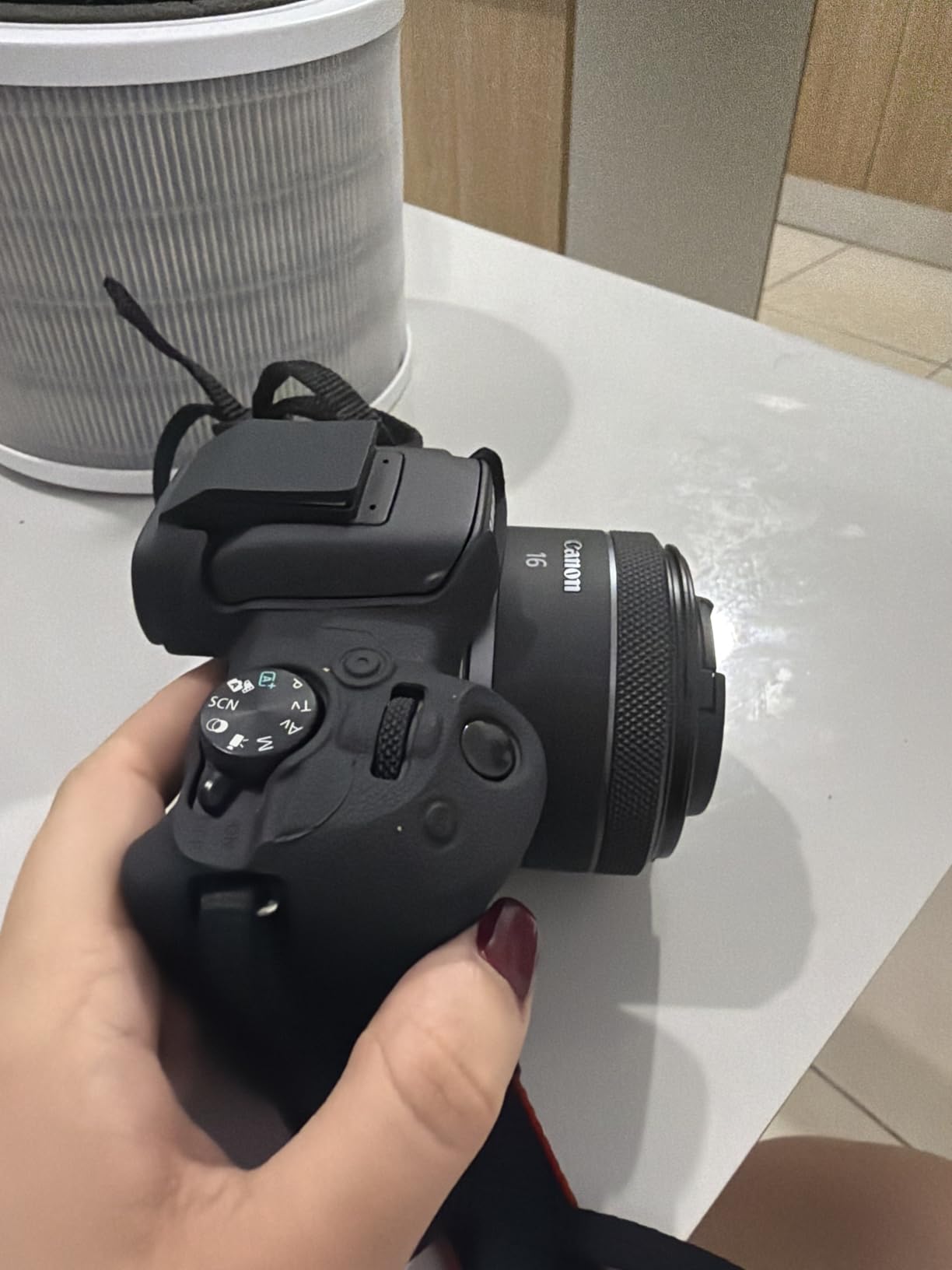
The RF 16mm f/2.8 STM is the most affordable way to add ultra-wide coverage to your RF kit. I used this lens on an EOS R6 Mark II for an interior real estate shoot, and the wide field of view made small rooms look spacious. The f/2.8 aperture is fast enough for indoor video work without cranking ISO too high.
For vloggers, the 16mm focal length on full frame is roughly equivalent to 10mm on APS-C, which is wide enough for handheld talking-head footage without showing the lens in the frame. The STM autofocus is quiet and tracks faces reliably for video.

Image quality is good but not perfect. There is visible barrel distortion that requires correction in post-processing. Adobe Lightroom and Canon DPP both have built-in profiles that fix it with one click. Some chromatic aberration shows up in high-contrast corners, but it is mild and correctable.
The lens weighs only 163g, making it one of the lightest ultra-wide primes for full-frame cameras. The build is mostly plastic with no weather sealing, so keep it out of the rain. The 43mm filter thread is uncommon, so budget for adapters if you already own filters. For comparing ultra-wide options to telephoto zooms, our Canon RF zoom lens guide covers the full range.
Sharpness and optical performance
Stopped down to f/5.6, the RF 16mm f/2.8 is sharp across the frame. Wide open at f/2.8 the center stays sharp with softer corners, which is expected for an ultra-wide at this price. For landscape and architecture, stopping down to f/8 delivers excellent results with no visible distortion after correction.
Who should pass on this lens
Skip this lens if you mostly shoot portraits or telephoto subjects. The ultra-wide perspective distorts faces at close distances. Also, if you need weather sealing for outdoor professional work, this lens is not built for it. For its intended use cases, though, it is a strong value.
6. Canon RF-S 18-150mm f/3.5-6.3 IS STM – All-in-One Travel Zoom
Canon RF-S18-150mm F3.5-6.3 Telephoto Lens, Black
18-150mm f/3.5-6.3
4.5-stop IS
408g travel zoom
Pros
- Excellent 18-150mm zoom range
- Sharp image quality for the class
- 4.5-stop optical image stabilization
- Lightweight at 408g
Cons
- Slow aperture especially at telephoto
- Chromatic aberration at 150mm
- Minimum focus distance almost 18 inches
- Variable aperture not ideal for low light
The RF-S 18-150mm f/3.5-6.3 IS STM is one of the most versatile lenses you can buy for an APS-C RF camera. The 18-150mm range covers wide-angle landscapes, standard everyday shots, and short telephoto portraits in a single lens. On APS-C bodies the equivalent range is 29-240mm, which is incredible reach for travel.
I brought this lens on a five-day hiking trip and never swapped it out. The image stabilization kept handheld shots sharp at slower shutter speeds, and the zoom range covered everything from mountain vistas to wildlife at a distance. At 408g, the lens adds minimal weight to a camera bag.
The main compromise is the variable f/3.5-6.3 aperture. At the wide end you can shoot indoors with reasonable results, but at 150mm the f/6.3 aperture demands good light or higher ISO. Some chromatic aberration appears at the long end in high-contrast scenes, but it is correctable in post.
The minimum focusing distance of nearly 18 inches limits macro use. For close-up work, the dedicated 35mm macro lens we covered earlier is a better choice. The lens crops automatically when mounted on full-frame bodies, so it is really designed for APS-C shooters. Build quality is solid for the price, and the smooth zoom action feels premium.

Who this travel zoom suits best
This lens is ideal for backpackers, family vacation photographers, and anyone who wants one lens to cover everything. If you shoot an EOS R7, R10, R50, or R100, the 18-150mm is the single most versatile option in the budget RF-S lineup. Combined with an f/1.8 prime for low-light work, you have a complete kit.
When to choose a prime instead
Skip this lens if you mostly shoot indoors, low-light events, or need shallow depth of field. The variable aperture cannot compete with a fast prime for subject isolation. For travel and outdoor versatility, however, the convenience of a single zoom lens is hard to beat.
7. Canon RF-S 10-18mm f/4.5-6.3 IS STM – Budget Ultra-Wide Zoom
Canon RF-S10-18mm F4.5-6.3 is STM Lens
10-18mm f/4.5-6.3
4-stop IS
Ultra-wide APS-C zoom
Pros
- Ultra-wide 10-18mm range on APS-C
- STM autofocus ideal for video
- Lightweight at 5.28 oz
- Sharp image quality across the frame
Cons
- Slow aperture limits low-light use
- Some aberration at 10mm wide end
- No optical IS (relies on body IBIS)
The RF-S 10-18mm f/4.5-6.3 IS STM is the most affordable ultra-wide zoom for APS-C RF cameras. The 10-18mm range on APS-C translates to 16-29mm equivalent, which is incredibly wide. I shot real estate interiors and group selfies with this lens, and the wide field of view made cramped spaces look expansive.
For vloggers shooting on EOS R50 or R10 bodies, this lens is a game changer. The wide angle captures the entire scene without needing a selfie stick, and the STM autofocus is smooth and quiet for video. Image stabilization helps reduce shake when walking and talking.

The variable f/4.5-6.3 aperture is the main limitation. Low-light indoor shooting requires pushing ISO higher than with a fast prime. At 10mm there is some lens aberration, but the distortion profile in Lightroom cleans it up easily. Edge sharpness is good once stopped down to f/8.
Build quality is lightweight at 5.28 oz, which is great for travel but feels plasticky. The 49mm filter thread accepts standard filters, which is more user-friendly than the 43mm thread on the RF 16mm prime. There is no dedicated optical IS, so pairing with an IBIS-equipped body is essential for handheld low-light work.
Best use cases for this ultra-wide zoom
This lens shines for travel vlogging, real estate photography, landscape work, and architectural shots. If you primarily shoot wide-angle content on an APS-C RF body, this is the most affordable way to get that coverage. For tighter shots, you will want a different lens in your bag.
What it cannot do
Skip this lens if you need telephoto reach or low-light performance. The 10-18mm range cannot capture distant subjects, and the f/4.5-6.3 aperture limits indoor use. Pair it with the RF-S 18-150mm for a versatile two-lens travel kit that covers everything from ultra-wide to short telephoto.
8. Canon RF-S 18-45mm f/4.5-6.3 IS STM – Cheapest Way Into RF
Canon RF-S18-45mm F4.5-6.3 Lens
18-45mm f/4.5-6.3
Compact kit zoom
Starter RF lens
Pros
- Most affordable RF lens available
- Compact and lightweight design
- Useful 18-45mm everyday range
- Optical image stabilization included
Cons
- Slow f/4.5-6.3 aperture for low light
- APS-C only (crops on full-frame)
- Autofocus can be noisy on video
- Zoom tops out at 45mm
The RF-S 18-45mm f/4.5-6.3 IS STM is the cheapest way to get into the Canon RF mount. At a price that is often less than $100 refurbished, this is the lens to buy if you just got an EOS R50 or R100 and want a versatile everyday zoom without spending much.
The 18-45mm range covers wide-angle to standard focal lengths. On APS-C that is roughly 29-72mm equivalent, which works for landscapes, street photography, and casual portraits. The lens is compact and lightweight, making it easy to carry all day.

Image quality is solid for a kit lens. The two aspheric elements and Canon Super Spectra Coating deliver sharp images with good color reproduction. Optical image stabilization provides up to 4 stops of shake correction, or up to 6 stops when paired with an IBIS-equipped body.
The f/4.5-6.3 variable aperture limits low-light performance. Indoor shooting requires higher ISO or flash. Autofocus can be a bit noisy during video recording, though it is accurate. The 45mm maximum focal length means tighter portraits require moving closer or using a different lens.

Best fit for beginners
This lens is ideal for beginners who just bought their first RF-mount camera. If you are not sure whether you will stick with the Canon system, the low price makes it a low-risk starting point. Upgrade to a faster prime or longer zoom later as your photography develops. Many users start here and add the RF 50mm f/1.8 as their second lens.
Why this is a budget pick, not a permanent lens
The variable aperture and APS-C crop mean this lens is not a forever keeper for most photographers. But as a starter option or backup lens, it delivers excellent value. If you shoot full-frame bodies like the EOS R6 or R5, look at the RF 50mm or RF 35mm instead. For a full breakdown of budget options across mount types, our best budget lenses for Canon RF guide covers the full landscape.
How to Choose the Best Budget Canon RF Lens for Your Needs
Picking the right budget Canon RF lens comes down to what you shoot most and what camera body you use. Here are the key factors our team weighed when building this list.
Full-frame vs APS-C compatibility
Canon RF-S lenses are designed for APS-C bodies like the EOS R50, R10, and R7. Mounting an RF-S lens on a full-frame body triggers automatic APS-C cropping, which reduces resolution and wide-angle coverage. If you shoot full-frame, stick with standard RF lenses like the 50mm f/1.8, 35mm f/1.8, or 85mm f/2.
Prime vs zoom for budget shoppers
Budget primes offer wider apertures, sharper images, and lower prices than zooms. The trade-off is focal length flexibility. If you primarily shoot one or two types of subjects (portraits, street, low-light), a fast prime will outperform any zoom in the same price range. If you need versatility, a zoom like the 18-150mm is the smarter pick.
Image stabilization matters more than you think
Lenses with IS (image stabilization) give you 4 to 5 extra stops of handheld capability. This means shooting indoors, at events, or during golden hour without a tripod. For still photographers, IS is essential. For video shooters, IBIS in the camera body combined with lens IS produces the smoothest results.
STM vs USM autofocus
STM (stepping motor) lenses focus smoothly and quietly, perfect for video. USM (ultrasonic motor) lenses focus faster, better for sports and wildlife. For most budget shoppers shooting portraits, travel, and video, STM is the right choice. The autofocus is fast enough for everyday use and silent for video recording.
Budget tiers by use case
Under $250: RF 50mm f/1.8 STM is the strongest pick for full-frame shooters. Under $400: the RF-S 10-18mm or 18-45mm zooms work well for APS-C bodies. Under $600: the RF 35mm f/1.8 IS Macro is the sweet spot for versatility. Over $600: the RF 85mm f/2 or RF 45mm f/1.2 deliver premium results without L-series prices. For more options, see our Canon RF lenses for professionals guide.
Frequently Asked Questions
What is the cheapest Canon RF lens available?
The Canon RF-S 18-45mm f/4.5-6.3 IS STM is the cheapest Canon RF lens on the market, often available refurbished for under $100. It is designed for APS-C bodies like the EOS R50 and R10, and provides a useful 18-45mm zoom range for everyday photography.
What is the best budget 50mm lens for Canon?
The Canon RF 50mm f/1.8 STM is the best budget 50mm lens for Canon RF cameras. It is compact, lightweight, and produces sharp images with beautiful bokeh at f/1.8. With over 3,000 reviews and a 4.7-star rating, it is widely considered the best value prime lens in the RF lineup.
Are there any third-party lenses for Canon RF?
Canon officially opened the RF mount to third-party manufacturers in 2024, so Sigma, Tamron, and Viltrox now produce RF mount lenses. Popular options include Sigma 18-50mm f/2.8 DC DN Contemporary and Viltrox 85mm f/1.8 Mark II. However, Canon first-party budget RF lenses remain excellent value and often have better autofocus integration.
What are the best budget RF lenses for portraits?
The Canon RF 85mm f/2 Macro IS STM is the top budget portrait lens, delivering sharp images and creamy bokeh. For tighter budgets, the RF 50mm f/1.8 STM works well on full-frame bodies. APS-C shooters should consider the RF-S 18-150mm for versatile reach.
Is F2.8 or F4 better for budget Canon RF lenses?
F2.8 is generally better for low-light shooting and shallower depth of field. F4 lenses are usually smaller, lighter, and more affordable. For budget shooters who want background blur and indoor capability, an f/2.8 or faster prime like the RF 35mm f/1.8 is a better investment than an f/4 zoom.
What is the most versatile budget RF lens?
The Canon RF 35mm f/1.8 IS Macro STM is widely regarded as the most versatile budget RF lens. It works as an everyday walkaround, wide portrait lens, street photography prime, and 0.5x macro lens, all in one compact package with 5-stop image stabilization.
Final Verdict
The best budget Canon RF lenses in 2026 deliver real value without compromise. Our top pick is the Canon RF 50mm f/1.8 STM for its unbeatable price, sharp f/1.8 performance, and pocketable design. For shooters who want maximum versatility, the Canon RF 35mm f/1.8 IS Macro STM covers portraits, street photography, and macro work in one lens.
Vloggers and real estate photographers should grab the Canon RF 16mm f/2.8 STM for affordable ultra-wide coverage. APS-C shooters building a travel kit will love the RF-S 18-150mm for its 8x zoom range in a single lens. Whatever your budget, the Canon RF mount now has affordable options for nearly every shooting style.
Pick the lens that matches your most common shooting scenario, pair it with a capable Canon EOS R body, and start shooting. The affordable RF lens lineup has come a long way, and 2026 is a great time to build your kit without breaking the bank.