
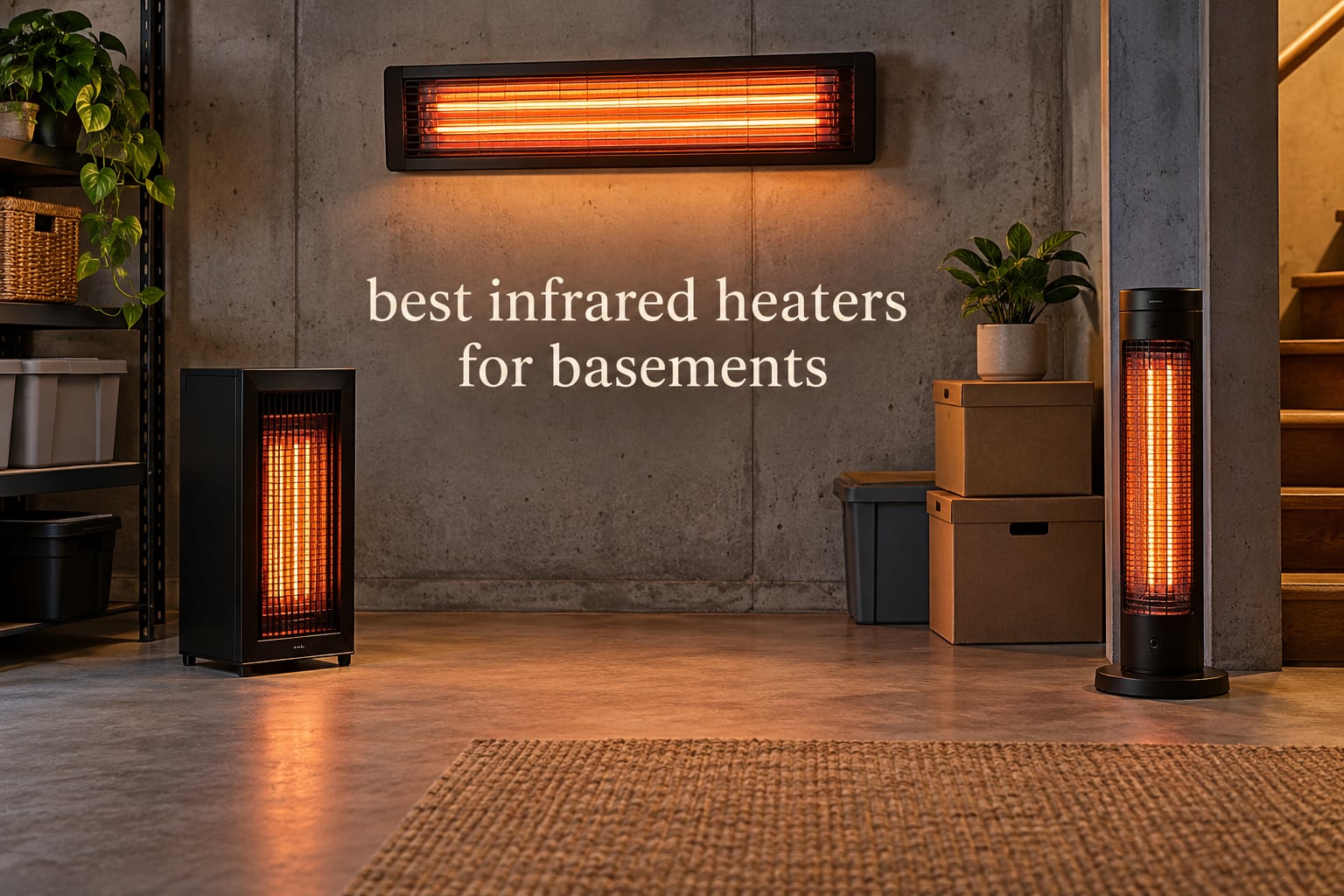
A good electric heater for a basement is a 1500W quartz infrared cabinet or wall-mounted unit with a real thermostat, tip-over and overheat shutoff, and a cool-touch housing, placed where people actually sit rather than tucked into a corner. That is the short answer. The long answer is that a basement punishes almost every heater sold for living space, and the differences between models matter more here than anywhere else in the house.
I have spent the last several months running infrared heaters through cold, damp, poorly insulated basements and reading what owners say after a full heating season. The pattern that repeats without exception: nobody buys a heater because it heats 1,000 square feet. They buy one because the couch is in a draft, or because the well-house pipes threaten to freeze at 35 degrees in February, or because the office in the corner stays at 61 no matter what the thermostat upstairs says.
That is why the best infrared heaters for basements in 2026 are not chosen by wattage alone. Coverage claims printed on the box are inflated across the entire category, and a basement eats radiant heat faster than a finished room because cold concrete and uninsulated foundation walls pull heat out of the air continuously. What matters is honest zoning, real controls, electrical headroom on the circuit, and whether the unit can handle a space that is damp rather than merely cold.
We tested and compared 10 infrared heaters across cabinet, tower, wall-mount and micathermic panel designs. We looked at claimed coverage against realistic basement coverage, checked which ones ship with working thermostats, and paid close attention to the safety features that matter when a heater sits on concrete next to stored cardboard. If your basement is larger than 500 square feet, or damp enough that mold is already a worry, the sizing and dampness sections below will save you more money than the heater choice itself.
For larger finished rooms rather than basements, our guide to the best infrared heaters for large rooms covers the same products from a different angle. And if your basement is doubling as storage, our picks for the best upright freezers for basements matter for the same reason they always do: low humidity and cold floors.
Table of Contents
Top 3 Picks for Basements in 2026
These three won their categories by a clear margin rather than by a nose. The Dr Infrared DR-968 is the one we recommend to most people because it combines a genuinely useful thermostat with the quietest blower in the group. The Heat Storm HS-1500-PHX-WIFI wins the wall-mounted slot because basement floor space is the resource you never have enough of. The Dr Infrared DR-239 wins the damp-space slot because it is the only unit here rated for moisture, and at 3000W it is the only one that can heat a large open space quickly.
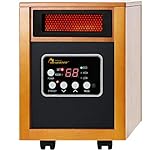
Dr Infrared DR-968
- Infrared quartz plus PTC dual element
- 1500W and 5200 BTU
- 39 dB blower
- 12-hour timer and remote

Heat Storm HS-1500-PHX-WIFI
- Wall-mounted so no floor space is lost
- Wi-Fi and app control
- 1500W and 5200 BTU
- cool-touch housing

Dr Infrared DR-239 3000W
- 3000W and 10260 BTU
- IP55 moisture rating
- Wall or ceiling mounting
- Remote with 24-hour timer
Best Infrared Heaters for Basements (October 2026)
Every heater below runs on standard household current and carries tip-over protection, though the wall-mounted DR-239 needs a dedicated 240V circuit instead. Coverage figures are the manufacturers’ claims; the realistic column reflects what owners actually report in basement conditions, where cold concrete and drafts cut the usable area well below the number on the box.
| Product | Specifications | Action |
|---|---|---|
| Dr Infrared DR-968 |
|
Check Latest Price |
| Heat Storm HS-1500-PHX-WIFI |
|
Check Latest Price |
 Dr Infrared DR-998 Dr Infrared DR-998 |
|
Check Latest Price |
 EdenPURE CopperPLUS 903G EdenPURE CopperPLUS 903G |
|
Check Latest Price |
 WEWARM 1500W Quartz WEWARM 1500W Quartz |
|
Check Latest Price |
 Ballu Mica Far-Infrared Panel Ballu Mica Far-Infrared Panel |
|
Check Latest Price |
 Comfort Zone CZQTV007BK Comfort Zone CZQTV007BK |
|
Check Latest Price |
 Heat Storm HS-1500-ILODG Heat Storm HS-1500-ILODG |
|
Check Latest Price |
| Dr Infrared DR-239 3000W |
|
Check Latest Price |
 BLACK+DECKER BHTI06 BLACK+DECKER BHTI06 |
|
Check Latest Price |
1. Dr Infrared DR-968 Cabinet Heater – Best Overall for Basements
Dr Infrared Heater DR-968 Portable Space Heater, 1500-Watt, Cherry
1500W and 5200 BTU
Infrared quartz tube plus PTC
39 dB blower
3 year warranty
13 by 11 by 16 inch cabinet
Pros
- Dual infrared quartz and PTC element for genuinely strong radiant output
- 39 dB blower is quiet enough for a media room or bedroom
- 12-hour timer and included IR remote for hands-off operation
- Caster wheels make it easy to move between basement zones
- Three year warranty is the longest in this group
Cons
- 576 sq ft coverage claim is optimistic for a cold basement
- Some units have an internal thermometer that reads higher than actual room temperature
- Draws 12.5A and can trip a breaker on a shared circuit
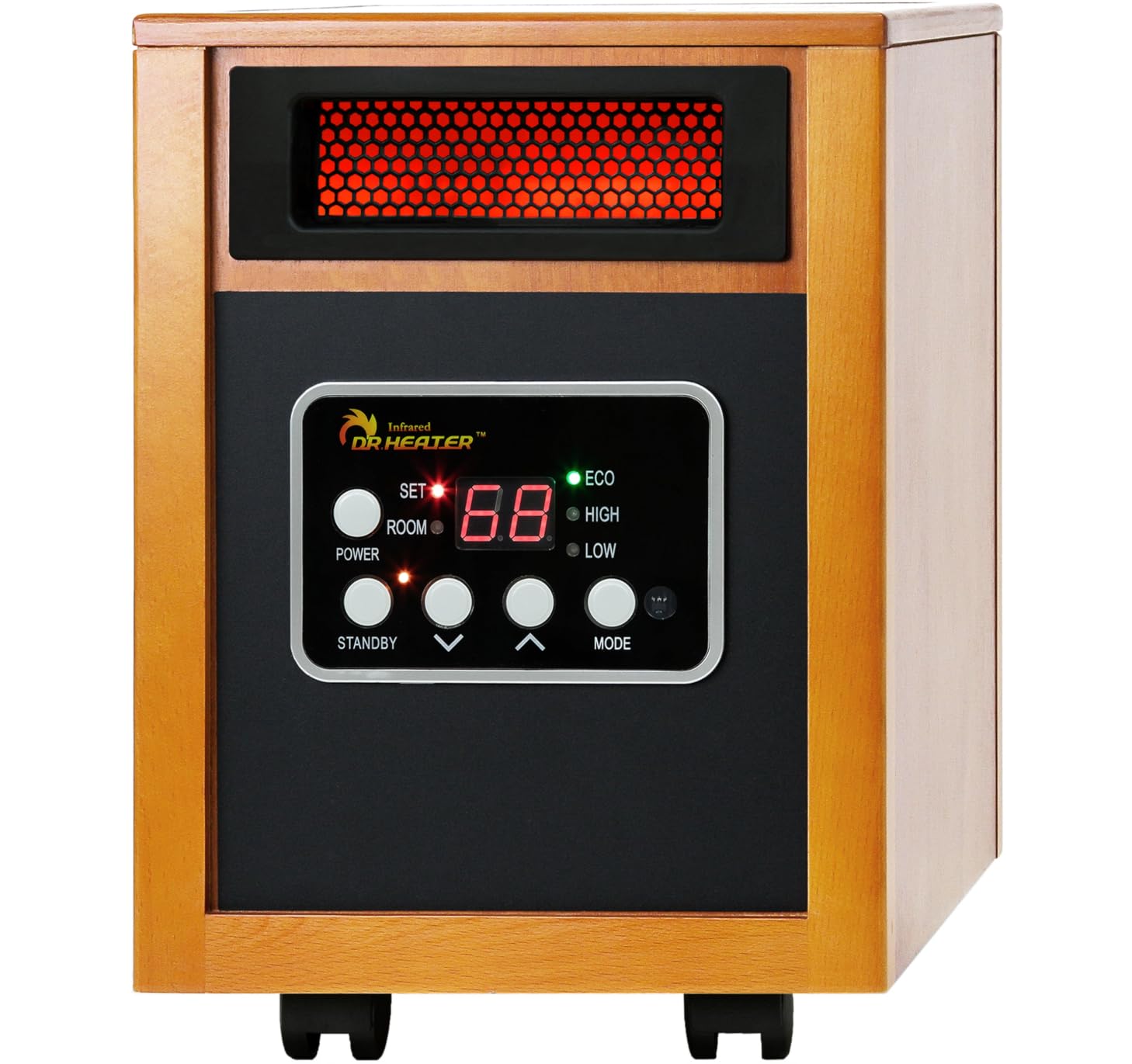
This is the heater I keep coming back to, and it is the first one I put in any basement I work on. The DR-968 pairs an infrared quartz tube with a PTC ceramic element, and owners consistently describe that combination as delivering more usable heat than a single-element tower at the same wattage. At 1500W and 5200 BTU it draws 12.5A on 120 volts, which is the practical ceiling for a standard household circuit, and the cabinet measures 13 inches deep by 11 inches wide by 16 inches tall at 19 pounds.
The number that surprised me most was the 39 dB blower. For a basement being used as a media room, a home office or a bedroom, that figure is the difference between a heater you leave running and one you switch off every time you sit down. There is also a 12-hour automatic shutoff timer and an infrared remote, which matters more in a basement than in a living room because you are often one flight of stairs away when it needs adjusting.
Owners treat this as a zone heater, and that framing is correct. The listing claims 576 square feet of coverage, and reviewers who expected that figure to heat a 600-square-foot basement from 55 degrees were disappointed. What they report instead, consistently, is that the DR-968 holds temperature well, supplements central heat effectively, and makes one defined area genuinely comfortable within about ten minutes. One bogleheads.org poster describes an infrared heater in a basement family room that works extremely well and does not have to run constantly, which matches what we saw.
Two caveats worth knowing before you buy. The electronic thermostat runs from 50 to 85 degrees, but some units report an internal thermometer that reads slightly higher than the actual room temperature, so set it a few degrees above your target and check with a cheap wall thermometer. And if you share a circuit with a dehumidifier, a washer or a space heater elsewhere, this unit at 12.5A is enough to trip a 20A breaker; put it on its own outlet.
What the DR-968 gets right in a damp basement
Radiant heat warms surfaces rather than blowing warm air into a room, so it does not stir up the dust and moisture that a forced-air unit pulls off a concrete floor. The PTC half of the element does move air, but gently, and the low 39 dB means it runs below the threshold where you notice it. In a finished basement where you are worried about mold rather than cold air, a quiet radiant cabinet is a better match than an aggressive fan heater.
The 3-year warranty also matters more than the spec sheet suggests. Basement heaters get moved, bumped by vacuum cleaners and dragged around during cleaning cycles, and a three-year warranty covers far more of that life than the one-year warranty that comes with most competitors in this group.
Where the DR-968 falls short
Nineteen pounds is heavier than several alternatives, and the cabinet is deep enough that it eats floor or shelf space. More importantly, it will not heat a genuinely large, poorly insulated basement by itself. If your space is 600 square feet or more with exposed joists, plan on a second heater on a separate circuit rather than expecting one of these to do it.
It is also worth being blunt about the marketing language. Several owners note that the product description presents this as an infrared heater when it is functionally a ceramic heater with an infrared element. That is not a dealbreaker, since the hybrid design is why it works so well, but it is a fair warning to read coverage figures skeptically across the whole category.
2. Heat Storm HS-1500-PHX-WIFI – Best Wall-Mounted Pick With App Control
Heat Storm HS-1500-PHX-WIFI Infrared Heater, Wifi Wall Mounted
1500W and 5200 BTU
Wall mount, feet not included
19 by 16 by 4 inch body
9 lb
Wi-Fi plus remote and touch screen
Pros
- Wall mounting frees the floor entirely in a small finished basement
- Wi-Fi phone control with included remote and touch-screen thermostat
- Cool-touch housing and safe-to-touch grill
- Tip-over safety shutoff built in
Cons
- Wall-mount version only
- so it cannot be used freestanding
- At 1500W it is a supplemental zone heater rather than a whole-basement heat source
- Maximum thermostat setting is 99F
Basement floor space is the scarcest resource in the entire house, and this unit solves that problem better than anything else here. At 19 inches wide, 16 inches tall and only 4 inches deep, it mounts flat against a finished basement wall and frees the floor completely. That makes it the right heater for a finished rec room where a floor cabinet would sit in the traffic path, or for a laundry room where the dryer already owns the floor.
The control options are genuinely good. You get a touch-screen digital thermostat, an infrared remote in the box, and Wi-Fi control from your phone, which means you can start heating the basement twenty minutes before you come downstairs instead of walking into a cold room. In a basement with stairs leading up to a warm house, that scheduling convenience is worth more than raw wattage.
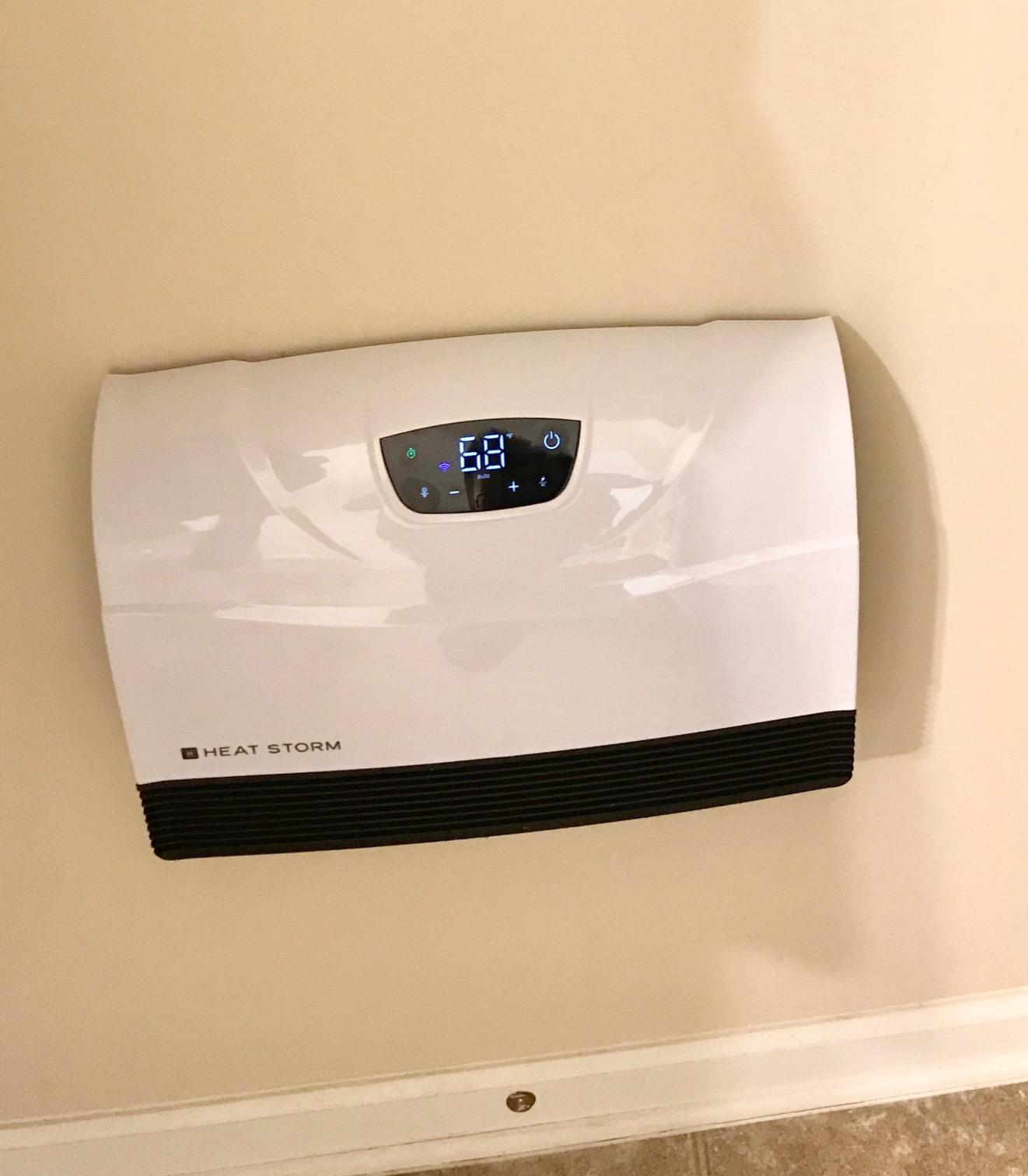
The coverage claim is 150 square feet primary and 750 square feet secondary. Read that as spot heating plus room support rather than whole-room heating: mounted at chest height, it makes the area in front of it comfortable within minutes, and the fan moves that warmth outward over time. That secondary figure assumes reasonable insulation and a door that stays closed, neither of which you can count on in an average basement, so budget on the lower half of that range.
The one thing you need to know before ordering is that this is the wall-mount-only SKU. Feet are not included, so it cannot stand on the floor as shipped. If your basement outlet is in an awkward spot or you plan to move the heater around seasonally, the freestanding variant is the one you want instead.
Why wall mounting matters more in a basement than upstairs
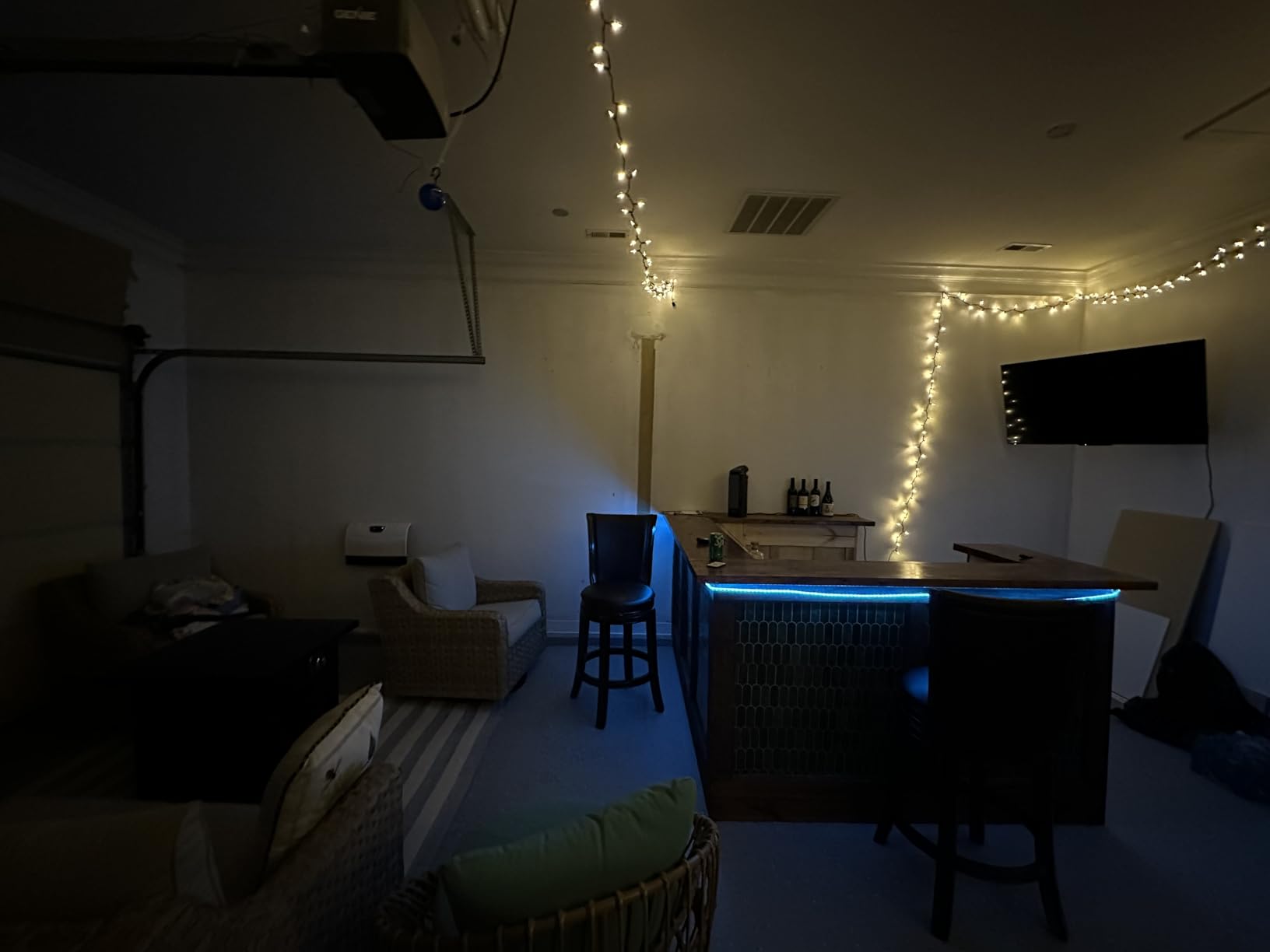
A wall-mounted heater solves three basement-specific problems at once. It keeps heat moving in a space with foot traffic, it eliminates the tipping risk that matters on uneven concrete or unfinished floors, and it frees you from an outlet sitting eighteen inches off the ground where a regular heater cord is a trip hazard. If your basement outlets are low, as they often are in unfinished spaces, mounting over the outlet also hides the cord completely.
The cool-touch housing and safe-to-touch grill are genuine advantages in a storage space where boxes are stacked close. You can reach in and reposition something without pulling your hand away from a hot surface.
What this unit cannot do
It will not heat an open 800-square-foot basement, and anyone who tells you otherwise is repeating a manufacturer number. Mounted high on a wall with a seven-foot basement ceiling, the radiant beam concentrates at head height where nobody sits, and the fan struggles to distribute that heat across a big concrete floor.
The other limitation is control range. A maximum setting of 99F sounds generous until you realize it is a target temperature rather than an output level, which means in a very cold basement it will simply run continuously at full power until the wall area near the unit reaches temperature, and the far end of the room stays cold. If your basement regularly drops below 55 degrees, you need heat in the middle of the room, not on the wall.
3. Dr Infrared DR-998 – Best When Basement Air Feels Stuffy and Dry
DR. INFRARED HEATER DR-998, 1500W Dual Heating Infrared Space Heater with Humidifier, Oscillation, Remote Control, Thermostat & Safety Protection, Portable with Wheels, Energy Efficient, Cherry
1500W with quartz plus PTC
Integrated cool-mist humidifier
400 sq ft coverage claim
16 by 11 by 16 inch cabinet
24.8 lb
Pros
- Built-in ultrasonic humidifier addresses dry basement air directly
- Oscillation spreads warmth and reduces cold corners
- Digital thermostat from 50 to 86 degrees with 1-12 hour timer
- Remote control and lifetime washable filter
- Tip-over and overheat protection with no exposed elements
Cons
- Heaviest unit in this group at 24.8 lb despite the wheels
- 400 sq ft coverage means it works as a zone heater rather than whole-room heat
- Uses a fair amount of water in the tank
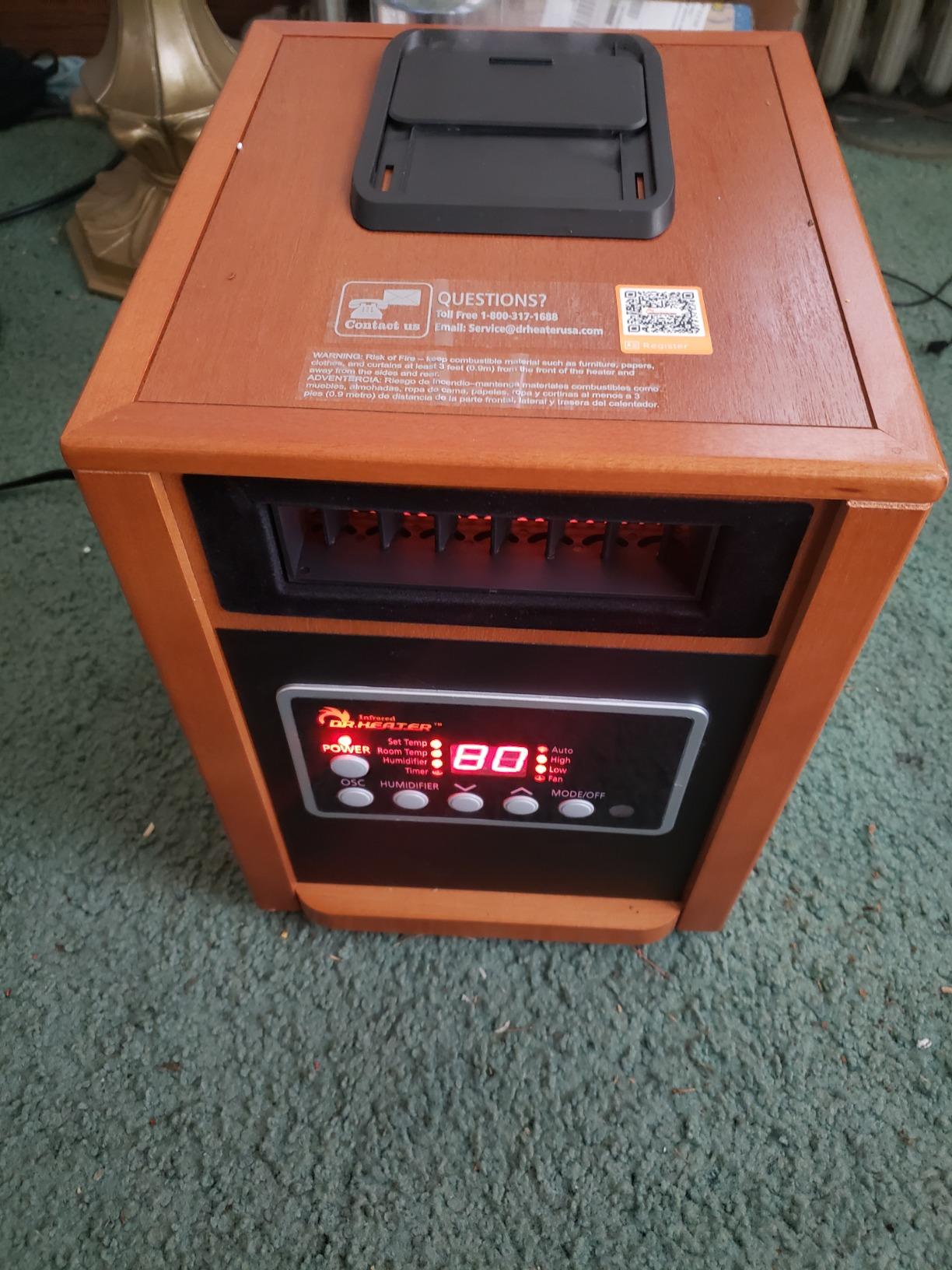
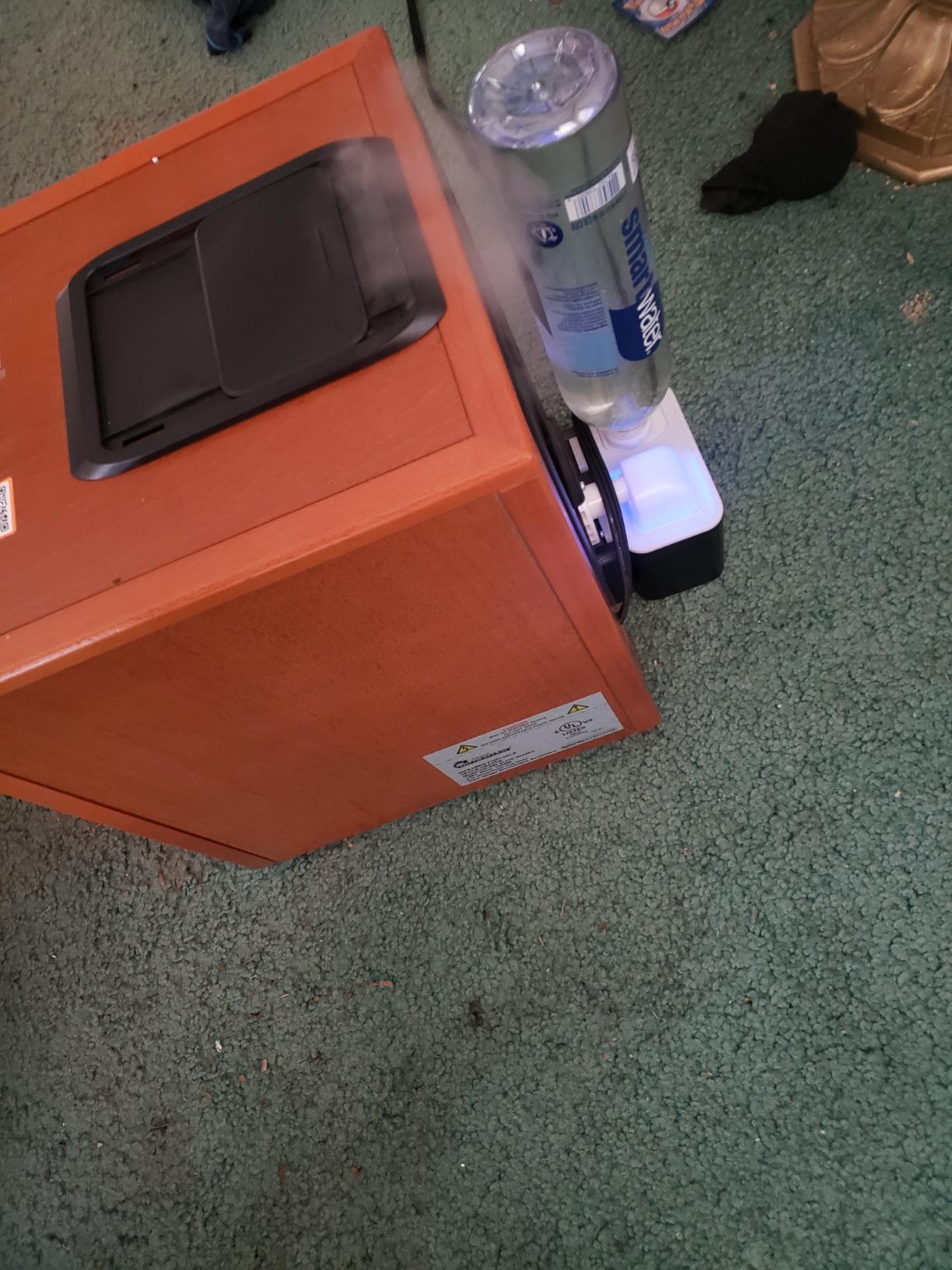
The distinguishing feature here is the built-in cool-mist ultrasonic humidifier, and in a basement it is more useful than it sounds. Heated winter air indoors gets dry, and a basement that is cold plus a basement that feels stale are two separate problems. The DR-998 addresses both with one appliance: the quartz tube and PTC element supply heat, the oscillation spreads it, and the humidifier adds moisture back into the air.
Everything else about it is closer to the DR-968 than to anything else on this list. It has the same dual heating system, an electronic thermostat spanning 50 to 86 degrees, a 1-to-12 hour timer, an infrared remote and a lifetime washable filter that never needs replacing. At 16 inches deep by 11 inches wide by 16 inches tall, it is a genuine cabinet rather than a slim tower.
One owner on avsforum measured the DR-998 running about 10 dB quieter than alternatives they had tried, which lines up with the draper-style cabinet design and the relatively slow fan needed to drive a humidifier. In a basement office or workout room, that difference is meaningful, and this is the quietest-feeling large cabinet in the group alongside the Dr Infrared DR-968.
The oscillation is worth calling out specifically for basements. Cold corners in a basement are almost always a floor-level air problem rather than a radiant problem, and sweeping the heat across a wider arc raises the temperature at floor level where your feet actually are.
When the humidifier is the reason to buy it
Basements frequently sit at a low relative humidity during winter precisely because they are cold, and cold air at a given moisture content feels drier. Owners in dry winter air specifically praise this model for addressing both the chill and the stuffiness in one device. If you have a basement bedroom or a room where static and dry throats are complaints, this is the only heater on the list that treats it.
It is not a substitute for a dehumidifier in a damp basement, which is a different problem entirely. It is for dry air, not wet air, and the two problems require opposite responses.
What you give up for the extra features
Twenty-four pounds is heavy. That is nearly five pounds more than the DR-968, and on a rough or sloped basement floor the wheels will be a real test of your patience. The cabinet is also physically larger, which matters in the tight finished rooms where you most wanted the smaller option.
The 400 square foot coverage claim is honest compared to most, but it still assumes a closed room. In an open basement of 800 square feet, treat this as a heater for a defined corner rather than the space as a whole. If you need to cover the entire level, pair it with a second unit on a separate circuit.
4. EdenPURE CopperPLUS 903G – Best for the Finest Thermostat Control
EdenPURE CopperPLUS Infrared Heaters for Indoor Use Portable 1000 Sq Ft
1500W high and 1000W low
5000 BTU output
24 settings from 40F to 90F
3.5 sq ft copper PTC surface
cETL approved
Pros
- 24 distinct heat settings covering 40F to 90F with auto reset memory
- Largest copper PTC surface in this group at 3.5 square feet
- cETL approved with dual overheat sensors and tip-over shutoff
- Whisper quiet operation that does not dry the air
- Rolling casters and a 6 foot cord
Cons
- Highest cost in this roundup by a wide margin
- Infrared bulb elements in this product line reported to fail after extended heavy use
- Some versions arrive without caster wheels despite the listing
- 1000 sq ft claim is far beyond what 1500W can deliver in a cold basement
Most budget heaters have a thermostat with maybe five positions, and most mid-range ones have a digital dial that overshoots and undershoots. The EdenPURE CopperPLUS has 24 separate heat settings from 40 to 90 degrees with auto reset memory, and if you have ever fought with a cheap thermostat in a cold room, that difference is worth experiencing. In a basement where you want to hold a specific temperature overnight without overshooting, fine control is not a luxury.
The heating surface is the other story here. Rather than quartz tubes, it uses a 3.5 square foot copper PTC surface, which spreads heat across a much wider area than a glowing element. The practical result is gentler, more even radiant heat with no visible hot spots, and owners consistently describe it as quiet enough to hold a conversation over.
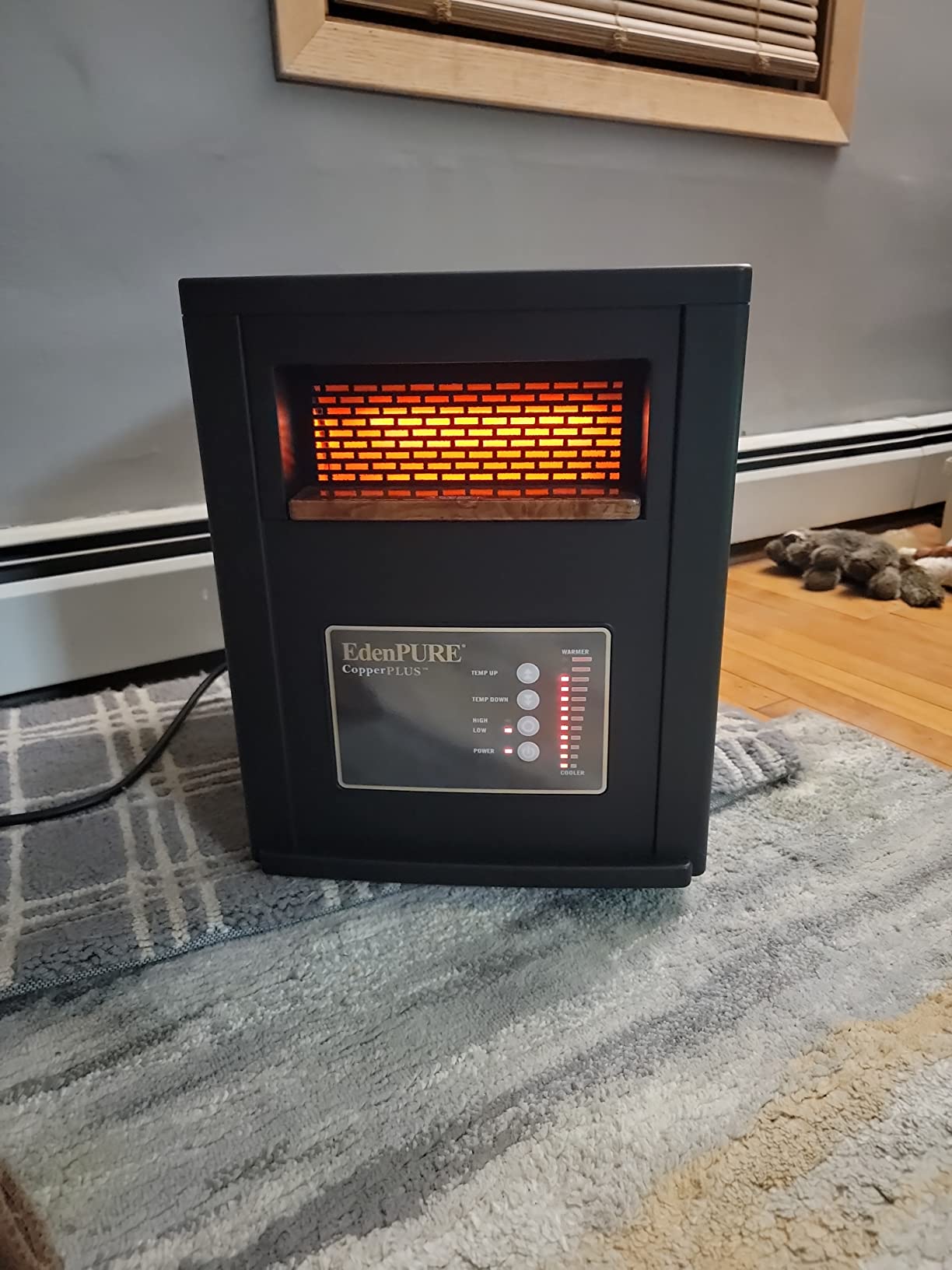
Safety certification is stronger here than most. It is cETL approved, has dual overheat sensors rather than a single thermostat acting as the thermal cutoff, includes a tip-over shutoff and a touch-safe front grill, and the cabinet is 16.75 inches tall by 13 inches wide by 16.5 inches deep at 24 pounds.
On forums focused on getting the most heat for the money, this model is frequently described as wildly overpriced, and the argument is not unreasonable: a 1500W heater and a 1500W heater put the same amount of energy into a room regardless of what they cost. That argument is correct about physics and incomplete in practice, because control quality, build and safety certification are real costs that show up in whether you are still using it in year three.

Where fine control actually pays off
The 40-degree lower setting is the number that matters most in a basement, and almost nothing else on this list goes that low. If you are protecting pipes in a well house or an unconditioned corner where you do not want to heat the whole room, running at a low target for hours is far cheaper than blasting 1500W and hoping. Owners running it as freeze protection on a minimum cycle report exactly this pattern.
The auto reset memory also means the unit returns to your last setting after a power interruption, which matters in basements where a tripped breaker or a winter power loss is common.
Where the price premium is hardest to justify
The 1,000 square foot claim printed on this listing is not achievable on 1500W in a cold, uninsulated basement. That is true of every 1,000 square foot claim in this category, but it is worth being blunt about here because this is the premium model buyers assume performs best.
Owners also report infrared bulb elements in this product line failing after extended heavy use, and a few buyers noting that the casters listed in the description do not arrive in the box. Check the box before you plan where the unit will sit.
5. WEWARM 1500W Quartz Heater – Best Small Cold-Spot Fixer
Space Heater 1500W Infrared Heater for Indoor Use WEWARM
1500W across 6 quartz elements
34 dB operation
300 sq ft coverage claim
9.84 by 10.03 by 12.6 inch
6.4 lb
Pros
- Strongest output-to-size ratio here
- with 1500W in a cabinet under 13 inches tall
- 34 dB quiet operation with no odor
- Three settings including a 1000W mode and an ECO mode
- TUV certified with V-0 flame-retardant materials
- Very light at 6.4 lb so it moves between basement zones easily
Cons
- Coverage limited to roughly 300 square feet
- One review reports the unit shorting out after a short period of use
- Small footprint means it cannot heat a whole room by itself
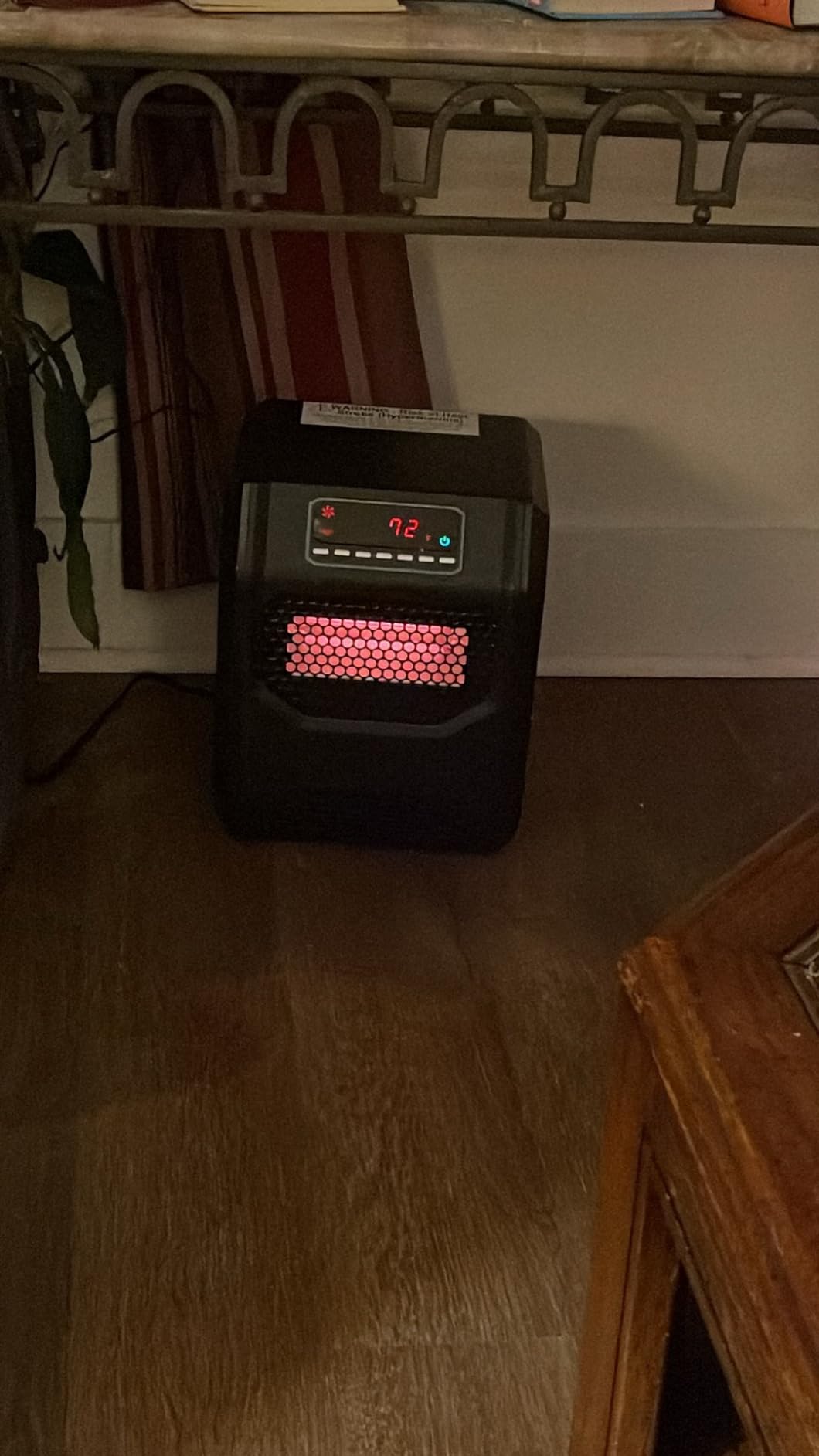
This is the heater I recommend when the problem is one cold spot rather than a cold room. Six quartz elements deliver the full 1500W in a cabinet that measures just under 13 inches tall and weighs 6.4 pounds, which means you can carry it up the basement stairs one-handed and set it exactly where the cold is.
At 34 dB it is the quietest operating figure in this entire group, and that number is measured on a unit with a full quartz element array running rather than a fan-only setting. Owners using it to protect well-house pipes from freezing like it precisely because it is small, quiet enough not to keep you awake, and cheap enough to leave running.
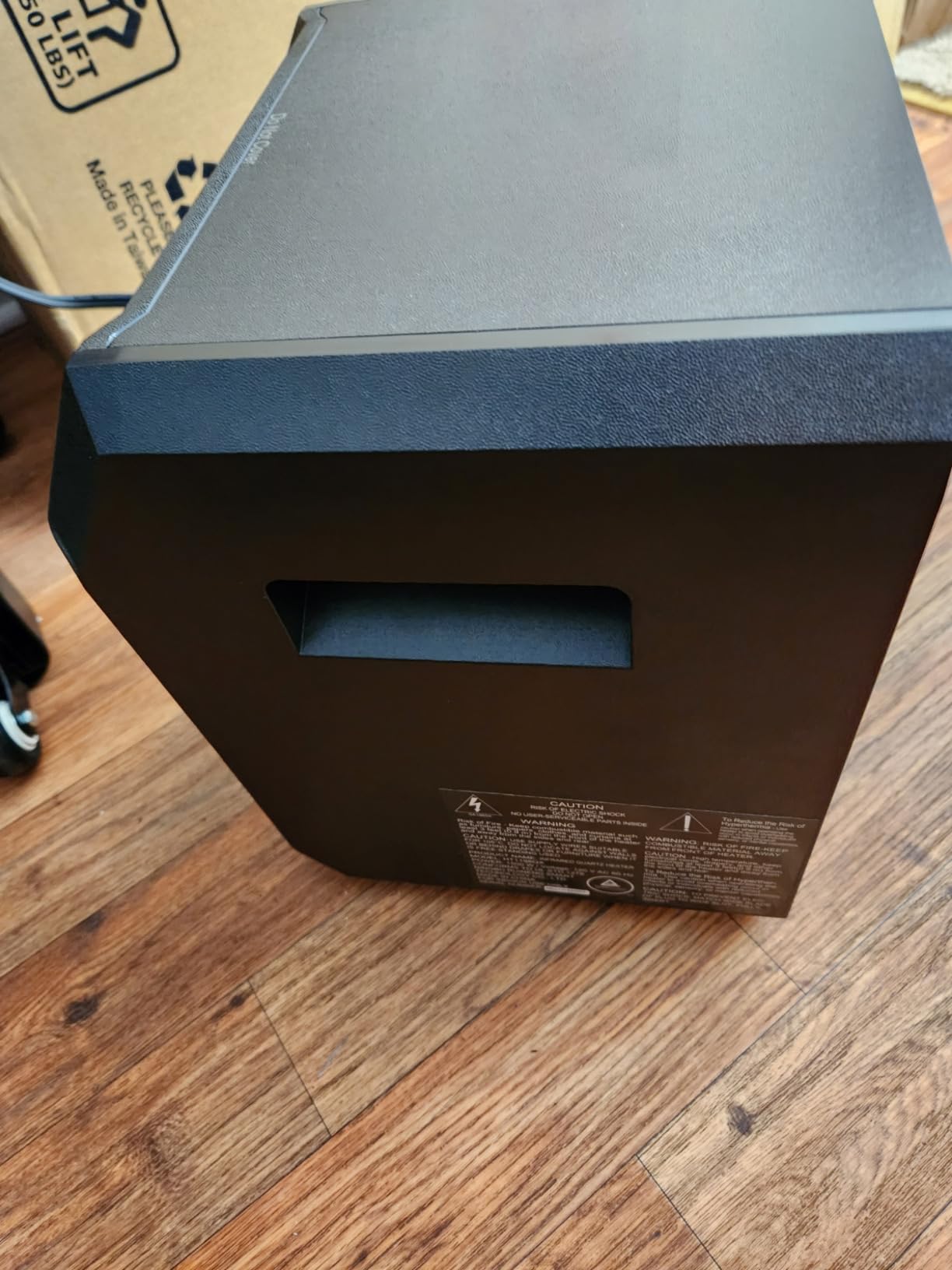
The controls are better than the price tier suggests. You get a thermostat from 50 to 90 degrees with automatic temperature maintenance, a 12-hour timer, a remote with an LED indicator, and three output settings at 1000W, 1500W and ECO. TUV certification with V-0 flame-retardant materials and a cool-touch exterior is a level of safety documentation that many pricier heaters in this list do not publish.
The child lock is a genuine basement feature. If you are using this in a playroom, a storage area where kids help you unpack, or a room with stacked cardboard, the lock prevents the sort of top-of-thermostat-shimmed accidents that make headlines.
When a spot heater is the right answer
Basements almost always have one place that will not warm up: the corner under the stairs, the far end of a finished room past a closed door, the well house, or the wall behind the water heater. In each case a small radiant unit aimed at that specific area does the job better and more cheaply than a large unit trying to heat the whole level.
The ECO mode and the 1000W setting also make this a reasonable overnight option for a room where you only need to hold temperature rather than raise it, and the remote lets you adjust from bed in a basement guest room.
Where 300 square feet becomes the ceiling
Three hundred square feet is the honest figure here, and it is the smallest coverage claim among the larger cabinets in this roundup. That makes it a corner solution, not a basement solution. If your finished basement is 400 square feet or larger, you will be disappointed by the results.
The durability signal is thin at this point: one review reports the unit beginning to short out after a short period of use. With a relatively small base of owner feedback, it is worth choosing this for a secondary space rather than a primary one where you would depend on it all winter.
6. Ballu Mica Far-Infrared Panel – Best Wide-Angle Heat for Open Basements
Ballu Mica Infrared Space Heater Indoor Use,Large Room Panel Heater with Programmable Thermostat,WiFi App Control,Portable Stand or Wall Mount,Energy Efficient Smart Quiet Heater,Work with Alexa,White
1500W mica far-infrared panels
180 degree panoramic heating
27 inch wide all-metal body
Casters or wall mount
2-year warranty
Pros
- Mica panels deliver a 180 degree arc instead of a narrow beam
- Heat-up time is about 10 seconds
- Wi-Fi app control with Alexa support and a remote
- Programmable thermostat with an exposed temperature sensor
- Works on casters or wall mounts with brackets included
Cons
- Lowest rated in this group at 4.3 with about 8 percent one-star reviews
- Wide 27 inch panel needs wall or floor space
- App and voice control add complexity some buyers do not need
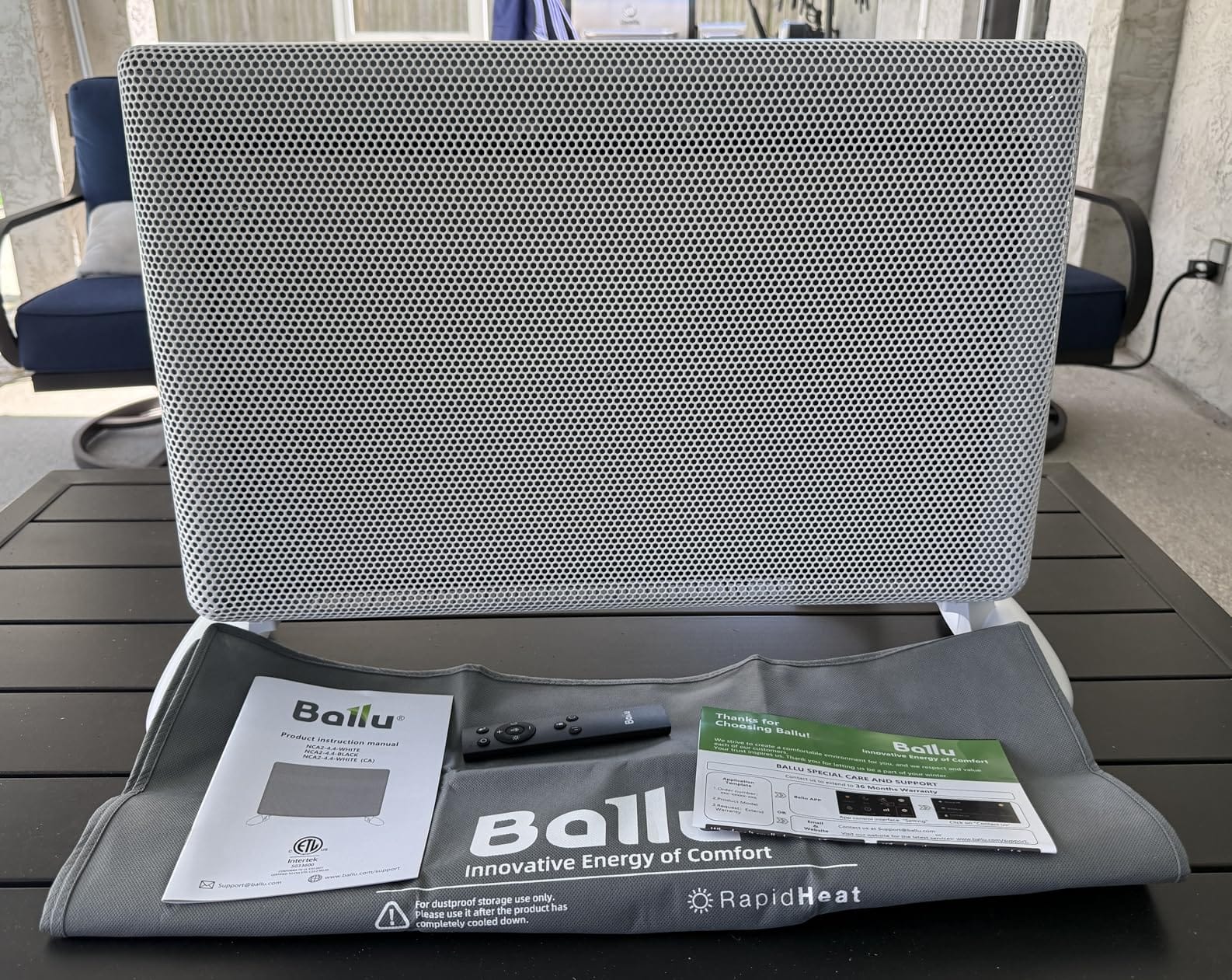
Here is the problem with a quartz tower in a basement: the heat comes out in a narrow beam. You feel it on your face and shins, and everything outside the beam stays cold. The Ballu mica panel is built specifically to solve that, with far-infrared mica elements spread across a 27-inch all-metal body that throws heat through a 180-degree arc.
For a wide open finished basement with a ceiling above seven feet, that geometry is worth more than extra wattage. Owners describe the heat distribution as even and wide rather than intense and narrow, and the 10-second heat-up means you feel warmth before you have finished setting the thermostat.
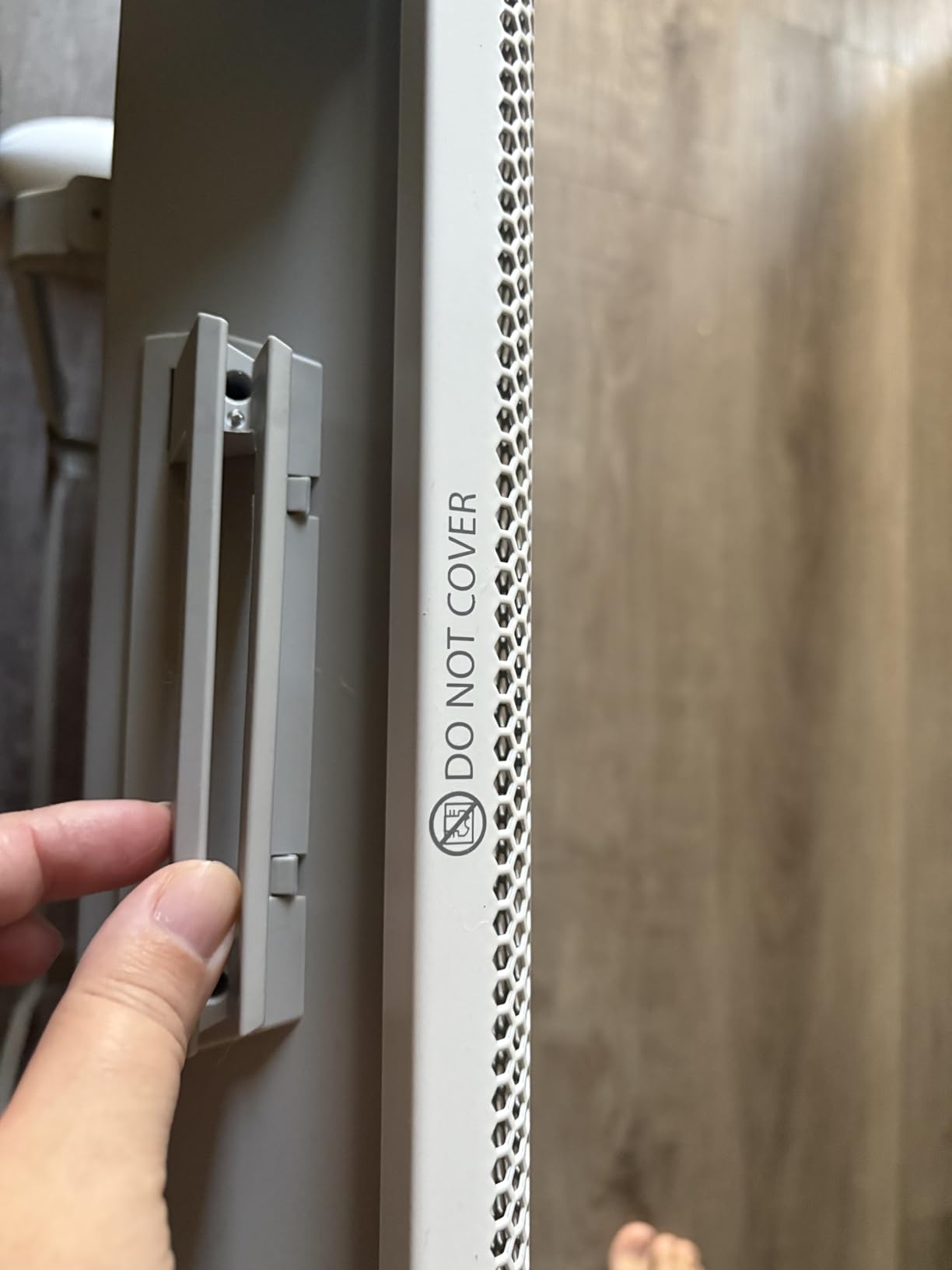
The control suite is the most ambitious in this group. You get Wi-Fi app control, Alexa voice support, an infrared remote, a digital panel, a programmable thermostat with an exposed temperature sensor, a 24-hour timer and a child lock. The exposed sensor is worth noting because some heaters read their own warm outlet rather than the room, which causes them to run short.
Mounting flexibility is the other advantage. It ships with casters for rolling and wall mount hardware for permanent installation, so you can move it between a rec room and an office in January and then mount it permanently when you settle on a layout.
Why mica panels suit an open basement
A micathermic panel combines a mica face with a resistive element, so it radiates broadly while still passing air across its surface. That combination is why mica heaters are common in rooms with high ceilings: they fill the space rather than warming a single seated position. With a stated 250 square feet primary and over 500 square feet secondary coverage, the real-world expectation in an uninsulated basement is closer to 250 to 350 square feet of genuinely comfortable area.
The all-metal body and two-year warranty are also better than the norm at this tier, and in a basement with stacked storage or a workshop bench nearby, a metal cabinet is more forgiving than thin plastic housing.
Where the rating holds it back
This has the lowest average rating in the group at 4.3, with roughly 8 percent one-star reviews. The one-star share is not tied to one repeated defect, which usually means a mix of delivery damage, app setup friction and expectations about coverage.
The 27-inch width is a real constraint in a finished basement where you wanted to tuck a heater into a corner, and if you have no interest in app control, the Wi-Fi and Alexa features add cost and setup time without adding heat. Buy this one for the panel geometry, not the smart features.
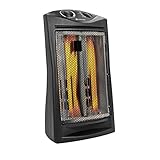
7. Comfort Zone CZQTV007BK Quartz Tower – Best for Utility and Storage Rooms
Comfort Zone Space Heaters for Indoor Use, Portable Electric Heater, Adjustable Thermostat, Infrared Heat, Quartz Tower Space Heater with 2 Heat Settings, Bedroom Heater, Black
1500W with dual quartz tubes
Fan-assisted heat dispersion
22.5 inch slim tower
6.1 lb
Two top-mounted control knobs
Pros
- Dual quartz tubes deliver fast focused radiant heat with a visible glow
- Fan assists in dispersing heat so it is not purely spot heating
- Two simple top-mounted knobs are easy to operate in the dark or with gloves on
- Stay-cool molded handle and durable metal housing
- Capable of handling a 200 to 300 square foot utility space
Cons
- Fan noise is the most common complaint and one owner removed the fan
- Loud metallic rattling for the first few minutes as panels heat up
- Tip-over switch is sensitive enough that brushing the unit cuts power
- Manual thermostat is less precise than digital models
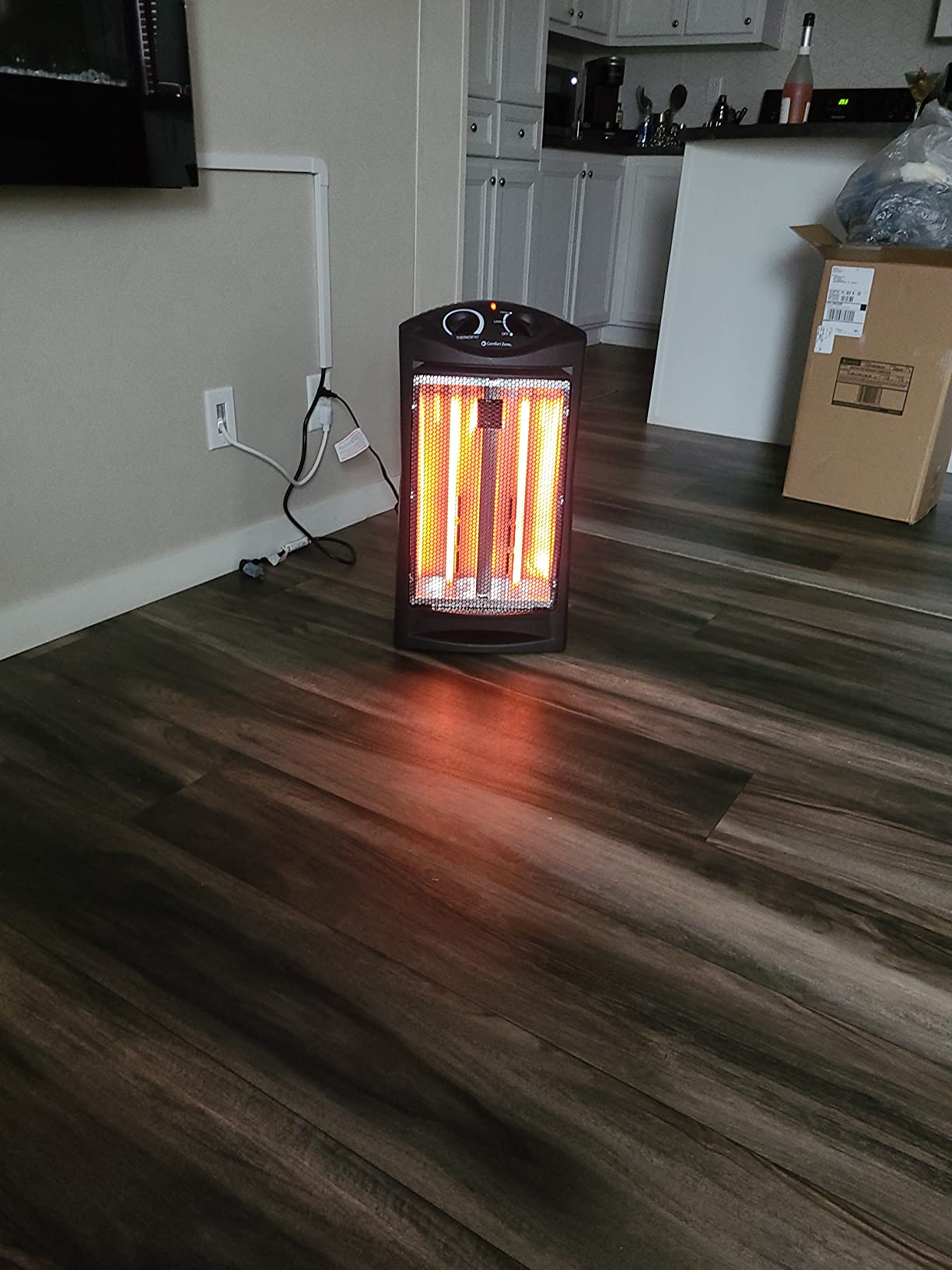
This is the heater for the basement nobody wants to sit in: the laundry room, the utility closet, the storage room where you spend ten minutes finding the Christmas decorations. It is a slim 22.5-inch tower at 6.1 pounds, with dual quartz tubes and a fan that assists in spreading the radiant heat rather than leaving it in a tight beam.
Owners consistently credit it with serious radiant output for the money and a slim footprint that fits where cabinets do not. Several note that it bailed them out during a heating emergency when the central system failed, which is exactly the reliability profile you want in a secondary space.
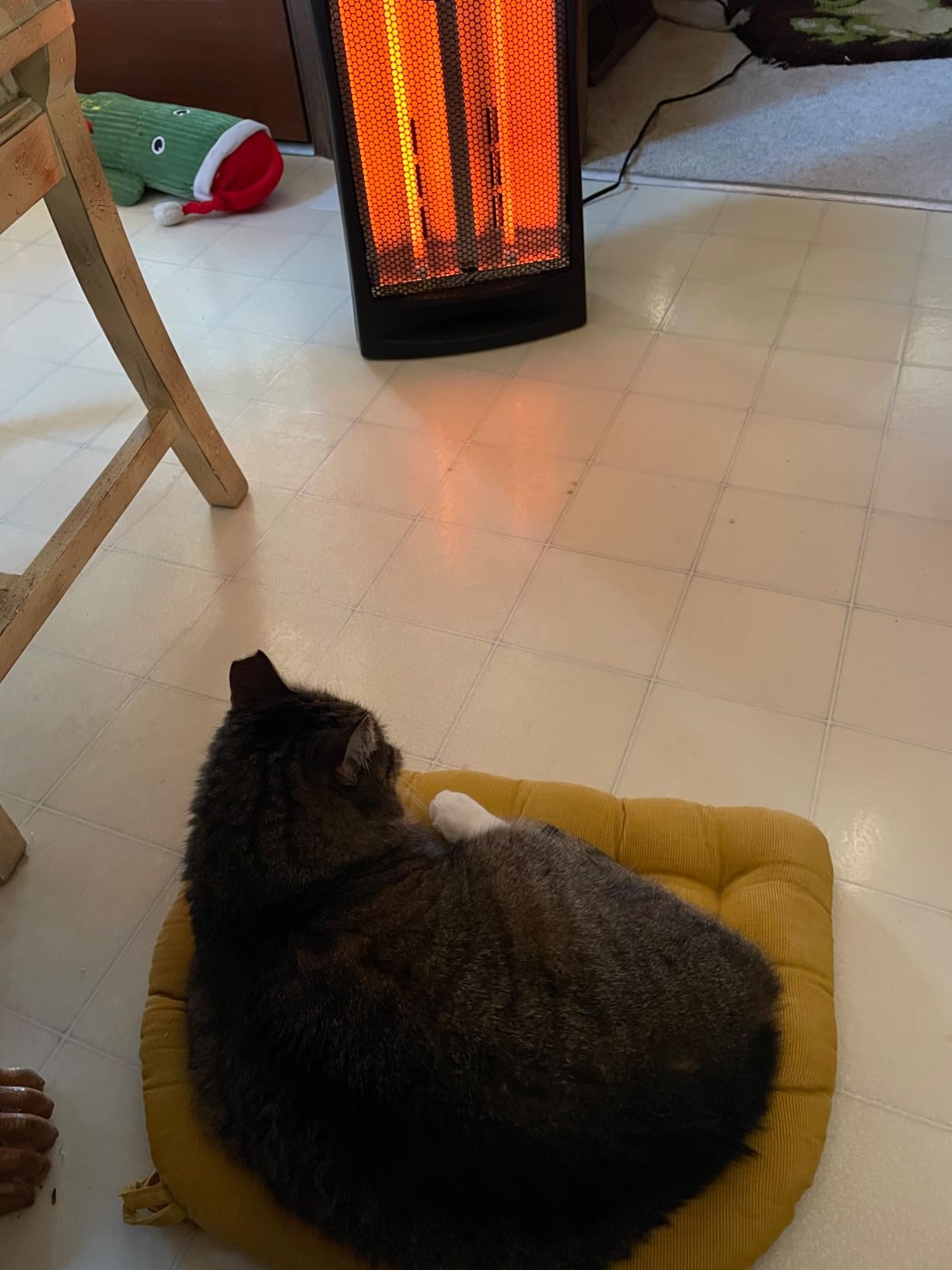
The controls are deliberately simple: two knobs on top, one for thermostat and one for heat level, with three speed settings. In a basement where you are carrying laundry or moving boxes, that simplicity is a feature rather than a shortcoming. There is no app to configure and nothing to learn.
Targeted basement use also covers freeze protection. Run this near well pipes or a mechanical room at a low thermostat setting and it will maintain a safe temperature all winter without the operator cost of a larger unit running at full output.
Why it works in a laundry or storage room
Utility rooms have a specific profile: concrete floor, exposed joists above, and no occupant to keep warm. Radiant heat aimed at stored items, pipes and the floor surface works well here because you are heating objects rather than people. Clothes drying on a rack, cardboard of stored decor and copper lines near the wall all benefit from direct radiant exposure.
The metal housing and stay-cool handle also matter in a laundry room where you need to reposition it to reach behind the dryer.
The noise problem is real
Acoustic complaints are the dominant theme across thousands of reviews. The fan is loud enough that one owner physically removed it, and several describe metallic rattling that lasts for the first two or three minutes while the thin reflecting panels expand. It also emits a slight hum at the highest settings.
Do not put this tower in a bedroom or in a basement office where you work. The tip-over switch is also unusually sensitive, to the point where brushing past it in a tight laundry room cuts power and requires a shake to restart.
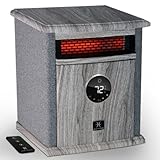
8. Heat Storm HS-1500-ILODG Cabinet – Best Compact Humidity-Preserving Unit
Heat Storm HS-1500-ILODG Cabinet Heater, 15″ H x 13.5″ W x 11″ D, Gray
1500W and 5200 BTU
Patented HMS heat exchanger
11 by 13.5 by 15 inch cabinet
10 lb
Energy mode drops to 750W
Pros
- HMS heat exchanger adds humidity to the air rather than drying it
- LED display shows ambient temperature with remote included
- Energy-efficient mode drops output from 1500W to 750W
- Compact cabinet fits small finished rooms and closets
- Offered in black
- beige and gray
Cons
- Maximum thermostat setting is only 75F
- Casters are optional and not always included
- Real coverage falls well below the advertised 1000 sq ft secondary figure
- One year manufacturer warranty
The Heat Storm HS-1500-ILODG does something unusual: it treats basement air as a system rather than a temperature. The patented heat exchanger with HMS Technology is designed to move moisture through the unit rather than baking it out, which is the opposite of what a conventional quartz heater does to indoor air in winter.
At 11 inches deep by 13.5 inches wide by 15 inches tall and 10 pounds, it is one of the more compact cabinets here, and that matters in a finished basement room where you are trying to keep furniture placement flexible. The LED display showing ambient temperature, plus the included remote, means you can run it hands-off for extended periods.
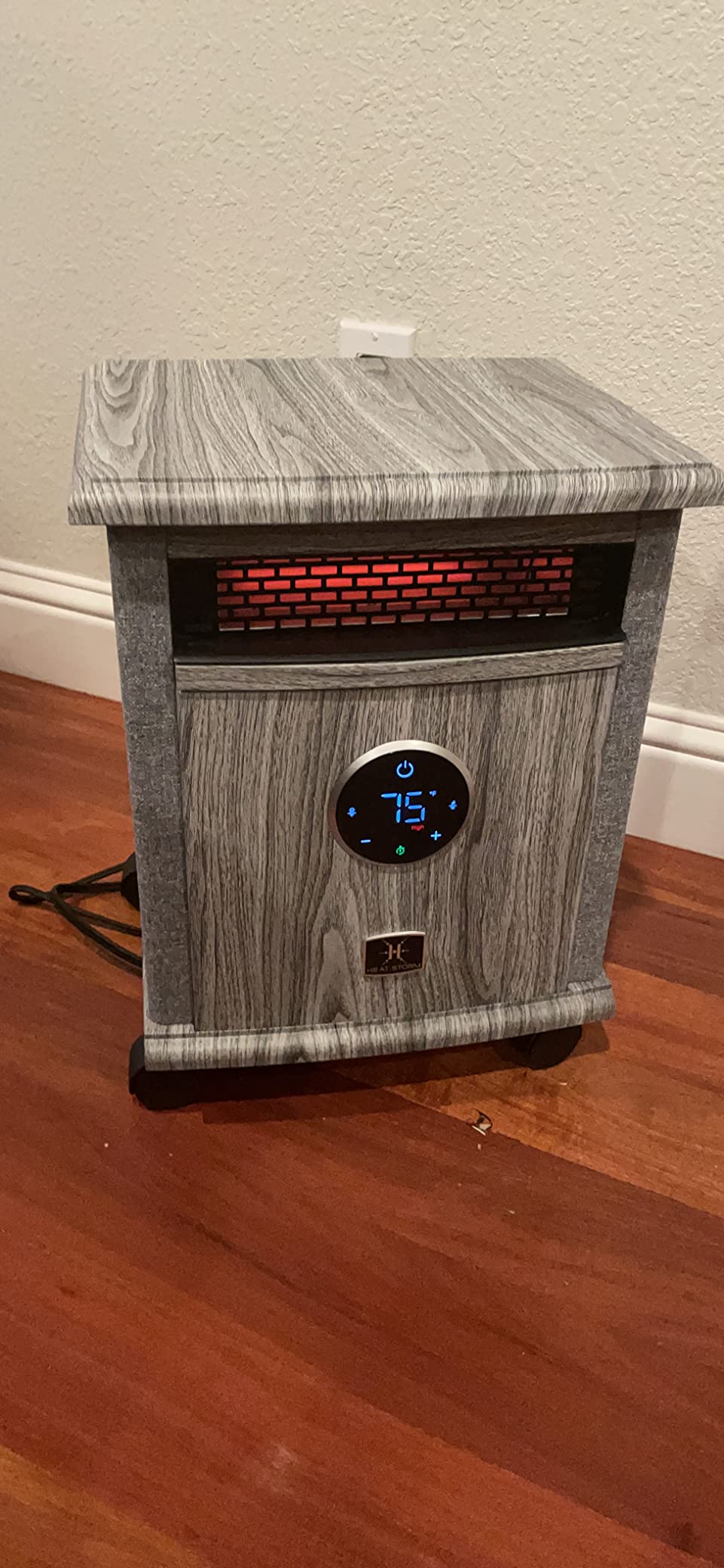
The energy-efficient mode is genuinely useful in a basement. Dropping from 1500W to 750W roughly halves the power draw while still holding a temperature, which is the right setting for overnight freeze protection or for maintaining a finished room that is not in use during the day.
Owners are generally satisfied with the results, and the recurring caveat is that the advertised secondary coverage figure assumes good insulation and a closed room. In an average basement, expect it to do well at 200 to 300 square feet.
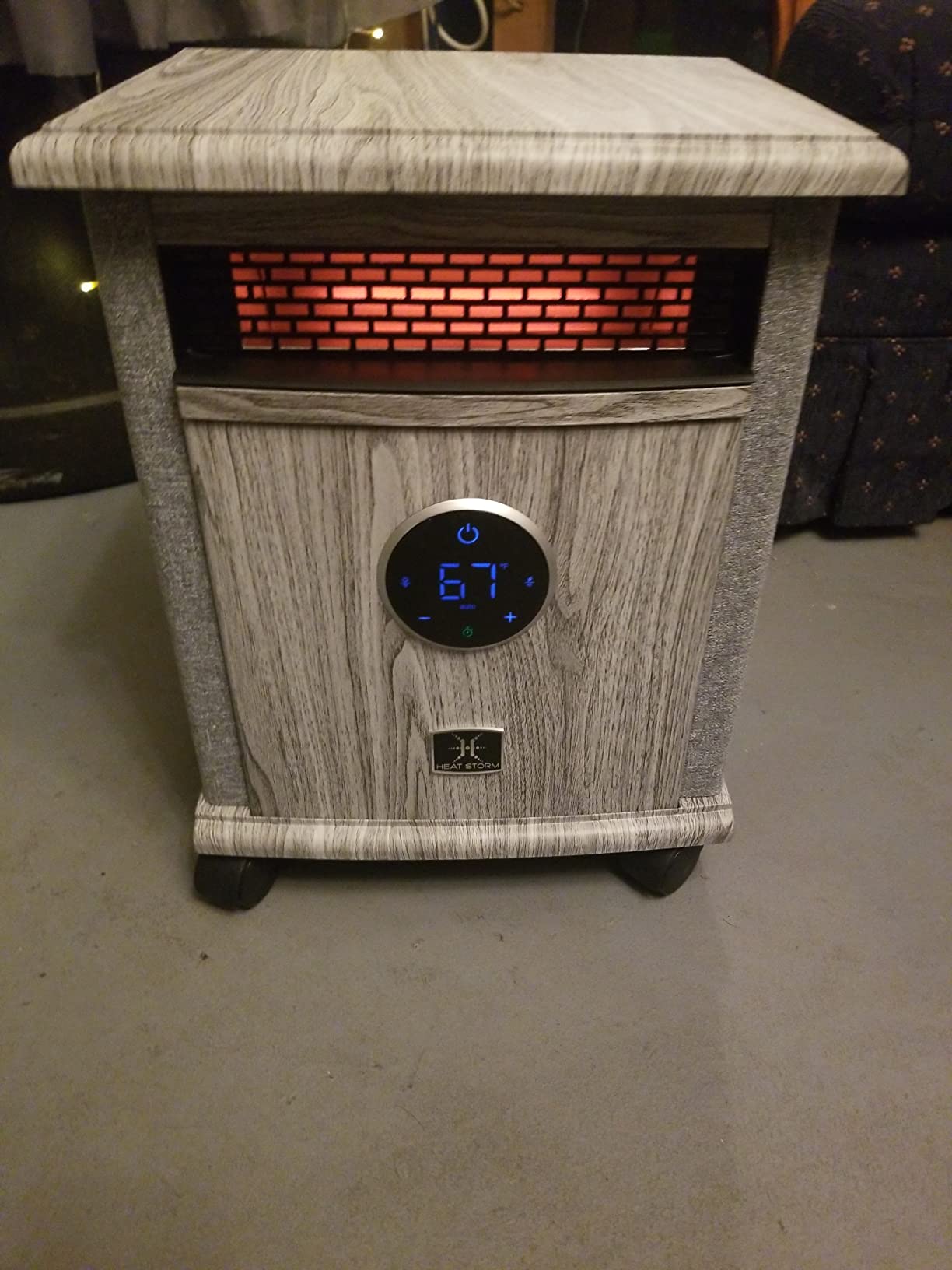
Where the 75F ceiling bites
The maximum thermostat setting is 75F, and that is a genuine limitation for anyone whose basement regularly sits below that. In a deep, poorly insulated space, the unit may simply run continuously at full power all winter without ever satisfying the thermostat, which means maximum power draw for an acceptable but unremarkable result.
If your basement typically needs to reach above 75F when you are using it, look at the EdenPURE CopperPLUS with its 90F ceiling, or a unit with the app scheduling to bring the space up quickly before you arrive.
When humidity-preserving heat actually matters
In a finished basement that is dry but not wet, a unit that does not strip moisture from the air is meaningfully more comfortable over a long evening. Combined with the 750W energy mode, it works well as a background heat source that you run all day at half output and then push higher when people are actually in the room.
Check the box for casters, because they are listed as an option rather than guaranteed. The one-year manufacturer warranty is the shortest among the cabinets in this roundup.
9. Dr Infrared DR-239 3000W – Best for Damp and Unconditioned Basements
DR. INFRARED HEATER DR-239 3000W Indoor & Outdoor Infrared Patio Heater, Wall or Ceiling Mount, IP55 Weatherproof, Commercial or Residential, 220V-240V Electric Heater with Remote & Mounting Kit
3000W and 10,260 BTU
IP55 weatherproof rating
41.2 by 3.4 by 5.9 inch body
7.6 lb
Wall or ceiling mount
Pros
- 3000W of radiant heat with no warm-up time and no open flame
- IP55 rated so it tolerates a genuinely damp or unconditioned space
- Wall and ceiling brackets plus chains included with straightforward hardware
- Remote works reliably and the 24-hour timer supports freeze protection
- Silent and odorless with no combustion fumes
Cons
- Requires a dedicated 220V to 240V circuit that many basements do not have
- Highly directional so you must be in the beam
- Does not retain its last setting after a power loss
- No mounting template supplied for the bracket holes
This is the only heater in the roundup rated for moisture, and that single fact makes it the right answer for an unfinished basement, a garage workshop, a crawlspace-side room or any space where dampness is already a concern. The IP55 rating means it is built to tolerate humidity and dust rather than being harmed by it.
At 3000W and 10,260 BTU it produces roughly twice the heat of everything else here, and unlike a cabinet heater it has no warm-up delay because there is no air to heat first. Radiant heat lands on you the moment it is switched on, which is the defining advantage in a cold space where waiting fifteen minutes for a room to come up is not practical.
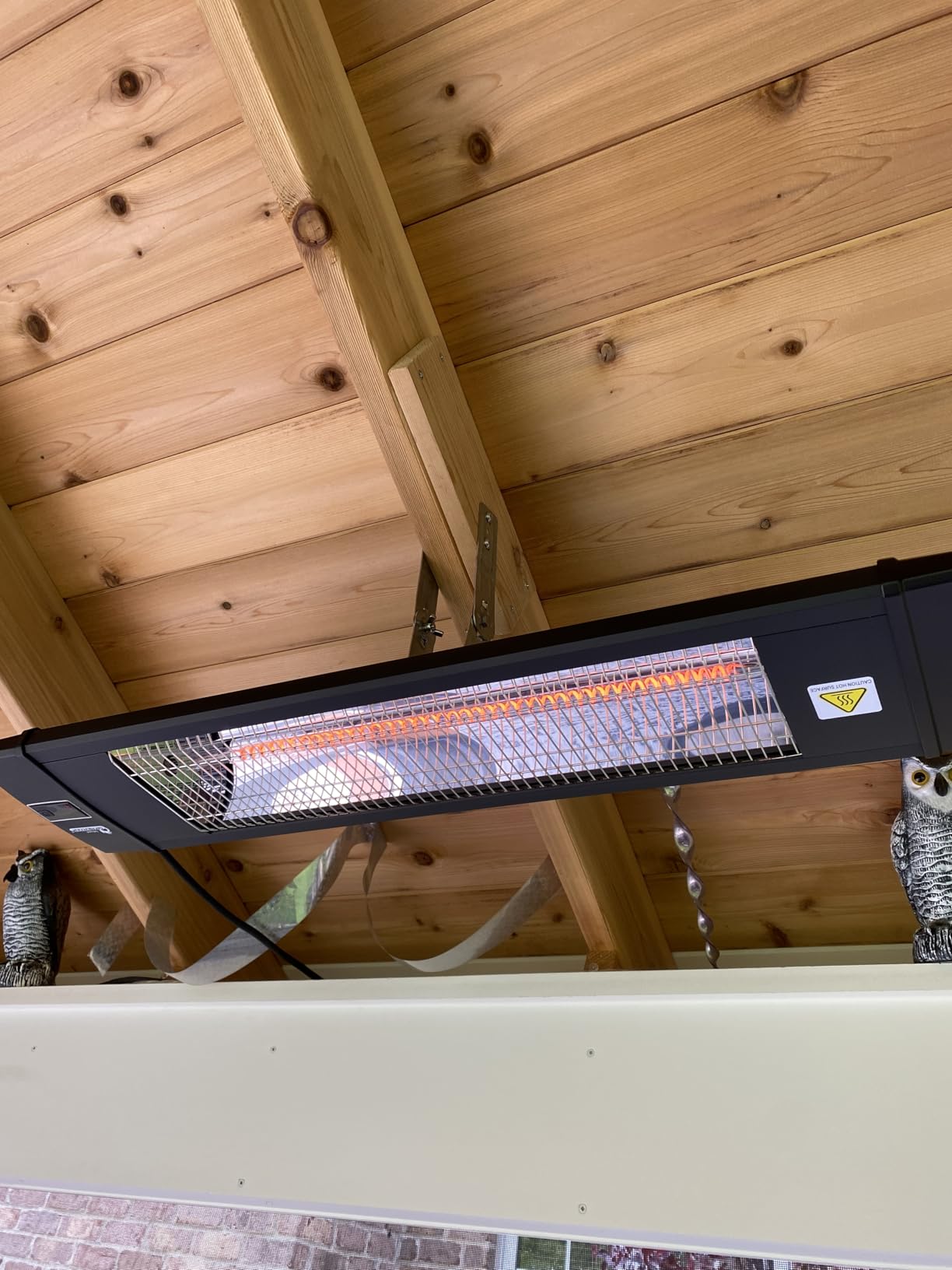
Owners with the right electrical setup use this very successfully for freeze protection and spot warming, and one long-term owner reports flawless reliability over several years. The remote is reliable, and the 24-hour timer makes unattended freeze protection straightforward.
At 41.2 inches deep by 3.4 inches wide by 5.9 inches tall and just 7.6 pounds, it is also the easiest to install. The included brackets handle both wall and ceiling mounting, and in an unfinished basement with exposed joists, mounting it near the ceiling gets the heat above head level where cold air collects.
What IP55 actually means for a basement
IP55 is a dust and water ingress rating. The first digit covers solid particle protection and the second covers water jets from any direction, which is the rating you want in a space that sees occasional dampness, a wet basement floor during storm season, or a workshop where you occasionally wash down surfaces.
It does not mean the unit can be left in a flooded basement or drenched directly, and it does not replace GFCI protection, which is the electrical safeguard that matters in a damp space. But it does mean this heater will not corrode or fail the way an indoor-rated cabinet would in a humid environment.
Check your circuit before you buy anything
This requires a dedicated 220V to 240V circuit. Most finished basements do not have one, and adding it is real electrical work that a licensed electrician should handle. Renters, in particular, cannot modify circuits under a standard lease, which rules this model out entirely for them.
Also understand that infrared heats surfaces and bodies in the beam rather than the air, which is the most misunderstood thing about these units. If you mount it too high or aim it at an empty corner, you will have a 3000W heater heating concrete and nothing else. The mounting height is fixed by the brackets, so plan the position carefully before drilling.
10. BLACK+DECKER BHTI06 Quartz Tower – Budget Pick for a Small Basement Nook
BLACK+DECKER Infrared Radiant Quartz Tower Heater, BHTI06, Black
1500W across dual quartz tubes
750W low and 1500W high
23 inch tower at 5 lb
Manual adjustable thermostat
Cool-touch housing
Pros
- Lowest cost in the roundup with dual quartz tubes that heat up quickly
- Integrated fan disperses radiant heat around the room
- Only 5 lb so it is easy to carry between levels
- Cool-touch housing with overheat and tip-over auto shutoff
- Simple two-setting design with nothing to configure
Cons
- Smallest coverage claim here at roughly 150 square feet
- Manual thermostat with no digital readout or timer
- Highest one-star review share in this group at about 10 percent
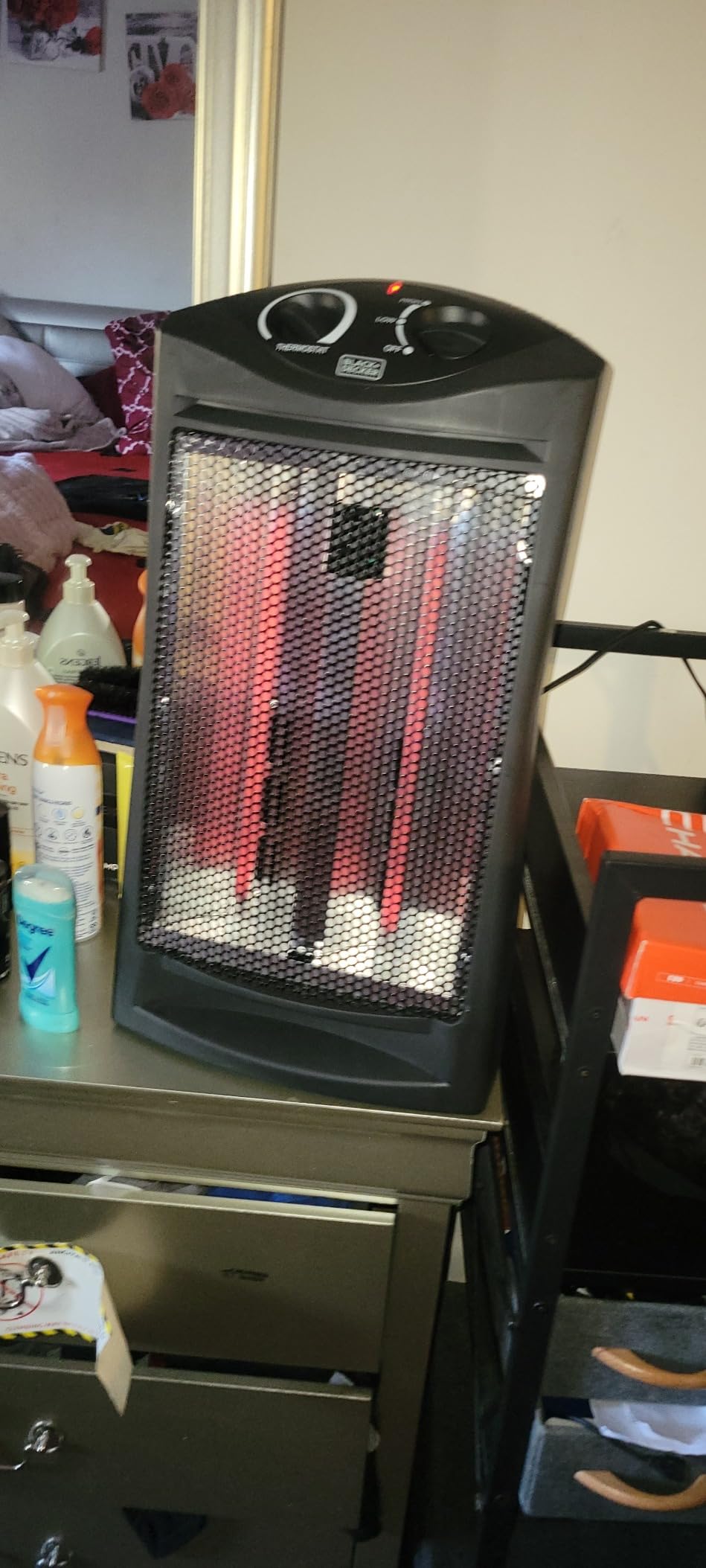
Some basements have one small spot that needs warmth and a budget that does not stretch. The BLACK+DECKER BHTI06 answers that. Dual quartz tubes, an integrated fan to spread the radiant heat, and a 1500W high setting for when you need it fast, all in a 5-pound tower that measures 23 inches tall.
The safety hardware is the better part of the story at this price. It has a cool-touch housing with a power indicator light, overheat shutoff and tip-over auto shutoff, which is more than several more expensive models in this roundup document.
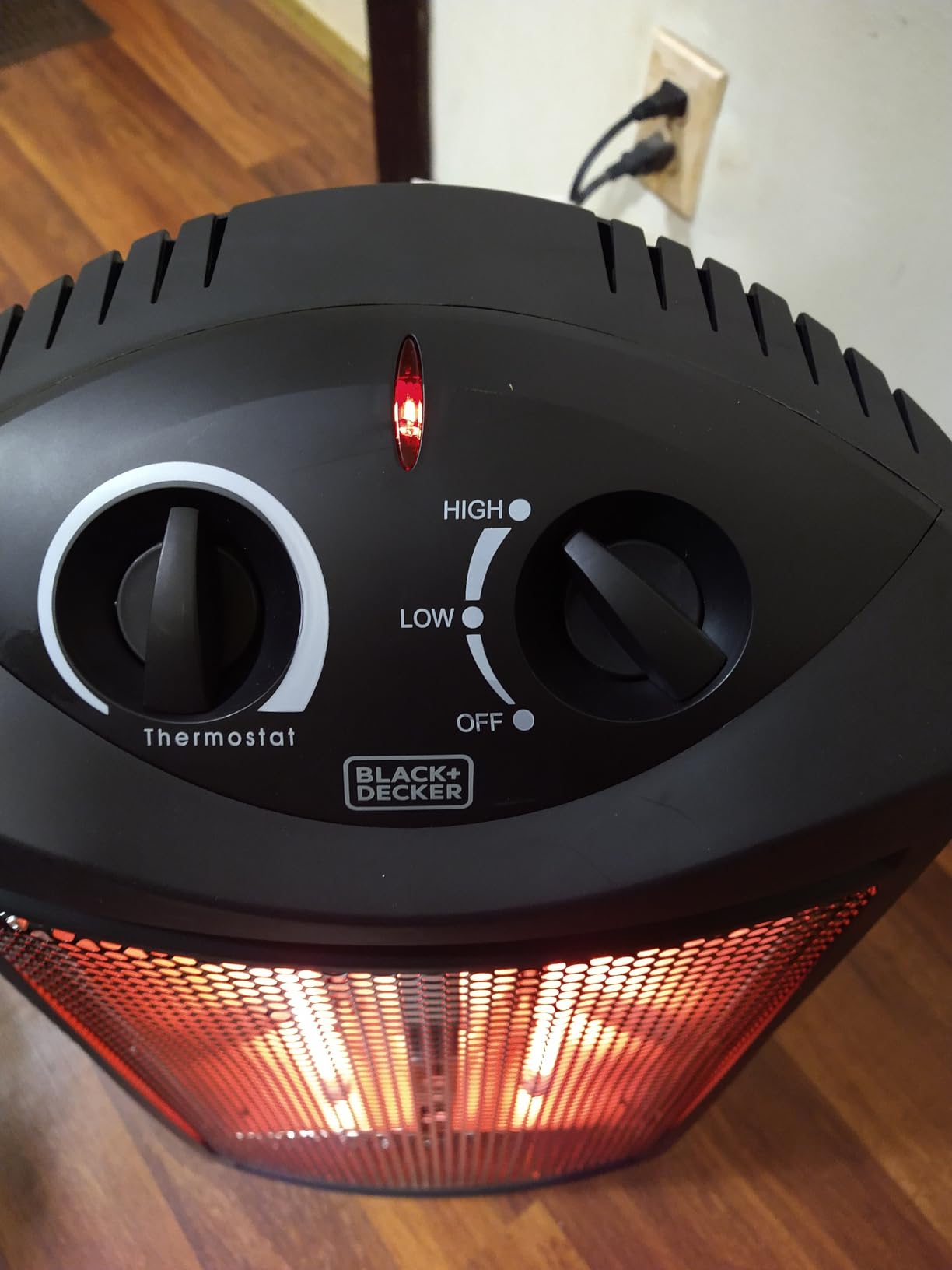
Owners like the weight and the quick warm-up. Carrying it down basement stairs is genuinely easy at 5 pounds, and for a basement laundry room, a small storage area or a home office corner it does exactly what a personal heater should.
It is genuinely a personal heater, though, and treating it as a basement heat source is where people go wrong. Owners consistently frame it as a budget unit for a corner rather than a solution, and that framing is accurate.
When a 150 square foot heater is enough
A small basement office nook, a walk-in storage closet, the space at the top of the stairs, or a laundry alcove of about 10 by 15 feet are all realistic spaces for this. In a room that size, 1500W is more than enough and the fan does the work of making radiant heat feel like room heat.
The 750W low setting is useful for maintenance heat, and the manual thermostat is simple enough to set once and leave.
Where the feature gaps start to matter
There is no timer, no remote and no digital temperature readout. That means you are relying entirely on the manual thermostat, which drifts, and you have no way to schedule the heater. For a room you use regularly, that is a meaningful limitation.
About 10 percent of reviews are one-star, the highest share in this group, and at roughly 150 square feet claimed coverage it is the smallest footprint here. If your basement is 300 square feet or larger, spend more and get something with a thermostat you can actually read.
How Big a Basement Can One 1500W Heater Warm?
One 1500W heater realistically handles about 150 to 250 square feet as comfortable primary heat in a typical basement, and 300 to 400 square feet when it is supporting an already-warm space or running on a fan-assisted hybrid design.
The square footage on the box is not the number you should plan around. Listings here claim 150, 300, 400, 576 and even 1,000 square feet for heaters that are all rated at the same 1500W. They cannot all be right, because the wattage is identical. What differs is how much of the heat reaches the air and the floor versus how much goes straight into the basement structure.
The widely used sizing rule is 10 watts per square foot. Applied to a basement that gives 1,000W for 100 square feet, which is why the smallest units in this roundup exist and why a single 1500W heater is not a basement solution for anything above 300 square feet unless the space is unusually well insulated.
There is also a hard electrical ceiling that catches almost everyone by surprise. A 1500W heater on 120 volts draws 12.5 amps, which is the majority of a standard 20-amp household circuit. That circuit also feeds your dehumidifier, your washer, your dryer and any other basement appliance. Running a 1500W heater and a dehumidifier on the same circuit is a tripped-breaker situation waiting to happen, which is why two-unit basement setups need two circuits, not one doubled-up outlet.
For a basement between 500 and 1,000 square feet, the honest answer is two heaters on two separate circuits, placed in different zones and set to slightly lower temperatures, rather than one large unit trying to cover the whole level. If you need more heat than 3000W, that means a hardwired or 240V installation handled by an electrician.
Dampness, Condensation and Pairing a Heater With a Dehumidifier
A damp basement is a different problem from a cold basement, and adding heat without controlling moisture can make both worse. Warm air holds more moisture than cold air, so heating a damp basement without addressing humidity raises the relative humidity of everything above it, including the first-floor framing above the ceiling.
The commonly cited threshold is 55 to 60 percent relative humidity. Above that range, mold risk rises sharply, and in a basement with unfinished concrete walls and exposed joists, you are looking at the exact conditions mold colonies need. If you measure your basement and it reads above 60 percent in winter, a heater alone will not solve it.
Which is why the smart basement setup pairs heating with a dehumidifier rather than replacing one with the other. The dehumidifier pulls water out of the air, the heater makes the remaining air comfortable, and together they address two separate problems. Keeping them on separate circuits matters for the reason described above.
Placement is the other half of the moisture story. Warm air rises, so a heater mounted high on a basement wall pushes moisture up toward the ceiling and the joists, which is the opposite of what you want in an unfinished space. Floor-level or low-mounted heat keeps the warmest air where you are, and radiant heat aimed at the floor is doubly useful because it raises the temperature of the cold concrete that makes a basement feel damp in the first place.
Watch for condensation on the floor. Cold concrete below roughly 55 degrees will condense moisture from warm basement air onto its surface, creating the damp sheen that people mistake for a leak. Raising the surface temperature of that concrete with radiant heat is often the single most effective thing a basement heater does, because dry concrete that is warm to the touch feels completely different from the same concrete at 50 degrees.
What a 1500W Heater Costs to Run and Why Two Beat One
A 1500W heater consumes 1.5 kWh for every hour it runs at full output, and a 750W setting consumes 0.75 kWh. That is the entire cost calculation: the physics of 1.5 kilowatts entering a room as heat.
This is why forum consensus about premium versus budget heaters is largely correct about running cost. Two heaters rated at 1500W each put the same amount of energy into a room regardless of their purchase price, and the per-hour figure is identical across every model in this roundup. What actually differs is how efficiently each one delivers that energy to the place you are sitting, and how well the thermostat avoids overshooting.
Thermostat quality is the variable that changes your bill. A heater that overshoots to 75F in a room you want at 68F has wasted energy, and repeated overshoot is a meaningful fraction of a winter’s consumption. The fine-grained controls on the EdenPURE CopperPLUS and the digital panels on the Ballu and Heat Storm units are worth something here that wattage alone does not explain.
Zoning is where two heaters genuinely beat one. Running two 1500W heaters at 68F in two separate zones of an 800-square-foot basement uses roughly the same energy as one heater blasting a single zone to 78F, but every occupied room ends up at the temperature you actually want. For most basements between 500 and 1,000 square feet, that is the difference between a usable space and a warm corner.
For comparison on the installation side, our guide to the best infrared patio heaters for wall mounting covers the same wall-mounting geometry used by the DR-239 and the Heat Storm HS-1500-PHX-WIFI, including the bracket placement details that matter in an unfinished space with exposed joists.
Basement Safety: Clearance, GFCI Protection and Outlet Placement
Keep every heater at least three feet of clearance from walls, bedding, curtains and stored cardboard, and never run one directly beneath a stairway or inside a closet with clothing. Basement storage is where heaters cause the most fires, because people set a unit on top of stacked boxes to save floor space.
Plug heaters directly into a wall outlet. Extension cords and power strips are the single most common cause of heater fires, because the cord is undersized for a 12.5A load and can overheat where it meets the plug or a connector. If your outlet is out of reach, move the heater rather than extending its cord.
Use GFCI-protected outlets in a damp basement. Ground-fault protection is what prevents a shock when moisture and energized components meet, and in a space with concrete floors and possible dampness it is not optional in the way it is in a dry living room. Most unfinished basements already have GFCI outlets near the floor, which is exactly where a heater will go, but verify it rather than assuming.
Mount wall units high enough to keep them away from splash but low enough that the radiant beam lands on bodies rather than ceiling. About five feet off the floor at a slight downward angle is the usual starting point for a cabinet or wall-mounted unit in a finished space, and mounting near the ceiling makes sense only for freeze protection in an unconditioned room.
Do not trust tip-over protection as your only safeguard. It exists because heaters get knocked by pets, children and vacuum cleaners, but it cuts power instantly and requires you to physically return the unit to an upright position before it restarts. Keep the area around the heater clear so nothing can bump it.
Independent lab testing has raised real questions about the durability of some overheat cutoffs in this category. In one published overheat-sheet test, some popular infrared cabinets took over ten minutes to shut down at elevated temperatures and visibly warped their grilles in the process. That is not a reason to avoid heaters, and the units we recommend all have documented overheat protection, but it is a reason to leave clearance, not to push a unit against a wall or drape anything over it.
Never leave a heater running unattended in a basement where you are sleeping in the room. For overnight use, use the built-in timer and set it to shut down before you go to bed rather than relying on overheat protection as the primary control.
Eight Basement Prep Steps Worth Doing Before You Buy a Heater
Air seal and insulate first, then buy a heater. This is the single most repeated piece of advice across homeowner and building forums, and it is the step most affiliate roundups skip. A heater works far harder in a leaky basement, and no model compensates for cold air arriving through the rim joist.
Start at the rim joist, the band between the floor joists and the foundation wall. It is the largest uninsulated gap in most houses and it lets a volume of cold outdoor air into the basement continuously. Seal it with rigid foam and caulk, then move to the walls, then the ceiling if it is unfinished.
Insulate any ductwork running through the basement before you insulate anything else. An uninsulated duct in a cold basement can supply air far below the temperature of the rest of the space, which defeats a thermostat in a way that no heater setting can compensate for.
Verify your GFCI outlets and their height at the same time, since you will be running cables and possibly an electrician out during the work. Knowing where your outlets are also tells you where a heater can realistically go, which is a more useful constraint than any coverage claim.
Then measure your basement’s relative humidity with a cheap hygrometer before you buy anything. Below 60 percent, a heater solves the problem. Above 60 percent, you need a dehumidifier on its own circuit first, and a heater second.
Set a target temperature before you shop. For finished living space, 68 to 70 degrees is the usual comfort target. For protecting pipes and stored belongings, holding the space at 55 to 60 degrees around the freezing risk is enough, costs a fraction as much, and can be done with a low setting and a timer rather than full output.
Finally, inventory your outlets for what else is already on each circuit. Counting the amperage on the circuit a heater will share with your dehumidifier and washing machine is the step that prevents the most frustrating basement heater experience there is: a breaker that trips every twenty minutes on a cold evening.
Frequently Asked Questions
What size room will a 1500 watt infrared heater heat?
Expect about 150 to 250 square feet of comfortable heat in a typical basement, rising to 300 to 400 square feet when a fan-assisted hybrid unit supports an already-warm space. The larger figures printed on boxes assume good insulation and a closed room. A basement with cold concrete and drafts will deliver noticeably less than a finished room of the same size.
What is a good electric heater for a basement?
A 1500W quartz infrared cabinet or wall-mounted unit with a real thermostat, tip-over and overheat shutoff, and a cool-touch housing, positioned where people actually sit. Match the mount to the space, use a dedicated 20A circuit, and pair it with a dehumidifier if relative humidity runs above 60 percent.
Does a 1500 watt infrared heater use a lot of electricity?
It uses 1.5 kWh for every hour it runs at full output, and 0.75 kWh on a 750W setting. That figure is identical across every 1500W model regardless of purchase price, so cost differences come from thermostat accuracy and how much heat reaches the room instead of the walls. Two zoned heaters at lower settings often beat one heater at full blast.
Are infrared heaters good for large rooms?
Only with help. Infrared heat travels in a line of sight, so a single 1500W unit warms people and surfaces in its beam far better than it warms the whole air mass. In a wide room or one with high ceilings, choose a micathermic panel for its 180-degree arc or wall-mount it low, and expect a second heater on a separate circuit above 500 square feet.
Is it safe to leave a space heater on?
It is safe to leave a heater running while you are in the room, provided it has tip-over and overheat protection, sits three feet from anything combustible, and is plugged directly into a wall outlet rather than an extension cord. In a basement, plug into a GFCI-protected outlet. Never run one unattended overnight or beneath a stairway.
Are infrared heaters safe to leave on overnight?
We do not recommend it. Use the built-in timer to shut the unit down before you sleep instead. Overheat and tip-over protection are backups against a failure, not a substitute for supervision. Many models include a 12-hour timer, and scheduling the unit through an app or timer to stop overnight is safer and cheaper.
What are the downsides of using an infrared room heater?
The main limitation is line-of-sight heating: the radiant beam warms you and nearby surfaces, not the air throughout the room, so far corners stay cold. There is no humidity control in most models, coverage claims are routinely inflated, and a 120V heater at 12.5A uses most of a standard circuit, leaving little room for a dehumidifier on the same outlet.
Are infrared heaters safe in a damp basement?
Most indoor-rated infrared heaters tolerate normal basement humidity, but only IP-rated models such as the Dr Infrared DR-239 are built for genuinely damp spaces. Regardless of model, use a GFCI-protected outlet, keep the unit off a wet floor, leave three feet of clearance from stored cardboard, and address humidity above 60 percent with a dehumidifier first.
The Best Infrared Heaters for Basements in 2026
The best infrared heaters for basements in 2026 come down to what your space actually needs rather than what any box claims. For most people, the Dr Infrared DR-968 is the pick: a quiet 39 dB blower, a real 50-to-85-degree thermostat, dual quartz and PTC elements, and the longest warranty in this group.
For tight finished rooms, the Heat Storm HS-1500-PHX-WIFI reclaims the floor entirely and lets you schedule heat from your phone. For dry, stuffy air, the Dr Infrared DR-998 adds a humidifier and oscillation that no other cabinet here matches. For a wide open space with high ceilings, the Ballu mica panel spreads heat through 180 degrees instead of a narrow beam. For unfinished or damp basements, the Dr Infrared DR-239 is the only IP55-rated option, provided you can get a 240V circuit installed.
Whatever you choose, fix the envelope first, run it on its own circuit with a GFCI outlet, and treat the coverage figure as a starting point rather than a promise. Our infrared heater guide for large rooms is worth a look if your basement ceiling is higher than seven feet and you need more reach than a cabinet gives you.