

A garage is the hardest room in most homes to heat. The walls are bare cinder block or unfinished stud, the ceiling is open to the joists, and a single overhead door the size of a driveway sits between you and everything winter has to say. Heat goes straight up through the roof deck and out the seams around the biggest opening in the building.
That is why the best space heaters for garages are not the same products that work in a bedroom. A 1,500-watt plug-in unit designed for a living room can barely hold a one-car garage above the freezing mark, and the reason is simple physics: the room is losing heat faster than a small heater can replace it. You either reduce the heat loss, raise the heat output, or accept that you are heating the person, not the room.
We spent 2026‘s cold months comparing the heaters that garage owners actually turn to, along the way reading thousands of buyer reviews on electric, propane, and infrared models. Seven made the cut, and they cover the three real categories of garage heating: radiant spot heat for the workbench, fan-forced heat for the whole room, and permanently mounted units you install once.
Below you will find the shortlist first, then a full write-up on each heater with the decisions that matter before you buy, followed by sizing math and safety rules that answer the questions garage owners ask us most.
Table of Contents
Top 3 Picks for the Best Space Heaters for Garages in 2026
Three heaters stand above the rest in 2026, and they stand above the rest for different reasons. The Mr. Heater Buddy is the one we would buy first for most garages. The Mr. Heater tank top model delivers far more heat than its size suggests. The Dr. Infrared DR-238 is the pick if your garage doubles as a gym.
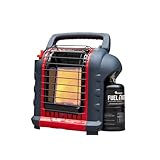
Mr. Heater Buddy 9000 BTU
- Radiant heat at 4000 or 9000 BTU per hour
- Covers about 225 sq ft
- Indoor and outdoor rated
- Low oxygen safety shutoff
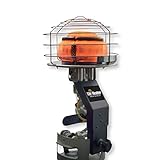
Mr. Heater 45000 BTU Tank Top
- Three BTU settings from 30000 to 45000
- Adjustable 360 degree radiant head
- Tip-over shutoff switch
- Runs about 9.5 hours on high

Dr. Infrared DR-238
- Three power settings from 900W to 1500W
- IP55 rated for indoor and outdoor
- Wall or ceiling mounting
- Remote control included
Best Space Heaters for Garages (October 2026)
This is the full lineup at a glance. Output, coverage area, and fuel type matter more than any other spec, because a heater that cannot deliver enough energy to offset your heat loss will run constantly without ever reaching temperature.
| Product | Specifications | Action |
|---|---|---|
| Mr. Heater Buddy 9000 BTU Radiant Propane |
|
Check Latest Price |
| Mr. Heater 45000 BTU Tank Top Radiant |
|
Check Latest Price |
 Comfort Zone CZ220BK 5000W 240V Ceiling Mount Comfort Zone CZ220BK 5000W 240V Ceiling Mount |
|
Check Latest Price |
 Mr. Heater 30000 BTU Vent Free Radiant Mr. Heater 30000 BTU Vent Free Radiant |
|
Check Latest Price |
 Remington 60000 BTU Forced Air Propane Remington 60000 BTU Forced Air Propane |
|
Check Latest Price |
| Dr. Infrared DR-238 1500W Infrared Heater |
|
Check Latest Price |
 Dr. Infrared DR218-1500W Greenhouse Heater Dr. Infrared DR218-1500W Greenhouse Heater |
|
Check Latest Price |
1. Mr. Heater Buddy 9,000 BTU Radiant Propane Heater – The One Most Garages Should Buy
Mr. Heater 9,000 BTU Portable Buddy Radiant Propane Heater
Radiant propane
4000 or 9000 BTU per hour
Covers about 225 sq ft
Indoor and outdoor
7.1 lbs
Pros
- Widely trusted design with the largest review base in the lineup
- Two heat settings at 4000 and 9000 BTU
- Runs 5.4 hours on low from a 1 lb cylinder
- Approved for indoor use with low oxygen shutoff
Cons
- About 225 sq ft of coverage suits a work corner rather than a whole two-car garage
- Needs a refillable cylinder with no electric plug or thermostat option
This is the heater we keep coming back to, and the reason is the review count. Just over 29,000 buyers have rated it at an average of 4.7 stars, with 84% giving it five. That is not a marketing number; that is two decades of garages, patios, and emergency use cases filtered down to one product.
The output is radiant rather than fan-forced. The burner throws heat in a line at whatever you are facing, which means your body and your work surface warm up before the air behind you does. In a garage that is usually the correct priority, because the thing you are working on is always in front of you and the coldest air is always somewhere else.
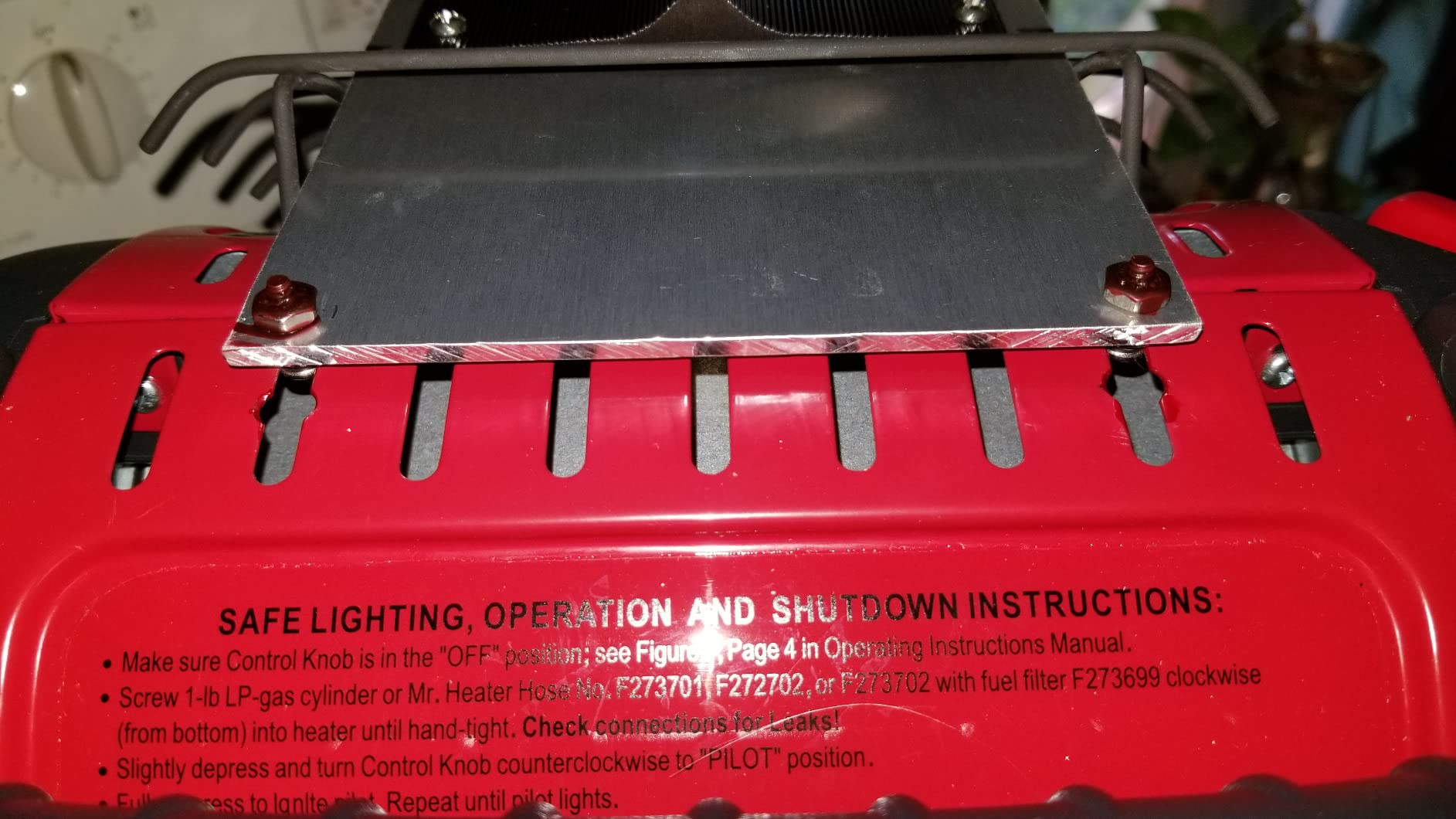
Two settings matter more than they sound. At 4,000 BTU the heater runs 5.4 hours off a single one-pound cylinder, which makes it reasonable for a long evening of work. At 9,000 BTU you get 2.4 hours from the same cylinder, which is the setting you want for a ten-minute warm-up before you start the saw.
The one thing to understand before buying is that the listed coverage of roughly 225 square feet is not a two-car garage rating. Read it as a comfortable work station. Position it so the heat path lands on your bench, and the delivery is immediate.
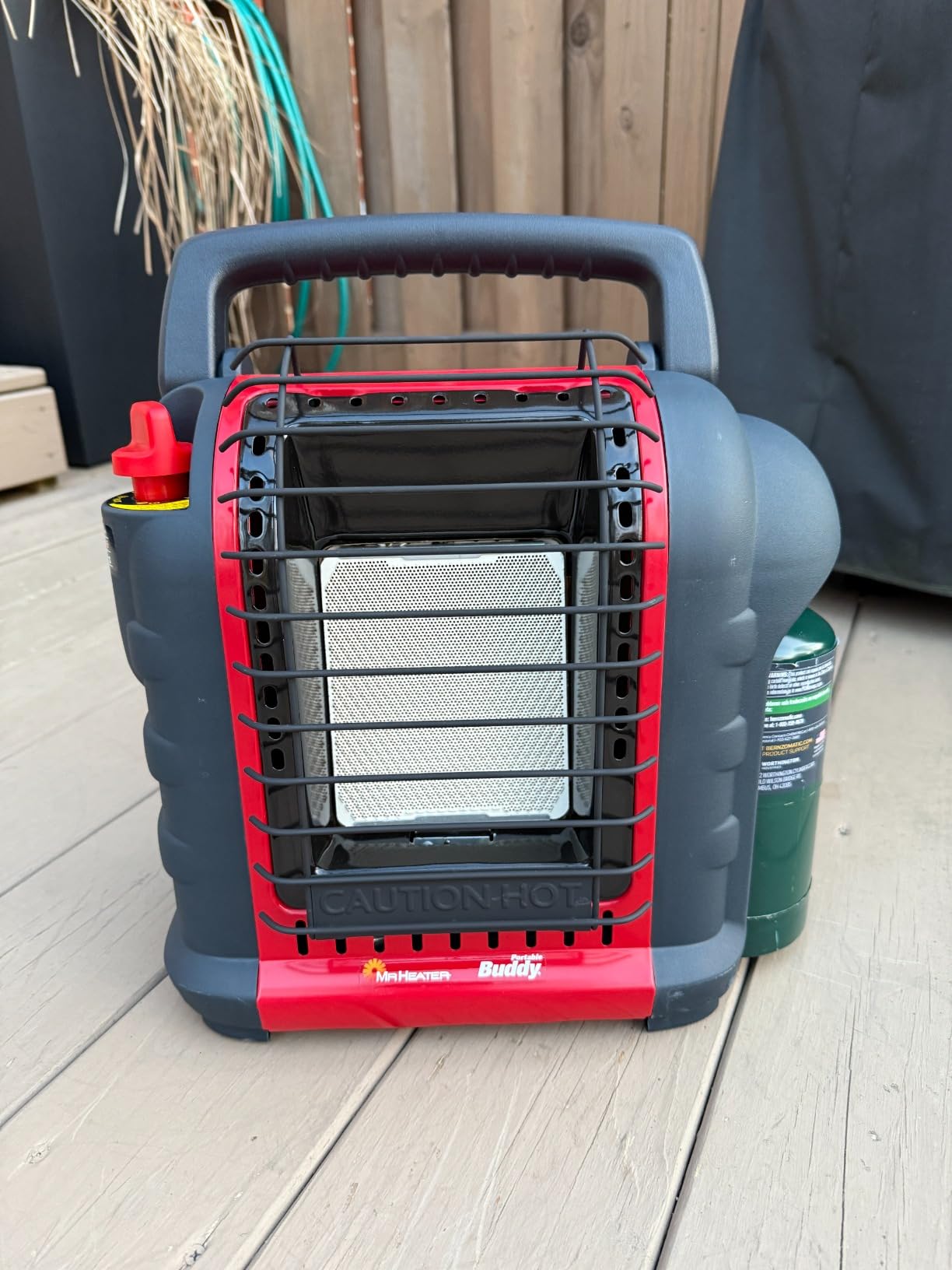
Is it safe to run inside an attached garage
Yes, and this is the detail that separates it from most of the propane heaters in this list. It is designed and approved for indoor use, and it carries an emergency low oxygen safety system that shuts the burner down when the air supply thins. The body is built from self-extinguishing materials.
That does not make ventilation optional. Any combustion heater in a space attached to a living area still needs fresh air, and the manual that ships with the unit says so. Run the garage door open or crack a window when you use it, and keep a working carbon monoxide detector on the ceiling inside the garage.
Where the coverage claim gets tested in a real garage
Owners on garage forums describe the same pattern repeatedly: park it at the edge of the workspace, aim it in, and it will warm a corner to working temperature in a few minutes. The complaints are about expectations, not failures. People who try to heat an entire 400-plus square foot bay with it end up frustrated.
The other recurring note is cylinder logistics. This is a refillable cylinder heater, so you are managing fuel by hand rather than running a fixed line. For occasional winter weekends that is a feature. For daily all-season use it becomes a chore.
2. Mr. Heater 45,000 BTU Tank Top Radiant Heater – The Most Heat You Can Carry With One Hand
Mr. Heater Original 540-Degree 45,000 BTU Tank Top Radiant Propane Heater
Radiant propane
45000 or 36000 or 30000 BTU
Covers about 1125 sq ft
Tip-over shutoff
5.6 lbs
Pros
- 45000 BTU from a unit that weighs 5.6 lbs
- Three output settings on a built-in regulator
- About 9.5 hours of run time on high from a 20 lb tank
- Adjustable radiant head spreads heat across a wide circle
Cons
- Outdoor use only so it does not suit an enclosed attached garage
- First ignition takes several minutes to bring the mantle fully red
- Awkward cage shape and the tank must be moved separately
When we looked at the output numbers across this lineup, this heater stood apart. Forty-five thousand BTU from a package that weighs 5.6 pounds is an unusual ratio, and it comes from the radiant design, which sends energy straight into the room rather than pushing it through a fan and duct.
The regulator gives you three settings: 45,000, 36,000, and 30,000 BTU. On a 20-pound tank it runs about 9.5 hours at the high setting, which means you can leave it working through a Saturday without babysitting a cylinder.
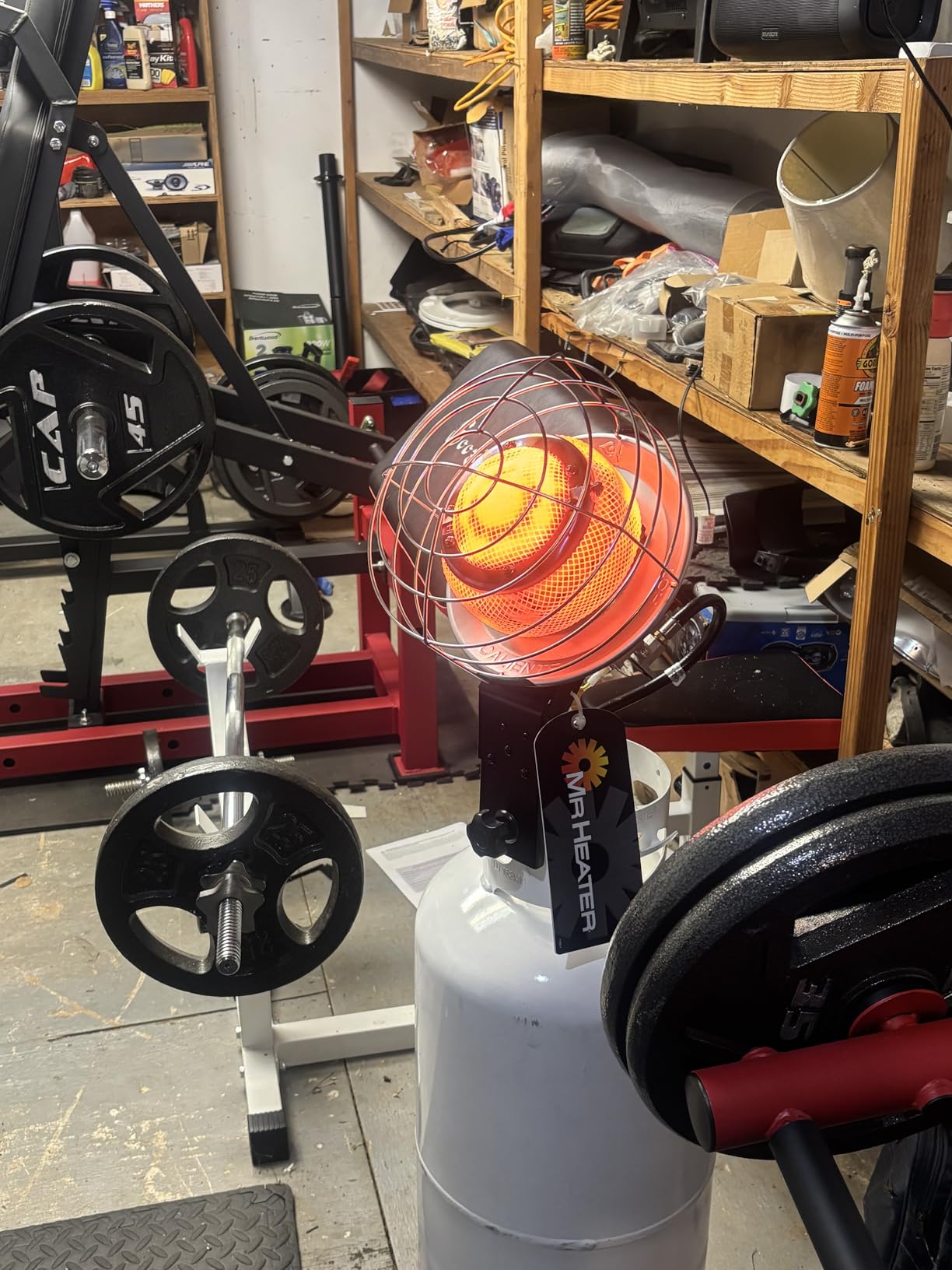
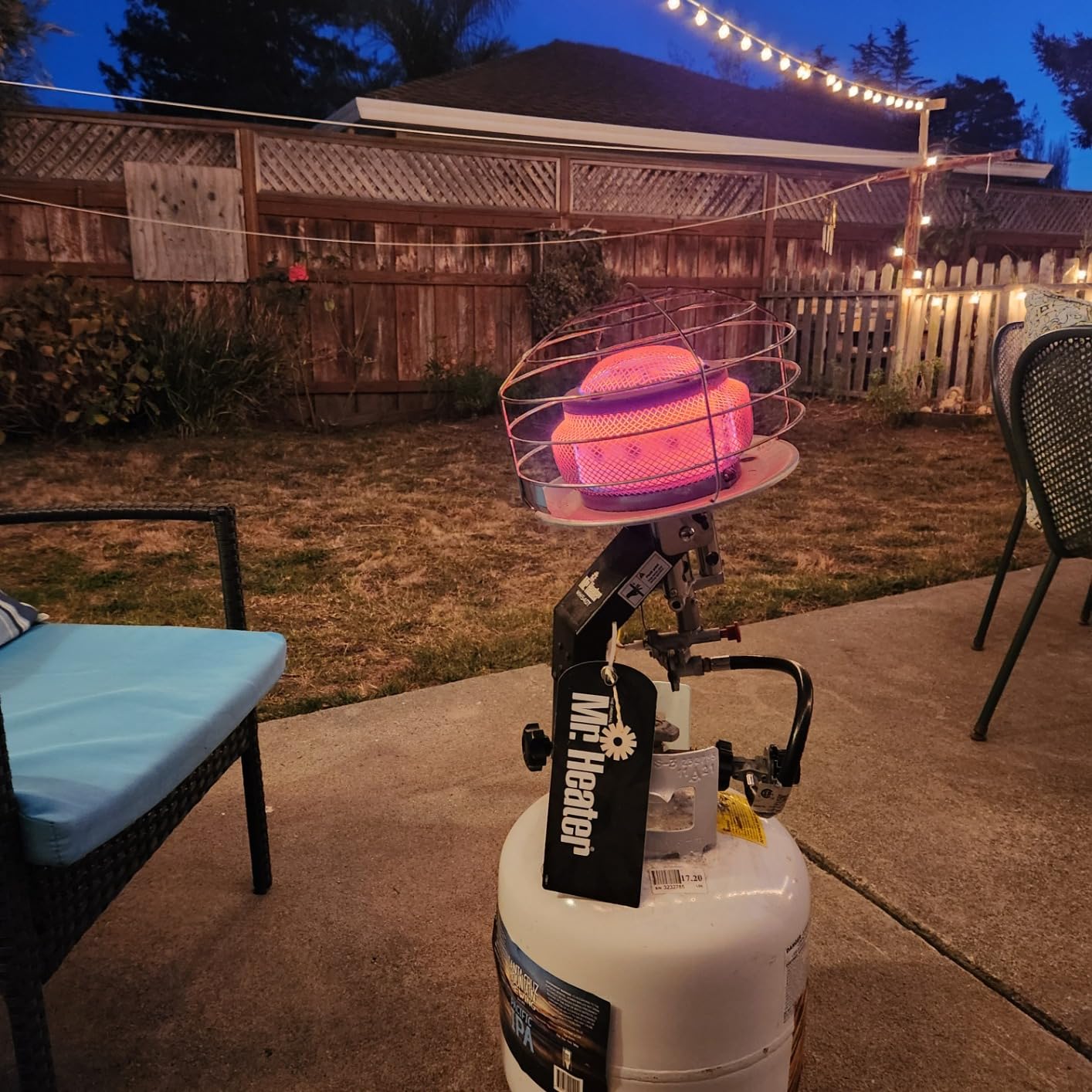
Rated 4.7 stars across 5,016 reviews with 85% five-star ratings, this is one of the most proven heaters we shortlisted. Owners running winter garage projects speak about the tilt head most: it rotates through 540 degrees, so you can point the heat at the workbench, the engine bay, or the door threshold without moving the tank.
The catch is stated plainly in the product data and repeated by buyers. This unit is outdoor use only. That rules it out for an enclosed attached garage and makes it a poor match for a garage with a finished ceiling.
Startup behavior is worth knowing. The first ignition takes several minutes while the mantle comes up to full red, and later ignitions take seconds. Several reviewers flag that most of the heat goes straight up until you tilt the head down, so plan your mounting angle before your first cold morning.
How this compares to the Buddy for garage work
Think of the Buddy as a hand warmer for a bench and this as a space heater for a bay. At 45,000 BTU and roughly 1,125 square feet of stated coverage, this one has the raw capacity to raise the temperature across an open, drafty garage, not just at arm’s length.
Users in northern climates consistently prefer gas over electric once they are heating a full bay, for the simple reason that a combustion heater is not tied to your electrical panel. One review we read described running this through three consecutive winters in a detached shop without a hitch.
What to check before you buy
Plan on a 20-pound cylinder and a place to store it safely, away from the door and out of the way of traffic. The cage shape that protects the burner also makes the unit awkward to grip, and the tank has to be carried separately.
Because it is radiant rather than fan-forced, you will feel the warmth in a cone. In a very large open garage with high ceilings, expect most of that energy to rise unless you tilt the head and keep the garage door closed to stop drafts.
3. Comfort Zone CZ220BK 5,000W 240V Ceiling Mount – The Workshop Heater You Install Once
Comfort Zone Hard-Wired Ceiling Mount Garage Electric Space Heater, Fan-Forced, 5,000 watt, 240 volt, Overheat Protection, Thermal Cut-Out Switch, Ideal for Workshop & Garage, ETL Compliant, CZ220BK
Fan forced electric
5000 watt at 240 volt
Covers about 1000 sq ft
Dual knob thermostat
20.4 lbs
Pros
- Ceiling mounting and hardwired install frees up all floor space
- Heavy-gauge steel built for temperature swings in uninsulated areas
- Louvers and adjustable angle aim the airflow where you want it
- Automatic overheat shutoff with power indicator
Cons
- Requires a hardwired 240V circuit so it is not a plug-in option
- Manual dual knob thermostat with no programming or remote
- Forced airflow also circulates cold drafts entering through the door
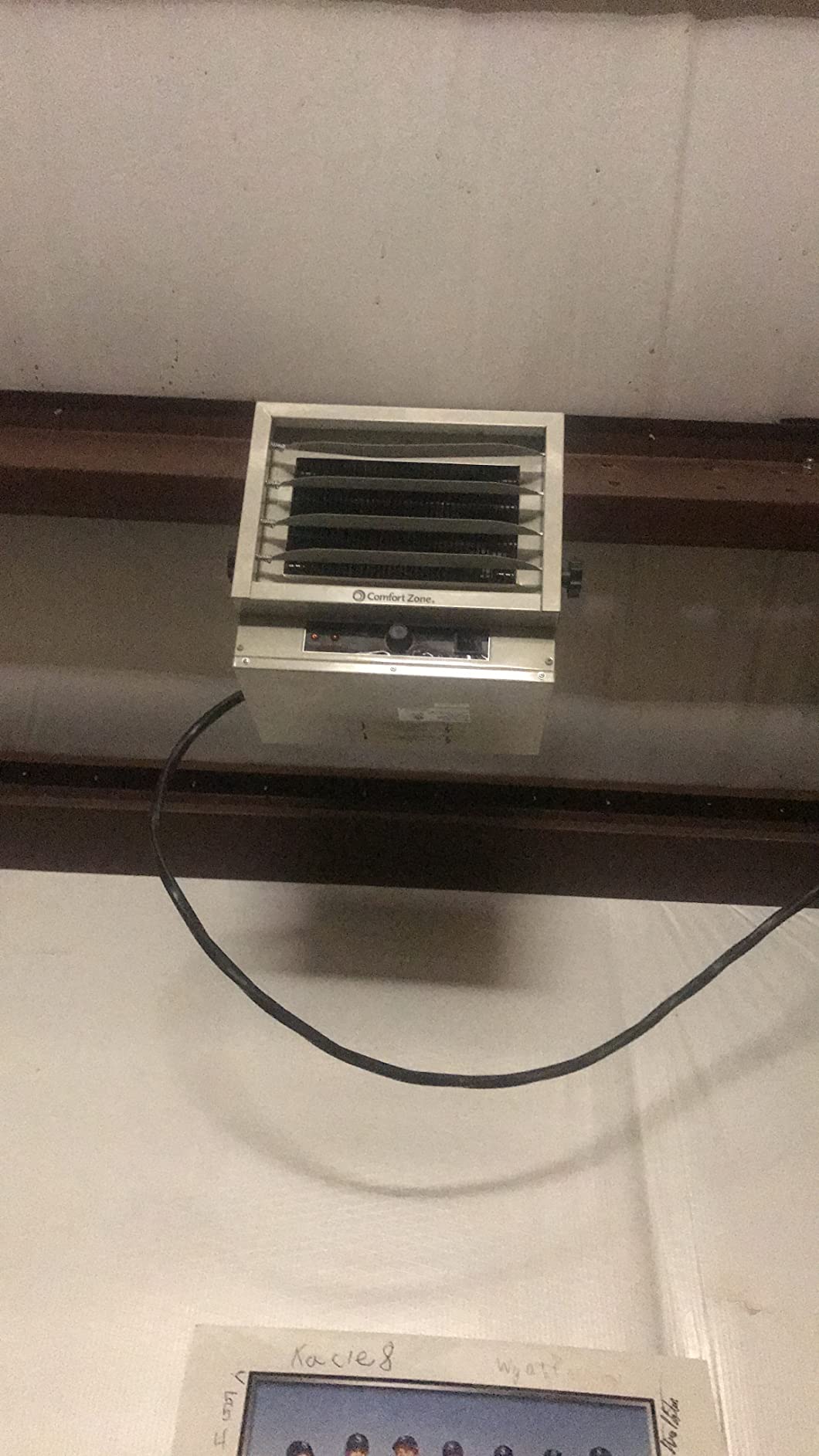
This is the only permanently installed heater on the list, and that is exactly why it belongs. At 5,000 watts on a 240-volt circuit it moves roughly 17,065 BTU of heat, with a stated coverage of about 1,000 square feet, and it hangs above head height where it cannot be kicked, bumped, or blocked by a parked car.
Ceiling mounting solves a problem that floor units create. A fan-forced heater sitting on the floor pulls cold air in along the skirting and pushes warm air out at ankle height, where it immediately rises and does nothing. Mounted overhead with adjustable louvers, the same fan directs air across the working volume.
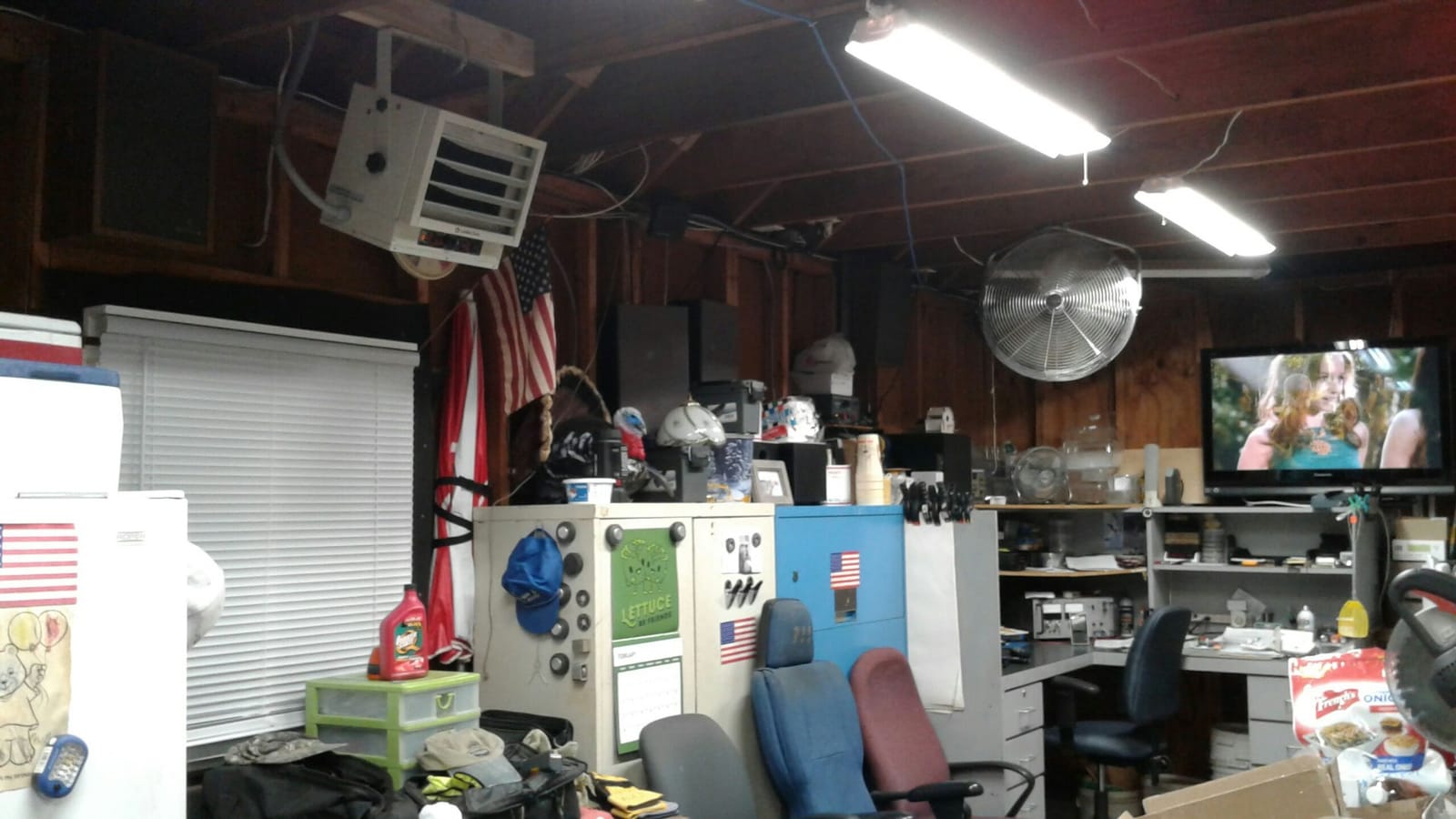
Ratings sit at 4.4 stars across 3,550 reviews, with 71% five-star. Owners in warehouses, workshops, and garages consistently mention the same three things: the steel holds up to temperature swings, the mounting angle adjustment actually helps, and the overheat sensor shuts the unit down when something goes wrong.
Be clear about the electrical commitment. At 240 volts and 20.9 amps, this needs a dedicated circuit run by someone qualified, and on a detached garage that run is often the largest single cost of the whole project. Our related guide on electric garage heaters for two-car garages walks through the wiring side in more detail.
The control situation is the main complaint in the reviews. You get a manual dual knob thermostat with quick on and off, and nothing more. No programming, no remote, no app. If you want set-and-forget scheduling, you need to add that yourself.
Where a ceiling mount beats everything else in this list
If your garage is a working shop with a car in it, floor space is the scarcest resource you have. Hanging the heater overhead returns the floor to you and keeps the discharge air above head height, where it mixes through the room instead of pooling at the ceiling.
Because the unit is fan-forced, it also moves air. In a drafty garage with an overhead door that leaks, that has a downside: the same fan that distributes heat will pull cold incoming air through the building. Seal the door edges before you rely on it.
Who should skip this heater
If your garage has no 240-volt service and adding it is not practical, this is the wrong purchase no matter how good it is. The same applies to renters and to anyone who expects to move the heater between locations. It is bolted to the ceiling.
The other case is a space heated only occasionally. Carrying an installation for a heater you run a few times a winter is rarely worth it. In that situation a portable propane unit with a tip-over shutoff is simpler and costs far less to set up.
4. Mr. Heater 30,000 BTU Vent Free Radiant Heater – Best When the Garage Has No Power
Mr. Heater 30,000 BTU Vent Free Radiant Propane Heater
Vent free radiant propane
30000 BTU
Heats up to 1000 sq ft
Indoor rated
26.3 lbs
Pros
- 30000 BTU from a vent-free cabinet heater with no vent pipe to run
- Works with no electricity at all
- Built-in adjustable thermostat and battery ignition with battery included
- Ceramic elements produce less off-gassing than an open flame
Cons
- Propane hose and regulator are not included and must be bought separately
- The optional blower fan kit is sold separately and performs poorly
- Bottom-facing inlet can pinch the hose if the unit sits directly on the floor
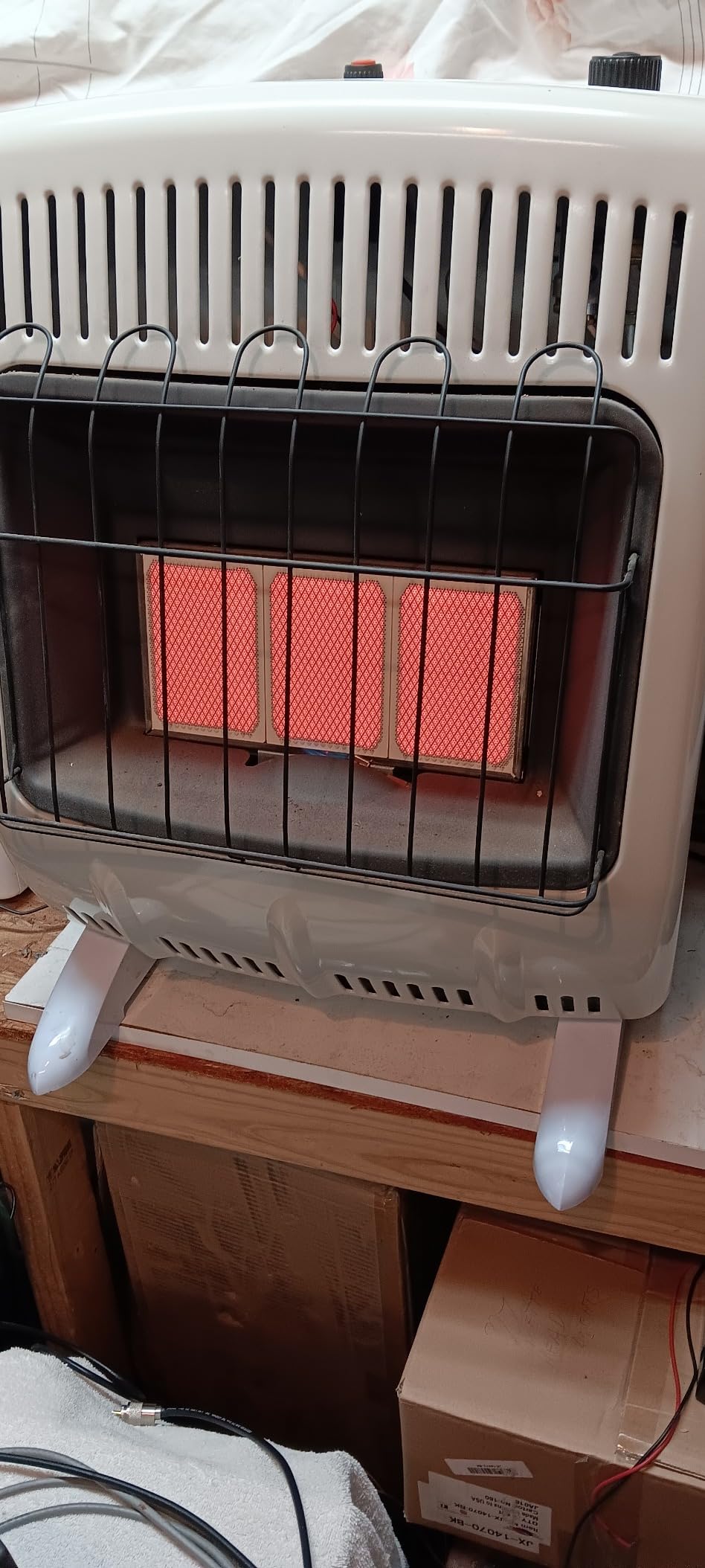
This is the answer to a specific and common problem: a detached garage, an older building, or a workshop where nobody ever ran an outlet. It needs no electricity and no vent pipe, which makes it the pick we would choose for a space with no services at all.
At 30,000 BTU it heats up to 1,000 square feet, which covers a standard one-car bay or the working half of a two-car garage. The cabinet format with a ceramic element also produces less off-gassing than an open-flame radiant unit, and that difference is felt in an enclosed space.
Ratings are 4.5 stars from 1,434 buyers, with 79% at five. Owners in older homes and cold basements report that the vent-free output genuinely heats the room, and several specifically credit the ceramic element with removing the smell that pushed them away from open-flame models.
Low oxygen safety shutoff is built in, and it is rated for indoor use. As with any vent-free combustion appliance, it carries the usual requirement for a working carbon monoxide detector and for periodic ventilation, particularly in an attached garage.
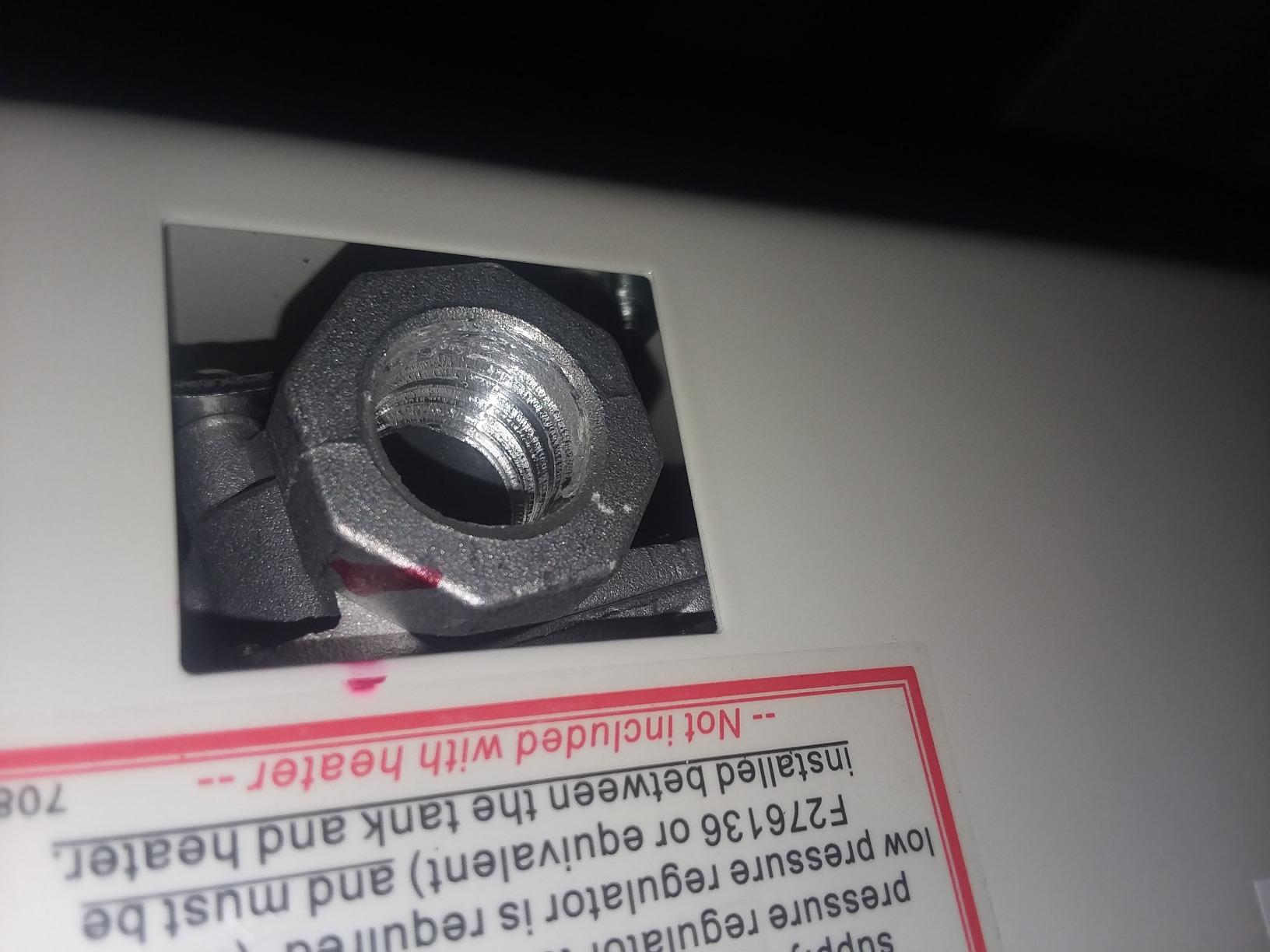
The accessory situation is the weak point. The propane hose and regulator are not included, and the optional blower fan kit is a separate purchase that reviewers say performs poorly once fitted. Factor both into your budget before ordering, and keep the unit off the floor so the bottom-facing inlet cannot pinch the hose.
Why vent-free output suits a garage better than most people expect
The usual objection to vent-free heaters is combustion efficiency, because the flue gases stay in the room. In a garage that is occupied for an hour or two at a stretch rather than lived in continuously, that trade makes sense. You get 30,000 BTU and no vent to route through a roof you would rather not cut.
Two details in the specifications matter at altitude. There is a 4,500-foot high altitude restriction, and the ignition is battery operated with the battery included. If your garage sits above that elevation, this is not the unit.
The trade-offs you are actually making
At 26.3 pounds this is the heaviest portable heater in the lineup. It is built like a small appliance rather than a tool, so it stays put once placed, and that is an advantage in a garage where the floor space is spoken for.
Some owners who are sensitive to propane off-gassing still find it noticeable, even with ceramic elements. If you are planning to run it in an attached garage with the door shut, test it on a mild day first with the door cracked and give it a week before committing to a full winter schedule.
5. Remington 60,000 BTU Forced Air Propane Heater – Fastest Warm-Up for a Big Open Bay
Remington LP Forced Air Heater, Portable 60,000 BTU Space Heater for up to 1500 Square Feet – Liquid Propane Gas Powered, Tank Not Included
Forced air propane
60000 BTU per hour
Covers up to 1500 sq ft
Continuous electronic ignition
11 lbs
Pros
- 60000 BTU covers up to 1500 square feet
- Steel body at only 11 lbs so one person can reposition it
- Variable heat settings with adjustable height
- Thermocouple
- high temp limit shutoff and flame-out fuel cut
Cons
- Very loud fan makes it a poor fit for a quiet workspace
- The electric power cord is extremely short at under one foot
- The LP fitting can need extra force to thread onto a grill tank
Sixty thousand BTU is the highest number in this roundup, and it comes with a fan. That combination makes this the heater to buy when the goal is to raise the temperature of an entire large bay, not to warm the person standing at a bench.
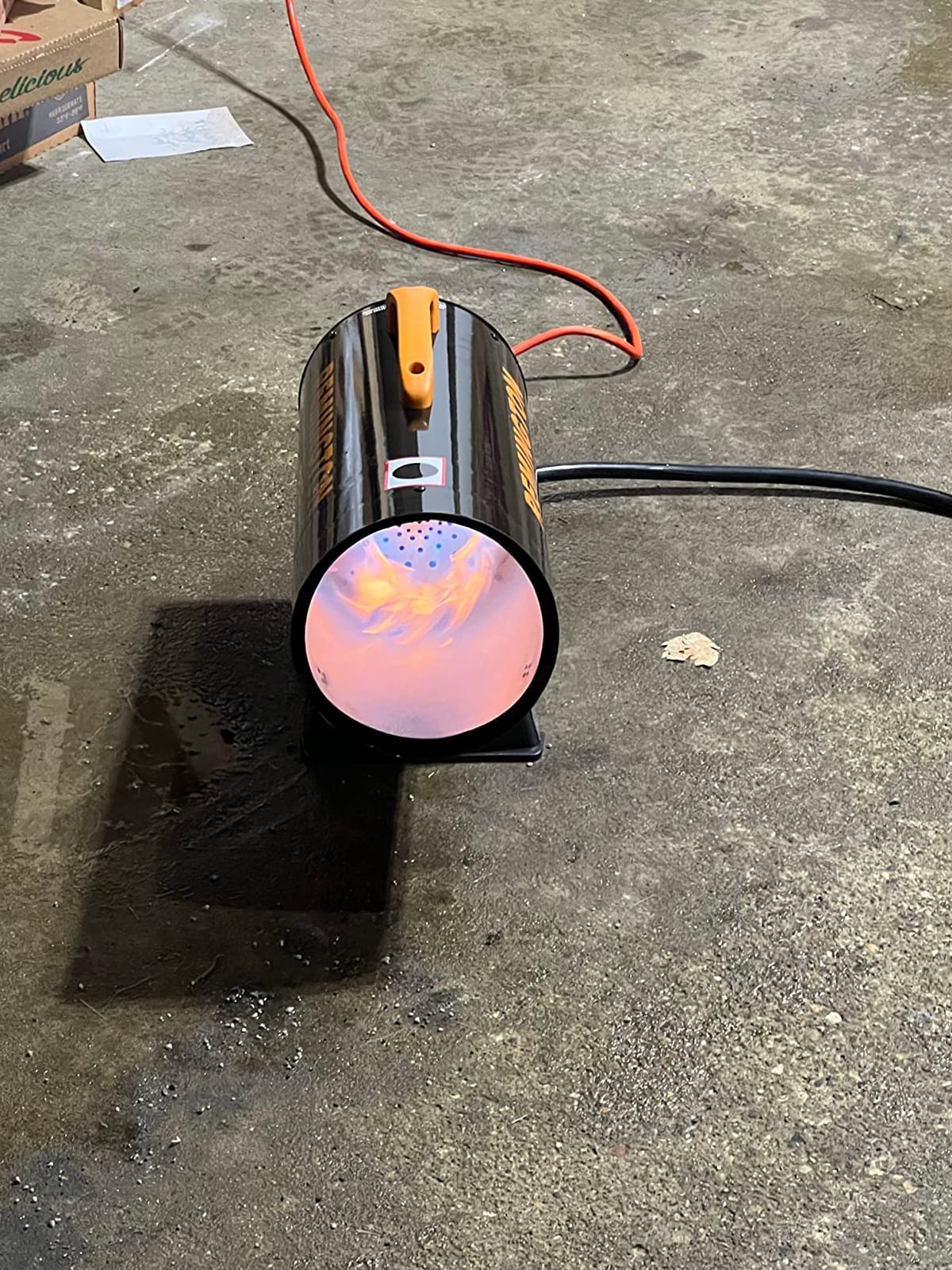
Fan-forced heaters win in large open spaces because air movement defeats the layering that leaves a garage cold near the floor. Owners report a warm-up in roughly 10 to 20 minutes in a two-car garage, which is the practical test that matters when you are trying to work in the cold.
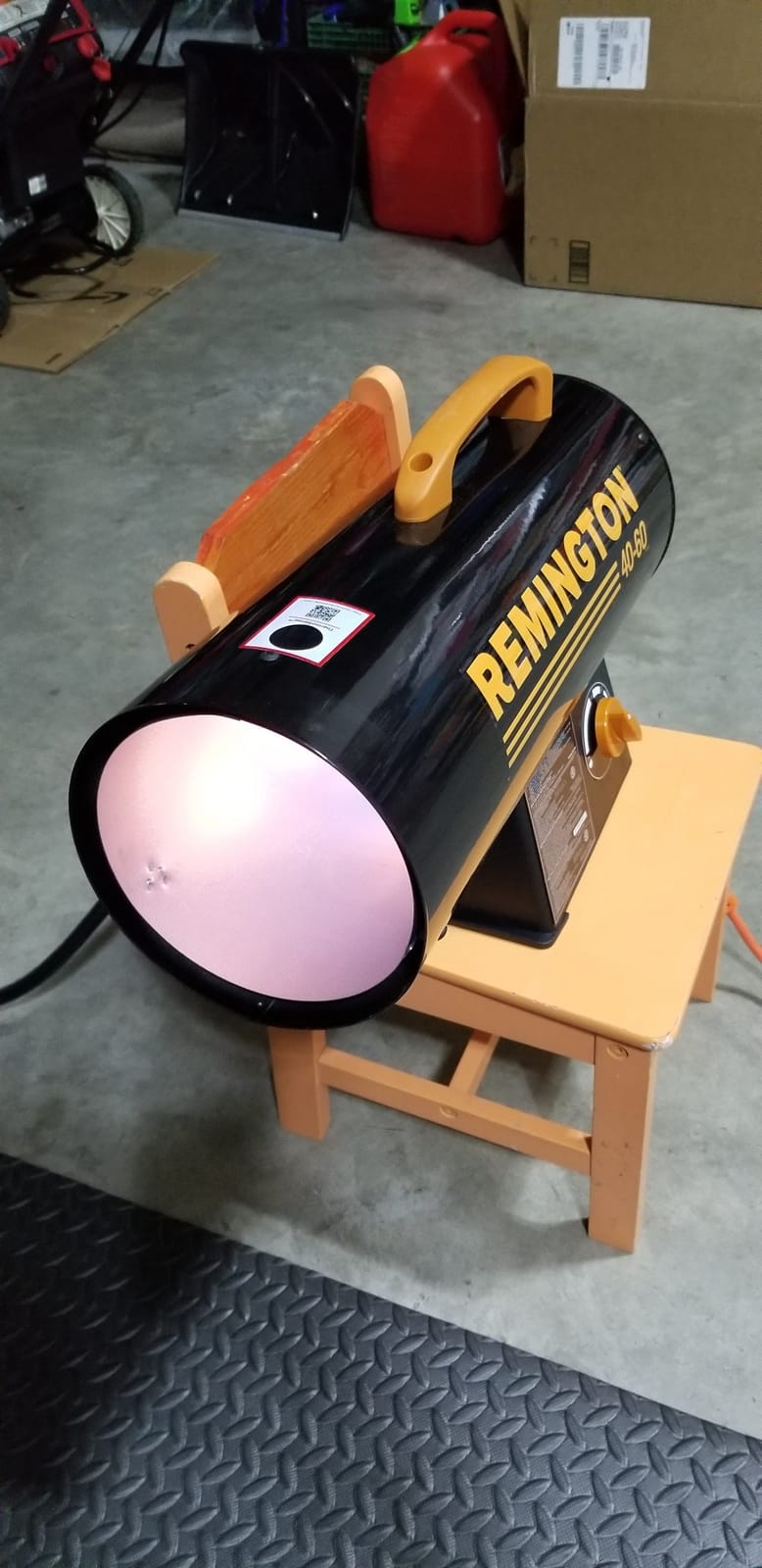
Ratings are 4.5 stars across 736 reviews, with 74% five-star. Reviewers repeatedly single out the output-to-weight ratio: a heavy steel chassis at 11 pounds that a single person can carry to the other end of the shop. Variable heat settings and adjustable height let you shape the output to the job.
The safety package is honest for a portable burner. A thermocouple, a high temperature limit shutoff, and a flame-out fuel cut all work together, and ignition is continuous electronic rather than a piezo lighter.
Noise is the complaint that comes up most often, and it is not a minor one. Forced air at this output sounds like a jet engine, which is fine for a workshop where you are wearing hearing protection anyway and a problem in a garage you use for reading or desk work.
Two smaller issues show up repeatedly. The electric power cord, which only runs the ignition, is extremely short at under a foot, so you need an extension or a nearby outlet. And the LP fitting can resist threading onto a standard grill tank the first time.
Forced air or radiant: which one wins in a garage
Forced air distributes and radiant concentrates. If you want every corner of a 1,500 square foot bay at a workable temperature, air movement wins because it removes the cold layer that sits at ankle height. If you want your hands warm at a bench in a small space, radiant wins because it puts energy exactly where you are looking.
The forum consensus we found matches that split. Owners of large, drafty spaces tend to run forced air to establish a baseline temperature, then add a small radiant unit at the bench for the last bit of comfort during fine work.
When this heater is the wrong choice
Skip it if the garage is small or well insulated. Sixty thousand BTU in a tight one-car space overshoots quickly, and the fan noise becomes the dominant experience. It is also rated for outdoor use, so it is meant for a garage bay or work area with reasonable air movement, not a sealed room.
Also consider the noise against your tolerance for it. If you plan to spend hours in the garage reading, on the phone, or running a small workshop where quiet matters, an electric infrared unit produces heat with a fraction of the sound.
6. Dr. Infrared DR-238 1,500W Infrared Heater – The Best Choice for a Garage Gym
DR. INFRARED HEATER Portable Infrared Indoor and Outdoor Space Heater for Patio, Garage, Commercial & Residential With Remote Control, Without Thermostat, Black
Infrared radiant electric
900W, 1200W or 1500W
IP55 indoor and outdoor
Wall or ceiling mount
8 lbs
Pros
- Infrared heat warms the body rather than the air
- IP55 rated for damp
- drafty garages and outdoor use
- Three wattage settings plus a remote control
- Includes wall and ceiling mounting brackets
Cons
- Highly directional so you must stand close and directly in front to feel it
- Heats objects rather than air so drafts and wind dissipate the warmth
- Mounting angle cannot be adjusted far downward and the unit runs hot
If your garage is a gym, the decision is made for you. Infrared warms objects and bodies directly rather than heating the air, so you feel the heat on your skin within seconds of walking in front of the unit. That is exactly the physics that makes cold-weather exercise in an unheated garage tolerable.
It is also the most heavily weather-rated electric heater in this roundup. The IP55 rating covers both indoor and outdoor use, which means damp floors, paint overspray, and a door left open on a mild day are not a problem. The aluminum housing is weatherproof and it weighs 8 pounds.

Ratings are 4.3 stars from 6,089 reviews, with 66% five-star. Garage, kennel, and patio owners consistently praise the fast, odorless warmth and the convenience of the remote. The reflector is mirror aluminum at 90% reflectivity, which is how it manages to project that far.
Three power settings at 900, 1,200, and 1,500 watts let you scale the heat to the session. A remote control is included, along with wall and ceiling mounting brackets so you can set the height once and leave it.
The limitation is directional heat and it is not a small one. You need to be in front of the unit and reasonably close. Because infrared warms surfaces rather than air, a steady wind through an open garage door will carry much of that energy away before it reaches you.
Two smaller notes from reviews. The mounting bracket does not tilt downward as far as some owners would like, so it needs to hang fairly high. And the remote is infrared, which means a power loss requires a physical press to turn it back on.
How to place an infrared heater so it actually works
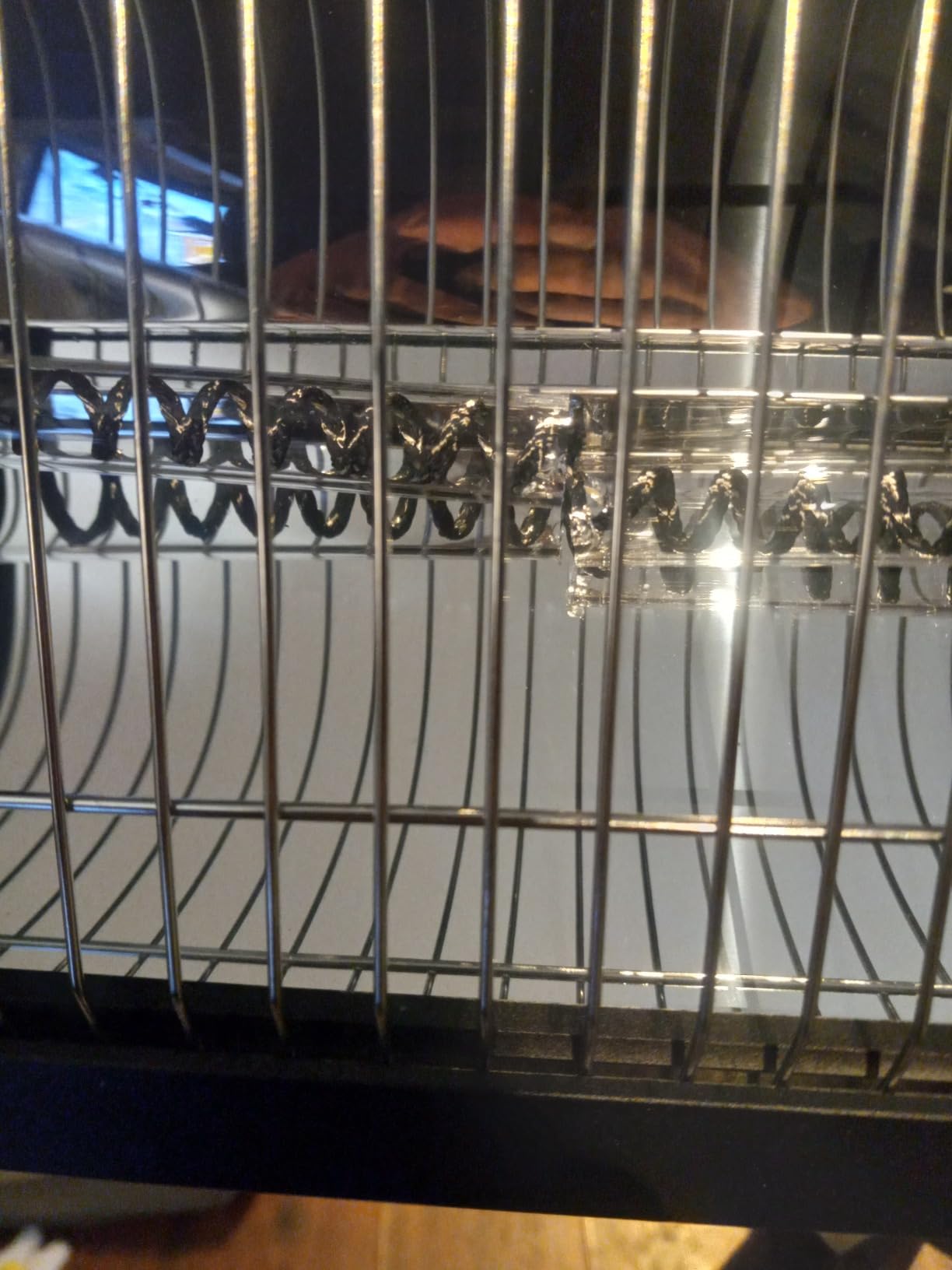
Mount it on a side wall or the ceiling, high enough that the heat cone lands on the exercise area rather than the door. In a garage gym, that usually means opposite the doorway and aimed slightly downward across the floor space you use.
Then control the drafts. Panel the insulated garage door or hang a curtain over it, and keep the unit clear of the airflow path from an open main door. Infrared loses to moving air more than any other heating method, so a gusty room is the one condition it cannot overcome.
When infrared is the wrong tool
Do not expect this heater to protect a vehicle, a paint booth, or plumbing in an unheated space. It raises the temperature of what its cone touches, and only what its cone touches. If you want a minimum temperature held overnight, you need air movement and much more BTU.
It is also a single-point comfort device. In a 400 square foot garage it will make one corner comfortable while the rest stays cold, which is fine for a gym and frustrating if you plan to use the space as a workshop. Read our electric garage heater comparison if you need something that heats air across a room.
7. Dr. Infrared DR218-1500W Greenhouse Heater – Most Versatile for a One-Car Garage
DR. INFRARED HEATER DR218-1500W Greenhouse Garage Workshop Infrared Heater, 1500-watt
Infrared and fan electric
1500 watt
Covers about 150 sq ft
IPX4 splash protected
11.5 lbs
Pros
- Compact steel build that feels sturdier than typical lightweight heaters
- Built-in thermostat cycles the unit instead of running continuously
- IPX4 splash protection suits damp greenhouse and garage floors
- Weighs only 11.5 lbs with no maintenance required
Cons
- Single 1500W setting with no wattage options
- Not enough to hold temperatures in single-digit weather
- Heat throw is roughly eight feet
- Fan noise is present though tolerable
This is the smallest heater in the lineup and the easiest to justify. At 1,500 watts on standard 120V with a 150 square foot rating, it is honest about what it is: a spot heater for a small work area, a one-car bay, or a corner of a workshop where you sit down to do detailed work.
The build is the surprise. Buyers describe the housing as heavier and more solid than the lightweight heaters they tried first, and the IPX4 splash protection makes sense in a garage where condensation and damp floors are normal. It also has low maintenance needs, which matters for something you run seasonally.
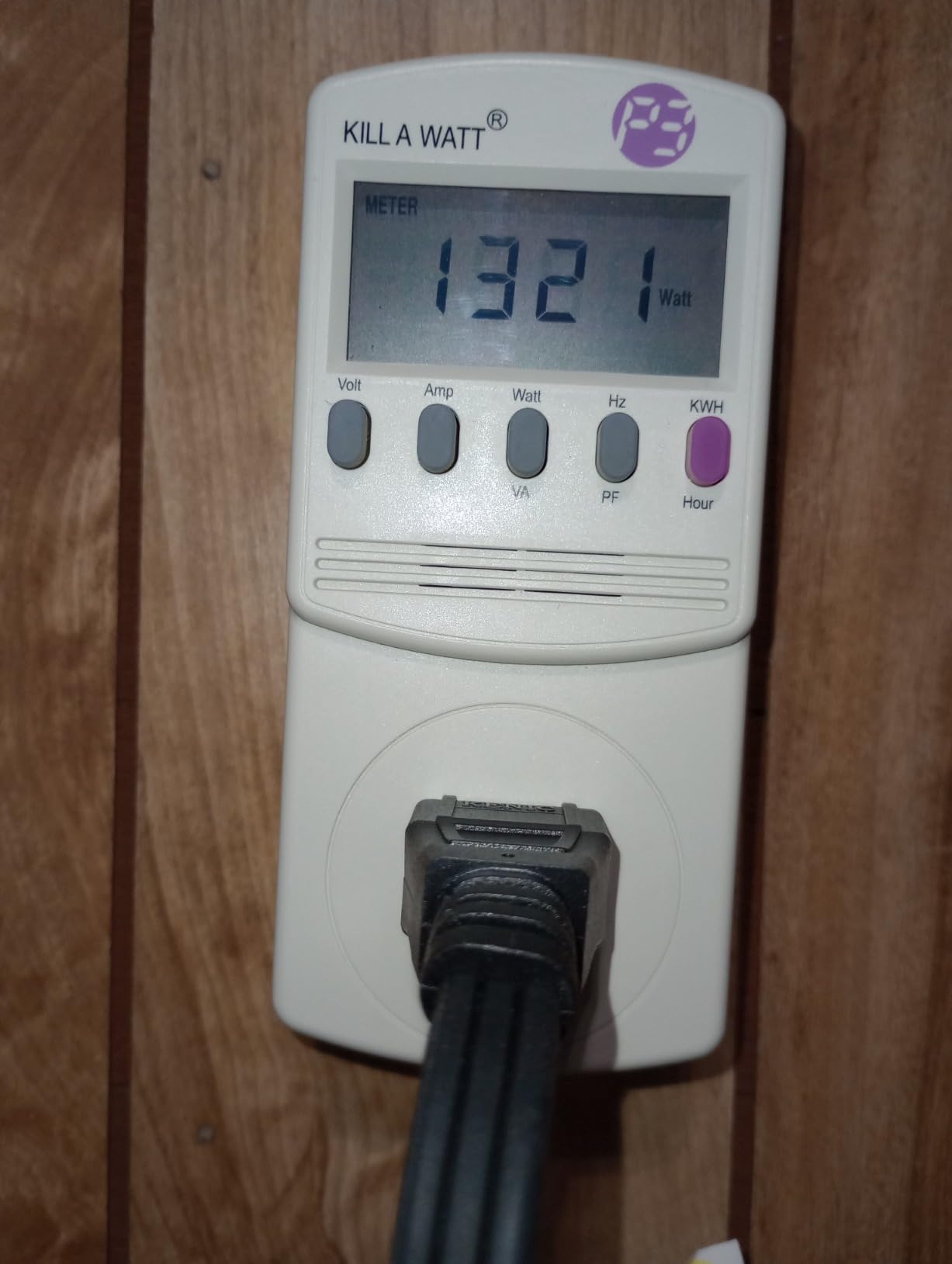
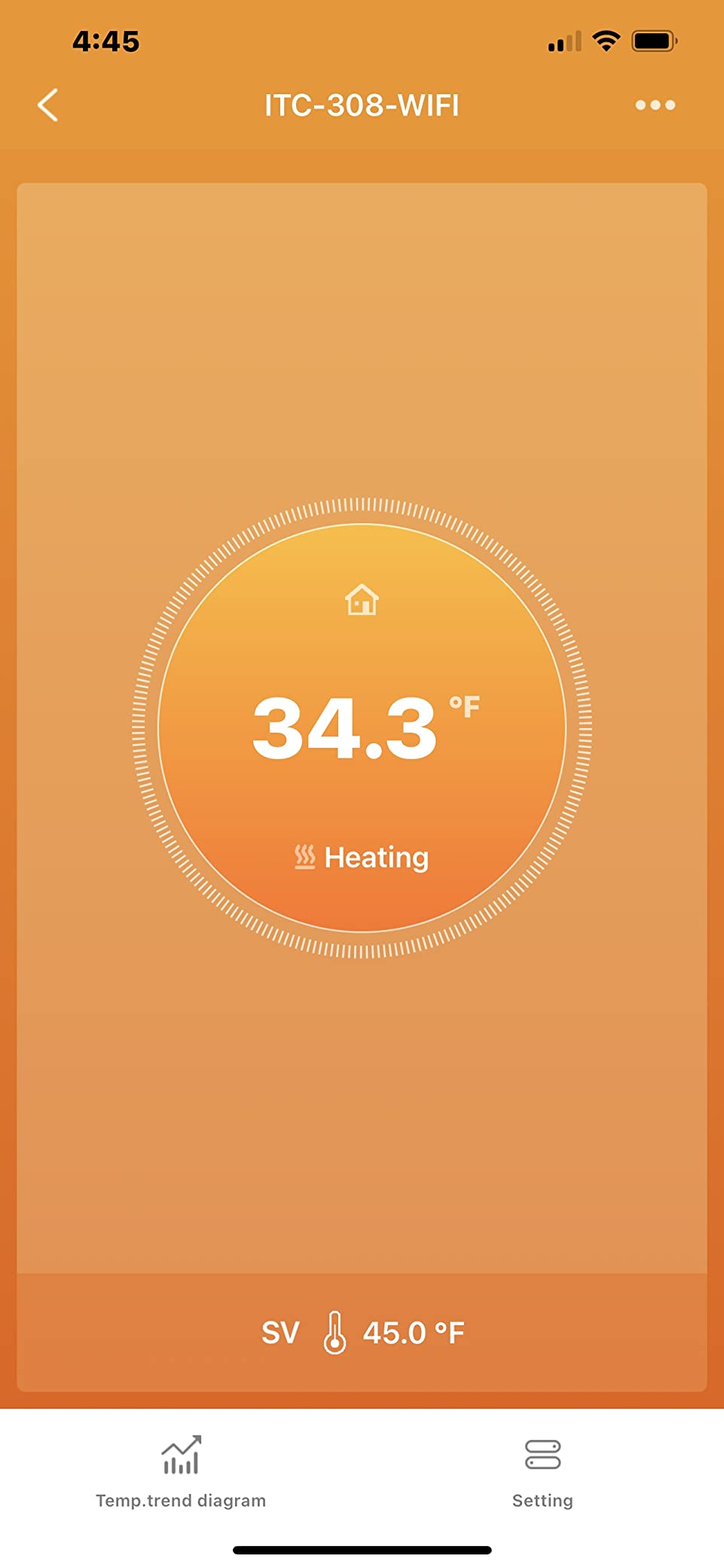
Ratings sit at 4.2 stars across 881 reviews, with 68% five-star. The most useful report we found describes owners raising a one-car garage from the mid-30s into the mid-60s overnight, which is a realistic outcome for a well-insulated single bay with the door closed.
Unlike many basic heaters, the built-in thermostat actually cycles the unit correctly instead of running continuously. That single feature is what separates a 1,500-watt heater that is manageable from one that simply runs all night at full output.
The design combines radiant elements with a fan, so you get some air movement as well as direct warmth. The limits are equally clear: one wattage setting with no options, a heat throw of roughly eight feet, and no ability to hold temperatures in single-digit weather.
One documented report of thermostat wiring burnout leading to two fires over roughly two years appears in the reviews. It is a single account against 881 ratings, but it is a reminder to check the cord and unit periodically rather than leaving any portable heater unattended indefinitely.
Where this heater earns its place
Treat it as personal comfort heat rather than space heat. Sitting at a desk, a drafting table, or a bench in an otherwise cold garage, it warms you and the surface you are working on. It is also a cheap way to test whether a 120V electric heater works at all in your space before you invest more.
Its 150 square foot rating is the honest limit. Owners note a heat throw of about eight feet from the front of the unit, so position it close to where you sit rather than across the bay hoping the warmth spreads.
Who should look past this one
If you need the whole garage above 50 degrees, this will not get you there and will run continuously trying. The same is true anywhere the winter regularly sits in single digits, since the review data is explicit that this unit cannot hold temperature in that range.
For those situations, step up to the forced-air propane option for raw output or the ceiling-mounted electric unit for set-and-forget coverage. If the goal is only to be warm at one spot, this is where you stop paying for more capacity you would not use.
How Many BTUs Do You Need? A Sizing Guide by Garage Size
Start with a number and work backward. Measure the floor area in square feet, then multiply by 10 watts per square foot for a well-insulated garage with insulated walls, a ceiling, and an insulated overhead door. That gives you the wattage for a 120V electric unit. Divide watts by 1,000 and multiply by 3,412 to convert to BTU.
A common rule of thumb for combustion heating in a garage is 45 BTU per square foot of floor area. That gives roughly 18,000 BTU for a 400 square foot two-car garage and about 26,000 BTU for a 576 square foot three-car space, before any adjustment for the building.
That is the number we would use for a 20×20 garage: 400 square feet, so about 18,000 BTU from gas or propane, or a 4,000-watt electric unit. For a 24×24 garage, also 576 square feet, plan on roughly 26,000 BTU or about 5,000 to 6,000 watts of hardwired electric.
Now adjust for the building itself, because a bare garage and an insulated one are different problems. Insulating the walls and the overhead door can cut the heater size you need by 40 to 50 percent. That is a larger saving than most people expect, and it is why we would spend money there before spending it on a bigger burner.
Ceiling height matters too. Warm air rises, and a 10-foot ceiling with an unfinished deck above it loses more heat than a 9-foot insulated ceiling. Older buildings also leak around the overhead door and the service door more than their square footage suggests, which pushes the required output up.
Finally, decide what you are heating. Maintaining a minimum of 40 to 45 degrees to protect a vehicle or plumbing needs far less than working at a bench in 60-degree comfort all afternoon. Sizing for the harder of those two goals is the safe mistake to make.
Electric vs Propane vs Natural Gas vs Kerosene: Which Fuel Wins in a Garage
Electric needs nothing but a circuit. Installation is simple, there is no combustion and therefore no carbon monoxide, and there is no fuel to store or refill. The trade is capacity and cost: 120V limits you to 1,500 watts, which is spot heat, while useful 240V output needs a dedicated circuit that can be the most expensive part of the project in a detached building.
Propane delivers far more heat per unit of effort and works with no electricity at all, which makes it the standard choice for off-grid and detached spaces. It stores fuel in cylinders you refill, needs no vent when you choose a vent-free cabinet model, and carries the trade that combustion means carbon monoxide and a ventilation requirement.
Natural gas costs less per hour to run and needs no tank, but it is also the only option on this list with a real installation. A gas line, meter, and code-compliant unit heater is a project for a licensed installer, and it only makes sense in a space you intend to heat for many seasons every year.
Kerosene burns efficiently and stores densely, but owners consistently report the smell as a dealbreaker in attached garages, and availability is now limited in many regions.
Within the fuel choice, two sub-decisions shape everything else. The first is 120V versus 240V electric: 120V means plug-in convenience and about 1,500 watts, while 240V means roughly triple the output and a hardwired circuit. The second is infrared versus forced air: infrared warms you and your work surface directly and quietly, while forced air moves heat through the whole room and warms the air itself.
Both electric and gas categories have vents and connection requirements worth understanding before purchase. Combustion units are either vent-free, which stay inside the room and need a carbon monoxide detector, or power-vented and direct-vented, which exhaust outdoors through a concentric vent pipe and are more efficient. Electric units need no venting whatsoever.
Garage Heater Safety: Carbon Monoxide, Venting and Placement Rules
The single most important rule is that you need a working carbon monoxide detector inside the garage, mounted on the ceiling or high on a wall. Carbon monoxide is slightly lighter than air, so a detector near the floor can miss it. This applies to every propane and kerosene heater on this list, vent-free or not.
Ventilation is the second rule. Any combustion heater in a garage needs fresh air, and in an attached garage that means opening the overhead door or providing a permanent low and high air exchange. People on garage forums who run propane heaters with the door closed in an attached space are taking on risk they do not fully understand.
Placement is the third. Give every heater the clearance its manual specifies from combustible material, and remember that a garage is full of it: cardboard boxes, sawdust, paper, rags, solvents, and plywood offcuts. Ceiling-mounted electric units must hang far enough above the floor that a vehicle cannot reach them.
Look for specific safety hardware when you shop. Tip-over protection shuts a portable heater off when it is knocked over. Low oxygen depletion sensors close the fuel valve when combustion air falls below a safe level. Overheat sensors cut power before a fan-forced unit overheats. High temperature limit shutoffs and flame-out fuel cuts do the equivalent job on burners.
Finally, do not leave a portable heater running unattended overnight. Several reviewers describe leaving a heater on while they sleep or while leaving the house, and that is the pattern behind nearly every heater fire story we found in the forums. A timer or a smart plug gives you a cutoff without relying on memory.
Frequently Asked Questions
How many BTUs do I need to heat a 20×20 garage?
A 20×20 garage is 400 square feet. Using the common garage rule of 45 BTU per square foot, you need about 18,000 BTU from a propane or natural gas heater. For electric, that works out to roughly 4,000 watts on a 240V circuit. If your walls, ceiling, and overhead door are insulated you can often size down by 40 to 50 percent.
Is it okay to use a space heater in a garage?
Yes, with the right model and setup. Choose a heater rated for the space, keep the clearance distances its manual specifies from cardboard, wood, and sawdust, and never run a combustion heater in a closed attached garage. A ceiling-mounted or wall-mounted unit is safer than a floor unit because it cannot be knocked over or blocked by a vehicle.
Can I use a propane heater in my garage?
Yes, provided it is rated for indoor use and the garage has ventilation. Install a carbon monoxide detector on the ceiling or high on a wall, keep the overhead door open or provide air exchange, and check the low oxygen depletion sensor works. Heaters labelled outdoor use only must never be run indoors, and a vent-free cabinet model needs no vent pipe.
How much does it cost to run a 2000 watt heater for 24 hours?
A 2,000 watt heater draws 2 kWh per hour, so running it for 24 hours uses 48 kWh. Multiply that by your utility rate per kWh: at 15 cents per kWh it is about 7.20 a day, and at 35 cents it is about 16.80 a day. Multiply by 30 for a monthly figure. That is why propane or natural gas is usually less expensive for heating an entire garage continuously.
What size heater do I need for a 24×24 garage?
A 24×24 garage is 576 square feet. At 45 BTU per square foot that is about 26,000 BTU from a combustion heater, or roughly 5,000 to 6,000 watts of hardwired 240V electric. Insulating the walls and overhead door can cut that requirement by nearly half, which is usually a better investment than a larger heater.
What is the most efficient way to heat a garage?
For occasional use on a budget, a portable propane radiant heater is the lowest-cost option. For everyday use in a large space, natural gas costs less per hour but needs a professional gas line installation. Electric is clean and simple but limited by your circuit. Insulating the garage door and walls saves more than any heater upgrade, often reducing the required size by 40 to 50 percent.
Is infrared or forced air better for a garage?
Infrared is better for you personally. It heats your body and work surface directly, runs quietly, and reaches you within seconds, which makes it the right pick for a garage gym. Forced air is better for the room. It moves heated air through the space and defeats the cold layer that collects at floor level, which is what you want for a workshop with benches across the whole bay.
Do garage heaters need to be vented?
It depends on the type. Electric heaters need no venting at all. Vent-free propane and kerosene models exhaust into the room by design and therefore require a carbon monoxide detector plus good ventilation. Power-vented and direct-vented gas heaters exhaust outdoors through a vent pipe and are more efficient, but they cost more and need a roof or wall penetration.
Final Verdict: Which Garage Heater Should You Buy in 2026
The Mr. Heater Buddy 9,000 BTU radiant propane heater is our pick for the best space heaters for garages in 2026, and it is not a close call. It is rated for indoor and outdoor use, carries a low oxygen safety shutoff, weighs 7.1 pounds, and has been validated by more than 29,000 buyers at an average of 4.7 stars. For a work corner, a one-car bay, or a garage you heat on weekends, it is the simplest thing that works.
Match it to your space and the choice gets clearer. If you want raw radiant output across an open bay and the garage has good air movement, the 45,000 BTU Mr. Heater tank top model is the highest radiant output you can carry by hand. If the garage has no electricity at all, the 30,000 BTU vent-free Mr. Heater cabinet needs nothing but a propane cylinder. If you want the floor space back and you have a 240V circuit, the Comfort Zone ceiling mount runs all season without a refill.
Two final pieces of advice came up again and again in the forum discussions we read while putting this together. First, insulate the garage door and walls before you buy a bigger heater, because that change alone can halve what you need. Second, buy a carbon monoxide detector whatever fuel you choose, and mount it high on a wall or on the ceiling.
Check the current details for each model below, and pick the one that matches the size of your garage and the way you actually use it.
Related: outdoor heaters for garages and patios and evaporative coolers for garages for the other half of the year.