
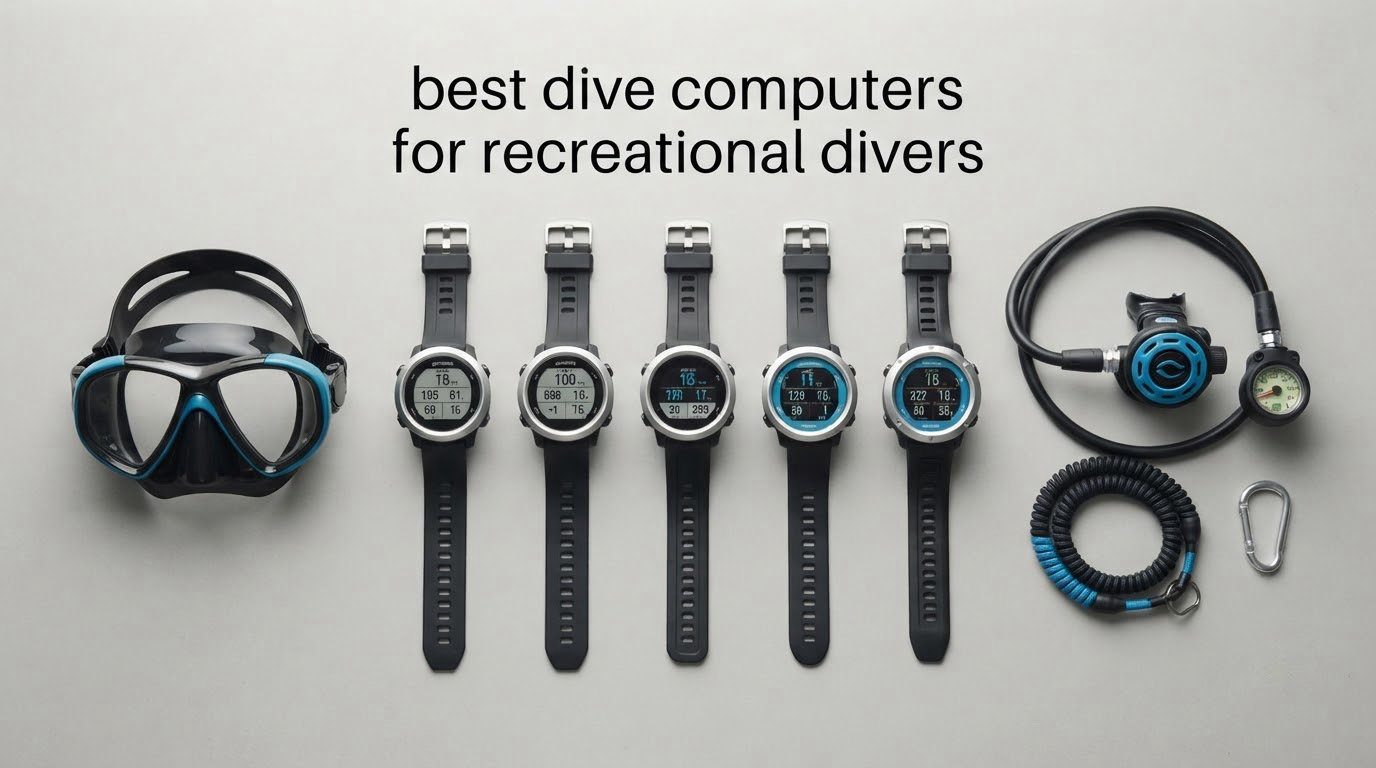
A recreational diver needs a computer that tracks depth and bottom time, recalculates your no-decompression limit in real time, and keeps your tissue-loading data between dives. After comparing 12 models on the things that actually decide the purchase — screen readability, battery type, algorithm, and wrist bulk — the Shearwater Peregrine comes out on top for most people. Dive planning, buying guides and kit choices all feed into the same decision, and the same gear logic applies if you are choosing underwater camera housings or dive lights for underwater photography.
This is the best dive computers for recreational divers guide for 2026. We looked at every unit that dominates the recommendation threads divers actually read, weighted the specs that change day-to-day usability above the headline features, and kept the list honest about the compromises each one makes.
Two things shape almost every decision below. The first is battery strategy: a sealed rechargeable cell is convenient until the morning of a nine-dive liveaboard trip when it dies. The second is readability at 20 metres in low visibility, which is where a large high-contrast display earns its price.
Table of Contents
Top 3 Dive Computers for Recreational Divers in 2026
Shearwater Peregrine
- 2.2 inch full color display
- Two-button state-aware navigation
- Multi-gas with NDL and deco planners
- About 30 hours per charge

Cressi Leonardo 2.0
- Air Nitrox and Gauge modes
- Single-button control
- USB and infrared transfer

Shearwater Peregrine TX
- Optional Swift transmitter pairing
- 2.2 inch color screen
- Tilt compensated compass
- About 30 hours of diving
Best Dive Computers for Recreational Divers (October 2026)
Every unit below is a real dive computer with published specifications, not a fitness band dressed up as one. Read the feature column before you read my verdict — two of these are aimed at completely different divers.
| Product | Specifications | Action |
|---|---|---|
| Shearwater Peregrine |
|
Check Latest Price |
| Cressi Leonardo 2.0 |
|
Check Latest Price |
 Cressi Donatello Cressi Donatello |
|
Check Latest Price |
 Cressi Giotto Cressi Giotto |
|
Check Latest Price |
| Shearwater Peregrine TX |
|
Check Latest Price |
 Shearwater Teric Shearwater Teric |
|
Check Latest Price |
 Garmin Descent Mk3i Garmin Descent Mk3i |
|
Check Latest Price |
 Garmin Descent G2 Garmin Descent G2 |
|
Check Latest Price |
 Suunto D5 Suunto D5 |
|
Check Latest Price |
 Mares Puck 4 Mares Puck 4 |
|
Check Latest Price |
 Suunto Ocean Suunto Ocean |
|
Check Latest Price |
 Mares Puck Lite Mares Puck Lite |
|
Check Latest Price |
1. Shearwater Peregrine – Best Dive Computer Overall
Shearwater Research Peregrine Dive Computer
2.2 inch full color LCD
120 m water resistance
About 30 hours per charge
2 year warranty
Pros
- Exceptionally bright large color display that reads well underwater
- Quick setup most divers report needs no manual
- Rechargeable battery lasting many multi-dive days
- Reliable cloud app for downloading and reviewing logs
- Multi-gas NDL and decompression planners included
Cons
- Display surface scratches easily without a protective sheet
- No air integration and no digital compass on this model
- Higher price than entry-level single-button computers
The Peregrine is the one I keep coming back to because it does the two things that matter most without asking you to learn anything complicated. Setup is a two-button walk-through that most owners finish without opening a manual, and the 2.2 inch full color LCD stays legible at depth in a way the small monochrome screens simply cannot match.
Reviewers consistently name readability underwater as the reason they own it, alongside roughly 30 hours of battery per charge and smooth log syncing to the Shearwater cloud app. At 483 ratings averaging 4.7 stars with 88 percent five-star feedback, that consensus is unusually clean for a dive computer.
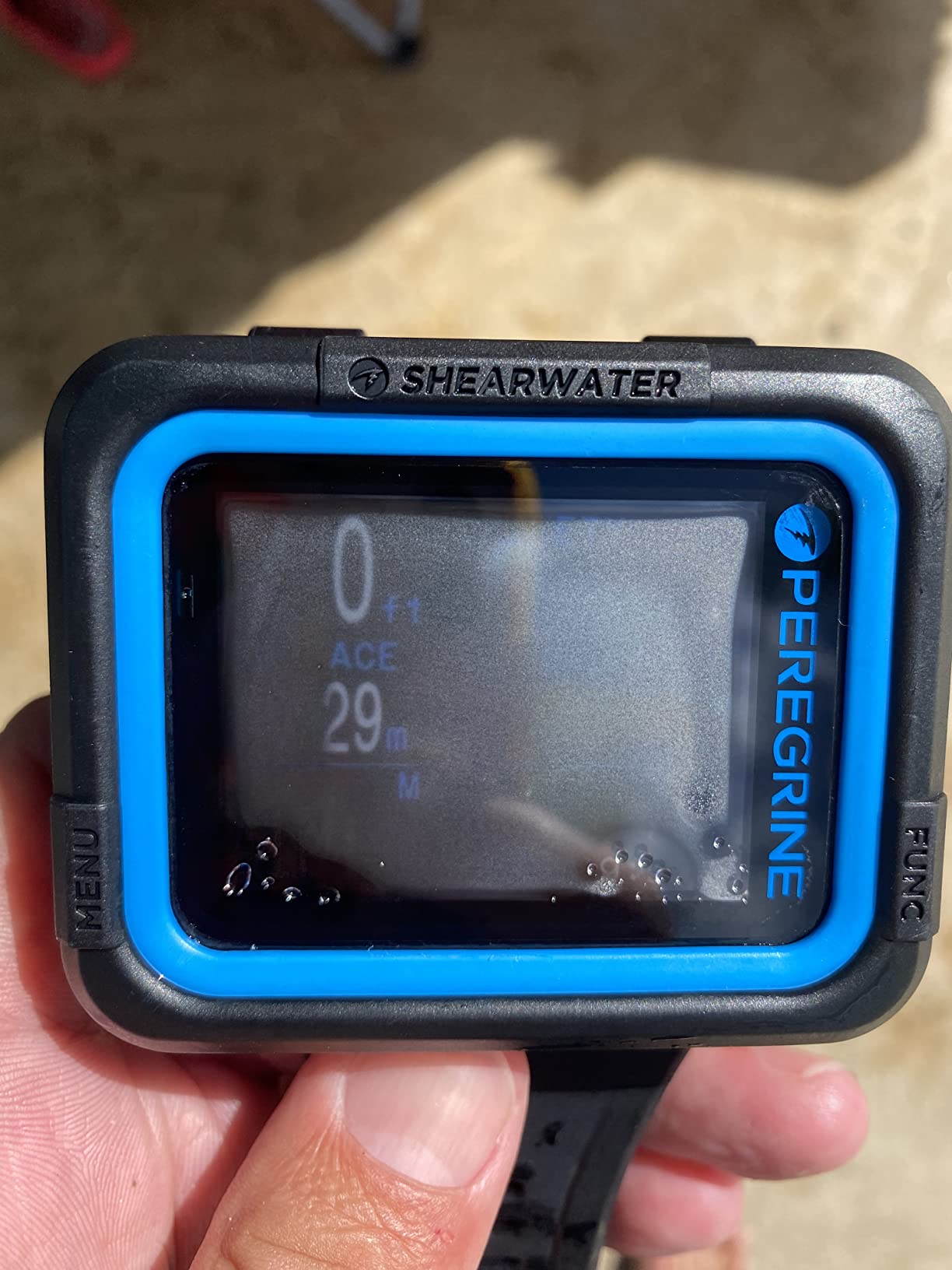
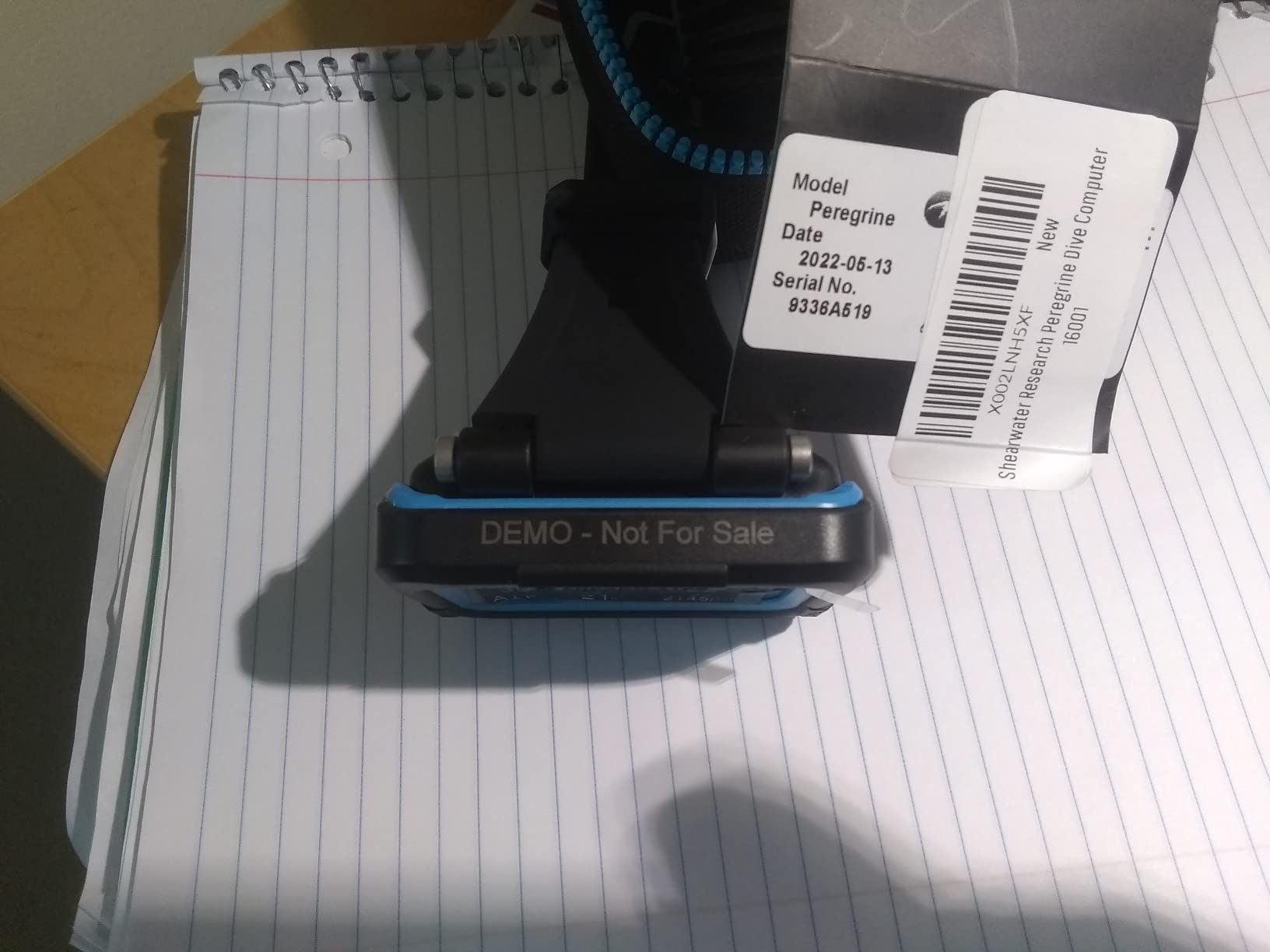
Technically it runs multi-gas modes with both an NDL planner and a decompression planner, holds 32 MB of storage, and carries a 120 m water resistance rating with a stainless steel case and 316 stainless buttons. Connectivity is Bluetooth plus USB with wireless charging, and the whole thing weighs 122 g, which disappears under a wetsuit cuff.
The honest catch is the display surface. It scratches easily without a protective sheet, and this model has no air integration and no compass. If you navigate by compass rather than by sight line, the Peregrine TX below is the version to buy instead.
What you get for the money
You get a color screen, multi-gas capability and cloud logging in a package that sits well below the premium titanium watches. Shearwater backs it with a 2 year warranty, which is double what Garmin offers on its dive models, and the brand holds resale value well enough that forum buyers treat it as a buy-once decision.
Where it falls short
For a pure recreational diver who never touches a transmitter, the missing compass is a real omission on surface navigation days. And if you are the type who scratches everything, buy the screen protector at the same time. A gauge or freedive mode enthusiast should look at the Mares Puck 4 instead, which does the same job for less.
2. Cressi Leonardo 2.0 – Best Budget Dive Computer
CRESSI Leonardo 2.0 G2 Dive Watch, One-Button Air Nitrox Gauge, White/Black
44 mm LCD screen
Air Nitrox and Gauge modes
70 hour battery
2 year warranty
Pros
- Very large review pool from long-term recreational divers
- Single-button interface keeps underwater operation simple
- Supports Air Nitrox and Gauge modes
- Audible and visual alarms for critical data
- USB and infrared transfer to computer and phone apps
Cons
- Small monochrome LCD screen with limited detail compared with color models
- Button-driven menus require practice to learn
- Non-rechargeable battery style limits long-term use convenience
With 3567 ratings the Leonardo is the most thoroughly reviewed dive computer on this list by a wide margin, and the reviews tell a consistent story: divers buy it because it is simple, dependable and cheap to keep running. It is the archetypal first computer, and the single button means you can operate it in gloves with no learning curve.
It runs Air, Nitrox and Gauge modes, and both audible and visual alarms cover the critical numbers. Log transfer works over USB and infrared into iOS and Android apps, which is more than most single-button computers at this level manage.
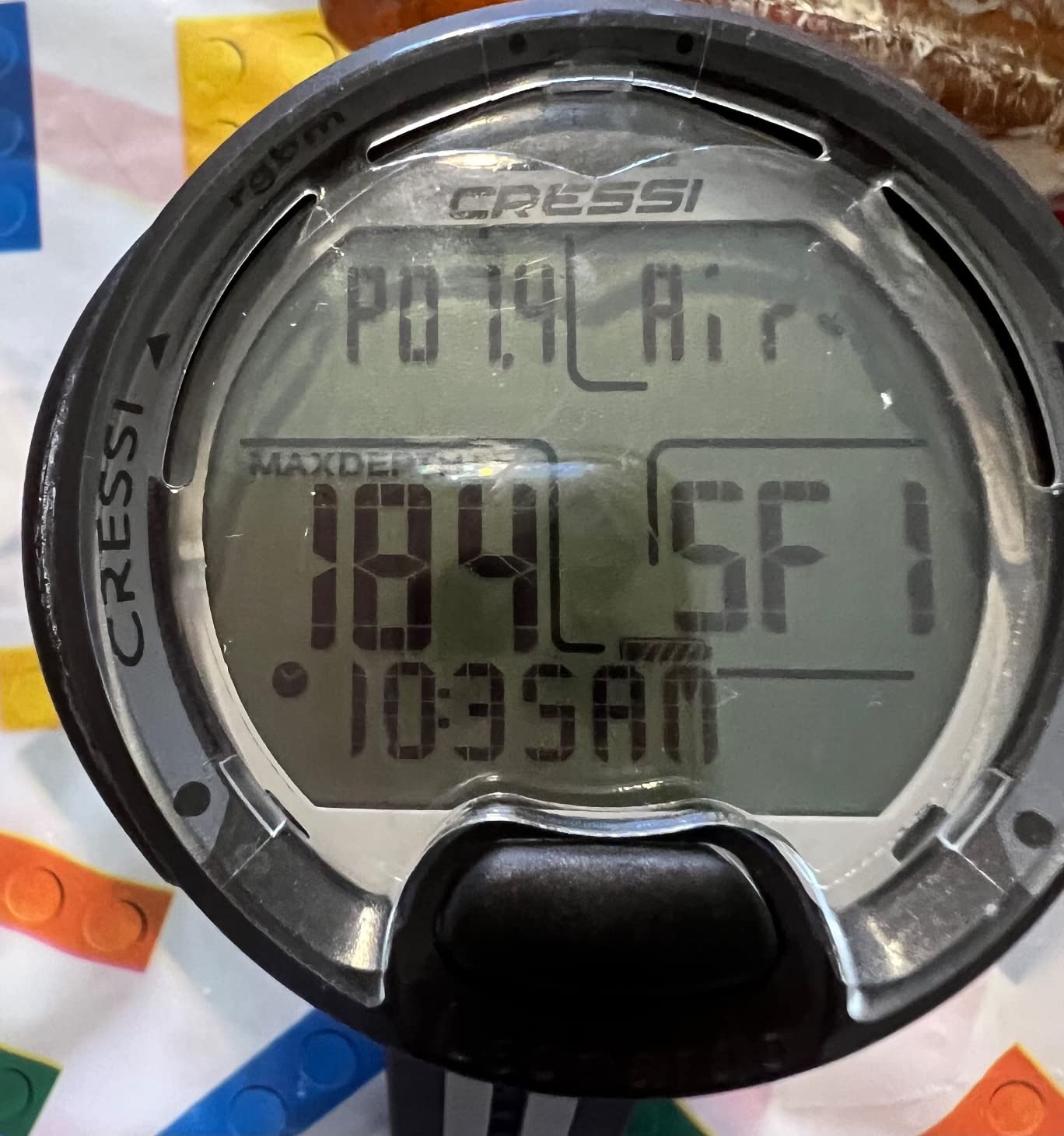
Specs are modest but honest: a 44 mm LCD, a plastic case with a silicone band, IPX8 waterproofing, and a stated battery life of 70 hours. The 4.2 star average with 67 percent five-star and 9 percent one-star feedback reflects a device that does its job without impressing anyone.
That is exactly why it works. Forum threads about first computers keep circling back to this kind of unit because nothing here can fail quietly. If your diving is one trip a year on calm water, this is the least money you can spend and still get a real instrument.
What you get for the money
You get three dive modes, a 70 hour battery that outlasts most sealed rechargeable rivals over a full trip, and a 2 year limited warranty. The single button is a genuine advantage underwater, not a compromise, because you can find the right number without looking at a menu tree.
Where it falls short
The monochrome screen carries far less information than a color display, so there is no at-a-glance gas or profile view. The button-driven menus need a few dives before they feel natural, and the audible alarm is loud enough that some owners describe it as almost disturbingly loud. Divers who want a log you can actually study later should step up to the Peregrine.
3. Cressi Donatello – Best for Scuba and Freedive Sessions
CRESSI Donatello Scuba Dive Computer, Single-Button Interface, Black/Yellow
1.85 inch digital display
150 m water resistance
Infrared connectivity
2 year warranty
Pros
- Handles both scuba and freedive sessions on one device
- Single-button control keeps glove-friendly operation simple
- Deep stop and ascent planning options add flexibility
- Saltwater calibration suits open-water diving
- Solid 4.4-star average across 608 ratings
Cons
- Infrared-only data transfer instead of Bluetooth
- Basic monochrome display with limited information density
- Menus can be unintuitive before you learn the button sequences
If you split your season between scuba and freediving, the Donatello handles both on one device without a mode fight. The single button stays glove-friendly, and the freedive gauge mode is a real feature here rather than a line in a spec sheet.
At 608 ratings and a 4.4 star average with 73 percent five-star, the Donatello holds the strongest score of the single-button Cressi units in this roundup. Owners mention easy switching between air and nitrox, usable deep stop planning and dual scuba and freedive use as the recurring positives.
What you give up is connectivity. Data moves over infrared rather than Bluetooth, so log review happens through Windows and Mac software rather than a phone app. The screen is a basic monochrome round display with limited information density, and the menu structure takes practice before it stops feeling awkward.
What you get for the money
You get user-selectable deep stops for ascent planning, saltwater calibration for open-water work, and a 150 m water resistance rating on a 320 mAh cell. The 2 year warranty and 4.4 star average make it a safer first purchase than most of the field.
Where it falls short
Infrared-only transfer is the dealbreaker for anyone who wants their log on a phone. The case weighs 250 g, which is heavy for a freedive computer, and the bulk is a problem if it also has to live on the same wrist as your dive computer. A freedive-first diver should look at the Mares Puck Lite instead, which is much smaller.
4. Cressi Giotto – Best for Altitude and Nitrox Flexibility
CRESSI Dive Computer, Giotto, 70 hr Logbook, Altitude Diving, Black/Pink
6.7 cm LCD display
393 foot depth capability
Three gas mixes
2 year warranty
Pros
- Supports up to three nitrox mixes with wide 21-99 percent O2 programming
- Very readable underwater even on deep dives
- Altitude adjustment makes it usable at mountain lakes
- 70-hour logbook with easy PC download
- Replaceable widely available battery
Cons
- Large case can overhang smaller wrists
- Protective face cover is not removable and traps water droplets
- Dim backlight and a menu structure that needs practice
The Giotto is the pick for anyone who dives above sea level or who wants the widest gas programming range in the group. It handles up to three nitrox mixes per dive with oxygen fraction adjustable from 21 to 99 percent, and it supports altitude diving for high-elevation lakes.
Owners also praise how readable it stays underwater even on deeper dives, and the 70 hour logbook downloads over USB to a PC. The replaceable battery is a common travel-friendly point: no charger, no dock, no anxiety before a trip.
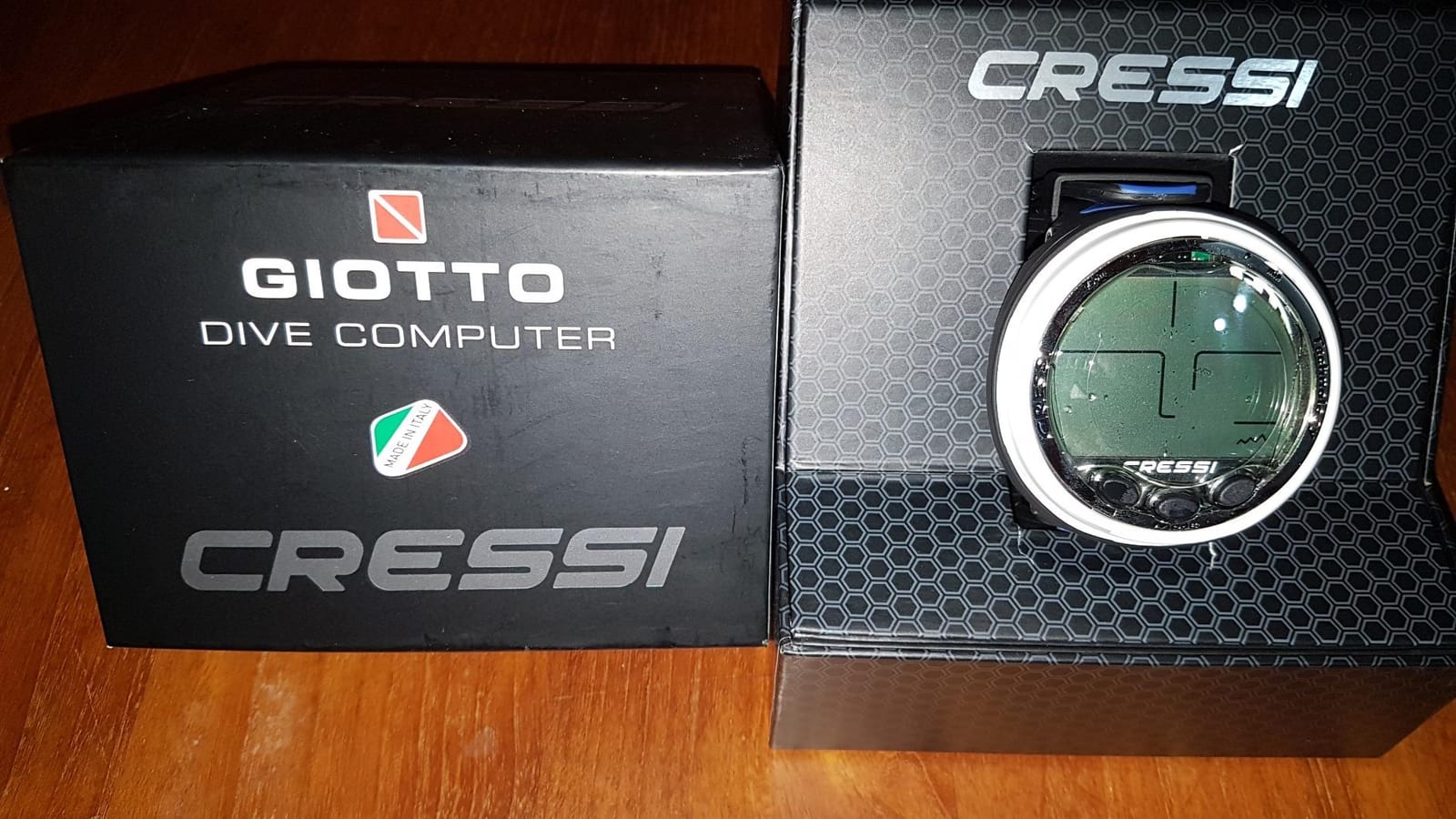
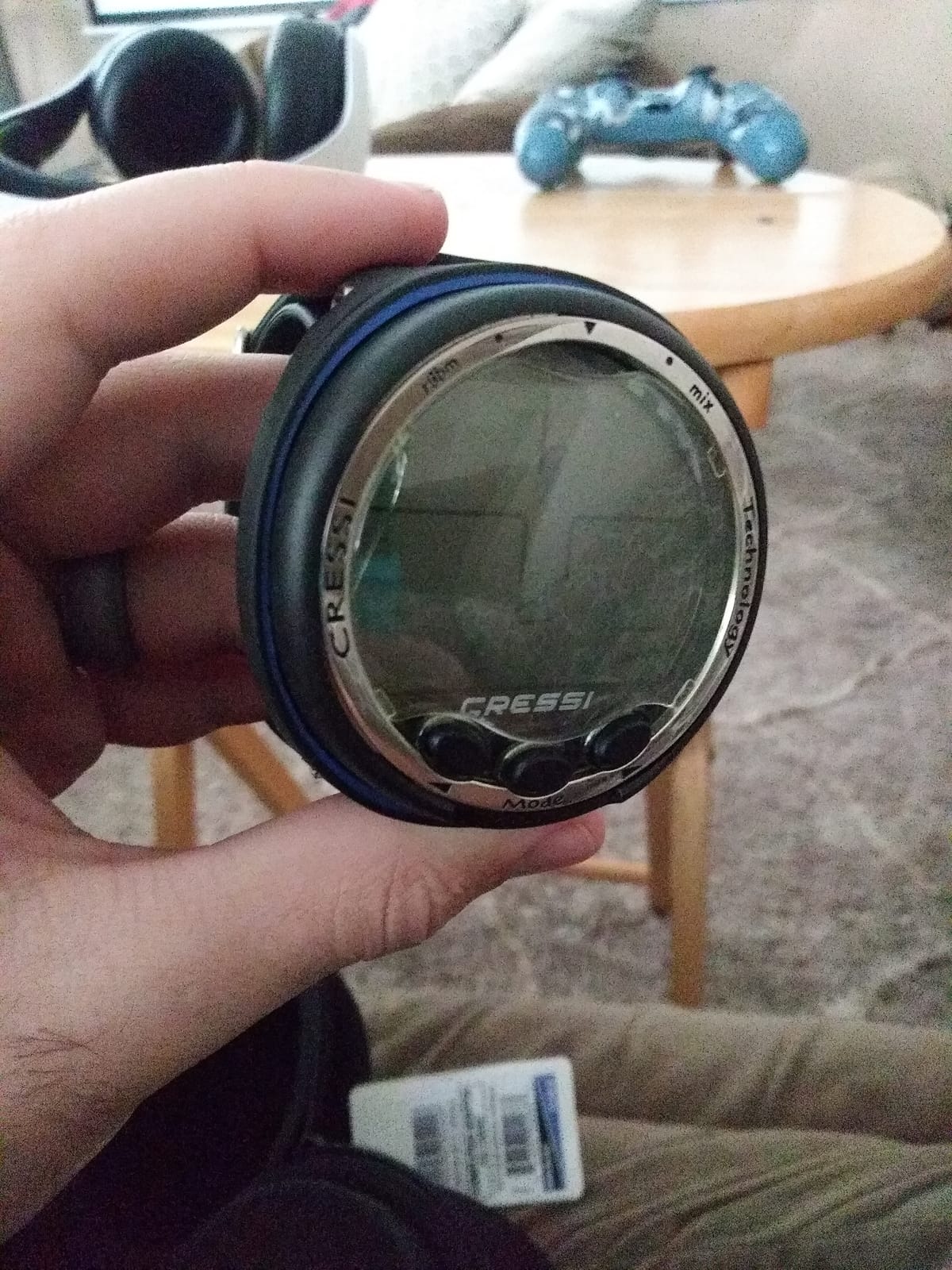
Depth capability runs to 393 feet, it is rated to 150 m with IP68 protection, and it carries 200 MB of storage. The 4.2 star average across 408 ratings comes with 65 percent five-star feedback, alongside a small tail of durability and slow warranty service complaints that are worth knowing about before you buy.
Recurring gripes cover a case that overhangs smaller wrists, a non-removable face cover that traps water droplets, a dim backlight and a menu structure that needs practice. All four are fixable with practice or a wrist sizing check in a shop.
What you get for the money
The altitude capability and three-gas programming are genuinely rare at this level, and the replaceable battery removes the single most common trip-day failure. Stainless steel construction and a 2 year warranty are better than the plastic cases used further down the entry tier.
Where it falls short
The non-removable face cover is an odd design choice that leaves droplets on the screen, and the dim backlight is a problem on night dives. If your diving is all sea level and single gas, that altitude feature is dead weight and the simpler Cressi Leonardo 2.0 does the job more cheaply.
5. Shearwater Peregrine TX – Best With Air Integration
Shearwater Peregrine TX
2.2 inch full color LCD
Optional Swift transmitter
120 m rating
2 year warranty
Pros
- Large bright color screens that stay legible for aging eyes
- Wireless air integration gives real-time gas time remaining
- Tilt compensated compass adds surface and underwater navigation
- About 30 hours of diving per charge confirmed across multi-dive trips
- Two-button setup walks new divers through configuration without a manual
Cons
- Air integration setup is not immediately obvious in the menus
- Wireless charging dock must be oriented correctly to charge
- Standard Buhlmann algorithm rather than trimix so technical divers should look higher in the range
The TX is the Peregrine with the two features the base model leaves out: wireless air integration through the Shearwater Swift transmitter, and a tilt compensated digital compass. If gas time remaining changes how you dive, this is the version rather than the standard Peregrine.
At 41 ratings the pool is small, and it is a perfect 5.0 with 100 percent five-star feedback, which tells you the owners who bought it are unusually happy. They describe it as intuitive enough to set up without a manual, with excellent screen readability and battery life that carried 21 dives at 65 percent remaining.
Two cautions appear repeatedly. The air integration pairing is not obvious the first time you go through the menus, and the wireless charging dock needs to be oriented correctly or it will not charge. The algorithm is standard Buhlmann rather than trimix, so anyone heading into technical territory should look higher in the Shearwater range.
What you get for the money
You get real-time tank pressure and gas time remaining, a compass for surface navigation, and the same 2.2 inch color display as the Peregrine. Battery life of about 30 hours in dive mode covers a full day of diving, and Shearwater’s 2 year warranty applies.
Where it falls short
The transmitter is a separate purchase, so the all-in cost is meaningfully higher than the headline price suggests. That is exactly the conversation to have before you buy, because for a purely recreational diver on open water, gas time remaining is often a nice-to-have rather than a safety tool.
6. Shearwater Teric – Best for Large, Readable Screens
Shearwater Research Teric Dive Computer – Black
5 inch wrist watch format
Buhlmann ZHL-16c with gradient factors
40 g weight
Nitrox and trimix
Pros
- Large bright display readable in difficult light
- Highly customizable Buhlmann gradient factors for conservative or aggressive profiles
- Lightweight 40 g wrist form factor
- Audible plus vibration alerts so nothing is missed on a noisy boat
- Firmware upgrades extend capability over time
Cons
- Highest price in this roundup
- Overkill feature set and complexity for purely recreational divers
- Air integration requires a separately purchased transmitter
The Teric is the one I recommend to divers over 40 or anyone who has ever squinted at a small screen and guessed. At 40 g it is remarkably light for its size, and the large bright display stays readable in exactly the conditions where smaller units fail: low visibility, overcast surface, last dive of the day.
It runs Buhlmann ZHL-16c with configurable gradient factors, which means you can dial the conservatism dial yourself instead of accepting the manufacturer’s guess. The alerts switch between audible and vibration, so nothing gets missed on a loud boat, and firmware upgrades extend what it does over time.
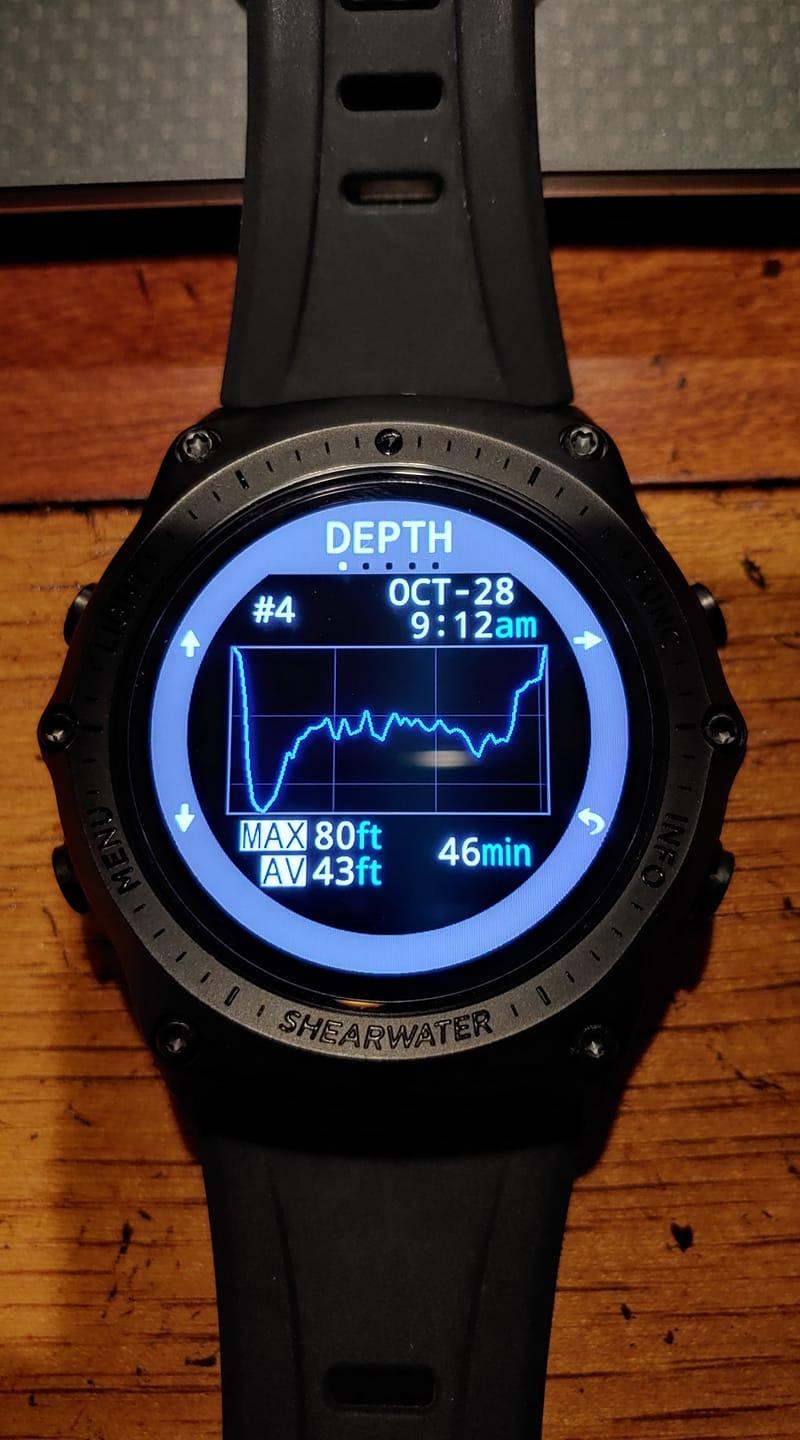
At 83 ratings and a 4.8 star average with 92 percent five-star, the owner satisfaction is high. The trade-off is that trimix, air integration and full customisation are genuinely beyond what most recreational divers ever touch, and the price is the highest in this roundup.
What you get for the money
Nitrox and trimix decompression, open-circuit, fixed PO2, gauge and freediving modes, a 316 stainless bezel and buttons, and a 22 mm strap with extender so it fits a larger wrist. For a diver with any intention of progressing past no-deco recreational diving, this is the room you need.
Where it falls short
It is the most expensive computer here, and a big share of what you are paying for will sit unused if you stay on recreational air and nitrox. Air integration still needs a separately purchased transmitter. If you mainly want a readable screen and not the algorithm tuning, the Peregrine gives you most of the readability for much less.
7. Garmin Descent Mk3i – Best for Navigation and Lighting
Garmin Descent™ Mk3i, Watch-Style Dive Computer, 51mm, Black
1.4 inch AMOLED sapphire lens
200 m dive rating
Built in LED flashlight
1 year warranty
Pros
- Sharp 1.4-inch AMOLED screen with sapphire lens built for harsh conditions
- Dive-focused software with multiple modes from recreational to technical
- Built-in flashlight is genuinely useful above and below water
- Underwater compass and multi-band GPS add real navigation value
- Dive readiness and health metrics help plan around fatigue and jet lag
Cons
- Very high price for a recreational dive computer
- 51 mm titanium case is large especially on smaller wrists
- Group features such as SubWave tracking need the separately sold Descent T2
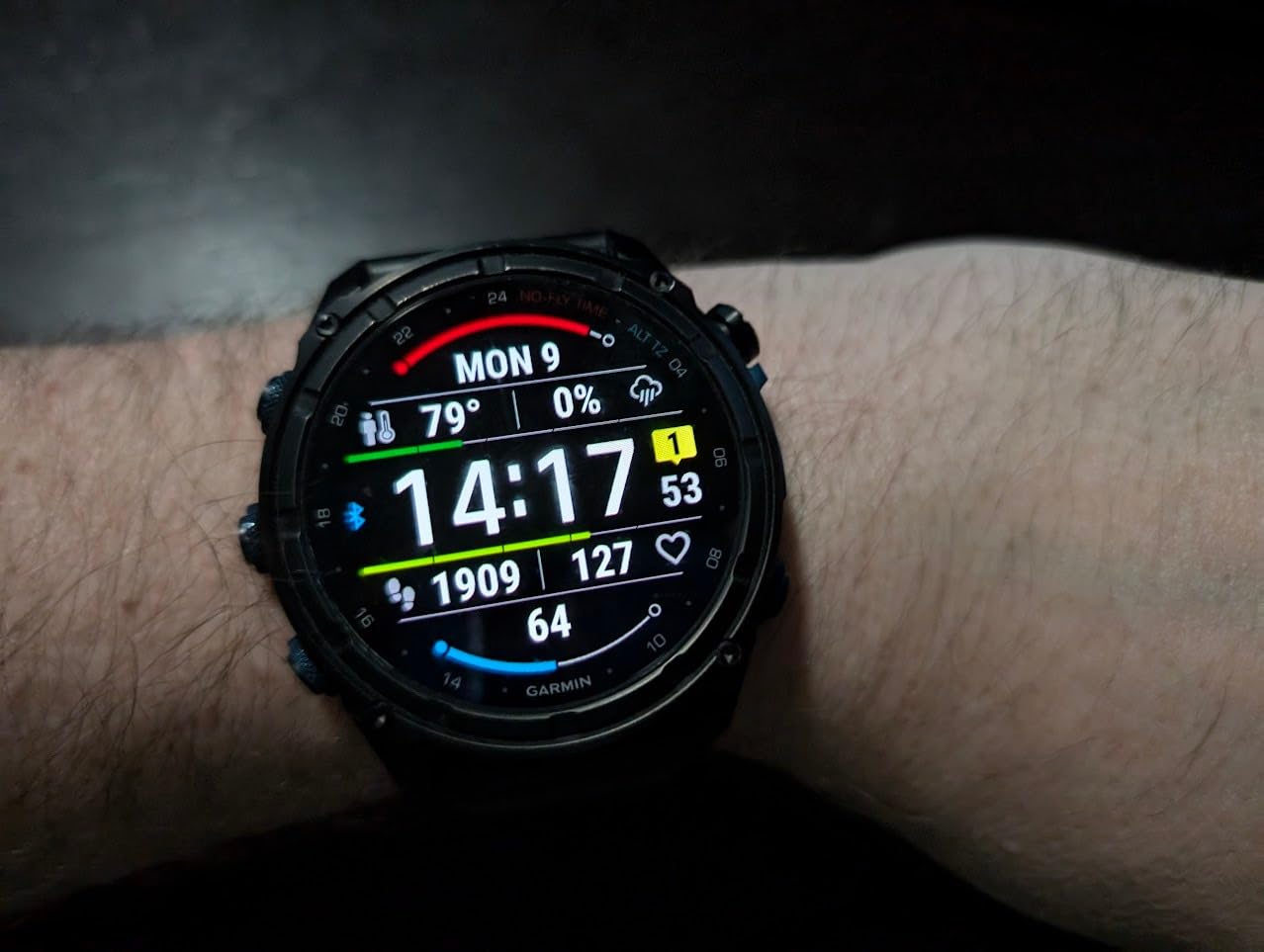
The Mk3i is the only computer here with a genuinely bright torch built in, and on an evening dive or a night entry to a shore site that alone justifies it. The 1.4 inch AMOLED panel sits under a sapphire lens, which is the combination you want on a watch that will meet boat rails and rocks.
It is rated to 200 m, so it covers recreational through technical scuba and freediving, and it carries SubWave sonar for preset diver-to-diver messages plus multi-diver tank pressure and depth monitoring for up to eight divers within 10 m. DiveView bathymetric contours and more than 4000 mapped dive sites, multi-band GPS and a dive readiness tool are all included.
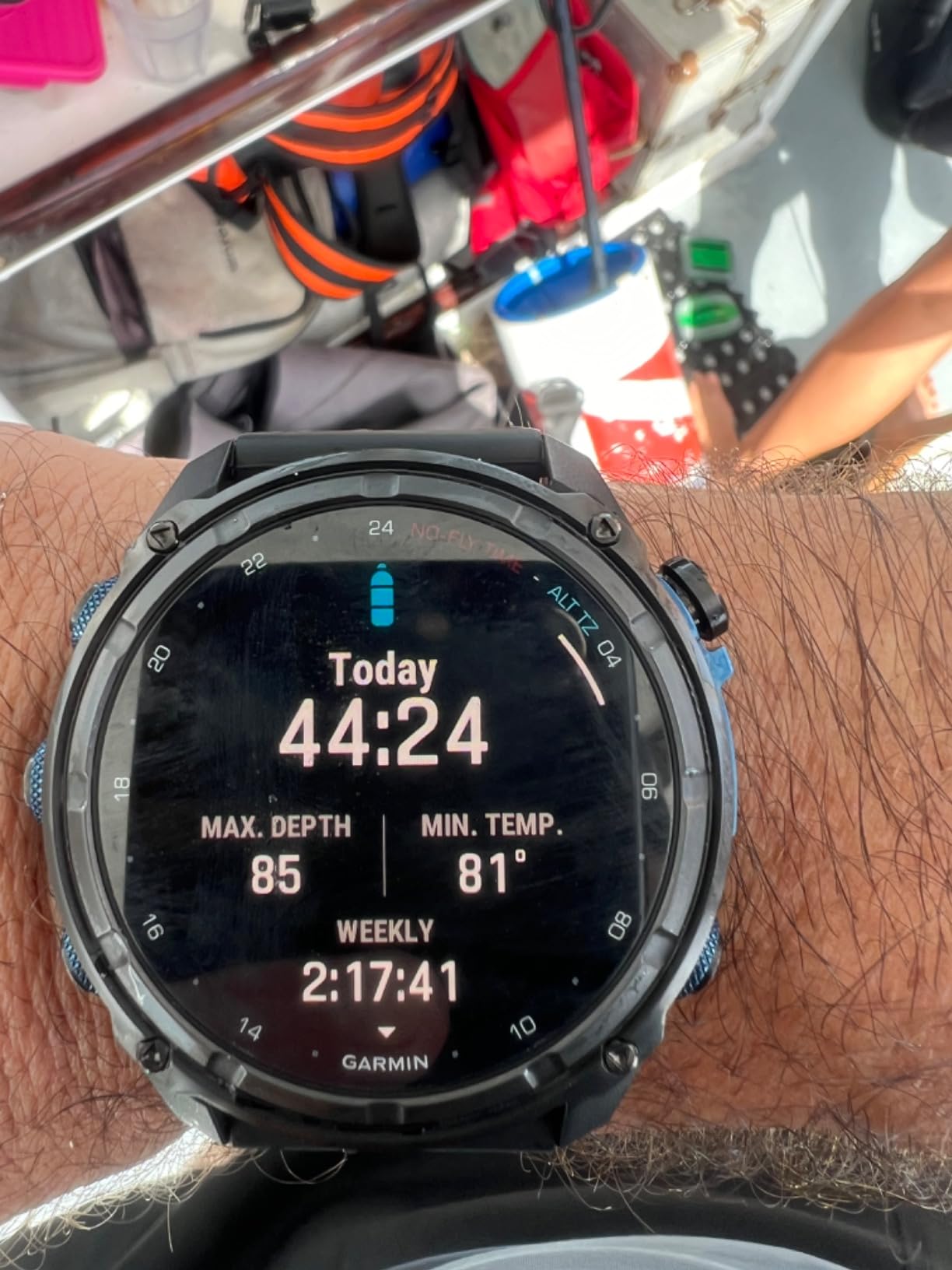
The health side is serious too: on-wrist heart rate, sleep, respiration and Pulse Ox, with up to 200 dives stored on the wrist and shared through the Garmin Dive app. At 136 ratings and 4.6 stars with 88 percent five-star, owners love the display toughness and the flashlight.
The reservations are consistent: the price is very high, the 51 mm titanium case is large on smaller wrists, and the group features need the separately sold Descent T2. The warranty is 1 year, half what Shearwater and Suunto offer.
What you get for the money
A 200 m dive rating with leakproof inductive metal buttons, 32 GB of storage, a built-in LED flashlight with variable intensity and strobe, and a full sports platform with training metrics. For a diver who travels to unfamiliar sites, the navigation layer is the differentiator no other watch here matches.
Where it falls short
This is the wrong purchase for someone who dives eight days a year on the same local reef. Most of the fitness and group-tracking capability will stay switched off, the case will overhang a smaller wrist, and the single year warranty is the shortest here. The Suunto Ocean does most of the same job with a two year warranty.
8. Garmin Descent G2 – Best Compact Dive and Sport Watch
Garmin Descent™ G2, Watch-Style Dive Computer, 46mm, Black
1.2 inch AMOLED display
27 hours in dive mode
10 days smartwatch mode
10 ATM rating
Pros
- Compact and light compared with larger titanium dive watches
- Bright easily readable AMOLED screen underwater
- Covers recreational technical and freediving modes with Buhlmann GF
- Dive readiness and health metrics help plan around sleep and stress
- Up to 10 days smartwatch battery and 27 hours in dive mode
Cons
- 1.2-inch screen is small for some especially with poor eyesight
- Battery life drops noticeably when Pulse Ox is left on continuously
- No air integration so tank pressure data is unavailable
The G2 is the compact option in the Garmin line and the one most divers will actually wear every day. It is 45.5 mm across rather than 51 mm, and at 2.3 ounces it is light enough that you forget it is there between dives.
Battery life is the quiet strength: up to 27 hours in dive mode and 10 days in smartwatch mode, which covers a full week of diving without a nightly charge. Dive modes span recreational, advanced, technical, freediving and pool apnea, with Buhlmann and gradient factors underneath.
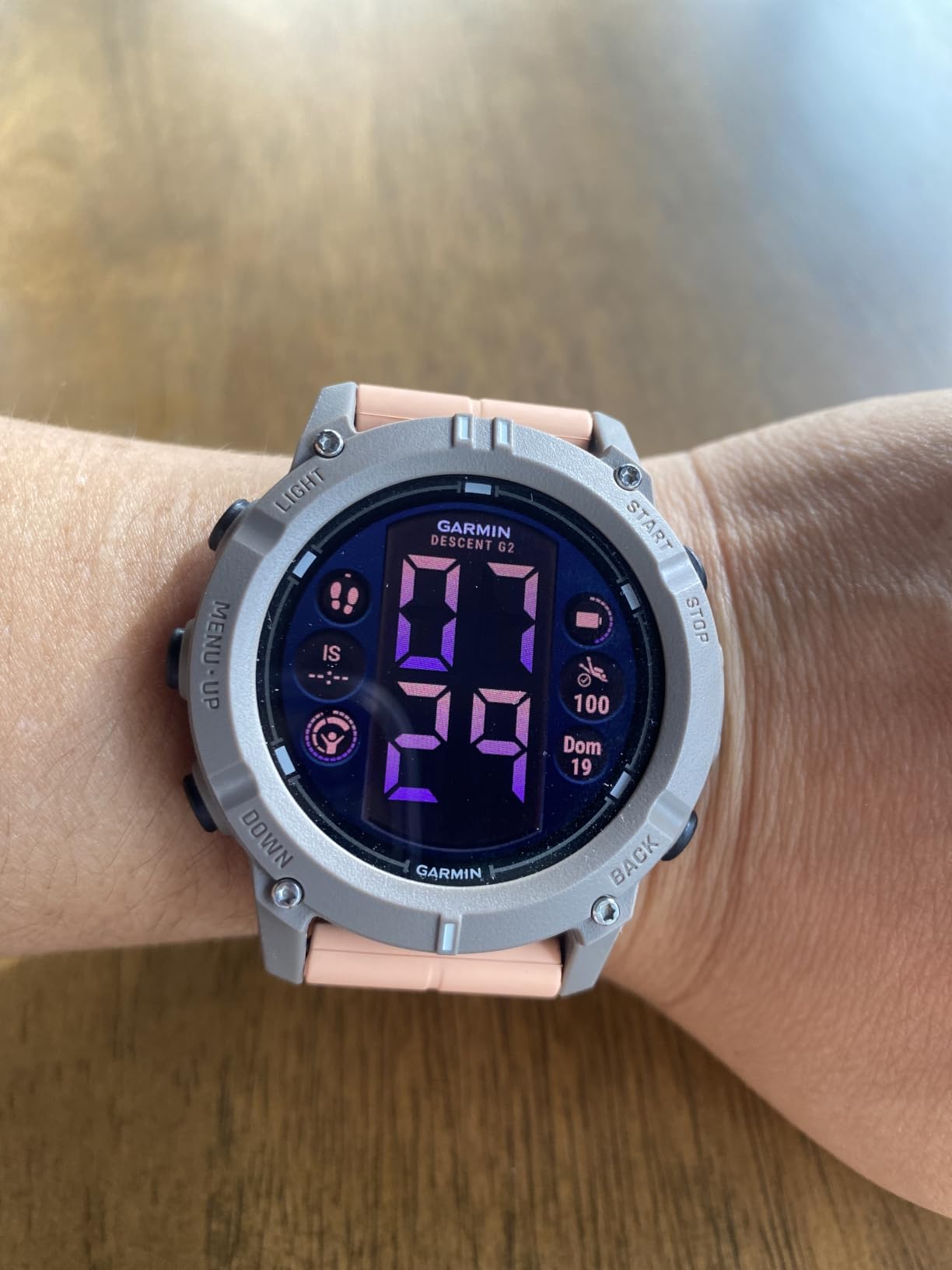
Multi-GNSS marks your surface entry and exit points, which is genuinely useful when you want to find the same sandbar twice. The housing, bezel and buttons are made from 100 percent recycled ocean-bound plastics, and the silicone band fits wrists from 128 to 224 mm with an extender to 373 mm.
At 122 ratings and 4.6 stars with 82 percent five-star, the most common criticism is the 1.2 inch screen being small for buyers with deteriorating eyesight. Battery life also drops noticeably if Pulse Ox is left running continuously, and there is no air integration at all.
What you get for the money
A sapphire-lens AMOLED display, 10 ATM dive rating, dive readiness insights, VO2 max training metrics, Garmin Pay, smart notifications and Connect IQ apps, with on-device dive logs reviewed in the Garmin Dive app. If you already wear a Garmin for running or cycling, this slots straight into that life.
Where it falls short
No air integration means no tank pressure data and no gas time remaining, which rules it out for divers who plan dives around gas. The 1.2 inch screen is the real limit, and if you are over 40 or need glasses underwater, test it in a shop before committing. The 1 year warranty is also the shortest in this group.
9. Suunto D5 – Best With a Digital Compass
SUUNTO D5 Dive Computer, Color Display 100m Waterproof, All Black
100 m water resistance
Digital compass and vibration alarms
Up to 12 hours diving
Tank pod support
Pros
- Lightweight and not bulky on the wrist
- Very readable in low light and on late afternoon dives
- Wireless tank pressure integration with accurate gas-time calculation
- Three-button menu system is quick to learn
- Good value for recreational divers
Cons
- Rechargeable battery is short-lived with a low battery warning blocking the screen
- Only two watch faces and a screen that can be hard to read for poor eyesight
- Safety stop depth is awkward to adjust in the field
The D5 is the pick if your diving involves returning to a boat or a shore entry point in low light and you want a compass that works underwater. Owners single out the display readability in low light and on late afternoon dives as the reason it stays on the wrist.
Wireless tank pressure support through the Suunto tank pod gives accurate gas time calculations, vibration alarms mean you feel an event through a glove, and the three-button menu is quick to learn. At 0.15 kg it is among the lighter units here.
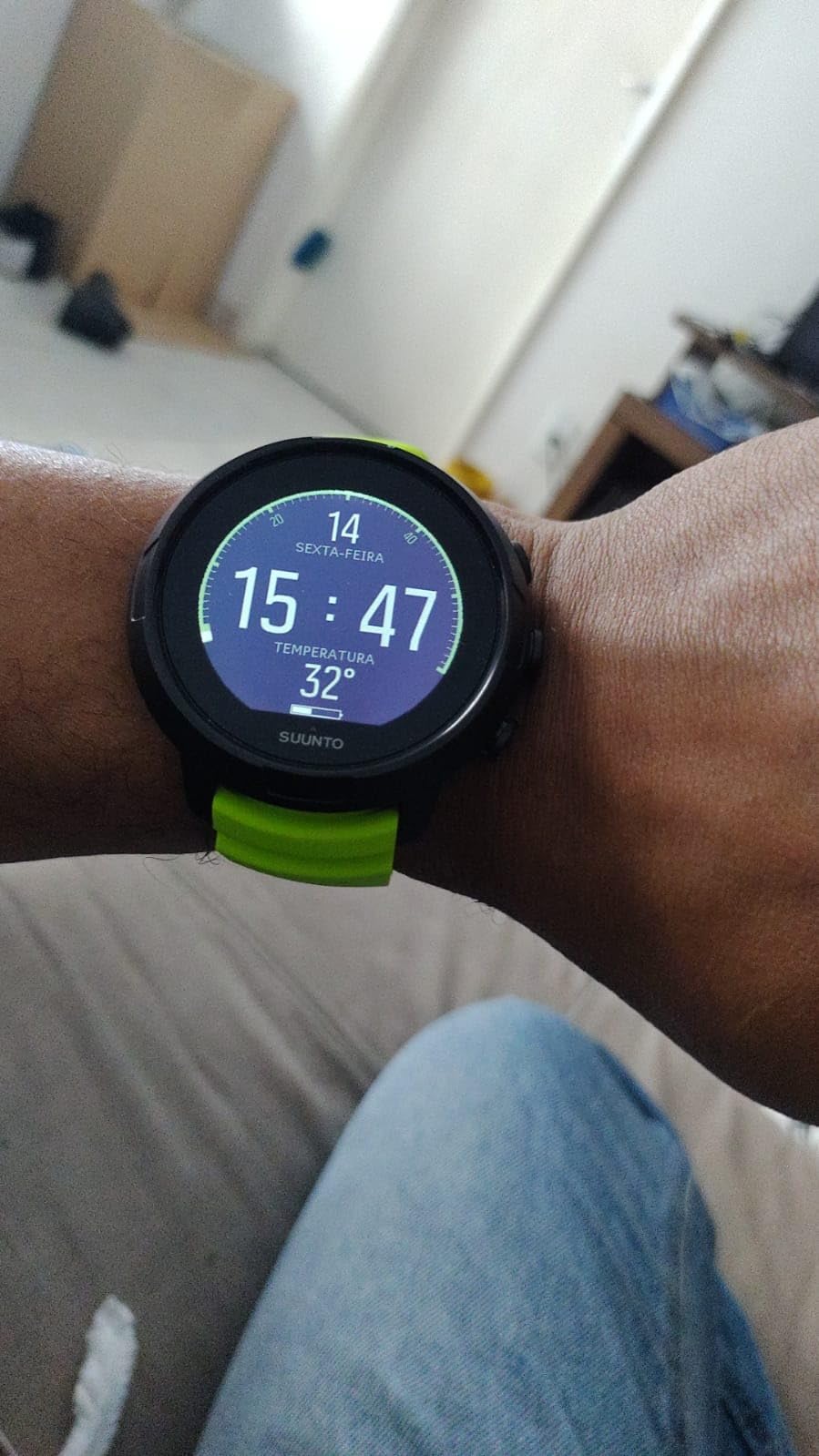
The problem is the battery. The stated diving time is up to 12 hours, and the dominant complaint in reviews is that the low battery warning blocks the screen partway through a dive day. Forum owners describe the sealed cell as fine until it starts going downhill, which is exactly the failure mode you do not want on trip day.
That is why I place it ninth rather than higher. At 119 ratings and 4.2 stars with 60 percent five-star, this is the lowest-scoring unit in the group. Secondary gripes include only two watch faces, a fiddly safety stop setting, scratching black paint and Mac software that has been reported to crash when opening individual dives.
What you get for the money
A digital compass, vibration alarms, wireless tank pressure support, 100 m water resistance and wireless connection to the Suunto app, with scuba and freedive modes. For a diver who navigates a lot and only does short day trips, the compass alone justifies the choice.
Where it falls short
Battery life is the dealbreaker, and it is not marginal. If you take more than three or four dives a day, or you are on a liveaboard, choose a computer with a replaceable or longer-lasting cell. The safety stop depth setting is also awkward to change in the field, which is a poor time to be fiddling with menus.
10. Mares Puck 4 – Best Entry-Level Buhlmann Computer
Mares Puck 4 Wrist Dive Computer | Entry-Level Watch-Style One Button Control Underwater Scuba Diving Computer, Black/Aqua
Buhlmann ZH-L16C with gradient factors
Three gas multigas
Bluetooth app transfer
Pros
- Buhlmann ZH-L16C algorithm with adjustable gradient factors at an entry price
- Multigas support for up to three gases
- Clear chip-on-glass segment display that reads well underwater
- Bluetooth log sync works with Mares SSI and Subsurface apps
- One-button interface is about as intuitive as a single button can be
Cons
- Not air integrated so no tank pressure readings
- Gradient factors capped at 85 percent rather than up to 100
- Reports of missing or weak safety stop alerting
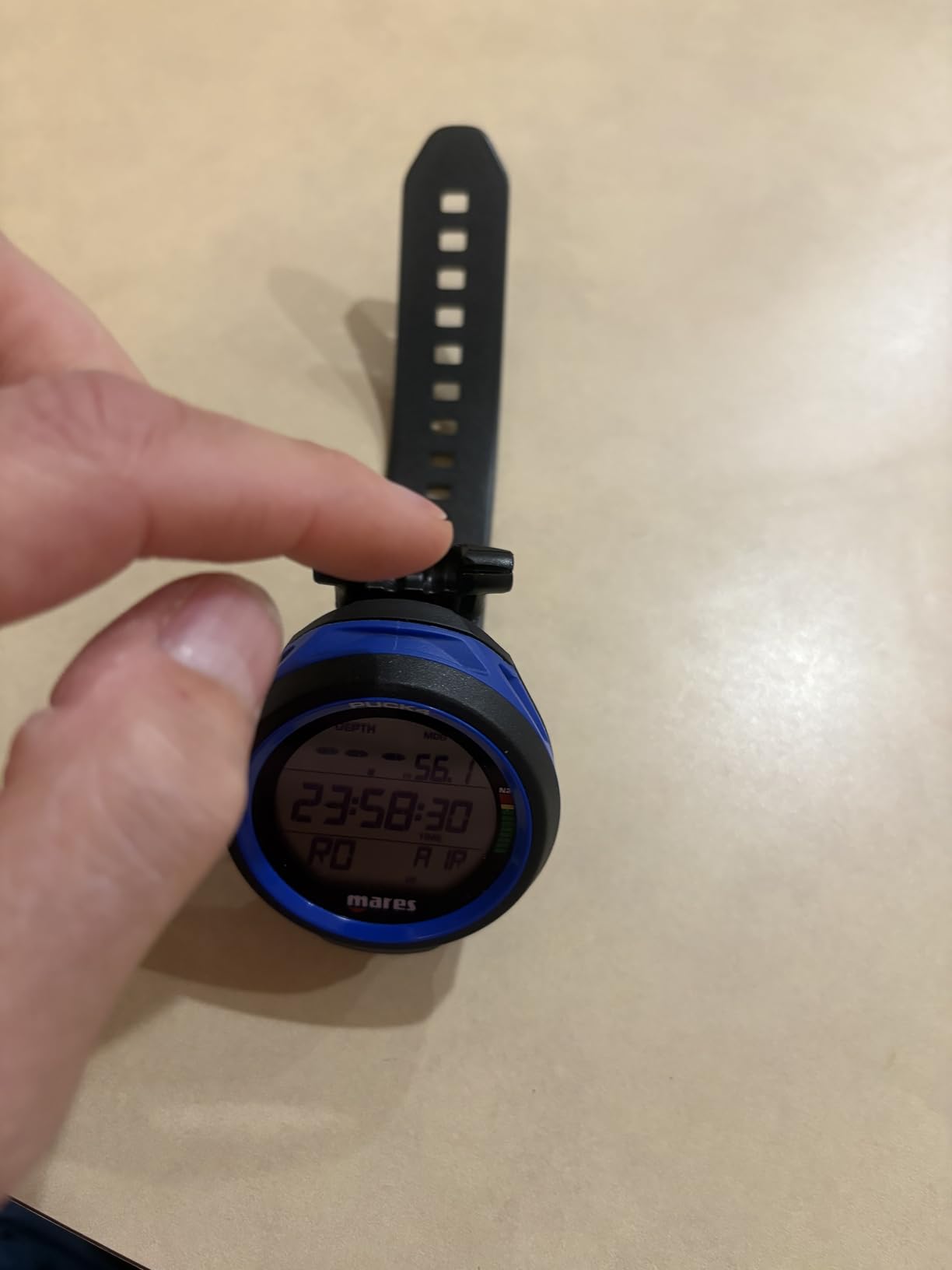
The Puck 4 is unusual at this price: it runs the Buhlmann ZH-L16C algorithm with adjustable gradient factors and supports up to three gases, which is real multi-gas capability usually reserved for higher tiers. Bluetooth transfer works with the Mares, SSI and Subsurface apps, so your log is not trapped in desktop software.
The chip-on-glass segment display reads well underwater and the single button is about as intuitive as one button can be. At 67 ratings the pool is small, and the 4.2 average comes with 75 percent five-star and a 13 percent one-star tail.
That one-star tail is worth understanding. Reviewers cite the absence of air integration, gradient factors capped at 85 percent rather than 100, a multigas rule requiring gas 2 to have a higher oxygen percentage than gas 1 which blocks some pony-bottle setups, and a few reports of the safety stop alert not working.
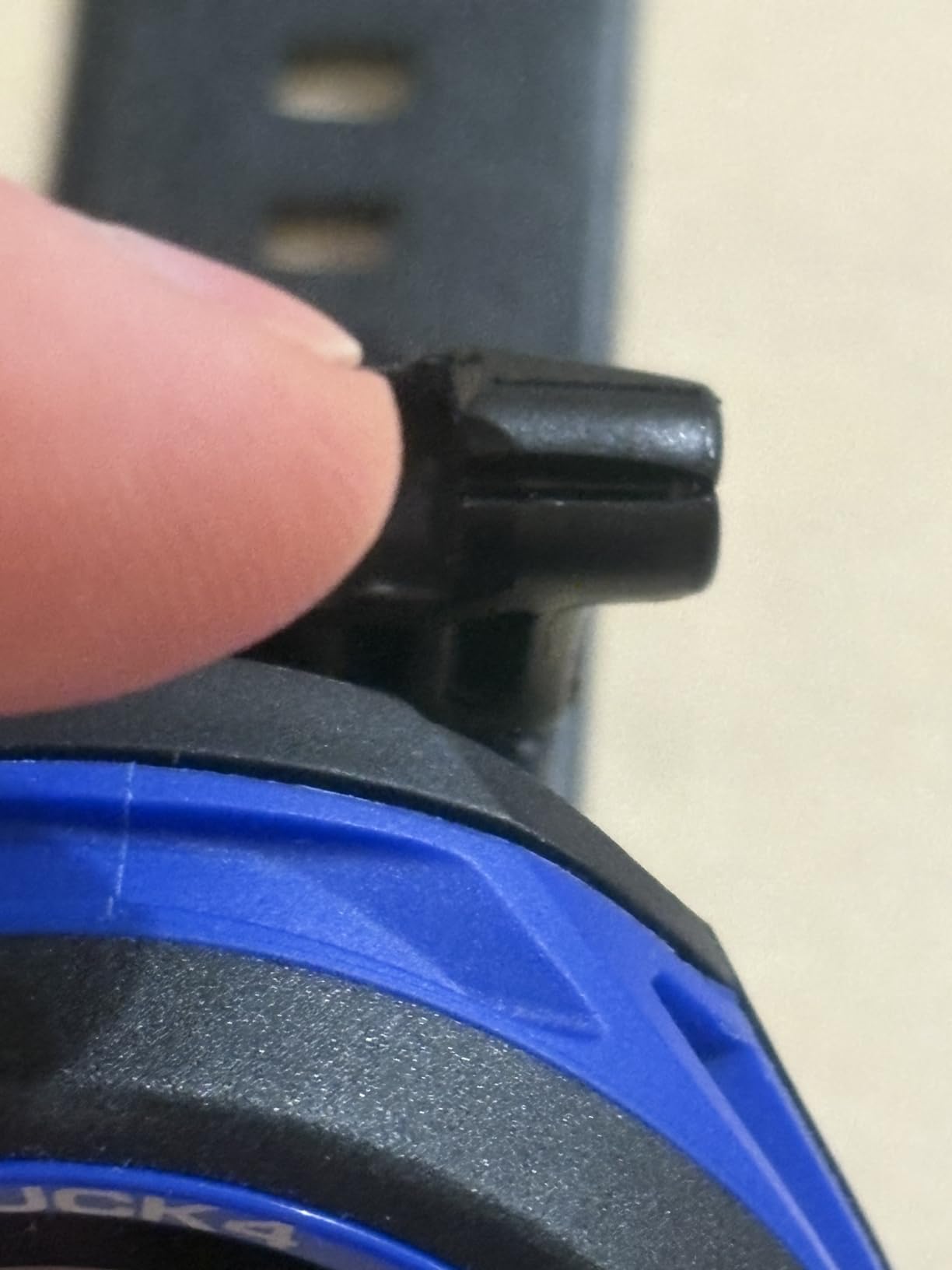
There is a neat trick here too: the strap is removable so the unit can be fitted into the Mares Mission console for boat instrument display. Replacement strap parts are genuinely hard to source, which is the kind of thing that only matters once it matters.
What you get for the money
An industry-standard decompression algorithm with gradient factor control, three-gas support, a digital logbook, a decompression planner and resettable average depth. If you plan dives on nitrox and want the same math a technical diver would use, this is the cheapest way onto it.
Where it falls short
No air integration, so no tank pressure readings and no gas time remaining. The gradient factor ceiling of 85 percent stops short of the full range, and the multigas ordering rule will frustrate anyone using a pony bottle as a second gas. If safety stop alerting matters to you, test it thoroughly on shallow dives before a trip.
11. Suunto Ocean – Best One-Watch Solution
SUUNTO Ocean Dive Computer, GPS Multisport Watch for Training, Steel Black
1.43 inch AMOLED touchscreen
40 hours in dive mode
12 days daily use
Dual band GNSS
Pros
- Colorful 1.43-inch AMOLED touchscreen with strong underwater readability
- 40 hours of dive time per charge rare at this size
- Wireless tank pod support with gas consumption tracking on the wrist
- Dual-band GNSS with offline maps and 3D dive route capture
- Doubles as a full multisport GPS watch with training and recovery metrics
Cons
- Touchscreen controls are less usable with cold hands or thick gloves
- Most customization and settings still require the desktop software
- Small screen relative to the older larger Suunto models
The Ocean is the answer to the most common question in dive forums: what if I want one watch for diving, training and travel. It is the current consensus pick for that, and it earns the place on battery life alone — 40 hours in dive mode, 12 days in daily use and 26 days on standby.
Underwater it runs freediving, snorkeling, mermaid, single gas and multigas modes with air and nitrox support, on the Buhlmann 16 GF algorithm with an optional wireless tank pod for tank pressure and gas consumption tracking on the wrist. The 1.43 inch AMOLED touchscreen is sapphire crystal in a stainless steel case, rated to 100 m.
On the surface it is a full multisport watch: dual-band GNSS, global offline maps, 3D dive route tracking saved to the Suunto app, and more than 95 preset sport modes with Suunto AI Coach and HRV training insights, stored in 32 GB.
At 44 ratings and 4.6 stars with 83 percent five-star, reviewers love the screen readability and the 40 hour dive runtime. Reservations are limited but real: touchscreen controls are harder with cold hands or thick gloves, deeper customization still needs desktop software, and the screen is small next to older Suunto cases. The 2 year warranty is a genuine plus.
What you get for the money
A 99 g steel case, 100 m water resistance, 60 m measurement depth, roughly one hour fast charging, underwater route tracking and a genuine multisport platform. If you are replacing a sport watch as well as a dive computer, this is the single most efficient purchase in the guide.
Where it falls short
The touchscreen is a real drawback in cold water, which is where glove operation matters most, so check it in the water if you can. The screen is also small relative to older Suunto watches. Divers who never exercise and only dive once a year are paying for a lot of watch they will not use, and the Cressi Leonardo 2.0 covers the same dives for far less.
12. Mares Puck Lite – Best for Small Wrist Travel Divers
Mares Puck Lite Scuba Diving Computer | Watch-Style One Button Control Underwater Freediving Scuba Diving Computer – Aqua
Compact wrist sizing
Buhlmann with gradient factors
User replaceable battery
Logbook for 100 dives
Pros
- Compact and comfortable on the wrist for travel and holiday diving
- Good underwater visibility on the chip-on-glass segment display
- Bluetooth syncs dive data to the phone quickly
- Single button is quick to master after a short adjustment
- Reliable over many logged dives at an approachable price
Cons
- Setup and settings changes are difficult especially switching unit systems
- No printed instructions included
- Limited feature set compared with larger computers at similar prices
The Puck Lite solves a specific problem well: a small, comfortable watch for a small wrist on a holiday trip. Users like the compact sizing, the good underwater visibility on the chip-on-glass segment display and quick Bluetooth transfer to the phone, with a logbook of up to 100 dives including graphs and profiles.
It runs the same Buhlmann ZH-L16C algorithm with customisable gradient factors as the Puck 4, supports nitrox from 21 to 50 percent, and the user-replaceable power source is rated for up to 100 dives. That last point is the headline for vacation divers, because a coin cell costs nothing and solves every charging problem.
At 28 ratings and a 4.3 star average with 67 percent five-star, the sample is thin. The main complaints are a steep initial setup curve, difficulty changing settings such as metric to imperial, no printed instructions in the box, and a feature set that feels thin next to computers at a similar price.
What you get for the money
An 800-segment chip-on-glass display, glove-friendly single-button navigation, nitrox, 100 dive logbook and Bluetooth syncing to the Mares and SSI apps. The replaceable battery rated for 100 dives is the feature that makes it the safest travel companion here.
Where it falls short
Setup and settings changes are genuinely difficult, and there are no printed instructions to fall back on. The main screen layout can put time ahead of depth, which is not what you want mid-dive. And with only 28 ratings, there is less long-term owner feedback than the other picks here, which for a safety instrument is worth weighing.
Dive Computer Buying Guide: How to Choose the Right One
The algorithm question matters less than most forums make it sound. Every computer on this list runs a recognised decompression model, and for a recreational diver doing no-deco air and nitrox dives inside the limits, the practical difference between them is a few minutes on your no-decompression limit.
Buhlmann ZHL-16C is the current industry standard and appears on the Peregrine, the Teric, the Puck 4, the Puck Lite and the Garmin models, usually with adjustable gradient factors. Gradient factors are the conservatism dial — low values are conservative, high values are aggressive. If a dive operator or liveaboard will not accept your chosen algorithm, check before you fly.
Where the algorithm does matter is if you plan to progress past no-deco recreational diving, because then you want full customisation and eventually trimix support. For vacation diving, a computer that gives conservative limits and a big readable screen beats one with a settings menu you will never open.
Air integration is the other big decision, and the honest answer is that for a recreational diver it is optional. It costs an extra transmitter, pairing takes practice, and gas time remaining only changes your dive if you actually plan around it. It is worth it if you do deeper repetitive dives, run a sidemount or pony configuration, or want the redundancy. It is not worth it if you dive shallow and stay within your NDL.
Battery type is the decision I would not delegate. Sealed rechargeable cells are convenient at home and a liability on a trip. The Cressi Giotto and the Mares Puck Lite both use replaceable batteries, and that single fact removes the most reported source of trip-day stress in dive forums.
Screen size follows from eyesight and conditions rather than price. Divers over 40, or anyone who has had to guess at a small display in 15 percent visibility, should prioritise screen size over features. The Shearwater Teric and the Peregrine both solve this; the Garmin Descent G2 does not.
Finally, bulk matters more than spec sheets suggest. Every Cressi unit here is described by forum buyers as too big to wear as a wristwatch, and several catch on the BCD while gearing up. Try the computer on over a wetsuit cuff before you commit, and check the strap range against your wrist measurement.
Dive frequency should drive the tier you buy. Vacation divers with one to ten dives a year should prioritise a replaceable battery, long runtime and a simple interface. Divers logging 50 or more dives a year can justify Bluetooth log syncing, multi-gas support and air integration. One more piece of kit worth checking alongside your computer is light selection, since dive lights for underwater video affect how much of that computer screen you actually get to see.
The 120-Minute Rule and Why You Never Power Off Between Dives
Turn your dive computer off between dives and it forgets you were ever underwater. The tissues in your body keep their nitrogen load whether or not the device is watching, so restarting wipes the history and lets the computer plan the next dive as if it were your first of the day. That is how people get into trouble on multi-dive days.
The practical rules are simple. Leave the computer on and in dive mode between dives, keep the surface interval running, and treat the second and third dives of the day as part of one repetitive series rather than fresh dives. If you must switch modes, do it deliberately with full understanding of what you are resetting.
On a multi-day trip the same logic applies across days. The computer carries residual tissue loading forward, which is why a second day of diving is not identical to the first. Back up your log before any firmware update, because some updates have been reported to reset dive counts or clear logs, and losing your history between days is genuinely annoying.
What to Do If Your Dive Computer Fails Mid-Dive
If the computer fails underwater, the honest first step is to accept that the dive is over. Do not continue on a guess. Signal to your buddy, ascend normally at a controlled rate, and end the dive.
From the surface, the standard fallback is the depth table on your back or in your logbook, applied conservatively using the deepest planned depth rather than the deepest actual depth, because actual depth can only have exceeded it. Treat yourself as having no further depth credit for the day.
Handle the failure itself the same way: report it, and expect to sit out the standard post-dive interval appropriate to the profile. If the failure happens on a decompression dive, treat yourself as being on a decompression obligation for the rest of the no-fly window. This is exactly the scenario that motivates owning a cheap second computer, which is why a lot of divers keep a Cressi or Mares unit as a backup.
Frequently Asked Questions
Which dive computer is best for daily use?
The Suunto Ocean is the clearest answer if you want one watch for diving, training and travel, with 40 hours of dive mode battery, 12 days in daily use and a full multisport platform. The Garmin Descent G2 is the lighter, more compact alternative with 10 days in smartwatch mode.
Which dive computer is the easiest for beginners to read?
The Cressi Leonardo 2.0 is the easiest to operate because of its single-button interface, which works in gloves and needs no menu learning curve. For raw screen legibility at depth, the Shearwater Teric has the largest display in this guide, and the Cressi Giotto is repeatedly praised for underwater readability.
What is the 120 rule in diving?
The 120 rule refers to waiting at least 120 minutes, or two hours, of surface interval between dives. Because a second dive is planned as a repetitive dive that still carries residual nitrogen from the first, a two-hour gap allows much of that loading to clear before you go back down.
Why shouldn’t you turn off a dive computer between dives?
Because switching it off erases the surface interval and the record of your earlier dive. Your tissues keep their nitrogen load even when the device is off, so a restarted computer plans your next dive as if it were your first, and it can grant you more no-decompression time than your body has actually earned.
How much should I spend on my first dive computer?
For a first computer, spend enough to get a reliable instrument with a readable screen and a battery you can live with. The Cressi Leonardo 2.0 covers every recreational dive mode at the entry level, the Cressi Giotto adds altitude and three-gas programming, and the Shearwater Peregrine is the step up for colour display and cloud logging.
Is air integration worth the extra cost for a recreational diver?
Usually not, for a diver staying within no-decompression limits in shallow water. Air integration is a separately purchased transmitter, pairing takes practice, and gas time remaining only changes your planning if you plan around gas. It earns its place on deeper repetitive dives, sidemount setups, or if you want a second independent check on your gas.
Can I use a smartwatch instead of a dedicated dive computer?
A dive-rated smartwatch with a proper dive app can work, but check the depth rating and algorithm carefully, because fitness watches often cap out at shallow recreational limits. Dedicated dive computers give you a clearer display, a physical depth rating and a decompression model designed for the job rather than adapted to it.
How long do dive computers last?
A well-made dive computer commonly lasts many years of regular use, and the main limits are battery type and seal condition. Computers with user-replaceable batteries can be kept going indefinitely, while sealed rechargeable units depend on cell health, and the dive-rated depth of a unit is not the same as its full serviceable lifespan.
The Best Dive Computer for Recreational Divers in 2026
The Shearwater Peregrine is the best dive computer for most recreational divers in 2026. It pairs a large, bright colour display with a genuinely simple two-button interface, multi-gas modes with NDL and decompression planners, and a battery that comfortably covers a multi-dive day, backed by a 2 year warranty.
Where your needs differ, the answer changes in a predictable way. Buy the Cressi Leonardo 2.0 if you want the simplest reliable unit at the lowest outlay. Buy the Shearwater Peregrine TX if gas time remaining and a compass matter to you. Buy the Shearwater Teric if screen size is your biggest concern, and the Garmin Descent Mk3i only if you want navigation, mapping and a built-in torch as much as diving.
Whichever you pick, buy it before the trip, dive with it a few times in shallow water first, and never power it off between dives. A computer you understand is safer than an expensive one you never learned to read.