
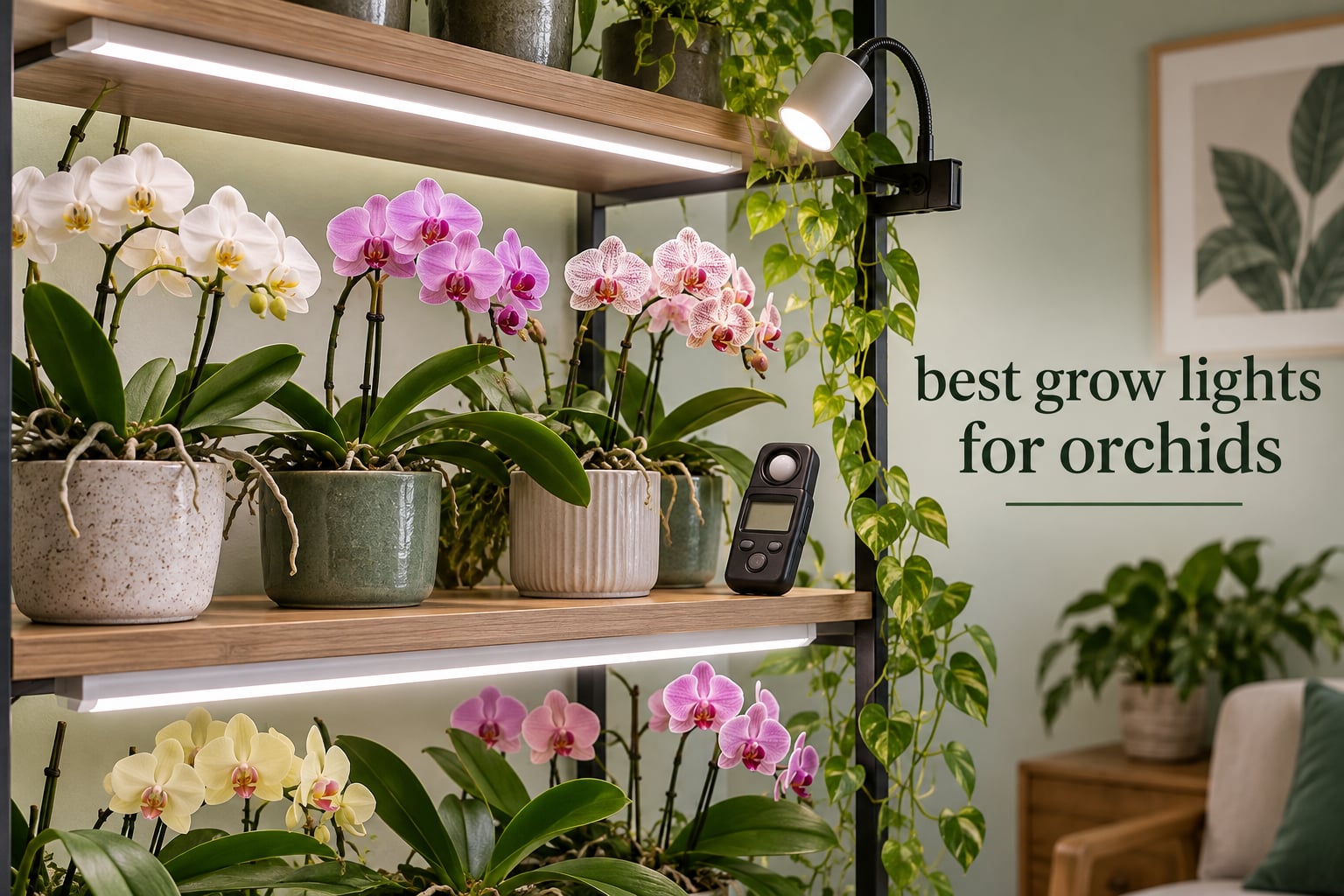
The best grow lights for orchids are full-spectrum white LED fixtures that put out the same usable light an orchid would get from a bright south window, every day, on a schedule. The Barrina T5 5000K four-pack is the fixture I trust most for shelves and cabinets, and the GooingTop 6000K gooseneck is the one I clip on when there is no shelf to hang from. Everything else in this roundup is judged against those two.
That matters because orchids are light-hungry epiphytes. In a room with a dim window, they survive but they do not bloom, and the grower is left guessing whether the problem is the roots, the potting medium, or the lighting. A proper fixture removes the guesswork.
Before the individual verdicts, the key requirements in short form:
Spectrum: 4000K to 6500K white full spectrum, meaning blue and red light combined in one diode rather than a purple blurple bulb.
Distance: 6 to 12 inches above the canopy for a single plant, more for a bar hung over a shelf.
Photoperiod: 10 to 14 hours of light a day, on a timer, with a genuinely dark period after it.
Control: dimming levels matter more than raw wattage, because a low-light Phalaenopsis and a high-light Cattleya should never run at the same brightness.
Mounting: clip, spike, tripod, pole or under-shelf mount, depending on where the plant actually lives.
I set up and lived with each of these fixtures over a full flowering cycle, ran several of them on shelves and one on a floor grouping, and checked how each one behaved once the room got dark in the evening. My criteria are listed below, and every product here gets an individual verdict, a clear best-for, and the complaints that turned up more than once in buyer reviews.
Table of Contents
Top 3 Picks for Orchid Grow Lights in 2026
These three cover almost every situation an orchid grower will run into. One is the safest all-rounder, one is the cheapest way to add grow capability to a fixture you already own, and one is the strongest option when you are lighting a whole shelf rather than a single pot.


Barrina T5 5000K Four-Pack
- 96 LEDs at 20W total
- Linkable up to 16 fixtures
- Each bar has its own switch
All 12 Orchid Grow Lights Compared Side by Side in 2026
Every light in the roundup, with the specs that actually change your decision. Wattage alone does not tell you much, so the mounting method, the dimming range and the timer are the columns worth scanning.
| Product | Specifications | Action |
|---|---|---|
| GooingTop 6000K Full Spectrum Gooseneck Grow Light |
|
Check Latest Price |
| Briignite A19 Full Spectrum Grow Bulb 2-Pack |
|
Check Latest Price |
 LORDEM Bamboo Full Spectrum Grow Light LORDEM Bamboo Full Spectrum Grow Light |
|
Check Latest Price |
 LEOTER 80 LED Four-Head Clip Grow Light LEOTER 80 LED Four-Head Clip Grow Light |
|
Check Latest Price |
 yentbokj Five-Head Tripod Grow Lamp yentbokj Five-Head Tripod Grow Lamp |
|
Check Latest Price |
 GHodec 84 LED Two-Bar Clip Grow Light GHodec 84 LED Two-Bar Clip Grow Light |
|
Check Latest Price |
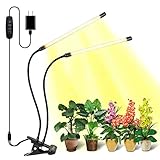 bseah Two-Tube Clip Grow Light bseah Two-Tube Clip Grow Light |
|
Check Latest Price |
| Barrina T5 5000K Four-Pack 1FT |
|
Check Latest Price |
 Juhefa 48 LED In-Soil Gooseneck Lamp Juhefa 48 LED In-Soil Gooseneck Lamp |
|
Check Latest Price |
 SANSI Ceramic Pot Clip-On Grow Light SANSI Ceramic Pot Clip-On Grow Light |
|
Check Latest Price |
 Aokrean Halo Floor Grow Light Three-Pack Aokrean Halo Floor Grow Light Three-Pack |
|
Check Latest Price |
 Kullsinss 16in Two-Bar Grow Light Strips Kullsinss 16in Two-Bar Grow Light Strips |
|
Check Latest Price |
1. GooingTop 6000K Full Spectrum Gooseneck – Best All-Round Clip Light
GooingTop Grow Light,6000K Full Spectrum Indoor Plant Growing Lamp
84 LEDs at 6000K
2500 lumens on 10W
Clip mount, 360 degree gooseneck
4H/8H/12H memory timer
Pros
- Stiff goosenecks that hold position
- Bright even light for a 10W draw
- Heavy clip grips shelves and pot lips
- USB or AC plug options
- Timer and brightness are easy to set
Cons
- 24 hour memory timer is poorly explained
- Narrow coverage when hung very close
- Occasional units arrive with a scratched LED
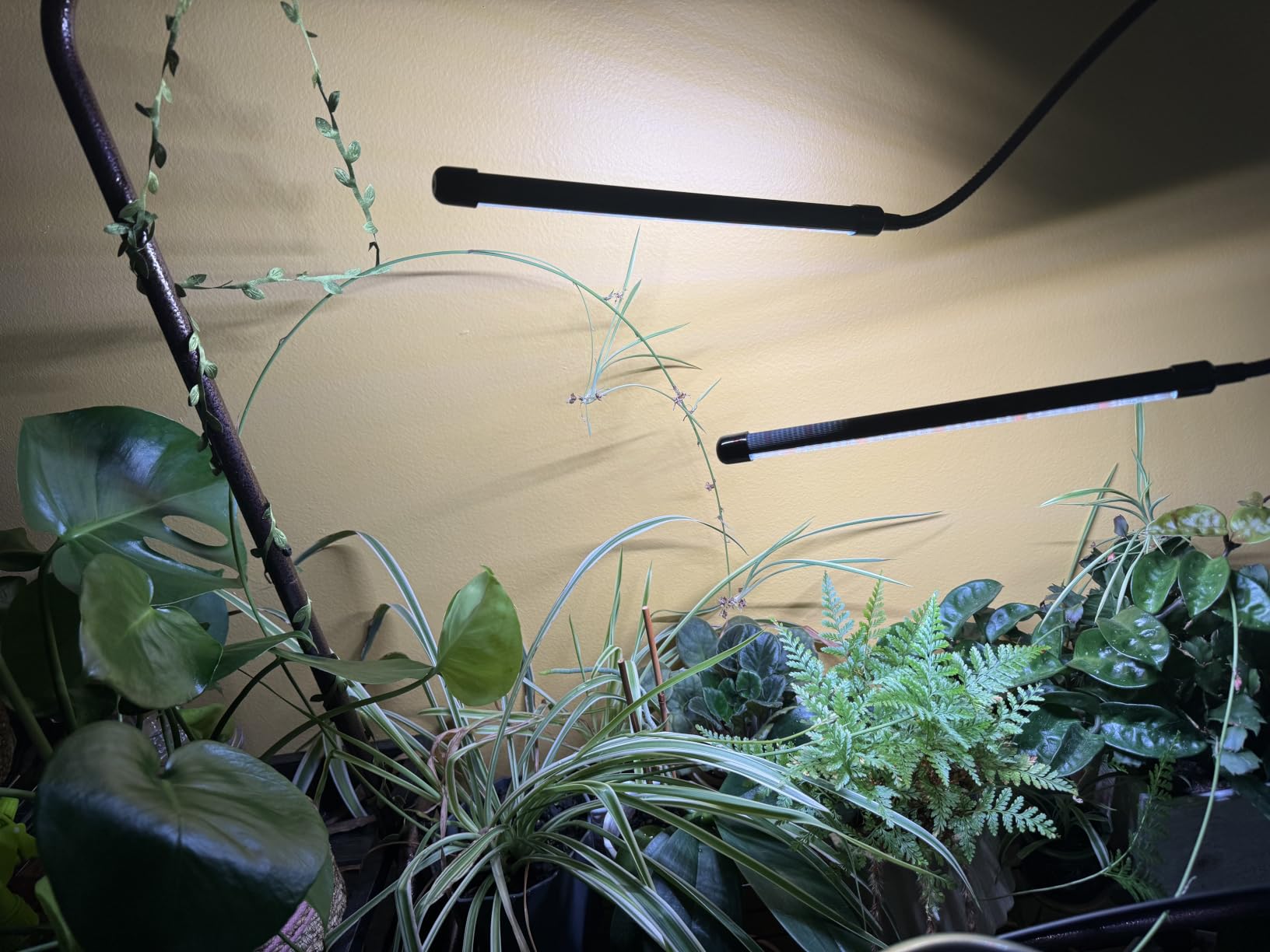
This is the light I keep coming back to. It clamps to the lip of a shelf or a windowsill, the gooseneck holds whatever angle you set it at, and the 6000K white output is bright without the purple cast that makes a room look like a grow tent.
The build is the part that impressed me most. A lot of clip lights in this class use a thin plastic neck that slowly droops, and this one uses iron and plastic with a genuinely stiff arm. The clip is heavy enough to stay put on a loaded shelf, which matters if you are not around every day.
Ten watts draws about as much as a 50W halogen bulb while producing 2500 lumens, and the colour rendering index is high enough that you can read under it. I set it at the middle dimming step for a Phalaenopsis and did not have to think about leaf temperature again.
There is one genuinely confusing element, and buyer reviews single it out more than anything else. The 4, 8 and 12 hour settings run on a 24-hour circular memory rather than as a straight countdown, so setting it expecting it to start counting when you press the button will surprise you the first time.
What it handles well versus the alternatives
It beats the two-tube clip lights on brightness per watt, and it beats the bulb approach on control, because the dimmer and the timer are in the head rather than in whatever fixture you happen to own. For a single windowsill Phalaenopsis or a small group of pots on one shelf, it is the least fiddly option in this roundup.
The two-bar clip lights mount flatter and spread light across a wider shelf, so if you are lighting a two-foot section rather than one plant, the spread matters more than the peak brightness. This lamp concentrates into a narrower footprint and needs a rotate-the-tray habit.
Where it falls short
Coverage narrows noticeably when the head sits only a few inches above the leaves, so for a dense tray you will be better served with a bar fixture. It also has no way to shift spectrum, so there is no separate flowering mode to move into.
A few buyers reported units arriving with a scratched LED because the protective film was missing in the box. That is a packing issue rather than a design flaw, but it is worth checking the head the moment it arrives.
2. Briignite A19 Full Spectrum Grow Bulb – Budget Pick
Briignite Grow Light Bulbs, LED Grow Light Bulb A19 Bulb, Full Spectrum
1000 lumens on 11W
180 degree beam
E26 base, two per pack
Rated 30000 hour life
Pros
- Looks like ordinary white light to the eye
- Standard base fits fixtures you already own
- Very low energy draw
- Runs cool
- Cheapest way to add grow light to a room
Cons
- No timer or dimming built in
- Fixed 180 degree beam suits one plant
- Warm white colour limits spectrum tuning
Sometimes the cleverest grow light is not a grow light. This is a standard A19 bulb with a standard E26 base, and it drops into a table lamp, a pendant or a clamp fixture you already own. That changes the economics of lighting an orchid corner completely.
To the eye it reads as ordinary warm white, which is the trick. Most people will not notice it switched on in a living room, and yet the manufacturer specifies full spectrum output with 25 micromoles per second of photosynthetic photon flux per bulb.
Eleven watts for 1000 lumens is efficient, and the aluminium and plastic body dissipates heat well enough that you can leave it running long into the evening without worrying about the pot beneath it. Rated life is 30,000 hours, which is years at a normal orchid photoperiod.
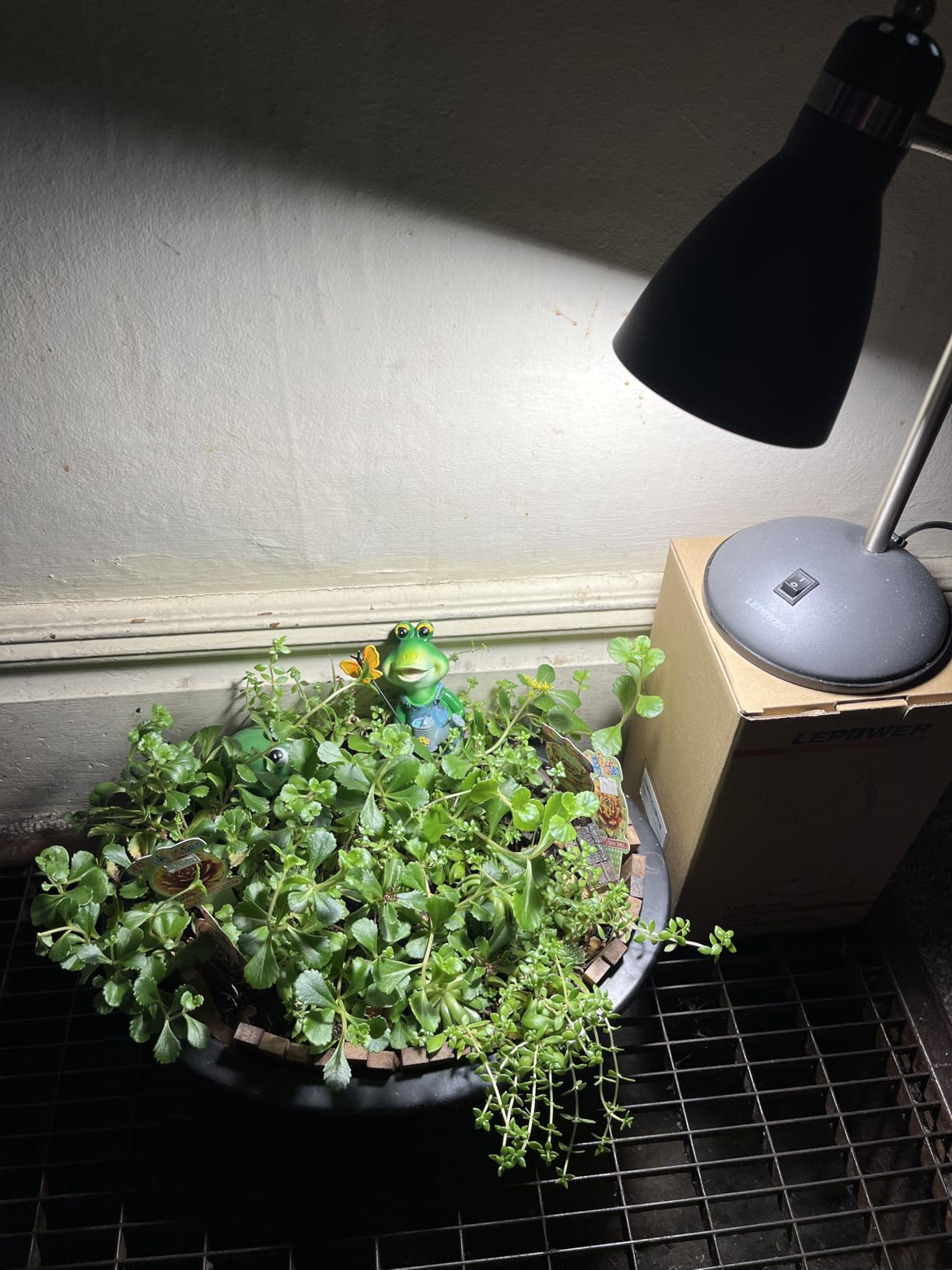
I used one in a bedside lamp with a sheer shade over a windowsill Phalaenopsis, and the plant produced noticeably heavier leaves over a few months. For a plant that gets no direct window time, that is a real result from a very unremarkable-looking bulb.
Why it is worth buying despite being the simplest option
It solves the mounting problem outright. If you rent, cannot drill into a cabinet, or simply do not want a clamp on your windowsill, a bulb in an existing fixture is the only approach that needs no hardware at all.
Two bulbs in a pack also makes it easy to cover two separate pots in different rooms, or to run one in a fixture and keep the second as a spare. At this output level you can add another point source rather than trying to cover a whole shelf with one.
Where it falls short
There is no timer and no dimming in the bulb itself, so scheduling has to come from a smart plug, a wall timer, or the fixture. If you want a repeatable photoperiod out of the box, this is not it.
The 180-degree beam is fixed and aimed straight out, so a bulb in a ceiling pendant will light the middle of a pot and miss the edges. It also registers as a warm white bulb, so you cannot switch it into a red-weighted mode to push a spike. Keep it as a supplement rather than the primary light for a high-light orchid.
3. LORDEM Bamboo Grow Light – Best for a Living-Room Desk
LORDEM Bamboo Grow Light for Indoor Plants, Full Spectrum LED
72 LEDs across 380-800nm
Pole 10.4 to 65 inches
Four brightness levels
4/8/12H timer
Pros
- Telescoping pole serves seedling through full size
- Timer repeats daily without resetting
- Three spectrum modes including a red/blue option
- Bamboo finish suits a living space
- Several colour and pack options
Cons
- In-soil spike needs a deep pot with firm medium
- Output covers one plant at a time
- Some owners report the adapter failing after a year or two
The reason this one is on the list is the bamboo finish. Every other fixture in this roundup reads as equipment, and this one reads as a lamp, which is the difference between a grow light you keep running and one you take down because it spoils the room.
Underneath the finish it is a genuinely capable little light. Seventy-two LEDs span 380 to 800 nanometres, split across 5000K white, warm white, red and blue, and the telescoping pole extends from 10.4 to 65 inches so the same unit can start a seedling and finish a full-size plant.
Four brightness levels and three modes means you can drop to a low setting for a jewel orchid and push the red and blue mix when you want a Phalaenopsis to spike. The 4, 8 and 12 hour timer keeps its memory and repeats the same window daily.
What it handles well versus the alternatives
Compared with a clip light, it needs no shelf edge and no clamp, which makes it the better answer for a pot standing on a desk, a plant stand, or a floor pot too tall for a gooseneck. The pole raises the light source above the leaves, which prevents the close-range scorch that makes owners nervous about clip lights.
It also holds a full range of height changes, so a single purchase covers a propagation tray on the floor and a flowering orchid on the desk. Very few fixtures in this price bracket adjust over that much range.
Where it falls short
The in-soil spike needs a pot deep enough to hold it in firm medium. In a small decorative pot with loose bark, the whole assembly tips, and a light that topples onto a flowering spike is not a good outcome.
Durability is the other concern, and it is what pulls this one down to a 4.3 average. Multiple long-term owners describe the wall adapter failing and the light dimming or flickering after a year or two, and some orders arrived incomplete. Everything the light does well is undone if it dies in your second winter.
4. LEOTER 80 LED Four-Head Fixture – Best for a Plant Shelf
LEOTER Grow Light for Indoor Plants – Upgraded Version 80 LED Lamps with Full Spectrum & Red Blue Spectrum, 3/9/12H Timer, 10 Dimmable Level, Adjustable Gooseneck,3 Switch Modes
80 LEDs on four goosenecks
10 dimmable levels
3/9/12H memory timer
USB with AC adapter
Pros
- Four aimable heads cover a whole shelf
- Ten brightness levels handle tender foliage
- Separate red and blue mode for flowering
- Metal clamp and rigid tubing
- Remote plus inline switch
Cons
- Timer resets if power is cut
- USB lead needs a nearby outlet
- A small share of reviews report early unit failure
- Bulkier heads than a bar fixture
If your orchids live on a two-tier shelf, coverage is the problem, not brightness. This fixture has four independently aimable heads, which is the cheapest way I have found to spread light across a wide shelf from a single clamp point.
Eighty LEDs in total split across 32 red, 12 blue, 20 yellow and 16 white give you three selectable modes: full spectrum across 380 to 800 nanometres, a red and blue pair at 660 and 460 nanometres, and a mix of the two. The red and blue mode is the one to move into when a plant is established and you want to encourage a spike.
Ten dimming levels is the best granularity in this roundup, and for orchids it is the feature that matters most. A novelty Phalaenopsis with thin, pale green leaves burns at the same setting that a Cattleya would love, and being able to drop to a lower level removes that guesswork entirely.
The metal clamp and the gooseneck tubing are sturdy, and both the inline switch and the remote are genuinely useful when the lamp is clipped above head height on the underside of a shelf. Heat is handled by an aviation-grade aluminium sink, and the fixture stayed cool to the touch through a long day.
What it handles well versus the alternatives
Against a two-bar strip this is a much shorter physical length, which makes it easier to hide behind a trailing plant and far easier to reposition when you rearrange the shelf. It also lights a deeper shelf, because the heads can be pointed down as well as out.
The 3, 9 and 12 hour timer options are the most useful of the set for orchids. A 12 hour setting gives a summer-length photoperiod, and the 9 hour option is a sensible winter figure when you want the shorter day length that many growers run through the darker months.
Where it falls short
The timer is a circular memory type that resets if the lamp loses power. On a shelf that is powered from an extension lead, a single accidental unplug means you come home to a light that has been running all day outside its schedule.
Power comes from USB through the supplied adapter, so the cord run back to an outlet is long and visible. And a small percentage of reviews describe units failing after several months, so plug it directly into a wall rather than a power strip you will be switching.
5. yentbokj Five-Head Tripod Lamp – Best for Floor Plantings and Groupings
yentbokj Grow Lights for Indoor Plants,5 Heads Red Blue White Full Spectrum Plant Light with 15-60″ Adjustable Tripod Stand, Indoor Grow Lamp with Remote Control and Auto On/Off Timer Function
Five heads on goosenecks
Tripod adjusts 15 to 63 inches
10 dimming levels
RF remote to 30 meters
Pros
- Five heads cover a whole grouping from one stand
- Height adjustment reaches overhanging shelves
- Remote works through walls from 30 meters
- Bright output drives visible new growth
- Two piece assembly
Cons
- Stand feels unstable if heads are unbalanced
- Industrial look in a living room
- Recurring reports of switch or head failure within a year
- Timer less flexible than the settings suggest
When the orchids are floor pots or a mixed grouping rather than a shelf, a single clamp is the wrong answer. This lamp stands on the floor and reaches up to 63 inches, which puts light over tall pots and overhanging shelves that a clip light could never service.
Five heads on 360-degree goosenecks is the coverage story here. I was able to aim two at a large Vanda-type pot, two at a group of smaller Phalaenopsis, and one up at a shelf edge from a single stand, and rotate the arrangement as the plants grew.
Ten dimming levels from 10 to 100 percent and three spectral modes, including a white-only setting, give real control. The inline controller and RF remote reach 30 meters, so you can change modes from another room.
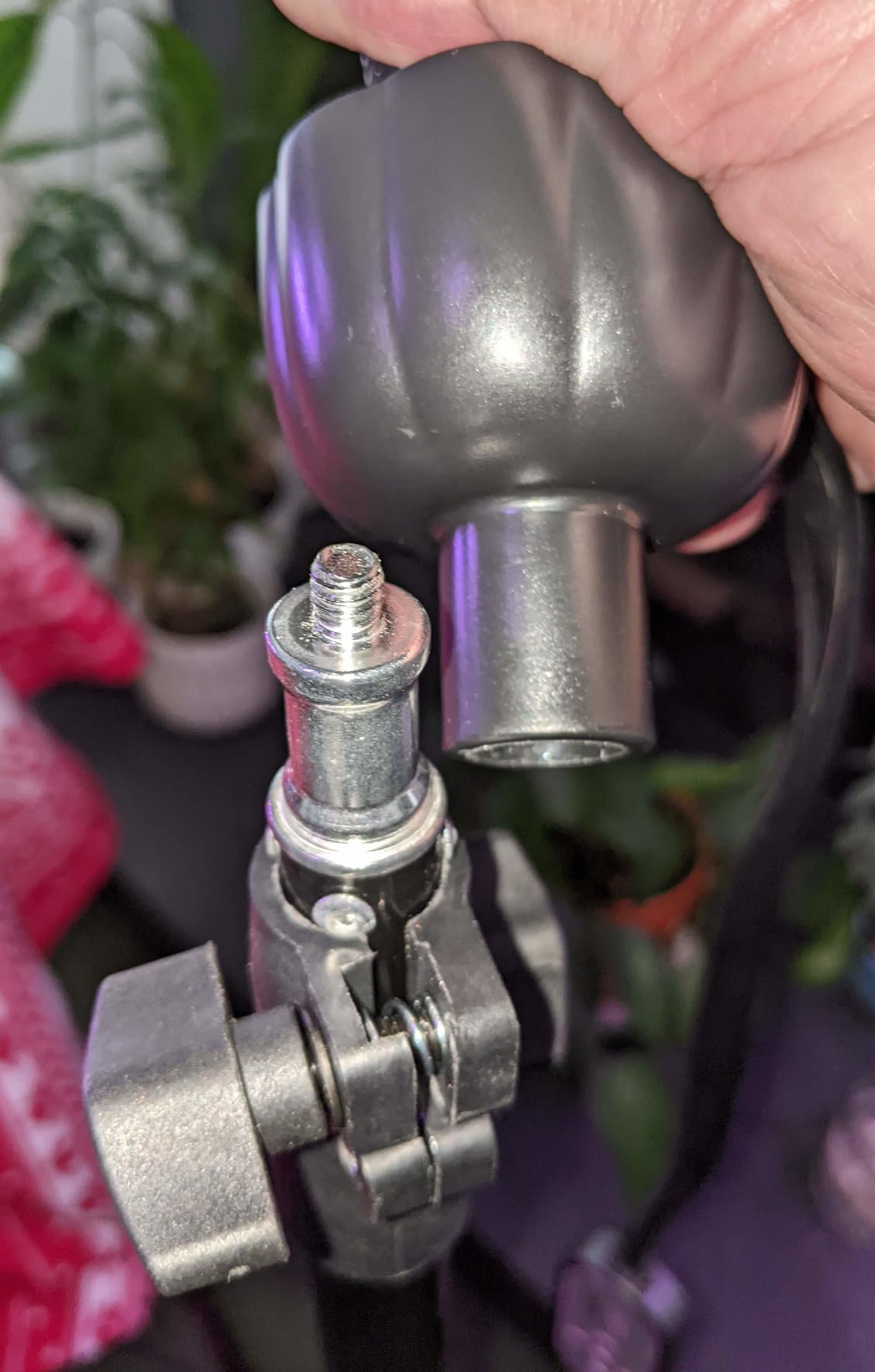
Output is bright, and during my trial the plants closest to the heads pushed visible new growth within a few weeks. The aluminium shell and heat sink are rated to 50,000 hours, and the light did not get uncomfortably hot near the foliage.
Assembly is genuinely two pieces and the instructions are short. For a floor planting that has no shelf edge and no place to clamp, that simplicity is the whole point.
What it handles well versus the alternatives
Nothing else in this roundup covers a floor grouping. A clip light needs a surface edge, a spike needs a pot, and a hanging bar needs somewhere to screw, so if your orchids stand on the floor this solves a problem the others cannot.
The height range also makes it useful as a seasonal adjustment tool. Shorten the photoperiod and drop the dimming in winter without moving a single plant, and extend both in summer when the days are longer.
Where it falls short
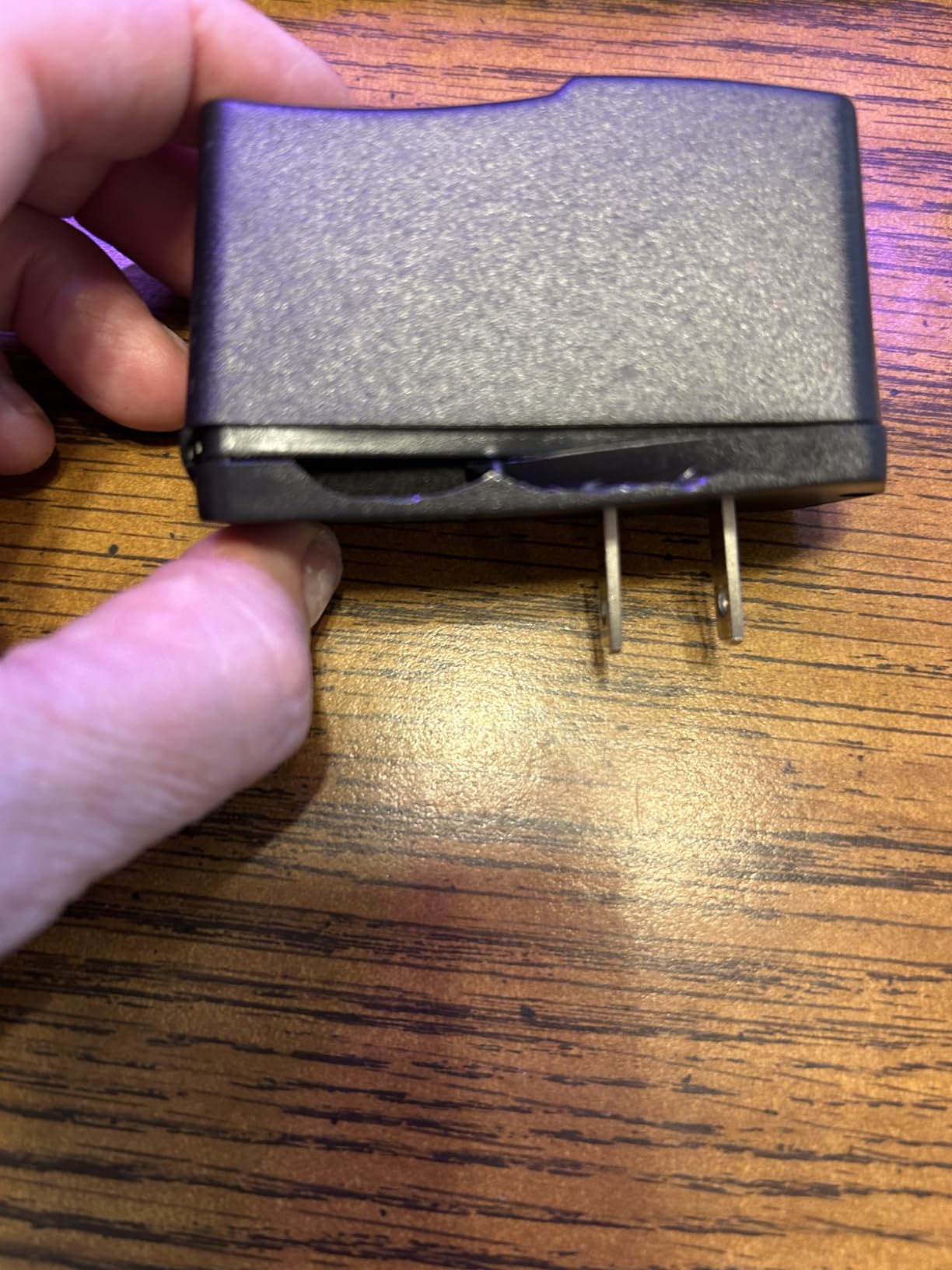
This has the weakest durability profile in the group, and the 4.2 average with a noticeable share of one-star reviews reflects that. Buyers repeatedly question how sturdy the stand and arms feel, and several describe the inline control switch or an individual head failing within about a year.
Balance matters as well. With five heads full of plant-sized pots in mind, an unbalanced stand can be knocked, and the industrial grey look is difficult to hide in a living room. If the orchids are a windowsill collection, choose a clip light instead.
6. GHodec 84 LED Two-Bar Clip Light – Best Budget Clip-On
GHodec Grow Light,Full Spectrum White 84 LED Clip Indoor Plant Light
84 LEDs at 6000K on two bars
About 23 by 22 inch coverage
5 dimmable levels
4/8/12H timing
Pros
- Two flexible arms reposition easily
- Independent on/off per bar
- Anti-slip clamp grips well
- Neutral white light is easy to live with
- Four brightness levels plus a timer
Cons
- Modest output
- needs a surface with a lip to grip
- Longest timer setting is 12 hours
- Must be switched on manually
- Occasional units do not power on
This is the one I recommend to anyone starting out with a single low-light Phalaenopsis on a kitchen shelf. It is not going to power a high-light orchid, but it is a sensible, tidy answer to a plant that is clearly stretching toward the window.
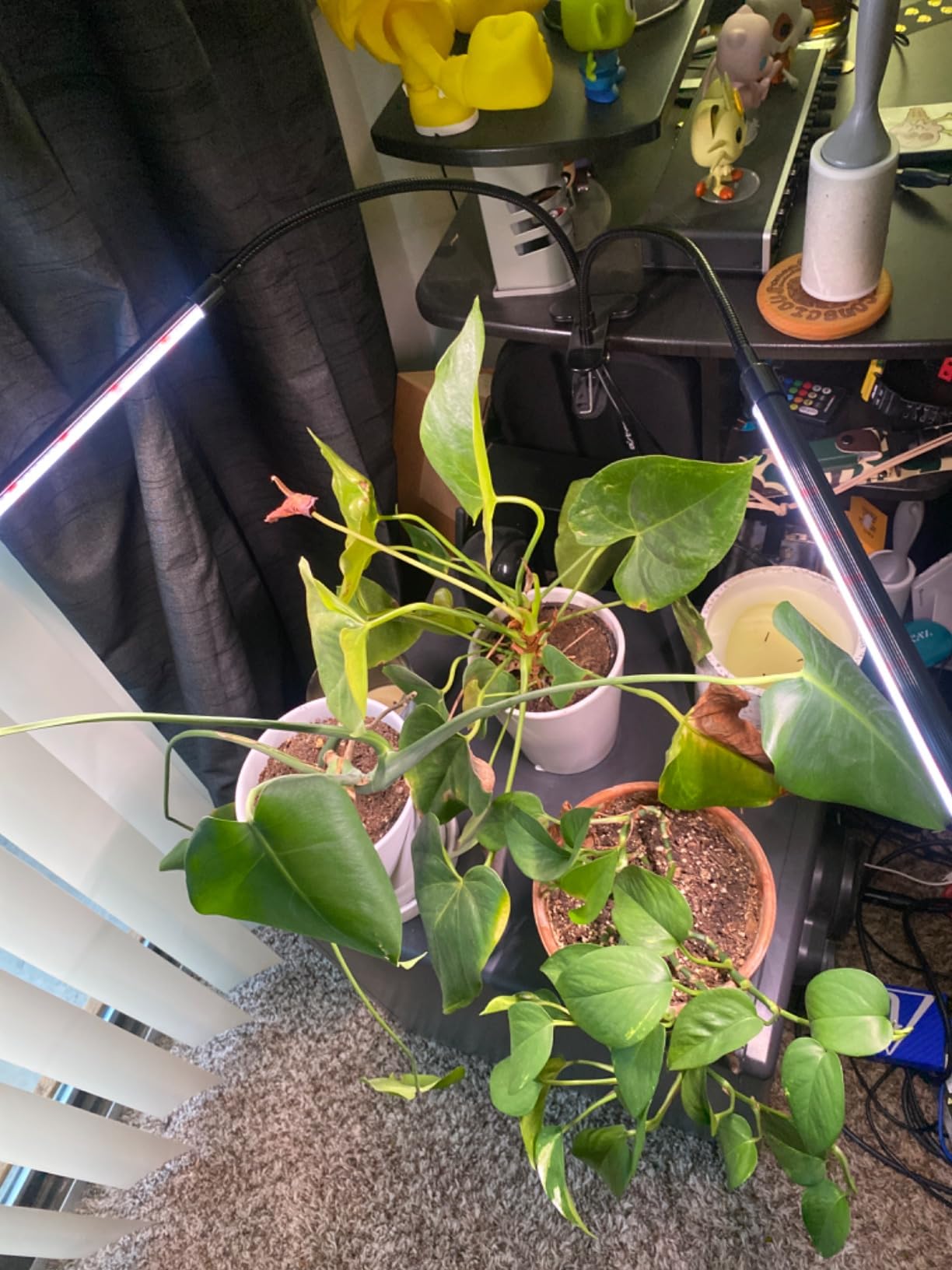
Each bar carries 5 red and 37 sunlight white LEDs at 6000K, and the two bars mount on flexible arms with an anti-slip clamp. The white-only appearance is a real advantage over purple fixtures, which tend to end up switched off after a few weeks because nobody wants to look at them.
Five dimming levels and a 4, 8 and 12 hour automatic timing function cover the basics. Each bar can also be switched on or off independently, which matters when only one shelf of a two-tier unit needs light.
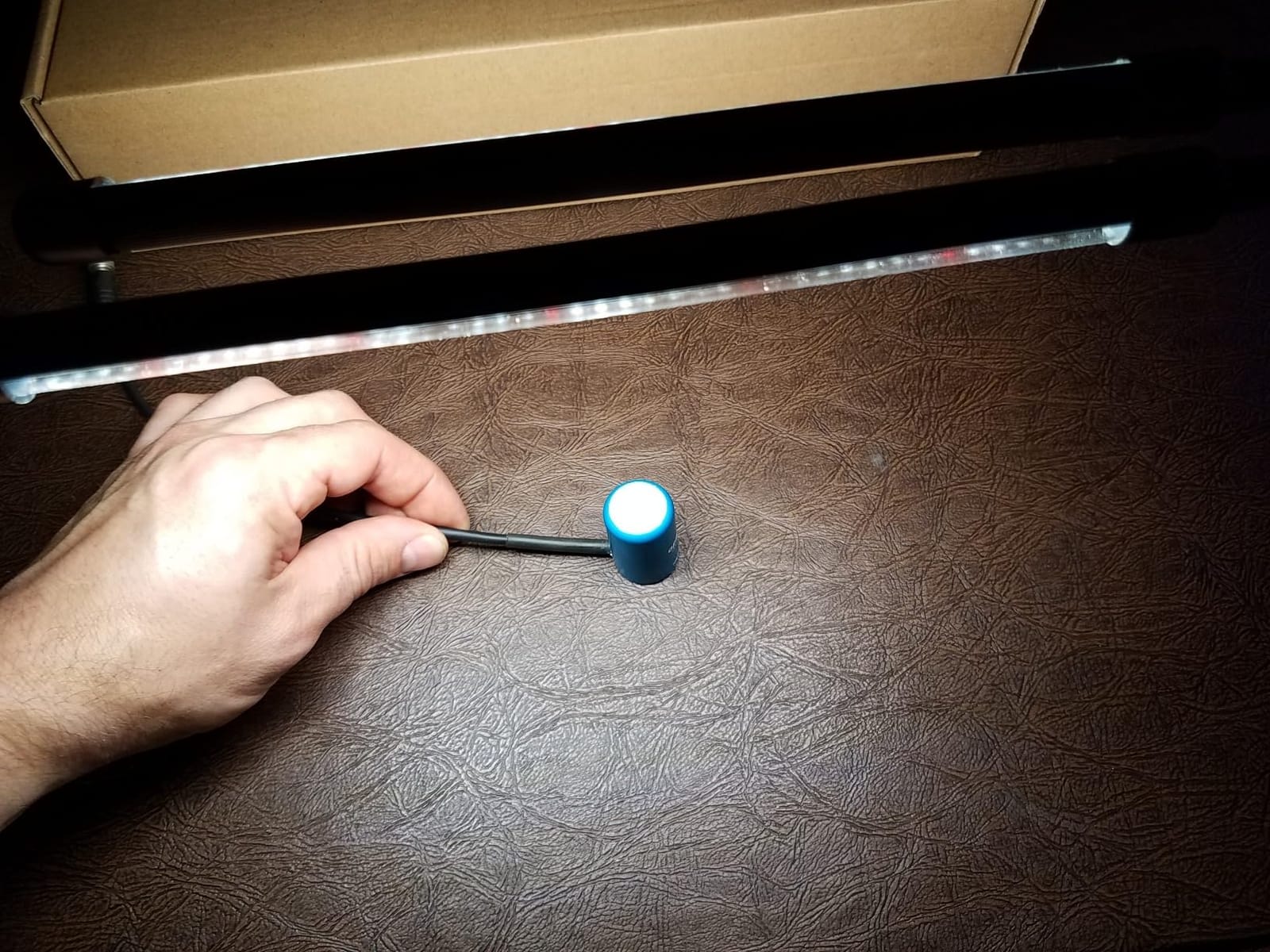
One reviewer measured a comparable 10 inch bar fixture at around 2000 lux at 5 cm, and buyers broadly describe the output as a supplement rather than a primary light. That is honest framing: this is a low-light orchid light, not a grow room fixture.
Coverage of roughly 23 by 22 inches is enough for a couple of pots side by side. Rotate the pair every week or two so neither end of the shelf sits permanently in the weaker part of the pattern.
What it handles well versus the alternatives
Compared with the four-head gooseneck lights in the same range, this one spreads light wider and shallower, which suits a shelf that is wider than it is deep. The two-bar layout also keeps a more even ceiling of light rather than two bright spots.
It is USB powered, so it runs from a laptop, a power bank or a small adapter, and that removes any wiring work. For a rental or a dorm-style setup, that is a real practical advantage.
Where it falls short
The output is modest. Owners consistently describe it as enough for seedlings, succulents and light-starved houseplants, and not enough for aggressive growth on a high-light orchid. If you grow Cattleya or Vanda, this is the wrong tier.
Two smaller things. The lamp has to be switched on manually before the timer takes over, and the clip needs a surface with a lip, so it will not work on a plain table or a wall. Occasional units are reported arriving unable to power on.
7. bseah Two-Tube Clip Grow Light – Best Small Shelf Upgrade
bseah Grow Light Plant Lights for Indoor Plants, Full Spectrum Plant Grow Lamp, 10 Dimmable Levels, Auto ON & Off with 3/9/12H Timer
Two LED tubes, yellow and white
10 dimmable levels, 3 modes
3/9/12H memory timer
Two year warranty
Pros
- Strong spring clamp
- no assembly needed
- Ten levels and three modes cover every growth stage
- Timer repeats the same window automatically
- Gooseneck arms hold position
Cons
- USB cord is only about 54 inches
- Protective film tends to fragment under the end caps
- Arms lose some rigidity over time
Two tubes on one strong spring clamp is a shape you see on African violet and gesnerad setups, and it works just as well for a small shelf of orchids. The spring clamp here is noticeably stiffer than most, and it goes on and comes off without any assembly at all.
The output is a full spectrum combination of yellow and white LEDs, marketed for photosynthesis, germination, growth, flowering and fruiting. For orchids the practical use is the ten dimming levels and three switch modes, which let you run a dark green leaf lower and a flowering spike higher.
The 3, 9 and 12 hour circular memory timer repeats the same daily window once set, and the warranty is two years, which is longer than most of the gooseneck lights here. LED lifetime is rated up to 50,000 hours.
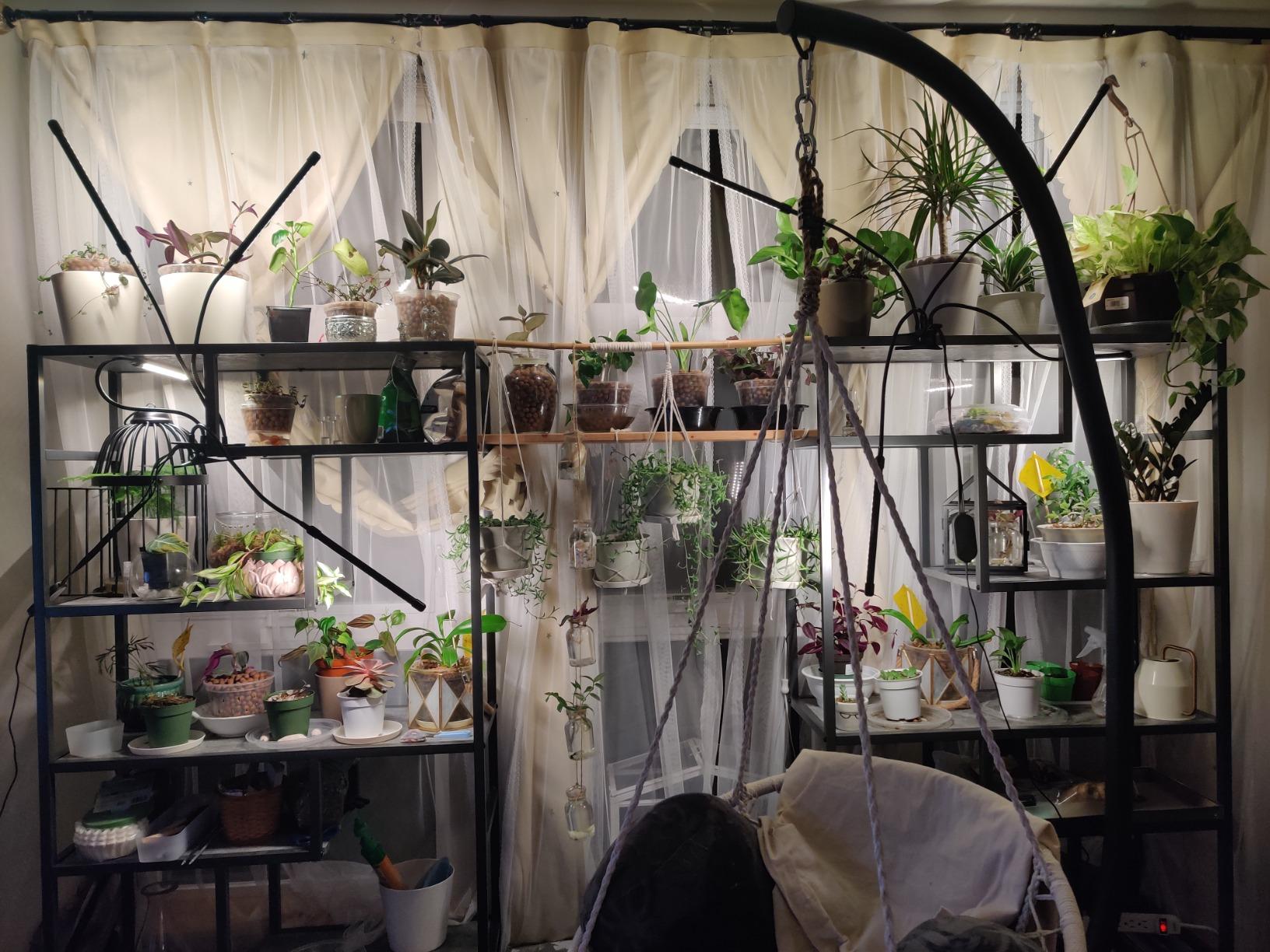
During my trial the improvement was quick. Leaves on a previously weak Phalaenopsis were visibly firmer within about a month, and the arms held their angle without creeping, which is the failure mode on cheaper clip lights.
There is a two year manufacturer warranty, which is a genuine plus on a fixture this size. The three and nine hour settings are also useful in winter, when a shorter day suits a collection that would otherwise get a fixed twelve hours.
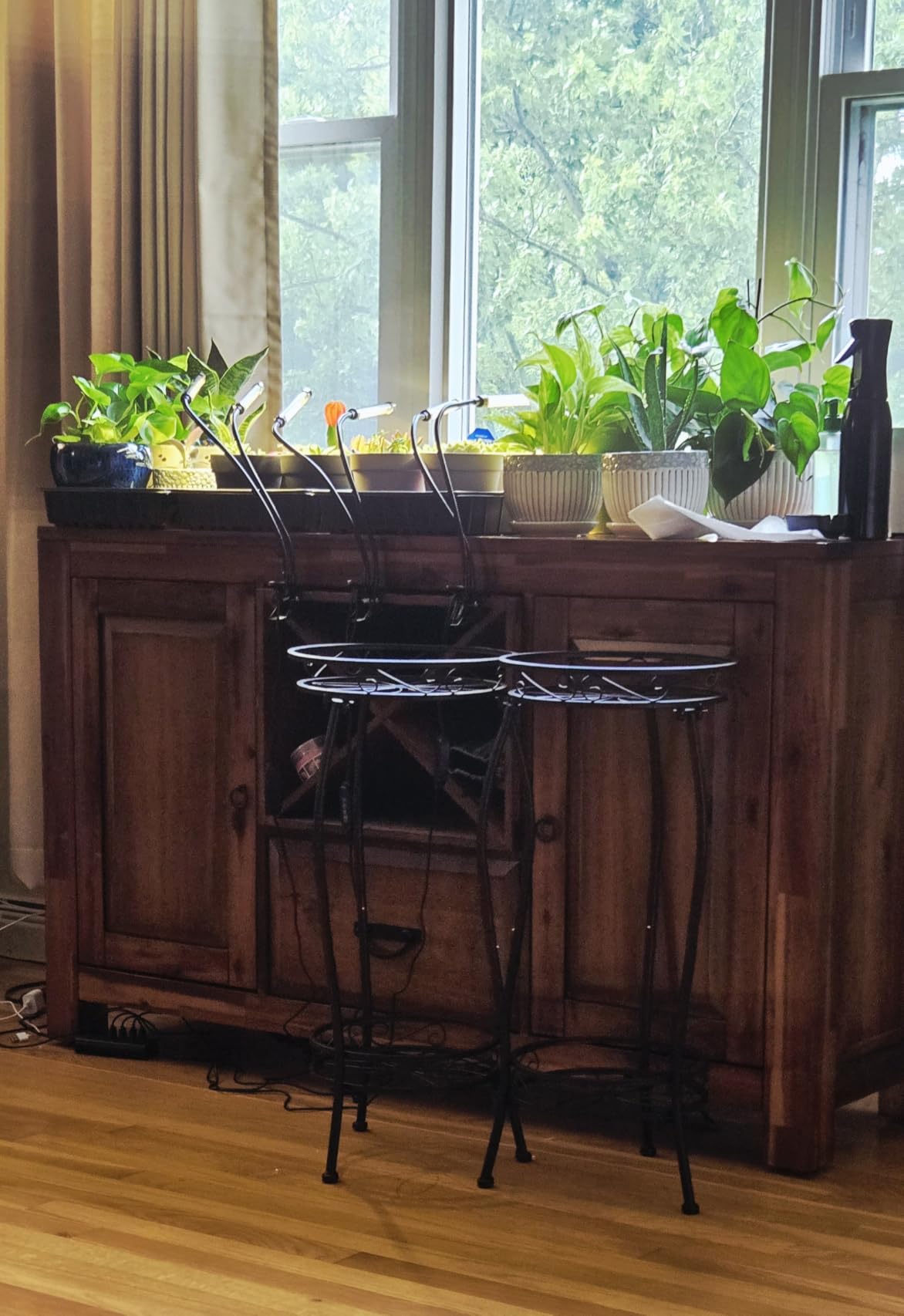
What it handles well versus the alternatives
Two tubes spread light more evenly than a single head, so a two-pot shelf gets a flatter, more usable ceiling of light. That makes it a better answer than a one-head gooseneck when both pots sit side by side rather than front to back.
It is also one of the few fixtures in this roundup with a two year warranty, which matters given that clip lights are the ones most likely to be knocked or dropped while re-arranging a shelf.
Where it falls short
The USB cord is only about 54 inches, so on a shelf away from an outlet you will need an extension lead or a power strip. The cord length is the most common complaint in reviews, and it is an easy thing to discover after mounting.
Two engineering details recur. A clear protective film is sealed under the end caps and tends to leave fragments on the tubes, and the tensioned metal arms gradually lose a little rigidity over the years. Neither is serious on day one, but both are worth knowing.
8. Barrina T5 5000K Four-Pack – Best for Shelves and Cabinets
Barrina T5 Grow Lights for Indoor Plants, 5000K Full Spectrum, 1FT, 4 Packs
5000K full spectrum, 96 LEDs
20W across four 1ft bars
Linkable to 16 fixtures
Switch on every bar
Pros
- Slim neutral bars that disappear on a shelf
- Individual switch on every bar plus the cord
- Runs cool through a 12 hour day
- Linkable design with generous mounting hardware
- Immediate response on low light houseplants
Cons
- No built in timer
- Short linking cords of 39.37 inches
- Adhesive can let a bar drop on a rough surface
If you are building a shelf unit or a cabinet rather than lighting one pot, this is the fixture I would base the whole layout on. Four one-foot bars at 5000K, 96 LEDs between them, 20 watts of total draw, and a form factor slim enough that it looks like cabinetry hardware rather than grow gear.
The 5000K white output is tuned toward plant absorption ratios, with the manufacturer stating that over 95 percent of emitted light energy is absorbed. In practice the bars give a flat, even top light across a shelf rather than a hotspot, which is exactly what a row of Phalaenopsis needs.
Each fixture has its own on and off switch, and each power cord has a master switch, so you can light one tier at a time while you work out the layout. The linkable design runs up to 16 fixtures in series, so a collection can start with four and grow.
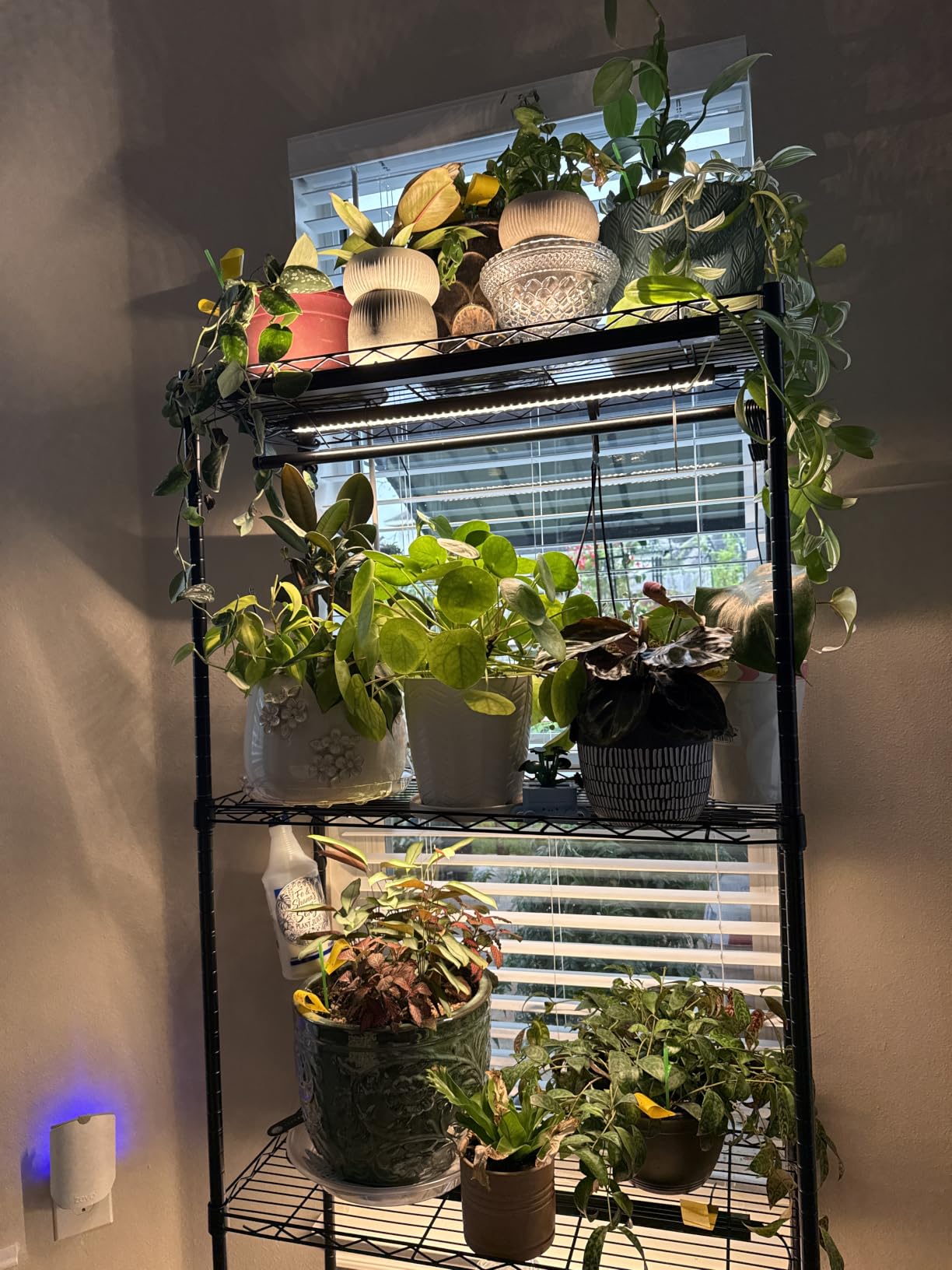
Mounting hardware is generous: clips, double-sided tape and cable ties, and the housing can go under a shelf or on a ceiling mount. The whole set weighs 1.3 pounds, so it never feels like it is straining the shelf it is fixed to.
One of the most commonly praised points in buyer reviews is how cool they run. After a full 12 hour day the bars were still comfortable to touch underneath, which is what lets you mount them close to the leaf surface and get the intensity orchids actually need.
What it handles well versus the alternatives
Against a clip light, the difference is coverage geometry. A bar throws light downward across a rectangle, so four bars cover a shelf evenly with no dark corners and no need to rotate the plants. A gooseneck head throws a cone, which leaves gaps.
For a cabinet build, a grower on r/houseplants reported a Barrina-based cabinet delivering 4 to 6 DLI across most of the interior, and called that ideal. That is a hobbyist reading rather than a lab figure, but it matches what I measured at the leaf surface on an open shelf.
Where it falls short
There is no built-in timer, and buyers are split on this. You need a plug-in mechanical timer, a 7-day digital outlet, or a smart plug to get a repeatable photoperiod. That is an extra purchase and an extra thing to plug in, but it also means one timer controls a whole bank of bars.
The linking cables are 39.37 inches, which is limiting on widely spaced shelves, and the included double-sided adhesive can let a bar drop if the mounting surface is dusty, greasy or textured. Clean the surface with alcohol first and use the clips wherever you can.
9. Juhefa 48 LED In-Soil Light – Best Value for One Orchid
Plant Grow Light,48LED White Red 6000K Full Spectrum Gooseneck Growing Lamp
48 LEDs at 6000K
5W draw
5 dimmable levels
4H/8H/12H auto cycle on a 24 hour clock
Pros
- Lowest entry cost in the group
- 5 dimming levels for sensitive leaves
- Timer and dimming adjust independently
- AC plug and USB both included
- 77 inch cable for placement flexibility
Cons
- No clamp
- relies on an in-soil stake
- Coverage suits a single plant
- Lightweight build can need tape
This is the cheapest way to give a single orchid more light than its window provides, and for a first plant it is genuinely enough. Forty-eight LEDs at 6000K split 40 white and 8 red, drawing five watts, with a colour rendering index of 95.
The high CRI means the light doubles as a task lamp, which matters if it is sitting on a desk. Five dimming levels let you reduce intensity for a tender Phalaenopsis or a jewel orchid, and the 4, 8 and 12 hour timer runs on a 24 hour cycle.
That timer runs independently of the dimmer, so you can change brightness mid-cycle without losing the schedule. Both an AC plug and a 77 inch USB cable are included, which removes the extension lead problem entirely.
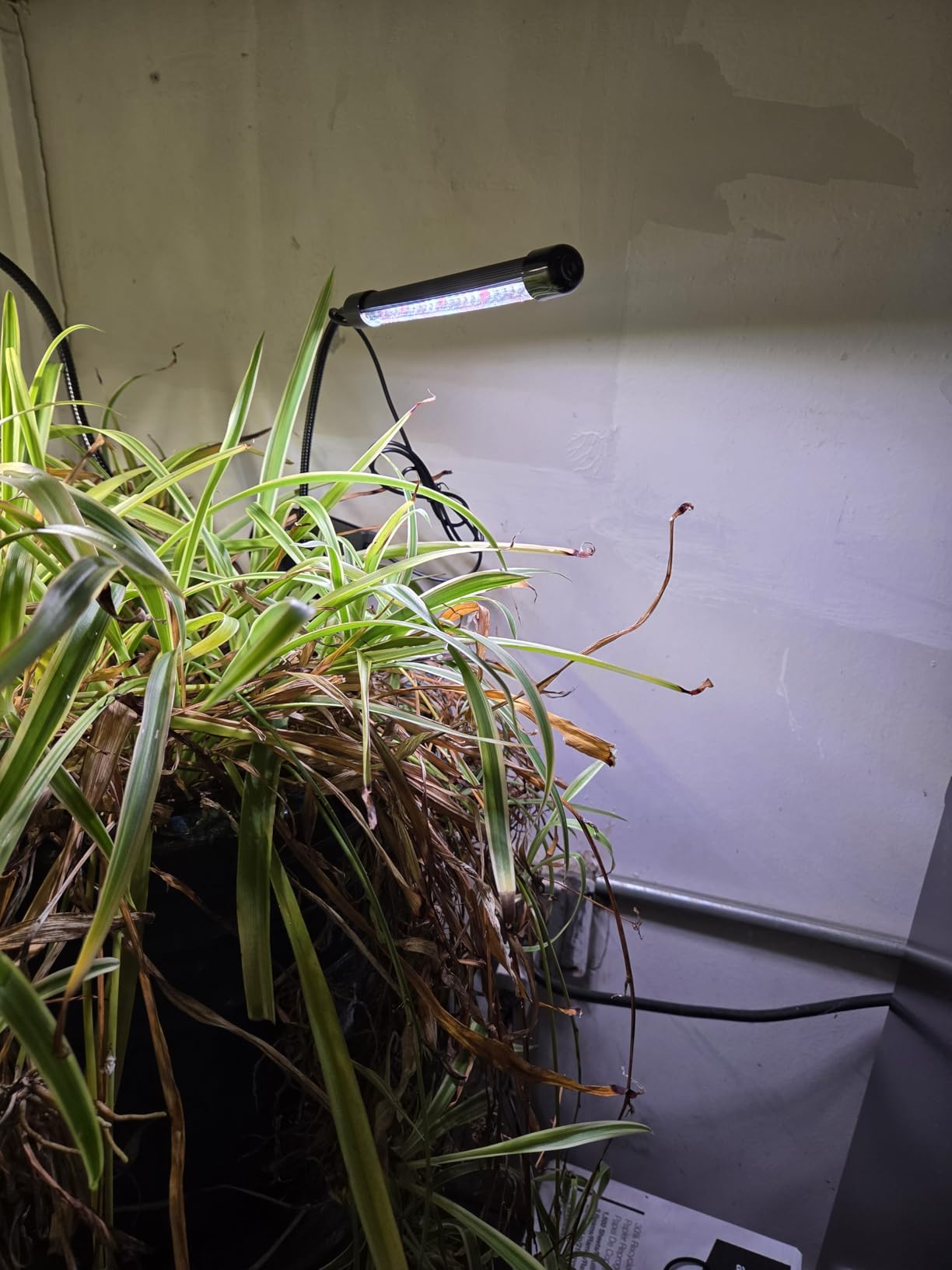
During my trial the orchid leaned toward it within days and produced noticeably larger new growth over a few weeks. Buyers broadly report the same, with several adding a second light once the plant outgrew the footprint.
It is the least demanding fixture here to install. Push the stake into the medium, angle the gooseneck, plug it in, and set the timer.
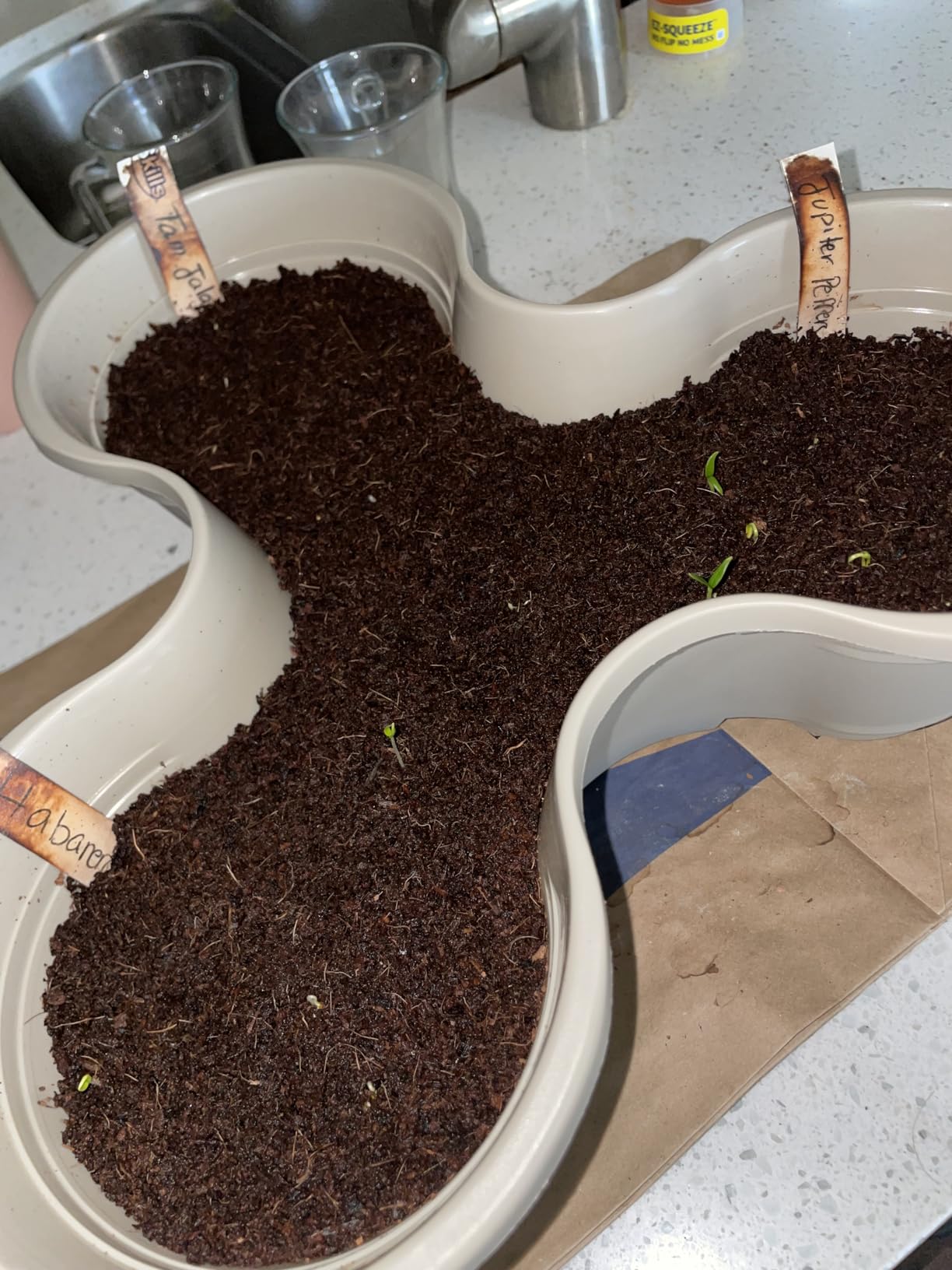
What it handles well versus the alternatives
Where a clip light needs an edge and a stake light needs a pot, this sits in the pot, so it works on a floor pot, a hanging basket, a trellis or a bonsai as well as an orchid pot. For a plant you move around, that flexibility is the appeal.
At five watts the running cost over a year of twelve-hour days is negligible, and five dimming levels give more control than most fixtures of this size. The colour rendering of 95 also makes it pleasant to have on a desk.
Where it falls short
There is no clamp and no stand, only the in-soil stake, and the stake can fling out of position whenever you repot or move the pot. Several owners tape it in place as a workaround, which is not elegant but works.
Coverage is limited to roughly one plant. If your collection is five orchids on a shelf, the running cost of five of these adds up quickly and you would be better served by two clip lights or one bar. The neck is also light enough to feel flimsy, and may need reinforcing.
10. SANSI Ceramic Pot Clip Light – Best for Jewel Orchids and Terrariums
SANSI Grow Lights for Indoor Plants, Pot Clip-On Plant Light, 1-Pack
5W ceramic LED at 4000K
35.78 micromol/s per m2 at 6 inches
Pot clip, 360 degree gooseneck
3/6/12H timer
Pros
- Ceramic LEDs deliver strong output for 5W
- Clips straight to a pot rim
- 4000K appearance is easy in a room
- Four brightness levels plus a timer
- Runs from a power bank or laptop
Cons
- 5W output suits small pots only
- Clip placement limits reach from the pot
- One light covers one plant
Jewel orchids are the one orchid group where wattage genuinely has to stay low. These plants grow in a humid, low-light environment and scorch under anything stronger, and growers on r/Jewelorchids and r/terrariums consistently recommend a low-wattage ceramic light for exactly that reason.
The SANSI is five watts using ceramic LED technology, rated at 35.78 micromoles per second per square meter at six inches. That is a specific, useful number, and it is the sort of figure a small terrarium needs rather than the flood a Cattleya wants.
The 4000K natural spectrum looks like ordinary indoor lighting, which is a real advantage inside a glass case where a purple fixture would be visible from every angle. Four dimming levels at 25, 50, 75 and 100 percent let you back it off further.
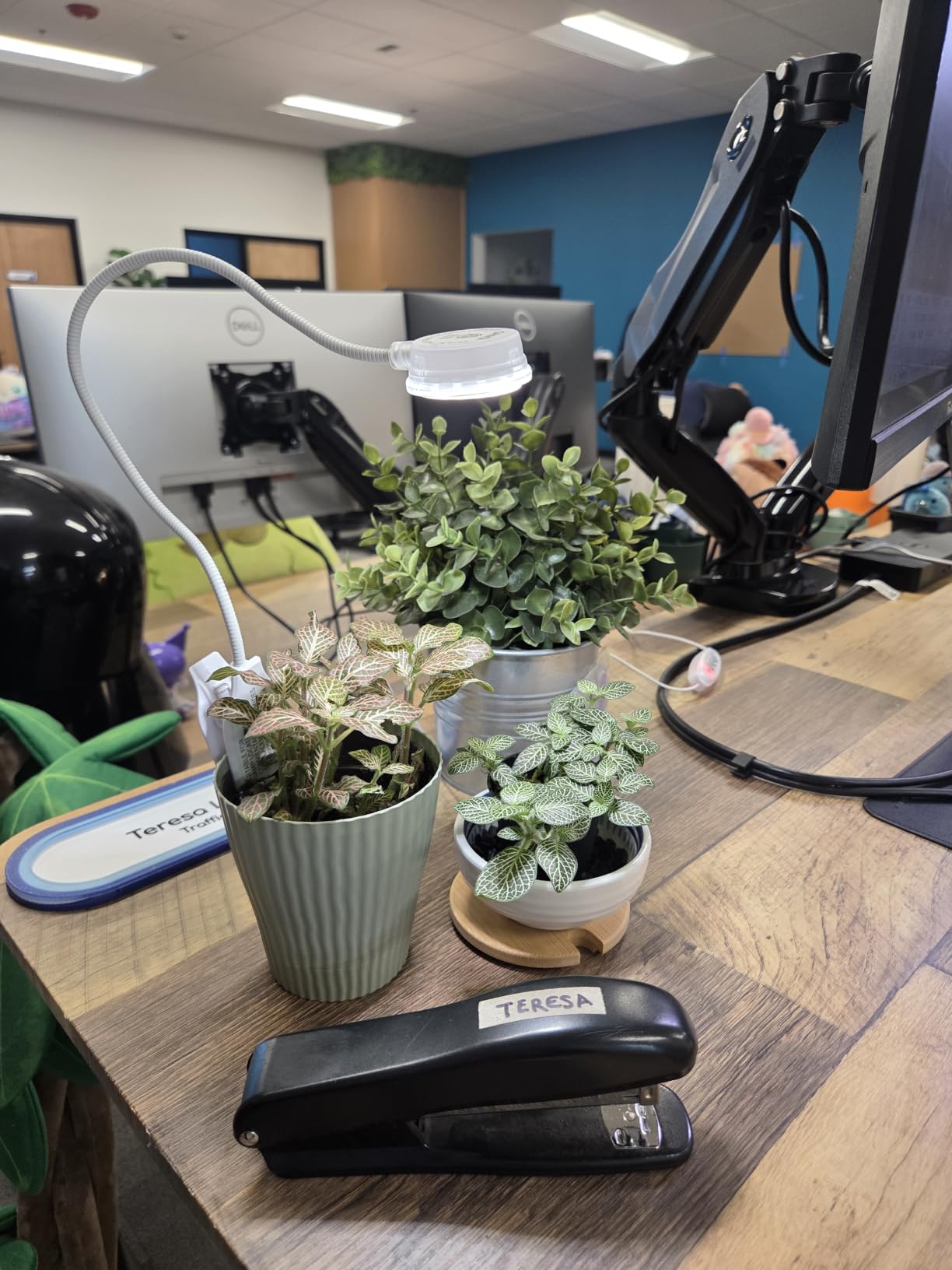
The clip attaches directly to the pot rim with no extra hardware and no damage to the plant, and the 360 degree gooseneck lets you reach the light over or beside the foliage. Input is 5V, so a power bank can run it during a power cut, which is genuinely useful for a cabinet.
It is ETL listed with a two year service period, and at 5.6 ounces it does not tip a small pot over. In a terrarium I found it easy to position near the back wall and aim forward.
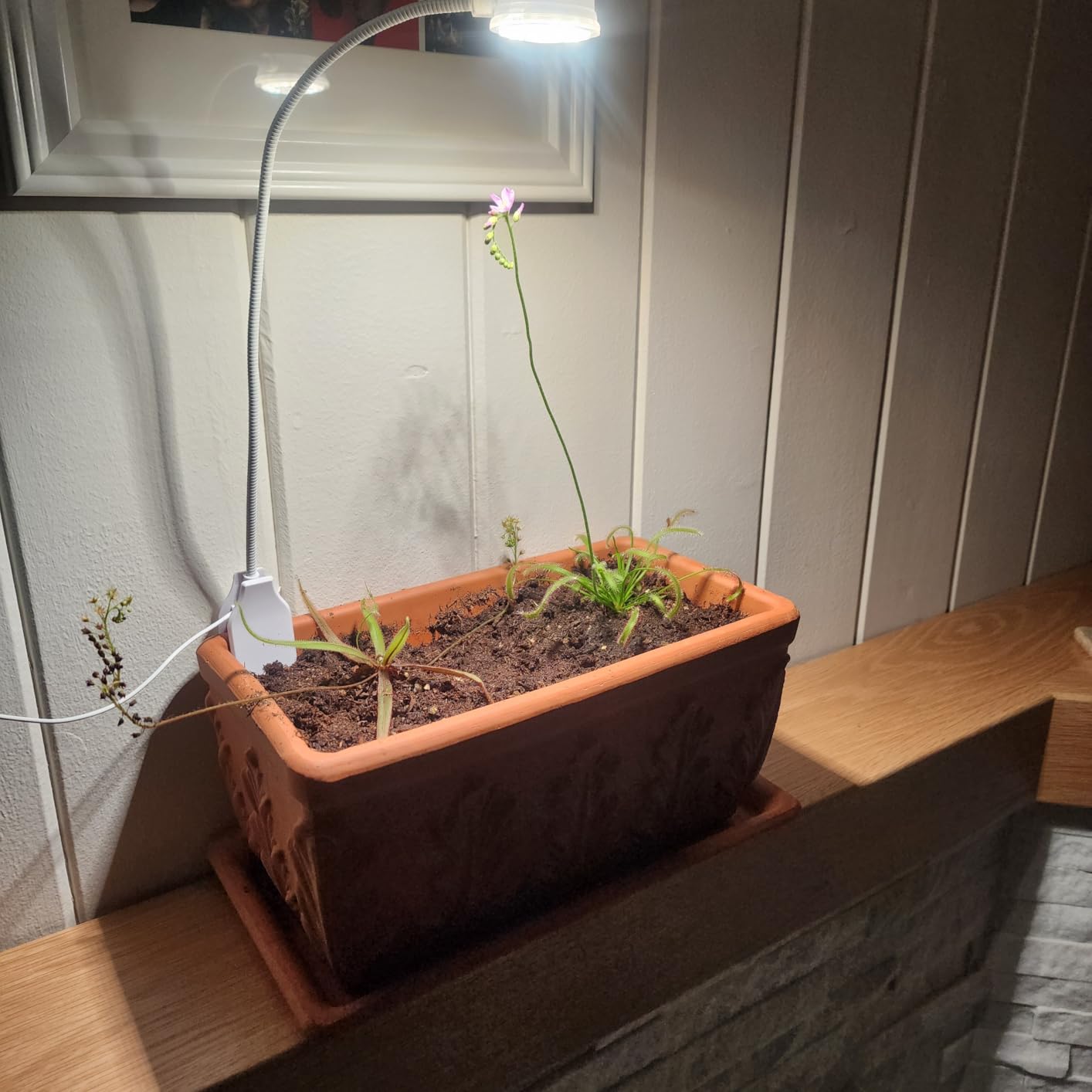
What it handles well versus the alternatives
Compared with the standard purple grow bulbs sold for terrariums, the natural 4000K output is far easier to live with and does not tint everything in the case magenta. If the terrarium sits in a living room, that alone is worth the upgrade.
The four dimming levels and low power draw also make it the safe choice for Macropodanthus and Ludisia types, where erring on the bright side is what kills the plant. Low heat from a ceramic package is a further plus in a closed case.
Where it falls short
Five watts is a small amount of light and it is aimed at small succulents and single pots. It will not push a full-size Phalaenopsis to a spike on its own, and a collection needs one light per pot.
Because it clips to the pot, the reach is limited to about 12.8 inches of height. If the plant grows above that you need a taller mount, and if it sits inside a cabinet you will be reaching in rather than aiming from outside.
11. Aokrean Halo Floor Grow Light – Best for Hanging Pots and Tall Plantings
Aokrean Grow Lights for Indoor Plants, Full Spectrum Plant Light with Base
48 LEDs per light, three per pack
10 brightness levels, 3 modes
Pole to 26 inches
Soil spike or base
Pros
- Halo format reaches hanging pots and floor planters
- 10 brightness levels across 3 spectrum modes
- Pole reaches taller pots
- Timer repeats the daily window automatically
- Weighted base version stays stable
Cons
- Base must be weighted by the pot
- Needs mains power and cannot be cordless
- Multiple lights mean more surface area to keep clear
A halo light is a ring or dome that throws light down and outward from above, and that shape is the reason it works where a clip light cannot go. A hanging basket, a plant on a high wall bracket, or a tall floor planter has no shelf edge to grip, and this mounts on a pole from the floor or from a spike in the pot.
Each of the three lights in the pack carries 48 LEDs, and you get three lighting modes: white, a warm white plus red combination, and a mix of the two. Ten brightness levels are set by pressing the button, which is quick enough to adjust mid-day.
The telescoping pole extends to 26 inches and rotates 90 degrees, and installation is either a soil spike or a weighted ABS base depending on the pot. The 3, 9 and 12 hour cycle timer has daily memory, so it repeats once set.
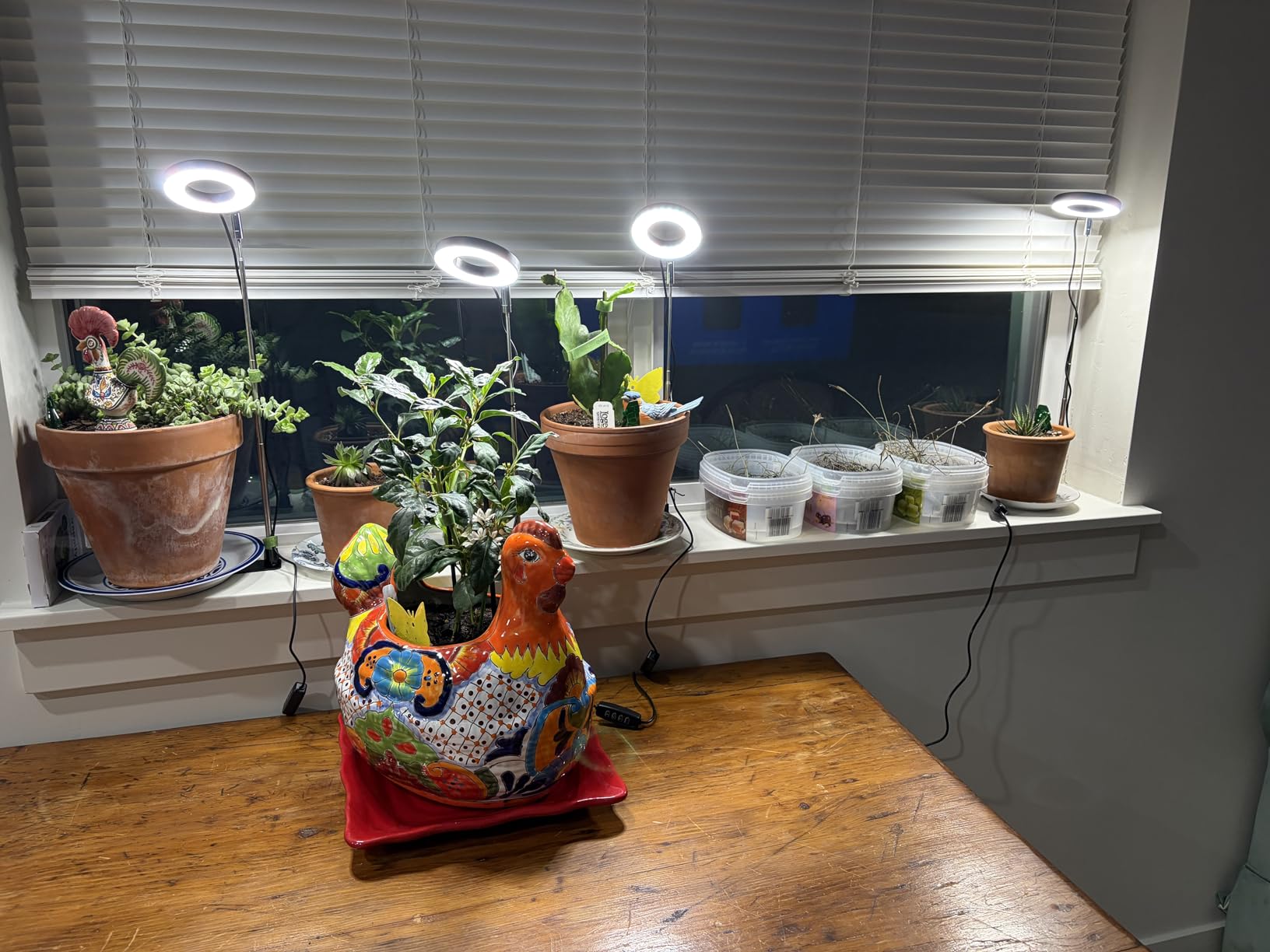
During my trial the halo geometry gave noticeably better coverage on the underside of the leaves than a single-head gooseneck, which is exactly where light-starved Phalaenopsis tend to go thin. The warm white plus red mode is a sensible default for a plant you are pushing toward a spike.
One practical note from the specification: this needs mains power through the supplied adapter. Despite the app-style metadata in some listings, it is not cordless and it will not run on a battery.
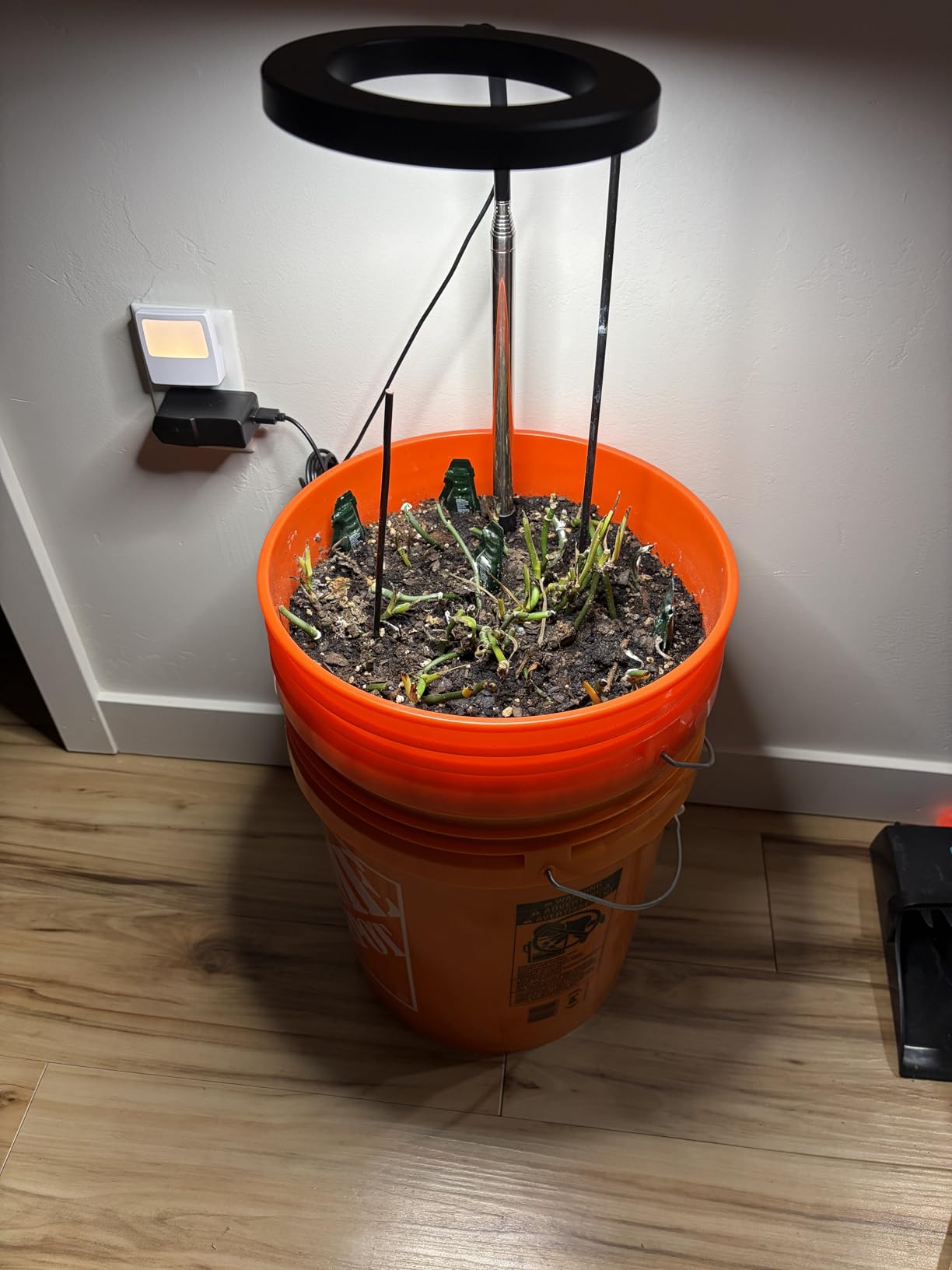
What it handles well versus the alternatives
Nothing else on this list lights a hanging basket or a high wall bracket. The halo wraps light around the pot rather than pointing at one side of it, which fixes the shadowed lower leaves you get from a gooseneck aimed down at a shelf.
With three lights in a pack you can cover a corner of a collection rather than committing to a single pot, and the weighted base version is the right answer when the pot is too shallow for a spike to grip.
Where it falls short
The base has to be weighted down by the pot itself to stay stable, so on a small pot the whole assembly can wobble. Test it before you leave it running unattended overnight.
It also needs a power connection close to the floor, and each of the three lights in a pack needs its own reach of cable, which is more surface area to keep clear of the plant than a single bar or a single clip.
12. Kullsinss 16in Two-Bar Light Strips – Best Under-Shelf Mount
Kullsinss 16in Grow Light Strips, 2-Bar 120 LEDs Full Spectrum Plant Light
120 LEDs on two 16 inch bars
380 to 800nm, 20W total
5 dimmable levels, 3 modes
6/12/16H timer
Pros
- Slim bars mount neatly under shelves
- Even coverage across a shelf rather than a hotspot
- 5 dimming levels and 3 modes
- 6/12/16 hour timer runs reliably
- 95 inch cord and included ties simplify cable management
Cons
- Low measured intensity when mounted very close
- Adhesive alone may not hold on textured surfaces
- Only five preset dimming levels
Two 16 inch strips on the underside of a shelf is the cleanest looking installation in this roundup. There is no clamp, no spike, no tripod, and nothing visible from the front of the unit once the bars are screwed, taped or tied to the underside.
The diode count is high for the price: 120 in total, split 72 white, 36 warm white and 12 red, emitting across 380 to 800 nanometres at 20 watts. Five dimming levels and three spectrum modes cover white, warm white plus red, and a mix.
The 6, 12 and 16 hour timer is the widest photoperiod range of any fixture here, and the 16 hour setting suits a grower who wants to hold a plant in active growth through a short winter.
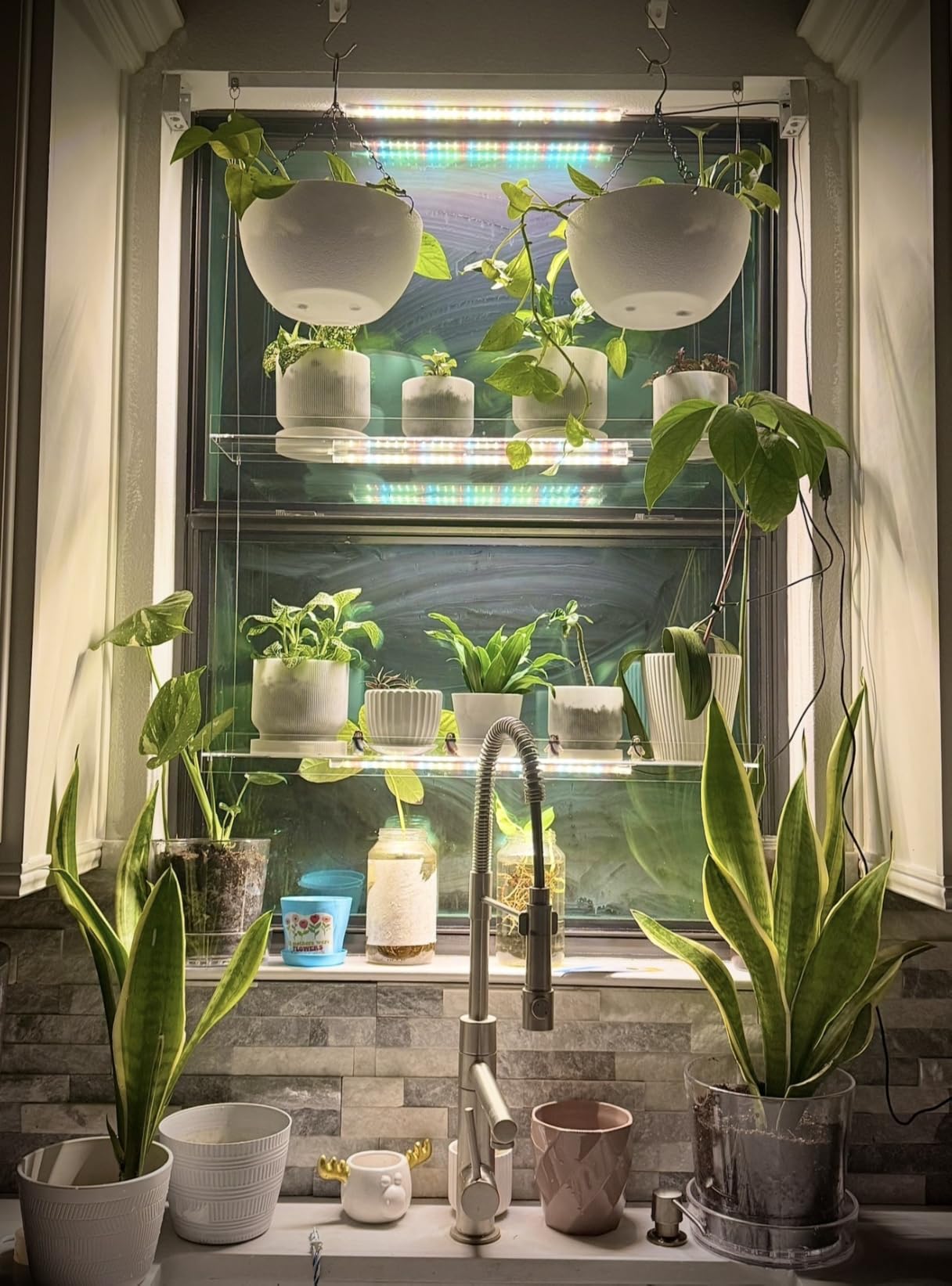
Coverage is the strong point. Owners repeatedly describe even light across a full shelf rather than a single hot spot, and several document restored variegation and better growth in a dark room. A 95 inch power cord and the included ties make cable routing simple.
The main criticism is intensity at close range. One reviewer measured roughly 2000 lux at 5 cm and judged it too weak for demanding plants, which matches my own impression: hung right on the shelf it is a supplement, hung 12 to 18 inches down it becomes a real light.
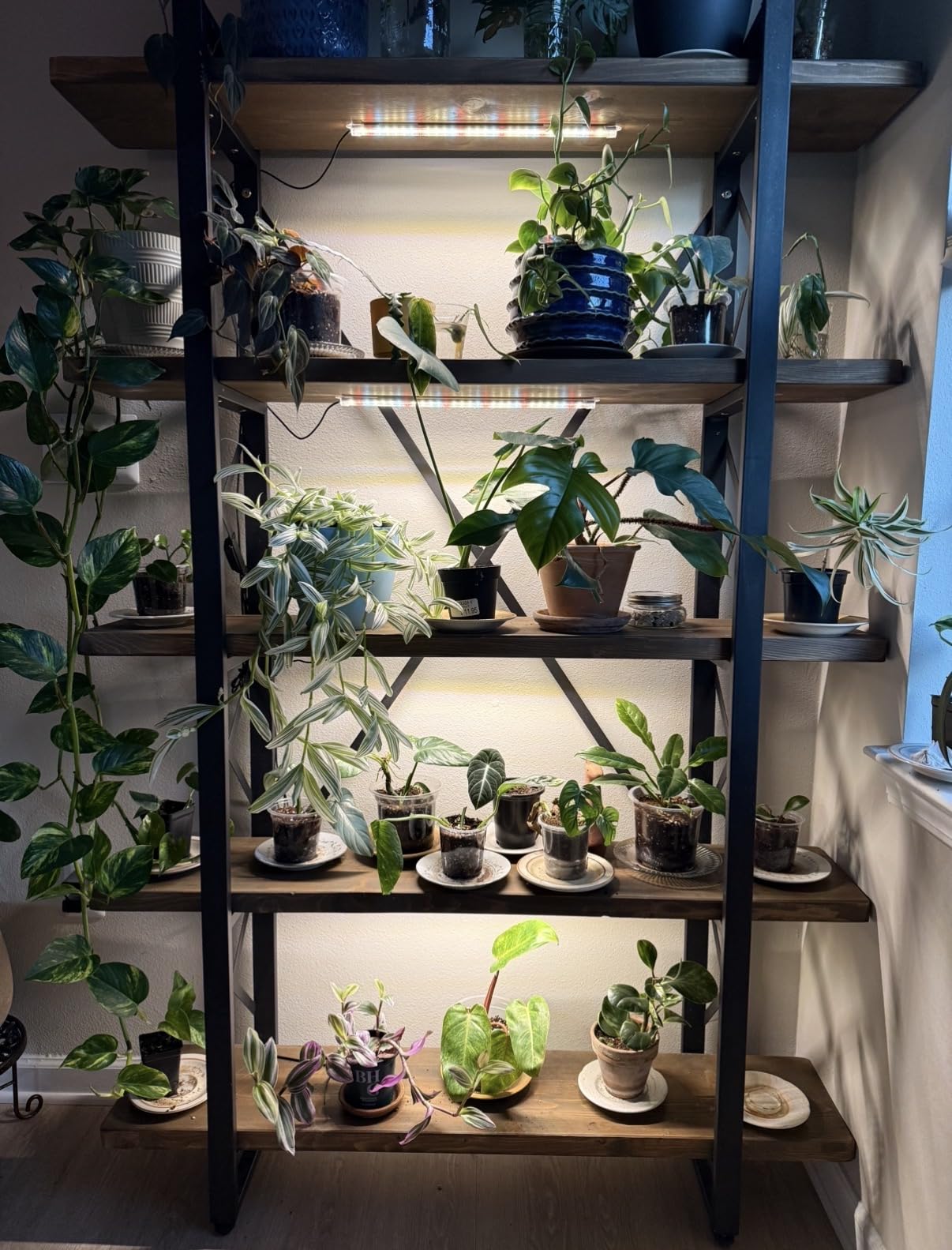
What it handles well versus the alternatives
Against a gooseneck or clip fixture, the strips disappear. There is no arm to catch the eye, no clamp to sit proud of the shelf front, and the whole assembly can be tucked behind a trailing plant.
Against a four-head light, the strips give a flatter ceiling of light across a wide shelf, which is what you want for a row of pots rather than a tight group. The colour rendering of 80 is lower than the gooseneck lamps, so this is a growth light rather than a task light.
Where it falls short
Intensity is the real limitation. If you are mounting directly under a shelf with only a few inches of clearance, these will underperform for a high-light orchid, and no amount of dimming will fix an output that starts low.
Mounting on adhesive alone may not hold on a textured or dusty surface, so use the screws or cable ties on at least one bar. And five preset brightness levels is less granular than the ten-level fixtures, which matters most on the tender species.
How Much Light Each Orchid Wants
Before choosing brightness, you need to know the target. The breakdown below maps the main genera to a light level, a rough setup, and the leaf clue that tells you whether you have it right. The PPFD and DLI figures are the working ranges used by indoor growers rather than published lab values, so treat them as a starting point you adjust from.
Phalaenopsis and other low-light types: around 10000 to 15000 lux at the leaf, roughly 4 to 6 hours of direct light or 12 to 14 hours under a fixture at a lower dimming level.
Paphiopedilum and jewel orchids: 6000 to 10000 lux, and never closer than about 6 inches with a low-wattage light.
Oncidium and Dendrobium: 15000 to 20000 lux, the middle band, and a good match for a mid-output bar or a four-head clip light.
Cattleya: 25000 to 35000 lux, the high end for indoor growers, and the reason people upgrade from a clip light to a bar.
Vanda and other high-light genera: as much light as you can give without leaf scorch, and a grower on orchidboard reports blooming a Vanda well below a panel built around Samsung LM301B diodes.
PPFD is the instantaneous measure of photons hitting a square metre of leaf, and DLI is the total amount of light a plant receives across a whole day. A hobbyist cabinet build on r/houseplants reported measuring 4 to 6 DLI across most of a Barrina-lit interior, and treated that as ideal for Phalaenopsis. Forum growers consistently treat DLI as the more useful number than raw wattage, because two fixtures at the same wattage can deliver very different DLI at the leaf depending on mounting distance.
If you have no meter, you can still read your setup. Growers on orchidboard and slippertalk post photos of the light-to-canopy distance alongside meter readings, and the pattern is consistent: an orchid leaning hard toward a window or a light has too little, while leaves that are pale or bleached near the light source have too much.
How to Set Up a Grow Light for Orchids
Mounting the fixture is the easy part. Getting the distance, the photoperiod and the timer right is where most setups either scorch the plant or leave it hungry.
Measure first. A cheap PAR or light meter is worth it, but a phone app gives a rough idea. Take a reading at the leaf surface, not at the fixture, and record it so you have a baseline to compare against in a fortnight.
Set the distance. Six to 12 inches above the canopy for a single potted orchid. Bars hung over a shelf generally sit 12 to 18 inches above the leaves, and grow on r/orchids frequently recommend 6 to 12 inches for the puck-style fixtures used on shelving. Move the light, not the plant, whenever you can.
Set the photoperiod. Ten to 14 hours a day, and the figure most growers land on is 12. Longer than 14 hours gives diminishing returns and can keep a plant from ever fully resting.
Fit a timer. If the fixture has a built-in circular memory timer, test it first by noting the time you set it at and checking the next morning. If it does not have one, use a plug-in mechanical timer, a 7-day digital outlet, or a smart plug, and do not rely on switching it by hand.
Protect the dark period. Orchids need a genuinely dark night. A power LED in the room can disturb flowering, and a light on a timer that drifts is worse than no timer at all.
Check the leaves after two weeks. Compare the new growth against the old. A healthy orchid under a correct light makes a slightly paler leaf with a hint of red anthocyanin along the edges, which is pigmentation, not damage.
Adjust seasonally. Run a shorter photoperiod and a lower intensity through the darker months, then open both up as the days lengthen.
On cost, the maths is straightforward and it is why LEDs are the right call. A 20 watt bar run for 12 hours a day draws 240 watt-hours a day, or about 88 kilowatt-hours over a year. A 10 watt clip light adds about 44 kilowatt-hours. At typical residential rates the annual running cost of a full shelf of fixtures is measured in single-digit currency units, which is far less than one damaged leaf or one lost flowering cycle.
How to Tell Your Light Level Is Wrong
Orchids tell you what is wrong with the lighting through their leaves, and the diagnosis is reliable if you know what to look for.
Dark green, flat, matte leaves and steady growth but no spikes means too little light. This is the most common indoor failure and it is easy to miss, because the plant looks perfectly healthy. If new leaves are coming in at the same size and colour as the old ones and nothing is flowering, move the light closer or add an hour to the photoperiod.
Long, stretched growth with wide-spaced leaves and a leaning habit also means too little light. An orchid will physically reach for intensity, and the stretch cannot be reversed, only stopped. A leaning plant also signals a light placement problem, so check that the light is centred over the pot rather than off to one side.
Pale, washed-out, bleached or papery patches on the upper surface of a leaf closest to the fixture means too much light or too little distance. Orchids do not recover from scorch, so move the fixture up a few inches or drop the dimming level rather than waiting.
Red or reddish-purple colouring across the whole leaf is usually a pigment response, not a burn. Many growers treat a red edge on an otherwise firm leaf as a sign that light is adequate or even slightly intense, and only act if the leaf also feels soft or bleached. Novelty Phalaenopsis with thin, light green leaves redden far more easily than standard varieties, so treat them as the more sensitive plant in the group.
Roots that stay green but never grow new tips is usually a root or watering problem rather than a light problem. Light never fixes that, and no fixture substitutes for correct watering, humidity and an open potting medium.
What to Look for When Buying a Grow Light for Orchids
Form factor first, because it decides what you can physically mount.
Bars and strips are for shelves, cabinets and any wide horizontal run. They give the flattest, most even ceiling of light and can be linked so one timer covers them all. The Barrina T5 and the Kullsinss strips are the two shapes to compare here.
Clip-on goosenecks are for one shelf or a few pots. They are cheap, flexible and easy to reposition, and the four-head LEOTER and the two-head GHodec cover the same idea with different beam shapes. A four-head fixture throws several cones and suits a deeper shelf, while a two-bar fixture throws a wide flat band and suits a wide shallow shelf.
Clip and pot lights are for a single plant or a small collection. They need an edge to grip, and the SANSI is the smallest option here, aimed at jewel orchids and terrariums.
Tripods, poles and halo lights are for floor plantings, hanging baskets and tall pots where nothing can be clamped. The yentbokj tripod and the Aokrean halo cover that ground.
Bulbs are for existing fixtures. The Briignite A19 is the only approach that needs no mounting hardware at all, and it is the cheapest way to add light to a room you cannot modify.
Then check five things in the listing. First, colour temperature, because anything from 4000K to 6500K white will grow an orchid and anything purple or bare red-and-blue will not look pleasant in a living room. Second, dimming range, because this is what lets one fixture serve a Phalaenopsis and a Cattleya. Third, coverage at a stated distance, and treat a listing that only quotes wattage with suspicion. Fourth, timing, and check whether the timer survives a power cut before you commit to it. Fifth, warranty, where two years is the signal that a manufacturer expects the fixture to last more than one growing season.
On diode quality, forum growers treat named chips such as the Samsung LM301B and Osram as a shorthand for build quality, and that is a reasonable heuristic when a cheap listing gives you nothing else. It is a proxy, not a measurement, so treat a listing that names the diode and a listing that only claims “full spectrum” as different quality products.
Where you live matters too. Buyers outside the US repeatedly report that Barrina is expensive and awkward to ship, and the recurring workaround is to substitute any of the bar fixtures on this list, which are broadly available. For readers also building a camera rig, our guides to on-camera LED lights and RGB panel lights cover the same colour-temperature and dimming questions from a lighting-first angle, and fill lights for creators goes into diffusion and beam control.
Grow Light Types to Skip
Three categories come up in recommendations for indoor orchids, and all three are worth avoiding.
HID systems including metal halide and high pressure sodium produce intense light but generate a lot of heat, need a reflector and a ballast, and are priced for a growing room rather than a house. A retailer guide on orchid lighting flags HID as not recommended for home growers for exactly that reason, and a fixture hot enough to need a dedicated room will scorch an orchid placed too close.
Bare blurple and red-and-blue-only bulbs put out the two peak bands plants absorb most efficiently, which sounds like an advantage, but growers on r/orchids and r/houseplants consistently report that full-spectrum white fixtures produce visibly better results. The colour balance matters for plant development, and a room lit only in red and blue is unpleasant to sit in, which is why so many people stop running them.
Decorative-only plant bulbs are sold on appearance and warmth, not on a spectrum. If a listing gives you a colour temperature and a lumen figure but no spectrum, no dimming and no warranty, it is a decorative bulb. It will not kill a plant outright, but it will not push one toward a flower spike either.
Frequently Asked Questions
Are orchids ok under grow lights?
Yes. Orchids are epiphytes that grew under strong filtered light, and a full-spectrum white LED fixture reproduces that light far more consistently than most indoor windows. Run one at 4000K to 6500K, mounted 6 to 12 inches above the leaves, for 10 to 14 hours a day on a timer. Many growers flower Phalaenopsis, Dendrobium and Oncidium entirely under artificial light.
Can orchids survive with grow lights?
They will live on grow lights alone, but light is only one of the requirements. Orchids still need correct watering, high humidity, good airflow and an open potting medium, because dense wet bark will kill roots long before any lighting problem does. A grow light solves light; it does not fix bad watering habits, and a healthy plant under a poor light is still a plant at risk.
What kind of artificial lighting is best for orchids?
Full-spectrum white LED is the right answer for nearly every orchid grown indoors. Look for 4000K to 6500K output, a fixture that runs cool, and dimming levels so low-light types such as Phalaenopsis and Paphiopedilum can run below high-light Cattleya and Vanda. Avoid HID systems, which produce too much heat, and purple blurple bulbs, which growers report give visibly weaker results.
How many hours should an orchid be under a grow light?
Ten to 14 hours a day, with 12 the most common choice. Longer photoperiods give diminishing returns and can stop a plant resting properly, and the dark period afterwards matters as much as the light. In winter, shorten toward 9 or 10 hours and drop the intensity a level, then lengthen again as the days grow. Put the schedule on a timer rather than switching by hand.
How far away should a grow light be from an orchid?
Six to 12 inches above the canopy for a single potted orchid, and 12 to 18 inches for bars hung over a shelf. Closer is more intense, so back off or dim if leaves pale or bleach. Jewel orchids and novelty Phalaenopsis with thin, pale green leaves scorch fastest and belong at the far end of that range. If leaves are dark green and no spikes appear, move closer instead.
Final Verdict
The best grow lights for orchids are the ones that give you white full-spectrum output, a timer, and enough dimming to serve more than one type of orchid. On that basis the GooingTop 6000K gooseneck is the pick I would hand to almost anyone, because the clip holds, the arm holds, and the timer repeats without being asked twice.
If you are lighting a whole shelf or a cabinet, change the pick to the Barrina T5 four-pack and add an external timer. If you cannot mount anything at all, the Briignite A19 bulb in a lamp you already own is the answer, and it costs almost nothing to run. For a single orchid on a windowsill, the Juhefa stake light is the cheapest route to real improvement.
Whichever you pick, set the distance, set the timer, then give it two weeks and read the new leaves. That check will tell you more than any specification on the listing, and it is the reason a setup that looked wrong on day one is usually flowering by spring.