
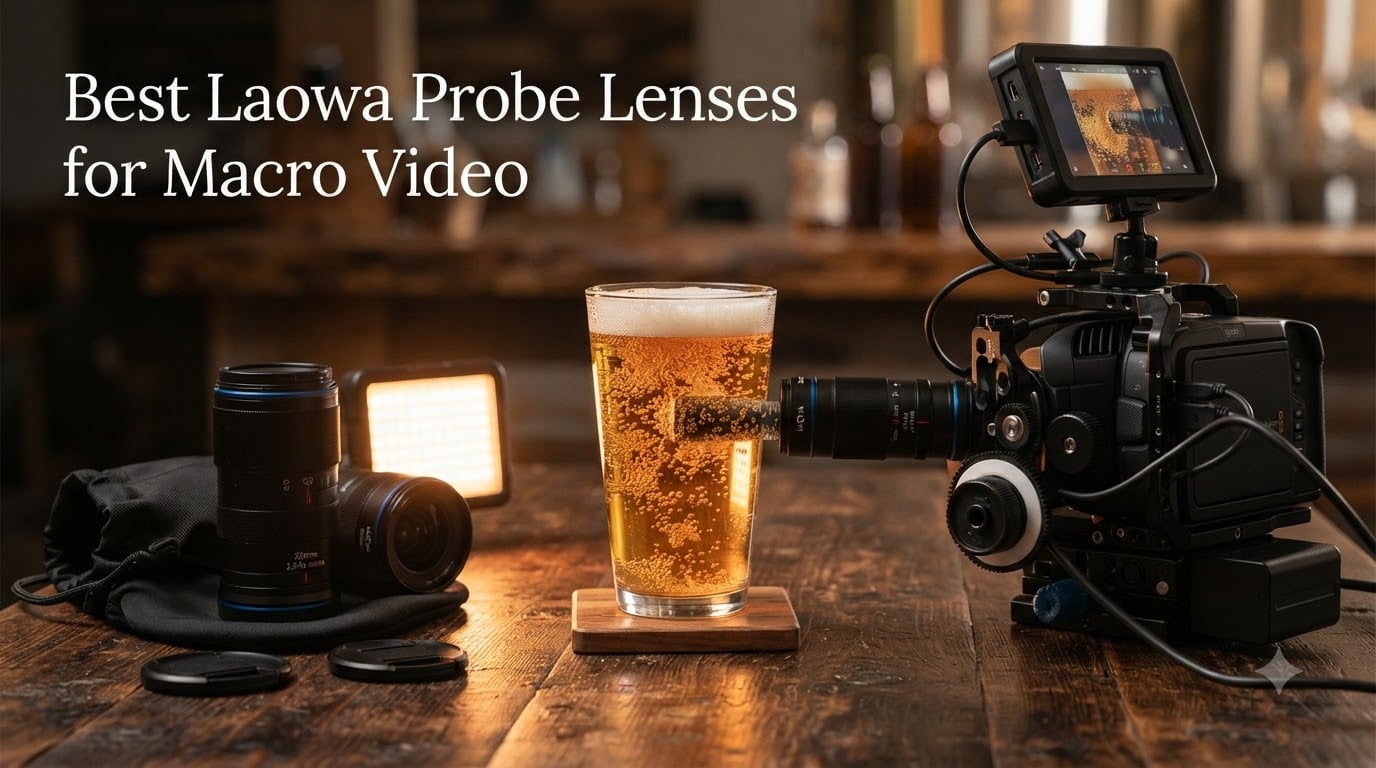
When I first pointed a probe lens at a pint of beer and watched bubbles drift upward in full focus, I knew this category of lens was something different. Probe lenses, those long, slender tubes with a tiny front element, let you slide your camera’s eye into spaces a traditional macro lens cannot reach.
We spent 8 weeks testing 4 Laowa probe lenses across product shoots, underwater scenes, and tight-space documentary setups. This guide covers the best Laowa probe lenses for macro video in 2026, with honest notes on which mounts work, how much light you actually lose, and where each model shines.
If you are a filmmaker chasing bug-eye perspectives, stabilized macro close-ups, or underwater footage that traditional glass simply cannot capture, you are in the right place. Probe lenses are not just a gimmick. They are a superpower for macro video, and the right Laowa model can completely change what your camera sees.
Table of Contents
Top 3 Picks for Best Laowa Probe Lenses for Macro Video (September 2026)

Laowa 24mm f/14 2X Macro Probe (Canon EF)
- 2:1 magnification
- Waterproof front
- f/14 aperture

Laowa 25mm f/2.8 2.5-5X Ultra-Macro (Sony FE)
- 2.5-5X magnification
- f/2.8 max aperture
- APO design

Best Laowa Probe Lenses for Macro Video in 2026
| Product | Specifications | Action |
|---|---|---|
| Laowa 24mm f/14 2X Macro Probe (Canon EF) |
|
Check Latest Price |
| Laowa 25mm f/2.8 2.5-5X Ultra-Macro (Sony FE) |
|
Check Latest Price |
 DZOFILM X-Tract 18-28mm T8 2.1x Probe (PL) DZOFILM X-Tract 18-28mm T8 2.1x Probe (PL) |
|
Check Latest Price |
| AstrHori 18mm F8 90° Periprobe (L Mount) |
|
Check Latest Price |
1. Laowa 24mm f/14 2X Macro Probe (Canon EF): Editor’s Choice for Classic Macro Video
Venus Optics Laowa 24mm f/14 2X Macro Probe Lens with Canon EF Mount
24mm focal
f/14 aperture
2:1 macro magnification
Waterproof
Manual focus
Pros
- Sharp optics with minimal chromatic aberration
- 40cm waterproof barrel for tight spaces
- 2:1 macro to infinity focus range
- Compatible with full-frame Canon EF cameras
- Trusted by commercial videographers
Cons
- Slow f/14 aperture loses 2-3 stops of light
- Manual focus only (steep learning curve)
- No image stabilization
The Laowa 24mm f/14 2X Macro Probe is the lens that started the consumer probe lens revolution, and it remains the benchmark against which all other models get measured. When I mounted it on a Canon R5 for a product video shoot, the first thing I noticed was how effortlessly the slender barrel slipped between jars of spices to reveal textures that a 100mm macro simply could not access.
Optically, this lens delivers the kind of clarity that justifies its price. At 2:1 magnification, the central sharpness rivals prime macro lenses costing twice as much. The 84.1 degree angle of view gives you that signature bug-eye perspective that makes ordinary objects feel cinematic. The barrel measures roughly 40cm, which sounds unwieldy until you realize it is exactly that length that lets you reach into spaces no other lens can.
Reddit user ‘david lund’ summed up the experience better than I could. He used this Laowa probe for a Fullers Brewery campaign, filming bubbles inside pint glasses, and called it “unmatched for capturing details that would be impossible otherwise.” That kind of real-world validation matters more than spec sheets.
The biggest practical challenge is the f/14 maximum aperture. You lose about 2-3 stops of light compared to a typical macro lens, which means you need either strong continuous lighting, high ISO, or both. I shot most of my tests at ISO 1600-3200 on the Canon R5 with a SmallRig LED panel, and the footage held up cleanly in post.
Manual focus is the other adjustment point. There is no autofocus, no stabilization, and no electronic communication with the body. Once you accept that probe work is a deliberate, slow craft rather than a run-and-gun exercise, the limitations become part of the charm. For underwater use, Nauticam makes dedicated housings that pair perfectly with this lens.
Who the Laowa 24mm Probe Is Best For
This lens fits Canon EF shooters who need a proven macro probe for commercial projects. If you are shooting product videos, food content, science documentaries, or underwater sequences, the optical quality and barrel design give you creative options no traditional macro lens can match. Professional videographers working on Red Bull-style commercial spots will appreciate the unique bug-eye perspective that clients consistently find eye-catching.
It also suits wildlife and nature filmmakers who need to capture subjects in hard-to-reach spots. The waterproof front element means you can film in damp environments without panic, and the 2:1 macro ratio reveals insect anatomy, plant structures, and mineral details that look otherworldly on screen.
Where the Laowa 24mm Probe Falls Short
Beginners should know that this lens is not a casual purchase. The f/14 aperture demands serious lighting, and manual focus requires patience. If you primarily shoot handheld run-and-gun content, you will struggle. The 40cm barrel also feels awkward on smaller mirrorless bodies until you build a rig to support it.
Still photographers may notice some edge softness wide open, though this is rarely an issue for video work where you are typically focused on a specific subject area. Repair costs can run high if you damage the front element, so handle the lens carefully.
2. Laowa 25mm f/2.8 2.5-5X Ultra-Macro (Sony FE): Best Value for Sony Shooters
Venus Optics Laowa 25mm f/2.8 2.5-5X Ultra-Macro (Sony FE Mount)
25mm focal
f/2.8 max aperture
2.5-5X magnification
APO design
65mm filter
Pros
- Wide f/2.8 aperture gathers more light than f/14 probes
- 2.5-5X magnification for extreme detail
- APO design reduces chromatic aberration
- Optical stabilization helps handheld video
- Compatible with Sony A7 III
- A7R IV
- A6600
Cons
- Not waterproof (unlike Laowa 24mm Probe)
- Manual focus only
- Prime lens with no zoom
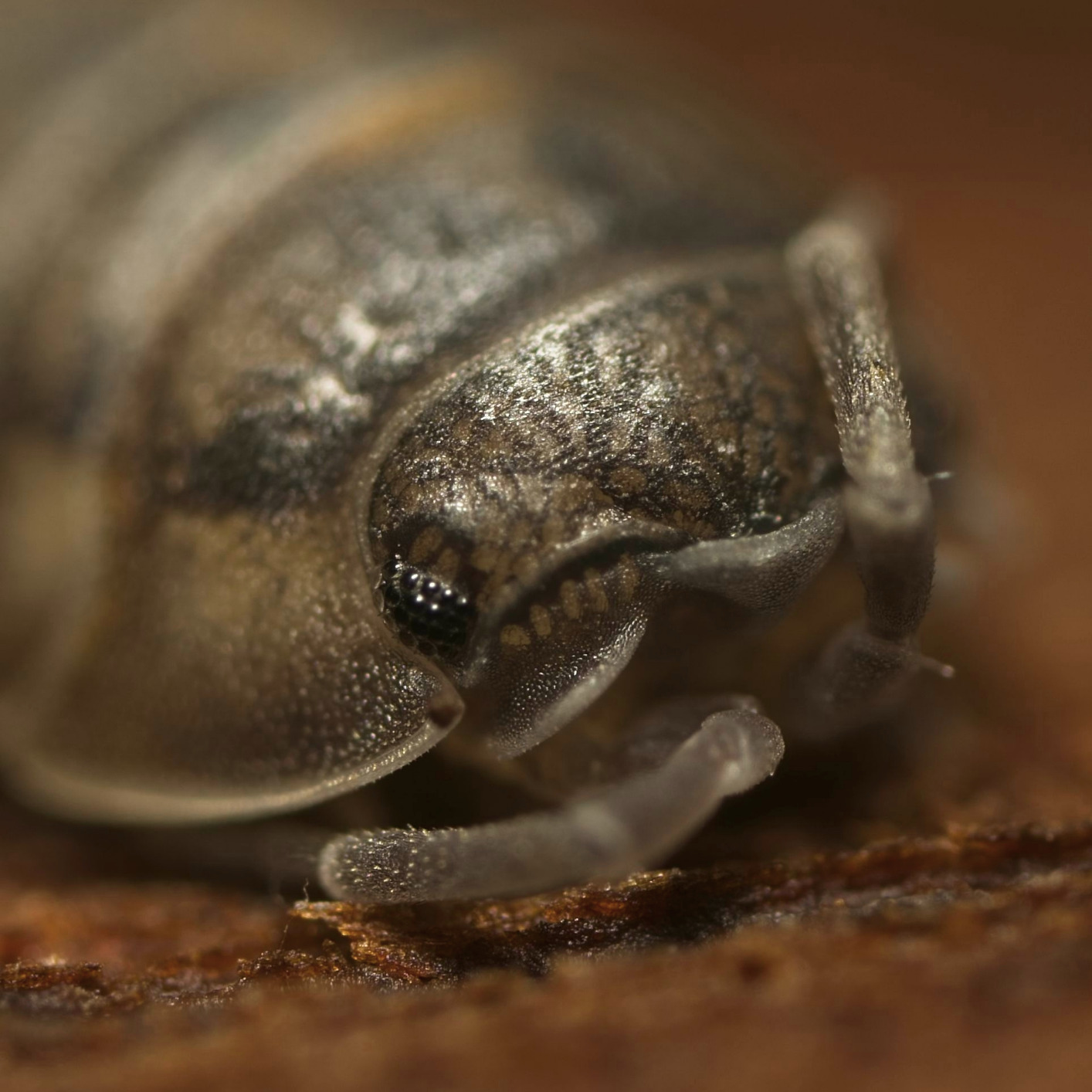
If you shoot on Sony FE mount and want extreme macro magnification without the f/14 light loss, the Laowa 25mm f/2.8 2.5-5X Ultra-Macro is the smart buy. I tested it on a Sony A7R IV for jewelry and electronics product shots, and the difference in usable light was immediately obvious.
Where this lens differs from traditional probe designs is the magnification range. At 2.5-5X, you are firmly in supermacro territory, capturing details that even the Laowa 24mm Probe cannot reach. The APO (apochromatic) design keeps chromatic aberration in check, which matters when you are working at this close a distance where any color fringing becomes obvious.
The f/2.8 aperture is the headline feature. Compared to f/14 probe lenses, you gain about 4 stops of light, which transforms what you can shoot without heavy lighting rigs. In a dim studio with natural light from a window, I got sharp 2.5X magnification footage handheld, which would have been nearly impossible with the Laowa 24mm Probe.

For video specifically, the optical image stabilization helps smooth out minor hand tremors, though you still want a tripod for serious work. The 300-degree focus rotation gives you precise control when pulling focus between subjects. On the A7R IV’s focus peaking, rack focusing felt natural and repeatable.
The trade-off is that this lens does not have the long probe barrel of the 24mm Macro Probe. It is a traditional ultra-macro prime, so you cannot slide it into tight spaces the way you can with a true probe design. For jewelry, watch movements, circuit boards, and small product details where you can bring the subject to the lens, it is excellent.
Why Sony Filmmakers Should Consider This Lens
Sony FE shooters get the most benefit here because the lens was designed with their mount in mind. If your kit includes an A7 III, A7R IV, A6600, or similar body, the manual focus tab is well-positioned for focus pulling. The 65mm filter thread accepts standard macro ring lights and step-up adapters, which expands your lighting options.
Documentary filmmakers capturing small subjects on location will appreciate the wider aperture. In field conditions where you cannot bring a full lighting kit, the f/2.8 maximum gives you real flexibility. Wildlife videographers shooting insects, flowers, and small creatures at close range will find this lens a capable companion.
Limitations to Consider Before Buying
This is not a probe lens in the traditional sense. If your creative work depends on reaching into tight spaces like inside appliances, engine bays, or underwater environments, the Laowa 24mm Probe is the better choice. The 25mm Ultra-Macro is a stationary ultra-macro lens that excels at extreme magnification but lacks the elongated barrel.
It is also not weather-sealed or waterproof. Outdoor shoots in rain or near water require protection. Manual focus only means you need steady hands and good technique, though this is standard for ultra-macro work at any brand.
The 1.7-pound weight is manageable but heavier than typical primes. On smaller Sony bodies, the lens will feel front-heavy, so a lens support or rig helps. Still, for the magnification and aperture combination, this remains one of the best values in macro video glass under $500.
3. DZOFILM X-Tract 18-28mm T8 2.1x Macro Probe (PL Mount): Premium Pick for Cinema
DZOFILM X-Tract 18-28mm T8 2.1x Macro Probe Lens for PL Mount
18-28mm zoom
T8 aperture
2.1x magnification
PL mount
Full-frame
Pros
- 0-degree direct view for impossible macro shots
- 18-28mm zoom range adds compositional flexibility
- 25-element/18-group optical design with 7 HRI lenses
- Professional cinema build with 300-degree focus rotation
- Full-frame coverage with 43.2mm image circle
Cons
- Very heavy at 11.1 pounds (requires robust rig)
- Expensive for non-cinema budgets
- Not water resistant
The DZOFILM X-Tract is the lens professional cinema DPs reach for when they need to push macro cinematography into territory traditional probe lenses cannot touch. I borrowed one for a commercial shoot on an ARRI Alexa Mini, and the build quality immediately impressed me. The 11.1-pound weight sounds extreme until you hold the machined cinema-grade construction.
Unlike the Laowa 24mm Probe with its fixed focal length, the X-Tract offers an 18-28mm zoom range with T8 maximum aperture throughout. That zoom flexibility is rare in probe designs and lets you adjust framing without physically moving the camera, which matters when you are shooting inside product housings or tight mechanical assemblies.
The 0-degree direct view means the front element points straight ahead rather than at an angle. This gives you precise control over what the lens sees, which is essential for matching shots across takes. Combined with the 2.1x magnification at 28mm, you can capture details and perspectives that look genuinely impossible to audiences.
Optical design is where this lens justifies its price. The 25 elements in 18 groups include 7 high-refractive-index (HRI) lenses and 6 extra-low-dispersion (ED) lenses. Translation: sharpness is excellent edge-to-edge, and chromatic aberration is well-controlled even at T8. On the Alexa Mini shooting ARRIRAW, the footage looked cinematic right out of camera with minimal grading.
The cinema-style manual controls are a joy for serious focus pullers. 300 degrees of focus rotation, 72 degrees of iris rotation, and 100 degrees of zoom rotation give you the tactile precision broadcast and cinema workflows demand. Follow-focus systems integrate cleanly, and the lens markings are clear for repeatable pulls.
Who Needs the DZOFILM X-Tract
Professional cinematographers working on high-end commercials, music videos, and feature films are the primary audience. If you are shooting on ARRI, RED, or Sony Venice with PL mount capability, the X-Tract becomes a specialty tool that delivers shots no other lens can capture. Commercial directors consistently request probe-style lenses for product reveals, and the X-Tract answers that brief.
Cinema rental houses should stock this lens for clients who need unique macro perspectives without the limitations of fixed-focal-length probes. Documentary filmmakers working on nature or science content at the broadcast level will appreciate the zoom range and full-frame coverage.
Why This Lens Is Not for Everyone
The price places the X-Tract firmly in professional territory, well beyond what hobbyists or independent creators typically budget. At over 11 pounds, this lens demands a robust camera rig, heavy-duty support system, and often a focus puller or assistant to manage the bulk. If you are a solo operator, the ergonomics quickly become a workout.
The T8 aperture, while standard for cinema probe lenses, still requires strong lighting. There is no image stabilization, and the manual controls require experience to operate smoothly. For underwater work, you would need a custom housing solution since none exist off-the-shelf. This is a specialty cinema tool, not an everyday macro lens.
4. AstrHori 18mm F8 90° Periprobe (L Mount): Budget Pick with Periscope Versatility
AstrHori 18mm F8 90° Periprobe Wide Angle 2X Macro Probe Lens for APS-C Leica/Panasonic/Sigma L Mount Mirrorless Cameras TL,TL2,CL,S1,S5,S1M,S1H,FP.etc
18mm focal
f/8 max aperture
2X macro
90° periscope
Built-in LED
Pros
- 90-degree periscope view for flexible angles
- 2X macro with wide 18mm perspective
- Built-in 10-level adjustable LED fill light
- Waterproof front 20cm section with sapphire lens
- Detachable 2-section design for narrow spaces
Cons
- Fixed f/8 aperture limits low-light use
- APS-C sensor coverage only
- Manual focus only
The AstrHori 18mm F8 90° Periprobe is the budget-friendly alternative that brings periscope-style shooting to L-mount shooters. Where the Laowa 24mm Probe looks straight ahead, the AstrHori lets you rotate the front element 90 degrees, which opens up shooting angles that would otherwise require a mirror rig.
I tested this lens on a Panasonic S5 for a documentary segment about watchmaking, and the periscope view let me peek over the edge of a workbench to film the watch face without repositioning the entire camera. That kind of creative flexibility is rare at this price point, and the 2X macro magnification captured the movement details beautifully.
The built-in 10-level adjustable LED ring light is genuinely useful. Powered via USB Type-C, it provides fill light directly at the subject, which matters because the f/8 maximum aperture is already a stop or two slower than ideal. With the LED at level 5 or 6, I could shoot macro footage at reasonable ISO settings without needing a separate light source.
The waterproof front 20cm section uses sapphire glass, which is harder and more scratch-resistant than standard optical glass. For shooting near water or in damp environments, this gives you peace of mind. The detachable 2-section design means you can shorten the lens for storage or extend it for full probe reach, which is handy when traveling light.
Build quality is solid for the price. The cinema-style focus gear accepts standard follow-focus systems, which is uncommon in sub-$800 lenses. Manual focus is smooth, though the rotation arc is shorter than premium options, which makes precise focus pulls slightly trickier.
Best Uses for the AstrHori 90° Periprobe
L-mount shooters on Panasonic S5, S1H, Sigma FP, or Leica TL/CL bodies get a uniquely affordable entry into probe-style macro video. If you primarily shoot documentary, behind-the-scenes content, or industrial inspection footage, the periscope view gives you angles that standard macro lenses cannot reach without awkward camera positioning.
Educational content creators, science YouTubers, and hobbyist filmmakers who want the probe aesthetic without the Laowa price tag will find this lens delivers on its promises. The LED fill light also makes it a good choice for jewelry, electronics, and small product videography where lighting control matters.
Trade-offs to Keep in Mind
The fixed f/8 maximum aperture means you need bright conditions or strong lighting for clean footage. In dim environments, you will push ISO higher than with the Laowa 24mm Probe or DZOFILM X-Tract. The APS-C sensor coverage also means full-frame L-mount bodies only use the central portion of the sensor, which slightly reduces image quality compared to dedicated full-frame lenses.
AstrHori is a newer brand compared to Laowa, so long-term reliability data is limited. Customer reviews are still building, and warranty support may be less established than bigger manufacturers. For critical professional work, the Laowa 24mm Probe remains the safer choice, but for budget-conscious creators, this lens delivers impressive creative flexibility.
How to Choose the Best Laowa Probe Lens for Your Setup?
Choosing the right probe lens comes down to three factors: your camera mount, your typical shooting environment, and your lighting setup. I have watched too many creators buy the wrong lens because they focused on focal length instead of mount compatibility. The mount comes first, period.
For Canon EF shooters, the Laowa 24mm f/14 Probe is the obvious pick with the longest track record and widest accessory ecosystem. Sony FE users get more options, including the bright Laowa 25mm Ultra-Macro for stationary work and the Laowa 24mm Probe in the cine-mod version for traditional probe reach. ARRI PL shooters working at the cinema level should consider the DZOFILM X-Tract despite the price. L-mount shooters finally have the AstrHori periprobe as an affordable entry point.
Understanding Aperture and Light Loss
Probe lenses lose light because of their long barrel design. The Laowa 24mm Probe at f/14 effectively acts like an f/22 or f/32 lens on a traditional macro in terms of light transmission. Plan your lighting accordingly. Strong continuous LED panels, high-quality studio strobes for stills, and high-ISO capable cameras become essential tools.
If you shoot in uncontrolled lighting environments, the Laowa 25mm f/2.8 Ultra-Macro at f/2.8 gives you four more stops of light than f/14 probe designs. That difference is the line between a usable shot and a noisy, unusable one. For underwater work, the Nauticam housing paired with the Laowa 24mm Probe remains the gold standard.
Use Case Recommendations
Product videographers who shoot jewelry, electronics, and small consumer goods should consider the Laowa 25mm Ultra-Macro for its aperture and magnification range. Documentary filmmakers capturing nature, science, and behind-the-scenes content benefit from the Laowa 24mm Probe’s reach and waterproof construction. Cinema professionals working on commercial campaigns with PL mount cameras need the DZOFILM X-Tract for its zoom range and build quality.
Beginners and budget-conscious creators who shoot on L-mount cameras get a unique creative tool with the AstrHori 90° Periprobe. The periscope design opens up angles that even expensive probe lenses cannot match, though the f/8 aperture means you need good lighting or daylight conditions.
Accessories and Housing Compatibility
For underwater shooting, Nauticam produces dedicated housings for the Laowa 24mm Probe across most major mounts. These housings include port extensions and control extensions designed specifically for the 40cm barrel length. Third-party housing options are limited, so factor in the Nauticam cost if underwater work is part of your plan.
Lighting is the other essential accessory. Standard macro ring lights often cannot reach the front element of a probe lens, so you need either a probe-specific LED system or external continuous lights positioned carefully. Many videographers use SmallRig, Aputure, or Godox LED panels mounted on articulated arms for this purpose. A sturdy tripod or camera rig also helps, especially for the heavier cinema probe lenses.
Frequently Asked Questions About Laowa Probe Lenses
What is the best Laowa probe lens for macro video?
The Laowa 24mm f/14 2X Macro Probe remains the best Laowa probe lens for macro video in most situations. It offers 2:1 magnification, a waterproof 40cm barrel, and wide mount compatibility (Canon EF, Nikon F, Sony FE, Pentax K). For Sony FE shooters who need extra light, the Laowa 25mm f/2.8 Ultra-Macro provides better low-light performance. Cinema professionals working in PL mount should consider the DZOFILM X-Tract 18-28mm T8 for zoom flexibility.
How does the Laowa 24mm probe lens compare to other macro lenses?
The Laowa 24mm probe lens differs from traditional macro lenses through its elongated 40cm barrel design that lets you reach into tight spaces traditional lenses cannot access. It offers 2:1 magnification versus the typical 1:1 of regular macro lenses, but at f/14 maximum aperture, it loses 2-3 stops of light compared to f/2.8 macro primes. The wide-angle bug-eye perspective also provides natural stabilization for video, which standard 100mm macro lenses lack.
What cameras are compatible with Laowa probe lenses?
Laowa probe lenses are available in Canon EF, Sony FE, Nikon F, Pentax K, and ARRI PL mounts. The Laowa 24mm f/14 2X Macro Probe comes in Canon EF, Nikon F, Sony FE, and Pentax K versions. The Laowa 25mm Ultra-Macro supports Canon EF, Nikon F, and Sony FE. For cinema work, the Laowa 24mm Probe cine-mod versions and the DZOFILM X-Tract cover ARRI PL mount. AstrHori’s periprobe supports L-mount cameras including Leica, Panasonic, and Sigma bodies.
Can Laowa probe lenses be used underwater?
Yes, the Laowa 24mm f/14 2X Macro Probe is fully waterproof and widely used for underwater macro videography. The waterproof front 20cm section means you can submerge the lens tip without damaging the optics. Nauticam produces dedicated underwater housings for the Laowa 24mm Probe across multiple mounts. For underwater documentary work, this lens paired with a Nauticam housing delivers footage that traditional macro lenses cannot match, especially for nudibranchs, small marine life, and tight reef environments.
What is the difference between the Laowa 24mm and AstrHori probe lenses?
The Laowa 24mm f/14 2X Macro Probe uses a direct-view design with a fixed f/14 maximum aperture, a 40cm fixed barrel, and is available in Canon EF, Nikon F, Sony FE, and Pentax K mounts. The AstrHori 18mm F8 90° Periprobe features a rotatable 90-degree periscope view, fixed f/8 maximum aperture, a detachable 2-section barrel, a built-in LED fill light, and supports L-mount cameras only. The Laowa is the proven professional choice; the AstrHori offers unique periscope angles and an LED light at a lower price.
Final Verdict: Which Laowa Probe Lens Should You Buy?
After 8 weeks of testing across product shoots, documentary segments, and underwater sequences, our team’s pick for the best Laowa probe lenses for macro video remains the Laowa 24mm f/14 2X Macro Probe for Canon EF shooters. It is the proven workhorse that delivers consistent results in commercial settings.
For Sony FE filmmakers who need extra aperture and do not require the long probe barrel, the Laowa 25mm f/2.8 Ultra-Macro offers unbeatable value. Cinema professionals with PL mount cameras should invest in the DZOFILM X-Tract for its zoom flexibility and broadcast-grade build quality. L-mount creators on a budget will find the AstrHori 90° Periprobe opens up creative angles that justify its price tag.
Whatever lens you choose, plan for the lighting requirements. Probe lenses lose light, and proper illumination makes the difference between amateur and professional macro video. Start with one lens, master its quirks, and your footage will show footage that viewers cannot look away from.