
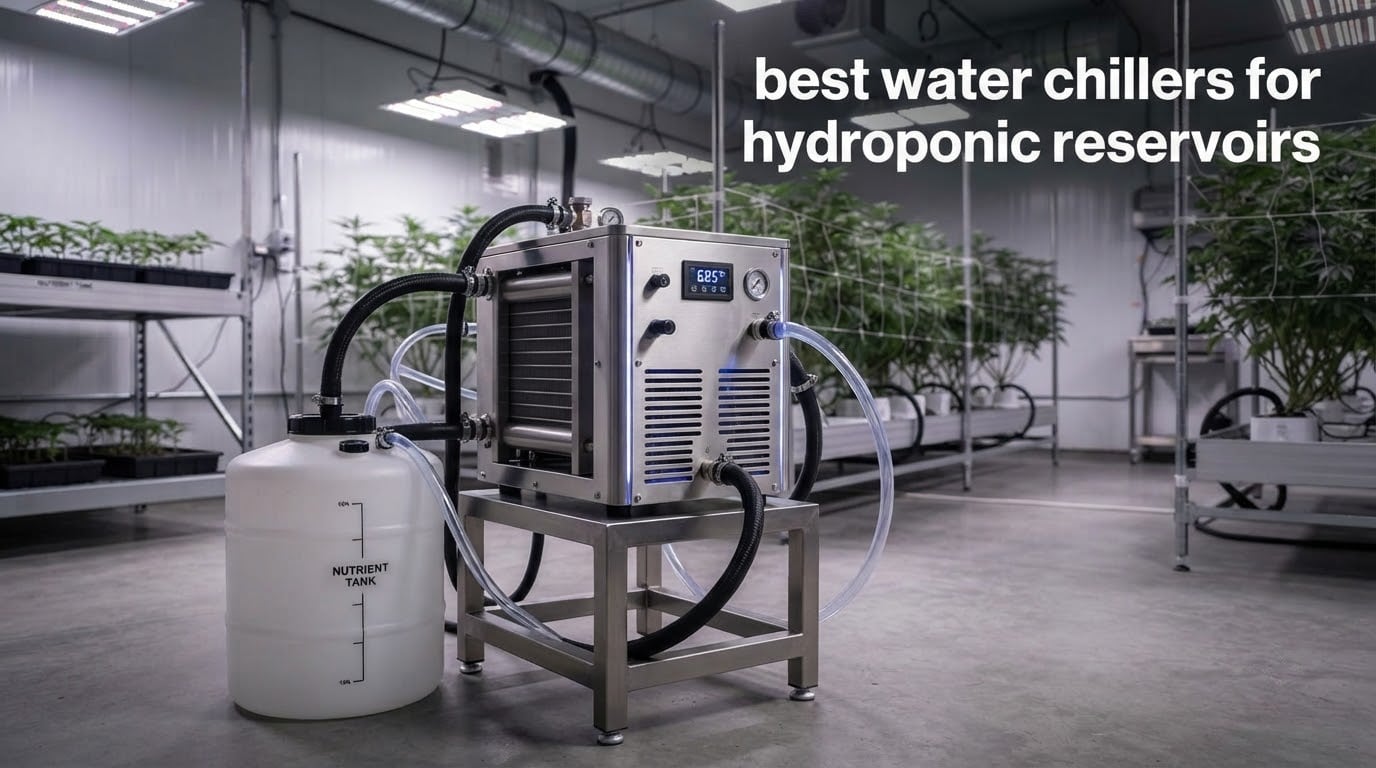
Keep your hydroponic reservoir between 65 and 72 F (18-22 C) and roots stay oxygen-rich, nutrient uptake stays fast, and Pythium has a much harder time taking hold. The wrong chiller, or no chiller at all, is the single most common reason a recirculating system stalls in summer.
Here is the short version of how to pick one. Match the chiller to the gallons of nutrient solution you actually need to hold at temperature, not to the size of your tent. Under 30 gallons means a 1/10 HP class machine, 30 to 90 gallons means 1/4 HP, 90 to 145 gallons means 1/2 HP, and 145 to 265 gallons means 1 HP. If your room regularly sits above 80 F, step up one class from that table before you buy.
We compared ten of the best water chillers for hydroponic reservoirs currently on the market, read through more than 1400 owner reviews between them, and focused on the things catalog pages never mention: whether the coil can survive continuous contact with nutrient solution, whether the bundled pump is strong enough, and what happens when ambient room temperature eats the rated capacity. The list below is arranged so you can jump straight to the class that matches your reservoir.
One thing worth saying early, because it comes up constantly in grow forums: almost every chiller sold for aquariums works fine in a hydroponic reservoir, as long as the wetted part is titanium or stainless steel. The aquarium category is simply cheaper to buy into. What differs is the plumbing, the duty cycle, and how much heat you are dumping back into the room.
Table of Contents
Top 3 Picks for Hydroponic Reservoirs in 2026
Our three fastest answers for most growers: the BAOSHISHAN 1/10 HP for small and mid-size reservoirs that want everything in one box, the Poafamx 1/3 HP for the best cooling per dollar, and the Fitnet 79 gallon for the sharpest temperature control in the group.


Fitnet 79 Gal Chiller
- Touch screen setpoint
- Memory after power loss
- 79 gal rated
- Titanium pump
Best Water Chillers for Hydroponic Reservoirs in 2026
Every chiller below is listed with the numbers that actually decide whether it fits your system: compressor class, rated reservoir volume, circulation rate, and the wetted material. Gallon ratings are manufacturer figures measured in a controlled room, so treat them as a ceiling rather than a promise in a hot tent.
| Product | Specifications | Action |
|---|---|---|
| BAOSHISHAN 1/10 HP Aquarium Chiller |
|
Check Latest Price |
 Active Aqua 0.25 HP Titanium Chiller Active Aqua 0.25 HP Titanium Chiller |
|
Check Latest Price |
 Poafamx 1/3 HP Chiller Poafamx 1/3 HP Chiller |
|
Check Latest Price |
| Fitnet 79 Gal 1/3 HP Chiller |
|
Check Latest Price |
 JBJ Arctica 1/15 HP Chiller JBJ Arctica 1/15 HP Chiller |
|
Check Latest Price |
 Poafamx 26 Gal Small Chiller Poafamx 26 Gal Small Chiller |
|
Check Latest Price |
 JBJ Arctica 1/10 HP Chiller JBJ Arctica 1/10 HP Chiller |
|
Check Latest Price |
 EcoPlus Commercial Grade 1.5 HP EcoPlus Commercial Grade 1.5 HP |
|
Check Latest Price |
 VEVOR 52 Gal 1/10 HP Chiller VEVOR 52 Gal 1/10 HP Chiller |
|
Check Latest Price |
 JBJ Arctica 1/5 HP Chiller JBJ Arctica 1/5 HP Chiller |
|
Check Latest Price |
1. BAOSHISHAN 1/10 HP Aquarium Chiller – Best All-Round Pick With a Complete Kit
BAOSHISHAN 1/10 HP Aquarium Chiller 42 Gal Fish Tank Water Chiller 110V
1/10 HP compressor
42 gal rated
800 L/h
Pump and hoses in the box
Pros
- Pump tubing and hose clamps included so nothing else needs buying
- Quiet low-vibration compressor at 45-50dB
- Rated down to 33 gallons for peak summer use
- Stainless steel build and flow direction that limits sediment disturbance
Cons
- 800 L/h flow is modest for a large recirculating system
- Condenser intake needs regular dust cleaning for best efficiency
This is the chiller we keep coming back to because it removes the single most common installation mistake, which is buying a bare evaporator and then realising you have no pump, no tubing, and no clamps. Everything you need to plumb a reservoir loop comes in the box, and the stainless steel shaft pump is a real one rather than a token accessory.
Across 503 reviews the star picture is 67% five-star with a further 13% at four stars, which is a genuinely strong distribution for a machine at this level. Owners running it on DWC buckets and small RDWC tanks report steady reservoir temps and no leaks at the fittings. The 4.2 average is held down by a long tail of setup friction rather than cooling failures.
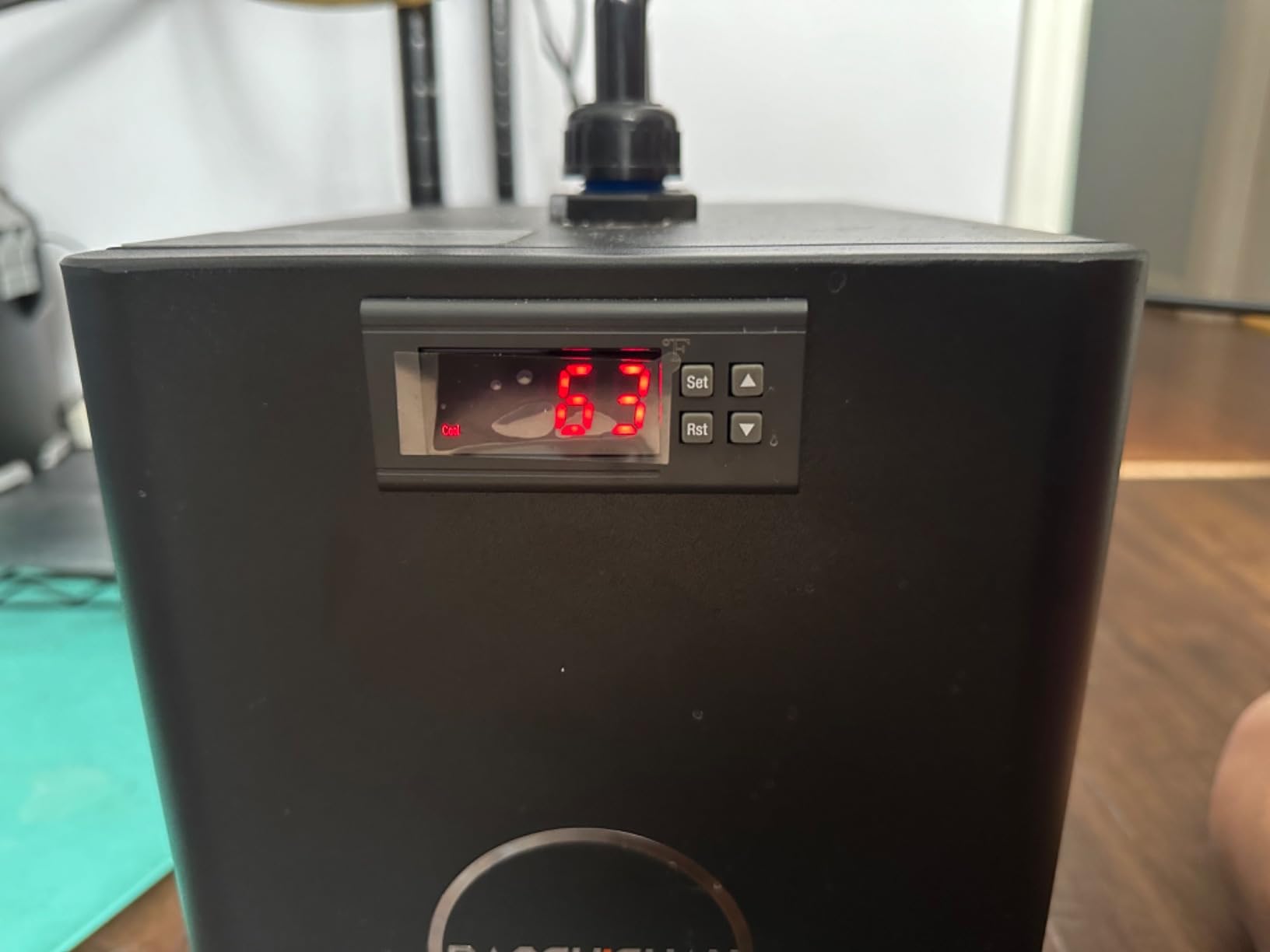
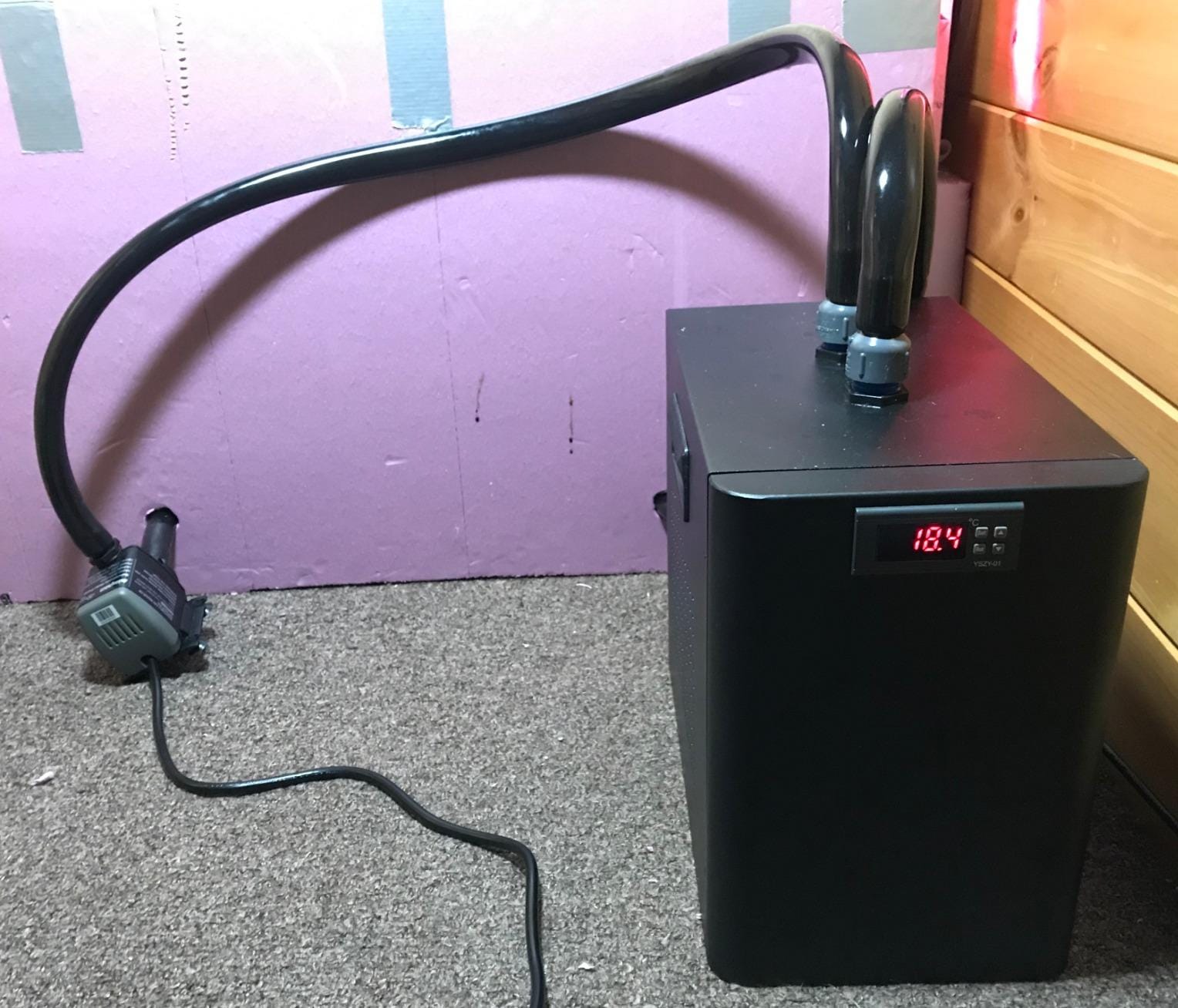
Technically it is a 1/10 HP compressor pulling water down by as much as 10 F to hold a 68-78 F band, rated for 42 gallons and recommended by the manufacturer at 33 gallons in peak summer. Dual high-speed fans with enlarged side vents move the heat, and the unit wants 6 inches of clearance on every side. It weighs 13 kg and measures 13.39 by 7.87 by 11.81 inches, so it fits on a shelf without drama.
The honest limitation is circulation. At 800 L/h this moves plenty of water for a bucket or a single NFT loop, but if you are feeding a large RDWC rack with a high-turnover pump you will outrun it. Buy a stronger pump and let the chiller act as the heat exchanger only, which is exactly how most experienced growers run it.
Is this the right chiller for your reservoir?
If your reservoir sits anywhere between 15 and 40 gallons, this is the safest buy on the list. You get a matched pump, matched tubing, and a compressor class that a 65 F setpoint can actually hold in a warm room.
If you are running 90 gallons or more, skip it. The rated ceiling is well below what a mid-size RDWC system pulls on a hot afternoon, and you would be fighting the machine all summer.
What to check before you commit
Measure your shelf depth first. The unit is 11.81 inches tall and needs airflow on the sides, so a closed cabinet will strangle it.
Plan a dedicated circuit if you can. Continuous compressor cycling through thin household wiring is a common source of early failures, and the clearance requirement is not optional.
2. Active Aqua 0.25 HP Titanium Chiller – Best for 40-92 Gallon Reservoirs
Active Aqua Water Chiller, 0.25 HP, Titanium, 40-92 Gal, Hydroponics
0.25 HP motor
40-92 gal
396-925 GPH
Pure titanium evaporator
Pros
- Wide 40-92 gallon rating covers most single-tent systems
- Pure titanium evaporator resists nutrient solution corrosion
- Boost function pulls temperature down fast after a door-open spike
- Control interface lets you set a precise range
Cons
- Pump and hoses must be bought separately
- 17 percent of reviews are one star with early failure reports
- Bulky at 19 by 14 by 19 inches and 44.9 pounds
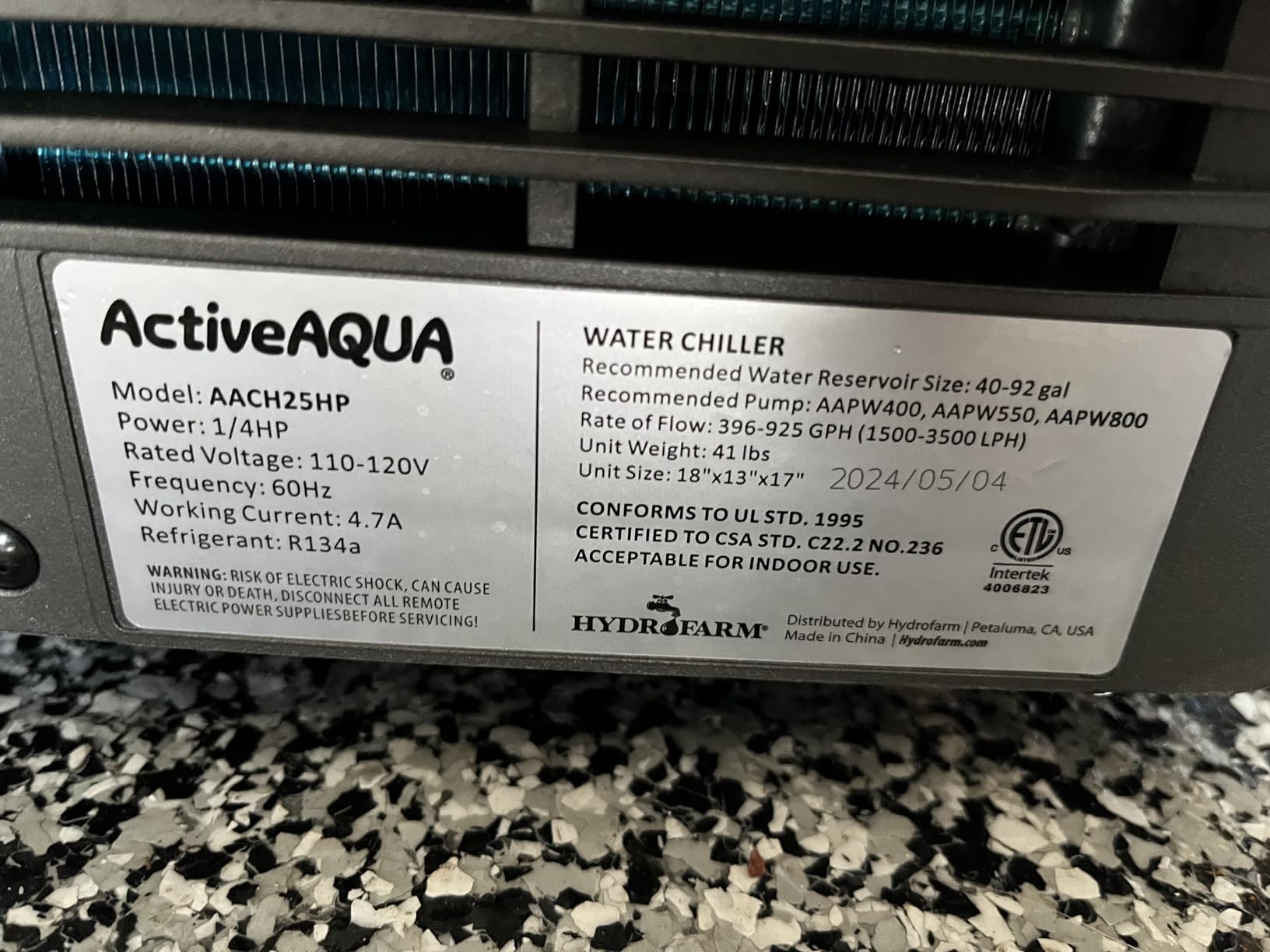
This is the only chiller in the group that was designed around hydroponic reservoirs rather than aquariums, and you can feel it in the details. The 40-92 gallon band maps neatly onto a mid-size grow tent, and the 0.25 HP motor circulates between 396 and 925 gallons per hour, which is the range you need to actually push nutrient solution past a coil at useful velocity.
The pure titanium evaporator is the reason to choose it over a cheaper aquarium model. Titanium is the only wetted material most growers will accept for continuous contact with a mixed nutrient solution, and the corrosion resistance shows up as long service life rather than as a spec you can measure on day one.
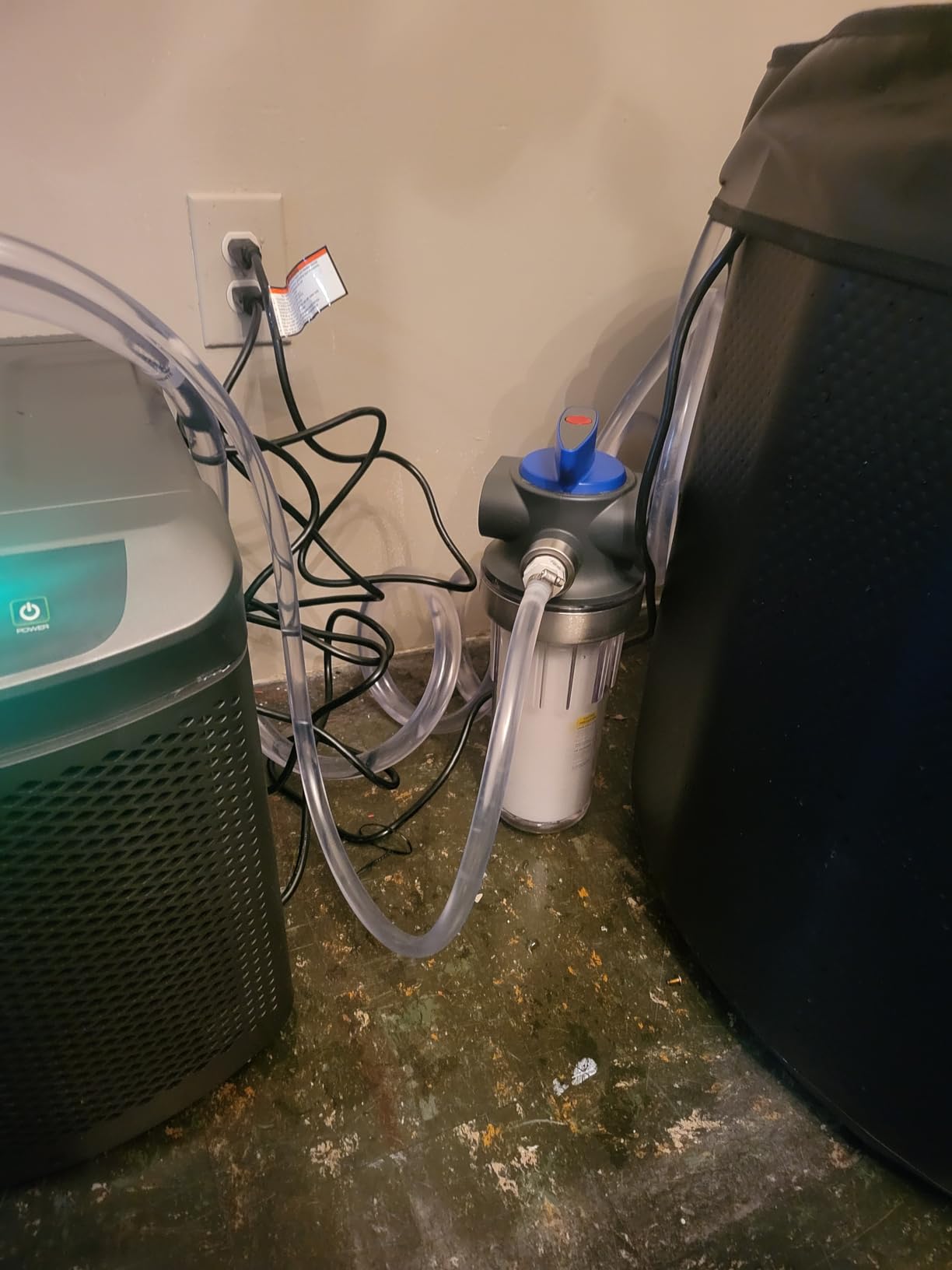
The boost function is more useful than it sounds. In a closed tent, opening the door on a sunny afternoon dumps a large slug of warm air into the room, and a normal compressor cycle can take an hour to claw that back. Power boost temporarily overdrives the compressor so the reservoir returns to setpoint far faster, which is the difference between a stress event and a non-event for roots.
The catch is that 17 percent of its 351 reviews are one star, and the complaints cluster around units that stopped cooling early in their life. It also comes without a pump or hoses, so budget for a circulation pump and plumbing hardware before you start. At 44.9 pounds it is a two-person lift.
None of that changes the core judgement. For a grower whose reservoir actually holds 40-92 gallons, this is the only unit here built for that job, and the titanium evaporator plus boost function are both genuinely useful rather than decorative. Judge the reliability spread as a reason to keep an eye on it in month one, not as a reason to skip it.
Does the 40-92 gallon rating survive a hot room?
Partially. Manufacturer gallon figures assume a moderate ambient temperature and a room with airflow. In a 90 F tent you should treat the top of that range as your realistic ceiling and aim for the middle of it.
Check that your pump sits inside the stated 396-925 GPH window. Overpumping past the maximum flow reduces heat transfer and can trigger a flow fault.
What to check before you commit
Add a pump to the cost. This is the most common surprise in this whole category, because listings read as if the machine is ready to plumb.
Find a spot with genuine clearance and no direct sun on the condenser. A chiller in a sealed closet is a chiller that runs hot and short-cycles all afternoon.
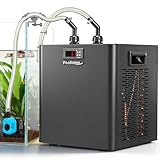
3. Poafamx 1/3 HP Chiller – Best Value for 40-80 Gallon Systems
Poafamx 1/3 HP Aquarium Chiller, Quiet Fish Tank Water Chiller 40-80 Gal
1/3 HP compressor
40-80 gal
Under 45dB
Complete fitting kit
Pros
- Complete kit with pump
- hose connectors and clamps
- Titanium evaporator rated for continuous nutrient contact
- Under 45dB makes it workable inside a living space
- Strong cooling performance reported on hydroponic reservoirs
Cons
- Bundled pump is underpowered and most owners replace it
- 14 percent of reviews are one star reporting first-year failures
- Rear vents dump noticeable heat into the room
The strongest argument for this one is simply the ratio of cooling delivered to cash outlay. A 1/3 HP compressor cooling up to 10 C below room temperature, rated across 40-80 gallons, is a step up in capacity for a step down in cost compared with the titanium units at the same class. If you are running a mid-size reservoir and you want the cooling now, this is the pick.
Owners running axolotl tanks, cold plunge tubs, and hydroponic reservoirs report solid cooling with no leaks at the connections. The R290 refrigerant has a low global warming potential and zero ozone depletion, which matters if your room is not perfectly ventilated.
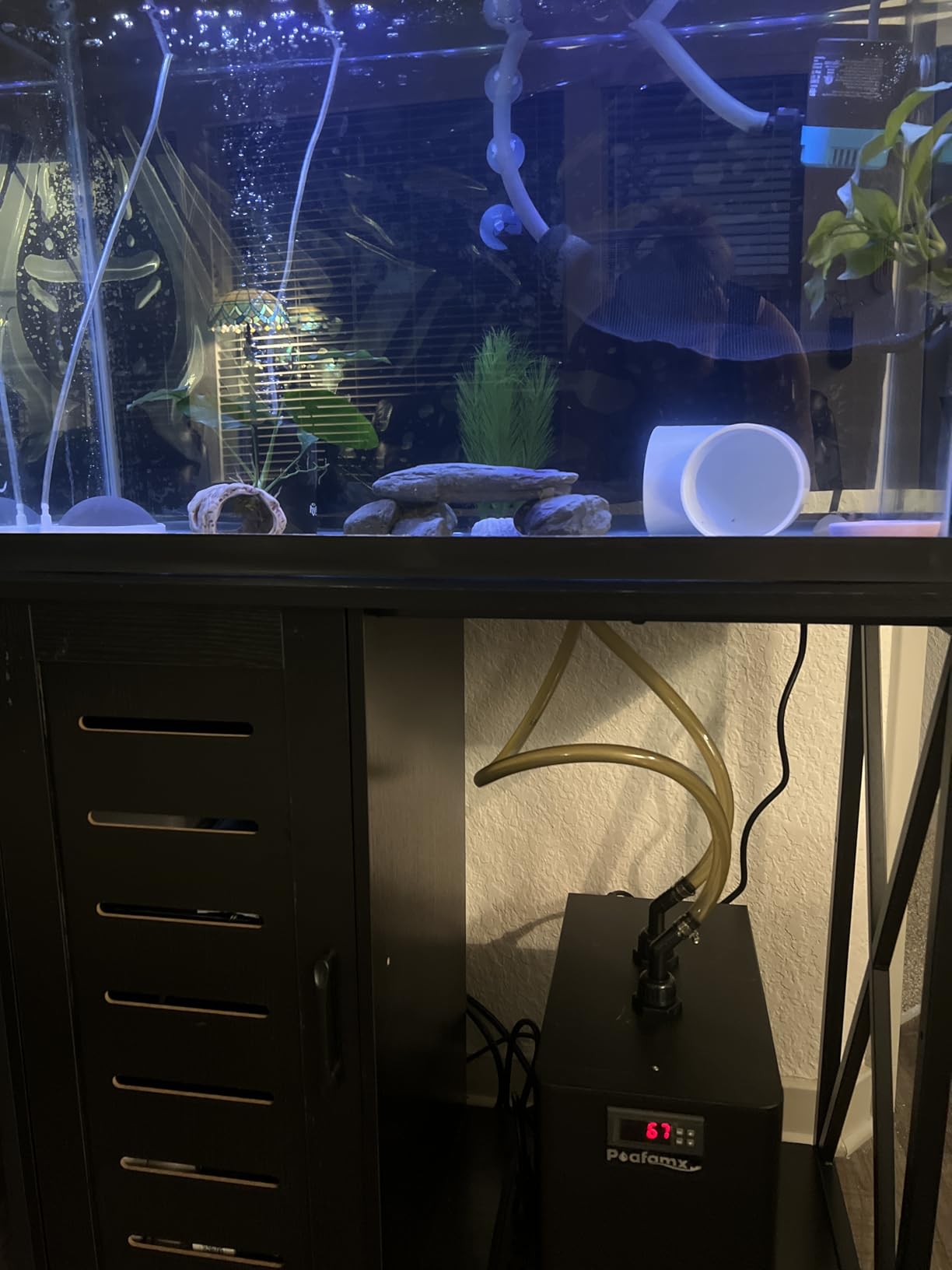
The most repeated fix in the reviews is swapping the included pump for a stronger one. The bundled circulation pump is the weak point in an otherwise complete kit, and owners who replace it report the problem disappears. Do it before you run it hard rather than after a summer of frustration.
Reliability is the other story. 63 percent of its 218 reviews are five-star, but 14 percent are one star, and those describe units or their bundled pumps failing inside a year. That split is why the average sits at 4.0 despite good cooling performance. Plan for one component replacement over the life of the machine.
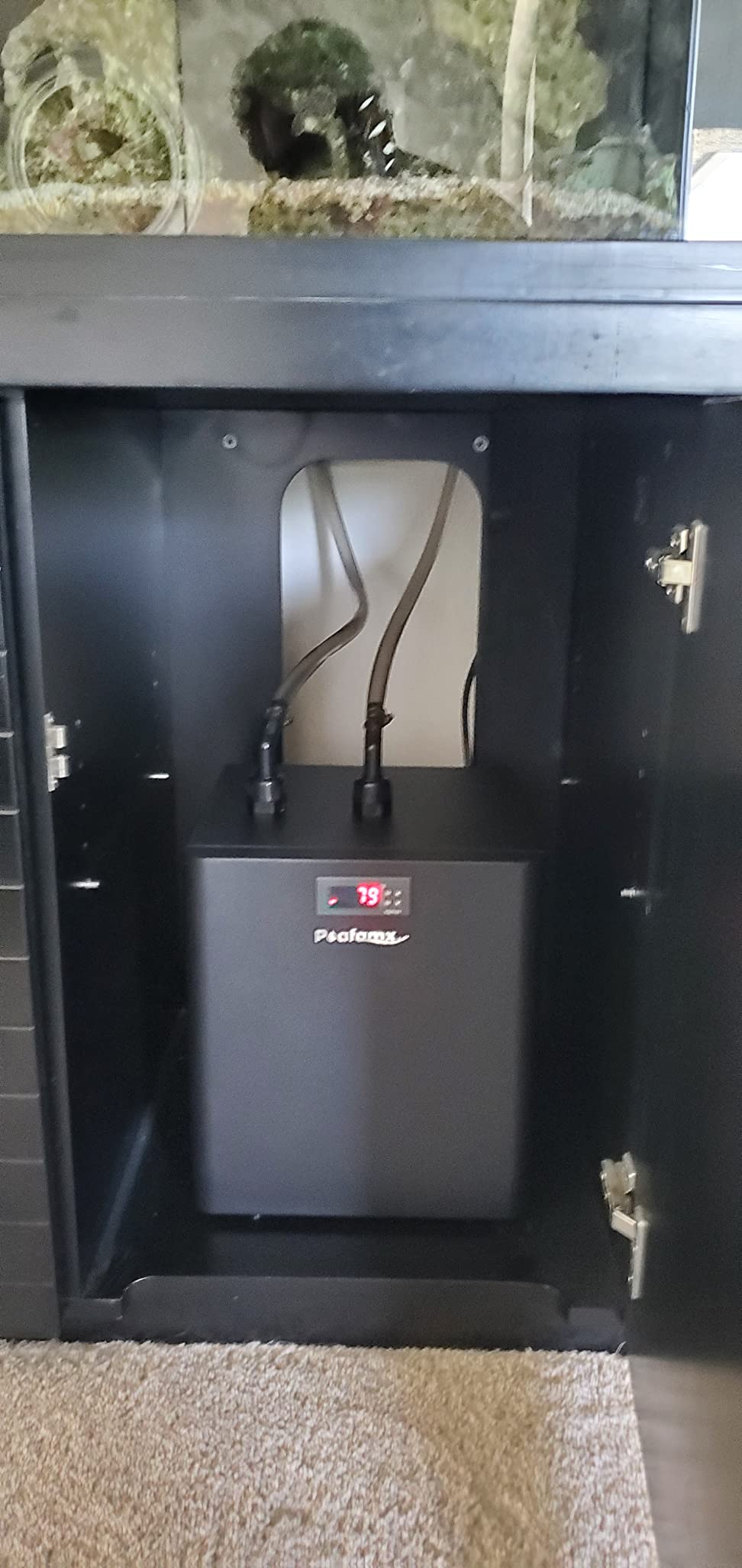
Is 40-80 gallons the right match for your setup?
Yes if your reservoir is a mid-size RDWC tank that runs in the 40-80 gallon range and your room is not consistently above 85 F. In that band the capacity margin is comfortable.
No if you are chasing the quietest possible option. At under 45dB it is quiet for its class, but the JBJ models later in this list are quieter still.
What to check before you commit
Buy a stronger circulation pump up front. It is the most common modification owners make and it is cheap relative to the chiller.
Give the rear vents room. Those exhaust ports release a real amount of heat into the room, which quietly works against you if the machine sits inside the tent.
4. Fitnet 79 Gallon 1/3 HP Touch Screen Chiller – Top Rated for Setpoint Control
Fitnet 79 Gal Aquarium Chiller, 1/3 HP Fish Tank Water Chiller, Hydroponic Water Chiller with Touch Screen, Hydroponics System Axolotl Jellyfish Coral Reef 300L
1/3 HP compressor
79 gal rated
Touch screen setpoint
Setpoint memory
Pros
- Highest average rating in the group at 4.4 stars
- Setpoint memory restores your target after a power cycle
- Owners report it chilling below its rated setpoint in hot weather
- Complete set with pump
- pipe
- and connectors
Cons
- Printed instructions do not match the listing and the F1 setting confuses setup
- Thermostat can read a few degrees off an independent thermometer
- A few owners report random beeping that needs a reset
At 4.4 stars from 112 reviews, this is the highest-rated machine we tested, with 73 percent of reviews at five stars. What earns those marks is control rather than raw capacity. The intelligent digital touch screen lets you dial a setpoint precisely, and the memory function restores it automatically after a power cut, which is the feature that matters most in a tent that loses power during a hot afternoon.
Owners also report it running colder than advertised, holding low forties in hot weather, and one reviewer runs it on a 125 gallon system well beyond the 79 gallon rating. Treat that as a happy outlier rather than a specification, but it does suggest the rated figure is conservative.
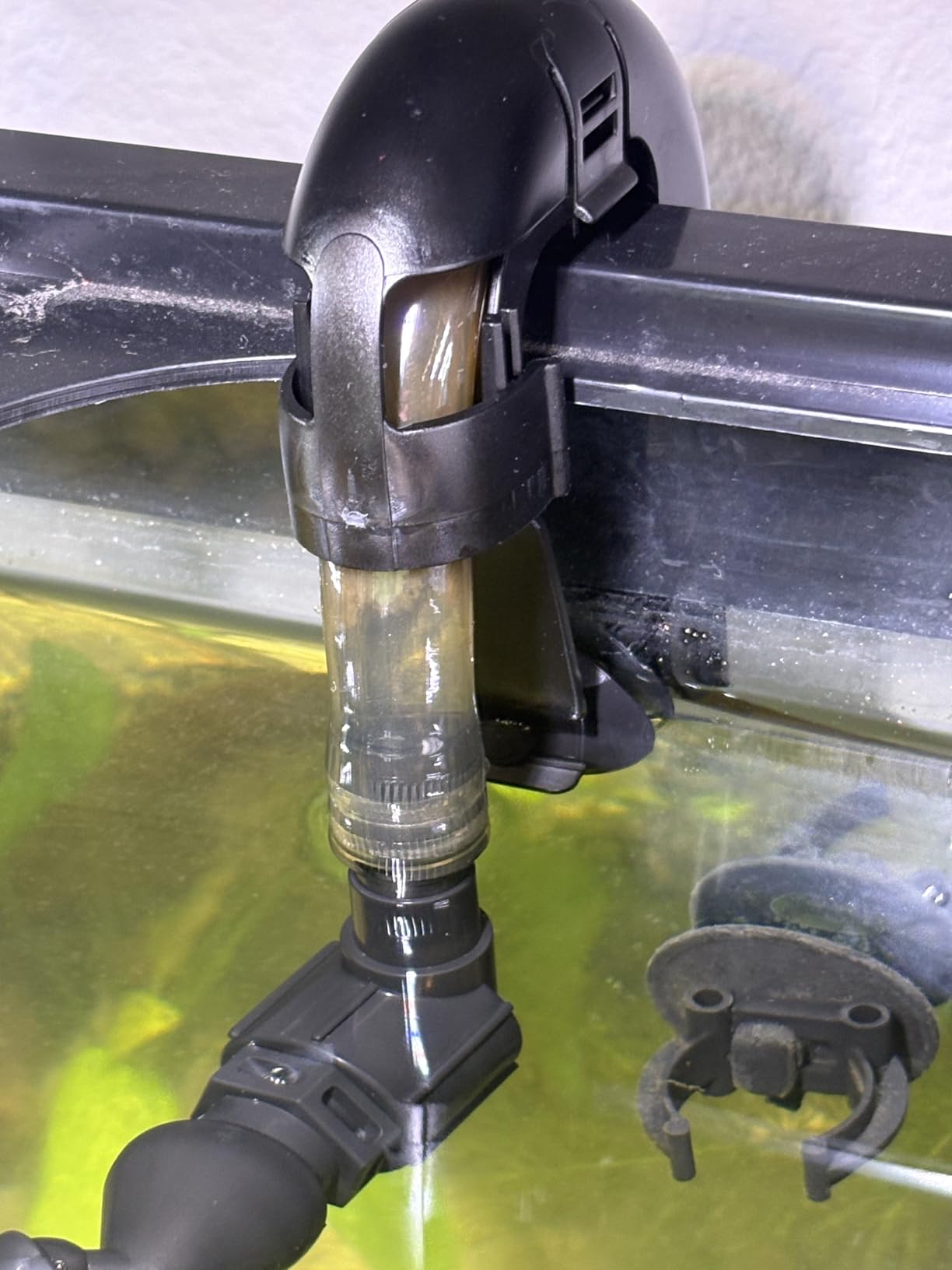
The compressor is a 1/3 HP high-efficiency unit running R290 refrigerant, holding 68-79 F with automatic constant temperature control. Heat comes off through a bank of small exhaust holes plus two built-in cooling fans, and the pump is a corrosion-resistant pure titanium unit. Plan 6 inches of clearance on all sides for those fans to do their job.
The main complaint is documentation rather than hardware. The printed instructions do not match the online listing, and the F1 temperature difference calibration step is genuinely confusing until it is configured. Budget an extra evening for setup and confirm your setpoint against a separate thermometer before you trust the readout.
It is also the newest design in this roundup, listed for the first time in April 2026, which means the long-term record is still being written. What matters for your decision is that the control electronics, not the compressor, are what set this unit apart. If your problem is a reservoir that drifts a few degrees overnight, this is the machine built to fix that.
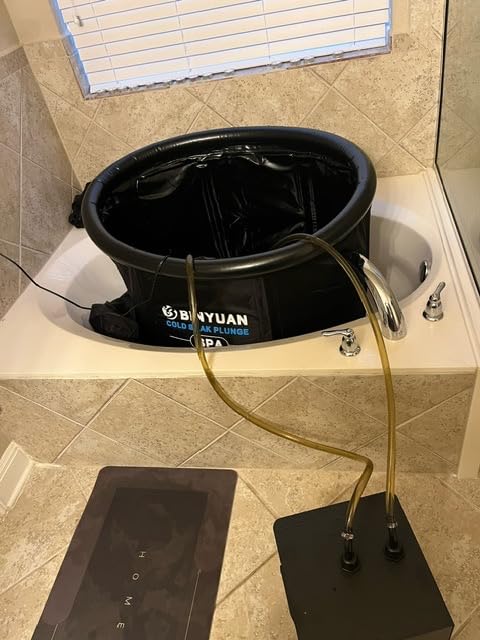
Why does this earn the highest rating?
Setpoint accuracy plus memory after power loss. In a real grow room those two things decide whether a reservoir stays inside the target band overnight, and very few chillers in this price class do both.
Support is also responsive. Owners report missing parts sent quickly and partial refunds issued, which shortens the sting if something does go wrong.
What to check before you commit
Read the F1 calibration instructions before first power-on, not after. Several owners report days of confusion that turned out to be one unconfigured menu step.
Verify the setpoint with an independent thermometer. The thermostat can sit a few degrees off, and you do not want to discover that in the middle of a heat wave.
5. JBJ Arctica 1/15 HP Chiller – Best for Quiet Rooms and Small Systems
JBJ Arctica Aquarium Chiller, 1/15 HP
1/15 HP in-line
12 x 16 x 15 in
25 pounds
Titanium coils
Pros
- Among the quietest chillers available and the most compact in the group
- Efficient condenser reduces energy use
- Compact footprint suits a shelf or a converted closet
- Titanium coils resist corrosion in nutrient solution
Cons
- In-line installation needs a compatible pump and plumbing hardware
- Only 53 reviews so long-term feedback is thin
- 1/15 HP capacity covers only modest reservoir volumes
If noise is the thing stopping you from cooling, this is the machine to look at. Across 53 reviews at 4.1 stars, the recurring theme is silence, and owners repeatedly describe it running beneath a room’s background hum. The condenser design is explicitly built for efficiency rather than raw output, which is why it is quiet and why it is small.
It is also the oldest design in this roundup, in production since 2004, and that longevity is itself a signal. A model that has been built and rebuilt for two decades has a settled engineering approach and a parts supply that newer budget imports do not have.
Installation is genuinely quick because it is an in-line unit rather than a submersible bucket chiller. You plumb it into a return line and it does its work as the solution passes through titanium coils. At 25 pounds and 12 by 16 by 15 inches it moves easily and fits where larger machines simply cannot.
The limitation is capacity. A 1/15 HP compressor is built for modest reservoir volumes, and the small review base means durability claims rest more on the model’s age than on owner feedback. If you have more than about 30 gallons to hold, step up a class.
Who should actually buy the smallest JBJ?
Growers with a small reservoir who are worried about noise. A closet or spare room setup where a compressor hum would be genuinely bothersome is where this design earns its place.
It also works well as a secondary stage. Pair it with a bigger chiller for peak afternoon load and use the small unit overnight, when the heat load drops and noise is the only thing you notice.
What to check before you commit
Confirm you already have a pump that can push adequate flow. In-line installation depends entirely on the circulation you bring to it.
Measure the plumbing run. The compact body is only an advantage if your return line can reach it without a tangle of new fittings.
6. Poafamx 26 Gallon Small Chiller – Best for Nano Grows and Tiny Reservoirs
Poafamx Aquarium Chiller 26gal, 1/13 HP Small Water Chiller for Axolotl
20-30 gal target
210 GPH pump included
22.1 pounds
Titanium evaporator
Pros
- Sized specifically for 20-30 gallon reservoirs with no wasted capacity
- Reported to drop 27 C water to 19 C in minutes
- Very quiet high-efficiency R134a compressor
- One owner reports three years of continuous service
Cons
- Intake and outlet ports are not labeled on the unit
- Initial temperature setting process is complicated
- Vents a large amount of hot air behind the unit
This is the rare case where buying the smaller machine is the correct decision rather than a compromise. If your reservoir is 20-30 gallons, a 1/10 HP or 1/4 HP machine is oversized, wastes energy, and adds heat to the room for no benefit. The compressor class here matches the volume almost exactly.
Owners report genuinely fast temperature drops, one describing 27 C falling to 19 C in minutes, and several aquarists using it for shrimp and axolotl tanks where any noise would stress the animals. One owner has run it continuously for three years, which is the durability datapoint this class most needed.
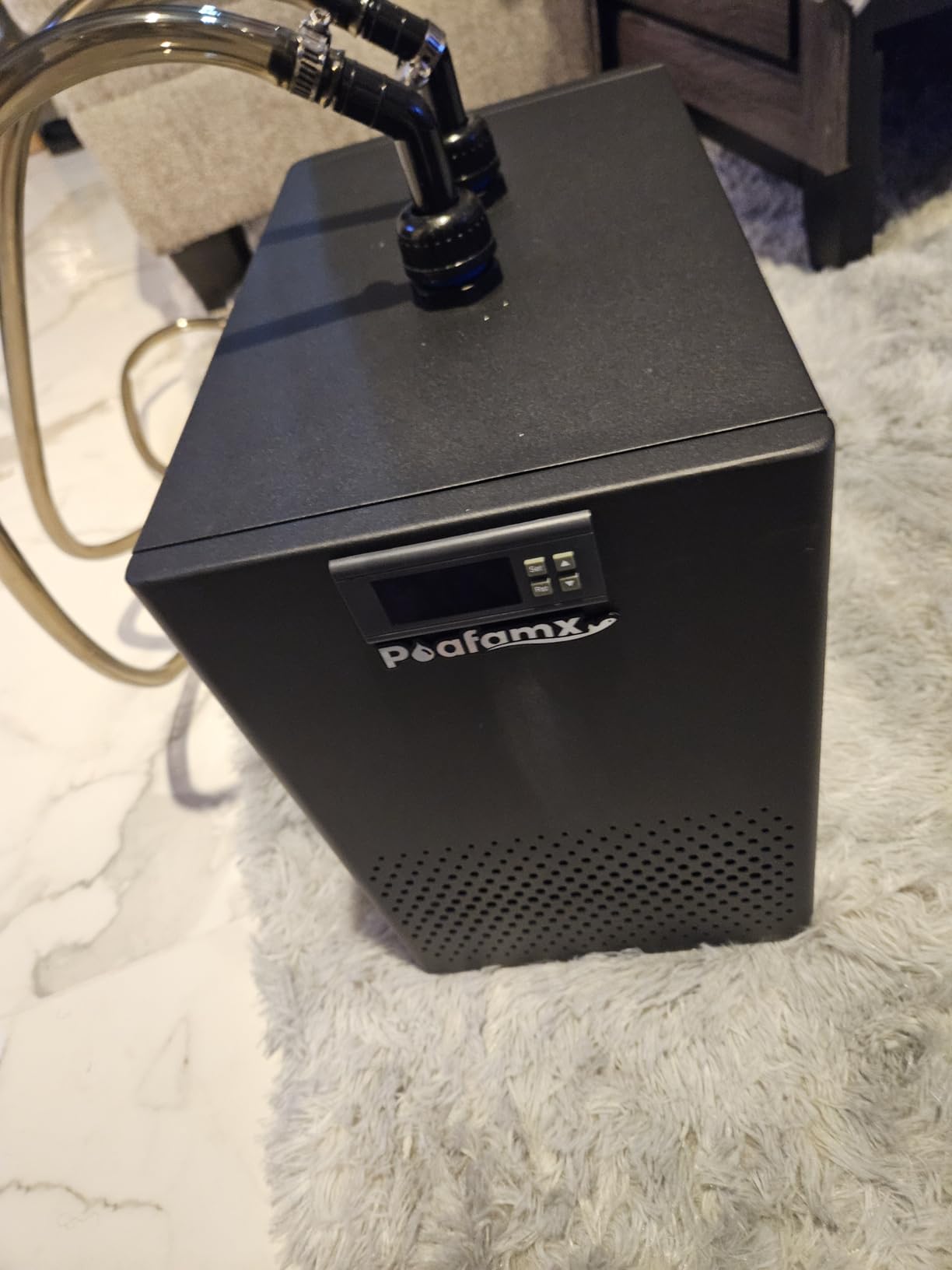
The included 210 GPH pump is adequate for a single small loop, and the titanium evaporator is safe for continuous nutrient contact. Heat leaves through front and side vents plus dual high-performance rear fans, and it needs 6 inches of clearance. It weighs 22.1 pounds and measures 13.4 by 7.9 by 11.8 inches.
Be aware of the documentation. 71 percent of its 48 reviews are five-star but 20 percent are one star, and the failures cluster in the first year around compressor overheating and condenser fan failure. The repeated complaint is that intake and outlet ports are not labeled, so trace the plumbing carefully at setup.
Is a nano chiller worth buying at all?
It is when your reservoir is 20-30 gallons and consistently warms past 72 F. A grower on a forum thread about practical chiller implementation wrote that he wished he had looked for a smaller machine for a six-gallon reservoir, and that is exactly the mismatch this unit corrects.
For a reservoir under about 10 gallons, buy something even smaller or use ice. At that volume a chiller spends most of its life cycling against a tiny thermal mass.
What to check before you commit
Label your own inlet and outlet before you plumb it. Owners who skip this spend an afternoon debugging flow direction.
Expect heat behind the unit. A small machine in a small room needs real clearance or it will short-cycle all afternoon without ever reaching setpoint.
7. JBJ Arctica 1/10 HP Chiller – Best for Precise Temperature Control
JBJ Aquarium Arctica Titanium Chiller, 1/10 HP
1/10 HP
Titanium evaporator
13 x 19 x 20 in
41 pounds
Pros
- Holds temperature within 0.1 degrees after calibration
- Inaudible during meetings according to one owner
- One owner reports six years of continuous service
- Clear sizing options across 1/10
- 1/5 and 1/3 HP
Cons
- Requires an external adjustable-flow pump and separate plumbing
- Adds noticeable heat to the surrounding room
- A minority of owners report units that run without cooling
The 0.1 degree hold reported by owners after calibration is what separates this model. Most chillers in the group are accurate to a couple of degrees, which is fine for plants. If you are chasing a narrow band for a sensitive crop or running an experiment, that precision is worth planning the plumbing for.
It is also the quietest option we recommend. One owner describes it as inaudible during computer meetings, which is a more useful data point than a decibel figure in a grow room where nobody is measuring. Long-term durability is supported by an owner reporting six years of continuous service.
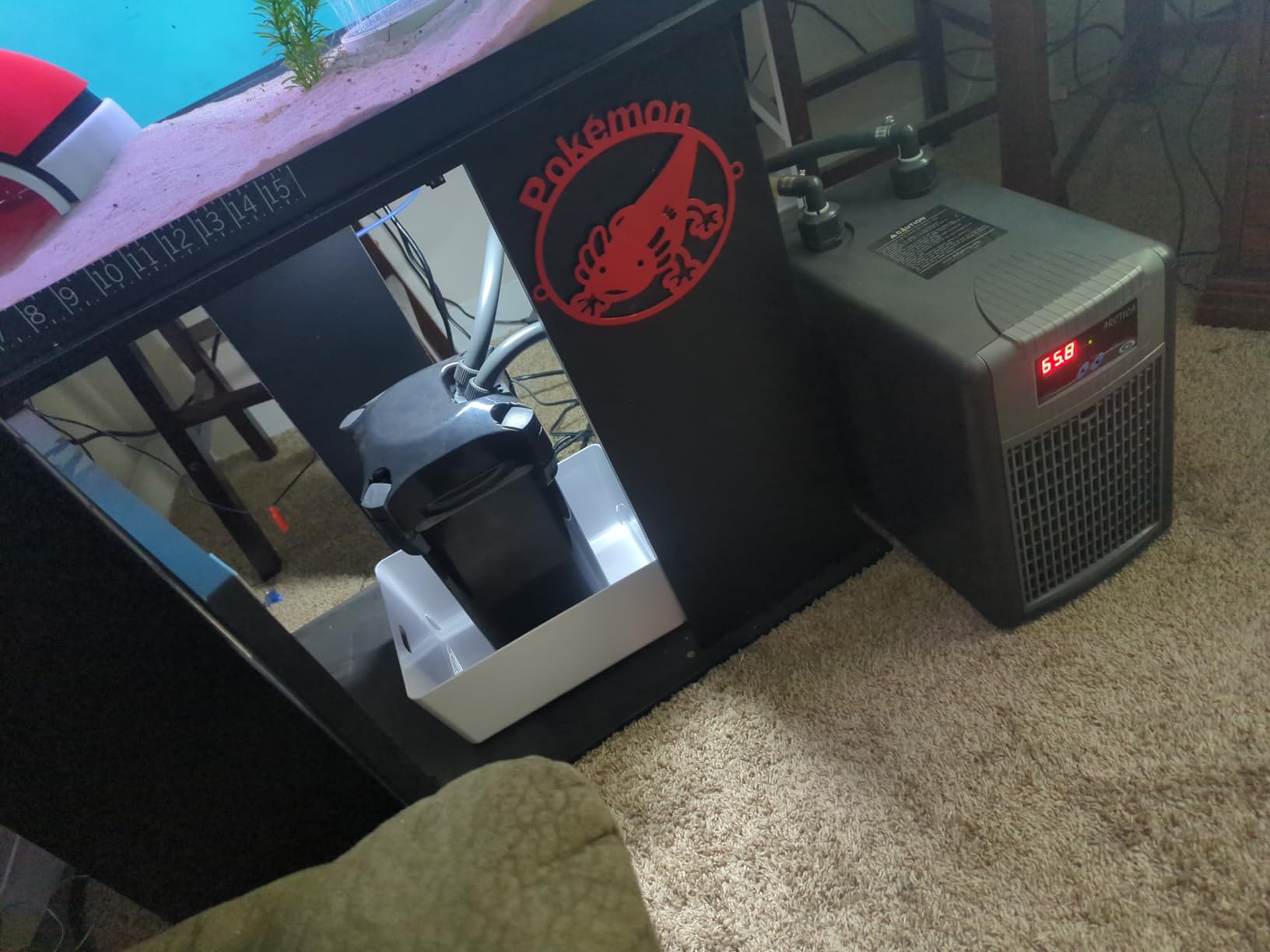
Technically you get a 1/10 HP titanium evaporator, a highly efficient condenser, and ozone-friendly R-134A refrigerant in a 13 by 19 by 20 inch body weighing 41 pounds. It is plumbed inline and needs an external pump with adjustable flow, which means the minimum flow requirement changes with the model size you choose.
Two things to plan around. First, the external pump is not optional, so add it to the cost and to the install. Second, the heat it rejects goes into the room, and owners note that clearly. In an enclosed space a chiller can raise ambient temperature enough to work against itself.
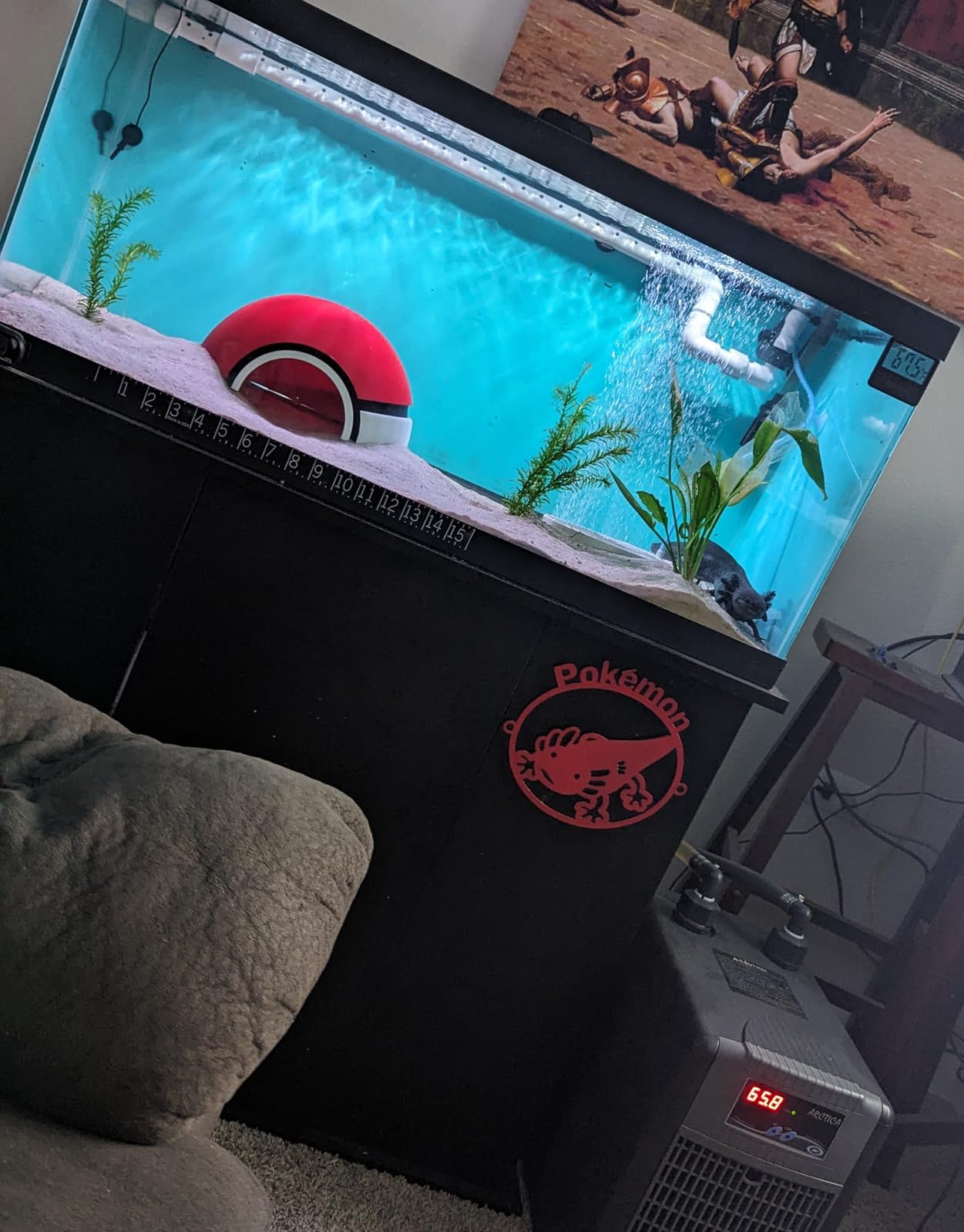
Is precision worth the extra plumbing?
Yes when you are chasing a narrow target band and your room temperature swings. The setpoint holds, and the boost-free operation is gentle on the compressor.
No if you just need water under 72 F. A broader band chiller will get you there with less fuss and fewer parts to buy.
What to check before you commit
Choose your model size before you choose the pump. Minimum required flow is tied to the size, and picking wrong is the most common installation error with this design.
Plan the heat rejection path. This machine adds real warmth to whatever room it sits in, which matters most in a small tent.
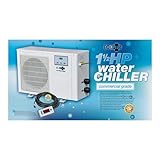
8. EcoPlus Commercial Grade 1.5 HP Chiller – Best for 300 Gallon Reservoirs
EcoPlus Commercial Grade Water Chiller, Cooler for Reservoirs, Hydroponics, and Aquariums, 1 ½ HP
1.5 HP
300 gal reservoir rated
94 pounds
Wired 30 ft remote
Pros
- Only unit here rated for a 300 gallon hydroponic reservoir
- Wired 30 foot remote lets you monitor and adjust from a distance
- Auto restart with temperature memory protects the setpoint after a power cut
- Includes fittings for 1 inch hard PVC or flexible tubing
Cons
- Lowest average rating here at 3.9 stars with 19 percent one star
- Needs a strong external pump at roughly 1267 GPH
- Heavy and bulky at 94 pounds and 41 inches long
Everything below 300 gallons in this roundup is a domestic machine being asked to do commercial work. This is the one built for it. The 1.5 HP compressor is rated by the manufacturer for a 300 gallon hydroponic reservoir, which changes the conversation from a weekend project to a facility with uptime requirements.
The wired remote with a 30 foot cord is the feature that matters most at this scale. You can read and adjust reservoir temperature from outside the room instead of walking into a hot space every hour, and the auto restart with temperature memory means a power event does not send a full reservoir back to ambient.
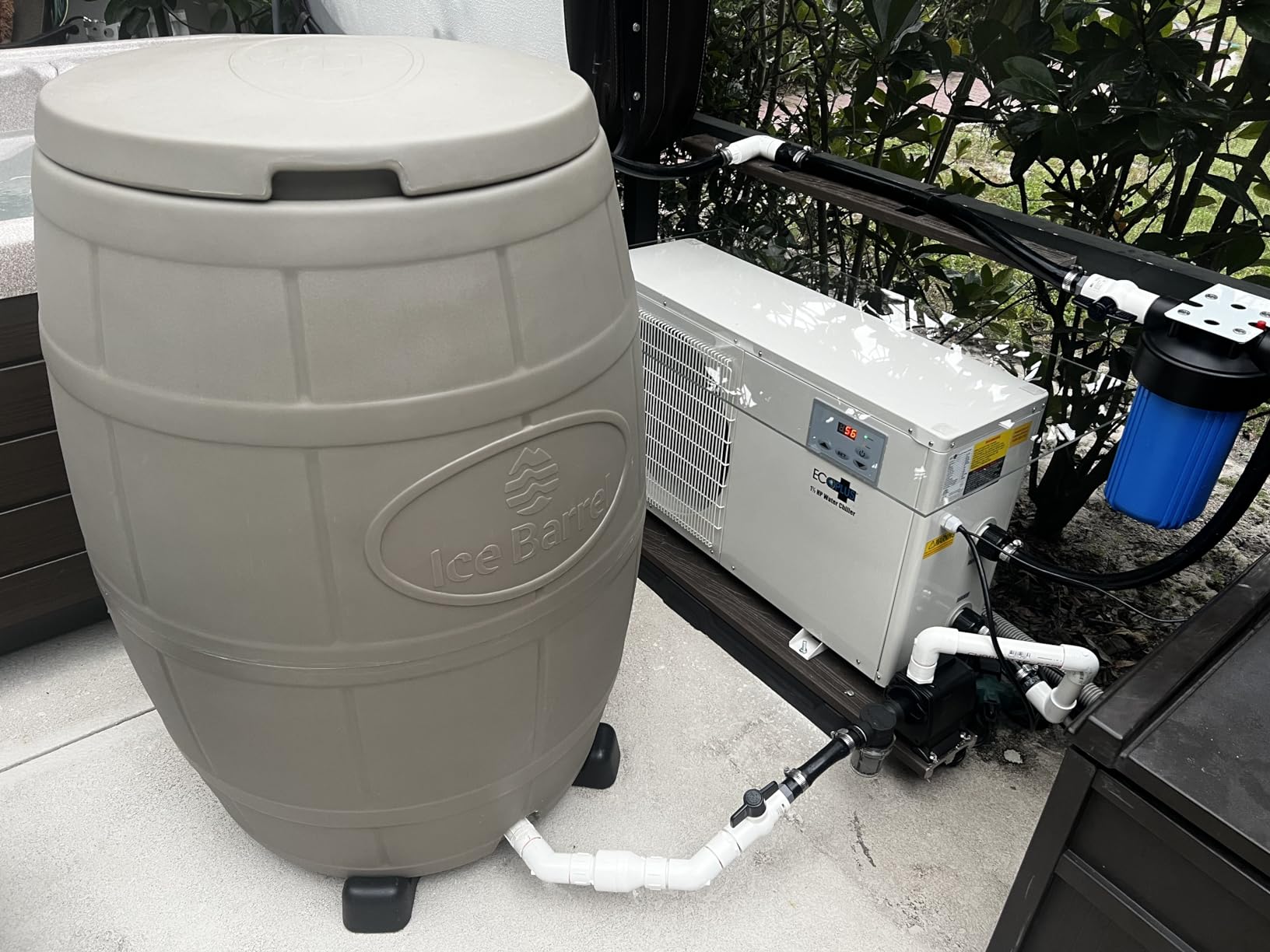
It is built from commercial grade materials with a titanium wetted surface, uses R140A refrigerant, and runs on 120V 60Hz at 300 watts. The body is 15 inches wide by 41 inches long by 24 inches high and weighs 94 pounds, so it needs a dedicated floor space and two people to position it.
Reliability is the caution. 65 percent of its 55 reviews are five-star but 19 percent are one star, the highest failure share in the group. The manufacturer recommends the EcoPlus 1267 GPH pump, and going under that flow rate is the most likely reason a unit like this underperforms.
Do home growers ever need this class?
Rarely. Unless you are running multiple reservoirs on a shared loop or a genuinely large RDWC system above 200 gallons, the capital and space cost is hard to justify.
Commercial operators with several independent reservoirs may find a centralized approach cheaper overall, but a single per-reservoir chiller like this is simpler to commission and to service.
What to check before you commit
Confirm your electrical service. It is a 120V 60Hz unit at 300 watts, but a dedicated circuit is still the sensible call for continuous compressor cycling.
Plan the floor space and the lift. At 94 pounds and over three feet long it is not a shelf appliance, and airflow around the condenser matters.
9. VEVOR 52 Gallon 1/10 HP Chiller – Best for First-Time Plumbing Jobs
VEVOR Aquarium Chiller 52Gal 1/10HP Quiet Cooler with Titanium Evaporator
52 gal rated
1200 L/h flow
30.9 pounds
Titanium evaporator
Pros
- Complete fitting kit included so no extra plumbing parts are needed
- Strong 1200 L/h circulation for a 52 gallon chiller
- Runs quietly enough to be comparable to a refrigerator
- Titanium evaporator with fluorine-free R290 refrigerant
Cons
- Bundled SP-2500 pump is the weak point and is often replaced
- Temperature readout can be off by several degrees
- Short cycles because there is no settable buffer
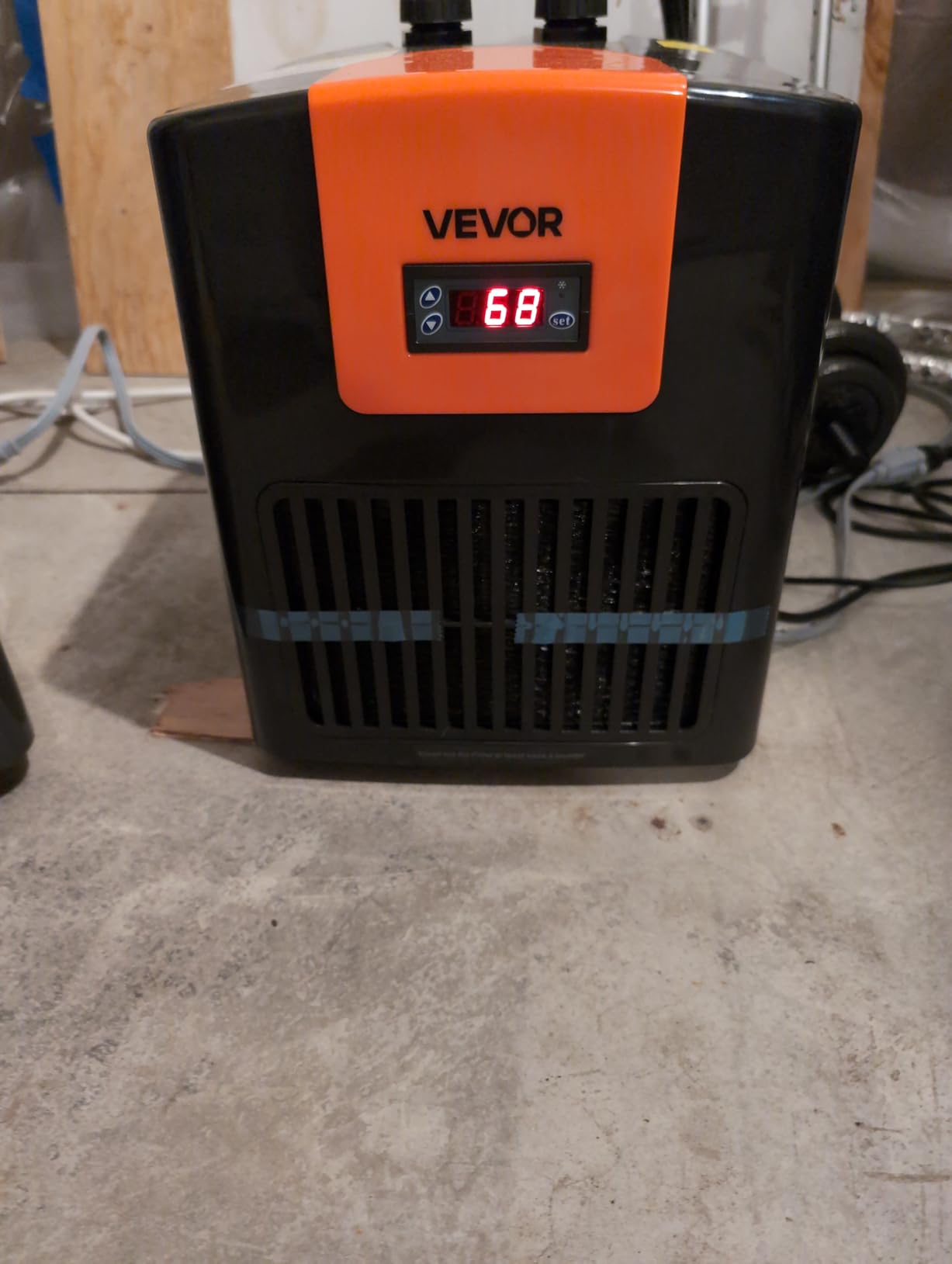
The box is the selling point here. It includes a full hose clamp kit in three sizes, pipe connection nuts, pipe connectors, O-rings, a water pump, PVC hoses, a user manual, and even a suction cup. If you have never plumbed a reservoir loop, this is the one that gets you from box to running without a second parts order.
Owners using it for ponds, hydroponic reservoirs, and axolotl tanks report holding 68 F consistently even in hot weather, and describe it as quiet as a refrigerator. The circulation figure of 1200 L/h is the highest in this group relative to its capacity class, which helps it keep a coil evenly wetted.
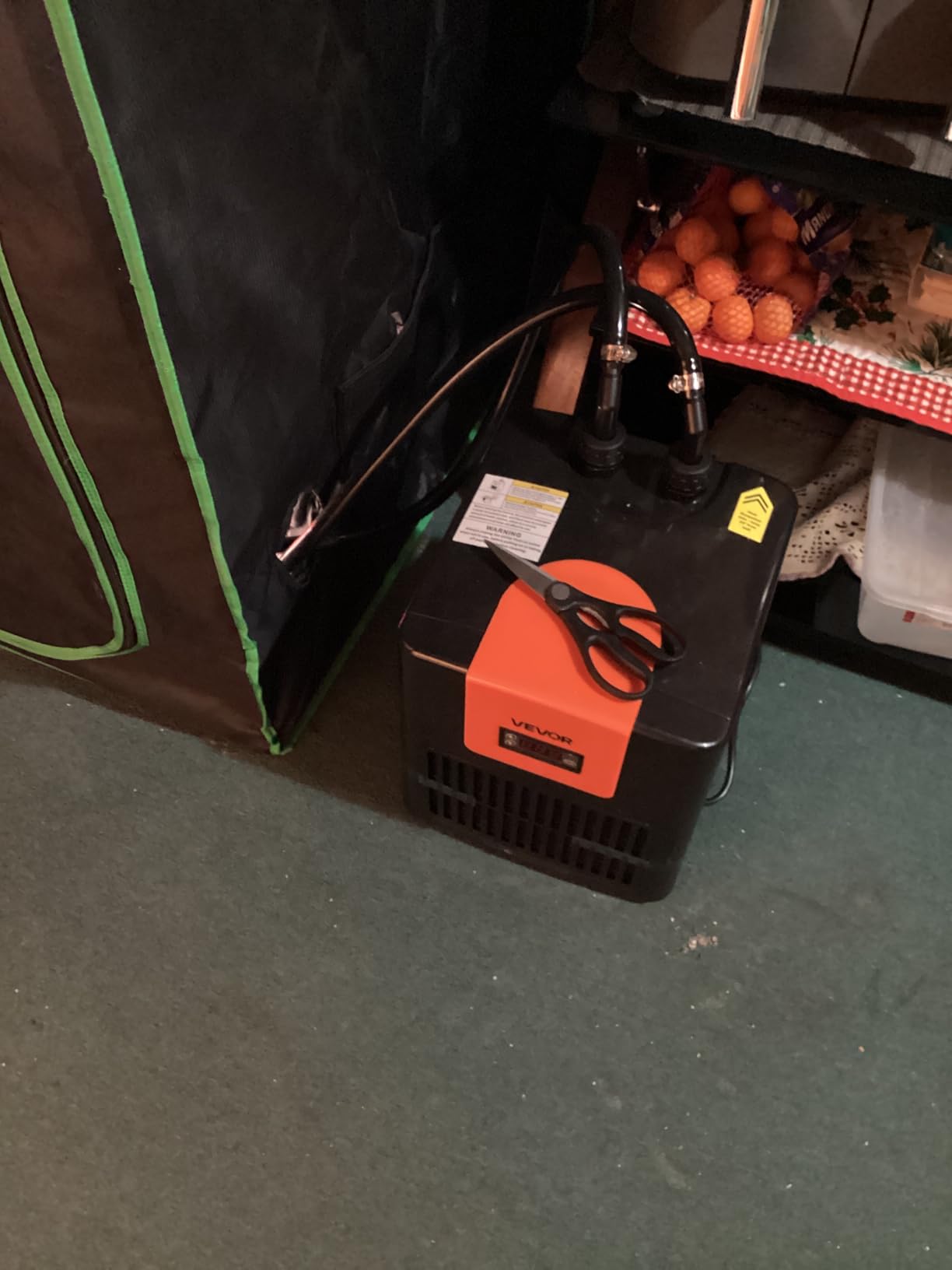
It uses a 1/10 HP compressor with fluorine-free R290 refrigerant, working across a 65-80 F range, with a corrosion-resistant titanium evaporator for fresh and salt water. Heat leaves through a built-in fan and multiple ventilation holes, and it wants 24 inches of clearance, which is more than most other machines here.
Two issues recur. The SP-2500 pump is the weak point and several buyers replaced it within weeks, and there is no settable buffer on the controller, so the compressor tends to short-cycle. The readout can also sit a few degrees off an independent thermometer, so calibrate before you trust it.
Is a 52 gallon chiller right for a mid-size reservoir?
Yes, and its rating sits above the BAOSHISHAN unit’s 42 gallon ceiling, which gives you more margin on a warm day. Owners have used it on systems larger than the rating with good results.
It is not suited to marine aquariums. One owner reports it interfering with protein skimming, which matters if you plan to use the same machine for reef duty and nutrient duty.
What to check before you commit
Give it 24 inches of clearance on the exhaust side. That is the largest clearance requirement in this roundup and it is easy to under-provide.
Budget for a replacement pump. The bundled SP-2500 is the most common upgrade owners make on this model.
10. JBJ Arctica 1/5 HP Chiller – Best for Aquarium Dual-Use Setups
JBJ Aquarium Arctica Titanium Chiller, 1/5 HP
1/5 HP
Titanium evaporator
LED controller
43.36 pounds
Pros
- Smart memory chip restores the last setpoint after a power failure
- Digital LED controller stays readable in a dark room
- Corrosion-resistant titanium wetted surface
- Quick installation with hose
Cons
- Smallest review base in the group at 23 reviews so evidence is thin
- Requires an external pump and separate plumbing hardware
- Adds heat to the surrounding room
If your system runs a shared loop between an aquarium and a hydroponic reservoir, the titanium wetted surface is the deciding feature. You can plumb the same machine into both without worrying about what a copper or aluminium component does to a mixed nutrient solution over time.
The smart memory chip is the sleeper feature. It restores the last set temperature automatically after a power failure, which in a dual-use setup matters more than it does anywhere else, because a single outage now affects two different biological loads instead of one.
The digital LED controller is readable day or night, and the unit is assembled in South Korea, which is a useful quality signal when you are choosing between components that all look identical in a listing photo.
How much evidence is there for this model?
Only 23 reviews, so treat long-term durability claims cautiously. The rating of 4.3 stars is the second highest in the group, but the base is small enough that a handful of extra reviews could move it noticeably.
What you can lean on is the design. It shares its architecture with JBJ models that have been in production since 2004, and the memory chip and LED controller features are consistent across that line.
What to check before you commit
Confirm your pump flow against the model requirements. This is an inline design and depends on circulation you provide.
Plan heat rejection. Like the other inline JBJ models here, it warms the room it sits in, so place it where the exhaust air leaves the growing area.
What Temperature Should a Hydroponic Reservoir Run At?
Hold your hydroponic reservoir between 65 and 72 F (18-22 C). Below 60 F root metabolism and nutrient uptake slow sharply, and above 75 F dissolved oxygen drops off a cliff while Pythium risk climbs. A chiller exists to keep you inside that band, not to make the water as cold as possible.
The reason is dissolved oxygen. Colder water holds more of it, and a reservoir sitting at 78 F in a warm tent can carry a fraction of the oxygen a 68 F reservoir holds at the same flow rate. Roots that cannot get oxygen cannot grow, and weakened roots are exactly where root rot pathogens establish themselves.
Temperature also drives nutrient chemistry. Warmer solution holds less dissolved calcium and magnesium, which encourages precipitation and scale on your equipment, and it shifts pH more quickly, so a reservoir that drifts in temperature drifts in pH too.
Crop tolerance varies. Lettuce, herbs, and leafy greens do well at the cool end of the range, while tomatoes, peppers, and cucumbers tolerate the warmer end. If you are running one mixed reservoir, aim for the middle of the band rather than targeting your hungriest plant.
How to Size a Water Chiller for Your Reservoir
Start with the one-line rule and adjust for your room. Under 30 gallons takes a 1/10 HP class chiller, 30 to 90 gallons takes 1/4 HP, 90 to 145 gallons takes 1/2 HP, and 145 to 265 gallons takes 1 HP. If your grow room regularly runs above 80 F, step up one class, because a chiller loses meaningful capacity as ambient temperature rises.
The basic calculation is straightforward. Multiply your reservoir volume in gallons by 8.33 pounds per gallon, then by the temperature rise you are trying to correct in degrees F, and you have the BTU per hour your system must remove. Divide by 12000 for tons of refrigeration. A 100 gallon reservoir needing a 5 F correction needs 4165 BTU per hour, or about 0.35 tons before any margin is added.
Then add a buffer. Twenty to 25 percent covers a hot afternoon, a closed tent, and the light heat load, because your lamps dump their full wattage into the room as heat. Under-budgeting here is the reason growers report that a correctly rated chiller simply will not hold temperature.
The empirical test is better than any formula because it measures your actual room, your actual lights, and your actual reservoir. Drop sealed ice bags into the reservoir, let the temperature fall, then remove them and run your system at full heat load for one hour. Measure the temperature rise over that hour. That delta-T times gallons times 8.33 is your real load, and anything less than the manufacturer’s rating means the formula was optimistic.
Ambient temperature is the variable nobody accounts for. A chiller rated for 100 gallons in a 70 F room will underperform in a 90 F room, because the condenser has less ability to reject heat into cooler air. This is the number one cause of a chiller that appears to do nothing. If you cannot keep the room cool, size up and place the machine outside the growing space where it can dump heat into a cooler area.
One more sizing trap worth naming. A grower on a growweedeasy thread about practical chiller implementation noted that when he looked up aquarium chillers he found a 1/10 HP model could chill something like 130 gallons of water, while his own reservoir held six, and he concluded he had overpaid by buying too large. Forum reports of small chillers exceeding their ratings are common, but relying on that is how people end up with a chiller that cannot pull a 70 gallon tank down on a July afternoon.
What Actually Matters When You Choose a Chiller
Coil material comes first. Titanium and stainless steel are the only wetted materials most growers accept for continuous contact with nutrient solution. A user on a refrigeration forum thread building a chiller for a small closet reservoir put it plainly, aluminium reacts with fertilizer solution and that is a reason to hunt down a stainless steel coil instead. The titanium evaporators on most of the models here handle this without drama.
Flow rate is the second thing. Your circulation pump has to push water past the coil fast enough for heat to transfer, and not so fast that it exceeds the chiller’s maximum rated flow. Units in this roundup span 210 GPH at the small end to 925 GPH on the Active Aqua, so check that your pump sits inside the window rather than assuming any pump works.
Whether the pump is included is a real cost and reliability factor. The BAOSHISHAN, Poafamx, Fitnet, and VEVOR machines include a pump, while the Active Aqua and the JBJ inline models do not. Several brands bundle a pump that owners replace within weeks, so treat the included pump as a starting point rather than a solved problem.
Noise matters more than expected in a grow room. The JBJ Arctica models are repeatedly described as the quietest in their class, while the BAOSHISHAN sits at 45-50dB at one meter and the Poafamx is under 45dB. If your tent is inside a living space, that difference is the one you will live with daily.
Finally, think about duty cycle. A chiller that runs continuously in a cool room will short-cycle, and short cycling is what wears compressors out. The Fitnet and the JBJ 1/5 HP both have setpoint memory after a power failure, and the EcoPlus has auto restart, which reduces the stress of a summer power interruption. Build quality, materials, and power draw are worth checking against your electrical service before anything else is bolted down.
How to Install a Hydroponic Reservoir Chiller
Place the chiller outside the growing space whenever you can. The heat it pulls out of your reservoir has to go somewhere, and if it goes into the tent air you are fighting your own machine. Positioning it in a cooler room, a basement, or even a ventilated closet gives you free performance that no specification sheet will promise you.
Set up the circulation path next. Run a return line from the reservoir to the chiller inlet and back to the reservoir, using clamps on every connection. Where your loop already has a pump, use it. Where the chiller is a submersible style with a bundled pump, connect that pump to the reservoir rather than to the chiller inlet.
Prime the loop before power. This step is skipped constantly and it is the single biggest cause of early compressor failure. Running a compressor with no water through the heat exchanger cooks it in minutes. Fill the reservoir, run the pump until water flows steadily through the coil and out the return, and only then switch the chiller on.
Give the machine its clearance. Several models here specify 6 inches on all sides, and the VEVOR asks for 24 inches on the exhaust side. Blocked vents raise internal temperatures and force short cycling, which is the most common reason a chiller that worked on day one stops holding setpoint in week three.
Finally, confirm the reading against an independent thermometer and set your target inside the 65-72 F band. Monitoring the thing you cannot feel is the last step, not the first, and a cheap thermometer in the reservoir is the cheapest insurance in this entire build.
Before you commit to hardware, it is worth checking your baseline water quality, because source water affects how quickly your reservoir chemistry responds to a temperature change. Our guides to countertop water filters and filter pitchers cover that side of the build.
DIY and Budget Alternatives to Buying a Chiller
Frozen water bottles are the classic low-cost answer and they genuinely work for small volumes. Drop two or three sealed bottles into the reservoir on a rotation and swap them out as they thaw. For a 20 gallon tank in a mild room it will hold temperature for most of a day. For 100 gallons it is hopeless, which is where the economics stop making sense.
An ice bath beats loose bottles because it decouples cooling from your reservoir volume. Float a sealed nutrient container in a larger tub of ice water, or run a small closed loop where a coil sits in an ice bath. A grower planning a build for a five litre reservoir in a closet raised exactly this question, and the practical answer is that at that volume you are managing a few litres of water, not cooling a system.
Shading and insulation are free and often skipped. An opaque, insulated reservoir blocks light that drives algae, and a lid with a foam layer cut for the return line reduces solar gain during the day. Moving the reservoir out of direct grow light does more than most people expect, and it costs nothing.
A pre-cooler on the intake is a bigger win than an ice bath for larger systems. Chilling the solution before it enters the reservoir, in a small line-mounted coil, spreads the cooling across a shorter segment of pipe where the whole flow passes through the coil at high velocity. It is more efficient per watt than trying to cool a large tank body.
Peltier builds are possible but demanding. A thermoelectric module needs a large heatsink and a serious power supply, and it pushes its own heat into the room rather than moving it away. If you go this route, the coil must be stainless steel or titanium. Aluminium wetted parts are not acceptable in nutrient solution, and finding the right coil is harder than the electronics.
Troubleshooting a Chiller That Will Not Reach Setpoint
If the compressor runs but the reservoir will not cool, the most common cause is placement. A chiller inside a warm tent rejects heat into the same air it is trying to cool, and it can lose more than it removes. Move it outside the growing space and give it clearance before you blame the machine.
Next check the flow. A pump that is too weak leaves the coil barely wetted, and one that is too strong exceeds the chiller’s maximum flow and reduces heat transfer. Both look identical from the reservoir: no cooling. Confirm your pump sits inside the manufacturer’s GPH window.
Then verify you have a pump at all. Several models in this roundup come without one, and a chiller plumbed inline with no circulation simply has no water moving past the coil.
A dirty condenser is the least glamorous cause and the easiest to fix. A layer of dust on the intake grille raises internal temperature enough to cause short cycling. Vacuum or brush it, and check that the intake is not pressed against a wall.
Finally, check the thermostat calibration. Owners of the Fitnet model report the readout running a few degrees off an independent thermometer, and several units need the F1 temperature difference setting configured correctly at first power-on. If the reservoir feels cold but the display says warm, you have a calibration problem, not a cooling problem.
Frequently Asked Questions
What is the best water chiller for hydroponics?
The best chiller is the one whose class matches your gallons: 1/10 HP under 30 gallons, 1/4 HP for 30-90 gallons, 1/2 HP for 90-145 gallons, and 1 HP for 145-265 gallons. Step up one class if your room stays above 80 F. In this roundup the BAOSHISHAN 1/10 HP is the best all-round pick.
How to keep hydroponic water cool?
Size and place a chiller outside the grow room, run an ice bath with frozen bottles for smaller volumes, shade and insulate the reservoir, add a pre-cooler on the intake, lower the ambient room temperature, and switch to opaque covered containers. The chiller is the last step, not the first.
How can I make a DIY hydroponic water chiller?
Use a frozen water bottle rotation, float a sealed container in an ice bath, or build a small loop with a coil sitting in ice. Peltier builds are possible but need a large heatsink. Never let aluminium contact nutrient solution; use stainless steel or titanium only.
What is the recommended reservoir size for hydroponics?
Allow roughly 1 gallon per plant for leafy greens and herbs, and 2-3 gallons per plant for fruiting crops like tomatoes and peppers. Sizing the chiller follows from that number: match gallons to compressor class, then add a 20-25 percent buffer for room heat and light load.
Do I need a chiller for my DWC system?
You need one if your reservoir regularly climbs above 72 F, which is most indoor growers running DWC in a warm room. Water above 75 F loses dissolved oxygen quickly and raises root rot risk. Below about 20 gallons, ice bottles may be enough instead of a chiller.
Is an aquarium chiller good for hydroponics?
Yes, as long as the wetted coil is titanium or stainless steel, the compressor is rated for continuous duty, and the unit runs in a cool ambient space. Most of the models in this roundup are aquarium-derived. You also need a pump, tubing, and clamps, and you must never run the compressor with no flow.
Conclusion
Match the chiller to your gallons, not to your tent, and add a class if your room runs hot. Under 30 gallons means a 1/10 HP class machine, 30-90 gallons means 1/4 HP, 90-145 gallons means 1/2 HP, and above that you are looking at 1 HP and commercial equipment.
Our pick for most growers is the BAOSHISHAN 1/10 HP, because the included pump, tubing, and clamps remove the most common installation mistake, and 503 owner reviews give you a real picture of how it behaves. For cooling power per dollar the Poafamx 1/3 HP is hard to argue with, and for setpoint precision the Fitnet holds a temperature better than anything else we tested.
Whichever you choose, place it outside the growing space, prime the loop before you power it on, and give it the clearance the manual asks for. Those three steps decide whether your hydroponic reservoir water chiller works or simply warms your room. As always, start with clean water and measure what you cannot feel.
More of our water gear picks are in the water flosser guide if you want the rest of the setup covered.