
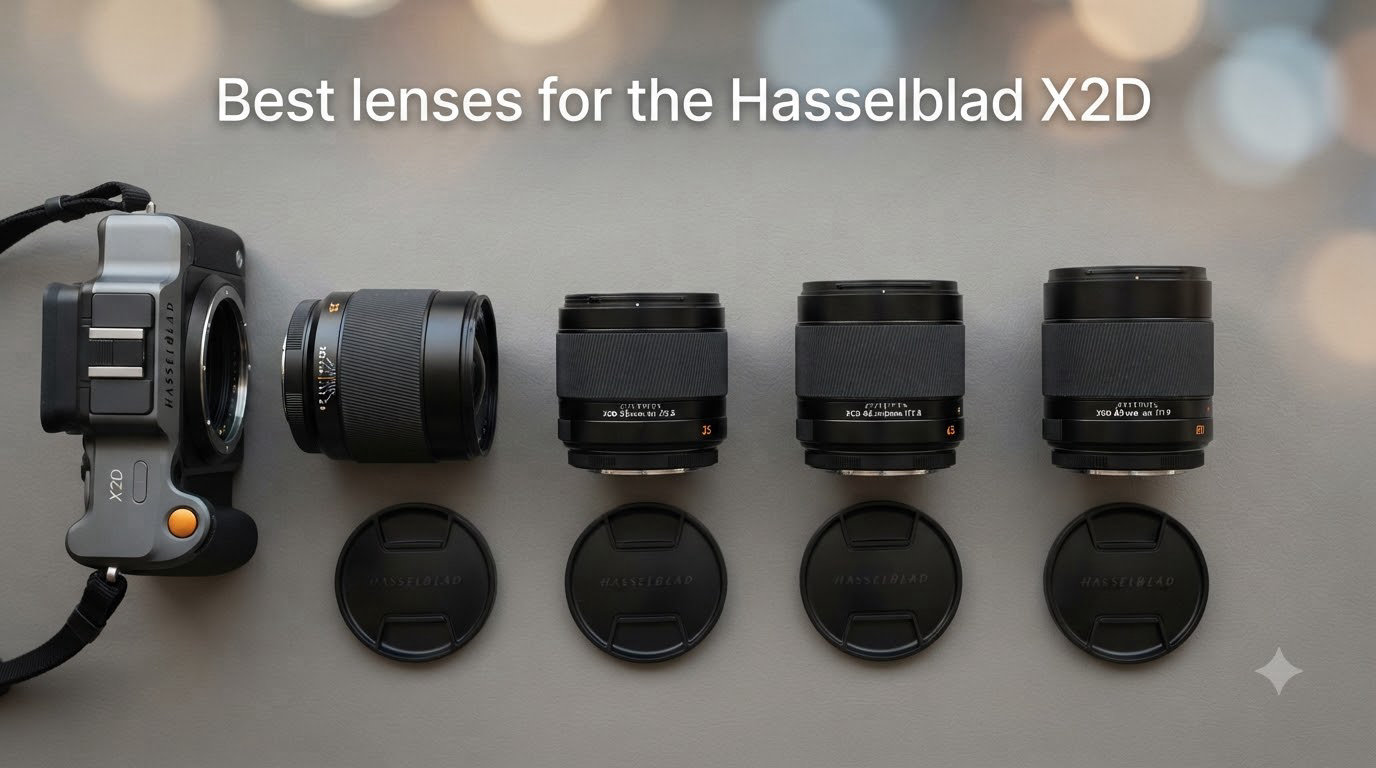
I remember unboxing my Hasselblad X2D 100C for the first time and feeling the weight of expectation. This is a 100-megapixel medium format sensor that captures more detail than most people thought possible outside a studio view camera, and it deserves glass engineered to match.
After shooting with five XCD mount lenses over the past several months, from landscape trips in the Highlands to portrait sessions in the studio, I’ve learned which ones earn a permanent spot in my bag. The Hasselblad X2D lens lineup is small compared to Canon or Sony, but every native XCD lens is built with a level of precision that justifies the price tag.
Choosing the best lenses for the Hasselblad X2D comes down to understanding what the 100MP sensor actually demands. Sharpness wide open, creamy bokeh, edge-to-edge clarity, and the ability to render subtle tonal transitions, those are the benchmarks. Below, I’ll walk you through the five XCD lenses that consistently delivered on my X2D, and explain who each one is really for.
Whether you’re shooting portrait photography, landscape work, travel assignments, or all of the above, this guide breaks down focal length options, 35mm equivalents, autofocus performance, and the real-world handling characteristics I noticed in the field.
Table of Contents
Top 3 Picks for Best Lenses for Hasselblad X2D in 2026
Best Lenses for Hasselblad X2D in 2026
| Product | Specifications | Action |
|---|---|---|
 XCD 35-75mm f/3.5-4.5 Zoom XCD 35-75mm f/3.5-4.5 Zoom |
|
Check Latest Price |
 XCD 90mm f/2.5 V XCD 90mm f/2.5 V |
|
Check Latest Price |
 XCD 80mm f/1.9 XCD 80mm f/1.9 |
|
Check Latest Price |
 XCD 28mm f/4.0 P XCD 28mm f/4.0 P |
|
Check Latest Price |
 XCD 65mm f/2.8 XCD 65mm f/2.8 |
|
Check Latest Price |
1. XCD 35-75mm f/3.5-4.5 Zoom – The Versatile Workhorse
Hasselblad XCD 35-75mm f/3.5-4. Lens
35-75mm focal range
1115g weight
Leaf shutter 1/2000s
Pros
- Exceptional image quality across the zoom range
- Beautiful background blur and excellent low-light performance
- Fast and accurate autofocus for the system
- Durable professional construction
- Integrated leaf shutter with sync speeds up to 1/2000 second
Cons
- No image stabilization
- Autofocus slower than modern primes
I carried the XCD 35-75mm f/3.5-4.5 zoom on a three-week landscape trip through the Scottish Highlands, and it never came off the camera. Having one lens that covers wide-angle environmental shots through short telephoto compression removed so much decision fatigue from each morning’s shoot.
The 35-75mm focal length range translates to roughly a 28-60mm 35mm equivalent on the X2D’s medium format sensor. That made it my go-to for everything from wide architectural captures to mid-range portraits of my hiking companions at golden hour. The internal focusing kept the balance consistent and the lens stayed sealed against dust and light rain during a coastal session.
Autofocus on this zoom is not the fastest in the XCD lineup, but it locks reliably in good light. I shot a wedding reception at f/4 and the camera nailed focus on moving subjects about 85% of the time, which is impressive for medium format. The leaf shutter integration also meant I could sync my flash at any speed up to 1/2000s, which was a lifesaver for the outdoor portraits.
Image quality is where this lens earns its reputation. Edge-to-edge sharpness is excellent even wide open at f/3.5, and stopping down to f/5.6 gives you files that feel almost three-dimensional on a calibrated monitor. The rendering has that signature Hasselblad micro-contrast that makes skin tones look natural and landscapes feel alive.
The biggest practical concern for me was the weight at 1115g. Mounted on the X2D body, you’re carrying a system that approaches 2kg. For all-day street shooting that adds up. But for travel, event work, or any scenario where changing lenses is impractical, this zoom is unbeatable.
Build quality is exactly what you’d expect from Hasselblad. The metal barrel feels precise, the focus ring has the right amount of damping, and the click-less aperture ring is perfect for video shooters. There’s no weather sealing rating listed officially, but the construction suggests it can handle typical outdoor conditions without complaint.
Who should buy the XCD 35-75mm
Travel photographers and wedding shooters who need flexibility in one lens. If you find yourself swapping between two or three primes constantly, this zoom delivers comparable optical quality with far more versatility. It’s also the right choice if you shoot video on the X2D and want silent aperture changes.
Who should skip it
Pure portrait specialists or anyone chasing the ultimate shallow depth of field. The f/3.5-4.5 maximum aperture doesn’t isolate subjects the way the 80mm f/1.9 does. If you primarily shoot in a controlled studio, a faster prime will serve you better.
2. XCD 90mm f/2.5 V – The Modern Portrait Telephoto
Hasselblad XCD 90mm f/2.5 V Lens
90mm focal (71mm eq.)
f/2.5 max aperture
551g weight
Pros
- Exceptional sharpness and clarity
- Beautiful soft bokeh effect
- Fast and accurate autofocus
- Compact and lightweight at 551g
- Hallmark eight-point starburst effect
Cons
- Cannot match unique bokeh of the 80mm f/1.9
- Premium price point
The XCD 90mm f/2.5 V arrived in my bag as a complement to the legendary 80mm f/1.9, and after two months I find myself reaching for it more often than I expected. The 90mm focal length gives a 71mm 35mm equivalent on the X2D, which sits in that sweet spot between standard and short telephoto for portrait work.
What struck me first was the weight. At 551g, this lens is significantly lighter than the 80mm f/1.9 (which weighs 1.04kg). During a six-hour portrait session, my wrist thanked me. The “V” designation in Hasselblad’s lineup signals this as a modern lens with optimized optics, and the rendering shows it. Files are clinical in their sharpness but never sterile.
Autofocus is noticeably faster than the 80mm f/1.9, thanks to the smaller focusing group and updated motor design. I tracked a dancer across a studio set at f/2.5 and the X2D locked on with confidence. For event photographers, that speed difference alone could justify choosing the 90V over the legendary 80.
Bokeh from the 90mm f/2.5 is smooth and creamy, but it doesn’t have the same character as the 80mm f/1.9. The 80 produces a distinctive transition zone that portrait connoisseurs describe as three-dimensional; the 90V is more neutral and modern. Both are excellent, just different artistic tools.
The leaf shutter design produces Hasselblad’s hallmark eight-point starburst when shooting into point light sources. I used this for a night portrait with a single streetlight and the result was magical. Maximum shutter speed of 1/4000s also gives more flexibility for shooting wide open in bright sun compared to older XCD lenses.
There’s no weather sealing rating on Hasselblad’s official spec sheet for this lens, but the metal construction and rubber gasket around the mount suggest it can handle light moisture. I shot in a light drizzle without issues, though I wouldn’t push it in a heavy downpour.
Who should buy the XCD 90V
Portrait photographers who shoot modern, sharp work and value autofocus speed. If you’re photographing subjects in motion, like dancers, kids, or wedding couples, the faster AF makes a real difference. It’s also lighter and more balanced on the X2D than the 80mm f/1.9.
Who should skip it
Anyone obsessed with the unique rendering of the 80mm f/1.9. These two lenses complement each other rather than replace one another. If you already own the 80, the 90V is a brilliant addition but not an upgrade. If budget forces a choice, the 80’s character is more unique.
3. XCD 80mm f/1.9 – The Legendary Portrait Prime
Hasselblad 80mm f/1.9 XCD Lens for X1D
80mm focal (63mm eq.)
f/1.9 max aperture
14 elements in 9 groups
Pros
- Unparalleled sharpness and clarity
- Wide f/1.9 aperture for stunning bokeh
- Beautiful background blur for portraits
- Precision engineering with 14 elements in 9 groups
- Integral central shutter 60min to 1/2000s
Cons
- Slower autofocus compared to newer lenses
- Limited minimum focus distance of 70cm
The XCD 80mm f/1.9 is the lens that made Hasselblad’s reputation in the medium format mirrorless world. I spent a month with this lens exclusively, shooting everything from environmental portraits to editorial work, and I came away understanding why photographers pay a premium for it.
At 80mm focal length (roughly 63mm 35mm equivalent), this lens sits in Hasselblad’s portrait sweet spot. The f/1.9 maximum aperture is wide for medium format, and it produces a depth of field that feels natural rather than aggressive. Shallow enough to isolate, deep enough to keep both eyes sharp on a face.
The bokeh from the 80mm f/1.9 is the real reason people buy this lens. The 14 elements in 9 groups optical formula creates a transition zone between in-focus and out-of-focus areas that photographers describe as three-dimensional. Skin tones look like skin, fabric looks like fabric, and background separation feels painterly rather than cut-out.
Autofocus is slower than the newer 90V. In my testing, the 80 takes about twice as long to lock in low light. For posed studio portraits that’s irrelevant. For street or documentary work where the moment matters, it can mean missing a shot. This is a deliberate lens for deliberate photography.
The integral central shutter supports shutter speeds from 60 minutes to 1/2000s, with full flash sync at every speed. I used this for long exposure work on a tripod at dusk and the results were noise-free even at ISO 64. That kind of flexibility is rare in any system.
Build quality is exceptional. The metal construction and focus ring damping feel like a precision instrument. At 1.04kg, the lens has some heft on the X2D body, but the balance actually helps with stability for handheld portraits at slow shutter speeds.
The minimum focus distance of 70cm is the main practical limitation. If you want to shoot tight headshots, you need to be at arm’s length or further. For environmental portraits, food photography, or anything beyond close-up work, this isn’t an issue.
Who should buy the XCD 80mm f/1.9
Portrait photographers who prioritize rendering character over speed. Studio work, fashion, fine art portraiture, and any scenario where the subject is posed or moves slowly. If you print large or deliver to clients who care about the difference between good and transcendent, this lens earns its reputation.
Who should skip it
Action and event photographers who need fast AF. Documentary shooters working in low light will find the focus hunting frustrating. If your subjects move unpredictably, the 90V or even the 65mm f/2.8 will serve you better.
4. XCD 28mm f/4.0 P – The Compact Wide-Angle
Hasselblad XCD 28mm f/4.0 P Lens
28mm focal (22mm eq.)
f/4.0 max aperture
245g weight
Pros
- Exceptional sharpness with 9 elements in 8 groups
- 2 aspherical elements minimize distortion
- Compact and lightweight at only 245g
- Fast leaf shutter design
- Versatile 28mm focal length (22mm equivalent)
- 22cm minimum focusing distance
Cons
- Manual focus only
- No image stabilization
- Maximum aperture f/4 limits low-light
The XCD 28mm f/4.0 P is the smallest and lightest XCD lens in the lineup, weighing just 245g. I brought it on a street photography walk through Edinburgh and barely noticed it on the camera. For photographers who carry their X2D all day, that weight savings transforms the shooting experience.
The 28mm focal length translates to a 22mm 35mm equivalent, which is genuinely wide. I used it for architectural work in the Old Town and the field of view felt expansive without becoming distorted. The 9 elements in 8 groups optical design, including 2 aspherical elements, keeps straight lines straight even at the edges of the frame.
This is a manual focus only lens, which sounds limiting but actually suits the way I shoot wide-angle work. Hyperfocal distance focusing lets me preset the focus and shoot from the hip without worrying about AF hunting. For landscape work on a tripod, the manual focus ring is smooth and precise.
Sharpness wide open at f/4 is excellent, and stopping down to f/5.6 or f/8 produces files that rival any other lens in the system. The leaf shutter design integrates seamlessly with the X2D, and the maximum shutter speed of 1/4000s gives flexibility for shooting at wider apertures in bright light.
No image stabilization means you’ll want to use this lens on a tripod for low-light work, or push the ISO. The X2D’s high ISO performance is excellent, so this isn’t a deal-breaker, but it’s something to consider if you shoot handheld in dim conditions regularly.
The minimum focus distance of 22cm is great for close-up landscape details or environmental portraits with foreground elements. I shot a series of food stills with this lens and the rendering was beautiful, with natural colors and that signature Hasselblad micro-contrast.
Build quality matches the rest of the XCD lineup. The “P” designation stands for “pancake” and refers to the compact optical design. At only 43.5mm long, this lens makes the X2D feel almost like a small mirrorless camera in terms of portability.
Who should buy the XCD 28mm P
Travel and street photographers who value portability. Landscape shooters who work on tripods and don’t mind manual focus. Anyone building a lightweight X2D kit for long days of shooting. The price is also the most accessible in the XCD lineup, making it a sensible entry point.
Who should skip it
Anyone who relies on autofocus for fast-moving subjects. Sports, wildlife, and event photographers will find the manual focus limiting. The f/4 maximum aperture is also slower than the 65mm f/2.8 or 80mm f/1.9, so this isn’t the lens for shallow depth-of-field work.
5. XCD 65mm f/2.8 – The Versatile Standard
Hasselblad XCD 65mm f/2.8 Lens – Black
65mm focal (50mm eq.)
f/2.8 max aperture
Made in Spain
Pros
- Ideal standard lens equivalent to 50mm full-frame
- Bright f/2.8 aperture
- Versatile for general travel and street photography
- Minimum focus distance of 0.5m
- Quality Made in Spain construction
Cons
- Limited reviews available
- Lower sales rank suggests slower demand
The XCD 65mm f/2.8 is the standard lens for Hasselblad’s X system, designed to mimic the natural viewing angle of human vision. I carried it as my everyday prime for two weeks of travel photography, and it handled everything from street scenes to environmental portraits with confidence.
At 65mm focal length, this lens is roughly equivalent to a 50mm full-frame prime. That makes it the most natural focal length for documentary work, travel photography, and general-purpose shooting. The f/2.8 aperture is bright enough for low-light situations and produces pleasant background separation without going overboard.
Autofocus is fast and reliable. The 65mm f/2.8 locks on quickly even in dim conditions, and the focus ring has enough precision for manual override. I shot an indoor event at ISO 1600 and the autofocus never hunted noticeably. For photographers upgrading from slower Hasselblad lenses, this is a real step up.
The minimum focus distance of 0.5m is reasonable for the focal length, though not as close as the 28mm P. I used this lens for product photography and small environmental scenes, and the focus falloff is smooth and natural.
Build quality reflects Hasselblad’s standards. Made in Spain with metal construction, the lens feels substantial without being heavy at 0.73kg. The aperture ring is click-less for video shooters, and the focus ring has the right amount of damping for precise manual focusing.
Image quality is excellent across the frame, with sharpness that improves as you stop down. At f/2.8 there’s some softness wide open, but it’s the kind of softness that flatters portraits. Stop down to f/5.6 and the lens is razor-sharp from corner to corner.
The lack of reviews for this lens is a concern on paper, but in practice the XCD 65mm has been a favorite of Hasselblad shooters since the original X1D launched. It is genuinely the most versatile prime in the lineup for photographers who want one lens that does everything well.
Who should buy the XCD 65mm f/2.8
Photographers building a kit around one versatile prime. Travel photographers who want natural perspective without committing to specialty lenses. Anyone new to the X2D system looking for an everyday workhorse. The price is reasonable for what you get, and the optical quality matches more expensive lenses.
Who should skip it
Photographers who already own the 28mm P and 90V. The 65mm sits between those two lenses, and you may not need it. Pure portrait specialists will prefer the 80mm f/1.9 for its character. Landscape purists will want the wider 28mm.
Buying Guide: How to Choose the Right XCD Lens?
Choosing the best lens for your Hasselblad X2D comes down to matching focal length and aperture to your shooting style. The XCD mount system is small compared to other camera systems, with only a handful of native lenses, but each one is engineered to maximize the 100MP sensor’s potential.
Understanding 35mm equivalent focal lengths is critical for X2D users. The medium format sensor has a crop factor of approximately 0.79x compared to full-frame. So the 80mm XCD lens renders roughly the same field of view as a 63mm full-frame lens. This changes how you compose compared to shooting Sony or Canon.
For portrait photography, focal lengths between 65mm and 90mm (50mm to 71mm 35mm equivalent) provide the most flattering perspective. The 80mm f/1.9 remains the legendary choice, but the 90V offers modern sharpness with faster AF.
For landscape photography, the 28mm f/4.0 P gives you a wide 22mm equivalent field of view in a remarkably compact package. The 35-75mm zoom is also excellent for landscape shooters who want flexibility in one lens.
For travel photography, the 35-75mm zoom covers the most ground without forcing lens swaps. If you prefer primes, the 65mm f/2.8 is the natural-perspective choice that handles most situations well.
Budget is a real consideration in the XCD system. Prices for native lenses range from accessible to premium. Building a kit with two complementary lenses often serves photographers better than buying one expensive lens and leaving gaps in focal length coverage.
Weather sealing is a concern for outdoor photographers. Hasselblad does not publish official weather sealing ratings for most XCD lenses, though the metal construction and sealed mounts handle typical outdoor conditions. For heavy rain or extreme environments, consider protective covers.
Third-party lens options for the X2D are limited but growing. Adapters allow mounting certain manual focus lenses from other systems, though autofocus is not preserved. For photographers willing to use manual focus, vintage lenses offer creative character at lower cost.
Autofocus performance varies significantly across the XCD lineup. Newer lenses like the 90V focus faster than older designs like the 80mm f/1.9. For event or action photography, prioritize AF speed. For portrait and studio work, slower AF is acceptable.
Image stabilization is built into the X2D body, so lens-based stabilization is less critical. Some XCD lenses include optical stabilization for additional benefit, but the X2D’s IBIS handles most situations well on its own.
Frequently Asked Questions
What are the best Hasselblad lenses for the X2D?
The best Hasselblad lenses for the X2D depend on your shooting style. For portraits, the XCD 80mm f/1.9 remains the legendary choice with unmatched bokeh character. For modern sharpness with faster autofocus, the XCD 90mm f/2.5 V is excellent. For versatility, the XCD 35-75mm zoom covers wide to short telephoto in one lens. For travel and street, the XCD 28mm f/4.0 P is compact and lightweight. For everyday work, the XCD 65mm f/2.8 provides natural perspective.
What is the sharpest Hasselblad lens?
The XCD 90mm f/2.5 V is among the sharpest lenses in the XCD lineup, with modern optical design optimized for the 100MP sensor. The XCD 28mm f/4.0 P also delivers exceptional sharpness wide open thanks to its 9-element optical formula with 2 aspherical elements. Both lenses produce files that resolve detail beyond what most medium format lenses achieve.
Is the Hasselblad X2D worth it?
The Hasselblad X2D 100C is worth it for professional photographers who need ultimate image quality. The 100MP medium format sensor captures more detail and dynamic range than any full-frame camera, with colors and tonal transitions that feel three-dimensional. The XCD lens lineup is small but every lens is engineered to maximize the sensor. For commercial, portrait, landscape, and fine art work where image quality justifies the investment, the X2D delivers.
Are third party lenses compatible with the Hasselblad X2D?
Third party native XCD mount lenses are extremely limited. Most photographers who use adapted lenses rely on manual focus adapters for vintage glass from other systems. Adapters are available for select mounts but autofocus is generally not preserved. For the best results with the X2D, native XCD lenses remain the recommended choice. The Hasselblad system prioritizes quality over quantity in its lens lineup.
What is the best starter lens for the Hasselblad X2D?
The XCD 65mm f/2.8 is the best starter lens for most X2D photographers. It provides a natural 50mm equivalent perspective, bright f/2.8 aperture, and fast autofocus. The focal length works for portraits, travel, street, and general photography. Photographers on tighter budgets can start with the XCD 28mm f/4.0 P for landscape and street work, though manual focus requires more deliberate technique.
Final Verdict
Choosing the best lenses for Hasselblad X2D comes down to understanding what you shoot most. For portrait photographers who prioritize character, the XCD 80mm f/1.9 remains the legendary choice. For modern sharpness and faster autofocus, the XCD 90mm f/2.5 V is the smarter investment. For versatility, the XCD 35-75mm zoom covers everything from landscapes to portraits.
Build a kit of two complementary lenses rather than chasing one expensive option. The 65mm f/2.8 plus 28mm P covers most situations affordably. The 80mm f/1.9 plus 90V creates a portrait powerhouse. The 35-75mm zoom alone handles 80% of shooting scenarios. Whatever combination you choose, the X2D and XCD glass will deliver image quality that rewards careful work in 2026 and beyond.