
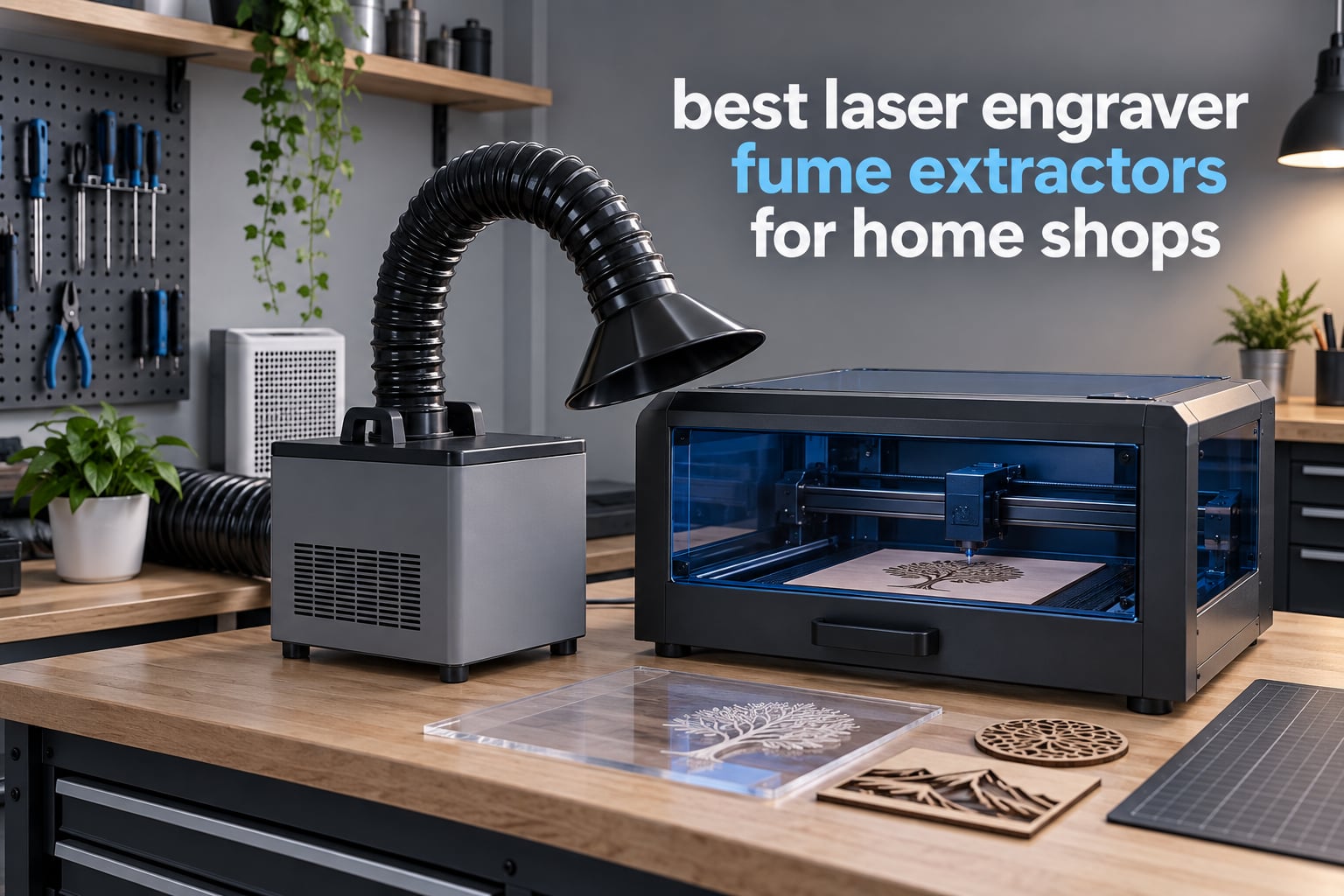
The best fume extractor for a laser engraver is a filtered air unit with enough measured airflow to pull smoke off the source, real HEPA plus activated carbon stages, and a noise level you can live with. For most home shops the xTool SafetyPro AP2 leads the field, with the FumeClear FC-2002 as the strongest all-rounder and the KQZ KQZ-200 as the best value pick.
That short answer is the whole roundup in a sentence, but there is more to choosing a laser engraver fume extractor than picking the highest airflow number on the box. Every unit below moves real air, and every one of them will do a decent job on an enclosed diode engraver in a garage. They diverge sharply on three things: how quietly they run, what your filters cost every year, and whether they leak smoke back into the room when the ducting is set up wrong.
We spent 2026 reading the specs, owner reviews and practitioner threads on laser extraction, then sorted the field by laser type and shop tier. The list covers everything from a 60W desktop unit for a spare-room hobbyist to a 420 m3/h pull for a 40W CO2 machine running production hours. If you are still choosing the machine itself, start with our hobbyist laser cutter guide so you size extraction to the right wattage from the start.
One thing to clear up before the list: a fume extractor is a safety item, not an accessory. Laser fumes contain ultrafine respirable particles and volatile organic compounds, and an extraction unit also keeps soot off your mirrors, rails and lens. Skipping it saves money once and costs you in optics and in air quality for as long as you own the machine.
Table of Contents
Top 3 Picks for Laser Fume Extractor Picks for Home Shops in 2026
Our three standouts cover the most common home-shop situations: an xTool owner who wants the software to talk to the extractor, a buyer who wants a metal box that fits under a bench, and a buyer who wants the most air movement per dollar spent.

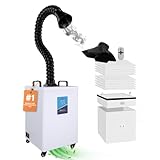
xTool SafetyPro AP2
- 6-layer SuperCyclone filtration
- 150 m3/h rated
- 55 dB App filter monitoring
Best Laser Engraver Fume Extractors for Home Shops in 2026
| Product | Specifications | Action |
|---|---|---|
| xTool SafetyPro AP2 |
|
Check Latest Price |
| FumeClear FC-2002 |
|
Check Latest Price |
 FumeClear FC-2004 FumeClear FC-2004 |
|
Check Latest Price |
 KQZ KQZ-200 KQZ KQZ-200 |
|
Check Latest Price |
 KQZ KQZ-1501 KQZ KQZ-1501 |
|
Check Latest Price |
 FumeClear FC-2003 FumeClear FC-2003 |
|
Check Latest Price |
 FUMEGO XF250 FUMEGO XF250 |
|
Check Latest Price |
 FUMEGO DX1002W FUMEGO DX1002W |
|
Check Latest Price |
 NEETOP NT-X1 NEETOP NT-X1 |
|
Check Latest Price |
 OMTech 60W Fume Extractor OMTech 60W Fume Extractor |
|
Check Latest Price |
1. xTool SafetyPro AP2 – Six-Layer SuperCyclone Unit With App Monitoring
xTool SafetyPro AP2 Smoke Purifier for Laser Engraver, SuperCyclone System 6-Layer Filtration for Dust & Odors, Quiet Operation for Diode Fiber Laser Engraving Machine and CO2 Laser Cutter
150 m3/h rated airflow
55 dB noise
Six-layer SuperCyclone filtration
20.9 kg
Pros
- Six-layer filtration clears 99.99 percent of dust and odors
- Handles long acrylic jobs without strain
- Quiet at 55 dB for a shared room
- Auto-syncs with xTool lasers and tracks filter life in the app
- Washable cyclone stage extends filter service life
Cons
- App and firmware features only pair fully with xTool lasers
- Occasional false clogged-airflow error needs troubleshooting
- Filters are sold direct by xTool
The SafetyPro AP2 is the strongest combination of rating and owner history in this group, with 153 reviews averaging 4.7 stars. Owners consistently describe what they set out to solve: acrylic jobs that used to leave a chemical smell in the room for hours now clear while the cut is still running. That is capture at the source working, not a room air cleaner catching up afterwards.
Filtration runs through six stages, fronted by a SuperCyclone array of 36 cyclones that pulls out 99 percent of larger particles before they reach the media. Under that sit a HEPA stage and an Ultra-Dense Carbon Mesh layer for odor and chemical absorption. A magnetic pull-out door lets you lift the filters out, wash the cyclone stage and put it back, which is the single cheapest thing you can do to stretch filter life.
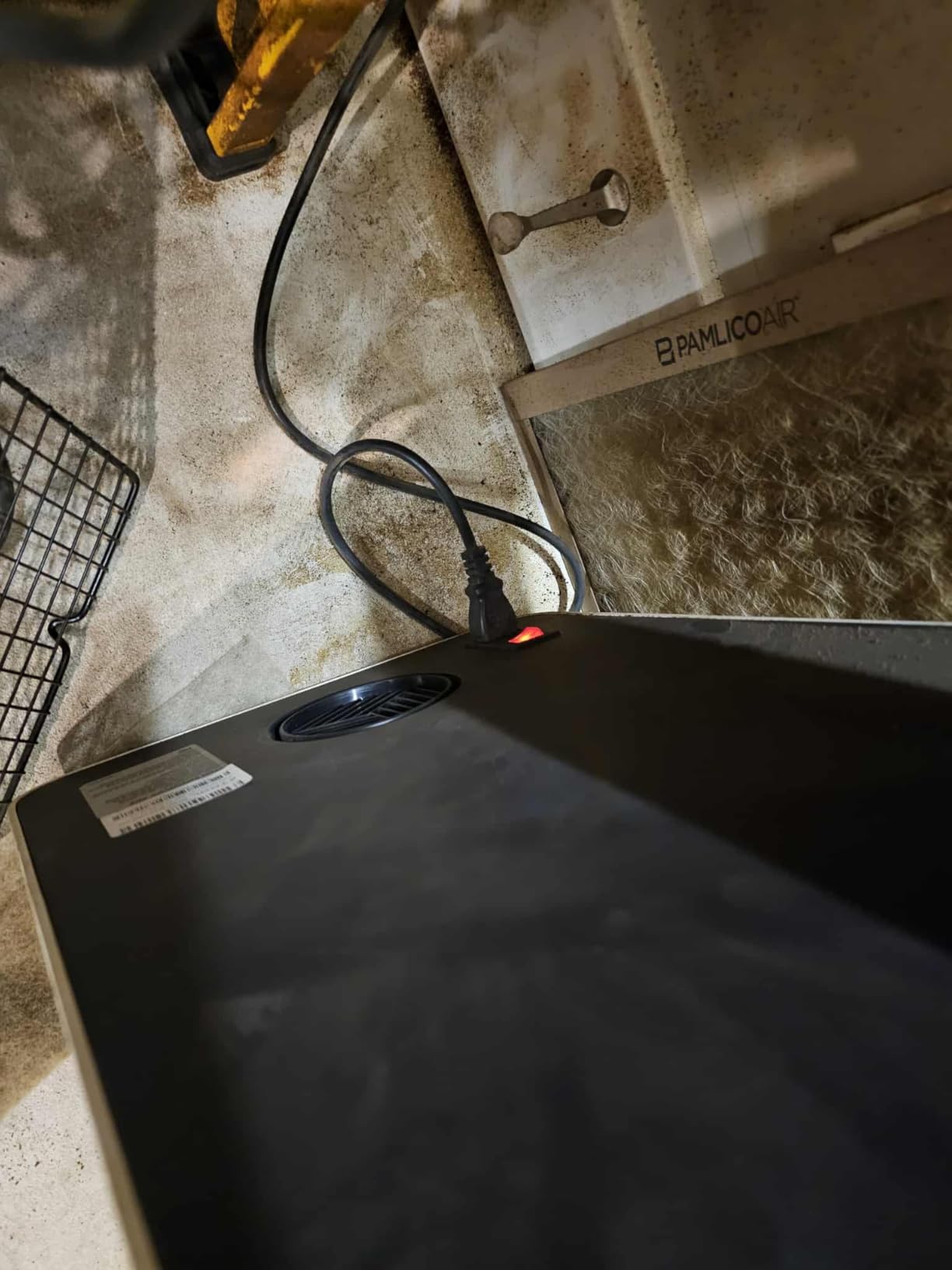
The mobile app is the reason this unit wins for most home shops. It syncs with xTool lasers, shows real-time filter status and gives material settings, so the extractor and the machine start together. Measured noise is 55 dB, which is the number that makes it usable in a house rather than a detached workshop. The unit weighs 20.9 kg and measures 11.42 by 19.33 by 21.34 inches, so plan a permanent spot rather than a carry-around position.
Owners do report one recurring software issue: a false clogged-airflow error that needs a power cycle or troubleshooting. And if your laser is not an xTool, the app, firmware and Bluetooth features go quiet, leaving you with manual mode only. The plain-language caveat is ecosystem lock-in, and it matters if you plan to change brands. Replacement filters are also sold direct by xTool rather than through the marketplace, so the running cost is set by one vendor.
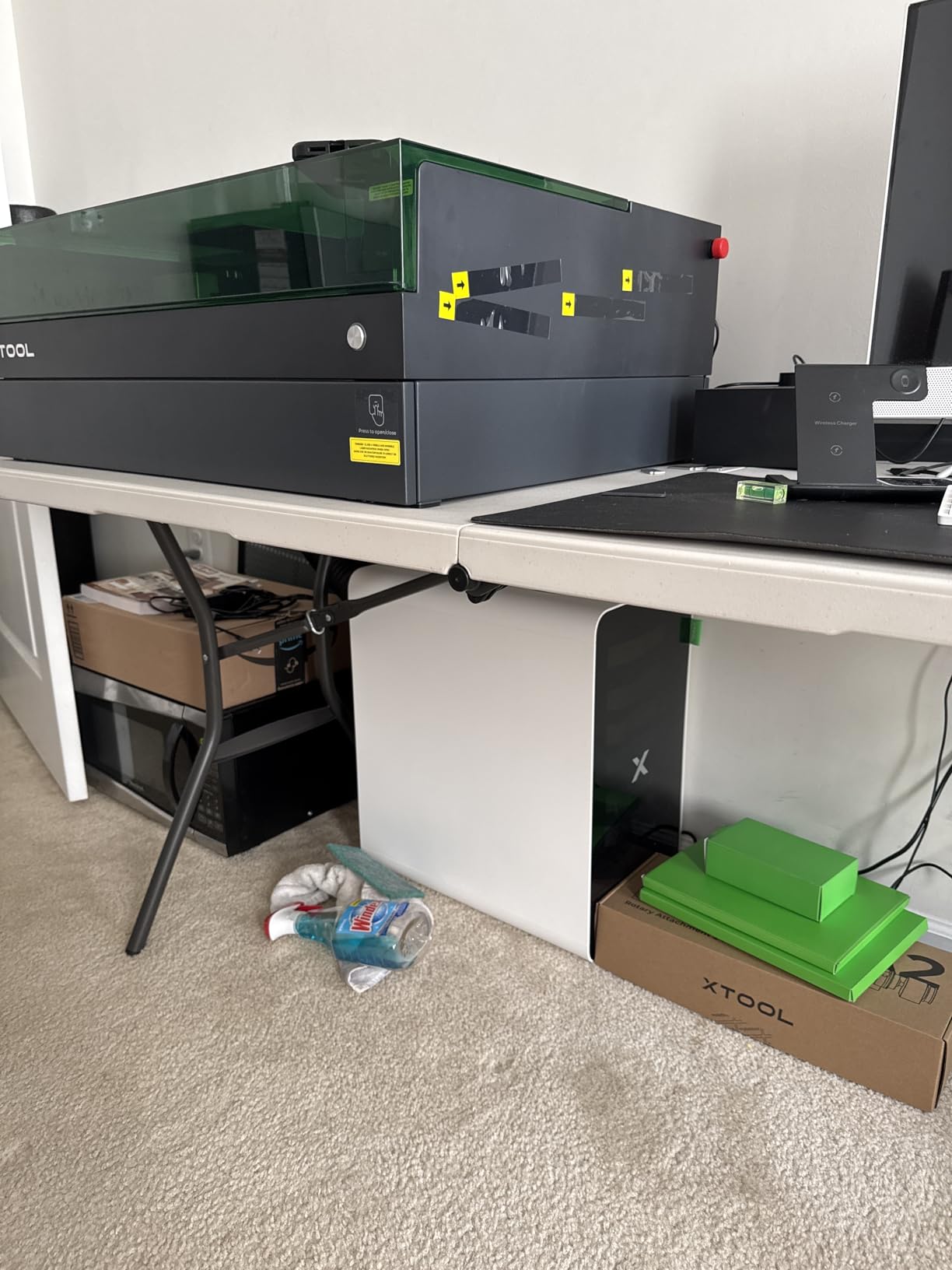
How the airflow figure holds up in practice
The AP2 is rated at 150 m3/h or less, roughly 88 CFM, and the manufacturer states it is not compatible with the higher-output xTool P3 at 238 m3/h. On a 20W to 40W diode engraver that is enough to keep the plume inside the enclosure. On a 40W CO2 tube running full-tilt on MDF, you will feel the difference against a 420 m3/h unit.
Because the extractor pairs with the machine software, it can start before the laser fires, which removes the worst few seconds of a job when the enclosure is still filling. That head start is worth more than a modest CFM gain in a home shop.
Where it will disappoint you
The 20.9 kg weight is the first thing owners mention when the unit needs to move between the garage and a spare room. The second is the app dependency: outside the xTool ecosystem, the smart features that justify the premium disappear. If you run anything other than an xTool, treat it as a well-built filtered unit and compare it on airflow.
Filter pricing is the hidden cost. You are buying a full replacement stack from one manufacturer rather than a generic HEPA cartridge, and the manufacturer-direct route has no price competition behind it. Budget for that before you commit.
2. FumeClear FC-2002 – All-Metal 300 m3/h Unit That Fits Under a Bench
FumeClear FC-2002 Laser Fume Extractor with H13 Filtration for Fume Removal
260-300 m3/h suction
H13 HEPA at 99.97 percent
Under 55 dB
30.4 lb all-metal body
Pros
- Suction clearly beats the exhaust fan built into most laser lids
- Handles wood and plywood smoke and odor well
- All-metal housing feels durable
- Compact footprint tucks under a workbench
- Locking casters and remote control aid repositioning
Cons
- Noticeably loud at maximum speed
- Gooseneck is short for workbench-height use
- A few reports of short filter life
The FC-2002 is the one we would put in a basement workshop with concrete floors and no neighbours. At 4.5 stars across 61 reviews, its reputation is built on suction that owners say outperforms the small exhaust fan built into their laser lid, and on an all-metal housing that shrugs off the sawdust and plaster dust of a real shop.
Filtration is a straightforward three-stage stack: a cotton pre-filter, an H13 HEPA filter capturing 99.97 percent of particles below 0.3 microns, and a high-iodine coconut shell carbon main filter rated to 4000 hours of service life. Ten replaceable pre-filters come in the box, and because the pre-filter is the part that takes the abuse, having ten spares means you are not hunting for them every month.
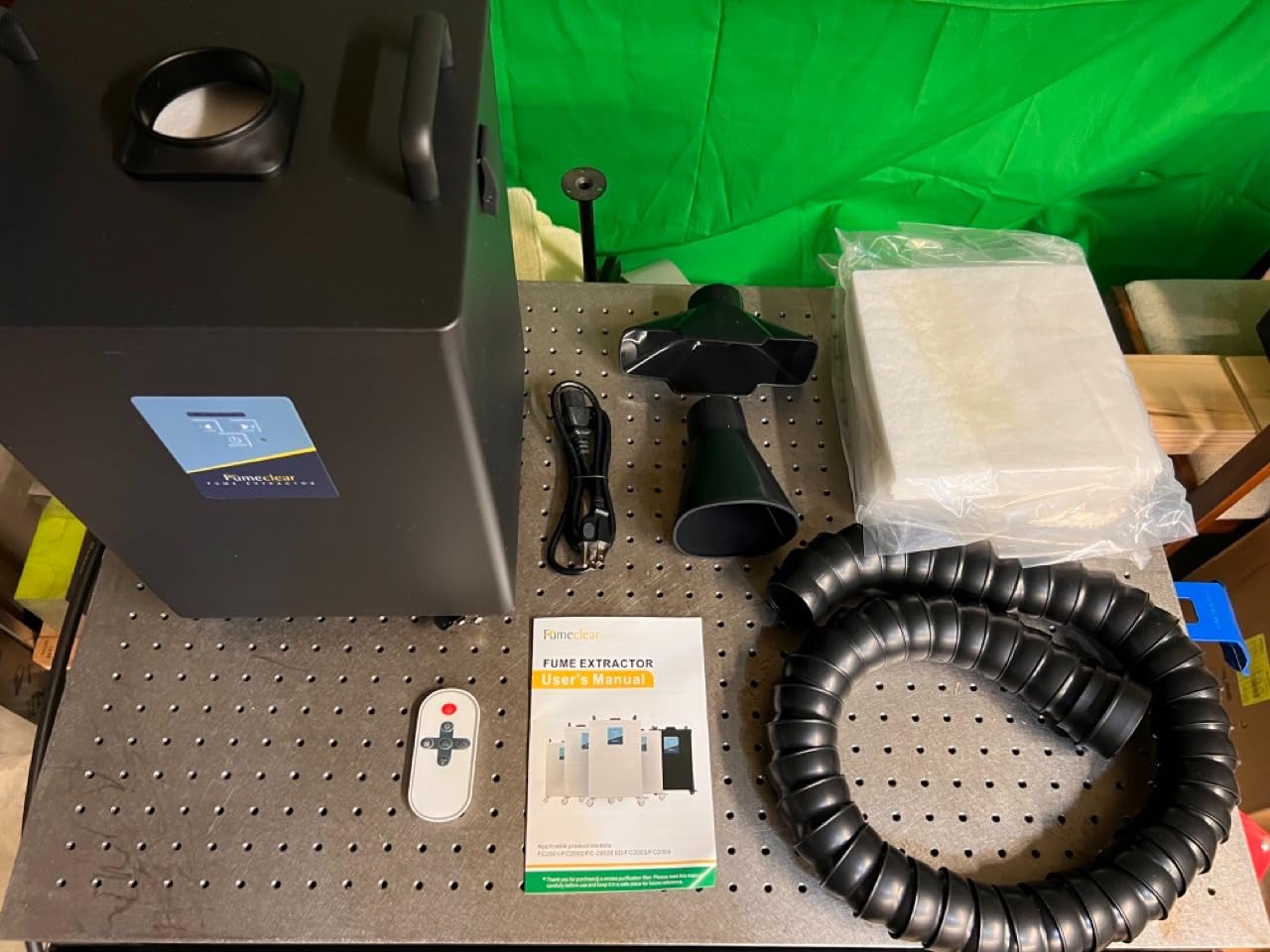
Suction is quoted at 260-300 m3/h within a 15 cm capture range, which converts to roughly 153 to 177 CFM. That is squarely in the range the r/lasercutting primer recommends as a solid minimum for home use, and it is enough headroom for a 40W CO2 cutter working wood. The noise figure is under 55 dB, with an aerospace-grade sound reduction structure and sound-absorbing interfaces, though owners still describe the top speed as noticeably loud.
Two practical notes. First, the gooseneck is short, so at full workbench height the capture head sits lower than you would like, and a longer arm is the first sensible upgrade. Second, the unit is 30.4 lb and 19.3 by 17 by 14.6 inches, but the locking casters mean you roll it rather than carry it. The remote control and a secondary outlet let you push filtered air toward a part of the room that needs it.
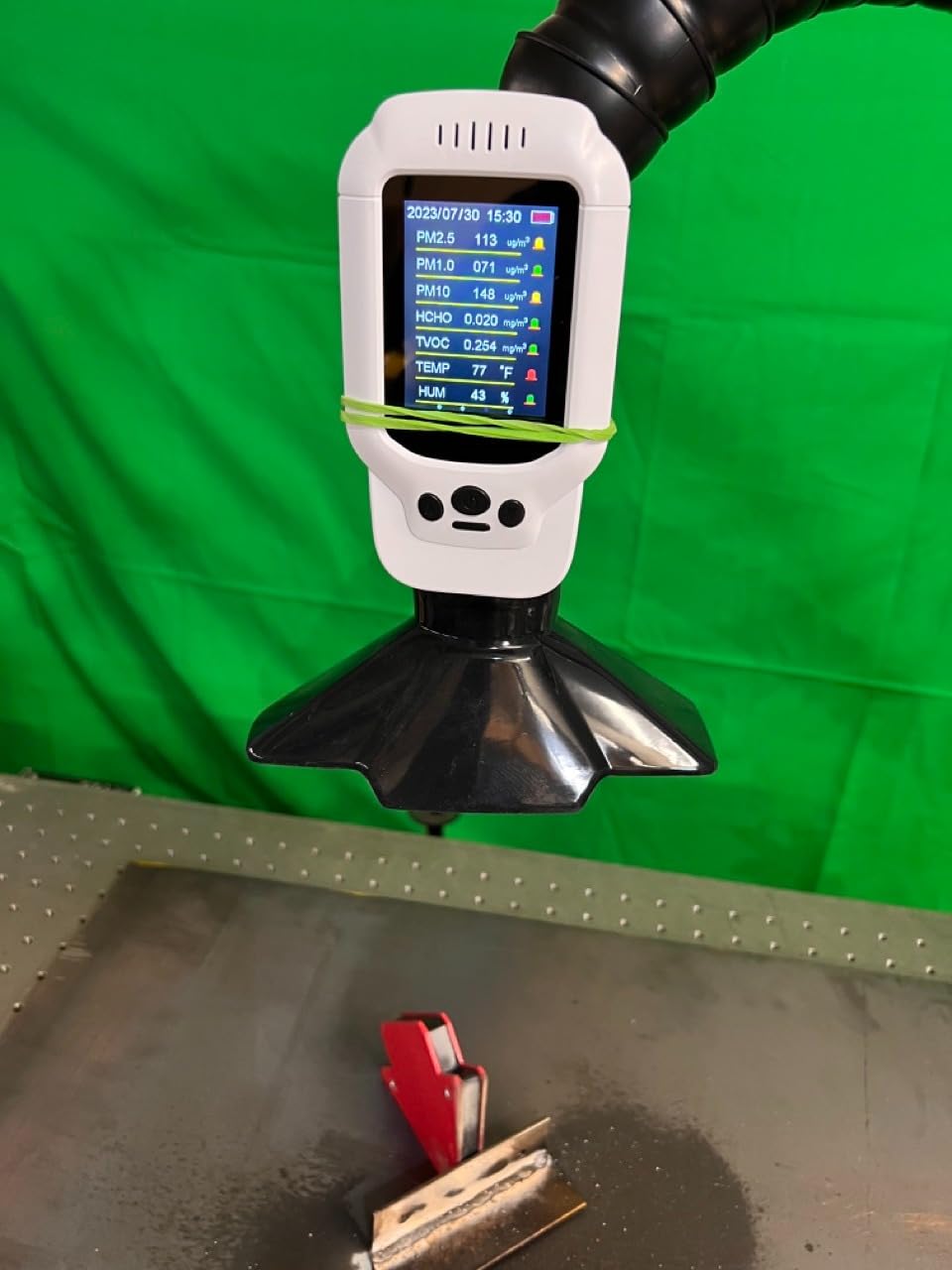
What the capture range means for your cuts
The 15 cm capture figure is the distance within which the extractor holds a strong enough draft to grab the plume. Hold the head there and the smoke never gets far enough to become a room problem. Most home operators park the arm at the rear of the bed over the cut line and leave it, and on a 15 cm tolerance you have very little room for error on tall stock.
On plywood and MDF, where the plume is heavy and brown rather than wispy, that close tolerance is exactly what you want. The heavy particulate drops out early, the pre-filter takes the hit, and the HEPA and carbon stages handle the fine fraction and the formaldehyde smell.
Where it falls short
Reviewers mention noise at maximum speed as the main drawback, and lower speeds are the practical answer for any job where you are listening to a podcast or supervising someone else. The other recurring note is filter life, with a minority of owners reporting filters loading faster than the 4000-hour figure suggests on heavy cutting work.
It is also a single-port unit. If you ever add a second machine, you are back to the search. For now, that is a fair trade for the metal chassis and the strong single-hose suction.
3. FumeClear FC-2004 – 420 m3/h Pull for 20W and Bigger Machines
FumeClear FC-2004 Fume Extractor For 20-80W P/S/M/F Laser Engraver & Cutter
Up to 420 m3/h suction
0.2 micron filtration
Built for machines above 20W
52.9 lb
Pros
- Airflow pulls smoke toward the hose faster than the cut produces it
- Adjustable neck rotates freely for quick repositioning
- Small desk footprint for the flow it moves
- Ten pre-filters plus main and HEPA filters included
- Support replaced a missing hose in full
Cons
- Very loud on the top setting and masks nearby equipment
- Lower speed settings lose more suction than noise
- Filters clog quickly on deep engraving of brass
- Replacement filter sets arrive in mixed sizes
The FC-2004 is the airflow king of this group at up to 420 m3/h, roughly 247 CFM, and owners describe the effect in physical terms: smoke gets pulled toward the hose faster than the cut produces it. That is the description you want from a unit on a 40W CO2 tube burning through MDF, where the plume is thick enough to see across the room.
Filtration is a three-layer system rated to purify 99.98 percent of harmful gases and filter particles below 0.2 microns, which is a tighter particle figure than anything else on this list. The high-iodine coconut shell carbon is rated at over 4000 hours, and the box contains 10 pre-filter cottons alongside the main and HEPA filters. It is engineered specifically for laser machines above 20W, so pairing it with a small 10W diode is paying for capacity you never use.
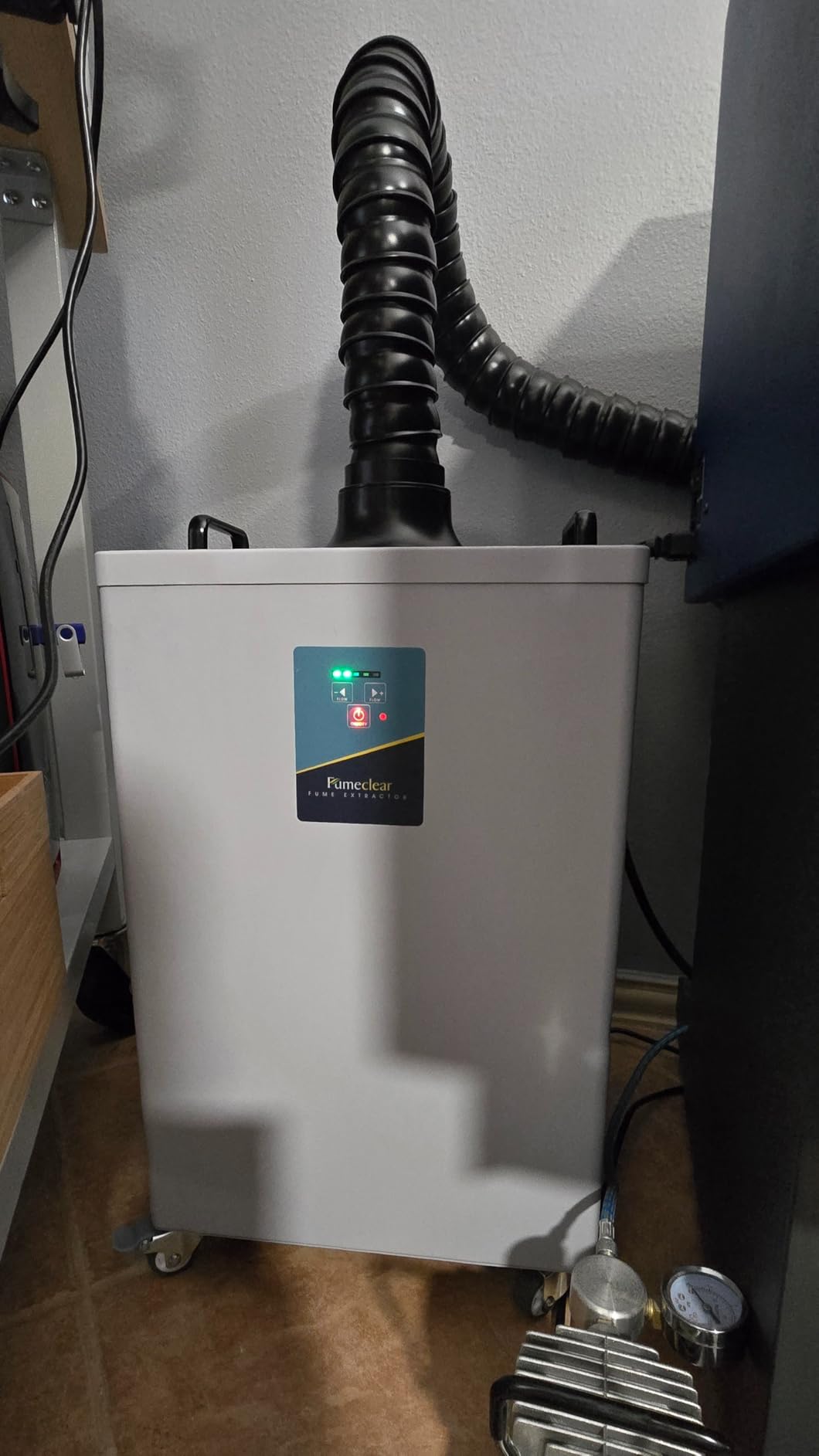
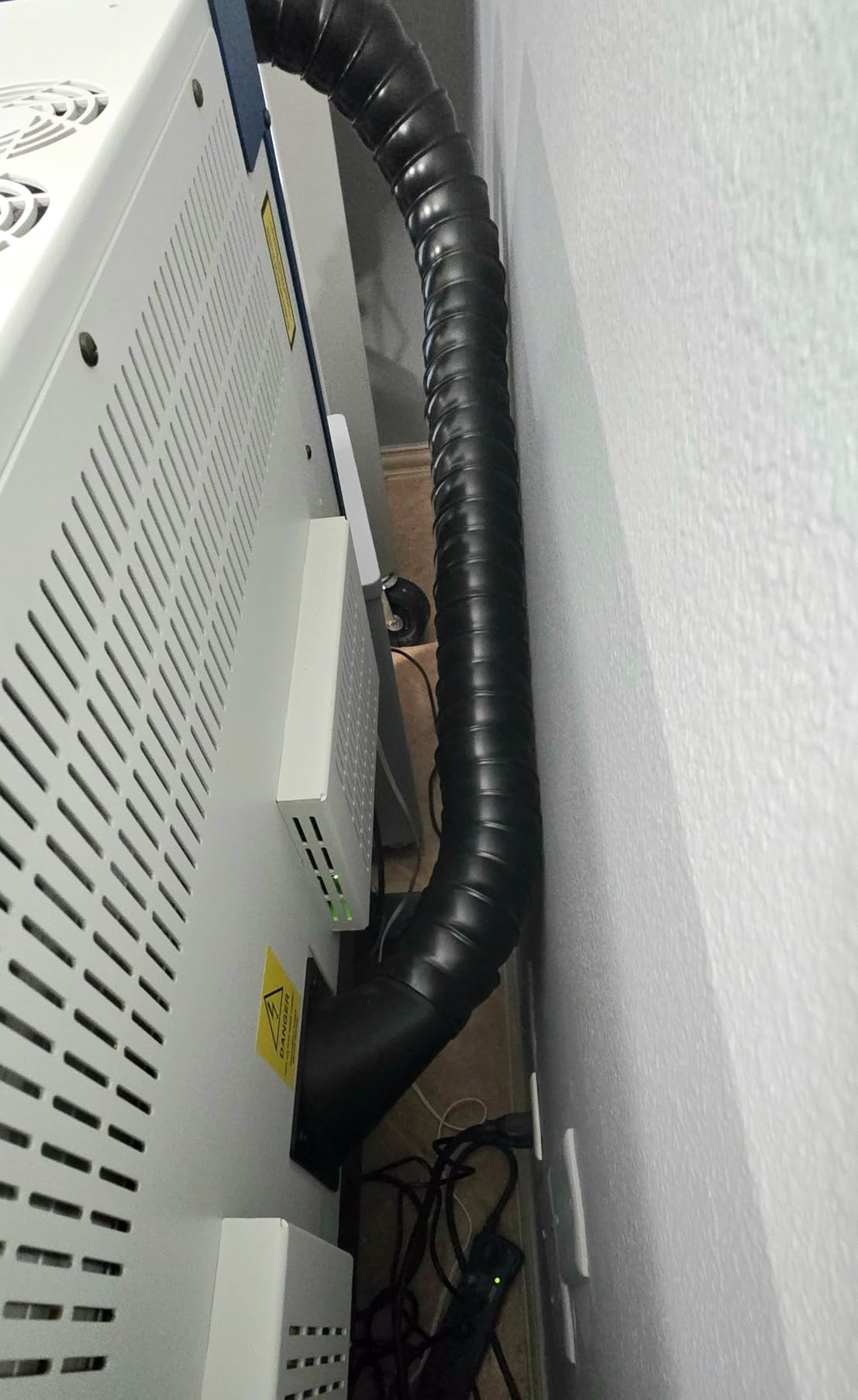
Where the FC-2004 differs from the smaller FumeClear units is physical size and honesty about sound. It is 52.9 lb and 21 by 16.2 by 26.2 inches, so it occupies real floor or bench space, and owners are consistent that it is very loud on the highest setting, loud enough to drown out nearby equipment. The trade-off is real: the lower settings cut suction faster than they cut noise, so you tend to live at full speed in a detached space.
The adjustable neck rotates freely for repositioning, which matters more than it sounds when you are switching between a flat bed job and a tall object. Support has also been responsive, with one owner receiving a full hose replacement after a missing part in the box.
Whether 420 m3/h is overkill for a home shop
For a 40W to 80W CO2 machine running several hours a day, no, this is the correct amount of headroom. Airflow ratings are measured at a clean filter, and they fall as media loads, so buying with margin means you are still above the effective minimum a year in. For a 20W diode that only ever marks acrylic, it is far more than the job requires.
The useful comparison is against the primer guidance on r/lasercutting, which puts 200 to 250 CFM as the preferred range for home use. At roughly 247 CFM rated, the FC-2004 lands at the top of that band before hose losses, which is exactly where you want a production machine to sit.
Where it falls short
The 4.0 star average across 37 reviews is the lowest of the units with meaningful review volume, and the reason is visible in the distribution: 17 percent of reviews are 1-star. Those cluster around loudness and filter consistency on heavy deep-engraving work such as brass, where the carbon and HEPA stages load quickly.
Replacement filter sets also arrive in mixed sizes, and they have to be ordered from the manufacturer rather than a general marketplace listing. Plan your filter budget around the manufacturer catalogue, not around whatever fits.
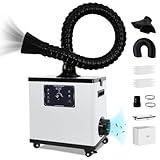
4. KQZ KQZ-200 – 330 m3/h Brushless Unit for Machines Under 60W
KQZ Laser Fume Extractor with Exhaust for Under 60W Laser Engraver Cutter
330 m3/h airflow
210W brushless motor
Under 50 dB claimed
48.1 lb
Pros
- Visible suction even at quarter speed on smoke and metal particulate
- Runs quiet next to the laser itself
- Works across diode
- CO2 and industrial engravers
- Steel casing with foam insulation and quality casters
- Generous first-stage filters that wash and reuse
Cons
- Some units lose suction after about six months even with new filters
- Replacement filters are costly and support is hard to reach
- Some plastic fumes still need outdoor venting
The KQZ-200 is our value pick because it puts 330 m3/h of airflow, roughly 194 CFM, into a steel case with a brushless motor, which is a combination you do not normally see at this level. It holds a 4.4 rating across 37 reviews, and the consistent theme is suction that is visible from across the room, pulling metal particulate into the hose even at quarter speed.
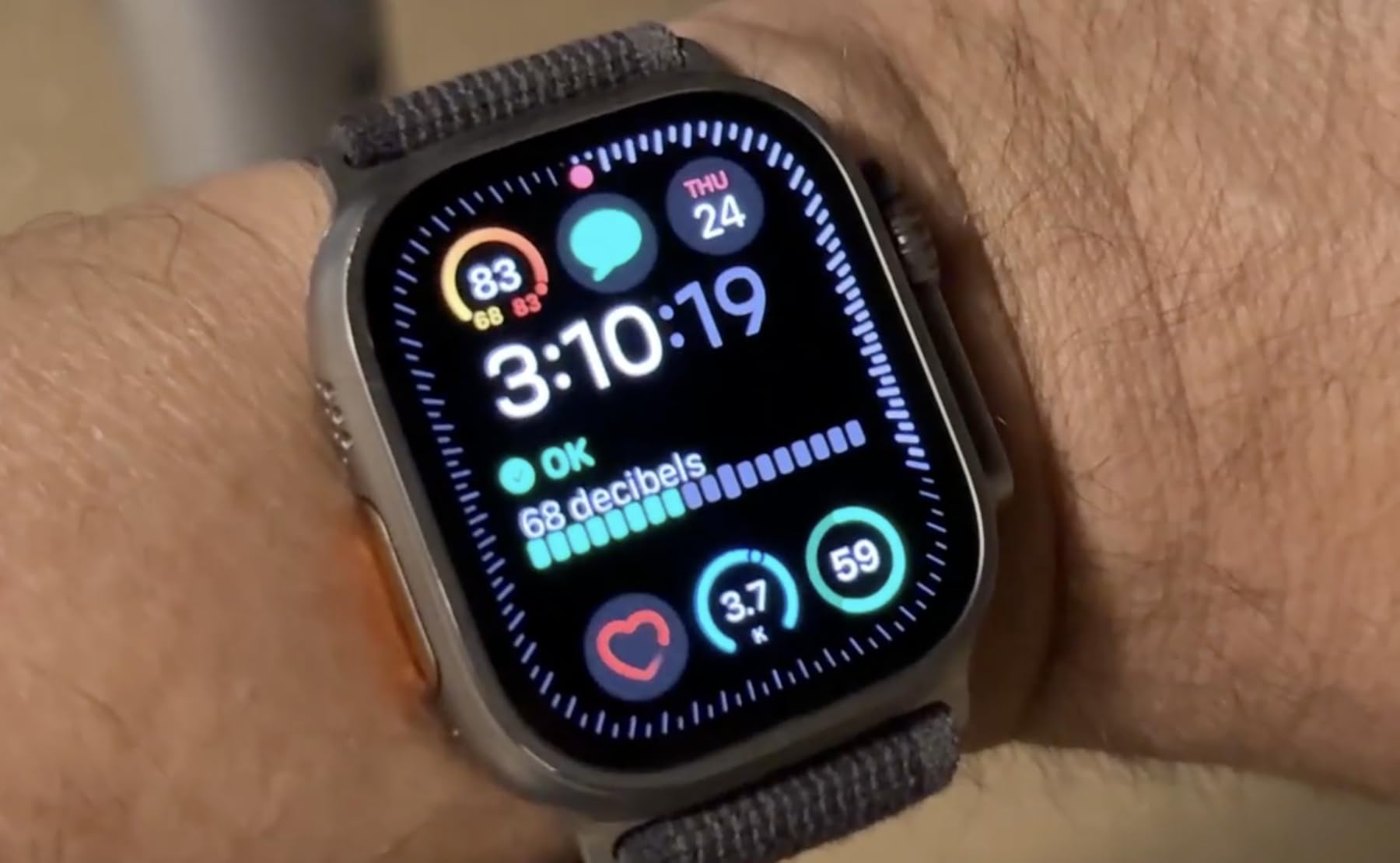
Filtration is three-stage, capturing 0.3 micron particles at 99.97 percent efficiency, with a high-iodine coconut shell carbon layer for odor. The 210W brushless motor drives 330 m3/h, and the aviation-grade sound-absorbing shell is rated under 50 dB, though owners who measured it themselves report closer to 68 dB at the highest speed. Treat the 50 dB figure as the low-speed reality and the 68 dB figure as the top-speed reality.
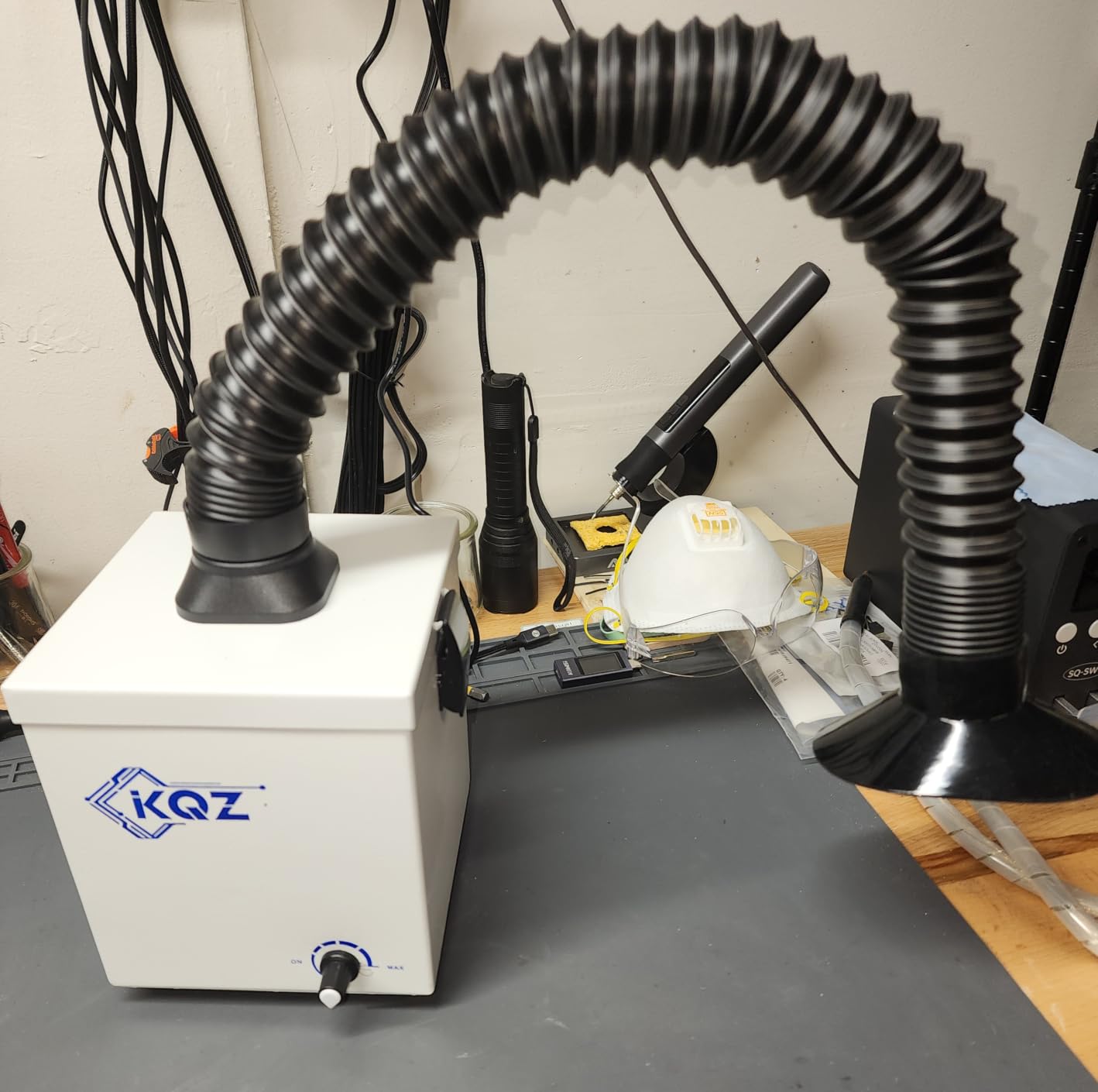
The box is well thought out for a home shop: 12 filter pieces, a bamboo tube, hose, power cord, and both round and square hoods plus flexible and foil connectors. The square hood matters on a flat-bed machine because it matches the rectangular exhaust opening, and the foil connector handles heat. The 48.1 lb steel casing with foam insulation feels like shop equipment rather than a plastic box.
Compatibility is broad for a unit at this level, listing xTool P2S, S1, F1, F1 Ultra, F2, F2 Ultra, M1 and M2. That matters for anyone who might change machines in a few years.
How it handles acrylic, MDF and metal marking
Acrylic is where the 330 m3/h figure earns its place. Acrylic plumes rise fast and spread wide, so you need the head to win the race rather than merely keep up. This unit does, and the round hood lets you get close to the cut line without worrying about catching a hot edge.
On MDF the story is the pre-filter, and the KQZ includes enough of them that you can wash and reuse rather than replace. On anodized aluminium and light metal marking, the carbon layer handles the smell and owners report particulate making it into the hose rather than settling around the machine.
Where it falls short
The durability theme is the honest weakness. Several owners describe suction declining after roughly six months of use even with fresh filters, which points at the motor or an internal duct rather than the consumables. One unit was replaced by the manufacturer, which is a good sign, but you should treat the motor as a service item rather than a lifetime component.
Support can also be hard to reach, and replacement filters are pricey. Owners of this unit, and the broader laser community, regularly note that some plastic fumes still call for outdoor venting even with a good recirculating filter running.
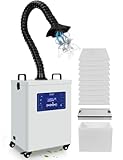
5. KQZ KQZ-1501 – Compact 280 m3/h Unit With a Filter Clog Alarm
KQZ Laser Fume Extractor for Under 40W Laser Engraver with Display & Remote
280 m3/h airflow
H13 HEPA with high-iodine carbon
55 dB
27.5 lb
Pros
- Useful suction on the lowest speed setting for wood smoke
- LED panel with remote and stepless speed control
- Programmable auto on and off timers
- Filter clog monitor tells you when media needs changing
- Dual hose kit seals well to enclosed machines
- Compact enough to sit under a desk
Cons
- Manual is poorly written and translated
- One report of a main filter failing within a month
- Not sized for industrial workloads above roughly 200W
The KQZ-1501 is the one we would pair with a mid-size enclosed diode machine in a home office, because it disappears under a desk and it tells you when the filter needs attention. At 27.5 lb and 10.43 by 9.05 by 13 inches it is one of the smaller units here, with a 4.3 rating across 30 reviews.
Airflow is 280 m3/h, roughly 165 CFM, from a 150W brushless motor described as a 40 percent speed boost over the previous version. Operating noise is listed at 55 dB, and owners describe it as genuinely quiet relative to the laser itself. Filtration pairs an H13 HEPA filter with 1000 iodine value carbon for 99.97 percent capture down to 0.3 micron, and 10 pre-filters are included, which is a thick pre-filter that extends main filter life.
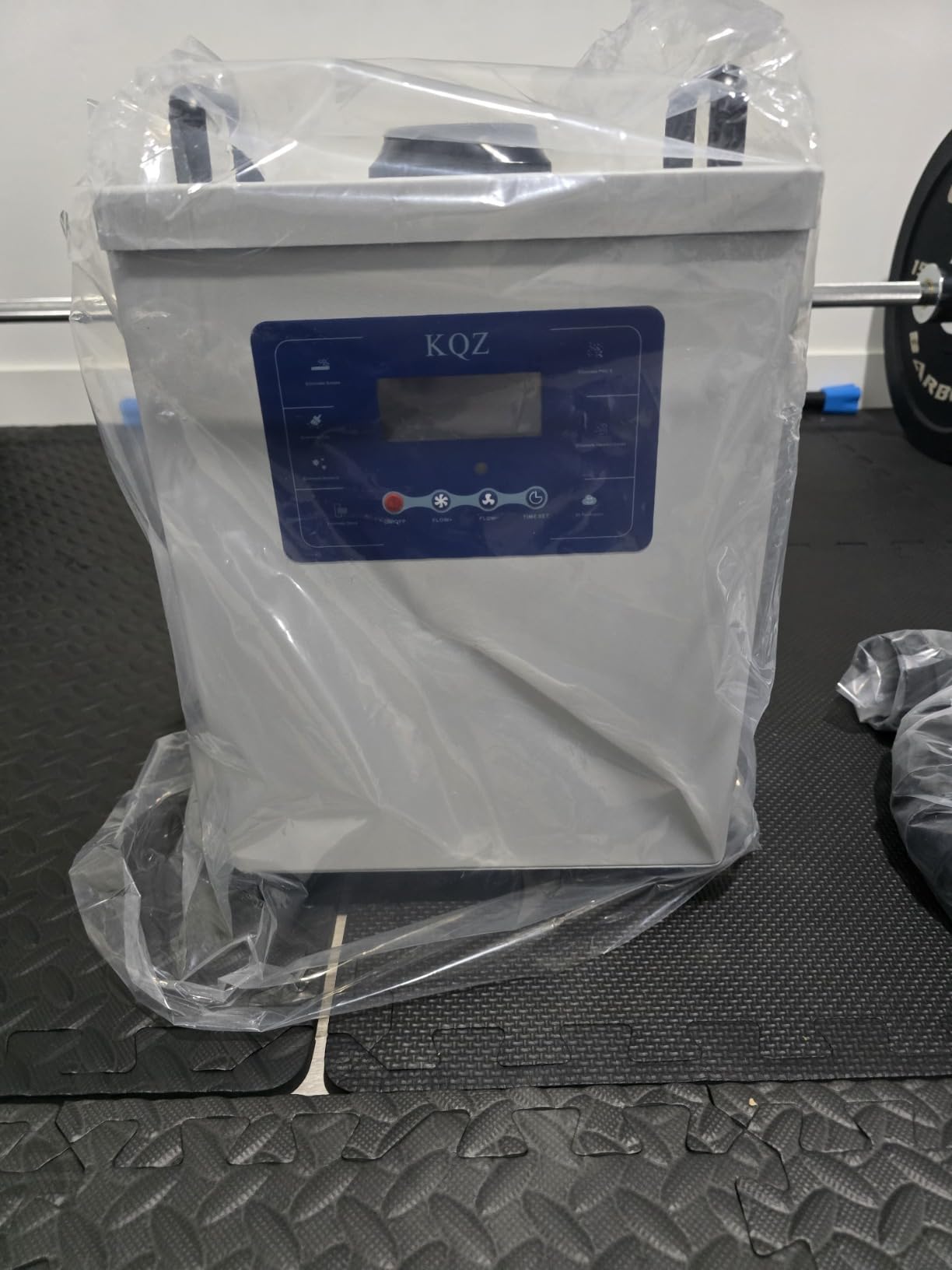
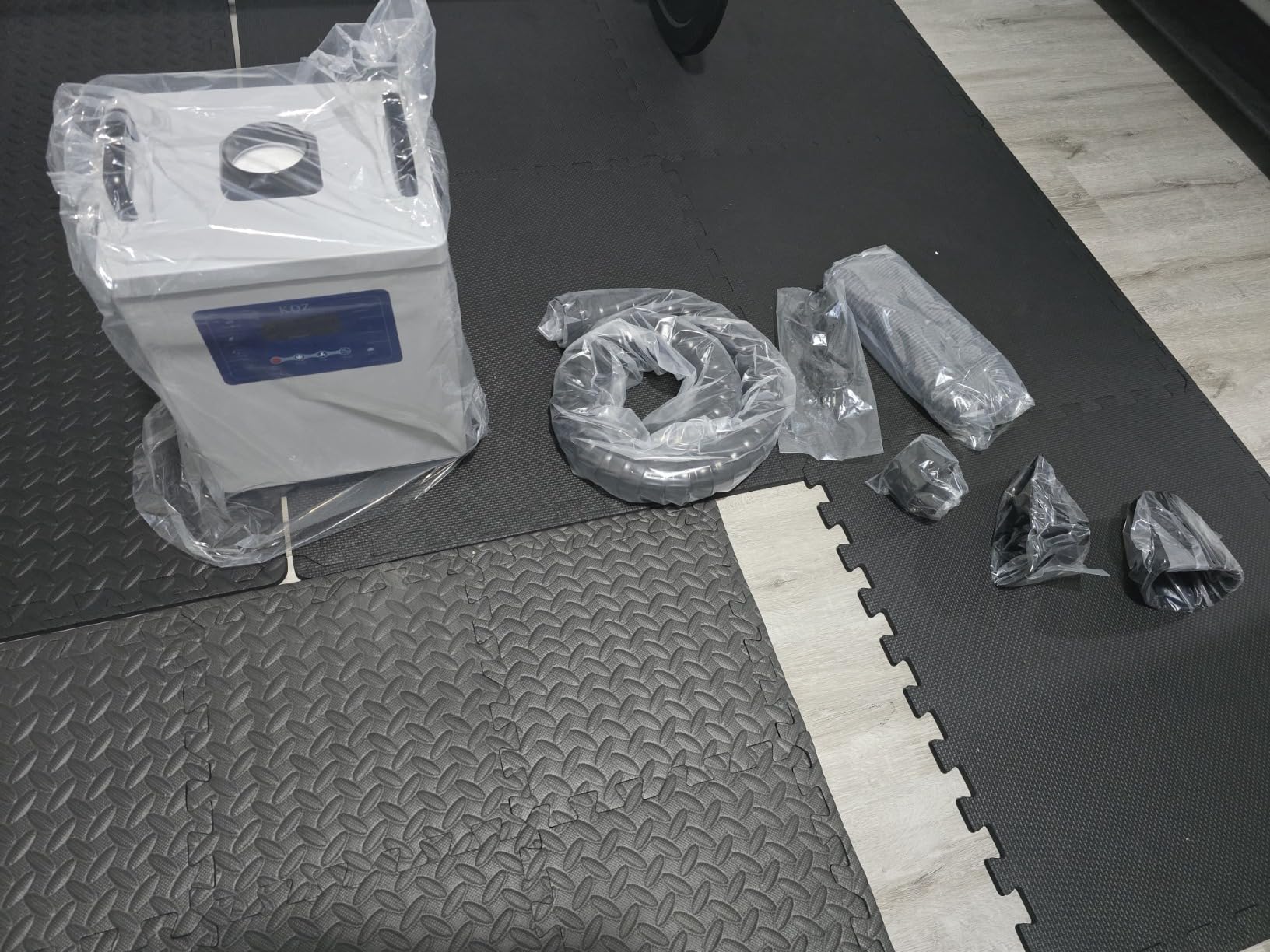
Two features separate it from most units at this airflow. The built-in filter clog monitor raises an alert when the media is loaded, which prevents the most common home-shop failure mode of running a clogged unit and assuming the machine is the problem. And the dual hose kit gives you one flexible hose and one rigid 50 mm tube, both 1.2 m long, so you can rigidly plumb into an enclosure and remove the leak path entirely.
The LED control panel with remote gives stepless speed control and programmable auto on/off timers, so the extractor can start with the machine and stop when it finishes. That scheduling is what makes a recirculating unit workable in a home, because the room only sees fumes for the length of the job.
Why the rigid tube matters more than the flexible hose
A flexible hose corrugated over a metre and a half is a leak path and a pressure drop, and it is where most leak-back complaints start. The rigid 50 mm tube in this kit holds a straight, sealed line from the enclosure port to the unit, and in a closed room that difference is the difference between the smell staying in the machine and the smell reaching your sofa.
Using the rigid tube also lets the extractor sit further away without losing capture, which matters in a small room where the machine and the unit cannot both live on the same workbench.
Where it falls short
The user manual is poorly written and translated, and for a unit with a control panel, timers and a clog alarm that is a real gap. You will be working the settings out yourself the first time.
There is also one report of a main filter failing within a month, with replacement filters hard to source locally, and the 40W ceiling in the compatibility notes means it is the wrong tool above that class. Buy the filters before you need them, not after.
6. FumeClear FC-2003 – Dual Inlet Unit for Two Machines at Once
FumeClear FC-2003 Dual Ports Fume Extractor for Remote Control Low-Noise
330 m3/h on one inlet
99.97 percent below 0.3 microns
Remote control
42.2 lb
Pros
- Two inlets capture from two machines or benches at once
- Three-layer stack outperforms two-layer designs on fine impurities
- High-iodine carbon outlasts standard activated carbon
- Remote control eases start and stop from across the room
- Ten pre-filter cotton pieces are included
Cons
- Each inlet drops to about 165 m3/h when both run together
- 42.2 lb metal chassis is a fixed piece of shop furniture
The FC-2003 exists for a specific home-shop situation that most lists ignore: a household with two engravers, or one engraver plus a soldering bench, where a single-hose unit means constant manual swapping. Its two inlets run simultaneously, and its 4.8 stars across 14 reviews came with no 1-star or 2-star reviews recorded.
The suction figure needs reading carefully. It is 330 m3/h on a single inlet and 165 m3/h with two inlets in use, so you are choosing between strength and coverage. For two light-duty enclosed diodes running one at a time, the dual-port setup is a genuine convenience. For one 40W CO2 machine under full load, single-inlet is the mode you will be in anyway.
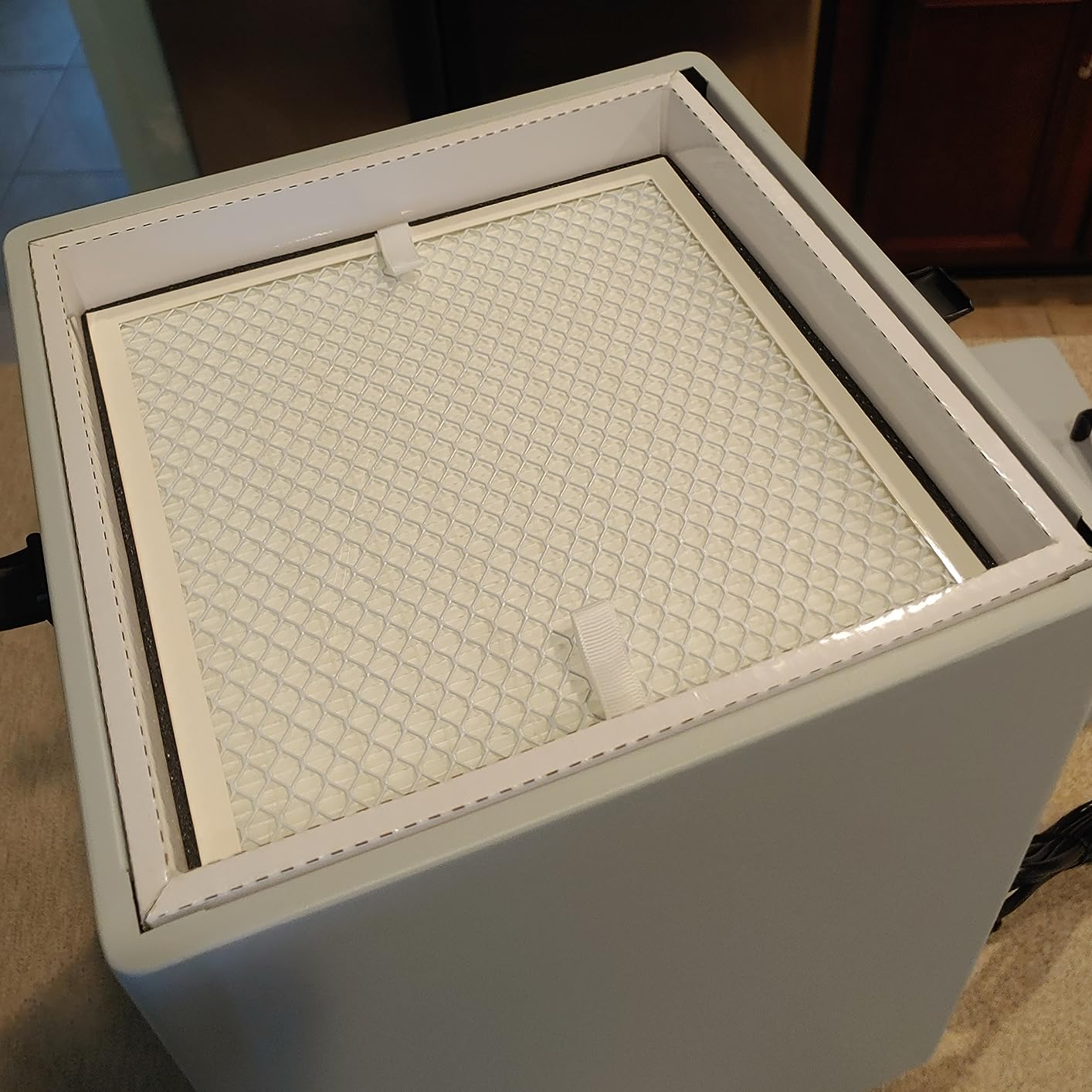
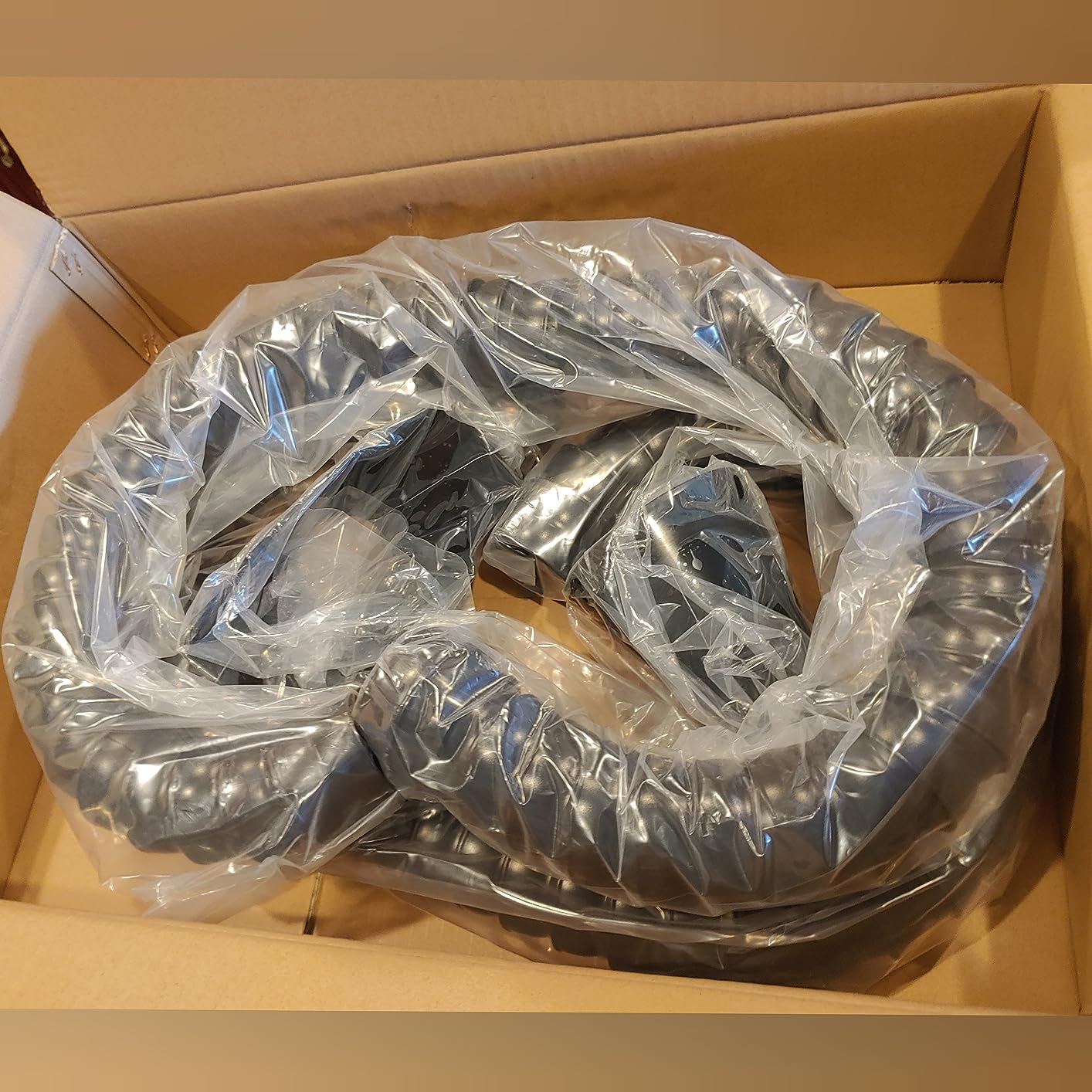
Filtration is the same three-layer approach as the rest of the FumeClear range, capturing dust below 0.3 microns at 99.97 percent efficiency, with a high-iodine coconut shell carbon main filter rated 2000 to 4000 hours and 10 pre-filter cottons in the box. The remote control is listed in the product details, which matters when the unit sits across the room from where you stand.
At 42.2 lb and 23.7 by 21.18 by 16.65 inches, this is a chassis you install once rather than move around. The 1-star column being genuinely empty at this stage of production is worth noting, but 14 reviews is a small base and durability over five years is simply not tested yet.
When two inlets actually help
Dual inlets pay off when two machines run intermittently and neither needs full suction alone. A small diode doing a batch of pendants while a larger machine cuts a sign means you do not have to swap hoses mid-project or run a machine without extraction for the minutes it takes to reconfigure.
It also works for a laser plus an adjacent soldering or DTF printing bench, where both generate a plume and both can share the same carbon stage. The penalty is the halved airflow per inlet, so match the two tasks in size rather than pairing a big machine with a small one.
Where it falls short
The halved flow when both inlets run is the honest cost, and on heavy jobs it is the difference between capture at the source and capture in the room. Plan which machine gets the high setting.
Beyond that, the limits are physical. A 42.2 lb metal unit is furniture, so choose its position before you buy, and the shared carbon stage means a heavy brass job will age the filter faster for both machines.
7. FUMEGO XF250 – Four-Stage Unit With a 1.2 m Gooseneck Arm
FUMEGO Laser Fume Extractor Compatible with 10 to 40W Laser Engravers S1/M1/Vista, 150W Power & 280 m³/h Low-Noise Smoke Extractor, Laser Air Purifier with HEPA+Carbon 4-stage Filtration System-XF250
280 m3/h airflow
Four-stage HEPA and carbon
60 dB or under
1.2 m gooseneck
Pros
- Four stages add a deodorization layer beyond HEPA and carbon
- 1.2 m gooseneck gives 360-degree positioning over the bed
- 75 mm hose seals to common 50-75 mm exhaust ports
- Low-noise brushless motor suits indoor home use
- Also handles soldering
- DTF and 3D printing
Cons
- Rated only up to 40W lasers
- Thin review base gives little long-term durability data
The XF250 is the unit we would recommend for an enclosed diode or a small CO2 machine in a room where appearance and arm reach matter. It runs 150W with 280 m3/h of airflow, roughly 165 CFM, and holds a 4.8 rating from 14 reviews with no reviews below 4 stars.
Filtration is the deepest stack here at four stages: an upgraded pre-filter, HEPA, 1000 mg/g high-iodine activated carbon, and an Ultra-Dense Carbon Mesh layer. The pre-filter is three times thicker than standard, which is the cheapest way to protect the expensive stages behind it. Owners and the spec sheet put particle capture at 99.97 percent down to 0.3 microns, with the dual deodorization layer removing up to 95 percent of odors.
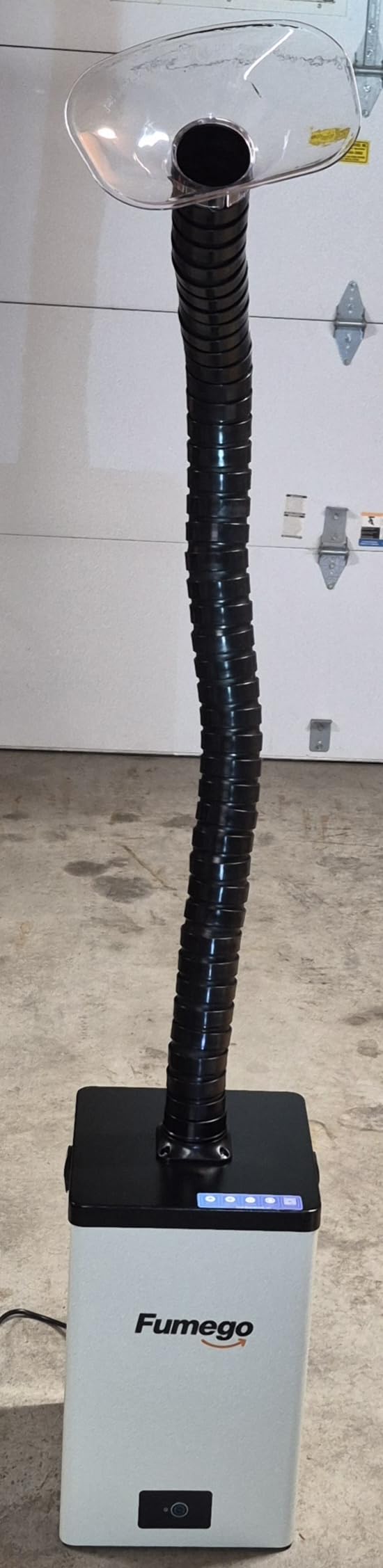
The 1.2 m flexible gooseneck arm is the feature that separates it from the boxes with a short fixed neck. It rotates through 360 degrees, so you can park the capture head directly over the cut without repositioning the unit, and the separate 1.5 m hose fits 75 mm ports covering the common 50 to 75 mm range on laser exhausts. The 75 mm diameter is also a better match to the 4 inch-plus hose guidance than the 55 mm tubes on cheaper units.
Noise is listed as low as 60 dB at full power, which is a step above the units sitting in the 50s dB range elsewhere in this roundup, so treat it as a workshop or garage machine rather than a living-room companion. It handles soldering, DTF printing and 3D printing as well as laser work, which broadens its usefulness in a mixed maker space.
Why hose diameter is the specification to care about
Airflow at the outlet means very little if the hose chokes it. A wider hose moves the same volume at a lower face velocity, and lower face velocity is what actually captures a plume instead of pushing it around the room. The 75 mm hose on this unit sits at the wider end of what home machines accept, and the fittings are sized to common ports rather than to one machine.
The gooseneck arm and the hose work together: the arm lets you put the head close, the wide hose lets the volume follow. On a 10W to 40W engraver that combination is close to the ideal home setup.
Where it falls short
The 40W ceiling is the binding constraint, and it is clearly stated. Above that class you want the FC-2004 or a comparable high-flow unit, not a faster motor in the same box.
With 14 reviews and no 1-star entries, there is very little long-term durability evidence. The reviews are uniformly positive, and a uniformly positive small sample is worth exactly as much as it looks like, which is not much. Give it a year of use and check the motor.
8. FUMEGO DX1002W – 177 CFM Unit That Can Also Vent Outdoors
FUMEGO Laser Fume Extractor Compatible with xTool S1/P2/F1 Ultra Under 60W Laser Engravers, Fume Extractor 200W Power & 177 CFM, Fume Extractor for Laser Cutter with HEPA Filter & 11 Pre-Filters
177 CFM airflow
2300Pa negative pressure
Under 54 dB
10 suction levels
Pros
- Sealed design holds 2300Pa of suction to cut leakage
- Eleven pre-filters keep ongoing consumable cost down
- Ten suction levels let you trade noise for capture
- Included hose lets filtered air discharge outdoors
- Panel shows status with timer and clogging alarm
Cons
- Scoped to machines under 60W
- Small review base after an early failure report
The DX1002W is the only unit on this list that can legitimately be called a compromise between recirculating and venting, and for a basement or garage shop that option is worth real money. It is one of only two units here that quote airflow in CFM rather than m3/h: 177 CFM, which is 300 m3/h, across 10 adjustable suction levels.
The 2300Pa negative pressure figure is the number to notice. That is the suction the sealed design holds at the outlet, and it is the specification that separates a unit that actually creates a draft at the enclosure from one that merely has a big fan inside. It is also, incidentally, the answer to the most common complaint on laser forums, where people report smoke leaking back through hose gaps because the fan was arranged to push rather than pull.
Consumable economics are the other strength. Eleven pre-filters are included alongside an integrated HEPA filter at 99.97 percent efficiency, so the parts you replace often are cheap and plentiful. The control panel gives real-time status, a timer and a clogging alarm, and the braked castors plus a carry handle make it movable without wrestling.
Compatibility covers xTool S1, P2, F1 Ultra, F2 Ultra, Vision and LX2, plus other machines under 60W. The outlet is 4 inch and the included hose is 1.5 m long at 3 inch diameter, which you can run through a wall, under a window or to an outside vent when the building and the neighbours allow it.
What negative pressure actually fixes
Leak-back is the number one repeated complaint in laser communities, and it has a mechanical cause. If the fan sits on the room side of the machine and pushes air toward the enclosure, every gap in the duct becomes an exhaust port. Put the fan downstream so it pulls, and the whole duct goes slightly below room pressure, which means any leak draws clean room air inward instead of pushing fume outward.
A unit rated at 2300Pa makes that arrangement easier to achieve, because it holds suction through a length of hose and a loaded filter. Seal the seams with RTV and the problem largely disappears.
Where it falls short
The under-60W scope is the main limit, and the review base of 10 includes an early failure report, which is a small sample but at least gives you something to weigh. With so few reviews, treat the reliability picture as unproven rather than poor.
The included 3 inch hose is narrower than the 4 inch minimum some practitioners argue for, so if you are extending the run, buy a wider hose rather than lengthening the narrow one.
9. NEETOP NT-X1 – Smallest Footprint for Desktop and Soldering Work
NT-X1 Laser Fume Extractor Diode/Fiber Laser with H13 HEPA Carbon Filter
60W motor
H13 HEPA and high-iodine carbon
55 dB
160 x 250 x 200 mm
Pros
- Real suction for a desktop unit this small
- Footprint fits beside a small engraver or on a shelf
- Quiet enough to talk over
- Rubberized feet and a top handle aid repositioning
- Separate filter sets cut long-term replacement cost
Cons
- Some newer xTool models need an adapter that is not included
- Rated for light-duty machines up to 20W
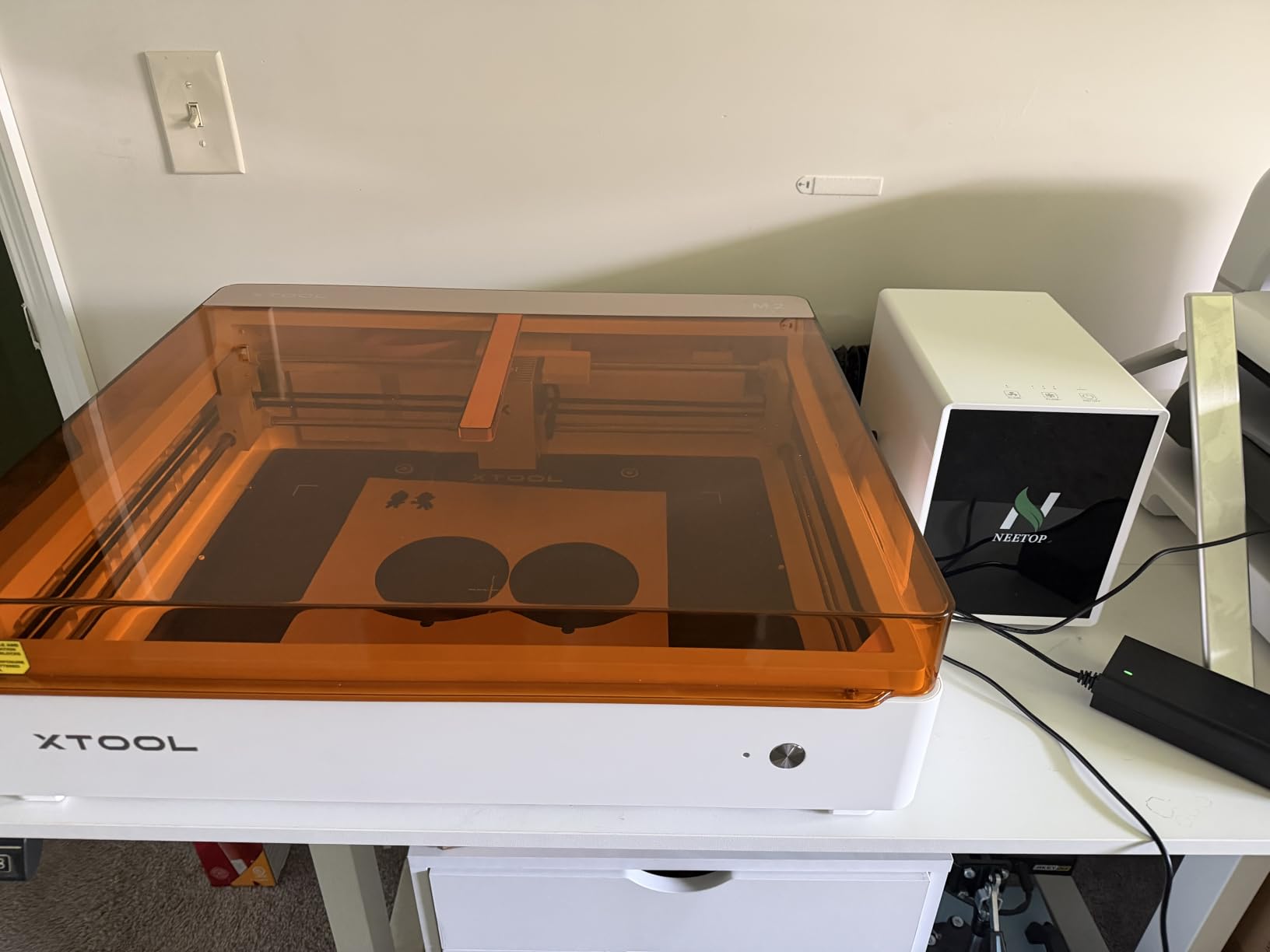
The NT-X1 is the answer to a question the rest of this list ignores: what if the laser is a small diode engraver on a desk in a room you also work in? At 160 by 250 by 200 mm and 7.73 lb, it is small enough to sit beside a desktop engraver on the same bench, and its 5.0 rating across 9 reviews has no negatives of any kind in the distribution.
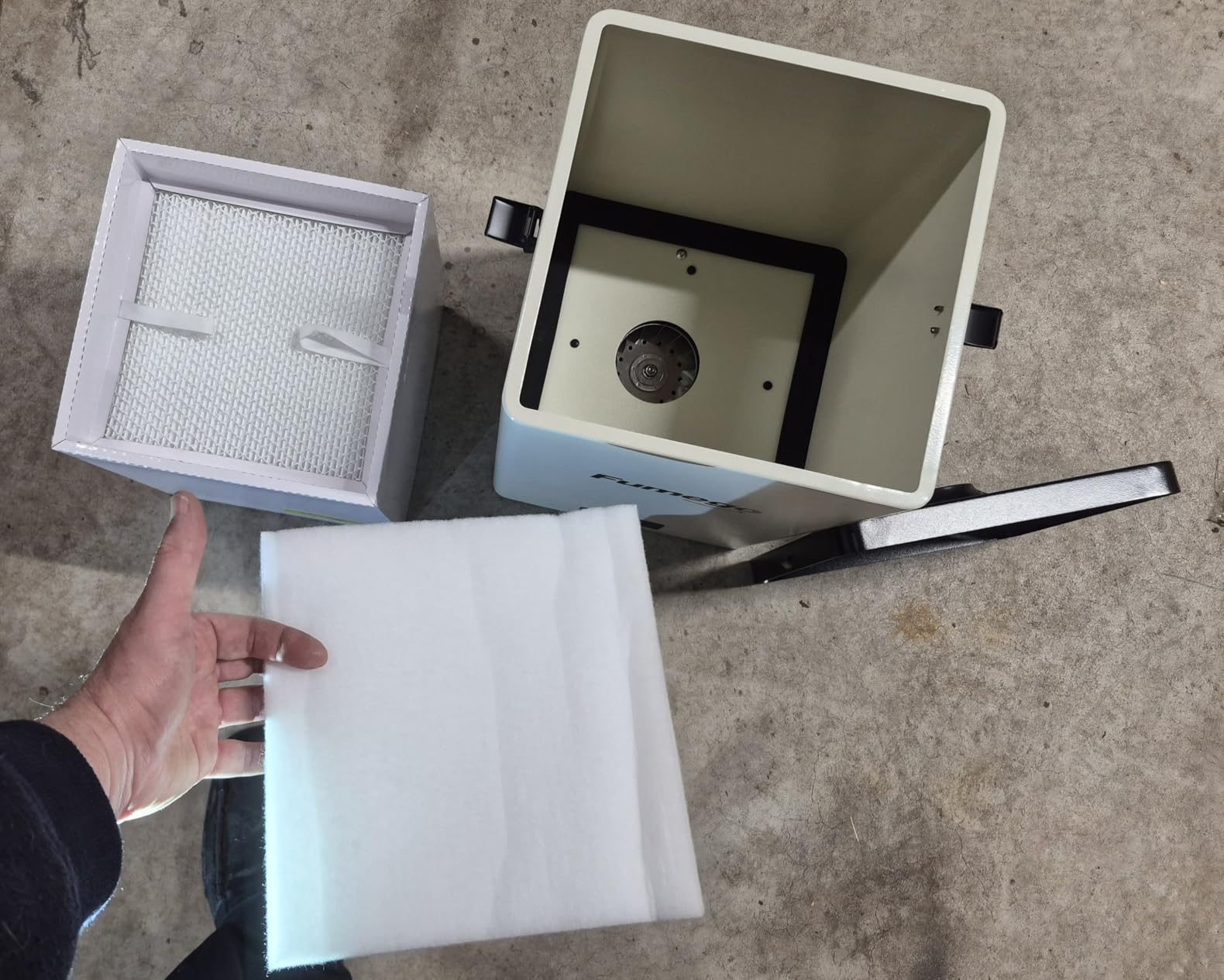
The 60W motor produces what owners describe as a strong, noticeable draft at the laser head, which is remarkable for something this size. Filtration is an H13 HEPA filter paired with high-iodine activated carbon for 99.97 percent particle capture, and the primary and high-efficiency filter sets are separated so you can replace the inexpensive stage without discarding the expensive one.
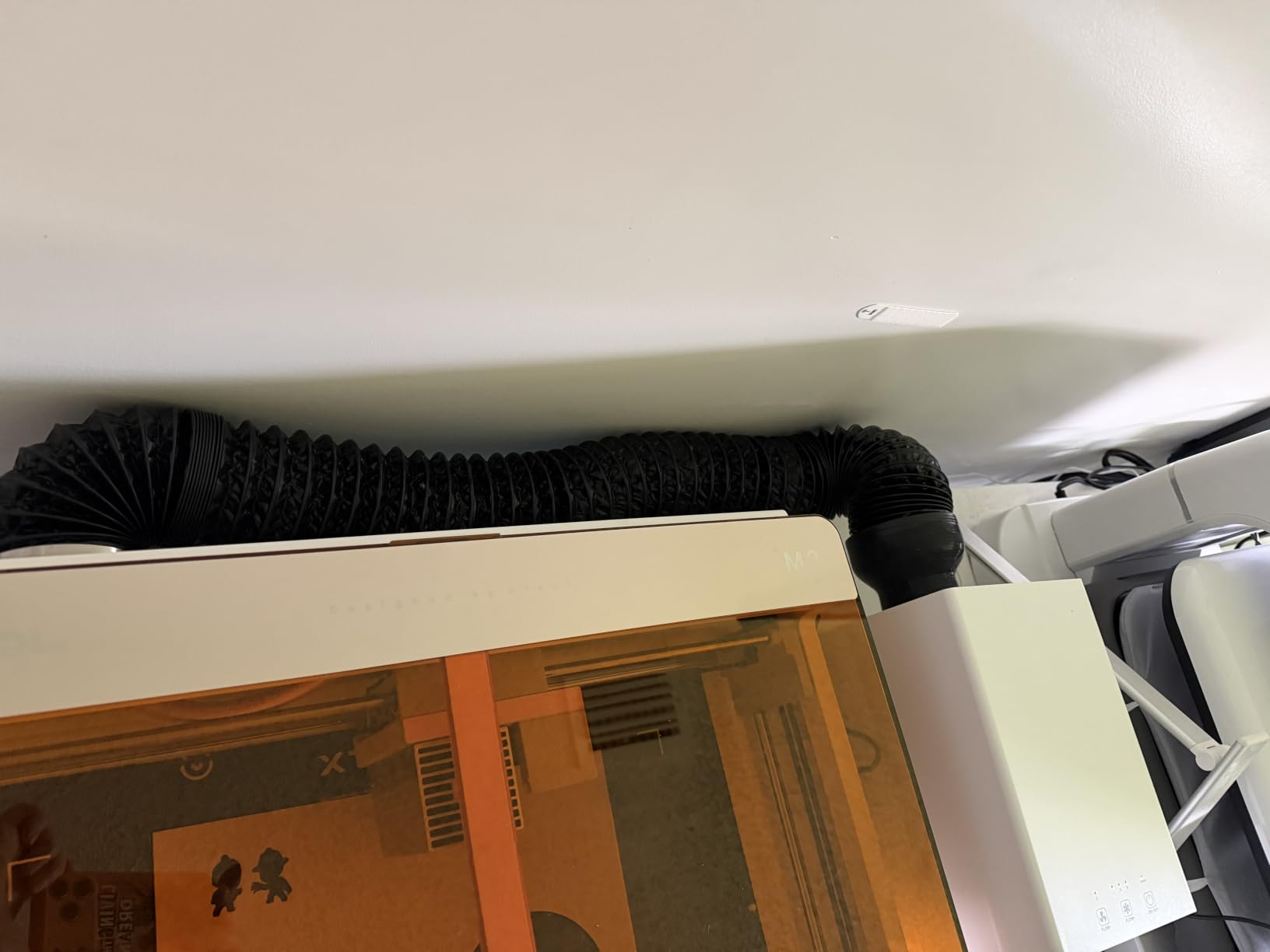
Noise is limited to 55 dB by the internal aerodynamic design, and the practical reports match: owners say it does not intrude on music or conversation. A three-speed adjustable switch with a built-in status alarm system is the whole control interface, which is about as simple as it gets and therefore easy to live with.
Compatibility covers diode lasers of 20W and under, infrared lasers of 15W and under, and light-duty fiber or CO2 marking machines. The one practical snag, noted by owners, is that some newer xTool models need an adapter that is not included in the box.
When a small unit is genuinely enough
For a 10W to 20W diode engraver marking anodized aluminium, slate, wood or thin acrylic, a desktop unit with capture at the source does the whole job. These are low-volume, low-plume operations, and the difference between 55 dB and 68 dB is the difference between a machine you use in the evening and one you only run in the garage.
The separate filter sets are the quiet winner here for running cost. Because the primary and high-efficiency stages are independent, a small engraving hobby does not force you to replace a full stack every year.
Where it falls short
The 20W ceiling is hard, and the smaller the laser the more noticeable its limit becomes. Move up a class and you need a different unit entirely.
With 9 reviews, all of them 5-star, there is no negative evidence to learn from, and the compatibility list is where the real risk sits. Check your machine’s exhaust port against the adapter situation before ordering, because an xTool owner may need a part that is not in the box.
10. OMTech 60W Fume Extractor – Entry Unit for Soldering and Hobby Lasers
OMTech 60W Fume Extractor, 2 Stage Air Filter System for Laser Engraver, 100 m3/h Smoke Absorber for Soldering Station Laser Engraving Machine, Air Purifier with Cotton HEPA Activated Carbon Filters
100 m3/h (58.9 CFM) airflow
99.95 percent above 0.3 micron
Two-stage filtration
Airflow adjustment knob
Pros
- Handles engraving and soldering smoke and odor effectively
- Simple airflow knob matches suction to the job
- Cotton pre-filter plus HEPA and carbon composite stack
- 24/7 support across multiple regions
Cons
- Supplied 55 mm hose and 65 mm adapter rarely match a laser out of the box
- Lowest airflow in this roundup at 100 m3/h
The OMTech 60W is the budget pick, and its 4.7 rating from 9 reviews reflects a simple proposition: for a hobby laser or a soldering bench, it removes smoke and odor at a level users are happy with. It sits at number 90 in Fume and Smoke Extractors, which is a real demand signal in this category.
Airflow is 100 m3/h, stated as 58.9 CFM, from a 60W motor. Filtration is a cotton pre-filter plus a composite HEPA and activated carbon stage, removing 99.95 percent of particles larger than 0.3 micron. That is a two-stage design rather than the three or four stages elsewhere, and it shows in what the unit can absorb. It is a bench tool for engraving, light welding and soldering, not a room-scale solution.
Adjustment is a single airflow knob, which is refreshingly straightforward. Support is listed as available around the clock across the US, China and the Philippines, a genuine advantage over smaller brands when something is not working.
What the 58.9 CFM figure means for your setup
Compare it to the practitioner guidance and you can see the gap. The primer advice on r/lasercutting puts 150 CFM as an acceptable minimum and 200 to 250 CFM as the preferred home range, and this unit sits well below both. On a small enclosed diode that is manageable because the enclosure volume is tiny and the cut is short.
On a 40W CO2 machine or any open-frame laser, it will not keep up. Know which machine you are pairing it with before you buy, and treat the number as a scoping tool rather than a disappointment later.
Where it falls short
Adapters are the immediate practical problem. The box includes a 2.2 inch (55 mm) exhaust hose and a 2.6 inch (65 mm) pipe adapter, and owners regularly note the two diameters do not match many lasers without a reducer. Budget for a reducer or a replacement hose in your first week.
Beyond that, the limit is airflow. At 100 m3/h it has the lowest rated move rate in this roundup, and it is included because for soldering and small diode work that limitation costs you very little.
How to Size Airflow to Your Laser
Airflow is quoted in CFM or m3/h, and one cubic foot per minute equals 1.699 m3/h, so 100 m3/h is 58.9 CFM. Fan wattage is not a substitute. A 200W motor with a poorly designed impeller can move less air through a loaded filter than a 150W motor with a straight duct, which is why every unit above quotes a move rate rather than only a motor size.
Start from the machine class, not the price of the extractor. The widely repeated practitioner figure on r/lasercutting is 150 CFM as an absolute floor and 200 to 250 CFM as the preferred home-shop range, with a caution that extraction fans are consumables and you should expect to service them over a machine’s life. Working down from that:
Small diode, 5W to 20W, enclosed: 60 to 100 CFM at the source is workable for short jobs. The NEETOP NT-X1 lives here.
Enclosed diode, 20W to 40W: 150 to 200 CFM keeps the enclosure negative between jobs. The KQZ-1501, FUMEGO XF250 and FumeClear FC-2002 all sit here.
40W to 60W CO2, enclosed or open frame: 200 to 250 CFM, with the head parked within about 15 cm of the cut. The KQZ-200 and FumeClear FC-2004 cover this.
High-power CO2 and production cutting: 250 CFM and above, plus ducting rated for the fire load. No unit in this roundup is rated that high, so a production shop adds an inline booster or moves to a commercial extraction unit.
Hose diameter is the second half of the sizing problem, and it is where the buying guides are thinnest. The same practitioner thread argues that 4 inch (100 mm) is the minimum acceptable and 6 inch (150 mm) is substantially better, because a wider hose moves the same volume at a lower face velocity and captures the plume instead of pushing it around. If a unit ships a 3 inch hose, replace it before your first long job.
Fan placement decides whether any of this works. Put the fan downstream of the enclosure so it pulls, which drives the whole duct slightly below room pressure and makes any small leak draw clean air inward rather than pushing fume out. Seal seams with RTV. This one change solves the leak-back problem that appears in almost every laser forum thread, and it costs nothing.
Finally, measure rather than assume. Rated CFM is measured at a clean outlet. A filter half-loaded with MDF dust can cost you a large share of that figure, which is why a clog alarm is worth paying for and why a smoke test at the start of every session is a sensible five-second habit.
Venting Outside vs Recirculating Filtration
If your building allows it, venting outside is the better answer, and no amount of filter media changes that. The practitioner position on r/lasercutting is that in-room smoke filters are never a substitute for extraction at the source, and that capture beats cleanup. If you have a detached garage, a basement workshop window you can seal and a run of duct, run the hose out.
Many home shops cannot. Apartments and condos frequently prohibit alterations to windows and exterior walls, HOAs restrict visible equipment and exhaust routing, and a landlord will usually not approve a wall penetration. In a rental or a shared-wall property, a recirculating unit with capture at the source is the realistic option, and it is worth taking seriously rather than settling for.
Two mitigations make recirculation workable. First, keep the extractor running only during jobs, using a timer or a machine-triggered start, so the rest of your home is not exposed to anything. Second, treat the filter as consumable media with a real service life and replace it on schedule rather than when you notice a smell, because odour is a late indicator of a loaded carbon stage.
Where a middle path exists, take it. The FUMEGO DX1002W is the unit in this roundup that supports both arrangements, with a 4 inch outlet and included hose for an outside run, and a note on the practical side: where venting is not possible at all, keep the capture head within the manufacturer’s stated range and confirm your HOA or lease terms before drilling anything.
Fire Safety and Noise for a Home Laser Shop
Fire safety is the part of this topic no competitor on the search results covers properly, and it matters more in a home than in a leased industrial unit. Keep a suitable fire extinguisher within reach of the machine but not so close that you cannot reach the door. Keep the laser bed clear of offcuts, keep a brush or shovel for small ember starts nearby, and never leave a cut running unattended.
Never cut PVC or vinyl-containing material on any of these machines. It releases chlorine compounds that corrode the extraction system and the machine, and it is the fastest route to a damaged extractor and a hazardous room. If you want plastic work, restrict yourself to acrylic and known-safe plastics. For an enclosed machine, an interlock switch that stops the laser when the lid opens is one of the highest-value safety purchases in a home shop, and the two tabletop units here, the NT-X1 and the OMTech, are small enough to pair with a shared-workroom interlock.
Noise is the constraint that decides whether the machine lives in your house or your garage. For context, 55 dB is roughly a quiet office, 60 dB is normal conversation, and 68 dB is where you start raising your voice. Measured against that, the NT-X1 at 55 dB and the FC-2002 under 55 dB are genuinely liveable in a home, the KQZ-1501 at 55 dB and the DX1002W under 54 dB sit in the same range, and the XF250 at 60 dB plus the FC-2004, which owners describe as very loud on its top setting, are workshop machines. Note that manufacturers quote noise at maximum speed, which is the number you will hear if you leave it there.
A practical approach is to buy for the top speed you will actually run. Extraction only needs full power on thick material or dense wood; on thin acrylic or light marking, the lower settings still capture the plume. If your unit has a remote or a control panel, set a low default and only push it up when the cut needs it. Our printer buying guides follow the same principle of matching the tool to the job rather than to the spec sheet.
How to Choose: 7 Criteria That Decide the Purchase
Here is the shortlist we would actually work from, in priority order, after spending time with these units and the review threads around them.
Measured airflow, in CFM or m3/h. Not motor wattage. Take the rated figure and discount it for hose length and filter loading.
Filtration stages that include real HEPA and carbon. Look for an H13 or H14 rating stated down to 0.3 microns at 99.97 percent, plus a carbon stage with an iodine value figure. HEPA-type and carbon-type claims without numbers are marketing.
Static pressure or negative pressure rating. This is what tells you whether the unit can hold suction through a duct, and it is the number that prevents leak-back.
Noise in dB at a stated distance, and at what speed. A figure quoted only at maximum speed describes the worst hour of your week, not the average one.
Filter availability and annual cost. Count the pre-filters, the carbon and the HEPA as separate line items. A unit with a washable pre-filter and split filter sets can cost a fraction of a sealed-stack design over three years, and that is a buying decision disguised as a small detail.
Enclosure and port fit. Check the exhaust port diameter on your laser, whether you need a rigid tube rather than a flexible hose, and whether the capture head can reach within the manufacturer’s capture range at your workbench height.
Warranty, support and consumable parts. Blowers and filters are consumables. A published warranty, reachable support and a documented filter catalogue tell you the vendor expects the unit to be kept for years.
Applied to a typical home shop: a 40W CO2 machine in a detached garage wants the FumeClear FC-2004 for airflow and no apologies. A 20W to 40W enclosed diode in a spare room wants the FumeClear FC-2002 for metal construction and low noise, or the KQZ-1501 if you want a clog alarm and a rigid duct run. A small desktop engraver next to a soldering bench wants the NEETOP NT-X1. If you are still finalising the machine side of the build, our laser level guide covers setup and alignment for the workshop itself.
Frequently Asked Questions
What is the best fume extractor for a laser engraver?
For most home shops the xTool SafetyPro AP2 is the best overall, pairing six-layer SuperCyclone filtration with 55 dB operation and app-based filter monitoring. The FumeClear FC-2002 is the strongest all-rounder for mixed laser and wood work, and the KQZ KQZ-200 delivers the most airflow per dollar at 330 m3/h. Match the unit to your machine wattage and the noise you can live with.
What is the best ventilation system for laser engraving?
The best system captures fumes at the source with a hood or arm held close to the cut, pulls them through pre-filter, HEPA and activated carbon stages, and discharges the filtered air outside where the building allows it. Venting outdoors is always preferable to recirculating. Where venting is impossible, a recirculating unit with capture at the enclosure is a far better answer than a room air purifier.
How effective are fume extractors at removing laser fumes?
A properly sized extractor is highly effective at removing fumes when the capture head stays within about 15 cm of the cut, because the plume is removed before it reaches your breathing zone. Effectiveness falls sharply when the head is distant, when the hose is narrow, or when the filter is loaded and airflow drops. Filtering air that has already spread through the room is far weaker, which is why capture beats cleanup.
Do you need a fume hood to laser cut metal?
Yes. Metal marking and cutting produce fine metal particulate and, in some coatings, additional fumes, so you need capture at the source rather than room filtration. A three-stage unit with a HEPA filter and a carbon layer handles most hobby metal marking, and anything above that calls for higher airflow and ideally an outdoor vent. A charcoal shop vacuum is not a substitute, because the exhaust is unfiltered.
How often should I replace laser fume extractor filters?
Pre-filters can often be washed rather than replaced, and the main carbon and HEPA stages on units in this roundup are rated in the region of 2000 to 4000 hours of service life. Heavy cutting of MDF or brass loads filters far faster than light engraving, so judge on airflow and the clog alarm rather than the calendar. A filter alarm is a far better trigger than waiting for an odour.
How loud is a laser fume extractor?
It depends on the unit and the speed setting. Desktop units such as the NEETOP NT-X1 and the FumeClear FC-2002 run at about 55 dB, which is close to a quiet office, while the largest units in this roundup reach roughly 60 to 68 dB at full power. Manufacturers usually quote the maximum figure, so run the unit on a lower setting for thin material and the noise drops considerably.
The Verdict for Home Shops in 2026
The xTool SafetyPro AP2 is our pick for the best laser engraver fume extractor for home shops in 2026, and the reason is durability of the whole package rather than a single specification: 4.7 stars across 153 reviews, six-stage filtration that owners confirm clears long acrylic jobs, 55 dB operation you can live with, and the only unit here where the extractor and the machine start together on their own. If you run anything other than an xTool, or you want a metal box instead of a smart appliance, take the FumeClear FC-2002. If you want the most air movement without spending much, take the KQZ KQZ-200 and accept that the motor is a service item.
Whichever one you choose, two setup decisions matter more than the model: run a wide hose and put the fan downstream so the duct sits under negative pressure. Buy the filters the same week you buy the unit, and check your lease or HOA terms before you plan a wall penetration. Any of the ten above will do its job properly once those three boxes are ticked.