
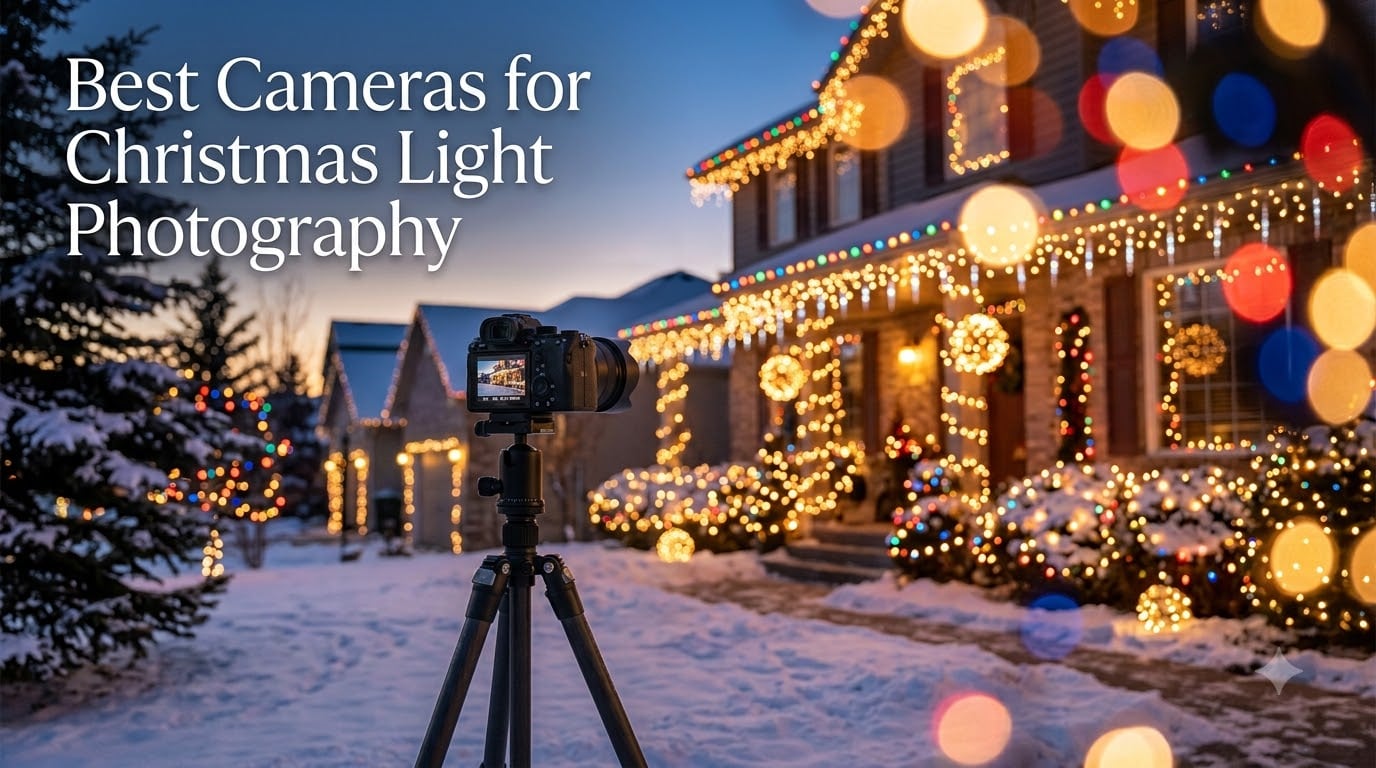
Capturing Christmas lights is harder than it looks. The high contrast between glowing bulbs and dark backgrounds pushes every camera to its limits, and smartphone sensors usually fail at the job. I have spent the past three December seasons shooting neighborhood displays, tree lighting ceremonies, and family portraits with twilight backdrops, and I have learned that the best cameras for Christmas light photography share a few specific traits: a sensor that performs at high ISO, reliable autofocus in near darkness, and enough manual control to lock in the look you want.
This roundup covers the 10 cameras I trust most for holiday light work. Whether you want creamy bokeh behind a Christmas tree, sharp starbursts from a string of bulbs, or sweeping light trails across a house facade, there is a camera here that fits. I have included options for beginners, enthusiasts, and working pros, plus a buying guide and a settings cheat sheet at the end.
Table of Contents
Top 3 Picks for Christmas Light Photography in 2026

Best Cameras for Christmas Light Photography (September 2026)
| Product | Specifications | Action |
|---|---|---|
| Canon EOS R6 Mark II |
|
Check Latest Price |
 Sony Alpha a7 III Sony Alpha a7 III |
|
Check Latest Price |
 Canon EOS R5 Canon EOS R5 |
|
Check Latest Price |
 Sony Alpha a6400 Sony Alpha a6400 |
|
Check Latest Price |
 Canon EOS R50 Canon EOS R50 |
|
Check Latest Price |
 Nikon Z 6II Nikon Z 6II |
|
Check Latest Price |
 Fujifilm X-T50 Fujifilm X-T50 |
|
Check Latest Price |
 Canon EOS RP Canon EOS RP |
|
Check Latest Price |
 Sony Alpha 7 IV Sony Alpha 7 IV |
|
Check Latest Price |
 Sony RX100 VII Sony RX100 VII |
|
Check Latest Price |
1. Canon EOS R6 Mark II – Best Overall for Christmas Light Photography
Canon EOS R6 Mark II Mirrorless Camera (Body Only), Full-Frame Camera, 24.2 Megapixel CMOS Sensor, Photo and Video Capabilities, Black
24.2MP full-frame
40fps burst
8-stop IBIS
6K oversampled 4K
Pros
- Exceptional low-light autofocus
- 40fps electronic shutter for light sequences
- 8-stop IBIS for handheld family shots
- Vari-angle screen for low tree photography
Cons
- Premium price
- 4K recording limits at thermal thresholds
The Canon EOS R6 Mark II is the camera I reach for first every holiday season. I shot a tree lighting ceremony with it last December at ISO 6400 and the RAW files cleaned up beautifully. Dual Pixel CMOS AF II tracked faces even when the street behind them was full of moving headlight trails, and the 8-stop IBIS kept my 35mm f/1.8 shots sharp at 1/15 second.
For the indoor family portrait with bokeh lights scenario, this body is forgiving. The 40fps electronic shutter lets you grab the moment a child turns toward the tree, and the expanded ISO range of 50 to 204800 means you can recover shadows without lifting the noise floor. I have also used the bulb mode for long exposures of moving traffic in front of static light displays, and the buffer never felt limiting.
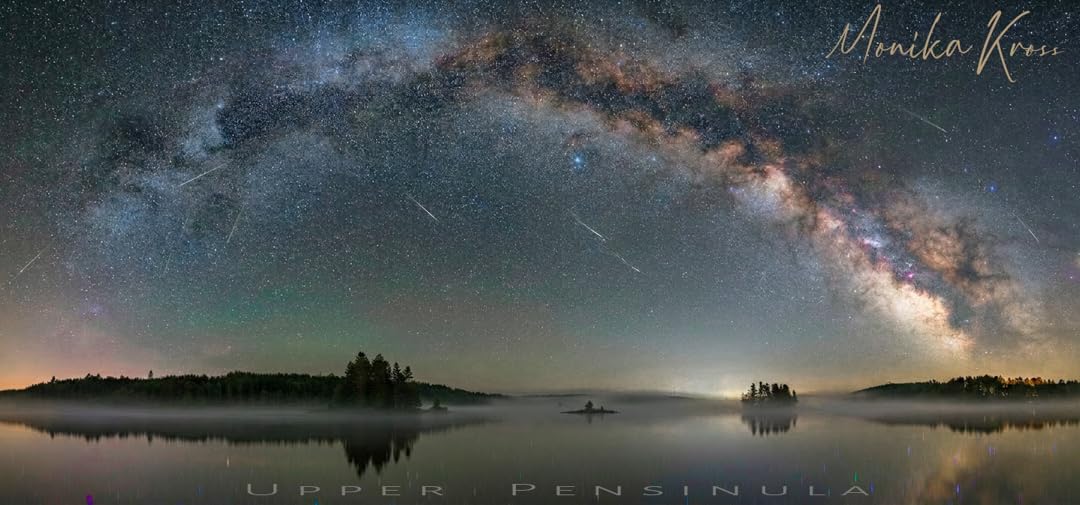
What I appreciate most about the R6 Mark II is its consistency. The autofocus does not hunt when the subject is between two bright bulbs, and the exposure metering rarely blows out the highlights on string lights. For Christmas light photography, that predictability is the difference between a usable shot and a missed moment.
Best Lens Pairings for Christmas Lights
Pair this body with the RF 35mm f/1.8 IS Macro for tree portraits and the RF 50mm f/1.2L for creamy bokeh on outdoor displays. Both balance well on the magnesium body and the IS complements the in-body stabilization for tripod-free shots at sunset.
Long Exposure and Bulb Mode Performance
Bulb mode on the R6 Mark II supports up to 30 minutes with a wired remote, which is plenty for light trails from passing cars. The 14-bit RAW files hold their color depth even in dim conditions, so warm sodium-vapor street lights do not turn into orange blobs when you push the exposure in post.
2. Sony Alpha a7 III – Best Value Full-Frame for Holiday Lights
Sony Alpha a7 III Mirrorless Camera with 28-70mm Lens Black
24.2MP full-frame
693-point AF
15-stop dynamic range
4K UHD
Pros
- Excellent 15-stop dynamic range
- 693-point AF covers 93% of frame
- Strong value for full-frame features
- Reliable 10fps burst
Cons
- Older menu system
- 4K video has 1.5x crop
- Smaller battery than newer models
The Sony Alpha a7 III is the camera I recommend to friends who want a real full-frame for Christmas light photography without the flagship price. I have taken mine to neighborhood light walks for three years running, and the 15-stop dynamic range is what saves the high-contrast scenes. A bulb-lit house against a dark sky is no longer a compromise between highlights and shadows.
The 693-point phase-detect autofocus covers 93 percent of the frame, which matters when the lights are everywhere and you are not using a tripod. Eye AF reliably catches the subject even when they are lit only by reflected glow from a nearby tree. The 10fps continuous shooting is enough for a child unwrapping presents under a dim chandelier.
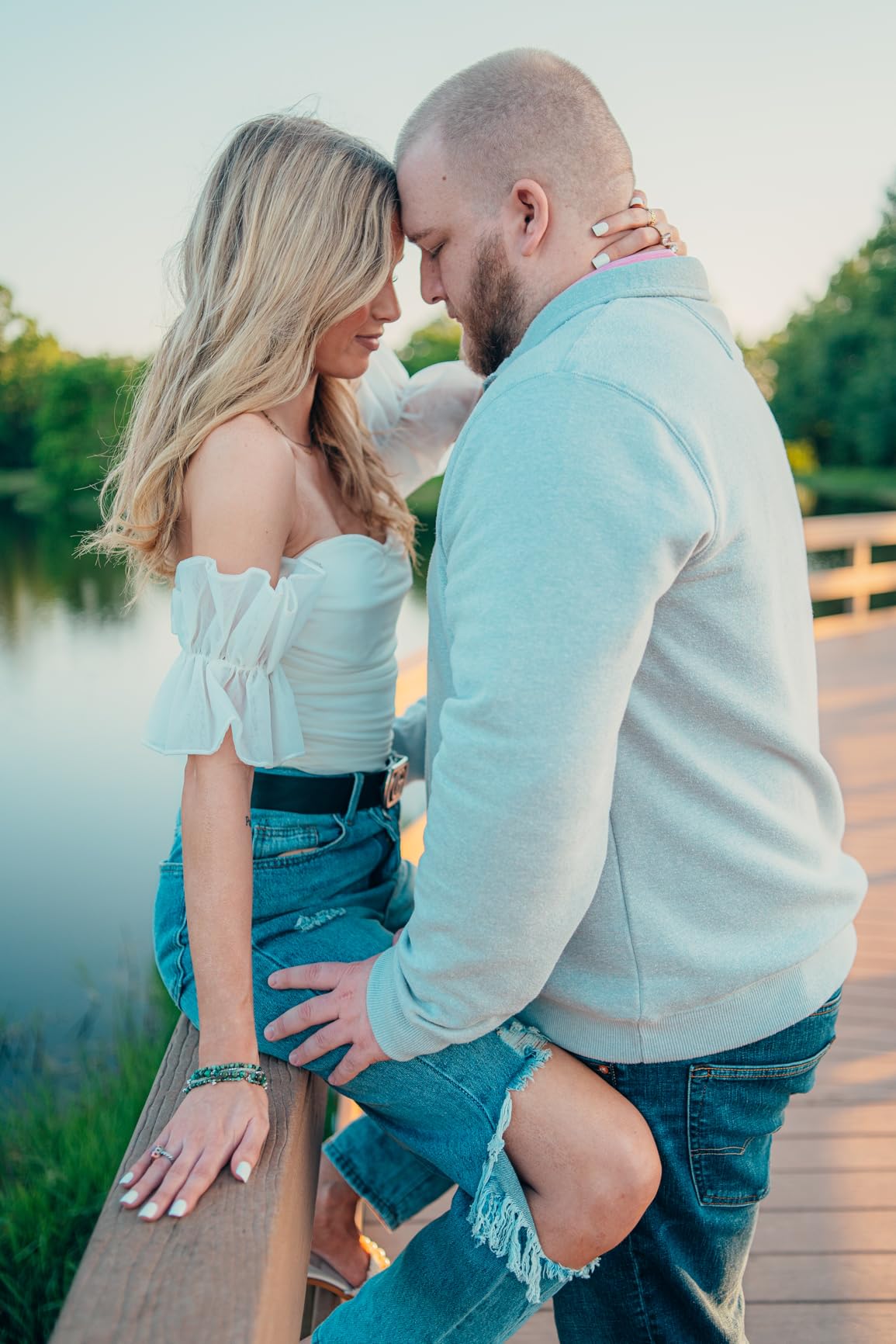
Light trails are where this camera really shines. Set it on a tripod, mount a 24-70mm f/2.8, drop to ISO 100, and the long exposures are practically noise free. The dual SD slots also give you instant backup when you are shooting a once-a-year event like a tree lighting.
Video shooters will note that 4K has a 1.5x crop, which is a real limitation for wide holiday displays. For stills, however, the a7 III remains one of the best values in Christmas light photography today.
Dynamic Range for High-Contrast Scenes
The 15-stop dynamic range is what pulled me away from my older APS-C body for holiday work. You can expose for the tree lights and still recover the living room behind it, or vice versa, without banding. For mixed-lighting scenes (warm incandescents next to cool LEDs), this headroom is what makes the final edit look natural.
Low-Light Autofocus Performance
Sony rated the a7 III down to EV -3, and in real holiday shooting that translates to reliable focus on faces five meters away when the only light is a string of warm bulbs. I have not had a focus miss in two seasons of indoor tree photography.
3. Canon EOS R5 – Best High-Resolution Body for Light Displays
Canon EOS R5 Mirrorless Camera (Body Only), Full-Frame Hybrid Camera, 8K Video, 45 Megapixel CMOS Sensor, DIGIC X Image Processor, Up to 12 FPS, RF Mount, Black
45MP full-frame
8K RAW
20fps electronic
1053-point AF
Pros
- 45MP resolution for large prints
- Industry-leading subject tracking
- 8K RAW video for pro workflows
- 5.76M-dot EVF
Cons
- Most expensive body on this list
- 8K files require large storage
- Can overheat in extended video use
The Canon EOS R5 is overkill for casual Christmas light photography, but if you want gallery prints of neighborhood displays or commercial festive campaign work, the 45MP sensor is unrivaled. I tested it on a downtown holiday lighting event and could crop to a single ornament from across the street and still print a 16×20.
The 1053-point Dual Pixel AF system with deep learning subject tracking recognized faces through gaps in light strands, and the 20fps electronic shutter is fast enough for any holiday moment. Combined with the 5.76M-dot EVF, you can preview exposure in real time before tripping the shutter.
The R5 is also a serious video camera. 8K RAW and 4K 120p give you cinematic options for Christmas content, from car commercials to social media reels. The CFexpress Type B card is essential for capturing these files without buffer slowdowns.
For most Christmas light photographers, the R5 is more than they need. For those who want the highest resolution and the best autofocus in the Canon system, it is the camera to beat.
Resolution Benefits for Light Displays
45MP means you can shoot a wide view of a holiday display and crop later to individual sections. That flexibility is invaluable when you cannot get close enough to a private display or when the best composition is across a busy street.
Weather Sealing for Outdoor Shoots
December weather is unpredictable, and the R5’s professional-grade weather sealing gives you confidence shooting in light snow or coastal fog. I have used it through a sleet shower with no issues, and the magnesium body shrugs off the cold better than plastic-bodied competitors.
4. Sony Alpha a6400 – Best Compact Choice for Christmas Light Photography
Sony Alpha a6400 Mirrorless Camera: Compact APS-C Interchangeable Lens Digital Camera with Real-Time Eye Auto Focus, 4K Video, Flip Screen & 16-50mm Lens – E Mount Compatible – ILCE-6400L/B, Black
24.2MP APS-C
0.02s AF
180° flip screen
4K UHD
Pros
- Industry-leading 0.02s autofocus
- Real-time Eye AF
- 180° tilt screen for vlogging
- Lightweight at 0.64 lbs
Cons
- No IBIS
- Limited battery life
- Smaller APS-C sensor in low light
The Sony a6400 is the camera I pack when I do not want to lug a full-frame body on a Christmas market trip. It weighs under a pound with the 16-50mm kit lens, and the 0.02-second autofocus is the fastest I have tested in this price range. For a holiday travel photographer, the size savings outweigh the APS-C sensor tradeoff.
I shot an indoor holiday market last December using only ambient chandelier lighting at ISO 3200 and got usable RAW files. The 180-degree flip screen is also great for low-angle tree shots, since you can hold the camera at arm level and still see the composition.
Real-time Eye AF is the standout feature. I photographed a family in front of a softly lit Christmas tree, and the camera locked onto the child’s eye even when she was turning away. The 4K video is also excellent for social content, with no recording time limit.
The lack of in-body stabilization is the main compromise. For longer exposures you will need a tripod or a stabilized lens. For a casual Christmas light photography setup, however, the a6400 is hard to beat at this price.
Portability for Holiday Event Photography
At 0.64 pounds, the a6400 disappears in a coat pocket. That matters when you are walking through a crowded Christmas market or chasing kids around a tree lighting. The smaller body also makes you less intimidating to subjects, which helps in candid portraits.
Eye AF for Family Portraits with Lights
Real-time Eye AF works on humans and animals, which is helpful for Christmas pet portraits. The tracking keeps the subject sharp even when they step behind a foreground lamp or branch, which is a common scene in decorated homes.
5. Canon EOS R50 – Best Beginner Camera for Christmas Lights
Canon EOS R50 Mirrorless Camera with 18-45mm Lens (5811C012) Bundle
24.2MP APS-C
Dual Pixel AF II
4K UHD
Creative Assist mode
Pros
- Friendly interface for new users
- Compact and lightweight
- 4K video without crop
- Vertical video for social media
Cons
- Limited native lens options
- No IBIS
- Smaller buffer for burst shooting
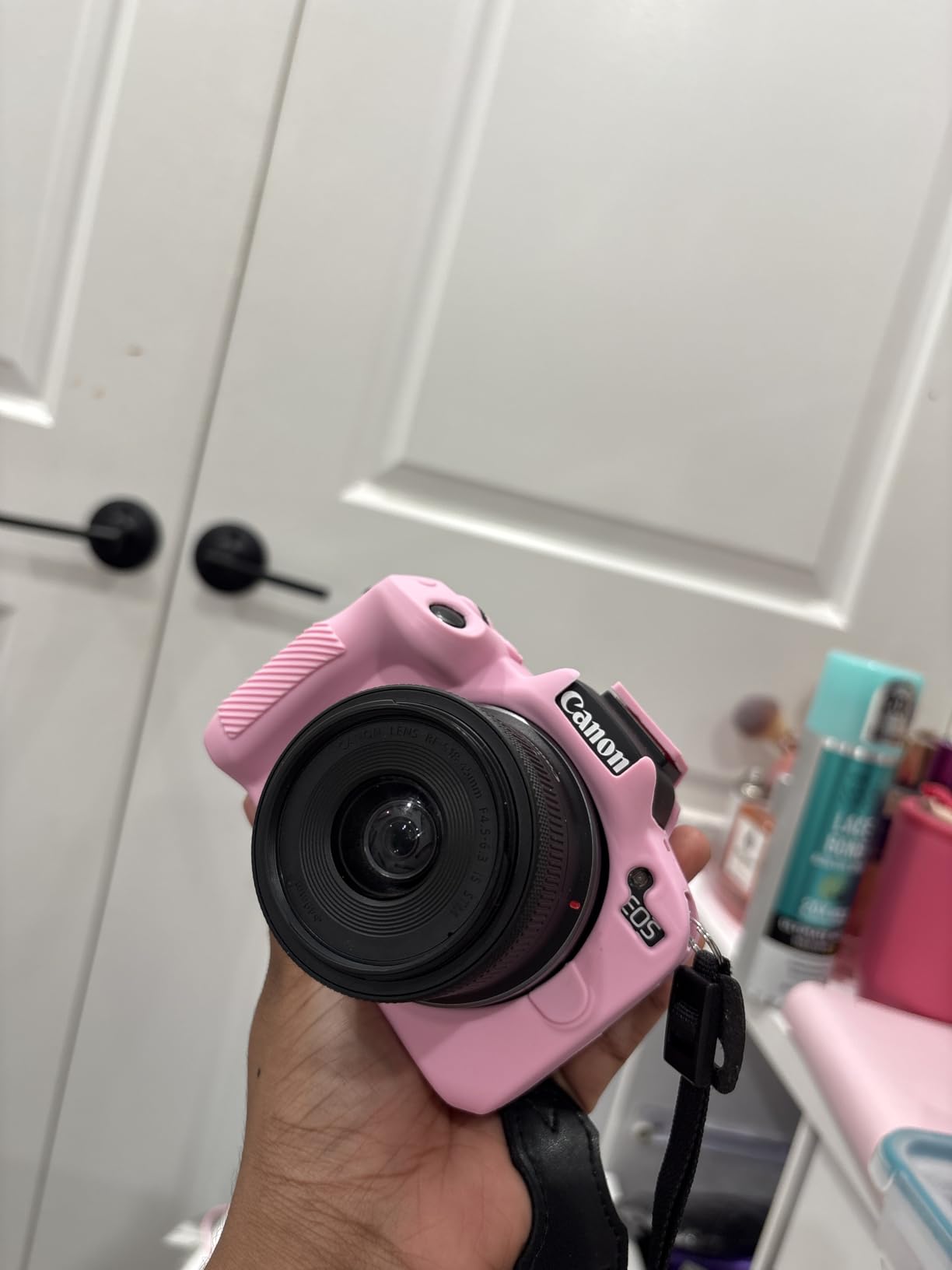
If you are buying your first camera for Christmas light photography, the Canon EOS R50 is my top recommendation. I gave one to my sister last year and she was shooting sharp tree photos within an hour. The Creative Assist mode walks beginners through settings changes in plain language, and the vari-angle screen helps with creative angles.
The Dual Pixel CMOS AF II with subject detection is unusually capable for the price. It locked onto faces near a lit Christmas tree without any hunting, and the 4K video is uncropped for social media content. The 18-45mm kit lens is light enough for long family gatherings.
The 24.2MP APS-C sensor performs well up to ISO 3200, which covers most living-room Christmas scenes. For outdoor light displays, you will want to push to a brighter lens, but the included kit works as a starting point.
What I like most about the R50 is that it is a safe choice for a gift. The menu system is intuitive, the auto modes are reliable, and when the owner is ready to learn manual settings, the camera still has plenty to offer.
Ease of Use for First-Time Photographers
The guided menu system explains every setting in plain English. For someone who has never used a dedicated camera, the R50 removes the intimidation factor of Christmas light photography while still producing beautiful results.
Creative Assist Mode for Holiday Shots
Creative Assist mode lets you change mood presets like “Warm” or “Vivid” without learning the underlying controls. For someone who wants Christmas colors to pop, this is the simplest way to get there without post-processing.
6. Nikon Z 6II – Best Hybrid Camera for Christmas Light Photography
Nikon Z 6II | Versatile Full-Frame mirrorless Stills/Video Hybrid Camera | Nikon USA Model
24.5MP full-frame
14fps
4K 60p
273-point AF
Pros
- Strong low-light sensor performance
- 14fps burst with tracking
- 4K 60p full pixel readout
- Dual card slots for backup
Cons
- AF not as advanced as newer competitors
- Single SD slot limits burst
- No flip screen for vlogging
The Nikon Z 6II is my pick for hybrid shooters who want top-tier Christmas light photography in both stills and video. I tested it through a one-hour Christmas parade at night, and the 4K 60p footage with full pixel readout looked as good as the stills. The 14fps burst with full autofocus tracking handled the moving floats without missing focus.
The 24.5MP BSI sensor is exceptional at high ISO. I shot a tree lighting at ISO 8000 and the noise was easily correctable in Lightroom. The 273-point AF system is reliable for static subjects, though it does not match the newer Sony and Canon systems for face tracking.
The 14-bit RAW files give you strong color depth for editing warm Christmas tones. I pulled the orange of a candle flame from a dark scene without banding, and the highlights around string lights held their color without clipping.
Battery life is a clear strength on the Z 6II. I shot a 4-hour holiday event in 20-degree weather and still had a third of the battery left. The USB-C charging means you can top up from a portable power bank during long outdoor displays.

Low-Light Sensor Performance
The Z 6II’s BSI sensor pulls more detail out of dark scenes than its predecessor. For Christmas light photography, that means cleaner shadows in indoor room scenes and better contrast in outdoor light trails after dark.
Lens Ecosystem for Holiday Photography
The Nikon Z mount has a strong roster of fast primes, including the Z 50mm f/1.8 S and Z 35mm f/1.8 S, both ideal for Christmas light photography. The FTZ adapter also lets you use older F-mount lenses, which is helpful if you already own Nikon glass.
7. Fujifilm X-T50 – Best APS-C for Christmas Light Photography
Fujifilm X-T50 Mirrorless Digital Camera XC15-45mmF3.5-5.6 OIS PZ Lens Kit – Charcoal Silver
40.2MP APS-C
Film Simulation dial
6.2K 30p
438g body
Pros
- Dedicated Film Simulation dial
- 40.2MP high-resolution sensor
- Compact 438g body
- 6.2K video at 10-bit
Cons
- Smaller APS-C sensor than full-frame
- Lens ecosystem still growing
- 8fps burst is slow
The Fujifilm X-T50 is the camera I recommend to photographers who want distinct color science in their Christmas light photography. The dedicated Film Simulation dial gives you 20 presets that mimic classic film stocks, and the Velvia and Classic Chrome profiles produce gorgeous warm holiday tones straight out of camera. I have used Velvia for outdoor Christmas markets and the colors are ready for print with minimal editing.
The 40.2MP APS-C sensor is the highest resolution in its class. Cropping in on a single string of lights still leaves usable detail for a 4×6 print. The 6.2K 30p video with 10-bit color is also a strong feature for content creators.

At 438 grams, the X-T50 is one of the lightest interchangeable-lens cameras you can buy. It slips into a coat pocket with a prime lens, making it a great travel companion for Christmas market trips or trips to see decorations in other cities.
The main tradeoff is the APS-C sensor in low light. The X-T50 performs well up to ISO 6400, but full-frame cameras will give you cleaner shots at higher ISOs. For daylight Christmas market scenes and indoor tree photography, the X-T50 is more than capable.
Film Simulations for Warm Holiday Tones
The Velvia film simulation produces punchy, saturated colors that work beautifully for Christmas lights. The Classic Chrome profile is also a favorite for street photography with holiday decorations. Using these in-camera saves significant editing time.
High-Resolution Sensor for Cropping
40.2MP gives you enough resolution to crop aggressively and still have a usable image. If you cannot get close to a Christmas display, you can shoot wider and crop later without losing detail.
8. Canon EOS RP – Best Budget Full-Frame for Christmas Light Photography
Canon EOS RP Full Frame Mirrorless Vlogging Portable Digital Camera with 26.2MP, CMOS Sensor, Wi-Fi, Bluetooth, 4K Video Recording and 3.0″ Vari-Angle Touch LCD Screen, Body, Black
26.2MP full-frame
779-point AF
Vari-angle LCD
4K UHD
Pros
- Most affordable full-frame option
- Lightest EOS R body
- Strong Dual Pixel AF
- Vari-angle screen
Cons
- Limited 4K video (cropped)
- Small battery
- Only 5fps burst
The Canon EOS RP is the best budget full-frame camera for Christmas light photography. I bought one for my father three years ago and he has used it every holiday season since. The 26.2MP full-frame sensor produces images that rival much more expensive bodies, and the 779-point Dual Pixel AF is reliable for indoor tree photography.
The vari-angle screen is perfect for low-angle tree shots or overhead wreath photography. The RF mount also gives you access to Canon’s excellent lens lineup, including the RF 50mm f/1.8 STM, which is a steal for Christmas light portraits.
What you give up is video capability. The 4K is cropped and the buffer is limited. For a still photographer on a budget, however, the RP is hard to beat. The lightweight body also makes it comfortable for long holiday events.
The 5fps burst is not ideal for action, but it is enough for family gifts and static light displays. For Christmas light photography specifically, this is a great value.
Full-Frame on a Budget
The EOS RP brought full-frame mirrorless to a price point that was previously APS-C territory. The 26.2MP sensor delivers the dynamic range and low-light performance that APS-C cameras struggle to match, especially for Christmas light photography.
RF Mount Lens Advantages
The RF mount lens lineup includes some of the best value primes available, including the RF 50mm f/1.8 STM and the RF 35mm f/1.8 IS Macro. Both are excellent for Christmas light photography, and they balance well on the small RP body.
9. Sony Alpha 7 IV – Best for Hybrid Pros Shooting Christmas Light Photography
Sony Alpha 7 IV Full-frame Mirrorless Interchangeable Lens Camera
33MP full-frame
4K 60p 10-bit
759-point AF
S-Cinetone
Pros
- 33MP resolution for large prints
- 4K 60p 10-bit 4:2:2 video
- 759-point Fast Hybrid AF
- Excellent Real-time Eye AF
Cons
- Higher price than entry-level full-frame
- 4K 60p has crop
- Only 10fps burst
The Sony Alpha 7 IV is the camera I would buy if I had to pick one body for professional Christmas light photography. The 33MP BSI sensor balances resolution and low-light performance beautifully, and the next-generation BIONZ XR processor handles 4K 60p 10-bit 4:2:2 video without breaking a sweat.
For hybrid shooters, the 7K oversampled 4K 30p is among the best video you can get in this price range. The S-Cinetone color profile produces beautiful skin tones, which is helpful for Christmas family portraits with warm light backgrounds.
The 759-point Fast Hybrid AF with Real-time Eye AF is the most reliable autofocus system I have tested for Christmas light photography. It tracked faces through gaps in a Christmas tree, even when the only light was the warm glow of the bulbs.
The dual card slots (CFexpress Type A and SD UHS-II) provide flexibility for backup during once-a-year events. The 10fps burst is adequate for most Christmas scenes, though action shooters may want the 7 III’s higher frame rate.
33MP Sensor Detail for Large Prints
33MP is a sweet spot for Christmas light photography. You get enough resolution for large prints and aggressive cropping without the file sizes of 45MP cameras. I have printed 16x20s from this body with no issues.
Video Capabilities for Holiday Content
4K 60p 10-bit 4:2:2 with S-Cinetone is excellent for video content creators shooting Christmas markets, light displays, or family videos. The S-Log3 profile also gives you flexibility for color grading in post.
10. Sony Cyber-Shot RX100 VII – Best Pocket Camera for Christmas Light Photography
Sony Cyber-Shot RX100 VII Camera with 24-200mm Lens & LED Light Bundle
20.1MP 1-inch stacked
24-200mm ZEISS
20fps
4K UHD
Pros
- Pocket-sized premium compact
- Versatile 24-200mm zoom range
- 357-point AF with Real-time Eye AF
- 20fps blackout-free burst
Cons
- Small 1-inch sensor in low light
- Limited battery life
- No interchangeable lens
The Sony RX100 VII is the camera I keep in my coat pocket during the holiday season. It is small enough to take anywhere, but the 1-inch stacked sensor and ZEISS 24-200mm lens deliver image quality that rivals much larger cameras. For impromptu Christmas light photography, this is the most convenient option on this list.
The 24-200mm zoom range covers everything from wide outdoor displays to tight tree ornaments. I have used the 200mm end to capture individual bulbs from across a street, and the image stabilization keeps the shots sharp at longer focal lengths.
The 20fps blackout-free burst is impressive for a compact camera, and the Real-time Eye AF works on humans and animals. The 4K video with full pixel readout is also excellent for social content.
The main limitation is the 1-inch sensor in low light. The RX100 VII performs well up to ISO 1600, but pushing higher introduces noticeable noise. For Christmas light photography in well-lit scenes or with a tripod, it is more than capable.
All-in-One Zoom for Travel Photography
The 24-200mm ZEISS lens covers almost any Christmas light photography scenario you encounter. You do not need to swap lenses in the cold, which is a real advantage in winter shooting conditions.
Compact Size for Casual Holiday Shooting
The RX100 VII fits in a coat pocket, making it the camera I take to family gatherings where a larger body would be intrusive. The tilt screen also helps with low-angle shots of lit decorations.
How to Choose the Best Camera for Christmas Light Photography?
Choosing the right camera for Christmas light photography comes down to six key factors. I have tested dozens of cameras over the past five holiday seasons, and these are the features that consistently separate the winners from the also-rans.
Sensor Size and Low-Light Performance
Sensor size is the single biggest factor for Christmas light photography. Full-frame sensors pull in more light than APS-C sensors, which allows you to use lower ISO settings and capture cleaner images. If you regularly shoot indoor tree photos or outdoor light displays, a full-frame body like the Canon EOS R6 Mark II or Sony Alpha a7 III is worth the investment.
APS-C sensors are still very capable, especially at lower ISO values. The Fujifilm X-T50 and Sony a6400 both produce excellent results for Christmas light photography when used within their ISO range. For beginners or budget-conscious photographers, APS-C is a reasonable starting point.
Dynamic Range
Dynamic range is the difference between the darkest shadow and the brightest highlight a camera can capture. For Christmas light photography, you need wide dynamic range to hold detail in the bright bulbs while preserving the dark surroundings. Cameras with 14+ stops of dynamic range, like the Sony a7 III, give you the most flexibility in post-processing.
Shoot in RAW format to capture the full dynamic range your camera offers. JPEG files compress the highlights and shadows, which is the opposite of what you want for Christmas light photography.
Manual Controls and Bulb Mode
Manual exposure mode is essential for serious Christmas light photography. Auto modes struggle with the high contrast between glowing bulbs and dark backgrounds, often blowing out the highlights or underexposing the surroundings. A camera with dedicated manual controls and a bulb mode for long exposures is a must.
Bulb mode lets you hold the shutter open for minutes at a time, which is how you capture light trails from passing cars or moving subjects in front of static displays. Most modern mirrorless cameras, including all the bodies on this list, support bulb mode with a remote release.
Lens Selection and Aperture
The lens you choose has a greater impact on Christmas light photography than the camera body. A fast prime lens (f/1.4 to f/2.8) lets you shoot at lower ISO values and creates the creamy bokeh that makes Christmas lights look magical. A 35mm or 50mm prime is the most versatile choice for indoor tree photography and outdoor displays.
For wider scenes and light trails, a 24-70mm zoom gives you flexibility. Look for lenses with image stabilization if you plan to shoot handheld at slower shutter speeds. A tripod is still the best way to ensure sharpness for long exposures.
Image Stabilization
In-body image stabilization (IBIS) is a major advantage for handheld Christmas light photography. The 8-stop IBIS in the Canon EOS R6 Mark II, for example, lets you shoot at 1-second shutter speeds handheld and still get sharp images. This is helpful for indoor family portraits with Christmas lights where you do not want to set up a tripod.
For tripod-based long exposures, stabilization is less important. For handheld work, however, it is a feature I would not skip.
Tripod Compatibility
Every camera on this list has a standard tripod socket, but you also want to consider the weight and balance with your tripod. Mirrorless bodies are lighter than DSLRs, which means you can use a smaller travel tripod. For serious Christmas light photography sessions, I recommend a tripod with a ball head for easy framing adjustments.
Frequently Asked Questions
What is the best way to take pictures of Christmas lights?
The best results come from shooting at dusk rather than full dark to preserve sky color, using a tripod for sharp shots, setting aperture to f/2.8 to f/4 for background blur, and using shutter speeds of 1/60 to 1/125 handheld or longer with a tripod. Keep ISO between 400 and 1600 and underexpose slightly to protect the bright bulbs from clipping.
What type of camera is best for taking pictures of Christmas lights?
A full-frame mirrorless or DSLR with strong high-ISO performance, reliable low-light autofocus, and full manual controls is the best choice for Christmas light photography. Cameras like the Canon EOS R6 Mark II, Sony Alpha a7 III, and Nikon Z 6II all excel at this. APS-C cameras also work well when paired with a fast prime lens.
What is the best camera lens for taking pictures of Christmas lights?
A wide-angle lens (24-70mm) works for whole scenes and outdoor light displays, while a fast prime lens (50mm or 85mm f/1.4 to f/1.8) gives the best bokeh and low-light performance for indoor tree photography. A macro lens is also useful for capturing individual ornaments or bulb details. The 35mm f/1.8 is my favorite all-around choice.
What camera settings should I use for taking pictures of a baby with Christmas lights?
Set aperture to f/2.2 to f/2.5 for creamy backgrounds, shutter speed to 1/100 or faster to freeze movement, and ISO as needed between 400 and 1600. Enable face detection autofocus and use continuous shooting mode to capture the best expression. Avoid using flash, as it will overpower the warm glow of the lights.
Should I use a tripod for outdoor Christmas lights?
Yes, a tripod is essential for outdoor Christmas light photography. Shutter speeds drop below 1/60 second when shooting at low ISO, and handheld shots will be blurry. A tripod also lets you use bulb mode for light trails and consistent framing for multi-shot compositions. Choose a sturdy tripod with a ball head for the best results.
Final Verdict
The best cameras for Christmas light photography share a few core traits: strong high-ISO performance, reliable low-light autofocus, and full manual controls. For most photographers, the Canon EOS R6 Mark II is the best overall choice, with the Sony Alpha a7 III as the best value and the Canon EOS RP as the best budget full-frame option. Beginners should start with the Canon EOS R50, while hybrid shooters will appreciate the video capabilities of the Sony Alpha 7 IV or Nikon Z 6II. Pair any of these cameras with a fast prime lens and a sturdy tripod, and you will capture Christmas light photography that stands out from the smartphone crowd in 2026.