
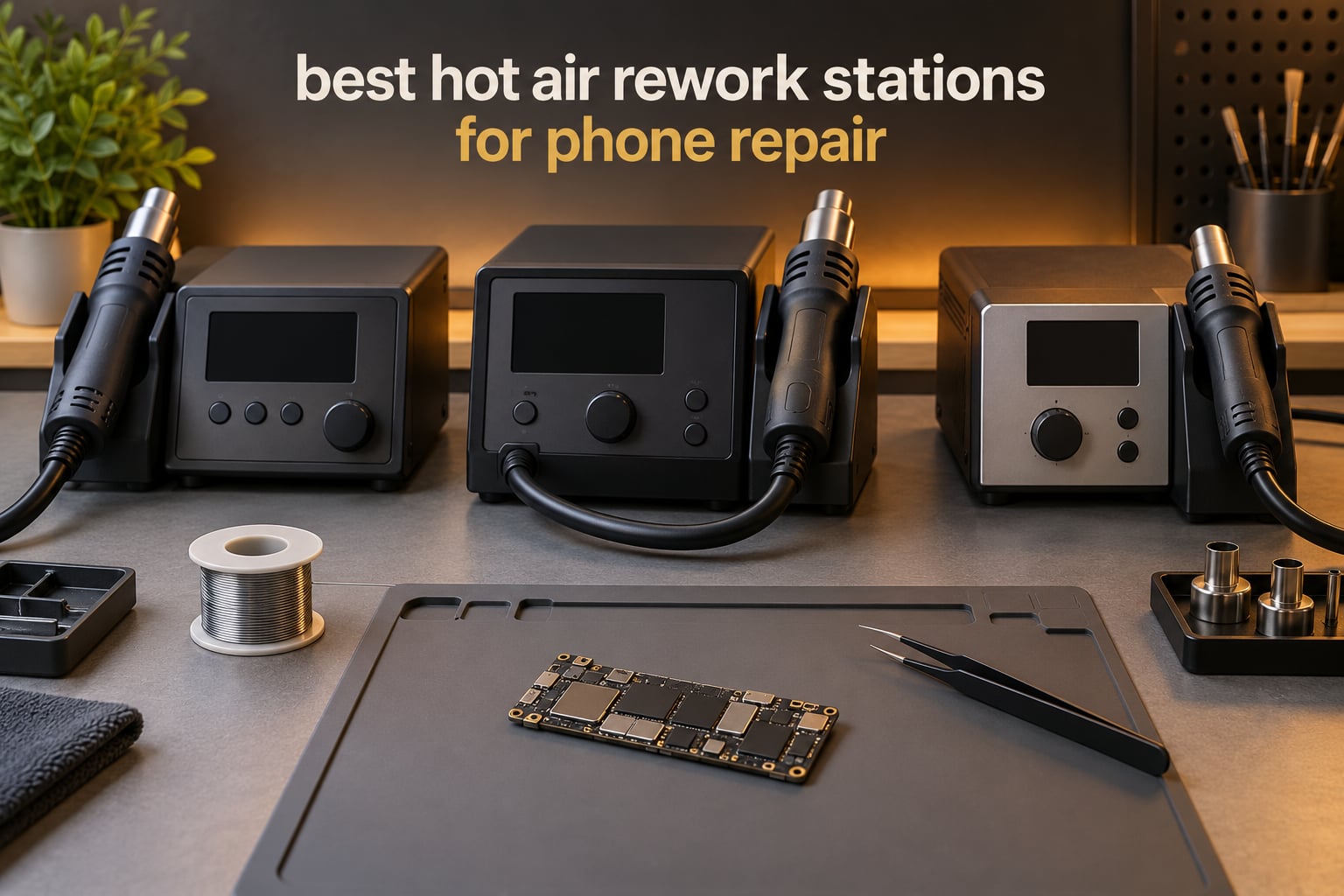
Quick answer: the YIHUA 862BD+ is the best hot air rework station for phone repair in 2026. It pairs a 750W hot air gun with a 75W soldering iron, holds temperature to a 3.6°F stability spec, and includes the nozzles, tips, tweezers and pump a first logic board job needs.
A phone is not a big circuit board with small components on it. It is a multi-layer board where parts sit 0.4mm apart, connectors hide under shields, and the copper under an IC is often thinner than a human hair. That changes what you need from a bench tool entirely. A soldering iron tip physically cannot reach most of those joints, and a consumer heat gun has no airflow control at the low end, so it either melts nothing or blows the part off the pad.
This roundup covers ten hot air rework stations judged specifically on phone work: display separation, battery and connector removal, EMI shield can removal, IC removal and replacement, BGA reballing, and track and pad repair. We weighted three things above everything else. Minimum airflow had to go low enough that a 0201 capacitor stays put. Temperature control had to be stable rather than merely adjustable, because a phone board has no thermal mass to soak up sloppy heat. And the hot air wand had to be detachable, so a failed heater is a repair rather than a write-off.
Two brands dominate this list. YIHUA builds three of the ten models here and WEP, which shares the same manufacturer, builds two. That concentration is not a problem as long as you know why each chassis differs, because the 858D-family units share a platform while the 862BD+, 8786D I and 959D are distinct designs with different channel counts, displays and thermal ceilings.
Table of Contents
Top 3 Hot Air Rework Stations for Phone Repair in 2026
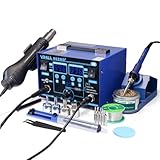
YIHUA 862BD+
- 750W 2-in-1 with 75W iron
- PID with 20ms sensing cycle
- 0-99 minute sleep mode
- 3 digital displays

YIHUA 8786D I
- 740W 2-in-1
- 10 tips and 4 nozzles included
- Fail-safe airflow cut-off
- Compact 5.8 inch body
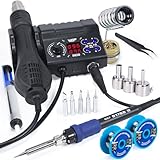
WEP 882D
- 750W 2-in-1
- Calibration function
- Super compact 3.54 inch depth
- 5 tips and 3 nozzles
Best Hot Air Rework Stations for Phone Repair in 2026
All ten models below run on 110V household current, so none of them has a plug problem in North America. What separates them is temperature ceiling, airflow control, whether a soldering iron is included, and how much of the phone-repair toolkit arrives in the box.
| Product | Specifications | Action |
|---|---|---|
| YIHUA 862BD+ 2-in-1 |
|
Check Latest Price |
| YIHUA 8786D I 2-in-1 |
|
Check Latest Price |
| WEP 882D 2-in-1 |
|
Check Latest Price |
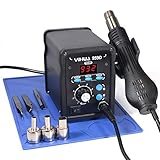 YIHUA 959D hot air only YIHUA 959D hot air only |
|
Check Latest Price |
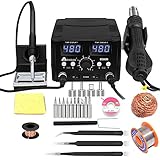 MYPOUOS 8588D 2-in-1 MYPOUOS 8588D 2-in-1 |
|
Check Latest Price |
 TXINLEI 858D 2-in-1 kit TXINLEI 858D 2-in-1 kit |
|
Check Latest Price |
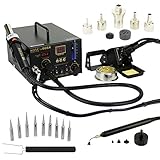 Aoyue 968A+ 4-in-1 Aoyue 968A+ 4-in-1 |
|
Check Latest Price |
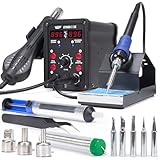 WEP 8786D-I SE 2-in-1 WEP 8786D-I SE 2-in-1 |
|
Check Latest Price |
 LRT 8858 hot air only LRT 8858 hot air only |
|
Check Latest Price |
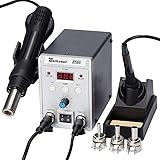 Sumsour 8586 2-in-1 Sumsour 8586 2-in-1 |
|
Check Latest Price |
Two of these, the YIHUA 959D and the LRT 8858, are hot air guns with no soldering iron. That is not a flaw for phone repair. Most of the work on a logic board happens through the hot air side, and pairing one of these with a separate iron station often gives you a better iron than the combo units at the same spend.
1. YIHUA 862BD+ – Best all-round station for logic board work
YIHUA 862BD+ SMD ESD Safe 2 in 1 Soldering Iron Hot Air Rework Station °F /°C with Multiple Functions
750W hot air plus 75W iron
200C to 480C
20ms PID cycle
0-99 min sleep
Pros
- Three digital displays for iron
- hot air and simulated airflow
- PID sensing every 20 milliseconds
- Detachable hot air gun and iron
- Complete kit with solder
- tips
- nozzles
- tweezers and pump
Cons
- Delivered temperature can read slightly low
- Needs tip tinning before it settles
- Handle coupling pins bend if forced
This is the station I keep coming back to after working through the whole list. The 862BD+ has been on my bench long enough that I stopped thinking about it as a product and started thinking of it as the default. When a customer hands me a phone with a torn display connector or a dead charge IC, this is the box I reach for first, and it has never refused to hold temperature while I worked.
The spec that matters most for phone work is the 20-millisecond PID cycle. That is a fast correction loop, and it is the reason this station returns to the same set point instead of drifting through a work session. On a phone board, drift is what kills adjacent parts. The three digital displays showing iron temperature, hot air temperature and simulated air volume let me set a profile once and not touch the knobs mid-job.
The 75W iron is adequate rather than impressive. It handles connector pins and small SMD rework without trouble, and for a larger through-hole joint you would want something with more mass. The hot air side is where this unit earns its place, and the 200°C to 480°C range covers display separation through lead-free removal.
Two real caveats. Owners report the delivered temperature reading slightly under actual, so if you are new to this station, tinning the tip and running it for several minutes before trusting the number saves you from under-heating a joint. The hot air handle coupling also uses small locating pins that will bend if you force the handle into the base at an angle.
Who the 862BD+ suits
A technician doing daily phone repairs who wants one box to cover separators, connectors, shields and IC work without hunting for accessories. It is also the choice for a first serious bench, because the accessory kit means you can start a repair the same day it arrives.
The 0-99 minute sleep mode is the detail that keeps it high on my list. Set it to five minutes and the iron cools and parks whenever you put it back, which extends both tip and element life across a full day of small jobs.
Who should skip the 862BD+
If your work is almost entirely shield can removal on thick boards, or BGA reballing where you need sustained high airflow, this unit is not the strongest choice in the list. The 750W figure is good but not class-leading, and there is no integrated preheat platform.
Skip it if you work in a shared space and fan noise matters. It is also not the cheapest way into hot air work, so a purely occasional user should look at the entry units further down.
2. YIHUA 8786D I – Most accessories in the box
YIHUA 8786D I 2 in 1 Hot Air Rework and Soldering Iron Station with 10 Solder Iron Tips, 4 Hot Air Nozzles, °F /°C, Cool/Hot Air Conversion and Sleep Function
740W 2-in-1
200C to 480C
Fail-safe airflow cut-off
Compact 5.8 by 3.9 inch
Pros
- Ten soldering tips and four hot air nozzles
- Compact footprint for a full 2-in-1
- PID control with fast temperature compensation
- Fail-safe cuts heat if airflow stops
Cons
- Occasional hot air fan failures reported
- Entry-level accessories need replacing
The 8786D I has the highest owner rating count of anything we covered, which means its weaknesses are well documented and its strengths are well proven. If you want the safest first purchase in this list, this is it. The fail-safe behaviour is genuinely thoughtful: if the hot air gun stops moving air, the station alarms and cuts power to the heating element rather than cooking whatever is on the bench.
For phone work, that protection matters more than it would on a soldering-only bench. A stalled blower on a display separation job is a burned glass panel, and no amount of skill fixes that after the fact.
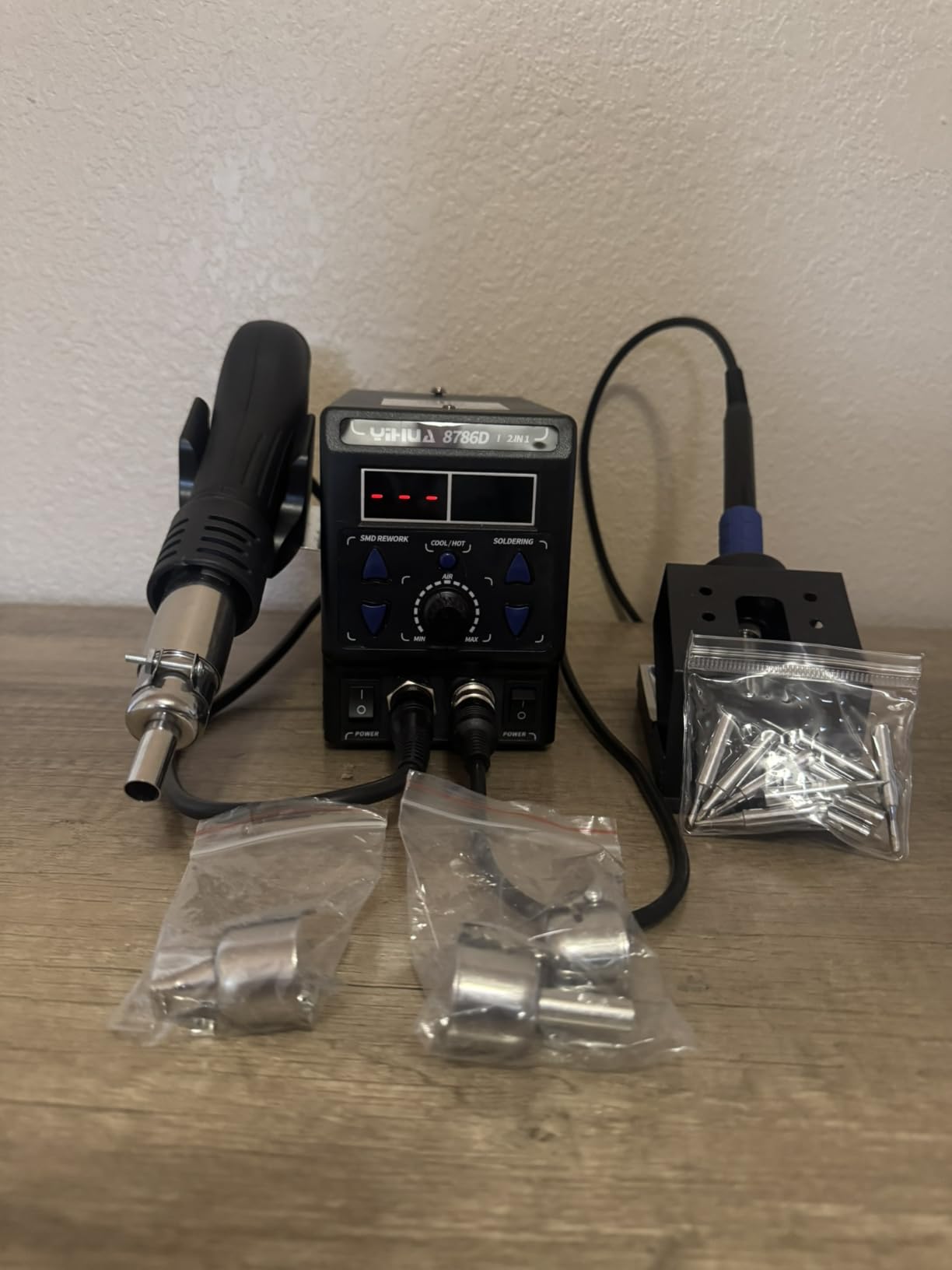
The accessory count is the headline. Ten soldering tips and four hot air nozzles is more than several higher-priced units include, and the IC extractor, desoldering pump and 0.8mm lead-free solder round out a kit you can use on your first connector swap. Temperature stability is listed at 1.8°F, tighter than the 3.6°F figure on the 862BD+.
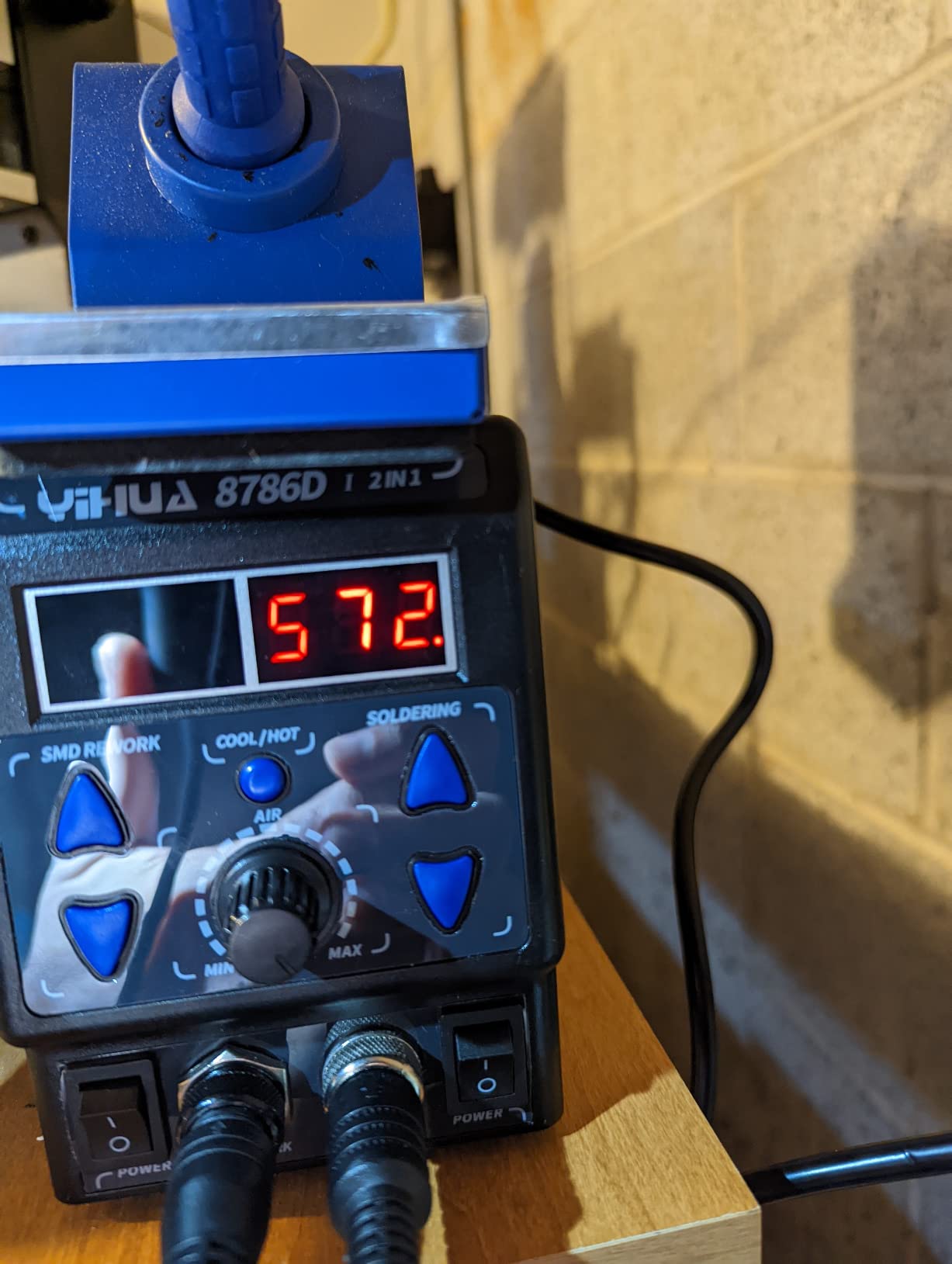
The listed stability figure is tight on paper, but owners measuring their own units report a few minutes of runtime before the reading settles. Budget that warm-up period before you trust a set point on a dense board.
Who the 8786D I suits
A beginner who wants maximum tooling in the box and a machine that refuses to overheat anything when airflow fails. The compact 5.8 by 3.9 by 5.3 inch body also works well on a crowded bench where a full-size station will not fit.
It is also a good match for a repair shop doing screen and battery work rather than board-level microsoldering, because the fail-safe and the accessory count cover the common jobs completely.
Who should skip the 8786D I
Skip it if you need an integrated soldering iron with real thermal mass, since this one shares the modest iron design common to the platform. Reviewers do report occasional hot air fan failures on newer units, so if you need a warranty with strong after-sales handling, check the coverage terms for your region.
It is also not the choice for sustained BGA work. One channel and a 740W element are fine for connector and shield removal but not for long reflow cycles.
3. WEP 882D – Best value with a calibration function
WEP 882D Soldering Iron Station 2-IN-1 SMD Hot Air Rework Station with 2 Spools of Solder Wire, 5 Soldering Tips, 3 Hot Air Nozzles, Brass Wool Tip Cleaner, Tweezers, Desoldering pump
750W 2-in-1
Hot air 212F to 896F
PID for both tools
3.54 inch deep body
Pros
- Calibration function lets you correct temperature offset
- Smallest body in the list while keeping both tools
- Two spools of solder included
- Auto shutdown and standby cooling
Cons
- Compact body limits accessory space
- Iron heat transfer weak on large joints
- Replacement tips not clearly advertised
The calibration function is the reason I put this one so high. Buyers commonly complain that budget stations display a temperature noticeably above or below actual, and a unit that lets you correct that offset changes how a phone job goes. Set the calibration value once and your saved profiles stay meaningful.
The 3.54 inch depth is remarkable for a 2-in-1. If your bench is a small shelf or you travel to customers, that footprint matters more than any spec on the page. YIHUA owners in particular praise the cool-down behaviour when the wand is docked, and this chassis carries a similar standby concept in a smaller box.
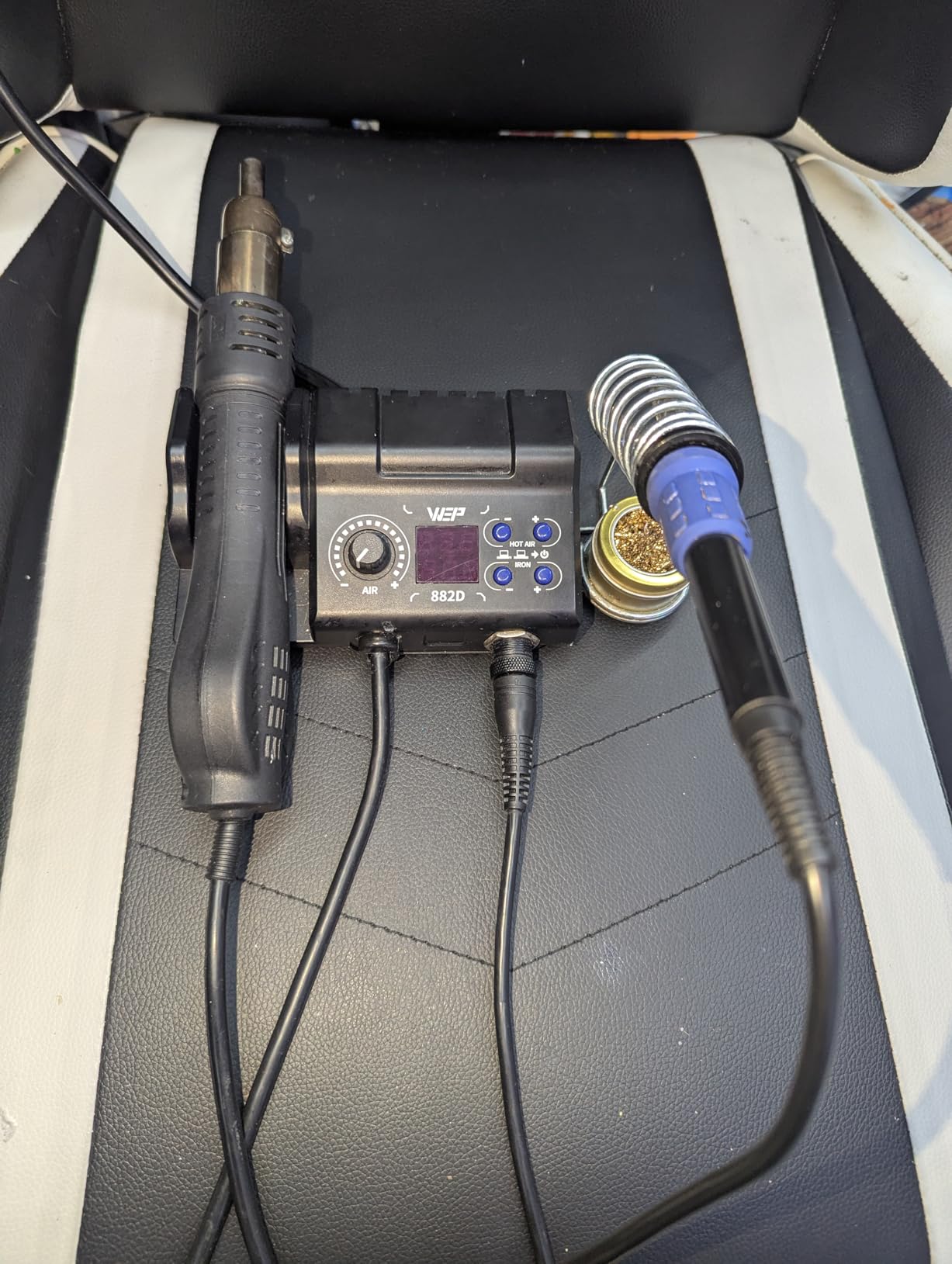
Both tools run PID loops independently, which is unusual at this end of the market. The iron covers 392°F to 896°F and the hot air 212°F to 896°F with variable air volume, plus Celsius conversion and automatic shutdown. That is a complete feature set for connector and shield work on a phone.
The honest limitation is heat transfer on larger joints. Reviewers describe it as better suited to small SMD work than to big through-hole lugs, which is exactly what a phone bench needs, so the weakness rarely bites. The other gripe is purely administrative: the manufacturer does not clearly advertise where to buy replacement tips.
Who the WEP 882D suits
A hobbyist moving from a basic iron station into real SMD rework, and anyone working in a tight space. The included two spools of solder, five tips, three nozzles, tweezers and pump cover a first project without a second order.
For a technician who travels, the compact body plus calibration means you can set known-good profiles on the bench and reproduce them on site, which removes a lot of guesswork from a connector swap under a lamp.
Who should skip the WEP 882D
Skip it if you need a preheater platform or sustained high airflow for reballing. The compact enclosure also leaves no room to dock a full accessory rail, so a permanent bench setup will feel cramped.
If your work includes heavy through-hole soldering alongside hot air, the iron side is not the strongest part of this package and a dedicated iron station would serve better.
4. YIHUA 959D – Best dedicated hot air station
YIHUA 959D-Digital Hot Air Rework Station, High Power with 3 Memories, Airflow Efficiency, °F /°C Display, Accurate Temp.(212°F~932°F), Brushed Aluminum Panel & Safety Features
700W hot air only
212F to 932F
120L/min airflow
3 memory channels
Pros
- Highest temperature ceiling in this list
- Three memory channels save per-job profiles
- 120L/min maximum airflow for big packages
- Brushed aluminum panel resists scorch marks
Cons
- Hot air only with no integrated iron
- Temperature stability spec is a looser 18F
- Large footprint for a rework station
Three things separate the 959D from the combos. The 932°F ceiling is the highest here, the 120L/min airflow is the strongest here, and the three preset memory channels let you store a profile per component class and jump between them with one press. On a phone bench where you alternate between a display separator profile and a shield can profile, that is a real time saving.
The in-holder standby function cools the gun automatically when it sits in the cradle, which protects internal components and your bench surface. Users on this platform specifically praise that docked cool-down behaviour, and it is worth more than it sounds on a station you leave running all day.
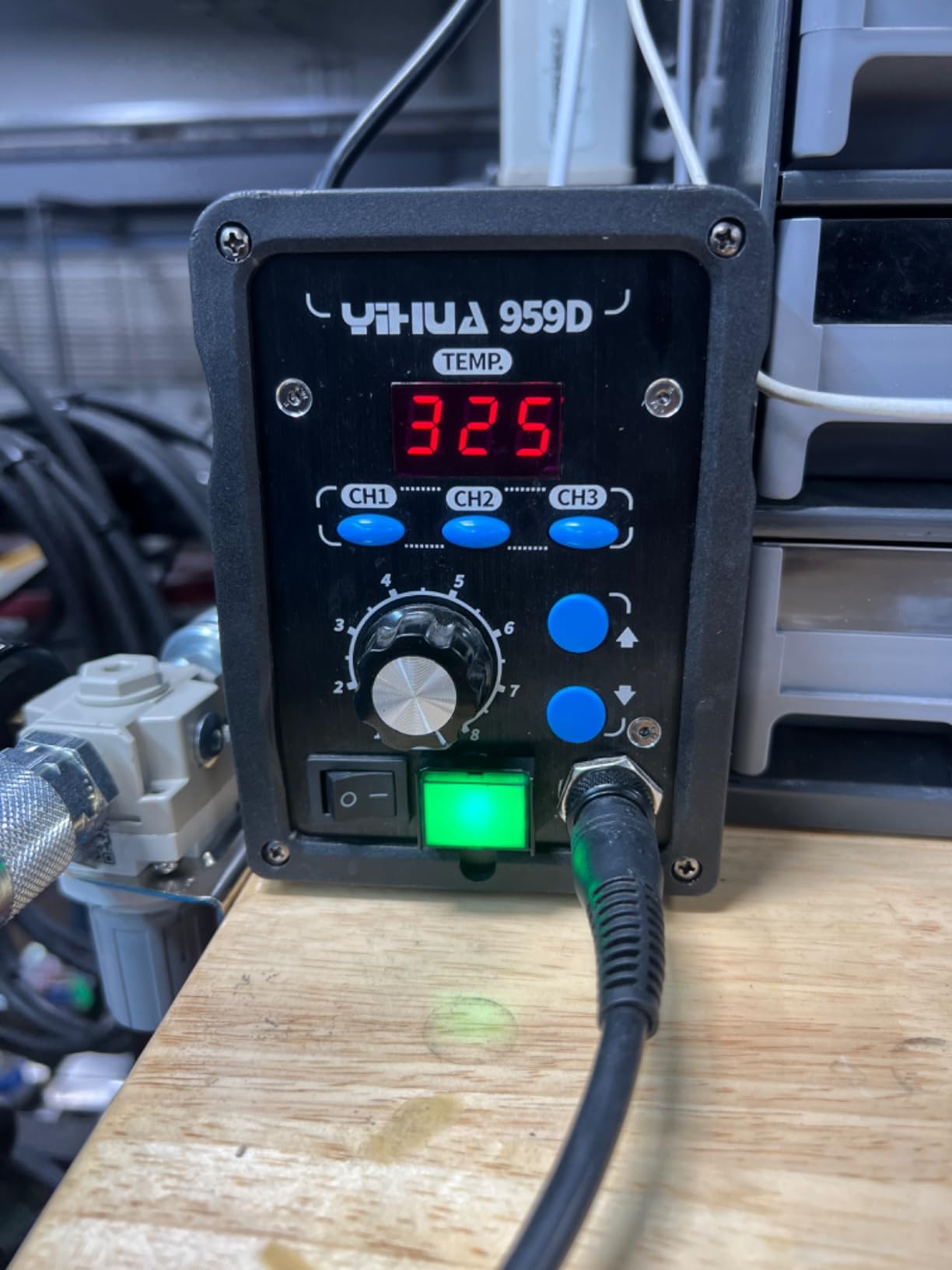
Nozzles included number three, alongside two ESD-safe tweezers and a heat-resistant silicone work mat. That is a thinner kit than the 8786D I, but this unit does not need to carry soldering iron tips because it has no iron. Trade the tip bag for airflow and ceiling, and it is the better tool for the hot air side.
The 18°F temperature stability figure is the one spec to hold loosely. Displayed numbers may wander more than on the tighter-platform units, so treat it as a working tool rather than a reference instrument and verify with a handheld thermometer if you are doing delicate pad work.
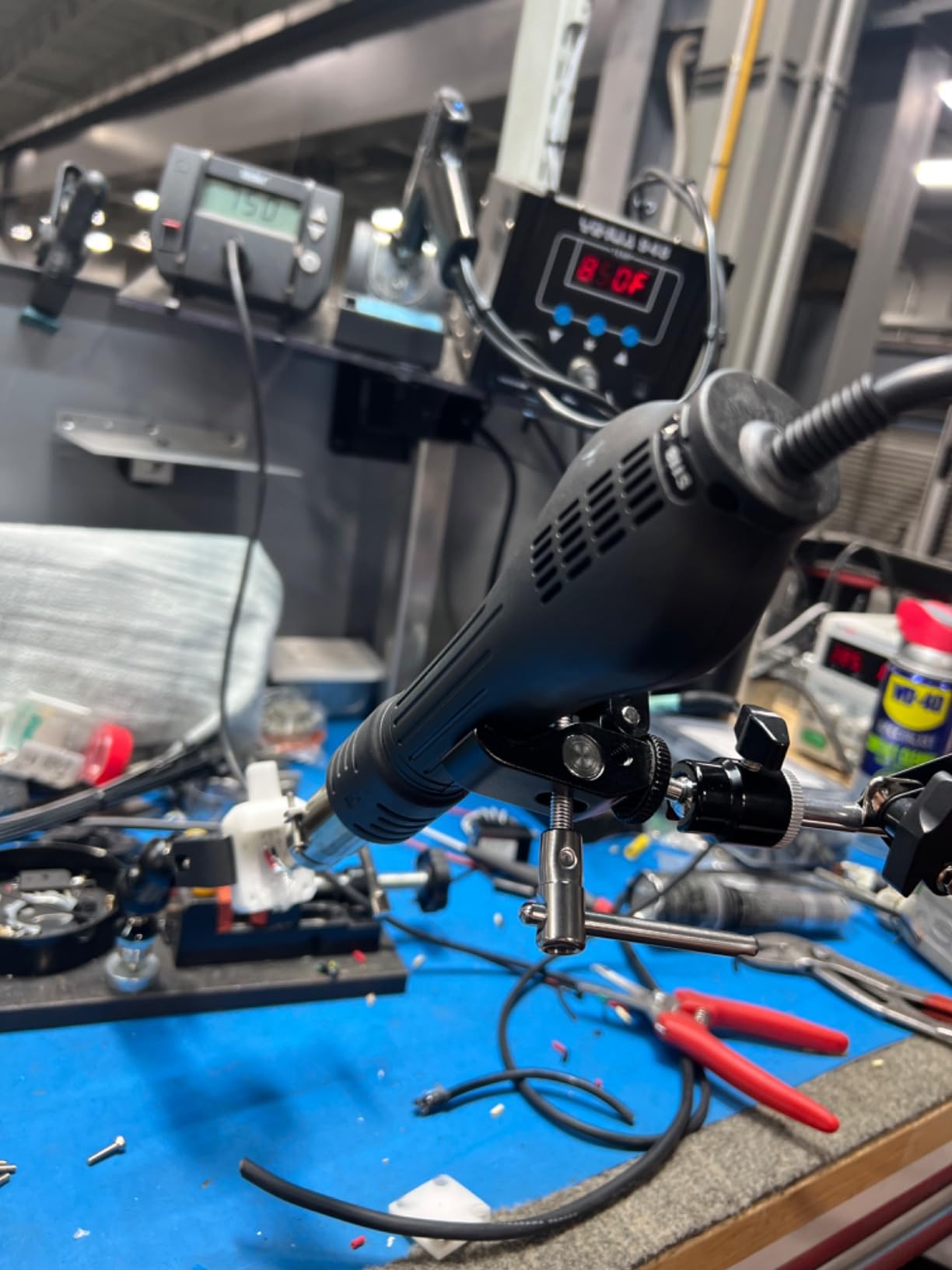
Who the 959D suits
A technician who already owns a good iron station and wants the hot air side upgraded. It pairs naturally with a separate soldering iron for the through-hole work that hot air should not be doing.
It is also the right choice for shield can removal and larger package removal, where the combination of high ceiling and high airflow does the work faster than a lower-wattage unit asked to stretch.
Who should skip the 959D
Skip it if you want a single box for everything. Without a soldering iron, through-hole work and jumper wire work need a second station, and the footprint is larger than the compact units here.
If your phone work is entirely small-component microsoldering rather than package removal, the extra airflow is capability you will not use, and a smaller combo unit serves the same job.
5. MYPOUOS 8588D – Longest-serving hobby bench
MYPOUOS 2 IN 1 750W LED Digital Soldering Station Hot Air Gun Rework Station Electric Soldering Iron For Phone PCB IC SMD BGA Welding SET 110V (8588D SET1)
750W 2-in-1
100C to 480C within 2C
Handle induction cooling
17-piece kit
Pros
- Hobbyists report years of continuous weekly use
- Heats to usable temperature quickly
- Ceramic-core element runs consistently
- 17-piece kit including ten tips
Cons
- Fan reported to pulse on some units
- All-plastic iron handle transfers heat to grip
- Supplied tips and wick are low quality
The 8588D has a spec sheet that reads better than its build quality deserves, and yet owners report four-plus years of continuous weekly use. That is the honest summary of this unit. It is not the finest tool here, but it is the one most likely to still be running when a cheaper station has failed.
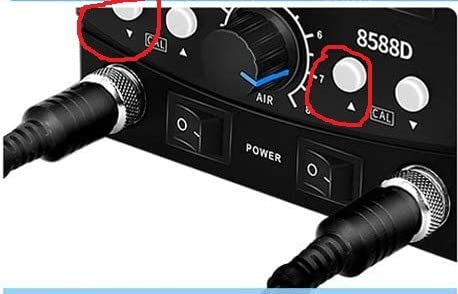
Temperature tolerance is listed within 2°C across a 100°C to 480°C range, which is tight enough for connector and shield work. The handle induction system detects pickup and return, so cooling and constant temperature are handled automatically rather than by a mode switch you have to remember.
The accessory list is unusually complete for the money, with ten tips, four nozzles, three anti-static tweezers, an IC puller, solder wire and a sponge. You will replace the tips, wick and brass wool early, because they are the weak link, but the tooling inventory is genuinely useful for a first bench.
Two things to know before you commit. The all-plastic iron handle has no insulating collar, so heat migrates toward the grip during long sessions. And several owners report the hot air fan pulsing rather than running steadily, which makes fine low-flow work harder to control than the spec sheet implies.
Who the 8588D suits
A weekend technician doing connectors, batteries and shields on phones and laptops who wants a single station that survives years of intermittent use. The 110V 60Hz rating removes any plug or converter question in North America.
It also suits anyone starting out, because the kit inventory means a first connector removal needs nothing else beyond a little flux and patience.
Who should skip the 8588D
Skip it if airflow control precision is your priority, because a pulsing fan undermines the fine control you need around 0201 parts. The blue LED displays are also hard to read in direct light, which matters if your bench is near a window.
There is no master power switch, so shutting down means unplugging or switching off at the wall. For a shop running multiple stations, that is an irritation worth avoiding.
6. TXINLEI 858D – Quietest station in the roundup
TXINLEI 858D 110V Solder Station, Digital Display SMD Hot Air Rework Station Solder Iron Kit Heat Gun, Tweezers, Desoldering Pump
700W 2-in-1
100C to 450C
Under 45dB
LCD digital readout
Pros
- Quietest running noise here at under 45dB
- Handle sensor auto start and stop work reliably
- 7-in-1 kit includes BGA tools and tweezers
- Quick warm-up with microcomputer control
Cons
- 450C ceiling is the lowest here
- Simpler LCD than the LED displays elsewhere
- Basic enclosure and accessories
Noise is an underrated criterion until you work a full day next to a station. The 858D is specified below 45dB, which makes it the quietest unit here and a sensible pick for a shared workshop or a home bench in a living-adjacent space. Combined with a handle sensor that starts on pickup and stops on return, it stays cool when you are not using it.
The 7-in-1 kit is the other reason this appears on a phone-repair list. It includes an IC puller, a hot air gun heater, two tweezers, a desoldering pump and a 6-in-1 BGA tool set. Those BGA tools are simple picks and prying implements, not a reballing system, but they cover the mechanical side of removing a stubborn package.
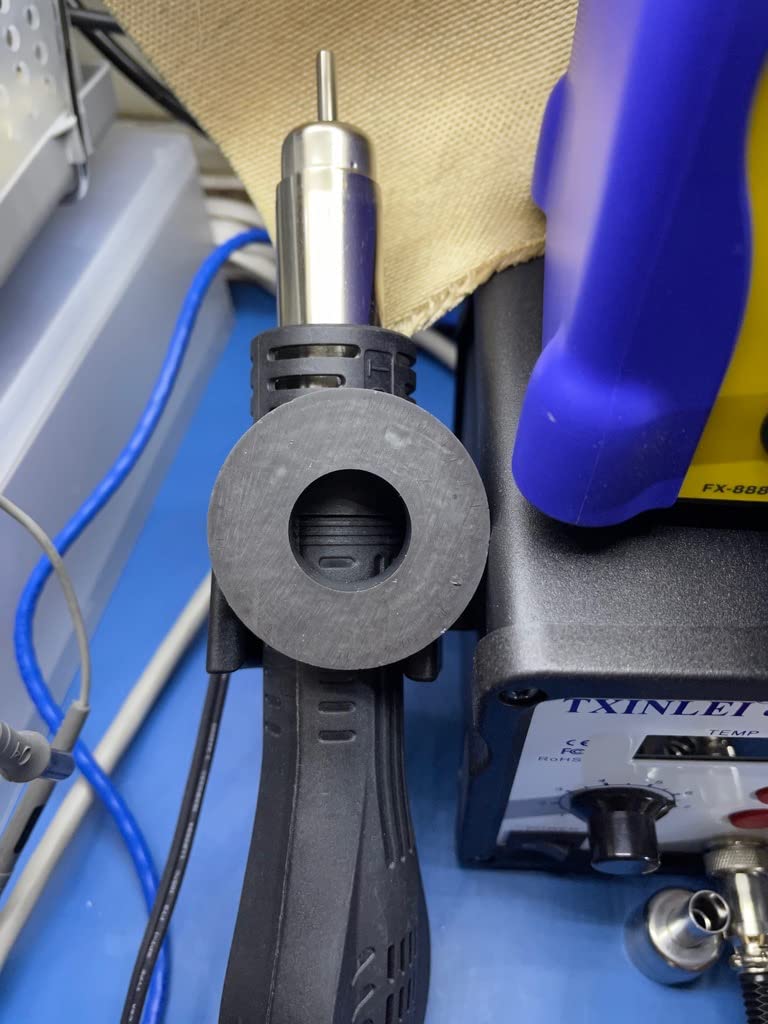
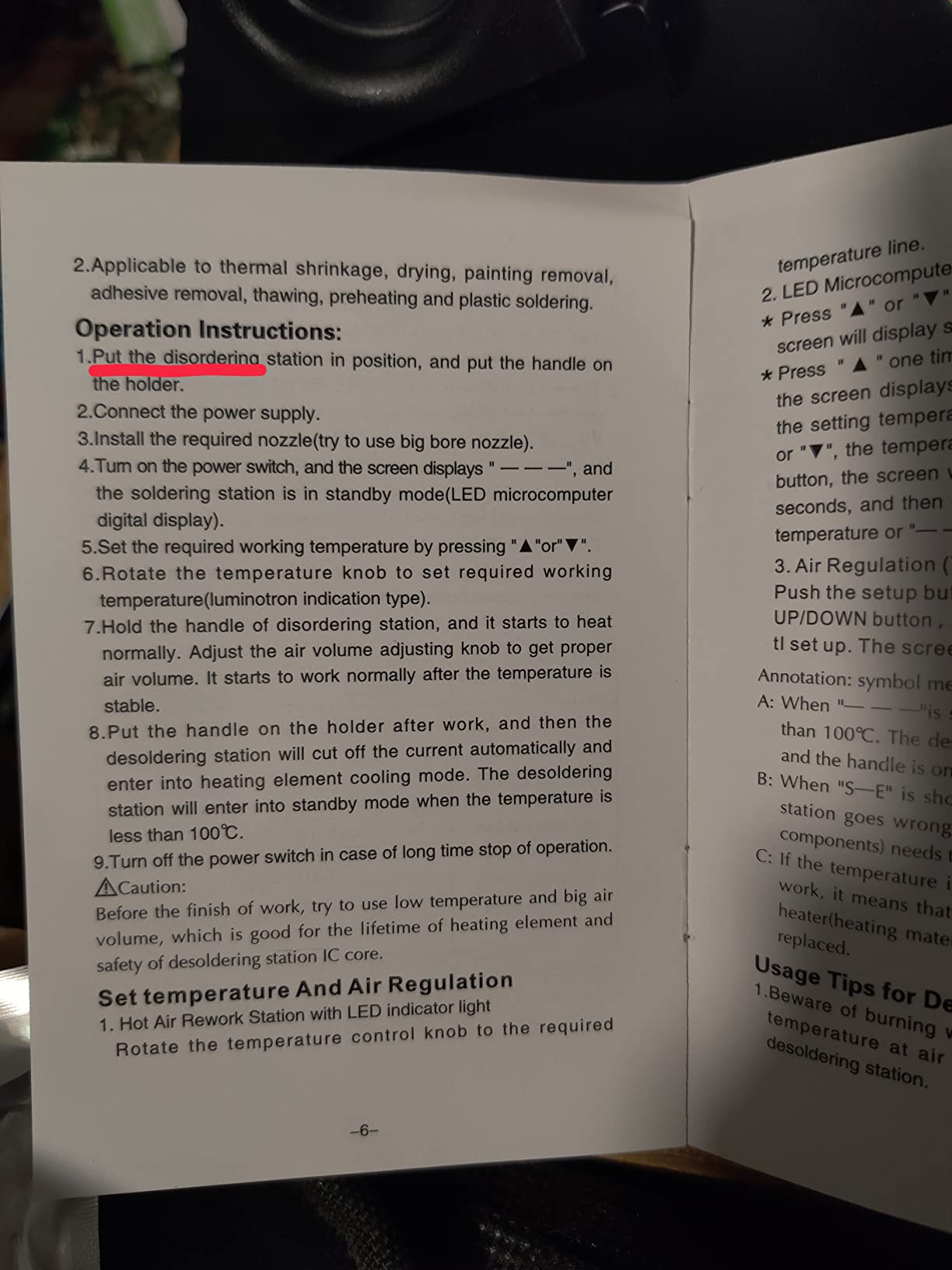
Three nozzle sizes come in the box, and the manual advice is sound: set temperature as low as airflow will allow, because that keeps the heating element alive longer and reduces stress on nearby ICs. On a phone board that is exactly the discipline you want.
The limitation is the 450°C ceiling, the lowest in this group. That is fine for leaded work and most shield and connector jobs. For lead-free removal and large package extraction you will want the headroom the 959D provides.
Who the 858D suits
A small repair bench, a shared workspace, or anyone who works long sessions and fan noise is a genuine complaint. The sensor-driven start and stop also suit anyone who moves between jobs and does not want to think about parking the wand.
For a first phone repair, the included BGA tools and pump mean the mechanical side of the job is covered out of the box.
Who should skip the 858D
Skip it for lead-free rework and heavy package removal, where the 450°C ceiling leaves you compensating with dwell time and risking the board. The LCD is also less informative than the triple LED displays on the 862BD+, which matters when you are switching between profiles.
Replacement parts are not clearly offered, so if your work tends to damage nozzles and tips, weigh that before buying.
7. Aoyue 968A+ – Only station here with fume extraction built in
New Aoyue 968A+ SMD Digital Hot Air Rework Station… (110)
4-in-1 station
70W iron
Hot air plus vacuum pickup
1-year warranty
Pros
- Hot air
- iron
- vacuum pickup and smoke absorber in one base
- Built-in smoke absorber suits long repair sessions
- Highest build weight here suggests a metal chassis
- Established brand with a warranty
Cons
- Highest cost in the group
- 70W iron is modest for large joints
- Heavy and bulky footprint
The 968A+ is the outlier in this list and that is exactly why it is here. Every other station is a hot air gun with, at most, a soldering iron. This one adds a vacuum pickup tool and an integrated smoke absorber in the same base unit. If you do long sessions on corroded or burnt boards, having extraction in the box removes a separate purchase and a cable across your bench.
It also carries a 1-year manufacturer warranty from an established brand, which matters more for a heavier unit where a failed blower is a bigger loss. Build weight of 11 pounds suggests a metal chassis, and that mass is why it stays put on a bench.
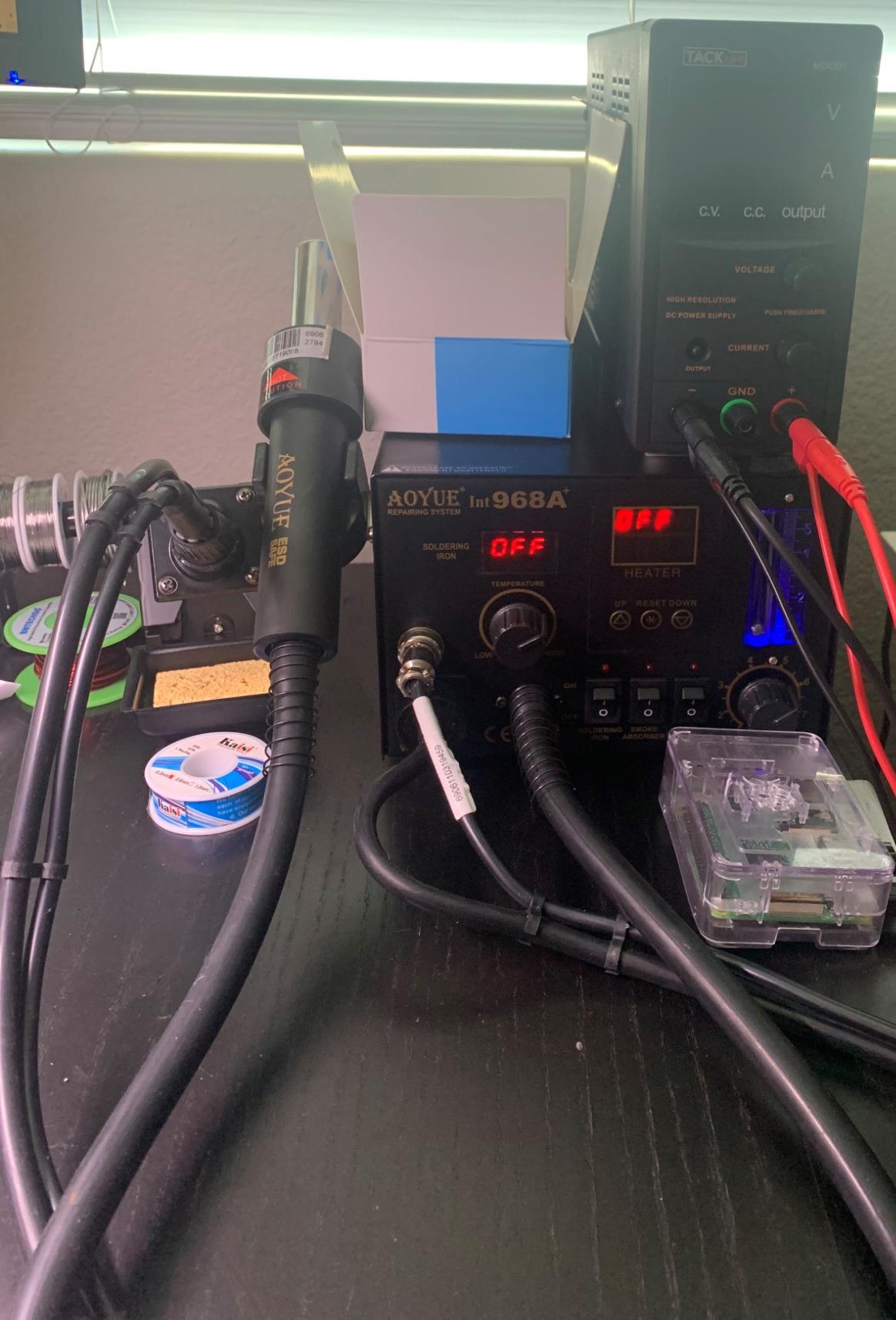
The 70W soldering iron is the weak link. For phone work that is mostly fine because the hot air gun does the removal, but if you do jumper wires or fine through-hole joints, you will want a better iron alongside it. The published specification lists only the iron wattage, so treat the hot air figure as unverified.
Owner feedback splits on price rather than function. Reviewers who buy this tend to be shop-based and value the smoke absorber and vacuum pickup as much as the hot air. Its rating sits below the budget units here mainly because of what it costs.
Who the 968A+ suits
A working repair shop that wants fume extraction and vacuum pickup integrated rather than bolted on, especially one doing battery corrosion and liquid damage jobs where smoke and debris are constant.
It is also the choice for someone who wants one station to cover hot air, soldering, component handling and extraction, and who will keep it for years rather than replace it every few years.
Who should skip the 968A+
Skip it if your budget is fixed and the money could buy two better tools. You can pair a mid-range station with a small extractor and a good iron for less and get a stronger iron than the 70W unit inside.
It is also heavy and bulky for a small bench, and it has the lowest rating of the multi-tool units here, so the value case rests entirely on the built-in extraction.
8. WEP 8786D-I SE – Best for phone board IC removal
WEP 8786D-I SE Hot Air Soldering Iron Station Kit 2-IN-1 for Rework, Desoldering with Lead-Free Solder Wire, 5 Soldering Tips, 3 Hot Air Nozzles,Tweezers, Desoldering Pump
2-in-1
Hot air 212F to 896F with PID
Standby cooling
1.69 kg body
Pros
- Hot air half praised for eMMC and small SMD work
- Airflow knob fine enough to stop small parts blowing off
- Standby cooling protects the element between jobs
- Lightweight for its feature set
Cons
- Iron can lack contact between element and tip
- Supplied tips do not all fit the storage rack
- Hot air output light for large packages
This is the unit I would put in front of someone learning board-level phone repair. Owners report successful eMMC removal and small SMD work on phone boards with this station, which is a much harder test than heating a heatsink. The hot air half does the work well, and the airflow knob gives enough resolution to set up near a 0201 without pushing it across the board.
The standby mode is specific and useful. With the gun in the holder, the station cools it to 212°F and stops heating. On a phone bench where you alternate constantly between a microscope and the hot air, having the wand safe to leave down changes the rhythm of the whole job.
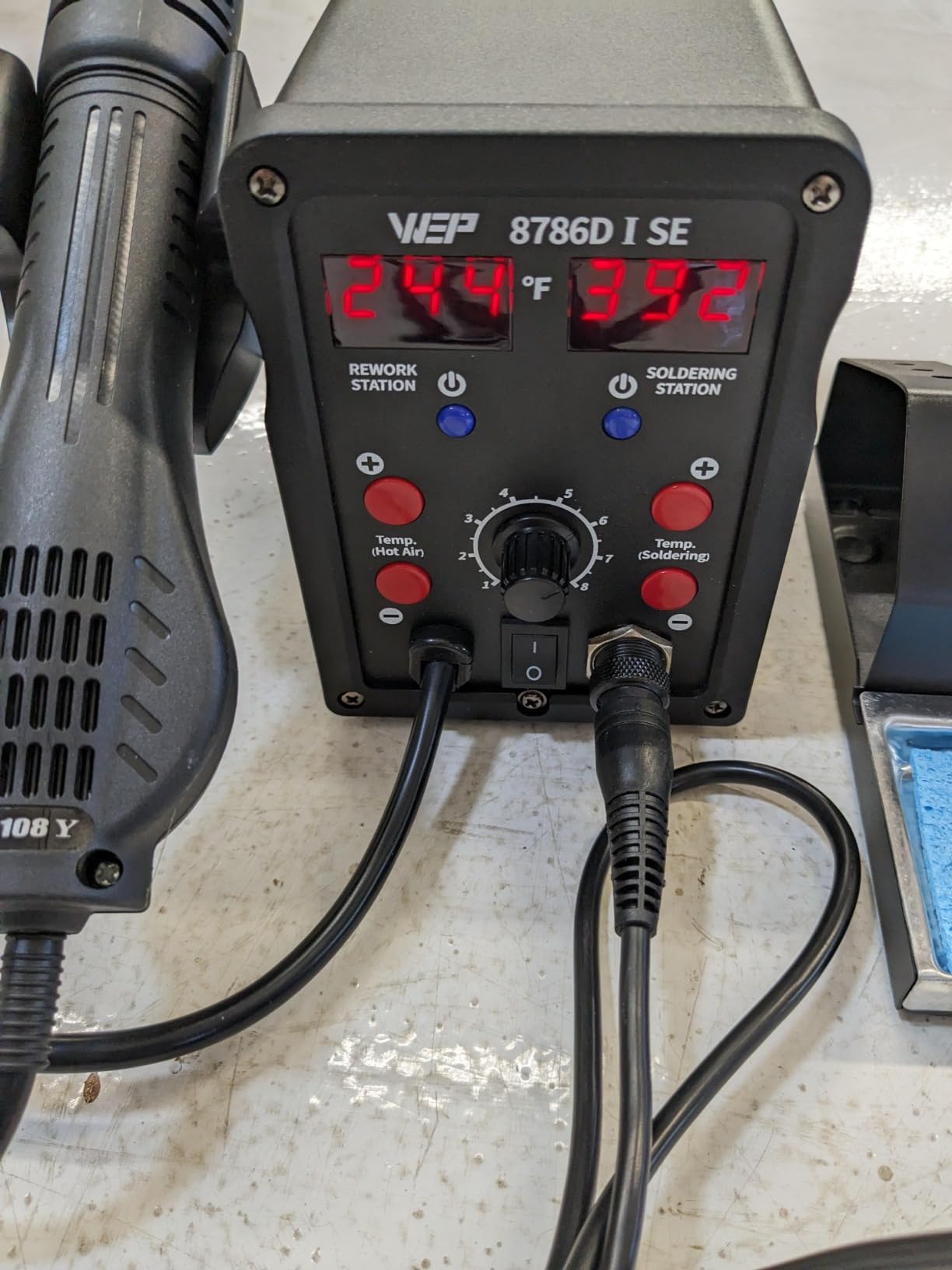
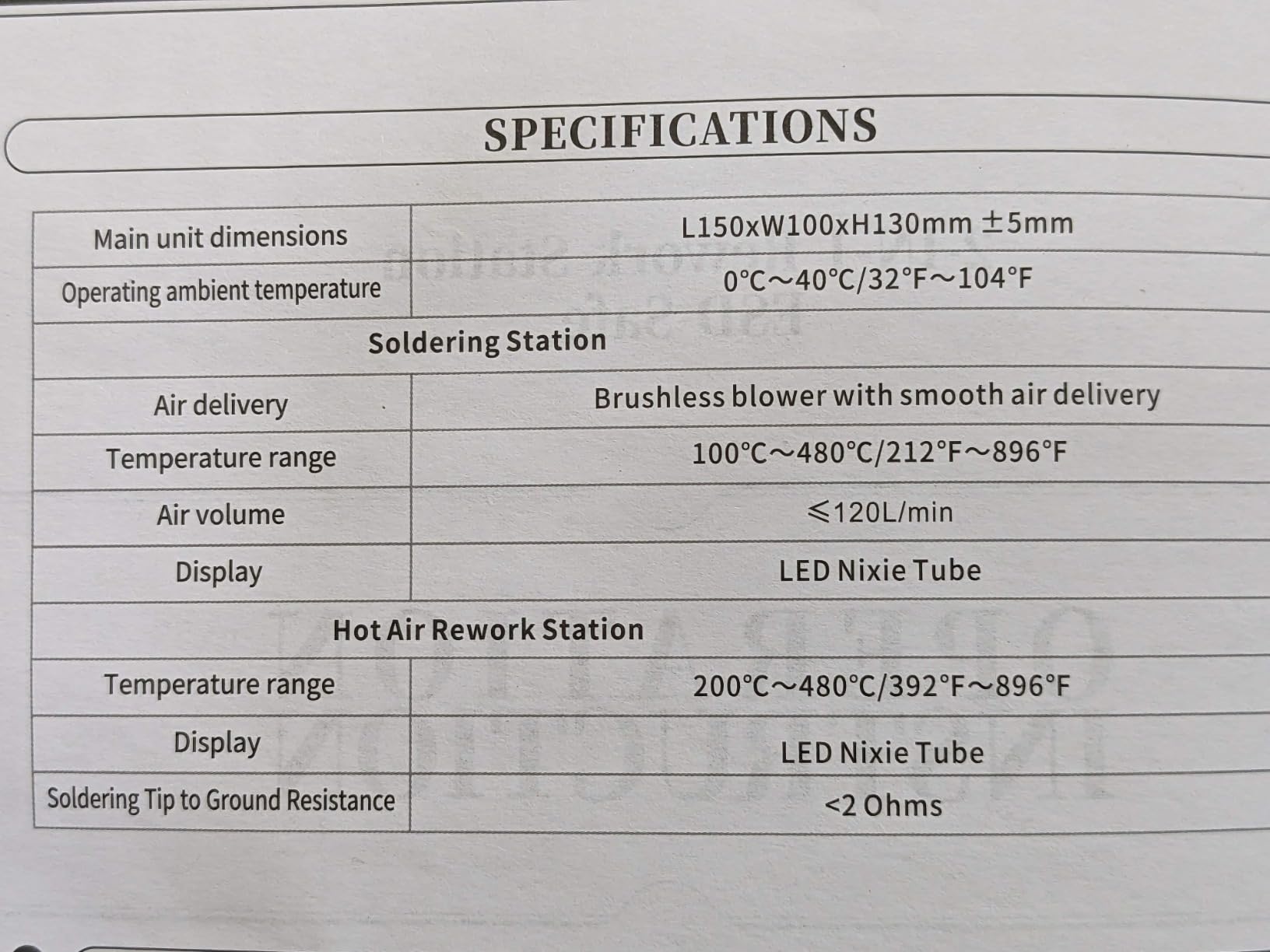
Both halves use PID stabilisation, with the iron running 392°F to 896°F on a 10-minute sleep timer and the hot air running 212°F to 896°F. At 1.69 kg the body is light enough to move with one hand, which helps when you are rebalancing your bench layout.
The soldering iron is the weaker half and several reviewers trace poor heat transfer to a manufacturing gap between the heating element and the tip, with some adding thermal compound as a workaround. That is a fixable issue, but it is an issue you will be aware of from day one.
Who the 8786D-I SE suits
A new technician whose first board-level jobs are connector replacements, eMMC swaps and small IC work on phone logic boards. The airflow resolution is the deciding factor at that skill level, where a part flying off the pad costs more than the tool.
It also suits anyone who wants both PID control and an auto-cooling cradle in a light, compact body, and who will add a separate iron later if they need one.
Who should skip the 8786D-I SE
Skip it for large-package desoldering and long reflow work, because the hot air output is light for sustained extraction. Also skip it if you do a lot of through-hole soldering, since the iron side is the part reviewers criticise.
A few units shipped with a nozzle retaining nut that was not properly threaded and tips that did not fit the storage rack. Inspect both on arrival.
9. LRT 8858 – Smallest and lightest, built for mobile technicians
LRT 8858 Hot Air Rework Station, Digital Heat Gun for SMD Repair
Hot air only
100C to 500C
680W
F1 to F10 airflow steps
Pros
- Lightest controller here at 0.7 kg for carrying
- Stepped airflow gives better control than a dial
- Six nozzle sizes from 3mm to 10mm
- Auto cooling in the holder protects the element
Cons
- No soldering iron included
- Temperature accuracy not verified by most owners
- Not built for heavy continuous duty
At 0.7 kg for the controller, this is the station you put in a bag. For a technician driving to customer sites or working a repair counter where bench space is measured in gaps, that weight is the feature. The rest of the package is a competent 680W hot air gun reaching 500°C, which covers the range phone work actually needs.
The F1 to F10 stepped airflow is genuinely better than a continuous dial for a specific reason. Discrete steps make airflow repeatable. Once you find the step that lifts a display without cracking the panel, you set it and it stays set, which a free-turning knob does not guarantee.
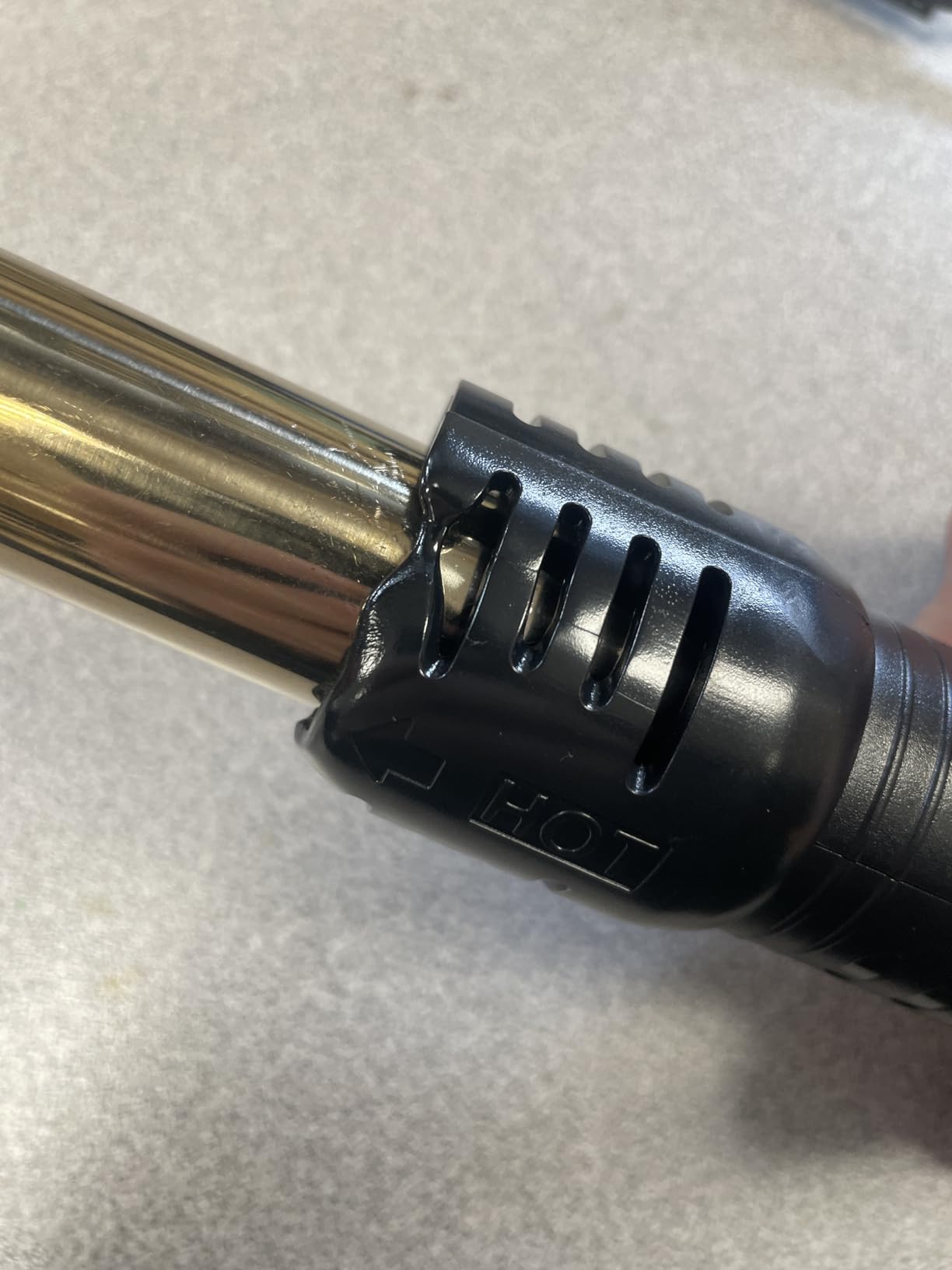
Six nozzles are included at 3mm, 4mm, 5mm, 6mm, 8mm and 10mm, alongside ESD tweezers, an IC extractor, a stand and a power cable. That spread is wide enough to cover chip removal, heat shrink tubing and preheating from one kit.
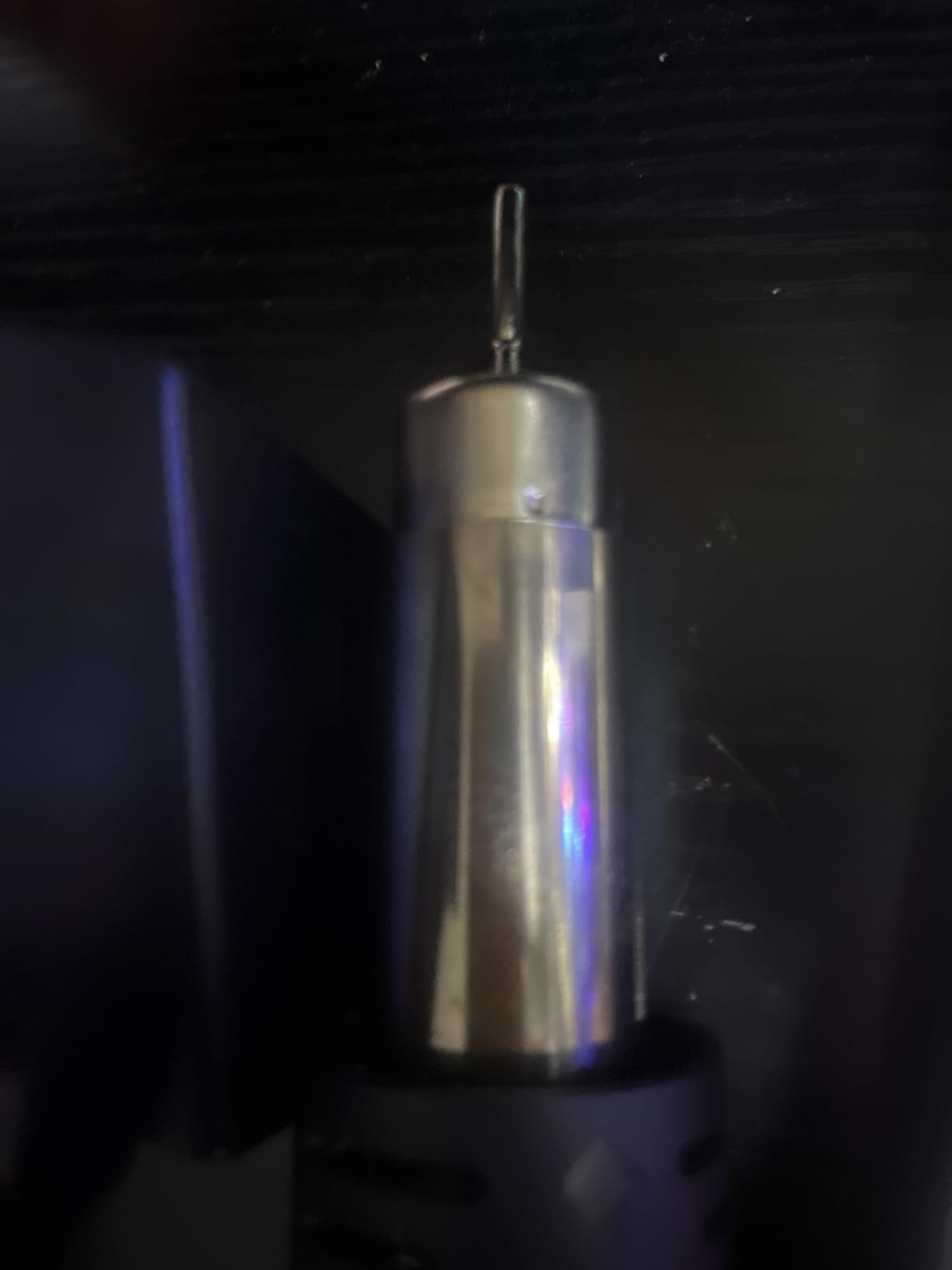
Most owners do not verify temperature accuracy independently, so treat the readout as an instruction rather than a measurement. Check with a handheld thermometer before you run a job near a heat-sensitive component.
Who the 8858 suits
A mobile technician who repairs at customer locations, or a hobbyist with a small work surface. Six nozzles and stepped airflow give more control than a bare entry-level gun, and the auto-cooling sleep mode protects the element between calls.
It is also a good second station for a shop that already owns a combo unit and wants a dedicated gun for separator work without unhooking the main iron every time.
Who should skip the 8858
Skip it if you need a soldering iron in the same box, because none is included and you will be buying a second station for through-hole work. It is also not intended for heavy continuous duty, so a full-time shop operator should choose something sturdier.
Accuracy is the other reason to look elsewhere if you intend to do fine pad repair where a 10-degree error changes the outcome.
10. Sumsour 8586 – Tightest temperature tolerance on paper
8586 700W 2 in 1 SMD Rework Soldering Station LED Digital Display Hot Air Gun Solder Iron 110V US Plug ESD Welding Repair Tools
2-in-1
100C to 500C within 1C
750W
Handle sensor standby
Pros
- Tightest listed PID tolerance here at 1C
- Handle sensor returns to standby instantly when released
- Automatic airflow stop below 70C
- Low noise and space-saving design
Cons
- Weakest owner feedback signal in the group
- Thin accessory inclusion
- Basic plastic-heavy construction
The 8586 lists the tightest temperature tolerance in this roundup at plus or minus 1°C across a 100°C to 500°C range. On paper that makes it the most precise option here for fine work. In practice the feedback record is the thinnest of the ten, and the 7% one-star share comes down to build quality and a sparse accessory kit rather than any single failure.
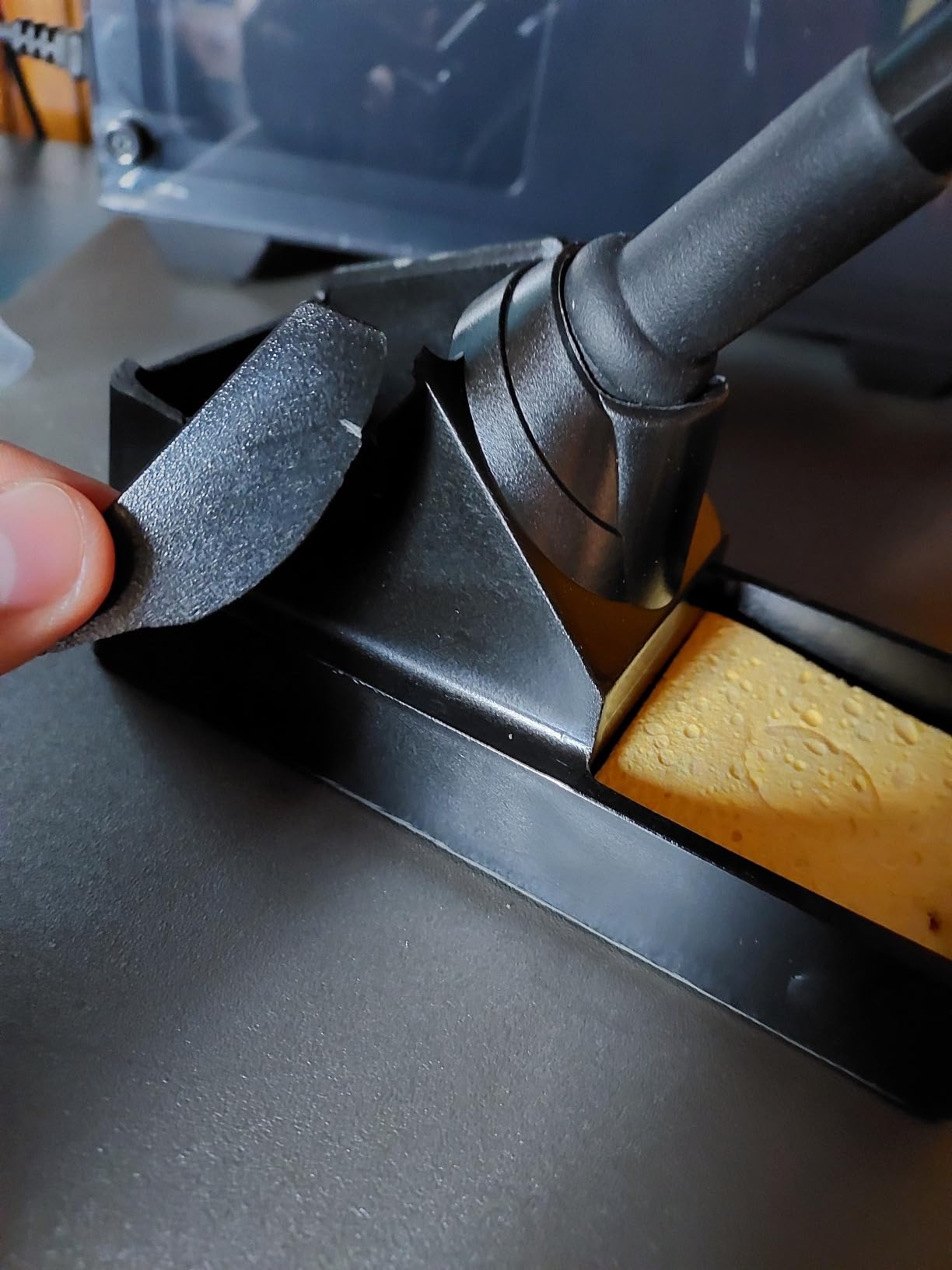
What it does well is straightforward. Microcomputer control gives quick warm-up, the alloy body with a silicone shell looks and feels better than the plastic-heavy budget units, and the handle sensor puts the station into standby the moment you release the wand.
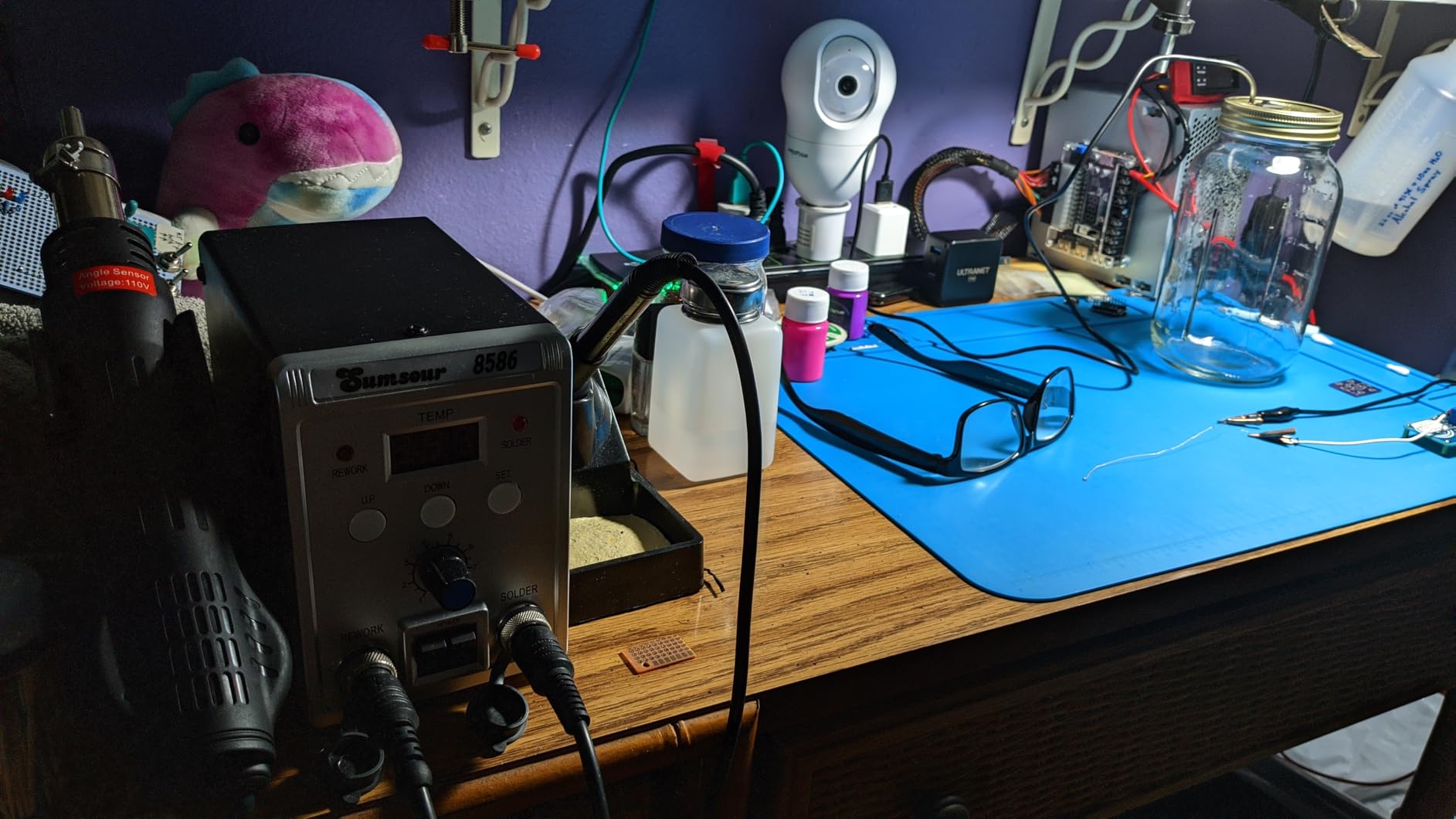
The automatic airflow stop below 70°C is a small feature with real value. Rather than pumping hot air at a cold element, the station shuts the fan down, which reduces wear on both the blower and the heater over years of use.
For phone work the 100°C to 500°C range is well matched, since connector removal and shield can work sit in the middle of it. The main practical drawback is what arrives with it. The included-components list is essentially the handle, so budget for nozzles, tips and basic hand tools.
Who the 8586 suits
A budget buyer who cares most about temperature precision and element longevity, and who is comfortable buying nozzles and tips separately. The alloy body construction also gives it a more durable feel than its rating count suggests.
It works well for connector and shield removal on phone boards where you want a tight set point and do not need a large accessory ecosystem.
Who should skip the 8586
Skip it if support and replacement parts matter to you, because this is the weakest feedback record here and the least documented platform. It is also the wrong choice if you want everything in one box on arrival.
If you want a 1-year warranty with an established service operation and a full kit, one of the higher-rated units is the safer bet.
How to Choose a Hot Air Rework Station for Phone Repair
Temperature control beats raw wattage
Most digital stations offer a temperature range between 100°C and 480°C (212°F to 896°F) with adjustable air volume, and almost every listing will quote those two numbers. What differentiates units is whether the temperature holds while you work. On a phone board, stability is what protects neighbouring components, not the headline wattage.
PID temperature control is the term to look for. It means a microcontroller samples the thermocouple and corrects the heater continuously rather than relying on a simple on-off thermostat. The 862BD+ samples every 20 milliseconds. The 8586D operates within 2°C. Treat any station claiming a wide range but no control loop as a heat gun with a display.
Buy the station whose readout is closest to actual air temperature, not the one with the widest claimed range. A unit with a calibration function, like the WEP 882D, is worth extra consideration because cheap thermocouples drift with age.
Minimum airflow is the make-or-break spec
Airflow at the low end decides whether you can work on 0201 and 0402 parts at all. A station that cannot be turned down far enough will move components you were trying to desolder. This is the single most common complaint about entry-level units, and it is why stepped airflow control on the LRT 8858 is more useful than it looks.
Conversely, for display separation and large package removal you want the opposite end of the range. The YIHUA 959D with 120L/min handles big shields and glue-bound displays faster than a 700W unit asked to stretch. A good bench setup often ends up wanting both ends, which is an argument for a dedicated hot air station plus a separate iron rather than a compromise combo.
Hot air versus soldering iron for phones
A soldering iron heats one contact point. Hot air heats the entire component from above. For a phone logic board, where components are mounted flush with no clearance and neighbouring parts sit a fraction of a millimetre away, heating the whole part evenly is the only reliable method.
Use the iron for connectors, jumper wires, through-hole joints and fine hand soldering. Use hot air for shield cans, IC removal, eMMC and storage chips, battery adhesive, display separation and reballing. The 2-in-1 stations here give you both, which is convenient; the dedicated hot air units give you a better gun and let you pair it with an iron you already own.
Nozzle size and the phone job recipe
Nozzle fit is not a detail. Air directed through a nozzle narrower than the component concentrates heat on that component, which is the entire point. The wrong size either under-heats or cooks the pad.
- Display or back glass separation: use a wide flat nozzle with the air spread low, roughly 330°C to 360°C, and lift slowly at the edges rather than pushing heat into one corner.
- Battery removal: a medium nozzle around 380°C with stretchy adhesive means patience and long slow passes rather than a hot spot.
- EMI shield can removal: a flat blade nozzle at about 380°C, working around the perimeter before lifting, since the can is held by several solder tabs.
- IC removal and replacement: a nozzle matched to the package footprint, roughly 350°C to 380°C, with the board on preheat if it is multi-layer.
- Pad and track repair: the lowest airflow and the most conservative temperature that will still flow solder, typically under 300°C.
- Heat shrink and non-heat work: anywhere from 100°C upward, which is why a low temperature floor matters for jobs that are not soldering at all.
Practise on a sheet of paper before you touch a board. It costs nothing, takes ten minutes, and it teaches you to move the nozzle continuously rather than parking it on one spot, which is how phone PCBs get scorched.
Wattage and BGA reballing
Wattage tells you how fast the element recovers when you drop air temperature onto a cold board. A 700W unit handles a shield can removal on a two-layer board without drama. Sustained BGA reballing on a dense multi-layer logic board, where the whole package has to come to temperature evenly, is where the gap between 700W and 1000W units shows.
For most phone repair work, wattage is the least important number on the spec sheet. Recovery speed only matters once you are past connector and shield work. Judge the entry units on airflow and temperature accuracy first, and treat wattage as a tiebreaker.
Do you need a preheater for phone boards?
For most single phone repairs, no. A preheater matters more when you are doing continuous reflow work, reballing an entire BGA array, or working on a board that is already fragile from prior heat. On a healthy logic board, top heat alone with careful technique is sufficient and lower risk than introducing a bottom heat cycle you have not tuned.
Where preheat does help is thermal shock on multi-layer boards with heavy ground planes. Bringing the whole board up to roughly 100°C to 120°C before top heating reduces the temperature differential and lowers the chance of pad lifting or capacitor cracking. The tradeoff is time and one more variable to control.
None of the ten stations here includes a bottom preheat platform, so if your work is reballing-heavy you will add a separate preheater. That is a reasonable pairing rather than a compromise.
Voltage and clone-tier risk
Every station in this roundup is rated 110V with a US plug, which removes the most dangerous trap in this category. Some listings in this market ship 220V EU models into a 110V market, and plugging one in is genuinely dangerous. Check the voltage marking on the base unit before you power anything up, not just the listing description.
The second trap is variance between units at the same price point. Many stations in this class are near-identical platforms, and quality differs between batches. That is the practical argument for buying from a brand with a stated warranty and US-based technical support rather than the cheapest listing you find.
Safety, sleep modes and fume extraction
ESD safe design protects the components on your bench from static, and every unit here is described as ESD safe. More important for phones is fail-safe protection: if airflow stops, the heater should cut power. That is a named feature on the 8786D I and the 959D, and it is worth paying for if you routinely work on glass panels.
Standby cooling when the wand sits in the holder is the feature most owners mention appreciating, because it protects the bench surface and the element. The 959D and the 8786D-I SE both cool down to a lower temperature automatically rather than staying hot.
Fume extraction matters more than most buying guides admit. Solder smoke and flux residue are a long-term health issue, and if you work on corroded boards all day, a filtered unit or a bench extractor is not optional. The Aoyue 968A+ is the only station here with a built-in absorber.
What each tier costs
Budget stations cover 100°C to 450°C or 500°C with 700W to 750W elements and enough airflow control for connectors, batteries and shield cans. Mid-tier adds higher ceilings, stronger airflow and calibration. Professional-tier units add preheat capability, stronger thermal recovery for BGA work and integrated extraction, and they are the tier most hobbyists never need.
Practitioner consensus on repair forums reflects that split. Experienced users repeatedly advise that the high-end tier is past what most hobbyists need, and that airflow and temperature accuracy matter more than wattage. For phone repair specifically, the mid tier is where the useful capability ends unless you are reballing all day.
What Else You Need Besides the Station
A station alone will not complete a first phone repair. These are the additions that turn a hot air gun into a working bench, and none of them are expensive relative to a board you might lift.
- A stereo microscope. Board-level phone work happens at a scale where you cannot see what you are doing with the naked eye. This is the single most important addition to any bench.
- Lower-melt solder, flux and solder wick. Lower-melt alloy flows at a lower temperature and leaves cleaner pads. Flux wets the joint so heat spreads evenly; wick clears the mess when you are not replacing a component.
- A board holder or silicone mat. Phones are small, hot and slippery. A mat protects the back glass and keeps the board from walking off the bench mid-pass.
- Reballing stencils and an IC extractor. For BGA work, a matched stencil and a proper low-temp alloy make the difference between a clean reball and a debris field.
- IPA and lint-free wipes. Cleaning the board after removing flux residue is part of the job, not a finishing touch. Residue under a shield is what causes corrosion later.
- Fume extraction. Either a filtered fan unit or a bench arm, positioned where the plume rises rather than where you breathe.
One practical detail worth sorting before a job: if you film the repair for reference, our guides to hot shoe phone mounts for camera monitoring and phone mounts for tripods cover keeping a phone or camera locked off over the bench, which is a separate problem from heat control.
If you are building a mobile bench instead, our roundups on car phone mounts and phone gimbals for vlogging cover the mounting and stabilisation side of a technician on the move.
Frequently Asked Questions
What is a hot air rework station for?
A hot air rework station heats and blows precisely controlled air to melt solder, letting you remove or replace surface-mount components without touching the part directly. A heating element in the base superheats air, a fan pushes it through a handheld wand and out a nozzle, and PID-controlled electronics hold the air at your set point. On phones this matters because components are tiny, densely packed and mounted on multi-layer boards with almost no clearance.
What is the best hot air rework station?
For phone repair specifically, the YIHUA 862BD+ is the best overall choice, pairing a 750W hot air gun with a 75W iron, a 20-millisecond PID sampling cycle, three digital displays and an adjustable sleep mode. If you only need the hot air side and already own an iron, the YIHUA 959D offers the highest temperature ceiling and strongest airflow in this group at 120L/min.
What is the difference between a hot air rework station and a soldering iron, and when is each better?
A soldering iron heats one contact point, which makes it right for connectors, jumper wires and through-hole joints. A hot air station heats the whole component evenly from above, which makes it right for shield cans, IC removal, eMMC chips, battery adhesive, display separation and reballing. On a phone logic board, hot air wins for anything mounted flush with no clearance for a tip.
How much do hot air rework stations cost?
Budget stations typically cover 100C to 450C or 500C with 700W to 750W elements and suit connectors, batteries and shield removal. Mid-tier adds higher temperature ceilings, stronger airflow and calibration functions. Professional-tier adds bottom preheat capability, stronger thermal recovery for BGA reballing and integrated fume extraction. For typical phone repair, the mid tier is where useful capability ends.
Can I solder SMD components with hot air?
Yes, and hot air is the preferred method on phone logic boards. SMD parts sit flush on multi-layer boards with neighbouring components a fraction of a millimetre away, so heating the whole part evenly protects its neighbours. Use a nozzle matched to the package footprint so concentrated heat lands on the component rather than the board, and keep the nozzle moving continuously to avoid scorching the PCB.
What is the best soldering station for mobile phone repair?
For most technicians, a 2-in-1 combination station is the practical answer because phone jobs alternate between hot air removal and iron work. The YIHUA 862BD+ leads that group with a 750W gun, a 75W iron and three displays. If you already own a good iron, a dedicated hot air unit such as the YIHUA 959D gives you better airflow and a higher ceiling than any combo here.
Do I need a preheater for phone board repair?
For most single phone repairs, no. Top heat with careful technique is sufficient on a healthy logic board, and adding an untuned bottom heat cycle introduces a second variable you do not control yet. Preheat matters more for continuous reflow, full BGA reballing and boards already weakened by heat. Bringing a fragile multi-layer board to roughly 100C to 120C first reduces thermal shock and pad lifting.
Why does temperature accuracy matter on cheap hot air stations?
Because the display number is what you set your recipe against. If a unit reads 20 degrees high, you lower the set point and then underheat the joint, or you keep the target and cook the board. A calibration function, like the one on the WEP 882D, lets you correct the offset directly. On expensive phone jobs, verifying the reading with a handheld thermometer before starting is worth five minutes.
Is 110V or 220V better for a hot air rework station?
Neither is better, but you must match the unit to your supply. Every station in this roundup is rated 110V with a US plug. Some listings in this market ship 220V EU models, and powering one from a 110V supply is dangerous. Always check the voltage marking on the base unit itself before connecting it, rather than trusting the listing description.
What nozzle size do I need for phone repair?
Match the nozzle to the component so concentrated heat lands on the part. Wide flat nozzles suit display and back glass separation, medium nozzles suit shield can removal and battery adhesive, and a nozzle matched to the package footprint suits IC removal. Using a nozzle much narrower than the part spreads heat into the surrounding board instead of the joint, which is how pads get lifted.
Final Pick for Phone Repair Benches in 2026
The YIHUA 862BD+ is our pick for the best hot air rework station for phone repair in 2026. The 20-millisecond PID loop holds temperature where cheaper platforms drift, the three displays let you switch between iron, hot air and airflow without guesswork, and the accessory kit means you can start a connector or shield job the day it arrives. Long-term owners report it still performing years later on phones, amplifiers and computer boards.
Buy the YIHUA 959D instead if you already own a good iron and want the highest ceiling and strongest airflow here for package removal. Buy the WEP 882D if bench space is tight and you want a calibration function in the smallest body available. Add a stereo microscope, lower-melt solder, flux and fume extraction before you take a board-level job, because no station on this list completes a repair by itself.