
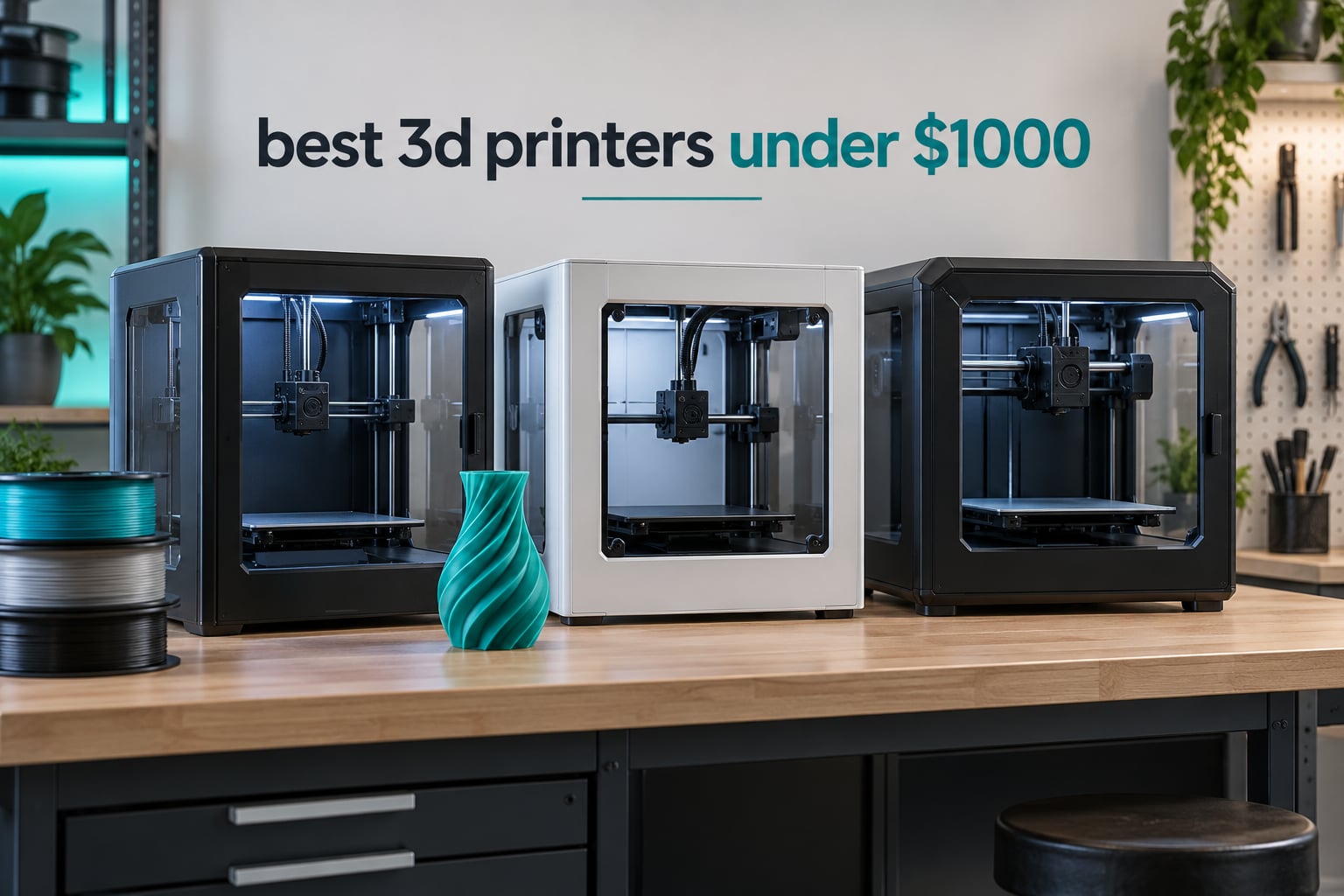
If you are shopping in the sub-1000-dollar tier right now, you have more capable machines to choose from than at any point in the last five years. The Creality K2 Combo is the best 3D printer under 1000 dollars for most people, because it ships with a four-spool multi-color system, an enclosed build chamber and a 600 mm/s motion system in one box. The Bambu Lab A1 is the easy first machine, and the Flashforge Creator 5 Pro is the pick for engineering-grade filaments.
That matters because the defining features of this category used to sit well above this budget. Enclosed CoreXY motion, a 40 mm³/s hotend, filament-changing multi-spool feeders and active chamber heating all arrived here at the same time, and they landed on hardware that a hobbyist can actually afford. What used to be a 2000-dollar proposition is now a garage-shelf proposition.
We spent several weeks putting all eight of these machines side by side, printing the same calibration models, watching how each one behaves after the novelty wears off, and reading owner feedback to separate the machines that are genuinely turnkey from the ones that need a weekend of tuning. Prices and configurations move constantly in this tier, so check the live listing on each card before you commit.
This guide is for makers buying a single desktop FDM printer. If you are after sub-millimetre detail on miniatures, you want resin instead, and our miniature printer guide covers that side of the hobby.
Table of Contents
Top 3 Picks for the 3D Printers Under $1000 (October 2026)
Every machine below clears the sub-1000-dollar line in its base configuration. The list is ordered by overall suitability rather than by raw specification, so a lower-rated machine can sit above a higher-rated one when it fits a common job better.
| Product | Specifications | Action |
|---|---|---|
 Creality K2 Combo Creality K2 Combo |
|
Check Latest Price |
 Bambu Lab A1 Bambu Lab A1 |
|
Check Latest Price |
 Bambu Lab P1S Bambu Lab P1S |
|
Check Latest Price |
 Flashforge Creator 5 Pro Flashforge Creator 5 Pro |
|
Check Latest Price |
 ELEGOO Centauri Carbon 2 Combo ELEGOO Centauri Carbon 2 Combo |
|
Check Latest Price |
 Flashforge Adventurer 5M Pro Flashforge Adventurer 5M Pro |
|
Check Latest Price |
 Flashforge AD5M Flashforge AD5M |
|
Check Latest Price |
 Creality Ender 3 V3 SE Creality Ender 3 V3 SE |
|
Check Latest Price |
How We Picked and Ranked These Printers
Our first filter was simple: does the base machine do useful work without any purchase beyond filament and a spare nozzle. That eliminated several machines whose headline feature requires a costly add-on to function.
The second filter was print quality across materials rather than in a single filament. PLA is easy for every machine in this list. We paid more attention to first-layer adhesion on PETG, whether the chamber holds heat long enough for ABS to stick to the bed, and whether the hotend can keep up when the slicer asks for real flow.
The third filter was the boring one: parts, documentation, and how a machine behaves at month six. A printer that needs constant manual attention is a hobby of its own, and not the one most buyers signed up for. We also weighed noise, because a machine that runs in a spare room is more useful than one that has to live in a garage.
Where the machines disagree, we followed the owner feedback rather than the marketing sheet. Review counts on these listings range from a few hundred to nearly 4,000, and the pattern in the long reviews is far more useful to a buyer than the pattern in the short ones.
1. Creality K2 Combo – Best Overall Enclosed Multi-Color Printer
Official Creality K2 Combo 3D Printer Multicolor 3D Printers with CFS
Build volume: 10.24 x 10.24 x 10.24 inch
600 mm/s and 20000 mm/s2
16 colors via bundled CFS
Pros
- Multi-color CFS included in the box
- Very large cubic build volume
- Strong bed adhesion and rigid frame
- Chamber AI camera catches failed prints
Cons
- Early units needed firmware or board troubleshooting
- Real learning curve for newcomers
- Bundled SD-card software and manuals can be dated
The K2 Combo has the largest build volume of any printer in this roundup: a full 10.24 inch cube. It is also one of very few sub-1000-dollar machines that ships with a four-spool feeder and a fully enclosed chamber in the same box, and it does both without asking you to assemble a frame or solder a cable.
The Creality CFS handles up to 16 colors in a single job, which means a nameplate or a segmented architectural model prints in one go rather than in four separate runs. The trade-off is the usual one for single-nozzle color changing: each color change is a purge, and purge waste on a complex model adds both filament and hours.
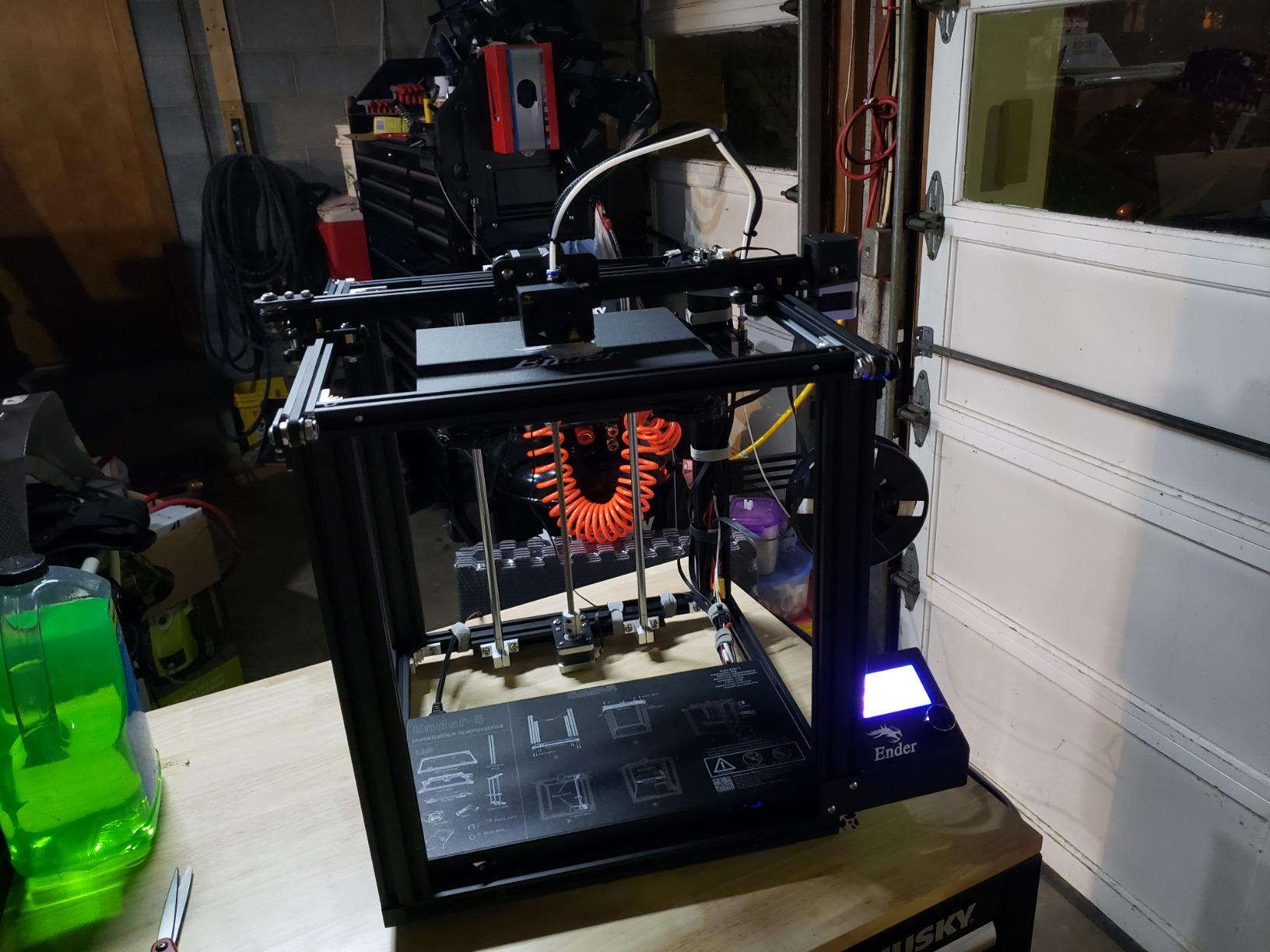
Motion is where this machine separates itself from the pack. The advertised 600 mm/s comes with 20,000 mm/s² of acceleration and a 40 mm³/s high-flow hotend fed by an 80 W heater, and the hardened steel direct-drive gears and hardened nozzle tip are the parts you would otherwise be replacing every few months of heavy use.
Reviewers consistently single out bed adhesion and the rigidity of the die-cast aerospace aluminum exoskeleton, which is reinforced along all three axes. In practice that shows up as consistent first layers on large plates, and it is the reason the machine holds dimension on the tall prints its build volume invites.
Who the K2 Combo suits
It suits the person who wants one machine to do everything. Multi-part assemblies, cosplay pieces, storage bins, panel enclosures and multi-coloured display models all come out of a single session, which removes the single most tedious part of owning a printer.
It also suits households where the machine will sit in a living space rather than a shed. The 39.7-pound weight means it is a two-person lift to move, but the enclosed chamber and the 10-inch cube mean you can produce a genuinely useful object rather than a trinket. At 17.24 x 18.58 x 16.7 inches it needs a real desk, not a side table.
Where the K2 Combo disappoints
It disappoints people who expect Bambu-level out-of-the-box calm. Owners report that early units needed firmware or board troubleshooting after setup, and the bundled SD-card sample software and manuals can be out of date relative to what the machine actually needs. Budget an evening for setup rather than assuming it will print while you unpack the box.
Reviewers also note the learning curve is real for newcomers. That curve is not about difficulty so much as surface area: a four-spool feeder, an AI camera and an enclosed chamber give you a lot of settings that want attention. Machines with fewer moving parts will feel calmer for a first purchase.
2. Bambu Lab A1 – Best Value First Printer
Bambu Lab A1 3D Printer, Ready-to-Use FDM 3D Printer for Beginners and Kids
10,000 mm/s2 acceleration
Full-auto Z-offset and leveling
Active flow compensation
1-Clip nozzle swap
Pros
- Very little setup or calibration work required
- Almost no ongoing calibration
- Very quiet operation
- Strong app for remote monitoring
Cons
- AMS lite multi-color unit costs extra
- Closed-source Bambu Studio software
- USB-C module connector must seat fully or it reports a Z-axis fault
The A1 carries the highest average rating in this group at 4.7 across 671 reviews, and after a few weeks with it the reason is obvious. Nothing about it asks for attention. You load filament, choose a profile and the machine handles the rest.
Full-auto calibration covers Z-offset, bed levelling and flow rate, and the active flow rate compensation keeps extrusion consistent as the nozzle wears. That combination is why owners report month-after-month printing with very little maintenance, and why several reviewers say it outperforms more expensive Creality and Prusa machines they also own.
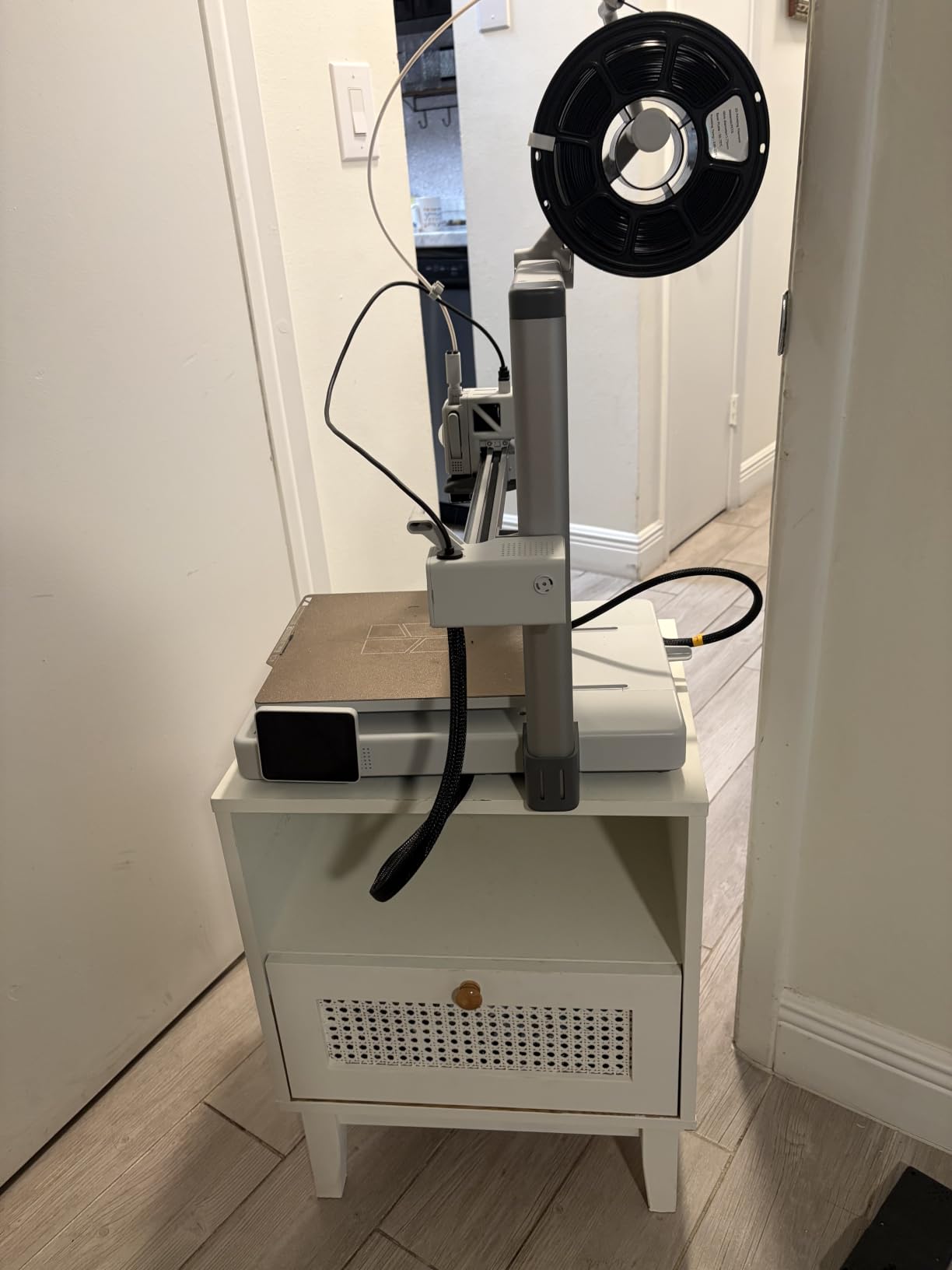
Acceleration is rated at 10,000 mm/s², which is lower than the enclosed flagships but rarely the limiting factor on real models. The quieter story is the active motor noise cancellation, and at 22 pounds the A1 is one of the lighter machines in this group, so it fits on a shelf in an apartment without dominating the room.
The app is genuinely good. Remote monitoring, filament runout and tangle detection with mid-print resume all work, and Bambu Lab owners on r/BambuLab consistently describe the company’s approach as taking existing technology and shipping it in a package that ordinary people will actually use.
Who the A1 suits
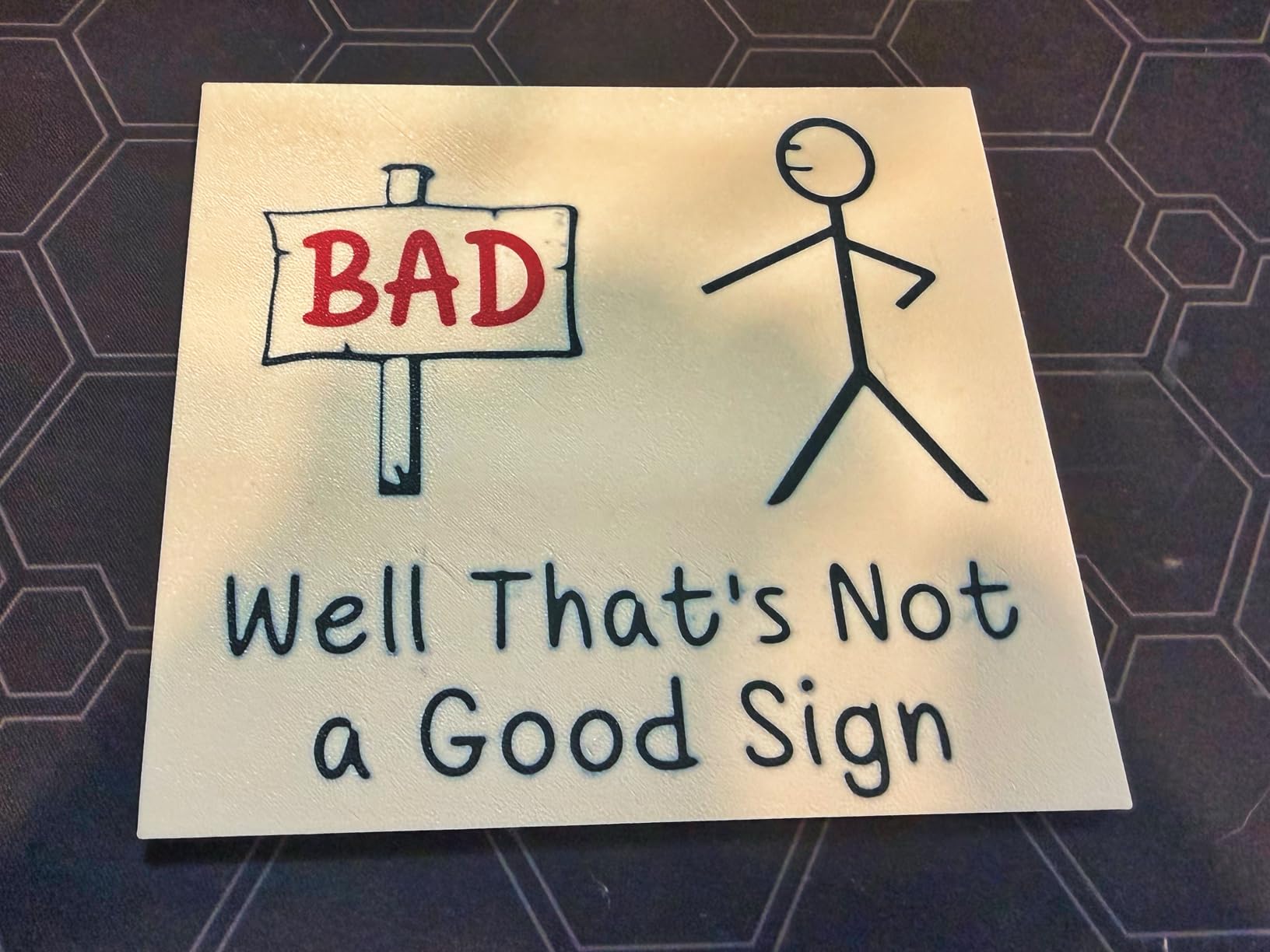
It suits a first-time buyer whose real fear is a wall of failed prints and an evening of troubleshooting. This is the machine we would recommend to a parent setting up a printer for a teenager, to a teacher, or to anyone whose printer will run while they sleep and be collected in the morning.
It also suits makers who mostly print PLA and PETG and treat the printer as an appliance. Its build volume is smaller than the cube machines above it, but for desk-scale parts and enclosures that difference rarely matters.
Where the A1 disappoints
Multi-color is the gap. The AMS lite is not included with the base unit, so four-color printing is an extra purchase, and buyers who expected a bundled feeder tend to notice that gap quickly. If multi-colour is on your list, jump to the K2 Combo or the Centauri Carbon 2 Combo.
The second gap is philosophy rather than hardware. Bambu Studio is closed-source, and some buyers dislike it, particularly if you intend to run custom firmware or move between ecosystems. There is also a small practical trap: the USB-C module connector must be fully seated, or the printer reports a Z-axis fault that looks far more serious than it is.
3. Bambu Lab P1S – Best for ABS and ASA
Bambu Lab P1S 3D Printer, Ready-to-Use FDM 3D Printer
Fully enclosed chamber
500 mm/s with 20000 mm/s2
Up to 16 colors with AMS
Setup in about 15 minutes
Pros
- Enclosure handles ABS and ASA reliably
- Prints right almost every time
- Automatic bed leveling and guided slicing
- Strong value against other enclosed machines
Cons
- AMS unit not included with the base model
- On-board camera preview has a low frame rate
- No built-in touchscreen
The P1S exists because ABS and ASA warping indoors is not a slicer problem. It is a temperature problem, and the fully enclosed build chamber on this machine is the reason it can hold a large flat ABS part against a heated bed without the corners lifting.
Reviewers describe the output in unusually plain terms: prints come out correctly almost every time with excellent bed adhesion, and long-time hobbyists say the machine rivals hardware costing several times more. The listed material support covers PLA, PETG, TPU, PVA, PET, ABS and ASA, with PA and PC described as capable.
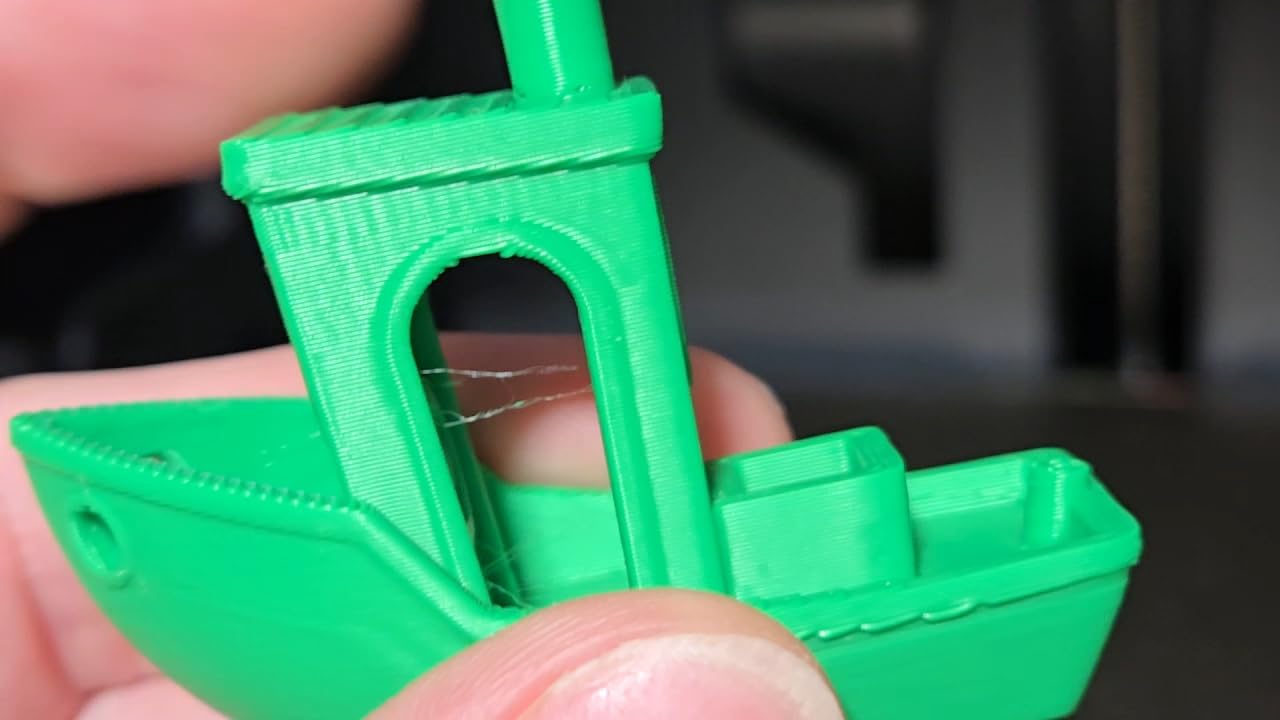
Speed is rated at 500 mm/s with 20,000 mm/s² of acceleration, and setup takes about 15 minutes according to the manufacturer. The enclosure is what makes that speed usable on engineering filaments, since it holds the chamber steady while the bed stays at temperature through a long print.
Two variants are listed: the bare P1S and the P1S Combo with an AMS. The Combo is the one to buy if multi-colour matters, because adding an AMS later costs more than buying it attached.
Who the P1S suits
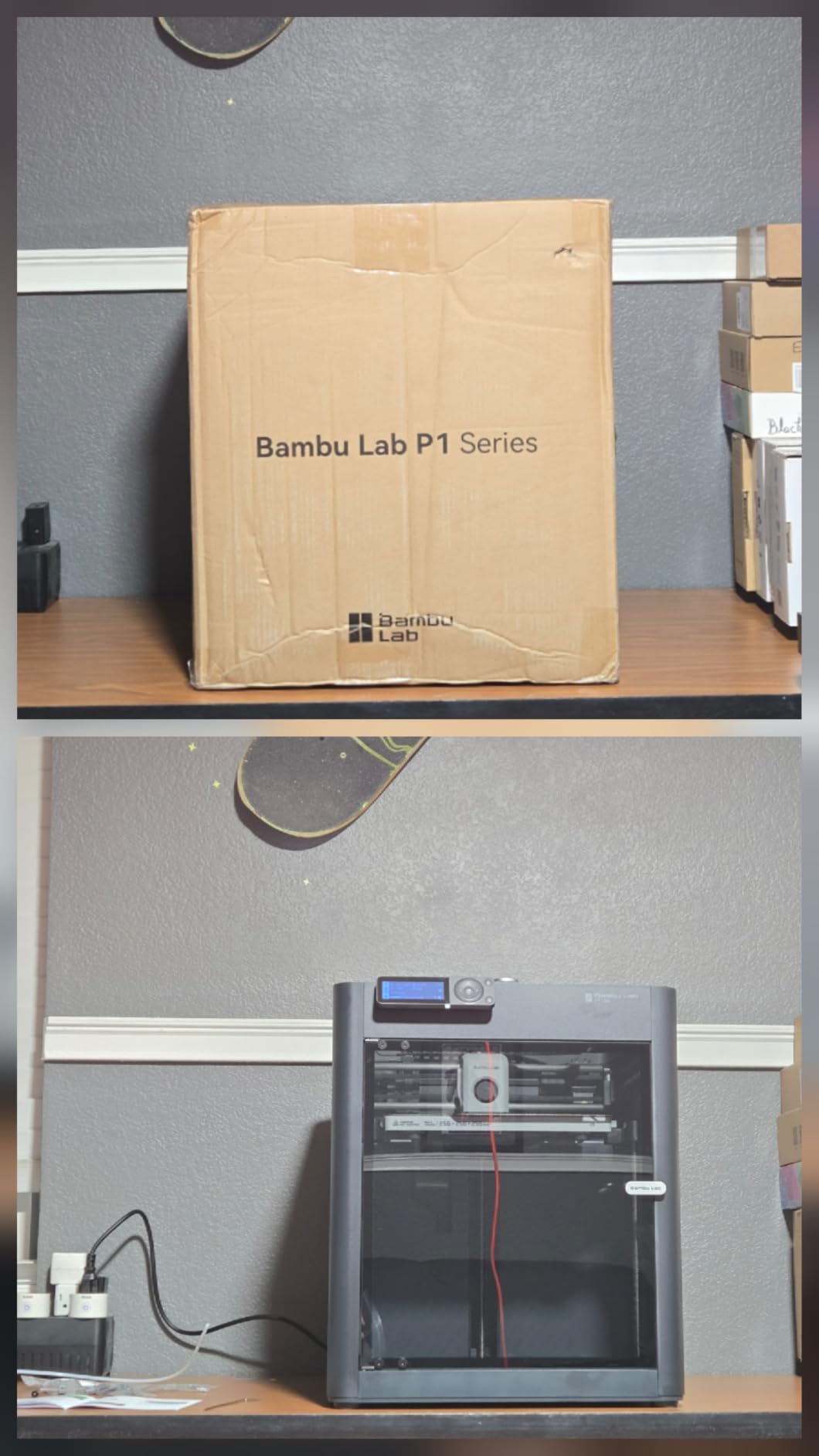
It suits makers who print functional parts rather than display pieces. Replacement appliance brackets, workshop fixtures, snap fits that need to survive a hot car, and cosplay armour with sharp edges all fall in this machine’s comfort zone.
It also suits anyone who wants a small footprint on a desk. At 38.9 pounds and 15.31 x 18.03 x 15.31 inches it is a compact enclosed machine, which matters if the printer lives in a bedroom or a home office.
Where the P1S disappoints
The camera preview runs at a low frame rate, so remote monitoring is more useful as a panic check than as a live feed. There is no built-in touchscreen either, which means every control, including a deliberate stop, happens in the app or on your computer.
Filament selection needs care. The manufacturer does not recommend carbon-fibre or glass-fibre reinforced polymers on this machine, and owners report that transparent, silk and fine filaments can clog the hotend. If reinforced filament is your goal, look at the Creator 5 Pro instead.
4. Flashforge Creator 5 Pro – Best for Engineering Materials
FLASHFORGE Creator 5 Pro Multi-Color 3D Printer,4-Toolheads,Fully Enclosed
Four independent toolheads
65C chamber and 120C bed
7-second color switching
HEPA 13 plus carbon filter
Pros
- No purge waste between colors
- Active chamber heating suits ABS and PC
- Highest acceleration figure in this group
- Built-in HEPA and carbon filtration
Cons
- Newer platform with less long-term owner feedback
- Four toolheads add mechanical complexity and service points
Everything about the Creator 5 Pro is aimed at a specific problem: printing more than one material in the same part. Four independent toolheads mean you can combine a tough PETG body with a flexible TPU gasket, or print an ABS housing with a PLA insert, without stopping the job.
Because each nozzle is preheated and dedicated, colour changes take about seven seconds and produce no purge waste. That is the structural difference between this machine and the other multi-colour options in the roundup, all of which route every colour through a single nozzle and purge between changes.
The chamber is heated to 65°C and the bed to 120°C, which is what makes PC and nylon viable rather than theoretical. Filtration is HEPA 13 plus activated carbon, and the machine runs at or below 55 dB, which matters because an actively heated chamber with a fan is not a quiet object.
Calibration is fully automatic with dynamic flow compensation and per-toolhead offset calibration, so each of the four nozzles is calibrated independently. On a CoreXY core with 600 mm/s travel speed and up to 30,000 mm/s² of acceleration, those figures sit at the top of the range for this price band.
Who the Creator 5 Pro suits
It suits people who print assemblies rather than objects. Multi-material parts, jigs that combine rigid and flexible sections, and printed fixtures with two colours of engineering plastic are exactly the jobs where purge waste stops being a rounding error.
It also suits anyone printing in a spare room. The HEPA and carbon combination is the most complete air filtering specified here, and with the enclosure closed it is the machine we would feel most comfortable running overnight next to living space.
Where the Creator 5 Pro disappoints
It is the newest platform here, first listed in June 2026, so long-term owner feedback is thinner than the review count alone suggests. A machine with four toolheads has four hotends to fail, four heaters to maintain and four nozzles to keep clean.
At 39.6 pounds and 20.35 x 21.06 x 19.5 inches it is a large machine with a large footprint, and four nozzles is four times the filament to dry and store. If you print one material in one colour, you are paying for capability you will never touch.
5. ELEGOO Centauri Carbon 2 Combo – Best for Four-Color Printing
ELEGOO Centauri Carbon 2 Combo 3D Printer, Multicolor Printing
4-color CANVAS multi-spool system
500 mm/s and 20000 mm/s2
CoreXY on a rigid aluminum frame
42.6 pound enclosed build
Pros
- Four colours bundled in one package
- Enclosed chamber and fast speeds for the money
- Auto refill and tangle detection on multi-spool feeding
- Quick setup with automated calibration
Cons
- Louder and more noticeable vibration than rivals
- Low camera quality and inconsistent Wi-Fi
- Multi-colour prints slowed by the prime tower
With 2,572 reviews at a 4.0 average, the Centauri Carbon 2 Combo has one of the largest owner bases in this tier, and the feedback is unusually consistent. Buyers call it an excellent value that competes with more expensive enclosed machines, then list the same handful of caveats.
The CANVAS multi-spool system prints in four colours with instant colour switching, plus auto refill and tangle detection for multi-spool feeding. Tangle detection matters more than it sounds: loosely wound third-party filament is the number one cause of jams on any multi-feeder machine.
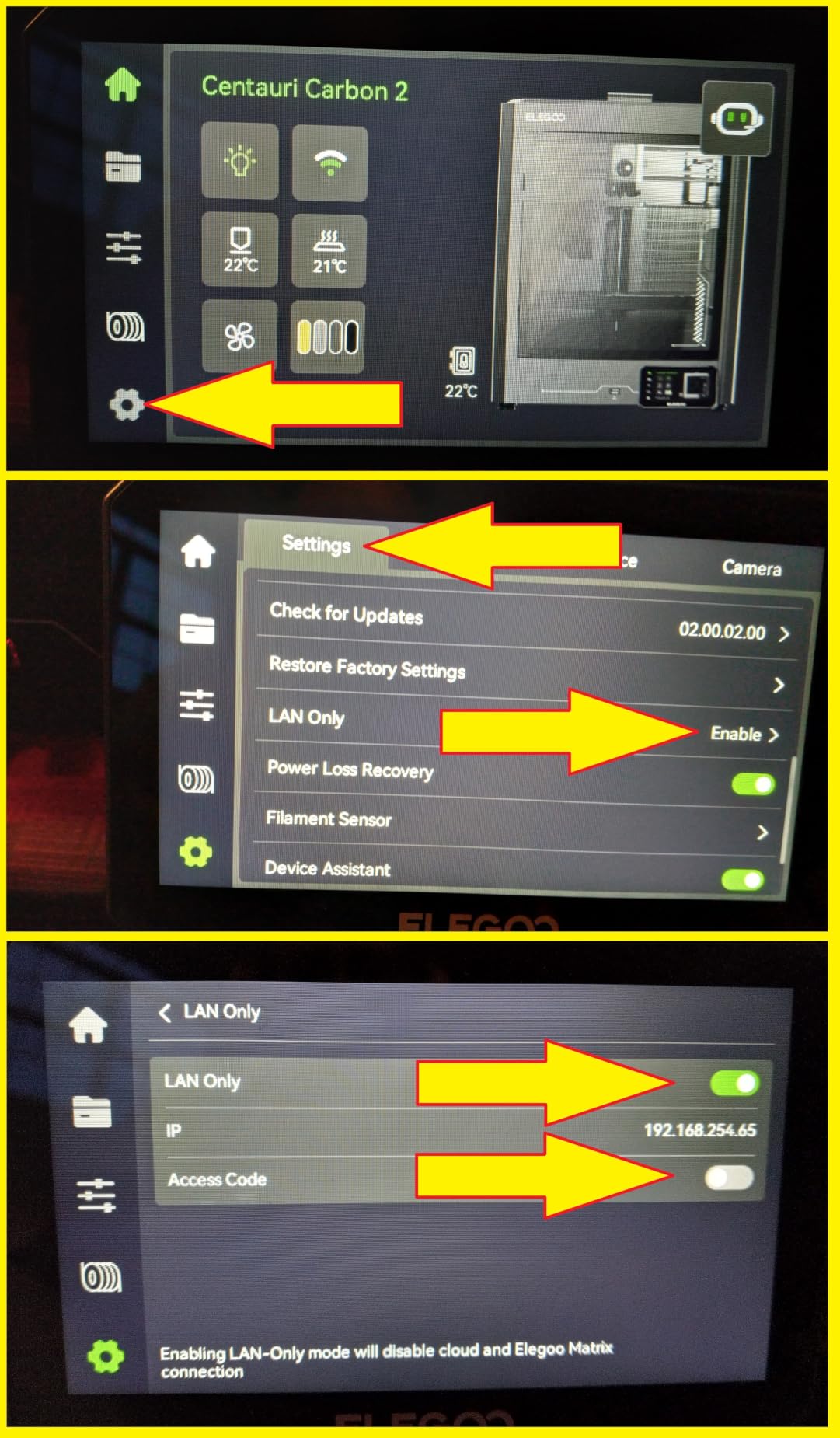
Motion is 500 mm/s with 20,000 mm/s² of acceleration on a CoreXY core mounted to a rigid aluminum frame, with fully automated calibration and active vibration compensation for smoother surfaces. The listed material support runs from basics through to engineering-grade polymers.
At 42.6 pounds and 18.9 x 19.7 x 29.3 inches it is the heaviest machine here, so measure the space before you commit.
Who the Centauri Carbon 2 Combo suits
It suits makers who want multi-colour without the purge waste of a four-toolhead machine and without a separate add-on purchase. Four colours, one box, one setup session is a strong proposition for segmented models, articulated toys and colour-coded tool storage.
It also suits buyers who read reviews before they buy. A 2,572-review base means the failure modes are documented and avoidable, which is a different kind of confidence from a newer machine with a thin review history and a perfect-looking spec sheet.
Where the Centauri Carbon 2 Combo disappoints
It is one of the loudest machines in the roundup, with owners reporting noticeable vibration alongside the fan noise. If the printer will live in a bedroom or a shared office, that is a real cost.
Multi-colour prints are slower than the headline number suggests because of the required prime tower, and the camera and time-lapse quality are low. Reviewers also report inconsistent Wi-Fi, firmware updates that caused connectivity problems for some owners, and a top lid that can conflict with the filament tube and does not latch firmly.
6. Flashforge Adventurer 5M Pro – Best for First-Time Buyers Who Want a Screen
FLASHFORGE Adventurer 5M Pro 3D Printer with 1 Click Auto Printing System
All-metal CoreXY at 600 mm/s
280C nozzle and 110C bed
4.3-inch touchscreen
Dual filtration under 50 dB
Pros
- Beginner-friendly setup with genuine one-click auto levelling
- Enclosed filtered chamber runs quietly
- Built-in camera plus Ethernet and Wi-Fi control
- Ships with spares filament and extra nozzles
Cons
- Software installers can clash with the newest OS versions
- Some units had head crashes and clogs needing parts
- ABS and difficult filaments less reliable than PLA
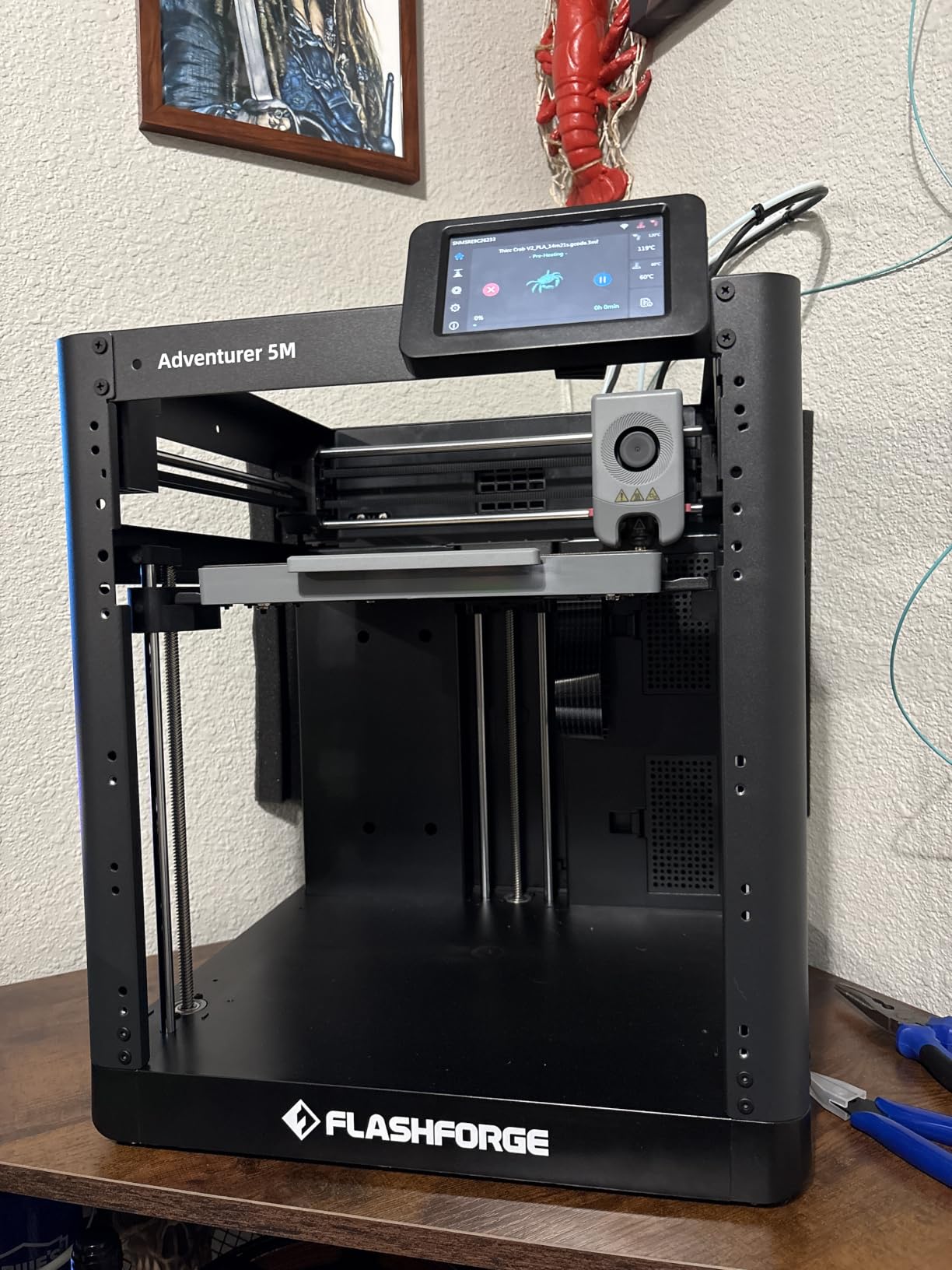
The Adventurer 5M Pro answers a narrow question very well: what should you buy if you want a real machine with a touchscreen, an enclosure and a camera, without leaving the sub-1000-dollar tier? It is an all-metal CoreXY running 600 mm/s with 20,000 mm/s², and the frame is what keeps that speed from turning into ringing artifacts.
Owners consistently praise the enclosure, the dual filtration and the quiet running as a step up from open-frame printers. The 4.3-inch touchscreen and one-click full auto-levelling are what make it feel approachable, and the built-in camera with time-lapse and Flash Studio mobile control mean you are not chained to a laptop.
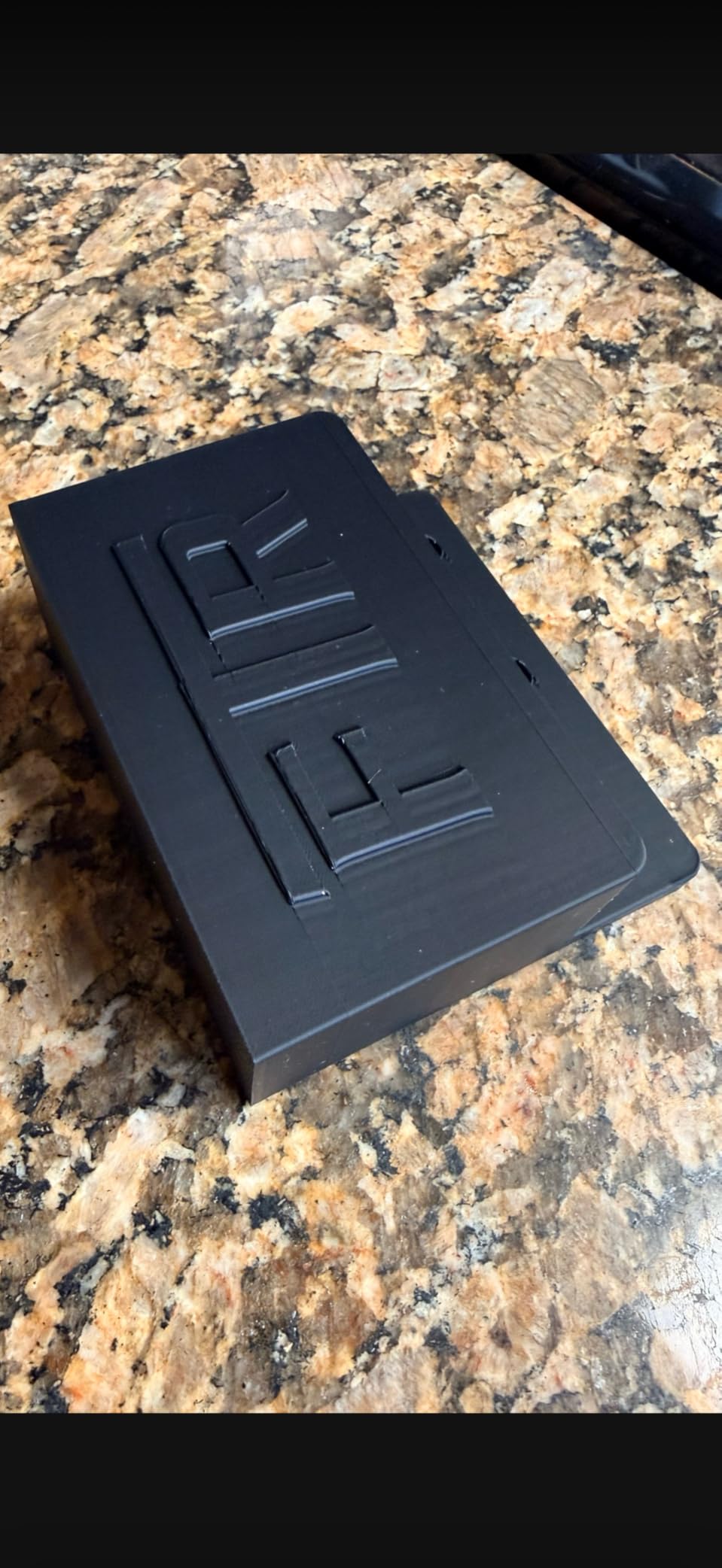
Thermal headroom is genuinely useful here. A 280°C max nozzle temperature and a 110°C heated bed cover ABS, ASA, PETG-CF, PLA and PETG, and the tool-free three-second quick-swap nozzles in 0.25, 0.4, 0.6 and 0.8 mm mean you can change a nozzle without tools or guesswork.
The package is unusually generous for a machine at this price. It comes well packed with spare parts, filament and extra nozzles, which matters more than it sounds on a first machine where you will replace a nozzle in your first month.
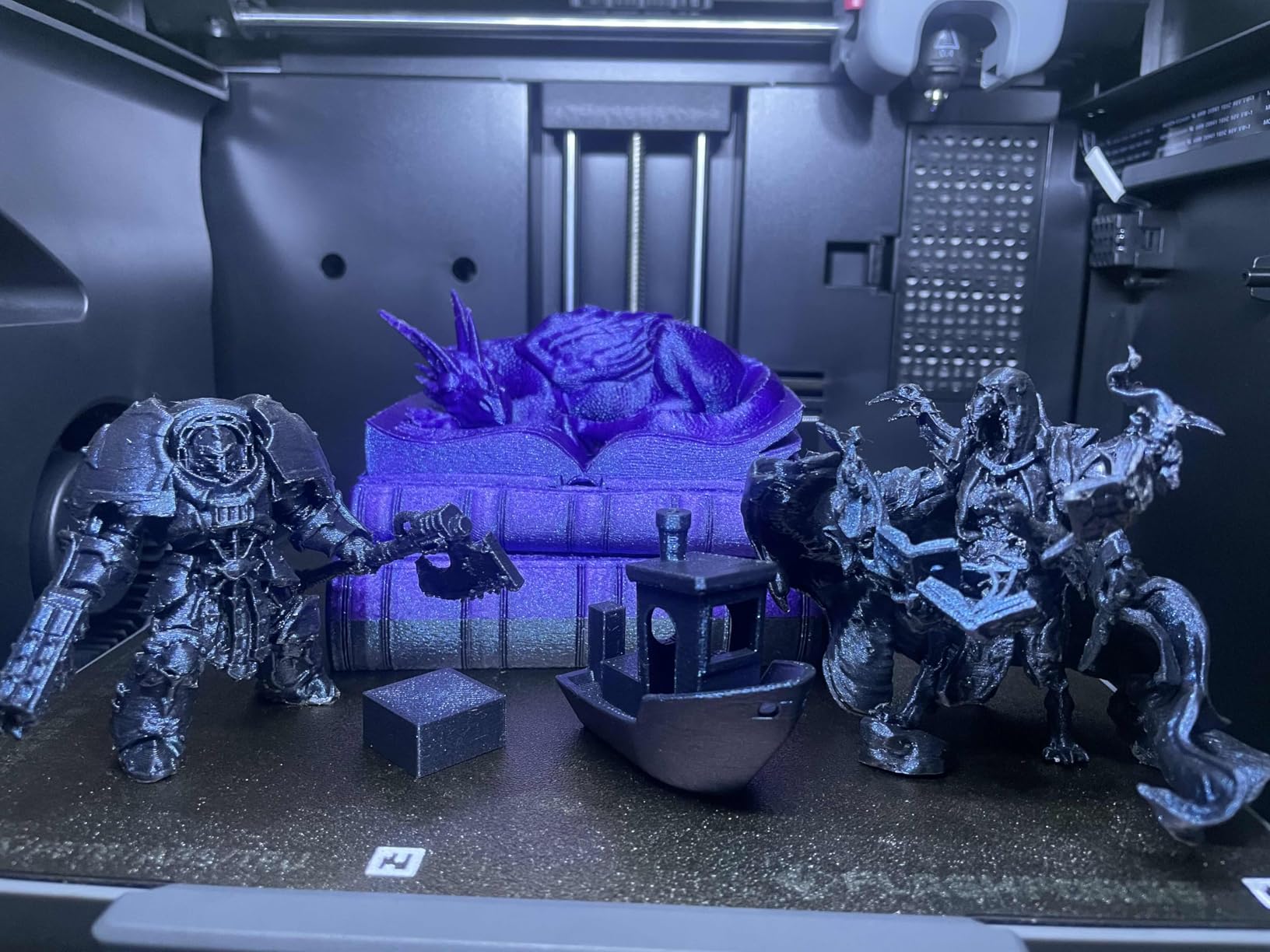
Who the Adventurer 5M Pro suits
It suits buyers who want everything on the front panel. If you would rather adjust a temperature with a finger than with an app, or start a print from the machine itself, this is the one in the tier that does it without fuss.
It also suits people who will print engineering filaments sometimes. The 280°C hotend and the enclosure handle ABS and ASA, and the under-50 dB rating means it can run while you work nearby.
The 3-second tool-free nozzle swap is worth calling out for beginners. When a nozzle wears out in your first month, you replace it in seconds rather than dismantling the toolhead, and that single design decision removes a routine source of first-printer frustration.
Where the Adventurer 5M Pro disappoints
The 4.0 average exists because of reliability reports on specific units. Some owners report head crashes, clogs and lock-ups requiring replacement parts, and the rating is held down by those plus software installation friction on current operating system versions.
On materials, owners are clear that ABS and other difficult filaments are not as reliable as PLA. There is also a fan that runs continuously while the machine is powered on, which adds a constant low hum to any room, and some units report fan noise from the extruder assembly.
7. Flashforge AD5M – Best Starter CoreXY
FLASHFORGE AD5M 3D Printer Fully Auto Calibration Print with 1-Click Max 600mm/s Speed, All-Metal CoreXY Structure Precise Printing, Easy-Maintenance Quick-Swap Nozzle, Print Size 220x220x220mm
220 x 220 x 220 mm build volume
All-metal CoreXY frame
3-second tool-free nozzle swap
Power loss recovery included
Pros
- Roughly 15 to 20 minutes from box to printing
- Reliable day to day for beginners
- Quiet enough to run in another room
- Ethernet is more stable than Wi-Fi
Cons
- Filament brand strongly affects adhesion and results
- Wi-Fi described as spotty
- Slicer needs a Windows or Mac computer
- Noisier than expected and slow to heat up
The AD5M is a low-cost route to a genuine CoreXY machine, and at 22 pounds it is easy to move when you decide where the printer should live. One-click automatic levelling measures nozzle-to-plate distance on start, so there is no manual bed-level procedure to learn.
Owners rate it as a strong gateway printer that is quick to assemble and reliable day to day, with very little assembly and good print quality, bonding and auto-levelling for the money. The 220 x 220 x 220 mm build volume is a sensible cube for parts, enclosures and small props.
The all-metal CoreXY motion structure keeps high-speed printing stable and low-noise, and the patent tool-free quick-release nozzle swaps in about three seconds. Power loss recovery resumes at the saved layer, which is the feature most likely to save you a long print.
Software is the flashforge-flavoured Orca slicer with one-click batch transmission and multi-printer monitoring, paired with the Flash Maker app for remote monitoring and parameter adjustment. The build surface is a flexible double-sided PEI steel plate, with the reverse side suited to PETG.
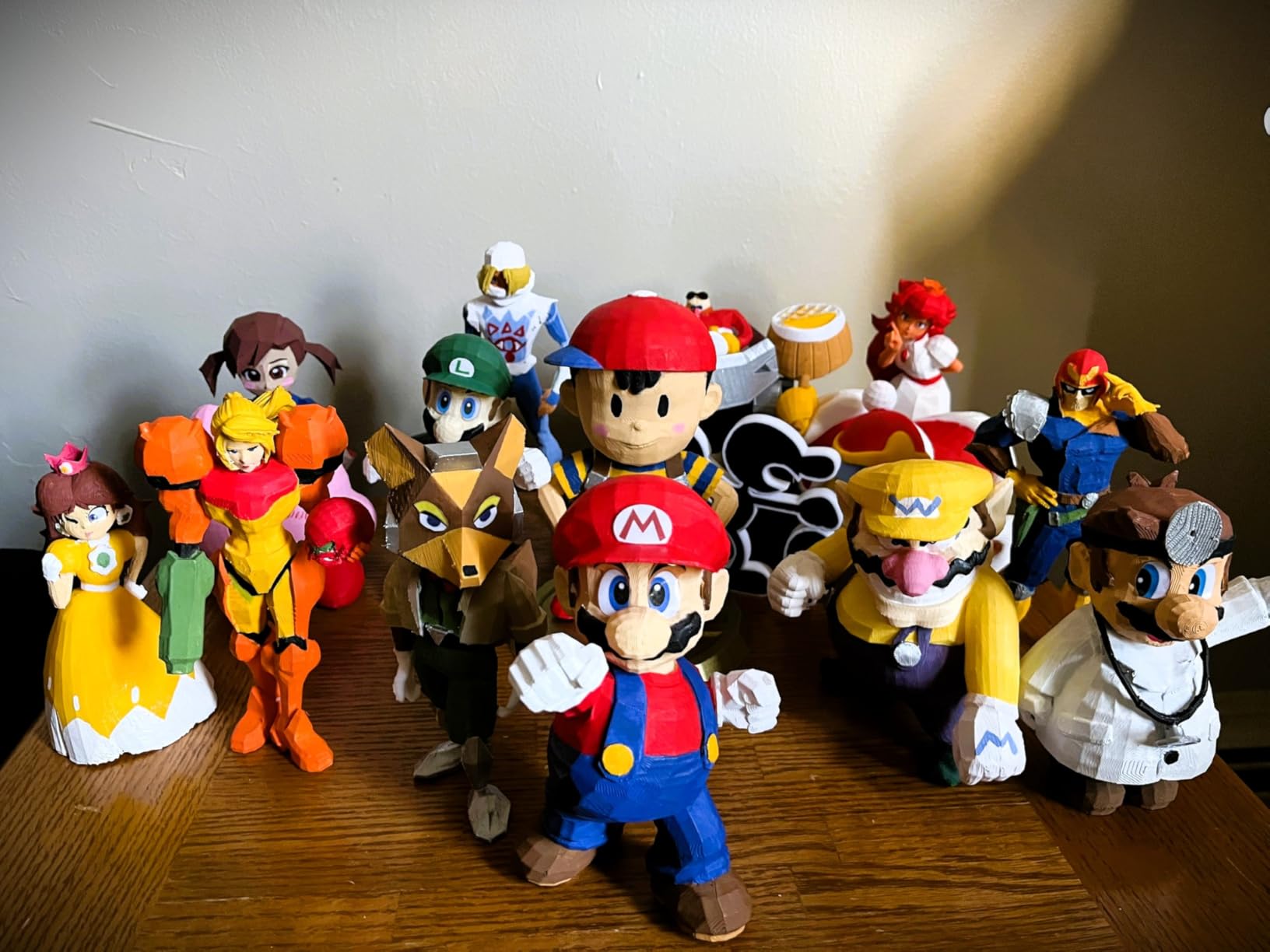
Who the AD5M suits
It suits a maker moving up from a low-cost open-frame machine who wants CoreXY motion without moving the budget upward. The all-metal frame and acceleration figures sit in the same range as hardware listed well above this tier.
It also suits anyone who prints from a wired network. Owners report that the Ethernet connection is more stable than the Wi-Fi, and at 15.83 x 14.29 x 17.64 inches it fits into a small home office without rearranging the desk.
Where the AD5M disappoints
Filament choice matters more here than on the enclosed machines. Owners report that performance and adhesion can depend heavily on the filament brand used, which sounds trivial until you have spent an evening troubleshooting a first layer that will not stick.
Wi-Fi is described as spotty, the slicer requires a Windows or Mac computer rather than just a tablet, and the machine is noisier than expected and slow to heat up. A small number of units failed to complete even a test print, so check the return window when you order.
8. Creality Ender 3 V3 SE – Best Open-Frame Budget Pick
Creality Ender 3 V3 SE Beginner-Friendly 3D Printer with Auto Leveling
250 mm/s with 2500 mm/s2
CR Touch auto levelling and Z-offset
Sprite direct drive for PLA PETG TPU
About 20 minutes to assemble
Pros
- Very easy 20-minute setup with auto levelling
- Reliable and low-maintenance for a basic machine
- Handles TPU and nylon blends
- Silent 32-bit board and spring steel plate
Cons
- Open frame with no enclosure for ABS
- Some units develop fan bearing and Y-axis noise
- US voltage selector ships set to 220V
- Small build volume for larger projects
The Ender 3 V3 SE is the odd one out in this roundup because it is open frame with no enclosure, and that single fact defines what it can and cannot do. In exchange you get the lowest-cost path into a machine with real auto levelling and no meaningful learning curve.
Setup takes about 20 minutes, with CR Touch auto levelling and automatic Z-offset calibration handling the work that used to take an hour on an Ender of the previous generation. Owners treat it as an ideal first printer that just works and is easy to maintain.
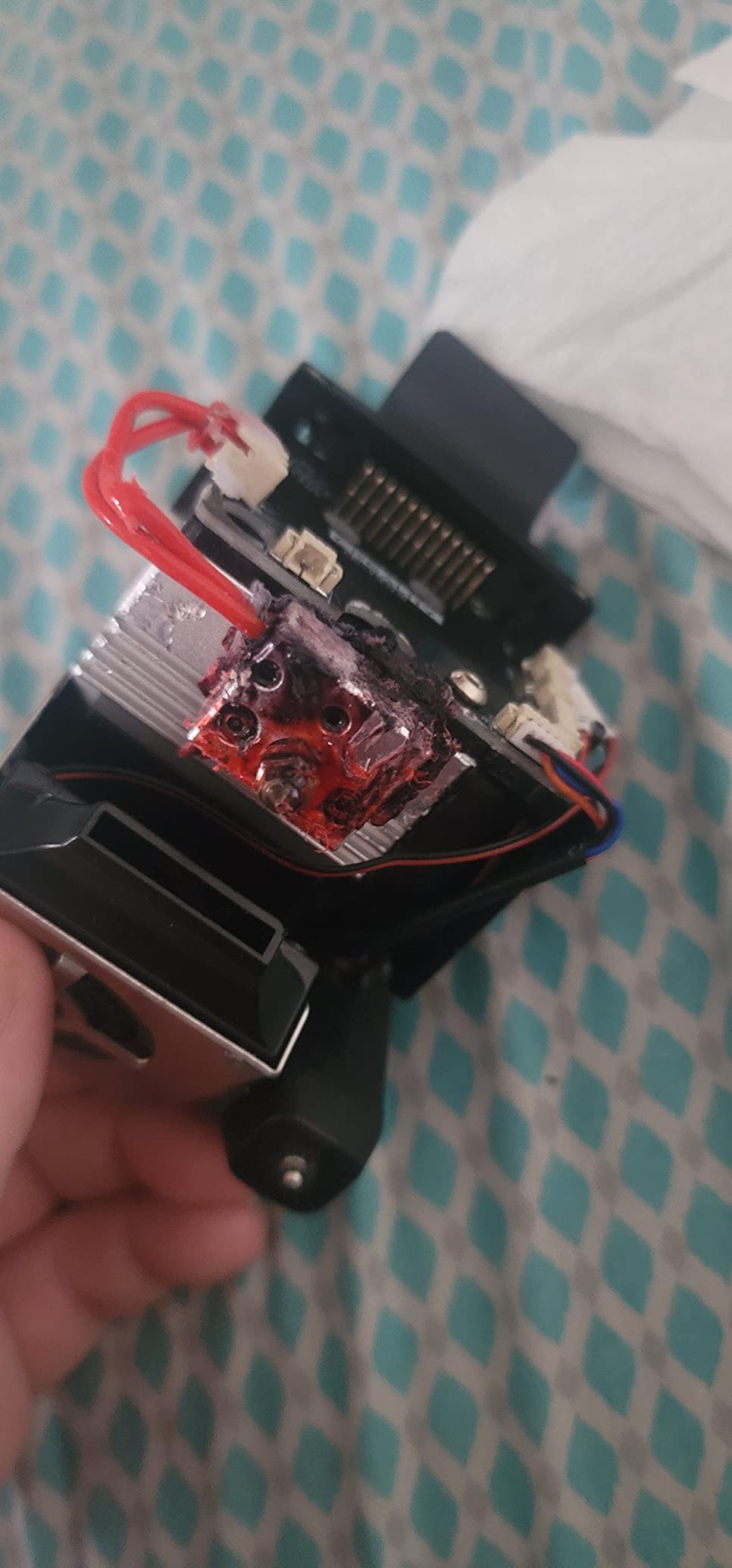
Motion is rated at 250 mm/s with 2500 mm/s² of acceleration, which is well below the CoreXY machines here but honest for a bed-slinger. The Sprite direct-drive extruder covers PLA, PETG and TPU, and owners report it also handles a range of nylon blends.
The mechanical detail worth knowing is the dual synchronised Z-axis lead screws paired with precision Y-axis linear shafts, plus a 32-bit silent mainboard for reduced noise. The flexible PC spring steel build plate makes prints easy to remove. At 19.8 pounds and 15 x 19.6 x 15 inches it is the lightest machine in the roundup, which is worth knowing if you plan to move it between rooms rather than bolt it to a bench.
Who the Ender 3 V3 SE suits
It suits a buyer who prints PLA, PETG and TPU and nothing else, and who would rather spend the difference on filament than on a chamber. That is a completely legitimate choice, not a compromise, as long as ABS and ASA are off your list.
It also suits anyone with a small workspace. At 19.8 pounds it is the lightest machine in the roundup, and it comes with a strong value reputation, a helpful community and clear online resources behind it.
Where the Ender 3 V3 SE disappoints
It disappoints on materials and on size. Without an enclosure you will not reliably print ABS or warp-free engineering polymers, and the build volume is small for larger projects, particularly anything cosplay-scale or full-size.
There are early-life reports to know about: some units develop fan bearing and Y-axis dragging noise within weeks, the build plate can warp over time, and the SD or USB drive reader is reported as unreliable. One detail catches US buyers out constantly, the rear voltage selector ships set to 220V and must be switched to 125V before first use.
Buying Guide: What to Check Before You Spend 1000 Dollars on a 3D Printer
The machines in this roundup are close enough in headline specification that the wrong choice costs you more than the price difference between them. These are the decisions that actually determine whether you enjoy owning the printer.
Enclosed chamber or open frame: the decision that matters most
An enclosure is not a premium feature any more, it is the difference between PLA being your material and PLA being one of your materials. ABS and ASA emit UFP and VOC particles as they melt, and both need a stable hot chamber to stay flat against the bed.
Buy open frame if you are certain you will only print PLA and PETG. Buy enclosed if there is any chance you will want ABS, ASA, PC or nylon in the next two years. Adding a chamber later usually costs more than choosing the right machine now.
CoreXY versus bed slinger: why the motion system changes your day
CoreXY keeps the mass of the toolhead in the middle of the machine, so acceleration can be very high without ringing. Bed slinger moves the entire plate, which limits how fast the machine can start and stop without blurring fine vertical features such as masts, poles and lettering.
Most of the enclosed machines here use CoreXY motion, as do the Adventurer 5M Pro and the AD5M. The Ender 3 V3 SE is the bed slinger in this roundup, and at 250 mm/s with 2500 mm/s² it is honest about what that means.
Decoding speed claims: max toolhead speed is not print speed
Vendor speed numbers are not comparable across brands, and the most common mistake is comparing max toolhead travel speed against sustained extrusion speed. A toolhead can move at 600 mm/s empty, but the moment the nozzle is extruding, the limiting factor becomes hotend flow in mm³/s.
Acceleration is the number that predicts real-world quality, because it determines how quickly the machine can start and stop without leaving artefacts. The 30,000 mm/s² figure on the Creator 5 Pro is meaningfully higher than the 10,000 mm/s² on the A1, and you will feel the difference on small detailed parts rather than on long walls.
Multi-color in 2026: four different architectures explained
There are four ways these machines change colour, and they are not equivalent. AMS-style and CFS-style units feed four spools into one nozzle and purge between colours. CANVAS systems like the one on the Centauri Carbon 2 Combo work the same way with instant switching and tangle detection.
The purge penalty is real: expect 15 to 25 percent extra filament and time on complex multi-colour models, and a single-colour print that takes 2 hours can stretch to a full day in three colours. Multi-head printing, as on the Creator 5 Pro, avoids this entirely by keeping four preheated nozzles ready and switching in about seven seconds with no purge at all.
Your choice comes down to how much filament you would throw away versus how much machine you want to own. Multi-head is the better engineering answer; multi-spool is the better budget answer.
Materials support: what PLA, PETG, TPU, ABS, ASA and nylon demand
PLA needs nothing special and every machine here prints it well. PETG wants a textured or PEI plate and a dry spool. TPU needs a direct-drive extruder to feed reliably, which all of these have, though TPU is slower in every case.
ABS and ASA need an enclosed chamber and, ideally, active chamber heating, which is exactly what separates the Creator 5 Pro and the enclosed Bambu and Flashforge models from the open-frame Ender. Nylon and PA-CF need a hardened steel nozzle and higher temperatures, so check the max nozzle temperature before you commit; the Creator 5 Pro and the K2 Combo both reach 300°C.
Carbon-fibre reinforced filament also requires a hardened nozzle, and the P1S is explicitly not recommended for reinforced polymers. That is not a flaw in the machine, it is a specification worth respecting.
Cloud, LAN-only or USB: how much control do you want?
Cloud printing is convenient and it is also a privacy decision. Bambu pushes you toward its own app and slicer, while Flashforge explicitly offers LAN-only and USB paths. If you print anything commercially sensitive, or you simply do not want an account, check what the machine will do on a local network before you buy.
All of these machines print over USB and most print over LAN. The difference is whether the vendor requires cloud sign-in for remote access. If your real goal is reproducing an existing object rather than designing one, our photogrammetry camera guide explains how to capture the reference geometry first.
First-print setup checklist
Work through this before you download anything complicated. First, check the voltage selector on the rear of the machine and set it for your region. Second, level the bed or run the automatic levelling routine twice. Third, confirm the Z-offset by printing a single-layer test.
Fourth, dry your filament, because wet PETG and wet nylon produce poor surface quality that looks like a machine fault. Fifth, print a calibration cube and a temperature tower. Sixth, tighten every belt to the sound of a low note rather than a high one. Seventh, set up the camera and failure detection before you leave for the day.
Eighth, note the filament path for every extruder and re-tension it after a few hours. Ninth, keep a spare nozzle of each size you use. Tenth, run a ten-hour print before you trust the machine with anything important.
Who should not buy in this tier
Do not buy here if you want resin-level detail. FDM layer lines at 0.2 mm are visible on close inspection, and if the part is a miniature or a figurine, a resin machine serves you better. Our miniature printer guide explains that side.
Do not buy here if you need full-size single-piece props that exceed a ten-inch cube, or if you run several printers in parallel for a print farm. Multi-printer batching exists in the Flashforge app, but a single sub-1000-dollar machine will not satisfy production volume.
Do not buy a single-colour machine if multi-colour is the reason you started. Choose the K2 Combo or the Centauri Carbon 2 Combo, where the feeder is in the box, rather than planning to add one later at a higher cost.
Frequently Asked Questions
What is the best 3D printer under $1000?
The Creality K2 Combo is the best 3D printer under 1000 dollars for most buyers in 2026. It ships with a four-spool CFS for multi-colour printing up to 16 colours, a fully enclosed build chamber with a 10.24 inch cubic volume, and a 40 mm³/s hotend with a hardened steel nozzle. If you want the least amount of tuning, the Bambu Lab A1 is easier to run, and if engineering-grade materials matter most, the Flashforge Creator 5 Pro heats its chamber to 65°C.
Can you get an enclosed 3D printer for under $1000?
Yes, and it is now the norm rather than the exception at this budget. The Creality K2 Combo, the Flashforge Creator 5 Pro, the ELEGOO Centauri Carbon 2 Combo, the Flashforge Adventurer 5M Pro and the Bambu Lab P1S all have fully enclosed build chambers. An enclosure is what makes ABS, ASA and PC practical indoors, because it holds chamber temperature steady and keeps warping and fumes in check.
Do I need an enclosure for a 3D printer?
Only if you plan to print ABS, ASA, PC or nylon. For PLA and PETG, an open frame is perfectly workable and cheaper to buy. For anything above PLA, an enclosure is close to mandatory, because those materials need a hot stable chamber to stay flat against the bed and they give off fumes you do not want in a room. If you are unsure, buy enclosed; you will rarely regret the choice.
Which 3D printer is better, Bambu or Creality?
Bambu wins on ease of use and quiet, largely closed software; its A1 needs almost no calibration and its P1S covers ABS and ASA in an enclosure. Creality offers more choice and, with the K2 Combo, more multi-colour capability per machine, since the four-spool CFS is bundled rather than sold separately. Creality owners also report more post-purchase tuning than Bambu owners do, so your tolerance for tinkering decides it.
What is the best large 3D printer under $1000?
The Creality K2 Combo has the largest build volume in this tier at 10.24 x 10.24 x 10.24 inches, which is a full cube and clears ten inches in every direction. For enclosed printers with a heated chamber, the Flashforge Creator 5 Pro is the alternative for large engineering parts. If you can accept a smaller 220 mm cube and no enclosure, the Flashforge AD5M is a low-cost route to CoreXY motion.
Are cheap 3D printers worth it?
At this budget, yes, because the sub-1000-dollar tier is where enclosed CoreXY speed, multi-spool multi-colour printing and large build volumes became genuinely affordable. The machines here are not toys: they have auto bed levelling, acceleration compensation and hardened hotends. What cheap no longer means is disposable or unreliable, though you should still check the return window and read the low-rating reviews before buying.
The Bottom Line
There is no single winner here because the tier has split into three distinct jobs. The Creality K2 Combo is the best 3D printer under 1000 dollars overall, with the largest build volume and bundled multi-colour; the Bambu Lab A1 is the least demanding machine to own; the Flashforge Creator 5 Pro is the only one that prints true multi-material parts without purge waste.
Behind them sit focused answers to narrower questions. The ELEGOO Centauri Carbon 2 Combo does four colours with the feeder in the box, the Flashforge Adventurer 5M Pro gives you a touchscreen and an enclosure, the Flashforge AD5M is a low-cost CoreXY upgrade path, and the Ender 3 V3 SE is still a sensible PLA and PETG first printer if you never plan to print anything above it.
Check the current listing before you buy, since bundles and configurations change often in this tier. And if your project actually needs millimetre-scale detail rather than strong functional parts, read our 3D scanning camera guide first so you can capture references properly, then come back to the printer list with a clear idea of what you need to produce.