
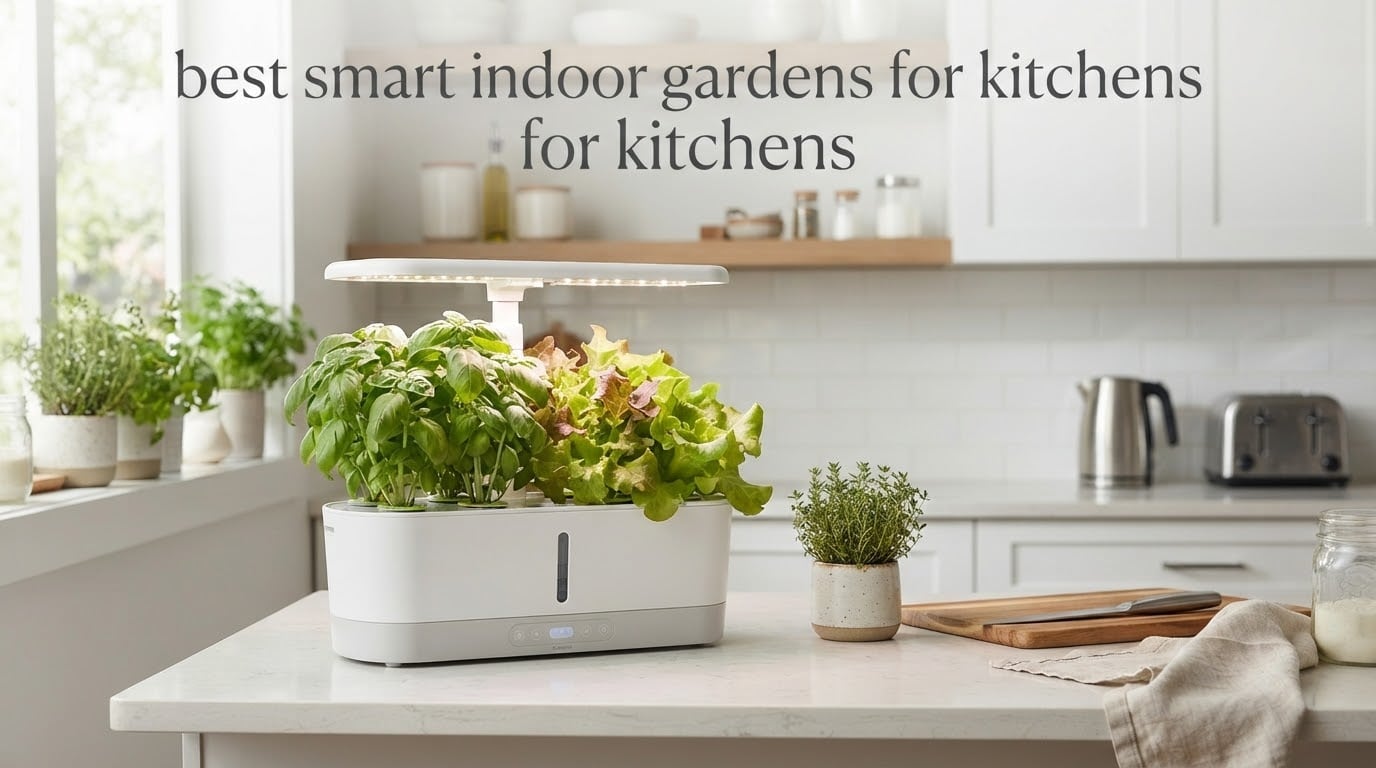
Most kitchens do not have room for a garden, and almost none have a windowsill that gets consistent light twelve months a year. A smart indoor garden solves both problems in about the footprint of a toaster, and picking the best smart indoor gardens for kitchens is mostly a question of counter space, light height, and how much babysitting you want to do each week.
We put ten of the most popular countertop growers through the same routine: unbox, fill the reservoir, drop in the starter pods, run a full light cycle, and judge how the unit behaves in a real kitchen rather than a clean studio bench. What separates them is rarely the brand name. It is how high the light arm travels, how long the tank lasts between refills, how loud the pump is during dinner, and whether the unit still works when the app on your phone goes quiet.
A smart indoor garden is a countertop unit that combines a water reservoir, a full-spectrum LED grow light, and a timed pump or self-watering wick so you can grow herbs, greens, and vegetables without soil, sunlight, or outdoor space. Seeds go into pods or sponges, a pump moves nutrient water to the roots on a schedule, and the light runs a fixed daily cycle that mimics the sun. Everything below was chosen for kitchen use specifically, which means we weighted footprint, heat, noise, and cleaning harder than raw yield.
Table of Contents
Top 3 Picks for Kitchens in 2026

Click & Grow Smart Garden
- 3 planted pods included
- Self-watering reservoir
- Works with 50+ pod varieties

These three cover the three ways people actually buy these units. The Click & Grow is the set-and-forget option for someone who has killed houseplants before. The iDOO is the capacity pick, giving you four times the planting sites of the Click & Grow in a single tray. The LetPot LPH-SE is the one to buy if you like seeing your light schedule on an app and being told when to top up the water.
Best Smart Indoor Gardens for Kitchens (September 2026)
| Product | Specifications | Action |
|---|---|---|
| Click & Grow Smart Garden |
|
Check Latest Price |
 iDOO 12Pods iDOO 12Pods |
|
Check Latest Price |
 Ahopegarden 12 Pods Ahopegarden 12 Pods |
|
Check Latest Price |
 LetPot LPH-Air 10 Pods LetPot LPH-Air 10 Pods |
|
Check Latest Price |
| LetPot LPH-SE 12 Pods |
|
Check Latest Price |
 inbloom 12 Pods inbloom 12 Pods |
|
Check Latest Price |
 URUQ 8 Pods URUQ 8 Pods |
|
Check Latest Price |
 DRYADES Self-Watering Pot DRYADES Self-Watering Pot |
|
Check Latest Price |
 MetryGrow MG-15 MetryGrow MG-15 |
|
Check Latest Price |
 SUNCOZE 12 Pods SUNCOZE 12 Pods |
|
Check Latest Price |
Two patterns jump out of the grid. The light arm matters more than the pod count: a unit with twelve pods and a 12 inch light will crowd faster than a ten pod unit with a 30 inch rod. And pod count alone is a weak signal, because a 15 pod tray with a 14 inch stand will crowd its own canopy faster than a 10 pod unit with real vertical travel.
1. Click & Grow Smart Garden – Best Overall for Low-Maintenance Growing
Click & Grow Indoor Herb Garden Kit with Grow Light | Smart Garden for Home Kitchen Windowsill | Easier Than Hydroponics Growing System | Vegetable Gardening Starter (3 Basil Pods Included), White
3 growing sites
3.5 lb unit
LED grow light
3 basil pods included
Pros
- Turnkey setup with no assembly required
- Energy efficient LED supports year round growing
- Works with more than 50 pre seeded pod varieties
- Seedless pods let you grow any seed you buy
Cons
- Only 3 growing sites at once
- Pods limit your control over the growing medium
This is the unit we put on our own counter first, and it is still the one we recommend to anyone who asks a single question: what will not disappoint me. You open the box, drop three basil pods into the slots, fill the reservoir, and plug it in. There is no assembly, no pump to prime, and no app to pair.
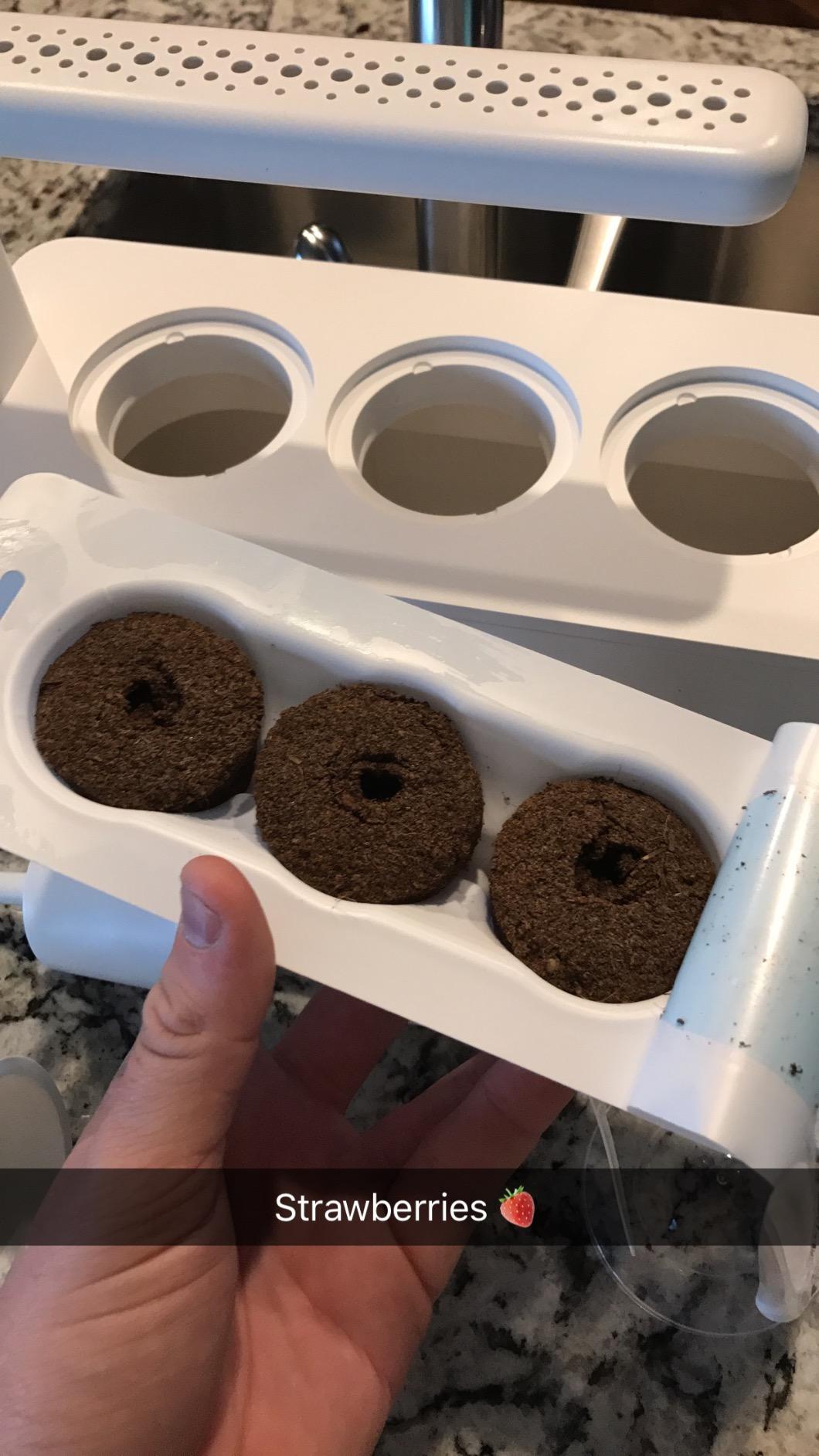
What earns it the top spot is not the hardware so much as the pod system. Buyers get a 4.6 average across more than 2300 reviews, and the recurring praise in that review history is about the pods rather than the machine: a catalog of more than 50 pre-seeded varieties including cilantro, thyme, lavender, wild strawberries, and chili peppers, plus seedless pods for anyone who wants to start from their own seed. The unit is rated 3.5 pounds, which is one of the reasons it is easy to move for a deep clean.
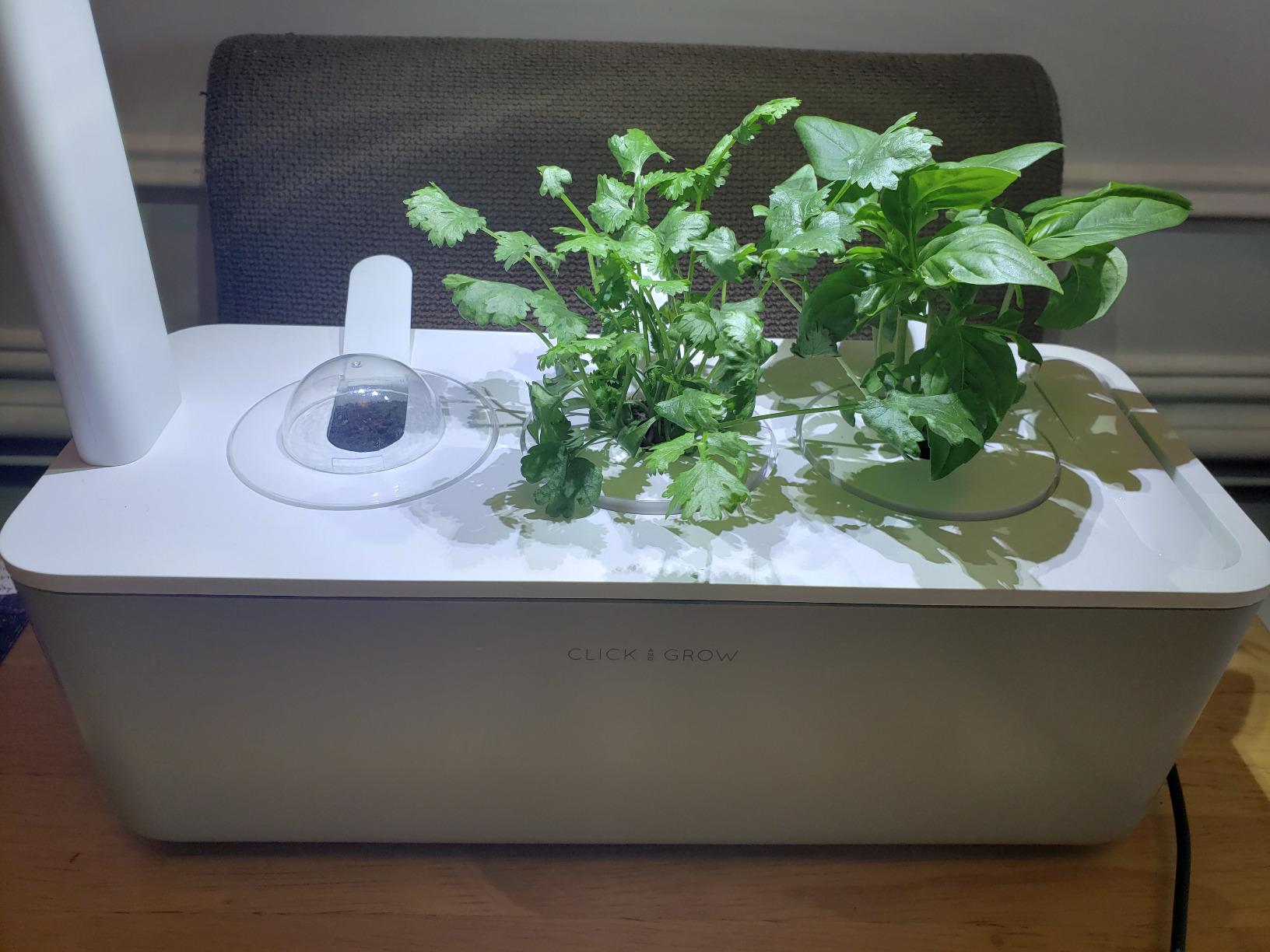
The catch is capacity. Three sites is a cooking rotation, not a harvest. Basil, chives, and mint in rotation will keep you supplied for weeknight cooking, but if you are salading every day you will run out. Growers also note that the fixed pod medium means you accept whatever the manufacturer put in the pod, which removes the variable growing-medium control that soil growers like.
Reviews also treat the pod ecosystem as a real buying factor, and the seedless pod route is the sleeper feature. If you have ever wanted to grow a specific heirloom herb or a hot pepper variety that does not appear in a catalog, the same unit handles it. The light is described as energy efficient, and the design is a self-watering planter that keeps the root zone fed without daily attention.
Is the Click & Grow worth it for a first garden
Yes, for a first garden it is the least risky purchase on this list. Everything you need arrives in the box, the setup is a matter of dropping in pods and filling water, and there is nothing to calibrate.
If you already know you will want more than three herbs at once within a few months, the twelve pod units grow the same crop across four times as many sites. Treat the Click & Grow as a teaching unit rather than a permanent one.
Where the Click & Grow falls short
The arm does not telescope far. Fixed low light positions are the single most common complaint pattern across countertop growers, and with three tall basil plants side by side the canopy closes over quickly.
Pods are also proprietary consumables, which is the lock-in that hydroponic buyers complain about most. Plan to grow from seedless pods with your own seed if you want to cut that recurring cost down.
2. iDOO 12Pods – Best Value for Growing Capacity
iDOO 12Pods Hydroponics Growing System Garden with LED Grow Light
12 growing sites
22W full spectrum LED
4.5L tank
11.02 inch light reach
Pros
- Twelve plants at once with an adjustable light
- Two dedicated light modes for veg and flowering plants
- Visible water level window on an independent 4.5L tank
- Three step setup with growth factors included
Cons
- No app or WiFi control on this model
- Pump and fan add moving parts that some buyers notice
The iDOO 12Pods is the most reviewed unit we looked at, with 6874 reviews averaging 4.5, and the number explains why: it packs four times the planting sites of the Click & Grow into a footprint that still fits a normal counter. At 13.78 by 12.09 by 8.86 inches and 1.8 kilograms, it is a wide tray rather than a narrow tower, so plan for depth as well as width.
Two features stand out on this unit. The 22 watt full spectrum LED has two growing modes, one for vegetables and one for flowering and fruiting plants, and the light height adjusts to cover plants up to 11.02 inches. A low-noise pump aerates the water while a fan simulates an outside breeze, which is a genuinely useful addition because root aeration is the difference between healthy roots and root rot.
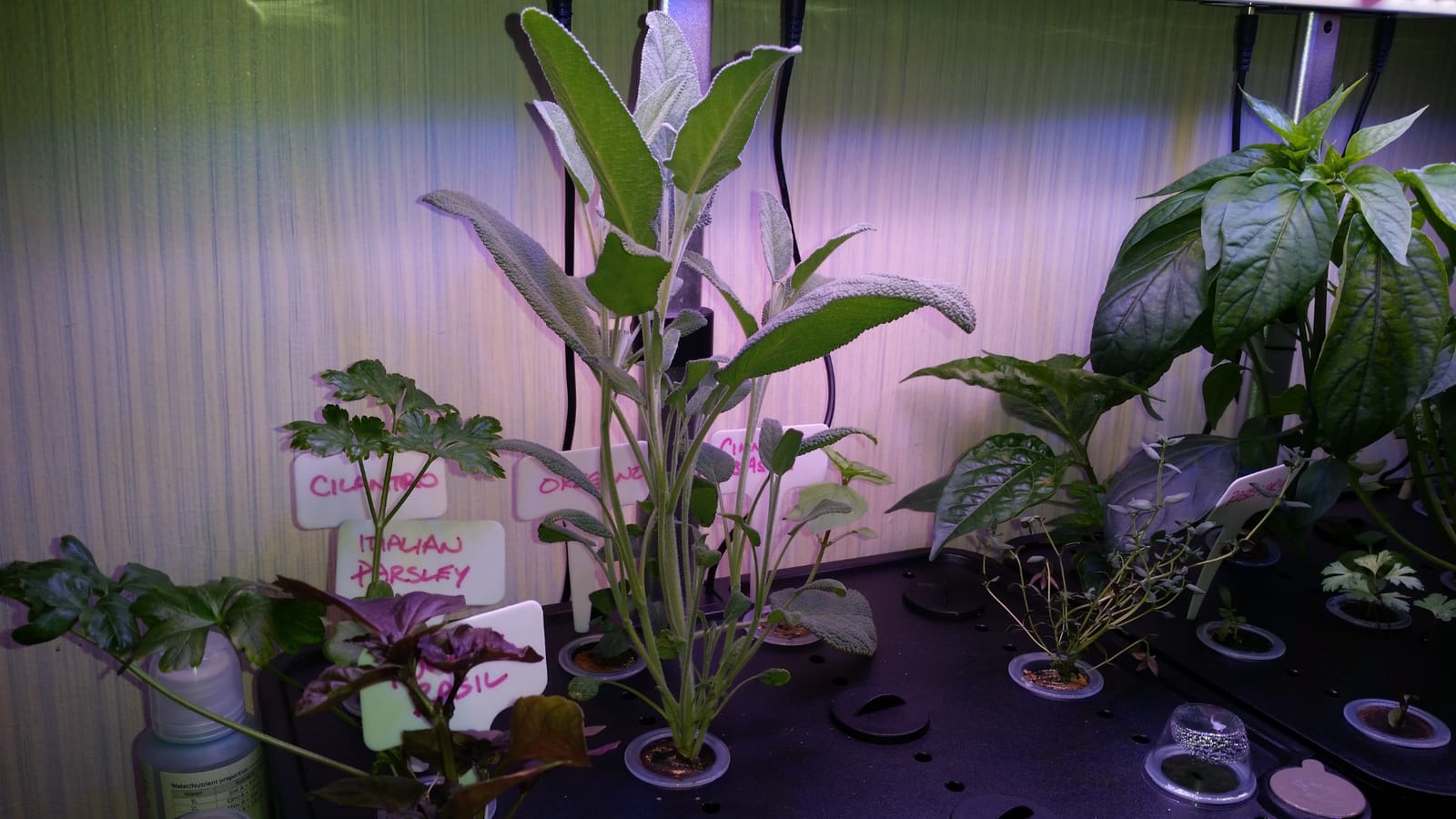
Buyers in this review group consistently point at three things: capacity, the two light modes, and a three step setup that is genuinely simple. Roughly 76 percent of ratings are five stars. The independent 4.5 liter tank is spec’d to support one to two weeks of growth, and the water level window means you are not lifting the lid to check.
The pump-and-fan combination is worth thinking about before you commit. In an open kitchen you can hear it, and while the noise level is not extreme, it is a continuous low hum for the whole cycle. The other trade is that this base model has no app or WiFi control, so the light schedule is set once and forgotten.
Who should buy the iDOO 12Pods
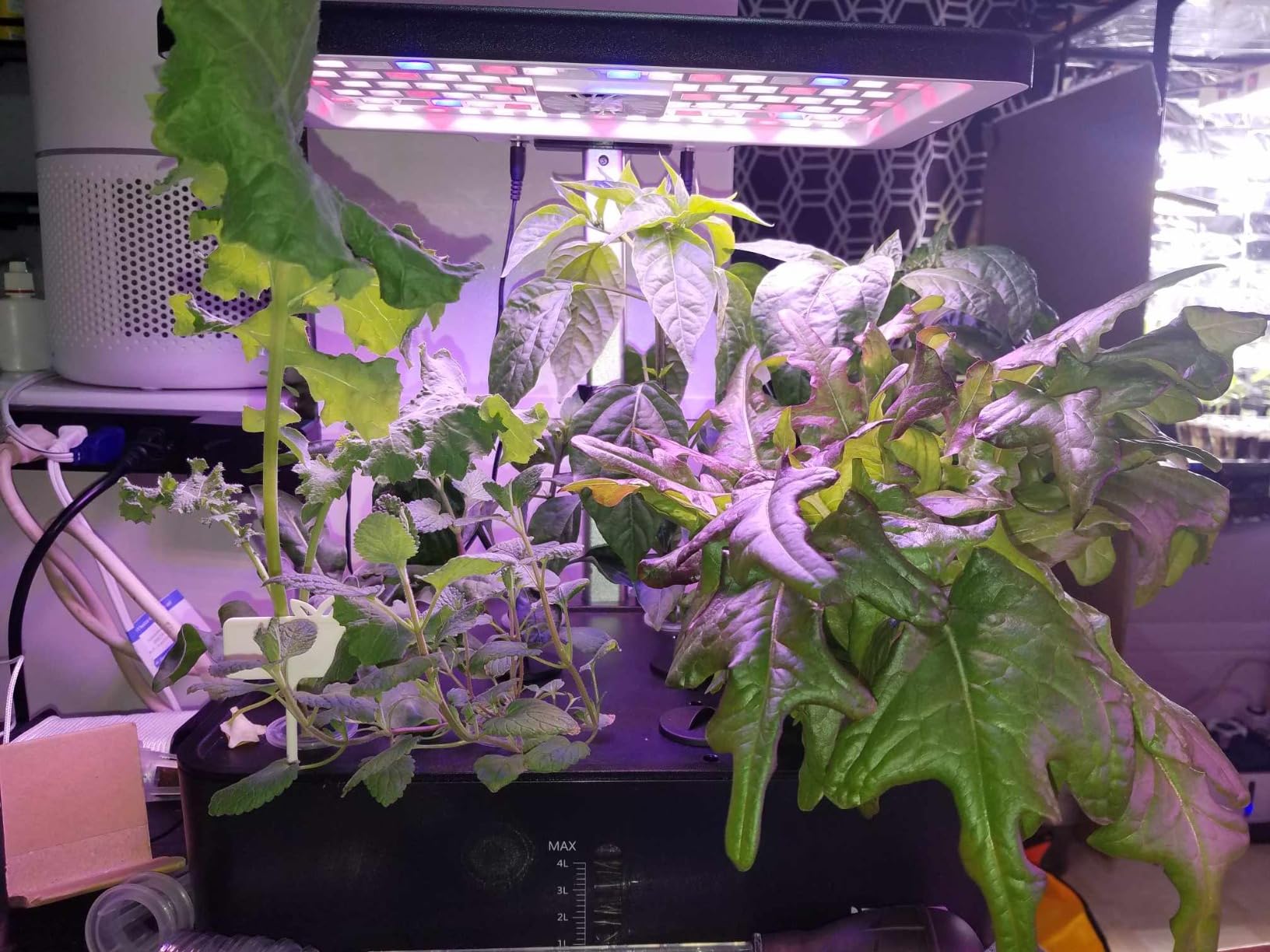
Buy it if you cook with herbs daily and want a real rotation running rather than a single pot of basil. Twelve sites means you can run basil, chives, cilantro, parsley, thyme, and mint at the same time and still have slots for experimental greens.
It is also the one to pick if two people share a kitchen and you want a visible, growing centerpiece rather than a small appliance you hide away.
What gives the iDOO trouble
Twelve plants under one 22 watt bar is a lot of canopy for a single light, and once basil fills out, lower leaves near the tray edges get shaded. Leave gaps between sites rather than planting all twelve at once.
The absent app is not a flaw for most kitchens, but if you travel regularly and want a vacation mode or watering alerts, this is the wrong unit. There is no on-screen display either, so the mode is set with a physical button.
3. Ahopegarden 12 Pods – Best Vertical Pick for Narrow Counters
Ahopegarden Hydroponics Growing System Kit: 12 Pods with LCD Control Panel
17 inch vertical profile
LCD touchscreen
5L tank
Twelve planting sites
Pros
- Narrow vertical column takes very little counter width
- LCD touchscreen shows status and sets modes at a touch
- Adjustable panel height helps prevent light burn
- Dual light modes plus a 22 hour flowering schedule
Cons
- Rated for 100 to 120V and 60Hz only
- Single column layout has less horizontal room than a wide tray
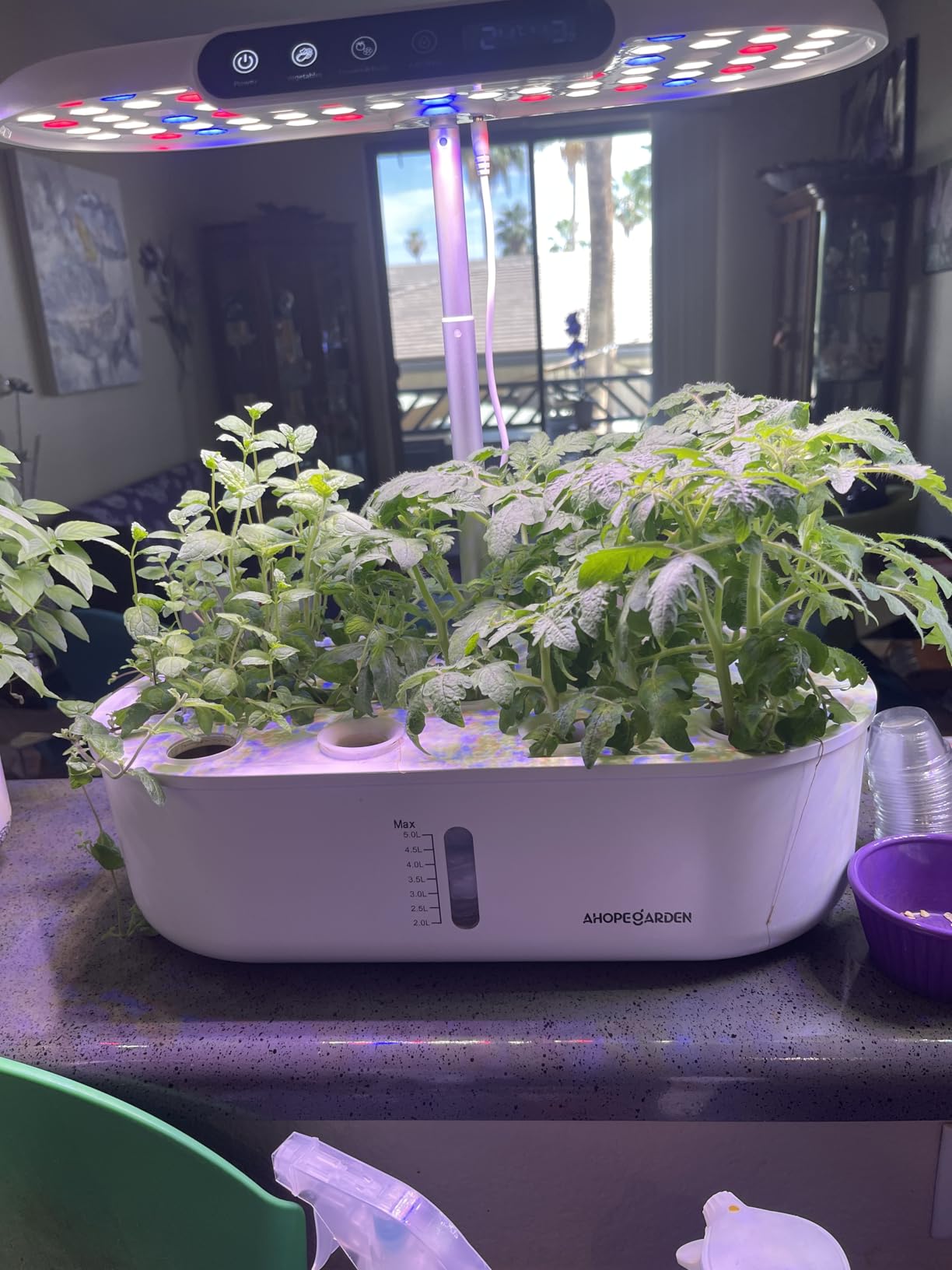
The Ahopegarden solves a problem the wide tray units create. At 18 by 9 by 6 inches it presents a narrow 17 inch profile, so it can stand at the end of a counter or on a shelf beside the kettle without taking the run of worktop a tray unit needs. The 12 pod capacity is identical to the iDOO, but the footprint is a fraction of the width.
This is the unit we would put in a galley kitchen or a rental where counter space is the binding constraint. It also has the only touchscreen control panel on this list, which shows settings and status at a glance rather than hiding them behind an app. The integrated grow panel adjusts in height, which is the fix for light burn on fast stems, and the dual light modes plus a dedicated 22 hour mode cover the flowering stage.
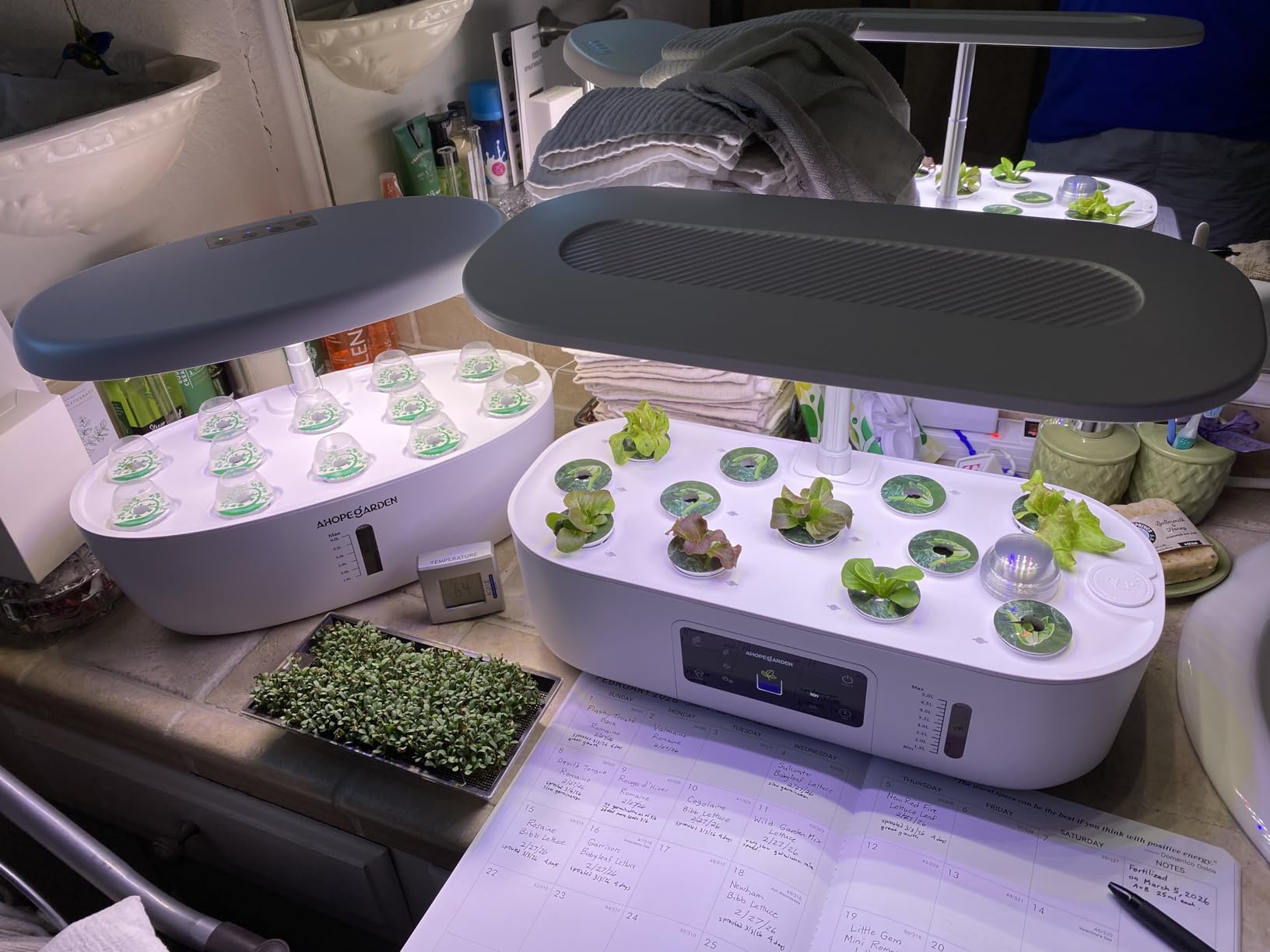
Reviews average 4.5 across 1017 ratings with 79 percent five stars, and the praise focuses on the modern finish and the clean vertical footprint. The pump is described as ultra quiet on a 30 minute cycle, and the 5 litre tank is among the larger reservoirs here. The kit includes A and B nutrient solution, twelve planting baskets and sponges, hole covers, and thirteen seedling covers, so a first run needs nothing else.
Two practical notes. The unit is rated for 100 to 120 volts at 60 hertz, which matters if you are outside North American style supply. And the 5.1 pound weight is worth keeping in mind if you plan to lift it for cleaning rather than slide it.
Why the vertical layout matters in a kitchen
Counter width is the resource you actually run out of. A kettle, a coffee maker, and a toaster take the run nearest the appliances, and what remains is a narrow strip at the end of the counter.
A vertical column like this one occupies roughly nine inches of width, so it fits that strip without pushing anything else along. The 17 inch height is the tradeoff, and it needs clearance under a wall cabinet.
Where it does not work
The single column means all twelve plants share one vertical plane, so a fast grower shades its neighbors more aggressively than in a wide tray with air between sites. Mix plant speeds deliberately.
And if you travel or want alerts, the LCD is local only. There is no app here, so the screen is the whole interface.
4. LetPot LPH-Air 10 Pods – Best for App-Controlled Scheduling
LetPot LPH-Air Hydroponics Growing System Kits, APP & WiFi Controlled Smart Indoor Garden with Adjustable 24W Grow Light Full Spectrum, 10 Pods Planter Indoor Gardening for Gifts, Kitchen, Vegetable
10 growing sites
24W adjustable LED
4L tank
14 to 21 day water interval
Pros
- App and WiFi control with 24 hour custom schedules
- Silent mode and water level alerts simplify upkeep
- 100 to 240V works across regions
- Light rod extends to 14 inches
Cons
- Ten pods is fewer sites than the twelve pod models
- Seeds and planting media are not included
This is the LetPot option to buy if you like the idea of controlling your garden from a phone, and it is the smaller of the two LetPot units here. The 24 watt full spectrum LED sits on a rod that extends to 14 inches, and the app lets you set any lighting schedule you want across a 24 hour period rather than accepting a fixed on and off window.
Two app features stood out to us for kitchen use specifically. Silent mode suppresses alerts, which matters if you do not want a phone notification every time the pump cycles, and water level alerts tell you when to top up rather than making you eyeball the tank. The 4 liter tank is rated for 14 to 21 days between waterings, one of the longest published intervals on this list.
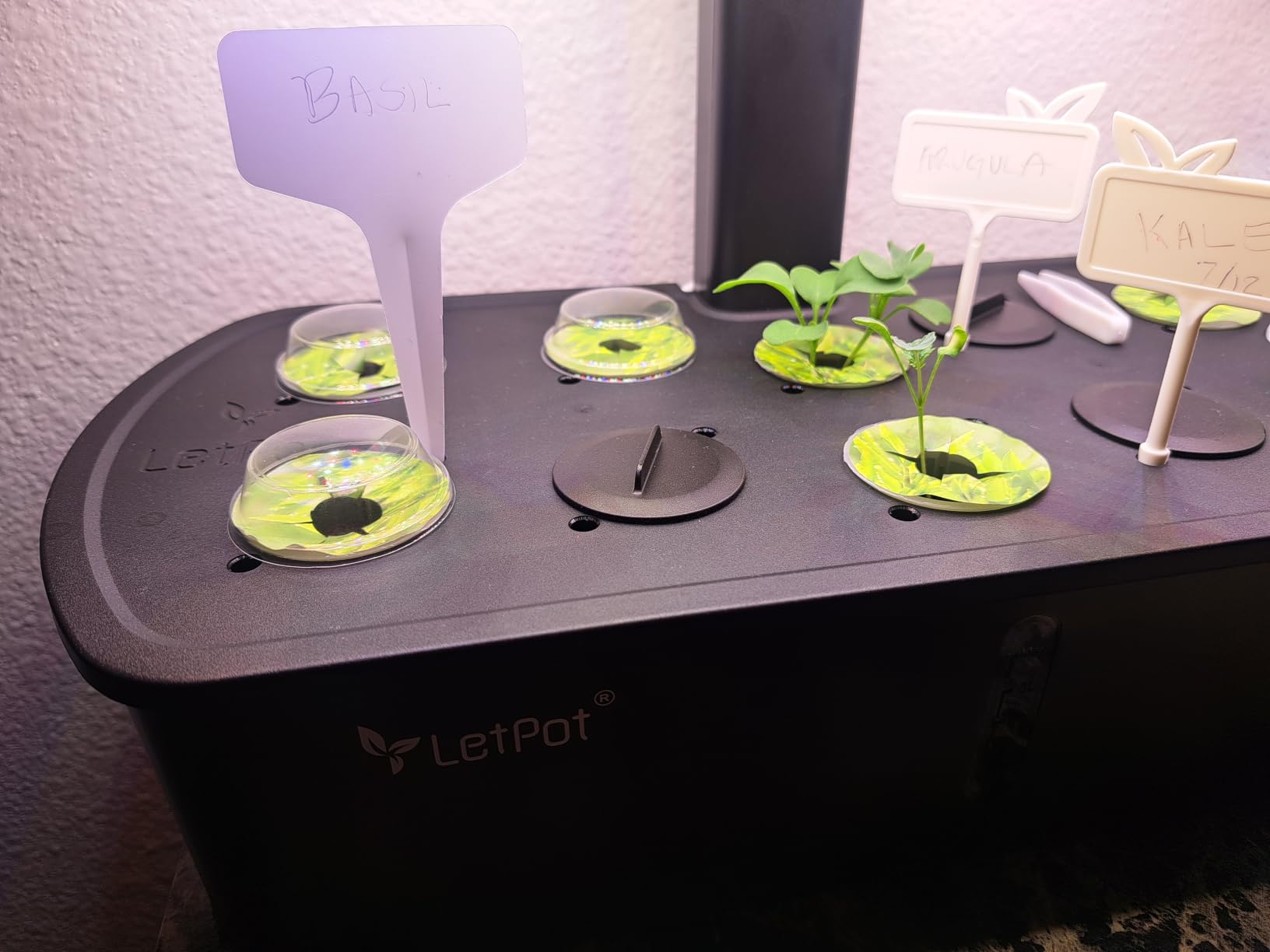
Reviews average 4.5 from 1077 ratings with 80 percent five stars, and buyers single out the scheduling and the long refill interval. The unit also accepts 100 to 240 volts at 50 to 60 hertz, which is the widest electrical compatibility here and makes it the safer choice for a non-North American kitchen.
Be clear-eyed about the trade. Ten pods leaves you with fewer sites than most other pod systems here, and the seeds and planting media are not included. You are buying a growing slot, not a planted garden.
Is app control actually worth paying for
It is worth it if you travel or already live in your phone. Setting a 16 hour light cycle once and having the app remind you about water is genuinely less work than a button and a visual check.
It is worth less if you are home and near the unit, and it is worth nothing if the app is the only control. Owners keep raising the same worry: an app-only garden becomes an expensive planter if the company folds or the software stops updating. Here the light hardware and the reservoir are entirely mechanical, so the unit still works if you never pair it.
What to watch with the 10 pod layout
Ten sites under one 24 watt bar is workable but tight once plants reach full canopy. Stagger your plantings by a week or two so you are not harvesting everything at once.
The 3.5 pound weight and 15 by 5 by 7 inch dimensions make it one of the easier units to move for a clean, which matters more than it sounds when algae appear in a reservoir.
5. LetPot LPH-SE 12 Pods – Best Premium Pick for Long Intervals Between Watering
LETPOT LPH-SE Hydroponics Growing System, 12 Pods Smart Herb Garden Kit Indoor, Indoor Garden, APP & WiFi Controlled, with 24W Growing LED, 5.5L Water Tank, Pump System, Automatic Timer
12 growing sites
24W full spectrum LED
5.5L tank
30 inch adjustable rod
Pros
- App sets precise LED on and off timing with reminders
- 5.5L tank for up to three weeks between fills
- Light rod adjusts to 30 inches for tall plants
- Stainless steel exterior is easy to wipe clean
Cons
- The most expensive unit in this roundup
- One star reviews run higher than most rivals at 7 percent
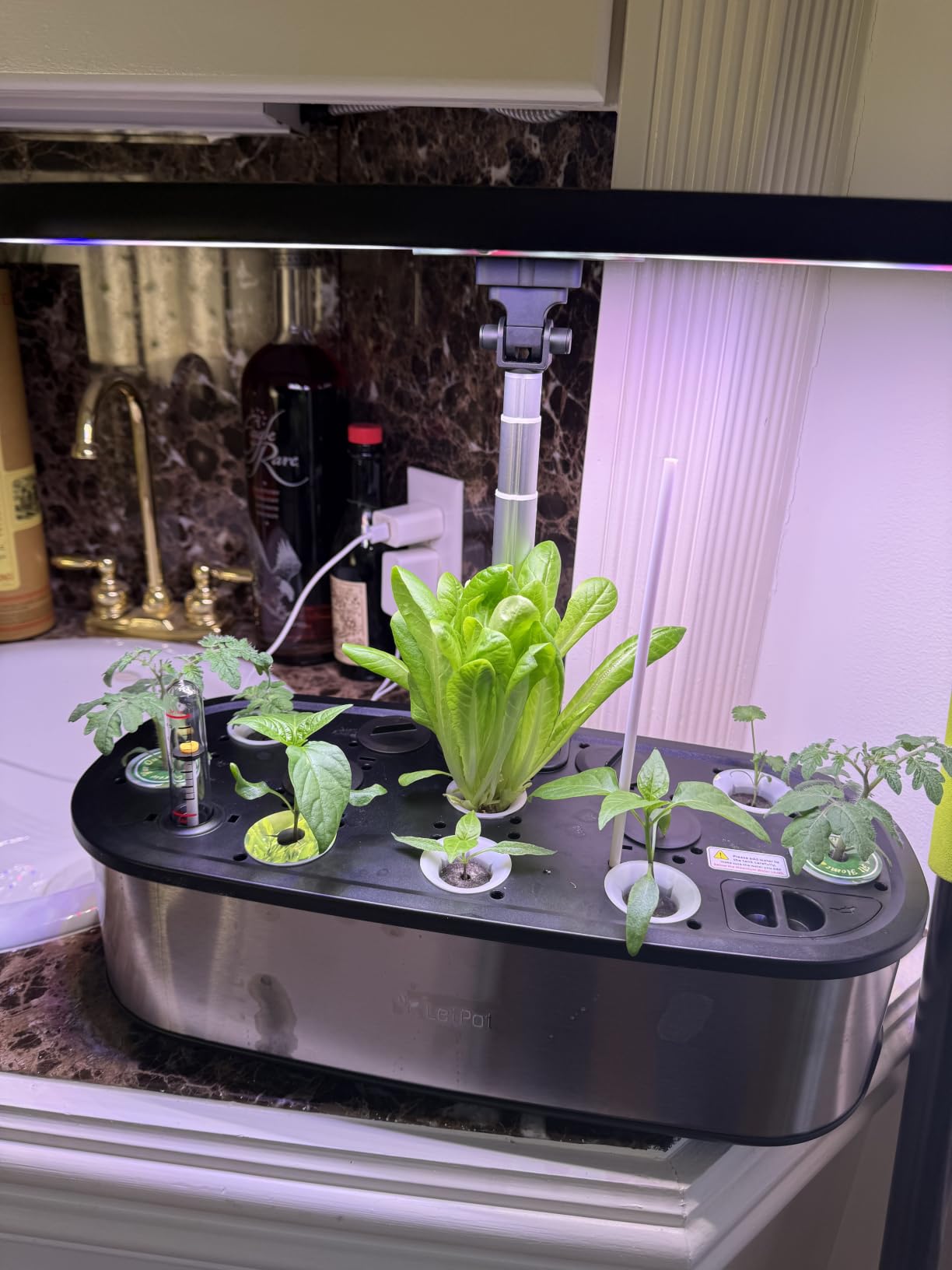
The LPH-SE is the one to buy if you want maximum plant height and minimum refilling. The 30 inch adjustable LED rod is by far the tallest travel of any unit here, more than double the fixed arms on the budget models, and the 5.5 liter tank is spec’d for up to three weeks of growth per fill. For someone with a busy week or a two week holiday, those two numbers do more work than any app feature.
The 24 watt full spectrum LED has two growing modes, a vegetative blue and a bloom red, both set from the app, and the light schedule can be set anywhere across a 0 to 24 hour range. The body is a stainless steel outer wall with a resin inner wall, which is the easiest surface on this list to wipe down after a messy harvest.
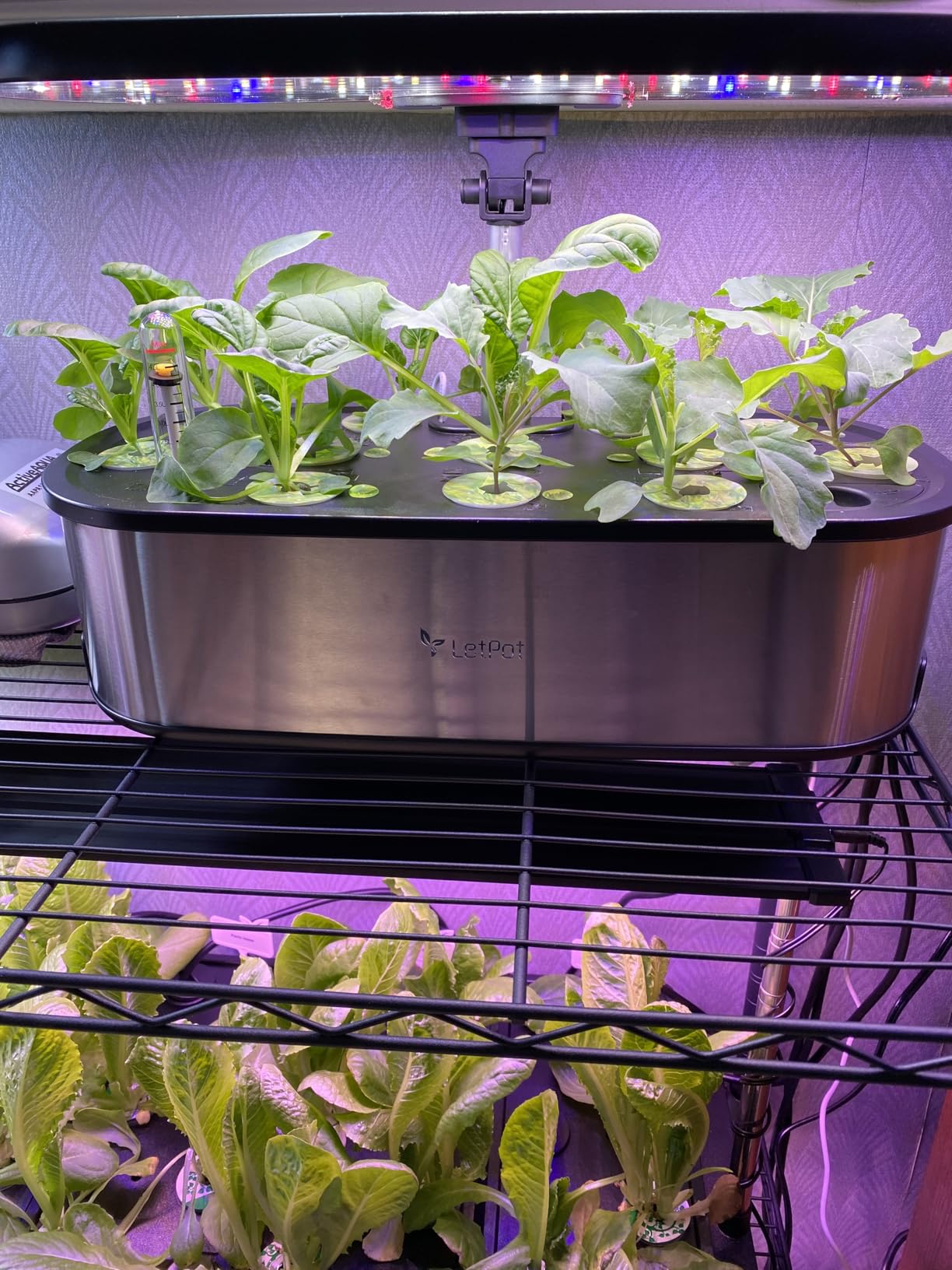
Reviews average 4.4 from 1758 ratings with 77 percent five stars, and the feedback centers on the app controls and the long interval tank. It is worth noting that 7 percent of ratings here are one star, the second highest share among the systems we tested, and the complaints in that group tend to be about durability and support responsiveness rather than growing results.
The kit is complete for a first run: twelve planting cups with sponges, baskets, seedling covers, and A and B nutrients. The unit measures 16 by 7 by 9.8 inches, so plan for a wide tray footprint similar to the iDOO.
Why light height is the spec that changes results
Leafy greens and basil bolt when the light sits too close, and a canopy that closes over the bar starves the plants underneath. A rod that reaches 30 inches lets a plant grow into the light rather than away from it.
This is the fix that budget units with 11 to 14 inch arms cannot offer. If you plan to grow lettuce, dill, or anything that gets tall, this rod range is the single best reason to spend more.
What we would watch out for
It carries the highest sticker cost of anything on this list, and the app is a real dependency for the two light modes. If you would rather not have a phone app in the loop, the SUNCOZE or Ahopegarden units give you physical controls instead.
The stainless steel finish also shows fingerprints and water spots. In a kitchen that cares about appearance, plan to wipe it down.
6. inbloom 12 Pods – Best for Fast Germination and Wide Pod Spacing
inbloom Hydroponics Growing System 12 Pods, Indoor Herb Garden with LEDs Full-Spectrum Plant Grow Light, Water Shortage Alarm, Automatic Timer, Height Adjustable, Ideal Gardening Gifts for Women
12 growing sites
24W 76 bulb lamp
4.2L tank
16 hour light cycle
Pros
- Reviewers report sprouts in about three days
- Pods spaced 20 percent wider than competing designs
- Low water alarm and one touch sleep mode for the lamp
- Rounded wood accent suits a kitchen counter
Cons
- Water level bobble reported to stick and misread
- LED is very bright across a 16 hour cycle
- Setup instructions described as confusing
The inbloom is the fastest starter on this list. Buyers repeatedly report sprouts in roughly three days, and with 989 reviews at a 4.4 average that consistency stands out. If your previous experience with indoor growing ended with pods that never germinated, speed is a legitimate reason to pick this over a slower unit.
The other design decision we like is pod spacing. The pods are laid out 20 percent wider than competing designs, which means more leaf light exposure per plant and less crowding as a tray fills. The 76 bulb 24 watt full spectrum lamp runs a fixed 16 hours on and 8 hours off, and the bar adjusts in height. The 4.2 litre tank is paired with a refill interval of roughly 15 to 30 days depending on how full you keep it.
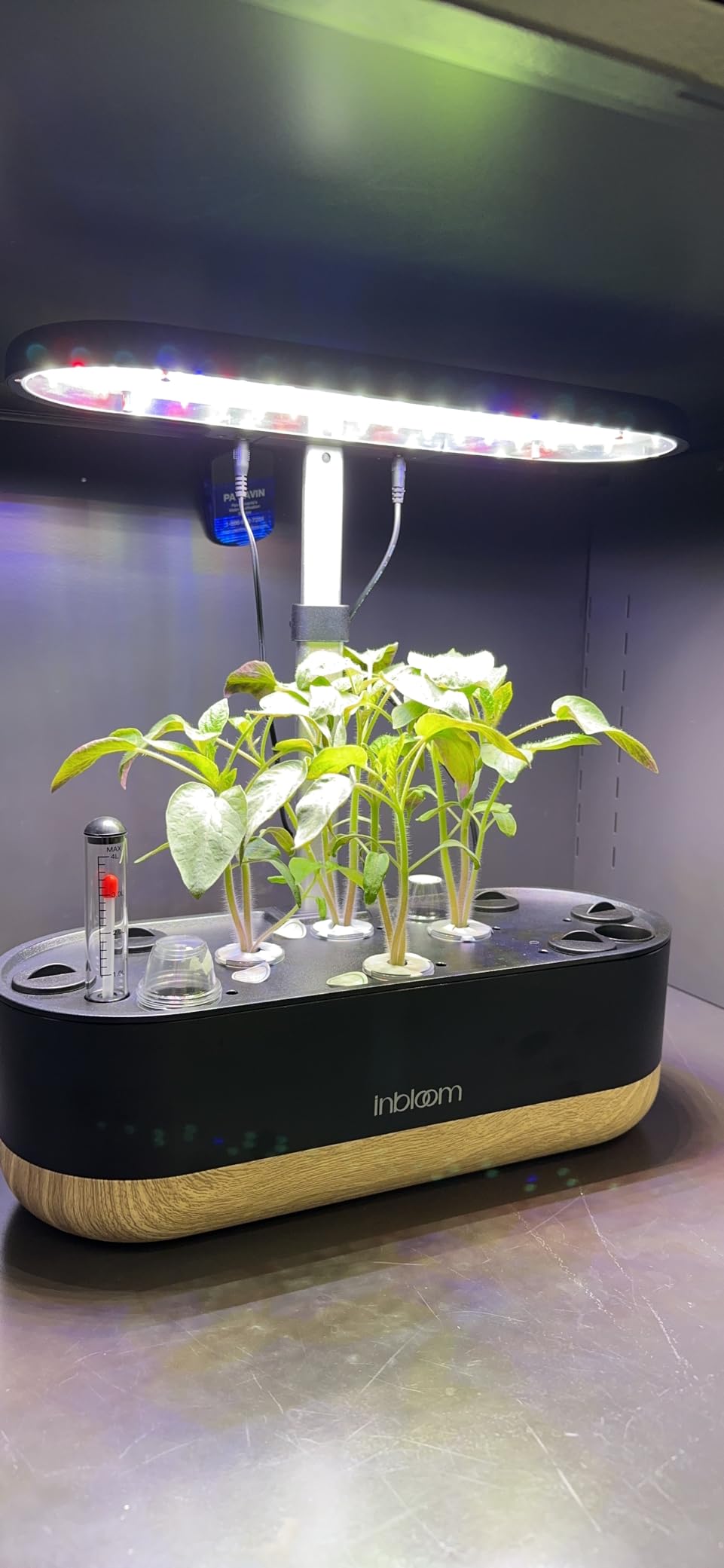
Three practical features are genuinely well judged. A low water level alarm triggers below 700 millilitres, which is early enough to save a crop, and a one touch lamp shutoff switches the light off and auto-resumes after ten hours, useful when you want the counter dark for an evening. The rounded wood accent on the body suits a kitchen counter better than the plain black and white mouldings. The kit includes twelve baskets, twelve domes, twelve sponges, A and B plant food, and twelve plant labels.
The recurring gripes are worth taking seriously. Owners report the floating water level bobble sticking and reading incorrectly, which undermines the whole point of a visible gauge. The lamp is also described as very bright, and over a 16 hour cycle that light spills into the room. A portion of buyers found the setup documentation confusing and contradictory, so budget an extra ten minutes.
Which plants benefit most from wide spacing
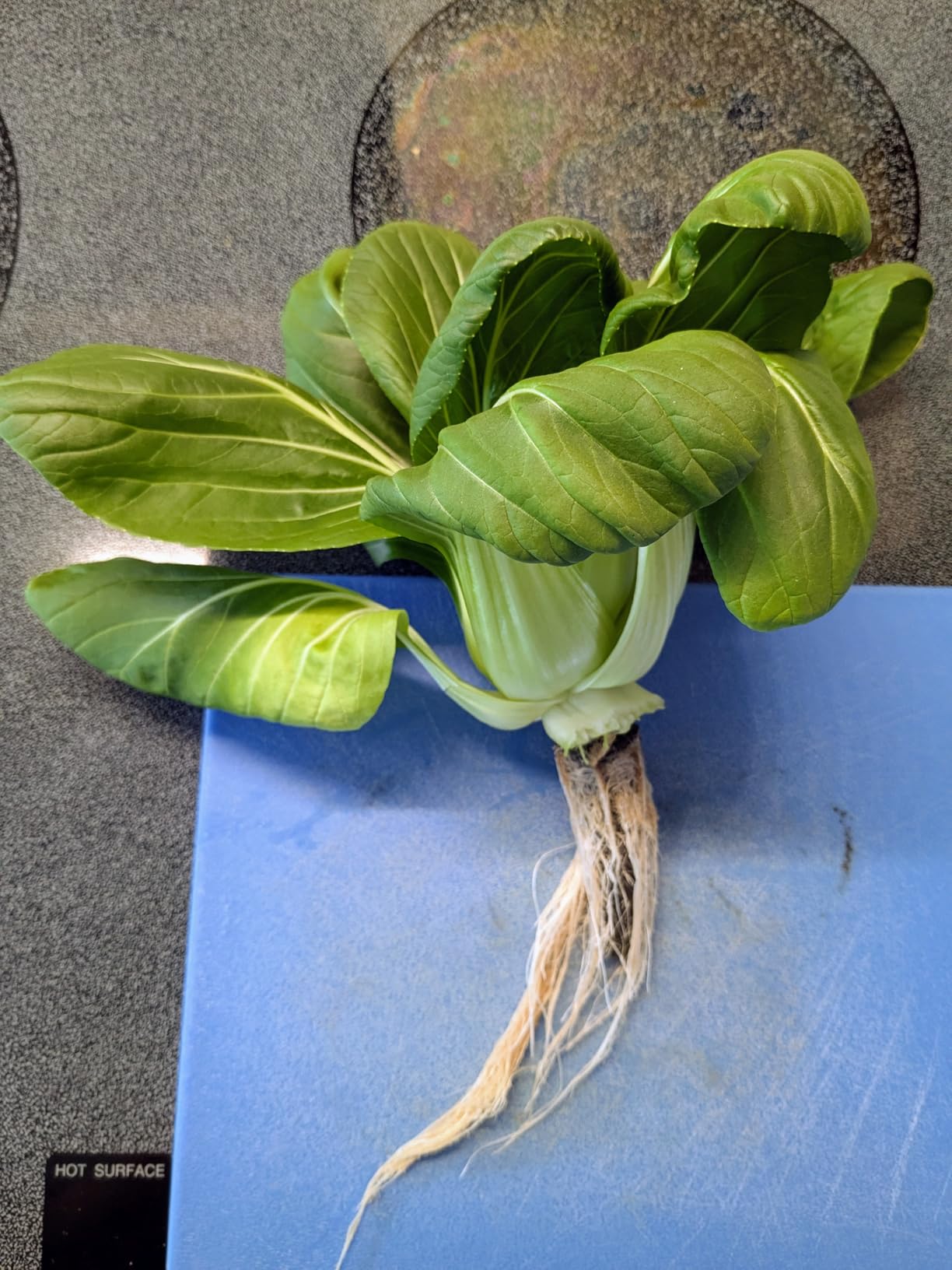
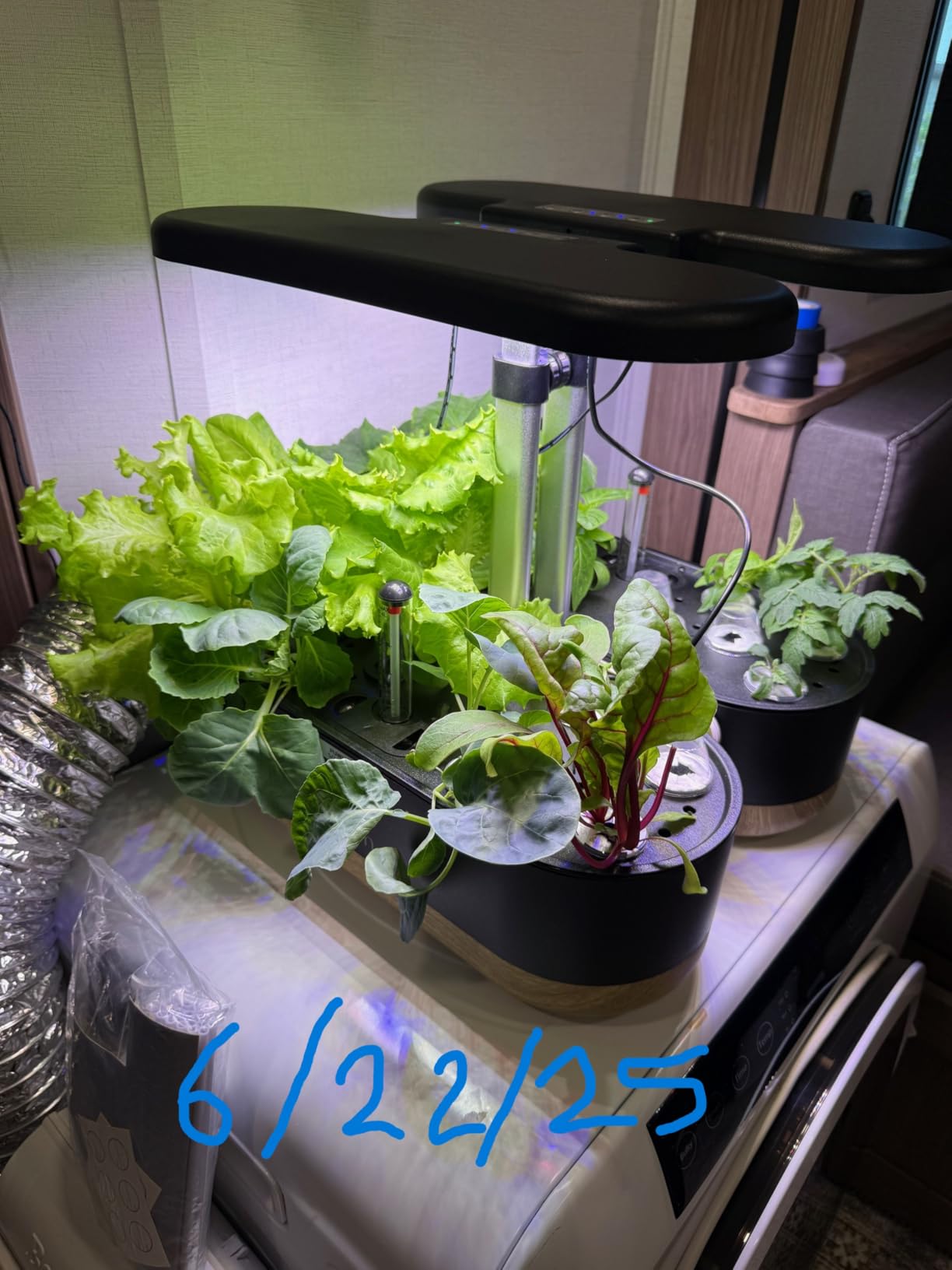
Anything with a wide leaf. Basil, lettuce, bok choy, and arugula all benefit from the extra 20 percent because their canopy can spread without immediately shading a neighbour.
For a kitchen herb rotation it also means you can plant a full tray of one herb and still get usable leaves from the centre sites, which is where a tightly packed tray usually goes bare.
Where the inbloom is frustrating
A gauge that lies is worse than no gauge. If you rely on the bobble to know when to fill, check the actual level until you trust it.
And the brightness is a real consideration at night. In a dark kitchen with a window, a 16 hour cycle at that intensity can be the thing you notice most about the room.
7. URUQ 8 Pods – Best for Quiet Kitchens and Open-Plan Living
URUQ 8 Pods Hydroponics Growing System with LED Grow Light – Black
8 growing sites
24W LED to 21 inches
Pump under 20 dB
3L tank
Pros
- Pump rated under 20 dB on a 30 minute cycle
- Compact footprint suited to a windowsill or shelf
- Detachable light pole makes cleaning safer
- Built in water shortage indicator
Cons
- Only 8 pods which is fewer sites than most units here
- 3L tank needs more frequent refilling than 5L models
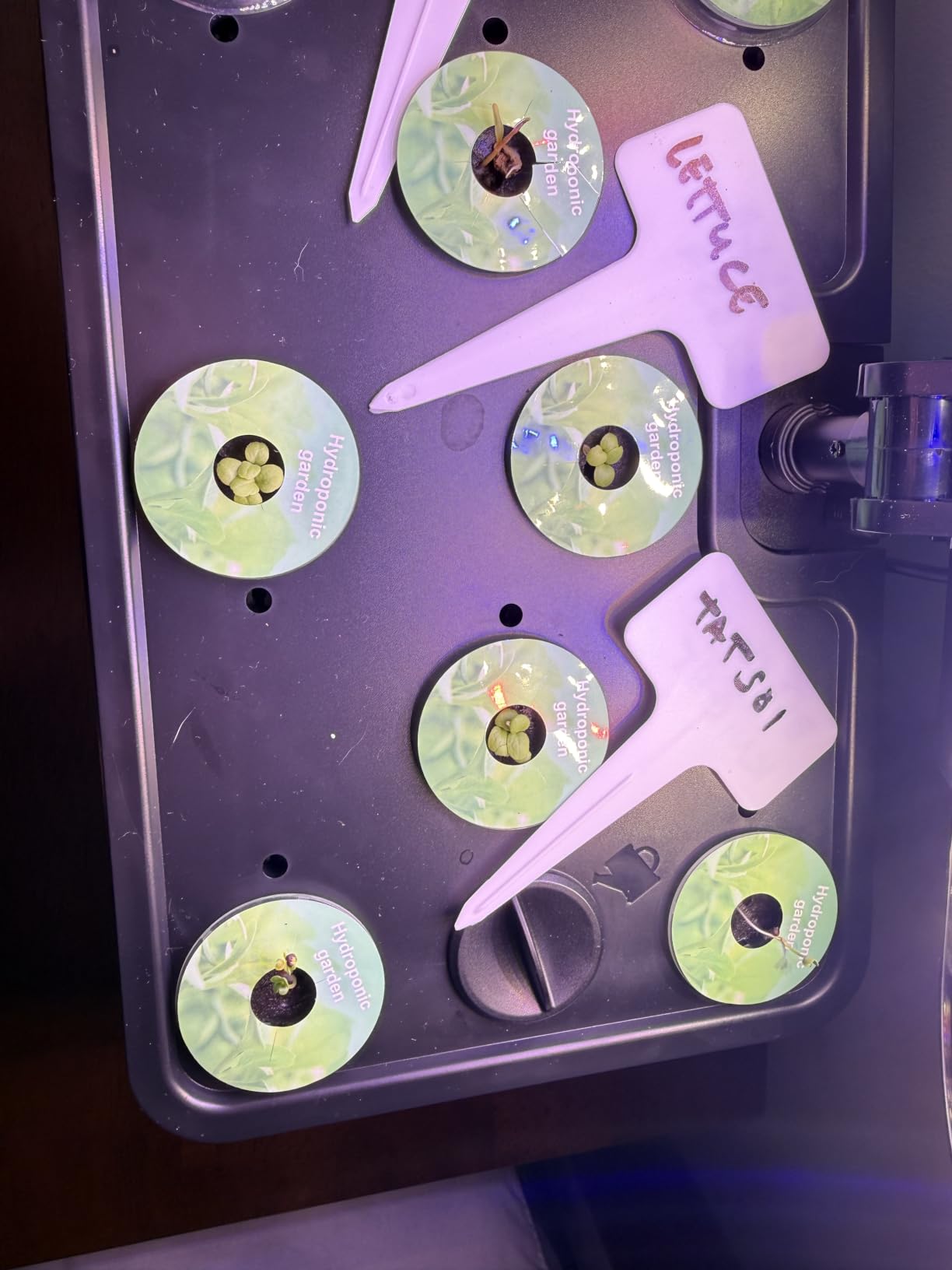
Noise is the criterion nobody publishes and everybody in an open-plan kitchen notices. The URUQ 8 Pods is the only unit here with a stated pump figure, under 20 dB, on a 30 minute circulation cycle. That is quiet enough that you can run it on an island counter while people eat and talk, which rules out several of the larger models on this list.
Eight pods is the fewest sites of any multi-site model here, but the 24 watt LED panel adjusts through 180 degrees and up to 21 inches tall, and that vertical travel is better than most of the twelve pod units here. The pump circulates every 30 minutes, a built in indicator warns you of water shortage, and a smart timer delivers 16 hours of light and 8 hours of rest without any app.
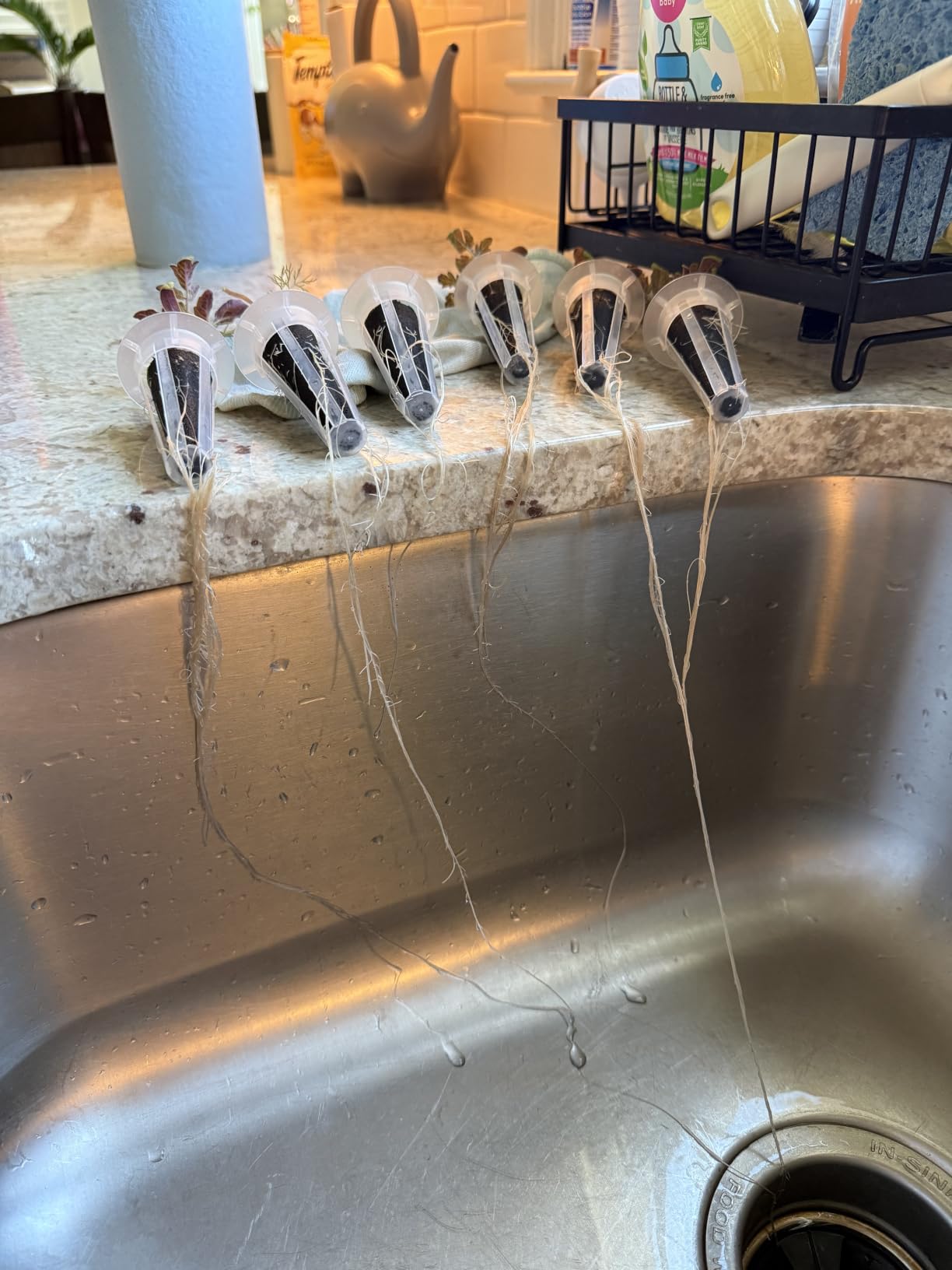
Reviews average 4.5 from 709 ratings with 78 percent five stars, and the praise centers on near silent pumping, easy setup, and a compact footprint. The detachable height adjustable light pole is an underrated detail: lifting the whole lamp to change the water means you are not working around a fixed arm with wet hands, and it is the safest way to clean the fixture.
The 3 liter tank with a viewing window is the trade you make for the quiet. It is the smallest reservoir among the pod systems here, so you will refill more often, and the window is useful enough that you will probably check it every few days anyway. Owners who want a week away from the kitchen should look at the 4 to 5.5 litre models instead.
Is pump noise real in a kitchen
It is. On a wide tray unit the pump and fan run through most of the light cycle, and a continuous circulation sound sits right in the middle of a conversation. In a closed kitchen you stop noticing within a week.
In an open-plan space you do not. A pump under 20 dB changes the experience from lab equipment to something you can leave on while guests are over.
Where eight pods is too few
If your cooking depends on more than three or four fresh herbs at once, eight sites will feel cramped by month two. Grow the same crop across sites and you get a good harvest, but no variety.
The 3 liter tank also means more hands-on attention, which partly undercuts the quiet-operation benefit if you are the kind of person who would rather not check a reservoir.
8. DRYADES Self-Watering Grow Pot – Best for Gardeners Who Want Soil
Indoor Garden Growing Systems Self-Watering Plant Pot Smart Gardening System with 17 Watts LED Grow Light Auto Timer Gardening Plant Gifts for Mom Plant Pot for vegetables herbs(No Seeds&Soil)
Single soil pot
17W full spectrum LED
8H 12H 16H timer
Compact body
Pros
- Uses standard potting soil so transplants and larger plants work
- Compact size fits under a cabinet or beside a coffee maker
- Three timer settings plus three brightness levels
- Doubles as a table lamp or night light
Cons
- A single pot limits total harvest volume
- Some buyers report the light or cord failing after a few months
- Rated for 100 to 120V and 60Hz only
This is the odd one out, and the odd one out is exactly why it is here. Every other unit on this list is a hydroponic pod system. The DRYADES is a soil planter with a 17 watt full spectrum LED and a wick, which means you can use standard potting mix, transplant seedlings you bought elsewhere, and grow something considerably larger than a basil sprig in a single pot.
It also solves a countertop problem the pod systems cannot. At 5.51 by 6.3 by 5.91 inches it is small enough to slide under a wall cabinet or stand beside a coffee maker where a twelve pod tray never fits. A silicone plug and an absorbent rope wick handle the watering, and the cycling mode offers three timer settings of 8, 12, or 16 hours with three light intensities.
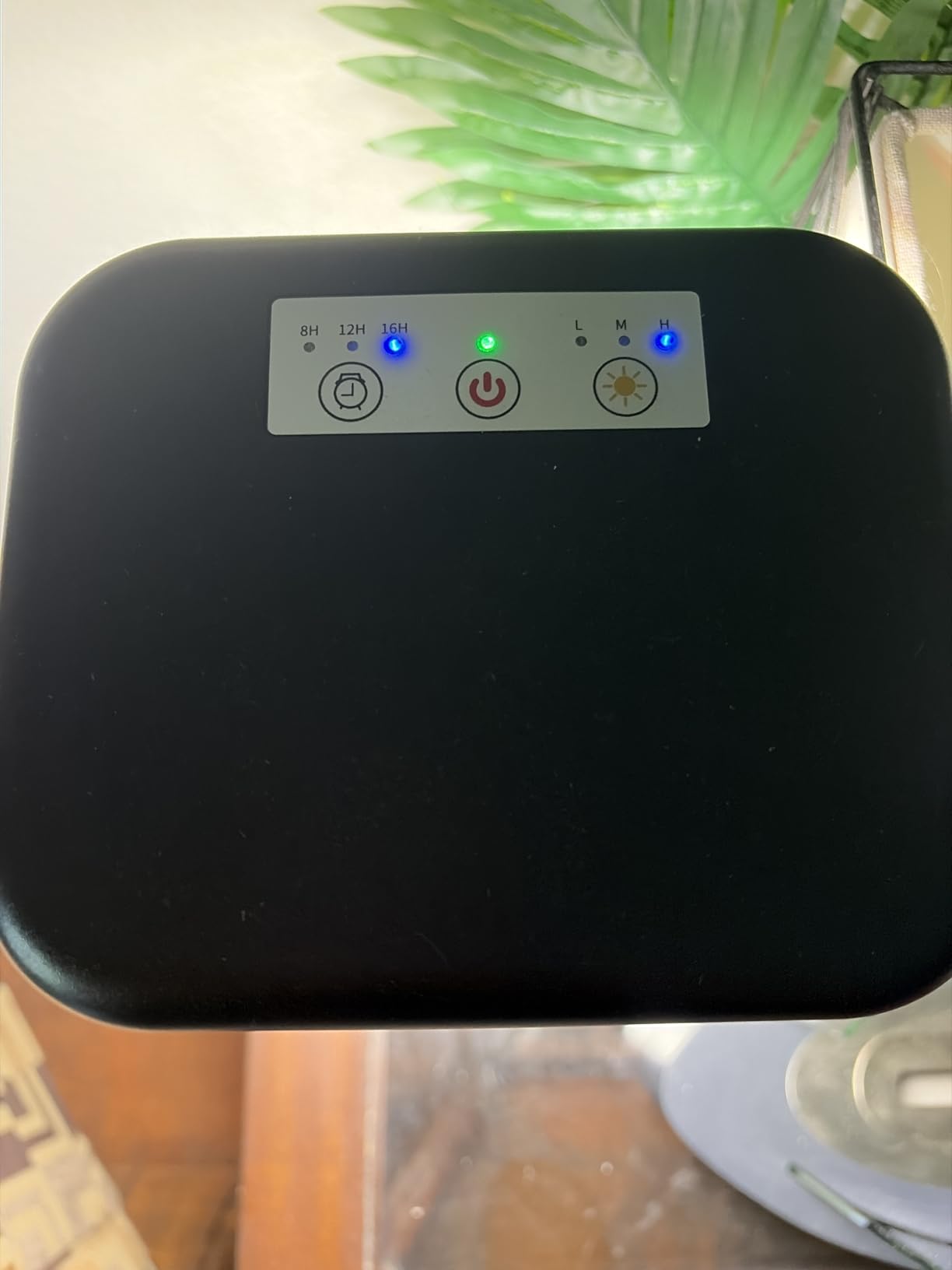
Reviews average 4.5 from 460 ratings with 73 percent five stars. Buyers mention the soil-based simplicity, the compact size, and the timer. The listed plant coverage is long, covering basil, lettuce, arugula, cilantro, mint, parsley, oregano, spinach, jalapenos, cherry tomatoes, and more, though fruiting plants in a single pot under a 17 watt lamp will disappoint anyone expecting a real crop.
The honest caveat is durability. A portion of buyers report the light or the cord failing after a couple of months, and the unit is rated only for 100 to 120 volts at 60 hertz. It is also a single pot, so treat it as an accent plant station rather than a supply of herbs. The included components are a power adapter, silicone plug, absorbent rope, manual, and plant stand. No seeds or soil are included.
When soil beats hydroponics in a kitchen
Soil wins when you want to grow a plant rather than cut from a plant. A single pot can hold a pepper, a compact tomato, or a decorative herb that you keep for months, and you can move it between indoor and outdoor light as the seasons change.
Hydroponics wins on speed, yield, and cleanliness. If your goal is a weekly supply of cut herbs, the pod systems produce more from less space.
Where this one falls short
One pot is one pot. No matter how well the light performs, you are harvesting from a single site, and the reviews are consistent that total harvest volume is the limit.
And the reported failures of the light or cord after a few months suggest buying it as a seasonal experiment rather than a permanent counter fixture.
9. MetryGrow MG-15 – Best for the Highest Pod Count
MG-15 Hydroponic Growing System Kits, Smart Indoor Garden with 24W Grow LED Light Full Spectrum, 15 Pods Herb Garden Planter Indoor Gardening for Gifts, Kitchen
15 growing sites
24W full spectrum LED
5.5L tank
14 inch adjustable stand
Pros
- Fifteen pods is the highest capacity in this roundup
- 5.5L tank with a clear level window needs monthly refills
- Dual modes for vegetables and for fruit and flowers
- Removable trays simplify harvesting and cleaning
Cons
- Only 214 reviews and the thinnest history here
- Light panel adjusts to only 14 inches
- 8 percent one star ratings which is the highest share listed
On paper the MG-15 is the value proposition: fifteen planting sites and the 5.5 liter tank matches the largest reservoir in this roundup. The 24 watt patented full spectrum LED carries a built in 16 hours on and 8 hours off timer, dual light modes for vegetables and for fruit and flowers, a silent pump on a 30 minute cycle, and a 5.5 liter tank with a clear level window that is refilled roughly monthly.
It is also the newest listing here, and that shows in the numbers. It has 214 reviews, the thinnest history of the ten, and a 4.3 average that is the lowest on this list. Eight percent of its ratings are one star, the highest share among the systems we looked at, and reviewers who report problems tend to cite build and light issues rather than growing results.
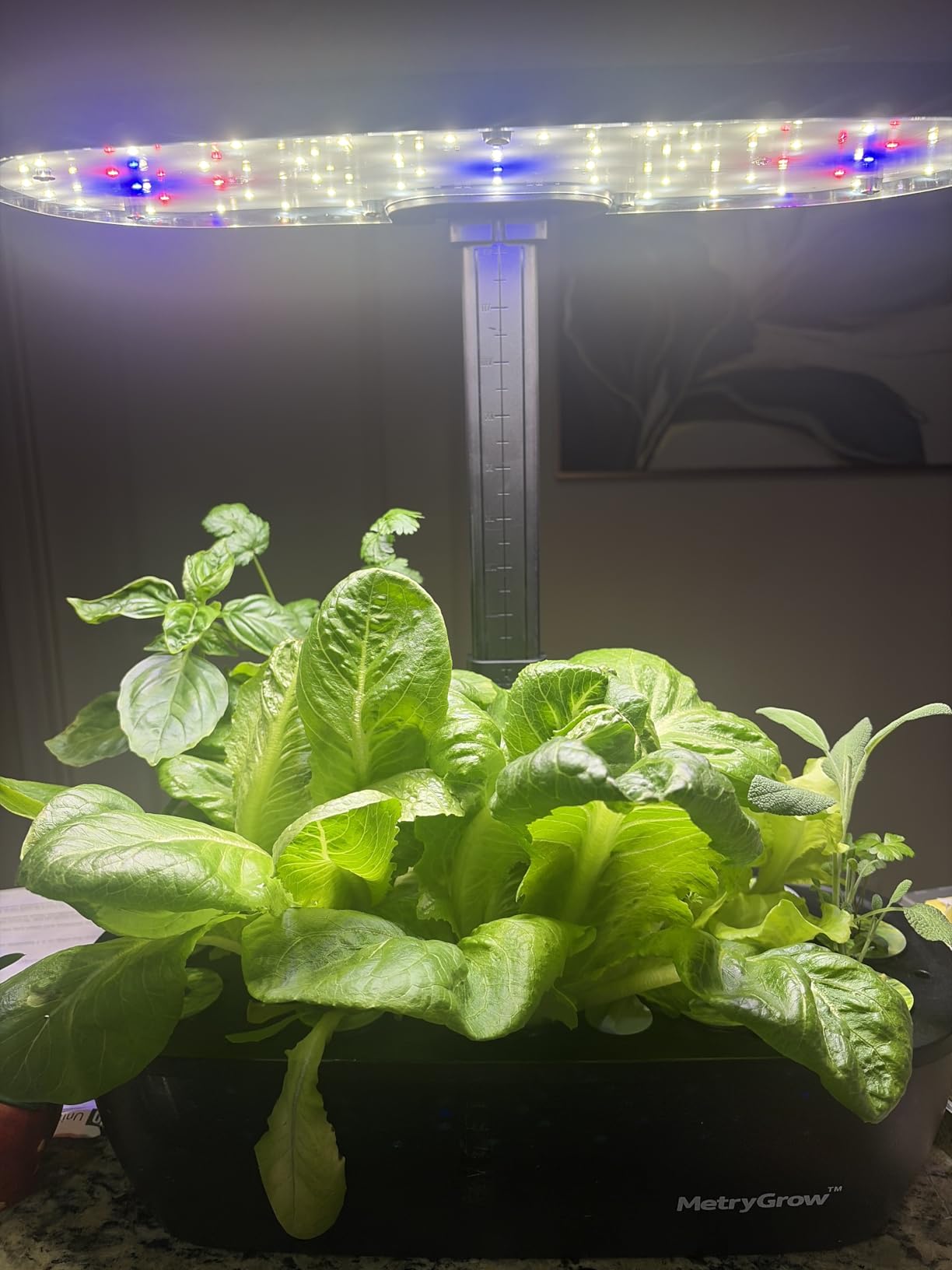
What the positive reviews do highlight is pod count and tank size for the money, and the detachable USB powered light panel plus removable trays, which make harvesting and cleaning simpler than units with a fixed arm. The support team is reported as replying within twelve hours, which matters more than it sounds if a pod fails to germinate. The kit is complete: fifteen sponges, fifteen baskets, stickers, two nutrient bottles, support poles, labels, and a certified adapter.
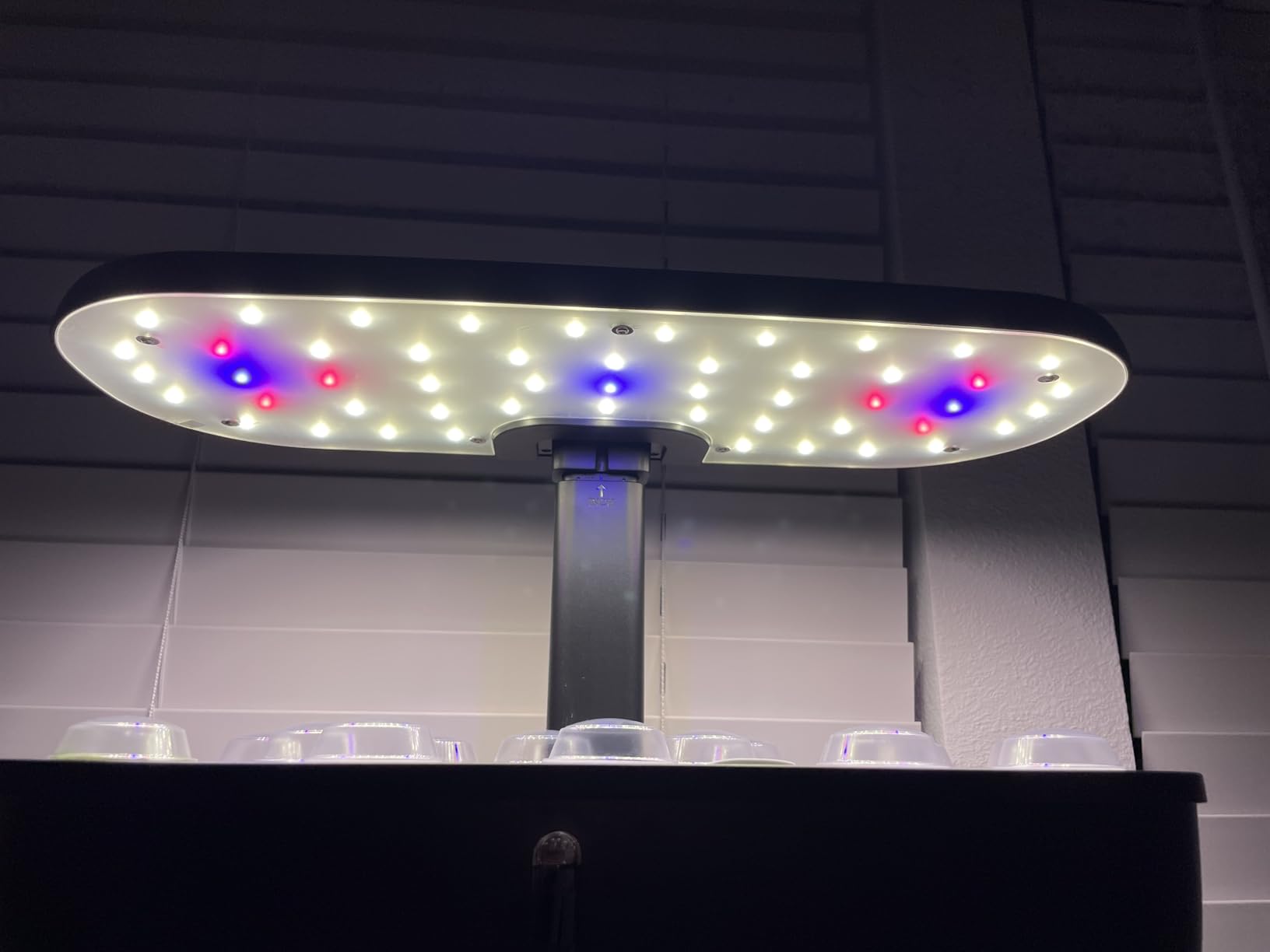
But fifteen pods under a 14 inch adjustable stand is a crowded canopy waiting to happen. That stand height is the shortest of the twelve-plus pod models here, and it is the reason we would not put this first on a kitchen counter where you want herbs that last.
Is more pod count actually better
Only if you can light them. Pod count is useful when your plants stay short, like microgreens, chives, or a salad mix harvested young. Above that height, count stops helping because the light bar is the constraint.
Compare this to a 10 pod unit with a 21 to 30 inch rod. The smaller unit will produce larger individual plants, and for cooking herbs that is the number that counts.
What the thin review history means for you
Fewer reviews means less long-term evidence about how the light, pump, and seals hold up after a year. Durability complaints are easier to detect in a product with thousands of reviews than in one with a couple hundred.
If you want the pod count, buy it knowing you are testing a newer design. If you want low risk, choose a unit with a deep review history even if it has fewer sites.
10. SUNCOZE 12 Pods – Best for First-Time Growers
SUNCOZE Hydroponics Growing System, Compact 12 Pods Indoor Garden, Green
12 growing sites
24W full spectrum LED
4L tank
Height adjustable 2.2 to 12.4 inches
Pros
- Roughly ten minutes from box to sprouting for most owners
- Pump reads as soft white noise
- Flashing indicator and gauge make top ups obvious
- Owners report success with lettuce parsley cilantro and basil
Cons
- Some owners report timer reliability issues
- Light bar is narrow relative to the grow deck
- Pods near the pump have reportedly failed to germinate
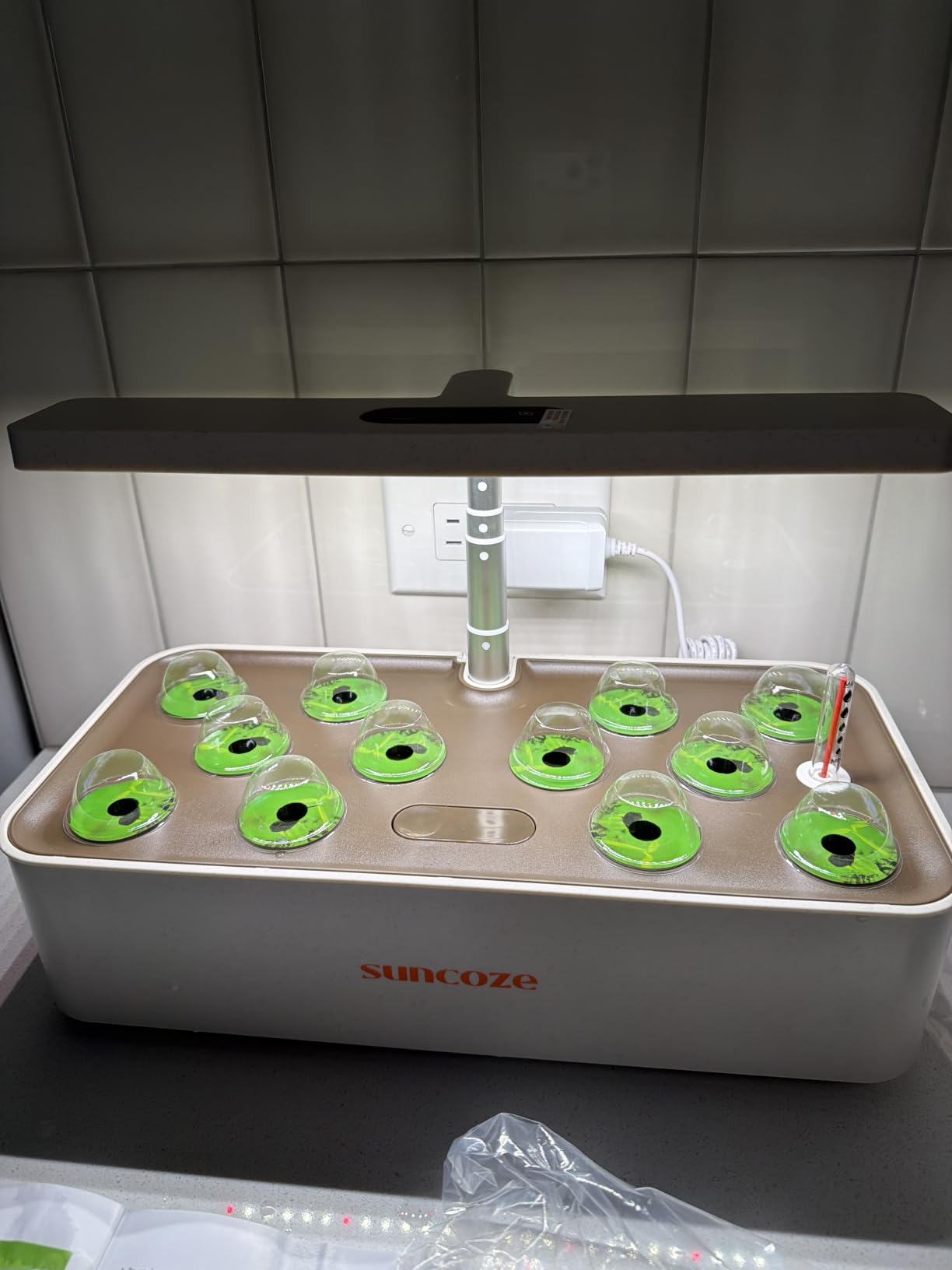
The SUNCOZE is the unit to hand someone who has never grown anything and does not want a project. Owners report about ten minutes from opening the box to sprouts, and successful results with lettuce, parsley, cilantro, and basil. At 15.6 by 7.4 by 7.8 inches and 3.7 pounds it is one of the more compact twelve pod units here.
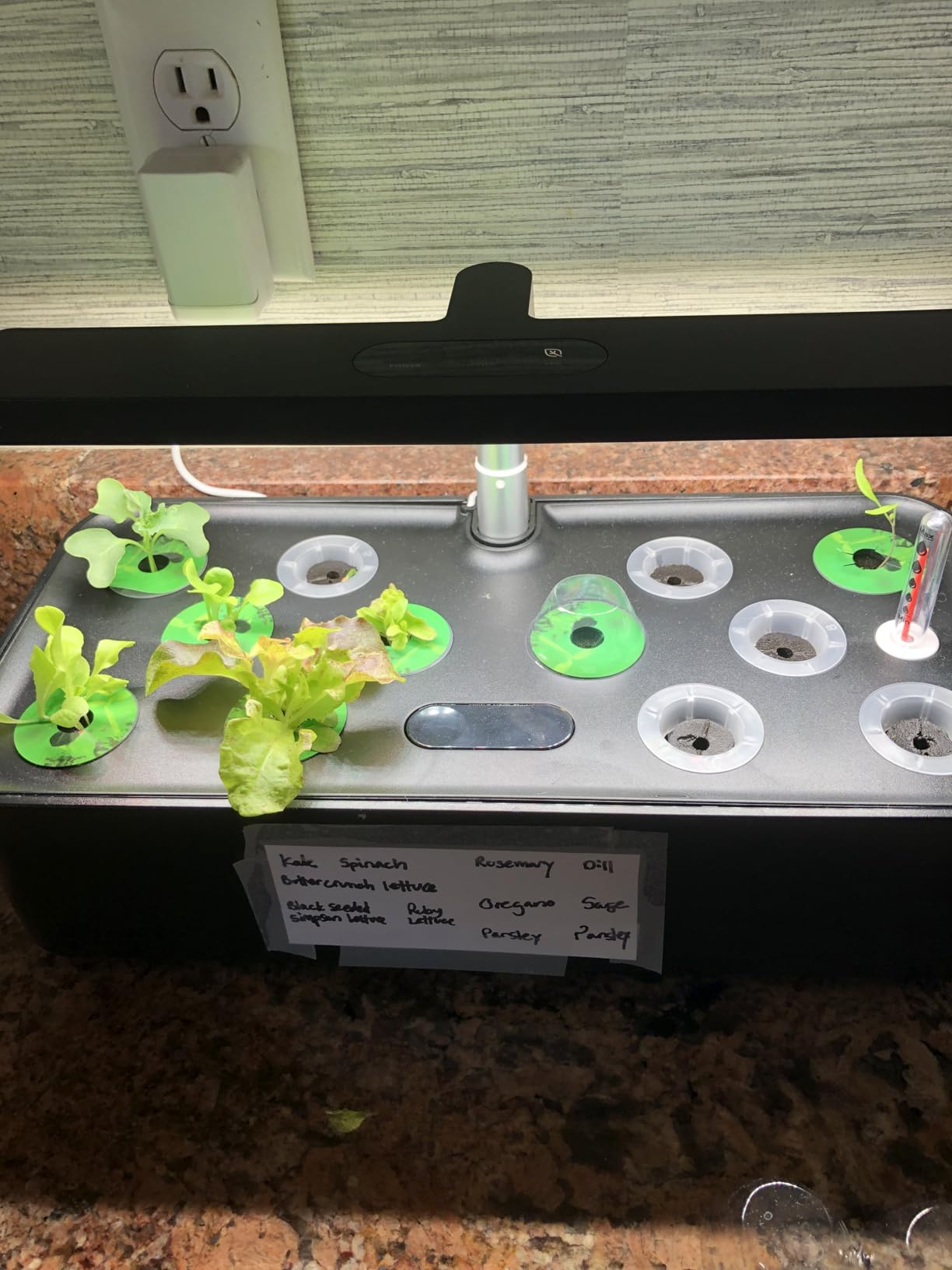
The controls are physical rather than app-based, and that turns out to be an advantage for a first purchase. A three button panel with a pulsing standby indicator, a marked water level gauge, and low water and nutrient alerts tells you exactly what the unit needs without an account, a phone, or a WiFi connection. The 24 watt full spectrum LED has four brightness levels for seedlings, leafy greens, and flowering plants, and the bar adjusts from 2.2 to 12.4 inches.
Reviews average 4.4 from 332 ratings with 73 percent five stars, and the pump draws the most praise, described as very quiet and reading as soft white noise rather than machine noise. The 4 liter tank runs a pump on a 15 minute on and 1 hour 45 minute off cycle, which is a gentler schedule than the 30 minute continuous cycling on many competitors.
There are three recurring negatives to weigh. Some owners report timer reliability issues, which matters because the light cycle is what drives the whole unit. The light bar is narrow relative to the grow deck, so a few buyers wish it were wider and coverage more even. And pods positioned nearest the pump have reportedly failed to germinate more often than the rest, so start those sites a few days later if you can identify them.
Why physical controls beat an app for a first garden
Nothing to set up. No account, no pairing, no firmware update, and no notification settings. You press a button and the unit runs the same cycle every day for a year.
That reliability is exactly what a first-time grower needs, and it is also why this unit suits a kitchen where nobody wants another app on their phone.
Where it needs watching
Timer reliability is the one to monitor. If your plants are stretching or not germinating, check that the cycle is actually running before you change anything else.
And the narrow light bar becomes a problem once lettuce fills out. Keep the canopy loose and raise the bar as the plants grow rather than letting it sit at the lowest stop.
Where to Put an Indoor Smart Garden in Your Kitchen
Placement changes your results more than any setting on the unit, and this is the part most roundups skip. Three things matter: heat, stray light, and reach to an outlet.
Keep it away from the stove and oven. Radiant heat from cooking raises the temperature around the reservoir and the root zone, and a warm reservoir is the fastest route to algae and root rot. A metre of clearance from a hob, and not directly above or beside an oven door, is a reasonable rule. Countertop units also run warm under their own LED panels, and dark plastic tray designs hold that heat more than light coloured ones.
Do not put it in a bright window. A unit near a south facing window gets light at the wrong times and at the wrong spectrum, and plants stretch toward the glass while getting less usable energy from the LED. You want a spot with ambient room light, not direct sun. A window with no direct sun is fine.
Check the outlet reach before you buy. A tall vertical unit with a 17 inch profile may not clear a wall cabinet, and the cord will not reach a socket across an island. Measure the counter run and the drop to the nearest outlet first. Several of the models here are also rated for specific voltages, so check that before you commit.
Think about noise for where you sit. In an open plan kitchen the pump is part of the room. The URUQ 8 Pods publishes a pump figure under 20 dB, which is the number to look for if the counter is near where you eat. A wider tray unit sitting in the middle of an island is audible from every seat. If you are already tracking particulates and ventilation where you cook, our guide to the best indoor air quality monitors covers the same counter-space decisions from a different angle.
Avoid the sunniest and darkest corners in equal measure. The instinct to tuck the unit into an unused corner near a plug usually puts it in a dim corner where the light bar has to work harder and the plants stretch. One to two metres of ambient light and a reachable outlet is the sweet spot.
What You Can Actually Grow on a Kitchen Counter
Set the right expectation and these units are genuinely satisfying. Buy one for herbs and greens, and you will use it every week. Buy one to replace a vegetable garden, and you will be disappointed within a month.
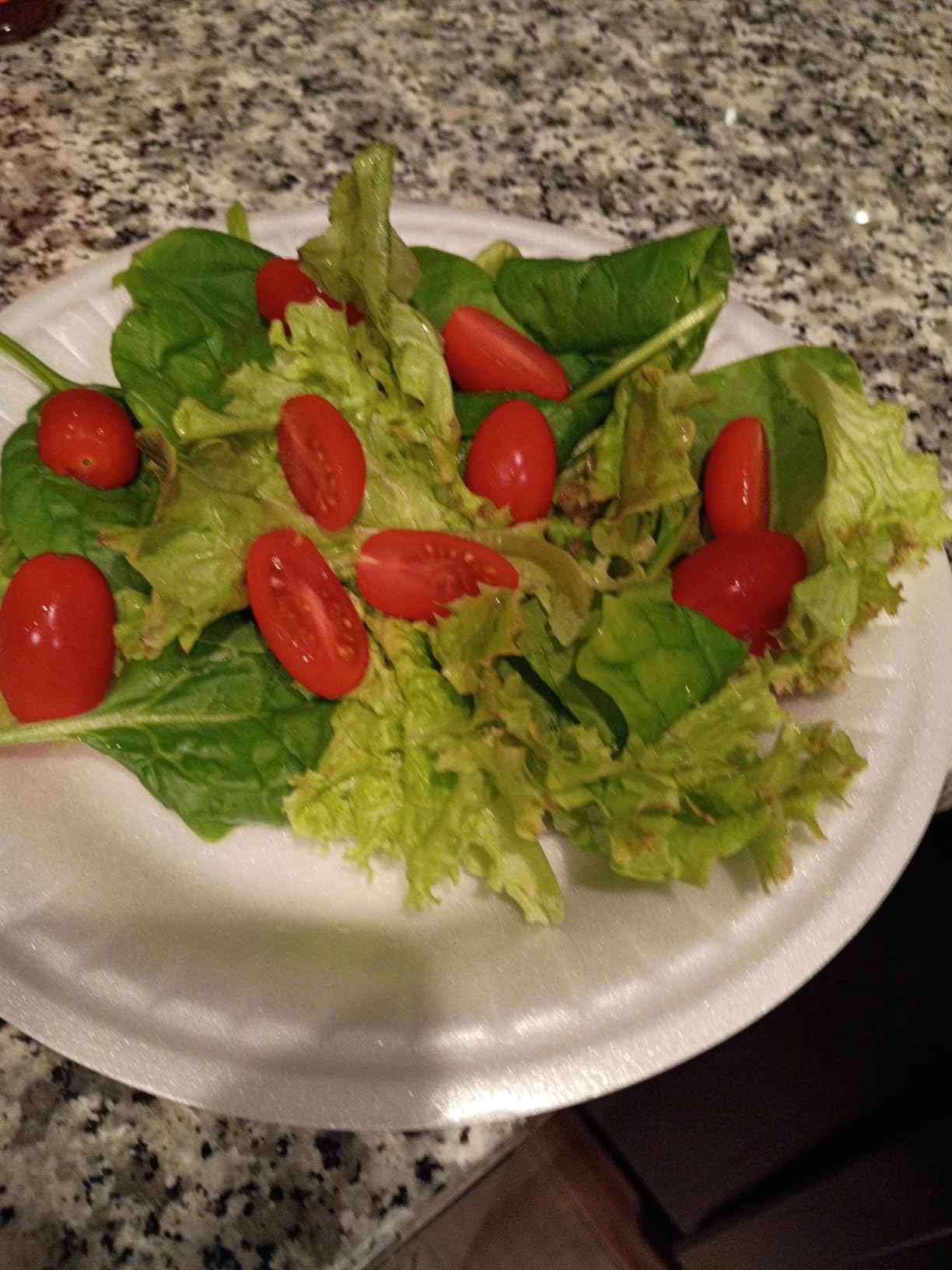
Reliable performers: basil, chives, cilantro, parsley, mint, thyme, oregano, lettuce, butter lettuce, arugula, spinach, bok choy, kale, and microgreens. These are fast, forgiving, and harvested small. Basil and mint in particular are the reason most people buy a unit.
Possible with the right conditions: cherry tomatoes, jalapenos, strawberries, and dwarf citrus. These need the tallest light rod you can find, which is why the 21 and 30 inch units on this list exist. Expect smaller fruit and more patience.
Three plants not recommended for hydroponics:
Large fruiting plants such as full size tomatoes. The root zone and light height a countertop unit provides cannot support the canopy and fruit load, and the plant collapses or the fruit never ripens.
Root vegetables such as carrots, radishes, and beets. They need a deep, soil-like medium to form a root, and pod baskets and sponges are the wrong shape for it.
Plants that need dormancy or a seasonal rest, such as many succulents and flowering bulbs. A constant 16 hour light cycle gives them no seasonal signal, and they weaken over time.
Two practical rules from experienced growers: buy it for herbs rather than vegetables, and stagger your plantings. Fast growing herbs shade slow growers badly, and the shaded sites end up as bare stems.
Hydroponic vs Soil-Based Countertop Gardens
Nine of the ten models here are hydroponic. They deliver water and dissolved nutrients to roots sitting in a basket or sponge, with a pump moving the solution on a timer. Roots stay oxygenated, nothing spills soil, and the same unit can run several crop cycles with a rinse between them.
Soil-based units like the DRYADES use a wick and standard potting mix. They are slower and messier, but you can transplant nursery starts, grow something with real size to it, and move the plant between indoor and outdoor light. A soil unit is also the better choice if you want to grow one plant and keep it for months rather than harvesting repeatedly.
Hydroponics wins for volume and speed of repeat harvests. Soil wins for flexibility and for a single statement plant. Whichever you choose, the honest downside of hydroponics is that algae in the reservoir and root rot are recurring maintenance items, and cleaning matters more than any feature on the box.
How to Choose a Countertop Hydroponic Garden
Start with the light, not the pod count. A fixed low arm slows growth and burns the tops of fast stems. Any unit whose rod extends past 20 inches will handle lettuce and tall herbs; anything around 11 to 14 inches is fine for short herbs and microgreens only.
Match tank size to how often you will refill. Reservoirs here run from 3 to 5.5 litres. A 3 litre tank means checking every few days, while the 5 litre models stretch the interval toward three weeks between fills, which is the difference between a garden you enjoy and a chore you avoid.
Decide how much you care about pump noise. Nobody publishes a figure except the URUQ, so judge by whether your counter is near your dining table. Continuous circulation is audible in an open plan space even when the unit is otherwise quiet.
Check whether the app is optional. An app-only control scheme is a liability if the company folds or the software stops updating. The Ahopegarden, SUNCOZE, and inbloom models run their full cycle from physical buttons on the device, and a connected model that also has a timer built into the hardware keeps working even if the app never connects.
Count counter width, not total size. Wide tray units ask for roughly 12 to 16 inches of depth. Vertical columns ask for about 9 inches of width and 17 inches of height. Measure the strip you actually have, including clearance under cabinets.
Factor in consumable lock-in. Proprietary pods are convenient and reliable, and they are the most common complaint across owner communities. Systems that let you use your own seed and generic sponges give you an escape route, and growing medium can be bought separately even where pods are branded.
Plan the clean. Between cycles you need to drain the reservoir, wipe the tank, and rinse the baskets. A stainless steel or light coloured interior is easier to keep clean than a dark plastic tray, and a detachable light pole makes the job safer.
What It Costs to Run One of These for a Year
Electricity is the smallest part of the running cost, and the numbers are small enough to ignore. A 24 watt grow light on a 16 hour daily cycle uses about 0.38 kilowatt hours a day, which works out to roughly 140 kilowatt hours over a full year. Garden models with a 17 watt lamp and an 8, 12, or 16 hour timer option land in a similar or lower range.
The 16 hour cycle is worth understanding as a daily habit. A unit set to 8 hours costs less than half of a 16 hour unit, and herbs will still grow, just more slowly and with a thinner stem. This is the one lever you control without buying anything.
Consumables matter more. The kits here ship with A and B nutrient solution, sponges, baskets, and domes, which covers an entire first grow cycle. After that, replacement pods, sponges, and nutrient refills are the recurring line item, and costs vary widely by brand because each one sells its own consumables. Growing from your own seed with seedless pods is the simplest way to reduce that line.
Against grocery prices, the honest answer is that you will not save money on a bunch of basil, and most owners treat the unit as a convenience and hobby purchase. You will come closer on microgreens, which spoil before you finish a supermarket container, and on herbs you buy in bunches and throw half of away. A practical way to bring the running cost down is growing a full tray of one crop at a time rather than mixing twelve varieties, which is also the pattern that harvests best.
Models We Would Skip
Two of the ten models on this list deserve a second look before you buy. The MetryGrow MG-15 offers the most pods and a large tank, but it has the thinnest review history at 214 ratings, the lowest average at 4.3, and the highest share of one star ratings at 8 percent. It is not a bad unit, it is just less proven than its feature list suggests.
The inbloom 12 Pods is the same story in miniature. It germinates fast and its pod spacing is genuinely better than most, but the water level bobble is reported to stick and read wrong, and a portion of buyers found the instructions confusing. If you are not comfortable cross-checking a float gauge, pick a unit with a marked window you can read directly.
More broadly, we would skip any unit where the app is the only interface and the light schedule cannot be set on the device. Connected gardens are a real convenience, but a unit you cannot adjust when the software misbehaves is a liability rather than a feature. The same logic applies to any connected device you put on the counter, whether that is a camera or a sensor hub, and our picks for best indoor security cameras go into the same permission and firmware checks in more detail.
Frequently Asked Questions
What is the best indoor smart garden for a kitchen?
The Click u0026amp; Grow Smart Garden is the best overall for kitchens because it needs almost no attention: three pods, a self-watering reservoir, a fixed LED cycle, and top ups every couple of weeks. For more capacity, the iDOO 12Pods grows twelve sites at once, and for app-based scheduling the LetPot LPH-SE pairs a 5.5 litre tank with a 30 inch light rod.
Are indoor hydroponic gardens worth it?
For fresh herbs, salad greens, and microgreens, most owners say yes: the results are better than store bought produce and you avoid waste from half used bunches. They will not replace a vegetable garden, and electricity is a minor cost, while replacement pods and nutrients are the real recurring expense. Buy it as a convenience and hobby, not to save money on basil.
What are the downsides of hydroponic gardening?
Algae in the reservoir is the most common complaint and it keeps returning without a proper clean between cycles. Root rot happens when roots are not checked and rerouted every couple of weeks. Pump noise, proprietary pod lock-in, and fixed low light arms that slow growth are the other recurring drawbacks.
What are three plants that are not recommended for hydroponics?
Large fruiting plants such as full size tomatoes cannot be supported by a countertop root zone and light height. Root vegetables including carrots, radishes, and beets need a deep soil-like medium that pod baskets cannot provide. And plants that need seasonal dormancy, including many succulents and flowering bulbs, weaken under a constant 16 hour light cycle.
How often should I fill up Click and Grow Smart Garden water?
Check the Click and Grow Smart Garden reservoir roughly every two to three weeks during normal growth, and top it up whenever the level drops below the indicator. Because the design is a self-watering planter, the unit keeps the root zone fed between fills, so you do not need to water daily. Clean the tank between grow cycles to stop algae returning.
Are indoor hydroponic gardens safe to use in a home kitchen?
They are safe when used as intended. Keep the reservoir away from the electrical unit and plug, never immerse the lamp base or the power supply, and wipe the tank down between cycles so mould does not develop. Because connected gardens run apps with sensors, update the firmware and review app permissions on any camera or microphone the unit requests.
The Bottom Line
For most kitchens, the best smart indoor gardens for kitchens come down to how little attention you want to give them. The Click & Grow Smart Garden wins overall because it is genuinely turnkey and its pod catalog is the broadest here, with a 4.6 average across more than 2300 reviews. Grow more than three herbs and the iDOO 12Pods gives you four times the sites. Want phone control and long intervals between refills, the LetPot LPH-SE has the largest tank and the tallest light rod. And if the counter is narrow or the kitchen is open plan, the Ahopegarden and URUQ models solve the two constraints that cause people to give up.
Whichever you pick, place it away from the stove, out of direct window light, close to an outlet, and buy it for herbs rather than vegetables. Used that way, it is the most useful ten minutes of daily gardening in a small kitchen.