
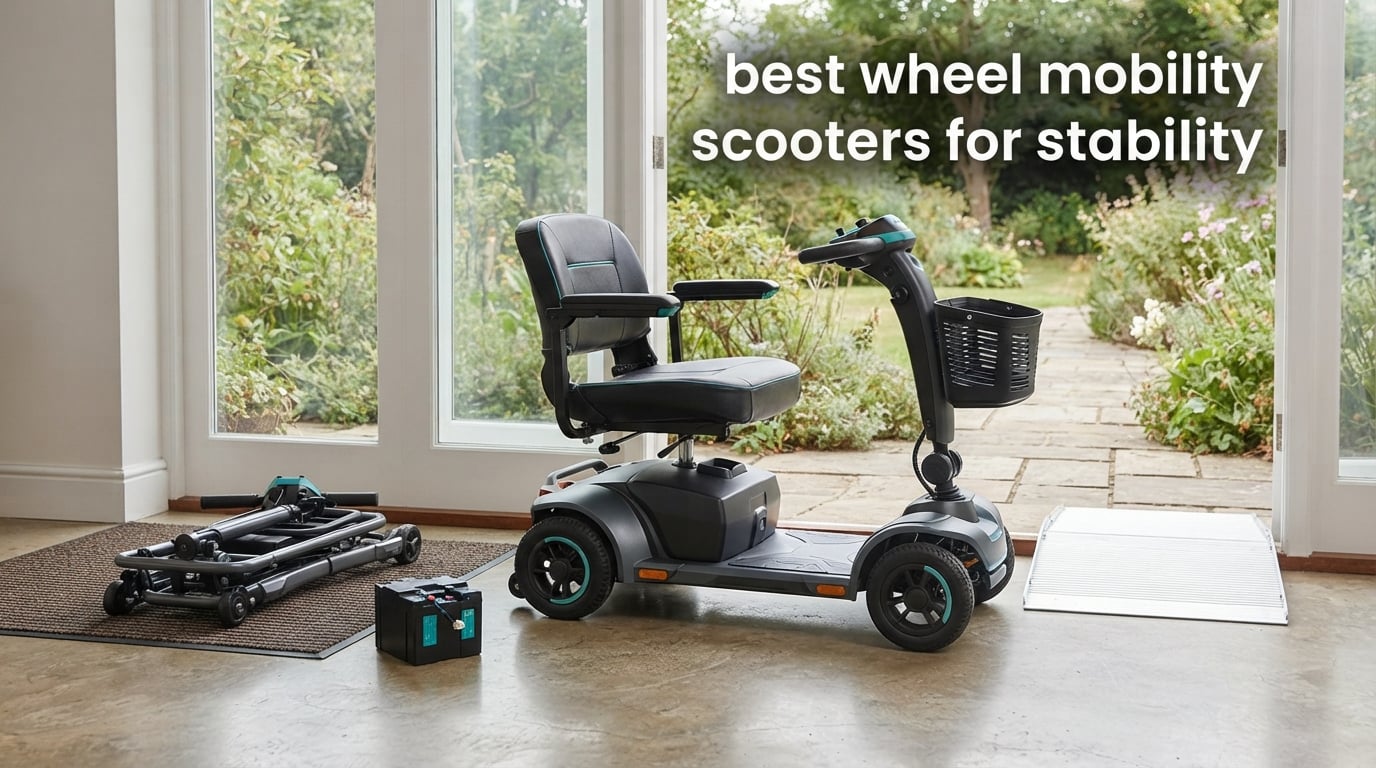
Choosing a mobility scooter is rarely about speed or looks. For most buyers the question is simpler and more serious than that: which one will not tip over when the curb is higher than expected, the path is not quite level, or the rider’s weight is more than the frame was built for. That is the entire premise of the four-wheel layout, and it is the filter we applied to every scooter in this guide.
We spent several weeks going through the specifications and owner feedback on the current generation of powered four-wheel scooters, looking at weight capacity, wheelbase, ground clearance, incline ratings, tire type, braking and how each one disassembles for transport. The result is a shortlist of ten models that cover very different needs, from a compact folder that fits in a trunk to heavy-duty machines rated for 500 pounds and rough ground. If your priority is simply stability, the short answer is the four-wheel layout itself; the harder question is which four-wheel layout fits your body, your terrain and your transport situation.
One thing worth flagging early: stability claims on this category are mostly marketing unless they come with a number attached. So we tie every judgement below to a measurable spec, and we note where owner reviews contradict the spec sheet. If you also use adaptive gear to get out and about, our guide to compact camera systems for photographers with mobility challenges covers a related angle on managing heavier equipment.
Table of Contents
Top 3 Picks for 4-Wheel Stability in 2026

Vive 4 Wheel Mobility Scooter
- 265 lb capacity
- 3.7 mph
- 12.4 mile range
- four-piece disassembly

Ecomobi 4 Wheel Foldable Scooter
- 53 lb net weight
- 330 lb capacity
- remote folding
- 15 mile range

Golden Buzzaround EX Extreme 4-Wheel
- 350 lb capacity
- pneumatic 9-inch wheels
- 18 mile range
- 18-inch seat
The Vive gets the top slot because it is the most thoroughly reviewed scooter in this group, with 3158 ratings averaging 4.3 out of 5, and because its four-piece breakdown and folding tiller make it the least permanent commitment of the mid-size options. The Ecomobi earns its place for a different reason: at 53 pounds net with a 330 pound capacity and remote-controlled automatic folding, it does the least work of any four-wheeler here for a rider who cannot lift a heavy component. The Golden Buzzaround is the outdoor answer, with pneumatic tires and a 350 pound rating, though it is also the heaviest thing in the comparison that is not a true all-terrain machine.
Best 4 Wheel Mobility Scooters for Stability (September 2026)
| Product | Specifications | Action |
|---|---|---|
| Vive 4 Wheel Mobility Scooter |
|
Check Latest Price |
 SKRT Lightweight Travel Scooter SKRT Lightweight Travel Scooter |
|
Check Latest Price |
 Rylox Foldable 4-Wheel Scooter Rylox Foldable 4-Wheel Scooter |
|
Check Latest Price |
 Hoverfly T4 4-Wheel Scooter Hoverfly T4 4-Wheel Scooter |
|
Check Latest Price |
| Ecomobi 4 Wheel Foldable Scooter |
|
Check Latest Price |
 Pride Go-Go Sport 4-Wheel Pride Go-Go Sport 4-Wheel |
|
Check Latest Price |
| Golden Buzzaround EX Extreme |
|
Check Latest Price |
 Drive Medical Phoenix LT Drive Medical Phoenix LT |
|
Check Latest Price |
 VEVOR Heavy Duty 4-Wheel Scooter VEVOR Heavy Duty 4-Wheel Scooter |
|
Check Latest Price |
 LAGTOM Heavy Duty 500 lb Scooter LAGTOM Heavy Duty 500 lb Scooter |
|
Check Latest Price |
1. Vive 4 Wheel Mobility Scooter – The Most Proven All-Rounder
Vive 4 Wheel Mobility Scooter – Electric Powered Wheelchair Device
265 lb capacity
3.7 mph top speed
12.4 mile range
4-piece disassembly
Pros
- Four-piece disassembly that fits a standard trunk
- Swivel padded seat with lever height adjustment
- Handles moderate hills
- 5-year guarantee
Cons
- Thin seat cushion with little shock absorption
- Real-world range falls short of the stated 12.4 miles
- Rear section weighs 29 pounds
The Vive is the scooter most people will end up looking at first, and for good reason. It is rated for 265 pounds, tops out at 3.7 mph and is dimensioned at 38 by 19.5 by 33 inches, which is small enough to get through a standard doorway and light enough at 88 pounds to be moved around by one person. The 8-inch flat-free non-marking tires are a sensible compromise: they will not go flat, and they will not scuff indoor floors.
What sold us on it is the disassembly design. The tiller folds and the seat comes off, giving four pieces, and owners consistently report that the whole routine is something a new rider can manage after one session. The variable speed dial and color-coded battery indicator are simple controls, and a headlight plus an audible warning tone come standard. There is a 5-year guarantee behind it too, which is longer than most of the field.

The trade-offs are honest ones. The seat cushion is thin and reviewers say you feel sidewalk joints through the frame, which matters if you plan long days out. Real-world range also tends to land below the stated 12.4 miles per charge, and the molded battery compartment is sealed, so you cannot drop in a different lithium pack later.
Two smaller annoyances recur in the reviews. The battery gauge shows bars rather than a charge percentage, so riders report guessing at when to plug in. And the audible warning beep is loud, with no easy way to silence it, which some owners find irritating in quiet indoor spaces.
How it behaves on thresholds, ramps and gravel
On smooth indoor surfaces this scooter is calm and predictable. The stability comes from the rectangular four-wheel footprint and a seat that sits low between the wheels, and in practice it does not feel the way a three-wheeler does at a doorway. On moderate paved hills, reviewers report it holds speed and climbs without drama.
Gravel is where the story changes. Owners report that steep gravel inclines make the scooter feel unstable, which matches the honest limits of an 8-inch flat-free tire with no suspension. Treat it as a pavement and indoor machine, and add a caution if your usual route includes loose gravel climbs.
Who should skip it
Riders above 265 pounds should look elsewhere, since the capacity is the least generous in this roundup. Anyone who cannot comfortably lift 29 pounds will also struggle with the rear section, and the heaviest part of the breakdown is the part you lift first. If you want all-day comfort over a thin cushion, this is the wrong tool.
For daily indoor use, neighborhood errands and car transport with a moderate budget, the Vive remains the most dependable pick we found. It is the one we would put in the hands of a first-time scooter owner.
2. SKRT Lightweight Travel Scooter – Best Folding Four-Wheeler for Cars
Mobility Scooter for Adults & Senior, Foldable 4 Wheels Electric Scooter
300 lb capacity
4.5 mph top speed
Folds to 16.5 inches
200W motor, 8-degree incline
Pros
- Folds to 16.5 inches for trunks and back seats
- Tool-free five-piece disassembly
- Anti-tip rear wheels and electromagnetic braking
- LED headlight plus deck ground lights
Cons
- Seat has no cushioning and no shock absorption
- Swivel lever is very tight for limited hand strength
- Short legroom for taller riders
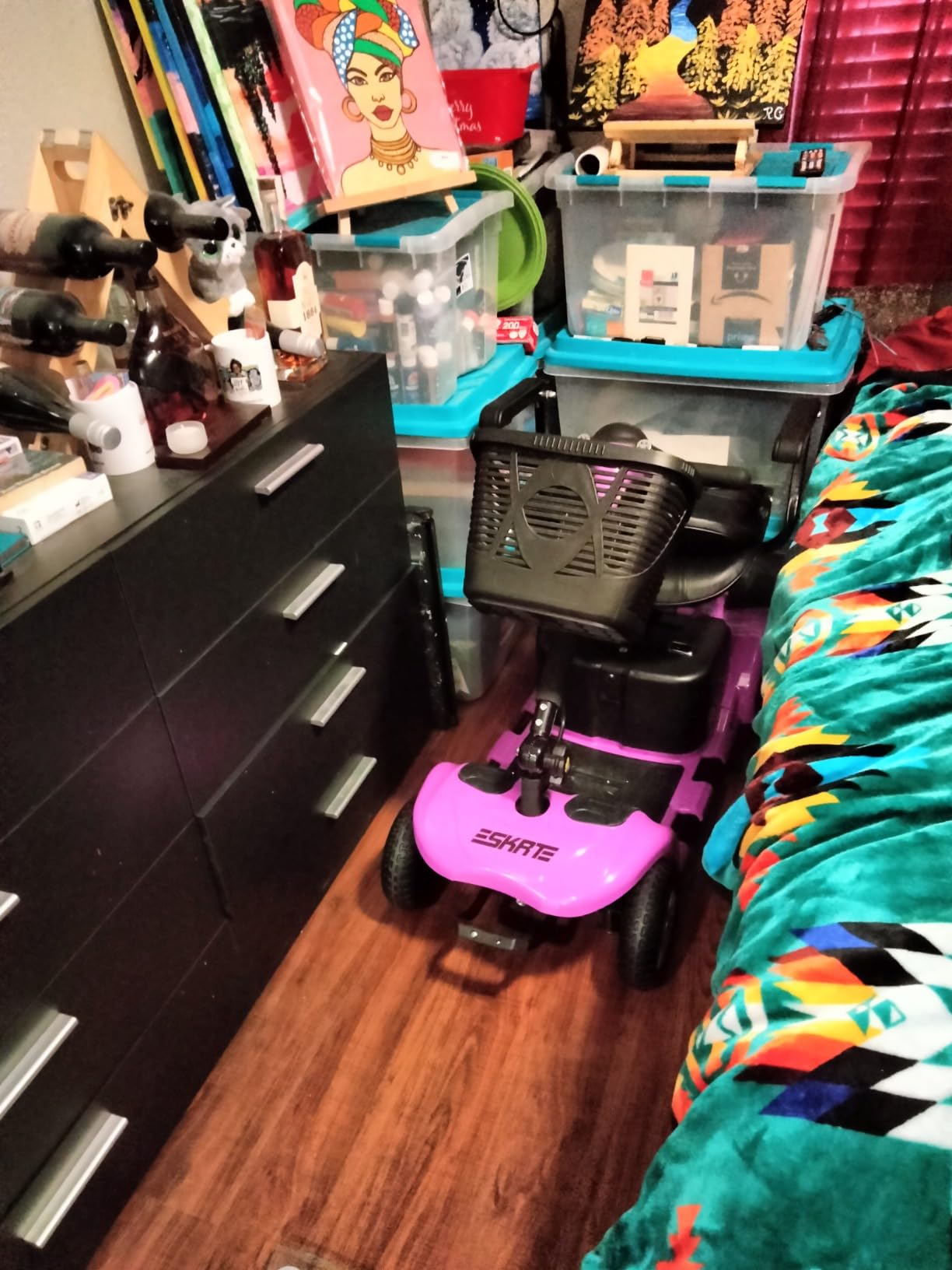
This is the scooter for people whose day is split between home and somewhere else. It folds to 16.5 inches tall, which is short enough to sit in the back seat of a crossover or stand upright in a trunk, and it comes apart into five pieces with no tools, heaviest at 40 pounds. Total weight is 101 pounds, and the dimensions are 39 by 20 by 31 inches.
Under the seat sits a 24V 12Ah battery that detaches for charging indoors, which is a meaningful convenience when you do not want to drag 101 pounds to a wall outlet. The 200W motor is rated for 8-degree inclines and the stated range is up to 15 miles per charge at a 4.5 mph top speed.
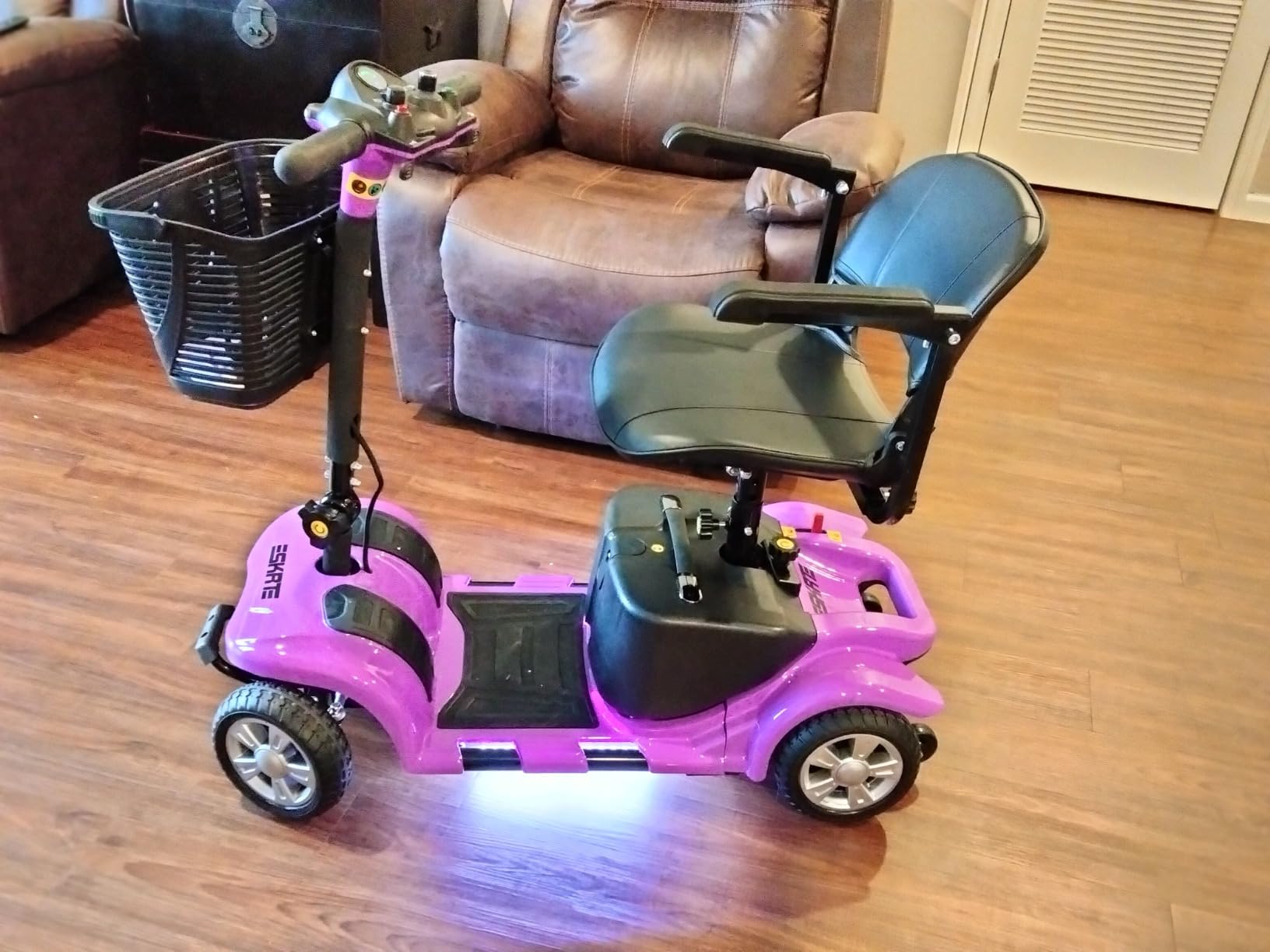
Stability hardware is where this model earns its place in a stability roundup. It has anti-tip rear wheels, electromagnetic braking, and thick solid all-terrain tires, which is a more robust tire description than most compact four-wheelers can honestly claim. A 360-degree swivel seat measuring 16.5 by 13.4 inches with height adjustment adds usable room at the top of the frame.
The seat itself is the weak point, and reviewers are blunt about it. There is no cushioning and no shock absorption, so the frame transmits every expansion joint. The seat also fits loosely in the swivel stand, and the swivel lever is very tight for anyone with limited hand strength. Taller riders report short legroom. All of these are real, and none of them are fixable after purchase.
Whether the fold actually saves you effort
Yes, and this is the model’s strongest argument. At 16.5 inches folded, it clears most vehicle cargo areas that a full-size scooter will not. The catch is the 40 pound heaviest piece, which is manageable for a caregiver with a back issue but genuinely difficult for a rider with their own lifting limits.
Those limits also apply to the freewheel and manual handling. Plan on folding it with a second person, or plan on a ramp, if loading is part of your routine rather than an occasional event.
Where it falls short
The 8-degree incline rating is the lowest among the compact models in this group, and that matters more than the top speed figure. If your route includes a steep driveway or a ramped parking structure, this is not the scooter for it. The uncushioned seat is the other dealbreaker for anyone spending hours in it.
Short errands, shopping trips, and a car in the driveway are exactly the use this machine suits. Just do not expect it to double as an outdoor vehicle.
3. Rylox Foldable 4-Wheel Scooter – Best Value for Mixed-Use Riding
Foldable 4-Wheel Mobility Scooter for Adults – Portable Motorized Scooter with 330 lbs Capacity, Detachable Battery, Dual Baskets, Cup & Phone Holder, Blue
330 lb capacity
250W motor
15 miles per charge
15-degree incline rating
Pros
- Eight extra inches of legroom than comparable models
- Dual removable baskets plus cup and phone holder
- Handles bumps
- rock walkways and grass
- Variable speed from 0 to 4.3 mph
Cons
- Turning radius is not sharp and needs multi-point turns
- Seat can wobble in use
- Heaviest piece is 50 pounds for a single-user load
The Rylox is one of the newer designs in the group and it solves a specific rider problem: legroom. The manufacturer states 8 inches of additional legroom than comparable models, and that claim shows up in owner comments about comfort on longer outings. The seat is cushioned, swivels 360 degrees and adjusts in height, which is a step up from the bare pan on the previous pick.
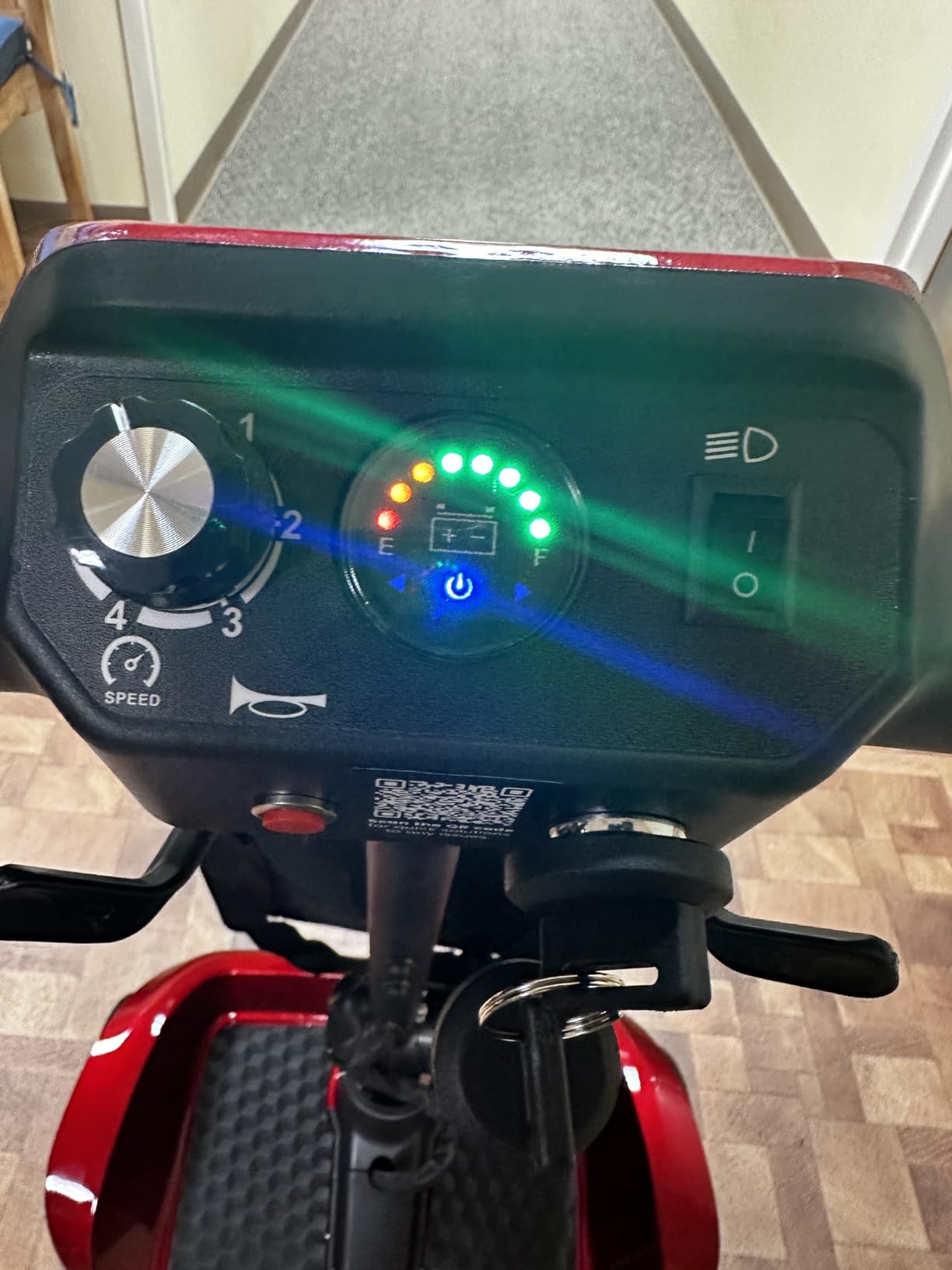
Underneath, a 250W motor is rated for 15-degree inclines, with variable speed from 0 to 4.3 mph. The stated range is up to 15 miles on a 6-hour charge, and the battery detaches for off-board charging. That incline rating is the best in the compact-and-folding class here, and it is the number we would look at first if your route has any hill in it.
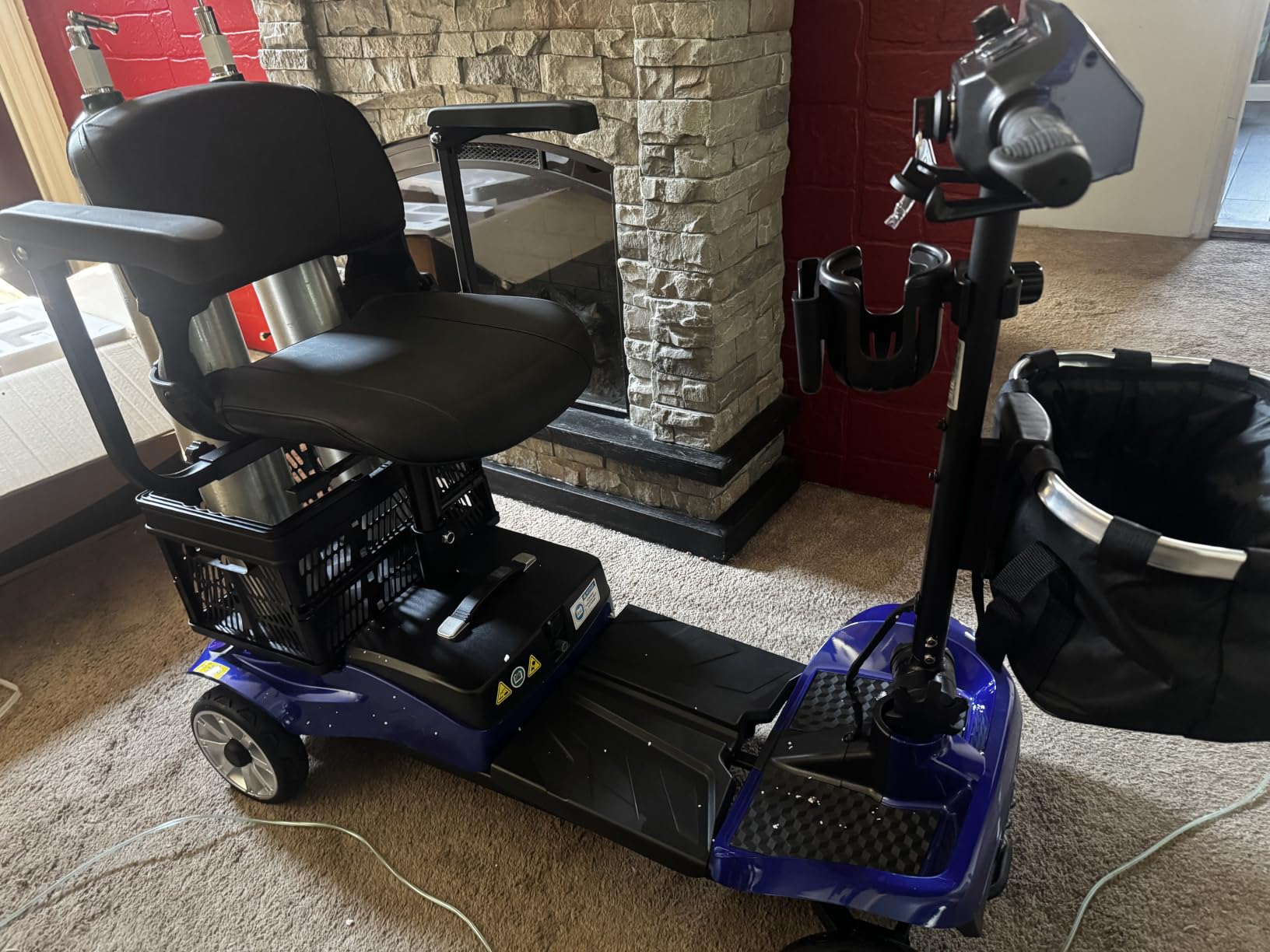
Storage is unusually well thought out. Two removable baskets, plus a combined cup and phone holder, is more than most four-wheel scooters at this size offer. Owners also report that it handles bumps, rock walkways, grass and asphalt smoothly, which lines up with the 8-inch puncture-proof tires and the anti-tip structure.
The compromises are real. The turning radius is not sharp, and owners describe needing multi-point turns in store aisles, which is the single biggest indoor-maneuverability complaint in this roundup. The seat can also wobble. And the heaviest of the four pieces weighs 50 pounds, which is the most difficult single-user load among the folding models.
Riding quality and what the fast speed means for safety
Owners mention that the instant acceleration and braking take some getting used to, and that is worth taking seriously on a 15-degree incline rating. Variable speed control helps, but the safest habit is to set a low speed before descending and to treat the incline rating as a firm ceiling rather than a target.
Solid tires also mean noise and transmitted bumps, and reviewers compare them unfavorably to inflatable tires on rough pavement. If you ride mostly on smooth concrete and paths, that trade is worth it. If your route is cracked asphalt, an air-filled option may be kinder to your back over time.
Best fit and worst fit
This suits a rider in the middle of the weight range who wants genuine outdoor capability and real cargo capacity, and who is not navigating tight store aisles daily. It is a good pick for a shopper who wants one scooter to cover errands, sidewalks and a park path.
If your days are spent in small stores, in apartments with tight hallways, or in clinical spaces where maneuverability beats range, the wide turning circle is a real cost. Look at the mid-size breakdown options further down instead.
4. Hoverfly T4 4-Wheel Scooter – Widest Seat for Long Sitting Days
Hoverfly T4 4-Wheel Mobility Scooter for Seniors/Adults, Max 12.4 Miles
330 lb capacity
17.2-inch swivel seat
12.4 mile range
10-degree incline rating
Pros
- Extra-wide 17.2 by 13.7 inch swivel seat
- Three seat height positions from 20 to 22 inches
- Smooth quiet low-speed control
- Pushes easily in manual mode for repositioning
Cons
- Large turning radius makes store aisles difficult
- No written assembly instructions
- Real-world range falls short of the stated figure
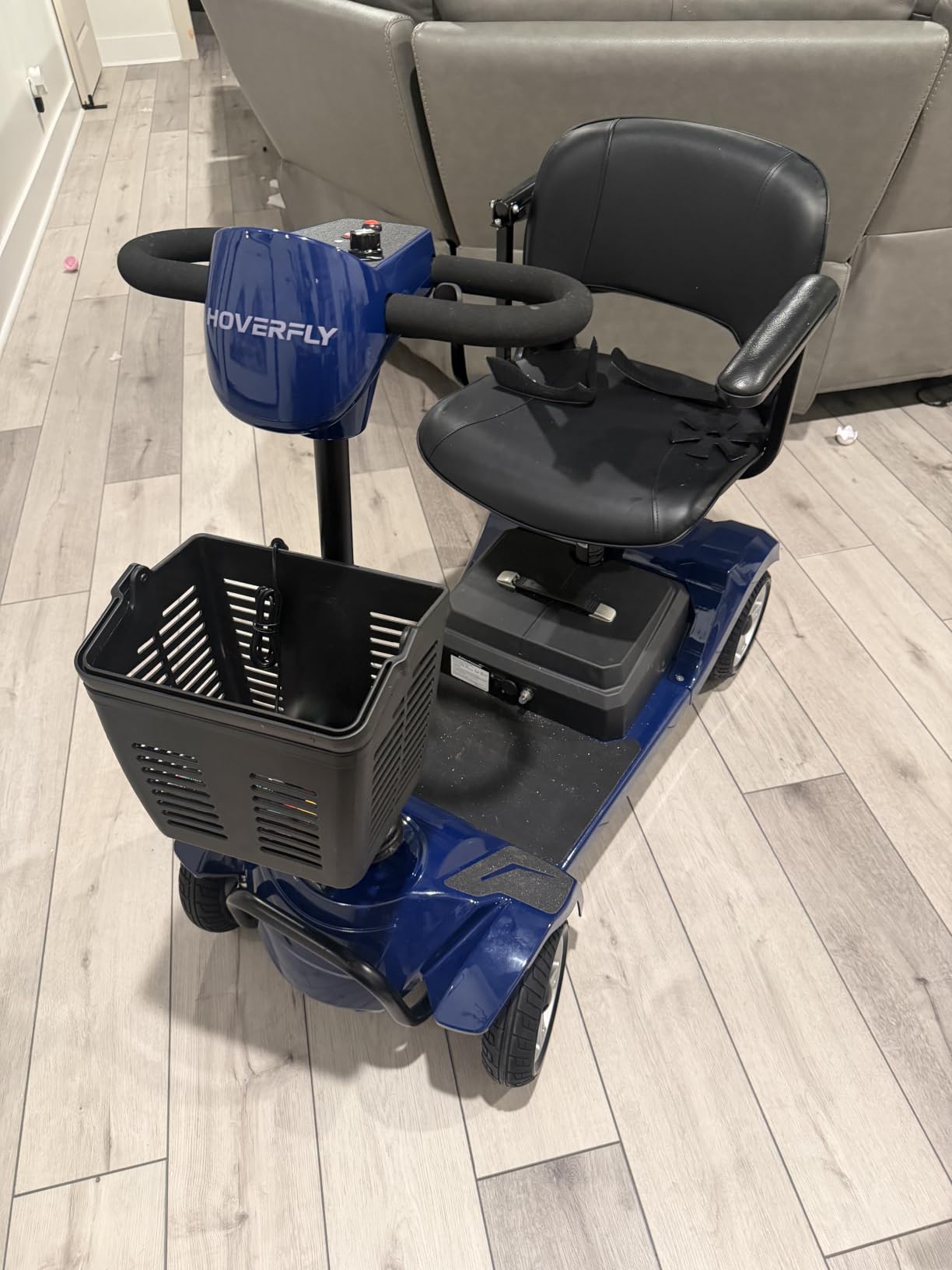
If sitting comfort is your top concern, the Hoverfly T4 is the model to look at first. The seat measures 17.2 by 13.7 inches, which is wider than anything else in the compact and mid-size group here, and it rotates 360 degrees. Seat height adjusts across three positions from 20 to 22 inches, and the armrests fold and shift to the side.
Weight capacity is 330 pounds. The 250W high-torque motor is rated for 10-degree inclines, and the removable 12Ah lead-acid battery weighs 21 pounds on its own, so taking it out for charging is a two-hand job rather than a wrestling match. Stated range is up to 12.4 miles per charge.

Owners like the smooth, quiet operation and the usable low-speed control, and several mention that the battery indicator clearly shows when a charge is needed, which is more than many competitors manage. Assembly takes about 20 minutes with no special tools, and the unit is easy to push in manual mode when you need to reposition it away from a doorway.
Two things work against it. The turning radius is large, and owners specifically call out difficulty getting around store aisles. There are also no written assembly instructions or clear hardware labeling, so first-time assemblers should budget extra time and patience for the initial build.
Winter is the other limitation. The 9-inch solid tires are described by reviewers as having no traction in snow, and they transmit every sidewalk defect straight to the frame and the rider. That is the physics of solid rubber, not a defect in this particular unit, but it is worth knowing before winter arrives.
What the wide seat changes day to day
A wider seat does more than improve comfort. It reduces the chance of thigh contact with the armrests, and it gives a stable base when you shift your weight to turn, which is exactly the moment a tip-over would occur. Combined with 9-inch tires and anti-slip rear wheels, this is one of the more planted-feeling compact four-wheelers we looked at.
The electromagnetic brake responds in about half a second according to the spec sheet, which is a reasonable figure for stopping on a downgrade. Owners do not complain about braking, which is notable for a category where it is usually the first thing to fail.
Where it is the wrong purchase
Buy something else if you are a tall rider, because the wide seat can come at the cost of foot clearance, and if you need to be quick in confined indoor spaces, because the turning circle works against you. It is also not the right tool for snow or for loose surfaces.
For riders who spend long hours seated and ride mostly on pavement, the Hoverfly T4 makes a good case for itself. The narrower aisles issue is the deciding factor more often than anything else.
5. Ecomobi 4 Wheel Foldable Scooter – Lightest Machine and Easiest Fold
Mobility Scooter for Seniors & Adults, 4 Wheel Foldable Scooter
53 lb net weight
330 lb capacity
Remote auto-fold
350W motor, 5 mph
Pros
- Remote-controlled automatic folding with onboard button
- Airline-friendly removable lithium battery at 288Wh
- Only 53 pounds net with a 330 pound capacity
- GPS location support for families and caregivers
Cons
- Some units developed a mechanical noise after heavy use
- Range varies with rider weight
- hills and battery condition
This is the most unusual machine in the roundup, and the reason is weight. At 53 pounds net, the Ecomobi weighs less than half of what most 330-pound-capacity four-wheel scooters weigh, and it does it with a 350W motor rather than the usual 200W to 250W unit. It still handles 15-degree climbing and offers up to 15 miles of range per charge.
The folding is the headline feature. A remote control triggers automatic folding, and there is an onboard button as a backup, so you do not need to wrestle with a latch while standing next to a car. The battery is a removable 24V 12Ah lithium pack rated at 288Wh, which is within the size range most airlines accept, and the dimensions fold down from 47 by 20.5 by 36.6 inches.
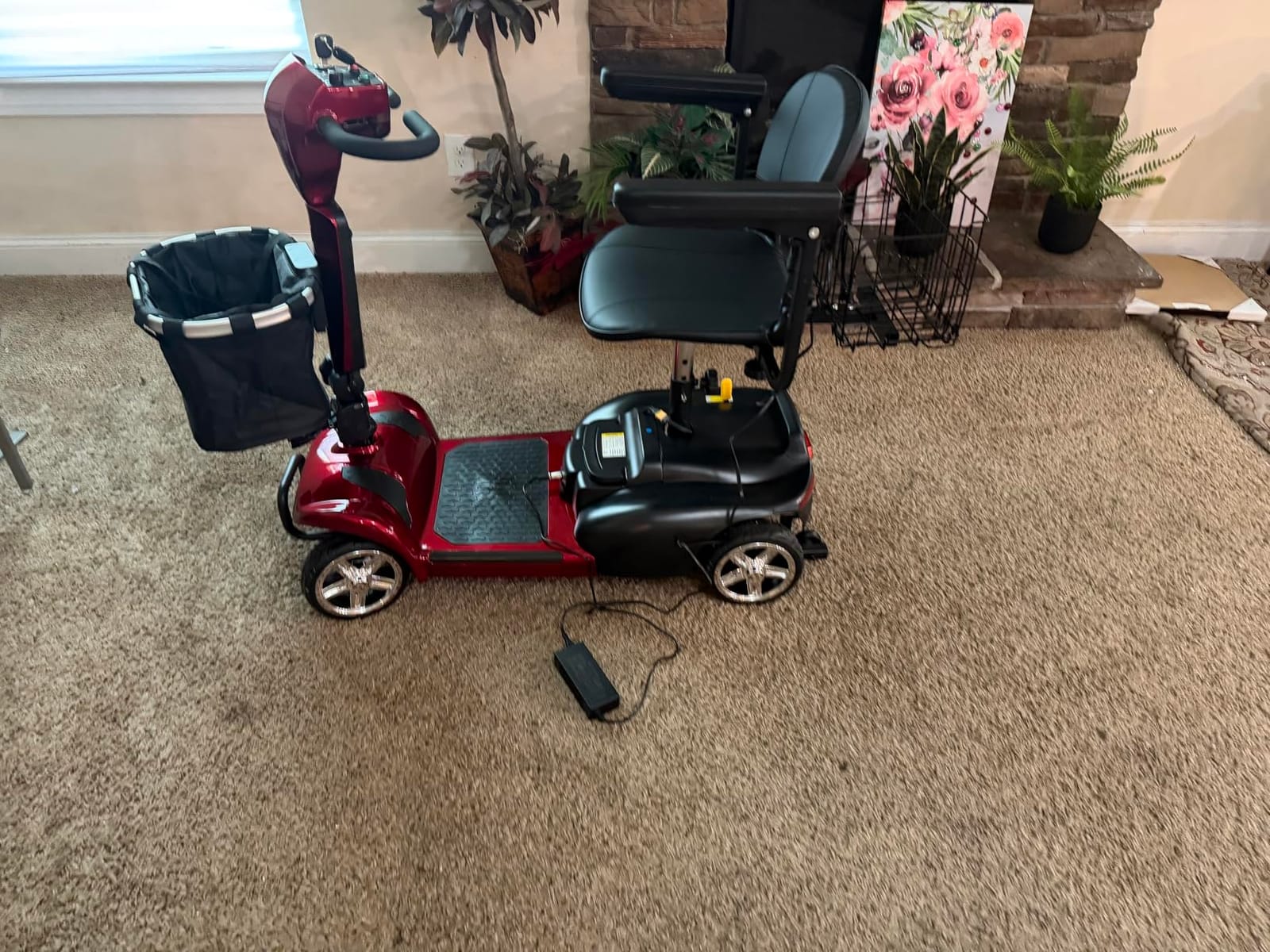
It also arrives nearly fully assembled, with only the armrests and basket to attach, which removes the single most common complaint in this category. Owners report comfortable, sturdy riding across different surfaces, good maneuverability in tight corners and crowded areas, and easy battery swapping. The GPS location support is a genuine caregiver feature rather than a gimmick, and the support team resolves issues quickly.
The caveats are honest but limited. Some units developed a mechanical noise after heavy use that required service, and range varies noticeably with rider weight, speed, hills and battery condition. The manual freewheel mode is for flat repositioning only, not for slopes, which is standard but worth reading twice.
Why the light weight changes the stability question
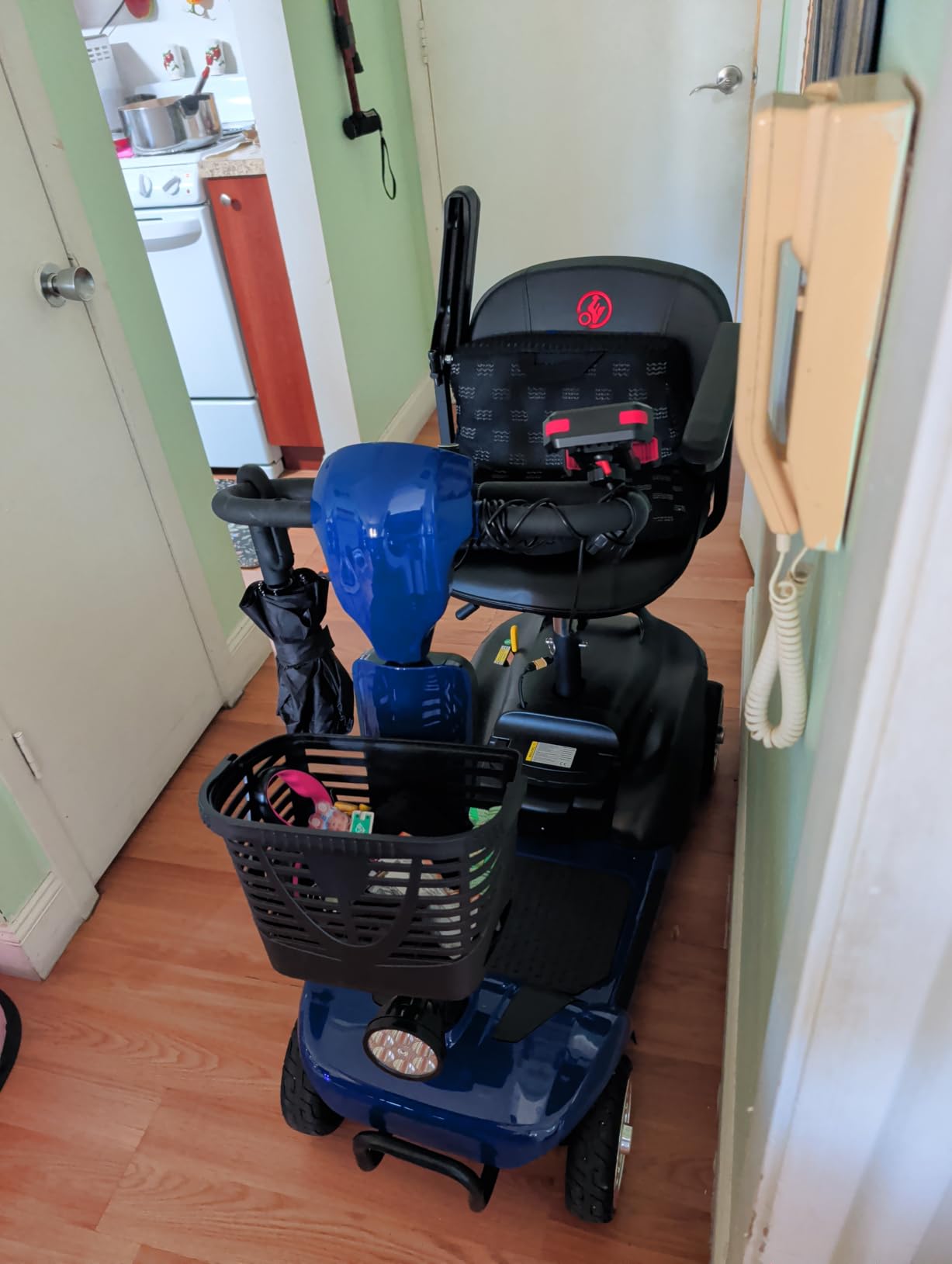
Lower mass on the frame means less force in a tip-over event and less effort needed to recover, so a 53-pound machine is easier to control in a tight spot than a 100-pound one. The four-wheel base, the 330 pound rating and the electromagnetic brake that engages when the driving lever is released all add to the planted feel. Owners describe it as comfortable in crowded areas, which is unusual for a scooter this light.
At a controlled top speed of 5 mph, the auto-braking on lever release is doing more work than it would on a slower model, and that is worth testing in an open area before you ride it in a corridor. Practice the stop once, then twice.
Who this suits and who it does not
This is the strongest choice for a rider who cannot lift heavy components, who travels regularly, or who wants a caregiver to be able to move it without strain. The lithium battery and the auto-fold remove most of the physical barrier to independence that heavier scooters create.
It is not the choice for maximum off-road work or for riders near the top of the capacity range who will be heavy every day of use. At full capacity, the stated range will shrink. If your priority is raw power rather than portability, look at the 500-pound machines at the end of this list.
6. Pride Go-Go Sport 4-Wheel – Frame-Mounted Seat Post for a Rockier Base
Pride Mobility S74 Go-Go Sport 4-Wheel Electric Mobility Scooter for Adults with Free Challenger Mobility Accessory
Frame-mounted seat post
Five-piece disassembly
Off-board dual voltage charger
Freewheel mode
Pros
- Seat post mounted on the frame rather than the floor
- Five-piece one-hand feather-touch disassembly
- Off-board charger works on or off the scooter
- Brakes hold well even on steep descents
Cons
- Seat feels somewhat shaky
- Steering column latch is fiddly to secure
- Disassembled unit fills most of a vehicle's cargo space
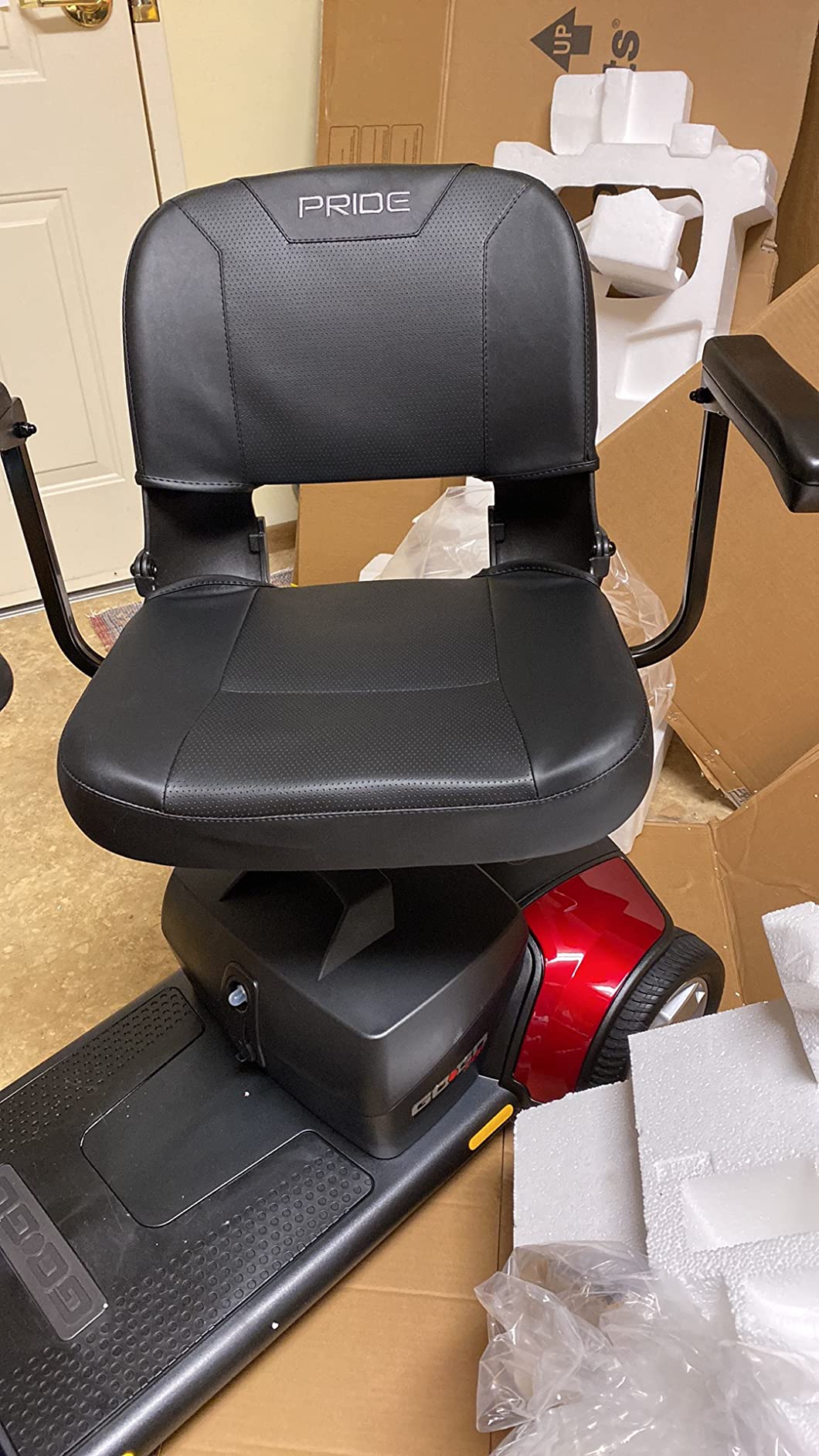
Two design details set this scooter apart from the rest of the mid-size group. The first is the front frame-mounted seat post, which carries the seat load into the frame rather than into the floor pan, and that is the sort of construction detail that shows up as a rockier, more planted feel over broken pavement. The second is the off-board dual voltage charger, which works whether the scooter is assembled or taken apart.
Disassembly is the other selling point. It comes apart into five lightweight pieces with a feather-touch one-hand mechanism, and the packed dimensions are 45.5 by 23.5 by 23 inches at a 44 pound shipping weight. A large front basket and a freewheel function for manual repositioning round out a practical package, and speed control sits on the tiller console.
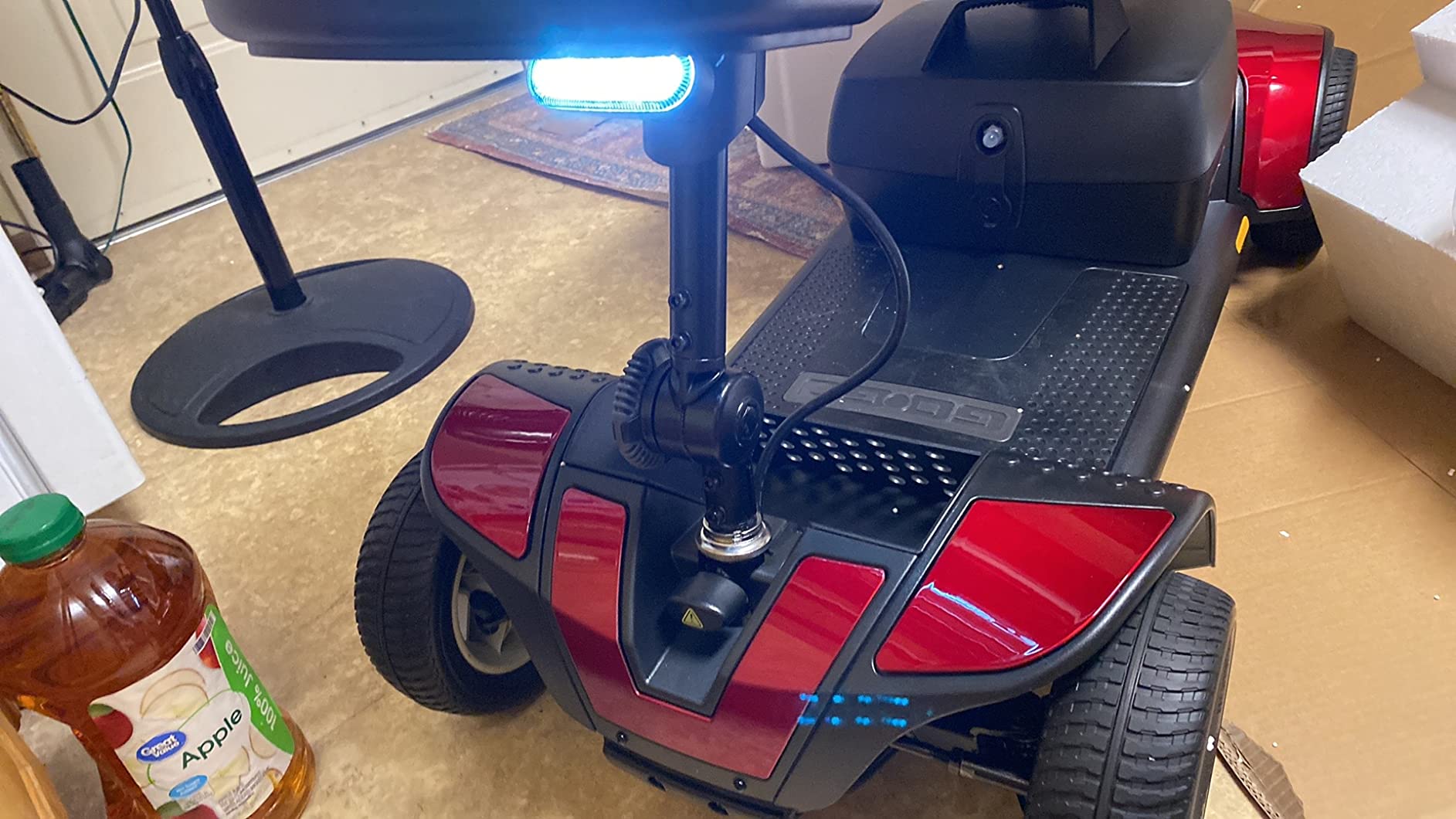
Owners report good hill-climbing ability, brakes that hold well even on steep descents, and long battery life, with one reviewer describing three days of heavy use on a single charge. Assembly and reassembly for transport are reported as straightforward, and sellers have replaced a defective seat cover in full.
There are drawbacks. The seat is described by some owners as feeling somewhat shaky, which sits oddly next to the stable frame and is the most common complaint. The steering column is also hard to secure and lock in position, and that is a safety-adjacent issue worth checking every time you set it up. Recharging takes several hours.
How the frame-mounted post actually helps
On a four-wheeler, stability is a function of how much the chassis resists twisting under load. Mounting the seat post to the frame shortens that load path and keeps more of the rider’s weight over the wheelbase rather than in the shell. Riders report confidence on hills that is out of proportion to the class of the machine, and strong braking on descents reinforces the impression.
Verify the column latch yourself before every ride. If it is not fully engaged and locked, the steering geometry changes under cornering load, and no amount of frame stiffness compensates for that.
Where it will frustrate you
Weight is the main issue for anyone transporting it alone, and even disassembled it occupies most of a vehicle’s cargo space. It passes through doorways, but narrow approaches can be difficult. If trunk space is tight, a folding four-wheeler will serve you better.
Otherwise, this is a solid dependable mid-size travel scooter for riders who value build quality and long charge duration over a small turning circle. The seat shakiness is the thing to test in person if you can.
7. Golden Buzzaround EX Extreme 4-Wheel – Pneumatic Tires and an 18-Inch Seat
BUZZAROUND EX Extreme 4-Wheel Heavy Duty Long Range Travel Scooter, Red, 18-Inch Seat
350 lb capacity
18 mile range
9-inch pneumatic wheels
18-inch swivel seat
Pros
- Pneumatic 9-inch wheels with strong ground clearance
- Room 18-inch swivel seat with removable armrests
- Accessory receivers for cane holder or O2 tank
- 5 mph top speed with an electromagnetic brake
Cons
- Batteries cannot be removed for indoor charging
- Largest section weighs around 46 pounds
- No suspension so bumps come through the frame
The Golden Buzzaround is the most comfortable long-distance machine in this group, and the reason is size. The 18-inch swivel seat, with 18 inches of depth and 18 inches of height, plus removable and adjustable armrests, is a genuinely different seating environment from the 15 to 17 inch pans on the compact models. For a full day out, that difference is not cosmetic.
It is also the only mid-size option here with pneumatic tires. Those 9-inch pneumatics, on an alloy steel frame, are why owners report strong power over grass, gravel, dirt and cobblestone, and why the good ground clearance comes up so often in reviews. Capacity is 330 to 350 pounds depending on the listing, with a 5 mph top speed and an 18 mile stated range.
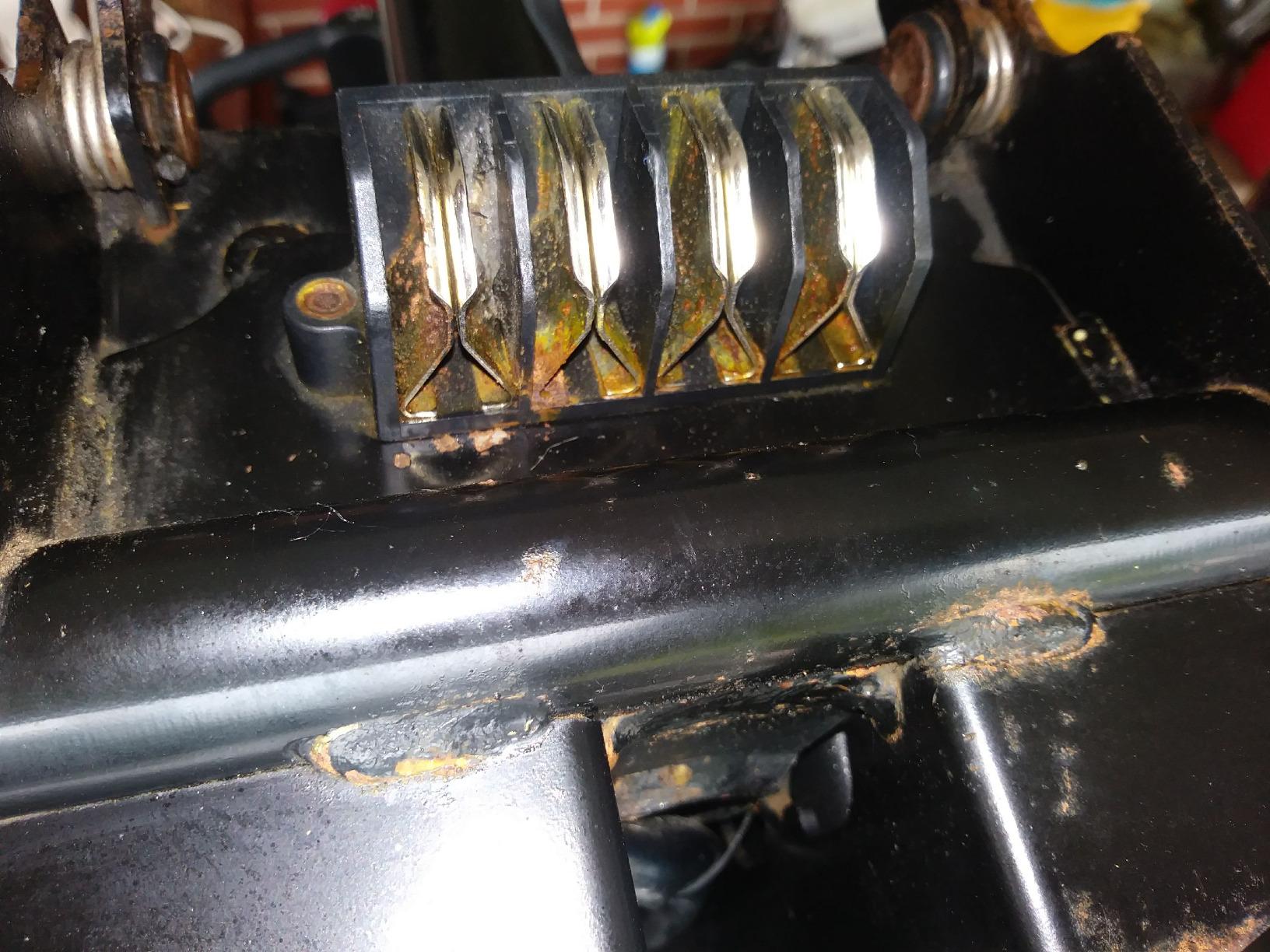
The build details are thoughtful for a medical device. The seat back carries a receiver for a cane holder, an oxygen tank or an extra basket. The electromagnetic brake is supplemented by a freewheel neutral mode for repositioning, and the charger port sits on the tiller so you do not have to crouch.
Now the parts that need honest framing. The total weight is 150 pounds and the largest section is around 46 pounds, so this is a two-person job for loading. The maximum rated incline is only about 6 degrees, which is the lowest in this roundup and directly contradicts the impression of an all-terrain machine. There is no suspension, so bumps arrive through the frame.
Two more: the batteries cannot be removed, so the whole scooter must come to an outlet, and the seat does not recline. Long-term owners also report periodic rear-end and transaxle repairs and eventual battery replacement, which is normal for a machine of this age and duty cycle but a real cost of ownership.
What the 54-inch turning radius means in practice
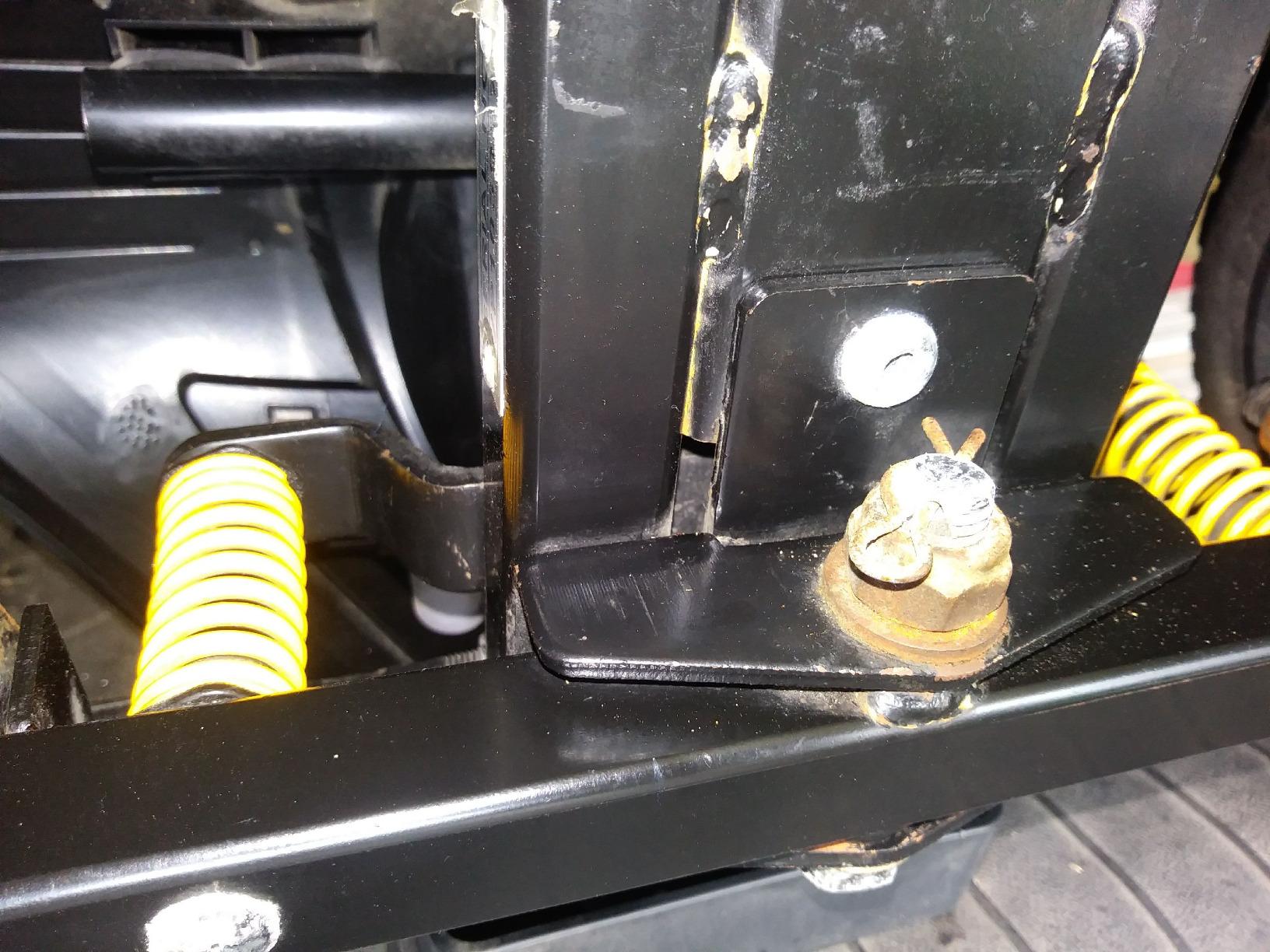
The stated turn radius is 54 inches, so plan on needing a bit of pavement in front of you to swing around. In a plaza or a park path that is unremarkable. In a narrow corridor between parked cars it is the difference between a smooth turn and a three-point shuffle. Measure the tightest spaces on your regular route before you commit.
Because there is no suspension, comfort on rough ground depends entirely on the pneumatics. They are the softest tire choice in the comparison, and they will need pressure checks, but they also do not transmit every crack straight into the seat frame. That is the trade, and on this machine it is a good one.
Who should buy it and who should not
Buy it if your days are long, your surfaces are mixed, and you value an upright comfortable seat over compactness. The accessory receivers also make it one of the better options for riders who use an oxygen tank or a cane.
Pass on it if you need to load it into a car alone, if you plan to charge it away from a standard outlet, or if your route involves grades steeper than 6 degrees. The incline rating is the honest limit here, and it is the number to test your route against.
8. Drive Medical Phoenix LT 4-Wheel – Heavy-Duty Travel with a Wide Footprint
Drive Medical Phoenix LT 4 Wheel Mobility Scooter, Red, Blue & Gray
350 lb capacity
Up to 15 mile range
Five-piece breakdown
2-3 inch ground clearance
Pros
- 350 lb capacity in a five-piece breakdown
- Height-adjustable swivel seat with fold-down backrest
- Adjustable tiller and padded armrests
- Blinking low-charge battery indicator
Cons
- Ground clearance of only 2-3 inches
- Limited legroom for taller riders
- Poor turning radius requires frequent three-point turns
The Phoenix LT is the oldest design in this roundup and it has aged in a specific, useful way. It is rated for up to 350 pounds, carries two 12V batteries, and covers up to 15 miles per charge. The dimensions of 55 by 23 by 21 inches and a total weight of 152 pounds make it the most substantial of the mid-size machines, and it still breaks into five pieces for trunk transport.
Long-term owners rate it as sturdy, with each piece liftable by hand and easy reassembly. Batteries are described as reliable, including through full theme-park days, and the quick-connect battery uses a blinking low-charge indicator so you know when it needs attention. The adjustable tiller and padded armrests with a height-adjustable swivel seat and fold-down backrest are properly ergonomic rather than minimal.
It handles ramps, grass, gravel and hills, and owners using it above 300 pounds report a stable ride. Drive Medical’s customer service is repeatedly described as very responsive, which matters for a device that will need batteries and parts eventually.
The ground clearance is the number to check first. At roughly 2 to 3 inches, this is the lowest in the comparison, and owners confirm it is not suited to sand, deep grass or loose dirt. That is a direct trade for a stable, low frame, but it does define the terrain envelope.
Legroom is also tight. Taller riders report placing their feet on the fenders, and the turning radius is poor enough that owners describe frequent three-point turns. Battery removal also requires taking the seat off first, which is a small friction point that adds up.
Ground clearance, explained for everyday terrain
Ground clearance is the vertical gap between the underside of the frame and the ground. At 2 to 3 inches, the Phoenix LT clears most sidewalks, thresholds and paved ramps without issue. It will also bottom out on a brick border, a raised garden edge, a mulch bed or a stone border, and bottoming out under load is exactly when a four-wheeler picks up its frame and stops absorbing.
That makes it a good match for smooth, paved, built environments and a poor match for anything rural. If your route includes unpaved paths, look at the Golden with its pneumatic tires or one of the all-terrain models instead.
Who it works for
This suits a rider above 300 pounds who needs a proven mid-size machine on paved routes, and who values responsive manufacturer support over compactness. The 350 pound rating and long service history are the reasons to keep it on a shortlist.
Skip it if you are tall, if your terrain is anything other than paved, or if frequent three-point turns would be a daily frustration. Height adjustment on the seat helps, but it does not create legroom that the frame does not have.
9. VEVOR Heavy Duty 4-Wheel Scooter – 1000W Power and the Longest Stated Range
VEVOR Heavy Duty 4-Wheel Mobility Scooter, Powerful 1000W Brushless Motor, 500 lbs Capacity, 21.5 Miles Long Range, All Terrain Mobility Scooter with Lockable Trunk for Seniors & Adults
500 lb capacity
1000W brushless motor
21.5 mile range
Spring suspension, 16-inch tires
Pros
- 1000W brushless motor rated for 20-degree slopes
- Four 16-inch tubeless tires with spring suspension
- Lockable rear trunk plus under-seat and front storage
- Front disc and rear drum brakes with seat belt and alarm
Cons
- Very large at 69.3 inches long and 277.78 pounds
- Seat does not swivel and is small for taller riders
- Written instructions and manual are very limited
This is the highest-specification machine in the roundup, and it is not close. The 1000W brushless motor, 60V 20Ah battery and 500 pound capacity put it in a different class from everything above it, and the stated range of up to 21.5 miles per charge is the longest figure in this roundup. Three speed settings give 6, 10 and 15 mph, and the motor is rated for slopes up to 20 degrees.
Stability comes from hardware that no other model here has: four 16-inch rugged tubeless tires on spring suspension, a 69.3 by 27.6 by 57.9 inch footprint, front disc and rear drum brakes, an anti-tip wheel, protective bumpers and a seat belt. The feature list runs to a 360-degree lighting system, turn signals, mirrors, a built-in anti-theft alarm and a lockable rear trunk with under-seat and front storage.
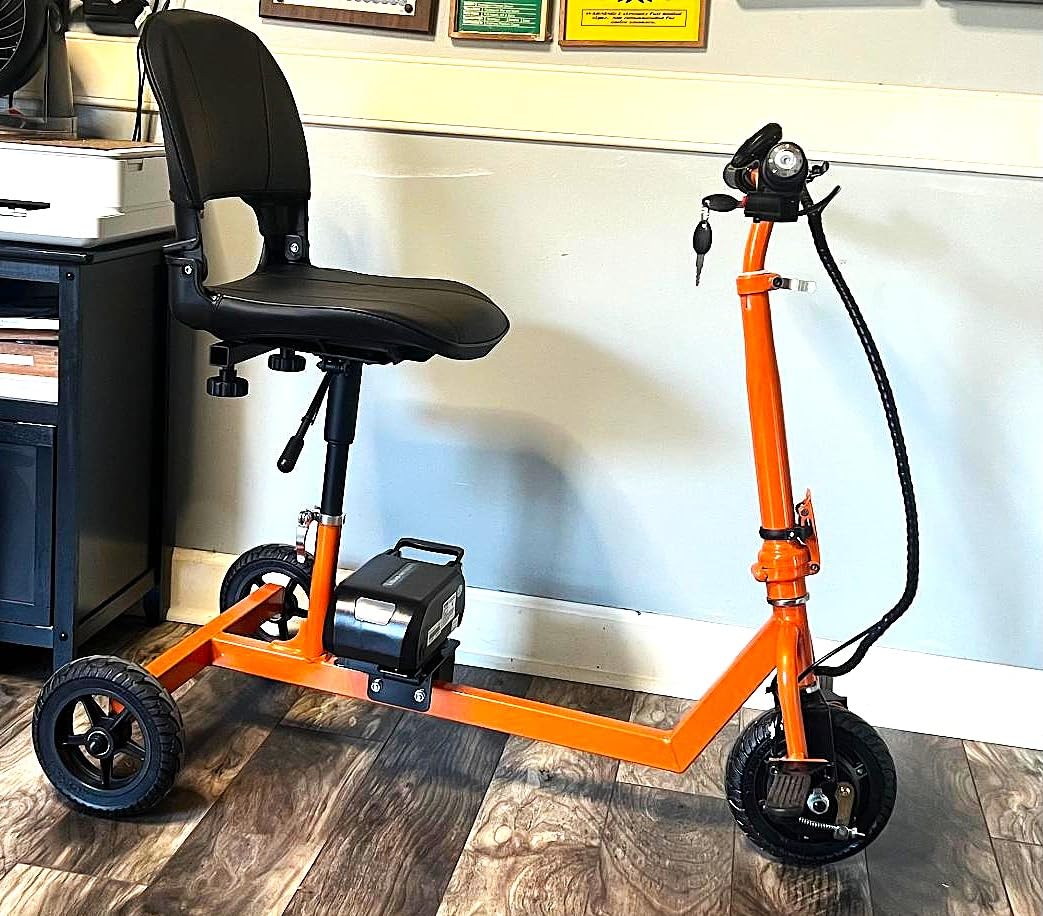
Owners report strong, smooth performance with plenty of power, good build quality and fit and finish, and whisper-quiet operation. It arrives fully assembled and protected in an angle-iron cage. One reviewer reported the front end arriving out of alignment from a loose tie rod, and several buyers report shipping damage to the crate and finish, so inspect the front end and the bodywork carefully on arrival.
Now the honest part, because the specs tell only half the story. At 277.78 pounds and nearly 70 inches long, this is not an indoor scooter and it will not be used as one. The turning radius is wide, and the seat does not swivel and is smaller than the 500 pound rating suggests for tall riders. Instructions and the manual are very limited, and customer support is described as weak or unhelpful.
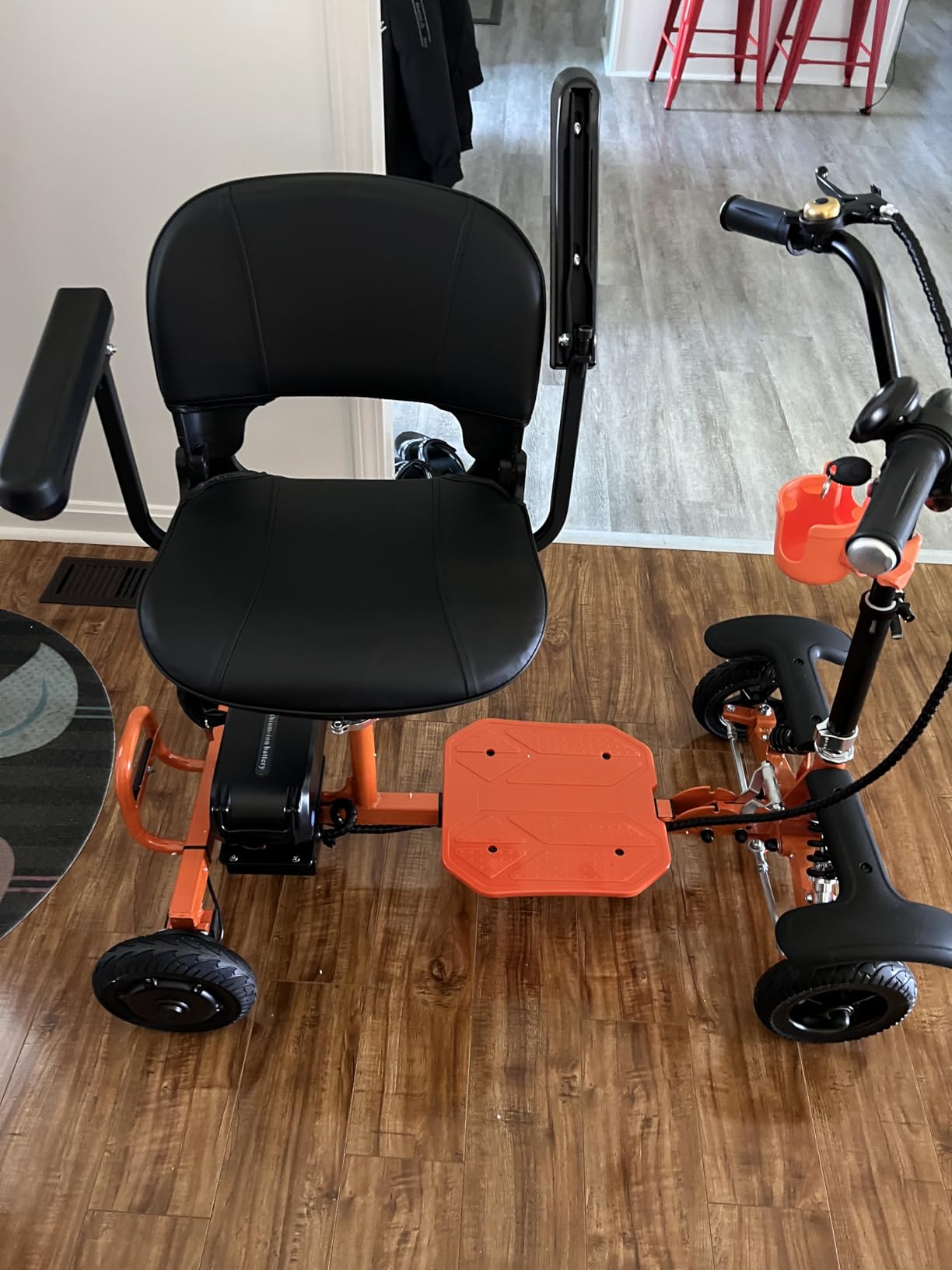
Reading the speed and incline numbers safely
These are the two figures that change how a machine feels. At 15 mph, this scooter covers ground roughly four times faster than a 3.7 mph indoor model, and reaction time matters far more. Run at the 6 mph setting indoors and in crowds. The 20-degree incline rating is a motor specification, not a recommendation to attempt a 20-degree ramp; treat slopes well below that as your working limit.
Spring suspension and tubeless tires are the reason this machine holds up on rough ground, and that combination is the single strongest stability feature in this article. It is also why the weight is where it is. There is no lighter way to put four independent spring-loaded wheels under a 500 pound-rated frame.
Who should look elsewhere
Pass if you live in an apartment, need indoor maneuverability, or intend to load this into a vehicle. At 277.78 pounds with a 57.9 inch height, transportation is a professional job rather than a weekend task. Riders over about 5 foot 10 should also check the seat dimensions in person, because the non-swiveling seat is a known mismatch with the capacity rating.
For a rider with a large outdoor area, a driveway, a property or a lot of rural space, and a place to keep it, this is the most capable machine in the guide. Verify the alignment on arrival and keep the alarm and the trunk in use, because a machine this size is a target.
10. LAGTOM Heavy Duty 500 lb Scooter – Reclining Seat and Fat-Tire All-Terrain Comfort
Heavy Duty 4 Wheel Mobility Scooters for Seniors & Adults 500lbs Capacity – Electric Powered Chair – 1000W All Terrain Fast Mobility Scooter for Travel w/Long Range Battery Remote Key
500 lb capacity
1000W motor
Speed from 1 to 15 mph
16-inch fat tires
Pros
- 16-inch fat tires with two rear shock absorbers
- Deluxe reclining captain's seat with folding armrests
- 98% pre-assembled at delivery
- Owners report 16 to 18 mile trips with charge remaining
Cons
- Very heavy at 275 pounds
- Wide turning radius
- Ignition tumbler switch can fail and no manual is supplied
The LAGTOM is the one to look at if you want the stability of a very large footprint with the comfort features of a lounge chair. The deluxe reclining captain’s seat, with folding armrests and a safety belt, is unique in this roundup and is the reason the model earns its place despite some rough edges. A reclining back changes posture management over a long day, and that is a real independence gain rather than a novelty.
Underneath it is genuine all-terrain hardware: 16-inch fat tires, two rear shock absorbers, rear wheel anti-tippers, and a 1000W motor paired with a 60V 20Ah long-range extended battery. The weight capacity is 500 pounds, and speed is variable from 1 to 15 mph through a dial. Dimensions are 62.6 by 27 by 42.1 inches at 275 pounds.
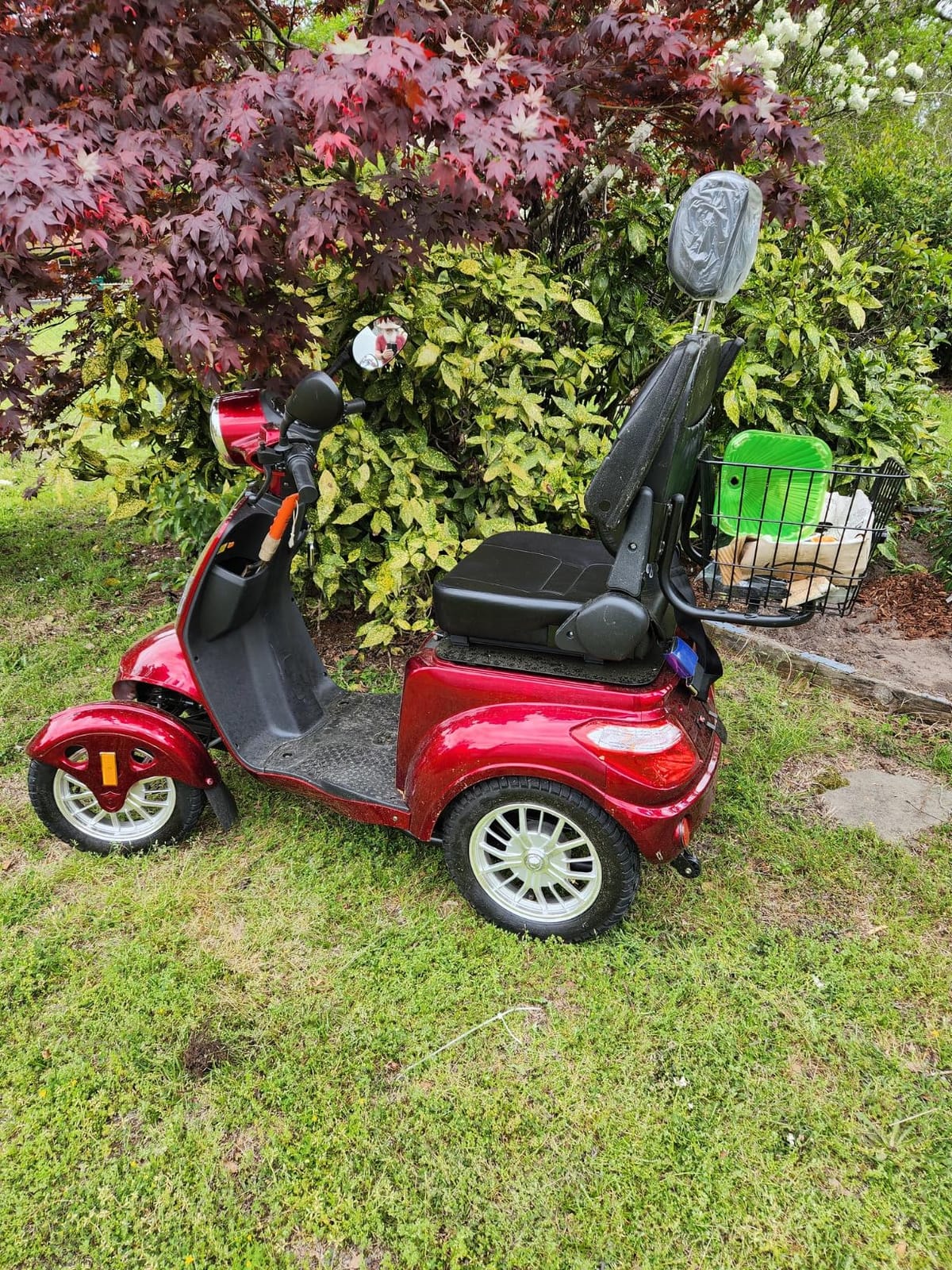
Owners report that it holds its top speed on hills, and that they completed 16 to 18 mile trips with battery remaining, which is the most useful real-world range feedback in this article. Reviewers also describe confident handling of sand, snow, grass, mud, gravel and slopes, a quick setup at 98% pre-assembled, and thoughtful daily details including a USB charger, cup holder, turn signals and a digital anti-theft alarm with a keychain remote.
The drawbacks are weight and hardware longevity. At 275 pounds, it is among the heaviest things here, and the turning radius is wide. Owners also report that the seat upholstery can deteriorate and needs reinforced repair, that the ignition tumbler switch can fail with no manual supplied, and that the reverse beeper is loud and hard to disable. Top speed came in below the advertised figure for some users.
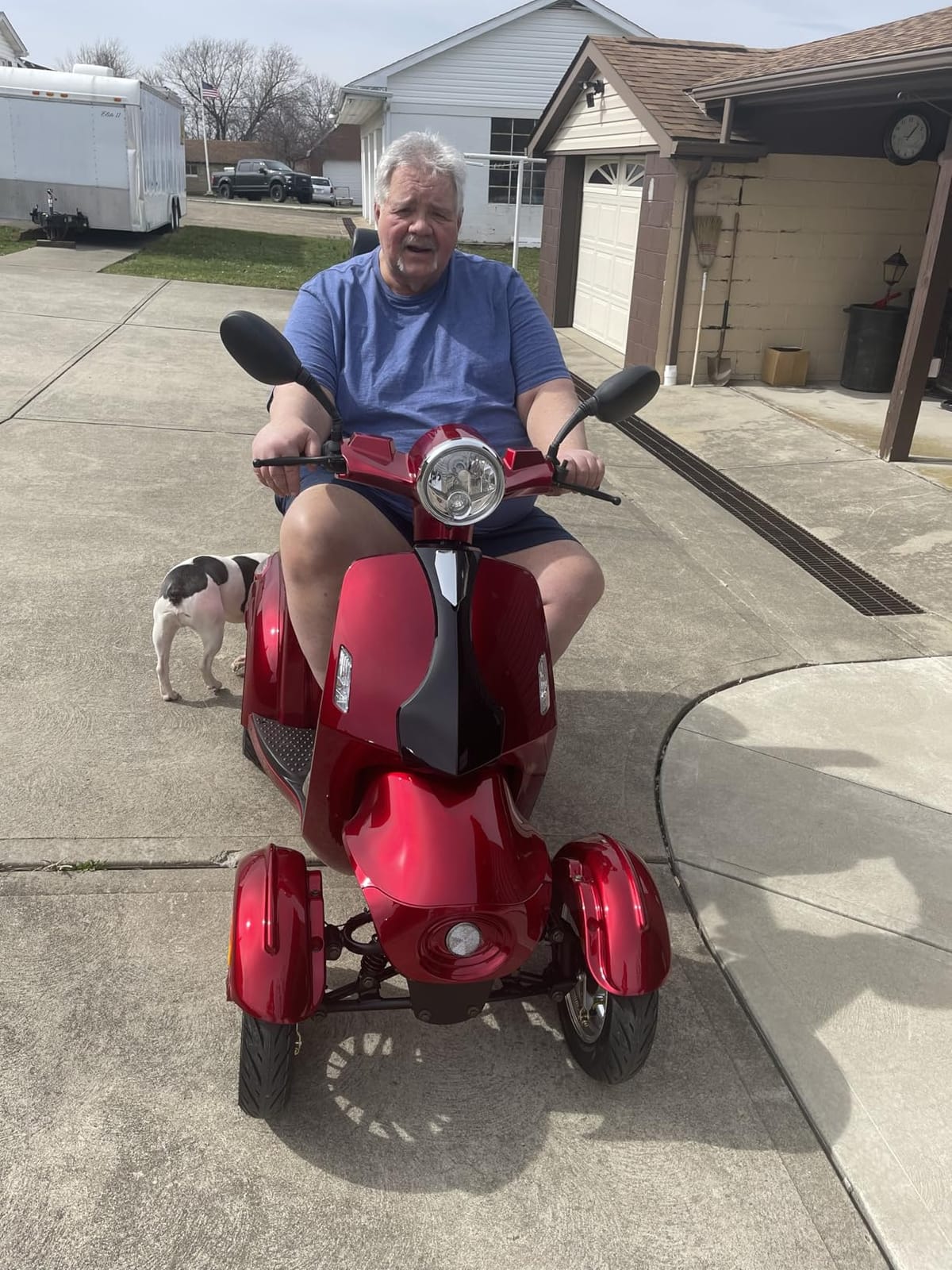
How a reclining seat interacts with stability
Reclining shifts the rider’s mass rearward and lowers the effective centre of gravity, which helps on uneven ground. It also moves weight away from the tiller, so steering response feels heavier while reclined, and the seat should not be reclined on a descent. A safety belt matters more on this model than on an upright-seat scooter, and the front and rear electronic braking system is what keeps the stop predictable at speed.
The fat tires and rear shocks absorb what the 62.6 inch length cannot. That combination is why owners report confidence on sand and mud, and why the ground clearance complaints that appear with the mid-size models do not show up here. The trade is a turning circle large enough that you need a driveway, not a corridor.
Who it suits and who it does not
Choose it if you ride outdoors over varied ground, want a seat that supports you over a full day, and have storage for a 275 pound machine. Snow and sand capability is claimed by owners in a way none of the mid-size models can match.
Pass if you need indoor maneuverability, plan to load it into a vehicle, or want the lowest maintenance burden. The seat upholstery, the tumbler switch and the lack of a supplied manual are the three things to budget for over a long ownership period.
Why Four Wheels Beat Three Wheels for Stability
Four-wheel mobility scooters are more stable than three-wheel models because their wider wheelbase and lower center of gravity resist tipping during turns, on slopes, and over thresholds. A four-wheel chassis forms a rectangle. The rider sits inside that rectangle rather than behind or above a single front wheel, so lateral force has to overcome the entire footprint instead of pivoting around one narrow contact point.
That is the whole argument, but it breaks down into four measurable effects. First, a wider wheelbase resists rollover directly, because the distance between the left and right wheels sets how far the centre of mass has to travel before the wheels lift. Second, the low seating position of a four-wheeler keeps the combined centre of mass of rider and machine lower relative to that base. Third, anti-tip wheels at the rear catch small drops backward on steep inclines, which is the most common tip-over direction in practice.
Fourth, and least discussed, three-wheelers put steering and balance in direct conflict. A three-wheel scooter has to lean into a turn or the rear wheel will swing wide, which requires balance from a rider who by definition may have balance issues. A four-wheel scooter just turns. For the buyer asking which category is more stable, that last point is often the deciding one, and it is why every model in this roundup is four-wheeled.
The honest caveat is that four wheels do not cancel out bad geometry. A model with 2 inches of ground clearance will scrape on a brick border regardless of how many wheels it has, and a model with a 6-degree incline rating will not climb a steeper ramp regardless of footprint. Stability is real, and it is still only one property.
Seven Stability Checks Before You Buy
Start with weight capacity, and treat the published figure as a floor rather than a target. Every model here is rated between 265 and 500 pounds. If you are within about 20 percent of a model’s limit, expect the stated range to shrink noticeably in real use, and you are also running the frame closer to where it was designed to fail.
Second, look at the wheelbase and the turning radius together. A long wheelbase is stable but slow to turn, and a short one is nimble but twitchier on uneven ground. Measure the narrowest point on your regular route, including a doorway and a store aisle, before choosing between the compact and mid-size groups.
Third, ground clearance. The spread in this roundup runs from roughly 2 to 3 inches on the Drive Medical Phoenix LT to 16-inch fat tires on the LAGTOM. If your route includes gravel, grass, brick borders or mulch, anything under 4 inches will disappoint you.
Fourth, incline rating. The published figures range from 6 degrees on the Golden Buzzaround to 20 degrees on the VEVOR. Treat the number as a hard ceiling, and subtract several degrees of margin for a wet surface, a loaded basket, or a heavier rider.
Fifth, tire type. Solid or flat-free tires never go flat and suit indoor and pavement use, but they transmit every defect and have poor snow traction. Pneumatic tires such as the 9-inch set on the Golden give a better ride and better grip on loose ground, at the cost of pressure checks and puncture repairs.
Sixth, confirm the anti-tip hardware is actually present, and that anti-tip rear wheels appear in the specification rather than in a marketing image. It also matters that the brakes are electronic, whether electromagnetic or a combined electronic system, because a four-wheeler carrying 250 pounds needs controlled deceleration more than a three-wheeler does.
Seventh, seat and tiller geometry. An 18-inch seat such as the Golden’s is materially more comfortable over a long day than a 15.75-inch pan. Adjustable tiller angle, fold-down or side-shift armrests, and a swivel that actually rotates without a tight lever all reduce the chance that a rider leans forward or sideways and unloads the base unevenly.
Indoor, Paved, or Rough Ground: Matching the Machine to the Route
For indoor and indoor-adjacent use, weight and turning radius decide it. Anything under about 90 pounds with a collapsing frame, such as the 53-pound Ecomobi or the 88-pound Vive, is far easier to manage in a hallway, a clinic or a restaurant than the 150 to 277 pound heavy-duty models. The price is capacity and tire size, and for a rider under 330 pounds who rarely leaves pavement, that trade is usually the right one.
For paved outdoor use, the 15-degree incline rating on the Rylox and the 10-degree rating on the Hoverfly T4 both open up hills that the 8-degree SKRT cannot handle. The Rylox also carries the best legroom in the compact class, which is what makes it our best value pick for mixed use.
For rough ground, only two approaches work. Pneumatic tires on a high-clearance frame, as on the Golden Buzzaround, handle gravel, grass and cobblestone with comfort but at 150 pounds and a 6-degree incline ceiling. Large tubeless tires on spring suspension, as on the VEVOR and LAGTOM, handle sand, mud and snow but only for riders who can manage a 275-pound machine.
One more terrain note that gets overlooked: the Drive Medical Phoenix LT and the SKRT both have ground clearance or incline ratings that rule out loose surfaces, no matter how good the four-wheel layout is. Know your route before you pick a machine, not after.
Frequently Asked Questions
What is the most stable 4 wheel mobility scooter?
Among the models reviewed here, the Ecomobi 4 Wheel Foldable Scooter combines a four-wheel base, a 330 lb capacity and a 53 lb net weight, which limits the force in any tip-over event. The Golden Buzzaround EX Extreme is the strongest outdoor choice, with pneumatic 9-inch wheels, good ground clearance and an 18-inch seat. For an indoor and transport mix, the Vive 4 Wheel Mobility Scooter has the most owner feedback behind it at 3158 ratings.
4 wheel vs 3 wheel mobility scooter stability
Four wheels are more stable because the chassis forms a rectangle, so lateral force must overcome the whole footprint rather than pivoting around a single front wheel. The rider sits low and centred inside that base, and rear anti-tip wheels catch backward drops on inclines. A three-wheel scooter also requires balance to complete a turn without the rear wheel swinging wide, which is difficult for riders with balance impairments.
What weight capacity do I need in a mobility scooter?
Choose a scooter rated comfortably above your own body weight, ideally by at least 20 percent, because running near the limit reduces real-world battery range and works the frame harder. Riders under 300 pounds are well served by the 265 to 350 lb models in this roundup. Above that, look to the 500 lb capacity models, such as the VEVOR or the LAGTOM, which also have larger frames and tires.
How far can a 4 wheel mobility scooter go on one charge?
Stated figures in this roundup range from 12.4 miles per charge on the Vive and Hoverfly T4 up to 21.5 miles on the VEVOR, with 15 miles claimed by several mid-size models. Real-world results are usually lower than the stated figure, and range varies with rider weight, hills, speed and battery condition. Owners of the LAGTOM report completing 16 to 18 mile trips with charge remaining.
Can 4 wheel mobility scooters go on grass and gravel?
It depends on tire type, ground clearance and incline rating rather than on wheel count. Solid tires with low clearance, such as the 2 to 3 inch clearance on the Drive Medical Phoenix LT, are not suited to sand, deep grass or loose dirt. Pneumatic tires on the Golden Buzzaround handle gravel and cobblestone well, and 16-inch fat tires with suspension on the VEVOR and LAGTOM handle sand, mud and snow. Check the incline rating before attempting a slope.
Conclusion
If you read nothing else, start with the Vive 4 Wheel Mobility Scooter. Its four-piece breakdown, folding tiller and 265 pound rating make it the least complicated way into four-wheel stability, and with 3158 owner ratings it has more real-world feedback behind it than anything else in this guide. It stays composed on floors, thresholds and moderate paved hills, and it stops being the right answer above 265 pounds or on steep gravel.
Push further from there based on your single biggest constraint. Riders who cannot lift heavy parts should look at the 53-pound Ecomobi with its remote auto-fold. Long outdoor days on mixed surfaces point to the Golden Buzzaround and its pneumatic 9-inch tires. Heavier riders, and anyone covering real distance off pavement, belong in the 500-pound VEVOR or LAGTOM, and should plan the storage and loading arrangements before they buy.
Whichever model you choose, test it on your real route in 2026, not in a showroom, and check the incline rating, ground clearance and turning radius against the tightest and steepest parts of your day. Those three numbers explain more about how a four-wheel scooter will feel than any feature list.