
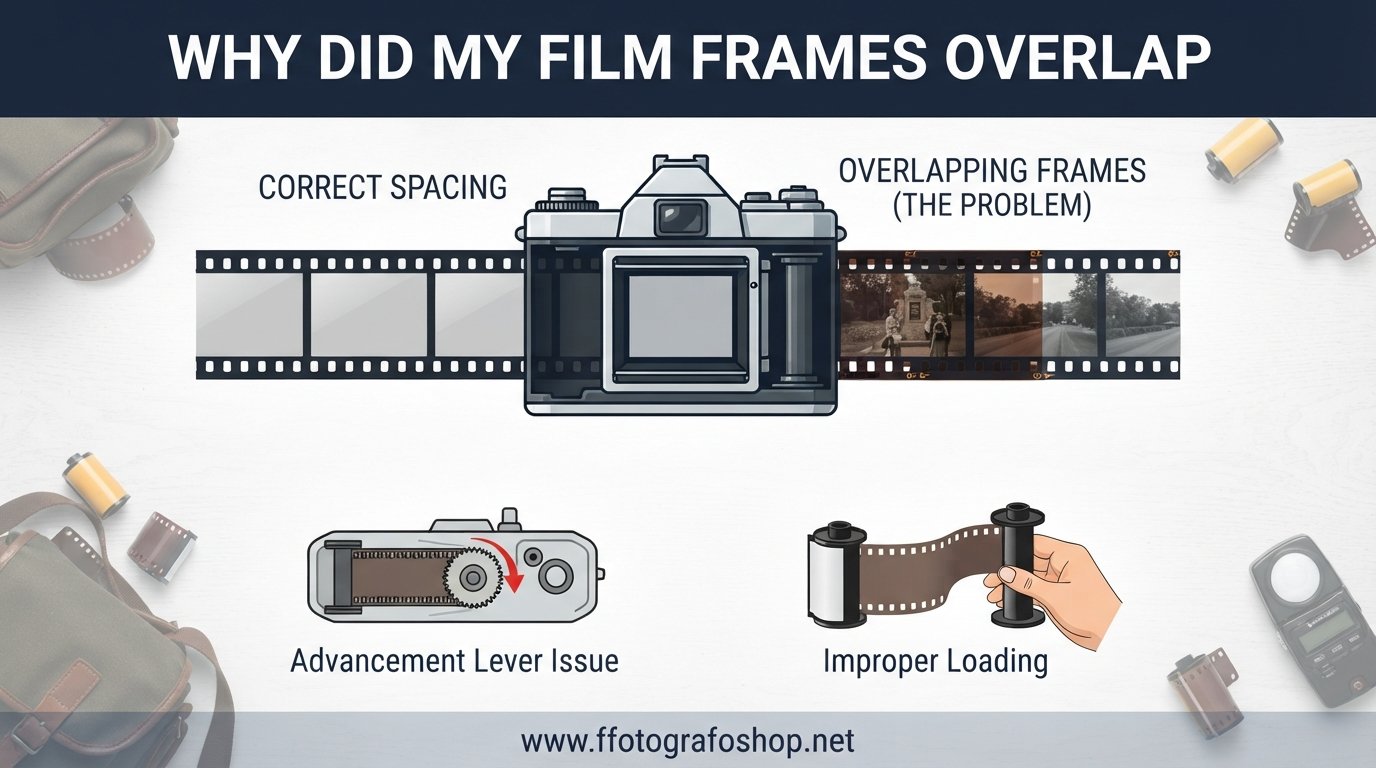
There is a particular kind of disappointment that hits when you pick up your developed negatives and see two photos bleeding into one another. You spent time framing each shot, trusting your camera, and the roll comes back with frames stacked on top of each other. If you are asking yourself why your film frames overlapped into each other, you are dealing with one of the most common and frustrating issues in film photography.
The good news is that overlapping frames almost always point to a diagnosable problem. It is rarely random. Once you understand how film transport works inside your camera, the cause becomes much easier to identify. In this guide, our team breaks down every reason your film frames overlapped into each other, how to figure out which one applies to your situation, and what you can do to prevent it from happening on your next roll.
Table of Contents
What Is Film Frame Overlap?
Film frame overlap occurs when two or more exposures are unintentionally recorded on the same section of film, causing images to blend together or sit too close to each other with little to no gap between them. Instead of each frame occupying its own cleanly spaced section of the negative, frames partially or fully merge.
This is different from a light leak, which typically shows up as streaks of orange or red bleeding across the film. It is also different from a true double exposure, which happens when you intentionally (or accidentally) expose the same frame twice without advancing the film at all. Frame overlap means the film did advance, but not far enough between shots.
On a properly functioning 35mm camera, each frame should sit with roughly 2 millimeters of gap between it and the next. When that spacing shrinks or disappears entirely, you are looking at a film advance or transport issue. The question is whether that issue is mechanical, user-caused, or both.
Common Causes of Film Frames Overlapping Into Each Other
Film frames overlapping into each other can be traced to a handful of root causes. Some are mechanical failures inside the camera. Others are simple loading or winding mistakes that any photographer can make, especially on a first or second roll. Here are the five most common culprits our team sees.
1. Film Advance Mechanism Failure
The film advance mechanism is the system of gears, levers, and springs that pulls film from the canister across the film gate and onto the take-up spool. On manual cameras, you power this system by thumbing the advance lever. On electronic cameras, a small motor does the work when you press the shutter or a dedicated advance button.
When gears inside this mechanism wear down, slip, or lose lubrication, the film may not advance the full distance between frames. You might feel the lever travel its normal stroke, but internally the gear train only moves the film partway. The result is frames that creep closer and closer together as you shoot through the roll.
This is one of the most frequent causes of frame overlap in older cameras. A camera that has sat unused for years often has dried-out lubricant on its gear train. The advance feels stiff or gritty, and the film transport becomes inconsistent.
2. Take-Up Spool Problems
The take-up spool is the component on the right side of the film chamber that physically winds the exposed film after each shot. Most take-up spools have slots or claws that grip the film leader when you first load the camera. If those claws are worn, bent, or missing, the spool may slip as it winds.
A slipping take-up spool produces inconsistent tension on the film. Some frames advance correctly while others barely move. You might see a pattern on your negatives where every third or fourth frame overlaps, while the rest are fine. That irregularity is a strong signal the take-up spool is the problem.
3. Rewind Clutch Not Engaging Properly
This is a cause that surfaces frequently in photography forums. The rewind clutch is a small mechanism that disengages the film sprocket connection when you rewind a roll. When you are shooting, that clutch needs to be fully engaged so the sprocket teeth can pull the film forward evenly.
Experienced photographers on forums like Photrio have reported that a rewind clutch can fail to engage properly if it is too stiff, has too much lubricant that has migrated into the wrong area, or has dried out entirely. When this happens, the sprocket slips and the film advances unevenly. The overlap you see on the negatives is the visible symptom of that internal slipping.
4. User Loading and Winding Errors
Not every case of frame overlap is the camera’s fault. One of the most common causes is improper film loading. If the film leader is not properly inserted into the take-up spool slot before you close the camera back, the first few frames may overlap or not advance at all.
Another frequent user error is advancing the film in two short strokes instead of one full stroke. Some photographers have a habit of half-thumbing the advance lever, then completing the stroke a moment later. On many cameras, this can confuse the frame counter and the internal gearing, leading to inconsistent spacing. Always advance in a single, smooth, full stroke.
Failing to ensure the film is taut when loading can also cause problems. If there is slack in the film when you close the back, that slack has to be taken up somewhere, and it often shows up as overlapping frames early in the roll.
5. Sprocket Hole Damage or Sprocket Teeth Wear
The sprocket teeth on the gear inside your camera mesh with the perforations along the edges of the film. These teeth are what give the film its precise, frame-by-frame movement. If the sprocket teeth are worn down, bent, or broken, they will not grip the film perforations reliably.
Sprocket damage can also originate from the film itself. Forcefully advancing the film, loading it at an angle, or using damaged film can tear or stretch the perforations. Once the sprocket holes are compromised, the film will not track straight, and frames will overlap.
If you notice torn sprocket holes on your developed negatives, that is a separate but related problem. It tells you the damage happened during transport, not during loading. Inspect the sprocket gear inside your camera with a small flashlight if you suspect wear.
How to Diagnose Why Your Film Frames Overlapped
Diagnosing frame overlap requires a bit of detective work. The pattern of overlap on your negatives tells you a lot about what went wrong. Follow this step-by-step diagnostic process to narrow down the cause.
Step 1: Examine the Overlap Pattern
Look at your negatives or scanned images and note the pattern. If every single frame overlaps evenly, the advance mechanism is consistently under-advancing. If only the first two or three frames overlap and the rest are fine, you likely had a loading error that resolved once the film tightened on the spool.
If overlap is irregular, with some frames fine and others merged, suspect the take-up spool or rewind clutch. Irregular slipping points to a component that is intermittently failing rather than consistently misaligned.
Step 2: Check the Sprocket Holes
Inspect the sprocket holes on your developed film. Are they torn, stretched, or ragged? If so, the sprocket gear in your camera is either damaged or the film was loaded crooked. Clean, round sprocket holes suggest the problem is in the gear train or clutch, not the sprocket itself.
Step 3: Test With a Sacrificial Roll
Load a cheap roll of film and shoot it with the lens cap on. After each shot, listen to the advance. Does it feel smooth and consistent? Does the frame counter advance exactly one number per stroke? If the counter sometimes jumps two numbers or feels like it skips, your advance mechanism is slipping.
After shooting the test roll, rewind and develop it. If the overlap pattern repeats, you have confirmed a mechanical issue. If the test roll comes out perfectly spaced, your original problem was likely a loading error.
Step 4: Consider Your Advancing Habit
Be honest with yourself about how you advance the film. Do you ever use two short strokes? Do you sometimes forget to fully advance before pressing the shutter? These small habits can produce frame overlap even on a perfectly healthy camera.
Camera-Specific Considerations
Different camera types are prone to different overlap issues. Understanding your camera’s design helps you diagnose faster.
Manual Winding SLR Cameras
Manual SLRs like the Minolta X700, Pentax K1000, and Canon AE-1 rely entirely on mechanical advance. These cameras are durable but susceptible to lubricant degradation over decades. A common report from photographers on community forums involves advance levers that feel stiff or have a dead spot partway through the stroke. That dead spot is where the gear train is slipping.
One photographer reported that their ZX-5n frame overlap issue was resolved simply by replacing weak batteries. Even though the ZX-5n has a mechanical advance feel, some of its internal functions depend on battery power. If your camera has any electronic components, always start with fresh batteries.
Electronic and Point-and-Shoot Cameras
Automatic cameras with motorized advance can also overlap frames. When the motor weakens or the electronic control circuit malfunctions, the film may not travel the correct distance. These cameras are harder to diagnose because you cannot feel the advance the way you can with a lever.
If your point-and-shoot is producing overlapping frames, the motorized transport is likely failing. This type of repair is often not cost-effective for consumer-grade cameras.
Medium Format Cameras
Medium format cameras like the Pentacon Six are notorious for frame spacing problems. The Pentacon Six in particular has a known issue where a workaround involves holding the shutter button halfway while winding to ensure proper frame spacing. Medium format film is more expensive, making overlap especially costly.
Rangefinder cameras with manual advance can suffer the same lubricant and gear wear issues as SLRs. The diagnosis process is identical.
How to Prevent Film Frame Overlap?
Prevention comes down to proper loading technique, consistent winding habits, and regular camera maintenance. Here is what our team recommends.
Load Film Correctly Every Time
When loading, insert the film leader firmly into the take-up spool slot. Wind one stroke before closing the back to confirm the film is catching and advancing. The film should be taut, not slack, when you close the camera.
Take an extra ten seconds to verify the film is properly engaged. This small habit prevents the majority of early-roll overlap problems.
Always Advance in One Full Stroke
Never advance the film in two partial strokes. One smooth, complete motion ensures the gear train cycles fully and the frame counter advances accurately. If your lever feels like it stops halfway, apply steady pressure until it completes its travel.
Keep Your Camera Maintained
No competitor in this space provides a maintenance schedule, so here is ours. If you shoot regularly, have your camera serviced with a CLA (Clean, Lubricate, and Adjust) every 3 to 5 years. If your camera has sat unused for more than a year, fire a test roll through it before using it for anything important.
Old lubricant is the enemy of consistent film transport. A CLA service cleans out dried grease, applies fresh lubricant to the gear train, and adjusts the advance mechanism to factory tolerances. It typically costs between $75 and $150 for common models.
Store Cameras Properly
Store your film cameras in a cool, dry place. Avoid leaving them in hot cars or humid environments, which accelerate lubricant breakdown and can cause internal components to corrode. Remove batteries during long storage periods to prevent leakage.
Repair vs Replace: What to Do With a Camera That Overlaps Frames?
If your diagnostic test confirms a mechanical advance issue, you face a decision. Should you repair the camera or replace it?
For cameras with sentimental value, collectible status, or professional-grade build quality, a CLA service is almost always worth it. A Leica, Nikon F-series, Hasselblad, or Rolleiflex deserves professional repair. These cameras are built to last decades and a $100 to $200 service restores them to like-new function.
For consumer-grade cameras worth under $100, repair costs often exceed the camera’s value. In that case, replacement is the practical choice. Many excellent used film cameras are available at reasonable prices.
If the problem turned out to be a loading error or winding habit rather than a mechanical fault, congratulations. Your camera is fine. Just adjust your technique and your next roll should come back perfectly spaced.
FAQs
Why did my 35mm film develop overlapping?
Overlapping on 35mm film is almost always caused by the film advance mechanism not moving the film far enough between exposures. This can result from worn gears, a slipping take-up spool, a faulty rewind clutch, dried-out lubricant, or improper loading technique. Check whether the overlap is consistent across the roll or irregular, as that distinction helps pinpoint the exact cause.
How to tell if a film is advancing properly?
You can verify proper film advance by watching the rewind knob turn as you advance the lever, confirming the frame counter moves exactly one number per stroke, and ensuring the advance lever completes a smooth full stroke each time. Shooting a test roll with the lens cap on and checking the spacing is the most reliable confirmation method.
Is my film ruined if I open the back?
Opening the camera back exposes the film to light, which will fog or destroy any frames that are currently unspooled and visible. Frames already wound onto the take-up spool are partially protected but may still show light leaks along the edges. Frame overlap from advance issues is unrelated to light damage from opening the back.
What are common negative film problems?
Common negative film problems include frame overlap, light leaks, underexposure, overexposure, scratches from dirty film channels, blank frames from shutter failure, color shifts from expired film, and static marks from rapid winding. Frame overlap specifically points to a film transport or advance mechanism issue rather than a exposure or development problem.
Conclusion
Discovering that your film frames overlapped into each other is frustrating, but it is also a solvable problem. The cause almost always falls into one of five categories: a worn advance mechanism, a slipping take-up spool, a faulty rewind clutch, improper loading or winding technique, or sprocket damage. By examining your overlap pattern and running a simple test roll, you can pinpoint which one applies to your camera.
For mechanical issues, a professional CLA service restores most cameras to reliable function. For user errors, a small adjustment to your loading and winding habits fixes the problem immediately. Either way, your next roll of film deserves to come back with clean, evenly spaced frames.