
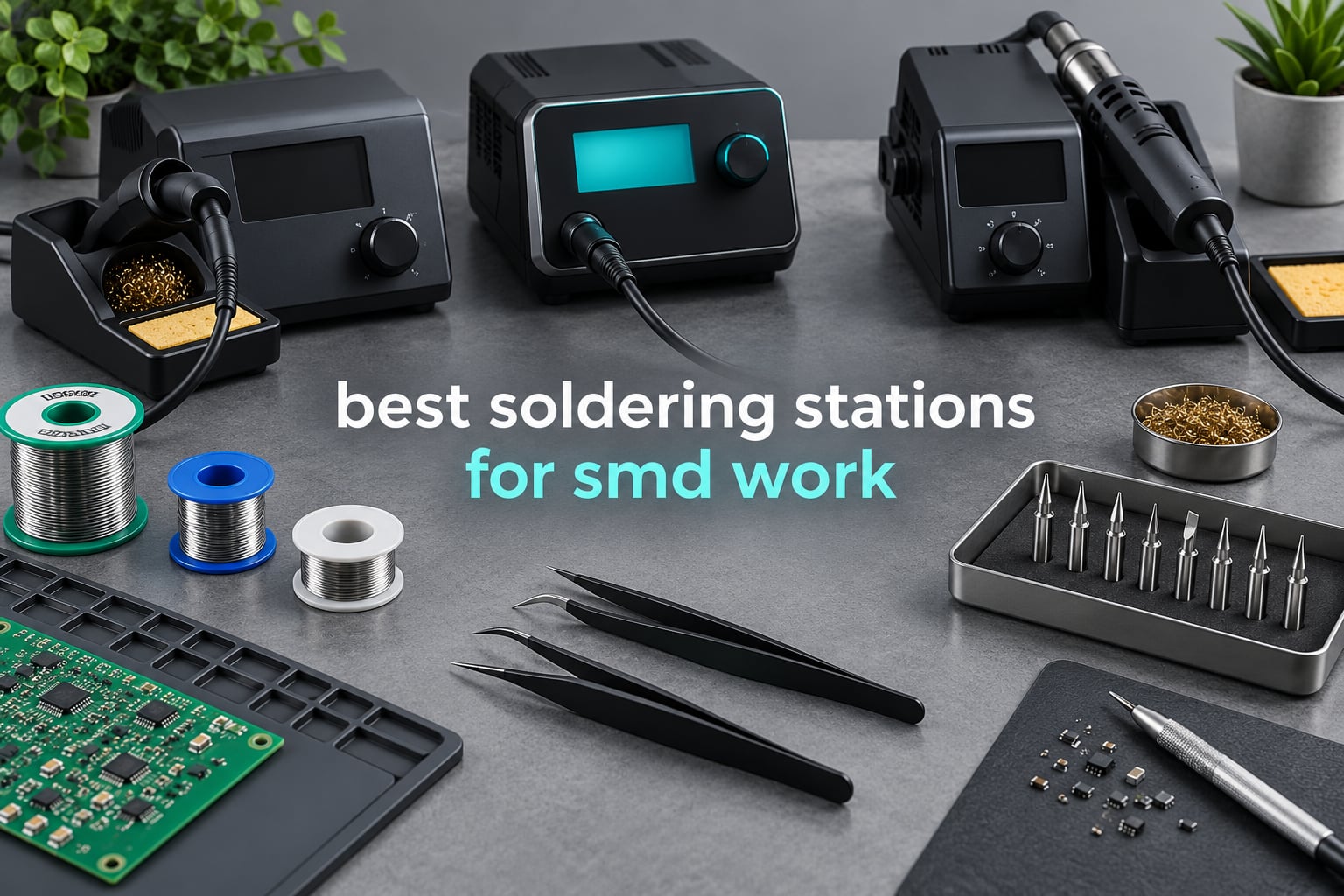
Soldering station shopping gets confusing fast, because three different tools share the same shelf: pencil irons, bench stations, and hot air rework stations. For SMD work specifically, the gap between them matters more than the price tag. A station with PID control holds a set temperature under load, a fine tip reaches a 0402 resistor without sliding off the pad, and a grounded output will not fry a CMOS part while you work. Get those three right and almost any hobby SMD job goes smoothly.
That is what this roundup is built around. We compared 12 temperature-controlled soldering stations and 2-in-1 hot air combos for SMD work, weighing each on temperature stability, calibration support, tip ecosystem, available heat, and whether it holds up under a real solder joint rather than at idle. The result is a list where the cheapest option and the best option are genuinely different products, and you can see exactly why.
Everything below reflects what buyers report after living with the hardware, plus the consensus that dominates the soldering forums. Forum threads matter here more than star ratings alone, because this audience cross-checks before buying. If you are still deciding between brands, the portable power station picks we maintain cover the other half of a mobile bench question: keeping tools powered away from a wall socket.
Table of Contents
Top 3 Picks for Soldering Stations for SMD Work in 2026
These three cover the most common situations: a proven all-round station, a feature-rich 2-in-1, and a low-cost first bench.
Best Soldering Stations for SMD Work (October 2026)
Every pick below, with the specs that actually change SMD results.
| Product | Specifications | Action |
|---|---|---|
| Weller WE1010NA |
|
Check Latest Price |
 YIHUA 862BD+ YIHUA 862BD+ |
|
Check Latest Price |
 YIHUA 926 III YIHUA 926 III |
|
Check Latest Price |
 WEP 927-IV WEP 927-IV |
|
Check Latest Price |
 FNIRSI DWS-200 FNIRSI DWS-200 |
|
Check Latest Price |
 TS101 Soldering Iron Station TS101 Soldering Iron Station |
|
Check Latest Price |
 YIHUA 8786D I YIHUA 8786D I |
|
Check Latest Price |
 WEP 882D WEP 882D |
|
Check Latest Price |
 WEP 8786D-I SE WEP 8786D-I SE |
|
Check Latest Price |
 MYPOUOS 8588D MYPOUOS 8588D |
|
Check Latest Price |
 TXINLEI 8586 TXINLEI 8586 |
|
Check Latest Price |
 Bakon 852d plus Bakon 852d plus |
|
Check Latest Price |
1. Weller WE1010NA: Best Overall Soldering Station for SMD Work
Weller 70 Watt Digital Soldering Station | WE1010NA
70W digital iron
Temperature stability plus or minus 4F
Temperature lock and password
ESD safe station and iron
Includes PH70 rest and 1.6mm tip
Pros
- Rock solid temperature stability and temperature lock for repeatable joints
- 70W iron with a heat resistant silicone cable
- ESD safe station and iron from an established brand
- Standby mode and auto setback conserve energy
- Password protection keeps your setpoints intact
Cons
- Fixed 120V operation limits portability
- Single channel with no hot air rework
- Soldering only so you will need a separate rework option for part removal
If you want one station that handles 95 percent of SMD work for the next decade, the Weller WE1010NA is the answer, and it is also the highest rated product in this group. It is a 70W digital station with temperature stability of plus or minus 4 degrees Fahrenheit, which is tight enough that a 0805 capacitor lands the same way at the start of a session and at the end.
We have seen the WE1010NA recommended endlessly as the safe default on soldering forums, where the recurring advice is that you cannot go wrong with a Weller or Hakko station. The Weller side of that argument is simpler in one specific way: this is soldering only. There is no hot air, no pump, nothing else to learn. Everything on the front panel does one job.
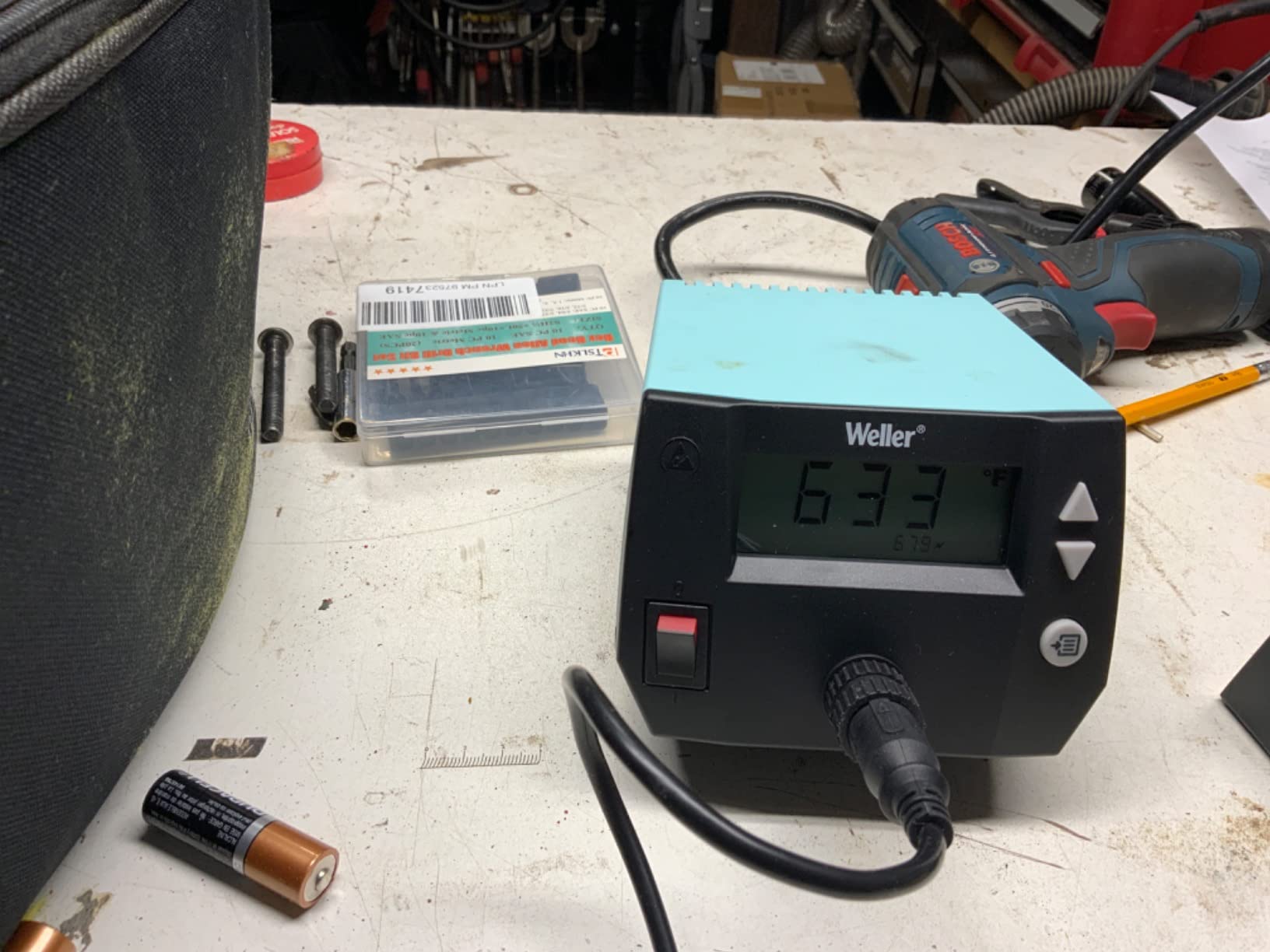
Build quality shows in the details that get ignored. The handle is comfortable, the cable is heat resistant silicone rather than the stiff vinyl that cracks near the heater, and the station is a full 5.5 pounds, which is mostly the isolation transformer doing its job quietly.
Temperature lock lets you set a working temperature and freeze it, so a curious finger cannot wander the dial mid-joint. Password protection sits on top of that and prevents accidental changes on a shared bench. Standby mode and auto setback cool the tip when you park it, which is the single most effective way to extend both tip and element life.
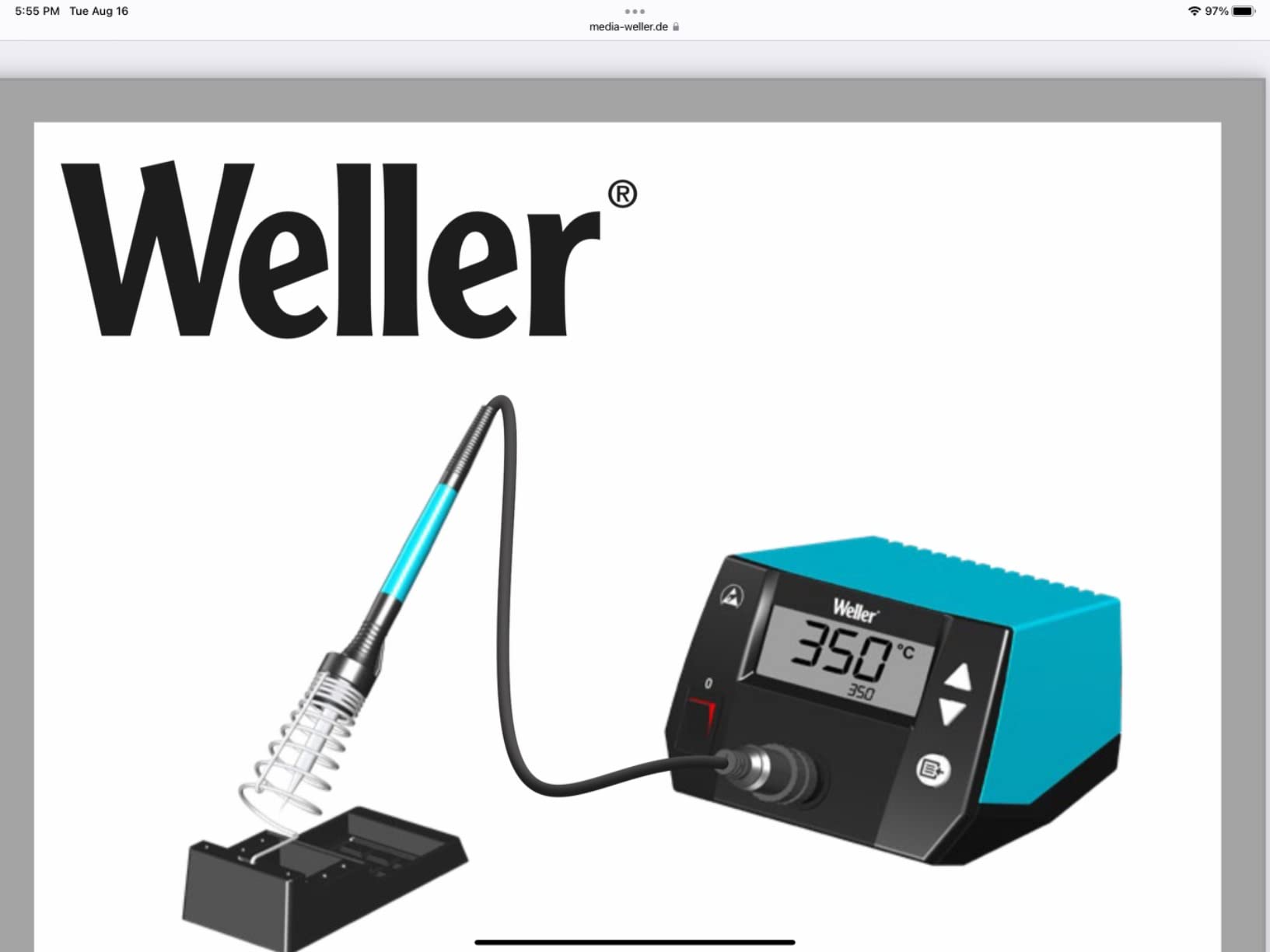
What tells you it will handle SMD work
The included 1.6 mm screwdriver tip is a sensible default for 0805 and 1206 parts, and the WEP70 tip family covers finer geometry without a proprietary lock. Buy a hoof or chisel tip in the same family and the same handle takes it. That tip availability is the quiet reason Weller keeps coming up on forums, since replacement tips are stocked everywhere the brand is sold.
For 0201 and 0402 parts, pair the station with a pointed or mini-chisel tip rather than trying to work with the supplied one. The temperature range reaches 400 degrees Fahrenheit at the top end, which is comfortable for leaded solder. Lead-free work sits at the upper limit of what this station can deliver, and reviewers who do lead-free joints regularly tend to prefer a higher-wattage station for that reason.
Where it falls short
Fixed 120V operation is the practical limit for anyone working outside North America or moving between benches on different supplies, since you need a step-down transformer rather than a plug adapter. There is also no hot air, so removing a QFN or reballing a BGA means buying a separate rework station or a 2-in-1 combo from this list.
Single channel means one setpoint at a time, and no memory of your working temperatures. For a solo user that is a non-issue. For a repair bench running three different jobs in an afternoon, one of the multi-channel units is worth the step up.
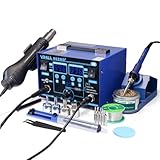
2. YIHUA 862BD+: Best Value 2-in-1 for SMD and Hot Air
YIHUA 862BD+ SMD ESD Safe 2 in 1 Soldering Iron Hot Air Rework Station °F /°C with Multiple Functions
75W iron plus 750W hot air
392-896F iron range
PID cycle every 20 milliseconds
Three digital displays
0-99 minute sleep mode
Pros
- Genuine 2-in-1 with separate soldering and hot air handpieces
- 20ms PID detection cycle with a dual-core microprocessor
- Three displays for soldering temp
- hot air temp and air volume
- Non-volatile memory recalls your last settings
- Detachable handpieces can be replaced instead of the whole unit
Cons
- Not temperature calibrated out of the box
- Both handpieces read a few degrees below setpoint
- AC power cord is not modular and hot air gun pins can bend
The YIHUA 862BD+ is the pick if you want a soldering station and a rework station without buying two boxes, and it does the combination better than anything else at this tier. Long-term owners on forums describe phone, amplifier, and computer repair with this unit over years of service, which is a better track record than most of the compact combos here.
The control electronics are the story. The PID cycle runs a detection pass every 20 milliseconds on a dual-core microprocessor, which is why the temperature does not hunt when you touch a joint. The iron runs 75W and adjusts from 392 to 896 degrees Fahrenheit. Buyers report solder starting to flow at roughly 575 degrees Fahrenheit within about 30 seconds of power-on.
Three separate digital displays cover soldering temperature, hot air temperature, and air volume, and each function has its own power switch. That sounds like a small thing until you are mid-rework and need to drop airflow without waiting for the iron to reheat. Non-volatile memory stores your temperature and airflow settings, so the station is ready at the same settings tomorrow.
The 0-99 minute adjustable sleep mode is genuinely useful. Set it to 15 minutes and the iron cools itself whenever you stop, which is the cheapest tip-life extension available. Both handpieces detach, so if the hot air gun connection wears out you replace a handpiece rather than the whole station.
What tells you it will handle SMD work
Two things put this unit ahead of the other 2-in-1s for fine work. The 20ms PID cycle means the iron recovers temperature almost immediately after a large pad, and the bundled five SGS-certified tips include geometry fine enough for 0402 parts rather than only through-hole shapes. The kit also ships with ESD-safe tweezers, a solder sucker, four hot air nozzles, and a brass wool holder.
It is built for 110-127V with a US-standard plug, and it is ETL certified as a genuine YIHUA unit, which matters because the marketplace is full of lookalikes with the same model number printed on the box.
Where it falls short
It is not calibrated out of the box, and the tip runs a few degrees cooler than the number on the display. Budget ten minutes to run a calibration cycle and verify with a probe before you trust it on anything expensive. A pyrometer check is worth doing once on any station in this roundup.
The alignment-sensitive pins on the hot air gun can bend if the connector is forced, and the fixed AC cord means you cannot swap in a longer cable. The included 0.8mm roll is lead-free, so if you prefer tin-lead you will want your own wire.
3. YIHUA 926 III: Best Budget Station for First SMD Joints
YIHUA 926 III 60W Digital Display Soldering Iron Station Kit w 2 Helping Hands, 6 Extra Iron Tips, Lead-Free Solder, Solder Sucker, S/S Tweezers, °C/ºF Conversion, Auto Sleep & Calibration Support
60W digital station
194-896F with PID stabilization
YIHUA 1200 and 900M series tips
Calibration support and sleep mode
UL Standard compliant
Pros
- Largest review base of any station in this roundup
- PID stabilization holds temperature across a wide range
- Compact body with integrated holder and tip storage slots
- Calibration support
- sleep mode and C to F conversion built in
- UL Standard compliant with 12 months of US technical coverage
Cons
- 60W element struggles on large high-thermal-mass joints
- Small display that is hard to read at a glance
For a first electronics bench, the YIHUA 926 III is the most proven starting point in this group, and it holds the top category rank in Soldering Stations with more than 7,000 reviews. The honest truth, which matches the prevailing forum view, is that a station in this bracket handles most hobby SMD work without any upgrade at all.
It is a 60W digital station with PID stabilization across a 194 to 896 degree Fahrenheit range, which covers leaded and lead-free work with room to spare. The calibration function matters more here than the spec sheet suggests: a budget station that can be dialed in against a reference is far more useful than one you simply trust.
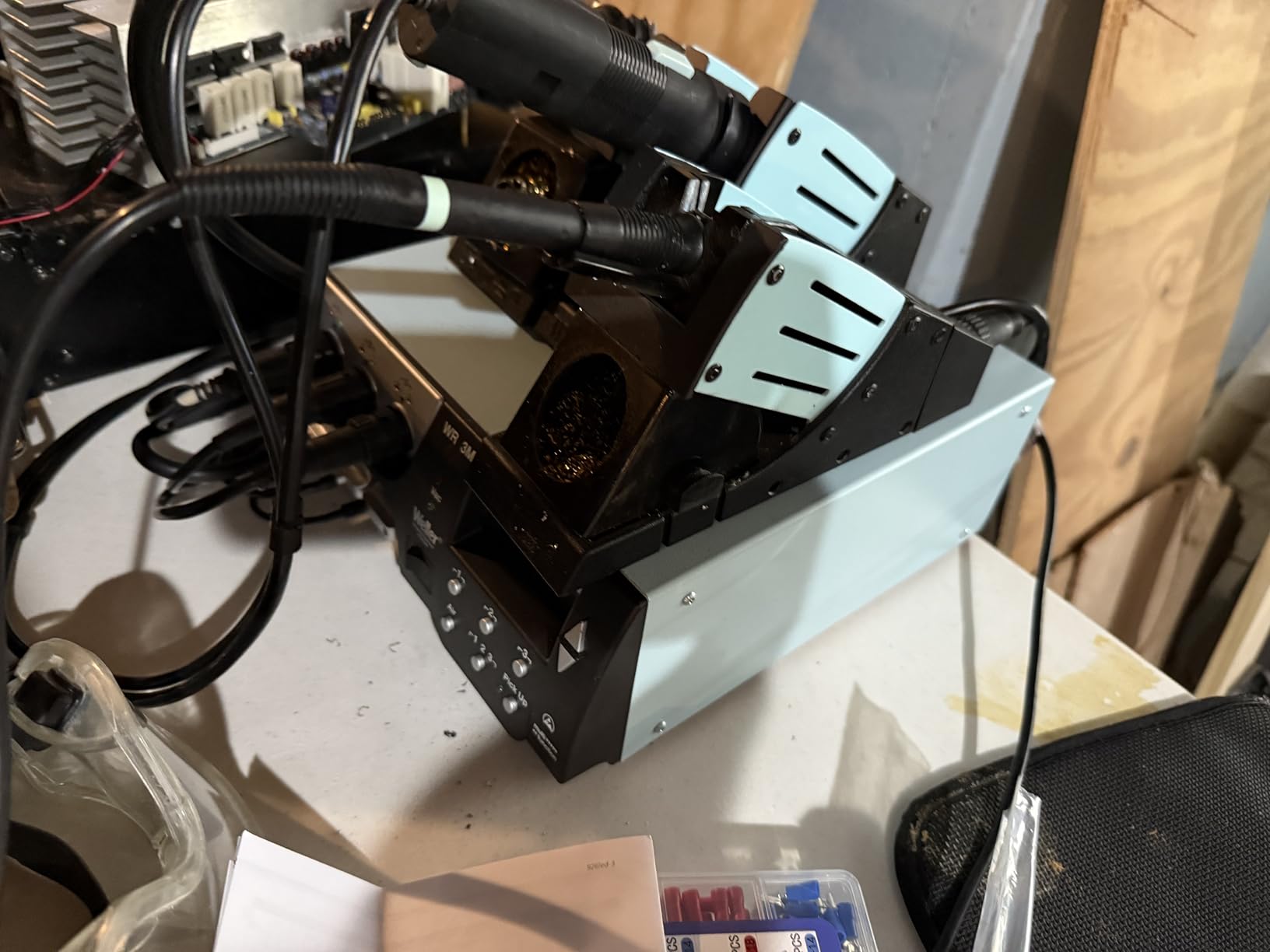
The physical design is the other quiet strength. The iron holder is integrated into the body with a protective mesh behind it, and there are tip storage slots built into the chassis, so the whole thing occupies very little bench space. The 7.3 by 4.5 by 2.8 inch footprint leaves room for a microscope stand beside it. Adjustable sleep mode offers 5, 10, or 30 minute cutoffs.
Tips come from the YIHUA 1200 and 900M series, which are among the easiest to source and are also the family that most T12-style clone handles accept with an adapter. That ecosystem compatibility keeps this station relevant even as you upgrade the handle later.
What tells you it will handle SMD work
The 12-in-1 bundle includes two helping hands, six extra tips, a solder sucker, ESD-safe tweezers, a 0.8mm lead-free roll, a wire dispenser, and a sponge. That is the full starting kit for a new bench in one box, and it removes the most common reason people stall: not having the small tools.
UL Standard compliance and 12 months of US manufacturer technical coverage are unusual at this price. If a station fails, you have somewhere to send it, which is exactly the after-sales problem that buyers on electronics forums complain about most with unbranded listings.
Where it falls short
60W is the hard limit. Touch it to a large ground plane, a heatsinked power device, or a thick two-layer ground pour and the temperature sags visibly, and recovering from that sag takes longer than on a 110W or 200W unit. If your SMD work includes lead-free rework on multilayer boards, buy the higher-wattage option instead.
The display is small and reads poorly at a glance, so you will find yourself leaning in more than you would like. There is no hot air, so component removal needs a separate tool or a 2-in-1 combo.
4. WEP 927-IV: Best for High-Wattage Through-Hole and Mixed Work
WEP 927-IV Soldering Station Kit High-Power 110W with 3 Preset Channels, Sleep Mode, LED Magnifier, 5 Extra Iron Tips, Tip Cleaner, 2 Helping Hands, Tip Storage Slots, Lead-free Solder Wire, Tweezers
110W heating element
90-480C adjustable
Dual display shows set and actual
3 preset temperature channels
0-99 minute sleep timer
Pros
- 110W element heats fast and recovers well on big joints
- Dual display shows setpoint and actual temperature at once
- Three preset channels cut repeated temperature configuration
- 0-99 minute sleep timer extends tip and station life
- All-in-one body holds the iron
- tip cleaner
- wire dispenser and helping hands
Cons
- Soldering only with no hot air rework capability
- LED magnifier is a modest add-on rather than a true stereo microscope
If your SMD work sits alongside heavy through-hole work, the WEP 927-IV is the one to buy, because 110W is where heat recovery stops being a compromise. Buyers single out thermal recovery as the standout: the element recovers temperature after a big copper pour quickly enough that you are not waiting through a long joint.
The dual numerical display showing setpoint and actual temperature simultaneously is a genuinely useful feature. On most budget stations the two numbers never agree until the station settles; here you can watch them converge, which makes diagnosing a problem tip or a cold joint much faster.
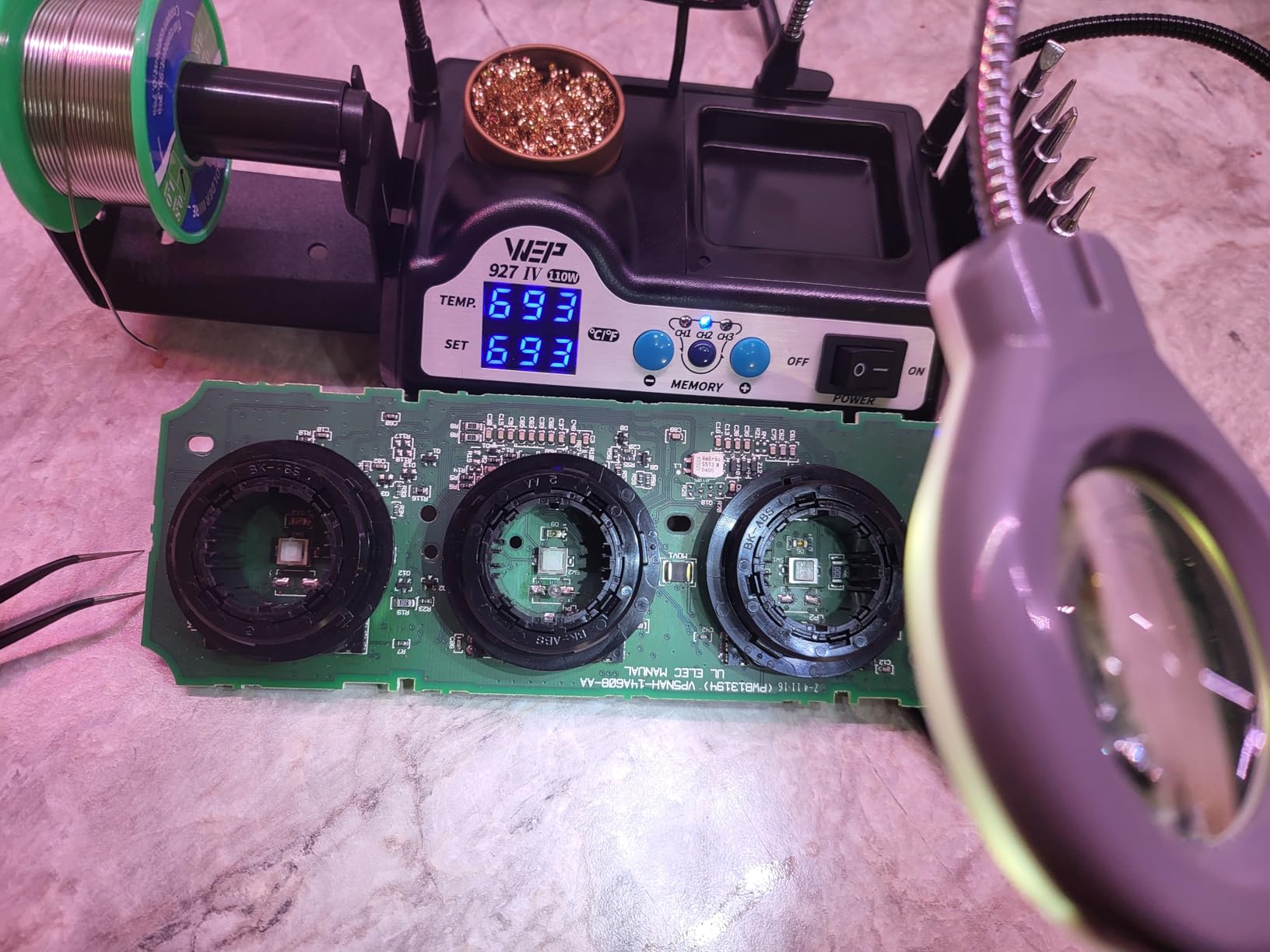
Three preset temperature channels are the sleeper feature for mixed work. Set one at 392 degrees Fahrenheit for leaded through-hole, one around 700 for general SMD work, and one at 850 for lead-free rework, then switch with one press instead of turning the knob each time. The sleep timer adjusts from 0 to 99 minutes, and a zero setting effectively disables it for long bench sessions.
The all-in-one body is genuinely space efficient at 3.94 by 5.91 by 1.89 inches. It integrates the iron holder, a brass wool tip cleaner with rosin flux, a solder wire dispenser, helping hands, a storage block, and an LED magnifier. The kit also ships five extra tips and a desoldering pump.
What tells you it will handle SMD work
The temperature range runs 90 to 480 degrees Celsius, which is wide enough that you are not fighting the station at either end. A 110W element also gives you more margin on lead-free, where the higher working temperature eats available heat faster.
Tips come from the WEP 1400 series, a family that is stocked and widely cloned. Refill costs are low, and tips are easy to find from multiple suppliers, which removes the single most common complaint buyers have about proprietary ecosystems.
Where it falls short
There is no hot air. If you remove components regularly, this is not the station, and you should be looking at a 2-in-1 instead. Also, the LED magnifier is a convenience light with a weak lens, not a working stereo microscope. It is useful for a quick look; it is not a substitute for real magnification when you are placing a 0201 part.
The rated input is 110-127V, so it is not intended for a 220V socket. Buying a dual-voltage unit is the better call if your bench moves between countries.
5. FNIRSI DWS-200: Best for Dual-Handle Precision Work
FNIRSI DWS-200 200W High Power Soldering Station Kit,2 Helping Hands
200W power
100-240V universal input
2.8 inch TFT display with curve mode
F210 precision and F245 power handles
Nine tips included
Pros
- 200W of power gives real headroom on large joints
- Comes with two handles so you can switch between fine and heavy work
- 2.8 inch TFT screen with three modes including a live temperature curve
- Three preset temperature sets for quick job switching
- Universal 100-240V input and a built-in pure copper transformer
Cons
- Higher power draw than smaller stations
- No hot air rework capability
The FNIRSI DWS-200 is the most interesting station here for anyone who alternates between fine micro work and heavy joints, because it ships with two handles. The F210 is the precision handle for 0402 and 0805 work, and the F245 is the high-power handle for big pads and lead-free rework, and they both plug into the same control box.
At 200W it has roughly double the power of typical comparable stations, which the manufacturer claims translates to heating in about a second and melting in about three. Treat that as a claim rather than a measurement, but the headroom is real and it is the reason this unit recovers quickly on multilayer boards.
The 2.8 inch TFT display is a step above the usual seven-segment readouts. It has three modes: temperature value, temperature curve, and value plus curve. Watching the curve while you drag solder across a row of pads tells you more about your technique than a number ever will, and it makes thermal recovery visible.
Universal 100-240V input is a practical advantage that almost no other station in this roundup offers, and the built-in pure copper transformer is a sensible isolation choice for sensitive boards. Three preset temperature sets, sleep mode, and automatic standby when the iron rests in the stand round out the controls. Two helping hands with 360 degree adjustable alligator clips are included.
What tells you it will handle SMD work
The nine included tips split three F210 and six F245, which is enough geometry to cover fine passives, chip components, and larger connectors without a second purchase. The F210 handle in particular is the right tool for 0201 and 0402 parts, where a thick handle and a blunt tip are the difference between a clean joint and a bridge.
Adjustable range is 212 to 842 degrees Fahrenheit, which covers leaded work comfortably and reaches high enough for lead-free without topping out.
Where it falls short
Review volume is still modest compared with the rest of this field, so you have less long-term owner data behind it than the established names. It also draws noticeably more power, which is worth knowing on a shared circuit. And there is no hot air, so this covers soldering only.
The TFT screen is also a screen. Buttons are simpler than the curve display is useful, and you will not find a physical knob for the things you adjust most often.
6. TS101 Soldering Iron Station: Best for Field and Travel Repair
UY CHAN Original TS101 Soldering Iron Station Kit Upgraded from TS100 DC 65W PD 45W Power Programmable Smart Mini Electric Portable Soldering Pen with B2 Solder Tip USB Type C Cable
65W from DC input or 45W from PD
122-752F on an OLED display
Heating element housed in the tip
Reprogrammable via computer
100g and 16.8cm long
Pros
- Heats up in roughly 10 to 15 seconds
- Dual power input runs from a USB-C PD pack or a DC supply
- Element lives inside the tip so a failed element is a cheap tip swap
- Two-button OLED interface is intuitive after a short learning curve
- Reprogrammable
- including widely used open-source firmware
Cons
- Supplied power cord is only about 2 to 2.5 feet
- Included hex key is a poor fit and the stand has no rubber feet
- Stock firmware can cap usable temperature until updated
The TS101 is not a bench station and we will not pretend otherwise, but for field service, drone repair, and travel work it is in a category of its own. It reaches operating temperature in 10 to 15 seconds, runs from a USB-C power bank or a DC supply, and the whole thing weighs 100 grams and measures 16.8 centimeters long.
The design decision that outlasts everything else is the tip-resident heating element. The heater is built into the tip rather than the handle, so a burned element is fixed by replacing an inexpensive tip instead of the whole iron. That single feature changes the economics of owning one for field work.
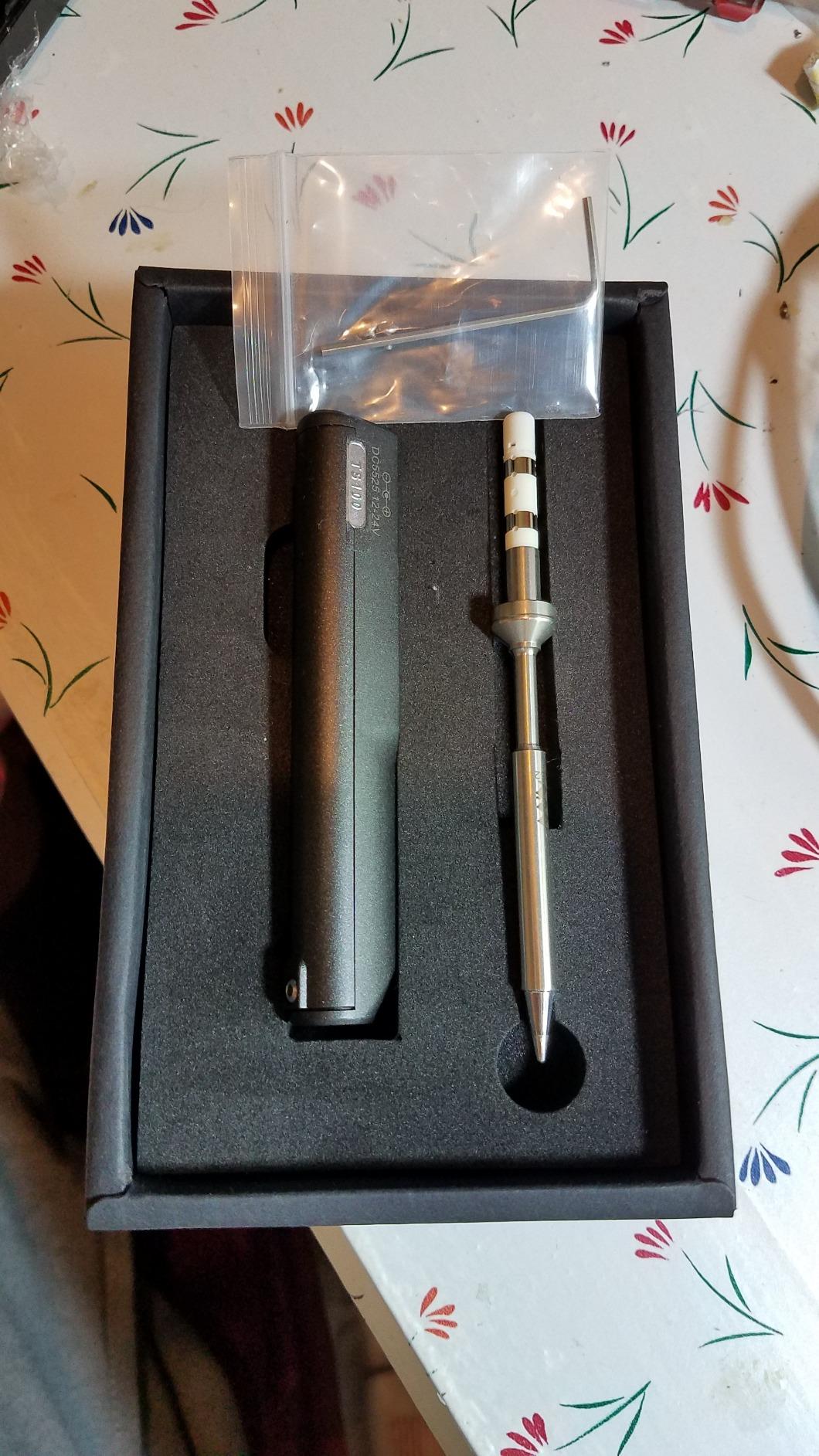
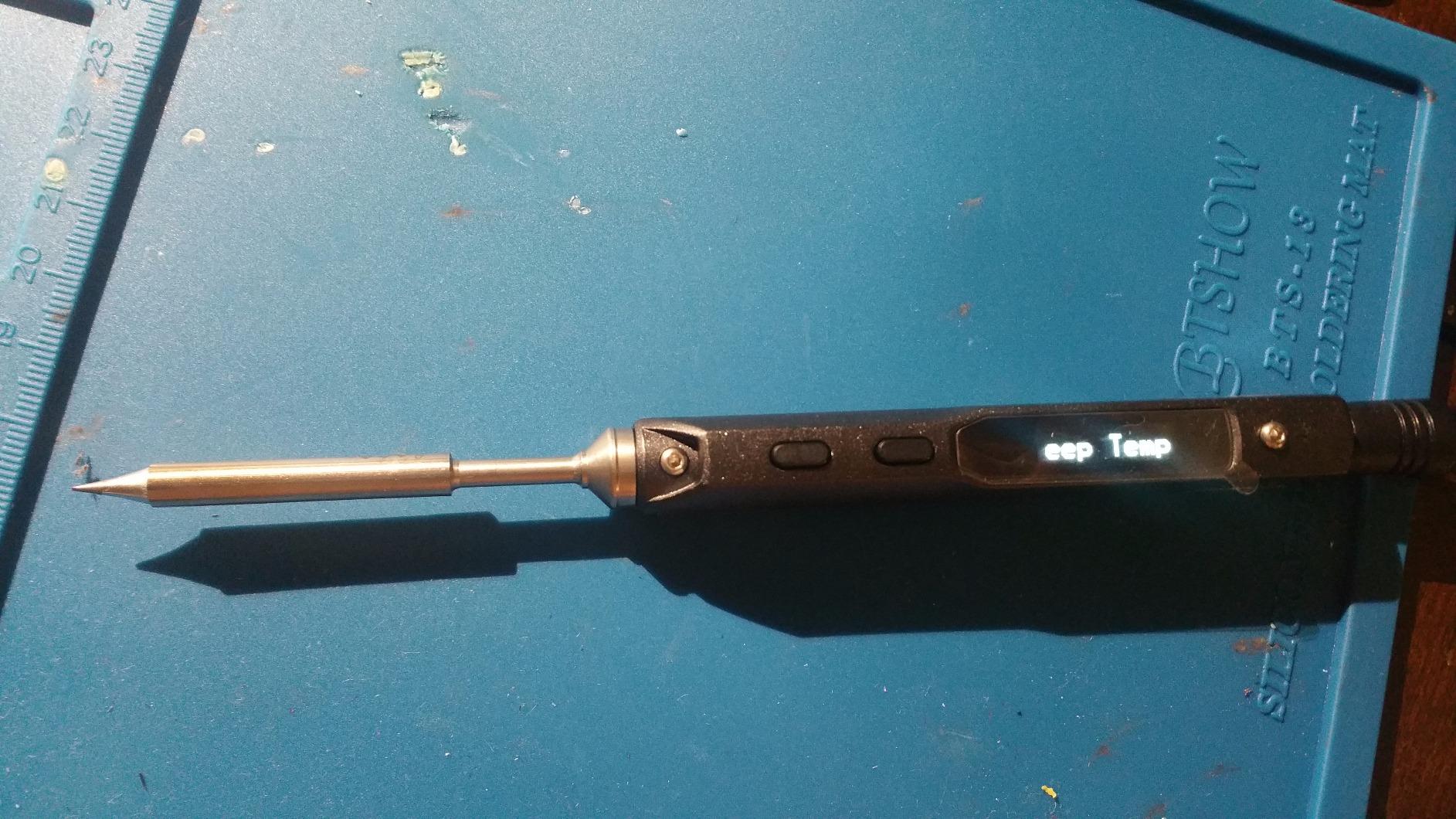
Control runs through an OLED display adjustable from 122 to 752 degrees Fahrenheit, with dual temperature sensors, acceleration sensors, a boost fast-heating function, automatic sleep, and an overheat warning. It is also reprogrammable by connecting it to a computer, which means custom temperature curves and community firmware are available for anyone who wants them.
Accuracy is the reason it is often treated as the portable benchmark. Owners report it holding setpoint under load, and the OLED readout gives you a live number rather than a rough dial position. For precision work away from a bench, that reliability matters more than raw wattage.
What tells you it will handle SMD work
The B2 tip included is a fine blade geometry that suits 0402 and 0805 work, and the tip ecosystem is broad and inexpensive. More important, this iron performs real SMD joints rather than token ones, which is not something you can say about most USB-C cordless irons marketed for electronics.
At 65W from a DC input, there is enough heat for small lead-free joints and modest ground planes. The PD path caps at 45W, which is the number to plan around when you are working from a battery pack.
Where it falls short
This is the honest caveat for the whole class: portable and cordless irons are not ready to replace a bench station for sustained SMD work. A 45W PD supply has little recovery headroom on a large pad, and there is no hot air here, so removal work needs a separate tool.
The small details also cost you. The included power cord is only about 2 to 2.5 feet, the bundled hex key is a poor fit for the case screws, the stand has no rubber feet and slides on a hard bench, and the sponge is about 1 mm thick. Stock firmware can cap the usable temperature until you update it.
7. YIHUA 8786D I: Best All-in-One Starter Kit for SMD
YIHUA 8786D I 2 in 1 Hot Air Rework and Soldering Iron Station with 10 Solder Iron Tips, 4 Hot Air Nozzles, °F /°C, Cool/Hot Air Conversion and Sleep Function
2-in-1 soldering and hot air
740W total
200C to 896F range
10 soldering tips and 4 nozzles
ESD safe with fail-safe cut-off
Pros
- Combines a soldering station and a hot air rework station in one unit
- PID temperature control with fast temperature compensation
- ESD safe design that protects sensitive components
- Large accessory bundle with 10 tips
- 4 nozzles
- solder
- pump and IC extractor
- Fail-safe protection cuts power to the element if hot air output fails
Cons
- Tip assortment is large and eats bench space
- Single channel with no preset temperature memories
The YIHUA 8786D I is the box to buy if you want one purchase to cover an entire first year of board work, and it carries more than 2,600 reviews. Buyers rate it highly for the combination of versatility, stable PID control, and the amount of hardware that arrives in the box.
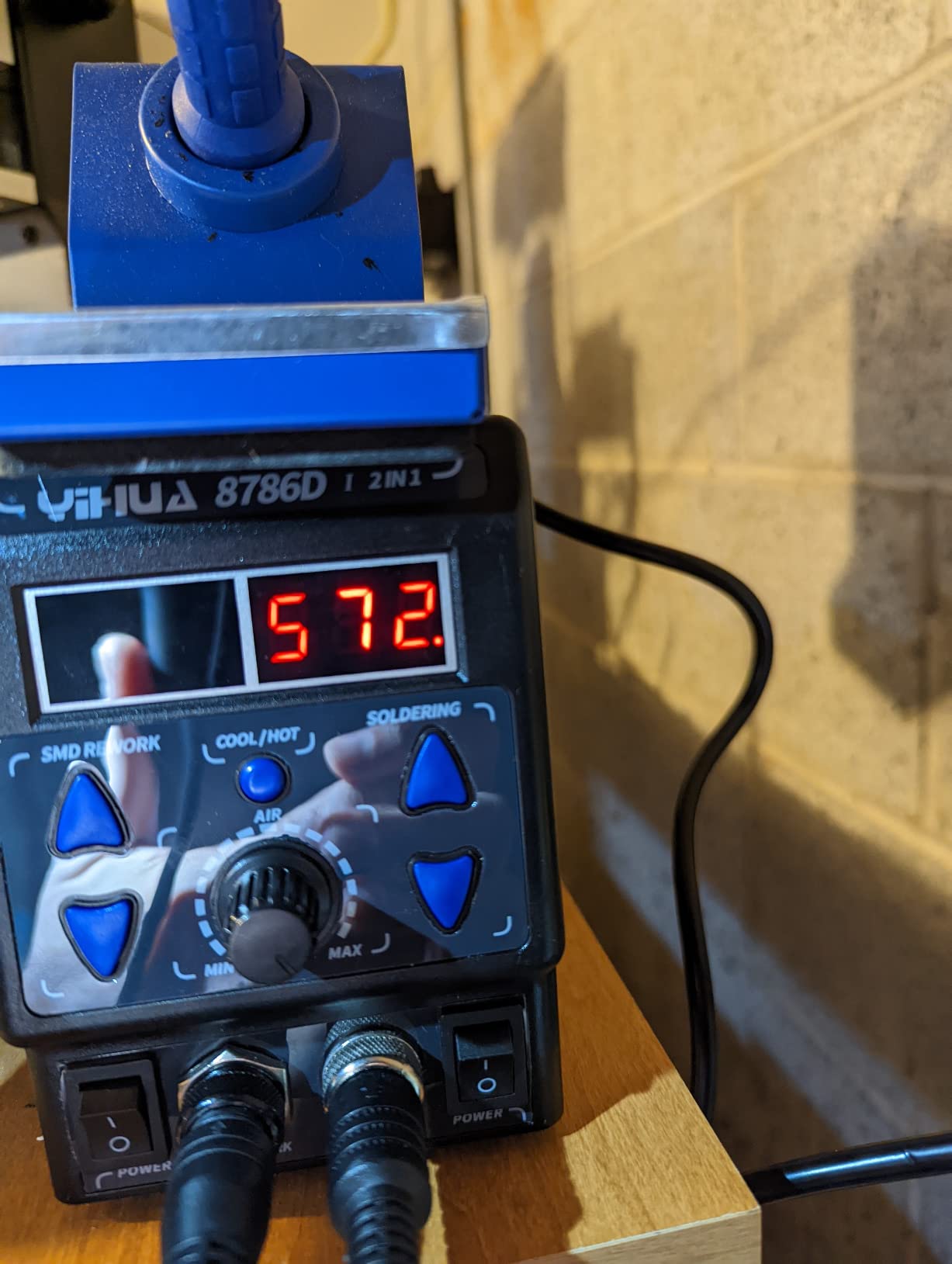
It runs 740W total and covers a 200 degree Celsius to 896 degree Fahrenheit range, with PID temperature control and fast temperature compensation as the headline control features. The fail-safe protection is the detail worth noting: if hot air output fails, the station cuts power to the heating element rather than cooking itself.
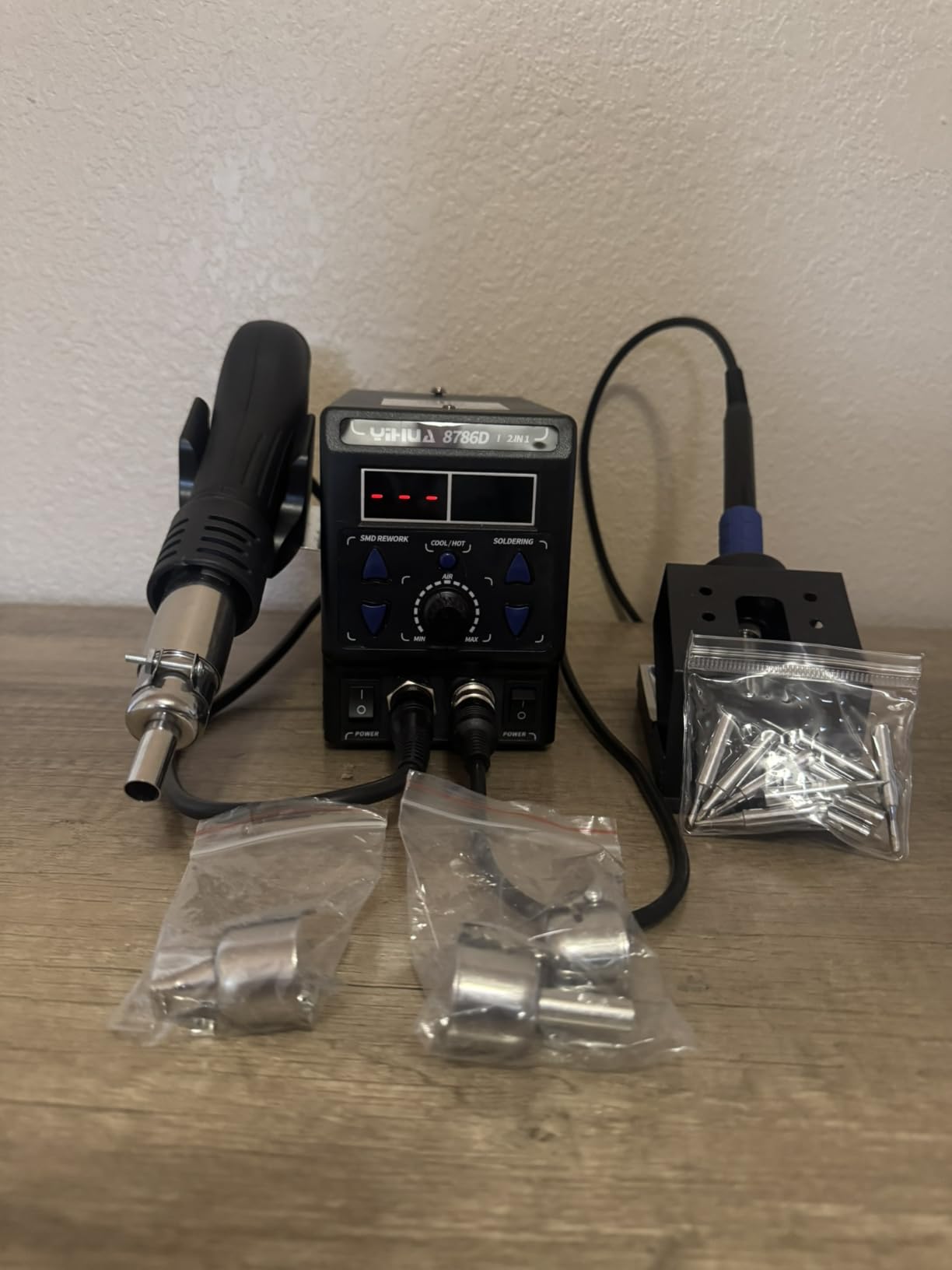
Included components cover a genuine first kit: 10 assorted soldering tips, 4 hot air gun nozzles, a desoldering pump, an IC extractor, and a 0.8 mm lead-free solder roll. The 5.8 by 3.9 by 5.3 inch body is compact enough for a small bench, the display is LED, and the design is UL Standard compliant with a US-standard plug for 110-127V.
Reported temperature stability is 1.8 degrees Fahrenheit, which is a good figure for a combo unit at this level. Multiple owners describe using it across phone and amplifier repair without drama.
What tells you it will handle SMD work
Ten tips in the box is the widest assortment here, and that matters when you are still learning which geometry suits which package. The ESD safe design is specifically called out for protecting sensitive components, and the combination of a soldering side and a hot air side means you can do a full component swap without a second machine.
Fail-safe cut-off protection and the anti-static design are both things to look for explicitly in a combo station, and most cheaper units skip both.
Where it falls short
Single channel only, with no preset temperature memories. That is fine for one job type and mildly annoying when you alternate between leaded and lead-free temperatures across an afternoon, since you will be turning the knob rather than pressing a button.
The tip set is genuinely large and the reviewers who complain about it are complaining about bench space, not quality. The 740W rating covers the whole unit rather than the iron alone, so do not read it as iron wattage when comparing against the 110W and 200W entries above.
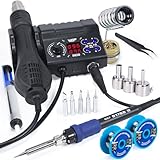
8. WEP 882D: Best 2-in-1 for a Compact Bench
WEP 882D Soldering Iron Station 2-IN-1 SMD Hot Air Rework Station with 2 Spools of Solder Wire, 5 Soldering Tips, 3 Hot Air Nozzles, Brass Wool Tip Cleaner, Tweezers, Desoldering pump
750W 2-in-1 station
Iron 392-896F, hot air 212-896F
PID on both functions
Variable air volume
1.1 kg, 3.54 by 5.9 by 2.28 inches
Pros
- Very compact body that saves real bench space
- PID temperature control on both the iron and the hot air gun
- Two spools of solder wire included so you can start immediately
- Sleep mode and hot air standby extend tip and element life
- Calibration function improves temperature precision
Cons
- Single channel with no preset temperature memories
- Smaller tip and nozzle assortment than the larger kits
The WEP 882D solves a specific problem: you want both a soldering side and a hot air side, and you simply do not have the bench space. At 3.54 by 5.9 by 2.28 inches and 1.1 kg, it is the smallest combination unit in this roundup, and reviewers repeatedly single out the footprint as the reason to buy it.
Both halves are PID controlled, which is not guaranteed at this size. The iron runs 392 to 896 degrees Fahrenheit and the hot air side runs 212 to 896 degrees Fahrenheit with variable air volume. Sleep mode covers the iron and a separate standby mode covers the hot air gun.
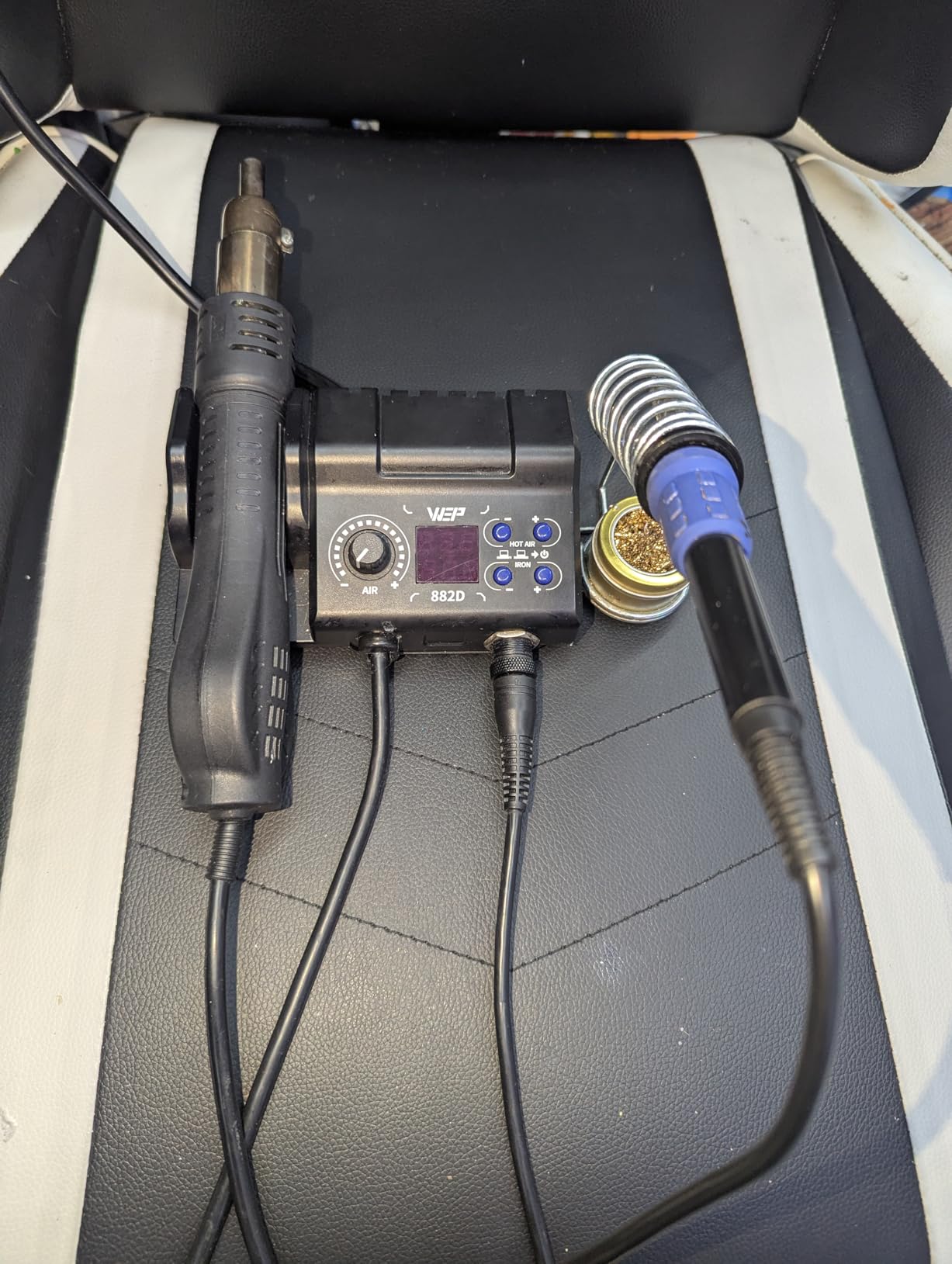
The calibration function is the feature that separates this from the other compact combos. Out-of-box temperature offset is a real problem on budget stations, and having a built-in calibration routine means you can dial the display to a reference instead of guessing. Degree Celsius to Fahrenheit conversion and automatic shutdown round out the control set.
Individual LED displays and separate power switches for each function mean the iron and the gun are genuinely independent. The kit includes two spools of solder wire, five tips in I, B, K, 3.2D, and 3C geometry, three hot air nozzles, brass wool, tweezers, and a desoldering pump, plus a year of US technical support.
What tells you it will handle SMD work
Five tips covering blade and chisel geometry is enough to work 0402 through-hole-adjacent SMD jobs with a fine tip, and the fine blade option is the one you will reach for on 0805 passives. The variable air volume control is what makes the hot air side usable for SMD rather than only for through-hole connectors, since you can lower airflow and keep the nozzle temperature up.
Compact size also matters at the component level, not just the bench level. Under a stereo microscope, a smaller control box means less of it in your field of view.
Where it falls short
Single channel, and the tip and nozzle assortment is smaller than the larger kits, so you will be ordering nozzles sooner if you take hot air work seriously. Rated for 110-127V only.
At this size there is less thermal mass than in the 8786D I or the 862BD+, and a buyer moving to 110W-plus leads or dense ground planes should step up rather than push this unit. For phone-scale SMD boards and general hobby rework it has more than enough headroom.
9. WEP 8786D-I SE: Best for Light Hot Air Rework
WEP 8786D-I SE Hot Air Soldering Iron Station Kit 2-IN-1 for Rework, Desoldering with Lead-Free Solder Wire, 5 Soldering Tips, 3 Hot Air Nozzles,Tweezers, Desoldering Pump
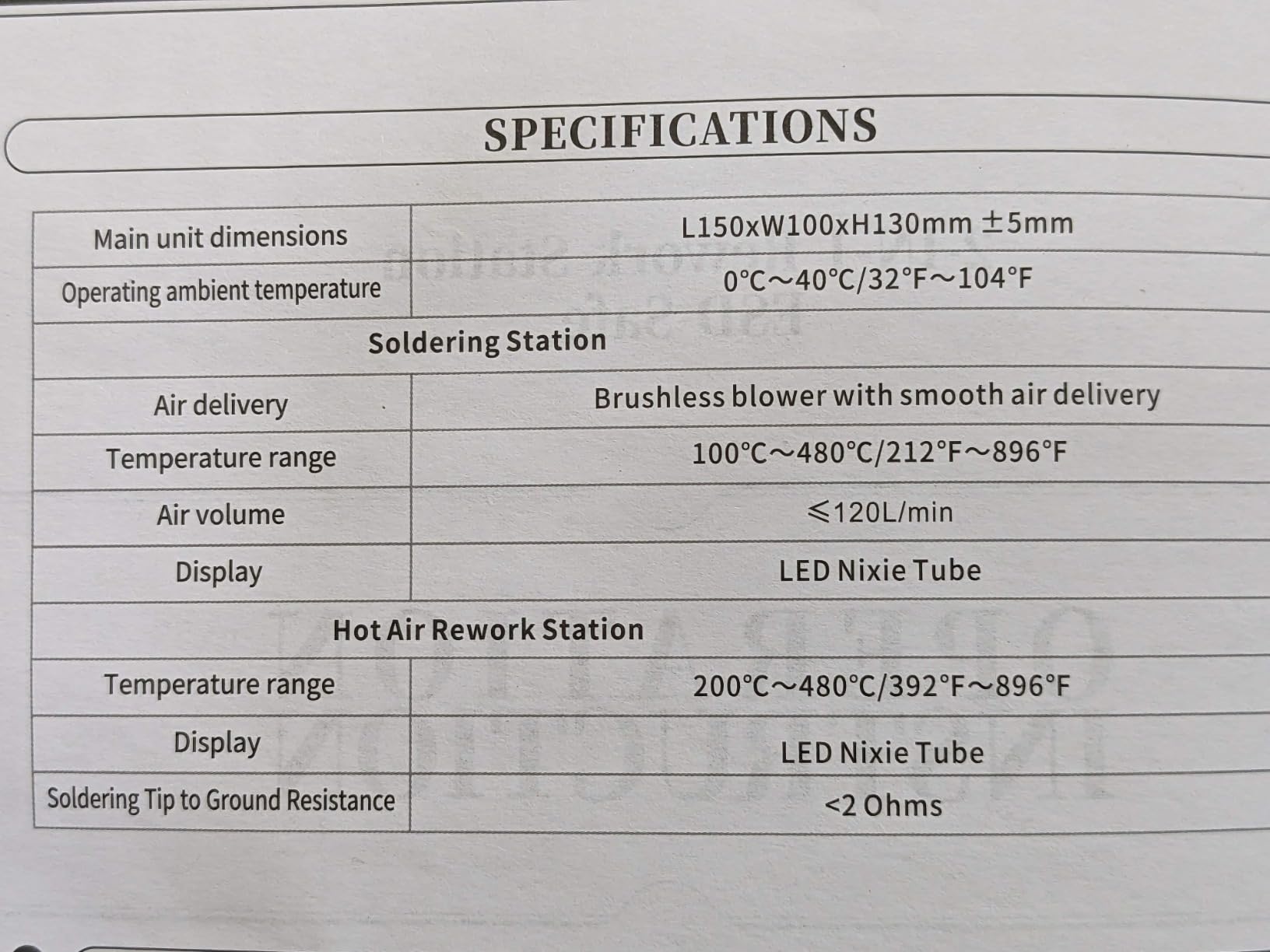
Soldering 392-896F, hot air 212-896F
PID stabilization on both
10 minute soldering sleep mode
Hot air standby cools to 212F
1.69 kg with 5.91 by 3.94 by 5.12 inch body
Pros
- Fast heat-up and steady
- reliable temperature control
- Lightweight
- compact
- sturdy build that fits small benches
- Air volume and temperature knobs are intuitive and effective
- Standby mode cools the gun to 212F in the holder
- Enough tips
- nozzles
- and accessories to start immediately
Cons
- Weak heat transfer from element to tip on larger components
- No guidance on where or how to order replacement tips
- Some supplied tips do not fit the tip storage rack
The WEP 8786D-I SE is a light-duty 2-in-1 for rework, not for marathon soldering, and the reviews are consistent about that boundary. It heats fast, the temperature control is steady, and the knobs are immediately understandable, but the iron side does not have the heat transfer to handle large components.
Both halves are PID stabilized. The soldering side runs 392 to 896 degrees Fahrenheit with a 10 minute sleep mode, and the hot air side runs 212 to 896 degrees Fahrenheit with a standby mode that cools the gun to 212 degrees Fahrenheit in the holder. That auto-cool behavior is the part that extends element life, and it is worth more than any of the marketing specs on this unit.
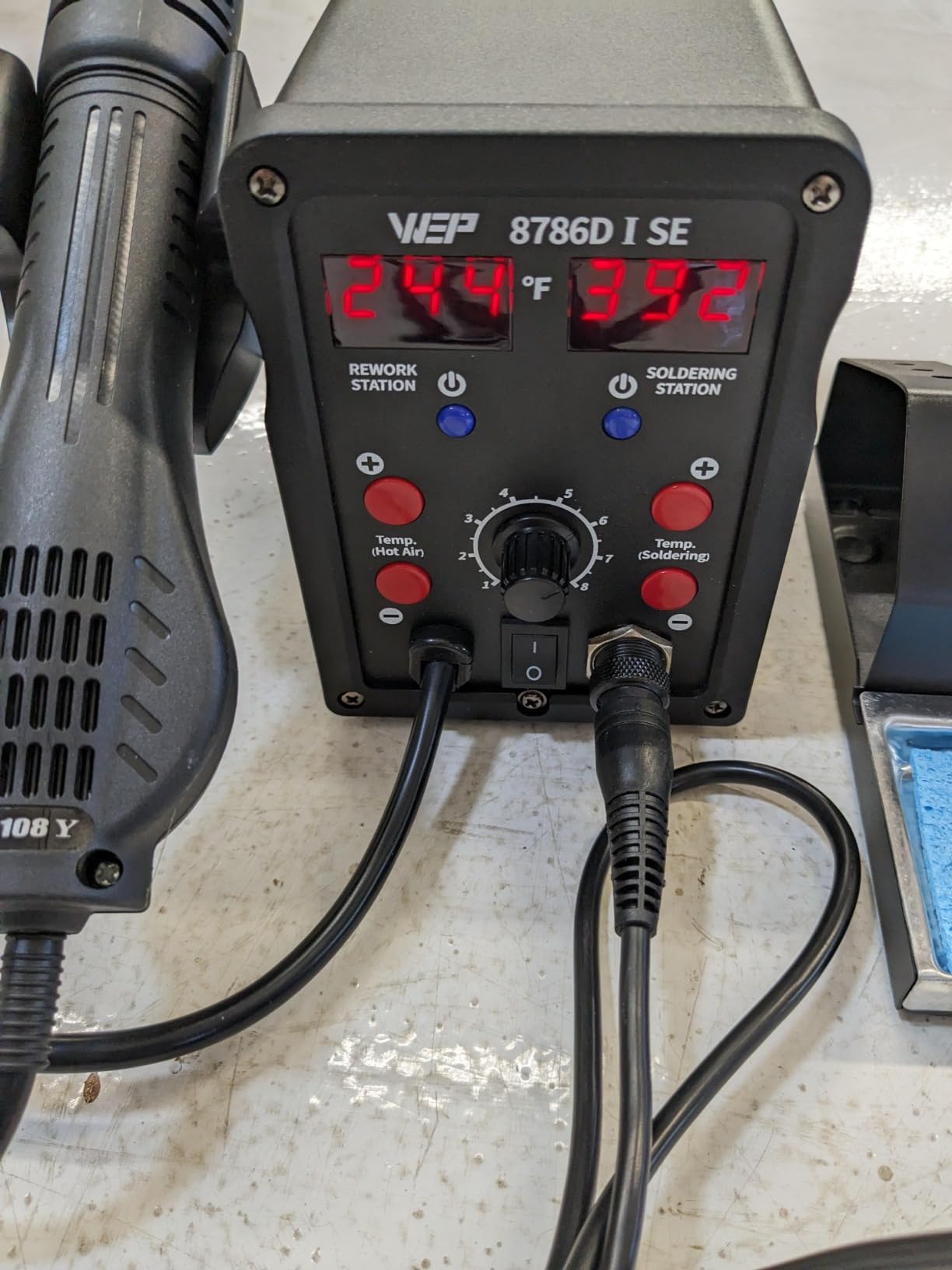
Individual digital readouts with separate power switches, temperature, and air volume controls make it easy to run a removal job without disturbing your soldering setpoint. At 1.69 kg and 5.91 by 3.94 by 5.12 inches it is compact and sturdy enough for a cramped bench, and owners describe it as fitting small workspaces well.
The bundle includes five tips in I, B, K, 3.2D, and 3C geometry, three nozzles, solder wire, a desoldering pump, tweezers, and a year of US technical support.
What tells you it will handle SMD work
For its intended workload, which is removing and replacing SMD components on phone and laptop boards, the combination is right. The hot air side reaches 896 degrees Fahrenheit with adjustable air volume, which covers shield removal, IC replacement, and connector work. The fine blade and chisel tips handle the reflow side for 0805 and chip passives.
Sleep and auto-cool on both functions mean you can leave the station on a bench overnight without cooking a tip.
Where it falls short
Weak heat transfer from the element to the tip on larger components is the most common complaint, and it is the reason this is not a bench soldering station. If your work includes wiring, connectors, or power devices, buy more iron.
There is no indication anywhere in the box about where to source replacement tips, which is a small but real quality-of-life gap for a unit that will eventually need them. Some supplied tips also do not fit the storage rack, and one reviewer found a heat gun nozzle retaining nut improperly tapped. Rated for 110-127V.
10. MYPOUOS 8588D: Best for Phone and Laptop Board Repair
MYPOUOS 2 IN 1 750W LED Digital Soldering Station Hot Air Gun Rework Station Electric Soldering Iron For Phone PCB IC SMD BGA Welding SET 110V (8588D SET1)
750W 2-in-1 station
100-480C within 2C stability
Dual blue LED displays at 1C resolution
Ceramic core hot air element
2.6 kg with 2 channel control
Pros
- Heats up fast and is usable in roughly 10 seconds
- Hot air gun performs well for PCB desoldering and removal
- Complete accessory assortment in the box
- Anti-static design for SMD component protection
- Fault self-detection with warning
- Some buyers report years of continuous weekly use
Cons
- Supplied accessories including wick
- brass scrubber
- and spare tips are low quality
- Blue LED displays are hard to read in direct light
- All-plastic iron handle runs hot in the grip
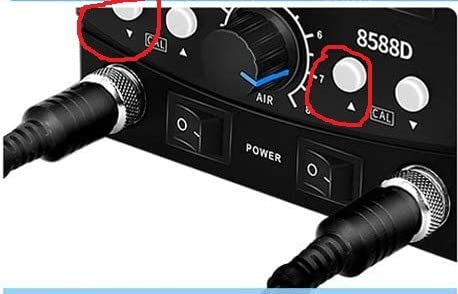
The MYPOUOS 8588D is aimed squarely at phone and laptop board repair, and the hot air side is the reason to consider it. Buyers report fast heat-up, roughly 10 seconds to usable temperature, and a gun that handles PCB desoldering well for a unit at this level.
Temperature control is specified at 100 to 480 degrees Celsius with plus or minus 2 degrees Celsius tolerance and 1 degree Celsius adjustment resolution on dual blue LED displays. Two channels means the soldering side and hot air side are separately controlled, and a ceramic core hot air element is a sensible choice for consistent airflow heating.
The box is genuinely complete: 10 tips, four nozzles, three anti-static tweezers, an IC puller, a connector line, a stand, a cleaning ball, solder wire, a suction tin wire, a sponge, a manual, and both handles. Handle induction gives automatic cooling and constant temperature behavior rather than a latching on-off switch.
Several owners describe continuous weekly use over years, which is unusual testimony for this category and matches the anti-static design and fault self-detection features, both of which are aimed at protecting components and the station rather than just the user.
What tells you it will handle SMD work
For board-level removal work, the two-channel control and the plus or minus 2 degree Celsius tolerance are the specs that matter. Temperature stability is what decides whether a shield comes off cleanly or whether you cook the connector underneath it, and the anti-static design is explicitly called out for SMD component protection.
The included tweezers, IC puller, and suction tin wire cover the handling side of a board swap, which is where most beginners actually get stuck.
Where it falls short
The bundled accessories are throwaway quality. Reviewers specifically call out the desoldering wick, brass scrubber, and spare tips, and the tips are what you touch constantly, so expect to order replacements early. The blue LED displays are hard to read in direct light, which is a real problem when you are leaning over a board under a lamp.
The all-plastic iron handle runs hot in the grip during long sessions, and at 2.6 kg with a 10.8 inch footprint it is one of the bulkiest units here. It is also not rated for sustained all-day professional use according to owner reports, and the soldering tip element may need calibration.
11. TXINLEI 8586: Best for Kit Completeness
TXINLEI 8586 110V Solder Station, 2 in 1 Digital Display SMD Hot Air Rework Station and Soldering Iron, 12pcs Different Soldering Tips, Tweezers,Desoldering Pump,700W 480℃
19-in-1 kit with 12 tips
100-480C range at 1C stability
Handle-sense operation
60W soldering iron
6-in-1 BGA tools and spare heaters
Pros
- Compact 2-in-1 design that saves bench space
- Clear digital display makes temperature monitoring and adjustment easy
- Heats up quickly and holds a stable temperature
- Produces cleaner
- better-attached joints than a basic pencil iron
- Feature-rich kit with spare tips
- spare heaters
- BGA tools
- tweezers and a pump
Cons
- Instruction manual is difficult to decipher
- including an obtuse calibration procedure
- Included soldering tips are low quality and wear out quickly
- Iron sits loosely in its holder
- Some accessory tips have the wrong diameter and do not heat
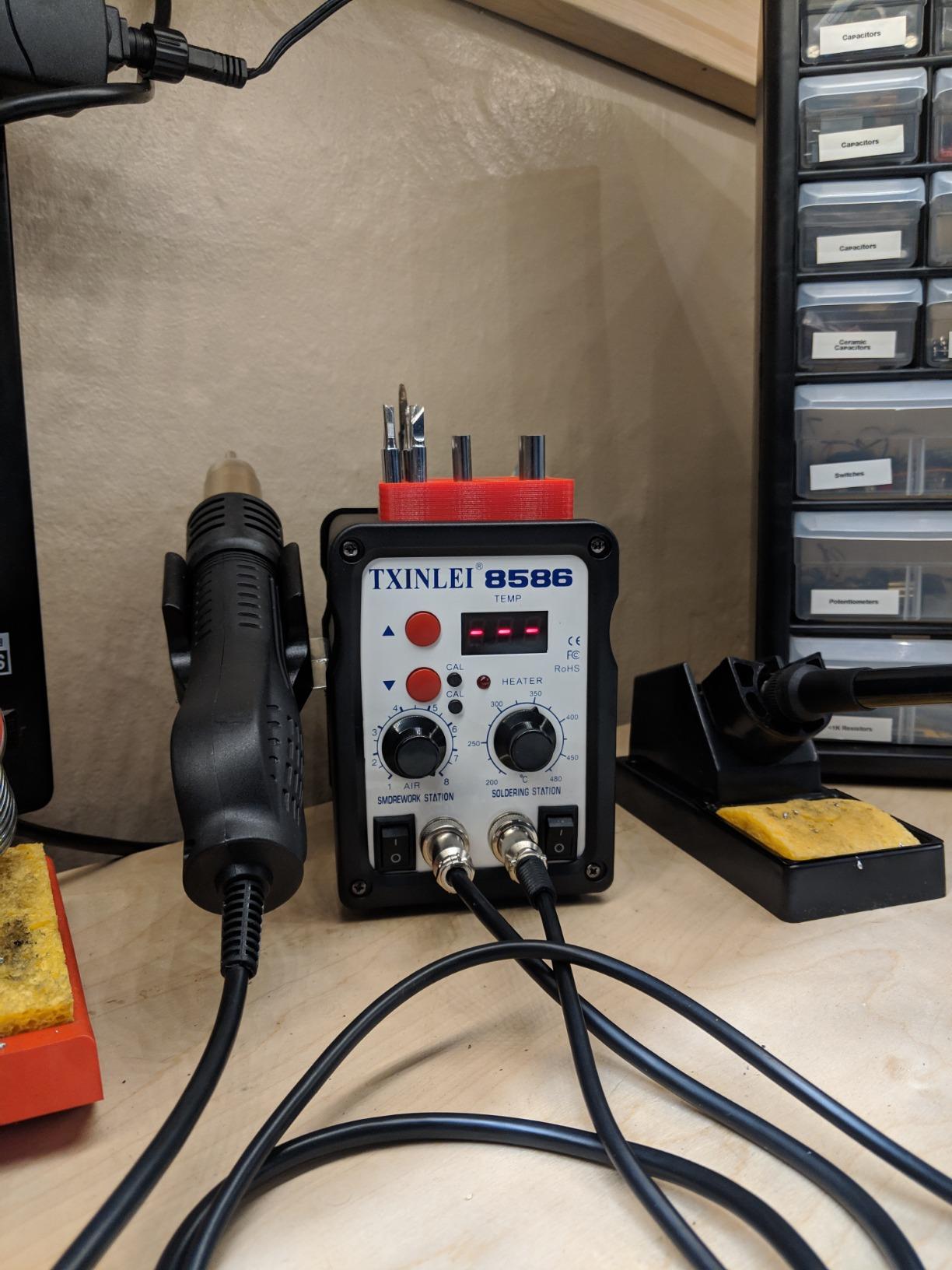
The TXINLEI 8586 wins on what is in the box, full stop. It is a 19-in-1 kit with 12 soldering tips, 6-in-1 BGA tools, a desoldering pump, tweezers, an IC puller, and spare heaters for both the iron and the blower, which is a level of spares coverage nothing else in this roundup matches.
Owners consistently praise fast heat-up, compact size, and the sheer accessory count for the money, and the practical result is that joints come out clean and well attached compared with a basic pencil iron. That is the point for a hobbyist replacing components on consumer boards.
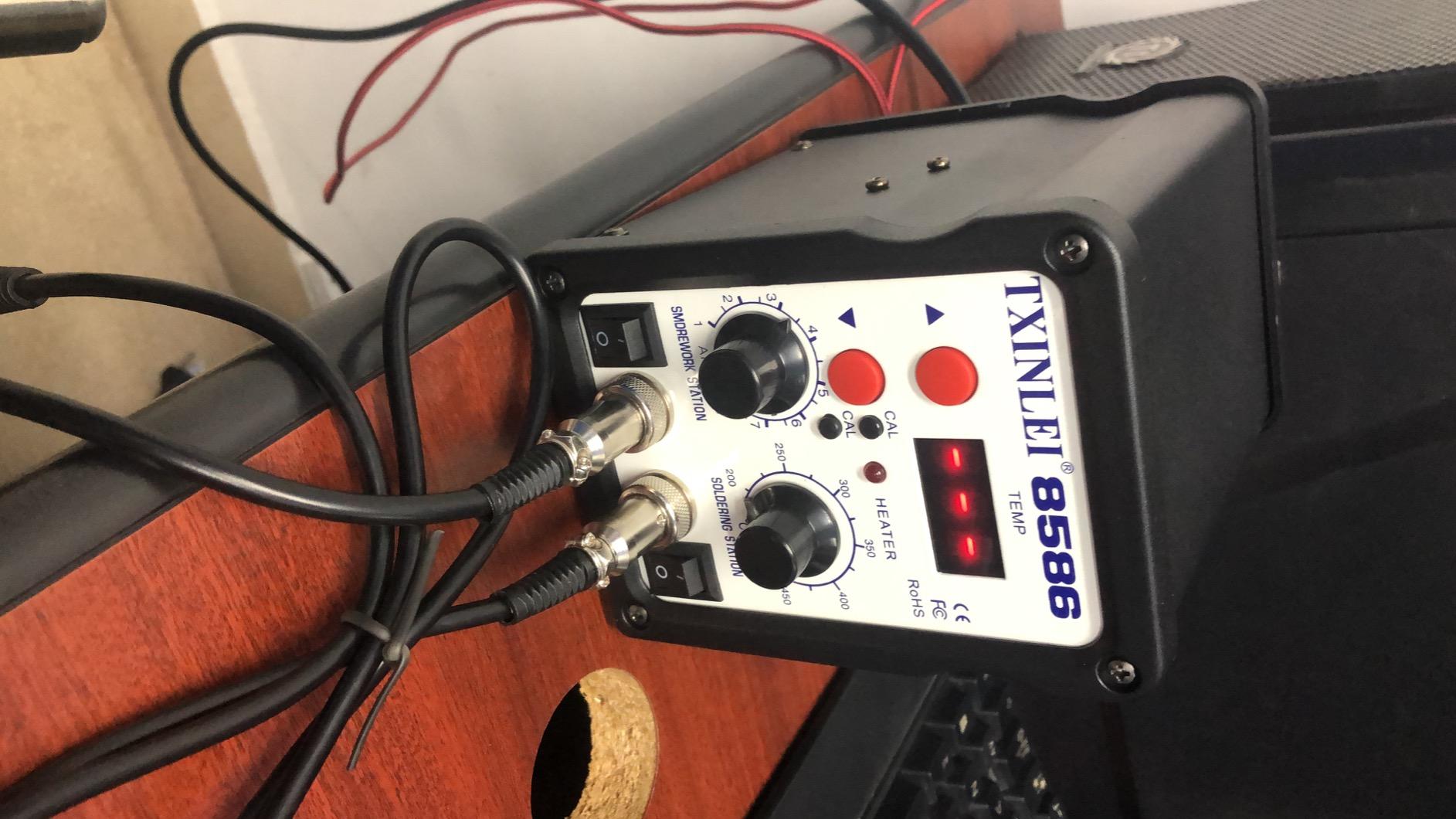
Control is a microcomputer with a digital LED temperature display, 100 to 480 degrees Celsius range, and reported temperature stability of 1 degree Celsius. The handle-sense operation is a nicer touch than a power switch: the iron activates when you pick it up and stops when you put it back in the holder. The station also describes itself as suited to SOIC, CHIP, QFP, PLCC, and BGA component work.
Coarse calibration holes for the blower heater and iron element are provided, which matters on a budget unit. It runs on 110V.
What tells you it will handle SMD work
With 12 tips in the box, including fine geometries, you can work 0402 through 0805 passives and chip components without ordering anything first. The handle-sense start-up is genuinely useful for a shared bench, and the reported 1 degree Celsius stability is a good published figure.
For someone assembling a repair kit for the first time, the spare heaters alone justify the package. Replacing a heating element is otherwise an expensive repair, and here you have a spare.
Where it falls short
The manual is the biggest problem, and it is a real one: owners describe the instructions as difficult to decipher, including the calibration procedure. Plan to spend an evening working out the calibration steps, and verify with a probe rather than trusting the display.
Included soldering tips are low quality and wear out quickly under heavy use, and some supplied accessory tips have the wrong diameter and do not heat at all. The iron also sits loosely in its holder, which is worth checking since a loose handle plus a hot tip is how people burn their bench. The hot air blower continues running until the element drops below 100 degrees Celsius, so do not leave it on the stand unattended.
12. Bakon 852d+: Best for Wide-Range Hot Air
Bakon 852d+ Heat Gun And Soldering Iron 2-In-1 Kit, Smd Hot Air Rework Soldering Station, Multiple Functions Electronics Kit, Led Digital Display, Knob Type Adjustable Temperature
700W combined output
90W PID iron, 100-480C
Hot air 100-500C with 28 L/min airflow
Knob temperature and airflow adjustment
Hot air standby cools to 212F
Pros
- Genuine 2-in-1 with 700W combined output and PID on both functions
- Widest hot air range here at up to 500C with 28 L/min adjustable airflow
- Knob adjustment is quick and easy to use without menus
- Hot air standby cools the gun in the holder
- extending element life
- Complete kit with solder
- 5 SGS-certified tips
- nozzles
- tweezers
- pump and stand
Cons
- Lowest average rating in this group with a 12 percent one-star share
- Some buyers report temperature accuracy and build quality below the spec sheet suggests
- Knob controls are less precise than digital button entry
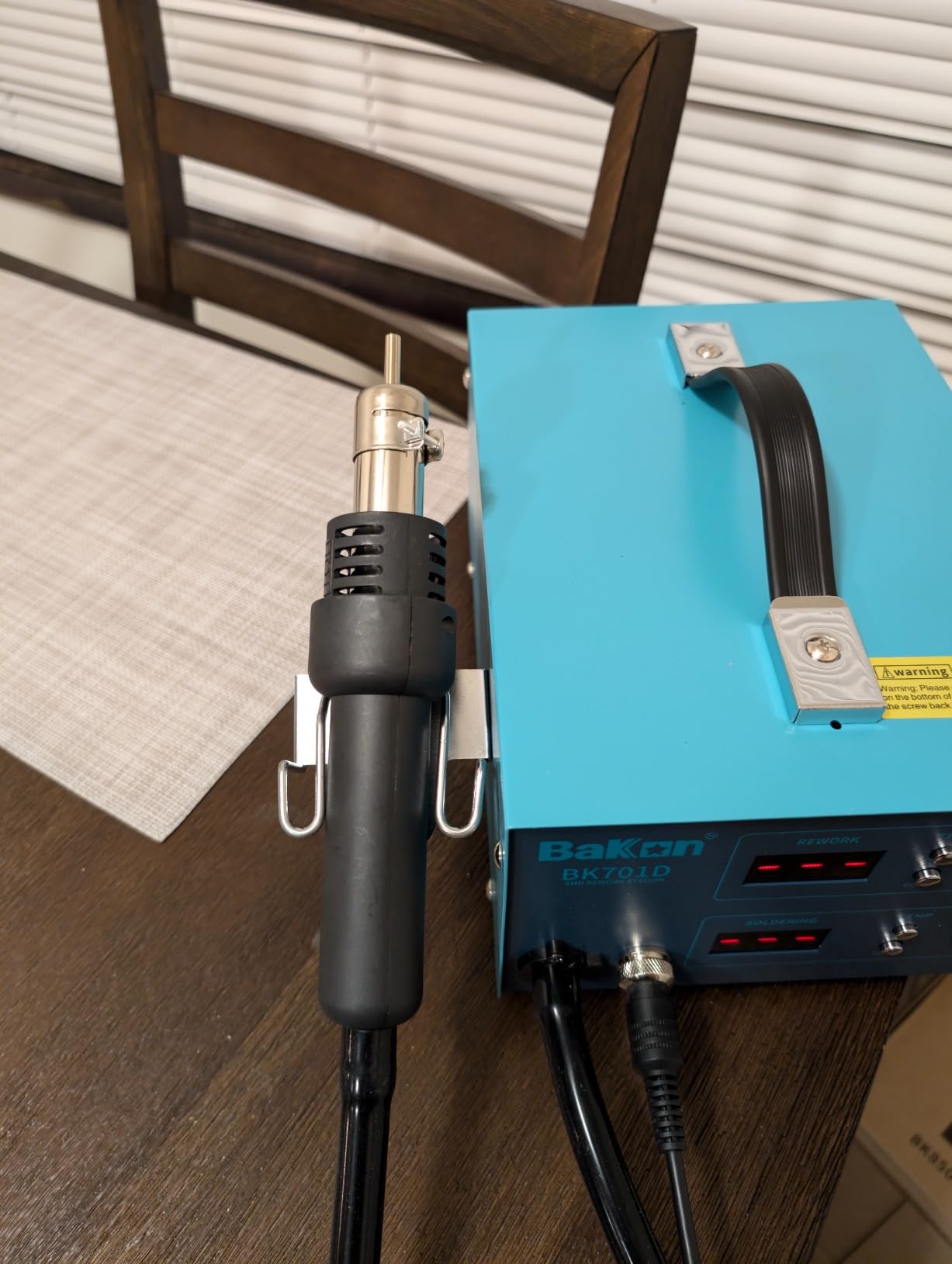
The Bakon 852d+ has the widest hot air range in this group, reaching 500 degrees Celsius with adjustable airflow up to 28 litres per minute, and that is the reason to consider it despite the lowest average rating here. When you need to move a large ground pad or re-flow a stubborn thermal interface, the headroom is the feature.
Total output is 700W across both functions. The iron is 90W with PID control across 100 to 480 degrees Celsius, and the hot air side is PID stabilized from 100 to 500 degrees Celsius. A dedicated standby mode cools the gun to 212 degrees Fahrenheit in the holder, and auto-cooling extends both tip and element service life.
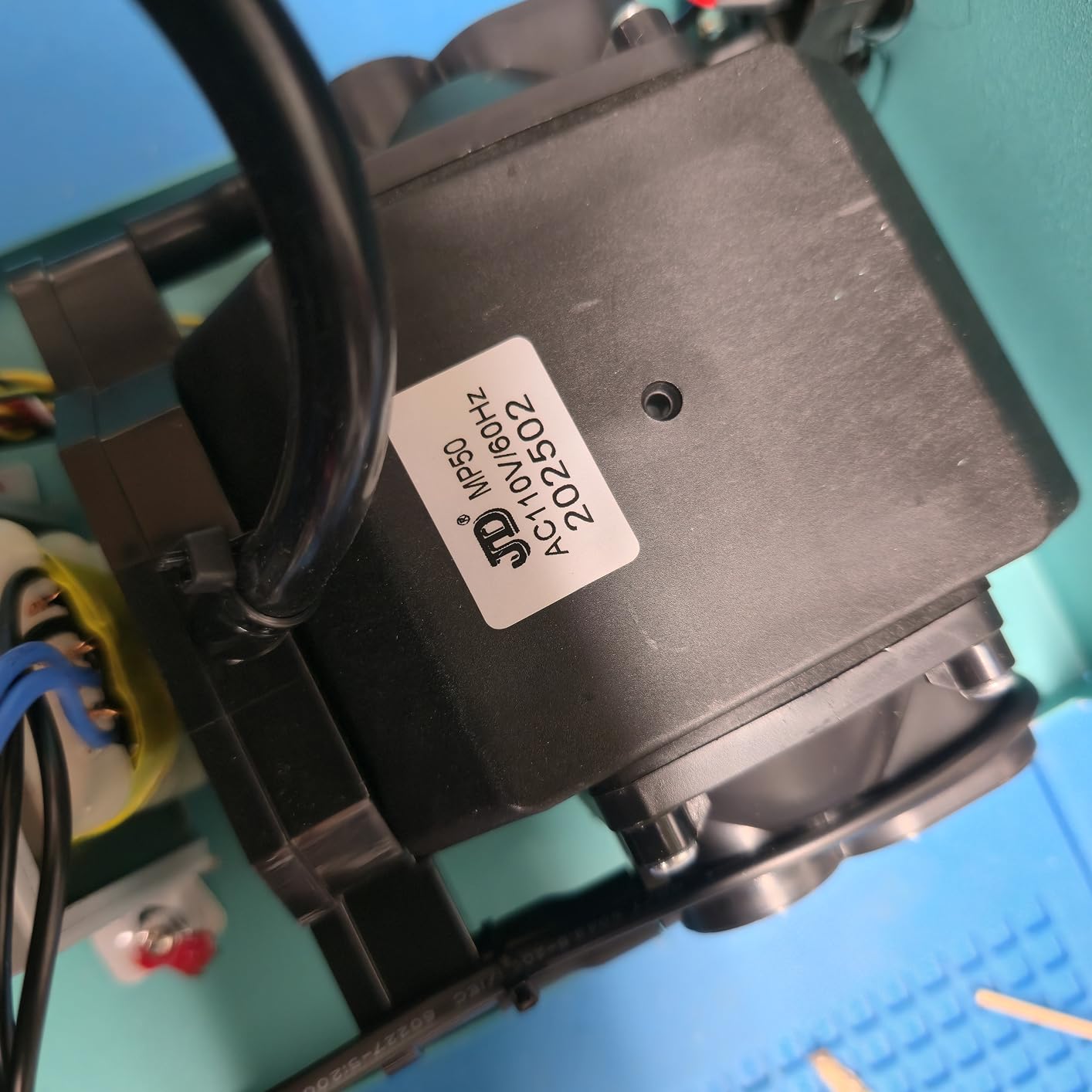
Adjustment is by knob, for both temperature and airflow, with an LED digital display. That is a genuine trade-off: it is faster than stepping through a menu, and it is less precise than digital button entry when you want to set exactly 340 degrees Celsius. For most rework work, the speed wins.
The kit is comprehensive, with 30g of lead-free solder, five SGS-certified tips, two hot air nozzles, ESD-safe tweezers, a desoldering pump, an iron stand, brass cleaner, a sponge, and solder suction tape, plus a 12 month US warranty. It is rated for a 110V US plug only.
What tells you it will handle SMD work
For rework-first work, the combination of a 90W PID iron and 500 degree Celsius hot air covers shield removal, connector work, and larger pad rework in one box. Auto-cooling in the holder is the detail that separates a station you can leave running from one you cannot, and this one has it on the gun side.
Two channels mean the iron and gun run independently, which matters when you are doing a removal and a reflow in the same session.
Where it falls short
This carries the lowest average rating of the twelve, with 12 percent one-star reviews, and the complaints cluster around temperature accuracy and finish quality relative to what the spec sheet implies. If accurate temperature is your primary concern, the Weller or the 2-in-1 units rated above this one are safer bets.
Knob controls are less precise than digital entry, and the 110V-only rating rules it out for a 220V bench. At roughly 500 reviews the long-term owner data here is thinner than most of the field, so treat the spec sheet as aspirational until you verify with a probe.
Soldering Station vs Soldering Iron vs Hot Air Rework Station
This is the distinction that trips up most beginners, and getting it wrong means buying two tools or one useless tool. Here is the plain version.
Soldering iron: a self-contained heated tool with no separate control box. Temperature is fixed or adjusted by a dial on the handle, and there is nowhere to park it safely. Fine for occasional through-hole work, a loose wire, or a kit build. Not suitable for SMD, because the tip temperature swings with load and you have no way to set a known setpoint.
Soldering station: a control box plus a detachable iron. The box powers the heater, measures tip temperature, and holds your setpoint with PID control. This is the tool for SMD joints, and it is what every pick in this roundup is, except the portable iron noted below. Add ESD safety and a calibration function and you can trust the number on the display.
Hot air rework station: a station that heats an entire component from above with directed hot air, so the part reflows off the board without a tool touching it. It is the removal method for QFN, BGA, and multi-pin ICs, and it is also how you reflow entire SMD footprints rather than soldering one pad at a time.
2-in-1 combo: both a soldering station and a hot air gun in one enclosure, sharing power and often sharing a PID loop. The practical rule: buy a combo if you expect to remove components regularly, and buy a soldering-only station if you mostly place parts and do occasional removals. Hot air you never use is wasted money, and hot air you cannot afford costs you damaged boards.
When do you genuinely need hot air? When the part has more than roughly four pins per side, when it sits on a ground pad that will not let a tip touch every lead, or when the package is a ground-shifted design such as a QFN. For 0402, 0805, and 1206 passives, a fine tip with decent flux removes the part without any hot air at all.
How to Choose a Soldering Station for SMD Work: 7 Criteria
1. PID control and how accurately the station holds temperature
A thermostat cycles the heater on and off. A PID loop samples the temperature continuously and modulates power to hold the setpoint, which is the reason a PID station does not overshoot and then hunt when you pull the tip off a joint. Most units in this roundup use PID, and the meaningful differences are the reported stability figures, which run from plus or minus 1 degree Celsius on the TXINLEI to plus or minus 2 degrees Celsius on the MYPOUOS and the Weller.
What matters in practice is temperature recovery, not idle accuracy. When you touch a large pad, the tip drops, the loop pushes power back in, and how quickly it returns determines whether you get a wet joint or a cold one. Higher wattage helps here, which is why available heat is a separate criterion below.
2. Calibration support, and whether the display can be trusted
Budget stations routinely read high out of the box, and the forum complaint about cheap units drifting out of calibration is one of the most repeated on electronics boards. A calibration function lets you correct offset against a known reference, and it matters more than any other single feature on an inexpensive station.
Check whether the station offers a calibration button or an offset menu, and whether it stores the correction. The WEP 882D, the YIHUA 926 III, and the YIHUA 8786D I all include one. Regardless, verify the tip temperature with a thermocouple probe or a pyrometer at least once, and again if the tip is replaced.
3. Tip system and tip compatibility
This is where most buyers make a mistake they regret. Tip families are proprietary, and the handle geometry, the heater cartridge, and the sensing arrangement all have to match. Buy a station whose tip family is stocked in your country, because a dead tip on a Saturday with no local supplier is a real outage.
Families named in this roundup include the YIHUA 1200 and 900M series, the WEP 1400 series, Weller WEP70, and the F210 and F245 handles on the FNIRSI. The highest-value piece of community knowledge on this topic is that JBC C-series tips, including the C210, C245, and C115, can be adapted to many budget handles with a simple converter. That is repeatedly the factor that decides a purchase on soldering forums, and it is worth checking before you commit to a handle.
4. Available heat, which is not the same as wattage
Wattage is not a quality score. It is the energy available to recover after you touch a thermal load. A 60W station is entirely adequate for 0402 and 0805 passives and will struggle on a lead-free joint on a multilayer board. A 200W station gives you headroom that you may never use on small parts but that you will feel on big pads.
Read wattage carefully for combos, where the rating often covers the whole unit rather than the iron. The 740W and 750W and 700W figures on the combo units are total output across both functions. The figures that describe the iron alone in this list are 60W, 70W, 75W, 90W, and 110W.
5. ESD safety, and when it actually matters
ESD safe means the station and handle present a grounded tip and a properly isolated output so a static discharge on a sensitive part goes to ground rather than through the device. Several units here carry an anti-static or ESD safe design explicitly, and the Weller calls out an ESD safe station and iron.
It matters most on CMOS devices, smartphone and laptop motherboards, and anything with an exposed ESD device such as a USB interface. It matters least on a thick through-hole board with a bench mat and a wrist strap already in place. ESD protection is not a substitute for a mat, but it is a cheap layer on top of one.
6. Hot air rework capability
If you expect to remove parts, a 2-in-1 or a separate hot air station is not optional. Look for PID control on the air side, adjustable airflow rather than fixed output, and a standby mode that cools the gun in the holder. A blower that keeps running at full temperature in its cradle will cook its own element in a year.
Airflow control is the spec that separates usable hot air from useless hot air. You want to be able to lower airflow on a small SMD footprint while keeping the temperature up, so you can lift a part without blasting a neighbour off the pad.
7. What the price tier actually buys you
Under the entry bracket you get a working PID loop, a calibration function on the better units, and tips in the box. The limits are heat, build quality, and accessory durability. That tier handles hobby SMD work, and the prevailing forum consensus is that most hobbyists never need to move past it.
In the middle bracket you get 70W to 110W iron power, multi-channel presets, dual setpoint and actual displays, and better tip families. This is the professional working range, and it is where the Weller and the higher-wattage WEP sit. Above that, you are buying dual handles, transformer isolation, universal input voltage, and hot air headroom. Our honest note on the top tier: the gains are real but incremental, and they are only worth it if you are doing rework for hours at a time.
Our testing rubric weighted temperature stability highest, followed by control precision, tip ecosystem and compatibility, usability, and value. The honest statement about not upgrading: if you are doing 0805 passives on single-layer boards, a mid-bracket station will not change your results, and no amount of spending in the top bracket will either.
Which Soldering Tip for SMD? Match the Tip to the Package
Tip choice matters more to your results than most station buyers realize. The right geometry puts heat on every lead of the part at once, which is what makes an SMD joint reflow properly. Here is the mapping, starting with the single most useful rule on this topic.
Conical or pointed tip: for 0201 and 0402 passives and for single-pad work. Its narrow contact heats one pad at a time, which is exactly right for a tiny component and exactly wrong for anything with several leads. Use it for probe points and single joints.
Fine chisel tip: the general SMD default. A 1.0 to 1.6 mm chisel works for 0402 through 1206 passives, chip components, and small SOT packages. This is the geometry to buy first and the one most of the kits in this roundup include.
Hoof tip: a concave shape that straddles an IC so the shoulders contact two or more leads at once. This is the tip for SOIC and QFP packages, and it is the fastest way to get a multi-pin part off without dragging solder across neighbouring pins.
Knife or blade tip: a flat, wide edge for dragging solder across a row of pads on a fine-pitch footprint. It works on QFN edges and on connector pins, and it depends on technique and a steady temperature. If you only add one specialist tip for advanced SMD, this or the hoof is it.
Lancet tip: a pointed, angled geometry used to reach into tight spots and along the side of a package where a hoof will not fit, such as under a raised connector on a phone board.
On the series names that show up in searches: JBC C-series tips are designated by the letter and the number, where C210 is a fine chisel, C245 is a larger chisel, and C115 is a knife or blade. The F210 and F245 handles on the FNIRSI DWS-200 use the same numbering convention, which makes those two naming schemes easy to confuse and worth checking carefully before you order.
One more piece of practical knowledge from the soldering community: C-series tips can often be adapted to lower-cost handles with a converter, so if you already own a set of C245 or C210 tips, buy a handle that accepts them rather than starting a new tip collection.
What Else You Need Alongside a Soldering Station
A station alone will not get you through SMD work. Four things matter, and none of them is a third station.
A stereo microscope. Anything at 0402 or finer needs real magnification with a working distance that leaves room for your hands. The LED magnifier included with some kits here is a quick-look aid, not a substitute.
An ESD mat and wrist strap. Even with an ESD safe station, a grounded mat and a strap protect parts while they are sitting on the bench, which is where most of the exposure actually happens.
Flux and good solder. Clean no-clean rosin flux plus quality solder wire does more for joint quality than any station upgrade. Leaded alloys such as Sn63Pb37 melt around 183 degrees Celsius and work at roughly 350 to 380 degrees Celsius; lead-free SAC305 melts around 217 to 221 degrees Celsius and needs roughly 380 to 420 degrees Celsius, which is why lead-free pushes these stations toward their upper ranges. Wash your hands after handling leaded solder and ventilate the bench.
A preheater and fume extraction. A bottom preheater slows the heating rate on thick or multilayer boards and reduces thermal stress that lifts pads. A fume extractor is non-negotiable for daily SMD work, since the flux smoke is the real health risk, not the iron.
Also worth considering: helping hands or a PCB holder, a desoldering pump for through-hole cleanups, a brass wool tip cleaner, and a solder sucker. Most kits here include several of these, which is one of the reasons a bundled kit is often the better value despite forum complaints about accessory bloat. If you are building a portable or bench workstation layout, our workstation roundup covers how people physically arrange a fixed bench so tools and power stay put.
Frequently Asked Questions
What is the best soldering station for SMD soldering?
The Weller WE1010NA is the best all-round choice, with a 70W iron, plus or minus 4 degree Fahrenheit stability, temperature lock, and an ESD safe station and handle. If you expect to remove components often, a 2-in-1 combo such as the YIHUA 862BD+ is a better fit, because it adds a hot air gun. Check tip temperature with a probe once before trusting any display.
What is the best micro soldering station?
For 0201, 0402, and 0805 work under a microscope, a station with a fine tip ecosystem and accurate low-end control matters more than wattage. The Weller WE1010NA with a pointed or fine chisel tip handles micro work well, and the FNIRSI DWS-200 adds a dedicated precision handle. Avoid running a thick tip at micro scale, because a large tip touching a small pad is how pads lift.
What is the best cheap soldering station that actually works?
The YIHUA 926 III is the proven entry-level answer, with the largest review base in this group, PID stabilization, calibration support, and a 12-in-1 kit. If you need hot air as well, the WEP 882D or the YIHUA 8786D I give you a combo at a similar level. Whatever you choose, run a calibration pass and verify with a pyrometer before real work.
What is the best soldering station for hot air rework?
For removal-heavy work, a 2-in-1 combo with PID on the air side and adjustable airflow is the right shape. The YIHUA 862BD+ offers three displays including air volume and a 20ms PID cycle, while the Bakon 852d plus has the widest hot air range at up to 500 degrees Celsius. Look for a standby mode that cools the gun in the holder to protect the element.
Which soldering tip for SMD?
Use a fine chisel for 0402 through 1206 passives, a pointed conical tip for 0201 and single-pad work, a hoof tip for SOIC and QFP packages, and a knife or blade tip for dragging solder across fine-pitch rows. The most useful tip is the one that heats every lead of the part at once. Remember that C210, C245, and C115 refer to JBC series geometry, and many budget handles accept them with an adapter.
Which is better, Hakko or Weller?
Both are safe buys and forums treat them as the default recommendation. Availability differs by region, and forum buyers note that Hakko tends to be cheap and plentiful in the US while Weller is more common in Europe, so buy the brand with local tip supply. A third name worth knowing is JBC, which is widely respected for fine work but costs more at the tip. Tip availability in your country should decide it, not the badge.
Do I need a hot air station to do SMD work?
Only if you remove multi-pin parts. 0402, 0805, and 1206 passives come off with a fine tip and decent flux, and so do most chip components. Hot air becomes necessary at roughly four pins per side and above, for QFN and BGA packages, and for parts sitting on a ground pad a tip cannot reach. Many beginners buy hot air they never use, then need a second station anyway.
Do soldering station tips interchange between brands?
Generally no, because the handle geometry, heater cartridge, and sensing arrangement have to match. Tips are proprietary within a family, such as the YIHUA 1200 and 900M series or the WEP 1400 series. The exception worth knowing is that JBC C-series tips can often be adapted to many budget handles with a converter, and that some T12-style handles accept multiple families. Check before you buy, not after.
Final Verdict: Which Soldering Station Should You Buy?
Start with the Weller WE1010NA. It is the highest rated station in this roundup, the control is stable, the handle and cable feel like tools rather than accessories, and it covers essentially all SMD soldering work. Buy it, add a hoof tip and a fine chisel, and you will not be thinking about your station again for a long time.
Buy the YIHUA 862BD+ instead if you remove components regularly or want one box to do everything, and it is the better value of the two. For a first bench on a tight budget, the YIHUA 926 III genuinely handles most hobby SMD work, so resist upgrading before you have outgrown it. Reach for the WEP 927-IV when your SMD work sits next to heavy through-hole joints, for the FNIRSI DWS-200 when you want a precision handle and a power handle from the same box, and for the TS101 when the work happens away from a bench.
One last piece of honest advice. Whichever station you choose in 2026, verify the tip temperature against a reference before you start, and buy the accessories a station cannot replace: a microscope, an ESD mat, good flux, and fume extraction. The station is the part that gets talked about most, and it is not the part that decides whether your joints are good.