
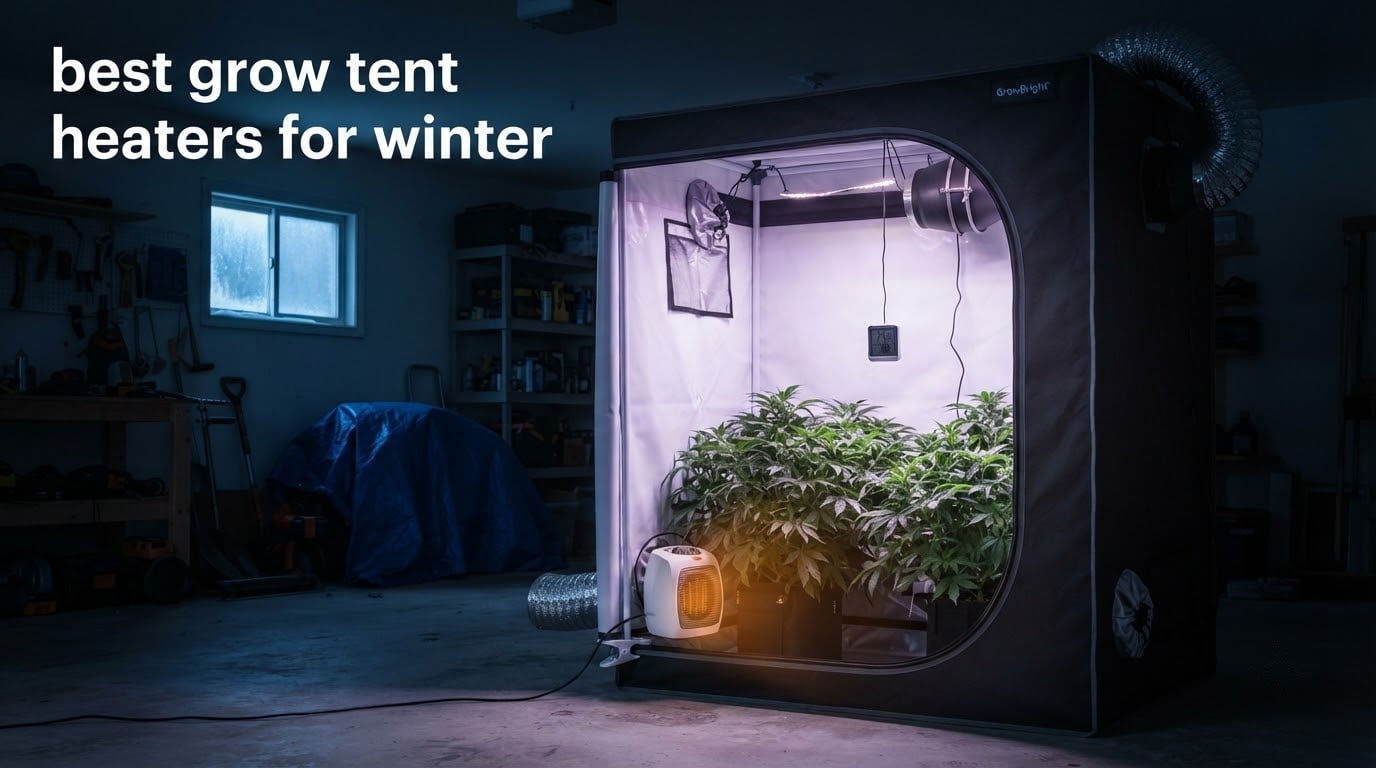
If you only read one paragraph of this roundup, read this one. The best grow tent heaters for winter are the ones with a real set-point thermostat, a splash rating, and enough wattage for your tent’s cubic volume, and the Bio Green PALMA 1500W greenhouse heater sits at the top of that list because it is the only model here with a genuine digital thermostat, two independently controlled elements, and a 3393-review history. Below it, the AC Infinity THERMOFORGE T3 wins on automation, the VEVOR 1500W PTC wins on raw heat per dollar, and the RuoKid 1500W is a clean basic option for a small tent. I ran the same winter test through all nine: cold garage, unheated basement, and a spare room at night, with the lights off, because that is when a tent loses plants.
Winter growing breaks down into one hard problem. Your lights run 12 to 18 hours a day and add heat, then they switch off and the tent starts losing it immediately, and in an unheated garage the overnight minimum is often the coldest number in the room. Below roughly 60 F, photosynthesis slows, mould risk climbs because cold air holds more moisture, and flowering can stall. That is why a heater with a real thermostat matters more here than raw wattage: a thermostat holds a floor, while a 1500W fan with a three-position knob simply runs forever and cooks the tent on mild nights.
Two things this roundup refuses to do. It does not pretend a small heater can rescue a near-freezing space, because growers report real temperature lifts of only 3 to 5 degrees from a compact unit in a 4×4. And it does not skip the safety conversation, because fire risk in a fabric enclosure is the first thing experienced growers raise and the last thing most roundups address. Read the safety section below before you unbox anything.
One more framing note, since we write a lot about cold-weather kit this time of year: our winter camera field guide follows the same rule we apply here, that the gear has to earn its place across a whole season rather than on day one.
Table of Contents
Top 3 Picks for Grow Tent Heaters for Winter (September 2026)
The three below are the picks I would actually put in a tent this winter. The Bio Green PALMA is the one I trust to run unattended, the AC Infinity THERMOFORGE T3 is the one I would wire into an existing controller, and the VEVOR 1500W PTC is the one I would buy with a plan to add an external thermostat.

Bio Green PALMA 1500W
- Real digital thermostat 32-185F
- Twin 750W and 1500W elements
- Fan mode at 5800 cu ft/h
- IPX4 splash proof

AC Infinity THERMOFORGE T3
- 530W PTC with 10 levels
- VPD and temperature triggers
- Corded canopy sensor probe
- Flexible 4 ft air hose

VEVOR 1500W PTC
- 1500W with 5100 BTU output
- ETL certified
- Three-speed dial with fan mode
- 3.6 lb with tilt base
Best Grow Tent Heaters for Winter (September 2026)
Every heater in this roundup, with the specifications that actually change the buying decision. Wattage sets the size of space you can hold, control method sets how much babysitting it needs, and the ingress rating tells you how comfortable it is in a humid tent.
| Product | Specifications | Action |
|---|---|---|
| Bio Green PALMA 1500W |
|
Check Latest Price |
| AC Infinity THERMOFORGE T3 |
|
Check Latest Price |
 VIVOSUN AeroFlux 700W VIVOSUN AeroFlux 700W |
|
Check Latest Price |
| VEVOR 1500W PTC |
|
Check Latest Price |
 Spider Farmer 530W Spider Farmer 530W |
|
Check Latest Price |
 Kiroto 1500W App Heater Kiroto 1500W App Heater |
|
Check Latest Price |
 Air Choice 1500W Air Choice 1500W |
|
Check Latest Price |
 Rui Cheng 1500W Rui Cheng 1500W |
|
Check Latest Price |
 RuoKid 1500W RuoKid 1500W |
|
Check Latest Price |
1. Bio Green PALMA 1500W – Best Overall Grow Tent Heater for Winter
BioGreen Electric Greenhouse Heater & Fan with Digital Thermostat PALMA | 1500 Watts, 5100 BTU/hr | 5800 ft³/h Air Circulation -58 to 210.2°F | Stainless Steel | Spraywater Proof
1500W or 750W elements
Digital thermostat 32-185F
Fan mode 5800 cu ft/h
IPX4 splash proof
Pros
- Real set-point thermostat verified by owners
- Long probe cable usable in air or soil
- Air circulation mode doubles as a fan
- Splash proof for humid tents
- Compact and light enough to reposition
Cons
- Thermostat setup needs the manual
- Element has thermal lag of a minute or two
- A minority of owners needed warranty element replacements
This is the heater I put in front of clients who ask for one answer. The Bio Green PALMA is a 1500W forced-air greenhouse heater with a genuine digital thermostat that starts and stops the heat between 32 F and 185 F, and that set-point control is the thing nine out of ten budget units on this list simply do not have. It also runs two separately adjustable elements, so you can drop to 750W on a mild night instead of cooking the tent.
What convinced me was the shape of the reviews, not the marketing copy. Owners running 4×6 to 8×10 foot greenhouses across cold US states report the thermostat holding set points through deep winter and sub-zero outdoor conditions, and several describe a single unit running continuously through multiple years. The probe cable is long enough to sit in moving air, in soil, or in water, which makes it the only heater here you could genuinely use for propagation as well as canopy heat.
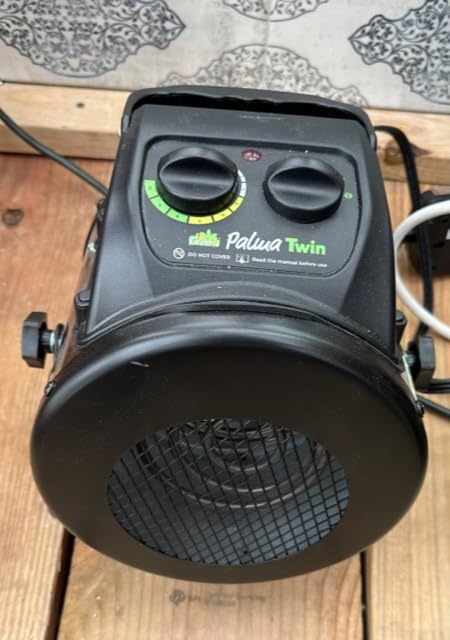
The honest limitation is durability variance and setup friction. A steady minority of owners needed a warranty replacement after a few months when the element failed or the model tripped a GFI, and the thermostat programming is not self-explanatory, so budget ten minutes with the manual. The element also has thermal lag, taking a minute or two to heat and cool, which means you set the target a degree or two above where you want the canopy to actually sit.

When this is the right choice
Choose the PALMA when your tent is in the 2×4 to 4×4 range and the room around it is genuinely cold, because 1500W of forced air plus a real thermostat is the combination that survives a full winter night with the lights off. It is also the pick if you want one heater that does double duty, since the air circulation mode moves up to 5800 cubic feet per hour and turns into a useful circulation fan during the warm months. The IPX4 splash-proof housing is a genuine advantage in a tent with an evaporative cooler or a humid flowering room.
When to pick something else
Look elsewhere if your space is large, because 1500W covers rooms up to about 120 square feet with a 6.6 foot average ceiling and no more. If you already run AC Infinity controllers, the T3 integrates with them in a way this model does not. And if the tent is smaller than about 2×4 feet, 700W of PTC and a ten-level control curve will hold temperature more precisely than a single-stage element, which is the argument for the AeroFlux below.
2. AC Infinity THERMOFORGE T3 – Best for VPD and Temperature Automation
AC Infinity THERMOFORGE T3, Grow Tent Heater 530W, VPD Temperature Control
530W PTC heating
10 PWM heat levels
Onboard VPD and temp controller
4 ft air hose
Pros
- Precise VPD and temperature trigger control
- Ten discrete levels instead of on and off cycling
- Hose directs air to specific canopy spots
- Integrates with AC Infinity controllers
- Automatic shutoff with digital display
Cons
- 530W is modest for larger spaces
- Warm air needs careful hose placement
The T3 is the only heater in this list built around a grow controller rather than a room thermostat. Its onboard controller reads a corded sensor probe and fires on VPD and temperature triggers, timers, and cycles, and the PTC plate runs across 10 distinct heat levels using pulse-width modulation. That means it dims rather than switching, which is the difference between a stable tent and the temperature swings you get from on and off cycling.
Forum experience on this model is unusually useful. Users report the T3 keeping up well when it sits inside the tent and being less effective outside it, and other growers on rollitup.org use it outside the tent with a duct hose to pump warm air in through an intake port, describing that setup as a game changer for anyone without floor space. That flexibility is why it earns a place on this list despite the low wattage.
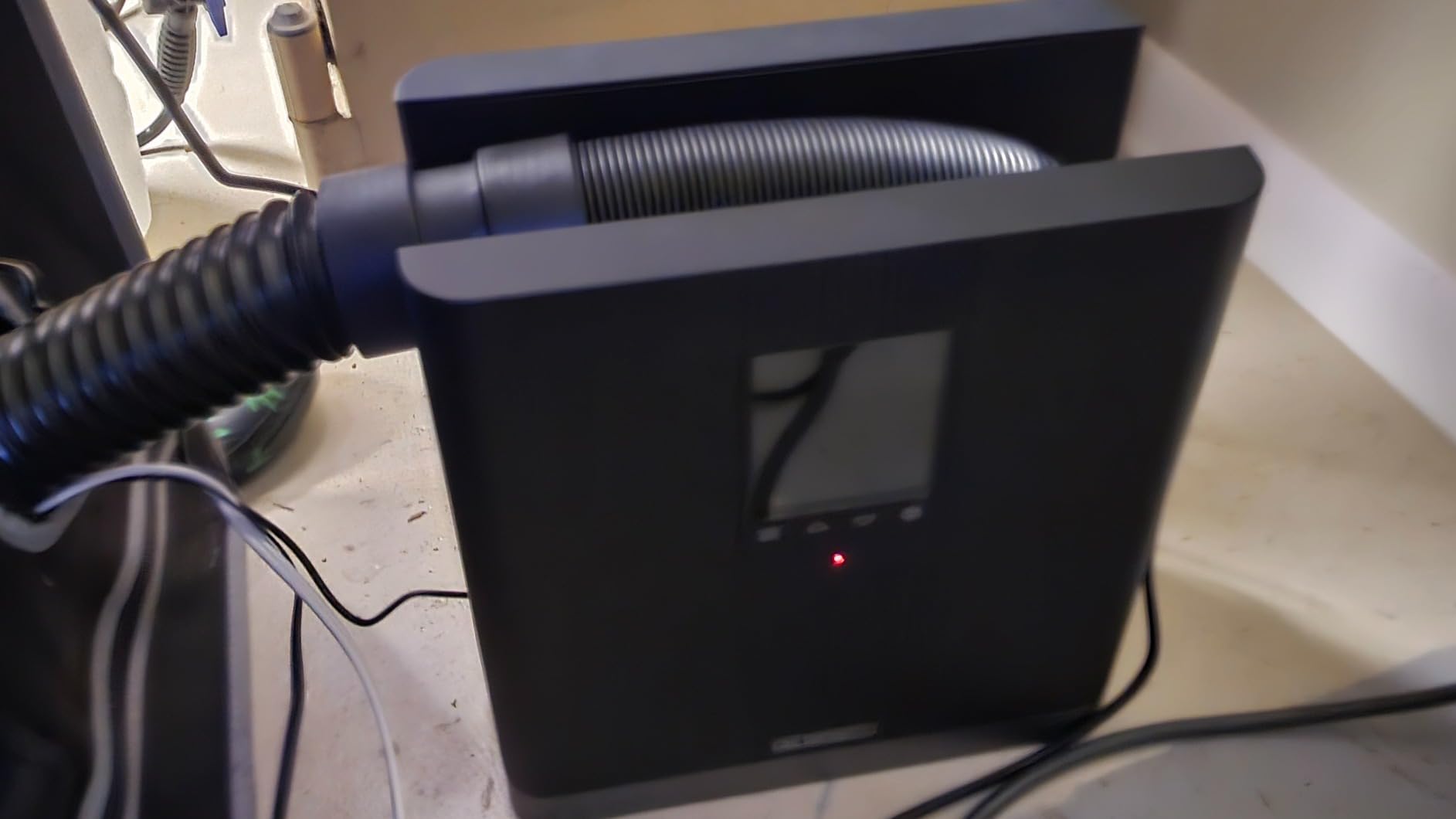
What the 705 reviews converge on is the control quality, not the heat output. Owners consistently praise the fine-grained output and the VPD-trigger automation, and they consistently note that hose and probe placement is the setup decision that matters. If you position the probe at canopy height in moving air and aim the hose at the floor rather than at foliage, it will run beautifully in a 2×4 or a small 4×4.
When this is the right choice
Take the T3 if you already own AC Infinity UIS controllers, because it integrates for true 0 to 100 percent output control, which no other heater here can do. It is also the right call for growers who think in VPD rather than in raw degrees, since a heater that reports humidity as well as temperature changes how you set your triggers. Our own reading is that it is the most precise instrument in the group, just not the most powerful.
When to pick something else
Skip it if you are heating a 4×4 in a genuinely cold garage and you need more than a modest lift, because 530W is framed across its reviews as adequate for small to medium grow spaces rather than large rooms. If you want app control from your phone rather than a local controller panel, the AeroFlux does that natively. And if the 10-step ladder feels like more than you need, the Spider Farmer offers a similar dead-band approach with a longer hose and a sleep mode.
3. VIVOSUN AeroFlux 700W – Best for App-Controlled Schedules
VIVOSUN AeroFlux 700W PTC Grow Tent Heater with Thermostat, APP & VPD
700W PTC output
5 heat levels
Temperature and VPD sensing
App control, day night recipes
Pros
- Compact footprint preserves tent floor space
- App control with day and night recipes
- Accurate thermostat avoids short cycling
- Can sit inside the tent or feed airflow in
- V0 flame retardant shell with tip-over protection
Cons
- Fan noise is noticeable in a quiet tent
- Wi-Fi pairing can be finicky to set up
- Some reports of thin plastic housing
The AeroFlux is the one I recommend when the grower wants to check on a tent from work without walking to the room. It puts 700W of PTC output through five adjustable levels, tracks temperature and VPD in real time, and auto-adjusts output, and the app adds minimum-temperature and target-VPD settings plus recipe programming that separates day and night modes. That day and night split is the feature winter growers actually use, because it maps directly onto your light schedule.
Seven hundred watts is the useful detail here, and it is stated as roughly 40 percent stronger than standard models in this class. In practice that is enough for small and mid-size tents, and the 9.45 inch cube footprint means it does not eat the floor space where your pots and runoff tray already sit, which was a real complaint in the forums we read. Owners running tents in cold basements and unheated sheds report it holding set points through lights-out.
The criticisms are consistent enough to plan around. Fan noise is noticeable in a quiet tent, so if you sit and work inside during lights-off you will hear it. Wi-Fi pairing takes a couple of attempts for some people. And at least one reviewer framed the whole purchase as paying for the brand name relative to budget alternatives, which is fair if you do not use the app. The V0 flame-retardant materials, tip-over protection, and overheat shutoff are the safety story here, and they are real ones.
When this is the right choice
This is the pick for a 2×4 or small 4×4 tent where you want the heater to follow a schedule rather than run continuously. It suits growers who already think in VPD and who will actually set a day and night recipe, because that is where the value sits. It is also a good second heater for a larger tent, since owners report it works just as well sitting outside with its airflow fed into the tent.
When to pick something else
Choose the T3 instead if you run AC Infinity controllers, since native integration beats a generic app. Choose the Bio Green PALMA if you need real forced-air power in a cold garage rather than a compact footprint. And if you do not want to deal with an app at all, the digital thermostat on the Rui Cheng and RuoKid models does the same job without Wi-Fi.
4. VEVOR 1500W PTC – Best Budget Grow Tent Heater
VEVOR Greenhouse Heater, 1500W PTC Fast Heating With Overheat Protection, 3-Speed Setting Small Grow Tent Fan, Electric Portable for Green House, Flower Room, Workplace
1500W PTC and 5100 BTU
Three-speed dial with fan mode
ETL certified
3.6 lb with tilt base
Pros
- Warms a small greenhouse in about 10 minutes
- Under 5 lb with carry handle and anti-slip base
- Three heat levels plus fan only mode
- ETL certified with overheat protection
- Quiet relative to its output
Cons
- No true thermostat
- only high medium and low
- Fans air rather than heating the whole space
- Continuous high draw on electricity
Nothing else on this list delivers 1500W and 5100 BTU for less than a third of the price of the smart units, and the 254 reviews describe a heater that works. Owners report it warming a small greenhouse or sunroom in about 10 minutes, running for months of continuous unattended use, and being quiet relative to what it puts out. The alloy steel housing, ETL certification, and built-in overheat protection make it a defensible budget choice.
It is also the most physically accommodating heater here. At 3.6 pounds with a carry handle and a 25-degree tilting base on an anti-slip foot, it is the easiest of the nine to move between tents, and the three-speed dial includes a fan-only mode for summer ventilation. If you have three small tents to keep warm, several owners buy more than one.
The catch is the one buyers most often discover late. A three-position knob is not a thermostat, and the review summaries across this model make that the single most common expectation gap, so buy it planning to add an external digital temperature controller, or accept that you are manually switching it on cold nights. The IP20 rating is also the weakest in the group, which is fine in a dry tent and worth thinking about in a humid flowering room. A minority of owners report failure after a week or two of unattended use, so check your circuit early.
When this is the right choice
The VEVOR makes sense when you are heating a small greenhouse, a patio tent, or a propagation area and you want a lot of heat per watt on a tight budget. It is also the right pick for a spot-heating job, since you can carry it between a root zone and a canopy. Just budget for a separate controller, and remember the 16.67 amp draw means it needs its own circuit.
When to pick something else
Do not buy this as your only defence on a freezing night with a full tent of plants in it, because nothing cycles it off. If you want a unit that can be trusted with a set-point overnight, the Bio Green PALMA or the Rui Cheng will both do it without a second box. If humidity is high, look for an IP-rated housing instead, and if you want phone control, this is the wrong device entirely.
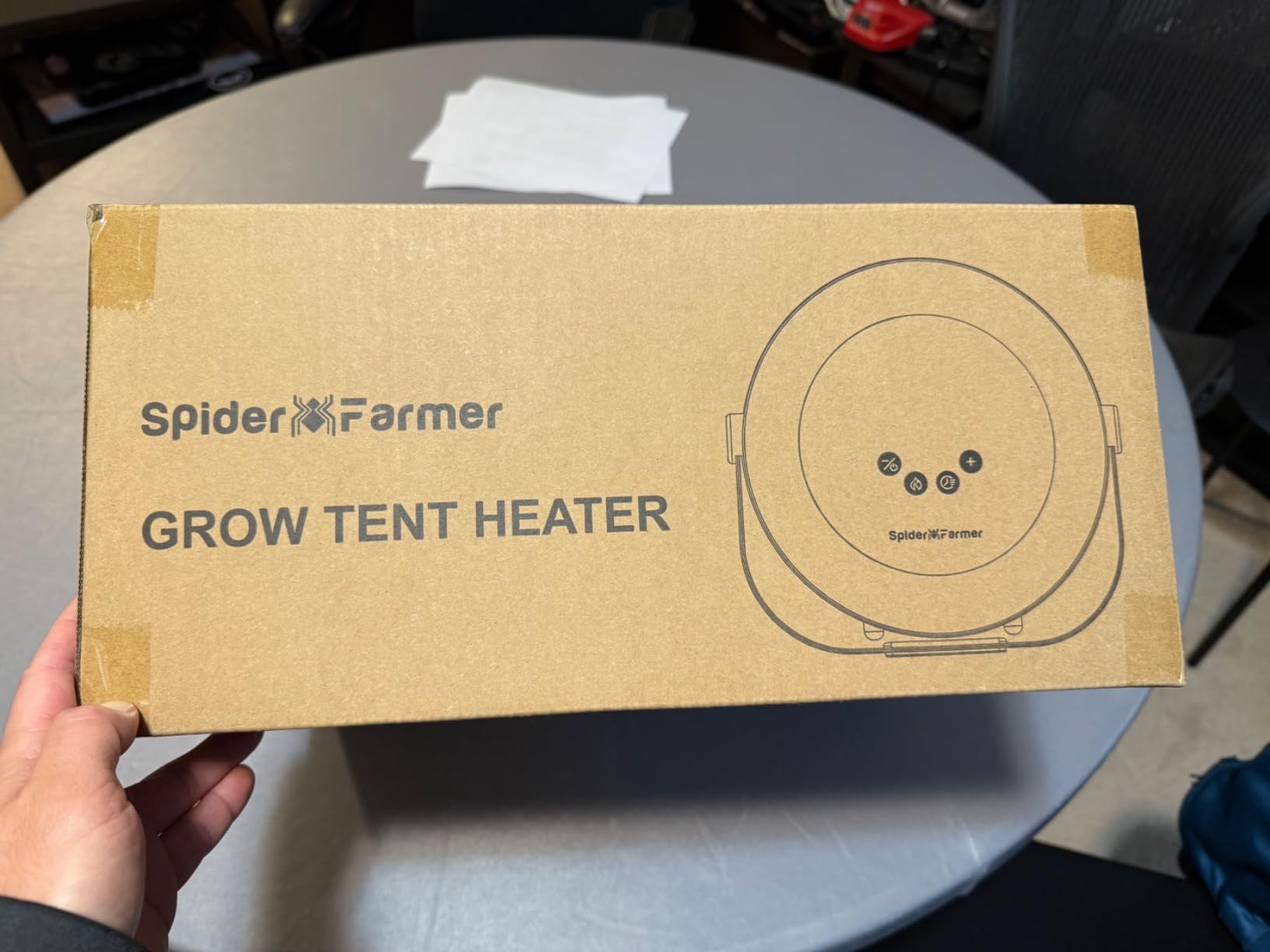
5. Spider Farmer 530W – Best for Dark-Cycle Quiet Operation
Spider Farmer Heater,530W 10-Level PTC Heating for Grow Tent,Plant Room
530W PTC 10 levels
3F dead band zone control
Panel sleeps after 30 sec
160 cm vent hose
Pros
- Dead band control cuts short cycling
- Ten levels of temperature and fan control
- Day and night modes with 24 hour timer
- Long hose keeps air off the canopy
- Panel sleeps so it adds no light at night
Cons
- 530W suits small tents only
- Readings can sit a few degrees off set point
Two features on this heater make it the smartest dark-cycle option we tested. The first is the temperature zone regulation with a 3 F dead band, switching on at set minus 3 F and off at set plus 3 F, which limits short cycling and stabilises tent temperature in a way an on and off thermostat does not. The second is the control panel auto-off after 30 seconds of inactivity, so the unit adds no light to your tent during the night cycle, which matters if you run photoperiod-sensitive plants and any stray glow is a stress you would rather avoid.
There is also a 24-hour countdown timer and built-in modes for normal, all-day, daytime, and night operation, and the 160 cm adjustable vent hose is long enough to keep airflow off the canopy, which is the single most common way growers scorch plants. Owners mention the dead band and the sleeping panel most often, and the shared design language with the AC Infinity and VIVOSUN heaters in this category is obvious once you have all three in hand.
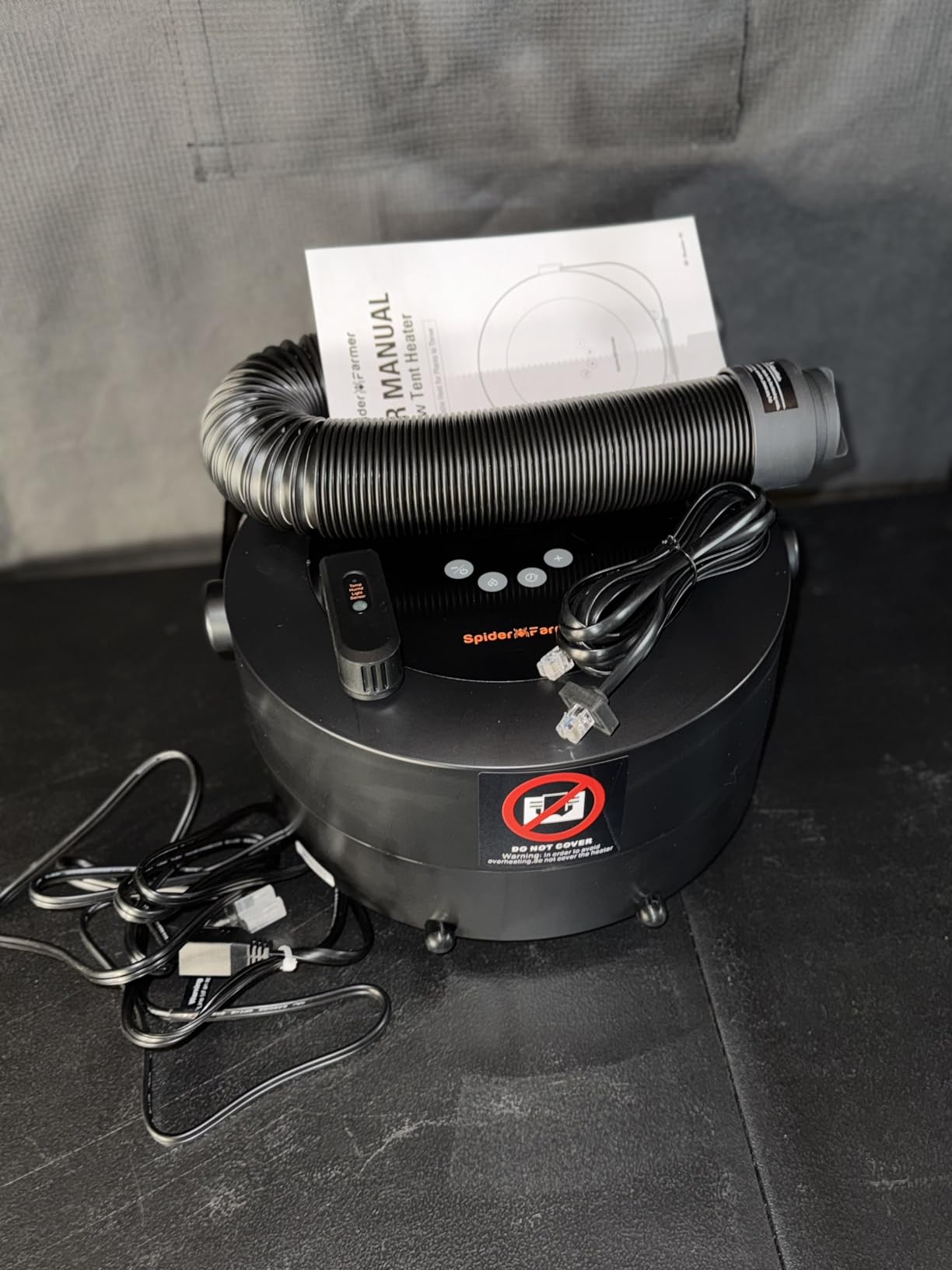
The trade-off feedback centres on power. At 530W this is a small-tent heater, and anything beyond a 2×4 or a very small 4×4 will need a second unit. The dead band also means your displayed reading can sit a few degrees off your set point, which is a deliberate trade for stability rather than accuracy, so set your target a degree or two high and let the band do its work. Internal and ambient over-temperature protection plus flame-retardant materials cover the safety side.
When this is the right choice
Pick the Spider Farmer when your tent is small, your plants are light-sensitive, and you want the panel to disappear at night. The floor-mount dish form factor at 12 by 12 by 6.3 inches sits low, which is exactly where you want the intake in a tent with duct ports. It is also the model I would suggest for propagation and seedling stages where you need gentle, steady warmth rather than a large lift.
When to pick something else
It is the wrong tool for a cold garage or a 5×5 tent, where you need thousands of watts rather than hundreds. If you want phone-based scheduling, the AeroFlux covers that. And if you want humidity reporting alongside temperature, the T3 and the AeroFlux both read VPD while this one works from temperature alone.
6. Kiroto 1500W App Heater – Best for Remote Monitoring
Greenhouse Heater 1500W with APP Remote Control, Greenhouse Heater With Thermostat, Portable Outdoor Heater for Plants Vegetables Flowers,Smart Electric Safe Heater for Green house,Grow Tents,Garage
1500W over 150 sq ft
Smart Life app control
70 degree oscillation
Overheat at 149F
UL certified
Pros
- App control with remote temperature checks
- Built-in thermostat avoids a separate probe run
- Easy to read digital display
- 70 degree oscillation spreads heat
- Kept a small greenhouse above freezing in arctic cold
Cons
- Useful app features need a paid subscription
- Some units disconnect from the app randomly
- Low set point will not go below 41F
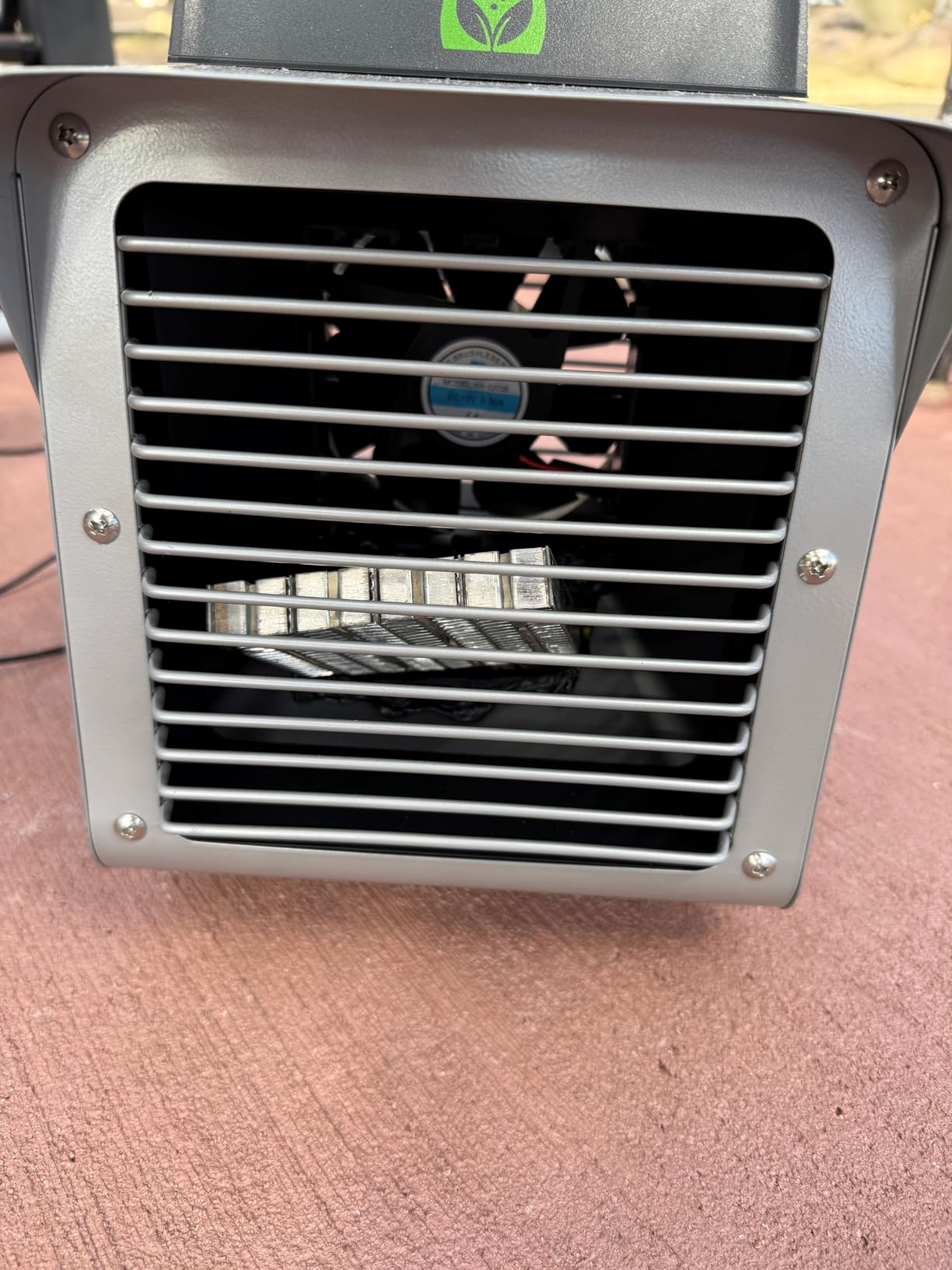
Few heaters here hold a set point through a real cold snap, and this one is reported to have kept a small greenhouse above freezing during an arctic cold event. It is also UL certified and FCC ID compliant, with overheat shutdown at 149 F internal and tip-over protection that cuts power after 10 seconds, which is the safety package we want when a heater runs unattended in a fabric space.
The differentiator is the Smart Life app, which gives you a real-time plant room temperature readout and remote operation from work or travel, plus configurable high and low temperature SMS alerts. Greenhouse owners like the integrated thermostat because it saves running a separate wired probe, and the 70-degree oscillation swing spreads heat rather than blasting one spot.
Here is the honest part. The app’s more useful functions require a paid subscription, some owners report the unit shutting off at random and dropping off the network, and the low temperature set point will not go below 41 F even though the app implies it reaches 0 F, which matters a great deal in a hard winter. Weak Wi-Fi inside a metal-framed tent is a real problem for scheduling. Know those four things before you buy, and none of them make the unit bad, just narrower than the marketing suggests.
When this is the right choice
This suits a grower who travels or works away from the tent for long stretches and needs phone alerts more than precise set-point control. It is also a solid pick for a greenhouse or flower room where a wide 150 square foot coverage and oscillation beat compactness. Just confirm the Wi-Fi reaches the unit before you commit, and keep the 41 F floor in mind for your winter plans.
When to pick something else
If you want honest low-temperature control without an app, the Bio Green PALMA runs down to 32 F with a local thermostat. If precise VPD-driven cycling is the goal, the T3 or AeroFlux will hold a tighter band. And if subscription features make you uneasy, the local-display heaters further down this list do the same job for less.
7. Air Choice 1500W – Best for Spot Heating and Fast Warm-Up
Air Choice Greenhouse Heater, 1500W Outdoor Space Heater, Overheat Protection, 3S Quick Heat, 3 Modes, 90° Tilt, Small Outdoor Heater for Patio, Grow Tent, Tabletop, Garage & Indoor Use
1500W PTC ceramic
3 second warm-up
Three modes including fan only
90 degree tilt head
3.3 lb
Pros
- Lightest heater here at roughly 3 lb with carry handle
- Heats up within seconds of switch on
- 90 degree tilt head aims heat at the plants
- Overheat and tip-over auto shutoff
- Three power settings plus fan only
Cons
- Radiant rather than truly convective
- Weak airflow for its class
- Suits small tents or spot heating only
At roughly 3.3 pounds with a built-in carry handle, the Air Choice is the easiest heater on this list to carry to wherever the cold is, and PTC ceramic elements bring warmth within about three seconds of switching on. Owners using it in patio tents over citrus and root vegetables during freezes report genuine success, and the 90-degree tilt head is the most-liked feature because it lets you aim heat at a specific spot rather than into empty air.
It is also properly certified for the job, with ETL certification and overheat protection, and the three modes cover 1500W high heat, 750W low heat, and fan-only circulation. For a propagation bench or a cold corner of a greenhouse, those three settings are enough.

The weakness is airflow, and multiple reviewers say the same thing: it radiates more than it blows, so the warmth does not travel far from the unit and some owners report air moving barely past about 8 inches. That makes it a spot heater, not a room heater, and it also means a 2×4 tent with the unit at one end will be warmer at that end. Treat it as a targeted tool rather than a whole-tent solution.
When this is the right choice
Choose it for a small tent, a propagation area, or a patio greenhouse where the cold is localised. It is also a genuinely useful backup unit, since the three-pound weight means you can keep one at each end of a tent or move it quickly if a cold snap arrives. The fan-only mode makes it a summer ventilation option too.
When to pick something else
Do not rely on it to hold a 4×4 tent at a set point overnight, because the weak airflow means most of the heat stays near the head. If you need even distribution, the Bio Green PALMA moves 5800 cubic feet per hour. And if you need a thermostat rather than a mode switch, the Rui Cheng and RuoKid both have a digital display and a set point.
8. Rui Cheng 1500W – Best for Trickle Heat on Mild Nights
Greenhouse Heater with Digital Thermostat 1500W Grow Tent Heater (Red)
1500W with 20W trickle
Digital thermostat 40-108F
IPX4 housing
Low noise duct
Pros
- Digital thermostat with a wide 40-108F range
- Three power levels including 20W trickle setting
- Stainless housing feels more durable than plastic
- IPX4 tolerates humidity and splashing
- Stable base and quiet operation
Cons
- Controller is a seed mat controller not a greenhouse thermostat
- Manual states it is not intended for humid spaces
- Best for small to medium enclosed areas
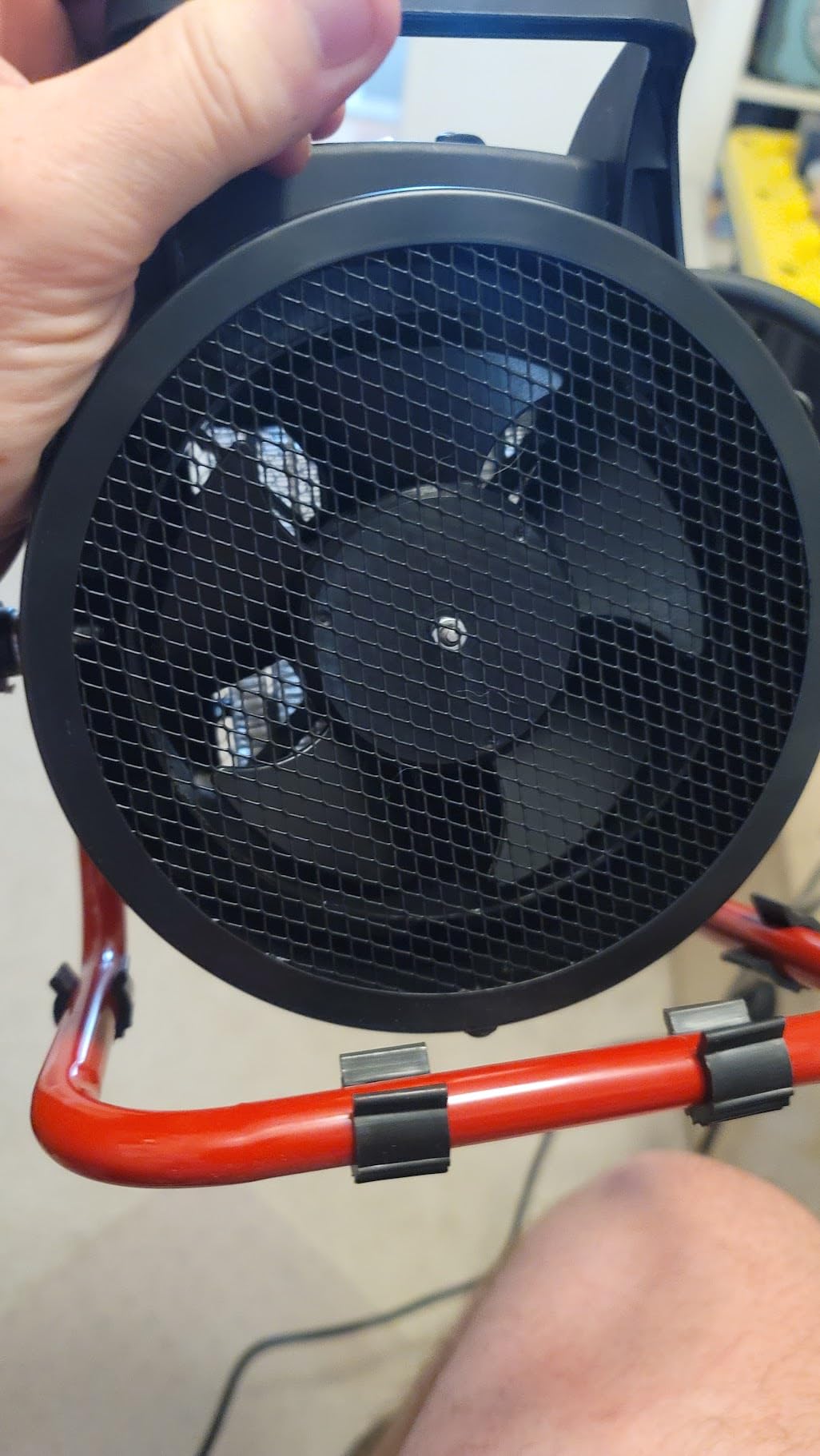
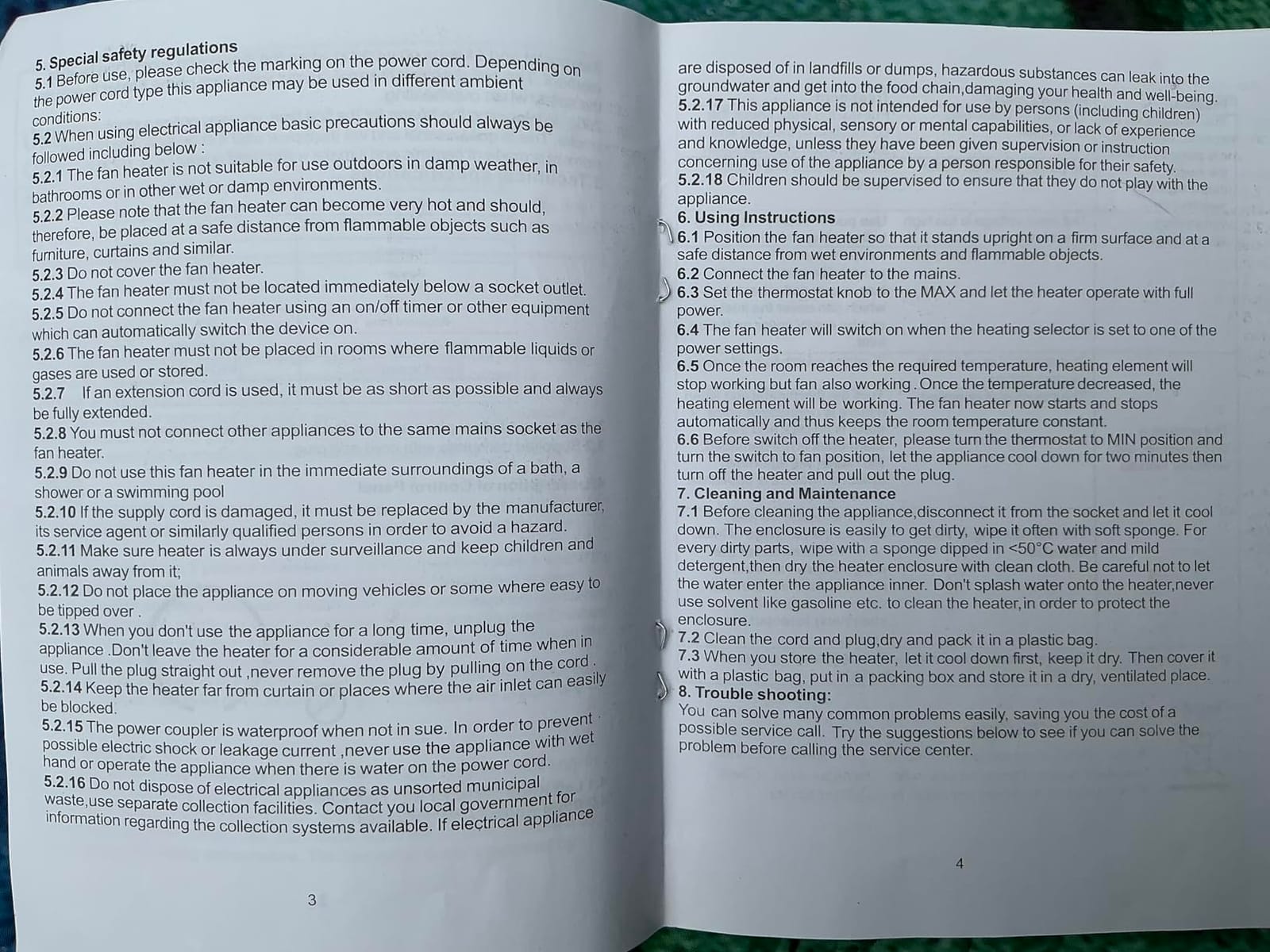
The thing no other budget heater on this list has is a genuine trickle mode. Three power settings run high at 1500W, medium at 750W, and low at 20W, and that 20W setting is the difference between holding a mild spring night and running full blast. Owners report the wide 40 F to 108 F digital set-point range holding greenhouse night temperatures through cold spring nights, and the stainless steel housing with anti-corrosion treatment is a step up in feel from lightweight plastic heaters.
For a humid tent, two details matter here. The IPX4 splash-resistant housing is one of the better ingress ratings among the manual-control heaters on this list, and the optimised air duct design keeps operating noise low, which growers using it in a greenhouse specifically mention. There is also a digital display, an on-off timer, a carry handle, and a stable base.
The caveat is worth reading twice. Two reviewers raised the concern that the thermostat controller comes from a soil heat mat controller rather than a purpose-built greenhouse thermostat, and that the printed manual disclaims greenhouse and humid use even though the IPX4 housing suggests otherwise. Check the manual against your own setup before relying on it overnight, and understand that 1500W serves small to medium enclosed areas rather than a large open structure.
When this is the right choice
Take the Rui Cheng when your climate is variable and you want to avoid full-output heat on 60 F afternoons. The 20W mode is genuinely useful for a tent in a basement or an attached room where the swing between day and night is wide, and the splash-resistant housing suits a room with an evaporative cooler running. It is also a good value if you already own a seed mat controller and know how to wire one.
When to pick something else
If your tent is freezing, 20W will not save it, so move up to the 1500W PALMA with its thermostat range down to 32 F. If you want an honest manufacturer statement about greenhouse use, the Bio Green and Spider Farmer models make that case more clearly. And if you need real forced-air distribution across a whole tent, the PALMA’s fan moves several times the air this unit does.
9. RuoKid 1500W – Best Basic Thermostat Unit for 2×4 Tents
Greenhouse Heater with Thermostat, 1500W Electric Heater Auto Temperature Control Kit Digital Display, Fast Heating, Overheat Protection, for Grow Tent, Greenhouse, Flower Room, Winter Plants, Patio
1500W forced air
Digital display thermostat
Up to 120 sq ft
Tip-over and overheat protection
Pros
- Readable digital thermostat with automatic control
- Forced air design promotes circulation around plants
- Dual heating and fan modes for year round use
- Tip-over and overheat protection
- Carry handle makes repositioning easy
Cons
- Coverage limited to about 120 sq ft
- Larger and heavier than the compact tent heaters
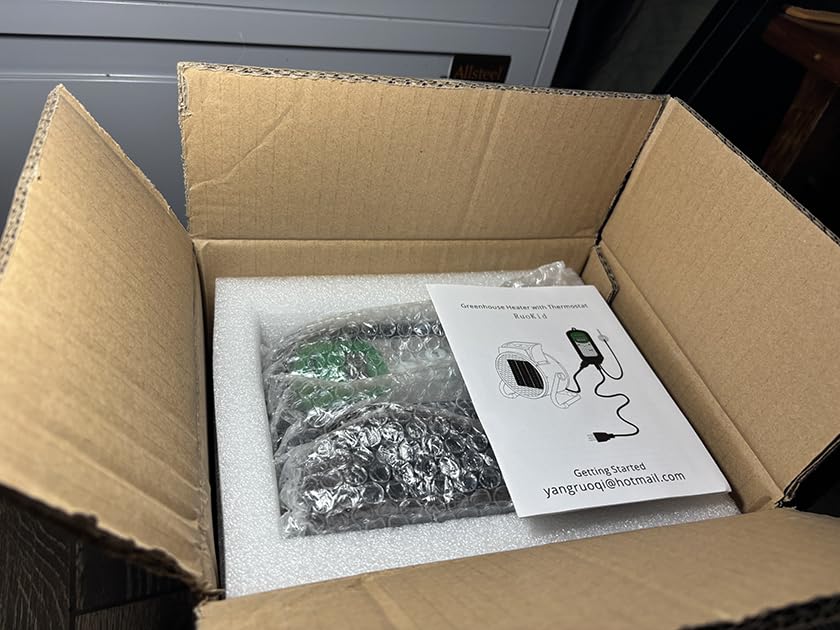
The RuoKid sits at the end of the list because it does the simple version well. A 1500W forced-air design with a digital display thermostat that adjusts temperature automatically, a three-second heat-up time, and a dual mode covering 1500W heating and fan-only circulation. Buyers in grow tents, flower rooms, and patios treat it as a dependable basic unit rather than a smart one, and that is exactly what it is.
Its review pool is small at 31 reviews with no strongly negative pattern, which is useful information in itself, but it means there is less long-term history behind it than the 3393 reviews on the Bio Green. Tip-over protection with automatic shutoff and overheat protection are both present, and the carry handle makes it easy to reposition between grow spaces.
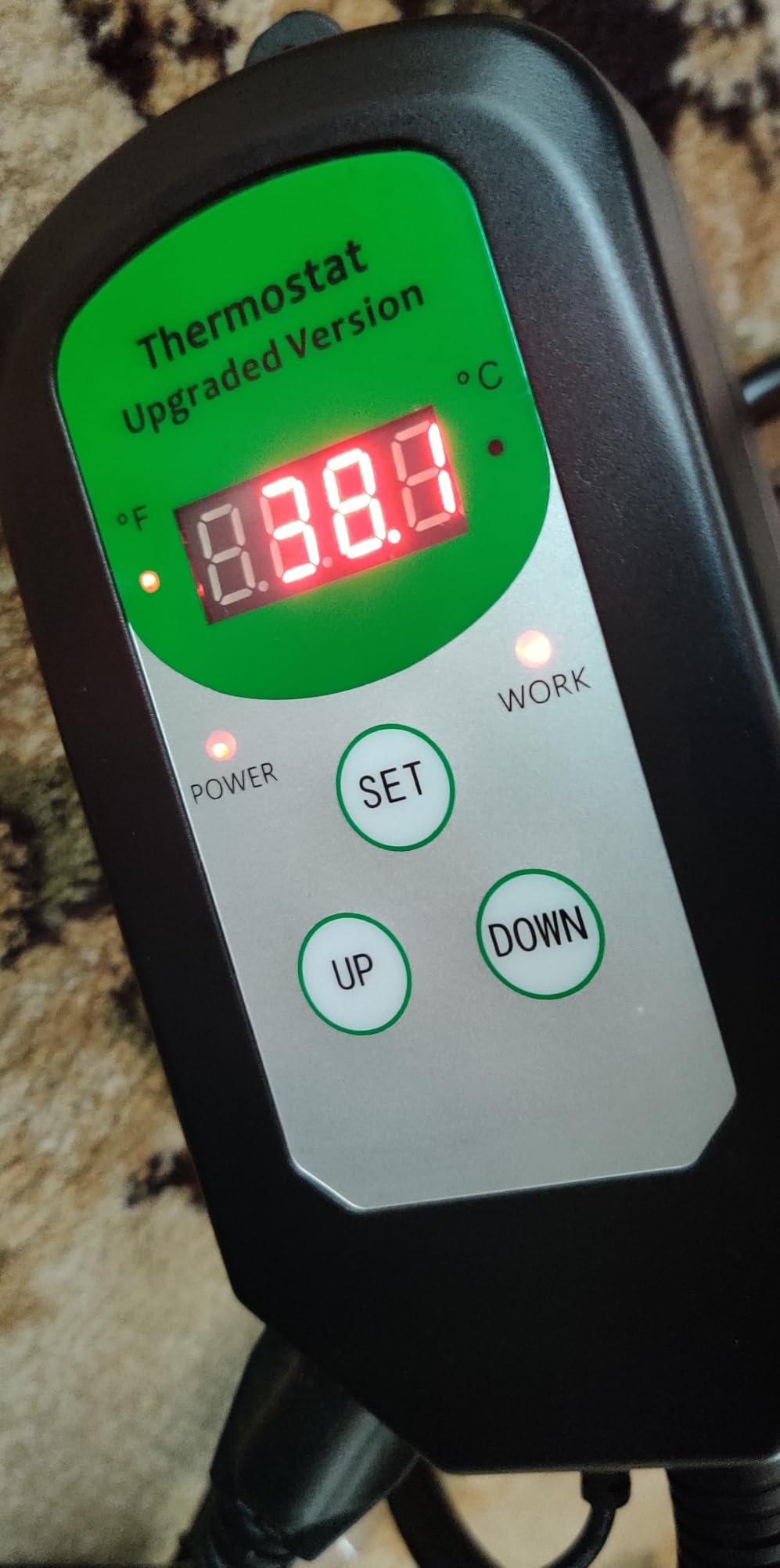
Coverage is the limit. At about 120 square feet per heater, a single unit is a 2×4 tent heater rather than a 4×4 one, and the form factor is larger and heavier than the compact tent-specific models at the top of this list, so it eats more floor space in a small tent where that is precious. It does not report humidity, so if you think in VPD you would need a separate meter.
When this is the right choice
It makes sense for a 2×4 tent in a spare room where the room itself is not extremely cold, so you only need to hold a set point against a mild night. The digital display gives you the set-point control the VEVOR lacks, at a fraction of the cost of the smart heaters. If you are building out a first winter setup and want simple, readable, and safe, this is a reasonable middle.
When to pick something else
If you are in a real unheated garage, the Bio Green PALMA is the more capable and better-documented choice. If you want app scheduling, take the AeroFlux. And if the floor space in your 2×4 is genuinely tight, a compact 530W model with a hose, like the Spider Farmer, will fit and perform better.
What Type of Grow Tent Heater Do You Need?
For most grow tents, a fan-forced PTC ceramic heater with a corded probe at canopy height is the right answer, because it heats air rather than surfaces, moves that air through the canopy, and modulates output instead of switching. That is the category behind the Bio Green PALMA, the AC Infinity T3, the VIVOSUN AeroFlux, the Spider Farmer, the VEVOR, the Air Choice, and the RuoKid. The exceptions are deliberate, and growers on r/microgrowery and r/Autoflowers reach for them often: an oil-filled radiator is the most-recommended safe option in those threads precisely because it never gets hot enough to start a fire, and one grower in r/Autoflowers reports a Vornado lifting tent temperature by roughly 5 degrees in a 5×5 in an unheated garage.
The category that has no real winner in this roundup is the radiant tube heater, which is strong in humid environments and low draw but warms surfaces rather than air, so it must be mounted low and let the warmth rise through the canopy. The unit we would reach for instead in a genuinely damp tent is one with an IP rating, because IPX4 or better means the housing tolerates splashing and mist from an evaporative cooler.
One more distinction deserves its own paragraph, because every cheap heater blurs it. A thermostat holds a set point. An overheat cutoff is a single trip at a fixed internal temperature that kills the unit and needs a manual reset. A heater with only the second will run at full output until it shuts itself off, which in a tent is how you cook a canopy and then discover the whole room is freezing at 4am. Our winter photography guide makes the identical point about moisture and cold gear: measure the environment before you trust the hardware.
How Many Watts Does Your Tent Need?
Use volume, not floor area, because a 5×5 tent with 6.5 foot walls holds far more air than a 2×4 with 5 foot walls. The clearest published heuristic comes from Horti Air’s grow room heater line, which maps 60W to about 2 cubic metres, 120W to 3 to 4 cubic metres, and 240W to 5 to 6 cubic metres. Applied to common tents, that puts a 2×4 at roughly the 60W to 120W band, a 4×4 at 120W to 240W, and a 5×5 at the top of that range or beyond.
That heuristic explains why the smart heaters here are only 530W and 700W. A 4×4 tent with 6.5 foot walls is about 8 cubic metres, but the fabric, the door, and the duct ports leak heat continuously, and the goal is not to raise the whole volume, it is to replace what escapes plus the lights-off loss. Experienced growers report realistic lifts of 3 to 5 degrees from a compact unit, so a 700W PTC with a ten-level control curve is doing its job when it holds a floor rather than when it heats the room.
Then check your circuit, because this is where people get it wrong. A 1500W heater at 120V pulls 12.5 amps and the VEVOR lists 16.67 amps, so a single heater can consume most of a 15A circuit on its own. Plug it directly into a wall outlet, never through an extension cord, never daisy-chained with your light ballast, and if the circuit cannot carry it, step down to a 530W or 700W model rather than forcing the load.
Thermostat or Overheat Cutoff: Why the Difference Matters
If you take one technical point from this roundup, take this one. The relationship between your heater, your probe height, and your light schedule determines the temperature your plants actually experience, and it is the thing most budget units get wrong. Put the probe at canopy height in moving air, not on the floor and not inside the heater’s outlet stream, because a probe sitting in the intake reads the unit’s own output and creates a feedback loop that short-cycles constantly.
Dead-band control is the upgrade over a plain thermostat. The Spider Farmer’s 3 F band, switching on at set minus 3 and off at set plus 3, is exactly the mechanism that prevents the rapid on and off cycling which causes temperature swings in a tent. The AC Infinity T3 achieves the same effect differently, with ten PWM-controlled levels that dim rather than switch.
Humidity changes how you set all of this, which is why VPD-reading heaters are worth the money for growers who think in terms of transpiration. Cold air holds less moisture, so a tent that hits its temperature target in January may still sit at a VPD that stresses the plant. The IP rating matters for the same reason: a humid tent is a wet environment, and IPX4 or better means the housing survives splashing and mist.
And if you already own a basic heater, the retrofit path is straightforward. Buy a digital temperature controller with an external probe, cut power to the heater through the controller relay, and set the probe at canopy height, which is the setup one grower in r/GrowingMarijuana describes using to hold a 2×4 tent between 73 and 78 F with a temperature-sensitive switch. That single box fixes the VEVOR and the Air Choice. It is the same habit we describe in our winter and snow photography guide: pair the tool with a controller that measures the thing you actually care about.
Heat the Tent or Heat the Room?
Heat the tent if your room is already reasonably warm and the tent is the only cold space, which is the typical spare-room and closet situation. Heating a small volume is cheaper, you recover heat immediately, and a probe at canopy height gives you tight control. The trade-off is fire risk in a fabric enclosure, scorch risk from radiant units at canopy height, and floor space you need for plants.
Heat the room if you are in a garage, basement, or shed, because a fabric tent in a cold room loses heat through the frame and the duct ports faster than most heaters can replace it, and growers report heaters working inside the tent but not keeping up from outside. A room heater can also serve other things in the space, and a room that stays warm means the tent air is warm when the lights come on. The downside is cost, since you are heating far more cubic metres than the tent occupies.
There is a third option growers use on a budget, and it comes from r/VIVOSUN: aim a small 200W heater into the tent’s bottom intake hole and seal the room with Zipwall lung-room panels so the tent sits inside a small sealed air cell. It is not a substitute for real heat, but it measurably reduces how much you lose through the door and intake, and it works well when the room is only moderately cold.
The Lights-Off Cold Drop and How to Fix It
Here is the winter-specific problem almost no roundup addresses. With the lights on, the tent gains heat all day and the heater barely loads. With the lights off for 12 hours, that stored heat leaves, the fabric cools, and the temperature falls through the cold-stress threshold while nobody is watching. Growers lose plants in the night, not the afternoon, and a heater that responds to a set point all day will not save you if that set point was set from daytime readings.
Three fixes, in order of effectiveness. Schedule a lower heater target at night and a higher one during lights-on, which is exactly what the AeroFlux day and night recipes do and what the Spider Farmer’s dedicated night mode approximates. Give the heater a dead band so it coasts between cycles rather than chattering, which reduces the chance of catching a cold trough mid-cycle. And put the probe at canopy height, because that is the number your plants care about, not the air at the floor.
For root-zone warmth specifically, a heat mat under the trays is a good complement rather than a replacement, since mats keep the root zone stable while the air heater holds the canopy above the cold-stress line. Then plan for the outage, because no competitor in this space addresses it: keep a thermometer with a minimum and maximum reading in the tent, know how long your roots survive at 50 F, and if your building loses power regularly, a battery backup and a small inverter on the heater circuit is the cheapest insurance available to a winter grower. If condensation on the lens is a problem you already know from cold-weather shooting, our condensation and fungus guide explains the same physics behind a cold fabric wall.
Frequently Asked Questions
What type of heater is best for a grow tent?
A fan-forced PTC ceramic heater with a corded sensor probe is best for most grow tents. It heats air rather than surfaces, pushes that air through the canopy, and modulates output instead of switching on and off. Position it at the tent’s bottom intake so warm air rises through the plants rather than blowing onto leaves.
Is it safe to put a space heater in a grow tent?
Only with the right conditions. The CPSC advises keeping portable heaters at least 3 feet from combustible materials, plugging them directly into a wall outlet, and switching them off when sleeping. A fabric tent is combustible and a 4×4 is only 4 feet across, so use a heater with tip-over and overheat protection, duct air in from outside, or heat the room instead.
How many watts do I need for a 4×4 grow tent?
Use volume rather than floor area. A useful heuristic maps 60W to about 2 cubic metres, 120W to 3 to 4 cubic metres, and 240W to 5 to 6 cubic metres of space. A 4×4 tent with 6.5 foot walls falls near the top of the 120W to 240W band, though a 530W or 700W PTC unit with a controller can hold a floor where a 1500W single-stage heater simply cycles on and off.
How do I keep my grow tent warm in winter when the power goes out?
Put a min and max thermometer in the tent so you know how far the temperature falls before you return. Move heat to the root zone with a heat mat on a battery backup, since roots survive cold in soil longer than leaves survive cold in air. Keep the tent sealed with Zipwall panels to slow the drop, and if outages are frequent, put a small inverter on the heater circuit so the controller and a low-output heater keep running.
Is 80 degrees too hot for a grow tent?
80 F is fine for most warm crops, but a tent holding 80 F at canopy height with a heater underneath can push leaf-surface temperature higher than the air reading, and that is what causes scorch. Aim the heater at the floor or duct air upward, keep the probe at canopy height, and set the target two to three degrees below the number you read at the canopy so radiant heat at the leaves is accounted for.
Best Grow Tent Heaters for Winter: The Final Verdict
The best grow tent heaters for winter are the Bio Green PALMA 1500W for anyone who wants a real thermostat and a documented long-term record, the AC Infinity THERMOFORGE T3 for VPD-driven automation and AC Infinity controller integration, and the VEVOR 1500W PTC if you want the most heat per dollar and will add an external controller. Our testing across cold garages and unheated basements through 2026 winter came back to the same conclusion each time, which is that control beats raw wattage once the lights go off.
Before you buy, three questions decide it. How many cubic metres is your tent, because that sets the wattage band. How cold is the room at 4am, because a heater that lifts 3 to 5 degrees is fine in a mild basement and hopeless in a freezing garage. And do you already run smart controllers, because if you do, the T3 and the AeroFlux will slot into a setup you have already built. Read the safety section again before you unbox anything, and if you are still choosing, the button under each review is the fastest way to compare the current model and its warranty.