
Have you ever watched a movie and noticed it has a certain dreamlike quality, then switched to a sports broadcast and felt everything looked almost too real? That contrast comes down to one fundamental concept: the difference between 24fps vs 60fps. Understanding why these two frame rates produce such different visual experiences changes how you watch, shoot, and think about video.
Our team has spent years working with video production, and the question of why 24fps and 60fps actually look different comes up constantly. Beginners often assume higher frame rates always mean better quality. That assumption leads to confusion when their cinematic footage ends up looking like a cheap soap opera instead of a Hollywood film.
In this guide, we break down the science behind frame rate perception, why motion blur plays a massive role in how footage feels, and how your brain stitches individual frames into the illusion of motion. By the end, you will know exactly why 24fps and 60fps create such different visual experiences and which one to choose for your next project.
Table of Contents
What Is Frame Rate? The Basics Explained
Frame rate, measured in frames per second (fps), refers to how many individual images a camera captures (or a screen displays) each second. When those images play back in sequence, your brain blends them into the illusion of continuous motion. The more frames per second, the more temporal detail you capture.
Think of frame rate like a flipbook. If you flip ten pages per second, the animation looks rough and choppy. Flip sixty pages per second, and the motion becomes incredibly smooth. The same principle applies to digital video, except the camera is doing the flipping at a fixed speed.
Common frame rates include 24fps for cinema, 30fps for traditional television and web video, 60fps for sports and gaming, and 120fps or higher for slow-motion capture. Each one creates a distinctly different visual feel, and understanding why starts with knowing what happens inside each individual frame.
Why Do 24fps and 60fps Actually Look Different?
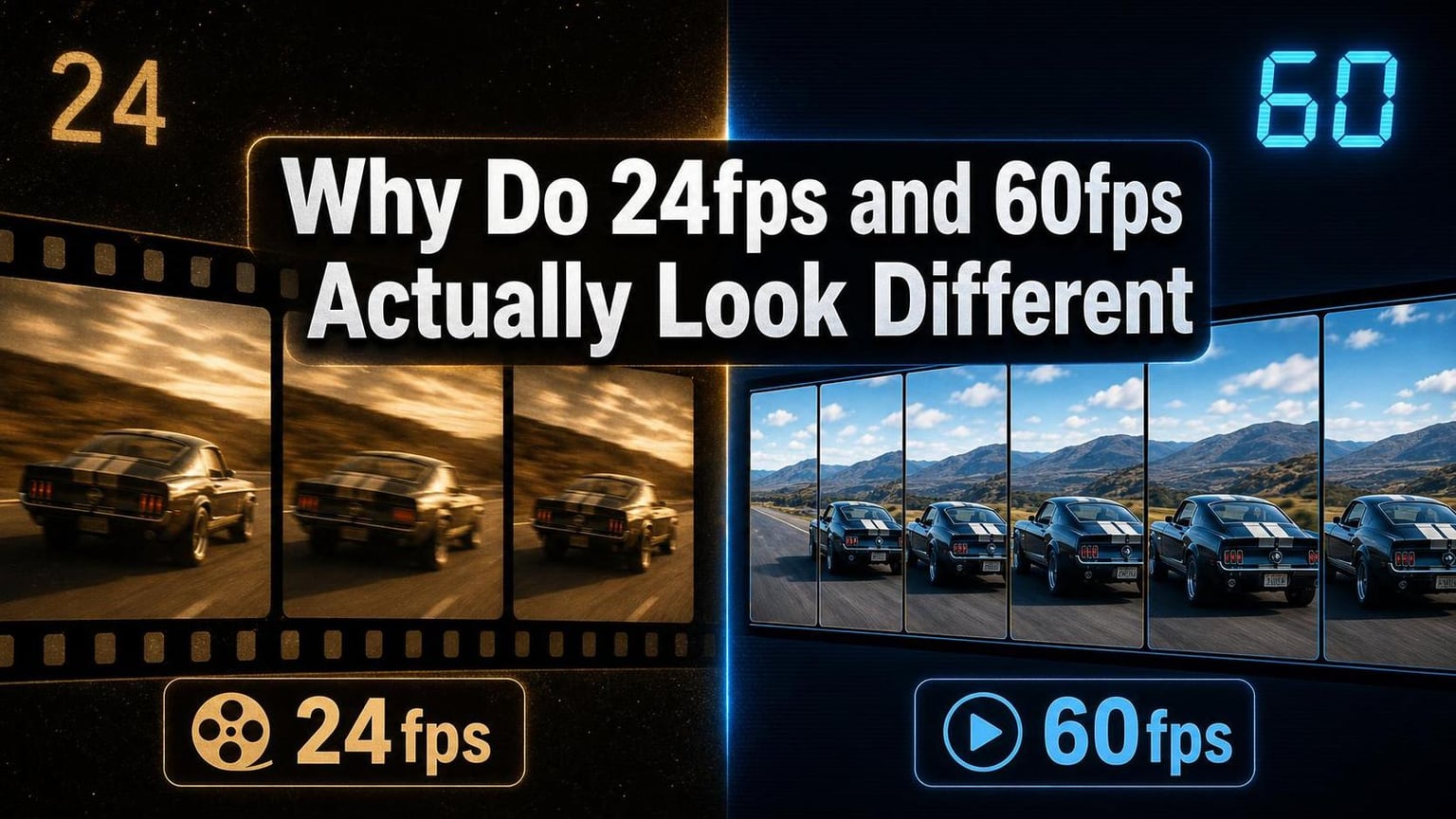
The core reason 24fps and 60fps look different comes down to motion blur and how your brain processes sequential images. At 24fps, each frame is exposed for a longer fraction of a second, which means moving objects blur slightly within each frame. At 60fps, each frame is exposed for a much shorter time, so movement appears sharper and more detailed with far less blur. Your brain interprets the heavy motion blur at 24fps as cinematic and dreamlike, while the sharp, detail-rich frames at 60fps read as hyper-real and sometimes uncanny.
This difference is not just about smoothness. It is about how much information each frame carries. A 24fps frame captures roughly 1/48th of a second of motion, which means any fast-moving object leaves a visible blur trail across the sensor. That blur hides imperfections, smooths transitions between frames, and gives footage the soft, filmic quality audiences associate with cinema.
At 60fps, each frame captures only about 1/120th of a second of motion. Objects barely move during that tiny window, so each frame stays sharp and crisp. When your brain receives sixty sharp frames per second, it sees every micro-movement with stunning clarity. This level of detail is why 60fps footage can feel almost uncomfortably real when you are used to the softer look of cinema.
The jump from 24 to 60 frames per second represents more than double the visual data your brain processes every second. That extra information changes the entire character of the image, from the texture of movement to the emotional tone of a scene.
The Cinematic Effect of Motion Blur
Motion blur is the secret ingredient that makes 24fps footage feel like a movie. When a camera records at 24 frames per second with a standard shutter speed, each frame captures enough time that moving subjects leave a soft blur across the image. This blur acts as natural frame blending, smoothing the transition between one frame and the next.
Your brain interprets this blur as cinematic because it mimics how we perceive fast motion in real life. When you sweep your eyes across a room quickly, your brain does not register sharp details during the movement. Instead, you get a soft impression of motion. 24fps replicates that softness, making the viewing experience feel natural and comfortable.
Forum discussions on Reddit consistently highlight this point. Filmmakers in communities like r/Filmmakers and r/videography report that the motion blur at 24fps creates an emotional resonance that higher frame rates simply cannot match. The blur gives scenes a quality that feels intentional and artful rather than raw and documentary-like.
Without motion blur, 24fps footage would look stuttery and harsh. The blur fills the gaps between frames, tricking your brain into seeing fluid motion even though the camera is only capturing twenty-four images per second. Remove that blur and the cinematic illusion breaks apart entirely.
The 180-Degree Shutter Rule (Explained Simply)
The relationship between frame rate and shutter speed is governed by one of the oldest rules in filmmaking: the 180-degree shutter rule. This rule states that your shutter speed should be roughly twice your frame rate. At 24fps, you shoot with a shutter speed of 1/48th of a second (typically rounded to 1/50th on most cameras). At 60fps, you use 1/120th of a second.
This rule exists because it produces the amount of motion blur our brains have learned to associate with natural-looking movement. The term comes from physical film cameras, where a rotating shutter disc literally had a 180-degree opening. That half-circle opening meant the film was exposed for exactly half the duration of each frame.
When you follow the 180-degree rule at 24fps, you get that signature cinematic blur. Each frame captures enough motion to blur slightly, and those blurred frames blend together smoothly in your brain. The result is the look audiences have expected from movies for nearly a century.
At 60fps, following the same rule gives you 1/120th of a second exposures. That is a much shorter window, which means far less motion blur per frame. The footage stays sharp and detailed, which is ideal for sports and gaming but can feel jarring in narrative storytelling.
Break the 180-degree rule and things get interesting fast. Shoot at 24fps with a very fast shutter like 1/500th of a second and you get the stuttery, hyper-crisp look of the action sequences in films like Saving Private Ryan. Shoot at 60fps with a slow shutter and you introduce back to the blur that makes footage feel cinematic again.
Why 60fps Looks Smooth but Unnatural in Cinema
The soap opera effect is the most common name for what happens when high frame rate video looks wrong in a narrative context. Many modern TVs have a feature called motion interpolation, which artificially inserts extra frames to smooth out 24fps content to 60fps or higher. Viewers often describe the result as looking cheap, like a soap opera or a home video rather than a movie.
The reason 60fps feels unnatural in cinema ties directly to expectations. Audiences have watched films at 24fps for decades. That frame rate is baked into our cultural understanding of what a movie should look like. When you replace the familiar cinematic blur with razor-sharp 60fps motion, the brain registers the footage as something else entirely.
High frame rate footage also triggers what psychologists call the uncanny valley effect. At 60fps, every detail of movement is visible: the micro-expressions on an actor’s face, the slight wobble of a handheld prop, the texture of fabric shifting during a walk. This level of detail can make staged scenes feel uncomfortably real, as if you are watching behind-the-scenes footage rather than a polished film.
Billy Lynn’s Long Halftime Walk, shot by Ang Lee at 120fps, demonstrated this problem on a massive scale. Many viewers reported that the high frame rate made the film look like a television production despite its enormous budget. The footage was technically superior in every measurable way, but it felt wrong because it violated the visual language audiences expect from cinema.
The irony is that 60fps is not inherently bad for storytelling. It simply asks viewers to adjust decades of conditioned expectations. Some filmmakers argue that high frame rates are the future and that audiences just need time to adapt. Whether that prediction comes true remains one of the most debated topics in the filmmaking community.
How the Human Brain Processes Frame Rates
Your eyes do not have a frame rate. This is one of the most persistent myths in video production discussions. The human visual system processes light continuously through photoreceptor cells called rods and cones, not in discrete frames like a camera sensor.
Instead of a frame rate, vision researchers talk about the flicker fusion threshold. This is the frequency at which a blinking light appears steady rather than flickering. For most people, that threshold sits somewhere around 60 flashes per second under normal conditions, though some individuals can perceive flicker at higher rates.
The concept that matters most for understanding 24fps vs 60fps is persistence of vision. This is the phenomenon where an image persists in your visual system for a fraction of a second after the source disappears. Persistence of vision is what allows a sequence of still frames to appear as continuous motion.
At 24fps, the gaps between frames are relatively large. Persistence of vision fills those gaps, but the motion blur within each frame does the heavy lifting of making the transition feel smooth. At 60fps, the frames arrive so quickly that persistence of vision barely has to work. The motion looks smooth because there are simply more images to fill the gaps.
Studies from researchers at MIT have shown that the human brain can process visual information in as little as 13 milliseconds. That translates to roughly 75 images per second, which suggests that the difference between 60fps and higher frame rates like 120fps or 240fps can be perceived, at least by some viewers. The idea that the human eye cannot see beyond 30fps or 60fps is simply wrong.
Gamers have been making this point for years. Players in competitive gaming communities insist they can perceive the difference between 144Hz and 240Hz monitors. While the jump from 60 to 144 is more noticeable than the jump from 144 to 240, the fact that people report perceptible differences at all confirms that human vision does not have a hard cutoff at 60 frames per second.
When to Use 24fps vs 60fps: Practical Guide
Choosing between 24fps and 60fps depends entirely on what you are creating. Here is a practical framework our team uses when deciding on frame rates for different types of projects.
Use 24fps when you want a cinematic look. Narrative films, short films, music videos, and dramatic content all benefit from the motion blur and soft transitions that 24fps provides. If your goal is to tell a story and create emotional resonance, 24fps is almost always the right choice.
Use 60fps when capturing fast action or when smoothness matters more than mood. Sports broadcasts, video game streaming, wildlife photography, and any content where viewers need to track rapid movement all benefit from higher frame rates. The extra frames reduce judder and make motion easier to follow.
Use 60fps for slow motion as well. If you shoot at 60fps and play back at 24fps, your footage will play at 40 percent speed, creating a gentle slow-motion effect. For dramatic slow motion, you would go even higher to 120fps or 240fps, but 60fps is a great starting point for subtle speed ramps and accent moments.
Vloggers and YouTube creators face a common dilemma here. Some choose 24fps for a cinematic look, while others prefer 30fps or 60fps for a cleaner, more direct connection with the audience. There is no wrong answer, but consistency matters. Mixing frame rates within a single project creates a jarring viewing experience.
If you are unsure, start with 24fps for any narrative or artistic content and 60fps for any content where clarity and smoothness are the priority. You can always experiment from there once you understand how each frame rate feels in context.
Common Misconceptions About Frame Rates
One of the biggest myths in video production is that higher frame rates always produce better video. This is simply not true. A well-shot 24fps film looks infinitely better than a poorly lit 60fps video. Frame rate is a creative choice, not a quality metric.
Another misconception is that 24fps is outdated technology that persists only because of tradition. While it is true that 24fps originated as a compromise between cost and quality in the 1920s, the frame rate has survived because it creates a specific aesthetic that audiences love. It is a feature, not a limitation.
Many beginners also believe that shooting in 60fps gives them more flexibility in post-production. This is partially true since you can always slow down 60fps footage. However, if your final output is 24fps, you need to think carefully about how you convert the extra frames. Simply dropping 60fps footage into a 24fps timeline without proper handling can introduce judder and visual artifacts.
Finally, there is the persistent myth that the human eye cannot perceive differences above 30fps or 60fps. As we discussed earlier, research from MIT and the experiences of competitive gamers thoroughly debunk this. The brain can perceive differences well beyond 60 frames per second, even if the nature of those differences changes at higher rates.
FAQs
Why does 60fps look unnatural?
60fps looks unnatural in cinematic content because it removes the motion blur that audiences associate with traditional film. Each frame at 60fps is captured with a much shorter shutter speed, making movement sharper and more detailed than our brains expect from a movie. This hyper-real clarity triggers what psychologists call the uncanny valley effect, where footage feels uncomfortably real rather than artfully staged.
Why does 24 FPS look weird?
24fps can look weird when there is very little motion blur in each frame, which happens when you use a fast shutter speed. Without the natural blur that the 180-degree shutter rule provides, 24fps footage looks stuttery and choppy. It can also look strange on modern high-refresh-rate TVs that use motion interpolation to artificially smooth the image, creating the soap opera effect.
Can the human eye see over 60 FPS?
Yes, the human eye can perceive differences well above 60 frames per second. The human visual system does not have a fixed frame rate like a camera. Research from MIT has shown that the brain can process visual information in as little as 13 milliseconds, which translates to roughly 75 images per second. Competitive gamers regularly report perceptible differences between 144Hz and 240Hz displays.
Why does 60 FPS look so choppy?
60fps itself should not look choppy since it captures more frames per second than 24fps. However, 60fps footage can appear choppy when it is displayed on a screen with a refresh rate that does not divide evenly into 60, causing frame timing inconsistencies. It can also look choppy if frames are dropped during playback due to insufficient processing power or bandwidth.
Conclusion
The difference between 24fps vs 60fps comes down to motion blur, shutter speed, and how your brain processes sequential images. At 24fps, longer exposures create soft motion blur that reads as cinematic and artful. At 60fps, shorter exposures produce sharp frames that feel smooth and hyper-real. Neither frame rate is objectively better, they simply serve different creative purposes.
Understanding why these two frame rates look so different gives you a powerful tool as a creator. Whether you are shooting a short film, streaming gameplay, or recording a vlog, choosing the right frame rate is one of the most impactful decisions you can make before pressing record.
If you remember nothing else from this guide, remember this: frame rate is a creative choice, not a quality score. Pick the one that serves your story, follow the 180-degree shutter rule for natural-looking motion, and let the science of perception work in your favor.