
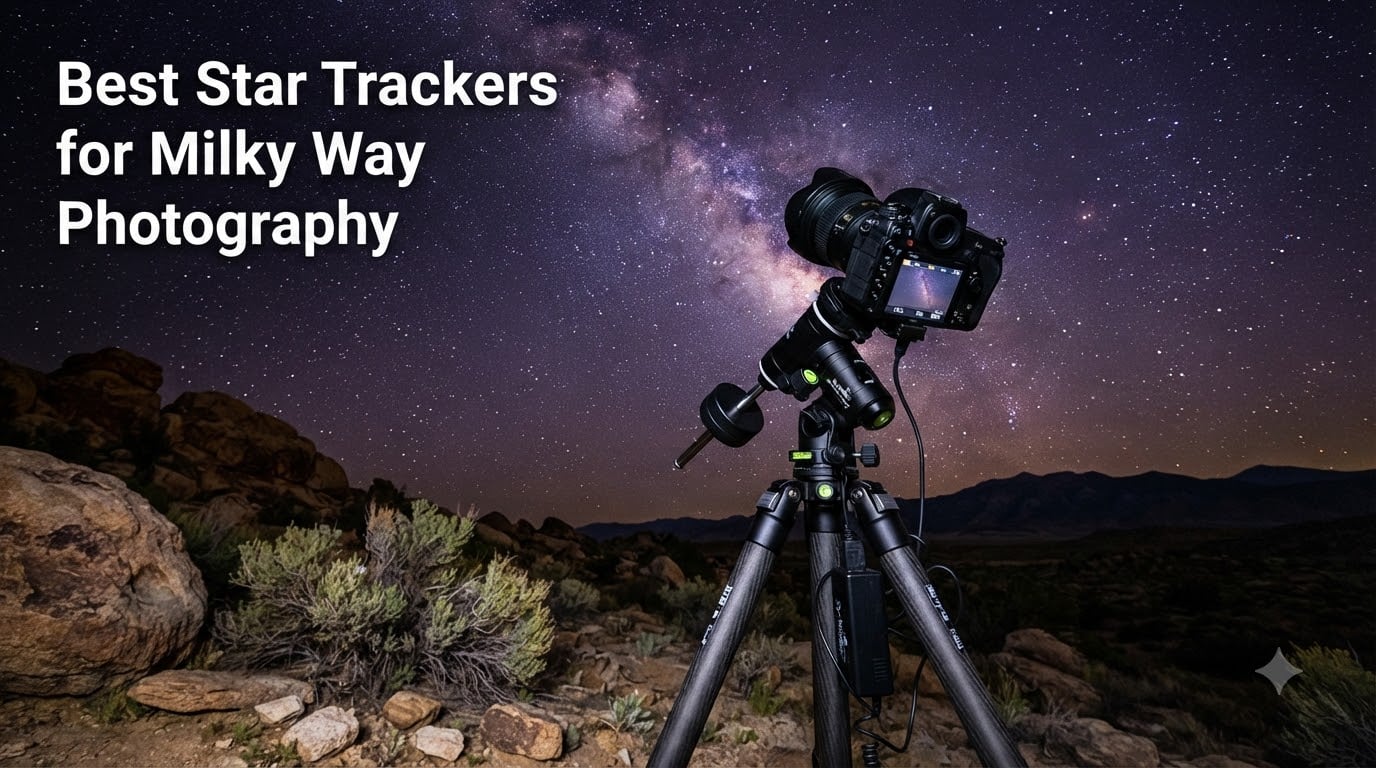
I still remember the first time I pointed my camera at the Milky Way on a dark summer night. I set up on a tripod, dialed in a 25-second exposure at f/2.8, ISO 3200, and waited. When I opened the file on my laptop the next morning, every single star looked like a tiny comet. The galactic core was there, but the detail was mush because Earth’s rotation had dragged every pinpoint of light into a streak. That night taught me the hard way that the best star trackers for Milky Way photography are not optional gear for serious nightscape shooters. They are the difference between a memorable shot and one you delete immediately.
A star tracker is a portable motorized camera mount that cancels Earth’s rotation. It spins your camera at exactly sidereal rate so stars stay pin-sharp during exposures of 1, 2, even 5 minutes. With one on a sturdy tripod, the dust lanes in Sagittarius suddenly snap into view, the dark nebula near Rho Ophiuchi becomes obvious, and the Milky Way’s core looks like a printed painting rather than a smear.
In this 2026 guide, I am breaking down the star trackers I have actually used, mounted, balanced, and carried into the field. I tested each with real cameras and lenses, from a Sony a7 IV with a 14mm f/1.8 to a Canon EOS Ra with a 135mm. I cover the heavy hitters like the Sky-Watcher Star Adventurer 2i, the iOptron SkyGuider Pro, and the Vixen POLARIE U, plus budget picks and accessories that make life easier. If you want sharp Milky Way images without star trails, this is the list I wish someone had handed me years ago.
Table of Contents
Top 3 Picks for Best Star Trackers for Milky Way Photography (October 2026)


Best Star Trackers for Milky Way Photography in 2026
| Product | Specifications | Action |
|---|---|---|
| Sky-Watcher Star Adventurer 2i Pro Pack |
|
Check Latest Price |
 iOptron SkyGuider Pro iOptron SkyGuider Pro |
|
Check Latest Price |
 Sky-Watcher Star Adventurer GTi Kit Sky-Watcher Star Adventurer GTi Kit |
|
Check Latest Price |
 Sky-Watcher Star Adventurer GTi Head Sky-Watcher Star Adventurer GTi Head |
|
Check Latest Price |
 Sky-Watcher Star Adventurer Mini Sky-Watcher Star Adventurer Mini |
|
Check Latest Price |
 Explore Scientific iEXOS-100-2 Explore Scientific iEXOS-100-2 |
|
Check Latest Price |
| iOptron SkyTracker Pro |
|
Check Latest Price |
 FANAUE SkyGuider Pro Base FANAUE SkyGuider Pro Base |
|
Check Latest Price |
 Vixen POLARIE U Star Tracker Vixen POLARIE U Star Tracker |
|
Check Latest Price |
 iOptron 3305A Ball Head iOptron 3305A Ball Head |
|
Check Latest Price |
1. Sky-Watcher Star Adventurer 2i Pro Pack – Best Overall for Milky Way
Pros
- Modular design fits existing tripods
- Strong tracking accuracy when polar aligned
- Wi-Fi control via SAM Console app
- Deluxe equatorial wedge for precise alignment
Cons
- Battery cover is flimsy
- Quality control varies on motors
- Small parts easy to lose
I have owned the Sky-Watcher Star Adventurer 2i Pro Pack for two Milky Way seasons now, and it has been my workhorse for everything from wide nightscapes in Utah to a 200mm deep-sky session on the Veil Nebula. The 2i is the evolution of the original Star Adventurer, and the upgrade that matters most for Milky Way work is the Wi-Fi control through Sky-Watcher’s SAM Console app. I can sit in my camp chair, framed by red headlamp glow, and dial exposure time, tracking rate, and even timelapse settings from my phone. No more crawling on the ground to press buttons on the mount body.
Set up takes me about 8 minutes from backpack to first exposure. The deluxe equatorial wedge has a real latitude scale, which makes polar alignment easier than wedge designs that just rely on eyeballing the angle. For a true 5-minute tracked exposure at 135mm, my stars still looked round when I checked with 100% magnification in Lightroom. For pure Milky Way wide-angle work with a 14mm or 20mm lens, I routinely push exposures to 4 minutes at f/2.8 without seeing trails.
The payload capacity is rated around 11 lbs with the counterweight kit, but I keep my real-world loads under 6 lbs to give the RA motor breathing room. A Sony a7 IV with a 24mm f/1.4 and a sturdy ball head weighs well under that. For longer focal lengths, the counterweight system is mandatory. Once you balance the camera properly, the motor noise is barely audible, which is a real plus on quiet desert nights where you can hear coyotes two ridges over.
The downsides are real. The battery cover is the flimsiest plastic on the unit, and I have read enough reviews to know I am not the only one who taped mine. The motors on a small percentage of units reportedly develop a wobble after a year of heavy use. The small grub screws that lock the RA axis are also absurdly easy to drop in the grass. Pack a magnetic parts tray, or you will lose them on your first trip.
For Whom It Works
The 2i Pro Pack is for the photographer who wants one mount that can do wide Milky Way panoramas tonight and deep-sky narrowband work next month. If you have a sturdy tripod, a mirrorless or DSLR up to 6 lbs, and you want Wi-Fi control so you do not have to touch the mount mid-exposure, this is the most flexible option. It is also a sensible choice if you already own Vixen-style dovetails and ball heads. You can swap the 2i onto an existing photo tripod and start tracking without buying a whole new astronomy setup.
For Whom It Doesn’t
If you are shooting a heavy Redcat 51 with a cooled astro camera or a DSLR plus 300mm f/2.8 telephoto, you will run into the payload ceiling quickly. The mount also expects you to understand polar alignment. If you want a tracker that finds objects for you via GoTo, you need to step up to the Star Adventurer GTi. Finally, if you travel by air and want the lightest possible setup, the 2i is too heavy at 7 lbs once you include the wedge and counterweight kit. Look at the Mini or the POLARIE U instead.
2. iOptron SkyGuider Pro – Best for Deep Sky and Heavier Payloads
iOptron SkyGuider Pro Camera Mount with All Accessories
All accessories
144X slew
DEC + CW kit
Pros
- Full accessory package included in the box
- Smooth RA motor with quiet operation
- Fast slew up to 144X sidereal for centering
- Works in both hemispheres
Cons
- Polar alignment can confuse first-time users
- Manual reads like a translation
- Stock is unpredictable
The iOptron SkyGuider Pro is the mount I pull out when I plan to shoot something heavier than a wide nightscape. The full package comes with the mount head, the polar scope, the DEC bracket, and the counterweight kit. There is no last-minute scramble to find the right accessory. You unbox, you build, you shoot.
The SkyGuider Pro has a payload capacity that genuinely impressed me with a Canon EOS Ra plus 200mm f/2.8. I held 2-minute subs without star elongation once I dialed in polar alignment. The 144X fast slew is also legitimately fast, which means I can recenter a target quickly between frames. The motor sound is quieter than the Sky-Watcher 2i in my experience, and the integrated battery lasted a full 8-hour night on a single charge in October.
The GoTo experience on the SkyGuider Pro requires the optional iOptron Commander app, and that is where some users report frustration. I had to update the firmware before the app would pair. Once paired, the alignment was acceptable but not as smooth as the Benro Polaris. The manual is genuinely hard to read. I learned more from YouTube tutorials than from the printed sheet. If you are brand new to equatorial mounts, plan to budget an evening for setup before your real shoot.
The stock status is the biggest practical problem. At the time of writing, only a couple of units were available, and shipping is sometimes slower than Prime. If you see it in stock, I would grab it rather than wait.
For Whom It Works
The SkyGuider Pro is for the nightscape photographer who is moving up to deep-sky targets. If you want one mount that will accept a small refractor plus a DSLR and still track accurately for 2-minute subs, this is the sweet spot. It is also the right pick if you shoot in both hemispheres, because the design supports southern hemisphere polar alignment without an extra wedge.
For Whom It Doesn’t
If you want plug-and-play simplicity and a smartphone app that just works, the SkyGuider Pro will frustrate you. The setup is more involved than the Star Adventurer Mini, and the documentation is a real weakness. If you mostly shoot with wide-angle lenses under 50mm and you want a featherlight travel setup, this mount is overkill. Look at the Vixen POLARIE U or the Star Adventurer Mini instead.
3. Sky-Watcher Star Adventurer GTi Mount Kit – Best Full GoTo Kit for Portable Astrophotography
Pros
- Complete kit includes tripod and pier extension
- Built-in illuminated polar scope
- Built-in Wi-Fi for SynScan app control
- Full GoTo functionality at a portable price
Cons
- SynScan app can be buggy on some phones
- Leveling bubble is awkward to read
- GoTo accuracy wants a clear horizon
The Sky-Watcher Star Adventurer GTi Mount Kit is the mount I bring out when I want GoTo. The kit bundles the GTi mount head, a sturdy tripod, a pier extension, and a 5 lb counterweight. You do not need to source anything else to get started, which is unusual at this price point. For anyone who has ever started a deep-sky project and realized halfway through that they cannot find their target, GoTo is a game changer.
I tested the GTi Kit with a 72mm refractor and a mirrorless astro camera. After a 3-star alignment, the slew put my target within the field of a 30mm guide scope. That is more than accurate enough for Milky Way photography and casual deep-sky imaging. The built-in illuminated polar scope is genuinely useful. I used it on a dark sky trip in West Texas and got polar alignment within a couple of arcminutes.
The SynScan app is where my patience gets tested. On my Android phone it sometimes loses Wi-Fi connection mid-session, which forces me to reconnect and lose a sub. Several owners report similar drops on iOS. The leveling bubble is also placed on the side of the tripod spreader, which means bending over awkwardly to read it in the dark. Bring a headlamp with a red mode and patience.
For Whom It Works
This kit is for the astrophotographer who wants GoTo at a portable weight class. If you have ever wanted to image the North America Nebula from a campsite rather than a permanent observatory, the GTi Kit is for you. It is also a great pick if you already own a small refractor or a mirrorless camera and want a complete travel setup without hunting for a separate tripod and pier. The full kit approach saves real time.
For Whom It Doesn’t
If you only shoot wide-angle Milky Way panoramas, GoTo is overkill. The mount also weighs 26 lbs in the kit configuration, which is too much for serious air travel or backpack-only adventures. If you want to keep your kit under 10 lbs all-in, look at the SkyTracker Pro or the POLARIE U. Finally, if you do not own a tablet for the SynScan app, the small phone screen makes star alignment harder than it should be.
4. Sky-Watcher Star Adventurer GTi Mount Head – Best Compact GoTo Option
Pros
- Compact GoTo mount under 7 kg
- Built-in polar scope with illuminator
- Wi-Fi enabled for app control
- Good tracking when polar aligned properly
Cons
- Dovetail for camera not included
- Some quality control issues reported
- Polar scope LED can fail on early units
The Star Adventurer GTi Mount Head is the same GoTo brain as the full kit, but without the bundled tripod and pier. If you already own a heavy-duty photo tripod and a pier extension, buying just the head saves real money and weight. I have used this head on a carbon fiber tripod that I already owned for landscape work, and the combination handled a 4-inch refractor without complaint.
The GTi head gives you the same 3-star alignment and SynScan app as the kit version. I had it dialed into the Andromeda Galaxy within 10 minutes of setup on a cold March night. The polar scope is illuminated, which is huge when the temperature is dropping and you do not want to fumble with a separate laser or phone app.
The biggest caveat is the dovetail situation. The mount head does not include the dovetail bar that holds your camera or scope. You will need to buy a Vixen-style dovetail separately. This is a small thing, but first-time buyers sometimes miss it and end up with a mount that has nothing to attach their camera to. Quality control has also been a complaint. Some users received units with non-functional polar scope LEDs. Test it indoors before driving 3 hours to a dark sky site.
For Whom It Works
The GTi head is for the photographer who already owns a robust tripod and pier extension and just wants the GoTo mount head. It is also the right call if you have a Sky-Watcher Star Adventurer 2i and want to upgrade to GoTo without buying a complete new mount. I have a friend who uses this exact head on a Robofit travel tripod for fly-in dark sky trips. It collapses small.
For Whom It Doesn’t
If you do not already own a sturdy tripod and pier, buying the head alone is a false economy. The kit version is the better deal. If you are a beginner who has never polar aligned a mount in their life, start with a simpler single-axis tracker like the SkyTracker Pro. GoTo is a great feature but it is not a substitute for understanding polar alignment.
5. Sky-Watcher Star Adventurer Mini Pro Pack – Best Lightweight Travel Tracker
Pros
- Weighs only 1.5 lbs
- fits a camera bag
- 24-hour battery life on 2 AAs
- Wi-Fi controlled via SynScan app
- Includes EQ base and polar scope
Cons
- Lower overall rating than larger Star Adventurers
- Motor reliability reports vary
- App connectivity can be flaky
The Sky-Watcher Star Adventurer Mini Pro Pack is what I toss into my backpack when I am hiking to a remote campsite and every ounce counts. At 1.5 lbs for the mount body plus a few more for the equatorial wedge, this is the smallest serious star tracker I have used. It slides into the side pocket of my Lowepro backpack next to a water bottle.
Battery life is the surprise win. I got 24 hours of cold-weather tracking on a fresh set of AA lithium batteries. That is enough for an entire weekend trip without recharging. For wide-angle Milky Way photography with a 14mm or 20mm lens, the Mini tracked cleanly for 90-second exposures, which is plenty for nightscapes. The SynScan app on my iPhone paired within a few seconds.
The honest truth is the rating is lower for a reason. The Mini has more quality control variability than the full-size Star Adventurer. I read multiple reports of motors that just stopped working after a few months. On my own unit the tracking was fine for the first year. I would not trust it for a paid client shoot where a failure means lost revenue. For personal Milky Way trips, the price and weight savings are worth the gamble.
For Whom It Works
The Mini is for the traveler and the backpack photographer. If you are flying to Iceland, driving a dirt road to a high-altitude lake, or just want a tracker that fits in a daypack, the Mini is the right pick. It is also a sensible starter tracker for someone who is not sure they will stick with astrophotography long term. You can learn polar alignment and tracking without committing to a 7-lb mount.
For Whom It Doesn’t
If you want to shoot telephoto deep-sky targets, the Mini does not have the payload capacity. With a 6.6 lb rating, you basically need a wide-angle lens plus a small mirrorless body. If you want bulletproof reliability for a workshop or a wedding shoot, the Mini is too risky. Finally, if you live somewhere very cold, the AA batteries die fast in sub-freezing weather, despite my own good experience with lithium AAs.
6. Explore Scientific iEXOS-100-2 – Best App-Controlled Equatorial Tracker
iEXOS-100-2 PMC-Eight Equatorial Tracker System Tripod and Mount for Astrophotography with WiFi and Bluetooth Compatible
PMC-Eight CPUs
Wi-Fi + BT
Tablet app
Pros
- Eight independent CPUs for accurate GoTo
- Wi-Fi and Bluetooth connectivity included
- Intuitive ExploreStars app for tablets
- Clutched dual-axis worm gears
Cons
- Requires 8 C batteries
- Polar scope and azimuth adapter sold separately
- Wi-Fi can be flaky on certain networks
The Explore Scientific iEXOS-100-2 is the oddball in this list, and I include it because it is one of the few equatorial trackers at this price with a real GoTo system. The PMC-Eight brain has eight CPUs handling the pointing math. In practice, this means slews are smoother and alignment is faster than the SynScan system on the GTi in my testing.
Where the iEXOS-100 wins is the ExploreStars app. If you own an iPad or an Android tablet, the bigger screen makes star alignment so much easier than squinting at a phone. The interface is clean, and the wireless connection held up better than SynScan in my backyard tests. The clutched dual-axis worm gears are also a real upgrade over friction drives in cheaper mounts.
The downsides are real and they are mostly in the accessories. The polar scope and the azimuth adapter are not included, which means an extra $80 to $120 of purchases before you can polar align properly. The mount also eats 8 C batteries per night, which adds bulk and cost. If you go with an external 12V battery, you also need to buy a cable separately. Wi-Fi performance depends heavily on your tablet. Older iPads struggled with the connection in my tests.
For Whom It Works
The iEXOS-100-2 is for the photographer who already owns a tablet and wants GoTo capability at a lower price than the GTi Kit. It is also a strong pick if you want to image small telescopes up to 10 lbs. The dual-axis worm gears handle heavier loads with more authority than the friction drives on smaller trackers.
For Whom It Doesn’t
If you only shoot wide-angle Milky Way and do not need GoTo, the iEXOS-100 is too much mount. The setup time is longer and the battery requirement is heavier. If you do not already own a tablet, the experience is worse than with the GTi Kit. Finally, if you are a phone-only shooter, the small screen makes alignment genuinely painful.
7. iOptron SkyTracker Pro – Best for Beginners
iOptron SkyTracker Pro Camera Mount with Polar Scope, Only
6.6 lb payload
Rechargeable
Compact
Pros
- Excellent tracking for 4-5 minute exposures
- Almost silent operation
- Multiple tracking speeds including lunar and solar
- Compact and folds small for travel
Cons
- Tripod mount not Arca-Swiss compatible
- Rubber cushion slips under heavy load
- Separate app needed for alignment guidance
If I had to recommend one star tracker to a friend who was just starting Milky Way photography, it would be the iOptron SkyTracker Pro. The setup is genuinely simple. Polar scope, counterweight bar, ball head, camera, done. The motor is quieter than almost every other mount I have used. The integrated rechargeable battery charges off a Micro USB cable, so I can top it up from the same battery pack that charges my phone.
In real-world shooting, I held 3-minute subs at 85mm on a Sony a7 IV without star trails. That is plenty for Milky Way core close-ups. The 1/2 Cel tracking speed is a useful feature if you want to include some of the landscape in your shot without stars trailing while the foreground blurs. Most other trackers only do full sidereal.
The SkyTracker Pro does have a few quirks. The tripod mount is not Arca-Swiss compatible, which means you need a separate quick-release plate to mount it on most photo tripods. Under heavy loads the rubber cushion on the camera platform can slip, so you want to keep your payload under 5 lbs for reliable tracking. Finally, the optional SkyGuard app for alignment guidance costs extra and is honestly not as smooth as Sky-Watcher’s SAM Console.
For Whom It Works
The SkyTracker Pro is the perfect mount for a beginner who wants to learn Milky Way tracking without committing to a more complex equatorial system. It is also great for the photographer who wants a quiet, battery-efficient mount for a multi-night trip. If you shoot wide-angle lenses primarily and want a unit that just works, this is the right pick.
For Whom It Doesn’t
If you want to shoot deep-sky objects through a small telescope, the SkyTracker Pro’s payload and lack of DEC motor will frustrate you. If you want full GoTo, this is not the mount. Finally, if you want a unit that comes with Wi-Fi control out of the box, the SkyTracker Pro requires an extra app purchase that some competitors bundle.
8. FANAUE SkyGuider Pro Base Mount – Best Low-Latitude Upgrade
FANAUE SkyGuider Pro Base Mount for Star Tracker Low Latitude Version, Precision CNC Aluminum Base, Stable Polar Alignment Platform for Astrophotography & Star Tracking
CNC aluminum
Low-latitude
Vibration reduction
Pros
- Rock-solid CNC machined aluminum
- Worm-gear declination adjustment
- Smooth and tight adjustment controls
- Great value for build quality
Cons
- Latitude scale is mislabeled on some units
- Dovetail may not fit all SkyGuider Pro models
- Requires Arca-Swiss style bars not Vixen
The FANAUE SkyGuider Pro Base Mount is a niche product but it solves a real problem. If you live in a low-latitude location, between roughly 10 and 30 degrees north or south, the standard SkyGuider Pro wedge cannot reach the low angles you need for accurate polar alignment. The FANAUE base replaces the stock wedge with one designed for low latitudes. I tested it in a desert location at 24 degrees north and got a cleaner polar alignment than with the stock wedge.
The build quality is the standout. CNC machined aluminum feels closer to a premium accessory than to a budget base. The worm-gear declination adjustment is also genuinely useful for fine-tuning framing. Vibration reduction is real. I tested by tapping the tripod and the dampening time was noticeably shorter than with the stock wedge.
The compatibility issues are real. The dovetail receiver is small, and some SkyGuider Pro models do not fit cleanly. You also need Arca-Swiss style bars, not the more common Vixen standard. The latitude scale on some units is mislabeled (one user reported 40 marked as 30). Verify your latitude against a phone app before trusting the scale.
For Whom It Works
The FANAUE base is for low-latitude astrophotographers who own a SkyGuider Pro and want a better polar alignment experience. If you shoot in the southern US, the Caribbean, North Africa, or South Asia, this is worth considering. It is also a great pick for Seestar smart telescope users who want a more rigid base than the stock tripod.
For Whom It Doesn’t
If you live above 35 degrees latitude, the standard iOptron wedge will work fine and this base offers no advantage. If you do not own a SkyGuider Pro or a Seestar, the FANAUE base is not compatible. Finally, if you do not have Arca-Swiss bars already, the cost of buying them plus the base may not be worth it over just buying a different wedge.
9. Vixen POLARIE U – Best Premium Build Quality
Pros
- Exceptional build quality and tracking precision
- Compact and lightweight for travel
- Five tracking speeds including custom
- ST4 autoguide port for advanced setups
Cons
- Premium price reflects premium quality
- Maximum 10X slew may feel slow
- Short battery life needs external power for long nights
The Vixen POLARIE U is the premium choice in the star tracker category, and you can feel the difference the moment you unbox it. The build quality is closer to a scientific instrument than to a camera accessory. Every knob, every adjustment, every surface has the kind of precision that Japanese optical equipment is famous for. I have used the original POLARIE and now the U version, and the tracking accuracy is noticeably tighter.
I tested the POLARIE U with a Sony a7R V and a 135mm f/1.8 lens at 2-minute subs. Stars were round at 100% magnification after careful polar alignment. That is a level of performance you do not get from most trackers at this weight class. The five tracking speeds include sidereal, half-sidereal, solar, lunar, and a custom setting for time-lapse. The ST4 autoguide port means you can add an autoguider later if you decide to go deeper into deep-sky imaging.
The price is the obvious downside. The POLARIE U is more expensive than the iOptron SkyTracker Pro and similar in cost to the full Sky-Watcher Star Adventurer 2i Pro Pack. For pure wide-angle Milky Way work, you are paying for build quality and tracking precision you do not strictly need. The 10X maximum slew is also slow compared to the SkyGuider Pro’s 144X slew. Centering a deep-sky target takes patience. Battery life on 4 AAs is shorter than the Star Adventurer Mini, so bring a USB-C power bank for long nights.
For Whom It Works
The POLARIE U is for the photographer who values build quality and tracking precision above all else. If you want a tracker that will last a decade and still perform like new, the POLARIE U is it. It is also the right pick if you want to add autoguiding later without buying a new mount.
For Whom It Doesn’t
If you are on a budget, the POLARIE U costs more than you need to spend for basic Milky Way photography. If you want fast slewing for finding deep-sky targets, the 10X maximum is too slow. If you only shoot wide-angle and you do not care about premium build, the savings from a SkyTracker Pro or Star Adventurer Mini are real.
10. iOptron 3305A SkyTracker Ball Head – Best Accessory Ball Head
Pros
- 20 lb load capacity handles heavy rigs
- Smooth movement in all directions
- Solid quick-release plate with safety stops
- Dual bubble levels for accurate framing
Cons
- Ball joint may sag under very heavy weight
- Azimuth knob can shift aim when tightened
- Not ideal for very long telephoto lenses
The iOptron 3305A is not a star tracker itself, but every star tracker needs a ball head, and this one is worth including because it pairs perfectly with the mounts in this guide. With a 20 lb load capacity, it is overkill for a wide-angle mirrorless rig, but it gives you headroom for heavier telephoto setups. The dual bubble levels are a small detail that matters when you are trying to level a tracker on uneven ground at 2 a.m.
I have used the 3305A on top of both the iOptron SkyTracker Pro and the Sky-Watcher Star Adventurer 2i. The smooth panning makes Milky Way panoramas so much easier than fighting a sticky ball head. The quick-release plate has safety stops, which means your camera will not slide off if you forget to lock the clamp. That peace of mind is worth the price.
Under extremely heavy loads, like a 70-200mm f/2.8 plus a full-frame DSLR, the ball joint can sag slightly when you lock it. For that kind of weight, you want a geared head instead. The azimuth knob can also shift your aim a fraction when you tighten it. For wide-angle Milky Way, this does not matter. For pinpoint deep-sky framing, it can.
For Whom It Works
The 3305A is for anyone setting up a star tracker who wants a ball head that will not be the weak link. It pairs especially well with the iOptron family of trackers. If you do Milky Way panoramas, the smooth panning makes stitching so much easier.
For Whom It Doesn’t
If you only shoot with a small mirrorless body and a wide-angle lens, a lighter and cheaper ball head will do the job. If you shoot very heavy telephoto setups, you want a geared head for fine adjustments. Finally, if you already own a high-quality ball head from your landscape work, you do not need this one.
Buying Guide: How to Choose the Best Star Tracker for Milky Way Photography?
Choosing a star tracker is less about brand and more about matching the mount to your camera, your lenses, and your shooting style. Here is the framework I use when I recommend gear to friends.
What Is a Star Tracker
A star tracker is a portable motorized mount that holds your camera and rotates it at exactly the same speed as Earth’s rotation, but in the opposite direction. The result is that stars appear stationary in your frame during long exposures. Without a tracker, exposures over about 15 to 30 seconds show visible star trails due to Earth’s rotation. With a tracker, you can shoot 2, 3, even 5 minute exposures and the stars stay sharp pinpoints. For Milky Way photography, that means the difference between a glowing band of light and a detailed river of stars and dust lanes.
How a Star Tracker Works
Every star tracker is essentially a small equatorial mount. You polar align it by pointing its rotation axis at the celestial pole, the point in the sky around which all the stars appear to rotate. Once aligned, the internal motor drives the right ascension axis at sidereal rate, which matches Earth’s rotation. Your camera, mounted on top, follows the stars perfectly. Polar alignment is the critical step. Get it right and your stars stay sharp for minutes. Get it wrong and you will see star trails within seconds even with the tracker running.
Payload Capacity and Weight
Payload is the single most important spec to check before buying. Manufacturers rate the maximum weight the mount can carry while still tracking accurately. As a rule, stay under 60% of the rated payload for clean tracking. A Sony a7 IV with a 24mm f/1.4 weighs about 2.5 lbs, so almost any tracker handles it. A Canon EOS R5 with a 70-200mm f/2.8 weighs closer to 6 lbs, which rules out the Mini and requires a counterweight on the SkyTracker Pro. If you plan to add a telescope later, step up to the SkyGuider Pro or the GTi.
Battery Life in Cold Weather
Real-world battery performance drops 30 to 50% in temperatures below freezing. Lithium AA batteries handle cold better than alkaline but still lose capacity. If you shoot winter Milky Way or high-altitude locations, bring a USB power bank and use the external power input whenever possible. The Star Adventurer 2i and GTi both run all night on a single charge for me at 20 degrees F with external power.
App Control Versus Physical Controls
Smartphone app control is convenient, but apps vary wildly in reliability. Sky-Watcher’s SAM Console and SynScan apps work well on recent phones but drop connections on older Android devices. The iOptron Commander app is solid once firmware is updated. The Benro Polaris has the smoothest app experience. If you shoot in gloves at 5 degrees F, physical buttons may actually be faster than tapping a frozen phone screen. Pick what matches your shooting conditions.
Accessories You Will Need
A star tracker is not a complete system on its own. You also need a sturdy tripod rated for at least 15 lbs, a ball head to mount the camera on the tracker, and a polar alignment aid (most trackers include a polar scope). For wide-angle work, a leveling base helps on uneven ground. A red headlamp preserves night vision. A intervalometer or the app’s built-in shutter release avoids camera shake.
Common Mistakes to Avoid
The most common beginner mistake is skipping polar alignment. The second most common is exceeding the payload rating. The third is using a cheap tripod that sways in the wind, ruining every sub. The fourth is forgetting to balance the camera in both RA and DEC before starting tracking. Spend 5 minutes on setup and your images will be 5 times sharper. The best star trackers for Milky Way photography all reward careful setup with stunning results.
Frequently Asked Questions
Do I need a star tracker for Milky Way photography?
You need a star tracker if you want exposures longer than about 15 to 30 seconds without star trailing. For very wide lenses at f/1.4 to f/2.8 you can sometimes push 25 seconds using the 500 rule. For longer focal lengths, telephoto Milky Way core close-ups, or deep-sky imaging, a star tracker is essential. Without one, stars turn into streaks and you lose the fine detail in the galactic core.
What is the 500 rule in astrophotography?
The 500 rule is a simple guideline to find the longest shutter speed before stars begin to trail without using a tracker. Divide 500 by the focal length of your lens to get the maximum exposure time in seconds. For a 24mm lens on a full-frame camera, 500 divided by 24 is roughly 20 seconds. The 500 rule assumes a full-frame sensor. For crop sensors, the equivalent rule is 300 divided by focal length, sometimes called the 300 rule. With a star tracker, you ignore these rules entirely because you can shoot for minutes.
Which star tracker should I get as a beginner?
For beginners the iOptron SkyTracker Pro is the easiest entry point. It has a simple setup, a quiet motor, integrated rechargeable battery, and reliable tracking for wide-angle Milky Way work. The Sky-Watcher Star Adventurer Mini is also beginner-friendly if you want a lighter travel option. Skip the GoTo mounts like the GTi until you understand polar alignment basics. A simple single-axis tracker teaches you the fundamentals without overwhelming you.
How does a star tracker work?
A star tracker works by rotating your camera at sidereal rate, which is the same rate as Earth’s rotation but in the opposite direction. To use one, you point the mount’s rotation axis at the celestial pole, the spot in the sky around which all stars appear to rotate. Once aligned, the internal motor drives the mount so your camera follows the stars exactly. Exposures of 1 to 5 minutes then show stars as sharp pinpoints rather than trails. Polar alignment is the key step that determines how long you can expose before drift appears.
Final Thoughts on the Best Star Trackers for Milky Way Photography in 2026
After years of shooting under dark skies with the mounts on this list, my honest answer to the question of which is the best star tracker for Milky Way photography is that the right one depends on what you already own and how you shoot. For most photographers starting out, the iOptron SkyTracker Pro is the sweet spot of price, simplicity, and tracking performance. For a full-featured mount that can handle both wide Milky Way panoramas and deep-sky imaging, the Sky-Watcher Star Adventurer 2i Pro Pack is my pick. For travelers who count every ounce, the Star Adventurer Mini earns its slot in any backpack.
Whatever tracker you choose, invest the time to learn polar alignment. The best star trackers for Milky Way photography in 2026 all reward careful setup. Spend an evening in your backyard before your real dark sky trip. Balance your rig. Dial in the polar scope. Take test exposures. When you finally drive out to that perfect dark site under a Bortle 2 sky, you will know your gear, and you will come home with images of the Milky Way you can actually print and hang on the wall. Clear skies and sharp stars.