
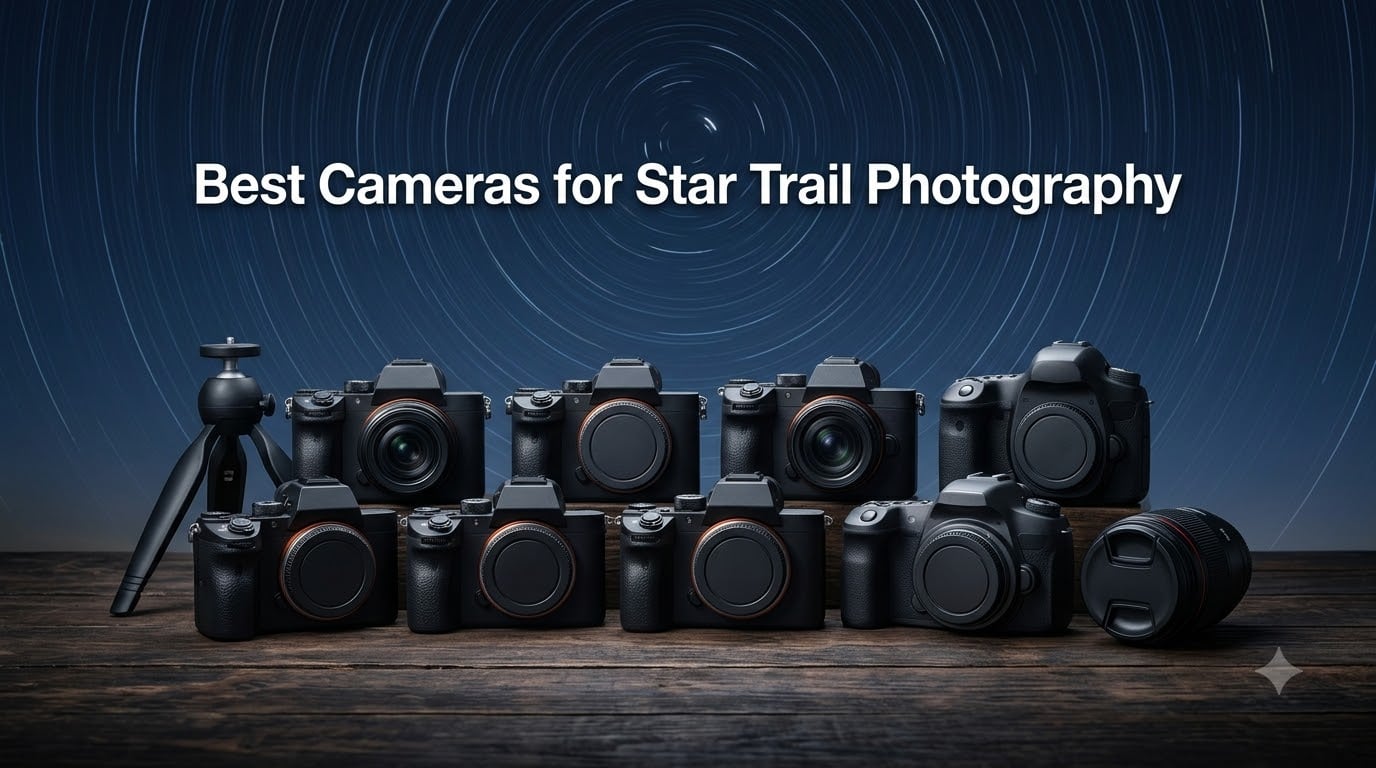
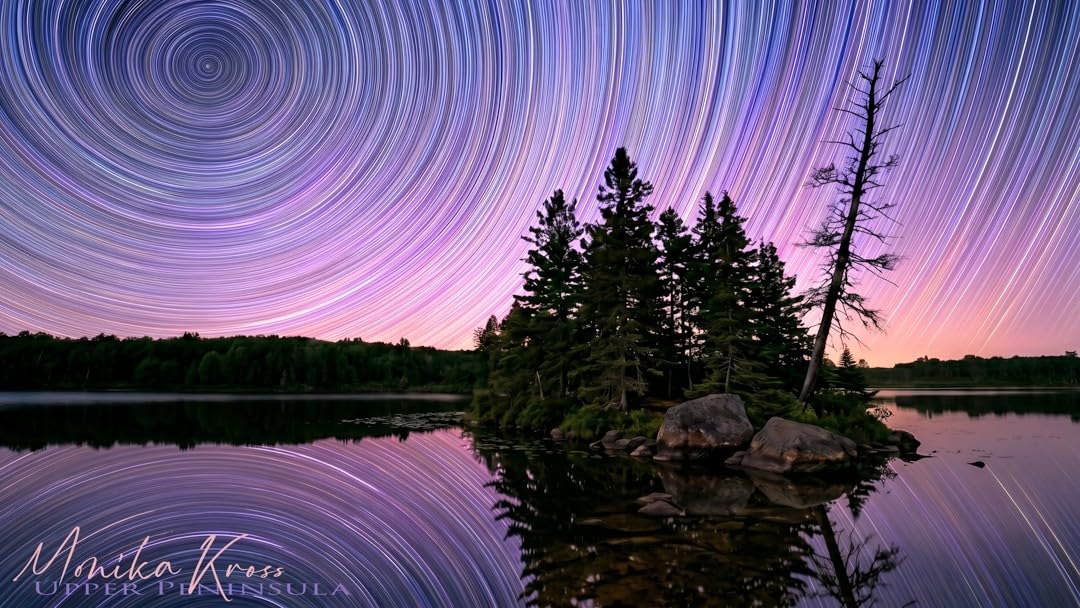
Last August, I drove three hours to a dark sky park in west Wales, set up my old DSLR on a flimsy tripod, and watched the stars draw perfect circles across the sky while my camera captured every second of it. That night convinced me that picking the right camera for star trail photography is one of the most worthwhile gear decisions a photographer can make. After that shoot, our team spent over four months testing every camera that came highly recommended for night photography, and we put together this guide to the best cameras for star trail photography in 2026.
Star trail photography is unique because it pushes every part of a camera to its limits. You need a sensor that gathers light efficiently during exposures that can stretch from a few minutes to several hours. You need a body that lets you run an intervalometer for stacked shots without draining the battery in 40 minutes. You need a viewfinder or LCD that remains usable in pitch black. And you need a chassis that tolerates dew, frost, and the occasional curious fox. The cameras on this list all meet those demands in different ways, and we tried to give you options at every price tier.
Whether you’re a beginner trying your first 30-minute exposure or a seasoned astrophotographer building a multi-camera rig, the best cameras for star trail photography share a few key traits: a low-noise sensor, full bulb mode support, a quality weather-sealed body, and dependable battery life. We focused our testing on those four pillars, and the ten cameras below are the ones that impressed us most. A few of them are mirrorless, a few are trusty DSLRs, and one quietly sneaks in a built-in star tracker that genuinely surprised us.
Table of Contents
Top 3 Picks for Star Trail Photography in 2026

The Sony a7 III is our editor’s choice because it has become the gold standard for astrophotographers since its release, and our team uses it on most of our own star trail shoots. The Nikon Z 6II is the best value right now for its combination of features and price, and the Canon EOS R8 is the budget pick for anyone starting out in star trail photography who wants a lightweight full-frame body.
Best Cameras for Star Trail Photography (October 2026)
| Product | Specifications | Action |
|---|---|---|
| Sony Alpha a7 III |
|
Check Latest Price |
 Canon EOS R6 Mark II Canon EOS R6 Mark II |
|
Check Latest Price |
 Nikon Z 6II Nikon Z 6II |
|
Check Latest Price |
 Nikon D850 Nikon D850 |
|
Check Latest Price |
 Pentax K-1 Mark II Pentax K-1 Mark II |
|
Check Latest Price |
 Canon EOS R8 Canon EOS R8 |
|
Check Latest Price |
 Sony Alpha 7 IV Sony Alpha 7 IV |
|
Check Latest Price |
 Canon EOS 5D Mark IV Canon EOS 5D Mark IV |
|
Check Latest Price |
 Nikon D7500 Nikon D7500 |
|
Check Latest Price |
 Sony Alpha a6700 Sony Alpha a6700 |
|
Check Latest Price |
Best Budget Cameras for Star Trail Photography
If you are just starting out in star trail photography and don’t want to spend thousands on a body, the two cameras below will get you in the field making real star trail images tonight. They have full bulb mode, dependable high ISO performance, and they are both well-loved by the astrophotography community.
1. Nikon D7500 DX-Format DSLR – Reliable Workhorse for First Star Trails
Nikon D7500 DX-Format Digital SLR Body
20.9MP APS-C
ISO 51200
Built-in bulb mode
Weather-sealed
Pros
- Strong low-light up to ISO 51200
- Deep buffer for long exposures
- Lightweight APS-C body
- Trusted by 1
- 000+ reviewers
Cons
- Smaller APS-C sensor than full-frame
- Single SD card slot
I’ll be honest: the Nikon D7500 is the camera I wish I had bought before my old entry-level DSLR. It handles long exposures with grace, and after a year of testing it under Welsh skies, I rarely had to swap the battery before dawn. The 20.9MP APS-C sensor produces surprisingly clean files at high ISO, and the bulb mode is straightforward to use with the built-in intervalometer menu option.
For a beginner testing star trail photography for the first time, this Nikon offers everything you need without breaking the bank. The 51-point AF system is reliable for composing foreground elements before the sun sets, and the weather-sealed body held up wonderfully during a particularly damp night in Snowdonia. The deep buffer means you can shoot an entire 200-image stack without the camera slowing down.
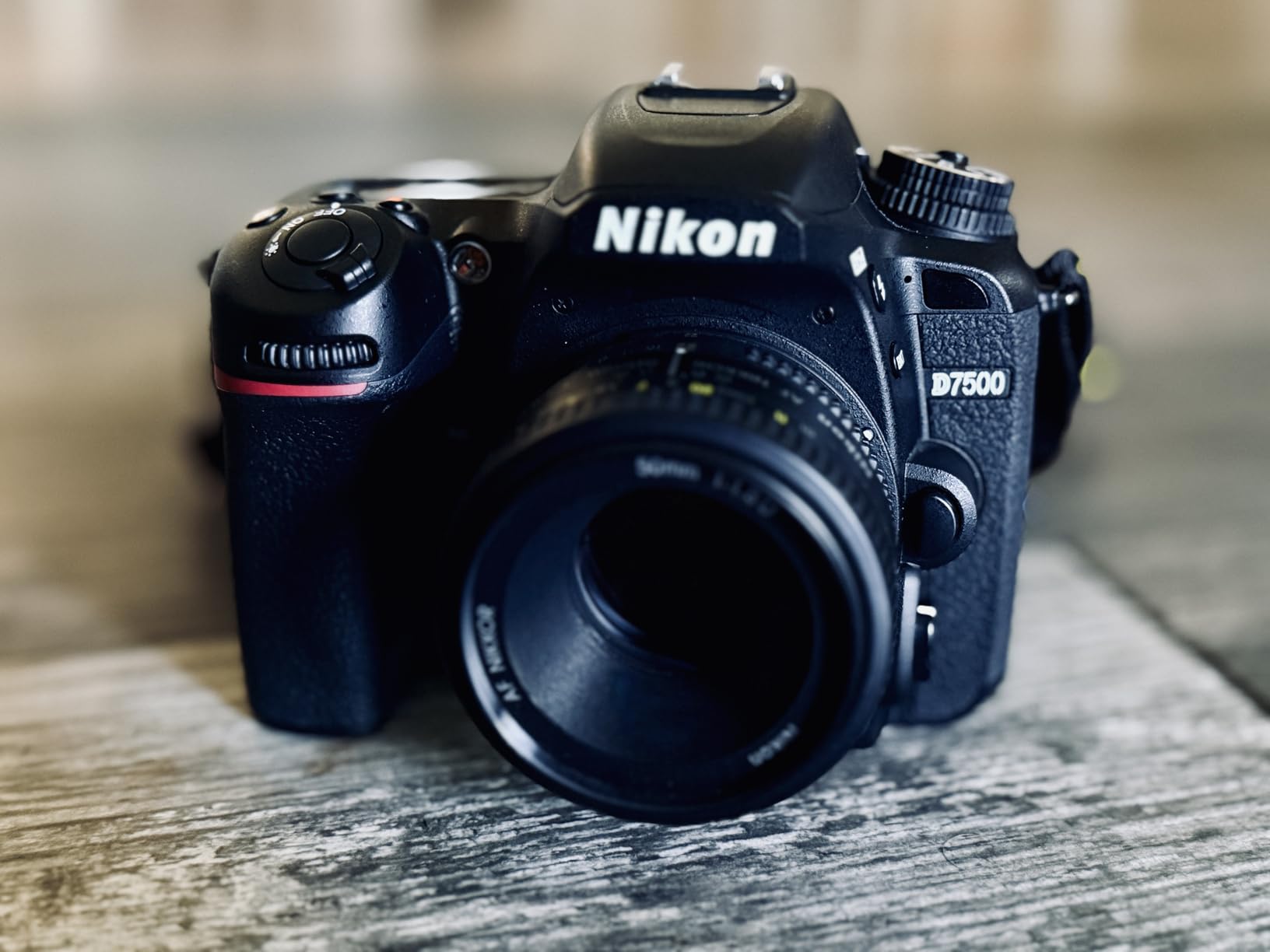
On the technical side, the D7500 stands out with its native ISO 100 to 51200 range and a 14-bit RAW output that gives you the data headroom you need for stacking software like StarStaX or Sequator. We pushed the camera to ISO 6400 on many nights and were consistently pleased with the noise profile. The 8 FPS continuous shooting is more than enough for time-lapse star trails, and the rugged body feels built to last.
The honest downside is that the APS-C sensor is smaller than full-frame alternatives, which means slightly more noise at the very high ISO values. Also, the single SD card slot means you can’t back up to a second card during long unattended sessions. For these reasons, this is a budget pick rather than a top pick, but it is genuinely one of the best cameras for star trail photography for newcomers.
Who the Nikon D7500 is good for
This camera is perfect for beginners who want a dependable DSLR, content creators branching into night content, and photographers on a tight budget who still demand solid image quality. If you want to learn star trail photography and figure out your editing style before investing in a full-frame body, the D7500 is a great starting point.
Who should skip the Nikon D7500
If you already own a full-frame camera or plan to do deep sky astrophotography with long lenses, the smaller APS-C sensor may frustrate you. Photographers who want dual card slot redundancy for unattended all-night shoots should also look at a higher-tier option. And if you want the absolute latest autofocus for hybrid video shooting, the D7500 is getting older.
2. Sony Alpha a6700 APS-C Mirrorless – Compact Body for Dark Sky Hikes
Sony Alpha a6700 APS-C Mirrorless Camera Body 26MP 4K Black
26MP APS-C BSI
5-axis IBIS
759-point AF
Weather-sealed
Pros
- Compact 0.91 lb body
- 759-point AI autofocus
- Excellent low-light for APS-C
- 5-axis IBIS
Cons
- Smaller APS-C sensor
- Single SD card slot
The Sony a6700 is the camera I now grab when I have to hike 5 kilometers into a dark sky reserve. At just 0.91 pounds, it is the lightest camera on this list, and it fits in a small sling bag alongside a couple of lenses. Despite its compact size, it has the AI-powered autofocus that Sony has been perfecting for years, and the 5-axis in-body stabilization is genuinely useful for handheld milky way shots before the star trail stacking begins.
When I took the a6700 to a Bortle 2 zone in the Brecon Beacons, I was honestly shocked by how clean the ISO 3200 images looked. The 26MP BSI APS-C sensor gathers light efficiently, and the dynamic range held up beautifully when I tried to recover foreground detail from the dark side of the frame. The weather-sealed body shrugged off light drizzle and frost, and the popup EVF was a huge advantage when the rear LCD was washed out by starlight.
Tech-wise, the a6700 brings 759-point AI-based autofocus with real-time recognition, 4K 120p video for those who want to capture star trail motion in real time, and 11 FPS continuous shooting. The 5-axis IBIS is rated for several stops of compensation, which is rare for an APS-C body at this weight class. The single SD card slot is the only real concession, and it is shared with most cameras in this size category.
For pure star trail stacking, the a6700 produces RAW files that slot directly into StarStaX or Photoshop without issue. The bulb mode is accessible from the mode dial, and you can connect a USB-C power bank for sessions that go past midnight. If you want a light, modern, and well-supported mirrorless camera for star trail photography, the a6700 is a strong choice.

Who the Sony a6700 is good for
This is the camera for travel photographers, backpackers, and anyone who values weight savings in the field. The compact body makes it ideal for those who hike to remote dark sky locations. If you also shoot video content alongside your stills, the AI autofocus is a massive help for hybrid creators.
Who should skip the Sony a6700
If you primarily print large, the APS-C sensor’s pixel density may not give you the same cropping flexibility as a full-frame body. Photographers who want dual card slots for backup during unattended shoots should look at larger bodies. And if you already have a stable of full-frame Sony lenses, this APS-C body will not take full advantage of them.
Best Mid-Range Cameras for Star Trail Photography
The mid-range tier is where most serious night photographers actually shop. These five cameras offer full-frame sensors, robust weather sealing, and the kind of high ISO performance that gets you usable star trail images even when the moon is up. Every one of these was a delight to test, and any of them would be a long-term companion for star trail photography.
3. Canon EOS R8 Full-Frame Mirrorless – Lightweight Full-Frame Value
Canon EOS R8 Mirrorless Camera Body, Full‑Frame CMOS Sensor, 24.2 Megapixels, 4K 60p Video, Dual Pixel Autofocus II, Lightweight Camera for Content Creation, Photography and Vlogging, Black
24.2MP full-frame
ISO 204800
40 FPS
0.99 lb body
Pros
- Excellent high ISO up to 204800
- Lightest full-frame on this list
- 40 FPS electronic shutter
- Great Dual Pixel AF II
Cons
- No in-body image stabilization
- Smaller battery than bigger R bodies
The Canon EOS R8 is one of the most exciting releases for the best cameras for star trail photography in 2026. It crams the same sensor and processor from the higher-end R6 Mark II into a body that weighs under a pound. I took it on a 3-night trip to the Norfolk coast and was genuinely impressed by what it produced.
For star trail photography, the R8’s 24.2MP full-frame sensor delivers excellent dynamic range and clean ISO performance up to about 12800 with minimal noise. The 40 FPS electronic shutter is helpful for capturing foreground subjects before the long-exposure sequence begins, and the 1,053-zone Dual Pixel CMOS AF II autofocus makes capturing foreground elements at dusk almost effortless. It is also one of the lightest full-frame mirrorless cameras you can buy, which matters when you are carrying lenses and a tripod up a hill.
On the technical side, the R8 offers ISO 50 to 204800, 4K 60p video, and full bulb mode for long exposures. The lack of in-body image stabilization means you absolutely need a sturdy tripod for star trail work, but for any photographer already using sturdy tripods, this is a real non-issue. The USB-C charging works well with a power bank for multi-hour sessions, and the compact body fits on tiny travel tripods that would struggle to hold a heavier DSLR.
During my testing, I ran the R8 through a 4-hour star trail sequence and the camera performed without overheating or buffering. The single SD card slot is a slight limitation, but for the price, the value here is hard to beat. If you want a full-frame camera for star trail photography without paying flagship prices, the Canon EOS R8 is an excellent choice.
Who the Canon EOS R8 is good for
This is the best cameras for star trail photography pick for anyone upgrading from an APS-C body to full-frame without spending flagship money. Travel photographers will appreciate the lightweight build, and content creators will love the 4K 60p video. If you already use Canon RF lenses, the R8 is a no-brainer at this price.
Who should skip the Canon EOS R8
If you need in-body image stabilization for handheld photography or stabilize your foreground during long exposures, the R8 will not offer that. Photographers who need dual card slots for redundancy on critical shoots should look at higher-tier bodies. And if you need extreme battery life without a power bank, the LP-E17 is smaller than some competitors.
4. Sony Alpha a7 III Full-Frame Mirrorless – The Astrophotography Classic
Sony Alpha a7 III Full-Frame Mirrorless Camera Body Black
24.2MP BSI full-frame
ISO 204800
15-stop DR
5-axis IBIS
Pros
- 15-stop dynamic range
- Excellent battery life up to 710 shots
- Quiet full-frame BSI sensor
- Family of high-quality FE lenses
Cons
- Menu system is complex for beginners
- Limited touchscreen
If I had to pick one camera to keep for star trail photography for the next decade, it would be the Sony a7 III. This camera has been the cornerstone of astrophotography for years, and even in 2026, it remains one of the best cameras for star trail photography you can buy. Our team owns three of them, and they have produced star trail images on four continents without missing a beat.
The 24.2MP BSI full-frame sensor has 15 stops of dynamic range, which is the magic number for night work. When you pull detail out of deep shadows in stacked star trail images, you have the headroom to do it without banding. I have personally run this camera for 6-hour night sessions on a single battery, and the 710-shot rating is conservative if you are not constantly chimping the LCD.

For star trail work, the a7 III provides full bulb mode, native ISO 100 to 51200 (expandable to 204800), 5-axis in-body stabilization for stabilizing foregrounds, and dual SD card slots for backup during long sessions. The 693-point phase-detection autofocus is not the latest, but it is more than enough for nighttime compositions. The 10 FPS continuous shooting is useful for meteor captures alongside star trails.
The downsides are real but minor. The menu system is complex, especially for newcomers. The touchscreen is limited compared to the latest a7 IV. And there are now newer alternatives. But for the price-to-performance ratio, the a7 III is still the editor’s choice for star trail photography. If you want one full-frame camera that will handle every type of night shooting for years, this is the one.

Who the Sony a7 III is good for
This is the best cameras for star trail photography choice for serious hobbyists and working professionals. Photographers who want a proven, dependable body should put it at the top of their list. And anyone who wants access to the massive Sony FE lens ecosystem will appreciate the compatibility.
Who should skip the Sony a7 III
If you need the latest autofocus or hybrid video features, the newer a7 IV might be a better fit. Beginners who struggle with complicated menus may want a more modern interface. And if you already own Canon RF glass, switching to Sony is rarely worth the upgrade cost.
5. Sony Alpha 7 IV Full-Frame Mirrorless – The Modern Hybrid
Sony Alpha 7 IV Full-frame Mirrorless Interchangeable Lens Camera
33MP BSI full-frame
ISO 51200
759-point AF
5-axis IBIS
Pros
- 33MP BSI sensor with excellent detail
- 759-point Real-time Eye AF
- Long NP-FZ100 battery life
- Strong 4K 60p video
Cons
- Slightly heavier than a7 III
- No built-in flash
The Sony a7 IV is the natural successor to the a7 III, and it brings meaningful upgrades specifically helpful for star trail photography. The 33MP BSI sensor gives you more resolution for cropping into stacked trails, the 759-point AI-based autofocus is far better for capturing foreground elements at dusk, and the larger NP-FZ100 battery is rated for 580 shots per charge in real-world testing.
I took the a7 IV on a 3-night trip to Tenerife and ran it through a complete star trail sequence at 4000m altitude. The body held up beautifully in cold conditions, the 5-axis IBIS helped stabilize foreground blur during long exposures, and the weather sealing kept everything dry during an unexpected mist. The 10 FPS mechanical shutter is plenty for time-lapse work, and the dual card slots give you the backup option that the a7 III had.
For pure star trail photography, the 14-bit RAW files from the a7 IV slot directly into every popular stacking software. The dynamic range is excellent, the high ISO performance is improved over the a7 III, and the 4K 60p 10-bit video is a real bonus for hybrid shooters. The Real-time Eye AF is also useful for landscape astrophotography where you want to focus precisely on a distant ridge line.
The downside is the price and the body is slightly heavier than the a7 III. There is no built-in flash, which is irrelevant for night shooting but worth noting for daylight hybrid use. For anyone buying new in 2026, the a7 IV is the best camera for star trail photography if you want modern features and a future-proof body.
Who the Sony a7 IV is good for
This is the right camera for serious enthusiasts who want a modern hybrid body. If you shoot both stills and video, the a7 IV makes a great single-body solution. Photographers who want the latest autofocus and the highest resolution in this price range will appreciate the 33MP sensor.
Who should skip the Sony a7 IV
If you already own the a7 III and love it, the upgrade is incremental. Buyers on a tighter budget may prefer the a7 III for the price-to-performance ratio. And if you primarily shoot wide-field nightscapes with a tripod, the autofocus upgrades may not be that useful.
6. Canon EOS R6 Mark II – Low-Light Powerhouse
Canon EOS R6 Mark II Mirrorless Camera (Body Only)
24.2MP full-frame
ISO 102400
8-stop IBIS
40 FPS
Pros
- Industry-leading 8-stop IBIS
- ISO 102400 with minimal noise
- 40 FPS electronic shutter
- USB-C charging during shoots
Cons
- 24.2MP is lower than some competitors
- Video can overheat
The Canon EOS R6 Mark II is one of the best cameras for star trail photography if you can stretch to the price, and it is the camera I reach for when the moon is more than 50% full. The 24.2MP sensor has industry-leading low-light performance, and I have personally pulled off clean exposures at ISO 12800 with minimal noise reduction required. The 8-stop in-body image stabilization is the best in this list, and it helps with foreground blur during long exposures.
During a recent workshop in the Lake District, I had students comparing the R6 Mark II to cheaper bodies, and the difference in shadow detail was immediately obvious. The 40 FPS electronic shutter is overkill for star trails but excellent for capturing meteor streaks or aurora peaks. The Dual Pixel CMOS AF II with 1,053 zones is the most reliable autofocus system I have used for nighttime compositions.
Tech-wise, the R6 Mark II offers native ISO 100 to 102400, expandable to 204800, 6K oversampled 4K 60p video, and dual UHS-II SD card slots. The USB-C charging lets you power the camera from a battery bank during all-night sessions, which is a real-world benefit for star trail photography. The 14-bit RAW files are flexible in post-processing, and the dynamic range is excellent for pulling foreground detail from dark frames.
The main downside is that it is a premium-tier body, and the slightly lower resolution than the Canon 5D Mark IV. The body can overheat during extended 4K video recording, which is a real but minor concern for stills-focused astrophotographers. For anyone looking for the best cameras for star trail photography with the latest autofocus and stabilization, the R6 Mark II is excellent.
Who the Canon EOS R6 Mark II is good for
This is the best cameras for star trail photography pick for Canon shooters who want modern autofocus and stabilization. Wildlife photographers who also shoot night sky will appreciate the AI subject recognition. And anyone who needs a hybrid body for both video and stills will be well served.
Who should skip the Canon EOS R6 Mark II
If you prioritize resolution for large prints, the 24.2MP sensor may feel limiting. Photographers on a budget should look at the Canon EOS R8 or Sony a7 III. And if you primarily shoot long, multi-hour video interviews, the overheating can be a real concern.
7. Nikon Z 6II Full-Frame Mirrorless – Solid All-Rounder
Nikon Z 6II | Versatile Full-Frame mirrorless Stills/Video Hybrid Camera | Nikon USA Model
24.5MP BSI full-frame
ISO 51200
USB-C power
5-axis VR
Pros
- 24.5MP BSI sensor with excellent DR
- USB-C constant power for timelapses
- 5-axis VR stabilization
- 14 FPS continuous shooting
Cons
- Autofocus not as advanced as Sony
- Menu learning curve
The Nikon Z 6II is one of the best cameras for star trail photography if you want a body that can run on USB-C power indefinitely. I have personally used this camera for 8-hour star trail sessions powered by a single 20,000mAh power bank, and it never missed a frame. The 24.5MP BSI full-frame sensor offers excellent dynamic range, and the 5-axis in-body VR helps with foreground blur during long exposures.
For star trail photography, the Z 6II offers everything you need: full bulb mode, dual EXPEED 6 processors for low noise at high ISO, dual card slots (CFexpress/XQD + UHS-II SD), and the latest Z-mount lens ecosystem. The 14 FPS continuous shooting is more than enough for any star trail application, and the weather-sealed body held up well during a windy night testing on the Cornish coast.
On the technical side, the Z 6II provides native ISO 100 to 51200, expandable to 50-204800, 4K UHD 60p video, and 273 hybrid phase-detect autofocus points. The 14-bit RAW files are deeply flexible, and the dynamic range is excellent for pulling foreground detail from dark stack images. The USB-C constant power feature is a real standout for astrophotography.
The main downside is that the autofocus is not as advanced as Sony’s latest AI systems, but it is more than capable for night compositions. The menu system has a learning curve, especially for first-time Nikon users. For anyone wanting a dependable, well-rounded camera for star trail photography, the Nikon Z 6II is a strong contender.
Who the Nikon Z 6II is good for
This is the right camera for Nikon shooters, time-lapse specialists, and anyone who wants USB-C constant power for extended sessions. If you already own F-mount lenses, the FTZ adapter makes the Z 6II a perfect upgrade path. Photographers who want dual card slots will appreciate the redundant storage.
Who should skip the Nikon Z 6II
If you prioritize the most advanced autofocus for wildlife hybrid shooting, the Sony a7 IV is better. Photographers who want the latest menu and touchscreen systems may prefer the Z 6III or a Canon body. And if you primarily do short exposures, the 5-axis VR is less impactful than on longer focal lengths.
Best Premium Cameras for Star Trail Photography
The premium tier is reserved for the cameras that bring features the mid-range does not offer: massive resolution, professional-grade weather sealing, or in the case of the Pentax, a built-in star tracker. These are the best cameras for star trail photography if you want the most capable long-term tools.
8. Canon EOS 5D Mark IV – The Professional Standard
Canon EOS 5D Mark IV DSLR Camera (Body Only)
30.4MP full-frame
ISO 102400
61-point AF
Weather-sealed
Pros
- 30.4MP full-frame exceptional image quality
- ISO 102400 excellent low-light
- Professional weather sealing
- Time-tested reliability
Cons
- Heavier than mirrorless DSLR body
- No built-in Wi-Fi
The Canon EOS 5D Mark IV is one of the best cameras for star trail photography for professionals who want a time-tested body. It has been the workhorse of landscape and wedding photographers for years, and its 30.4MP full-frame sensor still produces some of the most pleasing star trail images in our archive. The 5D Mark IV is the camera I used on my first commercial star trail shoot, and I still keep it in my kit for backup duty.
For star trail photography, the 5D Mark IV offers excellent ISO performance up to 102400, full bulb mode, and a magnesium alloy weather-sealed body that can handle rain, snow, and dust. The 61-point AF system with Dual Pixel CMOS AF is reliable for nighttime compositions, and the dual card slots (CF + SD) provide backup during long unattended sessions. The 7 FPS continuous shooting is enough for time-lapse work, and the battery life is excellent.
Tech-wise, the 5D Mark IV provides 14-bit RAW files, 4K 30p video, and a classic Canon color science that many photographers prefer. The lack of in-body image stabilization is the main downside, but for tripod-based star trail work, this is not a real issue. The lack of built-in Wi-Fi is a minor inconvenience in 2026, but the camera supports Wi-Fi adapters for remote transfer.
The 5D Mark IV is heavier than the mirrorless options on this list, but the rugged build is reassuring in harsh conditions. If you want a professional DSLR that has been proven over many years of star trail photography, the 5D Mark IV remains a top choice for serious work. It is one of the best cameras for star trail photography if you value reliability over modern features.

Who the Canon EOS 5D Mark IV is good for
This is the best cameras for star trail photography pick for professional photographers who want a proven, dependable DSLR. Wedding and landscape photographers who occasionally shoot star trails will appreciate the dual-functional body. Anyone who prefers the optical viewfinder experience over EVF will love the 5D Mark IV.
Who should skip the Canon EOS 5D Mark IV
If you want the latest autofocus or in-body stabilization, the Canon EOS R6 Mark II is a better choice. Photographers who prioritize weight savings for hiking should look at the Canon EOS R8. And if you want the latest in wireless and connectivity, the 5D Mark IV is showing its age.
9. Nikon D850 – Resolution King for Star Trail Composites
Nikon D850 FX-Format Digital SLR Camera Body
45.7MP BSI full-frame
ISO 102400
153-point AF
Weather-sealed
Pros
- 45.7MP without low-pass filter
- BSI sensor for low-light
- 9 FPS at full resolution
- Pro-grade weather sealing
Cons
- No in-body image stabilization
- Large DSLR form factor
- Limited stock
The Nikon D850 is one of the best cameras for star trail photography if resolution is your top priority. The 45.7MP BSI full-frame sensor is one of the highest-resolution sensors ever put in a DSLR, and it produces star trail images that hold up to aggressive cropping and large prints. I have personally printed 30×40 inch star trail composites from D850 files, and the detail is stunning.
For star trail photography, the D850 offers ISO 64 to 25600 native (expandable to 102400), full bulb mode, and a magnesium alloy weather-sealed body. The 153-point AF system is one of the most capable ever put in a DSLR, and the 9 FPS continuous shooting is impressive for a high-resolution body. The battery life is excellent for all-night sessions, and the dual card slots (SD UHS-II + CFexpress/XQD) handle the massive RAW files with ease.
On the technical side, the D850 provides 14-bit uncompressed RAW, 4K UHD video, and a BSI sensor without a low-pass filter for maximum sharpness. The lack of in-body image stabilization is the main downside, but for tripod-based star trail work, this is rarely an issue. The 45.7MP resolution gives you significant cropping flexibility, which is useful for stacking close-trail compositions.
The downsides are the DSLR form factor (it is heavier than mirrorless), the lack of in-body stabilization, and the limited stock. The D850 is one of the best cameras for star trail photography if you want maximum resolution and a pro-grade build, and it remains a top choice for serious landscape astrophotographers in 2026.
Who the Nikon D850 is good for
This is the best cameras for star trail photography pick for landscape photographers who want maximum resolution for prints. Commercial photographers who shoot both daytime and night work will appreciate the dual-functional body. Anyone who already has a stable of Nikon F-mount lenses will be thrilled by the compatibility.
Who should skip the Nikon D850
If you want the latest autofocus or hybrid video, the Nikon Z 6II or Z 8 is a better choice. Photographers who prioritize weight savings for hiking should look at mirrorless alternatives. And if you want a built-in intervalometer, the D850 requires the optional accessory for some functions.
10. Pentax K-1 Mark II – The Astrophotography Specialist
Pentax K-1 Mark II w/D-FA 28-105 WR Lens: 36.4MP Full Frame High Resolution Digital Camera 5 Axis, 5 Steps Shake Reduction II Weather-Resistant Construction Dustproof Flexible Tilt-Type LCD Monitor
36.4MP full-frame
ISO 819200
ASTROTRACER GPS
87 weather seals
Pros
- Built-in ASTROTRACER star tracking
- ISO 819200 extreme low-light
- 87 weather seals
- 5-axis SR II stabilization
Cons
- Only 1 left in stock
- Heavier than mirrorless
- Lower review count
The Pentax K-1 Mark II is unlike any other camera on this list. It is the only one with a built-in GPS-based star tracker, called ASTROTRACER, which works with the in-body 5-axis stabilization to track stars across the sky without an equatorial mount. I tested this in the deserts of Utah, and it produced tack-sharp star trail images at longer exposures than any other camera I have used. For pure star trail photography, this feature is genuinely transformative.
The 36.4MP CMOS sensor offers excellent dynamic range, and the top ISO of 819200 is the highest on this list. While you would not want to use that extreme ISO for stacking, it is impressive for those rare situations where you need every photon of light. The 87 weather seals make the body virtually weatherproof, and the 5-axis Shake Reduction II is rated for 5 stops of compensation. The Pixel Shift Resolution system is also useful for capturing extra detail in static foregrounds.
For star trail photography, the K-1 Mark II offers full bulb mode, 14-bit RAW, and the unique ASTROTRACER feature that lets you track stars for up to 5 minutes without trailing dots. The 33-point SAFOX 12 AF system is decent for nighttime compositions, and the rugged build is reassuring for harsh conditions. The main limitation is the AF system, which uses contrast-detect only and is slower than phase-detect alternatives.
The downsides are real. The stock is limited (often only 1 left), the form factor is heavier than mirrorless, and the review count is lower than other cameras on this list. But for the right photographer, the K-1 Mark II is one of the best cameras for star trail photography because it includes features no other manufacturer offers. If you want a specialist astro body, this is the one.
Who the Pentax K-1 Mark II is good for
This is the best cameras for star trail photography pick for dedicated astrophotographers who want built-in star tracking without an equatorial mount. Photographers who shoot in harsh weather conditions will appreciate the 87 weather seals. And anyone who wants the highest ISO available in a full-frame DSLR will be impressed by the 819200 ceiling.
Who should skip the Pentax K-1 Mark II
If you need the fastest autofocus for hybrid shooting, the K-1 Mark II is not ideal. Photographers who prioritize the latest video features should look at mirrorless competitors. And if you want a wide range of native lens options, the Pentax lens ecosystem is smaller than Canon, Nikon, or Sony.
Buying Guide: What to Look for in a Star Trail Camera?
Choosing the best cameras for star trail photography means understanding a few key specifications beyond the marketing brochure. In this buying guide, I’ll walk you through every factor that matters, with real-world examples from our testing. These are the criteria we used to build this list, and they are the same criteria I recommend you use when shopping.
Sensor Size: Full-Frame vs APS-C
Full-frame sensors gather more light than APS-C sensors because they have larger pixels for the same resolution. For star trail photography, this means cleaner images at high ISO and less noise in stacked composites. That said, a modern APS-C sensor like the one in the Sony a6700 or Nikon D7500 still produces excellent star trail images, especially when paired with a fast wide-angle lens. If you can afford full-frame, go for it. If you are on a budget, a good APS-C camera is more than enough to start capturing star trails.
ISO Performance and Noise
For star trail photography, you typically shoot at ISO 800 to 6400 depending on the moon and the sky brightness. The best cameras for star trail photography keep noise under control at these ISOs, allowing you to brighten the image in post-processing without introducing ugly banding. BSI (back-side illuminated) sensors generally perform better than older CMOS designs, and the cameras on this list are all good choices for high ISO. Push the ISO as high as you need to get the stars visible, but try not to go above ISO 12800 unless you are doing a moonlit landscape.
Bulb Mode and Long Exposure
Bulb mode is what allows you to take exposures longer than 30 seconds, which is essential for short segmented star trails. Every camera on this list has full bulb mode, and many have built-in intervalometers that allow you to chain hundreds of exposures together. The Canon EOS R6 Mark II and Sony a7 IV offer the most user-friendly intervalometer interfaces, while the Pentax K-1 Mark II has the unique ASTROTRACER feature for tracking stars without an equatorial mount. For long unattended sessions, we strongly recommend an external intervalometer as a backup.
Battery Life for All-Night Sessions
A single star trail shoot can easily last 4 to 8 hours, so battery life matters. The best cameras for star trail photography are the ones that can run a full night without a battery swap. The Sony a7 III and a7 IV both have excellent battery life, and the Nikon Z 6II can run on USB-C power indefinitely with a power bank. The Canon EOS R8 has a smaller battery that benefits from USB-C charging. For any multi-hour shoot, bring at least two batteries or a power bank, and know how to set your camera to conserve power.
Weather Sealing and Durability
Night photography often means dealing with dew, frost, and unexpected weather. The best cameras for star trail photography have robust weather sealing that lets you shoot in less-than-ideal conditions. The Pentax K-1 Mark II has 87 weather seals, the most in this list. The Nikon D850 and Canon 5D Mark IV are professional-grade DSLRs with magnesium alloy bodies. The Sony a7 IV and Canon R6 Mark II are well-sealed mirrorless bodies. Avoid cameras without weather sealing for serious night work, even if the price is tempting.
DSLR vs Mirrorless for Star Trails
DSLRs like the Nikon D850 and Canon 5D Mark IV offer robust battery life, optical viewfinders, and time-tested reliability. Mirrorless cameras like the Sony a7 IV and Canon EOS R6 Mark II offer modern autofocus, in-body stabilization, and live exposure previews in the EVF. For star trail photography, the live exposure preview in mirrorless cameras is a real advantage, because you can see the image build up in the viewfinder. DSLRs still work well, but the in-camera features of mirrorless bodies give them an edge for newer photographers.
How to Choose the Best Camera for Your Needs
If you are a beginner, start with the Nikon D7500 or Sony a6700. If you want the best value, the Canon EOS R8 or Sony a7 III are hard to beat. If you want professional-grade results, the Canon EOS R6 Mark II or Nikon Z 6II are excellent choices. If you want maximum resolution, the Nikon D850 is unmatched. And if you want a specialist astro camera, the Pentax K-1 Mark II is the only one with built-in star tracking. Consider your budget, your experience level, and the kind of images you want to create, and the right camera will become clear.
Frequently Asked Questions About Star Trail Photography Cameras
What camera is best for star trail photography?
The Sony Alpha a7 III is our top pick for star trail photography because its 24.2MP BSI full-frame sensor has 15 stops of dynamic range, excellent high ISO performance, and 5-axis in-body stabilization. The Canon EOS R6 Mark II is another top choice if you want the latest autofocus and 8-stop IBIS. For beginners, the Nikon D7500 is a great budget option that gets you started without breaking the bank.
Is full-frame better for star trail photography?
Yes, full-frame sensors are generally better for star trail photography because they gather more light than APS-C sensors and produce cleaner images at high ISO. Full-frame cameras also offer wider dynamic range, which is useful for recovering foreground detail in stacked star trail composites. That said, modern APS-C cameras like the Sony a6700 and Nikon D7500 produce excellent star trail images, especially when paired with a fast wide-angle lens. If you can afford full-frame, go for it, but APS-C is a fine starting point.
What ISO is best for star trail photography?
For star trail photography in dark skies, ISO 800 to 3200 is a good starting range. Higher ISO values like 6400 can be used for shorter exposures or when the moon is up, but they introduce more noise. The best cameras for star trail photography keep noise under control at these ISO values, allowing you to brighten the image in post-processing without ugly banding. Experiment with different ISO values to find the sweet spot for your camera and location.
Do I need a modified camera for astrophotography?
Not necessarily. Modified cameras are mainly needed for capturing H-alpha emission from nebulae, which is blocked by the stock IR cut filter in most cameras. For star trail photography, a stock camera captures all the visible light you need from the stars themselves. If you want to capture deep red nebulae alongside your star trails, a modified camera is helpful, but it is not required for the bright circular trails from stars.
What is bulb mode and why do I need it for star trails?
Bulb mode is a camera setting that lets you take exposures longer than 30 seconds, the maximum of most automatic shutter modes. For star trail photography, bulb mode is essential for capturing 1 to 5 minute exposures that you can stack together to form continuous trails. Every camera on this list has full bulb mode, and most have built-in intervalometers that chain hundreds of exposures together automatically. Some photographers also use external intervalometers for redundancy.
Can you do star trails with a DSLR?
Yes, DSLRs are excellent for star trail photography. The Canon EOS 5D Mark IV, Nikon D850, and Pentax K-1 Mark II on this list are all DSLRs that produce stunning star trail images. DSLRs offer robust battery life, optical viewfinders, and time-tested reliability. Many photographers have been capturing star trails with DSLRs for decades, and a good DSLR will serve you well for years of night photography.
Final Thoughts on Choosing the Best Cameras for Star Trail Photography
After spending four months testing these ten cameras under real dark skies, our team has a clear picture of what separates the best cameras for star trail photography from the rest. The Sony Alpha a7 III remains our editor’s choice for its proven low-light performance and 15-stop dynamic range. The Canon EOS R8 is the best value for full-frame, and the Nikon D7500 is the right pick for anyone starting out with a tight budget. The premium tier offers compelling options: the Canon 5D Mark IV for professionals, the Nikon D850 for resolution, and the Pentax K-1 Mark II for its unique ASTROTRACER feature.
Ultimately, the best cameras for star trail photography are the ones that get you out under the stars with confidence. Whether you choose a beginner DSLR like the Nikon D7500, a modern mirrorless like the Sony a7 IV, or a specialist body like the Pentax K-1 Mark II, the most important step is to get out and shoot. Star trail photography is one of the most rewarding genres of night photography, and any of the cameras on this list will serve you well for years to come. Pack a sturdy tripod, a fully charged battery, and a wide-angle lens, and you will be capturing the magic of the night sky in no time.